Showing posts with label Tobit. Show all posts

12 October 2022

Praying in Ordinary Time with USPG:
Wednesday 12 October 2022

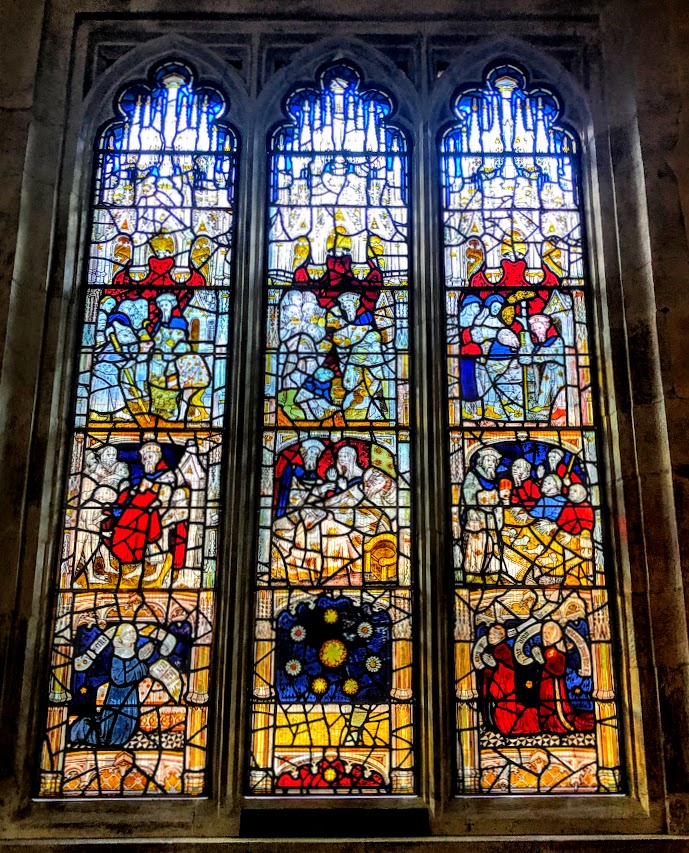
The ‘Corporal Works of Mercy’ window (ca 1410) in All Saints’ Church, North Street, York (Photograph: Patrick Comerford, 2022; click on images for full-screen viewing)

Patrick Comerford

The Calendar of the Church of England in Common Worship today (12 October 2022) remembers Wilfrid of Ripon (709), Bishop, Missionary, with a Lesser Festival, and Elizabeth Fry (1845), Prison Reformer, and Edith Cavell (1915), Nurse, with commemorations.

I have a meetings later today in Kidlington, near Oxford, and Shenley Church End, Milton Keynes. But, before today gets busy, I am taking some time this morning for reading, prayer and reflection.

During the last two weeks, I was reflecting each morning on a church, chapel, or place of worship in York, where I stayed last month. This week I am reflecting on the windows in one of those churches: All Saints’ Church, North Street, York.

In my prayer diary this week I am reflecting in these ways:

1, One of the readings for the morning;

2, A reflection on the windows in All Saints’ Church, North Street, York;

3, a prayer from the USPG prayer diary, ‘Pray with the World Church.’

Feeding the hungry: ‘I was hungry and you gave me food’; Giving drink to the thirsty: ‘I was thirsty and you gave me something to drink’ (Photographs: Patrick Comerford, 2022; click on images for full-screen viewing)

It is interesting to note that Elizabeth Fry and Edith Cavell, who are commemorated today, both relate to the themes in the ‘Corporal Works of Mercy’ window in York, which I am reflecting on this morning.

Elizabeth Fry (1780-1845) was born Elizabeth Gurney in Earlham, Norfolk. At the age of 20, she married Joseph Fry, a London merchant and a strict Quaker. She was admitted as a minister in the Society of Friends and became a noted preacher. The appalling state of the prisons came to her notice and she devoted much of her time to the welfare of female prisoners in Newgate. In 1820, she took part in the formation of a night shelter for the homeless in London. She travelled all over Europe in the cause of prison reform. She had a strong Christian and evangelistic impulse and this inspired all her work. She died on this day in 1845.

Edith Cavell (1865-1915) was born into a clerical family at Swardeston. After life as a governess, she trained as a nurse, ending up working with the Red Cross in Belgium in 1907. On the outbreak of World War I, she became involved in caring for the wounded on both sides. She refused repatriation and then began smuggling British soldiers from Belgium into Holland. She was arrested in 1915 and was put on trial. Protecting those who worked with her, she was sentenced to death and executed by firing squad on this day in the year 1915. She went to her death calmly, forgiving her executioners, convinced she had been doing her duty as a Christian.

Luke 11: 42-46 (NRSVA):

[Jesus said:] 42 ‘But woe to you Pharisees! For you tithe mint and rue and herbs of all kinds, and neglect justice and the love of God; it is these you ought to have practised, without neglecting the others. 43 Woe to you Pharisees! For you love to have the seat of honour in the synagogues and to be greeted with respect in the market-places. 44 Woe to you! For you are like unmarked graves, and people walk over them without realizing it.’

45 One of the lawyers answered him, ‘Teacher, when you say these things, you insult us too.’ 46 And he said, ‘Woe also to you lawyers! For you load people with burdens hard to bear, and you yourselves do not lift a finger to ease them.’

Offering hospitality to strangers: ‘I was a stranger and you welcomed me’; and Clothing the Naked: ‘I was naked and you gave me clothing’ (Photographs: Patrick Comerford, 2022; click on images for full-screen viewing)

‘The Corporal Works of Mercy’ window, All Saints Church, York:

All Saints’ Church, North Street, York, which I described in this prayer diary recently (28 September 2022), is said to be ‘York’s finest mediaeval church.’ It dates from the 11th century and stands near the River Ouse.

The church has an important collection of mediaeval stained glass, including ‘The Pricke of Conscience’ window, depicting the 15 signs of the End of the World; the window depicting the Corporal Works of Mercy (see Matthew 25: 31ff); the Great East Window, originally in the north wall; the Lady Chapel Window, which I am looking at tomorrow (13 October 2022); the Saint James the Great Window; the Saint Thomas Window; and the Coats-of-Arms window.

All Saints’ Church, on North Street, York, is known particularly for two early 15th century windows: the window depicting ‘The Pricke Of Conscience’ or ‘The Fifteen Signs of Doom’ window, which I was looking at earlier this week (Sunday, Monday and Tuesday); and the window depicting the ‘Corporal Works of Mercy’ (see Matthew 25: 35-46), which I am looking at this morning.

The ‘Corporal Acts of Mercy’ window may have been a memorial to Nicholas Blackburn senior, who was a merchant and mayor of York, erected by his son, Nicholas Blackburn, around 1410. Nicholas Blackburn was a merchant trader and the head of his family. His son and grandson also appear in the Great East Window in the church.

The ‘Corporal Acts of Mercy’ window is the western window in the Lady Chapel of the north choir aisle, the choir of the Blessed Virgin Mary. The glass was originally in the two-light window beside the north door. The glass around the main panels dates from the 1800s.

When looking at mediaeval windows, it is worth bearing in mind where they are seen. The nave belonged to the laity and its upkeep was paid for by them. Stained glass windows were often paid for by a wealthy individual or family, a guild or a group of parishioners, and the patron had a significant say in the subject matter of the scenes depicted.

At the time, wealthy parishioners were challenged morally by the Church to examine their consciences in regard to acts of charity. This window shows the way, and the chantry priest can help move the individual’s soul through Purgatory.

The window depicts six of the seven Corporal Acts of Mercy. The man who conducts the acts of mercy is older and bearded and possibly the dead man, Nicholas Blackburn senior.

In the top register amongst the pinnacles a pair angels peer down to witness the acts.

The corporal acts of mercy are then arranged in three panels in the two middle sections:

Row 1: Feeding the hungry: ‘I was hungry and you gave me food’ (Matthew 25: 35). Giving drink to the thirsty: ‘I was thirsty and you gave me something to drink’ (Matthew 25: 35). Offering hospitality to strangers: ‘I was a stranger and you welcomed me’ (Matthew 25: 35).

Row 2: clothing the naked: ‘I was naked and you gave me clothing’ (Matthew 25: 36). Visiting the sick: ‘I was sick and you took care of me’ (Matthew 25: 36). Visiting prisoners: ‘I was in prison and you visited me’ (Matthew 25: 36).

In each panel, the bearded man may represent Nicholas Blackburn performing these acts of mercy.

The one traditional act of mercy omitted is that of burying the dead. However, this seventh traditional act of mercy is not listed in Matthew 25; 35-36. Although part of the traditional mediaeval lists, it is not found in the list in Saint Matthew’s Gospel. Instead, it is found in asimilar list in Tobit 1: 16-22. Perhaps this explains its absence in the window in York; or, perhaps, this is because this is a memorial window and therefore it is implied throughout the window that the task has been done. The window itself, donated by his family, might be seen as a complete working out of the seventh act, the burial – or at least the commemoration – of the dead.

On the bottom register of the window to the right there appears to be a chantry priest singing and praying for the soul of the departed. He is mirrored on the right by a praying couple. The clean shaven man may be Nicholas Blackburn and the woman his wife. In between is a representation of the heavenly realms.

Visiting the sick: ‘I was sick and you took care of me’; Visiting prisoners: ‘I was in prison and you visited me’ (Photograph: Patrick Comerford, 2022; click on images for full-screen viewing)

Today’s Prayer (Wednesday 12 October 2022):

The Collect:

Almighty God,
who called our forebears to the light of the gospel
by the preaching of your servant Wilfrid:
help us, who keep his life and labour in remembrance,
to glorify your name by following the example
of his zeal and perseverance;
through Jesus Christ your Son our Lord,
who is alive and reigns with you,
in the unity of the Holy Spirit,
one God, now and for ever.

The Post Communion Prayer:

Holy Father,
who gathered us here around the table of your Son
to share this meal with the whole household of God:
in that new world where you reveal
the fullness of your peace,
gather people of every race and language
to share with Wilfrid and all your saints
in the eternal banquet of Jesus Christ our Lord.

The theme in the USPG Prayer Diary this week is ‘Day of the Girl Child.’ This theme is introduced this morning by the Revd Benjamin Inbaraj, Director of the CSI-SEVA department, which runs the Church of South India’s social ministries.

The USPG Prayer Diary invites us to pray today in these words:

Let us pray for the Church of South India’s Focus 9/99 programme, as it promotes and protects the rights of children across South India.

Yesterday’s reflection

Continued tomorrow

A chantry priest singing and praying for the soul of the departed; a representation of the heavenly realms; and a praying couple, perhaps Nicholas Blackburn and his wife (Photographs: Patrick Comerford, 2022; click on images for full-screen viewing)

Scripture quotations are from the New Revised Standard Version Bible: Anglicised Edition copyright © 1989, 1995, National Council of the Churches of Christ in the United States of America. Used by permission. All rights reserved worldwide. http://nrsvbibles.org

Further reading:

‘Church of All Saints with Anchorage Attached, Historic England List Entry 1257067, <https://historicengland.org.uk/listing/the-list/list-entry/1257067> [accessed 7 October 2022]
‘The Stained Glass of All Saints’, All Saint Church, <https://www.allsaints-northstreet.org.uk/stainedglass.html> [accessed 7 October 2022]
Dr Laura Varnam, ‘The Seven Works of Mercy: Part I’ (29 February 2016) <https://drlauravarnam.wordpress.com/2016/02/29/the-seven-works-of-mercy/> (accessed 7 October 2022)

The Edith Cavell Memorial in Saint Martin’s Place, London (Photograph: Patrick Comerford)

09 March 2013

Preaching from an Apocryphal book on Saint Patrick’s Day

Tobias and the Archangel Raphael, after Adam Elsheimer (mid-17th century, The National Gallery, London)

Patrick Comerford

The Revised Common Lectionary provides for the possibility of three Old Testament readings on Sunday week, 17 March:

● Isaiah 43: 16-21 (for the Fifth Sunday in Lent);
● Tobit 13: 1b-7 (for Saint Patrick’s Day);
● Deuteronomy 32: 1-9 (for those who do not want to use a Deuterocanonical reading on Saint Patrick’s Day).

I thought I should prepare some notes on Tobit for this morning’s Bible study, as for some of you this may be one of your few chances to consider how you might use an “Apocryphal” reading in preparation for a sermon.

Tobit 13: 1b-7

‘Blessed be God who lives for ever,
because his kingdom lasts throughout all ages.
For he afflicts, and he shows mercy;
he leads down to Hades in the lowest regions of the earth,
and he brings up from the great abyss,
and there is nothing that can escape his hand.
Acknowledge him before the nations, O children of Israel;
for he has scattered you among them.
He has shown you his greatness even there.
Exalt him in the presence of every living being,
because he is our Lord and he is our God;
he is our Father and he is God for ever.
He will afflict you for your iniquities,
but he will again show mercy on all of you.
He will gather you from all the nations
among whom you have been scattered.
If you turn to him with all your heart and with all your soul,
to do what is true before him,
then he will turn to you
and will no longer hide his face from you.
So now see what he has done for you;
acknowledge him at the top of your voice.
Bless the Lord of righteousness,
and exalt the King of the ages.
In the land of my exile I acknowledge him,
and show his power and majesty to a nation of sinners:
“Turn back, you sinners, and do what is right before him;
perhaps he may look with favour upon you and show you mercy.”
As for me, I exalt my God,
and my soul rejoices in the King of heaven.

Introduction:

The version of the Book of Tobit in the New Revised Standard Version Bible, unlike most other translations of the Book of Tobit in the English language, is based upon a longer version of the text in Greek found in the Codex Sinaiticus and supplemented from the Old Latin. The shorter version of the text in Greek has been the traditional Greek text used for translating the book throughout the history of the Church. However, the longer text is now almost universally judged to be the more original of the two texts.

There is a third text in some English translations based on the text of the Latin Vulgate.

The book was originally written in Hebrew or Aramaic, probably between the years 225 and 175 BC. The oldest text fragments of the Book of Tobit are in Hebrew and were recovered in the 20th century in the Dead Sea Scroll caves (Cave IV) at Qumran and in excavations at Masada.

The Book of Tobit introduces a new genre of literature to the Bible – the novel, and he uses a variety of literary techniques, including monologue and dialogue, prayers and hymns, demonology and angelology, wisdom sayings and deathbed testimonies. The writer may have used true events for the background of the drama in the book, but in the first chapter, the writer indicates his intention to communicate truth through the medium of novel.

The writer introduces a number of comical historical anachronisms that would have been immediately apparent to Jewish readers at the time. The book’s primary emphasis is on the everyday practical, moral and wisdom-tradition aspects of being good and doing good.

Perhaps the author is suggesting that although this book should not be considered among the corpus of sacred histories, nevertheless it contains timeless morality and spiritual lesson that show the sovereign care exercised by God on behalf of those who fear him.

Despite the fictional historical settings for the events, we can see evidence of the prophetic within the book. In Chapter 13, Tobit prophesies the future blessings for the righteous in the New Jerusalem. In language that seems to anticipate information God would later reveal in the New Testament to Saint John in the Book of Revelation, Tobit speaks of the glories of the New Jerusalem, whose gates “will be built with sapphire and emerald” (13: 16), and whose streets and buildings will be encrusted with precious stones and gold.

Summarising the story:

An icon telling the story of Tobit, Tobias and Raphael

The Book of Tobit tells the story of Tobit, a faithful Jew from the tribe of Naphtali whose family are exiled from Samaria into Upper Galilee and who continues to worship in Jerusalem until he is forced into exile in Nineveh in Assyria.

Tobit is struck blind and falls into poverty and is blinded by cataracts as a direct result of the pious deed of burying fellow Jews who have been murdered on the last day of Pentecost. He sends his son Tobias into a far land to find a wife and to obtain an inheritance.

While doing this, Tobias delivers the woman Sarah from Asmodeus, the demon who had claimed the lives of her seven previous husbands on their wedding night. He secures this with the help of the angel Raphael disguised as Azariah and by the sacrifice of a fish. Of course, the fish would later become the earliest of all Christian symbols for Christ, and the wedding banquet is a Gospel image of the Kingdom of God.

When the wedding celebrations are over, Tobias and Sarah return to Tobit’s house. On his deathbed, Tobit has Tobias promise to move the family from Nineveh to Ecbatana in Media, where Tobias lived to a rich old age.

Some scholars believe that the closing chapters (13 and 14) were added at a later stage. These chapters include Tobit’s hymn of praise (13: 1-17), from which this reading is excerpted.

This hymn of praise, which echoes many New Testament passages, including Isaiah 40-55, is divided into two parts:

● The first part (verses 1–8) is a song of praise that echoes themes from the Psalms, I Samuel and Isaiah.
● The second part (verses 9–18) is addressed to Jerusalem in the style of those prophets who spoke of a new and ideal Jerusalem (see Isaiah 60; cf. Revelation 21).

Joyful praise and words for joy and gladness occur throughout this hymn of praise (see verses 1, 7, 10, 11, 13, 14, 16, 18).

Preaching from the reading:

The Book of Tobit is replete with the commandments and wisdom of God as well as parallels with the story of Christ – the only Son who is sent by the Father to redeem a Bride from death. This story has inspired an oratorio by Handel, and many great works of art – by Rembrandt, Jan Steen, Abraham De Pape, Jan Massys, Barent Fabritius, Bernardo Strozzi, Pieter Lastman, Gerrit Dou … and so on.

There is even a stained glass window depicting Tobias and the Fish in Whitechurch Church of Ireland parish church in Rathfarnham, given by Don Tidey in thanksgiving for being freed from his kidnapping.

But how would you relate this story to Saint Patrick on Sunday week, 17 March? Perhaps a new Pope will be elected by then, and you may want to say something about that instead of working your way through the choice of readings. But if you are preaching on Sunday week, these are some of the themes that might emerge:

● The stories about Tobias and Patrick are about slavery and liberation from darkness
● They are stories about exile and being protected by God
● They are stories about deliverance from evil, represented in banishing the snakes or killing the fish
● They are about faithfulness in the midst of idolatry
● They are about bringing God’s message to other nations
● They are stories that teach the value of prayer, fasting, and almsgiving

What else can you find in this reading?

Canon Patrick Comerford is Lecturer in Anglicanism and Liturgy, the Church of Ireland Theological Institute, and an Adjunct Assistant Professor, Trinity College Dublin. These notes were prepared for a Bible study in a tutorial group with part-time students on the MTh course on 9 March 2013