Showing posts with label Jeremy Taylor. Show all posts

13 August 2026

Daily prayer in Ordinary Time 2026:
98, Thursday 13 August 2026

‘You wicked slave! I forgave you all that debt because you pleaded with me. Should you not have had mercy on your fellow-slave, as I had mercy on you?’ (Matthew 18: 32-33) … a stained-glass window in Saint Michael’s Church, Limerick (Photograph: Patrick Comerford)

Patrick Comerford

We are in Ordinary Time in the Church Calendar and this week began with the Eighth Sunday after Trinity (Trinity VIII). The calendar of the Church of England in Common Worship today remembers Jeremy Taylor (1613-1667), Bishop of Down and Connor, teacher of the faith; Florence Nightingale (1820-1910), nurse and social reformer; and Octavia Hill (1838-1912), social reformer.

I may stay up late tonight, or early into the morning, to watch the by-election results coming in from Clacton. But, before today begins, I am taking some quiet time this morning to give thanks, for reflection, prayer and for reading in these ways:

1, today’s Gospel reading;

2, a reflection on the Gospel reading;

3, a prayer from the USPG prayer diary;

4, the Collects and Post-Communion prayer of the day.

‘Have patience with me, and I will pay you everything’ (Matthew 18: 26) … old, worthless banknotes heaped up outside an antiques shop in Rethymnon (Photograph: Patrick Comerford)

Matthew 18: 21 to 19: 1 (NRSVA):

21 Then Peter came and said to him, ‘Lord, if another member of the church sins against me, how often should I forgive? As many as seven times?’ 22 Jesus said to him, ‘Not seven times, but, I tell you, seventy-seven times.

23 ‘For this reason the kingdom of heaven may be compared to a king who wished to settle accounts with his slaves. 24 When he began the reckoning, one who owed him ten thousand talents was brought to him; 25 and, as he could not pay, his lord ordered him to be sold, together with his wife and children and all his possessions, and payment to be made. 26 So the slave fell on his knees before him, saying, “Have patience with me, and I will pay you everything.” 27 And out of pity for him, the lord of that slave released him and forgave him the debt. 28 But that same slave, as he went out, came upon one of his fellow-slaves who owed him a hundred denarii; and seizing him by the throat, he said, “Pay what you owe.” 29 Then his fellow-slave fell down and pleaded with him, “Have patience with me, and I will pay you.” 30 But he refused; then he went and threw him into prison until he should pay the debt. 31 When his fellow-slaves saw what had happened, they were greatly distressed, and they went and reported to their lord all that had taken place. 32 Then his lord summoned him and said to him, “You wicked slave! I forgave you all that debt because you pleaded with me. 33 Should you not have had mercy on your fellow-slave, as I had mercy on you?” 34 And in anger his lord handed him over to be tortured until he should pay his entire debt. 35 So my heavenly Father will also do to every one of you, if you do not forgive your brother or sister from your heart.’

1 When Jesus had finished saying these things, he left Galilee and went to the region of Judea beyond the Jordan.

‘Have patience with me, and I will pay you everything’ (Matthew 18: 29) … a collection of denarii among old Greek coins in an exhibition in Callan, Co Kilkenny (Photograph: Patrick Comerford)

Today’s Reflections:

The Gospel reading at the Eucharist this morning (Matthew 18: 21 to 19: 1) looks critically at the limits we place on forgiveness and the over-abundant generosity and universal scope of God’s forgiveness.

What are the limits to my capacity to understand and forgive others?

Are there limits to God’s willingness to forgive?

Forgiveness is so central to Christian faith and life, that it is emphasised throughout Saint Matthew’s Gospel.

In this reading, Saint Peter asks how many times he should forgive, and is told ‘not seven times but, I tell you, seventy-seven times,’ or, as some sources put it, seventy times seven.

In Biblical thinking, the number seven always indicates holiness, as in the seventh day, the seventh month, the seventh year or ‘year of release,’ and the Jubilee year that follows seven cycles of seven years.

As the former Chief Rabbi, the late Lord (Jonathan) Sacks, has said, seven is the symbol of the holy, that God exists beyond time and space.

But what about the number 70 when Christ says ‘seven times seventy’ or ‘seventy-seven times’?

Talmudic scholars approach the Torah as if it has ‘seventy faces’ (Numbers Rabbah 13: 15-16). The number 70 has sacred significance in Biblical Hebrew: 70 is the number of people who first went down to Egypt, the elders chosen by Moses, the years of King David, the Babylonian exile, the sages of the Sanhedrin, the translators of the Septuagint, the span of human life, the words of Kiddush, the nations of the world …

The French philosopher Bernard-Henri Lévy points out in The Genius of Judaism that the number 70 is ‘no ordinary number.’ He calls it the ‘secret universal.’ It represents the fullness of humanity, the ‘other universal that escorts human beings on the path of their history and to the centre of their substance.’ It is ‘the number of infinity extended.’

So, Christ tells us in this Gospel reading that divine forgiveness is to be extended ‘seventy-seven times’ or ‘seventy times seven’ – in other words, God’s forgiveness in its abundance is holy in its giving and infinite in its reach.

In the second part of this reading, Christ explains what he is saying in a parable that is unique to Saint Matthew’s Gospel and that involves three distinct episodes:

1, A king decides to settle his accounts with his slaves or servants: the word δοῦλος (doulos) means either, so those who first heard this parable could imagine an end-of-year audit with court officials, financiers or tax collectors. One of these officials owes 10,000 talents, the equivalent to £3,358,735,524 (€3,877,551,979) today. No ordinary slave could accumulate such a debt. Of course, he is unable to clear a debt of such magnitude.

The king might have been reminded that Jewish law prohibits demanding payment from a debtor who is unable to pay (mitzvah 234; Exodus 22: 24). A lender may not embarrass a borrower by harassing him, and is forbidden to seize the debtor’s land or to sell him or his family into slavery.

When the servant seeks forgiveness, the king goes beyond the narrow constraints of rabbinical law, shows overflowing generosity, and agrees to clear off the loan.

2, Now, however, this senior official demands the repayment of a loan of three month’s wages, 100 denarii – about £6,473 (€7,473) today – from a lower-level servant. Imagine the senior official as the line manager for the official who asks for forgiveness. Once again, there is commandment not to take a pledge from a debtor by force (mitzvah 239; Deuteronomy 24: 10). The man already forgiven now refuses to forgive when it is his turn, even his obligation, and he compounds this with his use of force.

3, When the king hears about this, he retracts his original forgiveness.

After telling this parable, Christ identifies the king as God, the first servant as any Christian, and the second as anyone else.

Christ makes the point that God’s forgiveness in its abundance is holy in its giving and infinite in its reach. He calls us to forgive in a way that is so difficult that I am still wrestling with it.

Many of us grew up with language that chided us, so that when we did something wrong and said sorry, we were told, ‘Sorry is not enough’ or ‘Sorry doesn’t fix anything.’ Such phrases allow a hurt person to withhold forgiveness, to find comfort in their own hurt, to control us in a way that allows us to know mercilessly how much we are in need of mercy.

But we also live in a culture of half-hearted apologies that are difficult to forgive. Politicians and business leaders say they accept responsibility by resigning – so they never have to answer for their actions. Half-hearted apologies – ‘I am sorry if I have offended you’ – mean that those who are hurt feel they need to apologise for their response, their reaction, for being hurt.

There are times that I have no right to forgive, when it is not my place to forgive. I cannot forgive the plotters and perpetrators of the Holocaust, because, no matter how many times I have visited places that are an intimate part of the Holocaust story, I am not one of the victims.

I cannot forgive slaveholders or mass murderers in wars and killing fields, because I am not one of their victims. On the other hand, perhaps, because I am not a victim, I might find it is not so difficult.

The true difficulties arise in my own personal life: members of my own family, some of them long-dead, lost friends, once-near neighbours, former work colleagues I think hurt me in the past. I walk around in self-pity with perceived slights, insults and hurts, like some crutch that helps the wounded, broken me to walk through this broken and hurting world.

But then I am reminded, time and again, that God’s forgiveness in its abundance is holy in its giving and infinite in its reach.

‘And out of pity for him, the lord of that slave released him and forgave him the debt’ (Matthew 18: 27) … a stained-glass window in Saint Michael’s Church, Limerick (Photograph: Patrick Comerford)

Today’s Prayers (Thursday 13 August 2026):

In Pray with the World Church, the prayer diary of the Anglican mission agency USPG (United Society Partners in the Gospel), the theme this week (9-15 August 2026, pp 28-29), is ‘Mission to the Mangyans’. This theme was introduced on Sunday with a Programme Update by the Revd Jewel B Tumaliuan, Programme Director, Iglesia Filipina Independiente (IFI).

The USPG Prayer Diary today (Thursday 13 August 2026) invites us to pray:

Lord, we lament the danger and disruption caused by military presence and conflict that makes travel and worship unsafe for the Mangyans. Protect all, we pray. May your church shine as a light in the darkness for many.

The Collect of the Day:

Holy and loving God,
you dwell in the human heart
and make us partakers of the divine nature
in Christ our great high priest:
help us who remember your servant Jeremy Taylor
to put our trust in your heavenly promises
and follow a holy life in virtue and true godliness;
through Jesus Christ your Son our Lord,
who is alive and reigns with you,
in the unity of the Holy Spirit,
one God, now and for ever.

The Post-Communion Prayer:

God of truth,
whose Wisdom set her table
and invited us to eat the bread and drink the wine
of the kingdom:
help us to lay aside all foolishness
and to live and walk in the way of insight,
that we may come with Jeremy Taylor to the eternal feast of heaven;
through Jesus Christ our Lord.

Yesterday’s reflections

Continued Tomorrow

Forgiveness and love in the face of death and mass murder … a fading rose on the fence at Birkenau (Photograph: Patrick Comerford)

Scripture quotations are from the New Revised Standard Version Bible: Anglicised Edition copyright © 1989, 1995, National Council of the Churches of Christ in the United States of America. Used by permission. All rights reserved worldwide. http://nrsvbibles.org

03 November 2025

Daily prayer in the Kingdom Season 2025:
3, Monday 3 November 2025,
All Souls’ Monday

All Souls College, Oxford … its full, official name is: the Warden and the College of the Souls of All Faithful People deceased in the University of Oxford (Photograph: Patrick Comerford)

Patrick Comerford

The week began with All Saints’ Sunday (2 November), and I imagine few if any parishes or churches marked All Souls’ Day yesterday. On All Saints’ Day on 1 November, we moved in Ordinary Time in the Church Calendar to the Kingdom Season, the time between All Saints’ Day and Advent.

The calendar of the Church of England in Common Worship today (3 November) remembers Richard Hooker (1554-1600), Priest, Anglican Apologist, and Teacher of the Faith; and Saint Martin of Porres (1579-1639), Dominican friar. However, when 2 November is a Sunday, then the Commemoration of the Faithful Departed (All Souls’ Day) may be observed on Monday 3 November.

Charlotte and I are celebrating our wedding anniversary later today. Meanwhile, before the day begins, before having breakfast, I am taking some quiet time early this morning to give thanks, and for reflection, prayer and reading in these ways:

1, today’s Gospel reading;

2, a short reflection;

3, a prayer from the USPG prayer diary;

4, the Collects and Post-Communion prayer of the day.

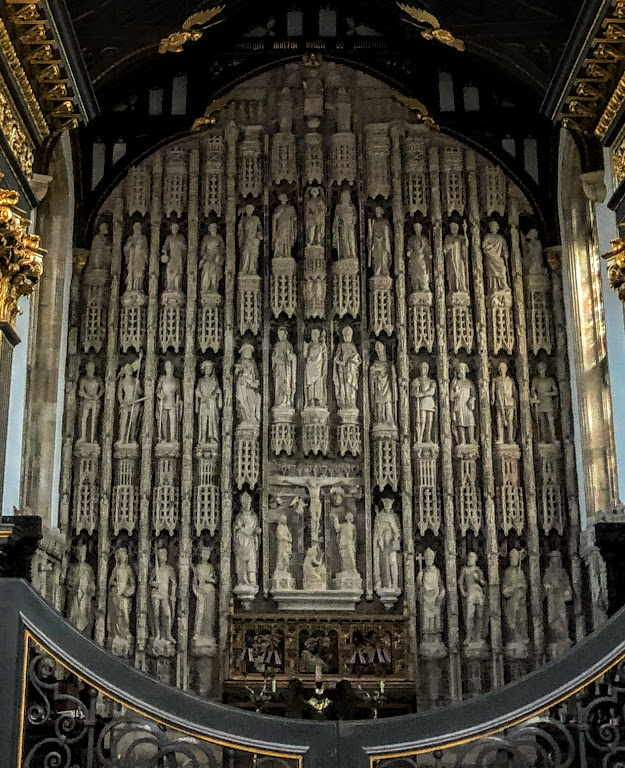
The reredos in the chapel of All Souls College, Oxford … a reminder of the ‘Faithful Departed’ (Photograph: Patrick Comerford)

John 6: 12-14 (NRSVA):

[Jesus said:] 37 ‘Everything that the Father gives me will come to me, and anyone who comes to me I will never drive away; 38 for I have come down from heaven, not to do my own will, but the will of him who sent me. 39 And this is the will of him who sent me, that I should lose nothing of all that he has given me, but raise it up on the last day. 40 This is indeed the will of my Father, that all who see the Son and believe in him may have eternal life; and I will raise them up on the last day.’

‘I will raise them up on the last day’ (John 6: 40) … an unlabelled carving in All Souls College, Oxford (Photograph: Patrick Comerford)

November is a month when we traditionally remember the saints, the Communion of Saints, those who are blessed, those we love and who are now gathered around the throne of God, those who have died and who we still love.

We do that on All Souls’ Day, we do that on Remembrance Day and Remembrance Sunday, and we do that on All Saints’ Day.

November is a month when we traditionally remember the saints, the Communion of Saints, those we love and who are now gathered around the throne of God, those who have died and who we still love.

As the evenings close in, as the last autumn leaves fall from the trees, it is natural to remember the dead and the fallen, with love and affection.

The special days in November include:

• All Saints’ Day (1 November);

• All Souls’ Day or the ‘Commemoration of the Faithful Departed’ (2 November, Common Worship, p 15);

• In Ireland, All Saints of Ireland (6 November);

• Remembrance Sunday (9 November 2025);

• Remembrance Day (11 November).

At this time of the year there are many people in my own family I am remembering, including:

• my mother, Ellen (Murphy) Comerford, who died 11 years ago, on 20 May 2014;

• my father, Stephen Edward Comerford, who died 21 years ago on 27 December 2004;

• my brother, Stephen Edward Comerford, who died in Durham, North Carolina, 55 years ago, on 18 December 1970;

• my foster mother, Peggy Kerr, who died on 27 July 2010, and my foster father George Kerr;

• my grandparents, Stephen Edward Comerford, who died on 21 January 1921, having contracted malaria five years earlier in Thessaloniki, and Bridget (Lynders) Comerford, who died on 25 March 1948;

• my grandparents, Thomas Michael Murphy, who died in Queensland, Australia, on 10 September 1949, and Maria (Crowley) Murphy, who died on 8 July 1957;

• and, at this time of the year, my ‘Gran’, Mary (McCarthy) Hallinan, who died on 6 November 1961; and ‘Granddad’ Edmond Hallinan, who died on 8 March 1963.

Hallowe’en is the day before we remember the Hallowed, not as the dead but as the blessed, the saints, who are model for our lives, our Christian lifestyle today. We believe the dead we love are still caught up in the love of God and are alive in Christ.

Indeed, saints do not need to be dead to be examples of ‘holy living and holy dying’ (Jeremy Taylor). Saint Paul regularly refers in his letters to fellow Christians as ‘saints.’ Saints Alive!

In the past, I have realised how many people and parishes have been shy, reluctant, perhaps even fearful, in the Church of Ireland when it comes to recalling, commemorating and celebrating the saints. A comparison of the calendars of the Church of Ireland and the Church of England is very telling.

Perhaps the people who decided on the calendar in the Church of Ireland were too afraid in the past of being seen to pray to the saints, or to pray for the dead. But, really, these are quite different to finding examples of godly living among Christians from the past, and expressing confidence that the dead we have loved are now committed to God’s love.

Yet the Church of England sees the calendar of saints as a living calendar, something that is added to as we find more appropriate examples of Christian living for today.

Saints do not have to be martyrs. But in recent years Oscar Romero was canonised and there was a major commemoration in Westminster Abbey of Oscar Romero in 2017 to mark his 100th birthday.

Saints do not have to be canonised. Modern martyrs include Dietrich Bonhoeffer and Martin Luther King, or Heather Heyer, the civil rights activist killed by far-right neo-Nazis and racists in Charlottesville, Kentucky, in 2017.

Many of us know people who handed on the faith to us – teachers, grandparents, perhaps neighbours. Even though many may be long dead, they remain part of our vision of the Communion of Saints.

Saints do not have to live a perfect life; as the Book of Common Prayer reminds us, ‘if we say we have no sin we deceive ourselves’ (I John 1: 8) … none of us is without sin, and none of us is beyond redemption. Some of the saints carved on the West Front of Westminster Abbey might have been very surprised to know they were going to appear there. But their lives in sum total are what we are asked to think about.

They are: Maximilian Kolbe, Manche Masemola, Archbishop Janani Luwum, Grand Duchess Elizabeth, Martin Luther King, Oscar Romero, Dietrich Bonhoeffer, Esther John, Lucian Tapiedi, and Wang Zhiming.

Some years ago, I asked students to share stories of their favourite ‘saints and heroes.’ They included an interesting array of people, some who were the still living at the time, including Archbishop Desmond Tutu.

In interviews in the Church Times, people are sometimes asked who they would like to be locked into a church with for a few hours.

Who are your favourite saints?

Who would you like to learn from a little more when it comes to living the Christian life?

This year marks the 1700th anniversary of the Nicene Creed, in which we express our belief in ‘the resurrection of the dead, and the life of the world to come’. In the Apostles’ Creed, we confess our belief in ‘the communion of saints’ and ‘the resurrection of the body.’

In the introduction to the Church Calendar and this in-between time, the time between All Saints and Advent, the resources for Common Worship remind us that ‘No Christian is solitary. Through baptism we become members one of another in Christ, members of a company of saints whose mutual belonging transcends death’. The resources then quote Charles Wesley:

One family, we dwell in him,
one Church, above, beneath;
though now divided by the stream,
the narrow stream of death.

Who are the saints in your life, in your own personal calendars? Who are those you recall whose souls we have committed to God’s love and who are part of ‘the communion of saints’?

Throughout the month of November, there are opportunities to remember their names as we are reminded in the first reading today that ‘The souls of the righteous are in the hand of God, no torment will ever touch them’ (Wisdom 3: 1).

The Library at All Souls College, Oxford, with a sundial designed by Sir Christopher Wren (Photograph: Patrick Comerford)

Today’s Prayers (Monday 3 November 2025, All Souls’):

The theme this week (2 to 8 November) in Pray with the World Church, the prayer diary of the Anglican mission agency USPG (United Society Partners in the Gospel), is ‘From Solitude to Connection’ (pp 52-53). This theme was introduced yesterday with a Programme Update from Ljudmila, a Ukrainian Refugee living in Budapest, Hungary.

The USPG Prayer Diary today (Monday 3 November 2025, All Souls’) invites us to pray:

Lord, as a God of peace, we pray that you will bring peace to Ukraine so families like Ljudmila’s may live without fear, reunited in safety and love.

The Collect:

Eternal God, our maker and redeemer,
grant us, with all the faithful departed,
the sure benefits of your Son’s saving passion
and glorious resurrection
that, in the last day,
when you gather up all things in Christ,
we may with them enjoy the fullness of your promises;
through Jesus Christ your Son our Lord,
who is alive and reigns with you,
in the unity of the Holy Spirit,
one God, now and for ever.

The Post Communion Prayer:

God of love,
may the death and resurrection of Christ
which we have celebrated in this eucharist
bring us, with all the faithful departed,
into the peace of your eternal home.
We ask this in the name of Jesus Christ,
our rock and our salvation,
to whom be glory for time and for eternity.

Yesterday’s Reflections

Continued Tomorrow

All Souls College, Oxford, founded in 1438 by Henry Chichele, Archbishop of Canterbury, with King Henry VI as its formal co-founder (Photograph: Patrick Comerford)

Scripture quotations are from the New Revised Standard Version Bible: Anglicised Edition copyright © 1989, 1995 National Council of the Churches of Christ in the United States of America. Used by permission. All rights reserved worldwide. http://nrsvbibles.org
13 August 2025

Daily prayer in Ordinary Time 2025:
96, Wednesday 13 August 2025

‘If two of you agree on earth about anything you ask, it will be done for you by my Father in heaven’ (Matthew 18: 19) … the Cross of Nails in Coventry Cathedral (Photograph: Patrick Comerford)

Patrick Comerford

We are continuing in Ordinary Time in the Church Calendar and this week began with the Eighth Sunday after Trinity (Trinity VIII). The calendar of the Church of England in Common Worship today remembers the lives and the witness of Jeremy Taylor (1613-1667), Bishop of Down and Connor, Teacher of the Faith; Florence Nightingale (1820-1910), Nurse, Social Reformer, and Octavia Hill (1838-1912), Social Reformer.

I have been staying overnight in Dublin during a family visit, and I am flying back to Birmingham late this afternoon. But, before today begins, I am taking some quiet time this morning to give thanks, for reflection, prayer and reading in these ways:

1, today’s Gospel reading;

2, a reflection on the Gospel reading;

3, a prayer from the USPG prayer diary;

4, the Collects and Post-Communion prayer of the day.

‘Go and point out the fault when the two of you are alone’ (Matthew 18: 15) … the sculpture ‘Reconciliation’ by Josephina da Vasconcellos in Coventry Cathedral (Photograph: Patrick Comerford)

Matthew 18: 15-20 (NRSVA):

[Jesus said:] 15 ‘If another member of the church sins against you, go and point out the fault when the two of you are alone. If the member listens to you, you have regained that one. 16 But if you are not listened to, take one or two others along with you, so that every word may be confirmed by the evidence of two or three witnesses. 17 If the member refuses to listen to them, tell it to the church; and if the offender refuses to listen even to the church, let such a one be to you as a Gentile and a tax-collector. 18 Truly I tell you, whatever you bind on earth will be bound in heaven, and whatever you loose on earth will be loosed in heaven. 19 Again, truly I tell you, if two of you agree on earth about anything you ask, it will be done for you by my Father in heaven. 20 For where two or three are gathered in my name, I am there among them.’

Dave Walker’s cartoon in the ‘Church Times’ last year following a week of far-right riots in England

Today’s Reflection:

In this morning’s Gospel reading at the Eucharist (Matthew 18: 15-20), Christ has just told the parable of the lost sheep, and how the shepherd goes in search of the one that goes astray, and rejoices over finding it (Matthew 18: 10-14).

So now, how should the Church respond to one member who has gone astray or who sins against other members of the Church?

The first response is to try taking that person aside to point out their fault. But that person should not be humiliated in front of others, and this should be done alone.

However, if you are not listened to, one or two others should be asked to be present as witnesses.

If the person still refuses to listen, the matter should be brought before the whole assembly of the Church, the εκκλησία (ekklesia). If the offender refuses to listen even to the Church, then, as a final sanction, that person should be treated as an unworthy outsider.

Christ then says that ‘you’ – the whole assembly of the Church, the ekklesia – have the authority to bind or condemn, to loose or to acquit, as if this is a decision that has divine authority.

Finally, Christ tells us that he is present in common prayer, study, and in decision-making, even when only two or three members of the Church are present. Christ is to be found in community.

How does Christ define the Church?

What makes up and defines the Church?

During the pandemic shutdown, when so many church buildings were closed, many of us comforted ourselves with phrases such as ‘the church is not a building’ and ‘people make the church.’

When Christ is talking about the church as εκκλησία then, he is talking about all the members of the church community, who have equal rights, equal power, equal duties, equal responsibilities and an equal and respected say in what is going on.

Baptism makes us all equal, without discrimination, in the Church.

And the Holy Communion, the Eucharist, is the lived continuation of our Baptism.

There is only one Body of Christ, and so there is only one Baptism and only one Eucharist.

For the Apostle Paul, the Church is one body, the Body of Christ, where there is no discrimination among those who are baptised and who share in the sacramental mysteries (see I Corinthians 12: 12-13 and Ephesians 1: 22-23).

And what Christ does in this Gospel reading is not to give power to the Church but to warn us as the Church about the power we already have as the εκκλησία and the consequences of how we use that power.

A few verses earlier, in yesterday’s Gospel reading (see verses 10-13), Christ reminds us not to despise the little ones, to go after the one sheep from among the 99 that might go astray, to make sure that not even one of the little ones is left to be lost.

Now he tells us that in the Church there is no room for us to refuse to talk to one another, to bear grudges, to refuse to listen to one another.

And he warns us against the real dangers of trying to use the powers that the Church has in the wrong way.

For Christ to say that what the Church approves of or disapproves of has implications of the highest order is not Christ endowing the Church with supernatural powers. Rather, he is warning us of making decisions, going in directions, exercising discrimination, in the Church that will have not merely temporal and worldly but also eternal and spiritual consequences.

There can be no petty divisions in the Church, if we are to be true to the meaning of Baptism and the Eucharist which form and sustain us in one body, the Body of Christ. And the Church has to be a haven for those who are the victims of division, discrimination and disaster. Our haven can be their heaven.

When we discriminate against others, the consequences are not just for them, or even for us, but for the whole Church.

In the US, many megachurch and evangelical leaders supported Donald Trump’s campaign for re-election and continue to support him despite all the horrors that have unfolded across the United States since he took office in January. Yet they are hauntingly silent when it comes to his bullying, illegality and corruption, to racism, to the plight of refugees, the rise of Islamophobia and antisemitism, and to other pressing issues such as climate change. In those instances, that part of the Church that claims the moral high ground is being found to be morally impoverished.

There is fear that the riots across England last year, fomented by people who are racist and who discriminate against people who need our compassion and support, may return to our streets before summer is out.

Faith leaders were quick to make their voices heard. Against this background, Justin Welby, then Archbishop of Canterbury, made an important intervention last summer when he wrote in the Guardian this time last year saying Christians cannot be part of any far-right group ‘because they are unchristian’ (12 August 2024). He condemned the use of Christian imagery by rioters as exploitation and ‘an offence to our faith, and all that Jesus was and is’.

We must be ready constantly to seek forgiveness and to forgive, yet we need to be clear when we seek to identify evil in the name of the Church and we must be fearless in condemning it.

‘Whatever you bind on earth will be bound in heaven’ (Matthew 18: 18) … paper or origami chains in the shape of cranes, a Japanese symbol of peace and reconciliation, in Coventry Cathedral (Photograph: Patrick Comerford)

Today’s Prayers (Wednesday 13 August 2025):

The theme this week (10 to 16 August) in Pray with the World Church, the prayer diary of the Anglican mission agency USPG (United Society Partners in the Gospel), is ‘Serving God in the Gulf’ (pp 26-27). This theme was introduced on Sunday with reflections from Joyaline Rajamani, Administrator at the Church of the Epiphany, Doha, Anglican Church in Qatar.

The USPG Prayer Diary today (Wednesday 13 August 2025) invites us to pray:

Lord God, we praise you for the Church in the Gulf. Thank you that it is thriving, empowered by your spirit, and many people are coming to know you.

The Collect of the Day:

Holy and loving God,
you dwell in the human heart
and make us partakers of the divine nature
in Christ our great high priest:
help us who remember your servant Jeremy Taylor
to put our trust in your heavenly promises
and follow a holy life in virtue and true godliness;
through Jesus Christ your Son our Lord,
who is alive and reigns with you,
in the unity of the Holy Spirit,
one God, now and for ever.

The Post-Communion Prayer:

God of truth,
whose Wisdom set her table
and invited us to eat the bread and drink the wine
of the kingdom:
help us to lay aside all foolishness
and to live and walk in the way of insight,
that we may come with Jeremy Taylor to the eternal feast of heaven;
through Jesus Christ our Lord.

Jeremy Taylor is remembered in the calendars of the Church of England and the Church of Ireland today (13 August)

Yesterday’s reflection

Continued tomorrow

Scripture quotations are from the New Revised Standard Version Bible: Anglicised Edition copyright © 1989, 1995, National Council of the Churches of Christ in the United States of America. Used by permission. All rights reserved worldwide. http://nrsvbibles.org

01 November 2024

Daily prayer in the Kingdom Season:
2, Saturday 2 November 2024,
All Souls’ Day

The reredos in the chapel of All Souls College, Oxford … a reminder of the ‘Faithful Departed’ on 2 November (Photograph: Patrick Comerford)

Patrick Comerford

We have moved in the Church Calendar from Ordinary Time to the Kingdom Season, the time between All Saints and Advent, and tomorrow is the Fourth Sunday before Advent (3 November 2024). Today in the Church Calendar is All Souls’ Day (2 November), or the Commemoration of the Faithful Departed.

All Souls’ Day is being marked later today in Saint Thomas’s Cathedral, Kuching, with an All Souls’ Day service this evening (7:30), when the celebrant is Canon Roannie W Cannidy, canon precentor of Saint Thomas’s Cathedral, and the preacher is the Revd Peter Augustine, one of the cathedral priests.

People have been invited to write the name or names of their faithful departed and drop them into a special box at the front of the chancel steps in the cathedral. Although only the names of past bishops and clergy will be read out during the intercessions this evening, all submitted names will be shown on the screens during the service. In addition, many people are expected to visit the graves and tombs of family members during the day.

Before today begins, before having breakfast, I am taking some quiet time early this morning to give thanks, and for reflection, prayer and reading in these ways:

1, today’s Gospel reading;

2, a short reflection;

3, a prayer from the USPG prayer diary;

4, the Collects and Post-Communion prayer of the day.

All Souls College, Oxford … its full, official name is: the Warden and the College of the Souls of All Faithful People deceased in the University of Oxford (Photograph: Patrick Comerford)

John 6: 37-40 (NRSVA):

[Jesus said:] 37 ‘Everything that the Father gives me will come to me, and anyone who comes to me I will never drive away; 38 for I have come down from heaven, not to do my own will, but the will of him who sent me. 39 And this is the will of him who sent me, that I should lose nothing of all that he has given me, but raise it up on the last day. 40 This is indeed the will of my Father, that all who see the Son and believe in him may have eternal life; and I will raise them up on the last day.’

‘I will raise them up on the last day’ (John 6: 40) … an unlabelled carving in All Souls College, Oxford (Photograph: Patrick Comerford)

Today’s Reflection:

November is a month when we traditionally remember the saints, the Communion of Saints, those we love and who are now gathered around the throne of God, those who have died and who we still love.

As the evenings close in, as the last autumn leaves fall from the trees, it is natural to remember the dead and the fallen, with love and affection.

All Saints’ Day yesterday (1 November) is one of the 12 Principal Feasts of the Church. In many parts of the Anglican Communion, today (2 November) is All Souls’ Day or the ‘Commemoration of the Faithful Departed’ (Common Worship, p 15). In Ireland, 6 November traditionally recalls ‘All Saints of Ireland.’ This year we mark Remembrance Sunday next Sunday (10 November), and Remembrance Day is on 11 November.

In recent days, Charlotte and I have wandered through some of the Chinese graveyards in the Kuching area, but have yet to find the place where her grandparents are buried.

At this time of the year – especially this year – there are a number of people in my own family I am remembering, including: my mother, Ellen (Murphy) Comerford, who died 10 years ago, on 20 May 2014;
my father, Stephen Edward Comerford, who died 20 years ago on 27 December 2004; my brother, Stephen Edward Comerford, who died on 18 December 1970;
my foster mother, Peggy Kerr, who died on 27 July 2010, and my foster father George Kerr;
and, at this time of the year, my ‘Gran’, Mary (McCarthy) Hallinan, who died on 6 November 1961; and ‘Granddad’ Edmond Hallinan, who died on 8 March 1963.

Hallowe’en, which was even marked in many places in Kuching this week, is the day before we remember the Hallowed, not as the dead but as the blessed, the saints, who are models for our lives, our Christian lifestyle today.

When he was Dean of Liverpool, Archbishop Justin Welby organised a Hallowe’en service he labelled ‘Night of the Living Dead’. At first, it sounds ghoulish. But that’s what it is … the ‘Night of the Living Dead’. We believe the dead we love are still caught up in the love of God and are alive in Christ.

Indeed, saints do not need to be dead to be examples of ‘holy living and holy dying’ (Jeremy Taylor).

Saint Paul regularly refers in his letters to fellow Christians as ‘saints.’ Saints Alive!

In the past, I have realised how many people and parishes have been shy, reluctant, perhaps even fearful, in the Church of Ireland when it comes to recalling, commemorating and celebrating the saints. A comparison of the calendars of the Church of Ireland and the Church of England is very telling.

Perhaps the people who decided on the calendar in the Church of Ireland were too afraid in the past of being seen to pray to the saints, or to pray for the dead. But, really, these are quite different to finding examples of godly living among Christians from the past, and expressing confidence that the dead we have loved are now committed to God’s love.

Yet the Church of England sees the calendar of saints as a living calendar, something that is added to as we find more appropriate examples of Christian living for today.

Saints do not have to be martyrs. But in recent years Oscar Romero was canonised and there was a major commemoration in Westminster Abbey of Oscar Romero in 2017 to mark his 100th birthday.

Saints do not have to be canonised. Modern martyrs may include Dietrich Bonhoeffer and Martin Luther King, or Heather Heyer, the civil rights activist killed by far-right neo-Nazis and racists in Charlottesville, Kentucky, in 2017.

Many of us we know people who handed on the faith to us – teachers, grandparents, perhaps neighbours. Even though many may be long dead, they remain part of our vision of the Communion of Saints.

Saints do not have to live a perfect life … none of us is without sin, and none of us is beyond redemption. Some of the saints carved on the West Front of Westminster Abbey might have been very surprised to know they were going to appear there. But their lives in sum total are what we are asked to think about.

They are: Maximilian Kolbe, Manche Masemola, Archbishop Janani Luwum, Grand Duchess Elizabeth, Martin Luther King, Oscar Romero, Dietrich Bonhoeffer, Esther John, Lucian Tapiedi, and Wang Zhiming.

Some years ago, I asked students to share stories of their favourite ‘saints and heroes.’ They included an interesting array of people, some who were the still living at the time, including Archbishop Desmond Tutu.

In the back-page interviews in the Church Times, people are sometimes asked who they would like to be locked into a church with for a few hours.

Who are your favourite saints?

Who would you like to learn from a little more when it comes to living the Christian life?

In the Apostles’ Creed, we confess our faith which includes our belief in ‘the communion of saints’ and ‘the resurrection of the body.’ In Nicene Creed, we express our belief in ‘the resurrection of the dead, and the life of the world to come.

In the introduction to the Church Calendar and this in-between time, the time between All Saints and Advent, the resources for Common Worship remind us that ‘No Christian is solitary. Through baptism we become members one of another in Christ, members of a company of saints whose mutual belonging transcends death’. The resources then quote Charles Wesley:

One family, we dwell in him,
one Church, above, beneath;
though now divided by the stream,
the narrow stream of death.

Who are the saints in your life, in your own personal calendars? Who are those you recall whose souls we have committed to God’s love and who are part of ‘the communion of saints’?

Throughout the month of November, there are opportunities to remember their names as we are reminded in the first reading today that ‘The souls of the righteous are in the hand of God, no torment will ever touch them’ (Wisdom 3: 1).

The Library at All Souls College, Oxford, with a sundial designed by Sir Christopher Wren (Photograph: Patrick Comerford)

Today’s Prayers (Saturday 2 November 2024, All Souls’ Day):

The theme this week in ‘Pray With the World Church’, the Prayer Diary of the Anglican mission agency USPG (United Society Partners in the Gospel), has been ‘All Saints’ Day’. This theme was introduced last Sunday with a programme update by the Revd Dr Duncan Dormor, General Secretary, USPG.

The USPG Prayer Diary today (Saturday 2 November 2024, All Souls’ Day) invites us to pray:

We give thanks for those who gone before us in the faith, may they rest in the mercy of God.

The Collect:

Eternal God, our maker and redeemer,
grant us, with all the faithful departed,
the sure benefits of your Son’s saving passion
and glorious resurrection
that, in the last day,
when you gather up all things in Christ,
we may with them enjoy the fullness of your promises;
through Jesus Christ your Son our Lord,
who is alive and reigns with you,
in the unity of the Holy Spirit,
one God, now and for ever.

Post Communion Prayer:

God of love,
may the death and resurrection of Christ,
which we have celebrated in this Eucharist,
bring us, with all the faithful departed,
into the peace of your eternal home.
We ask this in the name of Jesus Christ,
our rock and our salvation,
to whom be glory for time and for eternity.

Collect on the Eve of the Fourth Sunday before Advent:

Almighty and eternal God,
you have kindled the flame of love
in the hearts of the saints:
grant to us the same faith and power of love,
that, as we rejoice in their triumphs,
we may be sustained by their example and fellowship;
through Jesus Christ your Son our Lord,
who is alive and reigns with you,
in the unity of the Holy Spirit,
one God, now and for ever.

Yesterday’s Reflection

Continued Tomorrow

All Souls College, Oxford, founded in 1438 by Henry Chichele, Archbishop of Canterbury, with King Henry VI as its formal co-founder (Photograph: Patrick Comerford)

Scripture quotations are from the New Revised Standard Version Bible: Anglicised Edition copyright © 1989, 1995 National Council of the Churches of Christ in the United States of America. Used by permission. All rights reserved worldwide. http://nrsvbibles.org

13 August 2024

Daily prayer in Ordinary Time 2024:
95, Tuesday 13 August 2024

‘Truly I tell you, unless you change and become like children, you will never enter the kingdom of heaven’ (Matthew 18: 3) … a stained-glass window in the Comberford Chapel in Saint Edtha’s Church, Tamworth (Photograph: Patrick Comerford, 2023)

Patrick Comerford

We are continuing in Ordinary Time in the Church Calendar and this week began with the Eleventh Sunday after Trinity (Trinity XI). The calendar of the Church of England in Common Worship today remembers Jeremy Taylor (1667), Bishop of Down and Connor and teacher of the faith; Florence Nightingale (1910), nurse and social reformer; and Octavia Hill (1912), social reformer.

Before today begins, I am taking some quiet time this morning to give thanks, for reflection, prayer and reading in these ways:

1, today’s Gospel reading;

2, a reflection on the Gospel reading;

3, a prayer from the USPG prayer diary;

4, the Collects and Post-Communion prayer of the day.

He called a child, whom he put among them (Matthew 18: 2) … a stained-glass window in Saint Dunstan-in-the-West Church in Fleet Street, London (Photograph: Patrick Comerford, 2024)

Matthew 18: 1-5, 10, 12-14 (NRSVA):

1 At that time the disciples came to Jesus and asked, ‘Who is the greatest in the kingdom of heaven?’ 2 He called a child, whom he put among them, 3 and said, ‘Truly I tell you, unless you change and become like children, you will never enter the kingdom of heaven. 4 Whoever becomes humble like this child is the greatest in the kingdom of heaven. 5 Whoever welcomes one such child in my name welcomes me.

10 ‘Take care that you do not despise one of these little ones; for, I tell you, in heaven their angels continually see the face of my Father in heaven.

12 ‘What do you think? If a shepherd has a hundred sheep, and one of them has gone astray, does he not leave the ninety-nine on the mountains and go in search of the one that went astray? 13 And if he finds it, truly I tell you, he rejoices over it more than over the ninety-nine that never went astray. 14 So it is not the will of your Father in heaven that one of these little ones should be lost.’

‘Whoever becomes humble like this child is the greatest in the kingdom of heaven’ (Matthew 18: 4) … a stained-glass window in the Chapel in Saint John’s Hospital, Lichfield (Photograph: Patrick Comerford, 2024)

This morning’s reflection:

I think all of us have been disturbed in recent weeks about the terrors that are being rained down on children in the world today.

I say ‘children’ and not ‘innocent children,’ because there is no such being as a guilty child – there are only innocent children.

And the suffering and plight of children is all the more distressing when is caused by the calculations of adults who dismiss this suffering as merely the collateral damage brought about by war or because these children are dismissed as foreigners or outsiders.

For Christians, this distress must always be acute, must always demand our compassion, must always call for our response.

It cannot matter to us what label is placed on these children – whether the suffering Palestinian children in the Gaza Strip are Christians or Muslim, whether the children kidnapped from a kibbutz in Israel are from secular or religious Jewish families, whether the children on boats in the English Channel are from Africa, Asia or the Middle East, whether the refugee children Charlotte and I visited across Europe on behalf of USPG last year are Ukrainian or Russian.

The disciples ask Christ in the Gospel reading today (Matthew 18: 1-5, 10, 12-14), ‘Who is the greatest in the kingdom of heaven?’ He responds by calling a child, puts the child among them, and tells them: ‘Truly I tell you, unless you change and become like children, you will never enter the kingdom of heaven. Whoever becomes humble like this child is the greatest in the kingdom of heaven. Whoever welcomes one such child in my name welcomes me.’

We are not told whether this child is a boy or girl, Jew or Samaritan, Greek or Roman, a street urchin or the child of one of the Disciples.

Indeed, in all likelihood, the Disciples never noticed, for at that time a child was of no economic value and a burden on families until the child could earn his or her own way, or become the equivalent of a pension scheme for parents.

But Christ tells us: ‘Take care that you do not despise one of these little ones; for, I tell you, in heaven their angels continually see the face of my Father in heaven … it is not the will of your Father in heaven that one of these little ones should be lost.’

The Kingdom of Heaven is like little things. The Gospels remind us time and again that the Kingdom of Heaven is like small things:

• Sowing a seed;

Giving a nest to the birds of the air;

• Mixing yeast;

• Turning small amounts of flour into generous portions of bread;

• Finding hidden treasure;

• Rushing out in joy;

• Selling all that I have because something I have found is worth more – much, much more, again and again;

• Searching for pearls;

• Finding just one pearl;

• Casting a net into the sea;

• Catching an abundance of fish;

• Drawing that abundance of fish ashore, realising there is too much there for my personal needs, and sharing it;

• Writing about it so that others can enjoy the benefit and rewards of treasures new and old.

And this morning we are told that Kingdom of God is like a little child – imagine a child playing on a beach in Gaza, falsely feeling secure in a school or hospital in Ukraine, maimed and injured in a mother’s arms at home, dying in a Gaza hospital, kidnapped at a music festival in Israel or in her parent’s home in a kibbutz, caught in terror in the midst of a far-right riot on our city streets, starving and despised in a refugee camp or in war the world ignores in Sudan, sea-sick in a crowded small boat in the English Channel, cowering in a cramped hotel room as rioters try to set the hotel alight.

In the face of these images I find myself thinking of the prophets, like Ezekiel in our first lectionary reading (Ezekiel 2: 8 to 3: 4), who are called to speaking ‘words of lamentation and mourning and woe’ and compelled to ‘go to the house of Israel and speak [God’s] very words to them.’

But I have hope too, for I hear Christ’s words today: ‘in heaven their angels continually see the face of my Father in heaven … it is not the will of your Father in heaven that one of these little ones should be lost.’

‘Whoever welcomes one such child in my name welcomes me’ (Matthew 18: 5) … a stained-glass window in Saint Mary’s Church, Lichfield (Photograph: Patrick Comerford, 2023)

Today’s Prayers (Tuesday 13 August 2024):

The theme this week in ‘Pray With the World Church,’ the Prayer Diary of the Anglican mission agency USPG (United Society Partners in the Gospel), is ‘Whom Shall I Send?’ This theme was introduced on Sunday with a programme update from the Revd Davidson Solanki, Regional Manager Asia and Middle East, USPG, on the Episcopal Province of Jerusalem and the Middle East’s new programme launched in accompaniment with USPG, ‘Whom Shall I Send.’

The USPG Prayer Diary today (Tuesday 13 August 2024) invites us to pray:

We pray for all the young people currently taking part in the ‘Whom Shall I Send’ programme. May they continue to learn and grow in their ministry.

The Collect:

Holy and loving God,
you dwell in the human heart
and make us partakers of the divine nature
in Christ our great high priest:
help us who remember your servant Jeremy Taylor
to put our trust in your heavenly promises
and follow a holy life in virtue and true godliness;
through Jesus Christ your Son our Lord,
who is alive and reigns with you,
in the unity of the Holy Spirit,
one God, now and for ever.

The Post Communion Prayer:

God of truth,
whose Wisdom set her table
and invited us to eat the bread and drink the wine
of the kingdom:
help us to lay aside all foolishness
and to live and walk in the way of insight,
that we may come with Jeremy Taylor to the eternal feast of heaven;
through Jesus Christ our Lord.

‘So it is not the will of your Father in heaven that one of these little ones should be lost’ (Matthew 18: 14) … a stained-glass window in Saint Michael’s Church, St Albans (Photograph: Patrick Comerford, 2024)

Yesterday’s reflection

Continued tomorrow

Scripture quotations are from the New Revised Standard Version Bible: Anglicised Edition copyright © 1989, 1995, National Council of the Churches of Christ in the United States of America. Used by permission. All rights reserved worldwide. http://nrsvbibles.org

13 August 2022

Praying with USPG and the hymns of
Vaughan Williams: Saturday 13 August 2022

Monk’s Gate … the West Sussex hamlet near Horsham where Vaughan Williams first heard the tune he used for Percy Dearmer’s rewriting of John Bunyan’s hymn (Photograph: Pete Chapman/Wikipedia)

Patrick Comerford

Today, the Calendar of Common Worship in the Church of England commemorates Jeremy Taylor, Bishop of Down and Connor, Teacher of the Faith (1667), with a Lesser Festival, and Florence Nightingale, Nurse, Social Reformer (1910), and Olivia Hill, Social Reformer (1912), with commemorations.

Before the day gets busy, I am taking some time this morning for reading, prayer and reflection.

This year marks the 150th anniversary of the composer Ralph Vaughan Williams, whose music is celebrated throughout this year’s Proms season. In my prayer diary for these weeks I am reflecting in these ways:

1, One of the readings for the morning;

2, Reflecting on a hymn or another piece of music by Vaughan Williams, often drawing, admittedly, on previous postings on the composer;

3, a prayer from the USPG prayer diary, ‘Pray with the World Church.’

Jeremy Taylor … wrote about forgiveness as an essential part of Holy Living and Holy Dying

Jeremy Taylor (1613-1667) was born in Cambridge in 1613 and educated at Gonville and Caius College. He was ordained in 1633 and, as the Civil War got under way, he became a chaplain with the Royalist forces. He was captured and imprisoned briefly but after his release went to Wales, where the Earl of Carbery gave him refuge.

He wrote prolifically whilst there, notably The Rule and Exercise of Holy Living (1650) and of Holy Dying (1651). He went to Ireland in 1658 to lecture and two years later was made Bishop of Down and Connor. He found many of his clergy held to Presbyterianism and so ignored him; and the Roman Catholics rejected him as a Protestant. In turn, he treated both sides harshly.

His health was worn down by the protracted conflicts and he died on this day in 1667.

I was invited to preach on Jeremy Taylor at the Eucharist in the Chapel of Saint John the Baptist in Saint John’s Hospital without the Barrs, Lichfield, on 12 August 2009.

Jeremy Taylor, a leading Caroline Divine and Bishop of Down and Connor

Matthew 5: 17-20 (NRSVA):

[Jesus said:] 17 ‘Do not think that I have come to abolish the law or the prophets; I have come not to abolish but to fulfil. 18 For truly I tell you, until heaven and earth pass away, not one letter, not one stroke of a letter, will pass from the law until all is accomplished. 19 Therefore, whoever breaks one of the least of these commandments, and teaches others to do the same, will be called least in the kingdom of heaven; but whoever does them and teaches them will be called great in the kingdom of heaven. 20 For I tell you, unless your righteousness exceeds that of the scribes and Pharisees, you will never enter the kingdom of heaven.’


Today’s reflection: ‘He who would Valiant be’

Ralph Vaughan Williams was the composer of symphonies, chamber music, opera, choral music, and film scores, a collector of English folk music and song. With Percy Dearmer, he co-edited the English Hymnal, in which he included many folk song arrangements as hymn tunes, and several of his own original compositions.

From Monday to Friday this week, I have been reflecting on the ‘Five Mystical Songs,’ composed by Vaughan Williams between 1906 and 1911and based on the poems by the 17th century Welsh-born English priest-poet George Herbert (1593-1633).

This morning [13 August 2022], I have chosen the hymn ‘He who would Valiant be’ also commonly known as ‘To be a Pilgrim,’ sung to the tune Monk’s Gate, which the New English Hymnal says was adapted from an old English folk song by Vaughan Williams. The words by Percy Dearmer (1867-1936) are a comprehensive reworking of an earlier, 17th century hymn by John Bunyan (1628-1688), the author of The Pilgrim’s Progress.

John Julian’s great Dictionary of Hymnody, revised in 1907, mentions Bunyan only to say that he did not write any hymns. This is Bunyan’s only known hymn and was first published in 1684 in Part 2 of The Pilgrim’s Progress. It recalls the words of Hebrews 11: 13: ‘… and confessed that they were strangers and pilgrims on the earth.’

Bunyan’s words were modified extensively by Percy Dearmer for The English Hymnal (1906), with a new tune composed by Vaughan Williams, who used a traditional Sussex melody, ‘Monk’s Gate.’

This popular hymn tune is in 65 65 66 65, and it is the tune rather than the words that have made this hymn so memorable Edward Darling and Donald Davison, in their Companion to Church Hymnal, say it provides ‘a fine example of the use of syncopation and cross-rhythm in a hymn tune.’

Monk’s Gate is a hamlet in West Sussex, on the A281, 4.3 km south-east of Horsham. It was there in December 1904 that Vaughan Williams first heard the tune when he heard Harriet Verrall of Monk’s Gate singing the English folksong ‘Our Captain Calls All Hands.’ Harriet and Peter Verrall, who lived at Thrift Cottage, were also responsible for teaching Vaughan Williams the ‘Sussex Carol’ (‘On Christmas Night all Christians sing’) and the tune known as Sussex (‘Father, hear the prayer we offer’).

The song ‘Our Captain Calls All Hands’ tells of a woman deserted by her sailor lover:

How can you go abroad
fighting for strangers?
Why don’t you stay at home
free from all danger?
I will roll you in my arms,
my own dearest jewel,
So stay at home with me, love,
and don’t be cruel.


Vaughan Williams’s tune was published in the first edition of the English Hymnal in 1906.

Three years later, he heard the same tune being sung at Westhope, near Weobley, Herefordshire, by Ellen Powell with a folk song called ‘A Blacksmith Courted Me.’ This song has the same theme of love deserted:

A blacksmith courted me
Nine months and better
He fairly won my heart
Wrote me a letter.
With his hammer in his hand
He looked so clever
And if I was with my love
I would live forever …

Oh, witness have I none
Save God Almighty
And may he reward you well
For the slighting of me.
Her lips grew pale and wan
It made a poor heart tremble
To think she loved a one
And he proved deceitful …


This second song has been recorded by many of the folk rock bands that emerged from the late 1960s on. Steeleye Span lead off their first two studio albums Hark! The Village Wait (1970) and Please to See the King (1971) with different versions of the song as well as on several live albums. Planxty sing it on their first album Planxty (1973), and Pentangle on the album So Early in the Spring (1989). Maddy Prior of Steeleye Span also sings an a cappella version on her solo album Year (1993).

In the early 1970s, I was enjoying the music of English folk rock bands such as Steeleye Span, Pentangle, Fairport Convention, Lindisfarne and Jethro Thull. Their music provided an interesting bridge to the music of Vaughan Williams, which I was introduced to in rural Shropshire.

The adaptation of Monk’s Gate by Vaughan Williams brought new attention to Bunyan’s much-forgotten poem, which was hidden in the second part of The Pilgrim’s Progress. But the words sung to Monk’s Gate are no longer those penned by Bunyan, whose poem begins:

Who would true valour see,
  Let him come hither;
One here will constant be,
Come wind, come weather.


The version in the English Hymnal is the one rewritten by Percy Dearmer and begins:

He who would valiant be
’Gainst all disaster,
Let him in constancy
Follow the Master.


The Master, of course, is Christ, and Dearmer also introduced explicit references to the Lord and the Spirit, making a Trinitarian hymn of a poem that was written as an allegory and with lyrics that are only metaphorically Christian. But Dearmer also cut out Bunyan’s references to a lion, a hobgoblin and foul fiend.

Bunyan’s original was not commonly sung in churches, perhaps because of the references to ‘hobgoblin’ and ‘foul fiend.’ Some recent hymnbooks have returned to Bunyan’s original, including the Church of England’s Common Praise and the Church of Scotland’s Hymns of Glory, Songs of Praise, and it has been popular with English folk rock artists such as Maddy Prior and the Carnival Band.

The two versions of the hymn are included in the Irish Church Hymnal (No 662), which also uses the tune Monk’s Gate for Herbert O’Driscoll’s hymn ‘Who are we who stand and sing?’ (No 532).

‘To Be a Pilgrim’ is the school hymn for many schools throughout England, and is sung in several school films. In Lindsay Anderson’s film if.... (1968), it characterises the traditional religious education in English public schools in the 1960s. It is also sung again in a public school context in Clockwise (1986), starring John Cleese, who directs all of the members of the Headmasters’ Conference to stand and sing the hymn, as he often would with his own pupils.

This was one of the hymns chosen by Margaret Thatcher for her funeral in April 2013. But the hymn was also one of Tony Benn’s choices on BBC Radio 4’s Desert Island Discs.

The hymn’s refrain ‘to be a pilgrim’ has entered common usage in the English language and has been used in the title of many books about pilgrimage.

From his childhood, Vaughan Williams had been attracted to the sturdy and simple prose of John Bunyan, with its sincerity and spiritual intensity. Vaughan Williams described his Pilgrim’s Progress as a ‘Morality’ rather than an opera, although he intended the work to be performed on stage rather than in a church or cathedral.

Vaughan Williams later made an opera of Bunyan’s The Pilgrim’s Progress, although he changed the hero’s name from Christian to Pilgrim. I shall return to Bunyan, Vaughan Williams, and The Pilgrim’s Progress when I invite you to listen with me to ‘The Song of the Tree of Life,’ a song from that opera.


‘He who would valiant be’

He who would valiant be
’Gainst all disaster,
Let him in constancy
Follow the Master.
There’s no discouragement
Shall make him once relent
His first avowed intent
To be a pilgrim.

Who so beset him round
With dismal stories
Do but themselves confound –
His strength the more is.
No foes shall stay his might;
Though he with giants fight,
He will make good his right
To be a pilgrim.

Since, Lord, thou dost defend
Us with thy Spirit,
We know we at the end,
Shall life inherit.
Then fancies flee away!
I’ll fear not what men say,
I’ll labour night and day
To be a pilgrim.


Today’s Prayer:

The Collect:

Holy and loving God,
you dwell in the human heart
and make us partakers of the divine nature
in Christ our great high priest:
help us who remember your servant Jeremy Taylor
to put our trust in your heavenly promises
and follow a holy life in virtue and true godliness;
through Jesus Christ your Son our Lord,
who is alive and reigns with you,
in the unity of the Holy Spirit,
one God, now and for ever.

The Post Communion Prayer:

God of truth,
whose Wisdom set her table
and invited us to eat the bread and drink the wine
of the kingdom:
help us to lay aside all foolishness
and to live and walk in the way of insight,
that we may come with your servant Jeremy Taylor
to the eternal feast of heaven;
through Jesus Christ our Lord.

Saturday 13 August 2022:

The theme in the USPG prayer diary this week has been ‘International Youth Day.’ It was introduced on Sunday by Dorothy deGraft Johnson, a Law student from Ghana.

The USPG Prayer Diary invites us to pray today in these words:

Let us pray for ordinands of all ages. May they be supported at the beginning of their ministry.

Yesterday’s reflection

Continued tomorrow

Scripture quotations are from the New Revised Standard Version Bible: Anglicised Edition copyright © 1989, 1995, National Council of the Churches of Christ in the United States of America. Used by permission. All rights reserved worldwide. http://nrsvbibles.org

13 August 2015

Jeremy Taylor and forgiveness
in ‘Holy Living’ and ‘Holy Dying’

Jeremy Taylor … wrote about forgiveness as an essential part of Holy Living and Holy Dying

Patrick Comerford

Christ Church Cathedral, Dublin

Thursday, 13 August 2015,

12.45 p.m., Mid-Day Eucharist

Readings:
Joshua 3: 7-11, 13-17; Psalm 114; Matthew 18: 21 – 19: 1.

May I speak to you in the name of + the Father, and of the Son, and of the Holy Spirit, Amen.

Today, in the calendar of the Church, we remember the saintly Jeremy Taylor (1613-1667), one of the key bishops in the restoration of the Church of Ireland after the ravages and spoliations of the mid-17th century.

Jeremy Taylor was born in 1613 in Cambridge, where he was educated at Gonville and Caius College. He was ordained in 1633 and, as the Civil War got under way, he became a chaplain with the Royalist forces. He was captured and imprisoned briefly, but after his release went to Wales, where the Earl of Carbery gave him refuge.

During the Civil War, Jeremy Taylor suffered internal exile and persecution, but remained true to the essentials of his Anglicanism, worshipping daily according to the tradition of the Book of Common Prayer.

In this exile, he wrote The Rule and Exercise of Holy Living (1650) and The Rule and Exercise of Holy Dying the following year (1651).

In 1658, Jeremy Taylor moved to Ireland, and with the end of the Cromwellian era, he and Archbishop John Bramhall of Armagh moved immediately to restore the Anglican tradition within the Church of Ireland. They revised and updated the Book of Common Prayer, they restored catholic order to the worship, liturgy and the organisation of the Church of Ireland, they provided priests for parishes that had long been vacant, and they ensured the consecration of bishops for vacant dioceses.

He became the bishop for three of those dioceses – Down, Conor and Dromore – he restored and rebuilt cathedrals, visited his parishes, and provided sacramental and pastoral care for the people.

Yet he never neglected the deeper spiritual truths. His two best known works, Holy Living (1650) and Holy Dying (1651), are precisely that – models for how to live and how to die in faith in Christ.

Learning to live with our lives as they are, and learning to die when death comes are important themes throughout his writings.

Thinking on today’s Gospel reading (Matthew 18: 21 – 19: 1), and its emphases on forgiveness, I am reminded that Jeremy Taylor also writes, throughout his works, about the constant need for forgiveness – giving and receiving forgiveness – as essential parts of the health of a Christian, spiritual health and physical health.

He reminds us in Holy Dying that we receive absolution of our sins in proportion to our forgiving of one another.

He reminds us that when we are distressed, in sickness, find ourselves without hoped-for and prayed-for healing, sorrowful and feeling the weight of sickness, as he describes it, we should call to mind what injuries we have been forgiven.

He wrote: “He who knows not to forgive, knows not to be like a Christian, and a disciple of so gentle a master.”

Jeremy Taylor’s health was worn down by the protracted conflicts of his day, and he died on this day, 13 August 1667.

And so may all we think, say and do be to the praise, honour and glory of God, + Father, Son and Holy Spirit, Amen.

The Collect:

Holy and loving God, you dwell in the human heart
and make us partakers of the divine nature
in Christ our great high priest:
help us who remember your servant Jeremy Taylor
to put our trust in your heavenly promises
and follow a holy life in virtue and true godliness;
through Jesus Christ your Son our Lord,
who is alive and reigns with you,
in the unity of the Holy Spirit,
one God, now and for ever.

Post Communion Prayer:

God of truth,
whose Wisdom set her table
and invited us to eat the bread and drink the wine
of the kingdom:
help us to lay aside all foolishness
and to live and walk in the way of insight,
that we may come with Jeremy Taylor to the eternal feast of heaven;
through Jesus Christ our Lord.

This reflection was shared at the Mid-Day Eucharist in Christ Church Cathedral, accompanied by prayer and laying-on of hands in association with the Church’s Ministry of Healing, on Thursday 13 August, 2015

12 August 2009

Remembering the saintly Jeremy Taylor

Saint John’s, John Street, Lichfield

The Chapel of Saint John the Baptist,
Saint John’s Hospital-without-the-Barrs,
John Street, Lichfield

Wednesday 12 August 2009; 9.15 a.m., Holy Eucharist

Revd Canon Patrick Comerford


May I speak to you in the name of + the Father, and of the Son, and of the Holy Spirit, Amen.

I am very grateful to Father Roger [Canon Roger Williams, SSC, Master of Saint John’s Hospital] for asking me to share a few words this morning, as we remember in the calendar of the Church – even if we have moved him forward by a day – the saintly Jeremy Taylor (right, one of the key bishops in the restoration of the Church of Ireland after the ravages and spoliations of the mid-17th century.

Although Dublin is only a 40-minute plane hop and a 40-minute train journey from Lichfield, the Church of Ireland may be many hundreds of miles away for many people in Lichfield, even today.

Yet this has always been a precious place to me … both Lichfield as a city, and Saint John’s itself.

When I was in my late teens, I first came to Lichfield almost 40 years ago, because of distant family connections with the Comberford family of Comberford, halfway between Lichfield and Tamworth.

I have happy memories of how I began working as a freelance journalist here, with the occasional contribution to the Lichfield Mercury.

One summer’s evening in 1971, when I was staying on Birmingham Road, on an evening just like yesterday’s, I found myself passing by Saint John’s. Some would say by accident, others would say by divine providence, I decided to look into this very building.

It was more than a decade before John Piper’s window was placed here.

And yet on that bright, warm summer’s evening, I was truly filled – physically, emotionally and spiritually – with the light, the life and the love of God.

How was I to respond to that experience? I immediately made my way, passing the Lichfield Mercury’s offices in Beacon Street, up to the cathedral, and slipped into the choir stalls for choral evensong. One of the canons asked me that evening had I started going to church because I was thinking of ordination.

I suppose I was. It was the beginning of a long journey, a long pilgrimage, and I come back here regularly to remind myself of how that journey, that pilgrimage, began, and to give thanks to God for his call to me, for waking me up, for calling me into his life, his love and his light.

And over the past – well almost – forty years, I have given thanks for the particular tradition of this church, which has been very relevant as I developed my sense of calling to ministry and mission.

Archbishop Henry McAdoo, a former Archbishop of Dublin and a one-time co-chair of ARCIC, the Anglican-Roman Catholic International Commission, once claimed that the second phase of the Anglo-Catholic movement, that part of the movement that we associate with Charles Gore, and later with figures such as Percy Dearmer, owed more to Jeremy Taylor and the Caroline Divines than to John Henry Newman and the Oxford Movement.

Whether it did or not may be irrelevant. But the Jeremy Taylor and the Caroline Divines remain very relevant today. During the English Civil War, Jeremy Taylor suffered internal exile and persecution, but remained true to the essentials of his Anglicanism, worshipping daily according to the tradition of the Book of Common Prayer.

With the end of the Cromwellian era, Jeremy Taylor and Archbishop John Bramhall moved immediately to restore the Anglican tradition within the Church of Ireland. They revised and updated the Book of Common Prayer. They restored catholic order to the worship, liturgy and organisation of the Church of Ireland. They saw to providing priests for parishes that had long been vacant, and to consecrating bishops for vacant sees – indeed Jeremy Taylor had the singular honour of being asked to preach at his own consecration.

He moved to the north-east of Ireland, taking responsibility as bishop for the three dioceses of Down, Conor and Dromore. This is a vast swathe of the Church of Ireland today – from Rathlin island between the coasts of Antrim and Scotland, through what is now Belfast, south to the shores of Co Down, where, in words of Percy French, the Mountains of Mourne sweep down to the sea.

He restored and rebuilt cathedrals, he visited his parishes, and he provided a model for how to combine sacramental and pastoral care for people with missionary foresight and vision.

Yet he never neglected the deeper spiritual truths. His two best known works, Holy Living and Holy Dying, are precisely that – models for how to live and how to die in faith in Christ.

Jeremy Taylor died regretting that he had never been called back as bishop to an English diocese. But I am constantly grateful for his contribution to the life and the spiritual depths of the Church of Ireland … just as I am always grateful to Saint John’s for its place in looking after my own Holy Living and, eventually, Holy Dying.

And now may all our thoughts, words and deed be to the praise, honour and glory of God, + Father, Son and Holy Spirit, Amen.

Canon Patrick Comerford is Director of Spiritual Formation, the Church of Ireland Theological Institute, Dublin. This sermon was preached at the Eucharist in the Chapel of Saint John the Baptist in Saint John’s Hospital without the Barrs, John Street, Lichfield, on Wednesday 12 August 2009.