Showing posts with label Stations of the Cross. Show all posts

30 August 2026

Daily prayer in Ordinary Time 2026:
114, Sunday 30 August 2026,
Thirteenth Sunday after Trinity (Trinity XIII)

‘If any want to become my followers, let them deny themselves and take up their cross and follow me’ (Matthew 16: 25) … a Crucifixion icon by Hanna-Leena Ward in her recent exhibition in Lichfield Cathedral (Photograph: Patrick Comerford, 2026)

Patrick Comerford

This is the August bank holiday weekend here. We are continuing in Ordinary Time in the Church Calendar and today is the Thirteenth Sunday after Trinity (Trinity XIII, 30 August 2026). Later this morning, I hope to be at the Parish Eucharist in Saint Mary and Saint Giles Church, Stony Stratford. But, before today begins, I am taking some quiet time this morning to give thanks, for reflection, prayer and reading in these ways:

1, today’s Gospel reading;

2, a reflection on the Gospel reading;

3, a prayer from the USPG prayer diary;

4, the Collects and Post-Communion prayer of the day.

‘If any want to become my followers, let them deny themselves and take up their cross and follow me’ (Matthew 16: 25) … ‘The Passion’, a sculpture by Enzo Plazzotta in Saint Bene’t’s Church, Cambridge (Photograph: Patrick Comerford, 2026)

Matthew 16: 21-28 (NRSVA):

21 From that time on, Jesus began to show his disciples that he must go to Jerusalem and undergo great suffering at the hands of the elders and chief priests and scribes, and be killed, and on the third day be raised. 22 And Peter took him aside and began to rebuke him, saying, ‘God forbid it, Lord! This must never happen to you.’ 23 But he turned and said to Peter, ‘Get behind me, Satan! You are a stumbling-block to me; for you are setting your mind not on divine things but on human things.’

24 Then Jesus told his disciples, ‘If any want to become my followers, let them deny themselves and take up their cross and follow me. 25 For those who want to save their life will lose it, and those who lose their life for my sake will find it. 26 For what will it profit them if they gain the whole world but forfeit their life? Or what will they give in return for their life?

27 ‘For the Son of Man is to come with his angels in the glory of his Father, and then he will repay everyone for what has been done. 28 Truly I tell you, there are some standing here who will not taste death before they see the Son of Man coming in his kingdom.’

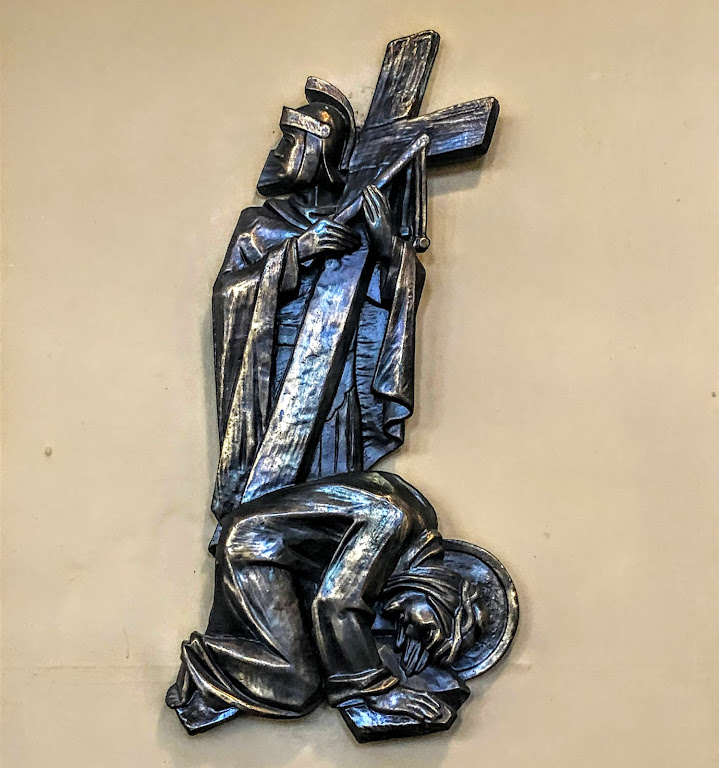
‘If any want to become my followers, let them deny themselves and take up their cross’ (Matthew 16: 25) … Simon of Cyrene helps Jesus carry the Cross, Station 5 in the Chapel, Saint John’s Hospital, Lichfield, (Photograph: Patrick Comerford)

Today’s Reflections:

There is a wonderful contrast today in the Gospel reading and the Epistle reading between the Apostle Peter, who gets it wrong, and the Apostle Paul, who gets it right.

On the previous Sunday [23 August 2026], in the Gospel reading, we saw how Saint Peter could get it right with his confession of faith, a rock-solid faith that had firm foundations. This week, Saint Peter becomes a stumbling block because he thinks Christ has come to defeat those he sees as the enemies of the people, and he wants to share in the victory he hopes Christ will win. From rock to stumbling block in the space of a week.

Saint Peter is going to share in Christ’s victory, but it is not that kind of victory. It is a victory won not by killing enemies, but by forgiving them. It is a victory won on the cross, and Saint Peter will share it when he is ready to take up his cross and follow Christ.

On the other hand, Saint Paul, who once used rocks and stones in a very different way – at the stoning of the first, early Christian martyrs – now provides us with his own concise summary of Christianity faith, life and love. It reads like his own retelling of the Sermon on the Mount, or Christ reading in the synagogue in Nazareth (see tomorrow’s Gospel reading, Luke 4: 16-30).

Saint Paul tells us: ‘Let love be genuine; hate what is evil, hold fast to what is good; love one another with mutual affection; outdo one another in showing honour’ (Romans 12: 9-10).

Christ has been teaching the disciples about their mission and how to proclaim the good news of the Kingdom of God. Now, as he prepares them to go up to Jerusalem, his emphasis shifts to teaching them that he must suffer, die and be raised from the dead on the third day.

The Apostle Peter has already grasped in last Sunday’s reading that Christ is ‘the Messiah, the Son of the living God’ (verse 16, see Matthew 16: 13-20, 23 August 2026). Now, however, he fails to grasp or refuses to accept the concept of the Messiah suffering and dying, rather than leading them to freedom glory.

There is a harsh, terse response from Christ: ‘Get behind me Satan! You are a stumbling-block to me; for you are setting your mind not on divine things but on human things.’

Peter who is a rock becomes a stumbling block, literally a scandal (σκᾰ́νδᾰλον, skandalon; see Leviticus 19: 14); Peter who has attempted to walk on water does not grasp what it means to walk with Christ on the road to Jerusalem; Peter who is to receive the keys of the kingdom fails to grasp the key to understanding Christ’s Messiahship; later, Peter who is present at the Transfiguration, is also going to deny Christ three times at his passion.

Christ then talks to the disciples about the cost of discipleship. To be his followers, we must be willing to take up the same cross, we must be willing to devote our whole lives to God, denying ourselves, giving up physical comforts and safety, accepting even death if necessary.

Jesus then asks a rhetorical question. Nothing that we can gain can add to the value of our future with God.

There will be a time of reckoning, when Christ comes in glory at the end of time, on the Day of Judgment, when Christ comes, ushering in his kingdom.

‘If any want to become my followers, let them deny themselves and take up their cross and follow me’ (Matthew 16: 25) … a crucifix in the North Transept in Jesus College Chapel, Cambridge (Photograph: Patrick Comerford, 2026)

Today’s Prayers (Sunday 30 August 2026, Trinity XIII):

In Pray with the World Church, the prayer diary of the Anglican mission agency USPG (United Society Partners in the Gospel), the theme this week, from 30 August to 5 September 2026 (pp 34-35), is ‘Anglican Youth Tackle Waste in Madagascar’. This theme is introduced today with a Programme Update by Ialy Tongasoa, Community Development Lead, Diocese of Toliara, Madagascar:

In Madagascar, huge amounts of waste are left untreated – clogging rivers, polluting land, and threatening both health and fragile ecosystems. Across Fort-Dauphin, and other parts of southern and northern Madagascar, Anglican dioceses have trained over 100 young advocates in practical ways to manage waste and tackle climate change. Workshops include hands-on sessions in composting organic waste, recycling plastics into useful products, and sensitising communities. The diocesan bishops also led Bible study sessions exploring the theological importance of caring for God’s creation, linking faith directly to environmental action.

Youth are central to this programme because they bring energy, creativity, and influence across their communities, and by learning sustainable practices early, they become lifelong stewards of God’s creation. With guidance from church leaders and local environmental specialists, the youth are taking these skills into their neighbourhoods – encouraging recycling, using smart bins, and even generating income from recycled materials.

When Kakafoharisoa Gabriel Fabriano from Mananjary joined the Smart Waste We Care programme, he never imagined how much he could learn. ‘Before the workshop, I knew waste could be recycled but didn’t know how. Now I can turn organic waste into compost and plastic waste into paving materials. I am ready to help my community and share what I have learned,’ he says.

To find out more about this year’s Harvest Appeal and climate action in Madagascar, visit harvest.uspg.org.uk

The USPG Prayer Diary today (Sunday 30 August 2026, Trinity XIII) invites us to pray as we read and meditate on today’s Gospel reading, Matthew 16: 21-28.

‘If any want to become my followers, let them deny themselves and take up their cross and follow me’ (Matthew 16: 25) … the Crucifixion scene on the rood screen in Saint Saviour’s Church, Pimlico (Photograph: Patrick Comerford, 2026)

The Collect:

Almighty God,
who called your Church to bear witness
that you were in Christ reconciling the world to yourself:
help us to proclaim the good news of your love,
that all who hear it may be drawn to you;
through him who was lifted up on the cross,
and reigns with you in the unity of the Holy Spirit,
one God, now and for ever.

The Post Communion Prayer:

God our creator,
you feed your children with the true manna,
the living bread from heaven:
let this holy food sustain us through our earthly pilgrimage
until we come to that place
where hunger and thirst are no more;
through Jesus Christ our Lord.

Additional Collect:

Almighty God,
you search us and know us:
may we rely on you in strength
and rest on you in weakness,
now and in all our days;
through Jesus Christ our Lord.

Yesterday’s reflections

Continued tomorrow

‘If any want to become my followers, let them deny themselves and take up their cross and follow me’ (Matthew 16: 25) … the steel sculpture Crucifix created by the sculptor David Begbie in the Barn Chapel, Walsingham (Photograph: Patrick Comerford, 2026)

Scripture quotations are from the New Revised Standard Version Bible: Anglicised Edition copyright © 1989, 1995, National Council of the Churches of Christ in the United States of America. Used by permission. All rights reserved worldwide. http://nrsvbibles.org

07 August 2026

Daily prayer in Ordinary Time 2026:
92, Friday 7 August 2026

‘Whosever will come after me, let him take up their cross and follow me’ (Matthew 16: 24) … Station V in the Stations of the Cross by Irene Ogden in Saint Julian’s Church, Norwich (Photograph: Patrick Comerford)

Patrick Comerford

We are continuing in Ordinary Time in the Church Calendar and the week began with the Ninnth Sunday after Trinity (Trinity IX, 2 August 2026). Today, the calendar of the Church of England in Common Worship recalls John Mason Neale (1818-1866), Priest, Hymn Writer. Before today begins, I am taking some quiet time this morning to give thanks, for reflection, prayer and reading in these ways:

1, today’s Gospel reading;

2, a reflection on the Gospel reading;

3, a prayer from the USPG prayer diary;

4, the Collects and Post-Communion prayer of the day.

‘Let them deny themselves and take up their cross and follow me’ (Matthew 16: 24) … Simon of Cyrene takes up the Cross, Station 5 in the Stations of the Cross in the chapel of Saint John’s Hospital, Lichfield (Photograph: Patrick Comerford)

Matthew 16: 24-28 (NRSVA):

24 Then Jesus told his disciples, ‘If any want to become my followers, let them deny themselves and take up their cross and follow me. 25 For those who want to save their life will lose it, and those who lose their life for my sake will find it. 26 For what will it profit them if they gain the whole world but forfeit their life? Or what will they give in return for their life?

27 ‘For the Son of Man is to come with his angels in the glory of his Father, and then he will repay everyone for what has been done. 28 Truly I tell you, there are some standing here who will not taste death before they see the Son of Man coming in his kingdom.’

‘For what will it profit them if they gain the whole world but forfeit their life?’ (Matthew 16: 26) … torn and ragged banknotes in a tin box outside an antiques shop in Rethymnon in Crete (Photograph: Patrick Comerford)

Today’s Reflections:

In the Gospel reading at the Eucharist today (Matthew 16: 24-28), Christ and the disciples are near the villages of Caesarea Philippi, in today’s Golan Heights. Christ has both commended Peter for his faith and warned him of the danger of being a stumbling block.

To their dismay, Christ now speaks openly about his imminent death and resurrection. He then describes true discipleship: first, a disciple must follow him and renounce self-centeredness (verse 23). Those who are prepared to give even their lives for his sake and for the sake of spreading the good news will find true life verse 24). But those who opt for material well-being deny their true selves and lose out (verse 26).

There is a cost to discipleship, but the challenge to take up the Cross and to follow Christ is open to all.

God in Christ has come to enfold humanity. The cross will not stop the proclamation of the Good News, nor will it keep salvation history from breaking into the cosmos.

So often, in the face of criticism, the Christian response is either to shut down or to retreat to a different understanding of God and Jesus. But Christ tells the people that if they want to follow him on the journey, there is a cost to discipleship.

We are challenged to take up our cross and follow Christ on that journey.

Christianity cannot be reduced to an individual mental or philosophical decision. It is a journey with Christ and with not only the disciples but with the crowd, the many, who are also invited to join that journey.

If Saint Peter knew what was ahead of him, perhaps he might have been even more vocal in rebuking Christ in yesterday’s Gospel reading. But the triumph comes not in getting what we want, not in engineering things so that God gives us what we desire and wish for, so that we get a Jesus who does the things we want him to do. The triumph comes in the Resurrection.

True discipleship and true prayer mean making God’s priorities my priorities: the poor, the sick, the imprisoned, the isolated, the marginalised, the victims, the unloved. If that is difficult, nobody said that being a Christian was going to be easy, that being a Christian would not cost anything.

As the German martyr and theologian Dietrich Bonhoeffer might have put it, being a disciple means having to pay the cost of discipleship. There is no cheap Christianity and there is no cheap grace.

The late Pope Francis once put it another way. Referring to discipleship and the traditional Lenten fast, he asked, ‘Do you want to fast this Lent?’ And then, he answered:

Fast from hurting words and say kind words.

Fast from sadness and be filled with gratitude.

Fast from anger and be filled with patience.

Fast from pessimism and be filled with hope.

Fast from worries and have trust in God.

Fast from complaints; contemplate simplicity.

Fast from pressures and be prayerful.

Fast from bitterness; fill your hearts with joy.

Fast from selfishness and be compassionate.

Fast from grudges and be reconciled.

Fast from words; be silent and listen.

‘Let them deny themselves and take up their cross and follow me’ (Matthew 16: 24) … the Stations of the Cross in Saint Gregory’s Armenian Church, Singapore (Photograph: Patrick Comerford)

Today’s Prayers (Friday 7 August 2026):

In Pray with the World Church, the prayer diary of the Anglican mission agency USPG (United Society Partners in the Gospel), the theme this week (2-8 August 2026, pp 24-25), is ‘Faith Under Pressure in Nicaragua’. This theme was introduced on Sunday with a Reflection by the Most Revd Juan David Alvarado, Bishop of El Salvador and Primate of the Province of the Anglican Church in Central America.

The USPG Prayer Diary today (Friday 7 August 2026) invites us to pray:

Lord Jesus, renew hope in your missions, parishes, and communities. Give your people a missionary heart - open to all, ready to accompany those who suffer, and to speak words of hope.

The Collect of the Day:

Almighty God,
who sent your Holy Spirit
to be the life and light of your Church:
open our hearts to the riches of your grace,
that we may bring forth the fruit of the Spirit
in love and joy and peace;
through Jesus Christ your Son our Lord,
who is alive and reigns with you,
in the unity of the Holy Spirit,
one God, now and for ever.

The Post Communion Prayer:

Holy Father,
who gathered us here around the table of your Son
to share this meal with the whole household of God:
in that new world where you reveal the fullness of your peace,
gather people of every race and language
to share in the eternal banquet of Jesus Christ our Lord.

Additional Collect:

Gracious Father,
revive your Church in our day,
and make her holy, strong and faithful,
for your glory’s sake
in Jesus Christ our Lord.

Yesterday’s reflections

Continued tomorrow

A Cross in the north aisle in Saint Bene’t’s Church, Cambridge (Photograph: Patrick Comerford, 2026)

Scripture quotations are from the New Revised Standard Version Bible: Anglicised Edition copyright © 1989, 1995, National Council of the Churches of Christ in the United States of America. Used by permission. All rights reserved worldwide. http://nrsvbibles.org

04 April 2026

Daily prayer in Lent 2026:
46, Saturday 4 April 2026,
Easter Eve

The Deposition of Christ from the Cross by Giotto in the Scrovegni Chapel in Padua (Photograph: Patrick Comerford)

Patrick Comerford

We have reached the end of Holy Week and the end of Lent. Today is Easter Eve (4 April 2026), known in the Greek Orthodox Church as Great Holy Saturday. However, Easter comes a week later in the Orthodox calendar this year. Later this morning, I hope to drop in to Το Στεκι Μας, Our Place, the pop-up Greek café which opens every first Saturday of the month at the Swinfen Harris Church Hall beside the Greek Orthodox Church on London Road, Stony Stratford, between 10:30 am and 3 pm. Today there is an Easter Special ‘Steki’, with a taste of Greek Easter delicacies, with Easter crafts for children, including decorating Easter candle, as well as Greek olive oil and honey and, of course, authentic Greek coffee, pastries and cakes.

Later, I hope to find somewhere appropriate to watch the Cambridge v Oxford boat races, although this is the first time in many years that they are not being broadcast by the BBC; the 80th Women’s Boat Race starts at 2:21 pm, the 171st Men’s Boat Race starts at 3:21 pm.

Easter begins in Saint Mary and Saint Giles Church, Stony Stratford, this evening with the Lighting of the New Fire, the Easter Vigil and the Eucharist in Saint Mary and Saint Giles Church at 8 pm, and I hope to sing with the choir and to read one of the lessons.

But, before this day begins, I am taking some quiet time this morning to give thanks, to reflect, to pray and to read in these ways:

1, reading today’s Gospel reading;

2, a short reflection;

3, a prayer from the USPG prayer diary;

4, the Collects of the day.

The Harrowing of Hell, depicted in a fresco on a chancel arch in the Church of the Four Martyrs in Rethymnon (Photograph: Patrick Comerford)

Matthew 27: 57-66 (NRSVA):

57 When it was evening, there came a rich man from Arimathea, named Joseph, who was also a disciple of Jesus. 58 He went to Pilate and asked for the body of Jesus; then Pilate ordered it to be given to him. 59 So Joseph took the body and wrapped it in a clean linen cloth 60 and laid it in his own new tomb, which he had hewn in the rock. He then rolled a great stone to the door of the tomb and went away. 61 Mary Magdalene and the other Mary were there, sitting opposite the tomb.

62 The next day, that is, after the day of Preparation, the chief priests and the Pharisees gathered before Pilate 63 and said, ‘Sir, we remember what that impostor said while he was still alive, “After three days I will rise again.” 64 Therefore command that the tomb be made secure until the third day; otherwise his disciples may go and steal him away, and tell the people, “He has been raised from the dead”, and the last deception would be worse than the first.’ 65 Pilate said to them, ‘You have a guard of soldiers; go, make it as secure as you can.’ 66 So they went with the guard and made the tomb secure by sealing the stone.

‘So Joseph took the body and wrapped it in a clean linen cloth and laid it in his own new tomb’ (Matthew 27: 59-60) … inside the Sarcophagus at the end of the Stations of the Cross in the Garden in Walsingham (Photograph: Patrick Comerford, 2026)

Today’s Reflections:

George Koros (1923-2014) was one of the finest Greek solo violinists of our time. He was born on the island of Evia in 1923, and he started playing the violin at the age of eight, when his father – who was a church cantor and a teacher of Byzantine music – decided to replace the mandolin with a violin and a bow without strings. His professional career began a year later, when he began playing at weddings and feasts with his father.

His mother spurned an opportunity for him to have a classical musical education. But Koros later revolutionised Greek folk music through the introduction of the fiddle as an accepted instrument. He became an acclaimed, self-made musician, who composed about 2,000 songs. But despite his reputation in Greek folk music, for me he stands out for his Byzantine hymns, particularly during this Easter weekend in Crete. In these hymns, Koros returned to his roots in Byzantine music and with his violin he recreates the tradition of the early hymns he learned from his father in church as a boy.

George Koros died in 2014, and was buried in Kiffisia in Athens.

On this Saturday – between Good Friday and Easter Day – many years ago (2008), during a series of Holy Saturday reflections in Whitechurch Parish in Dublin, I invited people to listen to George Koros using his violin to plaintively recall the sorrow of the tomb in two pieces: I see thy resting place (Τον Νυμφωνα Σου Βλεπω) and Life in the Holy Sepulchre (Η Ζωη εν Ταφω).

In the Western tradition of the Church, we seem to have contemplated the cross, and then moved to the empty tomb. At times, the deep joys of the Resurrection have often been overshadowed in the Western Church by the way of the Cross, as though the Cross leads only to death. But we have also neglected Christ’s resting place, his tomb, and given little thought to what was happening in the Holy Sepulchre on this day.

In Greece, Holy and Great Saturday, which falls next Saturday (11 April 2026) is observed solemnly by the Orthodox Church, with hymns and readings that truly explore the theme of the Harrowing of Hell in depth. For this is the day on which Christ’s body lay in the tomb, this is the day on which he visited those who were dead.

The icon of the Harrowing of Hell reminds us that God reaches into the deepest depths to pull forth souls into the kingdom of light. It reminds us how much we are unable to comprehend – let alone take to heart as our own – the creedal statement about Christ’s descent into Hell – ‘He descended into Hell.’

Christ’s descent into Hell is captured in Saint Peter’s Pentecost sermon in Acts 2. In the Petrine letters, we are told that when Christ died he went and preached to the spirits in prison ‘who in former times did not obey … For this is the reason the Gospel was proclaimed even to the dead, so that … they might live in the spirit as God does’ (see I Peter 3: 15b to 4: 8).

In the NRSV, I Peter 4: 6 reads the gospel was ‘proclaimed even to the dead …’, reflecting the original Greek: ‘εἰς τοῦτο γὰρ καὶ νεκροῖς εὐηγγελίσθη …’ The New International Version, however, says the Gospel ‘was preached even to those who are now dead …’ But the word ‘now’ is not in the Greek text. It was inserted to rule out the idea that Christ preached to those who were dead at the time when Christ descended into Hell and preached to them there. Instead, the NIV interpolates and rewrites the text so that it says that Christ brought his good news to people who were dead at the time I Peter was written. If you remove the word ‘now,’ the English becomes ambiguous on that point, just like the Greek is ambiguous there.

The Early Church taught that after his death Christ descended into hell and rescued all the souls, starting with Adam and Eve, who had died under the Fall.

The Harrowing of Hell is intimately bound up with the Resurrection, the Raising from the Dead, for as Christ is raised from the dead he also plummets the depths to bring up, to raise up, those who are dead. The Harrowing of Hell carries us into the gap in time between Christ’s death and resurrection.

In Orthodox icons of the Harrowing of Hell, Christ stands on the shattered doors of Hell. Sometimes, two angels are shown in the pit binding Satan. And we see Christ pulling out of Hell Adam and Eve, imprisoned there since their deaths, imprisoned along with all humanity because of sin. Christ breaks down the doors of Hell and leads the souls of the lost into Heaven.

It is the most radical reversal we can imagine. Death does not have the last word, we need not live our lives entombed in fear. If Adam and Eve are forgiven, and the Sin of Adam is annulled and destroyed, who is beyond forgiveness?

In discussing the ‘Descent into Hell,’ the Swiss theologian Hans Urs von Balthasar (1905-1988) argues that if Christ’s mission did not result in the successful application of God’s love to every intended soul, how then can we think of it as a success. He emphasises Christ’s descent into the fullness of death, so as to be ‘Lord of both the dead and the living’ (Romans 5).

However, in her award-winning book Light in Darkness, Alyssa Lyra Pitstick says that Christ did not descend into the lowest depths of hell, and only stayed in the top levels. She finds untenable his view that Christ’s descent into hell entails experiencing the fullness of alienation, sin and death, which he then absorbs, transfigures, and defeats through the Resurrection. Instead, she claims, Christ descends only to the ‘limbo of the Fathers’ in which the righteous, justified dead of the Old Testament awaited the coming of the Messiah.

Her argument robs the Harrowing of Hell of its soteriological significance. For her, Christ does not descend into hell and experience the depths of alienation between God and humanity opened up by sin. She leaves Christ visiting an already-redeemed and justified collection of Old Testament saints to let them know that he has defeated death.

Archbishop Rowan Williams has written beautifully in The Indwelling of Light on the Harrowing of Hell. Christ is the new Adam who rescues humanity from its past, and who starts history anew. ‘The resurrection … is an introduction – to our buried selves, to our alienated neighbours, to our physical world.’ He says: ‘Adam and Eve stand for wherever it is in the human story that fear and refusal began … (This) icon declares that wherever that lost moment was or is – Christ (is) there to implant the possibility … of another future.’ (Rowan Williams, The Dwelling of the Light: Praying with Icons of Christ, p 38.)

I ask myself once again this morning: what is the difference between the top levels and bottom levels of hell?

Is my hell in my heart of my own creation?

In my mind, in my home, where I live and work, in my society, in this world?

Is hell the nightmares from the past I cannot shake off, or the fears for the future when it looks gloomy and desolate for this planet?

But is anything too hard for Christ?

On this day, the icon of the Harrowing of Hell tells us that there are no limits to God’s ability to search us out and to know us. Where are the depths of your heart and your soul – where darkness prevails, and where you feel even Christ can find no welcome? Those crevices even I am afraid to think about, let alone contemplate, may be beyond my reach. I cannot produce or manufacture my own salvation from that deep, interior hell, hidden from others, and often hidden from myself.

Christ breaks down the gates of Hell, and as the icon powerfully shows, he rips all of sinful humanity from the clutches of death. He descends into the depths of our sin and alienation from God; and by plumbing the depths of hell he suffuses all that is lost and sinful with the radiance of divine goodness, joy and light. If hell is where God is not, and Jesus is God, then his decent into hell pushes back hell’s boundaries. In his descent into hell, Christ reclaims this zone for life, pushing back the gates of death, where God is not, to the farthest limits possible.

The music associated with this day in the Orthodox tradition, the icons and the readings, remind me that Christ plummets even those deepest depths, and that his love and mercy can raise us again to new life.

On this Saturday, as I prepare to take part in this evening’s Easter celebrations of the Resurrection, I have been thinking of Christ lying in the grave, and thinking of how we can ask him to take away all that denies life in us, whether it is a hell of our own making, a hell that has been forced on us, or a hell that surrounds us. Christ reaches down, and lifts us up with him in his Risen Glory.


George Koros used his violin to plaintively recall the sorrow of the tomb in two pieces: ‘I see thy resting place’ (Τον Νυμφωνα Σου Βλεπω) and ‘Life in the Holy Sepulchre’ (Η Ζωη εν Ταφω)

Today’s Prayers (Saturday 4 April 2026, Easter Eve, Great Holy Saturday):

The theme this week (29 March-4 April 2026) in ‘Pray With the World Church’, the Prayer Diary of the Anglican mission agency USPG (United Society Partners in the Gospel), is a ‘Holy Week’ reflection’ (pp 42-43). This theme was introduced on Sunday with reflections by the Revd Kenson Li, Assistant Curate of Manchester Cathedral and a Trustee of USPG.

The USPG Prayer Diary today (Saturday 4 April 2026, Easter Eve, Great Holy Saturday) invites us to pray:

Loving Father, we pray for those to whom Easter brings no joy or hope. Make us a Resurrection People, sensitive to others’ suffering, so that we may spread Easter joy to the glory of your name, not our own.

The Collect:

Grant, Lord,
that we who are baptized into the death
of your Son our Saviour Jesus Christ
may continually put to death our evil desires
and be buried with him;
and that through the grave and gate of death
we may pass to our joyful resurrection;
through his merits,
who died and was buried and rose again for us,
your Son Jesus Christ our Lord.

Additional Collect:

In the depths of our isolation
we cry to you, Lord God:
give light in our darkness
and bring us out of the prison of our despair;
through Jesus Christ our Lord.

Yesterday’s Reflections

Continued Tomorrow

The Sarcophagus at the end of the Stations of the Cross in the Garden in Walsingham (Patrick Comerford, 2026)

Scripture quotations are from the New Revised Standard Version Bible: Anglicised Edition copyright © 1989, 1995 National Council of the Churches of Christ in the United States of America. Used by permission. All rights reserved worldwide. http://nrsvbibles.org

The Epitaphios in the Church of the Four Martyrs, Rethymnon, decorated with flowers symbolising the tomb of Christ (Photograph: Patrick Comerford, 2025)

03 April 2026

Daily prayer in Lent 2026:
45, Friday 3 April 2026,
Good Friday

An icon of the Crucifixion by Hanna-Leena Ward in her recent exhibition in Lichfield Cathedral (Photograph: Patrick Comerford, 2026)

Patrick Comerford

We are at the climax of Holy Week, the last week in Lent. Today is Good Friday (3 April 2026), known as Great Friday in the Greek Orthodox Church.

We were in Oxford yesterday for the Chrism Eucharist in Christ Church and the renewal of ordination vows, and I was back in Stony Stratford last night for the Eucharist of the Last Supper and the Watch of the Passion in Saint Mary and Saint Giles Church. I hope to sing with the choir this afternoon when the Watch of the Passion continues (12 noon to 2 pm), followed by the Veneration of the Cross from 2 pm.

But, before this day begins, I am taking some quiet time this morning to give thanks, to reflect, to pray and to read in these ways:

1, reading today’s Gospel reading;

2, a short reflection;

3, a prayer from the USPG prayer diary;

4, the Collects of the day.

A Byzantine-style crucifix by Αλεξανδρα Καουκι, icon writer in Rethymnon, Crete

John 18: 1 to 19: 42 (NRSVA):

1 After Jesus had spoken these words, he went out with his disciples across the Kidron valley to a place where there was a garden, which he and his disciples entered. 2 Now Judas, who betrayed him, also knew the place, because Jesus often met there with his disciples. 3 So Judas brought a detachment of soldiers together with police from the chief priests and the Pharisees, and they came there with lanterns and torches and weapons. 4 Then Jesus, knowing all that was to happen to him, came forward and asked them, ‘For whom are you looking?’ 5 They answered, ‘Jesus of Nazareth.’ Jesus replied, ‘I am he.’ Judas, who betrayed him, was standing with them. 6 When Jesus said to them, ‘I am he’, they stepped back and fell to the ground. 7 Again he asked them, ‘For whom are you looking?’ And they said, ‘Jesus of Nazareth.’ 8 Jesus answered, ‘I told you that I am he. So if you are looking for me, let these men go.’ 9 This was to fulfil the word that he had spoken, ‘I did not lose a single one of those whom you gave me.’ 10 Then Simon Peter, who had a sword, drew it, struck the high priest’s slave, and cut off his right ear. The slave’s name was Malchus. 11 Jesus said to Peter, ‘Put your sword back into its sheath. Am I not to drink the cup that the Father has given me?’

12 So the soldiers, their officer, and the Jewish police arrested Jesus and bound him. 13 First they took him to Annas, who was the father-in-law of Caiaphas, the high priest that year. 14 Caiaphas was the one who had advised the Jews that it was better to have one person die for the people.

15 Simon Peter and another disciple followed Jesus. Since that disciple was known to the high priest, he went with Jesus into the courtyard of the high priest, 16 but Peter was standing outside at the gate. So the other disciple, who was known to the high priest, went out, spoke to the woman who guarded the gate, and brought Peter in. 17 The woman said to Peter, ‘You are not also one of this man’s disciples, are you?’ He said, ‘I am not.’ 18 Now the slaves and the police had made a charcoal fire because it was cold, and they were standing round it and warming themselves. Peter also was standing with them and warming himself.

19 Then the high priest questioned Jesus about his disciples and about his teaching. 20 Jesus answered, ‘I have spoken openly to the world; I have always taught in synagogues and in the temple, where all the Jews come together. I have said nothing in secret. 21 Why do you ask me? Ask those who heard what I said to them; they know what I said.’ 22 When he had said this, one of the police standing nearby struck Jesus on the face, saying, ‘Is that how you answer the high priest?’ 23 Jesus answered, ‘If I have spoken wrongly, testify to the wrong. But if I have spoken rightly, why do you strike me?’ 24 Then Annas sent him bound to Caiaphas the high priest.

25 Now Simon Peter was standing and warming himself. They asked him, ‘You are not also one of his disciples, are you?’ He denied it and said, ‘I am not.’ 26 One of the slaves of the high priest, a relative of the man whose ear Peter had cut off, asked, ‘Did I not see you in the garden with him?’ 27 Again Peter denied it, and at that moment the cock crowed.

28 Then they took Jesus from Caiaphas to Pilate’s headquarters. It was early in the morning. They themselves did not enter the headquarters, so as to avoid ritual defilement and to be able to eat the Passover. 29 So Pilate went out to them and said, ‘What accusation do you bring against this man?’ 30 They answered, ‘If this man were not a criminal, we would not have handed him over to you.’ 31 Pilate said to them, ‘Take him yourselves and judge him according to your law.’ The Jews replied, ‘We are not permitted to put anyone to death.’ 32 (This was to fulfil what Jesus had said when he indicated the kind of death he was to die.)

33 Then Pilate entered the headquarters again, summoned Jesus, and asked him, ‘Are you the King of the Jews?’ 34 Jesus answered, ‘Do you ask this on your own, or did others tell you about me?’ 35 Pilate replied, ‘I am not a Jew, am I? Your own nation and the chief priests have handed you over to me. What have you done?’ 36 Jesus answered, ‘My kingdom is not from this world. If my kingdom were from this world, my followers would be fighting to keep me from being handed over to the Jews. But as it is, my kingdom is not from here.’ 37 Pilate asked him, ‘So you are a king?’ Jesus answered, ‘You say that I am a king. For this I was born, and for this I came into the world, to testify to the truth. Everyone who belongs to the truth listens to my voice.’ 38 Pilate asked him, ‘What is truth?’

After he had said this, he went out to the Jews again and told them, ‘I find no case against him. 39 But you have a custom that I release someone for you at the Passover. Do you want me to release for you the King of the Jews?’ 40 They shouted in reply, ‘Not this man, but Barabbas!’ Now Barabbas was a bandit.

1 Then Pilate took Jesus and had him flogged. 2 And the soldiers wove a crown of thorns and put it on his head, and they dressed him in a purple robe. 3 They kept coming up to him, saying, ‘Hail, King of the Jews!’ and striking him on the face. 4 Pilate went out again and said to them, ‘Look, I am bringing him out to you to let you know that I find no case against him.’ 5 So Jesus came out, wearing the crown of thorns and the purple robe. Pilate said to them, ‘Here is the man!’ 6 When the chief priests and the police saw him, they shouted, ‘Crucify him! Crucify him!’ Pilate said to them, ‘Take him yourselves and crucify him; I find no case against him.’ 7 The Jews answered him, ‘We have a law, and according to that law he ought to die because he has claimed to be the Son of God.’

8 Now when Pilate heard this, he was more afraid than ever. 9 He entered his headquarters again and asked Jesus, ‘Where are you from?’ But Jesus gave him no answer. 10 Pilate therefore said to him, ‘Do you refuse to speak to me? Do you not know that I have power to release you, and power to crucify you?’ 11 Jesus answered him, ‘You would have no power over me unless it had been given you from above; therefore the one who handed me over to you is guilty of a greater sin.’ 12 From then on Pilate tried to release him, but the Jews cried out, ‘If you release this man, you are no friend of the emperor. Everyone who claims to be a king sets himself against the emperor.’

13 When Pilate heard these words, he brought Jesus outside and sat on the judge’s bench at a place called The Stone Pavement, or in Hebrew Gabbatha. 14 Now it was the day of Preparation for the Passover; and it was about noon. He said to the Jews, ‘Here is your King!’ 15 They cried out, ‘Away with him! Away with him! Crucify him!’ Pilate asked them, ‘Shall I crucify your King?’ The chief priests answered, ‘We have no king but the emperor.’ 16 Then he handed him over to them to be crucified.

So they took Jesus; 17 and carrying the cross by himself, he went out to what is called The Place of the Skull, which in Hebrew is called Golgotha. 18 There they crucified him, and with him two others, one on either side, with Jesus between them. 19 Pilate also had an inscription written and put on the cross. It read, ‘Jesus of Nazareth, the King of the Jews.’ 20 Many of the Jews read this inscription, because the place where Jesus was crucified was near the city; and it was written in Hebrew,[o] in Latin, and in Greek. 21 Then the chief priests of the Jews said to Pilate, ‘Do not write, “The King of the Jews”, but, “This man said, I am King of the Jews.”’ 22 Pilate answered, ‘What I have written I have written.’ 23 When the soldiers had crucified Jesus, they took his clothes and divided them into four parts, one for each soldier. They also took his tunic; now the tunic was seamless, woven in one piece from the top. 24 So they said to one another, ‘Let us not tear it, but cast lots for it to see who will get it.’ This was to fulfil what the scripture says,

‘They divided my clothes among themselves,
and for my clothing they cast lots.’

25 And that is what the soldiers did.

Meanwhile, standing near the cross of Jesus were his mother, and his mother’s sister, Mary the wife of Clopas, and Mary Magdalene. 26 When Jesus saw his mother and the disciple whom he loved standing beside her, he said to his mother, ‘Woman, here is your son.’ 27 Then he said to the disciple, ‘Here is your mother.’ And from that hour the disciple took her into his own home.

28 After this, when Jesus knew that all was now finished, he said (in order to fulfil the scripture), ‘I am thirsty.’ 29 A jar full of sour wine was standing there. So they put a sponge full of the wine on a branch of hyssop and held it to his mouth. 30 When Jesus had received the wine, he said, ‘It is finished.’ Then he bowed his head and gave up his spirit.

31 Since it was the day of Preparation, the Jews did not want the bodies left on the cross during the sabbath, especially because that sabbath was a day of great solemnity. So they asked Pilate to have the legs of the crucified men broken and the bodies removed. 32 Then the soldiers came and broke the legs of the first and of the other who had been crucified with him. 33 But when they came to Jesus and saw that he was already dead, they did not break his legs. 34 Instead, one of the soldiers pierced his side with a spear, and at once blood and water came out. 35 (He who saw this has testified so that you also may believe. His testimony is true, and he knows that he tells the truth.) 36 These things occurred so that the scripture might be fulfilled, ‘None of his bones shall be broken.’ 37 And again another passage of scripture says, ‘They will look on the one whom they have pierced.’

38 After these things, Joseph of Arimathea, who was a disciple of Jesus, though a secret one because of his fear of the Jews, asked Pilate to let him take away the body of Jesus. Pilate gave him permission; so he came and removed his body. 39 Nicodemus, who had at first come to Jesus by night, also came, bringing a mixture of myrrh and aloes, weighing about a hundred pounds. 40 They took the body of Jesus and wrapped it with the spices in linen cloths, according to the burial custom of the Jews. 41 Now there was a garden in the place where he was crucified, and in the garden there was a new tomb in which no one had ever been laid. 42 And so, because it was the Jewish day of Preparation, and the tomb was nearby, they laid Jesus there.

Venerating the Cross in Church of the Four Martyrs in Rethymnon at the beginning of the commemorations of Great and Good Friday (Photograph: Patrick Comerford)

Today’s Reflections:

Throughout this week, the Holy Week prayers and devotions in many churches have included the Stations of the Cross. The verse and response at each station is:

We adore you, O Christ, and we bless you,
Because by your holy cross
you have redeemed the world.


And then, following a meditation:

Lord Jesus crucified,
Have mercy on us!

The Stations of the Cross are not usually found in Greek Orthodox Churches, but the Good Friday processions through the streets of cities, towns and villages in Greece on the evening of Good Friday are unmatched in northern Europe. Because of the differences in calculating the date of Easter, Great and Good Friday is taking place in Greece next week. It is marked with the Veneration of the Cross, sombre tolling of church bells, and procession of the Epitaphios or bier of Christ through the streets.

This morning, my reflections on today’s Gospel reading (John 18: 1 to 19: 42) are assisted by images of the Stations of the Cross in Saint Mary and Saint Giles Church in Stony Stratford:

Jesus is condemned to Death … Station 1 in the Stations of the Cross in Saint Mary and Saint Giles Church in Stony Stratford (Photograph: Patrick Comerford)

Jesus is made to carry his Cross … Station 2 in Stony Stratford (Photograph: Patrick Comerford)

Jesus falls the First Time … Station 3 in Stony Stratford (Photograph: Patrick Comerford)

Jesus meets his Sorrowful Mother … Station 4 in Stony Stratford (Photograph: Patrick Comerford)

Simon of Cyrene Helps Jesus carry his Cross … Station 5 in Stony Stratford (Photograph: Patrick Comerford)

Veronica wipes the Face of Jesus … Station 6 in Stony Stratford (Photograph: Patrick Comerford)

Jesus falls The Second Time … Station 7 in Stony Stratford (Photograph: Patrick Comerford)

The Women Of Jerusalem weep over Jesus … Station 8 in the Stations of the Cross in Stony Stratford (Photograph: Patrick Comerford)

Jesus falls The Third Time … Station 9 in Stony Stratford (Photograph: Patrick Comerford)

Jesus Is stripped of his garments … Station 10 in Stony Stratford (Photograph: Patrick Comerford)

Jesus Is nailed To The Cross … Station 11 in Stony Stratford (Photograph: Patrick Comerford)

Jesus Is Raised Upon the Cross And Dies … Station 12 in Stony Stratford (Photograph: Patrick Comerford)

Jesus Is taken down from the Cross and placed In the arms of his Mother … Station 13 in Stony Stratford (Photograph: Patrick Comerford)

Jesus is laid In the Sepulchre … Station 14 in Stony Stratford (Photograph: Patrick Comerford)

Today’s Prayers (Friday 3 April 2026, Good Friday):

The theme this week (29 March-4 April 2026) in ‘Pray With the World Church’, the Prayer Diary of the Anglican mission agency USPG (United Society Partners in the Gospel), is a ‘Holy Week’ reflection’ (pp 42-43). This theme was introduced on Sunday with reflections by the Revd Kenson Li, Assistant Curate of Manchester Cathedral and a Trustee of USPG.

The USPG Prayer Diary today (Friday 4 April 2026, Good Friday) invites us to pray:

Jesus, Saviour of the world, who rested in the tomb and sanctified the grave as a bed of hope: help us to know the depth of our need for forgiveness, and the greater power of your everlasting love.

The Collect:

Almighty Father,
look with mercy on this your family
for which our Lord Jesus Christ was content to be betrayed
and given up into the hands of sinners
and to suffer death upon the cross;
who is alive and glorified with you and the Holy Spirit,
one God, now and for ever.

Additional Collect:

Eternal God,
in the cross of Jesus
we see the cost of our sin
and the depth of your love:
in humble hope and fear
may we place at his feet
all that we have and all that we are,
through Jesus Christ our Lord.

Yesterday’s Reflections

Continued Tomorrow


The processions arriving at the Church of the Four Martyrs in Rethymnon on Good Friday last year (Patrick Comerford)

Scripture quotations are from the New Revised Standard Version Bible: Anglicised Edition copyright © 1989, 1995 National Council of the Churches of Christ in the United States of America. Used by permission. All rights reserved worldwide. http://nrsvbibles.org

28 February 2026

Daily prayer in Lent 2026:
12, Sunday 1 March 2026,
Second Sunday in Lent (Lent II)

Reflections from above on Stowe Pool in Lichfield in Lent … what would Nicodemus have understood by being born from above, or being born again? (Photograph: Patrick Comerford)

Patrick Comerford

We have come to the beginning of March and today is the Second Sunday in Lent (Lent II, 1 March 2026).

I am attending the early morning Eucharist in the Lady Chapel in Saint Thomas’s Cathedral, Kuching this morning before we head off to visit some more family member in the Kuching area. Meanwhile this morning, before today begins, I am taking some quiet time to give thanks, to reflect, to pray and to read in these ways:

1, today’s Gospel reading;

2, a short reflection;

3, a prayer from the USPG prayer diary;

4, the Collects and Post-Communion prayer of the day.

‘God so loved man (humanity)’ … Guizhou Theological Training Centre in Guiyang Province in central China (Photograph: Patrick Comerford)

John 3: 1-17 (NRSVA):

1 Now there was a Pharisee named Nicodemus, a leader of the Jews. 2 He came to Jesus by night and said to him, ‘Rabbi, we know that you are a teacher who has come from God; for no one can do these signs that you do apart from the presence of God.’ 3 Jesus answered him, ‘Very truly, I tell you, no one can see the kingdom of God without being born from above.’ 4 Nicodemus said to him, ‘How can anyone be born after having grown old? Can one enter a second time into the mother’s womb and be born?’ 5 Jesus answered, ‘Very truly, I tell you, no one can enter the kingdom of God without being born of water and Spirit. 6 What is born of the flesh is flesh, and what is born of the Spirit is spirit. 7 Do not be astonished that I said to you, “You must be born from above.” 8 The wind blows where it chooses, and you hear the sound of it, but you do not know where it comes from or where it goes. So it is with everyone who is born of the Spirit.’ 9 Nicodemus said to him, ‘How can these things be?’ 10 Jesus answered him, ‘Are you a teacher of Israel, and yet you do not understand these things?

11 ‘Very truly, I tell you, we speak of what we know and testify to what we have seen; yet you do not receive our testimony. 12 If I have told you about earthly things and you do not believe, how can you believe if I tell you about heavenly things? 13 No one has ascended into heaven except the one who descended from heaven, the Son of Man. 14 And just as Moses lifted up the serpent in the wilderness, so must the Son of Man be lifted up, 15 that whoever believes in him may have eternal life.

16 ‘For God so loved the world that he gave his only Son, so that everyone who believes in him may not perish but may have eternal life.

17 ‘Indeed, God did not send the Son into the world to condemn the world, but in order that the world might be saved through him.’

‘Christ Instructing Nicodemus,’ attributed to Crijn Hendricksz Volmarijn (ca 1604-1645), oil on panel, 87.5 x 111.4 cm, sold by Sotheby’s, London, 1994

Today’s Reflections:

In the Sunday Gospel readings in Lent this year, we meet some interesting if unusual characters, including:

1, The Devil, who appears as the serpent (Genesis 2: 15-17, 3: 1-7) and the Tempter (Matthew 4: 1-11) in last Sunday’s readings (Lent 1, 22 February 2026)

2, Nicodemus, who comes to meet Jesus in the night (John 3: 1-17) this week (Lent II, 1 March 2026)

3, The unnamed Samaritan woman at the well (John 4: 5-42) next week (Lent III, 8 March 2026)

4, The women at the Cross (John 19: 25b-27) on Mothering Sunday (Lent IV, 15 March 2026)

5, Lazarus who is raised from the dead (John 11: 1-45, Lent IV, 22 March 2026)

All these characters, as we meet them on our journey through Lent, challenge us to prepare to meet Christ in Jerusalem at his Passion, Death and Resurrection.

All are marginalised people in the Gospel. But they challenge us to abandon our old ways of thinking, to ask what holds us back, what keeps us rooted in old ways, those old places in our minds or hearts that hinder us from taking up this challenge. Where do we refresh and renew our faith and find new life?

Today, we meet Nicodemus, a prominent Pharisee, a rabbi, a teacher and a member of the Sanhedrin. He has a Greek name – Νικοδημος (Nikodemos) means ‘victory of the people’ – and this Greek name probably indicates he is an urbane and sophisticated man.

Nicodemus appears three times in Saint John’s Gospel:

1, He visits Christ at night to discuss Christ’s teachings (John 3: 1-21)
2, He reminds his colleagues in the Sanhedrin that the law requires that a person should be heard before being judged (John 7: 50-51)
3, At the Crucifixion, he provides the embalming spices and helps Joseph of Arimathea to prepare the body of Christ for burial (John 19: 39-42)

In this first encounter, in today’s Gospel reading, Nicodemus comes to Christ by night. Perhaps he did not want to be seen consulting Jesus, who is newly-arrived in Jerusalem and is already causing a stir. But we should remember too that Saint John’s Gospel uses poetic and dramatic contrasts: heaven and earth, water and wine, seeing and believing, faith and doubt, truth and falseness. Here too we have the contrast between darkness and light, the world that is in darkness is being brought into the light of Christ.

Nicodemus is a good and pious Pharisee and member of the Sanhedrin, the highest Jewish religious court. But, despite his positive attitudes to the Mosaic Law, what is the foundation of his faith?

Nicodemus acknowledges Christ is a teacher sent by God. But is this enough – is it simply an understanding of Christ without faith? At this point, Nicodemus sees but does not believe; he has insight but does not have faith.

Christ’s reply puts the emphasis back on faith rather than on law, on believing more than seeing. But does Nicodemus understand this?

Nicodemus seems to misunderstand what he hears. He thinks Christ is speaking about a second physical, natural birth from a mother’s womb.

The dialogue that follows includes two of the most quoted passages in Saint John’s Gospel:

‘Very truly, I tell you, no one can see the kingdom of God without being born from above’ or ‘born again’ (verse 5)

‘For God so loved the world that he gave his only Son, so that everyone who believes in him may not perish but may have eternal life’ (verse 16)

For many people, this second phrase is a summary of the whole Gospel: ‘For God so loved the world that he gave his only Son, so that everyone who believes in him may not perish but may have eternal life.’ Martin Luther said this verse is ‘the Gospel in miniature.’ But the original version does not say that God so loved the world, but that God so loved the cosmos (κόσμος), the whole created order, that he gave, or rather sent (ἔδωκεν, from δίδωμι) his only-begotten Son.

God so loved the cosmos (κόσμος) that he actively sent his only-begotten Son on a mission. And this love is the beginning of missio Dei, God’s mission.

Nicodemus finds it difficult to understand what Christ is saying. But what about the first saying, the phrase, ‘being born from above’ or ‘being born again’?

The key word (ἄνωθεν) here has the double meaning of ‘from above’ and ‘again.’ A new birth, a second birth, getting a whole new take on life, a new beginning, a fresh, refreshing start … what does it mean here?

The way we hear the phrase ‘born-again’ being used today may be derived from this event in Saint John’s Gospel. But that understanding is not available to Nicodemus, because it can only be traced to American evangelicalism in the second half of the 20th century.

Until the 20th century, most discussions about this phrase focussed on questions about baptismal regeneration. The key references are in Article 15 and Article 27 in in the 39 Articles. Article 15 seems to imply that all who are baptised are ‘born again in Christ’ – which is not the phrase used in this reading. Article 27 says, ‘Baptism is not only a sign of profession and mark of difference … but it is also a sign of Regeneration or new Birth …’

Despite its present-day use, the term ‘born again’ has been widely associated with evangelical Christians only since the late 1960s, beginning in the US. The phrase ‘born again’ now refers to a particular type of individual conversion experience – although the plural is used grammatically in verse 7 in this Gospel story.

The phrase gained popularity after 1976, when the Watergate conspirator Chuck Colson published his book Born Again. The term was so prevalent within a few years that in an interview during his presidential campaign Jimmy Carter described himself as ‘born again.’

But Nicodemus could not have anticipated late 20th century, evangelical, American uses of this phrase, let alone decide to answer the words of Jesus in an individual way that is promoted by the modern self-styled ‘born again’ movement.

So, what could a pious Jew and rabbi like Nicodemus have understood Jesus to mean in his own time?

According to the Mishnah, the duty of loving God ‘with all your soul’ (see Deuteronomy 6: 5) means ‘even if he takes your soul.’ Love of God is a total commitment – unto death. In commenting on this insight in the Mishnah, the rabbis quoted the psalms, ‘Because of you we are being killed all day long, and accounted as sheep for the slaughter’ (Psalm 44: 22, NRSVA).

One rabbi (Rabbi Simeon ben Menasya) asked what it could possibly mean for a righteous person to die many times throughout the day. He answered: ‘It is not possible for one to be killed every day; but God reckons the life of the pious as though they died a martyr’s death daily’ (Sifre Deuteronomy, 32).

Tradition said that when the people in the wilderness heard the words of the Ten Commandments revealed to Moses on Mount Sinai, the revelation struck death into their hearts. But [Rabbi Joshua ben Levi said], they were brought back to new life ‘by God’s power’ [Rabbi Joshua ben Levi here quotes Songs 5: 6 and Psalm 68: 10].

In this way, the Ten Commandments were given to the people through a succession of deaths and rebirths. In other versions, death and rebirth come with direct encounters with God’s glory, with the miraculous rebirth of each of the 600,000 people present as they continuously encounter God face-to-face.

In this way, an encounter with the living God brings death and rebirth, a rabbinic tradition that a pious rabbi like Nicodemus would be familiar with.

It was believed that longing for spiritual transcendence is expressed through overcoming material desire. In this way, a life imprisoned by desire is a living death, but dying into God by total self-giving brings true life.

This tradition of interpretation continued into the Middle Ages. Rabbi Yehuda Halevi (1075/1086-1141), in his poems, says he would gladly die, for life without God ‘is death’.

In other words, in the rabbinic tradition, life without God is like death, but life committed to loving God with the whole heart is lived as though I had died and had been given back my life as a new life by God.

What happened to Nicodemus after this reading? And what makes this an appropriate Gospel reading at an early stage in Lent?

In line with this rabbinic tradition, Nicodemus would have left Jesus that night challenged to ask whether he needed to move beyond the Law to an encounter with the living God, an encounter that brings death and rebirth.

This is his first of three appearances in this Gospel. We meet him again when he states the law concerning the arrest of Jesus during the Feast of Tabernacles (John 7: 45-51).

The third time follows the Crucifixion, when he helps Joseph of Arimathea in taking the body of Christ down from the cross before dark, and preparing the body for burial (John 19: 39-42).

Compare the unfolding faith of Nicodemus in these three encounters with the way Saint Peter is going to deny Christ three times.

So, in today’s Gospel reading, in the story of Nicodemus, birth is linked with death, new birth is linked with new life, and before darkness falls Nicodemus really comes to possess the Body of Christ, to hold the Body of Christ in his hands.

It is an appropriate Gospel reading for an early stage of Lent, as we prepare to recall the Crucifixion and Resurrection of Christ; he becomes a full communicant member of the Church.

This Lent, we are invited to join me on this journey, this pilgrimage, that leads to Good Friday, and that leads, of course, to the joys of Easter Day.

‘Entombed’ … Christ is laid in the tomb by Nicodemus, Station XIV in the Stations of the Cross in the Chapel of Saint John’s Hospital, Lichfield (Photograph: Patrick Comerford)

Today’s Prayers (Sunday 1 March 2026):

The theme this week (1-7 March 2026) in ‘Pray With the World Church,’ the Prayer Diary of the Anglican mission agency USPG (United Society Partners in the Gospel), is: ‘Saint David’s Day’ (ppp 34-35). This theme is introduced today with Reflections by the Revd Sarah Rosser, Team Vicar in the Netherwent Ministry Area, Diocese of Monmouth, Church in Wales:

‘On 1 March every year Wales celebrates Saint David’s Day, through the abundance of Welsh cakes, daffodils, leeks, and traditional Welsh dress. Saint David is the patron saint of Wales and was a bishop who lived in Wales in the 6th century AD.

‘It is said that on his deathbed on 1 March, 587 AD, David shared these last words to his monks: “Be joyful, brothers and sisters. Keep your faith and do the little things that you have seen and heard with me.”

‘This very much echoes Jesus’ words in Matthew 5: 13-16 which encourages us to “shine our light before others” and do “good works” so that we reflect our faith and the glory of God. As Christians, every moment is an opportunity to serve God and reflect his love in the world. Whether our “little things” happen in our workplaces, our homes, or the local shop- God is present in our lives at all times. We do the “little things” or “good works” not because it gets us a better seat in heaven but because we know God’s deep love for us and, firm in that knowledge, that love overflows out of us to others.’

The USPG Prayer Diary today (Sunday 1 March 2026, Lent II, Saint David’s Day) invites us to pray by reading Matthew 5: 13-16 from Revd Sarah’s reflection and to consider the words of Saint David, ‘Be joyful, brothers and sisters. Keep your faith and do the little things that you have seen and heard with me.’

The Collect:

Almighty God,
you show to those who are in error the light of your truth,
that they may return to the way of righteousness:
grant to all those who are admitted
into the fellowship of Christ’s religion,
that they may reject those things
that are contrary to their profession,
and follow all such things as are agreeable to the same;
through our Lord Jesus Christ,
who is alive and reigns with you,
in the unity of the Holy Spirit,
one God, now and for ever.

The Post-Communion Prayer:

Almighty God,
you see that we have no power of ourselves to help ourselves:
keep us both outwardly in our bodies,
and inwardly in our souls;
that we may be defended from all adversities
which may happen to the body,
and from all evil thoughts which may assault and hurt the soul;
through Jesus Christ our Lord.

Additional Collect:

Almighty God,
by the prayer and discipline of Lent
may we enter into the mystery of Christ’s sufferings,
and by following in his Way
come to share in his glory;
through Jesus Christ our Lord.

Yesterday’s Reflections

Continued Tomorrow

Andor Borúth (1873-1955), ‘Portrait of a Blind Rabbi,’ the Museum of Jewish Culture, Bratislava (Photograph: Patrick Comerford)

Scripture quotations are from the New Revised Standard Version Bible: Anglicised Edition copyright © 1989, 1995, National Council of the Churches of Christ in the United States of America. Used by permission. All rights reserved worldwide. http://nrsvbibles.org