An icon of Saint Nicholas in a church in Crete … in time, he became Santa Claus (Photograph: Patrick Comerford)
Patrick Comerford
One of my favourite restaurants in Milton Keynes must be the Olive Tree, a Turkish Mediterranean Restaurant and Bar on Midsummer Boulevard.
As our Christmas shopping began, Charlotte and I had a late lunch there last week, and were amused to see the Olive Tree is offering a special Christmas menu. At top of the menu, it asks: ‘Did you know that Santa Clause (sic) also known as Saint Nicholas was born in Turkey, who was much admired for his kindness and generosity. So here is our freshly prepared dishes in honour of Santa Clause.’
Tomorrow is the Feast of Saint Nicholas of Myra, the ‘real Santa Claus’ (6 December 2022). But, instead of retelling the story of the bishop who risked his life when he defended Orthodox doctrine against the Arains at the Council of Nicaea in the year 325, I thought it would be interesting to follow in his footsteps, visiting or revisiting a number of cathedrals, churches or former church sites to which he has given his name.
During the Covid-19 pandemic lockdown, I offered a number of ‘virtual tours’ of churches and other sites. My offering this evening, on the eve of the Feast of Saint Nicholas, is a ‘virtual tour’ with Saint Nicholas of a half-dozen churches in Greece, and a half-dozen more spread across the Czech Republic, Malta, Italy, Spain, Slovakia and Turkey.
1, Saint Nicholas, Rethymnon Harbour:
The Church of Saint Nicholas, near the bus station in Rethymnon (Photograph: Patrick Comerford)
The Church of Saint Nicholas is in a small square formed at the corner of Priskosoridi street and Emmanouil Kefalogianni avenue, the street that runs around the shore of the rocky bay beneath the western slopes of the Venetian Fortezza.
This small chapel or church, close to the bus station, is surrounded by good fish restaurants and tavernas. This is now a suburban part of western Rethymnon, and is slowly becoming a part of the tourist area. But, only a few decades ago and within living memory, this was an area closely associated with fishers and their fishing boats.
Saint Nicholas, as well as being the patron saint of children and the inspiration for Santa Claus, is also the patron saint of sailors, fishermen, ships and sailing, which explains the presence of this modern church dedicated to his name in this part of Rethymnon.
2, Saint Nicholas, Fortezza, Rethymnon:
The former Venetian Cathedral of Saint Nicholas on the Fortezza in Rethymnon … the stump of the former minaret is to the right (Photograph: Patrick Comerford)
The Fortezza towers above the city of Rethymnon. It was built by the Venetians during their rule in Crete (1204-1669) to protect the city and people from Ottoman invasions, on the hill of Paleokastro and the site the acropolis of ancient Rithymna.
The cathedral of Rethymnon was destroyed during a Turkish attack on the city by the Pasha of Algeria, Ulu Ali Reis, in 1571. A new Episcopal Palace was also built on the Fortezza in 1575, and the foundation stone for a new cathedral was laid in 1583 by the Latin Bishop of Rethymnon, Bartolomeo Chiapponi.
The new Venetian cathedral on the Fortezza was dedicated to Saint Nicholas and stands next to the former Episcopal Palace. When the cathedral was completed in 1585, Bishop Chiapponi’s successor, Bishop Giulio Carrara, refused to celebrated the Mass there, claiming conditions in the cathedral were too cramped and there were no sacred vessels there.
During the Ottoman period, Saint Nicholas Cathedral was converted into the Sultan Ibrahim Khan, named in honour of the reigning sultan, adding an over-sized dome, with a base diameter of 11 metres, was added. The former mosque is now used for exhibitions and as a venue for music events and recordings.
3, Saint Nicholas Church (Nerantze Mosque), Rethymnon:
The former Santa Maria Church and Nerantze Mosque glimpsed through the streets of the old town of Rethymnon … it became Saint Nicholas Church in 1925 (Photograph: Patrick Comerford, 2021)
The Nerantze Mosque or Gazi Hussein Mosque is on the corner of Ethnikis Antistaseos and Vernardou streets, and faces onto what was once the grand Venetian piazza of the old city of Rethymnon.
In Venetian times, this was the Church of Santa Maria. It was built in the style of Saint Mark’s in Venice and faced a large open piazza that included a clock tower, fountains and public buildings. It was originally the church of an Augustinian Priory, but only the east and north side of the original building survive.
After the Turks left Crete, the mosque was reconsecrated as a church in 1925 with a dedication to Saint Nicholas. However, it was seldom if ever used as a church, and for many years housed a Music School. Now known as the Municipal Odeon, it is a venue for lectures, concerts and theatre performances, and is sometimes open to the public. The minaret has been restored in recent years.
4, Saint Nicholas, Aghios Nikolaos:
The mediaeval church of Saint Nicholas in Aghios Nikolaos (Photograph: Patrick Comerford)
Aghios Nikoloas in Crete takes its name from Saint Nicholas. The town is built around an inner lagoon, Voulismeni, and local people try to convince visiting tourists that the lake is fathomless.
The town takes its name from the tiny 11th century church of Aghios Nikólaos (Saint Nicholas). Many years ago, a visit to this Church of Aghios Nikólaos, with its icons of the saint, was enough to end the doubts about Santa Claus that were beginning to emerge in hearts of two small children.
5, Aghios Nikolaos, Georgioupoli, Crete:
The picturesque modern Church of Saint Nicholas on a tiny islet off Georgioupoli in Crete (Photograph: Patrick Comerford)
The tiny white-washed chapel of Aghios Nikolaos (Άγιος Νικόλαος, Saint Nicholas) is on a small rocky islet off Georgioupoli in Crete. Rather than reaching the chapel by boat many tourists take the challenge each day of walking out to the chapel along a narrow rocky causeway.
It is said the chapel was built about 100 years ago by an anonymous sailor to give thanks for his rescue. Today, it is a much-photographed landmark that has become a symbol of Crete in the way that the Vlacherna Monastery close to the southern tip of the Kanoni peninsula has become an image of Corfu.
The rocky outcrop of Aghios Nikolaos is officially listed as a Greek island, and the chapel is a popular choice for weddings.
6, Aghios Nikolas, Élos, Crete :
The modern parish church of Aghios Nikolas in Élos (Photograph: Patrick Comerford)
The small village of Élos is 60 km south-west of Chania in west Crete, on the road to the Monastery of Chrissoskalitissa and the sandy beach of Elafonissi. Élos is one of the nine villages that are known collectively as the Enneachora, and is known for its chestnut forests.
Behind a taverna in the village, an old arch is said to have been part of an ancient Roman aqueduct. But the real hidden treasure in Elos is the Byzantine Church of Saint John the Theologian. This is a single-room, vaulted church, measuring 11.20 x 4.46 meters, and probably dates from the first half of the 14th century. he frescoes of Christ and the saints are attributed to Ioannis Pagomenos, a well-known icon writer and painter from Kissamos.
This tiny church, hidden in a shaded corner among trees behind a taverna, is almost dwarfed by the neighbouring modern parish church of Aghios Nikolas of Élos.
7, Saint Nicholas, Prague:
The Church of Saint Nicholas at night in the Old Town Square in Prague, with the statue of John Hus in the centre of the square (Photograph: Patrick Comerford)
The Church of Saint Nicholas stands on the corner of the Old Town Square, Pařížská Street and Franz Kafka Square in Prague. Its beautiful green baroque towers and dome can be seen throughout the old town centre.
This monumental church was built in 1732-1735 to designs by Kilián Ignaz Dientzenhofer, on the site of an earlier 13th century Gothic church, also dedicated to Saint Nicholas.
The church was the parish church of the Old Town and the meeting place until the Church of Our Lady Before Tyn the opposite side of the square was completed in the 14th century.
The church became part of a Benedictine monastery in 1620. The early mediaeval church was destroyed by fire, and the present church was completed in 1735, and its white façade decorated with statues by Antonin Braun. When the Emperor Joseph II closed all monasteries not engaged in socially useful activities in 1781, the church was stripped bare and the interior decorations were sold off.
The empty building was used as a granary and then as a registry archive. The church returned to its original purpose in 1871 when it was used by the Russian Orthodox Church. The Czechoslovak Hussite Church was founded here in 1920, reviving the legacy of the reformer Jan Hus. Since then, this has been the main church of the Czechoslovak Hussite Church and its Prague Diocese, and so it is often known as Saint Nicholas Cathedral.
During World War II, the church was used by Czech partisans as a hidden site for Radio Prague.
8, Saint Nicholas, Valletta, Malta:
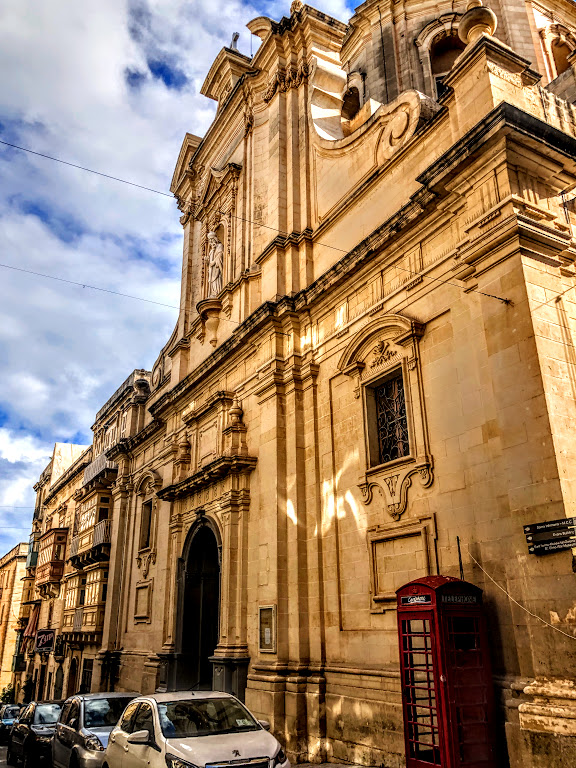
The Church of Saint Nicholas in Valletta (Photograph: Patrick Comerford, 2022)
The Church of Saint Nicholas also known as the Church of All Souls, in Valletta, the capital of Malta, is used by both the Greek Orthodox Church and the Greek Catholic Church.
The church was originally built as a Greek Orthodox church in 1569. It was handed over to the Confraternity of the Souls in Purgatory in 1639, which rebuilt the church in the Baroque style in 1652. Since 2014, the church has been used by both a parish of the Ecumenical Patriarchate of Constantinople and a Greek Catholic parish.
9, Cattedrale di San Nicolò di Mira, Noto, Sicily
The Duomo or Cattedrale di San Nicolò di Mira in Noto, Sicily (Photograph: Patrick Comerford)
The old city of Noto was destroyed by the 1693 earthquake, and a new city was then built on the bank of River Asinaro, nearer the Ionian Sea. The new city was the vision of Giuseppe Lanza, Duke of Camastra, and was laid out on a grid system by Giovanni Battista Landolina. The architects Rosario Gagliardi, Vincenzo Sinatra, Paolo Labisi, Francesco Sortino and others, made the new Noto a masterpiece of Sicilian Baroque.
Most of the buildings are built with a soft tufa stone, and in the summer sunlight they reflect a warm, bright honey tone. They include cathedrals, churches, convents, bell towers, religious buildings, and several palaces. Halfway along the Corso Vittorio Emanuele, in the Piazza del Municipio, Noto’s imposing cathedral or Duomo, the Cattedrale di San Nicolò di Mira, in the Piazza, was finished in 1776. Dozens of steps climb up to the towering cathedral its twin towers and an imposing dome that was restored after it collapsed dramatically in 1996.
Noto and its churches were declared a World Heritage Site by Unesco in 2002.
10, The Church of San Nicolás de Bari and San Pedro Mártir, Valencia
The Church of San Nicolás de Bari and San Pedro Mártir has been called the ‘Sistine Chapel’ of Valencia (Photograph: Patrick Comerford)
The Church of San Nicolás de Bari and San Pedro Mártir has been called the ‘Sistine Chapel’ of Valencia and a ‘Baroque jewel’. It is one of the finest examples of a Gothic church with baroque decorations. Frescoes and plasterwork cover the entire interior, from small pilasters in chapels, to the walls, apse and vaulted ceiling, creating a visual and colour spectacle.
The Church of Saint Nicholas was built ca 1242, and is tucked in the streets of the old town in Valencia. It almost hidden from view in a laneway off Calle Caballeros, adding to the surprise awaiting visitors. The church stands on the site of a Roman-Hispanic temple that later became a mosque with the Muslim conquest of the area. It was founded in the 13th century as one of the first 12 parish churches in the city following the reconquest of Valencia by King James I in 1238, and from an early stage was associated with the Dominicans.
The church was remodelled on the initiative of the Borja family in the Gothic style between 1419 and 1455, with the Gothic rib vault contracting in the central nave. The refurbishments include a rose window alluding to a miracle of Saint Nicholas. The interior was completed between 1690 and 1693, and was decorated in the baroque style by Juan Pérez Castiel, who filled it with frescoes depicting the lives and miracles of the two patrons, Saint Nicholas of Bari and Saint Peter of Verona or San Pedro Mártir (Saint Peter Martyr).
11, Saint Nicholas, Bratislava, Slovakia:
Saint Nicholas Church (left) seen from the ramparts of Bratislava Castle (Photograph: Patrick Comerford)
On my way down the hill from Bratislava Castle during a visit three years ago, I stopped to look at the locked Saint Nicholas Church, an Orthodox church built in 1661 by Countess Frances Khuen, the widow of Paul Pálffy (1589-1655), before she died 1672.
This early baroque church is simple, single nave church with a small wooden bell tower. It was built on the site of an earlier Gothic church dating back to the 11th century. After the castle area was incorporated into Bratislava, the church was administrated by a Catholic funeral society in Saint Martin's parish.
The church was no longer in use by 1936 when it was given to the Greek Catholic Church of Bratislava, an Orthodox-style church in communion with Rome. At the end of World War II in 1945, the church roof caught fire and the church was rebuilt by the Greek Catholic Church in 1945-1950. A violent persecution of the Greek Catholic Church in Slovakia began in 1950 and the church was given to the Orthodox Church.
12, Saint Nicholas Church, Gemiler Island, Turkey:
Saint Nicholas Church on Gemiler Island … was this is true burial place of Saint Nicholas? (Photograph: Patrick Comerford)
Gemiler Island is off the coast of Turkey, between near the city of Fethiye and the Greek island of Rhodes. The Turkish name Gemile from the Greek καμήλα (kamila, ‘camel’). The island has several church ruins on Gemiler, dating from the fourth and sixth centuries.
Archaeologists believe Saint Nicholas was buried there after his death in 326. His relics remained there until the 650s, when the island was abandoned as it was threatened by an Arab fleet. They were then moved to Myra, 40 km to the east.
Lighting candles at the chapel of Aghios Nikolaos on an islet off Georgioupoli in Crete (Photograph: Patrick Comerford)
Showing posts with label Aghios Nikólaos. Show all posts
05 December 2022
A ‘virtual tour’ of a dozen
churches and cathedrals
named after Saint Nicholas
Labels:
Aghios Nikólaos,
Bratislava,
Chania,
Christmas 2022,
Crete,
Czech Republic,
Fethiye,
Georgioupoli,
Greece,
Greece 2022,
Malta 2022,
Noto,
Prague,
Rethymnon,
Saint Nicholas,
Sicily,
Turkey,
Valencia,
Valletta
28 July 2020
Waiting for the ferry with
memories of Crete and
‘Who pays the Ferryman’
‘Who pays the Ferryman’ was filmed in Elounda (Photograph: Patrick Comerford)
Patrick Comerford
As we have waited patiently on both sides of the Shannon Estuary in recent weeks for the Tarbert-Killimer ferry on many occasions, the conversation has often turned to the theme music for Who pays the Ferryman, and one of us has – inevitably – ended up trying to hum the tune.
I suppose you have to be of a certain age to remember the series, but the tune stays in your memory. And memories of the series linger because it was set in Crete in 1977-1978, just ten years before I first arrived on the island.
Who pays the Ferryman was a BBC series, retelling the story of widower and retired boat builder Alan Haldane (Jack Hedley), a former soldier who had fought in Crete alongside the Greek resistance in World War II, and returns to Crete 30 years later to rediscover a lost sense of belonging.
Of course, his past comes back to haunt the man once known as Leandros and make difficult what he hopes would be a simple life.
The series was filmed in Elounda, near Aghios Nikolaos in Crete. The theme music was composed by Yannis Markopoulos and became an instant hit in Britain, where it is still rated among the best television scores. The music stands out because of its lyricism and its melody and of because it so easily creates memories of the Greek islands.
The eight episodes of Who Pays the Ferryman? were written by Michael J Bird, who drew on his knowledge of the history and folklore of Crete, and the series was filmed on location in and around Elounda.
‘The Lotus Eaters’ was filmed in Aghios Nikolaos in Crete (Photograph: Patrick Comerford)
The series followed on the success of Bird’s earlier BBC drama series, The Lotus Eaters, which was filmed in Aghios Nikoloas in 1972-1973. That earlier series deal with the lives of various British ‘expats’ living in Crete, including a married couple, Erik (Ian Hendry) and Ann Shepherd (Wanda Ventham), who ran a taverna called ‘Shepherd’s Bar.’
The Lotus Eaters became the first the Mediterranean-based dramas written by Michael J Bird for the BBC. The others included Who Pays the Ferryman?, also set in Crete, The Aphrodite Inheritance (1978-1979), set in Cyprus, and The Dark Side of the Sun, set in Rhodes.
The theme tune of Who Pays the Ferryman? was composed by Yannis Markopoulos, reached the UK singles charts in late 1977 and early 1978. Yannis (or Giannis) Markopoulos is a well-known and much-loved Greek composer who was born in Iraklion, the capital of Crete, on 18 March 1939.
He comes from an old family in Crete, and spent much of his childhood in the coastal town of Ierapetra. He says the sounds that influenced him during his childhood included the sounds of the Byzantine liturgy, Cretan traditional music, the waves of Crete, and the sound of land-mines being exploded after World War II.
He took his first lessons in music theory and the violin at the local conservatory and played the clarinet in the town band. He moved to Athens in 1956 to study at the Athens Conservatoire with the composer Yiorgos Sklavos and the violin teacher Joseph Bustidui.
As a student, Markopoulos composed music for theatre, cinema and dance performances. At 24, he received the Music Prize at the International Thessaloniki Film Festival for Nikos Koundouros’ film Young Aphrodites.
After the colonels’ coup in Greece in 1967, he left for London, where he composed the secular cantata Ilios o Protos (‘Sun the First’), based on the poetry of Odysseas Elytis, who received the Nobel Prize for Literature in 1979.
Markopoulos returned to Athens in 1969, and became involved in the struggle for democracy. In 1976, he composed the popular work The Free Besieged based on the poem by Greece’s national poet Dionysios Solomos.
A small boat outside the harbour in Elounda (Photograph: Patrick Comerford)
He composed the theme music for Who Pays the Ferryman? in 1979, and it became a hit in Britain and brought his work to international attention. He married the singer Vassiliki Lavina in 1980.
He founded the Palintonos Armonia Orchestra in 1980, and has performed and recorded in Greece and abroad since then. He composed The Liturgy of Orpheus in 1994, followed by Re-Naissance: Crete between Venice and Constantinople, a musical journey in four units that strikes a balance between the opera form and that of the oratorio, and the opera Erotokritos and Areti.
As time passes and travel restrictions become difficult to predict, it looks increasingly likely that this could be one of the few years since the mid-1980s that I do not get back to Greece.
I may just have to find some old versions of that BBC series set in Crete and imagine myself on a ferry or as a lotus eater.
Patrick Comerford
As we have waited patiently on both sides of the Shannon Estuary in recent weeks for the Tarbert-Killimer ferry on many occasions, the conversation has often turned to the theme music for Who pays the Ferryman, and one of us has – inevitably – ended up trying to hum the tune.
I suppose you have to be of a certain age to remember the series, but the tune stays in your memory. And memories of the series linger because it was set in Crete in 1977-1978, just ten years before I first arrived on the island.
Who pays the Ferryman was a BBC series, retelling the story of widower and retired boat builder Alan Haldane (Jack Hedley), a former soldier who had fought in Crete alongside the Greek resistance in World War II, and returns to Crete 30 years later to rediscover a lost sense of belonging.
Of course, his past comes back to haunt the man once known as Leandros and make difficult what he hopes would be a simple life.
The series was filmed in Elounda, near Aghios Nikolaos in Crete. The theme music was composed by Yannis Markopoulos and became an instant hit in Britain, where it is still rated among the best television scores. The music stands out because of its lyricism and its melody and of because it so easily creates memories of the Greek islands.
The eight episodes of Who Pays the Ferryman? were written by Michael J Bird, who drew on his knowledge of the history and folklore of Crete, and the series was filmed on location in and around Elounda.
‘The Lotus Eaters’ was filmed in Aghios Nikolaos in Crete (Photograph: Patrick Comerford)
The series followed on the success of Bird’s earlier BBC drama series, The Lotus Eaters, which was filmed in Aghios Nikoloas in 1972-1973. That earlier series deal with the lives of various British ‘expats’ living in Crete, including a married couple, Erik (Ian Hendry) and Ann Shepherd (Wanda Ventham), who ran a taverna called ‘Shepherd’s Bar.’
The Lotus Eaters became the first the Mediterranean-based dramas written by Michael J Bird for the BBC. The others included Who Pays the Ferryman?, also set in Crete, The Aphrodite Inheritance (1978-1979), set in Cyprus, and The Dark Side of the Sun, set in Rhodes.
The theme tune of Who Pays the Ferryman? was composed by Yannis Markopoulos, reached the UK singles charts in late 1977 and early 1978. Yannis (or Giannis) Markopoulos is a well-known and much-loved Greek composer who was born in Iraklion, the capital of Crete, on 18 March 1939.
He comes from an old family in Crete, and spent much of his childhood in the coastal town of Ierapetra. He says the sounds that influenced him during his childhood included the sounds of the Byzantine liturgy, Cretan traditional music, the waves of Crete, and the sound of land-mines being exploded after World War II.
He took his first lessons in music theory and the violin at the local conservatory and played the clarinet in the town band. He moved to Athens in 1956 to study at the Athens Conservatoire with the composer Yiorgos Sklavos and the violin teacher Joseph Bustidui.
As a student, Markopoulos composed music for theatre, cinema and dance performances. At 24, he received the Music Prize at the International Thessaloniki Film Festival for Nikos Koundouros’ film Young Aphrodites.
After the colonels’ coup in Greece in 1967, he left for London, where he composed the secular cantata Ilios o Protos (‘Sun the First’), based on the poetry of Odysseas Elytis, who received the Nobel Prize for Literature in 1979.
Markopoulos returned to Athens in 1969, and became involved in the struggle for democracy. In 1976, he composed the popular work The Free Besieged based on the poem by Greece’s national poet Dionysios Solomos.
A small boat outside the harbour in Elounda (Photograph: Patrick Comerford)
He composed the theme music for Who Pays the Ferryman? in 1979, and it became a hit in Britain and brought his work to international attention. He married the singer Vassiliki Lavina in 1980.
He founded the Palintonos Armonia Orchestra in 1980, and has performed and recorded in Greece and abroad since then. He composed The Liturgy of Orpheus in 1994, followed by Re-Naissance: Crete between Venice and Constantinople, a musical journey in four units that strikes a balance between the opera form and that of the oratorio, and the opera Erotokritos and Areti.
As time passes and travel restrictions become difficult to predict, it looks increasingly likely that this could be one of the few years since the mid-1980s that I do not get back to Greece.
I may just have to find some old versions of that BBC series set in Crete and imagine myself on a ferry or as a lotus eater.
Labels:
Aghios Nikólaos,
BBC,
boats,
Crete 2020,
Drama,
Elounda,
Elytis,
Iraklion,
Music
03 December 2017
How the real gift-giving
Saint Nicholas of Myra
became Santa Claus
An icon of Saint Nicholas in a church in Crete … how did he become Santa Claus? (Photograph: Patrick Comerford, 2017)
Patrick Comerford
When Jerpoint Abbey was founded in Co Kilkenny during the reign of Henry II, it was important to persuade local people that the monastery was of divine origin and had supernatural powers. To support their claims, the Cistercian monks needed a saint buried there who had a reputation as a miracle worker.
The story developed that Jerpoint was the burial place of Saint Nicholas who had lived in Myra, in present-day Turkey, until he died on 6 December 343.
In 809, Myra was captured by Harun al-Rashid and his Muslim force. It fell again to Muslim conquerors between 1081 and 1118. Taking advantage of the confusion, sailors from the port of Bari in southern Italy collected half the skeleton of Saint Nicholas in Myra in 1087, leaving the rest of his remains in the grave. The remaining remains were collected a decade later by Venetian sailors during the First Crusade (1096-1099).
The first part of the body arrived in Bari in 1087. The remaining bones were taken to Venice in 1100.
Saint Nicholas Church on Gemile Island … was this is true burial place of Saint Nicholas? (Photograph: Patrick Comerford)
Another grave attributed to Saint Nicholas also exists on the small Turkish island of Gemile, between Fethiye and Rhodes, and some historians say this is his original grave.
But a local story in Co Kilkenny says a band of Irish-Norman knights from Jerpoint travelled to the Holy Land with the Crusades, seized Saint Nicholas’s remains as they headed back to Ireland, and buried his bones in Jerpoint.
Another version says a Norman family called de Frainet or Frenet removed Saint Nicholas’s remains from Myra to Bari in 1169 and later brought the relics to be buried in 1200 in Jerpoint. A graveslab from the 1300s has an image of a cleric, said to be Saint Nicholas, and two other heads said to represent the crusaders who brought his relics to Ireland.
Finding the true saint
The mediaeval church of Saint Nicholas in Aghios Nikolaos (Photograph: Patrick Comerford)
This month, on 6 December, the Church commemorates Saint Nicholas, Bishop of Myra, who was also one of the fathers of the Council of Nicaea and became the role model for Santa Claus.
Saint Nicholas, whose name means ‘Victory of the People,’ was born in Myra in Lycia, now known as Demre, near Antalya in present-day Turkey. He had a reputation as a secret giver of gifts, such as putting coins in the shoes of poor children, and because of this, perhaps, he was transformed into our present-day Santa Claus.
King’s College Cambridge … founded as the King’s College of Our Lady and Saint Nicholas (Photograph: Patrick Comerford, 2017)
Saint Nicholas is also the patron saint of sailors, seafarers, merchants, archers, pawnbrokers, children and students, and the patron saint of Amsterdam, Liverpool and other port cities. King’s College, Cambridge, known for the Service of Nine Lessons and Carols on Christmas Eve, was founded in 1441 as the King’s College of Our Lady and Saint Nicholas in Cambridge.
Legend says that young Nicholas was sent to Alexandria as a student. On the voyage, he is said to have saved the life of a sailor who fell from the ship’s rigging in a storm. In one version, on their arrival back in Myra Nicholas took the sailor to church. The previous Bishop of Myra had just died, and the freshly-returned, heroic Nicholas was elected his successor.
The Venetian Cathedral of Saint Nicholas on the Fortezza in Rethymnon, Crete … turned into the Sultan Ibraim Han Mosque by the Turks in the 17th century (Photograph: Patrick Comerford)
Another story tells how during a famine, a butcher lured three small children into his house, slaughtered and butchered them, and put their bodies in a pork barrel to sell as meat pies. Saint Nicholas, who heard of the horrific plans, raised the three boys back to life through his prayers.
Saint Nicholas of Myra Church in inner city Dublin (Photograph: Patrick Comerford)
The best-known story tells how a poor man had three daughters but could not afford proper dowries for them, meaning they would remain unmarried or become prostitutes. Saint Nicholas secretly went to their house under cover of darkness and threw three purses filled with gold, one for each daughter, through the window – or down the chimney.
Defender of the Church
The minaret of the Nerantze mosque in Rethymnon … the mosque became Saint Nicholas Church in 1925 (Photograph: Patrick Comerford, 2017)
I prefer the stories that link Saint Nicholas with the defence of true doctrine. In the year 325, the Emperor Constantine convened the Council of Nicaea, attended by more than 300 bishops, to debate the nature of the Holy Trinity.
It was one of the most intense theological debates in the early Church. Arius from Alexandria was teaching that Christ was the Son of God but was not equal to God the Father. As Arius argued his position at length, Nicholas became agitated, crossed the room, and slapped Arius across the face.
The shocked bishops stripped Nicholas of his episcopal robes, chained him and jailed him. In the morning, the bishops found his chains on the floor and Nicholas dressed in his episcopal robes, quietly reading the Scriptures. Constantine ordered his release, and Nicholas was reinstated as the Bishop of Myra.
As the debate went on, the Council of Nicaea agreed with his views, deciding against Arius and agreeing on the Nicene Creed, which remains the symbol of our faith.
Saint Nicholas and his churches
Aghios Nikoloas in Crete takes its name from Saint Nicholas (Photograph: Patrick Comerford)
Saint Nicholas is associated with churches throughout Greece, and has given his name to the harbour town of Aghios Nikolaos in Crete. The town is built around an inner lagoon, Voulismeni, and local people try to convince visiting tourists that the lake is fathomless.
The town takes its name from the tiny 11th century church of Aghios Nikólaos (Saint Nicholas). Many years ago, a visit to this Church of Aghios Nikólaos, with its icons of the saint, was enough to end the doubts about Santa Claus that were beginning to emerge in hearts of two small children.
Saint Nicholas also gave his name to the monastic island of Saint Nicholas, now known as Gemile Island, close to the Ölüdeniz Lagoon and about 9 km south of Fethiye on the Anatolian coast of Turkey. The island is just beneath the town of Levessi or Kayaköy.
Saint Nicholas Island had numerous churches, chapels and schools, and was home to a significant Greek-speaking population until the last century. Then, like their neighbours in the nearby mainland town of Levessi, they were forced to leave their homes in the horrific wave of ‘ethnic cleansing’ that swept Anatolia in the 1920s.
The people of Levessi and their story inspired the novel Birds Without Wings (2004) by Louis de Bernières, his prequel to Captain Corelli’s Mandolin (1993).
Tourists pile onto the island every day during the holiday season as part of a sailing tour of the Twelve Islands off Fethiye. But few notice the ruins that were once family homes and churches or ask about the original inhabitants, why they were forced to leave, or why their churches and chapels no longer echo with the Divine Liturgy.
From Europe to America
Nicholas Street was the High Street of mediaeval Limerick … the site of Saint Nicholas Church is on the left (Photograph: Patrick Comerford, 2017)
As the patron of sailors, Saint Nicholas was popular among mediaeval seafarers. He gave his name to churches in many port cities, including Saint Nicholas Within-the-Walls and Saint Nicholas Without-the-Walls in Dublin, Saint Nicholas Church on the mediaeval High Street of Limerick, now known as Nicholas Street, churches in Adare, Co Limerick, and Dundalk, Co Louth, and the Collegiate Church of Saint Nicholas in Galway.
A mediaeval archaeological site close to the site of Saint Nicholas Church in Limerick (Photograph: Patrick Comerford, 2017)
Columbus named a port in Haiti after Saint Nicholas on 6 December 1492 – perhaps recalling his stop-off in Galway and a visit to Saint Nicholas Collegiate Church. But how did the kindly Bishop Nicholas end up as a roly-poly red-suited American symbol for a secular holiday festivity and commercial busyness?
The first European seafarers to arrive in North America brought their devotion to Saint Nicholas with them: the Vikings dedicated a cathedral to him in Greenland; centuries later in Florida, the Spaniards named an early settlement Saint Nicholas Ferry – now known as Jacksonville.
But there is scant evidence to support traditions that Saint Nicholas was popular in the Dutch New Netherlands.
An unhistorical history
Saint Nicholas Church in Dundalk, Co Louth (Photograph: Patrick Comerford)
After the American Revolution, New Yorkers remembered the colony’s nearly-forgotten Dutch roots. John Pintard, who formed the New York Historical Society in 1804, promoted Saint Nicholas as the patron of his society and his city. Washington Irving joined the society in 1809 and published the satirical fiction, Knickerbocker’s History of New York, with numerous references to a jolly Saint Nicholas character – not a saintly bishop, but an elfin Dutch burgher with a clay pipe.
And so, began the legends about Saint Nicholas and New Amsterdam: that the first Dutch emigrant ship had a figurehead of Saint Nicholas; that Saint Nicholas Day was observed in the colony; that the first church was dedicated to him; and that Saint Nicholas comes down chimneys to bring gifts.
Saint Nicholas Church in Adare, Co Limerick (Photograph: Patrick Comerford)
Inside Saint Nicholas Church, Adare, Co Limerick (Photograph: Patrick Comerford, 2017)
The New York Historical Society held its first Saint Nicholas anniversary dinner on 6 December 1810, and in an image by Alexander Anderson for the occasion, Saint Nicholas was shown in a gift-giving role with children’s treats in stockings hanging at a fireplace.
Other artists and writers continued the transformation of Saint Nicholas from a saintly bishop to an elf-like jolly, rotund gift-giver. In 1863, the cartoonist Thomas Nast began a series of drawings in Harper’s Weekly, based on the descriptions in Washington Irving’s fiction and Clement Clarke Moore’s poem, ‘A Visit from Saint Nicholas’ or ‘The Night Before Christmas.’ These drawings established a rotund Santa with flowing beard, fur garments, and a clay pipe, and the saint’s name shifted to Santa Claus – a phonetic alteration from the German Sankt Niklaus and the Dutch Sinterklaas.
By the end of the 1920s, a standard American Santa – life-sized, dressed in a red, fur-trimmed suit – was being portrayed by popular illustrators. In 1931, Coca Cola began 35 years of Santa advertisements that popularised and established this Santa as an icon of contemporary commercial culture.
Santa’s commercial success led to the North American Santa Claus being exported around the world, displacing the European Saint Nicholas who and his identity as a bishop and saint.
Saint, Santa and refugees
How was Saint Nicholas transformed into the modern Santa Claus? … a shop display in Limerick (Photograph: Patrick Comerford, 2017)
The metamorphosis of Saint Nicolas into the commercial Santa Claus recently came to his home town of Demre, the modern Turkish town near the ruins of ancient Myra.
Saint Nicholas is a popular Orthodox saint and the city attracts many Russian tourists. The Russian government donated a bronze statue of the saint to the city in 2000, and was it erected on the square in front of the mediaeval Church of Saint Nicholas.
But in 2005, the mayor replaced the statue with by a red-suited plastic Santa Claus. After Russian protests, the statue was returned, but to a secluded corner near the church. A third statue was erected showing Saint Nicholas as a modern-day Turk – although the Turks did not arrive in Anatolia until the 11th century. The church is being restored, and the Turkish Ministry of Culture has given limited permission for the Orthodox Church to celebrate the Divine Liturgy there.
But as Christmas approaches, I cannot forget the children of Levessi and Saint Nicholas Island, whose descendants have a very different idea of a stay-at-home Christmas.
Santa and the elves … more about Coca Cola than the Council of Nicaea (Photograph: Patrick Comerford)
(Revd Canon Professor) Patrick Comerford is Priest-in-Charge of the Rathkeale and Kilnaughtin Group of Parishes. This feature was first published in December 2017 in the ‘Church Review’ (Dublin and Glendalough) and the ‘Diocesan Magazine’ (Cashel, Ferns and Leighlin)
The picturesque modern Church of Saint Nicholas on a tiny islet off Georgioupoli in Crete (Photograph: Patrick Comerford, 2017)
Patrick Comerford
When Jerpoint Abbey was founded in Co Kilkenny during the reign of Henry II, it was important to persuade local people that the monastery was of divine origin and had supernatural powers. To support their claims, the Cistercian monks needed a saint buried there who had a reputation as a miracle worker.
The story developed that Jerpoint was the burial place of Saint Nicholas who had lived in Myra, in present-day Turkey, until he died on 6 December 343.
In 809, Myra was captured by Harun al-Rashid and his Muslim force. It fell again to Muslim conquerors between 1081 and 1118. Taking advantage of the confusion, sailors from the port of Bari in southern Italy collected half the skeleton of Saint Nicholas in Myra in 1087, leaving the rest of his remains in the grave. The remaining remains were collected a decade later by Venetian sailors during the First Crusade (1096-1099).
The first part of the body arrived in Bari in 1087. The remaining bones were taken to Venice in 1100.
Saint Nicholas Church on Gemile Island … was this is true burial place of Saint Nicholas? (Photograph: Patrick Comerford)
Another grave attributed to Saint Nicholas also exists on the small Turkish island of Gemile, between Fethiye and Rhodes, and some historians say this is his original grave.
But a local story in Co Kilkenny says a band of Irish-Norman knights from Jerpoint travelled to the Holy Land with the Crusades, seized Saint Nicholas’s remains as they headed back to Ireland, and buried his bones in Jerpoint.
Another version says a Norman family called de Frainet or Frenet removed Saint Nicholas’s remains from Myra to Bari in 1169 and later brought the relics to be buried in 1200 in Jerpoint. A graveslab from the 1300s has an image of a cleric, said to be Saint Nicholas, and two other heads said to represent the crusaders who brought his relics to Ireland.
Finding the true saint
The mediaeval church of Saint Nicholas in Aghios Nikolaos (Photograph: Patrick Comerford)
This month, on 6 December, the Church commemorates Saint Nicholas, Bishop of Myra, who was also one of the fathers of the Council of Nicaea and became the role model for Santa Claus.
Saint Nicholas, whose name means ‘Victory of the People,’ was born in Myra in Lycia, now known as Demre, near Antalya in present-day Turkey. He had a reputation as a secret giver of gifts, such as putting coins in the shoes of poor children, and because of this, perhaps, he was transformed into our present-day Santa Claus.
King’s College Cambridge … founded as the King’s College of Our Lady and Saint Nicholas (Photograph: Patrick Comerford, 2017)
Saint Nicholas is also the patron saint of sailors, seafarers, merchants, archers, pawnbrokers, children and students, and the patron saint of Amsterdam, Liverpool and other port cities. King’s College, Cambridge, known for the Service of Nine Lessons and Carols on Christmas Eve, was founded in 1441 as the King’s College of Our Lady and Saint Nicholas in Cambridge.
Legend says that young Nicholas was sent to Alexandria as a student. On the voyage, he is said to have saved the life of a sailor who fell from the ship’s rigging in a storm. In one version, on their arrival back in Myra Nicholas took the sailor to church. The previous Bishop of Myra had just died, and the freshly-returned, heroic Nicholas was elected his successor.
The Venetian Cathedral of Saint Nicholas on the Fortezza in Rethymnon, Crete … turned into the Sultan Ibraim Han Mosque by the Turks in the 17th century (Photograph: Patrick Comerford)
Another story tells how during a famine, a butcher lured three small children into his house, slaughtered and butchered them, and put their bodies in a pork barrel to sell as meat pies. Saint Nicholas, who heard of the horrific plans, raised the three boys back to life through his prayers.
Saint Nicholas of Myra Church in inner city Dublin (Photograph: Patrick Comerford)
The best-known story tells how a poor man had three daughters but could not afford proper dowries for them, meaning they would remain unmarried or become prostitutes. Saint Nicholas secretly went to their house under cover of darkness and threw three purses filled with gold, one for each daughter, through the window – or down the chimney.
Defender of the Church
The minaret of the Nerantze mosque in Rethymnon … the mosque became Saint Nicholas Church in 1925 (Photograph: Patrick Comerford, 2017)
I prefer the stories that link Saint Nicholas with the defence of true doctrine. In the year 325, the Emperor Constantine convened the Council of Nicaea, attended by more than 300 bishops, to debate the nature of the Holy Trinity.
It was one of the most intense theological debates in the early Church. Arius from Alexandria was teaching that Christ was the Son of God but was not equal to God the Father. As Arius argued his position at length, Nicholas became agitated, crossed the room, and slapped Arius across the face.
The shocked bishops stripped Nicholas of his episcopal robes, chained him and jailed him. In the morning, the bishops found his chains on the floor and Nicholas dressed in his episcopal robes, quietly reading the Scriptures. Constantine ordered his release, and Nicholas was reinstated as the Bishop of Myra.
As the debate went on, the Council of Nicaea agreed with his views, deciding against Arius and agreeing on the Nicene Creed, which remains the symbol of our faith.
Saint Nicholas and his churches
Aghios Nikoloas in Crete takes its name from Saint Nicholas (Photograph: Patrick Comerford)
Saint Nicholas is associated with churches throughout Greece, and has given his name to the harbour town of Aghios Nikolaos in Crete. The town is built around an inner lagoon, Voulismeni, and local people try to convince visiting tourists that the lake is fathomless.
The town takes its name from the tiny 11th century church of Aghios Nikólaos (Saint Nicholas). Many years ago, a visit to this Church of Aghios Nikólaos, with its icons of the saint, was enough to end the doubts about Santa Claus that were beginning to emerge in hearts of two small children.
Saint Nicholas also gave his name to the monastic island of Saint Nicholas, now known as Gemile Island, close to the Ölüdeniz Lagoon and about 9 km south of Fethiye on the Anatolian coast of Turkey. The island is just beneath the town of Levessi or Kayaköy.
Saint Nicholas Island had numerous churches, chapels and schools, and was home to a significant Greek-speaking population until the last century. Then, like their neighbours in the nearby mainland town of Levessi, they were forced to leave their homes in the horrific wave of ‘ethnic cleansing’ that swept Anatolia in the 1920s.
The people of Levessi and their story inspired the novel Birds Without Wings (2004) by Louis de Bernières, his prequel to Captain Corelli’s Mandolin (1993).
Tourists pile onto the island every day during the holiday season as part of a sailing tour of the Twelve Islands off Fethiye. But few notice the ruins that were once family homes and churches or ask about the original inhabitants, why they were forced to leave, or why their churches and chapels no longer echo with the Divine Liturgy.
From Europe to America
Nicholas Street was the High Street of mediaeval Limerick … the site of Saint Nicholas Church is on the left (Photograph: Patrick Comerford, 2017)
As the patron of sailors, Saint Nicholas was popular among mediaeval seafarers. He gave his name to churches in many port cities, including Saint Nicholas Within-the-Walls and Saint Nicholas Without-the-Walls in Dublin, Saint Nicholas Church on the mediaeval High Street of Limerick, now known as Nicholas Street, churches in Adare, Co Limerick, and Dundalk, Co Louth, and the Collegiate Church of Saint Nicholas in Galway.
A mediaeval archaeological site close to the site of Saint Nicholas Church in Limerick (Photograph: Patrick Comerford, 2017)
Columbus named a port in Haiti after Saint Nicholas on 6 December 1492 – perhaps recalling his stop-off in Galway and a visit to Saint Nicholas Collegiate Church. But how did the kindly Bishop Nicholas end up as a roly-poly red-suited American symbol for a secular holiday festivity and commercial busyness?
The first European seafarers to arrive in North America brought their devotion to Saint Nicholas with them: the Vikings dedicated a cathedral to him in Greenland; centuries later in Florida, the Spaniards named an early settlement Saint Nicholas Ferry – now known as Jacksonville.
But there is scant evidence to support traditions that Saint Nicholas was popular in the Dutch New Netherlands.
An unhistorical history
Saint Nicholas Church in Dundalk, Co Louth (Photograph: Patrick Comerford)
After the American Revolution, New Yorkers remembered the colony’s nearly-forgotten Dutch roots. John Pintard, who formed the New York Historical Society in 1804, promoted Saint Nicholas as the patron of his society and his city. Washington Irving joined the society in 1809 and published the satirical fiction, Knickerbocker’s History of New York, with numerous references to a jolly Saint Nicholas character – not a saintly bishop, but an elfin Dutch burgher with a clay pipe.
And so, began the legends about Saint Nicholas and New Amsterdam: that the first Dutch emigrant ship had a figurehead of Saint Nicholas; that Saint Nicholas Day was observed in the colony; that the first church was dedicated to him; and that Saint Nicholas comes down chimneys to bring gifts.
Saint Nicholas Church in Adare, Co Limerick (Photograph: Patrick Comerford)
Inside Saint Nicholas Church, Adare, Co Limerick (Photograph: Patrick Comerford, 2017)
The New York Historical Society held its first Saint Nicholas anniversary dinner on 6 December 1810, and in an image by Alexander Anderson for the occasion, Saint Nicholas was shown in a gift-giving role with children’s treats in stockings hanging at a fireplace.
Other artists and writers continued the transformation of Saint Nicholas from a saintly bishop to an elf-like jolly, rotund gift-giver. In 1863, the cartoonist Thomas Nast began a series of drawings in Harper’s Weekly, based on the descriptions in Washington Irving’s fiction and Clement Clarke Moore’s poem, ‘A Visit from Saint Nicholas’ or ‘The Night Before Christmas.’ These drawings established a rotund Santa with flowing beard, fur garments, and a clay pipe, and the saint’s name shifted to Santa Claus – a phonetic alteration from the German Sankt Niklaus and the Dutch Sinterklaas.
By the end of the 1920s, a standard American Santa – life-sized, dressed in a red, fur-trimmed suit – was being portrayed by popular illustrators. In 1931, Coca Cola began 35 years of Santa advertisements that popularised and established this Santa as an icon of contemporary commercial culture.
Santa’s commercial success led to the North American Santa Claus being exported around the world, displacing the European Saint Nicholas who and his identity as a bishop and saint.
Saint, Santa and refugees
How was Saint Nicholas transformed into the modern Santa Claus? … a shop display in Limerick (Photograph: Patrick Comerford, 2017)
The metamorphosis of Saint Nicolas into the commercial Santa Claus recently came to his home town of Demre, the modern Turkish town near the ruins of ancient Myra.
Saint Nicholas is a popular Orthodox saint and the city attracts many Russian tourists. The Russian government donated a bronze statue of the saint to the city in 2000, and was it erected on the square in front of the mediaeval Church of Saint Nicholas.
But in 2005, the mayor replaced the statue with by a red-suited plastic Santa Claus. After Russian protests, the statue was returned, but to a secluded corner near the church. A third statue was erected showing Saint Nicholas as a modern-day Turk – although the Turks did not arrive in Anatolia until the 11th century. The church is being restored, and the Turkish Ministry of Culture has given limited permission for the Orthodox Church to celebrate the Divine Liturgy there.
But as Christmas approaches, I cannot forget the children of Levessi and Saint Nicholas Island, whose descendants have a very different idea of a stay-at-home Christmas.
Santa and the elves … more about Coca Cola than the Council of Nicaea (Photograph: Patrick Comerford)
(Revd Canon Professor) Patrick Comerford is Priest-in-Charge of the Rathkeale and Kilnaughtin Group of Parishes. This feature was first published in December 2017 in the ‘Church Review’ (Dublin and Glendalough) and the ‘Diocesan Magazine’ (Cashel, Ferns and Leighlin)
The picturesque modern Church of Saint Nicholas on a tiny islet off Georgioupoli in Crete (Photograph: Patrick Comerford, 2017)
11 July 2017
The Greeks have a word
for it: (14) mañana
Lost among the lotus eaters? … the long stretch of beach east of Rethymnon at Platanes, with the Fortezza in the background and the White Mountains (Photograph: Patrick Comerford, 2017)
Patrick Comerford
The story is told of a tourist who asked whether there is a Greek word that translates mañana.
The Greek who was asked the question thought long and pondered for a while on the word αύριο (avrio), but then replied:
‘Yes, but it does not convey the same sense of urgency.’
I have managed to spend time at the beach in Platanes most days during these past two weeks in Rethymnon, or go for a swim in the pool.
There have been days in the mountains, visits to churches, monasteries, lakes, museums, galleries and exhibitions. There have been evening strolls to view sunsets. And there have been long meetings, meals and lengthy conversations with old friends.
But sometimes – just sometimes – as I laze on the beach, reading books and newspapers, enjoying the sunshine and swimming in the Mediterranean, I feel I might be among the lotus eaters.
In Greek mythology, the lotus-eaters (λωτοφάγοι, lōtophagoi) were a people living on an island over-run by lotus plants. The lotus fruits and flowers were the primary food on the island and were a narcotic, causing the inhabitants to sleep in peaceful apathy.
In the Odyssey, Homer tells how adverse north winds blew Odysseus and his crew off course as they were rounding Cape Malea, the southern-most tip of the Peloponnese, as they headed west towards Ithaca.
The crew are entertained by the islanders to a lotus meal, and soon stop caring about the return journey home. Against their wishes, Odysseus forces them back to the ships and to work on the oars.
Scholars differ about the location of the island of the lotus eaters. In the fifth century BC, the historian Herodotus located the Lotus-Eaters on the Libyan coast of north Africa. But others say that if it is an island then Crete was their home.
I have another day or two to go before this holiday ends, but you may have to wean me off my Greek diet before I agree to catch my plane back to Dublin.
‘Mañana.’
Possibly even, Αύριο.
But first I am planning to head up into the mountains again early this morning to visit Arkadi monastery, and hope to spend another afternoon on the beach.
This episode in the Odyssey inspired an episode in Ulysses by James Joyce, and later inspired the BBC television drama series The Lotus Eaters (1972-1973). The series written by Michael J Bird tells the stories of some British expatriates living on Crete and their reasons for being here in the closing days of the colonels’ regime.
The leading characters are Erik (Ian Hendry) and Ann Shepherd (Wanda Ventham), a couple who run a taverna called the Shepherd’s Bar. Ann is a sleeper agent for British Intelligence; Erik has been a broken-down drunk, and Ann has married him as part of her cover.
The Lotus Eaters was filmed in Aghios Nikolaos and of course tells of people who have lost the desire to return home. Eventually, however, as the series title has implied from the beginning, Erik and Ann have to leave Crete. As they leave on a plane from Iraklion, they have a partial reconciliation, for they are the only people each other can trust.
The series was the first of a number of Mediterranean-based dramas written by Michael J Bird for the BBC. The others included Who Pays the Ferryman?, also set in Crete, The Aphrodite Inheritance, based in Cyprus, and The Dark Side of the Sun, located in Rhodes.
The haunting Greek song that is the theme for the series is Τα τρένα που φύγαν (Ta tréna pou fígan, ‘The Trains That Departed’), from the album Hellespont. The music was composed by Stavros Xarchakos and the lyrics were written by Haris Alexiou and Marinella:
Τα τρένα που φύγαν
αγάπες μού πήρανε.
Αγάπες και κλαίνε,
ποια μοίρα τις μοίρανε;
Δώς μου χέρι να πιαστώ
να πιαστώ, να κρατηθώ,
ένα γέλιο, μια ματιά
κι ανασταίνετ' η καρδιά.
Το τρένο σε πήρε
πουλί, χελιδόνι μου.
Σε τύλιξ' η νύχτα
κι ορφάνεψα μόνη μου.
Patrick Comerford
The story is told of a tourist who asked whether there is a Greek word that translates mañana.
The Greek who was asked the question thought long and pondered for a while on the word αύριο (avrio), but then replied:
‘Yes, but it does not convey the same sense of urgency.’
I have managed to spend time at the beach in Platanes most days during these past two weeks in Rethymnon, or go for a swim in the pool.
There have been days in the mountains, visits to churches, monasteries, lakes, museums, galleries and exhibitions. There have been evening strolls to view sunsets. And there have been long meetings, meals and lengthy conversations with old friends.
But sometimes – just sometimes – as I laze on the beach, reading books and newspapers, enjoying the sunshine and swimming in the Mediterranean, I feel I might be among the lotus eaters.
In Greek mythology, the lotus-eaters (λωτοφάγοι, lōtophagoi) were a people living on an island over-run by lotus plants. The lotus fruits and flowers were the primary food on the island and were a narcotic, causing the inhabitants to sleep in peaceful apathy.
In the Odyssey, Homer tells how adverse north winds blew Odysseus and his crew off course as they were rounding Cape Malea, the southern-most tip of the Peloponnese, as they headed west towards Ithaca.
The crew are entertained by the islanders to a lotus meal, and soon stop caring about the return journey home. Against their wishes, Odysseus forces them back to the ships and to work on the oars.
Scholars differ about the location of the island of the lotus eaters. In the fifth century BC, the historian Herodotus located the Lotus-Eaters on the Libyan coast of north Africa. But others say that if it is an island then Crete was their home.
I have another day or two to go before this holiday ends, but you may have to wean me off my Greek diet before I agree to catch my plane back to Dublin.
‘Mañana.’
Possibly even, Αύριο.
But first I am planning to head up into the mountains again early this morning to visit Arkadi monastery, and hope to spend another afternoon on the beach.
This episode in the Odyssey inspired an episode in Ulysses by James Joyce, and later inspired the BBC television drama series The Lotus Eaters (1972-1973). The series written by Michael J Bird tells the stories of some British expatriates living on Crete and their reasons for being here in the closing days of the colonels’ regime.
The leading characters are Erik (Ian Hendry) and Ann Shepherd (Wanda Ventham), a couple who run a taverna called the Shepherd’s Bar. Ann is a sleeper agent for British Intelligence; Erik has been a broken-down drunk, and Ann has married him as part of her cover.
The Lotus Eaters was filmed in Aghios Nikolaos and of course tells of people who have lost the desire to return home. Eventually, however, as the series title has implied from the beginning, Erik and Ann have to leave Crete. As they leave on a plane from Iraklion, they have a partial reconciliation, for they are the only people each other can trust.
The series was the first of a number of Mediterranean-based dramas written by Michael J Bird for the BBC. The others included Who Pays the Ferryman?, also set in Crete, The Aphrodite Inheritance, based in Cyprus, and The Dark Side of the Sun, located in Rhodes.
The haunting Greek song that is the theme for the series is Τα τρένα που φύγαν (Ta tréna pou fígan, ‘The Trains That Departed’), from the album Hellespont. The music was composed by Stavros Xarchakos and the lyrics were written by Haris Alexiou and Marinella:
Τα τρένα που φύγαν
αγάπες μού πήρανε.
Αγάπες και κλαίνε,
ποια μοίρα τις μοίρανε;
Δώς μου χέρι να πιαστώ
να πιαστώ, να κρατηθώ,
ένα γέλιο, μια ματιά
κι ανασταίνετ' η καρδιά.
Το τρένο σε πήρε
πουλί, χελιδόνι μου.
Σε τύλιξ' η νύχτα
κι ορφάνεψα μόνη μου.
06 May 2013
The Mediterranean Diet: a food fad or a recipe for healthy living?
Eating less, living longer ... a table for one in the mountain village of Koutouloufari in Crete (Photograph: Patrick Comerford)
Patrick Comerford
I am not the best person to recommend a diet to anyone – and there are some good reasons for saying that: I’m not a good cook, I’ve never followed a diet, I’m a picky eater because of my vegetarianism, my GP thinks I’m a little overweight and do not exercise enough, and forty years of a strict vegetarian diet have caused a severe B12 deficiency and damaged my joints.
But, despite all this, I enjoy eating out, especially on holidays, and most especially on holidays in Mediterranean countries such as Greece, Cyprus, Italy and Turkey. In fact, truth to tell, I enjoy eating out in this part of Europe too – in particular in Greek, Italian, Turkish and Lebanese restaurants.
So, despite my reluctance to even hint at sharing my food idiosyncrasies, you can imagine my smug feelings when I came across a report a few weeks ago that claims eating a Mediterranean Diet rich in either extra-virgin olive oil or nuts cuts by 30% the risk of death from heart attacks and strokes.
The findings, published online by the New England Journal of Medicine, offer hope to people who are in danger of a heart attack or stroke because they smoke, who have type-2 diabetes or who exhibit other unhealthy characteristics.
The study also confirms that the diet common in southern European countries such as Greece, Spain and Italy, which involves consuming a lot of fruit, vegetables, fish and wine, and only small amounts of red meat or dairy products, offers protection against heart problems.
The trial results
Real food is not fast food ... the boast of restaurant in Aghios Nikolaos in Crete (Photograph: Patrick Comerford)
“The results of our trial might explain, in part, the lower cardiovascular mortality in Mediterranean countries than in northern Europe or the United States,” the authors conclude. The risk of those on the diet having a stroke was significantly reduced, they found.
Spanish researchers, led by Professor Ramon Estruch if Barcelona University, studied 7,447 men aged 55 to 88 and women aged 60 to 80 between 2003 and 2009.
Eating out in the sunshine in Tuscany (Photograph: Patrick Comerford)
None of the men in the study had any cardiovascular disease when they enrolled, but all were at risk of it because they had type-2 diabetes or had at least three risk factors from a list that includes:
● smoking;
● high blood pressure;
● high levels of bad cholesterol in their blood;
● low levels of healthy cholesterol;
● being overweight;
● a family history of coronary heart disease.
The participants either followed a Mediterranean Diet in which they had to eat four tablespoons of extra-virgin olive oil each day or another version of the diet in which they had to eat about an ounce a day of walnuts, almonds and hazelnuts.
These two groups were also told to eat fruit three times a day, vegetables twice daily, fish as well as beans, peas and lentils at least three times a week, and have seven glasses of wine a week with their meals. The third group followed a low-fat diet.
When the participants were examined an average of 4.8 years later, 228 had suffered a heart attack or stroke or died of heart problems – 96 occurred in the group with the diet that was heavy in olive oil (3.4% of participants), 83 among those eating a lot of nuts (3.4%), and 109 in the low-fat group (4.4%).
These results correspond to a drop in risk of 30% for those on the Mediterranean Diets compared with the low fat diet.
The key components of those diets that improve the risk of survival include moderate consumption of ethanol, from the wine, low consumption of meat and meat products, and a high intake of vegetables, fruit, nuts, legumes, fish and olive oil, they said.
Dining in a shady, quiet corner of Athens (Photograph: Patrick Comerford)
The researchers were so impressed with the Mediterranean Diet’s benefits that they all began following it.
“This large long-term study shows that eating a Mediterranean diet is associated with heart health benefits, including reductions in heart attack, stroke and deaths from cardiovascular disease,” Dr Mike Knapton, associate medical director of the British Heart Foundation, told the Guardian.
.
It seems that in the daily barrage of conflicting health advice, one theme stands out – eat a Mediterranean Diet, and you will live a longer, healthier life. Other studies claim the Mediterranean Diet reduces childhood asthma, hay fever and Alzheimer’s or that it can halve the risk of serious lung disease.
What part of the Med?
A Greek salad and a glass of wine (Photograph: Patrick Comerford)
It is worth asking why people who live in the Mediterranean have low rates of skin cancer, which is widely believed to be caused by over-exposure to solar UV radiation. For example, the incidence of melanomas in Mediterranean countries may be lower than in Northern Europe and significantly lower than in other hot countries such as Australia and New Zealand. Is it possible that some elements of the Mediterranean diet provide protection against skin cancer?
A study published in the Archives of General Psychiatry also claims that people who follow the Mediterranean Diet are less likely to develop depression.
A table for two in Crete (Photograph: Patrick Comerford)
But there are 21 different countries on the shores of the Mediterranean. So where is this Mediterranean Diet to be found? Spain? Southern France? Italy? The Greek islands? Turkey? Lebanon?
In 2010, UNESCO recognised the Mediterranean Diet pattern as an “Intangible Cultural Heritage” of Italy, Greece, Spain and Morocco.
But, despite its name, this diet is not typical of all Mediterranean countries. In Northern Italy, for example, lard and butter are commonly used in cooking, while olive oil is reserved for dressing salads and cooked vegetables. Muslims in North Africa traditionally avoid wine.
Of course, our images of the Mediterranean Diet are not based on a shared reality. Matthew Fort, author of Eating Up Italy: Voyages on a Vespa, says that in southern Italy, southern Spain and Sicily pig fat is used in cooking, while mutton fat is used in North Africa.
Nor does the Mediterranean Diet come from some fashionable food fad. At one time, poverty forced people in Mediterranean countries to rely on vegetables, pulses and cheap fish. Now there is more money, there is more meat, more fat and more obesity.
Ready for dinner .at Lychnos in Piskopiano, Crete (Photograph: Patrick Comerford)
Perhaps what we call the “Mediterranean Diet” is merely a short-hand for an ideal. But all food writers agree that the Mediterranean Diet is a lighter type of eating. More food is grilled rather than fried, there are plenty of vegetables, especially tomatoes, fish that is low in fat and, of course, olive oil – and this latest study recommends four spoonfuls of olive oil a day.
Olive oil is an essential ingredient in the Mediterranean Diet (Photograph: Patrick Comerford)
The Mediterranean Diet also emphasises plenty of exercise and recognises the importance of enjoying meals with family and friends. Although bread is an important part of the diet, throughout the Mediterranean bread is eaten plain or dipped in olive oil, and not with butter or margarines.
Discovering the Mediterranean Diet
Making fresh pasta in Chania in Crete (Photograph: Patrick Comerford)
Although the Mediterranean Diet failed to gain widespread recognition until the 1990s, a forerunner was first promoted in England by Giacomo Castelverto in A Brief Account of the Fruits, Herbs, and Vegetables of Italy (1614), when he tried but failed to convince the English to eat more fruits and vegetables.
It was only in 1945 that the Mediterranean Diet it was first publicised by Dr Ancel Keys from the University of Minnesota, who was then stationed in Salerno, Italy.
A Greek olive grove in the mountains of Crete (Photograph: Patrick Comerford)
Objective data about the benefits of the Mediterranean Diet first emerged in 1970 in the Seven Counties Study. It was carried out in the US, Finland, the Netherlands, Italy, Yugoslavia, Greece and Japan, and found that men in Crete had exceptionally low death rates from heart disease, despite their moderate-to-high intake of fat.
The most commonly understood version of the Mediterranean Diet was presented, among others, by Dr Walter Willett of Harvard University’s School of Public Health from the mid-1990s on.
Olives growing on a tree in a street in Thessaloniki (Photograph: Patrick Comerford)
According to a paper from the Mayo Clinic, the Mediterranean Diet incorporates the basics of healthy eating, along with “a splash of flavourful olive oil and perhaps a glass of red wine.” They said the Mediterranean diet reduces the risk of heart disease, reduces the incidence of cancer and cancer mortality, and reduces the incidence of Parkinson’s and Alzheimer’s diseases.
The Lyon Diet Heart Study set out to mimic the Cretan diet, consisting mostly of olive oil, bread, abundant fruit and vegetables, fish, and a moderate amount of dairy foods and wine. On this diet, mortality from all causes was reduced by 70%.
Fresh grapes on a market stall in Rethymnon in Crete (Photograph: Patrick Comerford)
A study in the British Medical Journal in 2008, found that the Mediterranean Diet provides substantial protection against Type-2 diabetes, and reduces the risk of cancer of cardiovascular disease and Parkinson’s and Alzheimer’s.
Now, a trial published in the New England Journal of Medicine has found that people on the Mediterranean Diet, supplemented with mixed nuts and olive oil, have a 30 per cent reduction in the risk of having a major cardiovascular event compared to people on just a low fat diet.
Starting on the Mediterranean Diet
Bread in a Greek baker’s window in Thessaloniki (Photograph: Patrick Comerford)
For all it’s worth, here are some steps to start on the Mediterranean Diet:
1, Eat your vegetables and fruits, and switch to whole grains. An abundance and variety of plant foods should make up the majority of your meals. They should be minimally processed and bought in season. Try to eat seven to ten servings a day of vegetables and fruits. Carrots, apples and bananas are handy for quick snacks, and fruit salads are a creative way to eat more fruit.
2, Switch to wholegrain bread and cereal, and begin to eat more wholegrain rice and pasta products.
3, Eat more nuts. Keep almonds, cashews, pistachios and walnuts on hand for quick snacks.
4, Cut out or reduce your use of butter, replacing it with olive oil. Use olive oil for cooking. After cooking pasta, add a touch of olive oil, some garlic and green onions for flavouring. Dip your bread in flavoured olive oil or lightly spread it on wholegrain bread for a tasty alternative to butter. Tahini, made from blended sesame seeds, is a good dip and spread too.
Melons on a market stall in Rethymnon in Crete (Photograph: Patrick Comerford)
5, Use herbs and spices instead of salt to flavour your food – they are also rich in health-promoting substances.
Fish on a market stall in Thessaloniki (Photograph: Patrick Comerford)
6, Eat fish once or twice a week, but avoid fried fish.
7, Cut back on red meat, and substitute it with fish or poultry. When you eat red meat, make sure it is lean and in small portions, and avoid sausage, bacon and other high-fat meats.
8, Choose low-fat dairy, and limit your use of higher fat dairy products such as whole milk, cheese and ice cream. Instead, try skim milk, fat-free yoghurt and low-fat cheese.
9, Raise a glass to healthy eating. If your doctor approves, have a glass of wine at dinner.
Nikos the Fisherman in Koutouloufari ... the Mediterranean Diet includes fish that is low in fat (Photograph: Patrick Comerford)
Canon Patrick Comerford is Lecturer in Anglicanism and Liturgy, the Church of Ireland Theological Institute, and an Adjunct Assistant Professor, Trinity College Dublin. This essay was first published in May 2013 in the Church Review (Dublin and Glendalough) and the Diocesan Magazine (Cashel and Ossory).
Patrick Comerford
I am not the best person to recommend a diet to anyone – and there are some good reasons for saying that: I’m not a good cook, I’ve never followed a diet, I’m a picky eater because of my vegetarianism, my GP thinks I’m a little overweight and do not exercise enough, and forty years of a strict vegetarian diet have caused a severe B12 deficiency and damaged my joints.
But, despite all this, I enjoy eating out, especially on holidays, and most especially on holidays in Mediterranean countries such as Greece, Cyprus, Italy and Turkey. In fact, truth to tell, I enjoy eating out in this part of Europe too – in particular in Greek, Italian, Turkish and Lebanese restaurants.
So, despite my reluctance to even hint at sharing my food idiosyncrasies, you can imagine my smug feelings when I came across a report a few weeks ago that claims eating a Mediterranean Diet rich in either extra-virgin olive oil or nuts cuts by 30% the risk of death from heart attacks and strokes.
The findings, published online by the New England Journal of Medicine, offer hope to people who are in danger of a heart attack or stroke because they smoke, who have type-2 diabetes or who exhibit other unhealthy characteristics.
The study also confirms that the diet common in southern European countries such as Greece, Spain and Italy, which involves consuming a lot of fruit, vegetables, fish and wine, and only small amounts of red meat or dairy products, offers protection against heart problems.
The trial results
Real food is not fast food ... the boast of restaurant in Aghios Nikolaos in Crete (Photograph: Patrick Comerford)
“The results of our trial might explain, in part, the lower cardiovascular mortality in Mediterranean countries than in northern Europe or the United States,” the authors conclude. The risk of those on the diet having a stroke was significantly reduced, they found.
Spanish researchers, led by Professor Ramon Estruch if Barcelona University, studied 7,447 men aged 55 to 88 and women aged 60 to 80 between 2003 and 2009.
Eating out in the sunshine in Tuscany (Photograph: Patrick Comerford)
None of the men in the study had any cardiovascular disease when they enrolled, but all were at risk of it because they had type-2 diabetes or had at least three risk factors from a list that includes:
● smoking;
● high blood pressure;
● high levels of bad cholesterol in their blood;
● low levels of healthy cholesterol;
● being overweight;
● a family history of coronary heart disease.
The participants either followed a Mediterranean Diet in which they had to eat four tablespoons of extra-virgin olive oil each day or another version of the diet in which they had to eat about an ounce a day of walnuts, almonds and hazelnuts.
These two groups were also told to eat fruit three times a day, vegetables twice daily, fish as well as beans, peas and lentils at least three times a week, and have seven glasses of wine a week with their meals. The third group followed a low-fat diet.
When the participants were examined an average of 4.8 years later, 228 had suffered a heart attack or stroke or died of heart problems – 96 occurred in the group with the diet that was heavy in olive oil (3.4% of participants), 83 among those eating a lot of nuts (3.4%), and 109 in the low-fat group (4.4%).
These results correspond to a drop in risk of 30% for those on the Mediterranean Diets compared with the low fat diet.
The key components of those diets that improve the risk of survival include moderate consumption of ethanol, from the wine, low consumption of meat and meat products, and a high intake of vegetables, fruit, nuts, legumes, fish and olive oil, they said.
Dining in a shady, quiet corner of Athens (Photograph: Patrick Comerford)
The researchers were so impressed with the Mediterranean Diet’s benefits that they all began following it.
“This large long-term study shows that eating a Mediterranean diet is associated with heart health benefits, including reductions in heart attack, stroke and deaths from cardiovascular disease,” Dr Mike Knapton, associate medical director of the British Heart Foundation, told the Guardian.
.
It seems that in the daily barrage of conflicting health advice, one theme stands out – eat a Mediterranean Diet, and you will live a longer, healthier life. Other studies claim the Mediterranean Diet reduces childhood asthma, hay fever and Alzheimer’s or that it can halve the risk of serious lung disease.
What part of the Med?
A Greek salad and a glass of wine (Photograph: Patrick Comerford)
It is worth asking why people who live in the Mediterranean have low rates of skin cancer, which is widely believed to be caused by over-exposure to solar UV radiation. For example, the incidence of melanomas in Mediterranean countries may be lower than in Northern Europe and significantly lower than in other hot countries such as Australia and New Zealand. Is it possible that some elements of the Mediterranean diet provide protection against skin cancer?
A study published in the Archives of General Psychiatry also claims that people who follow the Mediterranean Diet are less likely to develop depression.
A table for two in Crete (Photograph: Patrick Comerford)
But there are 21 different countries on the shores of the Mediterranean. So where is this Mediterranean Diet to be found? Spain? Southern France? Italy? The Greek islands? Turkey? Lebanon?
In 2010, UNESCO recognised the Mediterranean Diet pattern as an “Intangible Cultural Heritage” of Italy, Greece, Spain and Morocco.
But, despite its name, this diet is not typical of all Mediterranean countries. In Northern Italy, for example, lard and butter are commonly used in cooking, while olive oil is reserved for dressing salads and cooked vegetables. Muslims in North Africa traditionally avoid wine.
Of course, our images of the Mediterranean Diet are not based on a shared reality. Matthew Fort, author of Eating Up Italy: Voyages on a Vespa, says that in southern Italy, southern Spain and Sicily pig fat is used in cooking, while mutton fat is used in North Africa.
Nor does the Mediterranean Diet come from some fashionable food fad. At one time, poverty forced people in Mediterranean countries to rely on vegetables, pulses and cheap fish. Now there is more money, there is more meat, more fat and more obesity.
Ready for dinner .at Lychnos in Piskopiano, Crete (Photograph: Patrick Comerford)
Perhaps what we call the “Mediterranean Diet” is merely a short-hand for an ideal. But all food writers agree that the Mediterranean Diet is a lighter type of eating. More food is grilled rather than fried, there are plenty of vegetables, especially tomatoes, fish that is low in fat and, of course, olive oil – and this latest study recommends four spoonfuls of olive oil a day.
Olive oil is an essential ingredient in the Mediterranean Diet (Photograph: Patrick Comerford)
The Mediterranean Diet also emphasises plenty of exercise and recognises the importance of enjoying meals with family and friends. Although bread is an important part of the diet, throughout the Mediterranean bread is eaten plain or dipped in olive oil, and not with butter or margarines.
Discovering the Mediterranean Diet
Making fresh pasta in Chania in Crete (Photograph: Patrick Comerford)
Although the Mediterranean Diet failed to gain widespread recognition until the 1990s, a forerunner was first promoted in England by Giacomo Castelverto in A Brief Account of the Fruits, Herbs, and Vegetables of Italy (1614), when he tried but failed to convince the English to eat more fruits and vegetables.
It was only in 1945 that the Mediterranean Diet it was first publicised by Dr Ancel Keys from the University of Minnesota, who was then stationed in Salerno, Italy.
A Greek olive grove in the mountains of Crete (Photograph: Patrick Comerford)
Objective data about the benefits of the Mediterranean Diet first emerged in 1970 in the Seven Counties Study. It was carried out in the US, Finland, the Netherlands, Italy, Yugoslavia, Greece and Japan, and found that men in Crete had exceptionally low death rates from heart disease, despite their moderate-to-high intake of fat.
The most commonly understood version of the Mediterranean Diet was presented, among others, by Dr Walter Willett of Harvard University’s School of Public Health from the mid-1990s on.
Olives growing on a tree in a street in Thessaloniki (Photograph: Patrick Comerford)
According to a paper from the Mayo Clinic, the Mediterranean Diet incorporates the basics of healthy eating, along with “a splash of flavourful olive oil and perhaps a glass of red wine.” They said the Mediterranean diet reduces the risk of heart disease, reduces the incidence of cancer and cancer mortality, and reduces the incidence of Parkinson’s and Alzheimer’s diseases.
The Lyon Diet Heart Study set out to mimic the Cretan diet, consisting mostly of olive oil, bread, abundant fruit and vegetables, fish, and a moderate amount of dairy foods and wine. On this diet, mortality from all causes was reduced by 70%.
Fresh grapes on a market stall in Rethymnon in Crete (Photograph: Patrick Comerford)
A study in the British Medical Journal in 2008, found that the Mediterranean Diet provides substantial protection against Type-2 diabetes, and reduces the risk of cancer of cardiovascular disease and Parkinson’s and Alzheimer’s.
Now, a trial published in the New England Journal of Medicine has found that people on the Mediterranean Diet, supplemented with mixed nuts and olive oil, have a 30 per cent reduction in the risk of having a major cardiovascular event compared to people on just a low fat diet.
Starting on the Mediterranean Diet
Bread in a Greek baker’s window in Thessaloniki (Photograph: Patrick Comerford)
For all it’s worth, here are some steps to start on the Mediterranean Diet:
1, Eat your vegetables and fruits, and switch to whole grains. An abundance and variety of plant foods should make up the majority of your meals. They should be minimally processed and bought in season. Try to eat seven to ten servings a day of vegetables and fruits. Carrots, apples and bananas are handy for quick snacks, and fruit salads are a creative way to eat more fruit.
2, Switch to wholegrain bread and cereal, and begin to eat more wholegrain rice and pasta products.
3, Eat more nuts. Keep almonds, cashews, pistachios and walnuts on hand for quick snacks.
4, Cut out or reduce your use of butter, replacing it with olive oil. Use olive oil for cooking. After cooking pasta, add a touch of olive oil, some garlic and green onions for flavouring. Dip your bread in flavoured olive oil or lightly spread it on wholegrain bread for a tasty alternative to butter. Tahini, made from blended sesame seeds, is a good dip and spread too.
Melons on a market stall in Rethymnon in Crete (Photograph: Patrick Comerford)
5, Use herbs and spices instead of salt to flavour your food – they are also rich in health-promoting substances.
Fish on a market stall in Thessaloniki (Photograph: Patrick Comerford)
6, Eat fish once or twice a week, but avoid fried fish.
7, Cut back on red meat, and substitute it with fish or poultry. When you eat red meat, make sure it is lean and in small portions, and avoid sausage, bacon and other high-fat meats.
8, Choose low-fat dairy, and limit your use of higher fat dairy products such as whole milk, cheese and ice cream. Instead, try skim milk, fat-free yoghurt and low-fat cheese.
9, Raise a glass to healthy eating. If your doctor approves, have a glass of wine at dinner.
Nikos the Fisherman in Koutouloufari ... the Mediterranean Diet includes fish that is low in fat (Photograph: Patrick Comerford)
Canon Patrick Comerford is Lecturer in Anglicanism and Liturgy, the Church of Ireland Theological Institute, and an Adjunct Assistant Professor, Trinity College Dublin. This essay was first published in May 2013 in the Church Review (Dublin and Glendalough) and the Diocesan Magazine (Cashel and Ossory).
Subscribe to:
Posts (Atom)


