Showing posts with label Saint Luke's Gospel. Show all posts

10 September 2026

Daily prayer in Ordinary Time 2026:
125, Thursday 10 September 2026

‘Forgive, and you will be forgiven’ (Luke 6: 36) … street art on North Street, Leighton Buzzard (Photograph: Patrick Comerford)

Patrick Comerford

We are continuing in Ordinary Time in the Church Calendar and the week began with the and the week began with the Festival of Creation in Christ or the Fourteenth Sunday after Trinity (Trinity XIV, 6 September 2026). But, before today begins, I am taking some quiet time this morning to give thanks, for reflection, prayer and reading in these ways:

1, today’s Gospel reading;

2, a reflection on the Gospel reading;

3, a prayer from the USPG prayer diary;

4, the Collects and Post-Communion prayer of the day.

‘Be merciful, just as your Father is merciful’ (Luke 6: 36) … the ‘Corporal Works of Mercy’ window in All Saints’ Church, North Street, York (Photograph: Patrick Comerford)

Luke 6: 27-38 (NRSVA):

[Jesus said:] 27 ‘But I say to you that listen, Love your enemies, do good to those who hate you, 28 bless those who curse you, pray for those who abuse you. 29 If anyone strikes you on the cheek, offer the other also; and from anyone who takes away your coat do not withhold even your shirt. 30 Give to everyone who begs from you; and if anyone takes away your goods, do not ask for them again. 31 Do to others as you would have them do to you.

32 ‘If you love those who love you, what credit is that to you? For even sinners love those who love them. 33 If you do good to those who do good to you, what credit is that to you? For even sinners do the same. 34 If you lend to those from whom you hope to receive, what credit is that to you? Even sinners lend to sinners, to receive as much again. 35 But love your enemies, do good, and lend, expecting nothing in return. Your reward will be great, and you will be children of the Most High; for he is kind to the ungrateful and the wicked. 36 Be merciful, just as your Father is merciful.

37 ‘Do not judge, and you will not be judged; do not condemn, and you will not be condemned. Forgive, and you will be forgiven; 38 give, and it will be given to you. A good measure, pressed down, shaken together, running over, will be put into your lap; for the measure you give will be the measure you get back.’

‘If anyone strikes you on the cheek, offer the other also’ (Luke 6: 29) … street art in Plaza de la Judería in Malaga (Photograph: Patrick Comerford)

Today’s Reflections:

Today’s Gospel reading continues reading from the ‘Sermon on the Level Place’, Saint Luke’s equivalent of the Sermon on the Mount, which we began reading yesterday with Saint Luke’s version of the Beatitudes (Luke 6: 20-26).

After the blessings and woes of the Beatitudes, we read this morning that Jesus tells us as his followers to be merciful as God is merciful. Mercy is one of God’s primary qualities (see Exodus 34: 6-7), and the concept of mercy in Luke 6 has an eschatological frame of reference. God is merciful by offering the possibility of turning away from disobedience through repentance and turning towards him and receiving forgiveness and restoration.

In Mary’s song Magnificat, God is twice identified as merciful (Luke 1: 50, 54). Zechariah too identifies mercy as a sign of God’s faithfulness to God’s promises, creating a people who ‘might serve God without fear in holiness and righteousness’ (Luke 1: 72-78). In today’s reading, Christ shows how to put this mercy into practice.

Luke 6: 27-29 presuppose a situation of conflict, in a time when the religious and political leaders of day were seen by many as their enemies. But Christ calls on us to respond and act in ways that seek the good of the other. This form of nonviolence goes beyond non-retaliation and takes positive steps that promote the welfare of the other parties in the conflict.

Verse 30 presupposes an economic situation in which many people are exploited, live in poverty, and seek to survive by begging. The give to those who beg implies that we have an abundance from which to share (see Luke 6: 39).

Verse 31 repeats the ‘Golden Rule’: ‘Do to others as you would have them do to you.’ But the golden rule is not enough for us, the Children of God (see verse 35) in our covenant relationship with God.

Verses 32-34 challenges the widely accepted notion in the Hellenistic world that relationships are reciprocal, and calls on us to go beyond behaviour is guided merely by the expectation of similar responses.

Verse 35 calls on us to replace old-age pattens of behaviour with ways that reflect the Kingdom of God, and to imitate God who is kind also to the ungrateful and the wicked. To be kind does not mean to approve but means to seek their best interest. Even the ungrateful and the wicked have the potential and the possibility of becoming part of the Kingdom of God.

Verse 36 sums up how to live a life that reflects the Kingdom of God.

Verse 37 is a reminder that we not have the final say ourselves on who is in and who is outside the Kingdom of God. We do not live in the apocalyptic moment, and when he exclude others from the Church we risk finding we have excluded ourselves too.

Verse 38 reminds us that God’s generosity is overflowing and overwhelming and goes beyond any possibility we have of measuring it.

As Shakespeare reminds us, in the words of Portia in The Merchant of Venice,

The quality of mercy is not strained;
It droppeth as the gentle rain from heaven …
(The Merchant of Venice, Act IV, Scene 1).

‘Love your enemies, do good to those who hate you’ (Luke 6: 26) … street art on North Street, Leighton Buzzard (Photograph: Patrick Comerford)

Today’s Prayers (Thursday 10 September 2026):

In Pray with the World Church, the prayer diary of the Anglican mission agency USPG (United Society Partners in the Gospel), the theme this week, from 6-12 September 2026 (pp 36-37), is ‘Turning Pain into Glory’. This theme was introduced on Sunday with a Reflection by Nolene Sheppard, Leader of a Women’s Empowerment Group, Magnificat, and Ukraine Aid Project Support Lead at Saint Thomas à Becket, Hamburg, Germany.

The USPG Prayer Diary today (Thursday 10 September 2026) invites us to pray:

Dear Father, we pray for the refugee women and children supported by the Magnificat group. Grant safety and strength, and may these new friendships be refreshing to their souls.

The Collect of the Day:

Almighty God,
whose only Son has opened for us
a new and living way into your presence:
give us pure hearts and steadfast wills
to worship you in spirit and in truth;
through Jesus Christ your Son our Lord,
who is alive and reigns with you,
in the unity of the Holy Spirit,
one God, now and for ever.

The Post-Communion Prayer:

Lord God, the source of truth and love,
keep us faithful to the apostles’ teaching and fellowship,
united in prayer and the breaking of bread,
and one in joy and simplicity of heart,
in Jesus Christ our Lord.

Additional Collect:

Merciful God:
your Son came to save us
and bore our sins on the cross:
may we trust in your mercy
and know your love,
rejoicing in the righteousness
that is ours through Jesus Christ our Lord.

Yesterday’s reflections

Continued tomorrow

‘A good measure, pressed down, shaken together, running over … the measure you give will be the measure you get back’ (Luke 6: 38) … street art in Dublin (Photograph: Patrick Comerford)

Scripture quotations are from the New Revised Standard Version Bible: Anglicised Edition copyright © 1989, 1995, National Council of the Churches of Christ in the United States of America. Used by permission. All rights reserved worldwide. http://nrsvbibles.org

09 September 2026

Daily prayer in Ordinary Time 2026:
124, Wednesday 9 September 2026

‘Blessed are you when people hate you, and when they exclude you, revile you, and defame you’ (Luke 6: 22) … the Battle of Cable Street mural in the East End, London (Photograph: Patrick Comerford)

Patrick Comerford

We are continuing in Ordinary Time in the Church Calendar and the week began with the and the week began with the Festival of Creation in Christ or the Fourteenth Sunday after Trinity (Trinity XIV, 6 September 2026). Today the Church of England in the Calendar in Common Worship remembers Charles Fuge Lowder (1820-1880), who, in many ways, epitomise the 19th-century Anglo-Catholic ‘slum priest’.

I have another medical appointment later this morning, to review recent blood tests as my sarcoidosis and Vitamin B12 levels continue to be monitored. Later, I hope to return to the choir rehearsals in Saint Mary and Saint Giles Church, Stony Stratford. But, before today begins, I am taking some quiet time this morning to give thanks, for reflection, prayer and reading in these ways:

1, today’s Gospel reading;

2, a reflection on the Gospel reading;

3, a prayer from the USPG prayer diary;

4, the Collects and Post-Communion prayer of the day.

‘Woe to you who are full now, for you will be hungry’ (Luke 6: 25) … full meals at restaurants in Rethymnon in Crete (Photographs: Patrick Comerford)

Luke 6: 20-26 (NRSVA):

20 Then he looked up at his disciples and said:

‘Blessed are you who are poor,
for yours is the kingdom of God.
21 ‘Blessed are you who are hungry now,
for you will be filled.
‘Blessed are you who weep now,
for you will laugh.

22 ‘Blessed are you when people hate you, and when they exclude you, revile you, and defame you on account of the Son of Man. 23 Rejoice on that day and leap for joy, for surely your reward is great in heaven; for that is what their ancestors did to the prophets.

24 ‘But woe to you who are rich,
for you have received your consolation.
25 ‘Woe to you who are full now,
for you will be hungry.
‘Woe to you who are laughing now,
for you will mourn and weep.

26 ‘Woe to you when all speak well of you, for that is what their ancestors did to the false prophets.’

‘Blessed are you who weep now …’ (Luke 6: 21) … street art in Limerick (Photograph: Patrick Comerford)

Today’s Reflections:

The typesetters’ decision to present much of the New Testament as narrative discourse has left us with little poetry in the New Testament compared with the Hebrew Bible.

But there are poetic hymns throughout the New Testament, and Saint Luke’s Gospel has several poems that we continue to use as poems or songs in the form of liturgical canticles:

• The Song of Mary, or Magnificat (Luke 1: 46-55), part of which we read on Monday;
• The Prophecy of Zechariah, known as Benedictus (Luke 1: 68-79);
• The Song of the Heavenly Host, Gloria in Excelsis (Luke 2: 14);
• The Song of Simeon, Nunc Dimittis (Luke 2: 29-32), which inspired TS Eliot’s ‘A Song for Simeon.

Two of the best known poetic passages in the Gospels are the two accounts of the Beatitudes (Matthew 5: 3-10; Luke 6: 20-26). In today’s Gospel reading, Saint Luke then narrates his account of the ‘Sermon on the Mount’ (verses 20-26). He offers four beatitudes and four corresponding woes or warnings.

The word blessed (Greek μακαριοι, makarioi) also means ‘happy’ or ‘fortunate.’ Some people are blessed, happy, fortunate to be included in the Kingdom of God, others are warned of the consequences of their choices in life.

The paired blessings and warnings in today’s Gospel reading are:

• to the poor (verse 20), and to the rich (verse 24);
• to the hungry (verse 21), and to the ‘full’ (verse 25a);
• to those who weep (verse 21), and to those are laughing (verse 25);
• to those who are hated, excluded, reviled and defamed (verse 22), and those who are held in esteem (verse 26).

Saint Luke records the ‘poor’ without any qualification (verse 20), compared with Saint Matthew’s ‘poor in spirit’ (see Matthew 5: 3). In Jewish tradition, the poor and the hungry are not cursed or impure, but are deserving recipients of divine and earthly care (see Deuteronomy 11: 15; Isaiah 49: 10; Jeremiah 31: 25; Ezekiel 34: 29). The poor are to receive the Kingdom of God; the rich have their reward today in their comfortable lifestyles.

Those who are excluded are denied their right to worship in the Temple and in the synagogue. But in the past, the prophets – including Jeremiah – were hated, excluded, reviled and defamed (verse 23), while the people in power spoke well of the false prophets (verse 26; see Jeremiah 5: 31).

This Gospel reading today is set within a large crowd of people who came to hear Jesus and to be healed, and that those who were troubled were cured. If the same people came to our churches today – if they came to me as a priest of the church today – would they know from how we behave – from how I behave – that Jesus cares for them, that he seeks to restore them to the fullness of life?

Poverty comes in many forms today. Exclusion and marginalisation are common experiences for many in our society. Those who hunger and who weep are not just around us, but among us, in the Church, in our community, in this society.

If you feel you are excluded or marginalised, if you know you are hungry and you are often close to tears, do you feel the rest of us in the Church do enough to see to it that you know you are counted in when it comes to the Church being a sign of the Kingdom of God?

If you think you are financially secure, that you have enough to eat, if you have plenty of good reason to laugh and be happy, if you know people respect you and treat you properly, do you see the rest of us in the Church as a blessing to you, as an opportunity to share your blessings, to share your joys, to share your Easter faith in the Risen Christ?

Poor and rich, hungry and ‘full’, those who weep and those who laugh, the hated, excluded, reviled and defamed and those held in esteem: in Oscar Wilde’s satirical play, A Woman of No Importance (1893), Lord Illingworth observes wisely: ‘The only difference between the saint and the sinner is that every saint has a past, and every sinner has a future.’

He was probably paraphrasing a quotation popularly attributed to Saint Augustine: ‘There is no saint without a past, no sinner without a future.’

‘The only difference between the saint and the sinner is that every saint has a past, and every sinner has a future’ … Oscar Wilde or Saint Augustine? (Photograph: Patrick Comerford)

Today’s Prayers (Wednesday 9 September 2026):

In Pray with the World Church, the prayer diary of the Anglican mission agency USPG (United Society Partners in the Gospel), the theme this week, from 6-12 September 2026 (pp 36-37), is ‘Turning Pain into Glory’. This theme was introduced on Sunday with a Reflection by Nolene Sheppard, Leader of a Women’s Empowerment Group, Magnificat, and Ukraine Aid Project Support Lead at Saint Thomas à Becket, Hamburg, Germany.

The USPG Prayer Diary today (Wednesday 9 September 2026) invites us to pray:

Father in heaven, we thank you for Nolene and for carrying her through when she felt overwhelmed and alone. Thank you for walking beside her step by step. Remind us to trust you too and know that you are with us.

The Collect of the Day:

Almighty God,
whose only Son has opened for us
a new and living way into your presence:
give us pure hearts and steadfast wills
to worship you in spirit and in truth;
through Jesus Christ your Son our Lord,
who is alive and reigns with you,
in the unity of the Holy Spirit,
one God, now and for ever.

The Post-Communion Prayer:

Lord God, the source of truth and love,
keep us faithful to the apostles’ teaching and fellowship,
united in prayer and the breaking of bread,
and one in joy and simplicity of heart,
in Jesus Christ our Lord.

Additional Collect:

Merciful God:
your Son came to save us
and bore our sins on the cross:
may we trust in your mercy
and know your love,
rejoicing in the righteousness
that is ours through Jesus Christ our Lord.

Yesterday’s reflections

Continued tomorrow

‘Woe to you when all speak well of you’ (Luke 6: 26) … street art in Dublin (Photograph: Patrick Comerford)

Scripture quotations are from the New Revised Standard Version Bible: Anglicised Edition copyright © 1989, 1995, National Council of the Churches of Christ in the United States of America. Used by permission. All rights reserved worldwide. http://nrsvbibles.org

08 September 2026

Daily prayer in Ordinary Time 2026:
123, Tuesday 8 September 2026

The Synaxis of the Apostles … an icon in the Cathedral in Rethymnon in Crete (Photograph: Patrick Comerford)

Patrick Comerford

We are continuing in Ordinary Time in the Church Calendar and the week began with the Festival of Creation in Christ or the Fourteenth Sunday after Trinity (Trinity XIV, 6 September 2026). Today the Church celebrates the Birth of the Blessed Virgin Mary (8 September).

I have yet another medical appointment later this morning, and a meeting of the Stony Stratford Town Centre Working Group, a working committee of the town council, later this evening. But, before today begins, I am taking some quiet time this morning to give thanks, for reflection, prayer and reading in these ways:

1, today’s Gospel reading;

2, a reflection on the Gospel reading;

3, a prayer from the USPG prayer diary;

4, the Collects and Post-Communion prayer of the day.

The Twelve Apostles … an icon in the church in Panormos, east of Rethymnon in Crete (Photograph: Patrick Comerford)

Luke 6: 12-19 (NRSVA):

12 Now during those days he went out to the mountain to pray; and he spent the night in prayer to God. 13 And when day came, he called his disciples and chose twelve of them, whom he also named apostles: 14 Simon, whom he named Peter, and his brother Andrew, and James, and John, and Philip, and Bartholomew, 15 and Matthew, and Thomas, and James son of Alphaeus, and Simon, who was called the Zealot, 16 and Judas son of James, and Judas Iscariot, who became a traitor.

17 He came down with them and stood on a level place, with a great crowd of his disciples and a great multitude of people from all Judea, Jerusalem, and the coast of Tyre and Sidon. 18 They had come to hear him and to be healed of their diseases; and those who were troubled with unclean spirits were cured. 19 And all in the crowd were trying to touch him, for power came out from him and healed all of them.

The Twelve Apostles depicted in the East Window in Saint Editha’s Church, Tamworth (Photograph: Patrick Comerford)

Today’s Reflections:

The Gospel reading for the Feast of the Birth of the Blessed Virgin Mary today, Matthew 1: (1-16,) 18-23, gives us Saint Matthew’s account of the genealogy of Jesus.

The lectionary provision today following the weekday readings this week from Saint Luke’s Gospel (Luke 6: 12-19) tells of the selection of the Twelve from among the disciples, and naming of the Twelve. Their selection comes not only after a night of prayer alone on the mountain top, but between the stories of two healing miracles: a man in the synagogue whose right hand was withered (Luke 6: 6-11), which we read about yesterday, and the large number of people who come to hear Jesus and to be healed of their diseases (Luke 6: 17-19), which is the second part of today’s Gospel reading.

The call and ministry of the Twelve seems to be grounded firmly in the need of ordinary, everyday people, from far and wide, for healing, wholeness, restoration and acceptance.

Cardinal Karl Lehmann (1936-2018) was described as the face and voice of Catholicism in Germany for over 35 years. He was the Bishop of Mainz and former Professor of Dogmatic Theology at the University of Mainz, and during the Second Vatican Council he had been an assistant to Karl Rahner, the Jesuit theologian.

Dr Johanna Rahner, who succeeded Hans Küng as Professor of Dogmatics, History of Dogma and Ecumenical Theology at the Catholic Theological Faculty of Tübingen University, told the German weekly Die Zeit some years ago that Cardinal Lehmann ‘interpreted the Church’s teaching as a seelsorger (a ‘carer of souls’ – the German word for priest) and not in the narrow, doctrinal, sense.’

I like the idea of seeing the priest or the pastor as the physician or doctor of souls. The German theological journal Seelsorger describes itself as a ‘Journal for the Contemporary Cure of Souls,’ and the topics on pastoral care it discusses range from sexuality to post-modernity, the conscience to the use of story, vice, virtue, and baptism and the dangers and blessings of a long-term pastorate.

The soul is the deepest centre of the psyche. Problems at the level of the soul radiate out to all levels of the psyche and even the body.

The priest, the soul doctor, traces the problem to its deepest point. A hurting person should be addressed at all of those levels, but it is the soul doctor who addresses the very deepest level.

Among the Patristic writers, Saint John Chrysostom says that every priest is, as it were, the father of the whole world, and therefore should have care of all the souls to whose salvation he can co-operate by his labours. Besides, priests are appointed by God as physicians to cure every soul that is infirm. Origen has called priests ‘physicians of souls,’ while Saint Jerome calls us ‘spiritual physicians.’ Later, Saint Bonaventure asks: ‘If the physician flees from the sick, who will cure them?’

Canon 21 of the Fourth Lateran Council in 1215 drew an analogy between the physicians of the body and the physicians of the soul. This analogy between medical or physical care and spiritual or pastoral care was enthusiastically developed in mediaeval sermons and penitential literature, opening the door to many further comparisons.

The English word curate refers to a person who is charged with the care or cure (cura) of souls in a parish. In this sense, ‘curate’ correctly means a parish priest. In France, the cure is the principal priest in a parish, as is the Italian curato and the Spanish cura. But in English-speaking places, the term curate is commonly used to describe priests who are assistants to the parish priest.

However, the word curate in the 1662 Book of Common Prayer means the incumbent of a benefice, who is licensed by the bishop to the ‘cure of souls.’ The shared cure of souls is made clear by the traditional wording of the bishop’s deed of institution to a new incumbent, ‘habere curam animarum, et accipe curam tuam et meam, receive the cure of souls which is both mine and thine.’

In other words, when a parish priest begins his or her new ministry, the bishop is sharing the care of the parish – described traditionally as ‘the cure of souls’ – with the priest, but the bishop does not give it away. In the Church of Ireland, the 43 Canons listed in Chapter IX of the Constitution refer specifically to cures rather than parishes.

The soul is just as complicated as the body, just as rich and strange and puzzling. And it needs just as much attention. That does not mean that any priest can necessarily address these soul problems. But the true soul doctor is the depth psychologist.

When we think about salvation, it is worth recalling that the English word ‘salve’ is derived from the Latin salvus, which means healing. The priest, as an alter Christus, is seen as one who mends broken hearts, heals hurting souls, and applies God’s soothing balm on pained and wounded lives.

The priest truly is the ‘doctor of souls.’ Perhaps theology is the technical language of soul doctoring. But the prescription is the word and the medicine is the Eucharist, regular confession and daily prayer. The proper exercise is found in prayer, regular good deeds and acts of kindness.

The popular German word for priest means ‘carer of souls’ (Photograph: Patrick Comerford)

Today’s Prayers (Tuesday 8 September 2026):

In my prayers this morning, I am remembering my parents, who were married on this day 81 years ago, 8 September 1945, having waited until the end of World War II for their wedding.

In Pray with the World Church, the prayer diary of the Anglican mission agency USPG (United Society Partners in the Gospel), the theme this week, from 6-12 September 2026 (pp 36-37), is ‘Turning Pain into Glory’. This theme was introduced on Sunday with a Reflection by Nolene Sheppard, Leader of a Women’s Empowerment Group, Magnificat, and Ukraine Aid Project Support Lead at Saint Thomas à Becket, Hamburg, Germany.

The USPG Prayer Diary today (Tuesday 8 September 2026) invites us to pray:

Heavenly Father, thank you that you provide strength in times of loneliness and weakness. Grant wisdom to support those who feel like strangers in unfamiliar places.

The Collect of the Day:

Almighty God,
whose only Son has opened for us
a new and living way into your presence:
give us pure hearts and steadfast wills
to worship you in spirit and in truth;
through Jesus Christ your Son our Lord,
who is alive and reigns with you,
in the unity of the Holy Spirit,
one God, now and for ever.

or:

Almighty and everlasting God,
who stooped to raise fallen humanity
through the child–bearing of blessed Mary:
grant that we, who have seen your glory
revealed in our human nature
and your love made perfect in our weakness,
may daily be renewed in your image
and conformed to the pattern of your Son,
Jesus Christ our Lord,
who is alive and reigns with you,
in the unity of the Holy Spirit,
one God, now and for ever.

The Post-Communion Prayer:

God most high,
whose handmaid bore the Word made flesh:
we thank you that in this sacrament of our redemption
you visit us with your Holy Spirit
and overshadow us by your power;
strengthen us to walk with Mary the joyful path of obedience
and so to bring forth the fruits of holiness;
through Jesus Christ our Lord.

or:

Lord God, the source of truth and love,
keep us faithful to the apostles’ teaching and fellowship,
united in prayer and the breaking of bread,
and one in joy and simplicity of heart,
in Jesus Christ our Lord.

Additional Collect:

Merciful God:
your Son came to save us
and bore our sins on the cross:
may we trust in your mercy
and know your love,
rejoicing in the righteousness
that is ours through Jesus Christ our Lord.

Yesterday’s reflections

Continued tomorrow

Saint John Chrysostom says priests are appointed by God as physicians to cure every soul that is infirm (Photograph: Patrick Comerford)

Scripture quotations are from the New Revised Standard Version Bible: Anglicised Edition copyright © 1989, 1995, National Council of the Churches of Christ in the United States of America. Used by permission. All rights reserved worldwide. http://nrsvbibles.org

A traditional Greek icon of the Nativity of the Blessed Virgin Mary, celebrated on 8 September

07 September 2026

Daily prayer in Ordinary Time 2026:
122, Monday 7 September 2026

‘On another sabbath he entered the synagogue and taught, and there was a man there whose right hand was withered’ (Luke 6: 6) … ‘Healing Hands’, a sculpture by Shane Gilmore in Ennis, Co Clare (Photograph: Patrick Comerford)

Patrick Comerford

We are continuing in Ordinary Time in the Church Calendar and the week began with the Festival of Creation in Christ or the Fourteenth Sunday after Trinity (Trinity XIV, 6 September 2026).

Before today begins, I am taking some quiet time this morning to give thanks, for reflection, prayer and reading in these ways:

1, today’s Gospel reading;

2, a reflection on the Gospel reading;

3, a prayer from the USPG prayer diary;

4, the Collects and Post-Communion prayer of the day.

A Hamsa Hand from the Old Jewish Quarter in Prague with a prayer attributed to Rabbi Yehuda ben Bezalel Lewa ‘Maharal’ (Photograph: Patrick Comerford)

Luke 6: 6-11 (NRSVA):

6 On another sabbath he entered the synagogue and taught, and there was a man there whose right hand was withered. 7 The scribes and the Pharisees watched him to see whether he would cure on the sabbath, so that they might find an accusation against him. 8 Even though he knew what they were thinking, he said to the man who had the withered hand, ‘Come and stand here.’ He got up and stood there. 9 Then Jesus said to them, ‘I ask you, is it lawful to do good or to do harm on the sabbath, to save life or to destroy it?’ 10 After looking around at all of them, he said to him, ‘Stretch out your hand.’ He did so, and his hand was restored. 11 But they were filled with fury and discussed with one another what they might do to Jesus.

Father Michael Lapsley standing at the altar and presiding at the Eucharist in Saint George the Martyr, Silvertown, Cape Town, last month

Today’s Reflections:

This morning’s Gospel reading (Luke 6: 6-11) tells another story of healing in a synagogue and on the Sabbath.

At one time, not having two functioning hands was an impediment to ordination to the priesthood in the Roman Catholic Church. A priest without hands was regarded as unable to take the bread and wine in his hands at the words of institution, to raise them at the elevation, to distribute them at the Eucharist, to pronounce absolution, or to give a blessing.

In a similar way, not being able to stand on one’s own two legs was also an impediment, seen as stopping a priest from standing at the altar and presiding at the Eucharist.

Father Michael Lapsley, a Facebook friend, is a New Zealand-born Anglican priest in South Africa. At the height of apartheid, he was a university chaplain in Durban. At the time of the Soweto uprising and killings 50 years ago in 1976, he began to speak out on behalf of schoolchildren who were being shot, detained and tortured. His activism resulted in his expulsion from South Africa. He continued his studies in exile in in Lesotho, and became a chaplain to the African National Congress.

He moved to Zimbabwe in 1982, and there in 1990, three months after Nelson Mandela’s release from prison, he was sent a letter bomb. He lost both hands and the sight in one eye in the blast, and was seriously burnt. He was about to become a parish priest in Bulawayo. Instead, he spent months on end in hospitals first in Harare and then in Australia.

When he returned to Zimbabwe, his bishop had given the parish to someone else. ‘He looked at me and said, But you are disabled now. What can you do?’ He replied: ‘I think I can be more of a priest with no hands than I ever was with two hands.’

Archbishop Desmond Tutu invited him to work in his diocese, telling him, ‘I have a priest who’s deaf, one who’s blind, now one with no hands, come and work in my diocese.’

Father Michael has continued as a priest, working with the Truth and Reconciliation Commission, helping to set up the Institute for Healing of Memories in Cape Town, and creating the International Network for Peace to promote effective and nonviolent solutions to terrorism.

He has been a canon of the cathedral in both Cape Town and Edmonton, Canada, vice-president of the South African Council of Churches (2014-2017), and has been honoured with honorary doctorates and medals. Nelson Mandela said of him, ‘Michael’s life … is part of the tapestry of the many long journeys and struggles of our people.’

‘I can’t shake hands,’ he once told Chris Chivers of The Tablet, ‘but I do love hugs.’

I have a Hamsa Hand from Josefov, the Old Jewish Quarter in Prague, hanging above the kitchen door in Stony Stratford. The small Hamsa Hand points down and is decorated with an eye and some fish.

Some years ago, in Hamsa, a kosher and Middle Eastern restaurant in Kraków, I learned how the Hamsa is a popular talisman throughout the Middle East, a sign of protection and blessing. An introductory leaflet said the Hamsa hand ‘helps you make the right choices, find friends and in times of doubt gives us hope that everything will work out.’

The Hamsa Hand is used as a symbol throughout the Middle East, among Jews, Muslims and some Christians as a protective sign. The Hamsa Hand, particularly the open right hand, also represents blessings, power and strength. It is a common symbol in jewellery in the Middle East and is also painted on the walls of houses or on the doorways of rooms.

The Hamsa Hand has a wide variety of names and variant spellings, including hamesh, hamsa, chamsa, and khamsa. Different Jewish traditions identify it as the ‘Hand of Miriam,’ the sister of Aaron and Moses, while many Muslims refer to it as the ‘Hand of Fatima.’

The Hamsa Hand has two main styles. One is shaped like a regular hand, the other has two symmetrical thumbs. The second style is the most popular, and the hamsa can be worn facing up or down.

It is difficult to pinpoint when the Hamsa Hand emerged in Jewish culture, although it is clearly a symbol that is Sephardic in nature. Jews might have used the hamsa to invoke the hand of God, or to counteract the Evil Eye with the eye embedded in the palm of the hand. It is often worn as a pendant on a necklace but also is found on key chains, house decorations, baby carriages, and other jewellery items.

Some hamsa hands contain images of fish, referring to a saying in the Talmud by Rabbi Yose son of Hanina that the descendants of Joseph, who received Jacob’s blessing of multiplying like fish in Genesis 48: 16, are protected from the Evil Eye like fish. He explains: ‘the water covers the fish of the sea so the eye has no power over them’ (Berakhot 55b).

Other images that have found their way into the hamsa include the Star of David, prayers for travellers, the Shema, the blessing over the house, and the colours red and blue.

The meaning of the Hamsa Hand has a variety of interpretations, but the name hamsa seems to come from the five fingers of the hand. In Hebrew, the number five is hamesh and the fifth letter of the Hebrew alphabet, (ה), is one of God’s holy names, an abbreviation for Hashem, which means ‘The Name’ and is a way of saying God without actually saying the name of God.

It can also represent the five books of the Torah or the five senses used to praise God.

The symbol of the hand appears in Kabbalistic manuscripts and amulets, doubling also as the Hebrew letter Shin (ש), the first letter of Shaddai, one of the names referring to God. In these variations of the hamsa, the index and middle fingers, and the ring and small finger, are joined, giving three upward strokes and the shape of the letter shin (ש). This calls on the all-sufficiency of Shaddai, ‘the Almighty,’ a name for God, to impart the blessing.

Some writers say the Hamsa has been present in Judaism since Biblical times, and cite Deuteronomy 5: 15, where it refers to the ‘strong hand’ of God who led the people out of slavery in Egypt.

Later, in late antiquity, the Byzantine period, and even in mediaeval Europe, including mediaeval Spain, the Hamsa Hand is seen in Jewish art as God’s hand reaching down from heaven.

In the Middle Ages, the Hamsa Hand became associated particularly with the medical arts, and was displayed by Maimonides as a token of the healings he sought to obtain from God and the orderly Creation. It has also been traditionally combined with the eye symbol, but this does not add any potency to either symbol used separately.

One of the most prominent early appearances of the Hamsa Hand is the image of a large open hand that appears on the Puerta Judiciaria (Gate of Judgment) of the Alhambra in southern Spain.

Some historians, including Shalom Sabar, argue that after the Jewish expulsion from Spain in 1492, exiled Jews used the hamsa as a sign of protection and ‘as a distinctive sign of the priesthood, especially when they wished to show that a person was of priestly descent ...’

The use of the hamsa in Jewish culture has been intermittent. It was often used by Sephardic Jews in the late 19th and early 20th centuries, but it was used less and less over time into the mid-20th century.

Among Jewish people, the hamsa has become a respected, holy and common symbol. It is used in the ketubot or marriage contracts, as well as items that dress the Torah such as pointers, and the Passover Haggadah.

In the kabbalah, the hamsa is the symbol of an extended hand and literally means ‘fivefold,’ from chamesh, five. It is usually depicted in an artificially stylised form, with the thumb and the small finger at identical lengths and the hand in a symmetrical shape rather than a left or right or right.

The first meaning is extending one’s hand towards another in a gesture of peace, blessing and fellowship. From this meaning is derived its symbolism for communal prayer, one for another, and particularly the two prayers of initiation and restoration.

From these meanings are derived its use as a symbol of welcome and of healing, including physical healing. It is said, therefore, that anyone who displays the Hamsa Hand has a responsibility to pray continually for those who may view it.

However, the power of the universal gesture is that the universal energy field, which works through order rather than force, is most easily transmitted through the hands. From this fact is derived the principle that smikhah (the ‘laying on of hands’) can physically confer benefits. It takes from what belongs to the giver, including status, authority, and leadership among others, health, vitality, and peace within oneself, and gives it to the receiver.

Some interpretations say the hands are depicted with the fingers spread apart to ward off evil, or closed together to bring good luck, that fingers point up to ward off evil and down to bestow blessings.

The left hand is often regarded as unclean in Middle Eastern cultures because of its function in personal cleanliness. The man in this morning’s Gospel reading is not merely ‘down on his luck’ but he is constantly forced into a state of ritual uncleanliness because of his withered right hand.

In his gestures to this man in the synagogue, Jesus uses his hand as a symbol of welcome and of healing, including physical healing.In his invitation to this man, ‘Come and stand here,’ Jesus calls him from the margins into a full place in the heart of the community of faith. Jesus has status, authority, and leadership among others, health, vitality, and peace within himself, and he gives these to those he heals and restore. Through taking his full place, the man finds healing and restoration.

A hand as a decorative door knocker on Souliou Street in Rethymnon, Crete (Photograph: Patrick Comerford)

Today’s Prayers (Monday 7 September 2026):

In Pray with the World Church, the prayer diary of the Anglican mission agency USPG (United Society Partners in the Gospel), the theme this week, from 6-12 September 2026 (pp 36-37), is ‘Turning Pain into Glory’. This theme was introduced yesterday with a Reflection by Nolene Sheppard, Leader of a Women’s Empowerment Group, Magnificat, and Ukraine Aid Project Support Lead at Saint Thomas à Becket, Hamburg, Germany.

The USPG Prayer Diary today (Monday 7 September 2026) invites us to pray:

Father in heaven, giver of life, I thank you for my breath and for making me in your image and likeness. Walk with me today and help me to live in the strength and wisdom you give.

The Collect of the Day:

Almighty God,
whose only Son has opened for us
a new and living way into your presence:
give us pure hearts and steadfast wills
to worship you in spirit and in truth;
through Jesus Christ your Son our Lord,
who is alive and reigns with you,
in the unity of the Holy Spirit,
one God, now and for ever.

The Post-Communion Prayer:

Lord God, the source of truth and love,
keep us faithful to the apostles’ teaching and fellowship,
united in prayer and the breaking of bread,
and one in joy and simplicity of heart,
in Jesus Christ our Lord.

Additional Collect:

Merciful God:
your Son came to save us
and bore our sins on the cross:
may we trust in your mercy
and know your love,
rejoicing in the righteousness
that is ours through Jesus Christ our Lord.

Yesterday’s reflections

Continued tomorrow

He said to him, ‘Stretch out your hand.’ He did so, and his hand was restored (Luke 6: 10) … the ‘Wishing Hand’ sculpture by Linda Brunker at the Department of Education on Marlborough Street, Dublin (Photograph: Patrick Comerford)

Scripture quotations are from the New Revised Standard Version Bible: Anglicised Edition copyright © 1989, 1995, National Council of the Churches of Christ in the United States of America. Used by permission. All rights reserved worldwide. http://nrsvbibles.org

A Hamsa Hand used to serve food in the Hamsa restaurant in Kraków (Photograph: Patrick Comerford)

05 September 2026

Daily prayer in Ordinary Time 2026:
120, Saturday 5 September 2026

‘While Jesus was going through the grainfields, his disciples plucked some heads of grain’ (Luke 6: 1, NRSV) … walking through the fields along Comberford Lane between Wigginton and Comberford in Staffordshire (Photograph: Patrick Comerford, 2026)

Patrick Comerford

We are continuing in Ordinary Time in the Church Calendar and tomorrow is the Festival of Creation in Christ or the Fourteenth Sunday after Trinity (Trinity XIV, 6 September 2026).

This weekend includes the Festal Weekend in Saint Mary and Saint Giles Church, Stony Stratford, coming between the Feast of Saint Giles (1 September) and the Feast of the Birth of the Blessed Virgin Mary (8 September). There are children’s activities in the church this morning, a Festal Eucharist tomorrow morning, and Calverton Fete at All Saints’ Church, Calverton, tomorrow afternoon.

Later this morning, I hope to go to Το Στεκι Μασ / Our Place, the ‘pop-up’ coffee shop in the Greek Orthodox Church in Stony Stratford, from 10:30 to 3 pm today. Before today begins, I am taking some quiet time this morning to give thanks, for reflection, prayer and reading in these ways:

1, today’s Gospel reading;

2, a reflection on the Gospel reading;

3, a prayer from the USPG prayer diary;

4, the Collects and Post-Communion prayer of the day.

‘While Jesus was going through the cornfields, his disciples plucked some heads of grain’ (Luke 6: 1, NRSVA) … cornfields near Lismore, Co Waterford (Photograph: Patrick Comerford)

Luke 6: 1-5 (NRSVA):

6 One sabbath while Jesus was going through the cornfields, his disciples plucked some heads of grain, rubbed them in their hands, and ate them. 2 But some of the Pharisees said, ‘Why are you doing what is not lawful on the sabbath?’ 3 Jesus answered, ‘Have you not read what David did when he and his companions were hungry? 4 He entered the house of God and took and ate the bread of the Presence, which it is not lawful for any but the priests to eat, and gave some to his companions?’ 5 Then he said to them, ‘The Son of Man is lord of the sabbath.’

The 12 loaves of shewbread or Bread of the Presence depicted in a fresco in the 17th century Kupa Synagogue in Kraków (Photograph: Patrick Comerford)
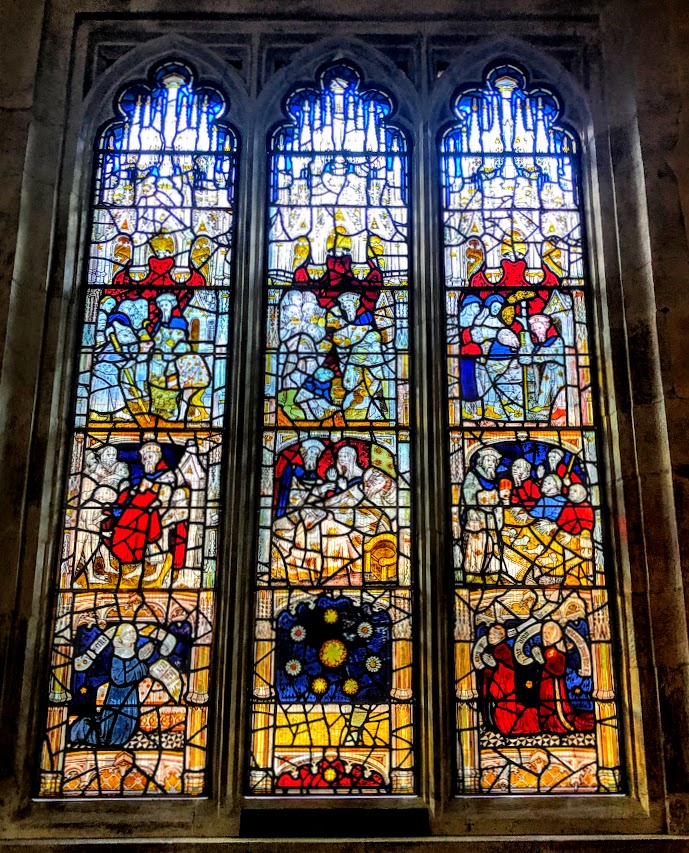
Today’s Reflections:

There are two minor details that continue to puzzle me about today’s Gospel reading (Luke 6: 1-5).

On this Saturday morning, I am slightly puzzled about the timing or the day when this event takes place. The NRSV and NIV translations refer to ‘one sabbath’, although footnotes explain that other ancient authorities read ‘on the second first sabbath.’ The KJV and similar translations refer to ‘the second sabbath after the first’.

But the KJV is based on the Textus Receptus, and the phrase in question, ἐν σαββάτῳ δευτεροπρώτῳ (en sabbáto deuteropróto) only exists in the Textus Receptus, a later text, and not in the earlier manuscripts or the critical versions. The phrase is omitted by many manuscripts, including the Codex Sinaiticus and the Codex Vaticanus.

In any case, what day did this event occur on?

When was ‘the second first sabbath’ or ‘the second sabbath after the first’?

Is the second sabbath after the first not the third sabbath?

Because the Greek word δευτερόπρωτος (deuteróprotos) is limited to Luke 6: 1, it is not found in all the manuscripts – or in other, contemporary Greek texts – and it is difficult to define and it is impossible to agree on its meaning.

One suggestion is that it refers to the Sabbath following the first day of Passover or Pascha, the Festival of Unleavened Bread. Some of the other efforts to provide explanations include:

• the first Sabbath in the second year of a seven-year cycle comprising the period from one Sabbatical year to the other;
• the first Sabbath after the second day of Passover;
• the second Sabbath after the Passover has taken place;
• the first of the seven Sabbaths the people were to ‘count unto’ themselves from ‘the morrow after the sabbath’ until Pentecost (see Leviticus 23: 15);
• the first Sabbath in the Jewish religious calendar of the time – about the middle of March;
• the Sabbath during Shavuot, the Feast of Weeks;
• the first Sabbath in the civil year – about the middle of September;
• the Sabbath for the presentation of the second offering of the first fruits;
• or, simply, some ‘technical expression of the Jewish calendar’ – without asking or explaining what that may be.

Indeed, the term δευτερόπρωτος (deuteroprotos) is an awkward, clunky combination of the words δεύτερος (deuteros, ‘second’) and πρω̑τος (protos, ‘first’). Its use may point to unskilful work and textual emendations on the part of copyists. If so, then it is not necessary to try to unravel this conundrum.

The phrase has confounded scholars from as early as the fourth century, when Jerome, in a letter to Nepotianus, confesses that he consulted Saint Gregory of Nazianzus, and was unable to determine what the phrase meant:

‘My teacher, Gregory of Nazianzus, when I once asked him to explain Luke’s phrase σάββατον δευτερόπρωτον, that is ‘the second-first Sabbath,’ playfully evaded my request saying: ‘I will tell you about it in church, and there, when all the people applaud me, you will be forced against your will to know what you do not know at all. For, if you alone remain silent, everyone will put you down for a fool’ (Jerome, Letter LII, 2).

I suppose I may simply accept it is not essential that we know the precise meaning of this calendar term. It is more important to get to the heart of what this story is about.

The second minor detail that continues to puzzle me about today’s Gospel reading is why Luke’s account does not include a peculiar detail in Saint Mark’s version of this event (Mark 2: 23-30).

In Saint Mark’s account, Jesus and his disciples are criticised for ‘harvesting grain’ on the Sabbath. They are simply plucking some heads of grain to munch on as they walk through a grainfield (verse 23). When the disciples are challenged about what they are doing on the Sabbath, Jesus cites an event in I Samuel 21: 1-6, and refers to a time when ‘Abiathar was high priest’.

In that event, David and his men ate the 12 loaves of shewbread from the tabernacle in Nob. David approaches Ahimelech the priest in Nob and asks for food for his men They were on the run from King Saul, but David keeps that fact from Ahimelech. Ahimelech gives David some of the ‘bread of the Presence’ (verse 6) and then, at David’s request, he gives him Goliath’s sword, which was being kept in Nob (verses 8-9).

Later, when Saul summons the priests to Gibeah to question them, Ahimelech is the priests’ spokesperson (I Samuel 22: 6-14). The passage implies that Ahimelech is the chief priest during the time David fled from Saul. Abiathar fled to join David and served as his priest all through David’s years of wandering and exile. He was appointed high priest after David became king, and he shared the high priesthood with Zadok, Saul’s appointee, until David’s death.

Neither Matthew (Matthew 12: 1-8) nor Luke mention Abiathar. Did Matthew and Luke eliminate the reference to Abiathar, realising there was an error in the original source?

To explain why in Saint Mark’s account Jesus refers to Abiathar as the high priest, several theories are put forward, although each one is equally tortuous and difficult. They include:

• Since Abiathar was the son of Ahimelech, it is possible that both men took part in high priestly duties.
• Abiathar was more closely associated with David than Ahimelech and was a long-time high priest during David’s reign.
• Abiathar, being present in Nob when David visited the tabernacle, is called the ‘high priest’ in anticipation of his future title.

Each explanation is eager to avoid accepting a literal reading of the conflicting or irreconcilable texts. To accept that there is a conflict between the passages means accepting that I Samuel is wrong, that Mark’s text is wrong, or that Jesus has made an historical error.

In addition, this event took place not in ‘the house of God’ (verse 4), for the Temple in Jerusalem had not yet been built, but in ‘the Tent of Meeting’.

It is interesting that the people who are most likely to refuse a literal exegesis of one or both passages are those who are most likely, in a very contradictory way, to demand a very literal exegesis of their own concoction when it comes to their interpretation of passages, for example, on sexuality.

Is it any coincidence that these self-styled ‘conservative evangelicals’ are also those most likely to reject a literal exegesis of the Eucharistic passages in the New Testament?

Both Jesus and the Pharisees regard the decision to provide the shewbread as righteous on the part of both Jesus and the Pharisees.

The important points in this reading are not in the debate over the day on which the events took place, nor are they to be found in debating who knew who was once the high priest and when.

The important points in this morning’s reading are that the Sabbath is most sacred when it is about God and about people rather than about the minutiae of interpreting rules and regulations. And one of the most important emphases in Jesus’ ministry is to feed the hungry: the physically hungry with bread, and the spiritually hungry with him as the true Bread of Presence, the Bread of Life.

‘While Jesus was going through the cornfields, his disciples plucked some heads of grain’ (Luke 6: 1, NRSVA) … cornfields near Stoke Bruerne, Northamptonshire, with the tower of Saint Mary’s Church in the background (Photograph: Patrick Comerford)

Today’s Prayers (Saturday 5 September 2026):

In Pray with the World Church, the prayer diary of the Anglican mission agency USPG (United Society Partners in the Gospel), the theme this week, from 30 August to 5 September 2026 (pp 34-35), has been ‘Anglican Youth Tackle Waste in Madagascar’. This theme was introduced last Sunday with a Programme Update by Ialy Tongasoa, Community Development Lead, Diocese of Toliara, Madagascar.

The USPG Prayer Diary today (Saturday 5 September 2026) invites us to pray:

Lord, may this initiative continue to grow, reaching more parishes and bringing hope, care, and practical solutions to Madagascar and across the Church of the Province of the Indian Ocean.

The Collect:

Almighty God,
who called your Church to bear witness
that you were in Christ reconciling the world to yourself:
help us to proclaim the good news of your love,
that all who hear it may be drawn to you;
through him who was lifted up on the cross,
and reigns with you in the unity of the Holy Spirit,
one God, now and for ever.

The Post Communion Prayer:

God our creator,
you feed your children with the true manna,
the living bread from heaven:
let this holy food sustain us through our earthly pilgrimage
until we come to that place
where hunger and thirst are no more;
through Jesus Christ our Lord.

Additional Collect:

Almighty God,
you search us and know us:
may we rely on you in strength
and rest on you in weakness,
now and in all our days;
through Jesus Christ our Lord.

Collect on the Eve of the festival of Creation in Christ:

Holy and eternal God,
you are the Maker of heaven and earth,
you are the Word through whom all things were made,
and you are the Spirit, the giver of life:
draw us into the mystery of your love,
that with all creation we may proclaim your praise,
through Jesus Christ our Lord.

or:

O God and Father of all that was, is and ever shall be,
help us to be thankful for all that is made
at the hands of your Son
and through the wisdom of your Spirit,
that we may care in heart and in deed for the life of our world,
to the praise and glory of your holy name.

Yesterday’s reflections

Continued tomorrow

‘While Jesus was going through the grainfields, his disciples plucked some heads of grain’ (Luke 6: 1, NRSV) … walking through the fields in Comberford, Staffordshire (Photograph: Patrick Comerford, 2026)

Scripture quotations are from the New Revised Standard Version Bible: Anglicised Edition copyright © 1989, 1995, National Council of the Churches of Christ in the United States of America. Used by permission. All rights reserved worldwide. http://nrsvbibles.org

‘While Jesus was going through the grainfields, his disciples plucked some heads of grain’ (Luke 6: 1, NRSV) … walking through the fields along Cross in Hand Lane near Lichfield (Photograph: Patrick Comerford)

04 September 2026

Daily prayer in Ordinary Time 2026:
119, Friday 4 September 2026

The banquet with Levi included the questions and answers – and the drinking – associated with a Greek symposium … pottery in a shop in Rethymnon in Crete (Photograph: Patrick Comerford)

Patrick Comerford

We are continuing in Ordinary Time in the Church Calendar and the week began with the Thirteenth Sunday after Trinity (Trinity XIII, 30 August 2026). The Season of Creation began on Tuesday (1 September 2026), and it continues until 4 October.

Today, the Calendar of the Church of England in Common Worship remembers Saint Birinus (650), Bishop of Dorchester (Oxon) and Apostle of Wessex. Before today begins, I am taking some quiet time this morning to give thanks, for reflection, prayer and reading in these ways:

1, today’s Gospel reading;

2, a reflection on the Gospel reading;

3, a prayer from the USPG prayer diary;

4, the Collects and Post-Communion prayer of the day.

After the symposium … an end-of-term dinner with the Institute for Orthodox Christian Studies at Sidney Sussex College, Cambridge (Photograph: Patrick Comerford)

Luke 5: 33-39 (NRSVA):

33 Then they said to him [Jesus], ‘John’s disciples, like the disciples of the Pharisees, frequently fast and pray, but your disciples eat and drink.’ 34 Jesus said to them, ‘You cannot make wedding-guests fast while the bridegroom is with them, can you? 35 The days will come when the bridegroom will be taken away from them, and then they will fast in those days.’ 36 He also told them a parable: ‘No one tears a piece from a new garment and sews it on an old garment; otherwise the new will be torn, and the piece from the new will not match the old. 37 And no one puts new wine into old wineskins; otherwise the new wine will burst the skins and will be spilled, and the skins will be destroyed. 38 But new wine must be put into fresh wineskins. 39 And no one after drinking old wine desires new wine, but says, “The old is good”.’

‘You cannot make wedding-guests fast while the bridegroom is with them, can you?’ (Luke 5: 34) … preparing for a wedding in Southwark (Photograph: Patrick Comerford)

Today’s Reflections:

Jesus has called the tax-collector Levi, and then dines with him in his house that evening (Luke 5: 27-31). Levi celebrates not just with dinner, or even a lavish dinner, but a ‘great banquet’ in his house that is attended by a large crowd.

Banquets were not merely lavish meals but also a setting for teaching and instruction, and the word for banquet here δοχή (dochē) suggests a formal Greek banquet known as a symposium (συμπόσιον, sympósion, from συμπίνειν, sympínein, ‘to drink together’).

In classical Greece, the symposium was the part of a banquet that took place after the meal, when drinking for pleasure was accompanied by music, dancing, recitals, or conversation. Literary works that describe or take place at a symposium include two Socratic dialogues, Plato’s Symposium and Xenophon’s Symposium, as well as a number of Greek poems.

If we read Levi’s banquet as a symposium, then, of course, it is going to be associated, culturally, in those days with drinking, and with questions and answers.

Some people ask why Jesus eats and drinks with tax collectors and sinners. Now, in this morning’s Gospel reading (Luke 5: 33-39), the same people ask why, unlike John’s disciples or the disciples of the Pharisees, who frequently fast and pray, the disciples of Jesus eat and drink.

Similar complaints were made about Socrates. In Plato’s Symposium, Alcibiades claims that Socrates, despite allegedly drinking heavily just like the others, never got drunk and that alcohol never has any effect on Socrates: ‘Observe, my friends, said Alcibiades, that this ingenious trick of mine will have no effect on Socrates, for he can drink any quantity of wine and not be at all nearer being drunk.’

Christ responds to his detractors by comparing the invitation into the Kingdom with an invitation to a wedding, and speaks of his followers as guests at a wedding banquet. The feast is in progress, so this is a time for joy, while after his death it will be a time for fasting.

He insists that the old way of being and the new way he brings are separate, even if both are to be valued. New material stretches more than old. When wine ferments, it expands. Soft new wineskins expand with the wine, but old ones do not.

And so, in a way, I find myself thinking this morning of two other banquets where the wine must have been flowing freely.

The first of these is the Wedding at Cana, the banquet before Christ’s ministry begins. There the wine runs out, and then the wine runs freely.

The second banquet is at the end of Christ’s ministry, the meal at the Last Supper. Not only must the wine have been flowing freely at that meal, it is the meal of the New Covenant, in which bread and wine are freely given, just as Christ gives himself freely, body and blood.

In this in-between time, this Ordinary Time in the Church Calendar, ordinary meals offer a promise of what the heavenly banquet is like. And constantly, as in this morning’s Gospel reading, Jesus uses the image of the wedding banquet to convey how sacred, how loving, how caring, how beautiful, how full of promise, is the heavenly banquet.

Just as the wedding banquet is not the wedding itself, but a celebration of the wedding and the promise of the wedding, the meals in the Gospel in the in-between times are foretastes of, promises of, the great heavenly banquet.

And, at those banquets, Christ dines with tax-collectors like tax-collectors like Levi, Pharisees like Simon, those who are rejected by polite society like Zacchaeus, just as he is going to dine at the Last Supper with those who are going to betray him like Judas, those who are going to deny him like Peter, just as he is going to insist on dining with those who fail to recognise him after the Resurrection, like the disciples at Emmaus.

No matter how wayward others may think we are, no matter how wayward we may think we have been, Christ calls us back to dine with him, to have a new and intimate relationship with, wants to dine with us, so that, as we say in the Prayer of Humble Access, so that ‘that we may evermore dwell in him and he in us.’

Levi’s banquet has parallels with the symposia associated with Socrates, including the drinking and the questions … Socrates bar in Piskopianó in Crete (Photograph: Patrick Comerford)

Today’s Prayers (Friday 4 September 2026):

In Pray with the World Church, the prayer diary of the Anglican mission agency USPG (United Society Partners in the Gospel), the theme this week, from 30 August to 5 September 2026 (pp 34-35), is ‘Anglican Youth Tackle Waste in Madagascar’. This theme was introduced on Sunday with a Programme Update by Ialy Tongasoa, Community Development Lead, Diocese of Toliara, Madagascar.

The USPG Prayer Diary today (Friday 4 September 2026) invites us to pray:

Gracious God, thank you for the skills young people are gaining and for how even small acts of recycling and composting are big signs of caring for your creation.

The Collect:

Almighty God,
who called your Church to bear witness
that you were in Christ reconciling the world to yourself:
help us to proclaim the good news of your love,
that all who hear it may be drawn to you;
through him who was lifted up on the cross,
and reigns with you in the unity of the Holy Spirit,
one God, now and for ever.

The Post Communion Prayer:

God our creator,
you feed your children with the true manna,
the living bread from heaven:
let this holy food sustain us through our earthly pilgrimage
until we come to that place
where hunger and thirst are no more;
through Jesus Christ our Lord.

Additional Collect:

Almighty God,
you search us and know us:
may we rely on you in strength
and rest on you in weakness,
now and in all our days;
through Jesus Christ our Lord.

Yesterday’s reflections

Continued tomorrow

‘No one tears a piece from a new garment and sews it on an old garment’ (Luke 5: 36) … colourful new fabrics in a shop in Seville (Photograph: Patrick Comerford)

Scripture quotations are from the New Revised Standard Version Bible: Anglicised Edition copyright © 1989, 1995, National Council of the Churches of Christ in the United States of America. Used by permission. All rights reserved worldwide. http://nrsvbibles.org

Socrates is regarded as the founder of western philosophy … a street name in Koutouloufári in Crete (Photograph: Patrick Comerford)

03 September 2026

Daily prayer in Ordinary Time 2026:
118, Thursday 3 September 2026

The Miraculous Draught of Fish … a fresco in the Church of Saint Konstantinos and Saint Eleni in Rethymnon (Photograph: Patrick Comerford; click on image for full-screen view)

Patrick Comerford

We are continuing in Ordinary Time in the Church Calendar and the week began with the Thirteenth Sunday after Trinity (Trinity XIII, 30 August 2026). The Season of Creation began on Tuesday (1 September 2026), and it continues until 4 October.

Today, the Calendar of the Church of England in Common Worship remembers Saint Gregory the Great (604), Bishop of Rome and Teacher of the Faith. The Stony Stratford Playreaders are meeting in the library this evening. But, before today begins, I am taking some quiet time this morning to give thanks, for reflection, prayer and reading in these ways:

1, today’s Gospel reading;

2, a reflection on the Gospel reading;

3, a prayer from the USPG prayer diary;

4, the Collects and Post-Communion prayer of the day.

The Miraculous Draught of Fish … a window by Heaton, Butler and Bayne in Saint Mary’s Church, St Neots, Cambridgeshire (Photograph: Patrick Comerford)

Luke 5: 1-11 (NRSVA):

1 Once while Jesus was standing beside the lake of Gennesaret, and the crowd was pressing in on him to hear the word of God, 2 he saw two boats there at the shore of the lake; the fishermen had gone out of them and were washing their nets. 3 He got into one of the boats, the one belonging to Simon, and asked him to put out a little way from the shore. Then he sat down and taught the crowds from the boat. 4 When he had finished speaking, he said to Simon, ‘Put out into the deep water and let down your nets for a catch.’ 5 Simon answered, ‘Master, we have worked all night long but have caught nothing. Yet if you say so, I will let down the nets.’ 6 When they had done this, they caught so many fish that their nets were beginning to break. 7 So they signalled to their partners in the other boat to come and help them. And they came and filled both boats, so that they began to sink. 8 But when Simon Peter saw it, he fell down at Jesus’ knees, saying, ‘Go away from me, Lord, for I am a sinful man!’ 9 For he and all who were with him were amazed at the catch of fish that they had taken; 10 and so also were James and John, sons of Zebedee, who were partners with Simon. Then Jesus said to Simon, ‘Do not be afraid; from now on you will be catching people.’ 11 When they had brought their boats to shore, they left everything and followed him.

An icon of the Church as a boat, including Christ, the Apostles and the Church Fathers (Icon: Deacon Matthew Garrett, www.holy-icons.com)

Today’s Reflections:

As I continue to go through some very difficult times personally, I find myself asking whether we ever ask whether we are worthy of the call of Christ – the call to follow him, the call to be a disciple, the call that was first answered for us, on our behalf, at our own baptism?

I am without permission to officiate (PtO), and there are times in recent years when I have had to question my worthiness to be priest. I am not a priest because I think it is my right to be one, or because I thought at one stage it would be a good career move. I am a priest because, despite my resistance to the call over many years, I believe God called me – called me many years ago, perhaps 55 years ago, at the age of 19.

This morning, in the Gospel reading (Luke 5: 1-11), we hear how the renewed call to some of the disciples, including Peter, James and John, comes not to them because they are worthy of this call, or have inherited a call, or have a right to speak on God’s behalf.

Peter, James and John are called not only to speak on Christ’s behalf, but to do what he commands and to follow him. In his response, Simon Peter expresses his feelings of inadequacy and unworthiness, yet accepts the call to speak in Christ’s name, unconditionally and in faith.

Our Baptism has ethical implications for our discipleship: in the community of the baptised, ethnic and social barriers are shattered, for ‘Christ is all and in all.’

In our Gospel story, we hear a story of commitment to Christ, to his message and to discipleship. Christ calls Simon or Simon Peter to be a disciple, promising him he is to be a ‘fisher of men,’ and Peter, James and John leave everything and follow Christ.

This story begins by the ‘lake of Gennesaret,’ on the south-west shore of the Sea of Galilee. The crowd is pressing in to hear Christ, the Word of God, preach the ‘word of God’ or the Christian message.

Christ gets into the boat with Simon Peter. There are two boats in this episode, and James and John are also fishing in one of the boats.

They not only listen to Christ, but they do what he tells them to do, and they are amazed at the consequences. Simon Peter acknowledges Jesus as ‘Master’ or teacher, and responds by falling down before Jesus in humility, pointing to himself as a sinful man, and calling Jesus ‘Lord,’ which becomes an expression of faith.

Peter, James and John make a total commitment to Christ, they leave everything, and they follow him.

In Christian art, the boat is often used as an image of the Church, while the fish is an image of Christ.

In the Early Church, the fish came to symbolise Christ because the Greek word Ichthus (ΙΧΘΥΣ), meaning ‘fish’, is an acrostic for Ἰησοῦς Χριστός, Θεοῦ Υἱός, Σωτήρ, ‘Jesus Christ, Son of God, Saviour.’

Some years ago, when I was visiting Kaş, a pretty town on the south coast of Turkey, I visited the former Church of the Annunciation. Kaş had once been a Greek-majority town known as Andifli, but the Greek ethnic community was expelled in 1923 in one of the early examples of ‘ethnic cleansing’ in 20th century Europe.

For 40 years, the Church of the Annunciation on the acropolis or hilltop above the town lay deserted and crumbling. But in 1963, 40 years after these people were expelled from Andifli, their former parish church was requisitioned as a mosque, and – despite its age – was renamed Yeni Cami (New Mosque). A minaret was added, along with a fountain with a quotation in Turkish, rather than Arabic, from the Quran: ‘We made from water every living thing’ (Surat al-Anbiyya, the Prophets, 21: 30).

Inside, the church was aligned facing east, a new mihrab or prayer niche facing Mecca and a minbar (pulpit) were inserted into the south wall, the frescoes were stripped away and the icon screen was removed. All obvious Christian symbols, including crosses, were picked out of the hoklakia or pebble mosaic in the courtyard. But no-one noticed the significance of the fish, symbolising the Greek word Ichthus (ΙΧΘΥΣ), so that dozens of fish symbolising Christ and the Christian faith are still scattered though this pebble mosaic.

This is, truly, the story of the ‘big fish that got away.’

Have you ever spoken of someone or some thing as a ‘good catch’? A person you had an emotional or romantic interest in? A job or promotion at work you hoped for? A house you wanted to buy?

Can you imagine how Christ sees you as ‘a good catch’?

If the Church is the agent of Christ, do we do a good job in drawing in his ‘good catch’?

Are we trusting enough to do what he asks us to do as his disciples?

And are we trusting enough to know that he sees you, you and me, as ‘good catches’?

But there are more and more ‘good catches’ that he wants us to draw into the boat, into the Church. And the way to do this is to listen to what he says and what he asks us to do. ‘When they had brought their boats to shore, they left everything and followed him’ (Luke 5: 11).

What he has been asking us to do in the readings this week – what he asked us to in his reading from the Prophet Isaiah, which we read as the Gospel reading on Monday morning (Luke 4: 16-30, 31 August 2026) are:

• to bring good news to the poor
• to proclaim release to the captives
• to proclaim recovery of sight to the blind
• to let the oppressed go free
• to proclaim the year of the Lord’s favour.

The Ichthus symbol remains discreetly unnoticed in the pebble mosaic of the former church courtyard in Kaş (Photograph: Patrick Comerford)

Today’s Prayers (Thursday 3 September 2026):

In Pray with the World Church, the prayer diary of the Anglican mission agency USPG (United Society Partners in the Gospel), the theme this week, from 30 August to 5 September 2026 (pp 34-35), is ‘Anglican Youth Tackle Waste in Madagascar’. This theme was introduced on Sunday with a Programme Update by Ialy Tongasoa, Community Development Lead, Diocese of Toliara, Madagascar.

The USPG Prayer Diary today (Thursday 3 September 2026) invites us to pray:

Lord, guide bishops, parish leaders, and clergy to support and nurture youth initiatives. Remind us, as Psalm 24:1 says, that ‘The Earth and everything in it is the Lord’s,’ and inspire us to promote sustainable practices in care for creation.

The Collect:

Merciful Father,
who chose your bishop Gregory
to be a servant of the servants of God:
grant that, like him, we may ever long to serve you
by proclaiming your gospel to the nations,
and may ever rejoice to sing your praises;
through Jesus Christ your Son our Lord,
who is alive and reigns with you,
in the unity of the Holy Spirit,
one God, now and for ever.

The Post Communion Prayer:

God of truth,
whose Wisdom set her table
and invited us to eat the bread and drink the wine
of the kingdom:
help us to lay aside all foolishness
and to live and walk in the way of insight,
that we may come with Gregory to the eternal feast of heaven;
through Jesus Christ our Lord.

Yesterday’s reflections

Continued tomorrow

‘When they had brought their boats to shore, they left everything and followed him’ (Luke 5: 11) … fishing boats on a shore at Mount Athos (Photograph: Patrick Comerford)

Scripture quotations are from the New Revised Standard Version Bible: Anglicised Edition copyright © 1989, 1995, National Council of the Churches of Christ in the United States of America. Used by permission. All rights reserved worldwide. http://nrsvbibles.org

Saint Gregory in a stained-glass window in Saint Giles Church, Cambridge … the Church Calendar in ‘Common Worship’ today remembers Saint Gregory the Great on 3 September (Photograph: Patrick Comerford)