Showing posts with label William Bedell. Show all posts

25 October 2026

Daily prayer in Ordinary Time 2026:
170, Sunday 25 October 2026,
Last Sunday after Trinity, Bible Sunday

The Lichfield Gospels or Saint Chad’s Gospel, dating from 730, is the greatest treasure in the mediaeval library at Lichfield Cathedral (Photograph: Patrick Comerford)

Patrick Comerford

We are continuing in Ordinary Time in the Church Calendar, we returned to ordinary time in the secular time too when the clocks went back overnight, and today is the Last Sunday after Trinity (25 October 2026). Dare I say it, but we are also just two months from Christmas.

Later this morning, I am reading one of the readings and leading the intercessions at the Parish Eucharist in Saint Mary and Saint Giles Church, Stony Stratford.

In many parishes this morning, the Gospel reading in the lectionary is Matthew 22: 34-46. But in places, including Stony Stratford, where this Sunday is being marked as Bible Sunday, the readings are: Nehemiah 8: 1-4a [5-6] 8-12; Psalm 119: 9-16; Colossians 3: 12-17; Matthew 24: 30-35.

Before today begins, meanwhile, I am taking some quiet time early this morning to give thanks, and for reflection, prayer and reading in these ways:

1, today’s Gospel reading;

2, a short reflection;

3, a prayer from the USPG prayer diary;

4, the Collects and Post-Communion prayer of the day.

‘Give thanks for those whose inspiration is the Law, the Prophets and the Writings of Holy Scripture’ … pages from a hand-made copy of Saint John’s Gospel in the ‘Holy Writ’ exhibition in Lichfield Cathedral some years ago (Photograph: Patrick Comerford)

Matthew 24: 30-35 (NRSVA):

[Jesus said:] 30 ‘Then the sign of the Son of Man will appear in heaven, and then all the tribes of the earth will mourn, and they will see “the Son of Man coming on the clouds of heaven” with power and great glory. 31 And he will send out his angels with a loud trumpet call, and they will gather his elect from the four winds, from one end of heaven to the other.

32 ‘From the fig tree learn its lesson: as soon as its branch becomes tender and puts forth its leaves, you know that summer is near. 33 So also, when you see all these things, you know that he is near, at the very gates. 34 Truly I tell you, this generation will not pass away until all these things have taken place. 35 Heaven and earth will pass away, but my words will not pass away.’
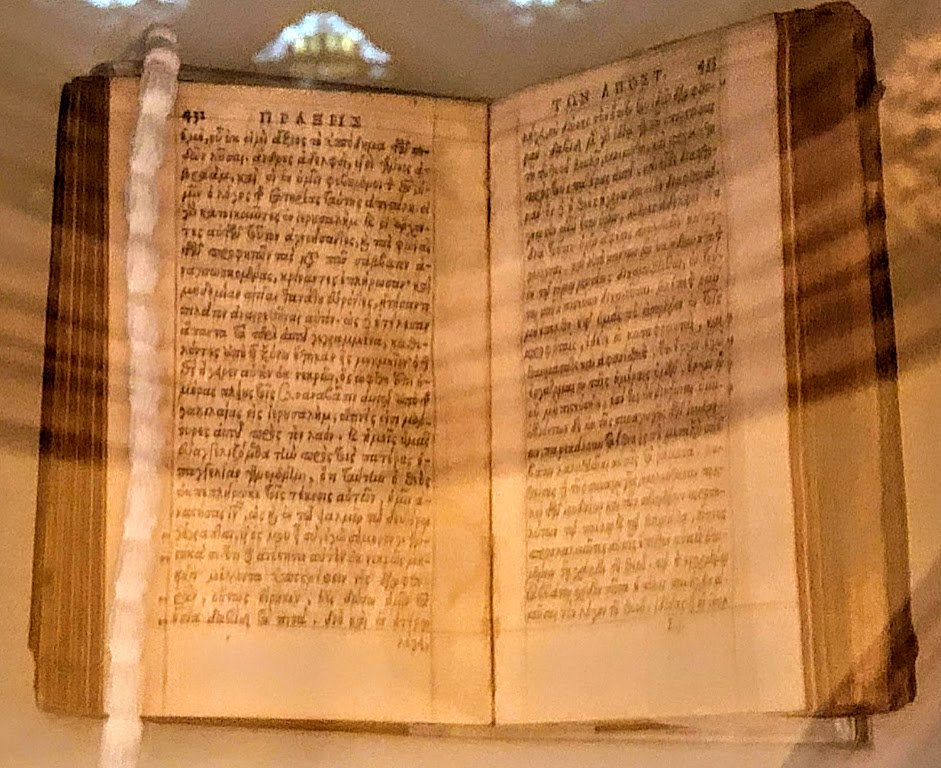
A Greek New Testament in the library in Lichfield Cathedral was published in Paris in 1569 (Photograph: Patrick Comerford)

Today’s Reflections:

My idea of indulgence is spending hours on end in the bookshops – new and second-hand – in Dublin, in Cambridge and in Oxford, and I still miss the old Staffs Bookshop in Lichfield, once my favourite second-hand bookshop.

But, as I navigate my way through the aisles and shelves of bookshops, I find I cannot help noticing the very limited versions of Bibles on many shelves. I seldom set out to buy a new Bible – my bookshelves have been stacked with a variety of translations and versions, usually known by their Initials (NRSV, NRSVA, JB, RSV, NIV, AV … ), and with Bibles in many languages, including English, Irish, Greek, Hebrew, French, Italian, Latin and Chinese – bought in Shanghai … I once had a version in Xhosa, bought in South Africa.

For a long-time I I clung onto some of these Bibles, even when they were bruised and battered, torn and dog-eared. I still have a King James Version that I think I was given during my school days.

There was a Living Bible, paraphrased by Kenneth Taylor … this version was printed in 1972 and sold for £1. It was heavily marked and stained, having endured being packed into rucksacks and travelling with me as I hitch-hikeded around Ireland and England at the age of 20.

My copy of the New English Bible had a note of where and when it was bought over 50 years ago: ‘Lichfield, 10.9.1973’ … I still remember that day, because the coup against Allende was staged in Chile the following day. The art nouveau illustrations by Horace Knowles are still a pleasure to come across.

I bought my first version of the Common Bible, with its ecumenical presentation of western and eastern canonical books, when I was working in Wexford in 1974. It was a paperback edition that fell apart through years of use, and was replaced over time with a later edition.

My many copies of the NRSVA have been lost, misplaced, borrowed or lent over the years, and the latest copy was found in the basement of the Oxfam bookshop on St Giles in Oxford.

A range of translations and commentaries is important for anyone who is interested in Biblical scholarship. And so, I was a little surprised at the very limited range of Bibles available on the shelves of one bookshop recently: four stacks of the King James Version, and one copy of the English Standard Version … and that was it.

The translations of the Bible we favour indicate a theological bias even before we start reading it.

The beauty of the English language in the King James Version is beyond question. Its influence on literary English places it alongside the works of Chaucer and Shakespeare and the Book of Common Prayer.

But, apart from historical, dramatic, poetic or comparative reasons, there are limited reasons for using the King James Version today, and if this was given to someone today as their first Bible, I would not expect them to continue reading it for very long.

The single, sole alternative of the English Standard Version in that bookshop that particular day took me aback.

There is a saying in Italian that I learned in Ealing Abbey while studying patristic and liturgical Latin: Traduttore, traditore – ‘The translator is a traitor.’

Every translation of the Bible is an interpretation as well as a translation, and the new text always betrays the old prejudices of the translators.

There was an interesting debate in the letters columns of the The Tablet some years ago when the Roman Catholic bishops of England and Wales approved the English Standard Version for a revised Lectionary.

The Irish-born historian Eamon Duffy, Emeritus Professor of the History of Christianity at Cambridge and author of The Stripping of the Altars, finds the ESV reflects ‘a deep-rooted dimension of Anglophone culture.’

He finds the Jerusalem Bible ‘is often woefully flat-footed, most painfully-obvious in Passiontide and at Christmas, when what is read in our churches falls so far short of versions given familiarity and valence by their presence in cultural touch-points like Handel’s Messiah or the Festival of Nine Lessons and Carols.’

Dr Sara Parvis of the University of Edinburgh was generously kind when she described the ESV as a ‘low-church evangelical Protestant translation.’ Neil Xavier O’Donoghue of Saint Patrick’s College, Maynooth, conceded that the ESV ‘was produced by conservative Evangelical scholars in the United States and is often described as Calvinist in philosophy.’

In fact, the ESV is deeply ‘fundamentalist,’ unnecessarily imposing the translators’ extreme ‘conservative evangelical’ views and dogmas on the text and on the reader.

The ESV’s general editor, Wayne Grudem, argued in paper published in 2016 ‘Why Voting for Donald Trump Is a Morally Good Choice.’

In recent years, Grudem and his colleagues have challenged the consensus on the Trinity, arguing that Christ is eternally subordinate to God the Father and that this provides a pattern for how men and women should relate to each other – that is, women should be subordinate to men.

This is a radical departure from what the Church has taught for more than 1,500 years, and a serious misunderstanding of a core Christian belief that needs to be rejected by anyone concerned for biblical orthodoxy.

The concept of the Eternal Subordination of the Son (ESS) has been created by Grudem and the Neo-Calvinists. Grudem, Bruce Ware of Southern Baptist Theological Seminary, Owen Strachen, and other Neo-Calvinists believe that Christ submitted to God for all eternity, a concept that reflects the teachings of Arius of Alexandria. Arianism is the belief that the Father, and the Son, and the Holy Spirit are not equal, instead Jesus was created by God and is eternally subordinate to the Father.

Grudem and his supporters have been challenged by some leading evangelicals, including Carl Trueman and Liam Goligher, who have asked whether he is creating a new deity. They have contrasted statements from Grudem and Ware with quotations from the historic creeds.

One critic concluded: ‘It comes down to this; if they are right we have been worshipping an idol since the beginning of the church; and if they are wrong they are constructing a new deity – a deity in whom there are degrees of power, differences of will, and diversity of thought. Because, mark this, to have an eternally subordinate Son intrinsic to the Godhead creates the potential of three minds, wills and powers. What they have done is to take the passages referring to the economic Trinity and collapse them into the ontological Trinity.’

Grudem also drafted the ‘Guidelines’ of the Council of Biblical Manhood and Womanhood (1997) that reject gender-inclusive approaches. This is due to their patriarchy-based objective of excluding women from leadership in the Church. But it may explain why the ESV, again and again, uses masculine pronouns and male gender-specific words that are absent from the Greek original, where other translations do not.

For example, although the ESV in its preface claims that ‘people rather than men is regularly used where the original languages refer to both men and women,’ this is not so. A good example would be when the generic Greek ἄνθρωποι (anthropoi), ‘human beings,’ is used to refer to a mixed group containing both women and men. To translate the term ‘men’ in such a case is in fact to misrepresent the meaning of the word since women were also present and were not mere ciphers or appendages of the men present.

But there are at least 100 instances in the ESV New Testament where ‘men’ translates the Greek ἄνθρωποι.

In some places the word ‘men’ is even added unnecessarily. For example, πρῶτοι τοῦ λαοῦ (protoi tou lao), ‘leaders of the people’ (NRSV and RNJB) or, more literally, ‘the first in rank among the people,’ in Luke 19: 47, becomes ‘principal men of the people’ in the ESV.

Earlier, the ESV translate Luke 18: 27, ‘What is impossible with man is possible with God.’ The NRSV renders this as, ‘What is impossible for mortals is possible for God.’ The original Greek says, Τὰ ἀδύνατα παρὰ ἀνθρώποις δυνατὰ παρὰ τῷ θεῷ ἐστιν.

The ESV translates I Corinthians 1: 25 as ‘For the foolishness of God is wiser than men, and the weakness of God is stronger than men.’ The NRSV says, ‘For God’s foolishness is wider than human wisdom, and God’s weakness is stronger than human strength.’ The RNJB says, ‘God’s folly is wiser than human wisdom, and God’s weakness is stronger than human strength.’ The original Greek says, ὅτι τὸ μωρὸν τοῦ θεοῦ σοφώτερον τῶν ἀνθρώπων ἐστίν, καὶ τὸ ἀσθενὲς τοῦ θεοῦ ἰσχυρότερον τῶν ἀνθρώπων.

When I am asked to recommend ‘versions’ of the Bible, I say without hesitation, ‘read the original.’ There is nothing to compare with wrestling with the original texts in Hebrew and Greek. But if I must recommend a translation to students and readers then it is the RSV and NRSV, for their scholarship and despite all their weaknesses.

Have I ever recommended the ESV?

Never.

Why?

Traduttore, traditore.

Bibles on a shelf in a bookshop … which translation would you recommend? (Photograph: Patrick Comerford)

Today’s Prayers (Sunday 25 October 2026, Bible Sunday):

The theme this week (25 to 31 October) in Pray with the World Church, the prayer diary of the Anglican mission agency USPG (United Society Partners in the Gospel), is ‘Update from Myanmar’ (pp 50-51). This theme was introduced today with a programme update from the Revd Davidson Solanki, Senior Regional Manager for Asia and the Middle East, USPG:

On 28 March 2025, a 7.7-magnitude earthquake hit central Myanmar, destroying homes, churches, and important infrastructure. Many communities were already struggling because of ongoing conflict and displacement since the 2021 military coup. The Church in Myanmar (CPM), together with USPG, responded quickly with emergency relief, putting faith into action by supporting those most in need.

Since then, CPM has been strengthening its longer-term development work. Church staff and leaders have met in workshops and discussions to reflect on what they have learned in the field, look at the impact of their programmes, and agree on shared priorities. This has helped ensure that work across dioceses is better coordinated and shaped by local communities.

This teamwork between leaders and practitioners is helping CPM move from short-term crisis response to more planned and sustainable programmes. Bishops have affirmed that development is a key part of the Church’s mission and have committed to supporting staff, improving systems, and reducing reliance on outside funding.

The aim is simple but important: to help communities be better prepared not only for emergencies like earthquakes, but also for ongoing social and economic challenges. Faith, experience, and leadership are coming together to build stronger, more resilient communities.

The USPG Prayer Diary today (Sunday 25 October 2026, Bible Sunday) invites us to pray:

Bible Sunday in the Anglican Church is a day to celebrate Scripture as God’s living Word, shaping our faith, worship, and daily life.

Consider: how would you summarise the Gospel in 60 seconds? Perhaps you could take inspiration from the lectionary reading for today, Matthew 22: 34-46, where Jesus teaches the greatest commandments: to love God and love our neighbour.

A copy of William Bedell’s Bible in Irish in a bookshop window in Camden Street, Dublin (Photograph: Patrick Comerford)

The Collect of the Day:

Blessed Lord,
who caused all holy Scriptures to be written for our learning:
help us so to hear them,
to read, mark, learn and inwardly digest them
that, through patience, and the comfort of your holy word,
we may embrace and for ever hold fast
the hope of everlasting life,
which you have given us in our Saviour Jesus Christ,
who is alive and reigns with you,
in the unity of the Holy Spirit,
one God, now and for ever.

The Post Communion Prayer:

God of all grace,
your Son Jesus Christ fed the hungry
with the bread of his life
and the word of his kingdom:
renew your people with your heavenly grace,
and in all our weakness
sustain us by your true and living bread;
who is alive and reigns, now and for ever.

Additional Collect:

Merciful God,
teach us to be faithful in change and uncertainty,
that trusting in your word
and obeying your will
we may enter the unfailing joy of Jesus Christ our Lord.

Yesterday’s Reflections

Continued Tomorrow:

I always recommend reading the Bible in the original texts … bookshelves in the synagogue in Porto (Photograph: Patrick Comerford)

Scripture quotations are from the New Revised Standard Version Bible: Anglicised Edition copyright © 1989, 1995, National Council of the Churches of Christ in the United States of America. Used by permission. All rights reserved worldwide. http://nrsvbibles.org

29 June 2024

Unexpected and unsolicited,
generous and encouraging
comments on a neglected site

I have been considering the future of the ‘Dead Anglican Theologians Society’ project for some time

Patrick Comerford

I have not paid much attention in recent years to the site ‘Dead Anglican Theologians Society’, a site I began in 2012 while I was a lecturer at the Church of Ireland Theological Institute and teaching Church History.

I was acutely aware at the time of the lack of appropriate resources when it came to looking for accurate biographies, personal accounts, reliable sources and useful illustrations. When it comes to the Church of Ireland, too much Church History has been written as pious and ill-researched hagiography.

I may have bitten off more than I could chew with that project a dozen years ago. Since then I have retired from academic life, it has been difficult to find the resources, the time and the energy to maintain the ‘Dead Anglican Theologians Society’ site. So much so that more recently I have seriously considered mothballing it, if not actually closing it down.

But then along came some surprising words of encouragement earlier this week that I read when I was on the train to Lichfield early one morning.

Professor Bruce Stewart, who now lives in Brazil, maintains the Irish historical website www.ricorso.net, with comprehensive bio-bibliographical information about 5,000 Irish authors. In recent days, he has left a very generous – and, I have to say, unsolicited – comment on a post from almost 12 years ago, ‘16: William Bedell (1571-1642), Caroline Divine and translator of the Bible into Irish.’

He says: ‘This [is] a wonderful essay on Bedell – great history-writing and immensely well-read in the historical and ecclesiastical questions concerned.

‘I have shameless[ly] copied the parts concerning his time in Ireland to Ricorso – hoping permission will not be denied – and want to thank the author, the website and Patrick Comerford, whose photography and personal warmth make him such a treasure to all who known him in Ireland and in the wide international circles where he shares his ecumenical message.’

These unexpected and encouraging comments from Bruce Stewart are making me think again about the future of the Dead Anglican Theologians Society website and pages.

Bishop William Bedell of Kilmore (right) with Archbishop William Sancroft of Canterbury (left) in a window in the chapel of Emmanuel College, Cambridge (Photograph: Patrick Comerford)

27 February 2021

An unexpected introduction
to the descendants and
family of Bishop Bedell

Bishop William Bedell of Kilmore (right) with Archbishop William Sancroft of Canterbury (left) in a window in the chapel of Emmanuel College, Cambridge … has Bishop Bedell descendants who continued to live in Ireland? (Photograph: Patrick Comerford)

Patrick Comerford

William Bedell (1571-1642) was the Church of Ireland Bishop of Kilmore, one of the great ‘Caroline Divines,’ and the fifth Provost of Trinity College Dublin. He is remembered for undertaking the translation of the Bible into Irish, and for his martyr-like death during the violence and wars that eventually led to the Cromwellian era.

He was under house arrest when he died of typhus on 7 February 1642. His last words were: ‘Be of good cheer, be of good cheer; whether we live or die we are the Lord’s.’ During his funeral at Kilmore Cathedral, a large Irish military force fired a volley over his grave, crying, according to some accounts: ‘Requiescat in pace, ultimus Anglorum.’

Father Edmund Farrely, a Roman Catholic priest who was present, was heard to exclaim: ‘O sit anima mea cum Bedello!, May my soul be with Beddell’s.’ His grave is shaded by a sycamore tree, said to have been planted by his own hands.

Saint Feithlimidh’s Cathedral, Kilmore, built as a memorial to Bishop William Bedell (Photograph: Patrick Comerford)

Bishop Bedell had two surviving sons, William and Ambrose, who received legacies of £80 and £60 a year each.

The eldest son, the Revd William Bedell, who was the bishop’s biographer, was born in Bury in 1613. He was ordained by his father in 1634 and became Vicar of Kinawley (Derrylin, Co Fermanagh) in the Diocese of Kilmore. He married Mary Barber from Essex, and after his father’s death, they left Ireland and returned to England. They first lived Black Notley in Essex, and then in Bury. William became was the Rector of Rattlesden in 1645, and remained there until he died in March 1671.

William and Mary Bedell had eight children, of whom the eldest, Leah, was baptised at Whepstead in 1643, and the other seven at Rattlesden: William, John, James, Ambrose, Penelope, Agnes and Isabella. The Revd John Bedell succeeded his father as Rector of Rattlesden, but died the following year, 1672.

The second surviving son, Ambrose Bedell, married in Ireland before the 1641 rebellion broke out. His wife Mary was a daughter of Peter Hill, Sheriff of Co Down. After the Restoration, he had a grant of lands in Co Cavan and Co Antrim. He died there in 1683, and had no surviving children.

Willaim Bedell’s grave in the churchyard of Kilmore Cathedral, Co Cavan (Photograph: Patrick Comerford)

When I wrote a biographical sketch of Bishop Bedell for the site ‘Dead Anglican Theologians Society’ back in 2012, I said at the time, ‘It appears there are no longer any living descendants of the bishop.’

But I was wrong.

William Bedell was born at Black Notley, a mile outside Braintree in Essex, and some days ago I was contacted by David Grice, who lives near Braintree, and who is interested in Bedell’s earlier career as an Anglican priest in Venice, and who is also interested in finding Bedell’s descendants.

David Grice went to school in Queen Elizabeth’s Grammar School, where his history master was the late DP Adams, author of a history of the Comberford family and the Moat House on Lichfield Street, Tamworth (DP Adams, The Moat House and the Comberford Family, Tamworth, 1967). His schoolfriends included Archbishop Alan Harper and the Revd Stan Evans, so we found we shared many common interests.

David was sure Bishop Bedell had many Irish descendants through his eldest son, the Revd William Bedell, although William had returned to live in Essex. He pointed out that the name Bedell had continued to descend among members of the Stanford family, and he wondered whether the descendants of Bishop Bedell included the Irish-born composer Charles Villers Stanford (1852-1924) and Professor William Bedell Stanford (1910-1984), Chancellor of Dublin University and Regius Professor of Greek at Trinity College Dublin.

Genealogists must always be prepared to correct the information we present. We work on the data available at any one time, but if we come across new information, we must modify or correct how we have presented information in the past.

And so, I pursued two questions:

Did Bishop William Bedell have descendants in Ireland?

And, if so, were Charles Villiers Stanford and William Bedell Stanford among those descendants?

A plaque at Kilmore Cathedral recalls the former bishop (Photograph: Patrick Comerford)

The youngest son of Bishop Bedell, Ambrose Bedell, married Mary, only daughter of Peter Hill, Sheriff of Down, and his wife, the sister of Randall, first Earl of Antrim. When Ambrose married, his father bought part of the lands of Carne from the Revd Martin Baxter, Vicar of Kildallan.

Ambrose Bedell made a deposition on 26 October 1642 about the Cavan rebels of 1641. He was a captain in the royalist army in Colonel Arthur Hill’s regiment until 1649, and was one of the ‘’49 Officers.’ Ambrose Bedell bought adjoining lands in Carne in 1661 from Thomas Richardson. He was the High Sheriff of Cavan in 1668. In 1682, he went to London to be touched for the King’s Evil or scrofula, and later wrote to the Archbishop of Canterbury saying his health had been fully restored. Bedell died the following year, 1683, at Cavan, aged 65, and was buried beside his father in the churchyard in Kilmore.

Ambrose Bedell left his lands and two mills in Co Cavan first to his nephew James Bedell and his heirs male; and failing such to his nephew Ambrose Bedell (James Bedell’s next brother) and his heirs male; and, failing such, to his heirs next in blood to his father, Bishop William Bedell.

Annagh Church, Belturbet, Co Cavan … many members of the Stanford family are buried there (Photograph: Patrick Comerford)

So, Ambrose Bedell’s line of descent had died out, and I began searching for descendants of his brother, the Revd William Bedell, Vicar of Kinawley, Diocese of Kilmore (1634-1637) and Rector of Rattlesden, Suffolk (1644-1670). This William’s children included a daughter:

Isabella Bedell, who was born ca 1662. She married Major Daniel French of Belturbet, Co Cavan, ca 1685. He was Provost (Mayor) of Belturbet (1682, 1700), High Sheriff of Co Cavan (1690), and a JP. They were the parents of three daughters, all born after 1685:

1, Elinor.
2, Mary, who married … Fletcher.
3, Susanna, who was twice married: 1, John Britton, and had three daughters: Mary, Winifred, and Isabella; and 2, Francis Le Hunte. Susanna and Francis Le Hunte were the parents of Richard Le Hunte, of Artramont, Co Wexford, Barrister, MP for Wexford (1771-1776, and 1776-1783), died 1783.

Richard Le Hunt left Isabella Stanford his diamond ring, his little mare called Polly, and £200, while he left Artramont to his cousin, Major George Le Hunte, great-grandfather of Sir George Ruthven Le Hunte of Artramont, Governor of South Australia.

Isabella French died in 1718; her will is dated 21 June 1718, and was proved on 18 August 1718. Her eldest daughter was:

Elinor (French) married Captain John Stanford (1686-1745) on 22 November 1707. John was the eldest son of Luke Stanford (d. 1733), of Belturbet, Co Cavan, ‘a merchant of large dealing,’ and his wife Anne Hecclefield (d. 1755). John Stanford was born in Killeshandra, Co Cavan, in 1686, and was educated by a Mr Walker of Drogheda and at Trinity College Dublin (BA 1706). He was High Sheriff of Co Cavan (1734) and Co Monaghan (1741) and a JP for Co Cavan. He died in 1745.

John Stanford and Elinor (French) were the parents of three children, two sons and a daughter:

1, John Stanford (1719-1735), educated at Cavan and TCD (entered 1734). He died aged 15 in 1735.
2, Bedell Howard Stanford (1720-1776), married Elizabeth Jones, and died in Belturbet, Co Cavan. in 1776.
3, Daniel Stanford married Mary Richardson, and of whom next.
4, Anne, born 1727, married Dr Henry Richardson of Belturbet, Co Cavan. 5, Charity, married John Bradshaw.
6, Isabel.
The third son:

Daniel Stanford, of Dominick Street, Dublin, married Mary Richardson, daughter of the Revd James Richardson, in 1759. Their children included three sons and three daughters:

1, John Stanford (1760-1806), of whom next.
2, James Stanford.
3, Bedell Stanford.
1, Elinor, married the Revd Francis Eastwood.
2, Mary, baptised in Saint Mary’s Church, Dublin, 22 December 1770; she died young.
3, Isabella, married in Wexford John Brownrigg.

Daniel Stanford died in 1787. His eldest son:

John Stanford (1761-1806), of Carn, Co Cavan, and of Gloucester Street, Dublin. He was born in Co Derry. Educated at TCD (entered 1776, tutor the Revd William Richardson, FTCD, but did not graduate). He was a Barrister-at-Law and High Sheriff, Co Cavan (1789). He married at Wexford, 22 October 1784, Barbara, second daughter of Major Loftus Cliffe, and his wife Anne, daughter of William Hore, of Harperstown, Co Wexford, MP for Taghmon (1727-1731, 1741-1746). He grandmother, the Hon Dorothy Ponsonby, was a daughter of William Ponsonby, 1st Viscount Duncannon, and a sister of the 1st Earl of Bessborough.

John Stanford died in 1806. He was the father of two sons and a daughter:

1, John Stanford, dsp.
2, Bedell Stanford (1786-1857), of whom next.
3, Anne, who married Augustus Heron in 1809.

The second son:

Bedell Stanford (1786-1857), was born ca 1786. He was a captain in the Cavan militia (1807), a JP (1809), and High Sheriff of Co Cavan (1835). He married ca 1820 Elizabeth Christiana Gale, daughter of (the Revd) John Gale (1768-1842). They were the parents of:

1, Charlotte Barbara, born 1823.
2, John Woodward Stanford (1825-1904), of whom next.
3, Elizabeth Anne (1826-1907), unmarried.
4, Harriet Mary (1828-1828).
5, Frances Harriet, born 1829, married her cousin, the Revd Walter Charles Edward Kynaston.
6, Bedell Henry Stanford (1832-1842).
7, Walter Frederick Stanford (1834-1850).
8, (Revd Canon) William Bedell Stanford (1836-1929), Rector of Wishaw, Diocese of Worcester, and a canon of Christchurch, New Zealand. Educated at Baliol College Oxford. He married his cousin Harriet, daughter of (Very Revd) Frederick Owen, Dean of Leighlin, and granddaughter of (Revd) Roger Carmichael Owen, Rector of Camolin, Co Wexford, by Anne, daughter of Major Loftus Cliffe. They have living descendants.
9, Robert Loftus Stanford (1839- ). Educated Cheltenham College and Exeter College, Oxford (BA, LLB). Born Buckinghamshire 1839; he married in 1864, his cousin Louisa Owen, daughter of Dean Frederick Owen. Moved to New Zealand 1864; Stipendiary Magistrate, Wanganui.
10, Henry Bedell Stanford, married Florence Carter.

The eldest son:

John Woodward Stanford (1825-1904), of Carn, Co Cavan, and Chetwode Priory, Buckinghamshire. He married Louise Reade, and they were the parents of five sons and two daughters:

1, (Major) Henry Bedell Stanford.
2, (Revd) Charles Woodward Stanford.
3, Walter John Stanford, civil engineer.
4, (Revd) Alfred Bracebridge Stanford (1867-1895), educated Emmanuel College Cambridge, died at Mafeking in 1895.
5, Archibald Alfred Stanford.
1, Elizabeth Mary.
2, Charlotte Barbara.

The eldest son:

(Major) Henry Bedell Stanford (1861-1904), major, Royal Garrison Artillery. He was born on 9 October 1861, and married on 10 October 1887, Florence, daughter of Colonel William Frederick Carter CB and his wife Hannah Emily (Anderson); Florence was born in Halifax, Nova Scotia, in 1859. Henry died on 14 July 1904.

They were the parents of one son and two daughters:

1, Jack Stanford, of whom next.
2, Norah (1889-1960), married James Stuart and had three children.
3, Aileen.

Major Henry Bedell Stanford’s son:

Jack Stanford, born 27 July 1888. Through his descent from the French family, he became the senior representative of the descendants of William Bedell, Bishop of Kilmore.

A memorial plaque in the chapel of Trinity College Cambridge to the composer Charles Villiers Stanford (Photograph: Patrick Comerford)

So, yes, Bishop Bedell had descendants, who eventually moved to England, New Zealand and Canada. But they did not seem to include either Charles Villiers Stanford or William Bedell Stanford.

I had to search another branch of the Stanford family to find their lines of descent.

Luke Stanford (d. 1733) and his wife Ann (Hecclefield or Hucklefield), whose son John Stanford (1686-1745), who married Elinor French, Bishop Bedell’s eventual heir, was also the ancestor of the composer Charles Villiers Stanford (1852-1924), and of a well-known clerical family.

Luke Stanford came to Ireland during the reign of Charles II. He and his wife Ann were the parents of:

1, John Stanford (1686-1745), who married Elinor French (see above).
2, Luke Stanford, of whom next.
3, Thomas Stanford.
4, Anne, who married William Berkeley.
5, Hecklefield Stanford (born 1723).

The second son:

Luke Stanford (died 1774), married Anne Heart in 1751. They were the parents of:

William Luttrell Stanford (born 1752). He married Mary Poe. They were the parents of three sons and one daughter:

1, William Stanford (born 1775), of whom next.

The eldest son of William Luttrell Stanford and his wife Mary (Poe) was:

William Stanford (1775- ). He was a woollen merchant at 33 Lower Sackville Street (now O’Connell Street), Dublin, and also had a family home in Co Cavan. He married Sarah Margaret McCullan (died 1846), daughter of James McCullan KC. They were the parents of three sons and a daughter:

1, (Revd) William Henry Stanford (1801-1856), of whom next.
2, (Revd Dr) Charles Stuart Stanford (1805-1873), of whom after William Henry Stanford.
3, John James Stanford (1810-1880), of whom after Charles Stuart Stanford.
4, Mary.

The eldest son:

(The Revd) William Henry Stanford (1801-1856), born in Dublin, educated TCD (BA 1827, MA 1829), ordained deacon and priest in 1827. He was a curate in Slane, Maynooth, Birmingham, Blackburn, Bray, Stottesden and Taney (1827-1837) before becoming Perpetual Curate (vicar) of Taney (1837-1851) and Rector of Rincurran (1851-1856). He married in 1833, Esther Katharyne Peter of 1 Saint Stephen’s Green, Dublin. They were the parents of:

1, William Henry Nassau Stanford (1834-1871).
2, Adelaide Esther Katharine (born 1835), married John Hatchell Cooper.
3, (Revd) Bedell Stanford (1837-1896), of whom next.
4, Charles Edward Stuart Stanford.
5, Virginia Pauline.

Their third son:

(Revd) Bedell Stanford (1837-1895). He was born in Dublin in 1837 and educated at TCD (BA 1863, Div Test 1868). He was ordained deacon and priest in 1867 and 1868, and was curate in Castlerahan in the Diocese of Kilmore (1867-1869), curate, Saint Luke’s, Dublin (1869-1882), Assistant Chaplain, Old Molyneux Chapel (1882-1886), and curate, Saint Paul’s (1886-1894). He died in 1895.

Bedell Stanford married in 1868 Phoebe Thompson (d. 1901) of Burlington Road, Dublin, and they were the parents of an only son:

(Revd) Bedell Stanford (1873-1945). He was born in Dublin and educated at Rathmines School and TCD (BA 1896, Div Test 1897, MA 1899). He was a curate in a number of parishes before becoming Rector of Holy Trinity, Belfast (1909-1915), Diocesan Curate in Waterford (1915-1922) and curate-in-charge, Ballintemple, Diocese of Cashel (1922-1931). He died on 6 March 1945.

He married Susan Jackson of Albany Road, Ranelagh, in 1902, and they were the parents of four daughters and two sons:

1, Adela Constance Dorothy (born 1903), married William Henry Joseph Sherlock Bosanquet.
2, Helen Maud (born 1906), married Francis Thomas Hewson.
3, Charles Bedell Stanford (1908-1909).
4, William Bedell Stanford (1910-1985), Regius Professor of Greek, TCD (1940-1980), Chancellor of Dublin University (1982-1984), and a Senator (1948-1969). He was born in Belfast and was educated at Bishop Foy’s School, Waterford, and TCD He married Dorothy Isabel Wright, and they were the parents of two sons and two daughters.
5, Marjorie Kathleen (born 1912).
6, Eileen May (born 1914), married Maurice Henry Le Clerc.

The second son of William Stanford Stanford and his wife Sarah Margaret (McMullan) was:

(Canon) Charles Stuart Stanford (1805-1873). He was born in 1805, educated at TCD (BA 1828, MA 1832, BD and DD 1855), and ordained deacon and priest in 1835. He was the Perpetual Curate (Vicar) of Glasnevin (1837-1843), Rector of Saint Thomas’s (1855-1872) and a canon of Christ Church Cathedral, Dublin (1843-1854).

He was the editor of the Christian Examiner and the Dublin University Magazine (1833-1834), and published a number of anti-Catholic pamphlets.

He married (1), Pamela Louisa Campbell (died 1859), and (2), Agnes Fayle. He died in Surbiton in 1873.

There were seven children in this family:

1, Guy Howard Stanford (born 1842).
2, Charles Edward FitzGerald Stanford (1854- ).
3, Helen Emily, married Edward Fitzgerald Frederick Campbell.
4, Lucy Frances Felicite.
5, Pamela Charlotte Augusta.
6-7, two other daughters.

The third son of William Stanford and his wife Sarah Margaret (McMullan) was:

John James Stanford (1810-1880). In 1851, he married Mary Henn (1817-1892) and they were the parents of:

(Professor) Charles Villiers Stanford (1852-1924), the composer. He married Jennie Wetton (1856-1921) in 1878, and they were the parents of:

1, Geraldine Mary (1883-1956).
2, Guy Desmond Stanford (1885-1953), who married Gwendolyn Dalrymple.

Charles Villiers Stamford was Professor of Music at Cambridge and composed a substantial number of concert works, including seven symphonies. His best-remembered pieces are his choral works for church performance, chiefly composed in the Anglican tradition. His students included the composers Gustav Holst and Ralph Vaughan Williams.

Charles Villiers Stanford (1852-1924) … Irish-born composer, his students included Gustav Holst and Ralph Vaughan Williams

Additional sources:

Ross Hinds (ed.), William Bedell Stanford: Regius Professor of Greek 1940-80: Trinity College, Dublin: Memoirs (Hinds, Dublin 2002).
JB Leslie and WJR Wallace (eds), Clergy of Dublin and Glendalough Biographical Succession Lists (Dublin, 2001).
LG Pine (ed), Burke’s Genealogical and Heraldic History of the Landed Gentry of Ireland (London, 1957).
Paul Rodmell, Charles Villiers Stamford (2017).

04 November 2016

Bale’s Books and Bedell’s Bible:
early Anglican Translations
of Word and Liturgy into Irish

Fig 1. Bishop William Bedell of Kilmore (right) with Archbishop William Sancroft of Canterbury (left) in a window of the chapel of Emmanuel College, Cambridge. Photograph by Patrick Comerford

Patrick Comerford

A guiding principle of the Anglican Reformation insisted that the Word of God and the words of the liturgy should be available in language ‘understanded of the people’ (Article 24 of the 39 Articles). The first book published in Ireland was the 1549 edition of the Book of Common Prayer, which was first used on Easter Day 1551 in Christ Church Cathedral, Dublin.

However, aspiration was separated from action by decades, and the failure to produce either a complete Bible or a Book of Common Prayer in Irish for generations was a factor contributing to the failure of the Reformation in Ireland. Another half a century lapsed before an Irish-language version of the Book of Common Prayer was produced in 1608 by William Daniel, Archbishop of Tuam (1609-1628), and a complete Irish-language translation of the Bible was not published until 1685, bringing together Archbishop Daniel’s New Testament by and the Old Testament translation by William Bedell (1571-1642), Bishop of Kilmore.

Two Church of Ireland bishops whose lives were separated by two generations – John Bale (1495-1563) of Ossory and William Bedell of Kilmore – personify the very different Anglican understandings and usages of the Bible and the Book of Common Prayer in the first century of the Anglican Reformation.

John Bale, a former Carmelite friar, was such a quarrelsome controversialist that he was known as ‘bilious Bale.’ His personal account of his time in Kilkenny shows how uncompromising he was and that his zeal was never tempered by discretion. When he was ordained bishop in Christ Church Cathedral, Dublin, on 2 February 1553, he refused to be consecrated according to the rites of the Church of Ireland, insisting he was sworn to obey only the laws of England.

He proscribed the celebration of the Eucharist on any day other than Sunday, yet failed to persuade his clergy in Ossory to introduce the Book of Common Prayer. When he tried to remove what he called ‘idolatries,’ he was met with ‘angers, slaunders, conspiracies, and in the end slaughters of men.’ He aroused opposition throughout his diocese, and he was forced to flee Kilkenny after an attack on workers in his fields at Uppercourt near Freshford on 8 September 1553 – he had been a bishop for just seven months.

In his autobiographical accounts, Bale twists facts and exaggerates his role in events. His account of his escape from Ireland is a vain attempt to present himself as seeking to preserve the faith and to draw comparisons with the voyages and sufferings of St Paul. Peter Happé says Bale’s autobiography ‘reads like a piece of fiction,’ in which he presents himself with a ‘self-dramatizing tendency.’ Leslie P. Fairfield goes even further, dismissing Bale as the ‘mythmaker for the English Reformation.’ He is vilified in John Arden’s novel, The Books of Bale (1989).

Yet Bale was indignant at and dismayed by the destruction of libraries at the dissolution of the monasteries, describing it as ‘a most horrible infamy.’ As the monastic libraries were being dispersed, he helped to preserve the manuscript heritage of the English language, cataloguing ancient writers and texts and persuading Matthew Parker (1504-1575), Archbishop of Canterbury, to become a great patron of ancient manuscripts.

Fig. 2. Trinity College, Dublin. Photograph by Patrick Comerford

Bale stands in sharp contrast to Bedell, a Caroline divine who insisted as Provost of Trinity College Dublin that theology students should learn Irish to enhance their ministry and who commissioned the translation of the Bible into Irish.

Bedell was born eight years after Bale’s death, and like him had been educated at Cambridge. At an early age he translated the Book of Common Prayer into Italian, and learned Hebrew from a rabbi in Venice to enhance his commitment to translating the Bible.

When he became Provost of Trinity College Dublin in 1627, he introduced New Testament readings by a native Irish speaker at Commons and prayers in Irish in the chapel. In an attempt to train clergy to preach in Irish, he employed Murtagh King, from a bardic family in Kilcoursey, Co Offaly, as an Irish teacher.

When Bedell became Bishop of Kilmore in 1629, he brought King with him to his new diocese and worked with him on translating the Old Testament. In 1631, Bedell published a simple, bilingual catechism. In very petulant terms, James Ussher (1581-1656), Archbishop of Armagh, censured Bedell for learning Irish and for preaching to the people in the only language they knew. Ussher was showing how he shared the prejudices of his class, in direct opposition to the principles of the Reformation.

Throughout his career, Bedell minimised the doctrinal differences between Catholics and Protestants, and in County Cavan devoted himself tirelessly to relieving hardship and poverty among the people, often in the face of opposition from his own clergy and fellow bishops. He died a martyr’s death on 7 February 1642. At his burial, a local Catholic priest, Father Edmund Farrely, was heard to exclaim: O sit anima mea cum Bedello! (‘May my soul be with Beddell’s’).

Had there been fewer Bales and more Bedells as bishops in the century immediately after the Reformation, the Church of Ireland would have been a happier church and Ireland would have been a happier island.

Further reading:

John Bale, The Vocacyon of Johan Bale (New York, 1990) Peter Happé and John N. King, eds (Binghampton, NY: Medieval and Renaissance Texts and Studies, 1990.
Leslie P. Fairfield, John Bale: Myth Maker for the English Reformation (West Lafayette, IN: Purdue University Press, 1976).
Thomas Wharton Jones, ed., A True Relation of the Life and Death of the Right Reverend Father in God William Bedell, Lord Bishop of Kilmore in Ireland, Bishop Gilbert Burnet (London: Camden Society, 1872).

The List of Contributors includes this note:

Patrick Comerford is Lecturer in Liturgy and Anglicanism, the Church of Ireland Theological Institute and a canon of Christ Church Cathedral, Dublin.


This was first published in Treasures of Irish Chrstianity, Volume II, A people of the Word, Salvador Ryan and Brendan Leahy (eds), (Dublin: Veritas, 2013), pp 124-128.

17 November 2015

Two Cambridge college chapels on
the Pugin trail and with Irish links

The cloisters beside the Chapel of Jesus College, Cambridge, survive from Benedictine convent of Saint Radegund (Photograph: Patrick Comerford, 2015)

Patrick Comerford

During my visit to Westcott House in Cambridge last week, I naturally visited Sidney Sussex College, which is separated from Westcott by Malcolm Street, and in my search for the Cambridge works of Eric Gill I also visited both Jesus College, which is a across Jesus Lane from Westcott House, and Saint John’s College, where Gill’s works can be seen at the chapel and in Chapel Court.

But at different times during the week I also found myself visiting the chapels of Jesus College and Emmanuel College, and found myself once again on the trail of the architectural heritage of two great 19th century Gothic revival architects, AWN Pugin and GF Bodley.

The Chapel of Jesus College has been used for worship since the 12th century. It is open during the day for prayer and quietness, and all members of the college community are made welcome. The two choirs enrich the worship of the chapel, and can be heard at evensong four times a week.

The chapel at Jesus College is the oldest college chapel in Cambridge. It is unique in that it was not originally designed as a college chapel: it predates the foundation of the college by three and a half centuries, and the university by more than half a century.

The chapel was originally a large Norman church dedicated to Saint Mary and served the 12th century Benedictine convent of Saint Radegund. This explains why the chapel, like that of the cloisters that surround it, has a conventual rather than a collegiate character. It also served as the church of the parish of Saint Radegund which grew up around the convent, which was at that time a semi-rural area just outside Cambridge.

The church took about a century to build. Building began ca 1157 and was completed ca 1245. It was of cathedrals dimensions and proportions and became the largest church in Cambridge. It was in the shape of a cross, with a high pitched roof, and surmounted by a belfry or steeple that was visible for miles.

The belfry collapsed at different times, devastating fires destroyed much of the surrounding convent and eventually the church itself fell into disrepair because of the convent’s poverty.

The convent of Saint Radegund was dissolved in 1496 by John Alcock, Bishop of Ely, and a new college was founded in its place. The conventual church of Saint Mary was rededicated to the name of Jesus, part of the church was demolished and the remaining portion was drastically modified.

Alcock designed many of the alterations to create a chapel for his new college, and the rebuilding took considerable time, continuing long after his death. Two-thirds of what had been the nave of the church were replaced by college rooms, which later became part of the eastern wing of the Master’s Lodge, and the chapels on the north and south sides of the choir were pulled down and the northern aisles became part of the cloister.

For a time after Saint Mary’s Church became the chapel of Jesus College, it continued to serve as the church of the parish, and was used for baptisms and marriages, which Jesus Churchyard was used for burials.

Part of the churchyard later formed the Master’s Garden, parts later became known as Fair Close, and later the rest of the old churchyard became the fellows’ garden and the orchard.

In the early 17th century, the college was known as a stronghold of the High Church party in the university and sympathetic to the views of the Caroline Divines, and the chapel services were renowned for “good music, elaborate solemnity and attractive decency.” During the English Civil War, the Master, Richard Sterne, and the former Master, William Beale, were arrested by Cromwell in the course of a service in the chapel and taken to the Tower of London, the chapel organ was taken to pieces and the remaining college plate was buried in the orchard.

At the Restoration, the interior of the chapel was repaired and restored to its former beauty, the organ was rebuilt and reinstated, the chapel was paved with black and white marble and a gallery was built in the chancel.

The tower in the Chapel of Jesus College was strengthened with repairs carried out on the advice of Augustus Pugin (Photograph: Patrick Comerford, 2015)

Inspired by the new spirit of the Gothic revival, major new restoration work was carried out in the chapel in 1846-1849. The aim was to restore the ritual as well as the architecture of the chapel, and to restore the musical traditional of the chapel services with a new organ and the reinstatement of the choir.

The tower was strengthened with repairs carried out on the advice of Augustus Pugin, who was a close friend of John Sutton, a college fellow who was deeply involved in the restoration of the chapel.

Pugin had come down to Cambridge to take the measurements for the organ chamber and on Sutton’s recommendation the college also employed Pugin to direct the continuing programme of the restoration of the chapel.

Pugin replaced Alcock’s Perpendicular east window with three tall lancet windows (Photograph: Patrick Comerford, 2015)

In the north transept, Norman windows embedded in the north wall were rediscovered. They were preserved as recessed arches and the whole wall was restored. New stalls and a new pavement were also supplied for the chancel. Pugin removed both 18th century plaster ceiling and Alcock’s low-pitched roof which he replaced by a high-pitched roof, in a 13th century style.

Pugin also rebuilt the choir stalls and the east wall and removed Alcock’s Perpendicular east window, replacing it with three tall lancet windows – archaeological evidence had shown that that this was the original form that the windows had taken.

Pugin installed stained glass windows of his own design in 1850 and the other windows were later glazed, in the same style, between 1850 and 1858. The new organ was installed in the organ chamber and on All Saints’ Day 1849 the chapel was re-opened with a full choral service.

Cracks began to appear in the arches and piers of the tower in 1662, and further repairs were carried out in 1864-1867 by George F. Bodley, who was also working simultaneously on All Saints’ Church, opposite the entrance to the college. A later Vicar of All Saints was Joseph Armitage Robinson (1858-1933), who was the vicar in 1888-1892, and for a brief period Robinson’s brother, Forbes Robinson (1867-1904), was his curate at All Saints (1891-1892).

The decorations for Pugin’s ceilings in the nave and the tower in the chapel of Jesus College were designed by William Morris (Photograph: Patrick Comerford, 2015)

The decorations for the newly-panelled ceilings of the nave and the tower in chapel of Jesus College were designed by William Morris and painted under his direction in 1867. In 1873-1877, the windows in the nave and transepts of the chapel were glazed by Morris and Company from designs by Edward Burne-Jones and Ford Madox Brown.

By the end of the 19th century, the chapel had attained its present proportions and appearance, in which the Norman original, together with Early English, Decorated and Perpendicular elements, James Essex’s 18th century cloisters and Pugin’s and Burne-Jones’ 19th century restorations combine to form this remarkable building.

The gallery was removed in the early 20th century, but may still be seen in the chapel of Westcott House.

The chapel in Emmanuel College is an early work of Sir Christopher Wren (Photograph: Patrick Comerford, 2015)

During the week, I also visited the Chapel in Emmanuel College, where the choir was rehearsing in advance of Evensong. The prominent central position of this chapel is a reminder of the original religious dimension to life in this college.

The Chapel, along with the cloisters outside and the gallery above, is an early work by Sir Christopher Wren. Indeed, this is the third place in the college to be used as a permanent place of worship.

The Dominican friars, also known as the Blackfriars, occupied the site before Emmanuel College was founded, and they used what is now the Hall as their church. When Sir Walter Mildmay founded Emmanuel in 1584, the friary buildings were in a semi-ruined state. The church walls were restored and a roof put on to make the hall for the new college. Another monastic building was put to use as the chapel – this is now know as the Old Library, and it served as the chapel until the present building was completed in 1677.

The moving force behind building a new chapel was William Sancroft (1617-1693) who became Master after the restoration of Charles II in 1660. He commissioned Wren and campaigned to raise the money to pay for the building, contributing generously out of his own resources. He left Emmanuel to become Dean of Saint Paul’s Cathedral after only two years, but retained a keen interest in the project, even when he later became Archbishop of Canterbury.

The original glass in the windows were plain, but current windows were added as part of a programme of restoration to mark the tercentenary of Emmanuel College in 1884.

The present stained glass is the work of Heaton, Butler, and Bayne and was completed in 1884 as part of the commemoration of the College’s tercentenary. This partnership also designed stained glass windows in a number of parish churches in the Church of Ireland, including Straffan Parish Church, Co Kildare, Saint Bartholomew’s Church, Ballsbridge, Dublin, and the Church of Saint John the Evangelist in Monkstown, Co Cork.

The windows in Emmanuel Chapel were probably designed by Clement John Heaton the younger (1861-1940) but the general scheme of subjects was suggested by the Revd FJA Hort, the Dublin-born New Testament scholar who was a Fellow of Emmanuel College (1872-1892).

Hort was inspired by the windows in the Chapel of Trinity College, planned a decade or so earlier by his friends and colleagues there, BF Westcott and JB Lightfoot. The figures are chosen to illustrate the continuity of the history of the Church, and the special part played in it by members of Emmanuel College.

Archbishop William Sancroft of Canterbury (left) and Bishop William Bedell of Kilmore (right) in a window in the chapel of Emmanuel College, Cambridge (Photograph: Patrick Comerford)

One window is shared as a pair by William Sancroft, Master of Emmanuel, who became Archbishop of Canterbury, and William Bedell (1571-1642), a former fellow of Emmanuel College and one of the Caroline Divines, who later became Provost of the University of Dublin and then Bishop of Kilmore.

Hort’s time at Emmanuel overlapped with Canon Forbes Robinson (1867-1904), who the Chaplain of Emmanuel College, Cambridge (1891-1896), and was briefly the curate of All Saints’ Church while his brother, Joseph Armitage Robinson was the vicar. Armitage Robinson is often seen as the heir to Hort’s mantle. The Robinsons’ father, the Revd George Robinson, was born in Co Monaghan, which brings another interesting Irish link to the life of Cambridge college chapels.

Evening lights at the chapel and cloisters of Emmanuel College, Cambridge (Photograph: Patrick Comerford, 2015)

10 October 2014

Late autumn sunshine by the shores
of Lough Ramor in Virginia, Co Cavan

Afternoon sunshine on the lake waters of Lough Ramor outside Virginia, Co Cavan this afternoon (Photograph: Patrick Comerford, 2014)

Patrick Comerford

In the middle of a busy working week that continues into the weekend, I took a short break this afternoon to attend the wedding of Lesley Trenier and Alexander Smyth in Saint Fethlimidh’s Cathedral, Kilmore, Co Cavan.

The wedding was conducted by the recently retired Dean of Kilmore, the Very Revd Raymond Ferguson, who was assisted by the Revd Ivan Dinsmore.

The cathedral was packed, with all the pews filled. Without the screens, it would have been impossible for those squeezed into the side aisles to see the ceremony in the sanctuary.

Inside Saint Fethlimidh’s Cathedral, Kilmore, this afternoon (Photograph: Patrick Comerford, 2014)

It is amazing how the theory of “six degrees of separation” hardly applies in the Church of Ireland. There were a number of clerical colleagues there this afternoon, including the Revd Tanya Woods, who invited me just a year ago [Sunday 13 October 2013] to preach at her Harvest Thanksgiving in Annagh Church, Belturbet.

And there too was Dr David Hutchinson-Edgar, a colleague in Irish CND and former lecturer in the Church of Ireland Theological Institute, who is a brother of the mother of the bride.

Bishop William Bedell remembered in an inscription above the west door of Kilmore Cathedral (Photograph: Patrick Comerford, 2014)

Kilmore Cathedral, with its 12th century Romanesque doorway, is about 5.6 km (3.5 miles) outside Cavan, and it took just over an hour and a half hours to get there for the wedding at 1 p.m.

For me, the cathedral will always be associated with the saintly William Bedell, Bishop of Kilmore (1629-1642), and the cathedral holds an original copy of the first translation of the Old Testament into Irish by Bedell. The 1860 organ is one of the earliest organs built by Charles Brindley of Sheffield and was restored in 2011.

Kilmore Cathedral stands on an elevated wooded site next to the Radisson Blu Farnham Estate Hotel, and close to Lough Oughter. However, we stopped for lunch on the way back in the Mason’s Apron in Virginia, one of the prettiest towns not only in Co Cavan but in all of Ireland.

Later, on the southern edges of Virginia, we stopped at the Lakeside Manor Hotel on the shores of Lough Ramor to enjoy the seasonally exceptional sunshine and the shadows in the clouds as the sun cast shimmering, silver rays across the waters of the lake.

Despite the storms earlier this week, the temperature this afternoon was still at 15, and as we returned to Dublin, the golden, green and brown fields of Co Cavan and Co Meath made the counrtyside look more like late summer than mid or late autumn.

On the way home tonight there was a beautiful golden harvest moon was beginning to rise in the night sky.

By the shores of Lough Ramor in Virginia in this afternoon’s autumn sunshine (Photograph: Patrick Comerford, 2014)