Showing posts with label Passion Week. Show all posts

06 April 2025

Daily prayer in Lent 2025:
33, Sunday 6 April 2025,
the Fifth Sunday in Lent (Lent V)

Mary anoints the feet of Jesus in Bethany … a window in the north aisle of Saint Mary’s Church in St Neots, Cambridgeshire (Photograph: Patrick Comerford, 2024)

Patrick Comerford

We are now in the last two weeks of Lent, and today is the Fifth Sunday in Lent (Lent V), sometimes still known as Passion Sunday. Later this morning, I hope to sing with the choir at the Parish Eucharist in Saint Mary and Saint Giles Church, Stony Stratford. The new Bishop of Buckingham, Bishop Dave Bull, is presiding and there are a number of confirmations this morning.

Before today begins, I am taking some quiet time this morning to give thanks, to reflect, to pray and to read in these ways:

1, reading today’s Gospel reading;

2, a short reflection;

3, a prayer from the USPG prayer diary;

4, the Collects and Post-Communion prayer of the day.

The Hardman window in Saint Mary’s Church, St Neots, with the Anointing of Jesus’ feet by Mary of Bethany … the gift of CP Rowley (Photograph: Patrick Comerford, 2024)

John 12: 1-8 (NRSVA):

1 Six days before the Passover Jesus came to Bethany, the home of Lazarus, whom he had raised from the dead. 2 There they gave a dinner for him. Martha served, and Lazarus was one of those at the table with him. 3 Mary took a pound of costly perfume made of pure nard, anointed Jesus’ feet, and wiped them with her hair. The house was filled with the fragrance of the perfume. 4 But Judas Iscariot, one of his disciples (the one who was about to betray him), said, 5 ‘Why was this perfume not sold for three hundred denarii and the money given to the poor?’ 6 (He said this not because he cared about the poor, but because he was a thief; he kept the common purse and used to steal what was put into it.) 7 Jesus said, ‘Leave her alone. She bought it so that she might keep it for the day of my burial. 8 You always have the poor with you, but you do not always have me.’

‘There they gave a dinner for him. Martha served, and Lazarus was one of those at the table with him’ … dinner in Sidney Sussex College, Cambridge (Photograph: Patrick Comerford)

Today’s Reflection:

We are coming close to the end of Lent. At one time, this Sunday was known as Passion Sunday. Next Sunday [13 April 2025], the Sixth Sunday in Lent, is Palm Sunday, and so our readings this morning prepare us to move closer to Palm Sunday and the Passion stories of Holy Week.

The timing for our Gospel reading (John 12: 1-8) is the day before Palm Sunday, and the setting is in Bethany, on the Mount of Olives, 3 km east of Jerusalem. It was there, in the previous chapter, Christ raised Lazarus, the brother of Martha and Mary, from the dead (see John 11: 1-44).

The name Lazarus is a form of the name Eleazar. As the freed slaves moved through the wilderness in the Exodus story, the priest Eleazar was responsible for carrying the oil for the Temple menorah or lampstand, the sweet incense, the daily grain offering and the anointing oil (see Numbers 4: 16).

So, as Saint John’s Gospel carefully sets the location and the timing of this story, we can expect a story this morning with a connection to death and resurrection, and with some association with anointing.

The plotting against Jesus has intensified. Meanwhile, many people are making the pilgrimage to Jerusalem for the feast of the Passover. The religious authorities, aware that Jesus is ‘performing many signs’ (11: 47), want to arrest him.

Jesus now returns to Bethany, where the family of Lazarus invite him to dinner. In this account, Martha serves the meal, and Lazarus is at the table with them. In Saint Luke’s account, Martha serves while Mary sits at the feet of Jesus (see Luke 10: 38-42).

After dinner, Mary takes ‘a pound of costly perfume made of pure nard’ to anoint the feet of Jesus. Nard came from the roots of the spike or nard plant grown in the Himalayas. If the guests were reclining on couches, Jesus’ feet would be accessible for anointing, but a respectable Jewish woman would hardly appear in public with her hair unbound.

Perhaps this can be seen as prelude to Nicodemus bringing a mixture of myrrh and aloes to embalm Christ’s body at his burial, which I referred to in my reflections yesterday.

The reaction of Judas points forward to the impending arrest of Jesus (see John 18:1-11). The cost of this nard, 300 denarii, was almost a year’s wages for a labourer. I wonder whether there is a link between 300 denarii and the 30 pieces of silver Judas receives in Saint Matthew’s Gospel (see Matthew 26: 15)?

Anointing was the last step before burial, but it was not for executed criminals.

Has Mary bought the perfume to have it ready for Christ’s burial?

Does she realise that using it now is not a waste of the perfume?

Martha and Mary have offered their home in Bethany as a place of welcome, peace and refuge for Jesus. His life is under threat, but still he has time, and they have time, for a meal together.

They had a hint of the Easter story already in this home when Jesus raised their brother Lazarus from the dead. Now we have a sign of Jesus’ impending death, when Mary anoints his feet with costly perfume.

But Judas fails to see the full picture, to understand the full scenario that is beginning to unfold. Judas has a point, I suppose, from our point of view. There is so much need in the world, so much need around us, there is so much that is demanding the best of our intentions.

But, so often, the best of my intentions remains just that, and I never do anything about them. How often do we hear people say, ‘Charity begins at home,’ as a way of putting down people who genuinely want to do something about the injustices around us, even the injustices in the wider world?

Yet, so often, we suspect, that in their case charity does not even begin at home … it never even gets to the starting blocks.

For Mary, in this morning’s Gospel reading, charity begins in her own home. But we get a hint that it is not going to end there. It has only started.

Judas is told the poor are always going to be with him … perhaps because charity does not even begin in his own home, never mind reaching out beyond that.

Mary’s action is loving and uninhibited, Mary’s gift is costly and beyond measure.

Love like that begins at home, and it goes on giving beyond the home, beyond horizons we never imagine.

Later that week, the disciples must have been reminded of Mary’s actions when Jesus insisted on washing their feet in a similar act of love and humility, once again at dinner.

How would I feel if Jesus knelt in front of me and washed my feet?

Would I worry whether I have smelly socks, whether he notices my bunions, chilblains and in-grown toenails? Would I be so self-obsessed and concerned about what he thinks of me that I would never stop to think of what I think of him and what he thinks of others?

Or would I, like Mary, smell the sweet fragrance that fills a house that is filled with love?

Someone has described prayer as ‘a time of living in the fragrance and the scent of God. It is gentle, light and lasts long. It comes off us; if we live in love, we spread love, and others know that something deep in us gives a fragrance to all of our life.’

Mary of Bethany is extravagant and generous and is not inhibited by the attitude of others around her. How much did she understand about Jesus’ impending death when none of the disciples saw it coming?

Mary does not sell the perfume, as Judas wants her to. Instead, she keeps it and she brings it to the grave early on Easter morning with the intention of anointing the body of the dead Jesus.

Can people smell the fragrance of Christ from us?

Are we prepared to let charity begin at home, but not end there?

And then, in the joy of the Easter Resurrection, are we ready to allow that generous charity, that generous love, to be shared with the whole world?

‘There they gave a dinner for him’ (John 12: 2) … a table ready for dinner in the evening sunset by the sea at Platanias, near Rethymnon in Crete (Photograph: Patrick Comerford)

Today’s Prayers (Sunday 6 April 2025, Lent V):

The theme this week in ‘Pray With the World Church’, the Prayer Diary of the Anglican mission agency USPG (United Society Partners in the Gospel), is ‘Healthcare in Bangladesh.’ This theme is introduced today with a Programme Update by Suvojit Mondal, Programme Director for the Church of Bangladesh Community Healthcare Programme in Dhaka:

The Church of Bangladesh Community Healthcare Programme continues to provide vital medical services and health education to rural and marginalised communities in Bangladesh. Many in these areas face barriers to basic healthcare due to economic challenges and geographical isolation. Our programme, which serves over 25 villages in the Dioceses of Dhaka and Barishal, offers free or affordable medical care, health workshops, and guidance on preventive health practices. We employ 33 dedicated staff members who work tirelessly at our community clinics, addressing not just physical ailments but also the emotional and spiritual wellbeing of those we serve.

Through this work, we have witnessed lives transformed – not only through improved health but by the deepening of faith among the people we assist. Our teams collaborate closely with local churches and community leaders, building trust and spreading God’s love through compassionate service. Reflecting the teachings of Christ, we aim to care for the most vulnerable, demonstrating Christ’s compassion and commitment to holistic wellbeing.

We are deeply grateful for the ongoing support of USPG, which allows us to sustain and grow this vital work. Together, we continue to bring healing and hope to more communities in need.

Thank you for your generosity to our Christmas Appeal 2024. To find out more about the work your gifts have supported, please go to www.uspg.org.uk

The USPG Prayer Diary today (Sunday 6 April 2025, Lent V) invites us to pray reflecting on these words:

‘He heals the broken-hearted, and binds up their wounds’ (Psalm 147: 3).

The Collect:

Most merciful God,
who by the death and resurrection of your Son Jesus Christ
delivered and saved the world:
grant that by faith in him who suffered on the cross
we may triumph in the power of his victory;
through Jesus Christ your Son our Lord,
who is alive and reigns with you,
in the unity of the Holy Spirit,
one God, now and for ever.

The Post Communion Prayer:

Lord Jesus Christ,
you have taught us
that what we do for the least of our brothers and sisters
we do also for you:
give us the will to be the servant of others
as you were the servant of all,
and gave up your life and died for us,
but are alive and reign, now and for ever.

Additional Collect:

Gracious Father,
you gave up your Son
out of love for the world:
lead us to ponder the mysteries of his passion,
that we may know eternal peace
through the shedding of our Saviour’s blood,
Jesus Christ our Lord.

Yesterday’s Reflection

Continued Tomorrow

The Risen Christ with Mary of Bethany (left) and Mary Magdalene (right) … a stained glass window in Saint Nicholas’s Church, Adare, Co Limerick (Photograph: Patrick Comerford)

Scripture quotations are from the New Revised Standard Version Bible: Anglicised Edition copyright © 1989, 1995 National Council of the Churches of Christ in the United States of America. Used by permission. All rights reserved worldwide. http://nrsvbibles.org

20 March 2024

Daily prayer in Lent with
early English saints:
36, 20 March 2024,
Saint Aelred of Rievaulx

Saint Aelred of Rievaulx, frontispiece of John Henry Newman’s ‘Lives of the English Saints’ (1845)

Patrick Comerford

Passiontide – the last two weeks of Lent – began on Sunday, the Fifth Sunday in Lent (Lent V), also known as Passion Sunday (17 March 2024). Today is the Spring Equinox (20 March), and today the Calendar of the Church of England in Common Worship remembers Saint Cuthbert of Lindisfarne.

Throughout Lent this year, I am taking time each morning to reflect on the lives of early, pre-Reformation English saints commemorated in Common Worship.

Before today begins, I am taking some quiet time this morning to give thanks for life and love, for reflection, prayer and reading in these ways:

1, A reflection on an early, pre-Reformation English saint;

2, today’s Gospel reading;

3, a prayer from the USPG prayer diary.

Saint Aelred of Rievaulx in an icon by Brother Robert Lentz OFM

Early English pre-Reformation saints: 36, Saint Aelred of Rievaulx

Saint Aelred of Hexham, Abbot of Rievaulx, is remembered in Common Worship on 12 January. He was born at Hexham in 1109, the son of Eilaf, a Saxon priest. After spending some years in the court of King David of Scotland he entered the newly-founded Cistercian abbey at Rievaulx, near Helmsley in Yorkshire, ca 1133.

Rievaulx Abbey was the first Cistercian monastery in the north of England, founded in 1132 by 12 monks from Clairvaux Abbey. Its remote location was well suited to the Cistercian ideals of a strict life of prayer and self-sufficiency with little contact with the outside world. Rievaulx Abbey remained one of the great abbeys in England until it was seized in 1538 at the Dissolution of the Monasteries.

Aelred became Abbot of Revesby in Lincolnshire in 1143. He returned to Rievaulx four years later to become abbot and to spend the remainder of his life. He was profoundly influential through his spiritual writings, which he began at the request of Saint Bernard of Clairvaux, the two having a similar approach to the spiritual life. Because of this, Aelred was often called ‘the Bernard of the North’.

His most famous work is The Mirror of Charity; On Spiritual Friendship is a Christianised version of Cicero’s De amicitial. Aelred also wrote lives of Saint Ninian and of Edward the Confessor, a rule for recluses and a genealogy of the kings of England. His correspondence and his work on Saint Cuthbert have been lost. He died at Rievaulx on 12 January 1167.

Rievaulx Abbey was founded in 1132, the first Cistercian monastery in the north of England (Photograph: English Heritage)

John 8: 31-42 (NRSVA):

31 Then Jesus said to the Jews who had believed in him, ‘If you continue in my word, you are truly my disciples; 32 and you will know the truth, and the truth will make you free.’ 33 They answered him, ‘We are descendants of Abraham and have never been slaves to anyone. What do you mean by saying, “You will be made free”?’

34 Jesus answered them, ‘Very truly, I tell you, everyone who commits sin is a slave to sin. 35 The slave does not have a permanent place in the household; the son has a place there for ever. 36 So if the Son makes you free, you will be free indeed. 37 I know that you are descendants of Abraham; yet you look for an opportunity to kill me, because there is no place in you for my word. 38 I declare what I have seen in the Father’s presence; as for you, you should do what you have heard from the Father.’

39 They answered him, ‘Abraham is our father.’ Jesus said to them, ‘If you were Abraham’s children, you would be doing what Abraham did, 40 but now you are trying to kill me, a man who has told you the truth that I heard from God. This is not what Abraham did. 41 You are indeed doing what your father does.’ They said to him, ‘We are not illegitimate children; we have one father, God himself.’ 42 Jesus said to them, ‘If God were your Father, you would love me, for I came from God and now I am here. I did not come on my own, but he sent me.’

‘Abraham is our father’ (John 8: 39) … ‘Abraham, our Father in Faith,’ by Sean Rice (1931-1997), in Liverpool Cathedral (Photograph: Patrick Comerford)

Today’s Prayers (Wednesday 20 March 2024):

The theme this week in ‘Pray With the World Church,’ the Prayer Diary of the Anglican mission agency USPG (United Society Partners in the Gospel), is ‘Lent Reflection: True repentance is the key to Christian Freedom.’ This theme was introduced on Sunday by the Revd Dr Simon Ro, Dean of Graduate School of Theology at Sungkonghoe (Anglican) University, Seoul, Korea.

The USPG Prayer Diary today (20 March 2024) invites us to pray in these words:

Let us pray for husbands and fathers. May they have the compassion and steadfastness of Joseph and know courage and joy in the face of challenge.

The Collect:

Almighty God,
who called your servant Cuthbert from following the flock
to follow your Son and to be a shepherd of your people:
in your mercy, grant that we, following his example,
may bring those who are lost home to your fold;
through Jesus Christ your Son our Lord,
who is alive and reigns with you,
in the unity of the Holy Spirit,
one God, now and for ever.

The Post-Communion Prayer:

Holy Father,
who gathered us here around the table of your Son
to share this meal with the whole household of God:
in that new world where you reveal
the fullness of your peace,
gather people of every race and language
to share with Cuthbert and all your saints
in the eternal banquet of Jesus Christ our Lord.

Yesterday: Saint William of York

Tomorrow: Saint Thomas Becket

Saint Cuthbert of Lindisfarne depicted in a window of the Church of All Saints Pavement, York … he is remembered in Common Worship on 20 January (Photograph: Patrick Comerford)

Scripture quotations are from the New Revised Standard Version Bible: Anglicised Edition copyright © 1989, 1995, National Council of the Churches of Christ in the United States of America. Used by permission. All rights reserved worldwide. http://nrsvbibles.org

19 March 2024

Daily prayer in Lent with
early English saints:
35, 19 March 2024,
Saint William of York

Saint William of York depicted above the doorway of Saint William’s College, York (Photograph: Patrick Comerford, 2023)

Patrick Comerford

Passiontide – the last two weeks of Lent – began on Sunday, the Fifth Sunday in Lent (Lent V), also known as Passion Sunday (17 March 2024). Today, the Calendar of the Church of England in Common Worship remembers Saint Joseph of Nazareth (19 March).

Throughout Lent this year, I am taking time each morning to reflect on the lives of early, pre-Reformation English saints commemorated in the Calendar of the Church of England in Common Worship.

Before today begins, I am taking some quiet time this morning to give thanks for life and love, for reflection, prayer and reading in these ways:

1, A reflection on an early, pre-Reformation English saint;

2, today’s Gospel reading;

3, a prayer from the USPG prayer diary.

Saint William of York depicted above the doorway of Saint William’s College, York (Photograph: Patrick Comerford, 2023)

Early English pre-Reformation saints: 35, Saint William of York (1154)

Saint William of York, who died in 1154, is remembered on 8 June. He was born William FitzHerbert in York, the son of Herbert of Winchester, Chancellor and Treasurer of King Henry I.

William was elected Archbishop of York in 1140, but his election was challenged by reformers, including a group of Cistercians. William was accused of simony, sexual misconduct and being unduly influenced by his connections to the Royal Court.

Pope Innocent cleared William of all charges and confirmed him as Archbishop of York in 1143, three years after his election. However, the charges resurfaced a few years later under Pope Eugene III, who was also a Cistercian. Pope Eugene suspended William from York and removed him as archbishop in 1147, replacing him with the Cistercian Henry Murdac, Abbot of Fountains Abbey. During a riot, some of William’s supporters burned a section of Fountain’ Abbey. William, however, retired to Winchester, became a monk and was known for his austere lifestyle and active prayer life.

During the reign of Pope Anastasius IV, William was called from his seclusion and again became the Archbishop of York in 1154. When he entered York after years of exile, he received an enthusiastic welcome. However, he died within two months, probably from poisoning believed to be in the sacramental wine. One of William’s clerks accused Osbert de Bayeux, Archdeacon of York, who was summoned to face trial before the king. But the king died before the trial took, and it seems never have taken place.

William was buried at York Cathedral. A few months of his death, miracles were attributed to his intervention and a sweet smell came from his tomb when it was damaged during a fire. Pope Honorius III canonised him on 18 March 1226, 73 years after his death.

Saint William’s College was founded for chantry priests in York Minister (Photograph: Patrick Comerford, 2023)

Matthew 1: 18-25 (NRSVA):

18 Now the birth of Jesus the Messiah took place in this way. When his mother Mary had been engaged to Joseph, but before they lived together, she was found to be with child from the Holy Spirit. 19 Her husband Joseph, being a righteous man and unwilling to expose her to public disgrace, planned to dismiss her quietly. 20 But just when he had resolved to do this, an angel of the Lord appeared to him in a dream and said, ‘Joseph, son of David, do not be afraid to take Mary as your wife, for the child conceived in her is from the Holy Spirit. 21 She will bear a son, and you are to name him Jesus, for he will save his people from their sins.’ 22 All this took place to fulfil what had been spoken by the Lord through the prophet:

23 ‘Look, the virgin shall conceive and bear a son,
and they shall name him Emmanuel’,

which means, ‘God is with us.’ 24 When Joseph awoke from sleep, he did as the angel of the Lord commanded him; he took her as his wife, 25 but had no marital relations with her until she had borne a son; and he named him Jesus.

Saint William of York (or Saint Thomas Becket?) in the Saint Thomas Window in All Saints’ Church, North Street, York (Photograph: Patrick Comerford)

Today’s Prayers (Tuesday 19 March 2024):

The theme this week in ‘Pray With the World Church,’ the Prayer Diary of the Anglican mission agency USPG (United Society Partners in the Gospel), is ‘Lent Reflection: True repentance is the key to Christian Freedom.’ This theme was introduced on Sunday by the Revd Dr Simon Ro, Dean of Graduate School of Theology at Sungkonghoe (Anglican) University, Seoul, Korea.

The USPG Prayer Diary today (19 March 2024, Saint Joseph of Nazareth) invites us to pray reflecting on these words:

Help us Lord understand that for true freedom we must have true repentance.

The Collect:

God our Father,
who from the family of your servant David
raised up Joseph the carpenter
to be the guardian of your incarnate Son
and husband of the Blessed Virgin Mary:
give us grace to follow him
in faithful obedience to your commands;
through Jesus Christ your Son our Lord,
who is alive and reigns with you,
in the unity of the Holy Spirit,
one God, now and for ever.

The Post-Communion Prayer:

Heavenly Father,
whose Son grew in wisdom and stature
in the home of Joseph the carpenter of Nazareth
and on the wood of the cross
perfected the work of the world’s salvation:
help us, strengthened by this sacrament of his passion,
to count the wisdom of the world as foolishness,
and to walk with him in simplicity and trust;
through Jesus Christ our Lord.

Yesterday: Saint Anselm of Canterbury

Tomorrow: Saint Aelred of Rievaulx

Saint Joseph and the Christ Child depicted in a mosaic in the Cathedral of Christ the King, Mullingar, Co Westmeath … Saint Joseph is commemorated on 19 March (Photograph: Patrick Comerford)

Scripture quotations are from the New Revised Standard Version Bible: Anglicised Edition copyright © 1989, 1995, National Council of the Churches of Christ in the United States of America. Used by permission. All rights reserved worldwide. http://nrsvbibles.org

18 March 2024

Daily prayer in Lent with
early English saints:
34, 18 March 2024,
Saint Anselm of Canterbury

Saint Anselm depicted in Westminster Cathedral (Photograph: Patrick Comerford)

Patrick Comerford

Passiontide – the last two weeks of Lent – began yesterday, the Fifth Sunday in Lent (Lent V), also known as Passion Sunday. Today, the Calendar of the Church of England in Common Worship remembers the life of Saint Cyril (386), Bishop of Jerusalem, Teacher of the Faith.

Throughout Lent this year, I am taking time each morning to reflect on the lives of early, pre-Reformation English saints commemorated in the Calendar of the Church of England in Common Worship.

Today, I am remembering that it is two years today since I suffered a stroke in Milton Keynes on 18 March 2022. But, before today begins, I am taking some quiet time this morning to give thanks for life and love, for reflection, prayer and reading in these ways:

1, A reflection on an early, pre-Reformation English saint;

2, today’s Gospel reading;

3, a prayer from the USPG prayer diary.

Saint Anselm depicted in the window above the High Altar in Saint Dunstan-in-the-West Church, Fleet Street, London (Photograph: Patrick Comerford, 2024)

Early English pre-Reformation saints: 34, Saint Anselm of Canterbury

Saint Anselm (1109) of Canterbury is remembered in Common Worship on 21 April as Abbot of Le Bec, Archbishop of Canterbury and Teacher of the Faith, 1109.

Saint Anselm was born in Aosta, northern Italy, in 1033. As a young man, he left home and travelled north, visiting many monasteries and other centres of learning. One of his visits was to the abbey of Le Bec, where he met Lanfranc, who advised him to embrace monastic life.

Anselm had a powerful and original mind and, during his 34 years at Bec (as monk, prior and finally abbot), he taught many others and wrote theological, philosophical and devotional works.

When Lanfranc died Anselm was made Archbishop of Canterbury and had to subordinate his scholarly work to the needs of the diocese and nation. When Queen Matilda, wife of King Henry I, founded the Priory of the Holy Trinity, also known as Christchurch Aldgate, for the Austin canons or Black Canons ca 1108, she was advised and helped by Saint Anselm.

Twice he endured exile for championing the rights of the Church against the authority of the king. But, despite his stubbornness, intellectual rigour, and personal austerity, he was admired by the Norman nobility as well as much loved by his monks. He died in 1109.

Saint Anselm (third from left), with Archbishop Lanfranc, Saint Dunstan and Archbishop Langton depicted in the window above the High Altar in Saint Dunstan-in-the-West Church, Fleet Street, London (Photograph: Patrick Comerford, 2024)

John 8: 1-11 (NRSVA):

1 Jesus went to the Mount of Olives. 2 Early in the morning he came again to the temple. All the people came to him and he sat down and began to teach them. 3 The scribes and the Pharisees brought a woman who had been caught in adultery; and making her stand before all of them, 4 they said to him, ‘Teacher, this woman was caught in the very act of committing adultery. 5 Now in the law Moses commanded us to stone such women. Now what do you say?’ 6 They said this to test him, so that they might have some charge to bring against him. Jesus bent down and wrote with his finger on the ground. 7 When they kept on questioning him, he straightened up and said to them, ‘Let anyone among you who is without sin be the first to throw a stone at her.’ 8 And once again he bent down and wrote on the ground. 9 When they heard it, they went away, one by one, beginning with the elders; and Jesus was left alone with the woman standing before him. 10 Jesus straightened up and said to her, ‘Woman, where are they? Has no one condemned you?’ 11 She said, ‘No one, sir.’ And Jesus said, ‘Neither do I condemn you. Go your way, and from now on do not sin again.’

‘Let anyone among you who is without sin be the first to throw a stone’ (John 8: 7) … rocks, stone and pebbles on the shoreline at Robin Hood’s Bay, Yorkshire (Photograph: Patrick Comerford, 2024)

Today’s Prayers (Monday 18 March 2024):

The theme this week in ‘Pray With the World Church,’ the Prayer Diary of the Anglican mission agency USPG (United Society Partners in the Gospel), is ‘Lent Reflection: True repentance is the key to Christian Freedom.’ This theme was introduced yesterday by the Revd Dr Simon Ro, Dean of Graduate School of Theology at Sungkonghoe (Anglican) University, Seoul, Korea.

The USPG Prayer Diary today (18 March 2024) invites us to pray reflecting on these words:

As yesterday was Saint Patrick’s Day, let us pray for the Church of Ireland and give thanks for the life and legacy of Saint Patrick.

The Collect:

Most merciful God,
who by the death and resurrection of your Son Jesus Christ
delivered and saved the world:
grant that by faith in him who suffered on the cross
we may triumph in the power of his victory;
through Jesus Christ your Son our Lord,
who is alive and reigns with you,
in the unity of the Holy Spirit,
one God, now and for ever.

The Post-Communion Prayer:

Lord Jesus Christ,
you have taught us
that what we do for the least of our brothers and sisters
we do also for you:
give us the will to be the servant of others
as you were the servant of all,
and gave up your life and died for us,
but are alive and reign, now and for ever.

Additional Collect:

Gracious Father,
you gave up your Son
out of love for the world:
lead us to ponder the mysteries of his passion,
that we may know eternal peace
through the shedding of our Saviour’s blood,
Jesus Christ our Lord.

Collect on the Eve of Joseph of Nazareth:
God our Father,
who from the family of your servant David
raised up Joseph the carpenter
to be the guardian of your incarnate Son
and husband of the Blessed Virgin Mary:
give us grace to follow him
in faithful obedience to your commands;
through Jesus Christ your Son our Lord,
who is alive and reigns with you,
in the unity of the Holy Spirit,
one God, now and for ever.

Yesterday: Saint Osmund of Salisbury

Tomorrow: Saint William of York

The ‘Site of the Priory of the Holy Trinity Founded 1108’ in London, founded by Queen Matilda with the advice and help of Saint Anselm (Photograph: Patrick Comerford)

Scripture quotations are from the New Revised Standard Version Bible: Anglicised Edition copyright © 1989, 1995, National Council of the Churches of Christ in the United States of America. Used by permission. All rights reserved worldwide. http://nrsvbibles.org

A blessing in the Chapel of the John Radcliffe Hospital, Oxford, seen shortly after my stroke two years ago (Photograph: Patrick Comerford, 2022)

17 March 2024

Daily prayer in Lent with
early English saints:
33, 17 March 2024,
Saint Osmund of Salisbury

Saint Patrick depicted in a window by Burlison and Grylls in the Church of Saint John the Baptist, Spon Street, Coventry (Photograph: Patrick Comerford, 2023)

Patrick Comerford

Lent began over a month ago on Ash Wednesday (14 February 2024), and Passiontide – the last two weeks of Lent – begins today. This is the Fifth Sunday in Lent (Lent V), also known as Passion Sunday. But today is also Saint Patrick’s Day (17 March 2024), and I hope to say more about Saint Patrick later today.

Later this morning, I hope to be at the Parish Eucharist in Saint Mary and Saint Giles Church, Stony Stratford, and I hope to celebrate Saint Patrick’s Day and my name day appropriately later in the day.

Throughout Lent this year, I am taking time each morning to reflect on the lives of early, pre-Reformation English saints commemorated in the Calendar of the Church of England in Common Worship.

Before this day begins, I am taking some quiet time this morning for reflection, prayer and reading in these ways:

1, A reflection on an early, pre-Reformation English saint;

2, today’s Gospel reading;

3, a prayer from the USPG prayer diary.

A statue of Saint Osmund in Salisbury Cathedral (Photograph: James Bradley/ Wikipedia/ CC BY 2.0)

Early English pre-Reformation saints: 33, Saint Osmund of Salisbury

Saint Osmund (1099), Bishop of Salisbury, is remembered in Common Worship on 16 July.

Osmund was born the son of a Norman count and came to England in the wake of William the Conqueror, his mother’s half-brother. He was quickly promoted to Chancellor in 1072. Six years later he became Bishop of Salisbury and completed the building of the new cathedral at Old Sarum.

He was a scholar and a good administrator but was best loved for his lack of avarice and ambition, traits apparently not common in the new hierarchy of Church and State. He took part in collecting the information for the Domesday Book and was present at Sarum when it was presented to the king in 1086. He is said to have compiled the Sarum Use.

Saint Osmund died on 4 December 1099 and his remains were translated to the new cathedral in Salisbury on 16 July 1457.

Saint Patrick depicted on cladding during recent restoration work at Saint Patrick’s Cathedral, Dublin (Photograph: Patrick Comerford)

John 12: 20-33 (NRSVA):

20 Now among those who went up to worship at the festival were some Greeks. 21 They came to Philip, who was from Bethsaida in Galilee, and said to him, ‘Sir, we wish to see Jesus.’ 22 Philip went and told Andrew; then Andrew and Philip went and told Jesus. 23 Jesus answered them, ‘The hour has come for the Son of Man to be glorified. 24 Very truly, I tell you, unless a grain of wheat falls into the earth and dies, it remains just a single grain; but if it dies, it bears much fruit. 25 Those who love their life lose it, and those who hate their life in this world will keep it for eternal life. 26 Whoever serves me must follow me, and where I am, there will my servant be also. Whoever serves me, the Father will honour.

27 ‘Now my soul is troubled. And what should I say – “Father, save me from this hour”? No, it is for this reason that I have come to this hour. 28 Father, glorify your name.’ Then a voice came from heaven, ‘I have glorified it, and I will glorify it again.’ 29 The crowd standing there heard it and said that it was thunder. Others said, ‘An angel has spoken to him.’ 30 Jesus answered, ‘This voice has come for your sake, not for mine. 31 Now is the judgement of this world; now the ruler of this world will be driven out. 32 And I, when I am lifted up from the earth, will draw all people to myself.’ 33 He said this to indicate the kind of death he was to die.

Saint Patrick receiving his mission to Ireland from Saint Celestine … a stained-glass window in a church in Dundalk, Co Louth (Photograph: Patrick Comerford)

Today’s Prayers (Sunday 17 March 2024, Lent V, Passion Sunday, Saint Patrick’s Day):

The theme this week in ‘Pray With the World Church,’ the Prayer Diary of the Anglican mission agency USPG (United Society Partners in the Gospel), is ‘Lent Reflection: True repentance is the key to Christian Freedom.’ This theme is introduced today by the Revd Dr Simon Ro, Dean of Graduate School of Theology at Sungkonghoe (Anglican) University, Seoul, Korea:

Read Luke 13: 1-9

‘Freedom is an idea that permeates most of the major religions in our world. This idea is essential to any spiritual journey, and for many the journey focuses on how to become liberated from a love for self, a state of self-righteousness and complacency.

‘What is Christianity’s approach towards freedom? The Gospel of Luke (13: 1-9) gives insight to answers this question, but a key idea is that of repentance. Jesus Christ stresses the universal need for repentance and shows us that unless we repent and respond to the challenges of our world, we will suffer such “disasters” as hopelessness, loneliness, frustration, anger and fear. Jesus does not want just devotion but rather a deep sincere change in heart and attitude which results in a change of behaviour – both spiritual and physical.

‘For true freedom to happen, true repentance must occur. We are challenged to recognise the need for true repentance and pursue a change in our thinking, attitude, and behaviour. This is definitely a message for consideration and change during this Lent season.’

This is a sample taken from the 2024 USPG Lent Course which can be downloaded and ordered from the USPG website www.uspg.org.uk

The USPG Prayer Diary today (17 March 2024, Lent V, Passion Sunday, Saint Patrick’s Day) invites us to pray reflecting on these words:

Praise to you, O Christ, King of eternal glory.
Christ humbled himself and became obedient unto death,
even death on a cross.
Therefore God has highly exalted him
and given him the name that is above every name.

The Collect:

Most merciful God,
who by the death and resurrection of your Son Jesus Christ
delivered and saved the world:
grant that by faith in him who suffered on the cross
we may triumph in the power of his victory;
through Jesus Christ your Son our Lord,
who is alive and reigns with you,
in the unity of the Holy Spirit,
one God, now and for ever.

The Post-Communion Prayer:

Lord Jesus Christ,
you have taught us
that what we do for the least of our brothers and sisters
we do also for you:
give us the will to be the servant of others
as you were the servant of all,
and gave up your life and died for us,
but are alive and reign, now and for ever.

Additional Collect:

Gracious Father,
you gave up your Son
out of love for the world:
lead us to ponder the mysteries of his passion,
that we may know eternal peace
through the shedding of our Saviour’s blood,
Jesus Christ our Lord.

Yesterday: Saint Wulfstan of Worcester

Tomorrow: Saint Anselm of Canterbury

Saint Patrick depicted in a window in Saint Patrick’s Church, Waterford (Photograph: Patrick Comerford)

Scripture quotations are from the New Revised Standard Version Bible: Anglicised Edition copyright © 1989, 1995, National Council of the Churches of Christ in the United States of America. Used by permission. All rights reserved worldwide. http://nrsvbibles.org

01 April 2023

Praying at the Stations of the Cross in
Lent 2023: 1 April 2023 (Station 7)

‘Jesus Falls the Second Time’ … Station 7 in the Stations of the Cross in Saint Dunstan and All Saints’ Church, Stepney (Photograph: Patrick Comerford, 2023)

Patrick Comerford

These final weeks in Lent are often known as Passiontide, beginning with last Sunday, the Fifth Sunday in Lent or Passion Sunday (26 March 2023).

We are at the end of what is often known as Passion Week, and tomorrow is Palm Sunday (2 April 2023). Before today day begins, I am taking some time early this morning (1 April 2023) for prayer, reflection and reading.

In these two weeks of Passiontide, Passion Week and Holy Week, I am reflecting in these ways:

1, Short reflections on the Stations of the Cross, illustrated by images in Saint Dunstan’s and All Saints’ Church, the Church of England parish church in Stepney, in the East End of London, and the Roman Catholic Church of Saint Francis de Sales in Wolverton, which I visited for the first time last month;

2, the Gospel reading of the day in the lectionary adapted in the Church of England;

3, a prayer from the USPG prayer diary.

Station 7, Jesus falls for the second time:

The Seventh Station in the Stations of the Cross has a traditional description such as ‘Jesus falls for the second time.’ Although Simon of Cyrene has come to help Jesus carry his cross, although Veronica has sought to sooth his brow, Jesus falls beneath the weight of his cross a second time.

In Station VII in Stepney, Simon is seen trying to lift the cross with both hands with dignity as Jesus stumbles and falls on the city streets and as others watch on. Simon is no reluctant conscript but is actively trying to share Christ’s burden.

The words below read: ‘Jesus Falls the Second Time’.

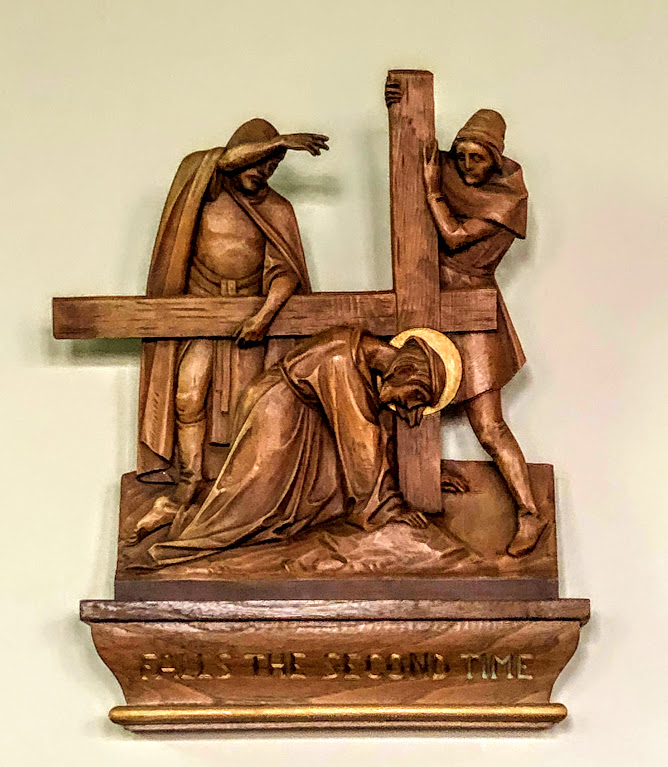
In Station VII in Wolverton, Jesus has let go of the Cross, and both hands have hit the ground in front of him. Without Simon catching hold of the Cross, Jesus would be crushed beneath the weight of it.

The words below read simply: ‘Falls the Second Time’.

So often, I have felt I am a broken and fallen man. In the past, at times, the Church had an appalling record for how it treated people regarded as ‘fallen.’ Instead of helping many women in distress, it has condemned them to the Magdalene laundries, and often conspired in the inhumane treatment of their children.

But the Church has also responded with both hands to people who have fallen to the bottom of the system because of political, economic and social policies.

I pray this morning for people from the churches who are working together throughout Europe with refugees fleeing the war in Ukraine, the families, neighbours and friends those refugees have left behind, and those who have fallen victims of this appalling war.

‘Falls the Second Time’ … Station 7 in the Stations of the Cross in Saint Francis de Sales Church, Wolverton (Photograph: Patrick Comerford, 2023)

John 11: 45-57 (NRSVA):

45 Many of the Jews therefore, who had come with Mary and had seen what Jesus did, believed in him. 46 But some of them went to the Pharisees and told them what he had done. 47 So the chief priests and the Pharisees called a meeting of the council, and said, ‘What are we to do? This man is performing many signs. 48 If we let him go on like this, everyone will believe in him, and the Romans will come and destroy both our holy place and our nation.’ 49 But one of them, Caiaphas, who was high priest that year, said to them, ‘You know nothing at all! 50 You do not understand that it is better for you to have one man die for the people than to have the whole nation destroyed.’ 51 He did not say this on his own, but being high priest that year he prophesied that Jesus was about to die for the nation, 52 and not for the nation only, but to gather into one the dispersed children of God. 53 So from that day on they planned to put him to death.

54 Jesus therefore no longer walked about openly among the Jews, but went from there to a town called Ephraim in the region near the wilderness; and he remained there with the disciples.

55 Now the Passover of the Jews was near, and many went up from the country to Jerusalem before the Passover to purify themselves. 56 They were looking for Jesus and were asking one another as they stood in the temple, ‘What do you think? Surely he will not come to the festival, will he?’ 57 Now the chief priests and the Pharisees had given orders that anyone who knew where Jesus was should let them know, so that they might arrest him.

Today’s Prayer:

The theme in this week’s prayer diary of the Anglican mission agency USPG (United Society Partners in the Gospel) is ‘Good Neighbours: A View from Sri Lanka.’ This theme was introduced on Sunday morning with an adaptation from Father Rasika Abeysinghe’s contribution to USPG’s Lent Course ‘Who is our neighbour,’ which I have edited for USPG. Father Rasika Abeysinghe is a priest in the Diocese of Kurunagala in the Church of Ceylon.

The USPG Prayer Diary today (Saturday 1 April 2023) invites us to pray:

Let us give thanks for those who seek to work across divisions. May they be enriched by difference and emboldened to share all that is life enhancing.

The Collect:

Most merciful God,
who by the death and resurrection of your Son Jesus Christ
delivered and saved the world:
grant that by faith in him who suffered on the cross
we may triumph in the power of his victory;
through Jesus Christ your Son our Lord,
who is alive and reigns with you,
in the unity of the Holy Spirit,
one God, now and for ever.

Post Communion:

Lord Jesus Christ,
you have taught us
that what we do for the least of our brothers and sisters
we do also for you:
give us the will to be the servant of others
as you were the servant of all,
and gave up your life and died for us,
but are alive and reign, now and for ever.

Yesterday’s reflection

Continued tomorrow

Stations of the Cross in Stepney, Wolverton and Stony Stratford (Photographs: Patrick Comerford)

Scripture quotations are from the New Revised Standard Version Bible: Anglicised Edition copyright © 1989, 1995, National Council of the Churches of Christ in the United States of America. Used by permission. All rights reserved worldwide. http://nrsvbibles.org

31 March 2023

Praying at the Stations of the Cross in
Lent 2023: 31 March 2023 (Station 6)

‘Veronica offers Jesus a towel’ … Station 6 in the Stations of the Cross in Saint Dunstan and All Saints’ Church, Stepney (Photograph: Patrick Comerford, 2023)

Patrick Comerford

These final weeks in Lent are often known as Passiontide, beginning with last Sunday, the Fifth Sunday in Lent or Passion Sunday (26 March 2023).

We are now coming towards the end of what is often known as Passion Week. In these two weeks of Passiontide, Passion Week and Holy Week, I am reflecting in these ways:

1, Short reflections on the Stations of the Cross, illustrated by images in Saint Dunstan’s and All Saints’ Church, the Church of England parish church in Stepney, in the East End of London, and the Roman Catholic Church of Saint Francis de Sales in Wolverton, which I visited for the first time last month;

2, the Gospel reading of the day in the lectionary adapted in the Church of England;

3, a prayer from the USPG prayer diary.

Station 5, Veronica wipes the face of Jesus:

The Sixth Station in the Stations of the Cross has a traditional description such as ‘Veronica wipes the face of Jesus.’ Veronica is not a Biblical or historical figure, but her name reminds us of every woman who takes a stand for truth, even when great personal costs and risks are involved.

I was staying at Glenstal Abbey, Co Limerick, when I heard the news that the journalist Veronica Guerin had been murdered on 26 June 1996. She first wrote for the Sunday Business Post and the Sunday Tribune, and began writing about crime for the Sunday Independent on 1994. She was shot dead while she was stopped at traffic lights near Newlands Cross, on the outskirts of Dublin. She was due to speak two days later at a conference in London on ‘journalists at risk.’

Her murder caused national outrage in Ireland, and the Taoiseach John Bruton called it ‘an attack on democracy.’

Her name and those of 38 other international journalists who died in the line of duty in 1996 were added to the Freedom Forum Journalists Memorial in Arlington, Virginia, in 1997. In 2000, she was named as one of the International Press Institute's 50 World Press Freedom Heroes of the past 50 years. The Veronica Guerin Memorial Scholarship at Dublin City University offers a bursary for a student following the MA in Journalism who wishes to specialise in investigative journalism.

Her husband Graham Turley has said: ‘Veronica stood for freedom to write. She stood as light, and wrote of life in Ireland today, and told the truth. Veronica was not a judge, nor was she a juror, but she paid the ultimate price with the sacrifice of her life.’

In the Sixth Station in Stepney, Veronica falls to her knees in front of Jesus as she reaches up to wipe his face, while a second woman stands weeping. Behind them, a soldier reaches his hand out to Christ’s shoulder, while Simon of Cyrene balances the weight of the Cross and a young apprentice carries a tool box, perhaps carrying the implements of the Crucifixion.

The words beneath the scene read: ‘Veronica offers Jesus a towel.’

This scene is depicted in a simpler presentation in Station 6 in Wolverton, where Veronica holds out the cloth and Jesus leans forward for it with one hand. Behind him, a soldier is carrying the spear that will pierce his side.

The words beneath read: ‘Jesus and Veronica.’

‘Jesus and Veronica’ … Station 6 in the Stations of the Cross in Saint Francis de Sales Church, Wolverton (Photograph: Patrick Comerford, 2023)

John 10: 31-42 (NRSVA):

31 The Jews took up stones again to stone him. 32 Jesus replied, ‘I have shown you many good works from the Father. For which of these are you going to stone me?’ 33 The Jews answered, ‘It is not for a good work that we are going to stone you, but for blasphemy, because you, though only a human being, are making yourself God.’ 34 Jesus answered, ‘Is it not written in your law, “I said, you are gods”? 35 If those to whom the word of God came were called “gods”—and the scripture cannot be annulled— 36 can you say that the one whom the Father has sanctified and sent into the world is blaspheming because I said, “I am God’s Son”? 37 If I am not doing the works of my Father, then do not believe me. 38 But if I do them, even though you do not believe me, believe the works, so that you may know and understand that the Father is in me and I am in the Father.’ 39 Then they tried to arrest him again, but he escaped from their hands.

40 He went away again across the Jordan to the place where John had been baptizing earlier, and he remained there. 41 Many came to him, and they were saying, ‘John performed no sign, but everything that John said about this man was true.’ 42 And many believed in him there.

Today’s Prayer:

The theme in this week’s prayer diary of the Anglican mission agency USPG (United Society Partners in the Gospel) is ‘Good Neighbours: A View from Sri Lanka.’ This theme was introduced on Sunday morning with an adaptation from Father Rasika Abeysinghe’s contribution to USPG’s Lent Course ‘Who is our neighbour,’ which I have edited for USPG. Father Rasika Abeysinghe is a priest in the Diocese of Kurunagala in the Church of Ceylon.

The USPG Prayer Diary today (Friday 31 March 2023) invites us to pray:

Let us pray for the Diocese of Kurunagala. May its work amongst struggling farmers and labourers, and those of different faiths, aid those most affected by Sri Lanka’s economic crisis.

The Collect:

Most merciful God,
who by the death and resurrection of your Son Jesus Christ
delivered and saved the world:
grant that by faith in him who suffered on the cross
we may triumph in the power of his victory;
through Jesus Christ your Son our Lord,
who is alive and reigns with you,
in the unity of the Holy Spirit,
one God, now and for ever.

Post Communion:

Lord Jesus Christ,
you have taught us
that what we do for the least of our brothers and sisters
we do also for you:
give us the will to be the servant of others
as you were the servant of all,
and gave up your life and died for us,
but are alive and reign, now and for ever.

Yesterday’s reflection

Continued tomorrow

Stations of the Cross in Stepney, Wolverton and Stony Stratford (Photographs: Patrick Comerford)

Scripture quotations are from the New Revised Standard Version Bible: Anglicised Edition copyright © 1989, 1995, National Council of the Churches of Christ in the United States of America. Used by permission. All rights reserved worldwide. http://nrsvbibles.org

30 March 2023

Praying at the Stations of the Cross in
Lent 2023: 30 March 2023 (Station 5)

‘Simon of Cyrene helps Jesus’ … Station 5 in the Stations of the Cross in Saint Dunstan and All Saints’ Church, Stepney (Photograph: Patrick Comerford, 2023)

Patrick Comerford

These final weeks in Lent are often known as Passiontide, beginning with last Sunday, the Fifth Sunday in Lent or Passion Sunday (26 March 2023).

We are now in the middle of what is often known as Passion Week. In these two weeks of Passiontide, Passion Week and Holy Week, I am reflecting in these ways:

1, Short reflections on the Stations of the Cross, illustrated by images in Saint Dunstan’s and All Saints’ Church, the Church of England parish church in Stepney, in the East End of London, and the Roman Catholic Church of Saint Francis de Sales in Wolverton, which I visited for the first time last month;

2, the Gospel reading of the day in the lectionary adapted in the Church of England;

3, a prayer from the USPG prayer diary.

Station 5, Simon of Cyrene helps Jesus:

The Fifth Station in the Stations of the Cross has a traditional description such as ‘Simon of Cyrene helps carry the Cross.’ Simon of Cyrene is mentioned in three of the four Gospels as the man forced by the Roman soldiers to help Jesus carry his cross. He was from Cyrene in north Africa. But was he a black African, or was he like so many others there who were of Greek, Roman or Jewish descent?

Simon’s name is Jewish. But whether he was a Jew or a Gentile is perhaps irrelevant. His action reminds me of the ‘Righteous Among the Nations,’ an honour used to describe non-Jews who risked their lives during the Holocaust to save Jews from extermination by the Nazis.

The term originates with the concept of righteous gentiles, a term used in rabbinic literature to describe non-Jews (ger toshav) who abide by the Seven Laws of Noah.

The Righteous are defined as non-Jews who risked their lives to save Jews during the Holocaust. Only a Jewish party can make a nomination. Helping a family member or a Jew convert to Christianity is not a criterion for recognition. Assistance has to be repeated and substantial, and it has to be given without any expected financial gain.

The largest number of Righteous is from Poland (6,706). Mary Elizabeth Elmes (1908-2002) from Cork was the first Irish person to be honoured among the Righteous by Yad Vashem. She saved at least 200 Jewish children under the age of 12 by smuggling them over the border between France and Spain in the boot of her car. There is also an application for another Irish person, Monsignor Hugh O’Flaherty, who rescued 6,500 Prisoners of War and Jews in Rome.

The Righteous are honoured with a feast day in the liturgical calendar of the Episcopal Church in the US (16 July), and a Righteous from Italy, Edward Focherini, was beatified by the Roman Catholic Church in 2013.

In the Fifth Station in Stepney, one soldier at the front helps to balance the bar of the Cross on Christ’s shoulders, while the other behind helps the balance the shaft of the Cross with both hands as he instructs Simon how to take hold of the end of the Cross. Simon has a purse slung over his shoulder and a sickle tucked into his belt, indicating a working man. Two small children, a girl and a boy, have their hands clasped in prayer, while a bearded onlooker seems to be bowing his head in reverence.

The words beneath the scene read: ‘Simon of Cyrene helps Jesus.’

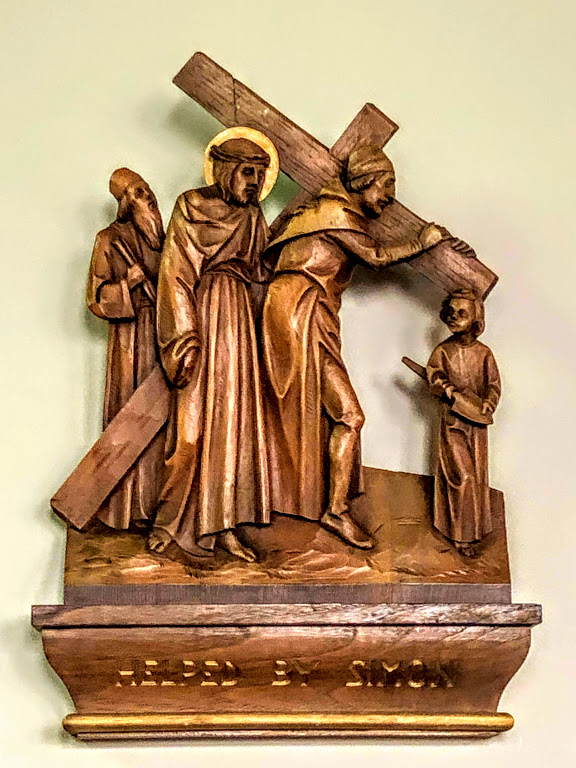
This scene is depicted in a simpler presentation in Station 5 in Wolverton, where Simon seems to take the whole burden and full weight of the Cross. There are no soldiers watching on, but there is a bearded man with a reverential gaze, and a child is carrying a spade, perhaps to dig the place in the ground where the Cross is going to be placed.

The words beneath read: ‘Helped by Simon.’

‘Helped by Simon’ … Station 5 in the Stations of the Cross in Saint Francis de Sales Church, Wolverton (Photograph: Patrick Comerford, 2023)

John 8: 51-59 (NRSVA):

[Jesus said:] 51 ‘Very truly, I tell you, whoever keeps my word will never see death.’ 52 The Jews said to him, ‘Now we know that you have a demon. Abraham died, and so did the prophets; yet you say, “Whoever keeps my word will never taste death.” 53 Are you greater than our father Abraham, who died? The prophets also died. Who do you claim to be?’ 54 Jesus answered, ‘If I glorify myself, my glory is nothing. It is my Father who glorifies me, he of whom you say, “He is our God”, 55 though you do not know him. But I know him; if I were to say that I do not know him, I would be a liar like you. But I do know him and I keep his word. 56 Your ancestor Abraham rejoiced that he would see my day; he saw it and was glad.’ 57 Then the Jews said to him, ‘You are not yet fifty years old, and have you seen Abraham?’ 58 Jesus said to them, ‘Very truly, I tell you, before Abraham was, I am.’ 59 So they picked up stones to throw at him, but Jesus hid himself and went out of the temple.’

Today’s Prayer:

The theme in this week’s prayer diary of the Anglican mission agency USPG (United Society Partners in the Gospel) is ‘Good Neighbours: A View from Sri Lanka.’ This theme was introduced on Sunday morning with an adaptation from Father Rasika Abeysinghe’s contribution to USPG’s Lent Course ‘Who is our neighbour,’ which I have edited for USPG. Father Rasika Abeysinghe is a priest in the Diocese of Kurunagala in the Church of Ceylon.

The USPG Prayer Diary today (Thursday 30 March 2023) invites us to pray:

Let us pray for all who live in poverty and distress. May they experience the bonds of community and be carried by care and compassion.

The Collect:

Most merciful God,
who by the death and resurrection of your Son Jesus Christ
delivered and saved the world:
grant that by faith in him who suffered on the cross
we may triumph in the power of his victory;
through Jesus Christ your Son our Lord,
who is alive and reigns with you,
in the unity of the Holy Spirit,
one God, now and for ever.

Post Communion:

Lord Jesus Christ,
you have taught us
that what we do for the least of our brothers and sisters
we do also for you:
give us the will to be the servant of others
as you were the servant of all,
and gave up your life and died for us,
but are alive and reign, now and for ever.

Yesterday’s reflection

Continued tomorrow

Stations of the Cross in Stepney, Wolverton and Stony Stratford (Photographs: Patrick Comerford)

Scripture quotations are from the New Revised Standard Version Bible: Anglicised Edition copyright © 1989, 1995, National Council of the Churches of Christ in the United States of America. Used by permission. All rights reserved worldwide. http://nrsvbibles.org

29 March 2023

Praying at the Stations of the Cross in
Lent 2023: 29 March 2023 (Station 4)

‘Jesus meets his Mother’ … Station 4 in the Stations of the Cross in Saint Dunstan and All Saints’ Church, Stepney (Photograph: Patrick Comerford, 2023)

Patrick Comerford

These final weeks in Lent are often known as Passiontide, beginning with last Sunday, the Fifth Sunday in Lent (26 March 2023), which is sometimes known as Passion Sunday.

I have a dental appointment later today. But, before this day begins, I am taking some time early this morning for prayer, reflection and reading.

During Lent this year, in this Prayer Diary on my blog each morning, I have been reflecting on words from Samuel Johnson, the Lichfield-born lexicographer and compiler of the first standard Dictionary of the English language. But, in these two weeks of Passiontide, Passion Week and Holy Week, I am reflecting in these ways:

1, Short reflections on the Stations of the Cross, illustrated by images in Saint Dunstan’s and All Saints’ Church, the Church of England parish church in Stepney, in the East End of London, and the Roman Catholic Church of Saint Francis de Sales in Wolverton, which I visited for the first time last month;

2, the Gospel reading of the day in the lectionary adapted in the Church of England;

3, a prayer from the USPG prayer diary.

Station 4, Jesus meets his Mother:

The Fourth Station in the Stations of the Cross has a traditional description such as ‘Jesus meets his Mother Mary.’

In the Fourth Station in Stepney, Christ meets his mother Mary and the Beloved Disciple. She reaches out with both hands cautiously and tenderly, her finger tips barely touching the fingers of his left hand, while Saint John clasps his hand to his heart, a sign of his broken-heartedness. They are to remain with Christ throughout his Passion and Death. It is a silent moment of love and pathos.

Behind them, a Roman solider and two other men stop for this moment, the soldier staring at the encounter, the other two almost averting their gaze, although one man also seems to be reaching out to Christ.

The words beneath the scene read: ‘Jesus meets his Mother.’

Saint John is also in the scene in Station 4 in Wolverton, watching on as Christ faces back to see his Mother, Mother and Son gazing into each other’s eyes, as her hands reach out to touch his shoulder and his arms while seem to say nothing. A soldier, instead of looking on, looks ahead – the journey to Calvary continues.

The words beneath the scene read: ‘Mother and Son.’

‘Mother and Son’ … Station 4 in the Stations of the Cross in Saint Francis de Sales Church, Wolverton (Photograph: Patrick Comerford, 2023)

John 8: 31-42 (NRSVA):

31 Then Jesus said to the Jews who had believed in him, ‘If you continue in my word, you are truly my disciples; 32 and you will know the truth, and the truth will make you free.’ 33 They answered him, ‘We are descendants of Abraham and have never been slaves to anyone. What do you mean by saying, “You will be made free”?’

34 Jesus answered them, ‘Very truly, I tell you, everyone who commits sin is a slave to sin. 35 The slave does not have a permanent place in the household; the son has a place there for ever. 36 So if the Son makes you free, you will be free indeed. 37 I know that you are descendants of Abraham; yet you look for an opportunity to kill me, because there is no place in you for my word. 38 I declare what I have seen in the Father’s presence; as for you, you should do what you have heard from the Father.’

39 They answered him, ‘Abraham is our father.’ Jesus said to them, ‘If you were Abraham’s children, you would be doing what Abraham did, 40 but now you are trying to kill me, a man who has told you the truth that I heard from God. This is not what Abraham did. 41 You are indeed doing what your father does.’ They said to him, ‘We are not illegitimate children; we have one father, God himself.’ 42 Jesus said to them, ‘If God were your Father, you would love me, for I came from God and now I am here. I did not come on my own, but he sent me.’

Today’s Prayer:

The theme in this week’s prayer diary of the Anglican mission agency USPG (United Society Partners in the Gospel) is ‘Good Neighbours: A View from Sri Lanka.’ This theme was introduced on Sunday morning with an adaptation from Father Rasika Abeysinghe’s contribution to USPG’s Lent Course ‘Who is our neighbour,’ which I have edited for USPG. Father Rasika Abeysinghe is a priest in the Diocese of Kurunagala in the Church of Ceylon.

The USPG Prayer Diary today (Wednesday 29 March 2023) invites us to pray:

Let us pray for a greater understanding between faiths. May we learn to listen to one another with open hearts and find ways to work together for the common good.

The Collect:

Most merciful God,
who by the death and resurrection of your Son Jesus Christ
delivered and saved the world:
grant that by faith in him who suffered on the cross
we may triumph in the power of his victory;
through Jesus Christ your Son our Lord,
who is alive and reigns with you,
in the unity of the Holy Spirit,
one God, now and for ever.

Post Communion:

Lord Jesus Christ,
you have taught us
that what we do for the least of our brothers and sisters
we do also for you:
give us the will to be the servant of others
as you were the servant of all,
and gave up your life and died for us,
but are alive and reign, now and for ever.

Yesterday’s reflection

Continued tomorrow

Scripture quotations are from the New Revised Standard Version Bible: Anglicised Edition copyright © 1989, 1995, National Council of the Churches of Christ in the United States of America. Used by permission. All rights reserved worldwide. http://nrsvbibles.org