Showing posts with label Pentecost 2022. Show all posts

11 June 2022

Praying with the Psalms in Pentecost:
11 June 2022 (Psalm 108)

‘Be exalted, O God, above the heavens, and let your glory be over all the earth’ (Psalm 108: 5) … Lichfield Cathedral Close (Photograph: Mark Anthony Walden, 2013)

Today in the Church Calendar is the Feast of Saint Barnabas. Before today begins, I am taking some time this morning to continue my reflections from the seasons of Lent and Easter, including my morning reflections drawing on the Psalms.

In my blog, I am reflecting each morning in this Prayer Diary in these ways:

1, Short reflections on a psalm or psalms;

2, reading the psalm or psalms;

3, a prayer from the USPG prayer diary.

Psalm 108:

Psalm 108 is the second psalm in Book 5 (Psalms 107-150), the closing book in the Hebrew psalter. It is sometimes known by its Latin name Paratum cor meum Deus. In the slightly different numbering system in the Greek Septuagint and Latin Vulgate, this psalm is counted as Psalm 107.

Psalm 108 is ascribed to David. This psalm contains numerous verses that appear in other psalms. Verses 1-5 are similar to Psalm 57: 7-11, with slight variation; verses 7-13 are similar to Psalm 60: 5-12.

David begins this prayer with praise and ended it with confidence in God’s strength and ability. The 13 verses in this psalm can be divided into two stanzas:

1, verses 1-5: David opens this psalm with a declaration of commitment to praise and bring adoration to God. He says he begins each day with praise and thanks to God. David expresses his trust, hope and confidence in God, and says God’s love, mercy and truth reach to the skies, extends beyond the earth and reaches the furthest corners of the universe.

2, verses 6-13: David appeals to God to keep him safe from the hand of the enemy and expresses his strong confidence in God. He can trust in God alone for success and victory.

The Midrash teaches that verse 2 (verse 3 in Hebrew numbering) refers to David’s practice of arising each night before dawn and praising God with psaltery and harp, thus ‘awakening the dawn.’

Stephen Fry’s autobiography, Moab Is My Washpot (1997) takes its title from verse 9, ‘Moab is my wash-basin.’

‘On Edom I hurl my shoe’ (Psalm 108: 9) … shoes in a charity event in Carlow (Photograph: Patrick Comerford)

Psalm 108 (NRSVA):

A Song. A Psalm of David.

1 My heart is steadfast, O God, my heart is steadfast;
I will sing and make melody.
Awake, my soul!
2 Awake, O harp and lyre!
I will awake the dawn.
3 I will give thanks to you, O Lord, among the peoples,
and I will sing praises to you among the nations.
4 For your steadfast love is higher than the heavens,
and your faithfulness reaches to the clouds.

5 Be exalted, O God, above the heavens,
and let your glory be over all the earth.
6 Give victory with your right hand, and answer me,
so that those whom you love may be rescued.

7 God has promised in his sanctuary:
‘With exultation I will divide up Shechem,
and portion out the Vale of Succoth.
8 Gilead is mine; Manasseh is mine;
Ephraim is my helmet;
Judah is my sceptre.
9 Moab is my wash-basin;
on Edom I hurl my shoe;
over Philistia I shout in triumph.’

10 Who will bring me to the fortified city?
Who will lead me to Edom?
11 Have you not rejected us, O God?
You do not go out, O God, with our armies.
12 O grant us help against the foe,
for human help is worthless.
13 With God we shall do valiantly;
it is he who will tread down our foes.

Today’s Prayer:

The theme in this week’s prayer diary of the Anglican mission agency USPG (United Society Partners in the Gospel) has been ‘The Time to Act is Now!’ The theme was introduced on Sunday by Linet Musasa, of the Anglican Council of Zimbabwe.

The USPG Prayer Diary this morning (Saturday 11 June 2022, Saint Barnabas the Apostle) invites us to pray:

Today is the feast of Saint Barnabas the Apostle. May we remember the life and works of Barnabas and seek to emulate his peaceful ways.

Yesterday’s reflection

Continued tomorrow

Saint Barnabas (right) with Saint Paul (left) and the Prophet Elijah (centre), in the east window of Saint George’s Chapel in Saint Editha’s Church, Tamworth … the Church Calendar today commemorates Saint Barnabas (Photograph: Patrick Comerford)

Scripture quotations are from the New Revised Standard Version Bible: Anglicised Edition copyright © 1989, 1995, National Council of the Churches of Christ in the United States of America. Used by permission. All rights reserved worldwide. http://nrsvbibles.org

10 June 2022

Praying with the Psalms in Pentecost:
10 June 2022 (Psalm 107)

‘Some went down to the sea in ships, doing business on the mighty waters’ (Psalm 107: 23) … fishing boats at the Quays in Wexford (Photograph: Patrick Comerford, 2022)

Before today begins, I am taking some time this morning to continue my reflections from the seasons of Lent and Easter, including my morning reflections drawing on the Psalms.

In my blog, I am reflecting each morning in this Prayer Diary in these ways:

1, Short reflections on a psalm or psalms;

2, reading the psalm or psalms;

3, a prayer from the USPG prayer diary.

Psalm 107:

Psalm 107 is the first psalm in Book 5 (Psalms 107-150), the closing book in the Hebrew psalter. This is one of the longer psalms, and has 43 verses. It is sometimes known by its Latin name Confitemini Domino. In the slightly different numbering system in the Greek Septuagint and Latin Vulgate, this psalm is counted as Psalm 106.

Psalms 106 and Psalm 107 are closely connected together, and the division of the fourth and fifth books does not correspond to any difference of source or character, as is the case in the other books.

Psalm 107 is a song of thanksgiving to God, who has been merciful to his people and gathered all who were lost. It is beloved of mariners because of its reference to ships and to the sea (verse 23).

Although the exact timing of the writing of Psalm 107 is uncertain, it may have been written at a time of increased union among the people during the reign of King David (1010-970 BCE).

This is considered one of Israel’s historical psalms, along with Psalm 106 and many of the royal psalms, among others. The overall outline of the historical psalms is to tell a story of a God who accomplishes ‘wonderful works’ (verse 8), although the Israelites, his chosen people, have proved faithless.

In the psalmist’s assessment, acts of infidelity often seem to correspond to an eventual awe-inspiring work of mercy from the Lord. The psalm also includes several specific themes that emphasise the general tone of praise and thanksgiving for God.

Psalm 107 displays an overall regularity. The line lengths are different, but the size of the original sectional divisions is pleasingly even. The theme of the psalm moves forward from section to section.

Psalm 107 is divided into 43 verses and is one of the longer psalms in the Bible. In the Masoretic Hebrew text, there are seven inverted nuns (׆). The words ‘Let them thank the Lord for his steadfast love, for his wonderful works to humankind’ appear as a refrain in verses 8, 15, 21 and 31.

It may be divided into seven sections, each section having a related but distinct theme:

1, verses 1-3: this is a general introduction, in which the Lord is said to gather ‘the redeemed … from the east and from the west, from the north and from the south’ verses 2, 3).

Following this, the next four sections address individuals who ‘wandered in desert wastes’ (verse 4), ‘sat in darkness and in gloom’ (verse 10), ‘were sick through their sinful ways’ (verse 17), and ‘went down to the sea in ships’ (verse 23). Each of these locational descriptors corresponds to a cardinal direction mentioned in verse 3.

2, verses 4-9: the desert wastes in verse 4 seem to indicate a ‘great, eastern desert’ that might be beat down upon by the sun, which rises in the east.

3, verses 10-16: in the opposing, western direction, where the sun sets, the people are said to sit ‘in darkness and in gloom’ (verse 10). The correlation depicted in this section between darkness and helplessness – apart from the aid of the Lord – harkens back to the earlier descriptions of Abraham (see Genesis 15: 12).

4, verses 17-22: throughout early Hebrew history, north was thought to be the direction most associated with evil and iniquity, thus adding emphasis to the direction of north’s correspondence to the fourth stanza, beginning with ‘some were sick through their sinful ways, and because of their iniquities suffered affliction’ (verse 17).

5, verses 23-3: in the orientation of the region that Israel occupied at the time of Psalm 107, to the south lay the sea, directly paralleling the beginning of the fifth section, ‘some went down to the sea in ships’ (verse 23).

6, verses 33-38: Psalm 107 is, above all, a hymn commemorating the power of God. Despite the transgressions of the people, the Lord forgives them. The psalm elaborates on this theme, going on to say that the Lord ‘turns a desert into pools of water … and there he lets the hungry dwell’ He ‘turns a desert into pools of water … and there he lets the hungry live’ (verses 35, 36). This description of miracles worked by God reinforces the imagery of ‘wonderful works’ mentioned earlier in the psalm (see verse 8).

7, verses 39-43: God’s works are mentioned in many psalms; what makes Psalm 107 unusual is its depiction of God’s works as explication for the people. The psalm is a hymn of thanksgiving, making God’s works known to all humanity, so that all may join in the praise of God.

‘Some sat in darkness and in gloom’ (Psalm 107: 10) … darkness closes in on a Dublin street (Photograph: Patrick Comerford, 2022)

Psalm 107 (NRSVA):

1 O give thanks to the Lord, for he is good;
for his steadfast love endures for ever.
2 Let the redeemed of the Lord say so,
those he redeemed from trouble
3 and gathered in from the lands,
from the east and from the west,
from the north and from the south.

4 Some wandered in desert wastes,
finding no way to an inhabited town;
5 hungry and thirsty,
their soul fainted within them.
6 Then they cried to the Lord in their trouble,
and he delivered them from their distress;
7 he led them by a straight way,
until they reached an inhabited town.
8 Let them thank the Lord for his steadfast love,
for his wonderful works to humankind.
9 For he satisfies the thirsty,
and the hungry he fills with good things.

10 Some sat in darkness and in gloom,
prisoners in misery and in irons,
11 for they had rebelled against the words of God,
and spurned the counsel of the Most High.
12 Their hearts were bowed down with hard labour;
they fell down, with no one to help.
13 Then they cried to the Lord in their trouble,
and he saved them from their distress;
14 he brought them out of darkness and gloom,
and broke their bonds asunder.
15 Let them thank the Lord for his steadfast love,
for his wonderful works to humankind.
16 For he shatters the doors of bronze,
and cuts in two the bars of iron.

17 Some were sick through their sinful ways,
and because of their iniquities endured affliction;
18 they loathed any kind of food,
and they drew near to the gates of death.
19 Then they cried to the Lord in their trouble,
and he saved them from their distress;
20 he sent out his word and healed them,
and delivered them from destruction.
21 Let them thank the Lord for his steadfast love,
for his wonderful works to humankind.
22 And let them offer thanksgiving sacrifices,
and tell of his deeds with songs of joy.

23 Some went down to the sea in ships,
doing business on the mighty waters;
24 they saw the deeds of the Lord,
his wondrous works in the deep.
25 For he commanded and raised the stormy wind,
which lifted up the waves of the sea.
26 They mounted up to heaven, they went down to the depths;
their courage melted away in their calamity;
27 they reeled and staggered like drunkards,
and were at their wits’ end.
28 Then they cried to the Lord in their trouble,
and he brought them out from their distress;
29 he made the storm be still,
and the waves of the sea were hushed.
30 Then they were glad because they had quiet,
and he brought them to their desired haven.
31 Let them thank the Lord for his steadfast love,
for his wonderful works to humankind.
32 Let them extol him in the congregation of the people,
and praise him in the assembly of the elders.

33 He turns rivers into a desert,
springs of water into thirsty ground,
34 a fruitful land into a salty waste,
because of the wickedness of its inhabitants.
35 He turns a desert into pools of water,
a parched land into springs of water.
36 And there he lets the hungry live,
and they establish a town to live in;
37 they sow fields, and plant vineyards,
and get a fruitful yield.
38 By his blessing they multiply greatly,
and he does not let their cattle decrease.

39 When they are diminished and brought low
through oppression, trouble, and sorrow,
40 he pours contempt on princes
and makes them wander in trackless wastes;
41 but he raises up the needy out of distress,
and makes their families like flocks.
42 The upright see it and are glad;
and all wickedness stops its mouth.
43 Let those who are wise give heed to these things,
and consider the steadfast love of the Lord.

Today’s Prayer:

The theme in this week’s prayer diary of the Anglican mission agency USPG (United Society Partners in the Gospel) is ‘The Time to Act is Now!’ This theme was introduced on Sunday by Linet Musasa, of the Anglican Council of Zimbabwe.

The USPG Prayer Diary this morning (Friday 10 June 2022) invites us to pray:

We pray for governments and international organisations to take urgent action on climate change.

Yesterday’s reflection

Continued tomorrow

Scripture quotations are from the New Revised Standard Version Bible: Anglicised Edition copyright © 1989, 1995, National Council of the Churches of Christ in the United States of America. Used by permission. All rights reserved worldwide. http://nrsvbibles.org

08 June 2022

Praying with the Psalms in Pentecost:
8 June 2022 (Psalm 105)

‘They shackled his feet with fetters; his neck was ringed with iron’ (Psalm 105: 18) … the former prison cells in the Guildhall in Lichfield (Photograph: Patrick Comerford)

Before today begins, I am taking some time this morning to continue my reflections from the seasons of Lent and Easter, including my morning reflections drawing on the Psalms.

In my blog, I am reflecting each morning in this Prayer Diary in these ways:

1, Short reflections on a psalm or psalms;

2, reading the psalm or psalms;

3, a prayer from the USPG prayer diary.

Psalm 105:

Psalm 105 is one of the longer psalms, and has 45 verses. It is sometimes known by its Latin name Confitemini Domino. In the slightly different numbering system in the Greek Septuagint and Latin Vulgate, this psalm is counted as Psalm 104.

Psalms 105 and 106, the two psalms that end Book 4 of the Hebrew psalms, are closely related. Psalm 105 gives thanks for God’s faithfulness to the covenant he made with Abraham; Psalm 106 is a psalm of penitence, reciting the history of Israel’s faithlessness and disobedience.

Psalm 105 was probably written for a major festival, and verses 1-15 are largely reproduced in I Chronicles 16: 8-22, with just two slight differences in the wording of the parallel passages.

Originally the psalm began as it ends, with the words ‘Alleluia!’ or ‘Praise the Lord.’ The word Ἁλληλουιά (alleluia) precedes the opening verse in the Septuagint, where it has been transposed from verse 35 of the previous psalm.

Psalm 105 recalls the events in Israel’s history, from Abraham to the entry into the Promised Land, that show God’s fidelity to his covenant, culminating in the giving of the Law.

Verses 1-6 invite the people, the ‘children of Jacob’ and the descendants of Abraham (verse 6) – not just Joseph and his brothers, but all people in the community of faith – to worship God.

They are called on to give thanks for his deeds with joy and gratitude. God is to be praised for his judgments and for his wonderful works. (verses 1-4).

God’s judgments are for all people. He first promised the land to Abraham, confirmed it to Isaac and to Jacob, and made it part of an everlasting covenant. We are to search for God with all our strength, and to recall his great deeds (verses 5-6).

As they sing this psalm, however, the people are reminded that Joseph was sold into slavery, and that the people were afflicted by famine (verses 16-19). Yet, when Pharaoh set Joseph free, he became a wise teacher, and this is worth recalling and celebrating, for its shows God’s hand in history (verses 20-22).

The story of slavery in Egypt is recalled in verses 23-25, the plagues in Egypt are recounted in verses 23-25, and the Exodus into the wilderness and to freedom are then recalled in verses 37-45.

And for this, we give praise to God (verse 45b).

In Jewish tradition, this Psalm is recited on the first day of Passover. Verses 8-10 are part of the prayers recited in the naming of a boy at his brit milah or circumcision, and verses 8-42 are repeated in the Amidah or principal prayer on New Year’s Day, Rosh Hashanah.

‘He sent darkness, and made the land dark; they rebelled against his words (Psalm 105: 28) … darkness falls on Dublin Castle (Photograph: Patrick Comerford, 2022)

Psalm 105 (NRSVA):

1 O give thanks to the Lord, call on his name,
make known his deeds among the peoples.
2 Sing to him, sing praises to him;
tell of all his wonderful works.
3 Glory in his holy name;
let the hearts of those who seek the Lord rejoice.
4 Seek the Lord and his strength;
seek his presence continually.
5 Remember the wonderful works he has done,
his miracles, and the judgements he has uttered,
6 O offspring of his servant Abraham,
children of Jacob, his chosen ones.

7 He is the Lord our God;
his judgements are in all the earth.
8 He is mindful of his covenant for ever,
of the word that he commanded, for a thousand generations,
9 the covenant that he made with Abraham,
his sworn promise to Isaac,
10 which he confirmed to Jacob as a statute,
to Israel as an everlasting covenant,
11 saying, ‘To you I will give the land of Canaan
as your portion for an inheritance.’

12 When they were few in number,
of little account, and strangers in it,
13 wandering from nation to nation,
from one kingdom to another people,
14 he allowed no one to oppress them;
he rebuked kings on their account,
15 saying, ‘Do not touch my anointed ones;
do my prophets no harm.’

16 When he summoned famine against the land,
and broke every staff of bread,
17 he had sent a man ahead of them,
Joseph, who was sold as a slave.
18 His feet were hurt with fetters,
his neck was put in a collar of iron;
19 until what he had said came to pass,
the word of the Lord kept testing him.
20 The king sent and released him;
the ruler of the peoples set him free.
21 He made him lord of his house,
and ruler of all his possessions,
22 to instruct his officials at his pleasure,
and to teach his elders wisdom.

23 Then Israel came to Egypt;
Jacob lived as an alien in the land of Ham.
24 And the Lord made his people very fruitful,
and made them stronger than their foes,
25 whose hearts he then turned to hate his people,
to deal craftily with his servants.

26 He sent his servant Moses,
and Aaron whom he had chosen.
27 They performed his signs among them,
and miracles in the land of Ham.
28 He sent darkness, and made the land dark;
they rebelled against his words.
29 He turned their waters into blood,
and caused their fish to die.
30 Their land swarmed with frogs,
even in the chambers of their kings.
31 He spoke, and there came swarms of flies,
and gnats throughout their country.
32 He gave them hail for rain,
and lightning that flashed through their land.
33 He struck their vines and fig trees,
and shattered the trees of their country.
34 He spoke, and the locusts came,
and young locusts without number;
35 they devoured all the vegetation in their land,
and ate up the fruit of their ground.
36 He struck down all the firstborn in their land,
the first issue of all their strength.

37 Then he brought Israel out with silver and gold,
and there was no one among their tribes who stumbled.
38 Egypt was glad when they departed,
for dread of them had fallen upon it.
39 He spread a cloud for a covering,
and fire to give light by night.
40 They asked, and he brought quails,
and gave them food from heaven in abundance.
41 He opened the rock, and water gushed out;
it flowed through the desert like a river.
42 For he remembered his holy promise,
and Abraham, his servant.

43 So he brought his people out with joy,
his chosen ones with singing.
44 He gave them the lands of the nations,
and they took possession of the wealth of the peoples,
45 that they might keep his statutes
and observe his laws.
Praise the Lord!

Today’s Prayer:

The theme in this week’s prayer diary of the Anglican mission agency USPG (United Society Partners in the Gospel) is ‘The Time to Act is Now!’ This theme was introduced on Sunday by Linet Musasa, of the Anglican Council of Zimbabwe.

The USPG Prayer Diary this morning (Wednesday 8 June 2022) invites us to pray:

We pray for those who are directly witnessing the impact of climate change. May we help them to mitigate and adapt to the effects of climate change.

Yesterday’s reflection

Continued tomorrow

The Four Questions (Ma Nishtanah) from Arthur Szyk’s ‘Haggadah,’ Łódź (1935) … In Jewish tradition, Psalm 105 is recited on the first day of Passover

Scripture quotations are from the New Revised Standard Version Bible: Anglicised Edition copyright © 1989, 1995, National Council of the Churches of Christ in the United States of America. Used by permission. All rights reserved worldwide. http://nrsvbibles.org

07 June 2022

Praying with the Psalms in Pentecost:
7 June 2022 (Psalm 104)

‘There go the ships, and Leviathan that you formed to sport in it’ (Psalm 104: 26) … a fresco in Vatopedi Monastery on Mount Athos (Photograph: Patrick Comerford)

Patrick Comerford

Before today begins, I am taking some time this morning to continue my reflections from the seasons of Lent and Easter, including my morning reflections drawing on the Psalms.

In my blog, I am reflecting each morning in this Prayer Diary in these ways:

1, Short reflections on a psalm or psalms;

2, reading the psalm or psalms;

3, a prayer from the USPG prayer diary.

Psalm 104:

Psalm 104 is one of the longer psalms, and has 35 verses. It is sometimes known by its Latin name Benedic anima mea Domino. In the slightly different numbering system in the Greek Septuagint and Latin Vulgate, this psalm is counted as Psalm 104. A portion of this psalm (Psalm 104: 24-35) was the appointed psalm on Sunday morning (Pentecost, 5 June 2022).

Psalm 104 is closely related to the first Genesis creation narrative (Genesis 1), where the waters are separated before the creation of Sun and Moon. This is a hymn of praise to God as the creator, creator of the heavens and the earth (verses 5-9). God is wrapped in light, the waters above (the skies) are his heavenly dwelling and the rains, the winds and the fire (thunder and lightning) are his messengers and servants, so that we depend on God for our very existence.

Verse 2-4 tell of the creation of the heavens and verses 5-9 of the earth. To ancient people, light (verse 2) was a thing, so likening it to a garment made sense. God built his heavenly dwelling on the chaotic waters (verses 2b-3a).

The wind (verse 3c) brings rain clouds from the sea; both are under God’s control. The hot wind in verse 4 is the sirocco, a desert wind from the east.

People saw the earth as a disk supported by pillars or foundations (verse 5). Before God’s creative acts, the waters (verse 6) covered the earth. God chased away chaos, bringing order. he restricted the waters to the mountain tops as snow and to the valleys as rivers (verse 8).

God will never again allow the waters to cover the earth (verse 9) and all that lives (verses 10-18): creatures depend on him for their very existence (verses 27-30).

God’s marvellous works (verse 24) are countless, all are made in his wisdom. He has made them in wisdom, with perfection of design and ethic, absolute integrity, truth and beauty.

For people at that time, the sea was almost chaotic, beyond controlling (verse 25), but God is so great that even Leviathan, the mythical sea monster, is his harmless, sportive creature (verse 26).

All living things depend on God at all times, for their food (verse 27) and their life (verse 29), without it, they die. Lack of God’s presence causes terror. His creative agent is his spirit (verse 30). Creation is continuous, continually renewed. The glory of the Lord (verse 31) is the magnificence of the created world, his visible manifestation. His power is evident too in earthquakes and volcanoes (verse 32).

The psalmist vows to praise God throughout his life.

‘The Old 104th’ is a well-known tune composed by Thomas Ravenscroft (1592-1635), and associated with a number of hymns, including ‘Disposer Supreme, and Judge of the earth’, in 1686 by Jean-Baptiste de Santeüil (1630-1697) and translated into English in 1836 by the Revd Isaac Williams (1802-1865).

Ralph Vaughan Williams’s composed an arrangement for ‘Disposer Supreme’ or the ‘Old 104th’ and the hymn ‘Disposer Supreme’ (New English Hymnal, No 216). His harmonisation for this hymn is his adaptation of the ‘Old 104th.’

Vaughan Williams probably came to know and love this because of the strong Gloucestershire connections of Isaac Williams. Indeed, he was so fond of this tune that he wrote a remarkable Fantasia on it for piano solo, chorus and orchestra.

Isaac Williams was John Henry Newman’s curate at the University Church of Saint Mary the Virgin, Oxford, where John Keble preached his Assize Sermon, the spark that ignited the Oxford Movement. Williams became the most prolific of the Tractarian poets, writing no less than 11 volumes of poetry for the movement. He was the author of Tract 80, on Reserve in the Communication of Religious Knowledge, which, next to Tract 90, stirred the greatest controversy. He was curate to Keble’s younger brother, the Revd Thomas Keble (1793-1875), who was also a Tractarian.

‘You cause the grass to grow for the cattle’ (Psalm 104: 14) … cattle grazing in fields by the River Ouse near Passenham in Northamptonshire (Photograph: Patrick Comerford, 2022)

Psalm 104 (NRSVA):

1 Bless the Lord, O my soul.
O Lord my God, you are very great.
You are clothed with honour and majesty,
2 wrapped in light as with a garment.
You stretch out the heavens like a tent,
3 you set the beams of your chambers on the waters,
you make the clouds your chariot,
you ride on the wings of the wind,
4 you make the winds your messengers,
fire and flame your ministers.

5 You set the earth on its foundations,
so that it shall never be shaken.
6 You cover it with the deep as with a garment;
the waters stood above the mountains.
7 At your rebuke they flee;
at the sound of your thunder they take to flight.
8 They rose up to the mountains, ran down to the valleys
to the place that you appointed for them.
9 You set a boundary that they may not pass,
so that they might not again cover the earth.

10 You make springs gush forth in the valleys;
they flow between the hills,
11 giving drink to every wild animal;
the wild asses quench their thirst.
12 By the streams the birds of the air have their habitation;
they sing among the branches.
13 From your lofty abode you water the mountains;
the earth is satisfied with the fruit of your work.

14 You cause the grass to grow for the cattle,
and plants for people to use,
to bring forth food from the earth,
15 and wine to gladden the human heart,
oil to make the face shine,
and bread to strengthen the human heart.
16 The trees of the Lord are watered abundantly,
the cedars of Lebanon that he planted.
17 In them the birds build their nests;
the stork has its home in the fir trees.
18 The high mountains are for the wild goats;
the rocks are a refuge for the coneys.
19 You have made the moon to mark the seasons;
the sun knows its time for setting.
20 You make darkness, and it is night,
when all the animals of the forest come creeping out.
21 The young lions roar for their prey,
seeking their food from God.
22 When the sun rises, they withdraw
and lie down in their dens.
23 People go out to their work
and to their labour until the evening.

24 O Lord, how manifold are your works!
In wisdom you have made them all;
the earth is full of your creatures.
25 Yonder is the sea, great and wide,
creeping things innumerable are there,
living things both small and great.
26 There go the ships,
and Leviathan that you formed to sport in it.

27 These all look to you
to give them their food in due season;
28 when you give to them, they gather it up;
when you open your hand, they are filled with good things.
29 When you hide your face, they are dismayed;
when you take away their breath, they die
and return to their dust.
30 When you send forth your spirit, they are created;
and you renew the face of the ground.

31 May the glory of the Lord endure for ever;
may the Lord rejoice in his works—
32 who looks on the earth and it trembles,
who touches the mountains and they smoke.
33 I will sing to the Lord as long as I live;
I will sing praise to my God while I have being.
34 May my meditation be pleasing to him,
for I rejoice in the Lord.
35 Let sinners be consumed from the earth,
and let the wicked be no more.
Bless the Lord, O my soul.
Praise the Lord!

‘You have made the moon to mark the seasons; the sun knows its time for setting’ (Psalm 104: 19) … Sun and Moon House on Market Square in Stony Stratford (Photograph: Patrick Comerford, 2022)

Today’s Prayer:

The theme in this week’s prayer diary of the Anglican mission agency USPG (United Society Partners in the Gospel) is ‘The Time to Act is Now!’ This theme was introduced on Sunday by Linet Musasa, of the Anglican Council of Zimbabwe.

The USPG Prayer Diary this morning (Tuesday 7 June 2022) invites us to pray:

Let us remember that we only have one earth and that we must act urgently to protect and support local and global ecosystems.

Yesterday’s reflection

Continued tomorrow


‘Disposer supreme – the Old 104th’ sung by the Choir of Trinity College, Cambridge

Scripture quotations are from the New Revised Standard Version Bible: Anglicised Edition copyright © 1989, 1995, National Council of the Churches of Christ in the United States of America. Used by permission. All rights reserved worldwide. http://nrsvbibles.org

06 June 2022

Praying with the Psalms in Pentecost:
6 June 2022 (Psalm 103)

‘Bless the Lord, O my soul … who satisfies you with good as long as you live so that your youth is renewed like the eagle’s’ (Psalm 103: 2-5) … the Byzantine eagle on a floor mosaic in a church in Maroulas, in the hills above Rethymnon in Crete (Photograph: Patrick Comerford)

Patrick Comerford

We celebrated Pentecost Day yesterday (5 June 2022). Before today begins, I am taking some time this morning to continue my reflections from the seasons of Lent and Easter, including my morning reflections drawing on the Psalms.

In my blog, I am reflecting each morning in this Prayer Diary in these ways:

1, Short reflections on a psalm or psalms;

2, reading the psalm or psalms;

3, a prayer from the USPG prayer diary.

Psalm 103:

Psalm 103 is sometimes known by its Latin name Benedic anima mea Domino. In the slightly different numbering system in the Greek Septuagint and Latin Vulgate, this psalm is counted as Psalm 102.

Psalm 103 could also be seen as a logical extension of Psalm 102, with Psalm 102 opening issues and questions to which Psalm 103 offers the solution or answer. For example, in Psalm 102 the psalmist blames his illness and pain on God’s ‘indignation and anger’ (verse 10), but Psalm 103 makes it clear that divine anger is not the final word, nor will it last forever.

Psalm 103 is both a psalm of thanksgiving and a hymn of praise. After recalling that God cares for the oppressed, forgives sins, loves dearly those who hold him in awe, and that he is a compassionate father, it contrasts him with humanity: our lives are transitory but God’s love is for ever.

The psalmist gives thanks to God for recovery from illness in verses 1-5. He speaks to his very self, reminding himself not to forget God’s healing power, both in curing disease and in forgiving sin. God fills one’s life with godliness and gives renewed vigour.

The psalmist, from the depths of his soul, from his very being, praises God for all he has done for him. God has cured him of diseases (verse 3). At the time, illness was seen as punishment for sin, so healing is a sign of forgiveness and being restored to a good relationship with God.

The psalmist was so ill that he felt his life slipping away, like the Pit or Sheol (verse 4), the place of the dead, where humans retained only faint glimmerings of life. God has restored him to a youthful vigour (verse 5) like the vigour of an eagle.

Verse 6-18 contrast God with humans: after recalling God’s care during the Exodus, the psalmist tells of God’s qualities in all times, expanding on them in verses 8-18.

God is just, especially to the oppressed, merciful (verse 8), is slow to anger and is only angry for a time (verse 9), is lenient when we go against him (verse 10), and loves greatly those who hold him in reverence or fear him (verse 11, 13). He is infinitely forgiving (verse 9-11 12); he is like a father in his mercy (verse 13).

God realises our frailty (verses 14-16). As the dry east wind devastates vegetation (verse 16), we have finite lifetimes, but God is everlasting, loving those who keep his Law, through all generations (verses 17-18).

In verses 19-22, the psalmist calls on heavenly beings and all whom God has created to praise God. God rules over all (verse 19), including the heavenly court verses 20-21), so we honour the Lord, and this means all he has created (verse 22), whether we are in heaven (verses 20-21) or on earth (verse 22). The psalmist himself blesses and praises ‘the Lord.’

The number of verses in Psalm 103 parallels the 22 letters of the Hebrew alphabet, and the concluding words repeat the opening words, finishing and rounding off the psalm into a complete whole. The opening words, ‘Bless the Lord, O my soul,’ appear again at the beginning of Psalm 104, reinforcing the thematic connection between these psalms.

Psalm 103 is the basis of several hymns. English hymns include ‘Praise, my soul, the King of Heaven,’ by Henry Francis Lyte.

‘The Lord has established his throne in the heavens’ (Psalm 103: 19) … an icon of Christ Enthroned on the Bishop’s Throne in Saint Nicholas Church, Rethymnon (Photograph: Patrick Comerford, 2021)

Psalm 103 (NRSVA):

Of David.

1 Bless the Lord, O my soul,
and all that is within me,
bless his holy name.
2 Bless the Lord, O my soul,
and do not forget all his benefits—
3 who forgives all your iniquity,
who heals all your diseases,
4 who redeems your life from the Pit,
who crowns you with steadfast love and mercy,
5 who satisfies you with good as long as you live
so that your youth is renewed like the eagle’s.

6 The Lord works vindication
and justice for all who are oppressed.
7 He made known his ways to Moses,
his acts to the people of Israel.
8 The Lord is merciful and gracious,
slow to anger and abounding in steadfast love.
9 He will not always accuse,
nor will he keep his anger for ever.
10 He does not deal with us according to our sins,
nor repay us according to our iniquities.
11 For as the heavens are high above the earth,
so great is his steadfast love towards those who fear him;
12 as far as the east is from the west,
so far he removes our transgressions from us.
13 As a father has compassion for his children,
so the Lord has compassion for those who fear him.
14 For he knows how we were made;
he remembers that we are dust.

15 As for mortals, their days are like grass;
they flourish like a flower of the field;
16 for the wind passes over it, and it is gone,
and its place knows it no more.
17 But the steadfast love of the Lord is from everlasting to everlasting
on those who fear him,
and his righteousness to children’s children,
18 to those who keep his covenant
and remember to do his commandments.

19 The Lord has established his throne in the heavens,
and his kingdom rules over all.
20 Bless the Lord, O you his angels,
you mighty ones who do his bidding,
obedient to his spoken word.
21 Bless the Lord, all his hosts,
his ministers that do his will.
22 Bless the Lord, all his works,
in all places of his dominion.
Bless the Lord, O my soul.

Today’s Prayer:

The theme in this week’s prayer diary of the Anglican mission agency USPG (United Society Partners in the Gospel) is ‘The Time to Act is Now!’ This theme was introduced yesterday by Linet Musasa, of the Anglican Council of Zimbabwe.

The USPG Prayer Diary this morning (Monday 6 June 2022) invites us to pray:

Let us pray for the Anglican Council of Zimbabwe, as they respond to the impact of climate change in Zimbabwe.

Yesterday’s reflection

Continued tomorrow

Scripture quotations are from the New Revised Standard Version Bible: Anglicised Edition copyright © 1989, 1995, National Council of the Churches of Christ in the United States of America. Used by permission. All rights reserved worldwide. http://nrsvbibles.org

05 June 2022

A reflection for the Day of Pentecost, 2022

Red for Pentecost … the sanctuary in the Church of Saint Mary and Saint Giles in Stony Starford this morning (Photograph: Patrick Comerford, 2022)

Patrick Comerford

I spent some time last week in the home studio in Milton Keynes of Stephen Fletcher, the Diocesan Communications Officer in the Diocese of Limerick and Killaloe, and a reader in both Ennis Parish, Co Clare, and the Cross and Stable Church, Downs Barn, and Saint Mary Magdalene Church, Willen, both in the Stantonbury Ecumenical Partnership, Milton Keynes.

We were recording some Sunday readings for Clare FM for the coming weeks in this season of Pentecost, and Stephen also recorded this reflection for the Day of Pentecost:


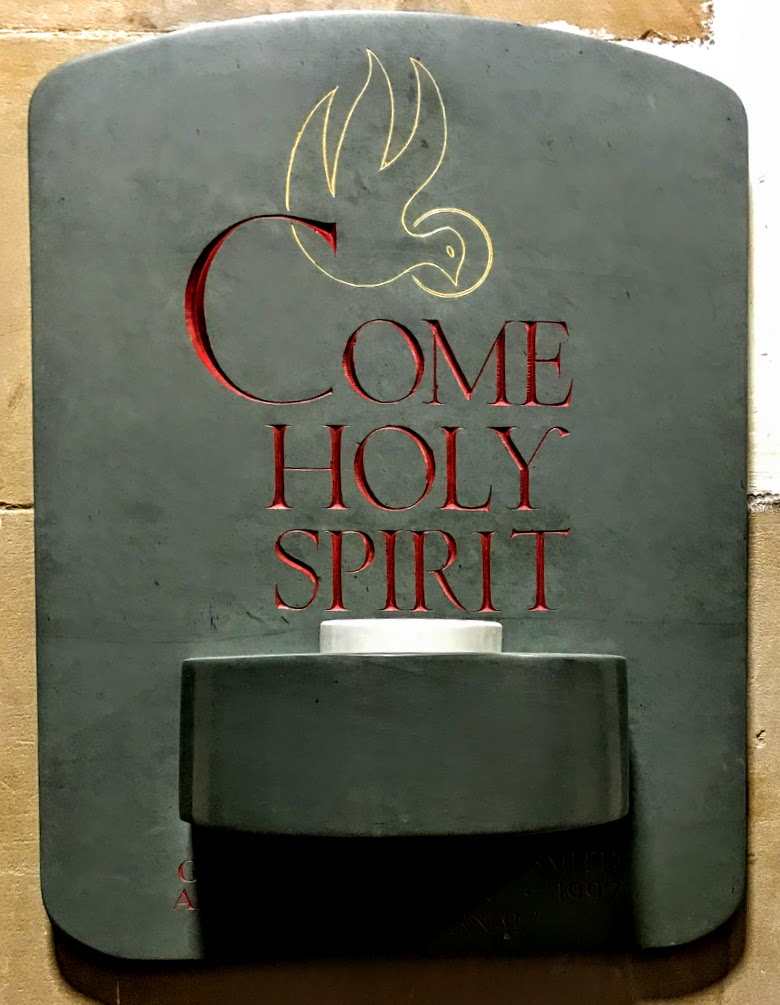
‘Come Hoy Spirit’ … the holy water stoup in the Chapel of Saint John’s Hospital, Lichfield (Photograph: Patrick Comerford)

Praying with the Psalms in Pentecost:
5 June 2022 (Psalm 102)

‘The Lord looked at the earth, to hear the groans of the prisoners, to set free those who were doomed to die’ (Psalm 102: 19-20) … the Old Gaol in Buckingham (Photograph: Patrick Comerford, 2022)

Patrick Comerford

This is Pentecost Day (5 June 2022), and later this morning I hope to attend the Parish Eucharist in Saint Mary and Saint Giles Church, Stony Stratford. This morning I am also reading the lessons for a broadcast Pentecost service on Clare FM at 7.45, recorded by Stephen Fletcher in his studio in Milton Keynes a few days ago.

But before this day begins, I am taking some time this morning to continue my reflections in the seasons of Lent and Easter, including my morning reflections drawing on the Psalms.

In my blog, I am reflecting each morning in this Prayer Diary in these ways:

1, Short reflections on a psalm or psalms;

2, reading the psalm or psalms;

3, a prayer from the USPG prayer diary.

Psalm 102:

Psalm 102 is sometimes known by its Latin name Domine exaudi orationem meam. In the slightly different numbering system in the Greek Septuagint and Latin Vulgate, this psalm is counted as Psalm 101.

This is one of the psalms not included in the Revised Common Lectionary.

This is one of the seven penitential psalms. It begins the final section of the three traditional divisions of the Latin psalms, and so the first words (‘Domine exaudi orationem meam et clamor meus ad te veniat ...’) and above all the initial ‘D’ are often enlarged in illuminated manuscript psalters, following the pattern of the Beatus initials at the start of Psalm 1.

In the original Hebrew, the first verse introduces the psalm as ‘A prayer of the poor man’ or ‘A prayer of the afflicted.’

In Midrash Tehillim, Rabbi Pinchas notes that in some psalms David calls himself by name, as in ‘A prayer of David’ (see Psalm 17 and Psalm 86), but here he calls himself ‘the afflicted,’ as in ‘A prayer of one afflicted.’

Rabbi Pinchas says that when David foresaw the righteous men who would descend from him he called himself David. But when he perceived the wicked men who would be his descendants he called himself ‘the afflicted.’

David calls this Psalm the prayer of an afflicted person who has been weakened by his troubles and calls out to God. He asks God to heed this prayer and not turn away from him on his day of trouble. Rather, he hopes that God will quickly answer his plea.

The afflicted person says that his days are insubstantial, like smoke, and that his bones are destroyed within him as if they were burned. His heart is like dry, withered grass and he no longer knows how to enjoy the fruits of his own labours. He is physically depleted from the strength of his own sighs. He feels like a bird in the wilderness, away from human settlements. He endures alone, while his enemies mock him. His sustenance is ashes and tears, the stuff of mourning.

Our days are like a growing shadow – eventually darkness comes. But God goes on forever and every generation will acknowledge him.

When the time comes, God will have mercy on the people. Those in exile long to return home. When God brings them home, the nations of the world will be in awe of him. God will rebuild Jerusalem and the Temple, where he will reveal himself in all his glory.

God answers the prayer of the people, who are destroyed and reviled by their enemies. But God looks down, sees their suffering, and frees them. The restored exiles will praise God and the nations of the world will join in his service.

In Jewish tradition, Psalm 102 is one of 15 psalms recited by Sephardi Jews as additional hymns during the Yom Kippur service. Sephardi Jews recite verse 14 after the prayer of Ein Keloheinu in the morning service. This verse is also used as a popular Jewish song called Atah Takum or Atah Sakum, with its popular refrain .

Psalm 102 is said in times of community crisis. It is also recited as a prayer for a childless woman to give birth. In the Siddur Sfas Emes, this psalm is said as a prayer ‘for the well-being of an ill person.’

TS Eliot’s poem ‘Ash Wednesday’ has been described as ‘the greatest achievement of Eliot’s poetry.’ It was published in its complete form in 1930, three years after his conversion to Anglicanism in 1927, and it appears in his Selected Poems. The poem ends with a prayer from Psalm 102: ‘And let my cry come unto thee’ (see Psalm 102: 1).

‘My days are like an evening shadow; I wither away like grass’ (Psalm 102: 12) … the grass in Tombs Meadow in Stony Stratford in the late evening (Photograph: Patrick Comerford, 2022)

Psalm 102 (NRSVA):

A prayer of one afflicted, when faint and pleading before the Lord

1 Hear my prayer, O Lord;
let my cry come to you.
2 Do not hide your face from me
on the day of my distress.
Incline your ear to me;
answer me speedily on the day when I call.

3 For my days pass away like smoke,
and my bones burn like a furnace.
4 My heart is stricken and withered like grass;
I am too wasted to eat my bread.
5 Because of my loud groaning
my bones cling to my skin.
6 I am like an owl of the wilderness,
like a little owl of the waste places.
7 I lie awake;
I am like a lonely bird on the housetop.
8 All day long my enemies taunt me;
those who deride me use my name for a curse.
9 For I eat ashes like bread,
and mingle tears with my drink,
10 because of your indignation and anger;
for you have lifted me up and thrown me aside.
11 My days are like an evening shadow;
I wither away like grass.

12 But you, O Lord, are enthroned for ever;
your name endures to all generations.
13 You will rise up and have compassion on Zion,
for it is time to favour it;
the appointed time has come.
14 For your servants hold its stones dear,
and have pity on its dust.
15 The nations will fear the name of the Lord,
and all the kings of the earth your glory.
16 For the Lord will build up Zion;
he will appear in his glory.
17 He will regard the prayer of the destitute,
and will not despise their prayer.

18 Let this be recorded for a generation to come,
so that a people yet unborn may praise the Lord:
19 that he looked down from his holy height,
from heaven the Lord looked at the earth,
20 to hear the groans of the prisoners,
to set free those who were doomed to die;
21 so that the name of the Lord may be declared in Zion,
and his praise in Jerusalem,
22 when peoples gather together, and kingdoms, to worship the Lord.

23 He has broken my strength in mid-course;
he has shortened my days.
24 ‘O my God,’ I say, ‘do not take me away
at the mid-point of my life,
you whose years endure
throughout all generations.’

25 Long ago you laid the foundation of the earth,
and the heavens are the work of your hands.
26 They will perish, but you endure;
they will all wear out like a garment.
You change them like clothing, and they pass away;
27 but you are the same, and your years have no end.
28 The children of your servants shall live secure;
their offspring shall be established in your presence.

Today’s Prayer:

The theme in this week’s prayer diary of the Anglican mission agency USPG (United Society Partners in the Gospel) is ‘The Time to Act is Now!’ This theme is introduced this morning by Linet Musasa, of the Anglican Council of Zimbabwe, who writes:

Every year, World Environment Day is celebrated on 5 June. This is an important day worldwide and the Anglican Church in Zimbabwe will join the rest of the world in commemorating the day. The impact of climate change in Zimbabwe is likely to stall the country’s development and pose a serious risk to supplies of food and water. The time to act is now!

The theme for this World Environment Day is ‘Only One Earth’. This theme reminds us of the responsibility we have as the Church to protect our world.

As Christians, God has given us a mandate to look after the earth as shown in scripture.

Genesis 1, v26: ‘Then God said, ‘Let us make man in our image, after our likeness. And let them have dominion over the fish of the sea and over the birds of the heavens and over the livestock and over all the earth and over every creeping thing that creeps on the earth.’

God has given us a mandate that we should have dominion over the earth. So, it is our responsibility to preserve that which God has made and given us.

The USPG Prayer Diary this morning (Sunday 5 June 2022, Pentecost) invites us to pray:

Creator God,
May we be guided by the Holy Spirit in all we do.
Help us to live out our faith,
seeing diversity as a gift, not a barrier.

Yesterday’s reflection

Continued tomorrow

‘Come Holy Spirit’ … the holy water stoup in the Chapel of Saint John’s Hospital, Lichfield … today is the Day of Pentecost or Pentecost Sunday (Photograph: Patrick Comerford)

Scripture quotations are from the New Revised Standard Version Bible: Anglicised Edition copyright © 1989, 1995, National Council of the Churches of Christ in the United States of America. Used by permission. All rights reserved worldwide. http://nrsvbibles.org