COMERFORD WAY: Patrick Comerford’s online journal on Anglicanism, theology, spirituality, history, architecture, travel, poetry, beach walks ... and more
‘Arbeit macht frei’ … the gate at Auschwitz … today is Holocaust Memorial Day (Photograph: Patrick Comerford)
Patrick Comerford
Today is Holocaust Memorial Day, marking the anniversary of the liberation of Auschwitz in 1945 and the beginning of the liberation of the concentration camps in Europe.
In a ‘virtual tour’ today, I visit Holocaust memorials in a dozen European countries: Austria, Czech Republic, England, France, Germany, Greece, Hungary, Ireland, Italy, Poland, Slovakia and Slovenia.
Looking back on many visits over the years, my images today include monuments, memorials, plaques, sculptures, shattered grave stones and Stolpersteine or ‘stumbling stones’, in cemeteries, libraries, museums, parks, schools, squares, streets, synagogues, railway stations, and bridges.
There are photographs from the concentration camps in Auschwitz, Birkenau and Sachsenhausen. There are Jewish families and individuals, mothers and children, the murdered and the survivors, resistance fighters and the ‘Righteous Among the Nations’.
Austria:
Rachel Whiteread’s Holocaust Memorial in Judenplatz in Vienna (Photograph: Patrick Comerford)
Czech Republic:
The walls of the Pinkas Synagogue in Prague are covered with the names of 78,000 victims of the Holocaust (Photograph: Patrick Comerford)
The names of the concentration camps surround the Aron haKodesh or Holy Ark in the Pinkas Synagogue, Prague (Photograph: Patrick Comerford)
England:
The Holocaust Memorial Stone at the east end of Bourton Park, Buckingham, was installed in 2021 (Photograph: Patrick Comerford)
France:
The Mur des Names or Wall of Names in the Mémorial de la Shoah lists 76,000 French Jews deported and murdered by the Nazis (Photograph: Patrick Comerford)
A plaque on a school in the Marais in Paris recalling the children of the Shoah (Photograph: Patrick Comerford)
Germany:
The Memorial to the Murdered Jews of Europe in Berlin (Photograph: Patrick Comerford)
A memorial to Jewish children at the Jewish Cemetery in Berlin (Photograph: Patrick Comerford)
The memorial to the victims of the Sachsenhausen Concentration Camp 1936-1945 … the victims included gays, Gypsies, political prisoners and disabled people (Photograph: Patrick Comerford)
Greece:
The Jewish Holocaust Memorial at Plateia Eleftherias (Liberty Square) in Thessaloniki (Photograph: Patrick Comerford)
Chief Rabbi Gabriel Negrin places candles in the Holocaust memorial in Etz Hayyim Synagogue in Chania (Photograph: Patrick Comerford)
The Holocaust Memorial by Georgios Karahalios (2001) in Corfu remembers the 2,000 Jews of Corfu who were murdered in Auschwitz in 1944 (Photograph: Patrick Comerford)
The monument in the Nuova or New Synagogue in Corfu to families who died in the Holocaust (Photograph: Patrick Comerford)
Hungary:
The Memorial of the Hungarian Jewish Martyrs by Imre Varga at the Dohány Street Synagogue in Budapest (Photograph: Patrick Comerford)
The Holocaust Memorial Park at the Dohány Street Synagogue in Budapest (Photograph: Patrick Comerford)
Italy:
A monument in Bologna commemorating victims of the Holocaust (Photograph: Patrick Comerford)
The Holocaust Memorial outside the railway station in Gorizia, a town that straddles the border of Italy and Slovenia (Photograph: Patrick Comerford)
The Holocaust Memorial at the Synagogue in Padua (Photograph: Patrick Comerford)
A monument to Jewish partisans and resistance to the Nazis and Fascists in Rome (Photograph: Patrick Comerford)
The memorial wall to victims of the Holocaust in the Ghetto in Venice (Photograph: Patrick Comerford)
The Holocaust memorial in the Ghetto in Venice (Photograph: Patrick Comerford)
Poland:
Multilingual memorials in Birkenau … a reminder of the many nationalities of the victims of the Holocaust (Photographs: Patrick Comerford)
Shattered gravestones make a Holocaust memorial in a Jewish cemetery in Kraków (Photograph: Patrick Comerford)
The Empty Chairs Memorial in Ghetto Heroes Square in Kazimierz , symbolising abandoned homes and mass deportations from the Kraków Ghetto in 1943 (Photograph: Patrick Comerford)
Slovakia:
The Holocaust Memorial in the centre of Bratislava on the site of the former Neolog Synagogue (Photograph: Patrick Comerford)
Stolpersteine or ‘stumbling stones’
Berlin:
Stolpersteine or Stumbling stones on Rosenthaler Straße 39, Berlin-Mitte, remembering members of the Salinger family murdered by the Nazis in Auschwtiz and Riga (Photograph: Patrick Comerford)
Dublin:
Dublin’s first Stolpersteine or ‘stumbling stones’, recalling six Irish Holocaust victims, at Saint Catherine’s National School on Donore Avenue (photograph: Patrick Comerford)
Prague:
‘Stolpersteine’ or ‘Stumbling Stones’ on the streets of Prague remember members of the Bergmann family deported to Terezín during the Holocaust (Photograph: Patrick Comerford)
Thessaloniki:
‘Stolpersteine’ or ‘Stumbling Stones’ on the pavement on Vassilisis Olgas Avenue in Thessaloniki commemorate Greek Jews deported to Auschwitz (Photograph: Patrick Comerford)
Venice:
Stolpersteine or stumbling stones (Pietre d’inciampo) in Venice recall victims of the Holocaust (Photograph: Patrick Comerford)
Remembering individuals:
Remembering Anne Frank in street art in Berlin (Photograph: Patrick Comerford)
The sculpture of Anne Frank by Doreen Kern in the British Library, London (Photograph: Patrick Comerford)
The Kindertransport monument at Liverpool Street Station … a reminder in the heart of London of the Holocaust (Photograph: Patrick Comerford)
A plaque on Heydukova Street in Bratislava marks the former home of Aron Grünhut (1895-1974), involved in heroic rescues during the Holocaust (Photograph: Patrick Comerford)
Monuments to ‘Righteous Among the Nations’:
Philip Jackson’s monument of the Swedish diplomat Raoul Wallenberg at Wallenberg Place, near Hyde Park, London (Photograph: Patrick Comerford)
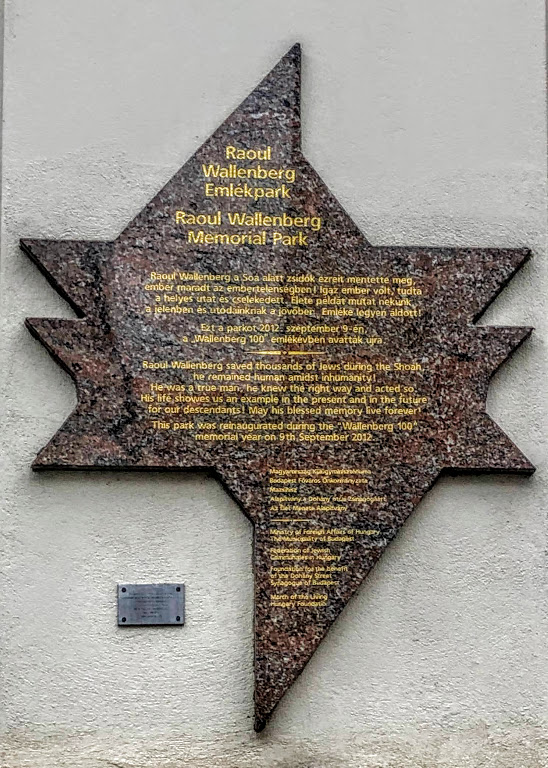
A memorial to Raoul Wallenberg in the Raoul Wallenberg Holocaust Memorial Park at the Dohány Street Synagogue, Budapest (Photograph: Patrick Comerford)
The Mary Elmes Bridge in Cork … the centrepiece of the bridge is designed to look like a menorah (Photograph: Patrick Comerford)
The Wall of the Righteous in Paris lists 3,300 French people who have been recognised as ‘Righteous Among the Nations’ (Photograph: Patrick Comerford)
These images are reminders not only of the Holocaust and its victims, but of real individuals who suffered and were humiliated, whose lives were shattered and who were murdered.
They are reminders of why we must never forget. The Holocaust happened not just because of one evil man but because many good people stood by and remained silent.
Over 80 years after the end of the Holocaust, antisemitism is on the rise once again. We are seeing the rise of the far-right in Britain across Europe and a resurgence of the far-right in Latin America, far-right ideology and vocabulary has become part and parcel of the language of the Trump regime, its spokespersons and those who support street murders by ICE in Minneapolis.
We must never forget.
The Eternal Flame in the Mémorial de la Shoah, Paris (Patrick Comerford)
The Obelisk in Alexandria in the early 20th century … the Comerford-Kneen family lived in Alexandria for four or five generations (William Henry Goodyear, Brooklyn Museum Archives)
Patrick Comerford
I recently came across the story of a branch of the Comerford family that passed on the Comerford name to a family that lived in Alexandria in Egypt for four or five generation in the second half of the 19th century and the first half of the 20th century.
It is a story that begins with a marriage in Limassol in Cyprus in 1882, and that brings the Comerford name to Alexandria and Cairo in Egypt, Limassol in Cyprus, Kavala and Thessaloniki in northern Greece, Nairobi in Kenya and to Mexico City and Australia. There are hints of minor aristocracy in Croatia and Slovenia, of descent from families in Romania and Lebanon, and of Egyptian, Syrian, Maltese and Jewish heritage. But it also involves places from the Isle of Man to Liverpool and through many parts of England.
It is a family whose story has inspired the Australian writer Krissy Kneen in her semi-biographical stories of Slovene women who became the nannies of choice for the wealthy Italians of pre-war Alexandria in The Three Burials of Lotty Kneen: Travels with My Grandmother’s Ashes, a new book published earlier this year (May 2021).
I am still researching this story of the Comerford and Comerford-Kneen family, and I remain uncertain of many of the genealogical details. But it begins with Helen Pauline Comerford who is in Limassol when she marries John Bernard Kneen from Liverpool who is living in Liverpool in 1882, and I thought it was worth sharing some of my research at this stage.
John Bernard Kneen (1841-1894) was born in Liverpool on 9 December 1841, the son of William Kneen (1813-1891), originally from the Isle of Man, and his wife, Jane Rowan (1821-1885). Kneen was married twice. He married his first wife, Sarah Ann Blunn, in Sheffield in 1864. They soon moved to Alexandria, Egypt, where they were living by 1867. He worked in Alexandria as a ‘foreign correspondent.’
Sarah and John Kneen were the parents of four children:
1, John William Kneen (1867-1870), born in Alexandria 1867, died in Liverpool 31 May 1870. 2, Amy (1868-1895), born in Alexandria ca 1868, died 1895. 3, Edith (1873- ), born in Alexandria ca 1873. 4, Edward Justin Kneen (1878-1933), born in Alexandria ca 1878.
Sarah Kneen died in Alexandria on 16 November 1881.
John Kneen married his second wife, Helen Pauline Comerford, in Limassol, Cyprus on 14 April 1882. She was born in Alexandria in 1861 and they were the parents of six children, four sons and two daughters:
1, John Albert Comerford-Kneen (1881-1931), of whom next. 2, Paul Bernard Comerford-Kneen (1884-1930), of whom after his eldest brother. 3, Hilda Helen Kneen (1881-1931). She was born in Alexandria 11 January 1888, and was married twice: firstly in Alexandria in 1908 William F Draycott, and they were the parents of a son, William DJBA Draycott (1921- ), born in Alexandria 1921, later married twice in England; Hilda married secondly in Alexandria in 1933 Percy George Crosbye Farrell (1896-1990), and they later lived in Chersey, Surrey. 4, Henry (Harry) Philip Kneen (1889-1963), of whom after his elder brothers. 5, Victor Comerford-Kneen (1892-1953), of whom after his elder brothers. 6, Gladys Mary Comerford-Kneen (1893-1973). She was born in Alexandria 1 June 1893, was married, and died in Leicester in March 1973.
John Bernard Kneen died in Alexandria on 10 January 1894. The eldest son of Helen (Comerford) and John Bernard Kneen was:
John Albert Comerford-Kneen (1881-1931). He was born in Alexandria 16 November 1881. He married Georgiana Naoum-Cassir (1895-1960) in Alexandria in 1913. He died in Alexandria in 1931; she died in Sussex on 3 March 1960. They were the parents of three sons:
1, Charles Albert Comerford Kneen. He was born in Aleaxandria and lived in Egypt (1939), Blacktown, Sydney, New South Wales, Australia (1963-post 1980). He married Dragitca (Dragica) Marušič, born in Miren, near Nova Gorica or Gorizia in Slovenia, 13 December 1916, daughter of Perina and Carlotta (née Mozetic) Marusic. He worked at the British Embassy in Cairo. They fled Alexandria in the aftermath of the 1956 Suez Crisis with other expatriates, and lived in England before moving to Australia. In Australia, Dragitca was known as Lotty Kneen, and died in 2014. They were the parents of two daughters: Sheila; and Wendy, who is the mother of the Australian writer Krissy Kneen. 2, Wilfred J (Bunny) Comerford-Kneen (1920-2010). He was born in Alexandria on 5 March 1920, and died in Worthing on 19 October 2010. He was married twice: first in Cairo in 1946; secondly in Fulham in 1958 to June Rosemary Smythe (1934-2011). There are surviving children. 3, John Anthony (Jackie) Comerford-Kneen (1928-1982). He was born in Alexandria on 8 May 1928, and died in Crawley, Sussex, in June 1982. In March 1961, he married in Horsham, Sussex, Ansley M (Mollie) Summerfield (1933-2005).
The second son of Helen (Comerford) and John Bernard Kneen was:
Paul Bernard Comerford-Kneen (1884-1930). He was born in Alexandria in 1884. He worked as a quarantine officer with the Egyptian government. He married in Alexandria in 1908 Edith Ellen Mabel Elsie Draycott (1889-1966). She was born in Cyprus on 14 November 1889, and died in Ormskirk, Lancashire, on 20 March 1966; he died in Amersham, Buckinghamshire, in March 1930. They were the parents of two children, a daughter and a son:
1, Helen Alice Pauline Comerford-Kneen (1910-1976), of whom next. 2, John Bernard Paul Kneen (1912-1937), born Alexandria, born 3 September 1912, died in Alexandria 28 October 1937.
The Comerford name was continued among the children of the only daughter and only surviving child of Edith and Paul Comerford-Kneen:
Helen Alice Pauline Comerford-Kneen (1910-1976). She was born in Alexandria on 12 June 1914, and died in Norwich in December 1976. She was married twice. She married first in Alexandria on 12 January 1935 Paul P de Relya (1912-1981), also known as Paul Ivo Ritter von Relya Ohmucevic (or Reglia von Ohmucevic). He was born in Kavala, east of Thessaloniki in northern Greece, on 2 October 1912, into a family of Croatian ancestry, and died in Hounslow in December 1981. They later moved to Liverpool and were the parents of six children, three daughters and three sons:
1, Patricia Paul Alice Ivana von Relya Ohmucevic (or Reglia von Ohmucevic) (1935-1937), born Alexandria 28 November 1935, died 25 September 1937. 2, Pavo (Paul) Patrick Denis Cyril Reglia von Ohmucevic (or de Relya) (1938-1970), travel consultant, born Alexandria 21 July 1938, died in a car accident in Mexico 7 March 1970. 3, Dalice (Dalys) Paule Roxellane Marguerite Patricia John Ma de Relya, born Liverpool 13 March 1948, married in Liverpool December 1973. 4, Mark Godfrey Patrick de Comerford von Kesmark (1949-2019), born 17 March 1949, lived in Norfolk from the late 1960s to the early 1980s, and from 2017; died in Bury St Edmunds, Suffolk, 7 February 2019. 5, Michael Anthony Ernest Sebastian Paul Dereyla d’Ohmucevic, born Liverpool 10 July 1973. 6, Ann.
Helen Alice Pauline Comerford-Kneen married secondly Ernest Wilson (1924-1999), a former flying officer in the Royal Air Force. She died in Norwich in December 1976.
The third son and fourth child of Helen (Comerford) and John Bernard Kneen was:
Henry (Harry) Philip Kneen (1889-1963) was born Alexandria 1889. He married in Alexandria in 1913 Elvira Katherine Varzon (1893-1996). She was born 14 September 1893, and died in Milton Keynes in October 1966; he died in Leicester 24 July 1963. They were the parents of one son:
1, Herbert George Kneen (1917-2011), born Alexandria 19 December 1917, married in Alexandria 1948 Blanche Simone Daoud (1925-2006). She died in 2006; he lived in Milton Keynes and died in Nuneaton 17 December 2011. They were the parents of one child.
The fourth and youngest son and fifth child of Helen (Comerford) and John Bernard Kneen was:
Victor Comerford-Kneen (1892-1953). He was born in Alexandria in 1892, and was married twice. He married firstly in Alexandria on 8 November 1913 Victoria Mallia and they were the parents of:
1, Gerald Denys Kneen (1932-1995). He was born in Alexandria 15 November 1932, and died in Thanet, Kent in June 1995.
Victor Comerford-Kneen married a second time before he died in Nairobi, Kenya, on 20 June 1953.
Médecins Sans Frontières … breaking down borders brings healing (Photograph: Patrick Comerford)
Patrick Comerford
As ‘Brexit’ begins to have its impact throughout this island, many of us are realising the harsh realities it is creating. Many popular brands and items are no longer readily available on the supermarket shelves, buying online has become more difficult – it’s not all that easy for everyone to access amazon.de or amazon.fr – and when we finally translate from German or French and find what we want, deliveries are slow and there is always the fear of those ‘hidden extras’ and unexpected charges.
Fishing boats have reduced areas to fish in, and they face greater complications in getting their catches to their markets.
Both the Vatican and San Marino – two of the three smallest internationally-recognised states in the world – are completely landlocked by Italy. The Vatican State has an area of just 44 ha (109 acres), and San Marino just 61 sq km (24 sq miles).
There are other countries that are totally landlocked by EU member states: Andorra is surrounded by Spain and France; Monaco’s only land border is with France; In addition, Switzerland and Liechtenstein only have borders with each other and with EU member states.
Perhaps the most unusual land border that is legally an internal border in the EU is the land border between France and the Netherlands – not on the continental European landmass, but on the shared island of Saint Martin / Sint Maarten in the Caribbean.
Malta, the world’s tenth smallest country defined by land area, has three main inhabited islands, but no land borders. The land border dividing Cyprus is illegal by all standards of international law, and Portugal’s only land border is with Spain.
Derry Girls … television can create a shared, cross-Border humour (Photograph: Patrick Comerford)
***
All the protocols promised that there would be no return to a hard border on this island. Now the Republic Ireland has become the only EU member state whose only land border is with a non-EU state.
I have crossed many of the internal and external borders of the EU, including the ‘Green Line’ dividing Cyprus. Even when a non-EU member state is part of the Schengen agreement, border crossings are not always smooth and seamless, as many people know when they arrive at the French ‘side’ or ‘sector’ of Geneva airport and want to hire a car to drive in Switzerland.
On the other hand, however, neither the Vatican nor San Marino is a party to the Schengen Agreement. Yet I have criss-crossed the borders between these two microstates without ever showing a passport, changing currency or facing customs … and sometimes not knowing which side of the border I was on.
Historically, the Isle of Man and the Channel Islands were never part of the UK or of the EU. Yet travel between the UK and the Republic of Ireland with those islands was always clean and simple – in pre-Covid days.
It seems, even in the first weeks of implementing ‘Brexit,’ that both Northern Ireland and the Republic of Ireland got the worst possible deal, when we compare ourselves with tiny Andorra, Liechtenstein, Monaco, San Marino and the Vatican.
San Marino is not in the EU … but visitors do not need a visa to cross the border (Photograph: Patrick Comerford)
Gibraltar … in or out
of the European Union?
One of the many unusual land borders I have crossed is the border at La Linea between Gibraltar and Spain. Technically, Gibraltar is not a member state of the Commonwealth, so it seems to be an anomaly that it was the only British Overseas Territory that was part of the EU.
After a ten-year campaign for the right to vote in European elections, the people of Gibraltar took part in European Parliament elections from 2004 to 2019 as part of the South-West England constituency, along with Bristol, Cornwall, Devon, Dorset, Gloucestershire, Somerset and Wilshire.
Before Britain left the EU, the constituency had five MEPs, including three Brexit Party members, among them the formidable Anne Widdicombe. But there was an 84 per cent turnout in the ‘Brexit’ referendum in Gibraltar in 2016, and 96 per cent of voters opted to remain in the EU.
The Economist, long part of my essential weekly reading, reported recently how the Chief Minister of Gibraltar, Fabian Picardo, describes Gibraltar as ‘a perfect synthesis of Britishness and the Mediterranean way of life.’ There are red telephone boxes, the police wear ‘London Bobby’ style helmets, and there are English pubs and a Marks & Spencer shop.
The official language is English. But the 34,000 residents often lapse into Llanito, a kind of ‘Spanglish’, and their daily lives are intertwined with Spain.
Gibraltar exports few goods, and its economy depends on finance, online gambling and tourism. It also depends on 10,000 workers who cross the border each day from Spain, and it relies on its Spanish hinterland for space for homes and business expansion.
Crossing the border at Gibraltar … totally landlocked by Spain (Photograph: Patrick Comerford)
***
Gibraltar got some consolation for Brexit on 31 December with an agreement that softens what is now a hard border. It was a victory for common sense. This agreement aspires to freedom of travel between Gibraltar and Spain. A corollary is that Gibraltar’s airport and port will be the external border of the EU and will fall within the Schengen passport-free area. Arriving passengers, including British visitors, will have their passports checked first by Gibraltar’s police and then by Frontex, the EU’s border agency, working in conjunction with the Spanish police.
The Economist points out that many of details have still to be hammered out before a treaty between the EU and Britain, perhaps later this year. But this involves many fudges. Spain continues to claim sovereignty over Gibraltar, although it was handed over to Britain over 300 years ago in 1713.
Without an agreement, the biggest losers would be the Spanish towns in the hinterland across the border. These are some of the poorest in Spain. In Linea, unemployment is already 27 per cent and drug-traffickers are powerful.
As I write, La Linea and Gibraltar are both locked down due to Covid-19, and there is little traffic across the border. But when the pandemic ends, both sides have much to gain, and Fabian Picardo says he looks forward to a ‘Bay of Prosperity.’
A red post box in Gibraltar … ‘a perfect synthesis of Britishness and the Mediterranean way of life’ (Photograph: Patrick Comerford)
A Cold War border
breaks down barriers
Among the many interesting but curious borders I have crossed between two EU member states is the old Cold War border that slices through the town that is known on one side in Italian as Gorizia and on the other side, in Slovenia, as Nova Gorica.
Like Berlin, this is one city is one despite straddling an old Cold War frontier, but unlike Berlin it remains in two separate states. Nicosia in Cyprus is also a divided capital, but this is in contravention of UN resolutions and international law.
In recent weeks it was announced the city has been chosen as the European Capital of Culture for 2025, alongside the German city of Chemnitz, known in East Germany during the Cold War era as Karl-Marx-Stadt.
Galway and Rijeka in Croatia were the European Capitals of Culture last year, and this year’s Capitals of Culture are Elefsina in Greece, Timisoara in Romania and Novi Sad in Serbia.
Gorizia and Nova Gorica applied as one, single urban area as the candidate for 2025 in a unique gesture of cross-border co-operation. Together, these two cities will be the first capital of a region that stretches across two countries.
The mayors say this this gives the two cities the opportunity to become an important point in the EU as ‘the hub of the cross-border region.’
Crossing points in Gorizia have been a matter of curiosity since the end of the Cold War (Photograph: Patrick Comerford)
***
After the collapse of Yugoslavia, the frontier dividing Gorizia remained in place until Slovenia became part of the Schengen Agreement on 21 December 2007.
Today, the border between Italy and Slovenia is almost invisible, an artificial line that slices through Gorizia and Nova Gorica. The most celebrated border crossing is at Europa Square, an open pedestrian square in front of the Transalpina railway station. But there are other border crossings between Gorizia and Nova Gorica, for the border is a straight line that ignores the natural contours and bends in the streets and buildings, still seen in the remains of a fence that once ran across streets and even divided gardens.
Today, the two towns form one conurbation that also includes the Slovenian municipality of Šempeter-Vrtojba. Since May 2011, these three towns are joined in a common trans-border metropolitan zone, administered by a joint administration board.
As I stepped between three towns and two countries, no-one asked me for a passport, no-one asked me to take my place in a queue, asked for my identity, or sought my opinion on who should be in the European Union and who should be out.
Perhaps the most creative and inviting borders are the ones that invite us to step out of our safe space to enrich our cultural experiences and to appreciate diversity and pluralism in our own lives. And, conversely, the worst borders must be those I set up in my own mind, to exclude others and to put fences around my own inner, and all too comfortable prejudices.
Gorizia has been chosen as one city as the European Capital of Culture for 2025 (Photograph: Patrick Comerford)
This feature was first published in February 2021 in the ‘Church Review’, the Dublin and Glendalough diocesan magazine (pp 14-15)
A two-page feature in the ‘Church Review’ on borders, creating divisions and enriching cultural co-operation in Europe (Photographs: Patrick Comerford)
Patrick Comerford
As ‘Brexit’ begins to have its impact throughout this island, many of us are realising the harsh realities it is creating. The Republic Ireland has become the only EU member state whose only land border is with a non-EU state.
My monthly column in the February 2021 edition of the Church Review, the Diocesan magazine in Dublin and Glendalough (pp 14-15), looks at how European borders can create division or enrich cultural co-operation.
I look at some of the peculiar borders and divisions in Europe, and take examples from Gibraltar, the Isle of Man, San Marino and the Vatican.
But I also look at the old Cold War border that slices through the town that is known on one side in Italian as Gorizia and on the other side, in Slovenia, as Nova Gorica. They have come together in a unique venture that allows them to share as one, single urban area, the title of ‘European Capitals of Culture’ in 2025.
But more about this tomorrow when the Church Review is published (see HERE).
In the regular ‘From the Archives’ slot on page 8, the Church Review looks back 20 years ago to the February 2001 edition and recalls:
‘Meanwhile, Patrick Comerford was looking forward to the introduction of the new edition of the Book of Common Prayer, which was due to be published in 2004. He reported that the editor, Canon Brian Mayne, had undertaken that the 204 Book of Common Prayer would be both “user-friendly and a lovely book.” He was writing as the Church of England had adopted new prayer books: Common Worship and Common Worship: Pastoral Services.’
The Holocaust Memorial outside the railway station in Gorizia, a town that straddles the border of Italy and Slovenia (Photograph: Patrick Comerford, 2018)
Patrick Comerford
Today is the Feast of the Annunciation, and offers an interesting interlude at this stage in Lent that seems to look forward to the Incarnation and Christmas rather than the Resurrection and Easter.
But the date of the feast of the Annunciation, 25 March, was chosen to match the supposed historical date of the Crucifixion. This was to underline the idea that Christ came into the world on the same day that he left it: his life formed a perfect circle. In other words, 25 March was both the first day and the last day of his earthly life, the beginning and the completion of his work on earth.
Saint Augustine of Hippo explained it this way:
He is believed to have been conceived on 25 March, upon which day also he suffered; so the womb of the Virgin, in which he was conceived … corresponds to the new grave in which he was buried …
Both events were understood to have happened in the spring, when life returns to the earth, and at the vernal equinox, once the days begin to grow longer than the nights and light triumphs over the power of darkness. In the Lord of the Rings cycle, the final destruction of the Ring takes place on 25 March, to align Tolkien’s own ‘eucatastrophe’ with this most powerful of dates.
The early historian, the Venerable Bede, says this dating is symbolic but it is not only a symbol: it reveals the deep relationship between Christ’s death and all the created world, including the sun, the moon and everything on earth.
During Lent this year, I am using the USPG Prayer Diary, Pray with the World Church, for my morning prayers and reflections. This year marks the 75th anniversary of the liberation of Auschwitz and the end of the Holocaust, so I am illustrating my reflections each morning with images that emphasise this theme.
USPG (United Society Partners in the Gospel) is the Anglican mission agency that partners churches and communities worldwide in God’s mission to enliven faith, strengthen relationships, unlock potential, and champion justice. It was founded in 1701.
This week (22-28 March 2020), the USPG Prayer Diary is focussing on Pakistan, human rights, slavery and the churches in Myanmar and Morocco. These themes were introduced in the Prayer Diary yesterday by Bishop Humphrey Sarfaraz Peters, Bishop of Peshawar Diocese and President Bishop, Church of Pakistan.
Wednesday 25 March 2020 (The Annunciation, International Day of Remembrance of the Victims of Slavery and the Transatlantic Slave Trade):
Lord, as we remember the atrocities of slavery in the past, help us to be active in ending modern-day slavery too.
The icon of Archangel Gabriel in the pair of icons in the Lichfield Annunciation in Lichfield Cathedral is based on the Lichfield Angel (Photograph: Patrick Comerford, 2018)
Pour your grace into our hearts, Lord,
that as we have known the incarnation of your Son Jesus Christ
by the message of an angel,
so by his cross and passion
we may be brought to the glory of his resurrection;
through Jesus Christ our Lord. Amen.
The Lenten Collect:
Almighty and everlasting God,
you hate nothing that you have made
and forgive the sins of all those who are penitent:
Create and make in us new and contrite hearts
that we, worthily lamenting our sins
and acknowledging our wretchedness,
may receive from you, the God of all mercy,
perfect remission and forgiveness;
through Jesus Christ our Lord.
Post Communion Prayer:
God Most High,
whose handmaid bore the Word made flesh:
We thank you that in this sacrament of our redemption
you visit us with your Holy Spirit
and overshadow us by your power.
May we like Mary be joyful in our obedience,
and so bring forth the fruits of holiness;
through Jesus Christ our Lord. Amen.
The Virgin Mary in the pair of icons in the Lichfield Annunciation … she is depicted seated on an elevated throne weaving a cloth that would become the veil of the Holy of the Holies in the Temple (Photograph: Patrick Comerford, 2018)