Showing posts with label Slovakia. Show all posts

01 September 2026

49 million hungry in the US,
49 million child refugees,
49 million wait for El Niño,
and 49 million blog readers

Čumil or ‘Man at Work’, a sculpture by Viktor Hulík in the old town in Bratislava … Slovakia covers 49 million sq metres or 49,000 sq km (Photograph: Patrick Comerford)

Patrick Comerford

I continue to be overwhelmed by the viewing and reading figures for this blog. These figures reached a total of 49 million about 10:30 last night (31 August 2026), having reached 48 million a week earlier (24 August 2026), 47 million a week before that (17 August 2026) and 46 million eight days previously (9 August 2026), and more than 3.6 readers for the month of August.

These viewing and reading figures are overpowering at times, and this blog continues to reach volumes of readers I never expected when I first started blogging 16 years ago. At the end of last year, this blog had 21 million hits (31 December 2025). So far this year, there have been more than 28 million hits or visitors in 2026 alone.

Half of all hits or reader figures have been in little more than six months, with 24.5 million hits since 23 February 2026. I first began blogging back in 2010, and it took almost two years until July 2012 to reach half a million readers. Throughout this year and last, the daily figures are overwhelming on many occasions. Of the ten days of busiest traffic on this blog, three were in May (1, 6 and 14 May 2026), three were the previous month (26, 29 and 30 April 2026), three in March, and one in February:

• 1,124,925 (1 May 2026)
• 525,719 (14 May 2026)
• 509,644 (29 April 2026)
• 344,003 (30 April 2026)
• 323,156 (27 March 2026)

• 322,038 (26 April 2026)
• 318,835 (6 May 2026)
• 318,307 (1 March 2026)
• 314,018 (28 February 2026)
• 301,449 (2 March 2026)

The daily average was about 118,700 hits a day throughout August. Yet, I recall how ten years ago, back in 2016, the daily average was around 1,000, or 30,000 a month.

There are 49 million child refugees and displaced minors across the globe, or 40% of all forcibly displaced people (Photograph: Patrick Comerford)

To put this latest figure of 49 million into perspective:

The UN World Food Programme warns that the strong El Niño weather that is forecast for later this year could push 49 million more people into acute hunger, raising total global food insecurity to roughly 274 million people.

There are 49 million child refugees and displaced minors across the globe who are impacted by conflict, violence, and persecution worldwide, representing 40% of all forcibly displaced people.

More than 49 million people are trapped in modern-day slavery worldwide, according to a recent report, and children account for 12 million of them. Human trafficking generates over $236 billion every year, making it one of the largest criminal economies in the world.

As of 2026, Spain has a total population of approximately 49.8 million people, having officially surpassed the 49 million threshold for the first time in 2025, largely driven by immigration over the past two decades.

Slovakia, officially the Slovak Republic, has territory of about 49,000 sq km or 49 million sq metres. The country is bordered by Poland, Ukraine, the Czech Republic, Hungary and Austria. Bratislava is the capital, and there is a population of over 5.4 million people.

Back in 2013, it was said in the US that 49 million Americans, including one-in-four children, go hungry every day, despite the US having the means to provide nutritious, affordable food for all. Inspired by the documentary A Place at the Table, a companion book edited by Peter Pringle offered insights from people at the front lines of tackling hunger in the US.

The contributors showed the inequities in America’s hunger crisis and suggested strategies for solving the crisis, argued the case for school lunch reform, uncovered the hidden persuaders of web food advertisers, explored the role of faith groups in feeding the hungry, discussed the health impacts of hunger and proposed increases in child nutrition programmes.

They argued for the need to move beyond charity-based emergency feeding programmes, and called for providing healthy food for all children. A Place at the Table showed how these problems could be solved once and for all, if the American public decided that making healthy food available and affordable is in the best interest of everyone.

But all those warnings and all those proposals were ignored by decision makers, while the rich get richer, the poor get poorer and the hungry continue to go hungry. And a good example of the rich getting richer came in recent financial disclosure filings that show that one day alone in June Donald Trump made over $49 million in stock and securities purchases during a portfolio reshuffling.

49 million minutes is equal to 93 years, 2 months, 21 days, 18 hours and 40 minutes. This means that if this blog was receiving just one hit a minute, I would need to have started blogging back in mid-June 1933.

I retired from active parish ministry over four years ago, on 31 March 2022. These days, though, about 130-140 people on average are reading my daily prayer diary posted on this blog each morning, or almost 1,000 people each week.

This evening, as this blog heads towards 50 million hits, I am truly grateful once again to the real readers among those 49 million hits to date. In particular I am thankful for the faithful core group of people who join me in prayer, scripture reading and reflections each day.

49 million Americans, including one-in-four children, go hungry every day, according to Peter Pringle’s book

27 January 2026

A ‘virtual tour’ of Holocaust
memorials on Holocaust
Memorial Day, a reminder
that we must never forget

‘Arbeit macht frei’ … the gate at Auschwitz … today is Holocaust Memorial Day (Photograph: Patrick Comerford)

Patrick Comerford

Today is Holocaust Memorial Day, marking the anniversary of the liberation of Auschwitz in 1945 and the beginning of the liberation of the concentration camps in Europe.

In a ‘virtual tour’ today, I visit Holocaust memorials in a dozen European countries: Austria, Czech Republic, England, France, Germany, Greece, Hungary, Ireland, Italy, Poland, Slovakia and Slovenia.

Looking back on many visits over the years, my images today include monuments, memorials, plaques, sculptures, shattered grave stones and Stolpersteine or ‘stumbling stones’, in cemeteries, libraries, museums, parks, schools, squares, streets, synagogues, railway stations, and bridges.

There are photographs from the concentration camps in Auschwitz, Birkenau and Sachsenhausen. There are Jewish families and individuals, mothers and children, the murdered and the survivors, resistance fighters and the ‘Righteous Among the Nations’.

Austria:

Rachel Whiteread’s Holocaust Memorial in Judenplatz in Vienna (Photograph: Patrick Comerford)

Czech Republic:

The walls of the Pinkas Synagogue in Prague are covered with the names of 78,000 victims of the Holocaust (Photograph: Patrick Comerford)

The names of the concentration camps surround the Aron haKodesh or Holy Ark in the Pinkas Synagogue, Prague (Photograph: Patrick Comerford)

England:

The Holocaust Memorial Stone at the east end of Bourton Park, Buckingham, was installed in 2021 (Photograph: Patrick Comerford)

France:

The Mur des Names or Wall of Names in the Mémorial de la Shoah lists 76,000 French Jews deported and murdered by the Nazis (Photograph: Patrick Comerford)

A plaque on a school in the Marais in Paris recalling the children of the Shoah (Photograph: Patrick Comerford)

Germany:

The Memorial to the Murdered Jews of Europe in Berlin (Photograph: Patrick Comerford)

A memorial to Jewish children at the Jewish Cemetery in Berlin (Photograph: Patrick Comerford)

The memorial to the victims of the Sachsenhausen Concentration Camp 1936-1945 … the victims included gays, Gypsies, political prisoners and disabled people (Photograph: Patrick Comerford)

Greece:

The Jewish Holocaust Memorial at Plateia Eleftherias (Liberty Square) in Thessaloniki (Photograph: Patrick Comerford)

Chief Rabbi Gabriel Negrin places candles in the Holocaust memorial in Etz Hayyim Synagogue in Chania (Photograph: Patrick Comerford)

The Holocaust Memorial by Georgios Karahalios (2001) in Corfu remembers the 2,000 Jews of Corfu who were murdered in Auschwitz in 1944 (Photograph: Patrick Comerford)

The monument in the Nuova or New Synagogue in Corfu to families who died in the Holocaust (Photograph: Patrick Comerford)

Hungary:

The Memorial of the Hungarian Jewish Martyrs by Imre Varga at the Dohány Street Synagogue in Budapest (Photograph: Patrick Comerford)

The Holocaust Memorial Park at the Dohány Street Synagogue in Budapest (Photograph: Patrick Comerford)

Italy:

A monument in Bologna commemorating victims of the Holocaust (Photograph: Patrick Comerford)

The Holocaust Memorial outside the railway station in Gorizia, a town that straddles the border of Italy and Slovenia (Photograph: Patrick Comerford)

The Holocaust Memorial at the Synagogue in Padua (Photograph: Patrick Comerford)

A monument to Jewish partisans and resistance to the Nazis and Fascists in Rome (Photograph: Patrick Comerford)

The memorial wall to victims of the Holocaust in the Ghetto in Venice (Photograph: Patrick Comerford)

The Holocaust memorial in the Ghetto in Venice (Photograph: Patrick Comerford)

Poland:

Multilingual memorials in Birkenau … a reminder of the many nationalities of the victims of the Holocaust (Photographs: Patrick Comerford)

Shattered gravestones make a Holocaust memorial in a Jewish cemetery in Kraków (Photograph: Patrick Comerford)

The Empty Chairs Memorial in Ghetto Heroes Square in Kazimierz , symbolising abandoned homes and mass deportations from the Kraków Ghetto in 1943 (Photograph: Patrick Comerford)

Slovakia:

The Holocaust Memorial in the centre of Bratislava on the site of the former Neolog Synagogue (Photograph: Patrick Comerford)

Stolpersteine or ‘stumbling stones’

Berlin:

Stolpersteine or Stumbling stones on Rosenthaler Straße 39, Berlin-Mitte, remembering members of the Salinger family murdered by the Nazis in Auschwtiz and Riga (Photograph: Patrick Comerford)

Dublin:

Dublin’s first Stolpersteine or ‘stumbling stones’, recalling six Irish Holocaust victims, at Saint Catherine’s National School on Donore Avenue (photograph: Patrick Comerford)

Prague:

‘Stolpersteine’ or ‘Stumbling Stones’ on the streets of Prague remember members of the Bergmann family deported to Terezín during the Holocaust (Photograph: Patrick Comerford)

Thessaloniki:

‘Stolpersteine’ or ‘Stumbling Stones’ on the pavement on Vassilisis Olgas Avenue in Thessaloniki commemorate Greek Jews deported to Auschwitz (Photograph: Patrick Comerford)

Venice:

Stolpersteine or stumbling stones (Pietre d’inciampo) in Venice recall victims of the Holocaust (Photograph: Patrick Comerford)

Remembering individuals:

Remembering Anne Frank in street art in Berlin (Photograph: Patrick Comerford)

The sculpture of Anne Frank by Doreen Kern in the British Library, London (Photograph: Patrick Comerford)

The Kindertransport monument at Liverpool Street Station … a reminder in the heart of London of the Holocaust (Photograph: Patrick Comerford)

A plaque on Heydukova Street in Bratislava marks the former home of Aron Grünhut (1895-1974), involved in heroic rescues during the Holocaust (Photograph: Patrick Comerford)

Monuments to ‘Righteous Among the Nations’:

Philip Jackson’s monument of the Swedish diplomat Raoul Wallenberg at Wallenberg Place, near Hyde Park, London (Photograph: Patrick Comerford)

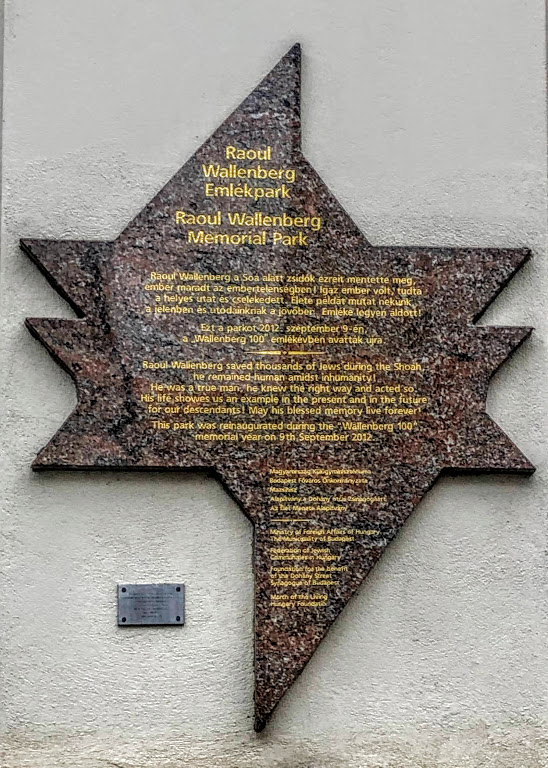
A memorial to Raoul Wallenberg in the Raoul Wallenberg Holocaust Memorial Park at the Dohány Street Synagogue, Budapest (Photograph: Patrick Comerford)

The Mary Elmes Bridge in Cork … the centrepiece of the bridge is designed to look like a menorah (Photograph: Patrick Comerford)

The Wall of the Righteous in Paris lists 3,300 French people who have been recognised as ‘Righteous Among the Nations’ (Photograph: Patrick Comerford)

These images are reminders not only of the Holocaust and its victims, but of real individuals who suffered and were humiliated, whose lives were shattered and who were murdered.

They are reminders of why we must never forget. The Holocaust happened not just because of one evil man but because many good people stood by and remained silent.

Over 80 years after the end of the Holocaust, antisemitism is on the rise once again. We are seeing the rise of the far-right in Britain across Europe and a resurgence of the far-right in Latin America, far-right ideology and vocabulary has become part and parcel of the language of the Trump regime, its spokespersons and those who support street murders by ICE in Minneapolis.

We must never forget.

The Eternal Flame in the Mémorial de la Shoah, Paris (Patrick Comerford)

25 October 2024

Belfast’s innovative
and award-winning
synagogue opened
60 years ago in 1964

The synagogue on Somerton Road, Belfast, was designed by the Slovak modernist architect Eugene Rosenberg

Patrick Comerford

During last month’s visit to Belfast, I visited the sites of the former synagogue on Annesley Street (1904-1964) and its predecessor on Great Victoria Street (1871-1904), and went in search of the site of the former Belfast New Synagogue at 2 Jackson Street and the former United Hebrew Congregation, which used the premises of the Jewish National School at 5 Regent Street.

On those few days, I also visited the restored Jaffé Memorial Fountain and was wrote about the influence of Sir Otto Jaffé on so many aspects of life in Belfast.

However, that visit last month was so short that I never had an opportunity to visit Belfast’s present synagogue, an architecturally-acclaimed and prize-winning building on Somerton Road that first opened 60 years ago today, on 25 October 1964.

The Jewish community in Belfast has been known as Belfast Jewish Community since 2004, and was previously known as Belfast Hebrew Congregation and Belfast Synagogue.

Much of my knowledge of the Jewish community in Belfast, its synagogues and its people has been gleaned from research by the Belfast-born Jewish historian Steven Jaffe.

The synagogue on Somerton Road was designed by the Slovak modernist architect Eugene Rosenberg, assisted by associate architect Karl Kapolka. The foundation stone was laid on 3 May 1964 and the synagogue was consecrated 25 October 1964.

Rosenberg’s award-winning design for the building was unusual and innovative. The synagogue is circular, not rectangular. There is no balcony for women, and instead there is a raised platform on either side, separated from the main part of the sanctuary by a railing. The roof is held up by concrete-covered beams that form the shape of a Star of David. The candelabrum and the Ner Tamid or eternal light, as well as the bronze and silver letters adorning the Ark doors, are by the Israeli sculptor Nehemia Azaz.

The synagogue has a plaque in memory of Jews killed during the Holocaust. The English part of the inscription reads, ‘In memory of the martyred millions of European Jewry 1933-1945.’

The architect Eugene (Evžen) Rosenberg (1907-1990) was born in Topoľčany, Slovakia, on 24 February 1907. He studied engineering in Bratislava, Brno and Prague in 1920-1928 and architecture at the Academy of Fine Arts in Prague in 1929-1932 as a pupil of Josef Gočár. In between his studies, he worked with Le Corbusier in Paris and with Josef Havlíček and Karel Honzík in Prague.

He set up his own practice in Prague in 1934 but left Czechoslovakia for Britain in 1939 to escape the Nazi occupation of Czechoslovakia and encouraged by his friendship with the architects Maxwell Fry and FRS Yorke. He was interned in 1940 and sent to Australia, but was able to return to London in 1942.

He established Yorke Rosenberg Mardall in 1944 with FRS Yorke and CS Mardall and they were responsible for a number of innovative architectural projects such as Gatwick Airport, the John Radcliffe Hospital, Oxford, and the Manchester Magistrates Court. Altnagelvin Hospital (1959-1961) in Derry was the first post-war NHS Hospital in the United Kingdom.

When the new synagogue on Somerton Road opened in 1964, it was known as the Woolfson Centre. It has been described as ‘one of the most sophisticated small synagogues built in the United Kingdom.’

The synagogue was partitioned in two in the early 1990s to make way for an on-site social centre. It was designated a Listed Historic Building in 2015.

Eugene Rosenberg’s award-winning design for the Belfast synagogue was unusual and innovative (Photograph © Michael Black)

During the ‘Troubles’, the Belfast Jewish Institute was burnt down in 1981. Leonard Kaitcer was one of three Jews to be killed as a result of the ‘Troubles’. Leonard Steinberg, a local businessman, left Belfast for Manchester after a shooting attack and later expanded his business, Stanley Leisure, and was raised to the peerage as Lord Steinberg of Belfast. The last kosher butchers in Belfast and the Levy’s delicatessen and grocery shop, both on the Antrim Road, are long closed.

On the other hand, the synagogue complex became a neutral venue during the ‘Troubles’ and the community hosted efforts at reconciliation between communities in North Belfast. However, the community found it difficult to attract the services of a minister and for a number of years relied on clergy who visited during the festivals.

Although the community and the synagogue follow Ashkenazi traditions and liturgies, the synagogue in Belfast has been served by at least one Sephardi minister. Rabbi Moshe Perez was born in Casablanca in Morocco in 1958, and was educated at yeshivot in Morocco, New York, Manchester and Israel. He was a shochet and assistant minister with the Dublin Jewish Community when he was appointed minister to the Belfast Hebrew Congregation (1988-1990). He later served in Nottingham (1990-2018), and received semicha or rabbinical ordination in 1995.

The present rabbi in Belfast is Rabbi David Kale, who served Jewish congregations in Staines and Bournemouth, before being moving to Belfast in 2018. He obtained semicha in 2022 and was made an MBE in the New Year Honours List on 30 December 2022.

The Jewish community in Belfast is one of the oldest ethnic and religious minorities in Northern Ireland and has thrived over four or five generations. Although numbers have fallen in recent years, the Jewish community continues to play a significant role in the religious and cultural life of Northern Ireland.

The synagogue has about 80 members today, but the Belfast Jewish community continues to make a contribution to life that is out of proportion to its numbers in Northern Ireland, which is an increasingly diverse and multicultural society.

Steven Jaffe continues to lead occasional Jewish heritage walking tours in Belfast city centre.

Shabbat Shalom, שבת שלום

The Jewish community in Belfast is one of the oldest ethnic and religious minorities in Northern Ireland

19 July 2023

Daily prayers in Ordinary Time
with USPG: (52) 19 July 2023

Holy Trinity Church, Bratislava … an 18th century baroque church near the Old Town in the capital of Slovakia (Photograph: Patrick Comerford)

Patrick Comerford

We are in Ordinary Time in the Church Calendar, and this week began with the Sixth Sunday after Trinity (16 July 2023).

Today (19 July 2023), the Calendar of the Church of England in Common Worship celebrates the lives of Gregory, Bishop of Nyssa (ca 394), and his sister Macrina (ca 379), Deaconess, Teachers of the Faith.

Before this day begins, I am taking some time this morning for prayer, reading and reflection.

Over these weeks after Trinity Sunday, I have been reflecting each morning in these ways:

1, Looking at relevant images or stained glass windows in a church, chapel or cathedral I know;

2, the Gospel reading of the day in the Church of England lectionary;

3, a prayer from the USPG prayer diary.

Inside Holy Trinity Church, Bratislava, reflects the new thinking in the 18th century on the function and form of baroque churches

Holy Trinity Church, Bratislava:

Holy Trinity Church, Bratislava, is an 18th century baroque church near the Old Town in the capital of Slovakia. The official name of the church is the Church of Saint John of Matha and Saint Felix of Valois. However, because of its association with the Trinitarian Order, the church is commonly known as the Holy Trinity Church.

The church was built on the site of the older church of Saint Michael. But the older church and the settlement of Saint Michael were demolished in 1529 during the Ottoman wars as a defensive measure.

The Trinitarian Order started building the present church in 1717, and it was consecrated in 1727. At the same time, a Trinitarian monastery was built on the site.

The Trinitarian Order was dissolved in the Austro-Hungarian Empire by Emperor Joseph II in 1782 in his ‘storm against the monasteries’ (Klostersturm) and the city council took possession of the building. However, it did not suit the needs of the city and the monastery portion was almost completely demolished.

The design of the church reflects the new thinking in the 18th century on the function and form of baroque churches, emphasising space and light. The design may have been influenced by Saint Peter’s Church in Vienna, with the architect of Saint Peter’s possibly having a hand in the blueprint.

Outside, the main portal is richly decorated in rococo style, celebrating the Holy Trinity. Inside, the arch of the church is dominated by a cupola with trompe-l’œil frescoes by the Italian baroque painter Antonio Galli da Bibiena (1744). In the inner cupola is a blue and red cross, the symbol of the Trinitarian Order.

The church has a massive main altar and several side altars. The main work of art is the large altar painting depicting Saint John of Matha and Saint Felix of Valois – the two founders of the Trinitarian Order – ransoming Christian prisoners. This masterpiece was painted by Franz Xaver Palkó in 1745, and the artist painted himself into the picture as the boy on the far right.

On either side of the main altar are large statues of Saint Agnes (left) and Saint Catherine of Alexandria (right) by the Bavarian sculptor Johann Baptist Straub.

An elaborate side altar on the far right of the main altar was commissioned by Count Zichy in 1736. Above it is a copy of the miraculous Regensburg icon of the Virgin Mary.

The other six side altars are dedicated to Saint Anne, mother of the Virgin Mary; the Holy Angels, with an image of the Pietà; Saint John Nepomuk, a Czech national saint; Saint Michael the Archangel, victorious over the Devil; Saint Mary Magdalene; and Saint John the Evangelist.

Today Holy Trinity Church is a parish church in the Catholic Archdiocese of Bratislava.

Inside, the arch of the church is dominated by a cupola with trompe-l’œil frescoes by the Italian baroque painter Antonio Galli da Bibiena

Matthew 11: 25-27 (NRSVA):

25 At that time Jesus said, ‘I thank you, Father, Lord of heaven and earth, because you have hidden these things from the wise and the intelligent and have revealed them to infants; 26 yes, Father, for such was your gracious will. 27 All things have been handed over to me by my Father; and no one knows the Son except the Father, and no one knows the Father except the Son and anyone to whom the Son chooses to reveal him.’

The large altar painting depicts Saint John of Matha and Saint Felix of Valois – the two founders of the Trinitarian Order – ransoming Christian prisoners

Today’s Prayer:

The theme this week in ‘Pray With the World Church,’ the Prayer Diary of the Anglican mission agency USPG (United Society Partners in the Gospel), is ‘Abundant life – A human right.’ This theme was introduced on Sunday.

The Prayer in the USPG Prayer Diary today (19 July 2023) invites us to pray in these words:

We pray for the people of the Philippines as they face uncertainty and unrest in their country. Lord bring peace and stability.
Collect:

Lord of eternity, creator of all things,
in your Son Jesus Christ you open for us the way to resurrection
that we may enjoy your bountiful goodness:
may we who celebrate your servants Gregory and Macrina
press onwards in faith to your boundless love
and ever wonder at the miracle of your presence among us;
through Jesus Christ your Son our Lord,
who is alive and reigns with you,
in the unity of the Holy Spirit,
one God, now and for ever.

Post Communion:

God of truth,
whose Wisdom set her table
and invited us to eat the bread and drink the wine
of the kingdom:
help us to lay aside all foolishness
and to live and walk in the way of insight,
that we may come with Gregory and Macrina to the eternal feast of heaven;
through Jesus Christ our Lord.

Yesterday’s reflection

Continued tomorrow

Holy Trinity Church is a parish church in the Catholic Archdiocese of Bratislava

Scripture quotations are from the New Revised Standard Version Bible: Anglicised Edition copyright © 1989, 1995, National Council of the Churches of Christ in the United States of America. Used by permission. All rights reserved worldwide. http://nrsvbibles.org