Showing posts with label Sermons 2022. Show all posts
17 December 2022
A sermon outline with USPG for
Advent IV, 18 December 2022
Patrick Comerford
The Fourth Sunday of Advent
18 December 2022
Reading: Matthew 1: 18-25 (NRSVA):
18 Now the birth of Jesus the Messiah took place in this way. When his mother Mary had been engaged to Joseph, but before they lived together, she was found to be with child from the Holy Spirit. 19 Her husband Joseph, being a righteous man and unwilling to expose her to public disgrace, planned to dismiss her quietly. 20 But just when he had resolved to do this, an angel of the Lord appeared to him in a dream and said, ‘Joseph, son of David, do not be afraid to take Mary as your wife, for the child conceived in her is from the Holy Spirit. 21 She will bear a son, and you are to name him Jesus, for he will save his people from their sins.’ 22 All this took place to fulfil what had been spoken by the Lord through the prophet:
23 ‘Look, the virgin shall conceive and bear a son,
and they shall name him Emmanuel’,
which means, ‘God is with us.’ 24 When Joseph awoke from sleep, he did as the angel of the Lord commanded him; he took her as his wife, 25 but had no marital relations with her until she had borne a son; and he named him Jesus.
Christmas is upon us, the last of the purple candles on the Advent Wreath, the one representing the Virgin Mary, is lit this week. Indeed, the Virgin Mary is likely to be the main figure in many sermons today focusing on the Gospel reading.
The readings this Sunday are about choices, about obedience to God’s plans, and about the fulfilment of God’s plans for all nations. They bring us into the last week of Advent.
So often we talk about the Virgin Mary and her obedience, about Mary’s ‘Yes’ to the birth of Christ But it means Joseph is often pushed to the side of the stage.
Joseph says ‘Yes’ too, but he says it silently; he has no scripted lines; he has no dramatic part or role; he is mute; but he is obedient.
And, like the earlier Joseph, his Biblical namesake who is named in the psalm (Psalm 80: 1-7, 17-19), he too is dreamer of dreams and a doer of deeds.
Saint Matthew’s nativity story lacks the romantic imagery of Saint Luke’s account, whose heady mixture of heavenly angels with earthy shepherds is missing here. Instead, the hope of all the earth takes shape under the sign of arrangements being made for a betrothal that is apparently violated. The gifts of God’s grace and the promise of God’s reign are hidden, are to be searched for and to be found in the midst of what appears be a tawdry story.
The Virgin Mary may have been a mere teenager at the time, just 14 or 15. And, like so many other teenage brides, she turns up for her wedding – pregnant! Joseph knows he could not possibly be the father. He decides to do the right thing and take off, quietly dropping out of the arrangement.
If Joseph goes ahead, then this child is going to be known in his family, among his neighbours, perhaps by everyone who needs to know, as illegitimate for the rest of his life. His critics indelicately remind him of this in Saint John’s Gospel: ‘You are indeed doing what your father does.’ They said to him, ‘We are not illegitimate children; we have one father, God himself’ (John 8: 41). The original Greek is more direct, crude and blunt: they taunt him that they were not conceived through illicit intercourse.
These fears and sneers, those social judgments and wagging fingers, must have been confronting Joseph like a nightmare. Yet the angel of Joseph’s dream makes a startling suggestion. He tells him to marry Mary, and then he is to name the child. To take on naming the child means becoming his father. And this is suggested not as a nice thing to do, a courteous thing to do, a gallant or gentlemanly sort of thing to do. Joseph is told why: ‘You are to name him Jesus, for he will save his people from their sins’ (verse 21).
It is not a promise of immediate reward. Joseph is not promised that if he does this he is going to earn points towards the forgiveness of his own sins; that God will see him as a nice guy; or even that if he lives long enough, this child may grow up, be apprenticed to him, take over the family business, and act as a future pension plan.
If Joseph is not the father of the Child Jesus, he must have wondered what the angel meant by ‘his people’ and ‘their sins.’
But the forgiveness here is spoken of in apocalyptic terms. It is the declaration of a new future. To be forgiven is to receive a future. Forgiveness breaks the simple link between cause and effect, action and reaction, failure and disaster, rebellion and recrimination.
Advent is a time of, repentance, forgiveness and expectation. It is a time of preparation, anticipation and hope. It is a time for dreaming dreams, and putting behind us all our nightmares.
Joseph dreams something wonderful. God would enter the world; God would be born to his new, young wife, Mary. But to believe this, Joseph had to trust not only his dream, but to trust Mary, to trust the future child, to trust God.
Do you love the people you trust and trust the people you love?
To trust the Virgin Mary, Joseph must have truly loved her. But trust in this predicament must have gone beyond trust. Joseph must have truly glimpsed what it is to trust God, to have hope in God, to love God, to have faith in God.
Joseph dreams a dream not of his own salvation, but of the salvation of the world.
Sometimes, like Joseph, we are supposed to trust God and then get out of the way. Do you trust that God is working through the people you love? Do you trust that God is working through people you find it difficult not to love but merely to like … working through God’s people for their salvation?
Too often we forget about poor Joseph. Every year, we tend to focus on the story of the Virgin Mary. But this year, Year A, the Lectionary asks us to focus on Saint Joseph. The annunciation occurs not just to Mary, but to Joseph too. And they both say ‘Yes.’
And Joseph says a second ‘Yes’ too later in this Gospel, when he agrees to the angel’s prompting to flee with Mary and the Christ Child to Egypt.
Joseph listens, God sends a messenger again, Joseph dreams again, and he remains true to God, he answers God’s call.
Joseph has no speaking part; he just has a walk-on part in this drama. But his actions, his obedience to God’s call, speak louder than words.
Yes, God appears over and over again, to men, women, to ‘all sorts and conditions of people.’
Joseph’s ‘Yes’ is not only a ‘Yes’ to the Christ Child but a ‘Yes’ to all children who seem unwanted and who are easily pushed to one side. Joseph’s ‘Yes’ is not only a ‘Yes’ to the Christ Child but a ‘Yes’ to the promises the Coming Christ brings to all who are marginalised and in danger today, for because of his ‘Yes’ God is among us.
We have an opportunity to echo that yes this Advent.
As a sign, as a symbol, of how we can join in that ‘Yes,’ USPG and the Church of North India says ‘Yes’ to the people who are being helped through this year’s Advent and Christmas appeal.
The people who cross borders, who face a dangerous ‘No’ along the way, who face violence and the dangers of human trafficking, are hearing an alternative response, an unexpected ‘Yes’ in the words and actions of those who are working in this project through the Diocese of Durgapur and USPG.
This is one way we can say ‘Yes’ to the coming Christ and the coming Christmas this Advent. In saying ‘Yes’ to this work, we become signs of our faith, our hope, in the promises of the coming kingdom and the promises of Christ’s coming in Advent.
This sermon outline for the Fourth Sunday of Advent, 18 December 2022, was prepared for USPG (United Society Partners in the Gospel) and the ‘Journey to Freedom’ appeal in Advent 2022
10 December 2022
A sermon outline with USPG for
Advent III, 11 December 2022
Patrick Comerford
The Third Sunday of Advent
11 December 2022
Reading: Matthew 11: 2-11 (NRSVA):
2 When John heard in prison what the Messiah was doing, he sent word by his disciples 3 and said to him, ‘Are you the one who is to come, or are we to wait for another?’ 4 Jesus answered them, ‘Go and tell John what you hear and see: 5 the blind receive their sight, the lame walk, the lepers are cleansed, the deaf hear, the dead are raised, and the poor have good news brought to them. 6 And blessed is anyone who takes no offence at me.’
7 As they went away, Jesus began to speak to the crowds about John: ‘What did you go out into the wilderness to look at? A reed shaken by the wind? 8 What then did you go out to see? Someone dressed in soft robes? Look, those who wear soft robes are in royal palaces. 9 What then did you go out to see? A prophet? Yes, I tell you, and more than a prophet. 10 This is the one about whom it is written,
“See, I am sending my messenger ahead of you,
who will prepare your way before you.”
11 Truly I tell you, among those born of women no one has arisen greater than John the Baptist; yet the least in the kingdom of heaven is greater than he.’
The Third Sunday of Advent is traditionally associated with Saint John the Baptist. The third, pink candle on the Advent Wreath on the Third Sunday of Advent, is a reminder of Saint John the Baptist.
We already meet Saint John the Baptist by the banks of the River Jordan in the Gospel reading on the previous Sunday, the Second Sunday of Advent (Matthew 3: 1- 12, 4 December 2022).
Do you remember how John is taken aback when he first meets Christ? He comes across full of confidence and certainty. He announces the coming of Christ with great hope and expectation, bursting with energy. Yet, when Christ comes to him to be baptised, is there even a hint that John is a little reluctant to baptise him?
Have you ever wondered why John does not know who Jesus is? After all, not only has he baptised him and hailed him, he is also his cousin. Considering how close to one another their mothers Mary and Elizabeth have been in life, why would John now not know who Jesus is?
Is this not the same John who leapt with joy in his mother’s womb when he realised he was in the presence of the unborn Christ (see Luke 1: 44)?
Have you ever wondered why John was not one of the disciples?
We move on quite a bit by the Third Sunday of Advent. It is a week later in the lectionary readings, but many months after Christ’s baptism in the River Jordan. Saint John the Baptist has preached himself hoarse about looking forward to one who is more powerful than he is. However, since then Jesus has not been wielding power in the way John may have hoped for or may have been expecting.
Now, as John waits in prison, about to lose his head, perhaps he wonders whether he made a mistake in thinking Jesus is the Messiah. Perhaps he is feeling discouraged and doubtful as he sends messengers to ask Jesus: ‘Are you the one who is to come, or are we to wait for another?’
The simple answer for Christ might have been: ‘Yes.’
Instead, however, Christ points Saint John, the messengers and the crowd to the signs of the Kingdom. Echoing the Prophet Isaiah, he points out that the blind see, the deaf hear, the lame walk, the lepers are healed, the dead are raised and the poor receive good news.
These are not mere claims, but incontrovertible proof. Yet, apparently, there are some who take offence at Christ. Perhaps even Saint John the Baptist has been disappointed because his expectations of the Messiah are not being fulfilled by Christ. He is hardly the king of the coming kingdom – after all, he is not ‘dressed in soft robes’. The term ‘soft robes,’ used twice in verse 8, has resonances of self-indulgence.
Is this what gives rise to Saint John’s doubts?
Is Jesus the one John the Baptist has been expecting?
When Saint John’s disciples return and tell him what Christ has told them, does Saint John conclude that Jesus is not the Messiah he has been waiting for?
Does John think he has been waiting for the wrong kind of Messiah?
How often have you waited expectantly – for Christmas, for a Christmas present, for a new job, for a major family milestone, for the move to a new home – only to face the realisation that your expectation has been unfulfilled? Another pair of socks? The wrong job with low pay, high expectations and bad conditions? The family milestone overturned by a family crisis? The new home has horrid neighbours?
Picture Vladimir and Estragon in Samuel Beckett’s Waiting for Godot, lonely and empty by the side of the road, waiting forever for Godot who never arrives.
Picture Eleanor Rigby in the lyrics of the Beatles, waiting alone at the window, alone among the lonely people.
Picture Saint John the Baptist, waiting in prison where he has been sent by Herod the Great.
Now he is tired. He has grown discouraged. He is questioning. He is like us. He jumps to hope with power and aggressiveness. But later, when he is dispirited, he has questions, and he has doubts. Is Jesus really the Christ he is looking for?
What happened to the John the Baptist who said Jesus would chop down fruitless trees and throw chaff into the fire?
Has Jesus spent his ministry throwing chaff into the fire?
No, it seems not. And so Saint John sends his own disciples, to ask: ‘Are you the one who is to come, or shall we wait for another?’
Has Jesus come in a way that John does not expect? Should he and his disciples look for another?
Christ refers to the signs of the Kingdom in Isaiah. Saint John is ‘more than a prophet’, for he heralds the dawn of the final era of history and he announces the coming of the Kingdom. Now Christ validates John’s ministry as a true prophet, quoting a prophecy from Malachi in verse 10, and then equating John’s ministry with the returned Elijah.
Christ criticises the people who went out to see John the Baptist in the wilderness with the wrong expectations. What they actually saw was greater than they could ever imagine. Yet even John, great as he is, only points the way to an even greater reality. Now the fulfilment of this promise is beginning to be worked out and to be seen.
When we are disappointed, when our expectations of the coming Kingdom are dashed, is it because we are not looking for the signs of the Kingdom that are all around us?
The gift of Christ is precious, but does it always meet our expectations?
Are we prepared to look around and notice new places where Jesus is working and living? If you were told: ‘Go and tell John what you see and hear,’ where would you say you see and hear Christ at work today?
I am not blind, lame, leprous, deaf, poor, downtrodden, dead … surely? Am I?
Christ comes in humility for the humble. He comes for those who do not have it all worked out for themselves. These, he tells John’s messengers, of his Advent, of the coming Kingdom of Justice and Mercy.
We have an opportunity to echo that yes this Advent.
As a sign, as a symbol, of how we can join in that ‘Yes,’ USPG and the Church of North India says ‘Yes’ to the people who are being helped through this year’s Advent and Christmas appeal.
The people who cross borders, who face a dangerous ‘No’ along the way, who face violence and the dangers of human trafficking, who find themselves in the wilderness or are imprisoned in their present circumstances and living conditions, are finding comfort in the words and actions of those who are working in this project through the Diocese of Durgapur and USPG.
This is one way we can share our hope for, our belief in , the coming Christ and the coming Christmas this Advent. In supporting to this work, we can be signs of our faith, or hope, in the promises of the coming kingdom and the promises of Christ’s coming in Advent.
This sermon outline for the Third Sunday of Advent, 11 December 2022, was prepared for USPG (United Society Partners in the Gospel) and the ‘Journey to Freedom’ appeal in Advent 2022
03 December 2022
A sermon outline with USPG for
Advent II, 4 December 2022
Patrick Comerford
The Second Sunday of Advent
4 December 2022
Reading: Matthew 3: 1-12 (NRSVA):
1 In those days John the Baptist appeared in the wilderness of Judea, proclaiming, 2 ‘Repent, for the kingdom of heaven has come near.’ 3 This is the one of whom the prophet Isaiah spoke when he said, ‘The voice of one crying out in the wilderness: “Prepare the way of the Lord, make his paths straight”.’
4 Now John wore clothing of camel’s hair with a leather belt around his waist, and his food was locusts and wild honey. 5 Then the people of Jerusalem and all Judea were going out to him, and all the region along the Jordan, 6 and they were baptized by him in the river Jordan, confessing their sins.
7 But when he saw many Pharisees and Sadducees coming for baptism, he said to them, ‘You brood of vipers! Who warned you to flee from the wrath to come? 8 Bear fruit worthy of repentance. 9 Do not presume to say to yourselves, “We have Abraham as our ancestor”; for I tell you, God is able from these stones to raise up children to Abraham. 10 Even now the axe is lying at the root of the trees; every tree therefore that does not bear good fruit is cut down and thrown into the fire.
11 ‘I baptize you with water for repentance, but one who is more powerful than I is coming after me; I am not worthy to carry his sandals. He will baptize you with the Holy Spirit and fire. 12 His winnowing-fork is in his hand, and he will clear his threshing-floor and will gather his wheat into the granary; but the chaff he will burn with unquenchable fire.’
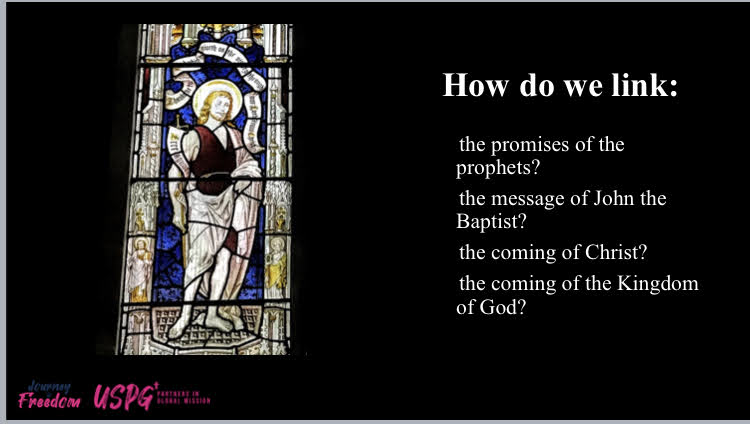
The Second Sunday of Advent, recalls the Prophets
The Second Sunday of Advent, recalls the Prophets. The Gospel reading, in a way, is a reminder of the promises of the Prophets. But, for some of us, it may seem a little out of place, for it is customary to recall John the Baptist on the Third Sunday of Advent.
Lighting the second candle on the Advent Wreath this Sunday, it is customary to think about the Prophets, leaving John the Baptist for the Third Sunday of Advent [11 December 2022], when the Gospel reading explains how Saint John the Baptist, and his mission point to Christ (see Matthew 11: 2-11).
On the other hand, this Gospel reading links with the promises of the prophets, anticipating the coming of the Messiah, telling us that the Kingdom of Heaven has come near, and quoting the Prophet Isaiah.
The introductory verses emphasise John’s preaching, not his baptising. John first and foremost is a prophet and a preacher, calling us to repentance, true conversion, turning around and reorienting ourselves.
John is like the one described by Isaiah as ‘the voice … crying out in the wilderness.’ Yes, we go on to hear a description of John’s baptising, but this Gospel reading places a greater emphasis on the meaning of that baptism and on the message of John.
Constantly, parallels are drawn between John the Baptist and the prophets, particularly Isaiah and Elijah.
The description of John’s clothing of ‘camel’s hair with a leather belt around his waist’ draws on descriptions of Elijah as ‘a hairy man, with a leather belt around his waist’. Although John positively denies that he is Elijah, later in this Gospel Christ speaks of John in terms of the ‘Elijah who is to come’.
Unlike Elijah, though, John performs no miracles; it is because of his preaching that John is identified as a latter-day Elijah. He fearlessly confronts the powers of the day, both secular and religious. John also heralds the coming Day of the Lord – which is part of the prophesy drawing on Elijah at the very end of the Old Testament (see Malachi 4: 5-6). In this way, John acts as a bridge between the Old Testament and the New Testament.
John’s preaching emphasises the coming of the Kingdom of heaven. The word used here for kingdom points first and foremost to God’s rule or reign, not to the realm over which he rules. As the Lord’s Prayer reminds us, where God’s will is done, there his kingdom comes. When God’s kingdom comes, his will indeed shall be done on earth as in heaven, and justice shall be firmly and truly established. And Advent is a time to prepare for, to anticipate, to look forward to the coming of those days.
Because the kingdom is at hand, John calls those who hear him to repentance. The word here means a change of direction, a change of heart, a change of mind. Those who take John’s preaching seriously must reorient their thinking, their priorities. Their whole outlook must change once they realise the nearness and the demands of God’s reign.
Is John trying to shock some of the people out of a false sense of security and into spiritual awareness when he uses strong language: ‘You brood of vipers! Who warned you to flee from the wrath to come?’
Christ has not yet arrived at the Jordan, but John’s message is not primarily about himself, but about the one who is to come (see verse 11-12), who is spoken of in apocalyptic images of the final judgment.
John’s promises about the promised, coming kingdom of heaven is linked with the prophetic call to make the Lord’s paths straight.
How do we make the Lord’s paths straight?
Where do people encounter difficult roads in their journey in life?
When do we allow ourselves to hear the cry of people in the wilderness?
As we await the coming of Christ – not only as the Child at Christmas but as Christ who ushers in the hopes of all in the wilderness – confront the fears of people on the margins? And, how do we embody, live out, the hopes of people on the move today?
The popular hymn ‘O Little Town of Bethlehem’ says that despite the dark places in the world today, ‘The hopes and fears of all the years / are met in thee tonight.’
As a sign, as a symbol, of how those hopes and fears are being met this year, USPG and the Church of North India sees the faces of Mary, Joseph and the Christ Child in the people being helped through this year’s Advent and Christmas appeal.
This is the Advent Hope and the Christmas present we can offer this year. The fears of those who cross borders, who face the threat of violence and the dangers of human trafficking, are being challenged by those who are working through the Diocese of Durgapur and USPG.
This is one way we can help to ‘Prepare the way of the Lord,’ to ‘ make his paths straight.’ With our support, they are no longer like voices crying out in the wilderness. They are heard, and through this work we became signs of our faith, or hope, in the promises of the coming kingdom.
This sermon outline for the Second Sunday of Advent, 4 December 2022, was prepared for USPG (United Society Partners in the Gospel) and the ‘Journey to Freedom’ appeal in Advent 2022
27 November 2022
A sermon outline with USPG for
Advent Sunday, 27 November 2022
Patrick Comerford
Advent Sunday
27 November 2022
Reading: Matthew 24: 36-44 (NRSVA):
[Jesus said:] 36 ‘But about that day and hour no one knows, neither the angels of heaven, nor the Son, but only the Father. 37 For as the days of Noah were, so will be the coming of the Son of Man. 38 For as in those days before the flood they were eating and drinking, marrying and giving in marriage, until the day Noah entered the ark, 39 and they knew nothing until the flood came and swept them all away, so too will be the coming of the Son of Man. 40 Then two will be in the field; one will be taken and one will be left. 41 Two women will be grinding meal together; one will be taken and one will be left. 42 Keep awake therefore, for you do not know on what day your Lord is coming. 43 But understand this: if the owner of the house had known in what part of the night the thief was coming, he would have stayed awake and would not have let his house be broken into. 44 Therefore you also must be ready, for the Son of Man is coming at an unexpected hour.
’
The First Sunday of Advent reminds us of the Patriarchs and Matriarchs, our fathers and mothers or ancestors in the community or family of faith.
Often these were people who were on the move in times of trouble, upheaval and of danger. Think of Abraham and Sarah, Isaac and Rebecca, Jacob and Leah – often on the move, facing long journeys, but always journeying with God.
It is worth asking: ‘If a fire broke out in your house, what three possessions would you grab?’ Many rectors/vicars have asked this question as they prepared their sermons on this Gospel theme, and the answers they get are interesting.
People include their laptops, their family photographs, their phones, their keys, their wallets or purses, cash or money, plastic cards, passports ... the family pet?
What would you take?
If you were forced to leave your home, or found yourself suddenly forced to abandon all that gave you security, would they really be worth taking?
Laptops are easily damaged, phones need to be charged and don’t always work in other countries, keys to an abandoned home no longer have any use, photographs fade, cash or money from an unstable country quickly loses value.
What would you take with you?
What do we cling to?
Anyone with an interest in old banknotes knows how it became meaningless to be a millionaire or even a multimillionaire in Weimar Germany, war-time Greece or Ceausescu’s Romania. They were in circulation at times when inflation became rampant in times of crisis in Europe. Had they been spent at the time they were issued they might have bought something of value; had they been given away in their day, they might have helped the poor and the hungry.
But circumstances saw to it that those who became attached to their wealth on paper would lose all they had. The Gospel reading this morning (Matthew 24: 36-44) challenges us to think again about what we cling to and what are our true values.
When our prosperity and wealth disappear, like the fast-fading value of old banknotes, are we in danger of feeling abandoned by God?
How would we grab our faith and take it with us if we rushed to escape a crisis?
What do you take with you on a journey?
Christ reminds those who are listening of the story of Noah. What Noah took with him on the ark is a reminder not only to anticipate our own future and our own needs to ensure that security, but to think of the needs of all life, of all creation.
Seasoned travellers know how to pack their bags.
What are the essential items you pack in your case?
Is it a small bag for an overhead cabin on a budget airline flight and a short overnight stay?
Or is it a large suitcase or two for a two-week holiday, filled with towels, sun cream and swimwear?
The list of essentials grows longer and longer as we think about it: passport, toothbrush, plastic cards, phone chargers, presents for hosts and friends, and changes of clothes and sandals, laptop, more than enough reading … so much more than we ever need or use.
Do you then regret having packed too much when you find there is not enough room for them on the way back because of restrictions on overhead bags?
What do you think Mary and Joseph took with them for the journey from Nazareth to Bethlehem?
Did they have enough to cope on finding there was no room for them in the inn?
Did they have enough with them when they made the next journey, from Bethlehem to Egypt?
Who helped them to find the missing necessities in Bethlehem, or in Egypt?
Mass migration is major problem in the world today. Politicians seem to want us to think it is a problem for us here. But the people who suffer most are the people on the move themselves, children, women and men.
They cannot take with them what they need, never mind what they want.
On the journey, they face many threats and dangers, from exploitation and violence to extortion and human trafficking.
Of course, if they were Mary, Joseph and the Christ Child, we would want to reach out and help to meet their needs.
USPG and the Church of North India sees the faces of Mary, Joseph and the Christ Child in the people being helped through this year’s Advent and Christmas appeal.
This is the Advent Hope and the Christmas present we can offer this year.
This sermon outline for the First Sunday of Advent, 27 November 2022, was prepared for USPG (United Society Partners in the Gospel) and the ‘Journey to Freedom’ appeal in Advent 2022
13 February 2022
‘Among the many changes of the world,
our hearts may surely there be fixed
where true joys are to be found’
‘They had come to hear him and to be healed of their diseases’ (Luke 6: 18) … a sign at a church in Glasnevin, Dublin (Photograph: Patrick Comerford)
Patrick Comerford
Sunday 13 February 2022,
The Third Sunday before Lent
9.30 a.m. Castletown Church, Co Limerick, the Parish Eucharist (Holy Communion 2)
11.30 a.m. Holy Trinity Church, Rathkeale, Co Limerick, Morning Prayer
Readings: Jeremiah 17: 5-10; Psalm 1; I Corinthians 15: 12-20; Luke 6: 17-26
There is a direct link to the readings HERE.
The shrine of Saint Valentine in the Carmelite Church in Whitefriar Street, Dublin (Photograph: Patrick Comerford)
May I speak to you in the name of God, + Father, Son and Holy Spirit, Amen
Do you recall a time when the Sundays before Lent were known by the traditional names of Septuagesima, Sexagesima and Quinquagesima? This Sunday, the Third Sunday before Lent, was known in the Book of Common Prayer until recently as Septuagesima.
But counting the Sundays and weeks before Lent and even during Lent is meaningless to most people.
On the other hand, everyone knows that tomorrow is Saint Valentine’s Day.
Never mind that this saint is not named in the calendar of the Church of Ireland; never mind that historians doubt many of the details that are supposed to be part of his life story. If you looked into the flower shops and card shops in Limerick last week, or noticed the racks of cards and gifts in every shop in Askeaton and Rathkeale last week, you would imagine that Saint Valentine is one of the most popular saints in Ireland – almost popular enough to rival Saint Patrick himself.
Tomorrow, thousands of locks may be secured to bridges and fences across Europe, people will try to visit Juliet’s supposed balcony in Verona, and many people may want to visit the Carmelite Church in Whitefriar Street, Dublin, where Saint Valentine’s reliquary is traditionally taken from a special shrine in a side chapel and placed before the High Altar.
Saint Valentine is a widely believed to have been a third century Roman martyr. He is commemorated on 14 February, and since the High Middle Ages he has been associated with young love.
Yet, despite his popularity, we know nothing reliable about Saint Valentine, apart from his name and the tradition that he died a martyr’s death on 14 February on the Via Flaminia, north of Rome. Many of the stories about his life are mythical and unreliable.
Popular legend says Valentine was a Roman priest who was martyred during the reign of Claudius II, Claudius Gothicus. He was arrested and jailed when he was caught marrying Christian couples and helping persecuted Christians.
It is said Claudius took a liking to this prisoner. But when Valentinus tried to convert the Emperor, he was condemned to death. He was beaten with clubs and stones; when that failed to kill him, he was beheaded outside the Flaminian Gate.
Many of the legends about Saint Valentine can be traced only to 14th century England and to the writings of Geoffrey Chaucer and his circle, when 14 February was already linked with romantic love.
Because of these myths and legends, Saint Valentine was dropped from the Roman Calendar of Saints in 1969. Nevertheless, the ‘Martyr Valentinus who died on 14 February on the Via Flaminia close to the Milvian Bridge in Rome’ is still on the list of officially recognised saints.
The day is also celebrated as Saint Valentine’s Day with a commemoration in Common Worship in the Church of England and in other churches in the Anglican Communion.
The relics of Saint Valentine were given by Pope Gregory XVI as a gift to Father John Spratt, an Irish Carmelite Prior, after he preached a popular sermon in the Jesuit church in Rome, the Gesu, in 1836. Since then, they have been kept in a shrine in the Carmelite Church in Whitefriar Street, Dublin.
Although the story of Saint Valentine is inextricably linked with romantic young love, it is good to be reminded of love as we prepare for Lent, which begins on Ash Wednesday [2 March 2022], and that our Lenten pilgrimage is a journey towards fully accepting the love of God offered to us through Christ on Good Friday and Easter Day.
Whitefriar Street Church, so closely linked with Saint Valentine, is an inner city church and one of two Carmelite churches in inner-city Dublin.
Great figures in the Carmelite tradition include Saint Teresa of Avila (1515-1582), Saint John of the Cross (1542-1591), Cardinal Charles Borromeo, Saint Thérèse of Lisieux (1873-1897), Edith Stein (Teresa Benedicta of the Cross), who died in Auschwitz in 1942, and Bishop Donal Lamont (1911-2003) of Umtali, an outspoken critic of apartheid in ‘Rhodesia’.
In my prayer diary each morning for some days now I have been reflecting on the writings of Saint Teresa of Avila, who speaks of love constantly in her writings.
She writes: ‘Whenever we think of Christ, we should recall the love that led him to bestow on us so many graces and favours, and also the great love God showed in giving us in Christ a pledge of his love; for love calls for love in return. Let us strive to keep this always before our eyes and to rouse ourselves to love Him.’
In keeping with the Carmelite contemplative tradition, Whitefriars Street Church provides an oasis of prayerful silence in the midst of the bustling city.
Saint Valentine’s shrine in Dublin is visited by thousands of couples throughout the year, especially on 14 February, when the reliquary is taken out from under the side-altar and is placed before the high altar in the church. There are special celebrations of the Eucharist, with a blessing of rings for couples who are about to be married.
Although the story of Saint Valentine is inextricably linked with romantic young love, it is good to be reminded of love as we prepare to journey through Lent, and that our Lenten pilgrimage is a journey towards fully accepting the love of God offered to us through Christ on Good Friday and on Easter Day.
In our readings this morning, the Prophet Jeremiah contrasts those who trust in mere mortals and those who trust in the Lord, and reminds us that God tests the mind and searches the heart, ‘to give to all according to the fruit of their doing’ (Jeremiah 17: 10).
I am constantly challenged by Christ’s emphasis on love.
The Gospel reading this morning (Luke 6: 17-26) is Saint Luke’s version of the ‘Sermon on the Mount.’ It offers a set of contrasts between the two sets of people, although those who first heard this must have been surprised by who fits into which category.
Some are blessed by being included in the Kingdom of God, others are warned of the consequences of their choices in life.
At times, in my own sinful life, in my good days and in my bad days, I can imagine myself in both categories. I need, in my deeply flawed life, to be reminded that it is not enough to talk about love, but I also need to make God’s love visible in my life and actions, each and every day.
As Saint Teresa of Avila writes: ‘Christ has no body now, but yours. No hands, no feet on earth, but yours. Yours are the eyes through which Christ looks compassion into the world. Yours are the feet with which Christ walks to do good. Yours are the hands with which Christ blesses the world.’
And the Collect of the Day challenges us to pray in these words:
Almighty God,
who alone can bring order
to the unruly wills and passions of sinful humanity:
Give your people grace
so to love what you command
and to desire what you promise;
that, among the many changes of the world,
our hearts may surely there be fixed
where true joys are to be found;
through Jesus Christ our Lord.
May those you love be a blessing to you, and may you be a blessing to those who love you.
And may all we think, say and do be to the praise, honour and glory of God, + Father, Son and Holy Spirit, Amen.
‘And all in the crowd were trying to touch him …’ (Luke 6: 19) … the crowd at the Battle of Cable Street depicted in street art in the East End of London (Photograph: Patrick Comerford)
Luke 6: 17-26 (NRSVA):
17 He came down with them and stood on a level place, with a great crowd of his disciples and a great multitude of people from all Judea, Jerusalem, and the coast of Tyre and Sidon. 18 They had come to hear him and to be healed of their diseases; and those who were troubled with unclean spirits were cured. 19 And all in the crowd were trying to touch him, for power came out from him and healed all of them.
20 Then he looked up at his disciples and said:
‘Blessed are you who are poor,
for yours is the kingdom of God.
21 ‘Blessed are you who are hungry now,
for you will be filled.
‘Blessed are you who weep now,
for you will laugh.
22 ‘Blessed are you when people hate you, and when they exclude you, revile you, and defame you on account of the Son of Man. 23 Rejoice on that day and leap for joy, for surely your reward is great in heaven; for that is what their ancestors did to the prophets.
24 ‘But woe to you who are rich,
for you have received your consolation.
25 ‘Woe to you who are full now,
for you will be hungry.
‘Woe to you who are laughing now,
for you will mourn and weep.
26 ‘Woe to you when all speak well of you, for that is what their ancestors did to the false prophets.’
‘He came down with them and stood … with a great multitude of people from … the coast’ (Luke 6: 17) … a small beach near Georgioupouli in Crete (Photograph: Patrick Comerford)
Liturgical Colour: Green
The Collect:
Almighty God,
who alone can bring order
to the unruly wills and passions of sinful humanity:
Give your people grace
so to love what you command
and to desire what you promise;
that, among the many changes of the world,
our hearts may surely there be fixed
where true joys are to be found;
through Jesus Christ our Lord.
Collect of the Word:
Righteous God, you challenge the powers that rule this world
and you show favour to the oppressed:
instil in us a true sense of justice,
that we may discern the signs of your kingdom
and strive for right to prevail;
for the sake of Jesus Christ our Lord,
who lives and reigns with you
in the unity of the Holy Spirit,
one God, for ever and ever.
The Post-Communion Prayer:
Merciful Father,
you gave Jesus Christ to be for us the bread of life,
that those who come to him should never hunger.
Draw us to our Lord in faith and love,
that we may eat and drink with him at his table in the kingdom,
where he is alive and reigns with you and the Holy Spirit,
now and for ever.
‘They shall be like a tree planted by water, sending out its roots by the stream’ (Jeremiah 17: 8) … a scene in Curraghchase Forest Park, Co Limerick (Photograph: Patrick Comerford)
Hymns:
10, All my hope on God is founded (CD 1)
553, Jesu, lover of my soul (CD 32)
324, God, whose almighty word (CD 19)
Scripture quotations are from the New Revised Standard Version Bible: Anglicised Edition copyright © 1989, 1995, National Council of the Churches of Christ in the United States of America. Used by permission. All rights reserved worldwide. http://nrsvbibles.org
Material from The Book of Common Prayer (the Church of Ireland, 2004) is copyright © Representative Body of the Church of Ireland 2004.
Patrick Comerford
Sunday 13 February 2022,
The Third Sunday before Lent
9.30 a.m. Castletown Church, Co Limerick, the Parish Eucharist (Holy Communion 2)
11.30 a.m. Holy Trinity Church, Rathkeale, Co Limerick, Morning Prayer
Readings: Jeremiah 17: 5-10; Psalm 1; I Corinthians 15: 12-20; Luke 6: 17-26
There is a direct link to the readings HERE.
The shrine of Saint Valentine in the Carmelite Church in Whitefriar Street, Dublin (Photograph: Patrick Comerford)
May I speak to you in the name of God, + Father, Son and Holy Spirit, Amen
Do you recall a time when the Sundays before Lent were known by the traditional names of Septuagesima, Sexagesima and Quinquagesima? This Sunday, the Third Sunday before Lent, was known in the Book of Common Prayer until recently as Septuagesima.
But counting the Sundays and weeks before Lent and even during Lent is meaningless to most people.
On the other hand, everyone knows that tomorrow is Saint Valentine’s Day.
Never mind that this saint is not named in the calendar of the Church of Ireland; never mind that historians doubt many of the details that are supposed to be part of his life story. If you looked into the flower shops and card shops in Limerick last week, or noticed the racks of cards and gifts in every shop in Askeaton and Rathkeale last week, you would imagine that Saint Valentine is one of the most popular saints in Ireland – almost popular enough to rival Saint Patrick himself.
Tomorrow, thousands of locks may be secured to bridges and fences across Europe, people will try to visit Juliet’s supposed balcony in Verona, and many people may want to visit the Carmelite Church in Whitefriar Street, Dublin, where Saint Valentine’s reliquary is traditionally taken from a special shrine in a side chapel and placed before the High Altar.
Saint Valentine is a widely believed to have been a third century Roman martyr. He is commemorated on 14 February, and since the High Middle Ages he has been associated with young love.
Yet, despite his popularity, we know nothing reliable about Saint Valentine, apart from his name and the tradition that he died a martyr’s death on 14 February on the Via Flaminia, north of Rome. Many of the stories about his life are mythical and unreliable.
Popular legend says Valentine was a Roman priest who was martyred during the reign of Claudius II, Claudius Gothicus. He was arrested and jailed when he was caught marrying Christian couples and helping persecuted Christians.
It is said Claudius took a liking to this prisoner. But when Valentinus tried to convert the Emperor, he was condemned to death. He was beaten with clubs and stones; when that failed to kill him, he was beheaded outside the Flaminian Gate.
Many of the legends about Saint Valentine can be traced only to 14th century England and to the writings of Geoffrey Chaucer and his circle, when 14 February was already linked with romantic love.
Because of these myths and legends, Saint Valentine was dropped from the Roman Calendar of Saints in 1969. Nevertheless, the ‘Martyr Valentinus who died on 14 February on the Via Flaminia close to the Milvian Bridge in Rome’ is still on the list of officially recognised saints.
The day is also celebrated as Saint Valentine’s Day with a commemoration in Common Worship in the Church of England and in other churches in the Anglican Communion.
The relics of Saint Valentine were given by Pope Gregory XVI as a gift to Father John Spratt, an Irish Carmelite Prior, after he preached a popular sermon in the Jesuit church in Rome, the Gesu, in 1836. Since then, they have been kept in a shrine in the Carmelite Church in Whitefriar Street, Dublin.
Although the story of Saint Valentine is inextricably linked with romantic young love, it is good to be reminded of love as we prepare for Lent, which begins on Ash Wednesday [2 March 2022], and that our Lenten pilgrimage is a journey towards fully accepting the love of God offered to us through Christ on Good Friday and Easter Day.
Whitefriar Street Church, so closely linked with Saint Valentine, is an inner city church and one of two Carmelite churches in inner-city Dublin.
Great figures in the Carmelite tradition include Saint Teresa of Avila (1515-1582), Saint John of the Cross (1542-1591), Cardinal Charles Borromeo, Saint Thérèse of Lisieux (1873-1897), Edith Stein (Teresa Benedicta of the Cross), who died in Auschwitz in 1942, and Bishop Donal Lamont (1911-2003) of Umtali, an outspoken critic of apartheid in ‘Rhodesia’.
In my prayer diary each morning for some days now I have been reflecting on the writings of Saint Teresa of Avila, who speaks of love constantly in her writings.
She writes: ‘Whenever we think of Christ, we should recall the love that led him to bestow on us so many graces and favours, and also the great love God showed in giving us in Christ a pledge of his love; for love calls for love in return. Let us strive to keep this always before our eyes and to rouse ourselves to love Him.’
In keeping with the Carmelite contemplative tradition, Whitefriars Street Church provides an oasis of prayerful silence in the midst of the bustling city.
Saint Valentine’s shrine in Dublin is visited by thousands of couples throughout the year, especially on 14 February, when the reliquary is taken out from under the side-altar and is placed before the high altar in the church. There are special celebrations of the Eucharist, with a blessing of rings for couples who are about to be married.
Although the story of Saint Valentine is inextricably linked with romantic young love, it is good to be reminded of love as we prepare to journey through Lent, and that our Lenten pilgrimage is a journey towards fully accepting the love of God offered to us through Christ on Good Friday and on Easter Day.
In our readings this morning, the Prophet Jeremiah contrasts those who trust in mere mortals and those who trust in the Lord, and reminds us that God tests the mind and searches the heart, ‘to give to all according to the fruit of their doing’ (Jeremiah 17: 10).
I am constantly challenged by Christ’s emphasis on love.
The Gospel reading this morning (Luke 6: 17-26) is Saint Luke’s version of the ‘Sermon on the Mount.’ It offers a set of contrasts between the two sets of people, although those who first heard this must have been surprised by who fits into which category.
Some are blessed by being included in the Kingdom of God, others are warned of the consequences of their choices in life.
At times, in my own sinful life, in my good days and in my bad days, I can imagine myself in both categories. I need, in my deeply flawed life, to be reminded that it is not enough to talk about love, but I also need to make God’s love visible in my life and actions, each and every day.
As Saint Teresa of Avila writes: ‘Christ has no body now, but yours. No hands, no feet on earth, but yours. Yours are the eyes through which Christ looks compassion into the world. Yours are the feet with which Christ walks to do good. Yours are the hands with which Christ blesses the world.’
And the Collect of the Day challenges us to pray in these words:
Almighty God,
who alone can bring order
to the unruly wills and passions of sinful humanity:
Give your people grace
so to love what you command
and to desire what you promise;
that, among the many changes of the world,
our hearts may surely there be fixed
where true joys are to be found;
through Jesus Christ our Lord.
May those you love be a blessing to you, and may you be a blessing to those who love you.
And may all we think, say and do be to the praise, honour and glory of God, + Father, Son and Holy Spirit, Amen.
‘And all in the crowd were trying to touch him …’ (Luke 6: 19) … the crowd at the Battle of Cable Street depicted in street art in the East End of London (Photograph: Patrick Comerford)
Luke 6: 17-26 (NRSVA):
17 He came down with them and stood on a level place, with a great crowd of his disciples and a great multitude of people from all Judea, Jerusalem, and the coast of Tyre and Sidon. 18 They had come to hear him and to be healed of their diseases; and those who were troubled with unclean spirits were cured. 19 And all in the crowd were trying to touch him, for power came out from him and healed all of them.
20 Then he looked up at his disciples and said:
‘Blessed are you who are poor,
for yours is the kingdom of God.
21 ‘Blessed are you who are hungry now,
for you will be filled.
‘Blessed are you who weep now,
for you will laugh.
22 ‘Blessed are you when people hate you, and when they exclude you, revile you, and defame you on account of the Son of Man. 23 Rejoice on that day and leap for joy, for surely your reward is great in heaven; for that is what their ancestors did to the prophets.
24 ‘But woe to you who are rich,
for you have received your consolation.
25 ‘Woe to you who are full now,
for you will be hungry.
‘Woe to you who are laughing now,
for you will mourn and weep.
26 ‘Woe to you when all speak well of you, for that is what their ancestors did to the false prophets.’
‘He came down with them and stood … with a great multitude of people from … the coast’ (Luke 6: 17) … a small beach near Georgioupouli in Crete (Photograph: Patrick Comerford)
Liturgical Colour: Green
The Collect:
Almighty God,
who alone can bring order
to the unruly wills and passions of sinful humanity:
Give your people grace
so to love what you command
and to desire what you promise;
that, among the many changes of the world,
our hearts may surely there be fixed
where true joys are to be found;
through Jesus Christ our Lord.
Collect of the Word:
Righteous God, you challenge the powers that rule this world
and you show favour to the oppressed:
instil in us a true sense of justice,
that we may discern the signs of your kingdom
and strive for right to prevail;
for the sake of Jesus Christ our Lord,
who lives and reigns with you
in the unity of the Holy Spirit,
one God, for ever and ever.
The Post-Communion Prayer:
Merciful Father,
you gave Jesus Christ to be for us the bread of life,
that those who come to him should never hunger.
Draw us to our Lord in faith and love,
that we may eat and drink with him at his table in the kingdom,
where he is alive and reigns with you and the Holy Spirit,
now and for ever.
‘They shall be like a tree planted by water, sending out its roots by the stream’ (Jeremiah 17: 8) … a scene in Curraghchase Forest Park, Co Limerick (Photograph: Patrick Comerford)
Hymns:
10, All my hope on God is founded (CD 1)
553, Jesu, lover of my soul (CD 32)
324, God, whose almighty word (CD 19)
Scripture quotations are from the New Revised Standard Version Bible: Anglicised Edition copyright © 1989, 1995, National Council of the Churches of Christ in the United States of America. Used by permission. All rights reserved worldwide. http://nrsvbibles.org
Material from The Book of Common Prayer (the Church of Ireland, 2004) is copyright © Representative Body of the Church of Ireland 2004.
06 February 2022
Ordinary people, in
ordinary time, doing
extraordinary things
‘He saw two boats there at the shore’ … two boats at the Pier in Kinvara, Co Galway, at the weekend (Photograph: Patrick Comerford, 2022)
Patrick Comerford
Sunday 6 February 2022,
The Fourth Sunday before Lent
9.30 a.m. Saint Mary’s Church, Askeaton, Co Limerick, the Parish Eucharist (Holy Communion 2)
11.30 a.m. Saint Brendan’s Church, Tarbert, Co Kerry, Morning Prayer
Readings: Isaiah 6: 1-8; Psalm 138; I Corinthians 15: 1-11; Luke 5: 1-11
There is a link to the readings HERE.
‘The fishermen had gone out of them and were washing their nets’ (Luke 5: 2) … fishing boats and nets in the harbour in Loughshinny, Co Dublin (Photograph: Patrick Comerford)
May I speak to you in the name of God, + Father, Son and Holy Spirit, Amen
The Season of Christmas came to an end on Wednesday (2 February 2022) with the Feast of the Presentation or Candlemas, which we celebrated in Holy Trinity Church, Rathkeale, last Sunday morning (30 January 2022).
Between now and Ash Wednesday (2 March 2022), we are in what the Church Calendar calls ‘Ordinary Time.’
So often, our celebrations in Church ask us to identify with the great saints and martyrs, in contrast to the ordinary people who are so often the focus of Christ’s ministry in the Gospels: ordinary people who are poor or on the margins in society; ordinary people with everyday jobs like fishermen and tax collectors, or publicans and farmers; ordinary people in the villages and towns; ordinary people with a need for healing or who are hurt and broken by loss and grief.
Ordinary people like you and me, living ordinary lives in ordinary time. Not sinless people, but ordinary people, conscious of our weaknesses and our failings, humbled in and all too aware of our own sinfulness and flaws.
In our readings this morning, we hear the call of Isaiah, a renewed call to David the Psalmist, the response of Saint Paul to his call, and the renewed call to some of the disciples, including Peter, James and John. These calls come not to people who feel they are worthy of this call, that the deserve this, that they have inherited a call, or who think they are entitled to speak on God’s behalf. They start off as very ordinary people, like you and me.
Isaiah is in the Temple, feeling he is lost and ‘a man of unclean lips’ when he hears and responds to God’s call, only to find he becomes isolated from his own people.
The Psalmist is in God’s presence in the Temple when he finds God answers his prayer and gives him a new calling or new spiritual gifts. Yet David begins life as a small and weak shepherd boy.
Saint Paul tells us he feels he is ‘the least of the apostles, unfit to be called an apostle.’
The three disciples, Peter, James and John are called not only to speak on Christ’s behalf, but to do what Christ commands and to follow him.
In all these readings, Isaiah, the Psalmist, Saint Paul and then Saint Peter, all express their feelings of inadequacy and unworthiness, yet accept God’s call to speak in God’s name unconditionally and in faith.
In our first reading (Isaiah 6: 1-8), the Prophet Isaiah hears his call from God to be a prophet. Isaiah feels unclean and unworthy in the presence of God, and yet he sees God. He sees the people as unworthy too, but one of the seraphs purifies him, rendering him fit to speak God’s word to his people.
Our Psalm (Psalm 138) thanks God for his steadfast, enduring love and for his care for his faithful followers. When the writer calls upon God, God not only answers him but gives him a new calling or makes him more confident spiritually: ‘you increased my strength of soul’ (verse 3).
In the Epistle reading (I Corinthians 15: 1-11), Saint Paul tells us that the Risen Christ first appeared to Cephas (Peter), then to the twelve, then to 500 at one time, then to James, then to all the apostles, and finally to Paul himself.
Saint Paul realises that he is not the first choice, not the second choice. He is way down the list, not among the first 12, not even in the top 500. Until then, he has been an ordinary Jewish Pharisee of the day, making a living mending tents and sails.
But he now knows that through his Baptism he shares in Christ’s suffering and death and that he has been raised to new life in Christ.
Our Gospel story (Luke 5: 1-11) is a story of commitment to Christ, to his message and to his destiny. Simon is named Peter for the first time in Saint Luke’s Gospel in this reading (verse 8). Christ calls Simon or Simon Peter to be a disciple, promising him he is to be a ‘fisher of men,’ and Peter, James and John leave everything and follow Christ.
Try to imagine the roles or the calls being reversed.
Can you imagine King Uzziah giving up his throne to be a marginalised prophet like Isaiah?
Can you imagine a powerful king accepting God’s call to be a despised shepherd boy?
Can you imagine a Roman Governor accepting the call to work with the disciples in an ordinary fishing boat?
Had Pontius Pilate heard Christ’s call would he have given up privilege, or paid heed to the inevitable obloquy that would follow his extraordinary use of power?
Our Gospel reading opens us to the concept that God does extraordinary things with ordinary people, in ordinary places, in ordinary times.
This episode begins beside the ‘lake of Gennesaret,’ on the south-west shore of the Sea of Galilee. The crowd is pressing in to hear Christ, the Word of God, to hear the Christian message.
Jesus gets into the boat with Simon Peter. There are two boats in this episode, and James and John are also fishing in one of the boats.
Simon acknowledges Jesus as ‘Master’ or teacher. The disciples do what Christ tells them to do, and they are amazed at the consequences. Simon Peter responds by falling down before Christ in humility, pointing to himself as a sinful man, and calling Jesus ‘Lord,’ which becomes an expression of faith.
Peter, James and John are ordinary working men who make an extraordinary and total commitment to Christ; they leave everything, and follow him.
In traditional illustrations, the boat is often used as an image of the Church, while the fish is an image of Christ. In the Early Church, the fish came to symbolise Christ because the Greek word Ichthus (ΙΧΘΥΣ), meaning ‘fish’, is an acrostic for ‘Jesus Christ, Son of God, Saviour’ (Ἰησοῦς Χριστός, Θεοῦ Υἱός, Σωτήρ).
The Church is the boat, Christ is the fish, and God calls us as ordinary people, in ordinary places, in ordinary times, to realise that God sees us – you and me, each and every one of us – to work with him, where he finds us. God sees us in our everyday lives as his partners in the boat. And we are all in this boat together.
It is in being the ordinary people we are, in our ordinary lives, in our ordinary times, that God calls us. And if we chose to respond, then, like Peter, James and John, we may find we are amazed at the catch Christ brings into the Church through us.
Are we brave enough to face this possibility? Or is that ordinary challenge too much for us? If we have any doubts, remember how Christ says to Simon Peter, ‘Do not be afraid; from now on you will be catching people.’
And so, may all we think, say and do be to the praise honour and glory of God, + Father, Son and Holy Spirit, Amen.
‘He saw two boats there at the shore’ … two fishing boats at the harbour in Skerries, Co Dublin (Photograph: Patrick Comerford)
Luke 5: 1-11 (NRSVA):
1 Once while Jesus was standing beside the lake of Gennesaret, and the crowd was pressing in on him to hear the word of God, 2 he saw two boats there at the shore of the lake; the fishermen had gone out of them and were washing their nets. 3 He got into one of the boats, the one belonging to Simon, and asked him to put out a little way from the shore. Then he sat down and taught the crowds from the boat. 4 When he had finished speaking, he said to Simon, ‘Put out into the deep water and let down your nets for a catch.’ 5 Simon answered, ‘Master, we have worked all night long but have caught nothing. Yet if you say so, I will let down the nets.’ 6 When they had done this, they caught so many fish that their nets were beginning to break. 7 So they signalled to their partners in the other boat to come and help them. And they came and filled both boats, so that they began to sink. 8 But when Simon Peter saw it, he fell down at Jesus’ knees, saying, ‘Go away from me, Lord, for I am a sinful man!’ 9 For he and all who were with him were amazed at the catch of fish that they had taken; 10 and so also were James and John, sons of Zebedee, who were partners with Simon. Then Jesus said to Simon, ‘Do not be afraid; from now on you will be catching people.’ 11 When they had brought their boats to shore, they left everything and followed him.
An icon of the Church as a boat, including Christ, the Apostles and the Church Fathers (Icon: Deacon Matthew Garrett, www.holy-icons.com)
Liturgical Colour: Green
The Collect:
O God,
you know us to be set
in the midst of so many and great dangers,
that by reason of the frailty of our nature
we cannot always stand upright:
Grant to us such strength and protection
as may support us in all dangers
and carry us through all temptations;
through Jesus Christ our Lord.
The Collect of the Word:
Most holy God,
the earth is filled with your glory,
and before you angels and saints serve in awe.
Enlarge our vision to see
your power at work in the world, and by your grace
make us heralds of your Son,
Jesus Christ, our Saviour and Lord.
The Post-Communion Prayer:
God of tender care,
in this Eucharist we celebrate your love for us and for all people.
May we show your love in our lives
and know its fulfilment in your presence.
We ask this in the name of Jesus Christ our Lord.
When he had finished speaking, he said to Simon, ‘Put out into the deep water and let down your nets for a catch’ (Luke 5: 4) … a fisherman at work at Torcello in the Venetian lagoon (Photograph: Patrick Comerford)
Hymns:
321, Holy, holy, holy! Lord God almighty (CD 19)
358, King of glory, King of peace (CD 21)
395, When Jesus taught by Galilee (CD 48)
‘When they had brought their boats to shore, they left everything and followed him’ … fishing boats on a shore at Mount Athos (Photograph: Patrick Comerford)
Scripture quotations are from the New Revised Standard Version Bible: Anglicised Edition copyright © 1989, 1995, National Council of the Churches of Christ in the United States of America. Used by permission. All rights reserved worldwide. http://nrsvbibles.org
Material from The Book of Common Prayer (the Church of Ireland, 2004) is copyright © Representative Body of the Church of Ireland 2004.
Patrick Comerford
Sunday 6 February 2022,
The Fourth Sunday before Lent
9.30 a.m. Saint Mary’s Church, Askeaton, Co Limerick, the Parish Eucharist (Holy Communion 2)
11.30 a.m. Saint Brendan’s Church, Tarbert, Co Kerry, Morning Prayer
Readings: Isaiah 6: 1-8; Psalm 138; I Corinthians 15: 1-11; Luke 5: 1-11
There is a link to the readings HERE.
‘The fishermen had gone out of them and were washing their nets’ (Luke 5: 2) … fishing boats and nets in the harbour in Loughshinny, Co Dublin (Photograph: Patrick Comerford)
May I speak to you in the name of God, + Father, Son and Holy Spirit, Amen
The Season of Christmas came to an end on Wednesday (2 February 2022) with the Feast of the Presentation or Candlemas, which we celebrated in Holy Trinity Church, Rathkeale, last Sunday morning (30 January 2022).
Between now and Ash Wednesday (2 March 2022), we are in what the Church Calendar calls ‘Ordinary Time.’
So often, our celebrations in Church ask us to identify with the great saints and martyrs, in contrast to the ordinary people who are so often the focus of Christ’s ministry in the Gospels: ordinary people who are poor or on the margins in society; ordinary people with everyday jobs like fishermen and tax collectors, or publicans and farmers; ordinary people in the villages and towns; ordinary people with a need for healing or who are hurt and broken by loss and grief.
Ordinary people like you and me, living ordinary lives in ordinary time. Not sinless people, but ordinary people, conscious of our weaknesses and our failings, humbled in and all too aware of our own sinfulness and flaws.
In our readings this morning, we hear the call of Isaiah, a renewed call to David the Psalmist, the response of Saint Paul to his call, and the renewed call to some of the disciples, including Peter, James and John. These calls come not to people who feel they are worthy of this call, that the deserve this, that they have inherited a call, or who think they are entitled to speak on God’s behalf. They start off as very ordinary people, like you and me.
Isaiah is in the Temple, feeling he is lost and ‘a man of unclean lips’ when he hears and responds to God’s call, only to find he becomes isolated from his own people.
The Psalmist is in God’s presence in the Temple when he finds God answers his prayer and gives him a new calling or new spiritual gifts. Yet David begins life as a small and weak shepherd boy.
Saint Paul tells us he feels he is ‘the least of the apostles, unfit to be called an apostle.’
The three disciples, Peter, James and John are called not only to speak on Christ’s behalf, but to do what Christ commands and to follow him.
In all these readings, Isaiah, the Psalmist, Saint Paul and then Saint Peter, all express their feelings of inadequacy and unworthiness, yet accept God’s call to speak in God’s name unconditionally and in faith.
In our first reading (Isaiah 6: 1-8), the Prophet Isaiah hears his call from God to be a prophet. Isaiah feels unclean and unworthy in the presence of God, and yet he sees God. He sees the people as unworthy too, but one of the seraphs purifies him, rendering him fit to speak God’s word to his people.
Our Psalm (Psalm 138) thanks God for his steadfast, enduring love and for his care for his faithful followers. When the writer calls upon God, God not only answers him but gives him a new calling or makes him more confident spiritually: ‘you increased my strength of soul’ (verse 3).
In the Epistle reading (I Corinthians 15: 1-11), Saint Paul tells us that the Risen Christ first appeared to Cephas (Peter), then to the twelve, then to 500 at one time, then to James, then to all the apostles, and finally to Paul himself.
Saint Paul realises that he is not the first choice, not the second choice. He is way down the list, not among the first 12, not even in the top 500. Until then, he has been an ordinary Jewish Pharisee of the day, making a living mending tents and sails.
But he now knows that through his Baptism he shares in Christ’s suffering and death and that he has been raised to new life in Christ.
Our Gospel story (Luke 5: 1-11) is a story of commitment to Christ, to his message and to his destiny. Simon is named Peter for the first time in Saint Luke’s Gospel in this reading (verse 8). Christ calls Simon or Simon Peter to be a disciple, promising him he is to be a ‘fisher of men,’ and Peter, James and John leave everything and follow Christ.
Try to imagine the roles or the calls being reversed.
Can you imagine King Uzziah giving up his throne to be a marginalised prophet like Isaiah?
Can you imagine a powerful king accepting God’s call to be a despised shepherd boy?
Can you imagine a Roman Governor accepting the call to work with the disciples in an ordinary fishing boat?
Had Pontius Pilate heard Christ’s call would he have given up privilege, or paid heed to the inevitable obloquy that would follow his extraordinary use of power?
Our Gospel reading opens us to the concept that God does extraordinary things with ordinary people, in ordinary places, in ordinary times.
This episode begins beside the ‘lake of Gennesaret,’ on the south-west shore of the Sea of Galilee. The crowd is pressing in to hear Christ, the Word of God, to hear the Christian message.
Jesus gets into the boat with Simon Peter. There are two boats in this episode, and James and John are also fishing in one of the boats.
Simon acknowledges Jesus as ‘Master’ or teacher. The disciples do what Christ tells them to do, and they are amazed at the consequences. Simon Peter responds by falling down before Christ in humility, pointing to himself as a sinful man, and calling Jesus ‘Lord,’ which becomes an expression of faith.
Peter, James and John are ordinary working men who make an extraordinary and total commitment to Christ; they leave everything, and follow him.
In traditional illustrations, the boat is often used as an image of the Church, while the fish is an image of Christ. In the Early Church, the fish came to symbolise Christ because the Greek word Ichthus (ΙΧΘΥΣ), meaning ‘fish’, is an acrostic for ‘Jesus Christ, Son of God, Saviour’ (Ἰησοῦς Χριστός, Θεοῦ Υἱός, Σωτήρ).
The Church is the boat, Christ is the fish, and God calls us as ordinary people, in ordinary places, in ordinary times, to realise that God sees us – you and me, each and every one of us – to work with him, where he finds us. God sees us in our everyday lives as his partners in the boat. And we are all in this boat together.
It is in being the ordinary people we are, in our ordinary lives, in our ordinary times, that God calls us. And if we chose to respond, then, like Peter, James and John, we may find we are amazed at the catch Christ brings into the Church through us.
Are we brave enough to face this possibility? Or is that ordinary challenge too much for us? If we have any doubts, remember how Christ says to Simon Peter, ‘Do not be afraid; from now on you will be catching people.’
And so, may all we think, say and do be to the praise honour and glory of God, + Father, Son and Holy Spirit, Amen.
‘He saw two boats there at the shore’ … two fishing boats at the harbour in Skerries, Co Dublin (Photograph: Patrick Comerford)
Luke 5: 1-11 (NRSVA):
1 Once while Jesus was standing beside the lake of Gennesaret, and the crowd was pressing in on him to hear the word of God, 2 he saw two boats there at the shore of the lake; the fishermen had gone out of them and were washing their nets. 3 He got into one of the boats, the one belonging to Simon, and asked him to put out a little way from the shore. Then he sat down and taught the crowds from the boat. 4 When he had finished speaking, he said to Simon, ‘Put out into the deep water and let down your nets for a catch.’ 5 Simon answered, ‘Master, we have worked all night long but have caught nothing. Yet if you say so, I will let down the nets.’ 6 When they had done this, they caught so many fish that their nets were beginning to break. 7 So they signalled to their partners in the other boat to come and help them. And they came and filled both boats, so that they began to sink. 8 But when Simon Peter saw it, he fell down at Jesus’ knees, saying, ‘Go away from me, Lord, for I am a sinful man!’ 9 For he and all who were with him were amazed at the catch of fish that they had taken; 10 and so also were James and John, sons of Zebedee, who were partners with Simon. Then Jesus said to Simon, ‘Do not be afraid; from now on you will be catching people.’ 11 When they had brought their boats to shore, they left everything and followed him.
An icon of the Church as a boat, including Christ, the Apostles and the Church Fathers (Icon: Deacon Matthew Garrett, www.holy-icons.com)Liturgical Colour: Green
The Collect:
O God,
you know us to be set
in the midst of so many and great dangers,
that by reason of the frailty of our nature
we cannot always stand upright:
Grant to us such strength and protection
as may support us in all dangers
and carry us through all temptations;
through Jesus Christ our Lord.
The Collect of the Word:
Most holy God,
the earth is filled with your glory,
and before you angels and saints serve in awe.
Enlarge our vision to see
your power at work in the world, and by your grace
make us heralds of your Son,
Jesus Christ, our Saviour and Lord.
The Post-Communion Prayer:
God of tender care,
in this Eucharist we celebrate your love for us and for all people.
May we show your love in our lives
and know its fulfilment in your presence.
We ask this in the name of Jesus Christ our Lord.
When he had finished speaking, he said to Simon, ‘Put out into the deep water and let down your nets for a catch’ (Luke 5: 4) … a fisherman at work at Torcello in the Venetian lagoon (Photograph: Patrick Comerford)
Hymns:
321, Holy, holy, holy! Lord God almighty (CD 19)
358, King of glory, King of peace (CD 21)
395, When Jesus taught by Galilee (CD 48)
‘When they had brought their boats to shore, they left everything and followed him’ … fishing boats on a shore at Mount Athos (Photograph: Patrick Comerford)
Scripture quotations are from the New Revised Standard Version Bible: Anglicised Edition copyright © 1989, 1995, National Council of the Churches of Christ in the United States of America. Used by permission. All rights reserved worldwide. http://nrsvbibles.org
Material from The Book of Common Prayer (the Church of Ireland, 2004) is copyright © Representative Body of the Church of Ireland 2004.
30 January 2022
Linking the joys of Christmas
with the pain of Good Friday
and the hopes of Easter
A detail of Harry Clarke’s ‘Presentation Window’ in Saint Flannan’s Church, Killaloe, Co Clare (Photograph: Patrick Comerford)
Patrick Comerford
Sunday 30 January (Epiphany 4, the Presentation):
11 a.m.: United Parish Eucharist, Holy Trinity Church, Rathkeale.
Readings: Malachi 3: 1-5; Psalm 24: 1-10; Hebrews 2: 14-18; Luke 2: 22-40
‘The dawn from on high will break upon us , to give light to those who sit in darkness’ (Luke 2: 78-79) … a winter sunrise at the Rectory in Askeaton, Co Limerick (Photograph: Patrick Comerford)
May I speak to you in the name of God, + Father, Son and Holy Spirit, Amen
This morning, we are using the readings and prayers for the Feast of the Presentation of Christ, which actually falls on Wednesday next (2 February 2022).
This celebration is known by several names over time, including the Presentation of Christ in the Temple; the Purification of the Blessed Virgin Mary; and Candlemas, as it is celebrated in many Anglican cathedrals and churches with the Candlemas Procession.
This feast, 40 days after Christmas, recalls how the Virgin Mary presents the Christ-Child to the priests in the Temple in Jerusalem. Because of the family’s poverty, the Virgin Mary and Saint Joseph bring two cheap doves or pigeons as their offering.
This feast is rich in meaning, with several related themes: the contrast between the poverty of this family and the richly-endowed Temple; the young Joseph and Mary with their first-born child and the old Simeon and Anna who are probably childless; the provincial home in Nazareth and the urbane sophistication of Jerusalem; the glory of one nation, Israel, and light for all nations, the Gentiles; the birth of a child and the expectation of death; darkness and light; new birth and impending death.
Candlemas is a ‘bitter-sweet’ feast. It calls for rejoicing with all in the Temple celebrating the hope and promise this new child brings. Yet Simeon speaks in prophetic words of the falling and rising of many and the sword that will pierce the Virgin Mary’s heart. His words remind us that Christmas is meaningless without the Passion and Easter.
This last festival of the Christmas cycle is pivotal as we shift from the cradle to the cross, from Christmas to Passiontide – Ash Wednesday and Lent are just four or five weeks away.
In this shift of mood, we take with us the light of Christ, a sure promise that Christ is the eternal light and the salvation of all humanity, throughout all ages.
Traditionally, Candlemas is the final day of the Christmas season. The liturgical colour changes from the White of rejoicing to the Green of ordinary, everyday life. This is the day that bridges the gap between Christmas and Lent, that bridges the gap between a time of celebration and a time of reflection, a time of joy and a time for taking stock once again.
This is an opportunity to take stock of where we are. After periods of recession and austerity, the economists tell us we have found light at the at the end of the tunnel.
Now, however, the debates about ‘post-Brexit’ relations with Britain and the long-term consequences of isolation during the Covid pandemic leave the majority of people with a new set of anxieties and uncertainties.
The lights of Christmas are dim and distant, and by this Candlemas most people in Ireland are living our very ordinary days with uncertainty, grasping for signs of hope, wondering how long we must remain in the dark.
How the Virgin Mary must have wept in her heart as in today’s Gospel story the old man Simeon hands back her child and warns her that a sword would pierce her heart (Luke 2: 35).
How many mothers are weeping in their hearts and clinging onto the rock of faith just by the end of their fingertips as their hearts, their souls, are pierced by a sword?
Mothers whose lives were held in slavery by fear (see Hebrews 2: 15).
Mothers who see their special needs children denied special needs assistants in our schools.
Mothers who see their children waiting, waiting too long, for care in our hospitals or to move from the uncertainty of hotel rooms or hostels to a house and a home.
Mothers who saw their graduate daughters and sons unable to find employment and have still not returned home.
Mothers whose silent weeping is not going to bring home their adult emigrant children and the grandchildren born in Australia or the US.
Mothers whose gay sons and lesbian daughters are beaten up on the streets just for the fun of it and are afraid if they come out that our Church can only offer tea and sympathy, at best, but moralising prejudice most of the time.
Mothers whose husbands are on low pay or dismissed as mere statistics in the figures for poverty.
Mothers whose adult children are caught up in substance abuse and have lost all hope for the future – for a future.
They know what TS Eliot calls ‘the certain hour of maternal sorrow.’ Like the Prophet in his poem A Song for Simeon, they ‘Wait for the wind that chills towards the dead land.’ And they know too how true Simeon’s words are for them this morning: ‘and a sword will pierce your soul too.’
If the Virgin Mary had known what grief would pierce her soul, would she have said ‘Yes’ to the Archangel Gabriel at the Annunciation?
Yet, in the midst of all this heartbreak, these mothers still cling on to the edge of the rock of faith by the edges of their fingernails. Wondering who hears their sobbing hearts and souls.
If they had known what grief would pierce their souls they would still have said yes, because they love their children, and no sword can kill that. They know too their children are immaculate conceptions, for their children too are conceived in a love for their world, our world, that is self-giving and sinless, and they continue to see the reflection and image of Christ in their children as they look into their eyes lovingly. Is that too not a truth and a hope at the heart of the Incarnation?
So often it is difficult to hold on to hope when our hearts are breaking and are pierced. So often it is difficult to keep the lights of our hearts burning brightly when everything is gloomy and dark. But Simeon points out that the Christ Child does not hold out any selfish hope for any one individual or one family … he is to be a light to the nations, to all of humanity.
And as our leaders – political, social, economic and financial leaders – search in the dark for the hope that will bring light back into our lives, we can remind ourselves that this search will have no purpose and it will offer no glimmer of hope unless it seeks more than selfish profit. This search must seek the good of all, it must seek to bring hope and light to all, not just here, but to all people and to all nations.
Who will speak out like the Prophet Malachi in our first reading ‘against those who oppress the hired workers in their wages, the widow, and the orphan, against those who thrust aside the alien,’ and do not fear the Lord God (Malachi 3: 5)?
This feast of Candlemas bridges the gap between Christmas and Lent; links the joy of the Christmas candles with the hope of the Pascal candle at Easter; invites us to move from celebration to reflection and preparation, and to think about the source of our hope, our inspiration, our enlightenment.
To paraphrase the words of Timothy Dudley-Smith’s hymn that draw on Simeon’s prophetic words, as we watch and wait in our faithful vigil for Christ’s glory in that Easter hope, may our doubting cease, may God’s silent, suffering people find deliverance and freedom from oppression, may his servants find peace, may he complete in us his perfect will.
And so, may all we think, say and do be to the praise, honour and glory of God, + Father, Son and Holy Spirit, Amen.
The Presentation in the Temple, carved on a panel on a triptych in the Lady Chapel, Lichfield Cathedral (Photograph: Patrick Comerford/Lichfield Gazette)
Luke 2: 22-40 (NRSVA):
22 When the time came for their purification according to the law of Moses, they brought him up to Jerusalem to present him to the Lord 23 (as it is written in the law of the Lord, ‘Every firstborn male shall be designated as holy to the Lord’), 24 and they offered a sacrifice according to what is stated in the law of the Lord, ‘a pair of turtle-doves or two young pigeons.’
25 Now there was a man in Jerusalem whose name was Simeon; this man was righteous and devout, looking forward to the consolation of Israel, and the Holy Spirit rested on him. 26 It had been revealed to him by the Holy Spirit that he would not see death before he had seen the Lord’s Messiah. 27 Guided by the Spirit, Simeon came into the temple; and when the parents brought in the child Jesus, to do for him what was customary under the law, 28 Simeon took him in his arms and praised God, saying,
29 ‘Master, now you are dismissing your servant in peace, according to your word;
30 for my eyes have seen your salvation,
31 which you have prepared in the presence of all peoples,
32 a light for revelation to the Gentiles
and for glory to your people Israel.’
33 And the child’s father and mother were amazed at what was being said about him. 34 Then Simeon blessed them and said to his mother Mary, ‘This child is destined for the falling and the rising of many in Israel, and to be a sign that will be opposed 35 so that the inner thoughts of many will be revealed – and a sword will pierce your own soul too.’
36 There was also a prophet, Anna the daughter of Phanuel, of the tribe of Asher. She was of a great age, having lived with her husband for seven years after her marriage, 37 then as a widow to the age of eighty-four. She never left the temple but worshipped there with fasting and prayer night and day. 38 At that moment she came, and began to praise God and to speak about the child to all who were looking for the redemption of Jerusalem.
39 When they had finished everything required by the law of the Lord, they returned to Galilee, to their own town of Nazareth. 40 The child grew and became strong, filled with wisdom; and the favour of God was upon him.
‘The Presentation in the Temple’ … a window by James Watson in the Church of the Holy Rosary, Murroe, Co Limerick (Photograph: Patrick Comerford)
Liturgical Colour: White.
Bidding Prayer:
The traditional Bidding Prayer for Candlemas:
Dear friends, forty days ago we celebrated the birth of our Lord Jesus Christ. Now we recall the day on which he was presented in the Temple, when he was offered to the Father and shown to his people.
As a sign of his coming among us, his mother was purified according to the custom of the time, and we now come to him for cleansing. In their old age Simeon and Anna recognised him as their Lord, as we today sing of his glory.
In this Eucharist, we celebrate both the joy of his coming and his searching judgement, looking back to the day of his birth and forward to the coming days of his passion.
So let us pray that we may know and share the light of Christ.
Penitential Kyries:
Lord God, mighty God,
you are the creator of the world.
Lord, have mercy.
Lord, have mercy.
Lord Jesus, Son of God and Son of Mary,
you are the Prince of Peace.
Christ, have mercy.
Christ, have mercy.
Holy Spirit,
by your power the Word was made flesh
and came to dwell among us.
Lord, have mercy.
Lord, have mercy.
The Collect:
Almighty and everliving God,
clothed in majesty,
whose beloved Son was this day presented in the temple
in the substance of our mortal nature:
May we be presented to you with pure and clean hearts,
by your Son Jesus Christ our Lord.
Introduction to the Peace:
In the tender mercy of our God
the dayspring from on high has broken upon us,
to give light to those who dwell in darkness
and in the shadow of death,
and to guide our feet into the way of peace. (cf Luke 1: 78, 79)
(Common Worship, p 306)
Preface:
You chose the Blessed Virgin Mary
to be the mother of your Son
and so exalted the humble and meek;
your angel hailed her as most high and highly favoured,
and with all generations we call her blessed:
(The Book of Common Prayer, the Church of Ireland, p. 234)
Post-Communion Prayer:
God, for whom we wait,
you fulfilled the hopes of Simeon and Anna,
who lived to welcome the Messiah.
Complete in us your perfect will,
that in Christ we may see your salvation,
for he is Lord for ever and ever.
Blessing:
Christ the Son of God, born of Mary,
fill you with his grace
to trust his promises and obey his will:
The Presentation or Candlemas … a stained glass window in Christ Church Cathedral, Dublin (Photograph: Patrick Comerford)
Hymns:
52, Christ, whose glory fills the skies (CD 4)
119, Come, thou long-expected Jesus (CD 8)
691, Faithful vigil ended (CD 39)
Scripture quotations are from the New Revised Standard Version Bible: Anglicised Edition copyright © 1989, 1995, National Council of the Churches of Christ in the United States of America. Used by permission. All rights reserved worldwide. http://nrsvbibles.org
Material from The Book of Common Prayer (the Church of Ireland, 2004) is copyright © Representative Body of the Church of Ireland 2004.
Material from Common Worship: Services and Prayers for the Church of England is copyright © The Archbishops’ Council 2000.
Patrick Comerford
Sunday 30 January (Epiphany 4, the Presentation):
11 a.m.: United Parish Eucharist, Holy Trinity Church, Rathkeale.
Readings: Malachi 3: 1-5; Psalm 24: 1-10; Hebrews 2: 14-18; Luke 2: 22-40
‘The dawn from on high will break upon us , to give light to those who sit in darkness’ (Luke 2: 78-79) … a winter sunrise at the Rectory in Askeaton, Co Limerick (Photograph: Patrick Comerford)
May I speak to you in the name of God, + Father, Son and Holy Spirit, Amen
This morning, we are using the readings and prayers for the Feast of the Presentation of Christ, which actually falls on Wednesday next (2 February 2022).
This celebration is known by several names over time, including the Presentation of Christ in the Temple; the Purification of the Blessed Virgin Mary; and Candlemas, as it is celebrated in many Anglican cathedrals and churches with the Candlemas Procession.
This feast, 40 days after Christmas, recalls how the Virgin Mary presents the Christ-Child to the priests in the Temple in Jerusalem. Because of the family’s poverty, the Virgin Mary and Saint Joseph bring two cheap doves or pigeons as their offering.
This feast is rich in meaning, with several related themes: the contrast between the poverty of this family and the richly-endowed Temple; the young Joseph and Mary with their first-born child and the old Simeon and Anna who are probably childless; the provincial home in Nazareth and the urbane sophistication of Jerusalem; the glory of one nation, Israel, and light for all nations, the Gentiles; the birth of a child and the expectation of death; darkness and light; new birth and impending death.
Candlemas is a ‘bitter-sweet’ feast. It calls for rejoicing with all in the Temple celebrating the hope and promise this new child brings. Yet Simeon speaks in prophetic words of the falling and rising of many and the sword that will pierce the Virgin Mary’s heart. His words remind us that Christmas is meaningless without the Passion and Easter.
This last festival of the Christmas cycle is pivotal as we shift from the cradle to the cross, from Christmas to Passiontide – Ash Wednesday and Lent are just four or five weeks away.
In this shift of mood, we take with us the light of Christ, a sure promise that Christ is the eternal light and the salvation of all humanity, throughout all ages.
Traditionally, Candlemas is the final day of the Christmas season. The liturgical colour changes from the White of rejoicing to the Green of ordinary, everyday life. This is the day that bridges the gap between Christmas and Lent, that bridges the gap between a time of celebration and a time of reflection, a time of joy and a time for taking stock once again.
This is an opportunity to take stock of where we are. After periods of recession and austerity, the economists tell us we have found light at the at the end of the tunnel.
Now, however, the debates about ‘post-Brexit’ relations with Britain and the long-term consequences of isolation during the Covid pandemic leave the majority of people with a new set of anxieties and uncertainties.
The lights of Christmas are dim and distant, and by this Candlemas most people in Ireland are living our very ordinary days with uncertainty, grasping for signs of hope, wondering how long we must remain in the dark.
How the Virgin Mary must have wept in her heart as in today’s Gospel story the old man Simeon hands back her child and warns her that a sword would pierce her heart (Luke 2: 35).
How many mothers are weeping in their hearts and clinging onto the rock of faith just by the end of their fingertips as their hearts, their souls, are pierced by a sword?
Mothers whose lives were held in slavery by fear (see Hebrews 2: 15).
Mothers who see their special needs children denied special needs assistants in our schools.
Mothers who see their children waiting, waiting too long, for care in our hospitals or to move from the uncertainty of hotel rooms or hostels to a house and a home.
Mothers who saw their graduate daughters and sons unable to find employment and have still not returned home.
Mothers whose silent weeping is not going to bring home their adult emigrant children and the grandchildren born in Australia or the US.
Mothers whose gay sons and lesbian daughters are beaten up on the streets just for the fun of it and are afraid if they come out that our Church can only offer tea and sympathy, at best, but moralising prejudice most of the time.
Mothers whose husbands are on low pay or dismissed as mere statistics in the figures for poverty.
Mothers whose adult children are caught up in substance abuse and have lost all hope for the future – for a future.
They know what TS Eliot calls ‘the certain hour of maternal sorrow.’ Like the Prophet in his poem A Song for Simeon, they ‘Wait for the wind that chills towards the dead land.’ And they know too how true Simeon’s words are for them this morning: ‘and a sword will pierce your soul too.’
If the Virgin Mary had known what grief would pierce her soul, would she have said ‘Yes’ to the Archangel Gabriel at the Annunciation?
Yet, in the midst of all this heartbreak, these mothers still cling on to the edge of the rock of faith by the edges of their fingernails. Wondering who hears their sobbing hearts and souls.
If they had known what grief would pierce their souls they would still have said yes, because they love their children, and no sword can kill that. They know too their children are immaculate conceptions, for their children too are conceived in a love for their world, our world, that is self-giving and sinless, and they continue to see the reflection and image of Christ in their children as they look into their eyes lovingly. Is that too not a truth and a hope at the heart of the Incarnation?
So often it is difficult to hold on to hope when our hearts are breaking and are pierced. So often it is difficult to keep the lights of our hearts burning brightly when everything is gloomy and dark. But Simeon points out that the Christ Child does not hold out any selfish hope for any one individual or one family … he is to be a light to the nations, to all of humanity.
And as our leaders – political, social, economic and financial leaders – search in the dark for the hope that will bring light back into our lives, we can remind ourselves that this search will have no purpose and it will offer no glimmer of hope unless it seeks more than selfish profit. This search must seek the good of all, it must seek to bring hope and light to all, not just here, but to all people and to all nations.
Who will speak out like the Prophet Malachi in our first reading ‘against those who oppress the hired workers in their wages, the widow, and the orphan, against those who thrust aside the alien,’ and do not fear the Lord God (Malachi 3: 5)?
This feast of Candlemas bridges the gap between Christmas and Lent; links the joy of the Christmas candles with the hope of the Pascal candle at Easter; invites us to move from celebration to reflection and preparation, and to think about the source of our hope, our inspiration, our enlightenment.
To paraphrase the words of Timothy Dudley-Smith’s hymn that draw on Simeon’s prophetic words, as we watch and wait in our faithful vigil for Christ’s glory in that Easter hope, may our doubting cease, may God’s silent, suffering people find deliverance and freedom from oppression, may his servants find peace, may he complete in us his perfect will.
And so, may all we think, say and do be to the praise, honour and glory of God, + Father, Son and Holy Spirit, Amen.
The Presentation in the Temple, carved on a panel on a triptych in the Lady Chapel, Lichfield Cathedral (Photograph: Patrick Comerford/Lichfield Gazette)
Luke 2: 22-40 (NRSVA):
22 When the time came for their purification according to the law of Moses, they brought him up to Jerusalem to present him to the Lord 23 (as it is written in the law of the Lord, ‘Every firstborn male shall be designated as holy to the Lord’), 24 and they offered a sacrifice according to what is stated in the law of the Lord, ‘a pair of turtle-doves or two young pigeons.’
25 Now there was a man in Jerusalem whose name was Simeon; this man was righteous and devout, looking forward to the consolation of Israel, and the Holy Spirit rested on him. 26 It had been revealed to him by the Holy Spirit that he would not see death before he had seen the Lord’s Messiah. 27 Guided by the Spirit, Simeon came into the temple; and when the parents brought in the child Jesus, to do for him what was customary under the law, 28 Simeon took him in his arms and praised God, saying,
29 ‘Master, now you are dismissing your servant in peace, according to your word;
30 for my eyes have seen your salvation,
31 which you have prepared in the presence of all peoples,
32 a light for revelation to the Gentiles
and for glory to your people Israel.’
33 And the child’s father and mother were amazed at what was being said about him. 34 Then Simeon blessed them and said to his mother Mary, ‘This child is destined for the falling and the rising of many in Israel, and to be a sign that will be opposed 35 so that the inner thoughts of many will be revealed – and a sword will pierce your own soul too.’
36 There was also a prophet, Anna the daughter of Phanuel, of the tribe of Asher. She was of a great age, having lived with her husband for seven years after her marriage, 37 then as a widow to the age of eighty-four. She never left the temple but worshipped there with fasting and prayer night and day. 38 At that moment she came, and began to praise God and to speak about the child to all who were looking for the redemption of Jerusalem.
39 When they had finished everything required by the law of the Lord, they returned to Galilee, to their own town of Nazareth. 40 The child grew and became strong, filled with wisdom; and the favour of God was upon him.
‘The Presentation in the Temple’ … a window by James Watson in the Church of the Holy Rosary, Murroe, Co Limerick (Photograph: Patrick Comerford)
Liturgical Colour: White.
Bidding Prayer:
The traditional Bidding Prayer for Candlemas:
Dear friends, forty days ago we celebrated the birth of our Lord Jesus Christ. Now we recall the day on which he was presented in the Temple, when he was offered to the Father and shown to his people.
As a sign of his coming among us, his mother was purified according to the custom of the time, and we now come to him for cleansing. In their old age Simeon and Anna recognised him as their Lord, as we today sing of his glory.
In this Eucharist, we celebrate both the joy of his coming and his searching judgement, looking back to the day of his birth and forward to the coming days of his passion.
So let us pray that we may know and share the light of Christ.
Penitential Kyries:
Lord God, mighty God,
you are the creator of the world.
Lord, have mercy.
Lord, have mercy.
Lord Jesus, Son of God and Son of Mary,
you are the Prince of Peace.
Christ, have mercy.
Christ, have mercy.
Holy Spirit,
by your power the Word was made flesh
and came to dwell among us.
Lord, have mercy.
Lord, have mercy.
The Collect:
Almighty and everliving God,
clothed in majesty,
whose beloved Son was this day presented in the temple
in the substance of our mortal nature:
May we be presented to you with pure and clean hearts,
by your Son Jesus Christ our Lord.
Introduction to the Peace:
In the tender mercy of our God
the dayspring from on high has broken upon us,
to give light to those who dwell in darkness
and in the shadow of death,
and to guide our feet into the way of peace. (cf Luke 1: 78, 79)
(Common Worship, p 306)
Preface:
You chose the Blessed Virgin Mary
to be the mother of your Son
and so exalted the humble and meek;
your angel hailed her as most high and highly favoured,
and with all generations we call her blessed:
(The Book of Common Prayer, the Church of Ireland, p. 234)
Post-Communion Prayer:
God, for whom we wait,
you fulfilled the hopes of Simeon and Anna,
who lived to welcome the Messiah.
Complete in us your perfect will,
that in Christ we may see your salvation,
for he is Lord for ever and ever.
Blessing:
Christ the Son of God, born of Mary,
fill you with his grace
to trust his promises and obey his will:
The Presentation or Candlemas … a stained glass window in Christ Church Cathedral, Dublin (Photograph: Patrick Comerford)
Hymns:
52, Christ, whose glory fills the skies (CD 4)
119, Come, thou long-expected Jesus (CD 8)
691, Faithful vigil ended (CD 39)
Scripture quotations are from the New Revised Standard Version Bible: Anglicised Edition copyright © 1989, 1995, National Council of the Churches of Christ in the United States of America. Used by permission. All rights reserved worldwide. http://nrsvbibles.org
Material from The Book of Common Prayer (the Church of Ireland, 2004) is copyright © Representative Body of the Church of Ireland 2004.
Material from Common Worship: Services and Prayers for the Church of England is copyright © The Archbishops’ Council 2000.
23 January 2022
‘The Spirit of the Lord is upon me,
because he has anointed me
to bring good news to the poor’
‘Now you are the body of Christ and individually members of it’ (I Corinthians 12: 27) … the Menqa or Boat Shelter in Saint Paul’s Bay on the north coast of Malta (Photograph: Patrick Comerford, 2022)
Patrick Comerford
Sunday 23 January 2022
The Third Sunday after the Epiphany (Epiphany III):
9.30: Castletown Church, Morning Prayer;
11.30: Holy Trinity Church, Rathkeale, the Parish Eucharist.
The Readings: Nehemiah 8: 1-3, 5-6, 8-10; Psalm 19; I Corinthians 12: 12-31a; Luke 4: 14-21.
There is a link to the readings HERE.
‘He went to the synagogue on the sabbath day, as was his custom’ (Luke 4: 16) … inside La Scuola Greca Synagogue in Corfu (Photograph: Patrick Comerford
May I speak to you in the name of God + Father, Son and Holy Spirit, Amen
Our Gospel reading this morning (Luke 4: 14-21) is set in in an in-between time in the Church Calendar, between the Christmas and Epiphany stories and the beginning of Christ’s public ministry in Galilee.
Our Epiphany stories over the last three weeks or so were telling us who Christ is, as priest, prophet and king. Those Epiphany moments are brought together in this Gospel reading.
Instead of succumbing to the temptations of a dramatic but false start to his ministry (Luke 4: 1-14), Christ begins his ministry in a very slow, thoughtful and considerate way. We are told that it was habit in the first stage of his ministry for Jesus to attend the synagogue on a Saturday, and we are told too that he taught in the synagogues regularly (verse 15).
Regular worship, scripture reading and teaching are the foundations of this ministry and for all his actions.
In the synagogue in those days, there were two readings in Hebrew, with a running translation into the vernacular, perhaps in Aramaic or in Greek.
In accordance with Jewish practice, on this particular Saturday, Jesus may have been the third person called on to read, after the priests and the Levites. Indeed, he may even have been further down the list.
The scroll of Isaiah was given to him to read and he returns the scroll when he is finished reading (verse 20).
The portion Christ reads from (verse 18-19) is actually three verses, and they do not come in sequence (Isaiah 61: 1, part of Isaiah 61: 2 and a portion of Isaiah 58: 6). So, even if he had been handed a pre-selected portion of Scripture to read – perhaps following in sequence from two or more previous readers – he makes a deliberate choice to roll back the scroll and to insert a portion of an earlier, extra verse (Isaiah 58: 6).
Christ tells the congregation in the synagogue that morning that the Scripture has been fulfilled in their hearing. Scripture has not been read that morning just to comply with part of the ritual; it actually has immediate meaning, significance and relevance that day. Christ is not merely reading the words, he is promising to see them put into action, to transform hope into reality.
It is as though these verses become his inaugural address or his campaign promises. He sets out his priorities, his hopes, his expectations. He tells those who are listening what is at the heart of everything he does and everything he asks us to do:
● to bring good news to the poor
● to proclaim release to the captives
● to proclaim recovery of sight to the blind
● to let the oppressed go free
● to proclaim the year of the Lord’s favour.
These are the core values of Christ’s ministry and these are the core values shared by the Church, no matter what our differences are today.
As I was walking around the churches of Malta over the last week – Anglican, Roman Catholic, Orthodox, Methodist, Presbyterian – I realised how so many of the differences between the Churches today were created in the past at the Reformation and in the generations that followed by people who never asked you and me about how we would like to shape the agenda for the Church of the future.
And, quite frankly, I do not want to share in an agenda that I had no part in shaping.
Instead of seeing the differences between the churches as threats to one another, I want to see them as gifts that remind us of who we might be.
And Christ’s agenda in this morning’s Gospel reading is not about how to respond when we differ about liturgy or about how we speak about our faith through doctrine.
This has been the Week of Prayer for Christian Unity, which ends on Tuesday (25 January), the Feast of the Conversion of Saint Paul. As I stood looking out onto Saint Paul’s Bay on Thursday and the site of his shipwreck in Malta, I was reminded that Saint Paul was arrested after a vigorous ministry in which the values that Christ proclaims this morning were at the heart of his thoughts, words and deeds.
In our Epistle reading (I Corinthians 12: 12-31a), Saint Paul turns to the nature of the Church, drawing on images of the human body.
He talks about how all the members of the Church are one together and share in the one Spirit. Whatever our ethnic or social origins, ‘we were all baptised into one body’ (verse 13), into the risen glorified body of Christ, and empowered by the same Holy Spirit acting in the Church.
The key verse is verse 14: the body needs a variety of members; so too the Church needs a variety of spiritual gifts, each making its own contribution.
At the time, the Church in Corinth was divided by exclusivism and by the refusal of some of the Corinthians to share the meals, to share communion, to share sacred time with fellow Church members from different backgrounds.
When Saint Paul’s letter arrived, it must have shaken some of the Corinthian Christians out of their comfort zone too. They are to respect one another, no matter what their background is, they are to share and to eat with one another, they are to share each other’s news, rejoicing at their good news and weeping at their bad news (see verse 26).
Saint Paul lists three groups with God-given gifts:
● apostles who continue spreading the good news;
● prophets who have new insights into God’s plan;
● teachers who teach the faith.
He then lists some other gifts: some help the poor and needy; others are leaders, managers, in church affairs. Perhaps we all need to grow in the use of the gifts, great or small, given to us.
We are no longer the children of the Reformation, and we need to get on with the challenge Christ poses in his choice of reading this morning. Who are the poor, the captives, the blind and the oppressed in our midst today? Compassion for them is at the heart of Christ’s ministry and mission, and is at the very core of why we should be actively working for ecumenism and the unity of the Church. Will they know we are Christians by our love?
And so, may all we think, say and do be to praise, honour and glory of God, + Father, Son and Holy Spirit.
‘He stood up to read and … he unrolled the scroll’ (Luke 4: 18-19) … a scroll in the Jewish Museum in the Ghetto in Venice (Photograph: Patrick Comerford)
Luke 4: 14-21 [22-30] (NRSVA):
14 Then Jesus, filled with the power of the Spirit, returned to Galilee, and a report about him spread through all the surrounding country. 15 He began to teach in their synagogues and was praised by everyone.
16 When he came to Nazareth, where he had been brought up, he went to the synagogue on the sabbath day, as was his custom. He stood up to read, 17 and the scroll of the prophet Isaiah was given to him. He unrolled the scroll and found the place where it was written:
18 ‘The Spirit of the Lord is upon me,
because he has anointed me
to bring good news to the poor.
He has sent me to proclaim release to the captives
and recovery of sight to the blind,
to let the oppressed go free,
19 to proclaim the year of the Lord’s favour.’
20 And he rolled up the scroll, gave it back to the attendant, and sat down. The eyes of all in the synagogue were fixed on him. 21 Then he began to say to them, ‘Today this scripture has been fulfilled in your hearing.’
Saint Paul’s Church at Saint Paul’s Bay in Malta … the Week of Prayer for Christian Unity ends on the Feast of the Conversion of Saint Paul (Photograph: Patrick Comerford, 2022)
Liturgical Colour: White
The Penitential Kyries:
God be merciful to us and bless us,
and make his face to shine on us.
Lord, have mercy.
Lord, have mercy.
May your ways be known on earth,
your saving power to all nations.
Christ, have mercy.
Christ, have mercy.
You, Lord, have made known your salvation,
and reveal your justice in the sight of the nations.
Lord, have mercy.
Lord, have mercy.
The Collect:
Almighty God,
whose Son revealed in signs and miracles
the wonder of your saving presence:
Renew your people with your heavenly grace,
and in all our weakness
sustain us by your mighty power;
through Jesus Christ our Lord.
The Collect of the Word:
Life-giving God,
who sent your Son Jesus to proclaim your kingdom
and to teach with authority:
anoint us with your Spirit,
that we too may bring good news to the poor,
bind up the broken-hearted,
and proclaim liberty to the captive;
through Jesus Christ our Lord,
who lives and reigns with you
in the unity of the Holy Spirit,
one God, for ever and ever.
Introduction to the Peace:
Our Saviour Christ is the Prince of Peace.
Of the increase of his government and of peace
there shall be no end. (cf Isaiah 9: 6, 7)
Preface:
For Jesus Christ our Lord
who in human likeness revealed your glory,
to bring us out of darkness
into the splendour of his light:
The Post-Communion Prayer:
Almighty Father,
your Son our Saviour Jesus Christ is the light of the world.
May your people,
illumined by your word and sacraments,
shine with the radiance of his glory,
that he may be known, worshipped,
and obeyed to the ends of the earth;
for he is alive and reigns with you and the Holy Spirit,
one God, now and for ever.
The Blessing:
Christ the Son be manifest to you,
that your lives may be a light to the world:
Jesus in the Synagogue, as imagined by the Northern Ireland-born artist Greg Olsen
Hymns:
381, God has spoken – by his prophets (CD 23)
218, And can it be (CD 14)
494, Beauty for brokenness (CD 29)
Scripture quotations are from the New Revised Standard Version Bible: Anglicised Edition copyright © 1989, 1995, National Council of the Churches of Christ in the United States of America. Used by permission. All rights reserved worldwide. http://nrsvbibles.org
Material from the Book of Common Prayer is copyright © 2004, Representative Body of the Church of Ireland.
Patrick Comerford
Sunday 23 January 2022
The Third Sunday after the Epiphany (Epiphany III):
9.30: Castletown Church, Morning Prayer;
11.30: Holy Trinity Church, Rathkeale, the Parish Eucharist.
The Readings: Nehemiah 8: 1-3, 5-6, 8-10; Psalm 19; I Corinthians 12: 12-31a; Luke 4: 14-21.
There is a link to the readings HERE.
‘He went to the synagogue on the sabbath day, as was his custom’ (Luke 4: 16) … inside La Scuola Greca Synagogue in Corfu (Photograph: Patrick Comerford
May I speak to you in the name of God + Father, Son and Holy Spirit, Amen
Our Gospel reading this morning (Luke 4: 14-21) is set in in an in-between time in the Church Calendar, between the Christmas and Epiphany stories and the beginning of Christ’s public ministry in Galilee.
Our Epiphany stories over the last three weeks or so were telling us who Christ is, as priest, prophet and king. Those Epiphany moments are brought together in this Gospel reading.
Instead of succumbing to the temptations of a dramatic but false start to his ministry (Luke 4: 1-14), Christ begins his ministry in a very slow, thoughtful and considerate way. We are told that it was habit in the first stage of his ministry for Jesus to attend the synagogue on a Saturday, and we are told too that he taught in the synagogues regularly (verse 15).
Regular worship, scripture reading and teaching are the foundations of this ministry and for all his actions.
In the synagogue in those days, there were two readings in Hebrew, with a running translation into the vernacular, perhaps in Aramaic or in Greek.
In accordance with Jewish practice, on this particular Saturday, Jesus may have been the third person called on to read, after the priests and the Levites. Indeed, he may even have been further down the list.
The scroll of Isaiah was given to him to read and he returns the scroll when he is finished reading (verse 20).
The portion Christ reads from (verse 18-19) is actually three verses, and they do not come in sequence (Isaiah 61: 1, part of Isaiah 61: 2 and a portion of Isaiah 58: 6). So, even if he had been handed a pre-selected portion of Scripture to read – perhaps following in sequence from two or more previous readers – he makes a deliberate choice to roll back the scroll and to insert a portion of an earlier, extra verse (Isaiah 58: 6).
Christ tells the congregation in the synagogue that morning that the Scripture has been fulfilled in their hearing. Scripture has not been read that morning just to comply with part of the ritual; it actually has immediate meaning, significance and relevance that day. Christ is not merely reading the words, he is promising to see them put into action, to transform hope into reality.
It is as though these verses become his inaugural address or his campaign promises. He sets out his priorities, his hopes, his expectations. He tells those who are listening what is at the heart of everything he does and everything he asks us to do:
● to bring good news to the poor
● to proclaim release to the captives
● to proclaim recovery of sight to the blind
● to let the oppressed go free
● to proclaim the year of the Lord’s favour.
These are the core values of Christ’s ministry and these are the core values shared by the Church, no matter what our differences are today.
As I was walking around the churches of Malta over the last week – Anglican, Roman Catholic, Orthodox, Methodist, Presbyterian – I realised how so many of the differences between the Churches today were created in the past at the Reformation and in the generations that followed by people who never asked you and me about how we would like to shape the agenda for the Church of the future.
And, quite frankly, I do not want to share in an agenda that I had no part in shaping.
Instead of seeing the differences between the churches as threats to one another, I want to see them as gifts that remind us of who we might be.
And Christ’s agenda in this morning’s Gospel reading is not about how to respond when we differ about liturgy or about how we speak about our faith through doctrine.
This has been the Week of Prayer for Christian Unity, which ends on Tuesday (25 January), the Feast of the Conversion of Saint Paul. As I stood looking out onto Saint Paul’s Bay on Thursday and the site of his shipwreck in Malta, I was reminded that Saint Paul was arrested after a vigorous ministry in which the values that Christ proclaims this morning were at the heart of his thoughts, words and deeds.
In our Epistle reading (I Corinthians 12: 12-31a), Saint Paul turns to the nature of the Church, drawing on images of the human body.
He talks about how all the members of the Church are one together and share in the one Spirit. Whatever our ethnic or social origins, ‘we were all baptised into one body’ (verse 13), into the risen glorified body of Christ, and empowered by the same Holy Spirit acting in the Church.
The key verse is verse 14: the body needs a variety of members; so too the Church needs a variety of spiritual gifts, each making its own contribution.
At the time, the Church in Corinth was divided by exclusivism and by the refusal of some of the Corinthians to share the meals, to share communion, to share sacred time with fellow Church members from different backgrounds.
When Saint Paul’s letter arrived, it must have shaken some of the Corinthian Christians out of their comfort zone too. They are to respect one another, no matter what their background is, they are to share and to eat with one another, they are to share each other’s news, rejoicing at their good news and weeping at their bad news (see verse 26).
Saint Paul lists three groups with God-given gifts:
● apostles who continue spreading the good news;
● prophets who have new insights into God’s plan;
● teachers who teach the faith.
He then lists some other gifts: some help the poor and needy; others are leaders, managers, in church affairs. Perhaps we all need to grow in the use of the gifts, great or small, given to us.
We are no longer the children of the Reformation, and we need to get on with the challenge Christ poses in his choice of reading this morning. Who are the poor, the captives, the blind and the oppressed in our midst today? Compassion for them is at the heart of Christ’s ministry and mission, and is at the very core of why we should be actively working for ecumenism and the unity of the Church. Will they know we are Christians by our love?
And so, may all we think, say and do be to praise, honour and glory of God, + Father, Son and Holy Spirit.
‘He stood up to read and … he unrolled the scroll’ (Luke 4: 18-19) … a scroll in the Jewish Museum in the Ghetto in Venice (Photograph: Patrick Comerford)
Luke 4: 14-21 [22-30] (NRSVA):
14 Then Jesus, filled with the power of the Spirit, returned to Galilee, and a report about him spread through all the surrounding country. 15 He began to teach in their synagogues and was praised by everyone.
16 When he came to Nazareth, where he had been brought up, he went to the synagogue on the sabbath day, as was his custom. He stood up to read, 17 and the scroll of the prophet Isaiah was given to him. He unrolled the scroll and found the place where it was written:
18 ‘The Spirit of the Lord is upon me,
because he has anointed me
to bring good news to the poor.
He has sent me to proclaim release to the captives
and recovery of sight to the blind,
to let the oppressed go free,
19 to proclaim the year of the Lord’s favour.’
20 And he rolled up the scroll, gave it back to the attendant, and sat down. The eyes of all in the synagogue were fixed on him. 21 Then he began to say to them, ‘Today this scripture has been fulfilled in your hearing.’
Saint Paul’s Church at Saint Paul’s Bay in Malta … the Week of Prayer for Christian Unity ends on the Feast of the Conversion of Saint Paul (Photograph: Patrick Comerford, 2022)
Liturgical Colour: White
The Penitential Kyries:
God be merciful to us and bless us,
and make his face to shine on us.
Lord, have mercy.
Lord, have mercy.
May your ways be known on earth,
your saving power to all nations.
Christ, have mercy.
Christ, have mercy.
You, Lord, have made known your salvation,
and reveal your justice in the sight of the nations.
Lord, have mercy.
Lord, have mercy.
The Collect:
Almighty God,
whose Son revealed in signs and miracles
the wonder of your saving presence:
Renew your people with your heavenly grace,
and in all our weakness
sustain us by your mighty power;
through Jesus Christ our Lord.
The Collect of the Word:
Life-giving God,
who sent your Son Jesus to proclaim your kingdom
and to teach with authority:
anoint us with your Spirit,
that we too may bring good news to the poor,
bind up the broken-hearted,
and proclaim liberty to the captive;
through Jesus Christ our Lord,
who lives and reigns with you
in the unity of the Holy Spirit,
one God, for ever and ever.
Introduction to the Peace:
Our Saviour Christ is the Prince of Peace.
Of the increase of his government and of peace
there shall be no end. (cf Isaiah 9: 6, 7)
Preface:
For Jesus Christ our Lord
who in human likeness revealed your glory,
to bring us out of darkness
into the splendour of his light:
The Post-Communion Prayer:
Almighty Father,
your Son our Saviour Jesus Christ is the light of the world.
May your people,
illumined by your word and sacraments,
shine with the radiance of his glory,
that he may be known, worshipped,
and obeyed to the ends of the earth;
for he is alive and reigns with you and the Holy Spirit,
one God, now and for ever.
The Blessing:
Christ the Son be manifest to you,
that your lives may be a light to the world:
Jesus in the Synagogue, as imagined by the Northern Ireland-born artist Greg OlsenHymns:
381, God has spoken – by his prophets (CD 23)
218, And can it be (CD 14)
494, Beauty for brokenness (CD 29)
Scripture quotations are from the New Revised Standard Version Bible: Anglicised Edition copyright © 1989, 1995, National Council of the Churches of Christ in the United States of America. Used by permission. All rights reserved worldwide. http://nrsvbibles.org
Material from the Book of Common Prayer is copyright © 2004, Representative Body of the Church of Ireland.
Subscribe to:
Posts (Atom)