Manor Farm, Old Wolverton, the home of the Whiting family for over 40 years … Barbara Ruth Whiting married Herbert George Comerford in 1952 (Photograph: Patrick Comerford, 2026)
Patrick Comerford
I have been researching two branches of the Comerford family in London in recent weeks and have visited some of the areas where they lived and the London churches where they were baptised, married and were buried from.
These two branches of the family (see here and here) share a common ancestor, Thomas Comerford, who came to London from Ireland and was a tobacconist in London from the mid-18th century. Although they went on to have contrasting social experiences and lives, they continued to share the same naming patterns when it came to naming patterns.
Now I have come across a third branch of the Comerford family in London that I believe may be closely related to them. But as I was putting together a family tree for this third London branch of the Comerford family, I found an unexpected connection with Old Wolverton, which is less than half an hour’s walk from Stony Stratford, and Castlethorpe and Hanslope, villages about three or four miles north of Stony Stratford, and in nearby Newport Pagnell.
When I moved to Stony Stratford four or five years ago, I found opportunities to visit a number of places within a short distance in both Buckinghamshire and Northamptonshire associated with branches of the Comberford and Comerford families.
For ten generations, members of the Comberford family of Comberford Hall, between Lichfield and Tamworth in Staffordshire, and their ancestors in the Parles family owned large portions of land in north Northamptonshire. These families gave their name to the manor near Watford Gap that was known for centuries as the Cumberford Manor and, before that, the Parles Manor. When the heiress Joan Parles married John Comberford, she brought the fourth part of the manor of Watford once held by the Parles family to the Comberford family ca 1460, and from then on it was known as Comberford Manor or Cumberford Manor.
Joan and John Comberford owned the manor of Byfield, with extensive property there and in Watford, Murcott, Shutlanger, Stoke Bruerne, Shaw, Alderton and Wappenham, along with half an acre in Yelvertoft. The Comberford family sold the former Parles estates in Stoke Bruerne, Shutlanger, Alderton and Wappenham in 1504. But the family continued to hold on to the Cumberford Manor until Thomas Comberford sold his share of the manor in Watford to Sir John Spencer in 1563.
Quite separately, John Comberford’s father, Judge William Comberford, bought properties in Newport Pagnell and Tickford in 1470-1471.
Later, John Comberford’s grandson, Canon Henry Comberford (1499-1586), Precentor of Lichfield Cathedral, was the Rector of Yelvertoft in 1546-1560. One of his predecessors there was his first cousin, the Revd Professor Thomas Babington, who was the Rector of Yelvertoft in 1510, and was also the Rector of All Saints’ Church, Milton Keynes, briefly in 1560, as well as Rector of Adstock and Sherrington, Buckinghamshire (1557), and Rector of Twyford, Buckinghamshire (1560-1563).
One of the London branches of the Comerford family has a number of members who have lived in Northampton for four or more generations, where they have been involved in the boot industry and the trade union movement. Another branch of the family closer to home in Buckinghamshire, orginally from Rosenalis an Ballinakill, Co Laois, has given its name to Comerford Way, a street in Winslow.
Barbara Comerford’s parents, Charles and Gladys Whiting, are buried in the churchyard at Holy Trinity Church, Old Wolverton (Photograph: Patrick Comerford, 2026)
My interest in the London branches of the Comerford family led me to another connection with these parts of Buckinghamshire. In July 1952, Herbert George Comerford (1928-2021) from Bierton near Aylesbury, Buckinghamshire, married Barbara Ruth Whiting (1929-2016), of Manor Farm, Wolverton.
Barbara Comerford was born in Potterspury, Northamptonshire. Her father, Charles Reginald Whiting (1886-1954), was born at Castlethorpe, Buckinghamshire, and later lived at Pottersbury, Hanslope, Newport Pagnell, and then at the Manor Farm, Old Wolverton. Charles and his wife Gladys died in Old Wolverton and are buried in Holy Trinity Churchyard, Old Wolverton.
So in recent days I went back to Castlethorpe and to Old Wolverton went in search of Manor Farm, where Barbara Comerford’s parents lived from 1929, to see their grave in the churchyard at Holy Trinity Church, to see the Whiting family graves in the churchyard at Saint Simon and Jude in Castlethorpe, and to find out more details of the history of the extended family Whiting family who had become intertwined with this branch of the Comerford family through the marriage of Barbara Whiting and Herbert Comerford.
The mediaeval village of Wolverton was divided east and west by the Grand Union Canal in 1800 (Photograph: Patrick Comerford, 2026)
Manor Farm in Old Wolverton was managed by the Gleed and Wilkinson families for a long period before the Whiting family took over the farm in 1929 and they farmed the land for the next 41 years. Their time represents the last chapter of active agriculture on the property before the area was transformed with the development of Milton Keynes.
Historically, the expansive Wolverton Manor estate was divided into three main tenant farms: Warren Farm, Stacey Bushes Farm, and Manor Farm. The original village of Wolverton seems to have been founded in the early mediaeval era, with the name deriving from the Old English for ‘Wulfhere’s settlement’. The village is recorded as Wluerintone in the Domesday Book in 1086, with around 50 households. A small motte and bailey castle was built just east of the site of the church in the Norman period, with a manor house also probably located in the vicinity.
The extent of the village was divided by the Grand Union Canal in 1800, although its plan appears to have been fairly linear, with central trackways surrounded by housing plots, and surrounding fields of ridge and furrow.
By the late mediaeval period, the village was owned by the Longville family. Many deserted villages declined due to the Black Death, but Wolverton is thought to have declined due to the Longville family enclosing the land for more profitable sheep pasture, or for deer hunting, with the inhabitants forced off the land.
Manor Farm House in Old Wolverton stands on the site of the mediaeval Gilbertine monastic grange (Photograph: Patrick Comerford, 2026)
Manor Farm House is a Grade II* listed house dating back to the 13th century, when the Gilbertine monastic foundation had its grange there. Manor Farm includes a farmhouse range dating from ca 1700 with 19th century additions. In the early-to-mid 19th century, it was built into an extensive model farmstead arranged around five-fold yards, built of local brick and stone with a two-storey tower.
The early 19th century house is a two-storey limestone house with an attic and a cellar. It is basically ‘L’-shaped with steep pitched gabled roofs, red tiles, and brick chimney stacks with stone bases. The south front has three segmental headed dormers and there is a two-storey extension at both ends of the front.
The central entrance has a stone doorcase, two three-quarter columns supporting a plain entablature and a blocking course. Inside, there is a wide oak staircase with turned balusters and finials.
Castlethorpe Lodge in the early 1900s, one of the many homes of the Whiting family in North Buckinghamshire (Pat St John / Milton Keynes Heritage)
The Whitings who moved to Manor Farm House, Wolverton, in 1929, were a prominent family with widespread farming interests across North Buckinghamshire and south Northamptonshire. As well as Manor Farm in Wolverton, family members also farmed at nearby Lodge Farm or Home Farm in Castlethorpe, Lower Farm in Castlethorpe, and Cosgrove Lodge or Elms Farm.
The Whiting family can be traced back to at least the mid-18th century:
Richard Whiting (born 1759) from Horton, halfway between Northampton and both Roade in Northamptonshire and Hanslope in Buckinghamshire. He was the father of at least two sons and a daughter:
1, Benjamin Evans Whiting (1785-1863).
2, Elizabeth.
3, Henry Whiting.
The eldest son:
Benjamin Evans Whiting (1785-1863), was born in Horton, Northamptonshire, in 1785. He married Sarah Manton (1793-1871) in West Haddon, Northamptonshire, on 7 November 1814, and they were the parents of two daughters and a son:
1, Caroline (1817-1856), who married Thomas John Ashby (1817-1890) in Moulton, Northamptonshire, on 14 March 1839.
2, Joseph Evans Whiting (1820-1888), of whom next.
3, Eliza (1826-1911), who married George Everard from Naseby, Northamptonshire.
Benjamin Evans Whiting died in Hardingstone, Northamptonshire, on 1 April 1863, and his widow Sarah died in Castlethorpe on 7 November 1871. Their son:
Joseph Whiting (1849-1923), top, and two of his sons, Charles Whiting (1855-1914), below left, grandfather of Barbara (Whiting) Comerford, and George Whiting (1858-1920), below right
Joseph Evans Whiting (1820-1888), was born at Eakley Lanes, Stoke Goldington, Northamptonshire, in 1820. He married Caroline Higgins (1822-1913), who was born at Eakley Lanes in 1822. They were married in Saint John’s, Southwark, on 14 May 1848 and were the parents of eight children, six sons and two daughters:
1, Joseph Evans Whiting (1849-1923) of Caldecote. He was born at Eakley Lanes, 1 October 1849, and died in Newport Pagnell 7 June 1923. He bought Lathbury Manor in Newport Pagnell from Viscount Hood in 1904. He was married twice: (1), Elizabeth Tressler Manning (1842-1892), from Moulton, Northamptonshire, in Old Saint Pancras Church, London, 11 July 1870; (2) Elizabeth Syratt (1866-1935), from Soulbury, Buckinghamshire, in Saint John’s Church, Wembley, 23 June 1914; and he was the father of five daughters.
2, Henry William Whiting (1852-1918), born Eakley Lanes 25 February 1852, and died in London 29 December 1918. He bought Manor Farm, Willen, bought the Manor of Newport Pagnell in 1904, but sold it again in 1905, and bought the Manor of Caldecote in Newport Pagnell in 1908. He married Mary Elizabeth Thomason, eldest daughter of Bennett Thomason (1824-1878), of Beckerings Park Farm, Ridgmont, Bedfordshire, and Hannah Elizabeth Checkley (1817-1904), in Hanslope in May 1875, and they were the parents of seven sons and four daughters.
3, John George Whiting (born 1854), born in Stoke Goldington, may have died in childhood.
4, Benjamin Edwin Whiting (born 1854), born in Stoke Goldington, may have died in childhood.
5, Charles Evans Whiting (1855-1914), of Castlethorpe, of whom next.
6, George Benjamin Whiting (1858-1920), born Eakley Lanes, Stoke Goldington, 16 April 1858, baptised in Stoke Goldingham, 5 September 1858. He was married twice: (1) Catherine Francis Tipler (1867-1954), in Brixworth, Northamptonshire, in July 1891; and (2) Elizabeth Varney (1860-1889). George and Catherine were the parents of two sons.
7, Katherine Caroline (1861-1947).
8, Ellen (1864-1947).
Joseph Whiting died in Newport Pagnell on 18 April 1888; his widow Caroline (Higgins) died at Lathbury Manor, Buckinghamshire, in April 1913. When Joseph Evans died in 1888, three of his surviving sons – Joseph, George and Charles Whiting – went into partnership, while another son, Henry William Whiting, went out on his own.
Saint Simon and Saint Jude Church, Castlethorpe, where many members of the Whiting family were baptised, married or buried from (Photograph: Patrick Comerford, 2026)
The Whiting brothers farmed 3,600 acres and their farms included: the Green Farm, Newport Pagnell, 263 acres; Caldecote Farm (now Manor Farm), 90 acres; Lathbury, 550 acres; Mill Farm, Gayhurst, 320 acres; Home Farm, Gayhurst, 415 acres; Bunstay Farm, 150 acres; Stoke Goldington, 520 acres; Castlethorpe, 485 acres; Pindon End Farm, 240 acres; Home Farm, Moulsoe, 330 acres; Top Farm, Moulsoe, 220 acres.
Joseph Evans Whiting’s fifth but third surviving son was:
Charles Evans Whiting (1855-1914), farmer. He was born at Eakley Lanes in 24 June 1855. He had farms at Castlethorpe and Hanslope, for many years he was a Conservative member of Castlethorpe Parish Council, and he was the vicar’s churchwarden at Castlethorpe Church for a number of years.
In the late 19th century, the gallery at the west end of Saint Simon and Saint Jude Church in Castlethorpe was known with humour as the ‘Fishes Gallery’ because the leading families who sat there had the names Pike, Whiting and Eel.
Some of the Whiting family graves in the churchyard at Saint Simon and Saint Jude Church, Castlethorpe (Photographs: Patrick Comerford, 2026)
Charles Whiting married Louisa Thomason (born 1858), daughter of Bennett Thomason (1824-1878), of Beckerings Park Farm, Ridgmont, Bedfordshire, and Hannah Elizabeth Checkley (1817-1904). She was born in Hanslope in 1858, and her sister Mary Elizabeth had married Henry William Whiting in Hanslope in 1875. Louisa and Charles were married in Woburn Sands, Bedfordshire, on 2 August 1883 and they were the parents of four sons and two daughters:
1, Dorothy Louisa (1885-1965), born Hanslope, 12 August 1885, married Alexander Edward Johnston (1889-1971) from Enniskillen, Co Fermanagh, in Saint Mary’s Church, Church End, Finchley, London, 28 September 1935, died Highgate, 27 December 1965.
2, Charles Reginald Whiting (1886-1954), of whom next.
3, Kathleen Mary Whiting (1888-1958).
4, Joseph Evans Whiting MC (1890-1923), of Castlethorpe Lodge, Castlethorpe. During World War I, he was a lieutenant with the Royal Field Artillery in France. He was a county councillor, and represented Weston Underwood on Newport Pagnell Rural Council. He married Julia Elizabeth Nickson (1893-1984), and they were the parents of two daughters: Anne Elizabeth Whiting (1920-1940), who died at the age of 19; and Patricia (born 1921) married (Squadron-Leader) John Ramsey St John (1917-1959), DSO, DFC and Bar, RAF, of Wellington, New Zealand, in Castlethorpe Parish Church in July 1941. She later lived at Castle House, Castlethorpe, and bought it from Lord Carrington in 1961.
5, Benjamin Sydney Whiting (1893-1975), married Elsie Louise Adams (1902-1980) of Muswell Hill, at Broughton Manor Farm, Newport Pagnell, 17 September 1924, and they were the parents of two children.
6, Herbert George Whiting (1896-1969), born Castlethorpe, 18 April 1896, moved to the Cape, South Africa. He married Judith Vaughan Ingle (1898-1962) in Saint Barnabas Church, Cogh, Cape Town, 3 June 1931, and they were the parents of three children. He died in Cape Town, 8 February 1969.
Louisa died in Newport Pagnell on 30 January 1914, Charles was 58 when he died at Castlethorpe on 20 October 1914, and they are both buried in the churchyard in Castlethorpe. His funeral in Castlethorpe was conducted by the Revd WJ Harkness, Vicar of Hanslope, assisted by the Revd T Evans, curate.
Autumn colours in Castlethorpe in north Buckinghamshire in morning sunshine this week (Photograph: Patrick Comerford, 2026)
The eldest son of Charles and Louisa Whiting was:
Charles Reginald Whiting (1886-1954) of Castlethorpe, Cosgrove and the Manor Farm, Old Wolverton. He was born in Castlethorpe on 3 December 1886, and later took on Manor Farm, Wolverton, in the mid-20th century.
Charles Reginald Whiting farmed the Lodge Farm, Cosgrove, and owned gravel pits bordering the River Ouse and Broad Waters. He began working gravel from his land to supply the Canal Company, and ran a successful gravel business until he sold the farmhouse, 110 acres of farmland and the gravel pits to the Cosgrove Sand and Gravel Company. He then moved to the Manor House, Old Wolverton, where he and his son Philip farmed over 300 acres at Old Wolverton Manor. Together, they managed the land for the final 41 years of its active life as a working farm until the land was acquired by the Milton Keynes Development Corporation.
He married Gladys Mary Montgomery (1893-1974) in Potterspury, Northamptonshire, in April 1915. She was born at Long Buckby, Northamptonshire, on 24 March 1893. They were the parents of three sons and a daughter:
1, Maurice Charles Whiting (1916-2010), dentist, born in Hanslope 19 May 1916; he married Rosemary Noel Harris (1919-2000) from Loxley, Warwickshire, in Evenlode, Gloucestershire, 15 March 1946; he died 12 March 2010.
2, Phyllis Mary (1918-1963), married Edgar Peter Brockes (1916-1977) in Towcester in January 1944.
She died in Kettering, 18 May 1963.
3, Reginald Philip Theodore Whiting (1921-1990). He was born in Potterspury 19 December 1921 and died in Wolverton 28 August 1990.
4, Barbara Ruth (1929-2016), born in Pottersbury 29 March 1929. She married Herbert George Comerford (1928-2021) of Aylesbury, in Old Wolverton, July 1952, and they were the parents of three children.
Charles Reginald Whiting died at the Manor Farm, Old Wolverton, on 23 May 1954; his widow Gladys died at Old Wolverton, Buckinghamshire, 3 February 1974. They are buried in the churchyard at Holy Trinity Church, Old Wolverton.
The second daughter and youngest of four children of Gladys and Charles Reginald Whiting was:
Barbara Ruth Whiting (1929-2016), who married Herbert George Comerford. Barbara Comerford was born Barbara Ruth Whiting in Potterspury on 29 March 1929. Her husband Herbert George Comerford (1928-2021), was born in Aylesbury, Buckinghamshire, 2 January 1928, and at the age of 21 in 1949, he was living in Bierton, near Aylesbury. They were married in North Buckinghamshire, in July 1952.
Barbara and Herbert Comerford were the parents of a large family, including four sons and a daughter. They later lived in Ross-on-Wye, Herefordshire, where Barbara Comerford died on 21 August 2016, and Herbert Comerford died on 27 February 2021. I understand they have many descendants living today.
Today, the site at Manor Farm Court supports a modern working environment with the farm buildings preserved and converted into an office complex known as Manor Farm Court, while the surrounding agricultural land has been transformed by the Milton Keynes Parks Trust into the Floodplain Forest Nature Reserve.
As for Herbert George Comerford and his branch of the Comerford family, I hope to share my research on their family tree in the days to come. I have also found a Comerford grave in the London Road cemetery in Stony Stratford, but I need time to find out where those connections may lead to.
The grave in Holy Trinity Churchyard, Old Wolverton, of Gladys and Charles Whiting, parents of Barbara Whiting who married Herbert Comerford (Photograph: Patrick Comerford, 2026)
Showing posts with label Yelvertoft. Show all posts
20 October 2026
A Comerford family link
brings me to Manor Farm
in Old Wolverton and
back to Castlethorpe
Labels:
Aylesbury,
Buckinghamshire,
Comberford,
Family History,
Genealogy,
Hanslope,
Local History,
London,
Newport Pagnell,
Northamptonshire,
Stony Stratford,
Tickford,
Wolverton,
Yelvertoft
02 November 2025
Daily prayer in the Kingdom Season 2025:
2, Sunday 2 November 2025,
All Saints’ Sunday
Saints and Martyrs … the ten martyrs of the 20th century above the West Door of Westminster Abbey (Photograph: Patrick Comerford)
Patrick Comerford
Today in the Church Calendar is All Souls’ Day (2 November). However, many churches and parishes are celebrating All Saints’ Day today as All Saints’ Sunday, transferring their All Saints celebrations from yesterday (1 November), including, for example, Saint Mary and Saint Giles Church in Stony Stratford, and All Saints’ Church, Margaret Street, London.
With All Saints’ Day, we move on in Ordinary Time in the Church Calendar to the Kingdom Season, the time between All Saints’ Day and Advent. Meanwhile, before today begins, before having breakfast, I am taking some quiet time early this morning to give thanks, and for reflection, prayer and reading in these ways:
1, today’s Gospel reading;
2, a short reflection;
3, a prayer from the USPG prayer diary;
4, the Collects and Post-Communion prayer of the day.
The 190 ft spire of All Saints’ Church, Leighton Buzzard, Bedfordshire, can be seen for miles around (Photograph: Patrick Comerford, 2025)
Luke 6: 20-31 (NRSVA):
20 Then he looked up at his disciples and said:
‘Blessed are you who are poor,
for yours is the kingdom of God.
21 ‘Blessed are you who are hungry now,
for you will be filled.
‘Blessed are you who weep now,
for you will laugh.
22 ‘Blessed are you when people hate you, and when they exclude you, revile you, and defame you on account of the Son of Man. 23 Rejoice on that day and leap for joy, for surely your reward is great in heaven; for that is what their ancestors did to the prophets.
24 ‘But woe to you who are rich,
for you have received your consolation.
25 ‘Woe to you who are full now,
for you will be hungry.
‘Woe to you who are laughing now,
for you will mourn and weep.
26 ‘Woe to you when all speak well of you, for that is what their ancestors did to the false prophets.
27 ‘But I say to you that listen, Love your enemies, do good to those who hate you, 28 bless those who curse you, pray for those who abuse you. 29 If anyone strikes you on the cheek, offer the other also; and from anyone who takes away your coat do not withhold even your shirt. 30 Give to everyone who begs from you; and if anyone takes away your goods, do not ask for them again. 31 Do to others as you would have them do to you.
Christ the Pantocrator surrounded by the saints in the Dome of the Church of Analipsi in Georgioupoli, Crete (Photograph: Patrick Comerford)
Today’s Reflections:
All Saints’ Day is one of the 12 ‘Principal Holy Days’ of the Church. November is a month when we traditionally remember the saints, the Communion of Saints, those who are blessed, those we love and who are now gathered around the throne of God, those who have died and who we still love.
We do that on All Souls’ Day, we do that on Remembrance Day and Remembrance Sunday, and we do that on All Saints; Day, all at the beginning of this month.
In today’s Gospel reading (Luke 6: 20-31), Saint Luke gives us his version of the beatitudes, with a different emphasis that the way Saint Matthew lists them (see Matthew 5: 3-12).
Christ speaks of four blessings or beatitudes and four parallel woes or warnings of the age to come. Some people are ‘blessed’ or ‘happy’ (μακάριος, makários) by being included in the Kingdom, but they are paired with those who are warned of coming woes:
• those who are poor now (verse 20) and those who are rich now (verse 24)
• those who are hungry now (verse 21) and those who are full now (verse 25)
• those who weep now (verse 21) and those who laugh now (verse 25)
• those who are persecuted, or hated, excluded, reviled and defamed (verse 22) and those who are popular (verse 26)
Who are the poor, the hungry, those who weep and those who are persecuted today? And do we see them as saints?
Bishop William Walsham How (1823-1897) wrote his hymn, ‘For all the saints, who from their labours rest’ (459), as a processional hymn for All Saints’ Day.
The saints recalled in his hymn are ordinary people in their weaknesses and their failings. In its original form, it had 11 verses, although three are omitted from most versions – the verses extolling ‘the glorious company of the Apostles,’ ‘the godly fellowship of the prophets’ and ‘the noble army of martyrs’ were inspired by the 1662 Book of Common Prayer version of the canticle Te Deum.
The tune Sine Nomine (‘Without Name,’ referring to the great multitude of unknown saints) was written for the hymn by Ralph Vaughan Williams (1872-1958) while he was editing the English Hymnal (1906) with Canon Percy Dearmer (1867-1936).
When he wrote this hymn, Walsham How was the Rector of Whittington, Shropshire, and a canon St Asaph Cathedral. He had spent time in Rome as chaplain of the Anglican Church there, All Saints’ Church, before returning to England.
While he was Bishop of Bedford, Walsham How became known as ‘the poor man’s bishop.’ He became the first Bishop of Wakefield, and died in Leenane, Co Mayo, in 1897 while he was on an Irish fishing holiday in Dulough.
The hymn vibrates with images from the Book of Revelation. The saints recalled by ‘the poor man’s bishop’ in this hymn are ordinary people who, in spite of their weaknesses and their failings, are able to respond in faith to Christ’s call to service and love, and who have endured the battle against the powers of evil and darkness.
The heart of the hymn is in the stanza that sings about the unity of the Church in heaven and on earth, ‘knit together in one communion and fellowship, in the mystical body of … Christ our Lord.’ Despite our ‘feeble struggles’ we are united in Christ and with one another in one ‘blest communion’ and ‘fellowship divine.’
It is a hymn that celebrates that there among the saints are the ordinary people, the people who are blessed and happy in Saint Luke’s version of the Beatitudes this morning.
All Saints’ Church, Rome … the Anglican church where the hymn writer Bishop William Walsham How was chaplain (Photograph: Patrick Comerford)
Today’s Prayers (Sunday 2 November 2025, All Saints’ Sunday):
The theme this week (2 to 8 November) in Pray with the World Church, the prayer diary of the Anglican mission agency USPG (United Society Partners in the Gospel), is ‘From Solitude to Connection’ (pp 52-53). This theme is introduced today with a Programme Update from Ljudmila, a Ukrainian Refugee living in Budapest, Hungary:
Next Step Hungary is a refugee-led NGO providing practical, costeffective interventions to support integration in Hungary. It is a partner organisation with Saint Margaret’s, Budapest, who reached out as part of USPG and the Diocese in Europe's joint appeal for Ukraine. Next Step is a lifeline for many like Ljudmila.
‘As a Ukrainian living in Budapest, my life was taken up by responsibilities – caring for my 12-year-old son, my parents, and even my cat – while balancing a demanding career as an architect. Despite my lifelong passion for art and design, the past few years had drained me emotionally and psychologically. Loneliness weighed heavily, and time for creativity felt like a luxury I couldn’t afford.
Then, at the end of summer, I signed up for a beading workshop run by Next Step. I was uncertain of what to expect, but from the very first session it turned out to be more than just a craft class. It was a welcoming community, a vibrant space for women filled with laughter, support, and shared creativity. Under the guidance of a fantastic teacher, I completed my first beaded ring and saw endless possibilities for new projects.
Each class became a highlight of my week, a space where I could reconnect with myself and others. This workshop didn’t just teach me a new skill – it rekindled my joy, creativity, and sense of belonging. For that, I am deeply grateful to Next Step.’
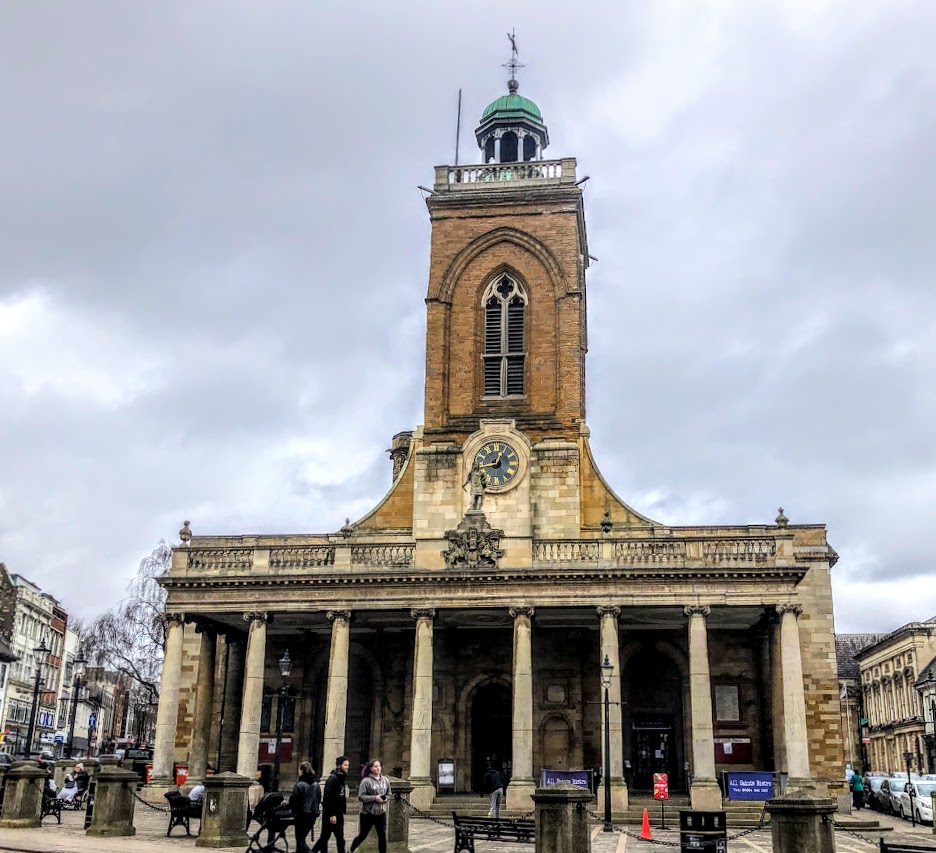
All Saints’ Church is the parish church in the centre of Northampton (Photograph: Patrick Comerford)
The USPG Prayer Diary today (Sunday 2 November 2025, All Saints’ Sunday, All Souls’ Day) invites us to pray:
God of hope, grant that we, with all who have believed in you, may be united in the full knowledge of your love and the unclouded vision of your glory; through Jesus Christ our Lord. Amen (A Prayer Book for Australia, 1995).
The Collect:
Almighty God,
you have knit together your elect
in one communion and fellowship
in the mystical body of your Son Christ our Lord:
grant us grace so to follow your blessed saints
in all virtuous and godly living
that we may come to those inexpressible joys
that you have prepared for those who truly love you;
through Jesus Christ your Son our Lord,
who is alive and reigns with you,
in the unity of the Holy Spirit,
one God, now and for ever.
The Post Communion Prayer:
God, the source of all holiness and giver of all good things:
may we who have shared at this table
as strangers and pilgrims here on earth
be welcomed with all your saints
to the heavenly feast on the day of your kingdom;
through Jesus Christ our Lord.
Additional Collect:
God of holiness,
your glory is proclaimed in every age:
as we rejoice in the faith of your saints,
inspire us to follow their example
with boldness and joy;
through Jesus Christ our Lord.
Yesterday’s Reflections
Continued Tomorrow
Christ the King and the saints on the panels of the altar in All Saints’ Church, Berkhamsted (Photograph: Patrick Comerford)
Scripture quotations are from the New Revised Standard Version Bible: Anglicised Edition copyright © 1989, 1995 National Council of the Churches of Christ in the United States of America. Used by permission. All rights reserved worldwide. http://nrsvbibles.org
All Saints’ Church in Yelvertoft, Northamptonshire, was connected with the Comberford family for about a century … Henry Comberford of Lichfield Cathedral was the rector in 1546-1560 (Photograph: Patrick Comerford)
Labels:
All Saints,
All Souls,
Berkhamsted,
Budapest,
Crete 2025,
Georgioupoli,
Greece 2025,
Hymns,
Kingdom Season,
Leighton Buzzard,
Mission,
Northampton,
Prayer,
refugees,
Rome,
Saint Luke's Gospel,
Ukraine,
USPG,
Westminster,
Yelvertoft
30 October 2025
Hallowe’en tales of nuns
and a ‘Grey Lady’ haunting
a former Comberford home in
the Monastery in Shutlanger
The Monastery in Shutlanger … the main house on the Parles and Comberford estate near Stoke Bruerne in the 15th and 16th centuries (Photograph: Patrick Comerford)
Patrick Comerford
Tomorrow is Hallowe’en, and in previous years I have entertained myself be retelling ghost stories associated with the Comberford family.
Frankly, I am a sceptic when it comes to ghost stories. I am much more in fear of the real spectres that haunt our world today, including wars and mass killings in the Middle East, Ukraine, Russia, Sudan and Yemen, the rise of the far-right across Europe and racism and antisemitism around the world, and the consequences of Donald Trump’s return to office as President in the US, or the run-down and neglect of the NHS, the institutional lack of compassion for refugees and asylum seekers, and the rise of an ugly far-right nationalism in both Britain and Ireland.
These are the real, living ghosts in my world today.
In previous years I have recounted three ‘ghost stories’ that remain with me from childhood: two from family stories – the three knocks at the door at Comberford Hall, and the ghost of Emily in the Moat House, Tamworth; and one from school days – the foxes baying at night on the lawn in front of Gormanston Castle.
In recent months, I have heard what has the semblance of a ghost story – should I say, I have heard the skeleton or bones of what may be another ghost story – that may have links with another Comberford family home.
Since moving to Stony Stratford, on the borders of Buckinghamshire and Northamptonshire over 3½ years ago, I have visited a number of places in Northamptonshire that have associations with the Comberford family, including Watford, Yelvertoft, Stoke Bruerne, Shutlanger and Wappenham. The shadow of a ghost story I heard in recent days comes from the small village of Shutlanger in Northamptonshire, which has a Comberford family connection dating from the 15th and 16th centuries.
William Comberford was entrusted with the Northamptonshire estates of Margaret Catesby, the widow of John Parles (1419-1452), when she died in 1459. Those estates included lands in Watford, Stoke Bruerne, Shutlanger and Wappenham, and her daughter Johanna Parles became William Comberford’s ward. Johanna was a wealthy heiress, and in time she married William’s son and heir, John Comberford (1440-1508).
This marriage added more land and wealth to the Comberford family estates. Their son, Thomas Comberford, sold much of the former Parles estates, including almost 400 acres in Stoke Bruerne, Shutlanger, Alderton and Wappenham, to Richard Empson of Easton Neston. But the Parles family had a lasting influence on the fortunes of the Comberford family, reflected even in the changes made to the Comberford family coat of arms over the generations.
The small village of Shutlanger is a mile west of Stoke Bruerne, half-way between Northampton and Stony Stratford. Shutlanger was neither a parish nor a lordship in its own right, and in the Middle Ages it had neither a church nor a manor house.
Two houses in the village became part of the story of the Parles and Comberford families and the history of the manor in Shutlanger: the Monastery on Water Lane has been identified as the home of the Parles family in the early 15th century, although it was first built in the 14th century; and the Manor House on Showsley Road has been a guest house until recently.
The entrance porch to the Monastery in Shutlanger has an ecclesiastical appearance (Photograph: Patrick Comerford)
Robert Parles of Watford, Northamptonshire, bought the estate in 1364 and their family continued to live in Shutlanger for almost a century, until John Parles died in 1452. The Manor of Watford and the Parles estates in Shutlanger and Stoke Bruene descended to his daughter Joan Parles, who married William Comberford.
The Comberford family continued to own these estates, including Shutlanger for over half a century until most them were sold in 1504, although the Comberford family held some its other interests in Northamptonshire for another 60 years, including the Comberford Manor in Watford and the advosom of Yelvertoft. When Thomas Comberford sold the Comberford Manor in Watford to Sir John Spencer in 1563, the Comberford family interest in Yelvertoft parish came to an end.
Sir Richard Empson’s purchase of the former Parles and Comberford estate from the Comberford family in 1504 was one of a number of purchases he made in Shutlanger as he built up a large estate centred on his mansion at Easton Neston.
The estate passed with Easton Neston to Richard Fermor, and Sir John Fermor of Easton Neston held a court for what was described as his Manor of Shutlanger in 1554. After his death in 1571, however, the family’s estate in Shutlanger ceased to be regarded as a manor. The ‘Manor of Shutlanger’ remained for generations in the hands of the Fermor family – later the Fermor-Hesketh family and Earls of Pomfret.
The 14th century house in Shutlanger later known as the Monastery is on Water Lane on the south-east edge of the village. It became known as the Monastery through a supposed association with the Cistercian nunnery of Sewardsley in Easton Neston.
The house become the capital messuage, the principal house or equivalent of a manor house, of the Parles estate, and was the home of the Parles family by the early 15th century.
The house has an almost complete medieval roof structure and a two-storey entrance porch. This seems to have been added to the main building, which appears to date from the first half of the 14th century, although the windows in the south elevation of the main range, and also the porch, perhaps date from the late 15th century or the beginning of the 16th century. The house was modernised in the 17th century by inserting a staircase in the cross-passage and a fireplace in the service bay.
A chapel licensed in 1411 was on the upper floor of the two-storey entrance porch to the Monastery (Photograph: Patrick Comerford)
A chapel licensed in 1411 occupied the upper floor of the two-storey entrance porch to the Monastery that appears to be a later addition to the main structure.
The house was surrounded by extensive grounds, with fishponds and a dovecote, while an adjoining close formed a small park, described in the 1540s as 20 acres of coppice known as Parles Park. The family name was still recalled in the 18th and 19th centuries in a field known as Parles Park.
The Monastery later became a farmhouse on the Fermor estate. It was included in an exchange between the trustees of the 5th Earl of Pomfret and the 5th Duke of Grafton in 1844. When the Grafton estate in Shutlanger was sold off in 1919, the Monastery was bought by the sitting tenant and remodelled as a private house.
The Monastery extended to 3½ bays, including a two-bay hall, with a half-bay below the spere truss containing the cross-passage and a service bay beyond. An east solar or parlour bay was demolished.
The Monastery was first listed Grade I in 1951 and was restored in 1965. In recent years, it was the premises of Monastery Stained Glass, dealers in antique stained glass and panels of glass from the Middle Ages to the 20th century. But when I visited it recently it seemed to have returned to use as a family home.
Whether the house was every a monastic house or the residence of nuns and linked with the Cistercian nunnery of Sewardsley in Easton Neston is a matter of conjecture or even speculation. But it has given rise to this evening’s Hallowe’en story.
Norman Barford Ridge and his wife Lilla (nee Underwood) inherited the Monastery and the surrounding lands from his aunts in the 1950-1960s. Before Norman and Lilla moved in, a fire had ruined the roof and they set about renovating the house.
Their youngest son, who was away at school at the time, stayed with his parents at the Monastery during school holidays, and later when he was working he would stay with his parents in the Monastery on family visits. His bedroom was at the top of the staircase in the former chapel above the front entrance. Later he would describe how he had heard steps on the broad stone stairs in the middle of the night.
There were other stories too about the hauntings in the Monastery, from an underground tunnel that supposedly ran between the nuns’ residence and the main house, to a ‘Grey Lady’ who appeared before and often wreaked havoc with a number of people who visited.
After Lilla died, Norman moved to Bury St Edmunds, and the Monastery was bought by Charles Henry Wigley and his wife. Charles Wigley was a Dan Air pilot who flew out of Luton. His hobby was working with stained glass, and when he retired he worked full-time with stained glass, selling his works all over the world.
Norman Ridge’s daughter and sons continued to visit the Wigleys regularly and all three returned to the Monastery in association when their father’s funeral about 30 years ago. The Wigleys generously showed the Ridge children and grandchildren around the Monastery and the stained glass studio.
Hallowe’en is the eve of All Hallows or All Saints Day (1 November) and two nights before All Souls’ Day (2 November). They both celebrate the lives of holy people and faithful Christians. There is nothing spooky and shiver-inducing about either feastday or its commemorations.
But it is good to remember family members from the past, to give thanks for them and to remember the Comberford family links with some of the villages near here 500 years ago.
A reminder at Lichfield Cathedral this week of the true meaning and symbolism of Hallowe’en (Photograph: Hugh Ashton, 2025)
31 October 2024
Daily prayer in the Kingdom Season:
1, Friday 1 November 2024,
All Saints’ Day
Saints and Martyrs … the ten martyrs of the 20th century above the West Door of Westminster Abbey (Photograph: Patrick Comerford)
Patrick Comerford
Today in the Church Calendar is All Saints’ Day (1 November), one of the 12 Principal Feasts of the Church. This celebration in the Church Calendar dates back to Pope Gregory III (731-741), who dedicated a chapel to All Saints in Saint Peter’s in Rome on 1 November to honour ‘the holy apostles and … all saints, martyrs, and confessors, … all the just made perfect who are at rest throughout the world.’
All Saints’ Festival is being celebrated, for example, in All Saints’ Church, Margaret Street London, this evening with High Mass at 6:30 pm, when the preacher is Bishop Stephen Conway of Lincoln, and the setting is Haydn’s Missa Sancti Nicolai.
We move today from Ordinary Time in the Church Calendar to the Kingdom Season, the time between All Saints’ Day and Advent. Before today begins, before having breakfast, I am taking some quiet time early this morning to give thanks, and for reflection, prayer and reading in these ways:
1, today’s Gospel reading;
2, a short reflection;
3, a prayer from the USPG prayer diary;
4, the Collects and Post-Communion prayer of the day.
Lazarus is raised from the Dead (John 11: 32-44) … a fresco in the Analpsi Church in Georgioupoli on the Greek island of Crete (Photograph: Patrick Comerford)
John 11: 32-44 (NRSVA):
32 When Mary came where Jesus was and saw him, she knelt at his feet and said to him, ‘Lord, if you had been here, my brother would not have died.’ 33 When Jesus saw her weeping, and the Jews who came with her also weeping, he was greatly disturbed in spirit and deeply moved. 34 He said, ‘Where have you laid him?’ They said to him, ‘Lord, come and see.’ 35 Jesus began to weep. 36 So the Jews said, ‘See how he loved him!’ 37 But some of them said, ‘Could not he who opened the eyes of the blind man have kept this man from dying?’
38 Then Jesus, again greatly disturbed, came to the tomb. It was a cave, and a stone was lying against it. 39 Jesus said, ‘Take away the stone.’ Martha, the sister of the dead man, said to him, ‘Lord, already there is a stench because he has been dead for four days.’ 40 Jesus said to her, ‘Did I not tell you that if you believed, you would see the glory of God?’ 41 So they took away the stone. And Jesus looked upwards and said, ‘Father, I thank you for having heard me. 42 I knew that you always hear me, but I have said this for the sake of the crowd standing here, so that they may believe that you sent me.’ 43 When he had said this, he cried with a loud voice, ‘Lazarus, come out!’ 44 The dead man came out, his hands and feet bound with strips of cloth, and his face wrapped in a cloth. Jesus said to them, ‘Unbind him, and let him go.’
Christ the Pantocrator surrounded by the saints in the Dome of the Church of Analipsi in Georgioupoli, Crete (Photograph: Patrick Comerford)
Today’s Reflection:
November is a month when we traditionally remember the saints, the Communion of Saints, those we love and who are now gathered around the throne of God, those who have died and who we still love. All Saints’ Day on 1 November is one of the 12 Principal Feasts of the Church, and in many parts of the Anglican Communion tomorrow (2 November) is All Souls’ Day.
The first of the three lectionary readings for All Saints’ Day today is Revelation 7: 9-17:
9 After this I looked, and there was a great multitude that no one could count, from every nation, from all tribes and peoples and languages, standing before the throne and before the Lamb, robed in white, with palm branches in their hands. 10 They cried out in a loud voice, saying,
‘Salvation belongs to our God who is seated on the throne, and to the Lamb!’
11 And all the angels stood around the throne and around the elders and the four living creatures, and they fell on their faces before the throne and worshipped God, 12 singing,
‘Amen! Blessing and glory and wisdom
and thanksgiving and honour
and power and might
be to our God for ever and ever! Amen.’
13 Then one of the elders addressed me, saying, ‘Who are these, robed in white, and where have they come from?’ 14 I said to him, ‘Sir, you are the one that knows.’ Then he said to me, ‘These are they who have come out of the great ordeal; they have washed their robes and made them white in the blood of the Lamb.
15 For this reason they are before the throne of God,
and worship him day and night within his temple,
and the one who is seated on the throne will shelter them.
16 They will hunger no more, and thirst no more;
the sun will not strike them,
nor any scorching heat;
17 for the Lamb at the centre of the throne will be their shepherd,
and he will guide them to springs of the water of life,
and God will wipe away every tear from their eyes.’
In the verses immediately before this reading, we are told:
‘Do not damage the earth or the sea or the trees, until we have marked the servants of our God with a seal on their foreheads.’
4 And I heard the number of those who were sealed, one hundred and forty-four thousand, sealed out of every tribe of the people of Israel:
5 From the tribe of Judah twelve thousand sealed,
from the tribe of Reuben twelve thousand,
from the tribe of Gad twelve thousand,
6 from the tribe of Asher twelve thousand,
from the tribe of Naphtali twelve thousand,
from the tribe of Manasseh twelve thousand,
7 from the tribe of Simeon twelve thousand,
from the tribe of Levi twelve thousand,
from the tribe of Issachar twelve thousand,
8 from the tribe of Zebulun twelve thousand,
from the tribe of Joseph twelve thousand,
from the tribe of Benjamin twelve thousand sealed. (Revelation 7: 3-8)
As I said in a reflection on All Saints’ Day last year, I love the clear implication that the salvation of humanity is directly and intricately intertwined with the command, ‘Do not damage the earth or the sea or the trees.’
The number 144,000 is a natural number. It is significant in many religious traditions and belief systems. The number 144,000 appears three times in the Book of Revelation, in this passage (Revelation 7: 3-8), and in two other places: Revelation 14: 1, and Revelation 14: 3-5.
The number 12 is used throughout the Bible to symbolise completeness, perfection, and God’s power. Think for a moment of the 12 tribes of Israel or 12 disciples of Christ. There are also 12 patriarchs from Seth to Noah; 12 patriarchs from Shem to Jacob; 12 spies led the way into the Promised Land; there were 12 judges from Othniel to Samuel; and King David appointed 24 groups of 12 (a total of 288) to lead music of praise in the temple (I Chronicles 25).
Exodus 39: 14 recalls there Aaron’s breastplate had 12 precious stones, ‘corresponding to the names of the sons of Israel; they were like signets, each engraved with its name, for the twelve tribe.’
The figure 12 also has symbolic significance in the New Testament. Christ promises the disciples, ‘Truly I tell you, at the renewal of all things, when the Son of Man is seated on the throne of his glory, you who have followed me will also sit on twelve thrones, judging the twelve tribes of Israel’ (Matthew 19: 28).
Saint Mark’s Gospels recalls how in one hour, Jesus heals a woman who had been bleeding for 12 years and then goes immediately to restore to life a girl who is 12 years old. The first woman is older, with a continual flow of blood, losing hr life blood; the young girl is given back her life blood and comes to life. Both touch Christ and after 12 years are restored to new life (Mark 5: 25-42).
In the Book of Revelation, Christ makes a similar promise to some who will come out of the last age of the church, known as Laodicea (which means ‘judging the people’): ‘To the one who conquers I will give a place with me on my throne, just as I myself conquered and sat down with my Father on his throne’ (Revelation 3: 21).
Revelation describes two groups of 12 (a total of 24) elders who sit around the throne of God, representing the 12 tribes in the Hebrew Bible and the 12 apostles in the New Testament (Revelation 4: 4). One vision in Revelation tells how a ‘great portent appeared in heaven: a woman clothed with the sun, with the moon under her feet, and on her head a crown of twelve stars’ (Revelation 12: 1). The 12 stars above the woman’s head are a symbol of the leadership of the church (I Corinthians 11: 10).
That great city, the holy Jerusalem … had a wall great and high, and had twelve gates, and at the gates twelve angels, and names written thereon, which are the names of the twelve tribes of the children of Israel … the holy city Jerusalem coming down out of heaven from God … has a great, high wall with twelve gates, and at the gates twelve angels, and on the gates are inscribed the names of the twelve tribes of the Israelites … And the wall of the city has twelve foundations, and on them are the twelve names of the twelve apostles of the Lamb (see Revelation 21: 10-14).
The foundation stones of the New Jerusalem (see Revelation 21: 19-20) appear to be identical to the 12 precious stones on Aaron’s breastplate (Exodus 39: 14).
The figurative use of the whole number 1,000 is also found throughout the Bible. For example, God increases the number of the Israelites 1,000 times (Deuteronomy 1: 11); God keeps the covenant to 1,000 generations (Deuteronomy 7: 9); and God owns the cattle on 1,000 hills (Psalm 50: 10). Other examples are found in Exodus 20: 6; and II Samuel 18: 12; Psalm 84: 10; and Isaiah 60: 22.
The number 12 becomes a symbol of totality, and when it is squared and multiplied by 1,000 it acquires more emphasis. With 1,000 as a multiplier of 12, the numbers 12,000 and 144,000 are imbued with a particular significance that is interpreted variously in Christianity. Some take the numbers in the Book of Revelation to be symbolic, representing all God's people throughout history in the heavenly Church.
Even in conversation, I often find any discussion of the number 144,000 is met by references to the belief among Jehovah’s Witnesses that exactly 144,000 faithful Christians from the year 33 AD until the present day will be resurrected to heaven as immortal spirit beings to spend eternity with God and Christ, serving as king-priests for 1,000 years. They believe all other people accepted by God will have an opportunity to live forever in a restored paradise on earth.
Popular interpretations of the number 144,00, from Jehovah’s Witnesses to literalist evangelicals and fundamentalists, miss out on the interesting poetical and mathematical richness and significance of the number 144,000.
I try to imagine how many people are needed to make up 144,000 people in any one place at any one time. When I was working as a journalist, there were conflicting claims from the police and organisers about the number of people on the streets at any protest or march. To arrive at an impartial estimate, you would count how many people passed one point in a minute, and then multiply that figure by the number of minutes it took the marchers to pass that particular place.
Of course, adjustments had to be made. There are always bottlenecks that hold up a protest for minutes on end, and marches always have gaps and trail off at the end. But, with those allowances, it was a fairly accurate way of making an impartial count.
If the Book of Revelation is finding a poetic way of describing 144,000 people passing through one particular point over one 24-hour period, that is a vast number: 6,000 people every hour, 100 people every minute, 2 or 3 people every second.
If the Book of Revelation is describing two lots of 144,000 people – one group of 144,000 standing on Mount Zion, and a second group of 144,000 before the throne – then we are talking about 288,000 people. In a 24-hour day, that would involve 12,000 people passing by every hour, or 200 every minute in a day.
The numbers 12, 60 and 144,000 are part of our cultural heritage dating back to Ancient Near East or Middle East societies. Sumerians looked to the heavens when they Invented the system of time we use to this day. It may seem curious that we divide the hours into 60 minutes and the days into 24 hours.
We use a multiple 12 rather than 10 because when the ancient Sumerians were inventing time, they did not operate on a decimal (base-10) or duodecimal (base-12) system but a sexagesimal (base-60) system.
For those ancient Sumerian innovators, who first divided the movements of the heavens into countable intervals, 60 was the perfect number. The number 60 can be divided by 1, 2, 3, 4, 5, 6, 10, 12, 15, 20, and 30 equal parts. Moreover, ancient astronomers believed there were 360 days in a year, a number that 60 fits neatly into six times.
The Sumerian Empire may not have lasted for long. But, for more than 5,000 years, the world has continued to use its calculations when it comes delineating time.
In a burst of imagination once again on All Saints’ Day, I am thinking of the figure 144,000 in the Book of Revelation as a poetic adaptation of Ancient Near East mathematical philosophy, and 144,000 are invited into the Kingdom of God, every day since, say the year 1 CE, for the past 2024 years, the total of people involved is 291,456,000. And if there two groups of 144,000 people in the Book of Revelation, that number doubles to 582,912,000.
And if the work of salvation is retrospective, going back in time as well as forward in time, perhaps that number could be doubled to at least 1,165,824,000, but probably much, much more.
That is more people than the number of people living today.
That is more people than the number of people who have ever lived on earth.
The UN estimates that the world population in mid-2024 is almost 8.2 billion (8,184,581,231).
In research for the National Library of Medicine some years ago, C Haub asked, ‘How many people have ever lived on earth?’ Assuming a constant growth rate and birth rates of 80 per 1,000 through to 1 AD, 60 per 1,000 from 2 AD to 1750, and the low 30s per 1,000 by modern times, he concluded 105 billion people have lived on earth, of whom 5.5% are alive today.
An earlier date for the appearance of human life on earth would raise the numbers. But any figures we come to are surpassed excessively by any number of people we could ever imagine ever alive on earth.
I am overwhelmed.
God’s love embraces more people than I can ever imagine, or could ever possibly exist in time, past, present or future. God’s love is beyond measure, is beyond limit, and the saints we celebrate and rejoice with today are beyond any number I can imagine or calculation you or I can make.
All Saints’ Church in Yelvertoft, Northamptshire, was connected with the Comberford family for about a century … Henry Comberford of Lichfield Cathedral was the rector in 1546-1560 (Photograph: Patrick Comerford)
Today’s Prayers (Friday 1 November 2024, All Saints’ Day):
The theme this week in ‘Pray With the World Church’, the Prayer Diary of the Anglican mission agency USPG (United Society Partners in the Gospel), is ‘All Saints’ Day’. This theme was introduced on Sunday with a programme update by the Revd Dr Duncan Dormor, General Secretary, USPG.
The USPG Prayer Diary today (Friday 1 November 2024, All Saints’ Day) invites us to pray:
We give thanks for the communion of saints across time and space and for all who have been sources of inspiration and encouragement to us in our Christian faith.
The Collect:
Almighty God,
you have knit together your elect
in one communion and fellowship
in the mystical body of your Son Christ our Lord:
grant us grace so to follow your blessed saints
in all virtuous and godly living
that we may come to those inexpressible joys
that you have prepared for those who truly love you;
through Jesus Christ your Son our Lord,
who is alive and reigns with you,
in the unity of the Holy Spirit,
one God, now and for ever.
The Post Communion Prayer:
God, the source of all holiness and giver of all good things:
may we who have shared at this table
as strangers and pilgrims here on earth
be welcomed with all your saints
to the heavenly feast on the day of your kingdom;
through Jesus Christ our Lord.
Additional Collect:
God of holiness,
your glory is proclaimed in every age:
as we rejoice in the faith of your saints,
inspire us to follow their example
with boldness and joy;
through Jesus Christ our Lord.
Yesterday’s Reflection
Continued Tomorrow
All Saints’ Church, Calverton, near Stony Stratford, Buckinghamshire, dates from the 12th century and was rebuilt in 1818 and 1824 (Photograph: Patrick Comerford)
Scripture quotations are from the New Revised Standard Version Bible: Anglicised Edition copyright © 1989, 1995 National Council of the Churches of Christ in the United States of America. Used by permission. All rights reserved worldwide. http://nrsvbibles.org
04 September 2024
Shutlanger, a village
in Northamptonshire
once linked to the Parles
and Comberford families
The Monastery in Shutlanger … the main house on the Parles and Comberford estate near Stoke Bruerne in the 15th and 16th centuries (Photograph: Patrick Comerford, 2024)
Patrick Comerford
One of my early reasons for wanting to visit Stoke Bruerne and Shutlanger, neighbouring small villages in Northamptonshire, was a Comberford family connection dating from the 15th and 16th centuries. Three of visited both Stoke Bruerne and Shutlanger last week, and so I decided to return again yesterday in search of those Comberford family links and to see whether there were any traces of the Parles and Comberford times there 500 yars ago.
William Comberford was entrusted with the Northamptonshire estates of Margaret Catesby, the widow of John Parles (1419-1452), when she died in 1459. Those estates included lands in Watford, Stoke Bruerne and Shutlanger, and her daughter Johanna Parles became William Comberford’s ward.
Johanna Parles was an heiress and in time she married William’s son, John Comberford (1440-1508). The marriage added more land and wealth to the Comberford family estates.
Their son, Thomas Comberford, sold much of the former Parles estates, including almost 400 acres in Stoke Bruerne, Shutlanger, Alderton and Wappenham, to Richard Empson of Easton Neston. But the Parles family had a lasting influence on the fortunes of the Comberford family, reflected even in the changes made to the Comberford family coat of arms over the generations.
I had already been to Watford in search of the former Parles and Comberford manor there, and to Yelvertoft, where the families had exercised their patronage of the parish or the right to nominate the rector. The Rectors of Yelvertoft appointed by the Comberford family included Canon Henry Comberford (1499-1586) of Lichfield Cathedral, who was Rector of Yelvertoft from 1546 to 1560.
However, to explore any remaining signs of the former Parles and Comberford estates in the Stoke Bruerne area, I needed to spend some additional time in the small village of Shutlanger, just a mile west of Stoke Bruerne.
Shutlanger is part of the parish of Stoke Bruerne, half-way between Northampton and Stony Stratford (Photograph: Patrick Comerford, 2024)
I caught a bus from Northampton to Blisworth yesterday (3 September 2024), and then walked through the countryside, almost parallel to the canal route, to Shutlanger. The village is part of the parish of Stoke Bruerne and half-way between Northampton and Stony Stratford.
Shutlanger first developed on either side of a south-flowing stream but it may have shrunk in the late mediaeval period. Since it was neither a parish nor a lordship in its own right, it lacked both a church and a manor house in the Middle Ages.
Two houses in the village are associated with the story of the Parles and Comberford families and the history of the manor in Shutlanger: the Monastery on Water Lane has been identified as the home in the early 15th century of the Parles family, although it was first built in the 14th century; and the Manor House on Showsley Road has been a guest house until recently.
Apart from the Monastery, the older houses in Shutlanger appear to date from the period of the Great Rebuilding and are of coursed rubble limestone, presumably originally with thatched roofs.
Autumn apples on a tree in a garden in Shutlanger last week (Photograph: Patrick Comerford, 2024)
Shutlanger was always a smaller village than Stoke Bruerne and later in time it was without the visual focus and economic stimulus provided by the canal.
William Brewer, a prominent crown servant of the reigns of Richard I and John, held lands in Stoke and Shutlanger by 1210-1212 was found to as successor to Gerard de Mauquency, but by what service was not known. The Brewer family in turn gave their name to Stoke Bruerne, and William Brewer was succeeded by his son, also William Brewer.
When the younger William Brewer died in 1232, his heirs were his five sisters and their representatives. By the early 14th century, Robert de Harrowden held an estate in Stoke Bruerne, Shutlanger, Alderton and Shaw, described in 1315 as consisting of eight messuages, two mills, 17 acres of meadow, 6½ acres of pasture, 44 acres of wood, and various rents, including one for 7½ virgates of land.
Robert’s heir was his nephew, also Robert de Harrowden. The estate was sold in 1364 by Robert’s successor, John Harrowden of Chislehampton, Oxfordshire, to Ralph Parles of Watford, Northamptonshire, and his wife Katherine. It then amounted to nine messuages, two mills, 11 virgates of land, 18 acres of meadow, 10 acres of pasture, 100 acres of wood and 40s. rent in Stoke, Shutlanger, Shaw and Alderton.
Ralph Parles was living in Shutlanger in 1411 when he, his wife Alice, their son Ralph and daughter-in-law Alice were granted a licence to celebrate divine service in the chapel or oratory within his manor at Shutlanger.
Ralph and Alice Parles re-settled their estate in 1415, and when he died in 1420 his heir was his 11-year-old grandson, also Ralph Parles. As well as the manors of Watford and Byfield, Ralph had four messuages, three tofts, 200 acres of land, 30 acres of meadow, 40 acres of wood, 100 acres of pasture and a water-mill in Shutlanger; another messuage, 23 acres of land, 1 acres of meadow and a water-mill in Stoke; and two messuages, 30 acres of land and 2 acres of meadow in Alderton – an estate of 430 acres or more.
The younger Ralph Parles died a few years of his grandfather, and his brother William Parles, the next heir, was still under age when he died in 1430. The surviving heir of that generation, John Parles, who born in 1419, did not recover the estate from a lengthy wardship until 1440.
John Parles died in 1452, and was survived by his widow Margaret and a five-year-old daughter and heir, Joan or Johanna, who was to inherit the estate when her mother died death. Margaret remarried almost at once, but her second husband Robert Catesby died within a few years. Margaret died in 1459, and their son William Catesby was then aged seven.
The quartered Comberford and Parles arms were used in the 19th century by James Comerford (Photograph: Patrick Comerford)
The Manor of Watford and the Parles estates in Shutlanger and Stoke Bruene were to descend to Margaret’s daughter Joan Parles, who came of age two years later. Joan’s wardship and marriage had been granted in 1454 to William Cumberford of Comberford Hall and John Lynton. She then married William Comberford’s son John Cumberford, who witnessed a deed relating to Shutlanger in 1477.
In a complex legal arrangement in 1482, Joan and John Comberford conveyed the Manor of Byfield, with extensive premises there and in Watford, Murcott, Shutlanger, Stoke Bruerne, Shaw, Alderton and Wappenham, along with half an acre of land in Yelvertoft and the advowson of the church there, to feoffees or trustees. These trustees were to hold the estate for the use of John and Joan Comberford for their lives, and then for their heirs or the rightful heirs of Joan.
In 1504, after his wife had died, John Cumberford, his son Thomas Comberford and daughter-in-law Dorothy, sold the former Parles estate in Stoke Bruerne, Shutlanger, Alderton and Wappenham to Sir Richard Empson (1450-1510) of Easton Neston. The sale included eight messuages, six tofts, one mill, 200 acres of land, 24 acres of meadow, 100 acres of pasture, 40 acres of wood and 14 shillings rent.
However, the Comberford family held onto its other interests in Northamptonshire for another 60 years, including the Comberford Manor in Watford and the advosom of Yelvertoft. When Thomas Comberford sold the Comberford Manor in Watford to Sir John Spencer in 1563, the Comberford family interest in Yelvertoft parish came to an end.
The Manor House in Shutlanger … the Parles and Comberford families held the manor in Shutlanger in the 15th and early 16th century (Photograph: Patrick Comerford, 2024)
Meanwhile, Sir Richard Empson’s purchase of the former Parles and Comberford estate from the Comberford family in 1504 was one of a number of purchases he made in Shutlanger as he built up a large estate centred on his mansion at Easton Neston.
Earlier, Empson had bought lands in Shutlanger and the surrounding area from Henry Bacon in 1476-1480, from Thomas Bosenhoe in 1484, from John Claypole in 1488-1489, from John Shefford in 1492, from John Jones in 1499, and from Edmund Grey, Lord Grey de Wilton and John Grey, Lord Grey de Wilton.
Soon after he had bought the Comberford estate in Shutlanger, Sir Richard Empson was arrested with Edmund Dudley. He was convicted of treason in Northampton in October 1509, and was executed on Tower Hill on 17 August 1510.
Empson’s estates were granted to William Compton in 1512, when Shutlanger was described as a manor. The manor was said then to be ‘late Comberford’ and included 20 acres of coppice called Parles Park.
The Monastery at Shutlanger was surrounded by extensive grounds, with fishponds and a dovecote,and one of the fields was known as Parles Park (Photograph: Patrick Comerford, 2024)
The estate passed with Easton Neston to Richard Fermor, and Sir John Fermor of Easton Neston held a court for what was described as his Manor of Shutlanger in 1554. After his death in 1571, however, the family’s estate in Shutlanger ceased to be regarded as a manor. The ‘Manor of Shutlanger’ remained for generations in the hands of the Fermor family – later the Fermor-Hesketh family and Earls of Pomfret.
Throughout the 17th and 18th centuries, most of the Fermor estate in Shutlanger appears to have been let in four farms. By the 1830s, the 5th Earl of Pomfret owned about 530 acres in Shutlanger.
Stoke Bruerne and Shutlanger each had their own common fields and common meadow in the Middle Ages. Most of these survived until 1844, when the parish was the last in south Northamptonshire to be inclosed. They appear to have shared a large area of common woodland or wood-pasture in the north of the parish, which was gradually cleared.
A chapel licensed in 1411 was on the upper floor of the two-storey entrance porch to the Monastery (Photograph: Patrick Comerford, 2024)
The 14th century house in Shutlanger later known as the Monastery is an impressive house on Water Lane on the south-east edge of the village. It may have been built by one of the freeholders, and became known as the Monastery, through a supposed association with the Cistercian nunnery of Sewardsley in Easton Neston.
The house become the capital messuage, the principal house or equivalent of a manor house, of the Parles estate Although the original owner cannot be identified for certain, it was the home of the Parles familiy by the early 15th century. However, it is not clear whether the Parles family bought the house, built it, inherited it through marriage to a local heiress, or acquired it when they bought the Harrowden estate.
The house has an almost complete medieval roof structure and a two-storey entrance porch. This seems to have been added to the main building, which appears to date from the first half of the 14th century, although the windows in the south elevation of the main range, and also the porch, perhaps date from the late 15th century or the beginning of the 16th century. The house was modernised in the 17th century by inserting a staircase in the cross-passage and a fireplace in the service bay.
A chapel licensed in 1411 occupied the upper floor of the two-storey entrance porch to the Monastery that appears to be a later addition to the main structure.
The entrance porch to the Monastery in Shutlanger has an ecclesiastical appearance (Photograph: Patrick Comerford, 2024)
The house was surrounded by extensive grounds, with fishponds and a dovecote, while an adjoining close formed a small park, described in the 1540s as 20 acres of coppice known as Parles Park. The family name was still recalled in the 18th and 19th centuries in the field named as Parles Park.
The Monastery later became a farmhouse on the Fermor estate. It was included in an exchange between the trustees of the 5th Earl of Pomfret and the 5th Duke of Grafton at the time of inclosure in 1844.
When the Grafton estate in Shutlanger was sold off in 1919, the Monastery was bought by the sitting tenant and remodelled as a private house. The Monastery extended to 3½ bays, including a two-bay hall, with a half-bay below the spere truss containing the cross-passage and a service bay beyond. An east solar or parlour bay was demolished.
The Monastery was first listed Grade I in 1951 and was restored in 1965. In recent years, it was the premises of Monastery Stained Glass, dealers in antique stained glass and panels of glass from the Middle Ages to the 20th century. But when I visited it this week it seems to have returned to use as a family home.
The Plough on the Main Road in Shutlanger (Photograph: Patrick Comerford, 2024)
The layout of Shutlanger village was altered at inclosure when the new road to Heathencote at Towcester was built and older lanes running down to the Tove were stopped up. The avenue from Easton Neston survived inclosure, although it was severed by the new road and by the 1880s trees were beginning to be felled at its east end.
The only industrial development in Shutlanger came in the early 1870s, when Sir Thomas Fermor-Hesketh leased the ironstone and other minerals beneath most of the estate to Samuel Lloyd, the Birmingham ironmaster. Both the Grafton and Pomfret or Fermor-Hesketh estates built a few new cottages in Stoke Bruerne and Shutlanger in the 19th century.
Today there are light industrial units on the Monastery Lakes Farm.
The Village Hall in Shutlanger was built as a school and a chapel of ease in 1884-1885 (Photograph: Patrick Comerford, 2024)
An infants’ school was built in Shutlanger in 1884 on land given by Sir Thomas Fermor-Hesketh. It was designed by Matthew Holding and opened in 1885. It had a reserved chancel that allowed the building to be used as a chapel of ease, and it was licensed for divine worship. A chancel with a stained glass east window was added in 1886.
The school closed in 1916, but the building, dedicated to Saint Anne, remained in use as a chapel of ease to Saint Mary’s Church. It is now the village hall.
A Wesleyan Methodist chapel built in Shutlanger in 1844 was extended in the 1870s and enlarged in 1889, but it had closed by the 1980s.
Shutlanger once had two pubs: the Horseshoe and Plough. The Horseshoe closed in 1917 when the number of pub licences was cut back during World War I. The Plough today has a good reputation as a gastropub, although it is closed on Mondays and Tuesdays, so I had to walk on to Stoke Bruerne, where I had lunch once again at the Bavigation by the banks of the canal.
Meanwhile, services continue to be held in Saint Anne’s Chapel or the village hall at 9:30 am on the third Thursday of the month, followed by a coffee morning.
The former Wesleyan Methodist chapel in Shutlanger (Photograph: Patrick Comerford, 2024)
Labels:
Church History,
Cistercians,
Comberford,
Country Walks,
Family History,
Local History,
Methodism,
Monasticism,
Northamptonshire,
schools,
Shutlanger,
Stoke Bruerne,
Watford,
Yelvertoft
Subscribe to:
Posts (Atom)