Showing posts with label River Liffey. Show all posts

07 November 2025

Daily prayer in the Kingdom Season:
7, Friday 7 November 2025

The Unjust Steward … part of the East Window in Saint Michael’s Church, Limerick, made in 1878 by Mayer & Co and illustrating 10 parables (Photograph: Patrick Comerford)

Patrick Comerford

We are in the Kingdom Season, the time between All Saints and Advent. The Calendar of the Church of England in Common Worship today remembers Saint Willibrord of York (739), Bishop, Apostle of Frisia (7 November).

Before today begins, before having breakfast, I am taking some quiet time early this morning to give thanks, and for reflection, prayer and reading in these ways:

1, today’s Gospel reading;

2, a short reflection;

3, a prayer from the USPG prayer diary;

4, the Collects and Post-Communion prayer of the day.

‘The Unjust Steward,’ by the Kazakhstan Artist, Nelly Bube (Bubay)

Luke 16: 1-8 (NRSVA):

1 Then Jesus said to the disciples, ‘There was a rich man who had a manager, and charges were brought to him that this man was squandering his property. 2 So he summoned him and said to him, “What is this that I hear about you? Give me an account of your management, because you cannot be my manager any longer.” 3 Then the manager said to himself, “What will I do, now that my master is taking the position away from me? I am not strong enough to dig, and I am ashamed to beg. 4 I have decided what to do so that, when I am dismissed as manager, people may welcome me into their homes.” 5 So, summoning his master’s debtors one by one, he asked the first, “How much do you owe my master?” 6 He answered, “A hundred jugs of olive oil.” He said to him, “Take your bill, sit down quickly, and make it fifty.” 7 Then he asked another, “And how much do you owe?” He replied, “A hundred containers of wheat.” He said to him, “Take your bill and make it eighty.” 8 And his master commended the dishonest manager because he had acted shrewdly; for the children of this age are more shrewd in dealing with their own generation than are the children of light.’

A ‘Shop To Let’ sign within view of Sidney Sussex College chapel, Cambridge … can we reconcile the values of the Kingdom and the demands of commercial life? (Photograph: Patrick Comerford)

Today’s reflection:

In the Gospel reading for the Eucharist today, we read the parable of ‘the Unjust Steward’ or the ‘Parable of the Dishonest Manager’.

Whatever name you give it, this morning’s reading is about ignoring and exploiting the plight of the oppressed and the poor and tells us that this amounts to turning away from God and turning towards idolatry. We are called to turn around, and in turning to the needs of the poor we find that we are turning to God.

So, let me tell this morning’s Gospel story (Luke 16: 1-13) in another way. When I left school, I started training as a chartered surveyor and in estate manager. I never finished that training, but I can visualise some of the characters in this story.

A very, very rich man lives in a big city, let’s say it is Dublin. He has a luxurious lifestyle made possible by the income from the apartments, hotels and office blocks he owns in the city centre. He has been a major property developer, and a key shareholder in one of the business banks lending to developers.

He has hired an estate manager to run his property holding company, his building society, and his insurance agency while he spends most of his time in his large country house in Co Kildare or Co Meath, in the Algarve playing golf or in Marbella on his yacht.

All the work of painting, maintaining the lifts and the plumbing in his apartment blocks, working the bar and servicing the rooms in his hotels, and working at the call centres in the office blocks, is done by people who travel in and out from the rims of the city, people whose grandparents probably once lived in the small terraced houses that once stood along the docks or the canal banks but were levelled to build those apartments, office blocks and hotels.

They pay their mortgages to the bank that financed the apartment blocks and similar developments. Their overdrafts are from the same bank. Their mortgage, insurance and life assurance policies are from an agency he owns. They find themselves increasingly in debt, paying school fees and health insurance, running a car or two cars, meeting term loan payments for fridges, freezers, TVs and laptops … What they earn is never enough to pay off their mortgages, their overdrafts, their term loans.

These families are slipping further and further into debt, working harder and harder to pay what cannot be paid.

But they never meet the rich developer. The immediate face of this system, of his companies and his investments, is the face of the estate agent who manages the blocks – a man whose grandparents came from the same families as the people who now suffer under his management.

However, his parents had escaped the system, he got a good education, and then got sucked into the system.

The developer hears rumours that the estate manager, who is also his insurance agent, has been squandering the developer’s resource, and gives him his dismissal notice. Now, remember that ‘squandering’ is not necessarily a bad word here – the sower in another parable squanders seed by tossing it on roads and in bird-feeding zones, and the shepherd in one of this week’s parables potentially squanders 99 sheep by running after the lost one; the widow searching for her lost coin risks losing her other nine as she sweeps everything out.

Meanwhile, the estate agent has to work out his notice, but is no longer authorised to let, to rent, to buy, to sell, to do anything at all in the developer’s name.

He probably shares the same background only a generation or two ago with the maintenance workers, the tenants, the workers in the office blocks. But when he is out on his ear, they are not going to help him to find a place to live, or find a new job, given that up to now he has allied himself with the developer’s interests, collecting high rents, refusing to bring down rents when the reviews are due, managing the work rotas for the maintenance workers, forcing them to work longer hours rather than taking on the staff needed for the job, dealing unjustly with both tenants and workers.

He has been demanding higher rents and premiums, and longer working hours, yet providing fewer and fewer services – doing what certain economists have advised him to do: increasing profit margins and productivity and cutting costs and outlays at one and the same time.

He may be shrewd, but that is why he is called ‘the dishonest manager’ (verse 8).

The agent then does something that is extraordinarily clever.

He gathers all the tenants and workers who owe him money, and he declares that their debts have been written down, more than the courts could ever write them down, to something that might be repaid, freeing families from heartbreaking choices. He has been upping their rents and their premiums; now he brings them all back to a payable rate. And in doing this, he manages to wipe out the arrears that have been mounting up.

The smart agent manages not to tell the tenants or the workers that he has been sacked. Nor does he tell them that the developer has not authorised any of his largesse. But the tenants and the workers now think the developer, their landlord, is more generous than anyone else in his position could be. The developer is now a hero in their eyes – and, by extension, the agent is too.

The developer comes back for his quarterly or annual visit to pick up the income the agent has collected for him, and he gets a surprise that is exhilarating and challenging. The people are delighted to see him. Workers shake his hands, tenants lean out of the balconies to wave at him, children want to have ‘selfies’ taken with him.

Then, as he inspects the books in the small office the agent has worked from in the complex, he finds out what the agent has done in telling the tenants and the workers that the developer has forgiven their debts.

He has a choice to make.

He can go and tell them that it was all a terrible mistake, that the agent’s ‘stroke’ amounted not to generosity but to theft, or at least to dishonesty, and has no legal basis – he can tell them they are still responsible for the unpaid rent, for the overdrawn loans.

The warm welcome could quickly turn to nasty protests.

Or, the developer can go outside, bask in the unexpected welcome he has received, and take credit for the agent’s actions. At least he has cash in his hand where once he might have had nothing because of defaulting tenants and clients. That would save him going to court, but has he to take the agent back to work for him?

What would you do?

Picture yourself in this dilemma, both as the agent and as the developer.

From the agent’s point of view, does it matter any more what the developer decides to do? Whatever decision the developer makes, his future is safe – either he gets his job back, or his own people are going to look after him.

But here is the big problem: what the agent did is clearly dishonest. He has taken the landlord’s property and squandered it – even after he was sacked and had no right to do anything in the developer’s name.

What is it that the agent has done, without permission? Who has he deceived?

The agent forgives. He forgives things that he had no right to forgive. He forgives for all the wrong reasons, for personal gain and to compensate for his past misconduct. But that decisive action that he undertakes redeems him from a position to which it seems he could not be reconciled, to the developer any more than to the tenants and workers.

So what is the moral of the story?

This story is unique to Saint Luke’s Gospel, and for him there is a significance that is important throughout the third gospel: Forgive. Forgive it all. Forgive it now. Forgive it for any reason you want. Forgive for the right reason. Forgive for the wrong reason. Forgive for no reason at all. Just forgive.

Remember, Saint Luke’s version of the Lord’s Prayer includes the helpful confusion: καὶ ἄφες ἡμῖν τὰς ἁμαρτίας ἡμῶν, καὶ γὰρ αὐτοὶ ἀφίομεν παντὶ ὀφείλοντι ἡμῖν: καὶ μὴ εἰσενέγκῃς ἡμᾶς εἰς πειρασμόν (‘and forgive us our sins for indeed we ourselves are forgiving everyone who is [monetarily] indebted to us’) (Luke 11: 4) – the monetary indebtedness is obvious in the original Greek.

We pray it, but do we put it into practice?

The arrival of the Kingdom of God is no occasion for score-keeping of any kind, whether monetary or moral.

Why should I forgive someone who has sinned against me, or against my sense of what is obviously right? I don’t have to do it out of love for the other person.

I could forgive the other person because of what I pray in the Lord’s Prayer every Sunday if not every morning.

I could forgive because I know I would like to be forgiven myself.

I could forgive because I know what it is like to be me when I am unforgiving.

I could forgive because I am, or I want to be, deeply in touch with a sense of Christ’s power to forgive and free someone just like me.

Or I could forgive because I think it will improve my life and sense of well-being.

It boils down to the same thing: deluded or sane, selfish or unselfish, there is no bad reason to forgive.

Extending the kind of grace God shows me in every possible arena – financial and moral – can only put me more deeply in touch with God’s grace.

If a crafty agent, a dishonest manager, an unjust steward, the sort of person we meet in this Gospel reading, can forgive to save his job or give himself a safety net when he is sacked, then those of us who have the experience of real grace, we who have been invited to the Heavenly Banquet, have a better reason than most people to forgive.

Where is the place for Christian values in today’s world of finance and debt? (Photograph: Patrick Comerford)

Today’s Prayers (Friday 7 November 2025):

The theme this week (2 to 8 November) in Pray with the World Church, the prayer diary of the Anglican mission agency USPG (United Society Partners in the Gospel), is ‘From Solitude to Connection’ (pp 52-53). This theme was introduced on Sunday with a Programme Update from Ljudmila, a Ukrainian Refugee living in Budapest, Hungary.

The USPG Prayer Diary today (Friday 7 November 2025) invites us to pray:

Father, we pray for the ministry of Saint Margaret’s Church as they seek to be a light for you in Budapest. Thank you for the way your love is modelled through the church’s open doors.

The Collect:

God, the Saviour of all,
you sent your bishop Willibrord from this land
to proclaim the good news to many peoples
and confirm them in their faith:
help us also to witness to your steadfast love
by word and deed
so that your Church may increase
and grow strong in holiness;
through Jesus Christ your Son our Lord,
who is alive and reigns with you,
in the unity of the Holy Spirit,
one God, now and for ever.

Post Communion Prayer:

Holy Father,
who gathered us here around the table of your Son
to share this meal with the whole household of God:
in that new world where you reveal
the fullness of your peace,
gather people of every race and language
to share with Willibrord and all your saints
in the eternal banquet of Jesus Christ our Lord.

Yesterday’s Reflections

Continued Tomorrow

Property developments and financial growth on the banks of the River Liffey in Dublin (Photograph: Patrick Comerford, 2024)

Scripture quotations are from the New Revised Standard Version Bible: Anglicised Edition copyright © 1989, 1995 National Council of the Churches of Christ in the United States of America. Used by permission. All rights reserved worldwide. http://nrsvbibles.org

13 January 2025

Kevin Roche, the Dublin-born,
prize-winning international architect
who designed the Convention Centre

The Convention Centre on Spencer Dock, Dublin … the Irish project of the prize-winning, Dublin-born architect Kevin Roche (Photograph: Patrick Comerford, 2024)

Patrick Comerford

During my visits to Dublin, as I travel from Dublin Airport along the quays and the banks of the River Liffey into the city centre, the Convention Centre on Spencer Dock on the north side of the river still has the same captivating, breath-taking visual impact as it had when it first opened in 2010. Back then, it immediately became a striking landmark building in Dublin.

The Convention Centre was designed as part of a Public/Private Partnership between the Office of Public Works (OPW) and Treasury Holdings, headed by Johnny Ronan and Richard Barrett, and was the first state-owned, public-access building built since the foundation of the Irish State. It is also the first and only Irish project of the prize-winning, Dublin-born architect Kevin Roche (1922-2019) since he moved to the US in 1948.

The Convention Centre was designed by the Pritzker Prize-winning architect Kevin Roche and is known for its many architectural innovations, including the glass frontage and numerous curved walls. The stunning glass-fronted atrium has panoramic views of the River Liffey, Dublin city centre and across to the Wicklow Mountains, and was the first carbon-neutral convention in the world.

The building was first suggested as long back as 1987, although the proposal was not formalised until 1997. The building was completed in May 2010, four months ahead of schedule and on budget, and was opened by the then Taoiseach Brian Cowen on 7 September 2010.

The lasting influence of John Ruskin on Kevin Roche’s approach to architecture is reflected in an observation he once made: ‘Architecture is a local language and a universal language. Ultimately, a great building touches both, so that artist, and common man, understand it without being conscious of it. It is interwoven. That is great architecture.’

Kevin Roche was born in Dublin but was based in the US throughout most of his career. He is seen as one of the greatest architects of the 20th century. He was a member of an elite group of third generation modernist architects that included James Stirling, Jorn Utzon and Robert Venturi, and he is considered to be the most logical and systematic designer of the group. He and John Dinkeloo, his partner in the firm KRJDA, produced over a half-century ‘of matchless creativity.’

Roche designed more than 200 landmark and famous buildings, including museums, art centres, corporate headquarters, airport terminals and university buildings. His portfolio in the US included work at the Metropolitan Museum of Art in New York, the UN Plaza in Manhattan, the Oaklands Museum in California and the Ford Foundation headquarters on East 42nd Street which, in 1968, became the first modern building to be laid out around a plant-filled atrium.

The Convention Centre Dublin … the architect Kevin Roche was born at 25 Lower Camden Street, Dublin (Photograph: Patrick Comerford, 2024)

Kevin Roche was born Eamonn Kevin Roche at 25 Lower Camden Street, Dublin, above his aunt’s shop, on 14 June 1922. He was the youngest of three sons of Alice (Harding) Roche (1882-1963) from Soloheadbeg, Co Tipperary, and Eamon (Edmond) Roche (1884-1956), a creamery manager who was born in Bansha, Co Tipperary. They were married in Saint Joseph’s Church, Limerick, in 1913 and Kevin Roche was born between the War of Independence and the Irish Civil War.

Eamon Roche fought on the Republican side in the Civil War, and was jailed twice. Kevin Roche told The Irish Times in an interview in 2017 that he was born while his father was serving his second jail sentence. When Eamon Roche was released from jail, he moved with his family to Mitchelstown, Co Cork, returned to work as a creamery manager. He successfully brought together the surrounding dairy co-operatives, forming the largest co-op in the south-west and setting up the Galtee Cheese Company later bought out by KerryGold.

Kevin Roche went to school in Rockwell College, near Cashel, Co Tipperary, where his interest in architecture developed after reading John Ruskin’s The Seven Lamps of Architecture. He later recalled that the book ‘was not the easiest to read but was very interesting’. He then studied architecture at University College Dublin. After his first year in UCD, his father gave him his first commission –designing a piggery for Mitchelstown Creameries.

After graduating in 1945, he worked with the Dublin modernist architect Michael Scott on the designs for Busáras and Donnybrook bus garage (1945-1946). He then moved to London to work with Maxwell Fry in 1946, before moving to the US to study under Ludwig Mies van der Rohe and Ludwig Hilberseimer at the Illinois Institute of Technology in Chicago (1948).

Excited by the building of the United Nations headquarters and the ‘idea that people would stop fighting one another’, he moved to New York in 1949 and worked in the planning office on the UN headquarters project.

He then moved to Detroit to work with the Finnish architect Eero Saarinen, who was then being recognised as one of the world’s leading architects. He was assigned to work on the General Motors Technical Centre, a sprawling campus of 24 modern buildings that became emblematic of corporate architecture of the early 1950s. While working for Saarinen, he met his future wife Jane Tuohy (1935-2020), from Lucas, Ohio. They were married in 1963 and became the parents five children.

When Eero Saarinen died suddenly in 1961, Kevin Roche and his colleagues John Dinkeloo and Joseph Lacy took over several unfinished projects, including the Gateway Arch in St Louis, Missouri; the TWA Flight Centre at JFK International Airport; Dulles International Airport in Washington DC; and the John Deere headquarters in Moline, Illinois. They founded Kevin Roche John Dinkeloo and Associates, based in Hamden, Connecticut, in 1966.

John Dinkeloo died in 1981, and Kevin Roche then headed the office himself. A year later, in 1982, Roche became one of the first recipients of the Pritzker Prize, described as architecture’s equivalent to a Nobel Prize. At the award ceremony he said: ‘We should, all of us, bend our will to create a civilisation in which we can live at peace with nature and each other. To build well is an act of peace. Let us hope that will not be in vain.’ The €100,000 prize money was used to create a chair of architecture at Yale in memory of Eero Saarinen.

Following these awards, Roche’s practice went global, receiving commissions for buildings in Paris, Madrid, Singaporeand Tokyo. He completed his first and only Irish project, the Convention Centre Dublin, in 2010.

The Convention Centre Dublin was Kevin Roche’s first and only Irish project (Photograph: Patrick Comerford, 2024)

As well as the Pritzker Prize in 1982, this awards included the Gold Medal of the American Academy of Arts and Letters (1990), the gold medal of the American Institute of Architects (1993), the Royal Institute of the Architects of Ireland Gandon medal for lifetime achievement, and the French Academie d’Architecture Grand Gold Medal. He was also a trustee of the American Academy in Rome, president of the American Academy of Arts and Letters, and a member of the National Academy of Design and the US Commission of Fine Arts.

Although he reached the top of his profession, Roche had a self-deprecating manner, little interest in celebrity and eschewed the label ‘starchitect’. His mission was to create buildings for the people who used them and for the community who would live around them. He has been credited with creating green buildings long before they became part of the public consciousness.

While he loved strong, memorable forms, he saw architecture as a matter of problem-solving as much as shape-making. Reviewers of his work say he was most comfortable when sculpting modernist shapes in glass, masonry and steel filled with light and greenery.

He had no interest in retiring and continued to work until he was 95 in the offices of Kevin Roche John Dinkeloo and Associates. He died at the age of 96 at his home in Guilford, Connecticut, on 1 March 2019. He was survived by his wife Jane four adult children and 15 grandchildren.

Kevin Roche John Dinkeloo and Associates or KRJDA continues as Roche Modern, where Roche’s son, Eamon, is currently the managing director. The firm which has been described as the ‘poster child architectural firm of corporate America’.

Kevin Roche’s work has been the subject of special exhibitions at the Museum of Modern Art, the Architectural Association of Ireland in Dublin, the American Academy and Institute of Arts and Letters, the Yale School of Architecture, the Museum of the City of New York, the Building Museum in Washington and the University of Toronto.
Meanwhile, during the Covid 19 restrictions, the Houses of the Oireachtas moved their location temporarily from Leinster House in Kildare Street in 2020 and met in the Convention Centre in June 2020. There Micheál Martin was elected Taoiseach in the Auditorium on 27 June 2020.

The Houses of the Oireachtas sat in the Convention Centre in June 2020 (Photograph: Patrick Comerford, 2024)

16 March 2024

Daily prayer in Lent with
early English saints:
32, 16 March 2024,
Saint Wulfstan, Bishop of Worcester

Saint Wulfstan depicted in the Goodman window in Worcester Cathedral (Photograph: Christopher Guy © Dean and Chapter, Worcester Cathedral)

Patrick Comerford

Lent began over a month ago on Ash Wednesday (14 February 2024), and Passiontide begins tomorrow with the Fifth Sunday in Lent (Lent V), also known as Passion Sunday. But it is also Saint Patrick’s Day (17 March 2024).

Throughout Lent this year, I am taking time each morning to reflect on the lives of early, pre-Reformation English saints commemorated in the Calendar of the Church of England in Common Worship.

I plan to spend much of this afternoon watching the international rugby matches in the Sux Nations Championship, particularly the crucial fixture between Ireland and Scotland at 4:45. But, before this day begins, I am taking some quiet time this morning for reflection, prayer and reading in these ways:

1, A reflection on an early, pre-Reformation English saint;

2, today’s Gospel reading;

3, a prayer from the USPG prayer diary.

Saint Wulfstan depicted on the reredos in the Jesus Chapel, Worcester Cathedral (Photograph: Christopher Guy © Dean and Chapter, Worcester Cathedral)

Early English pre-Reformation saints: 32, Saint Wulfstan of Worcester

Saint Wulfstan (1095), Bishop of Worcester, is remembered in Common Worship with a lesser festival on 19 January.

Wulfstan was born ca 1009, at Itchington in Warwickshire. His maternal uncle, also called Wulfstan, was the second Archbishop of York. Wulfstan was educated in the monastery of Peterborough and spent the first 25 years after his ordination in the Benedictine monastery in Worcester. He was elected Bishop of Worcester against his will in 1062. But he went on to prove an able administrator and pastor.

After the Norman conquest of England, Wulfstan was the only English-born bishop to retain his diocese for any significant time after. He carefully and gently nurtured both church and state through the transition from Saxon to Norman rule. He struggled to alleviate the suffering of the poor, was a strong opponent of the slave trade, and together with Lanfranc, was mainly responsible for ending the 11th century slave trade between Bristol and Ireland.

He died at Worcester on 19 January 1095, at the age of 87, after washing the feet of a dozen poor men, a humble ritual he performed daily. He was canonised by Pope Innocent III in 1203 on the testimony of Archbishop John Comyn of Dublin. He is the patron saint of peasants, vegetarians and dieters.

Inside Worcester Cathedral … Saint Wulfstan was Bishop of Worcester in 1062-1095

John 7: 40-52 (NRSVA):

40 When they heard these words, some in the crowd said, ‘This is really the prophet.’ 41 Others said, ‘This is the Messiah.’ But some asked, ‘Surely the Messiah does not come from Galilee, does he? 42 Has not the scripture said that the Messiah is descended from David and comes from Bethlehem, the village where David lived?’ 43 So there was a division in the crowd because of him. 44 Some of them wanted to arrest him, but no one laid hands on him.

45 Then the temple police went back to the chief priests and Pharisees, who asked them, ‘Why did you not arrest him?’ 46 The police answered, ‘Never has anyone spoken like this!’ 47 Then the Pharisees replied, ‘Surely you have not been deceived too, have you? 48 Has any one of the authorities or of the Pharisees believed in him? 49 But this crowd, which does not know the law – they are accursed.’ 50 Nicodemus, who had gone to Jesus before, and who was one of them, asked, 51 ‘Our law does not judge people without first giving them a hearing to find out what they are doing, does it?’ 52 They replied, ‘Surely you are not also from Galilee, are you? Search and you will see that no prophet is to arise from Galilee.’

Saint Wulfstan depicted in a window in Holy Trinity Church, Long Itchington (Photograph: Amanda Slater /Wikipedia / CC BY-SA 2.0)

Today’s Prayers (Saturday 16 March 2024):

The theme this week in ‘Pray With the World Church,’ the Prayer Diary of the Anglican mission agency USPG (United Society Partners in the Gospel), has been ‘Lent Reflection: JustMoney Movement.’ This theme was introduced on Sunday by Matt Ceaser, Movement Builder, JustMoney Movement.

The USPG Prayer Diary today (16 March 2024) invites us to pray in these words:

Let us pray for us all to receive the freedom we have in Christ.

The Collect:

Merciful Lord,
absolve your people from their offences,
that through your bountiful goodness
we may all be delivered from the chains of those sins
which by our frailty we have committed;
grant this, heavenly Father,
for Jesus Christ’s sake, our blessed Lord and Saviour,
who is alive and reigns with you,
in the unity of the Holy Spirit,
one God, now and for ever.

The Post-Communion Prayer:

Lord God,
whose blessed Son our Saviour
gave his back to the smiters
and did not hide his face from shame:
give us grace to endure the sufferings of this present time
with sure confidence in the glory that shall be revealed;
through Jesus Christ our Lord.

Additional Collect:

Merciful Lord,
you know our struggle to serve you:
when sin spoils our lives
and overshadows our hearts,
come to our aid
and turn us back to you again;
through Jesus Christ our Lord.

Collect on the Eve of Lent V:

Most merciful God,
who by the death and resurrection of your Son Jesus Christ
delivered and saved the world:
grant that by faith in him who suffered on the cross
we may triumph in the power of his victory;
through Jesus Christ your Son our Lord,
who is alive and reigns with you,
in the unity of the Holy Spirit,
one God, now and for ever.

Yesterday: Lanfranc of Canterbury

Tomorrow: Saint Osmund, Bishop of Salisbury

The River Liffey at Celbridge, Co Kildare, near the site of Saint Wolstan’s Abbey (Photograph: Patrick Comerford)

Scripture quotations are from the New Revised Standard Version Bible: Anglicised Edition copyright © 1989, 1995, National Council of the Churches of Christ in the United States of America. Used by permission. All rights reserved worldwide. http://nrsvbibles.org

26 March 2023

On a quiet street where
old ghosts and poets meet
along the enchanted way

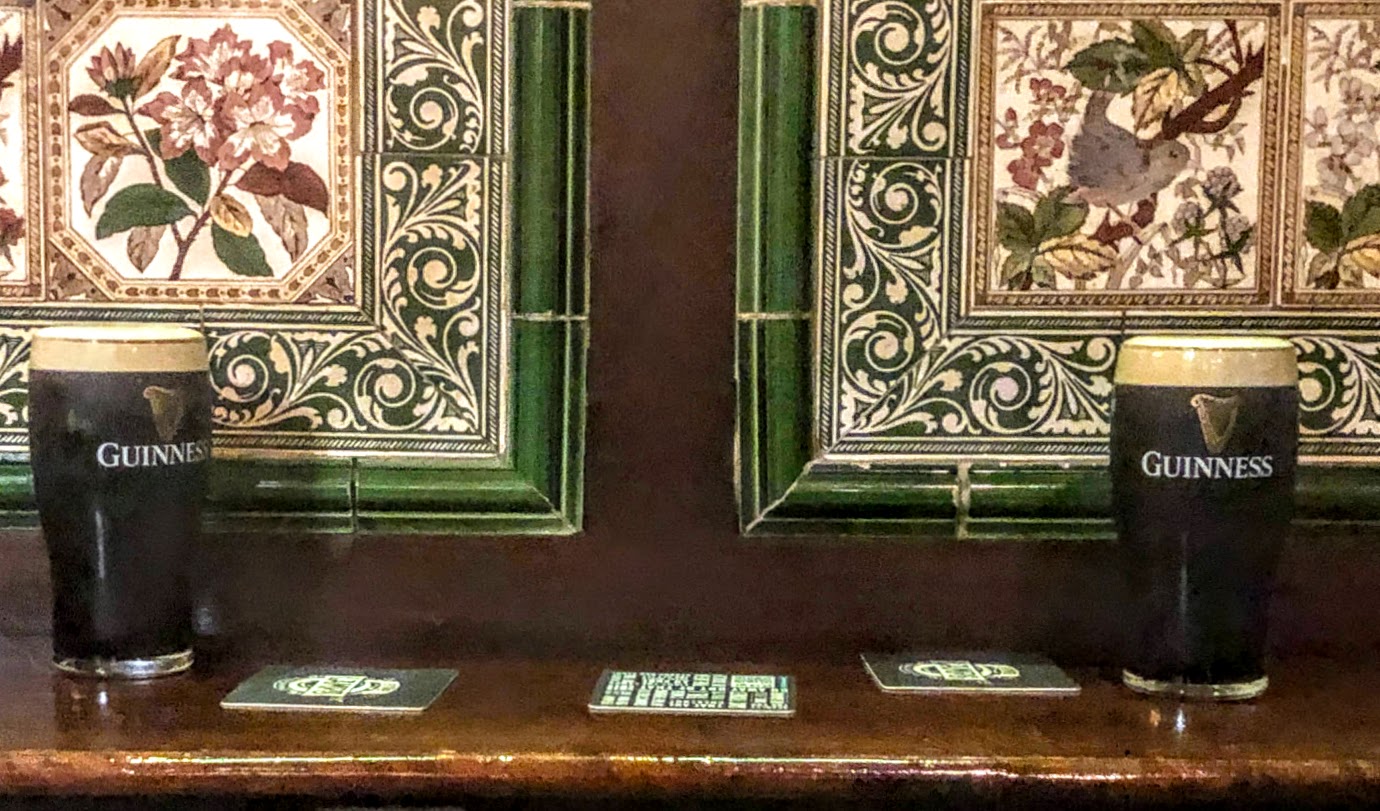
‘On Grafton Street … we tripped lightly along the ledge’ … two pints on the ledge in McDaid’s in Dublin (Photograph: Patrick Comerford, 2023)

Patrick Comerford

Two of us spent two days in Dublin last week while I was researching a chapter for a book due for publication later this year.

We stayed in Rathmines while I spent my two days of research working in the Church of Ireland library (the RCB Library) in Rathgar, just a 30-minute walk away, and the public library in Rathmines.

Although it was a very short, quick return visit, I had breakfast with an old friend in Churchtown, lunch in the Church of Ireland Theological Institute where I was on the academic staff for 15 years, strolled by banks of the River Dodder in Rathgar, and visited my older brother in Rathmines and the house on Beechwood Avenue in Ranelagh where my grandfather and great-grandfather had lived.

One evening, after dinner in Forno 500 in Dame Street, two of us strolled through Dublin in the night air, through Temple Bar, by the Ha’penny Bridge and the River Liffey, into Trinity College, where I was an adjunct assistant professor until 2017, and then along Grafton Street, before stopping off in McDaid’s for a late-night drink beneath the portraits of an array of Irish writers, including James Joyce, Brendan Behan, Sean O’Casey and Patrick Kavanagh.

We caught a bus from Redmond’s Hill back to Rathmines, discussing why we preferred one or other recording the poem ‘On Raglan Road’ by Patrick Kavanagh (1904-1967) – Charlotte’s choice is Luke Kelly, mine is Ronnie Drew. But our other nominees included Sinead O’Connor and Van Morrison.

‘On Grafton Street … where old ghosts meet’ … portraits of Irish writers on the wall in McDaid’s on Harry Street, including Patrick Kavanagh (Photograph: Patrick Comerford, 2023)

In the past, when I occasionally celebrated the Eucharist in Saint Bartholomew’s Church, I would take a quiet break in the stillness of the morning, and stroll through the neighbouring streets in Ballsbridge, including Herbert Park, Waterloo Road, Wellington Road, Pembroke Road, Elgin Road, Clyde Road and Raglan Road, the street that inspired the poem by Patrick Kavanagh:

On Raglan Road on an Autumn day, I saw her first and knew
that her dark hair would weave a snare that I might one day rue …


At the turn of the 19th and 20th centuries, the Victorian and Edwardian houses on Raglan Road and the surrounding streets in the Pembroke township and Pembroke estate became the new residential homes of people who had lived previously in the Georgian squares of Dublin, such as Fitzwilliam Square and Merrion Square.

In more recent years, Raglan Road has become one of Dublin’s most exclusive residential streets, with some of the most expensive houses on sale in Ireland. Recent residents of Raglan Road have included the billionaire businessman Denis O’Brien, and the road is also home to several ambassadors, including the Turkish and Belgian ambassadors, as well as the Mexican Embassy.

The Mexican Embassy at No 19 Raglan Road was the home of Patrick Kavanagh in 1940-1943. It was Mrs Kenny’s boarding house, and he paid 10 shillings a week in rent. Before that, he had lived nearby on 62 Pembroke Road, but his poetic genius is irreversibly linked with Raglan Road, and his best-known poem, ‘On Raglan Road.’

During those early Sunday morning strolls, as I walked along ‘the enchanted way’ that is wide, tree-lined Raglan Road, it was easy to imagine Kavanagh’s ‘Quiet street where old ghosts meet’:

On Raglan Road on an autumn day I met her first and knew.
That her dark hair would weave a snare that I might one day rue;
I saw danger, yet I walked along enchanted way.
And I said, let grief be a fallen leaf at dawning of day.


The poem was first published under the title ‘Dark Haired Miriam Ran Away’ in The Irish Press almost 80 years ago on 3 October 1946. But everyone at the time knew that Kavanagh’s poem was about Dr Hilda Moriarty from Dingle, Co Kerry.

Patrick Kavanagh met the beautiful, dark-haired Hilda Moriarty in 1944. She was a medical student at University College Dublin and was only in Dublin a few months, but she became one of most celebrated beauties of her time. She already knew Kavanagh’s poetry and writings; she was 22 and he was 40.

The penniless poet loved her, but there was an 18-year gap. She was flattered, but she did not reciprocate. When Hilda went home to Dingle for Christmas 1944, Kavanagh followed her but was not welcome in the Moriarty home. She was the young and beautiful daughter of the local doctor; he was a middle-aged, out-of-work journalist and the son of a small farmer. Kavanagh stayed at Kruger Kavanagh’s guesthouse in Dunquin and paid for his stay by writing an article on ‘My Christmas in Kerry’ in The Irish Press.

Back in Dublin, they met on-and-off throughout 1945. But eventually Hilda rejected him and in August 1947 she would marry Donogh O’Malley (1921-1968), later the Fianna Fail Minister for Education.

In the meantime, ‘Dark Haired Miriam Ran Away’ was published in The Irish Press on 3 October 1946. Patrick’s brother, Peter Kavanagh, said that ‘it was written about Patrick’s girlfriend Hilda, but to avoid embarrassment he used the name of my girlfriend in the title.’ A meaningless line in this edition, Synthetic sighs and fish-dim eyes and all death’s loud display, was later replaced with The Queen of Hearts still making tarts and I not making hay.

Kavanagh celebrated this unrequited love with a poem he dreamed of setting to the Irish traditional air, The Dawning of the Day (Fáinne Geal an Lae).

In the poem, the writer recalls a love affair that he had with a young woman while walking on a ‘quiet street.’ Although the speaker knew that he would risk being hurt if he initiated a relationship, he did so anyway:

I saw the danger, yet I walked along the enchanted way,
And I said, let grief be a fallen leaf at the dawning of the day.


Twenty years after Patrick Kavanagh wrote his poem, the Dubliners were playing one evening in 1966 in the Bailey in Duke Street, off Grafton Street, the other Dublin street named in this poem. On that evening, Patrick Kavanagh asked Luke Kelly of the Dubliners if he could adapt ‘On Raglan Road.’ Naturally, Luke Kelly chose the air of Fáinne Geal an Lae … and so was born a much-loved Irish song.

A year after his poem became part of the Dubliners’ repertoire, Patrick Kavanagh married his long-term companion Katherine Barry Moloney in April 1967 and they lived on Waterloo Road. He died a few months later, on 30 November 1967, in a Dublin nursing home. Hilda’s husband, Donogh O’Malley, died some weeks later on 10 March 1968.

In an interview with RTÉ in 1974, the writer Benedict Kiely recalled Kavanagh trying out the paired verse and tune for him soon after writing it.

Dr Hilda O’Malley was interviewed by RTÉ in 1987 for a documentary about Kavanagh, Gentle Tiger. In the interview, she said one of the main reasons for the failure of their relationship was that there was a wide age gap between them.

She recalled how ‘On Raglan Road’ was written by Kavanagh. He had described himself as the peasant poet but she was not impressed and teased him for writing about mundane things such as vegetables. She said he should write about something else so he agreed to do so. According to Dr Moriarty, he then went away and wrote ‘On Raglan Road.’

Dr Hilda O’Malley died in 1991 in Saint Vincent’s Hospital, Dublin.

Before leaving Dublin at the end of last week’s short visit, we returned to Grafton Street, and had coffee beneath the Harry Clarke windows in Bewley’s. As we headed back to the airport that evening, we were still discussing Patrick Kavanagh’s unrequited love and the competing merits of the different recordings of ‘On Raglan Road.’

‘Of the deep ravine where can be seen the worth of passion’s pledge’ … the Ha’penny Bridge at night in Dublin (Photograph: Patrick Comerford, 2023)

On Raglan Road, by Patrick Kavanagh

On Raglan Road on an autumn day I met her first and knew
That her dark hair would weave a snare that I might one day rue;
I saw the danger, yet I walked along the enchanted way,
And I said, let grief be a fallen leaf at the dawning of the day.

On Grafton Street in November we tripped lightly along the ledge
Of the deep ravine where can be seen the worth of passion’s pledge,
The Queen of Hearts still making tarts and I not making hay –
O I loved too much and by such and such is happiness thrown away.

I gave her gifts of the mind I gave her the secret sign that’s known
To the artists who have known the true gods of sound and stone
And word and tint. I did not stint for I gave her poems to say.
With her own name there and her own dark hair like clouds over fields of May.

On a quiet street where old ghosts meet I see her walking now
Away from me so hurriedly my reason must allow
That I had wooed not as I should a creature made of clay –
When the angel woos the clay he’d lose his wings at the dawn of day.

The Mexican Embassy on Raglan Road, where Patrick Kavanagh once lived (Photograph: Patrick Comerford)

11 October 2021

Praying in Ordinary Time 2021:
135, Merchants’ Quay, Dublin

The Franciscan Church and Friary on Merchants’ Quay on the south bank of the River Liffey, Dublin, facing the Four Courts (Photograph: Patrick Comerford, 2021)

Patrick Comerford

I am in Dublin Airport, waiting to catch a flight to Birmingham this morning to spend three days in Lichfield.

But, before the day gets busy, I am taking a little time this morning for prayer, reflection and reading. Each morning in the time in the Church Calendar known as Ordinary Time, I am reflecting in these ways:

1, photographs of a church or place of worship;

2, the day’s Gospel reading;

3, a prayer from the USPG prayer diary.

My theme for these few weeks is churches in the Franciscan (and Capuchin) tradition. In the past, in this series, I have also visited the chapel at Gormanston College, Co Meath (8 March), the Franciscan friary in Askeaton (25 April), the Capuchin Friary in Chania (2 July), and Saint Francis Church in Rethymnon (4 October).

My photographs this morning (11 October 2021) are from the Church of the Immaculate Conception on Merchants’ Quay, Dublin, better known to Dubliners as ‘Adam and Eve’s’ or simply as ‘Merchants’ Quay.’

The Merchants’ Quay entrance to the Church of the Immaculate Conception on Merchants’ Quay, Dublin, better known to Dubliners as ‘Adam and Eve’s’ (Photograph: Patrick Comerford, 2021)

Merchants’ Quay is on the south bank of the River Liffey, facing the Four Courts on the north bank.

The Franciscans have been in the south side of Dublin since mediaeval times. At the dissolution of monastic houses during the Tudor Reformation, King Henry VIII, the Franciscan Friary at Francis Street, on the site of the current church of Saint Nicholas of Myra, Francis Street, was confiscatedca 1640, and the Franciscan community was dispersed.

A new friary was built on Cook Street in 1615, and was Ireland’s first post-Reformation seminary. A chapel on the site was destroyed in 1629, and the friars did not return to the area until 1757, when they bought a house on Merchants’ Quay.

At first, the Franciscans secretly said Mass in the Adam and Eve Tavern, giving the present church its popular name. A newer church was built in 1759, and this was later replaced by the current church.

After Catholic Emancipation in 1829, the friars set about building a new church and laid the foundation stone of the current church in 1834. The church was designed in 1852 by the architect Patrick Byrne, who planned a tower at the Merchants’ Quay entrance. However, because of financial problems, the church was built without a nave or tower.

The church was originally dedicated to Saint Francis, but was rededicated to the Immaculate Conception of Our Lady in 1889.

The church was reorganised after 1900 by moving of the altar to the left wall and the original sanctuary was changed into a transept and an entrance from Cook Street. A small nave was added to the right and a dome built over the sanctuary.

A shrine to Saint Anthony, designed by the architects Doolin, Butler and Donnelly, was built in 1912.

To mark the seventh centenary of Saint Francis in 1926, the friars built a circular apse, remodelled the transepts and extended the nave with an entrance to Skipper’s Alley. This work was designed by JJ O’Hare.

The high altar was consecrated in 1928. The granite bell tower added in 1930 was probably designed by JJ Robinson and RC Keefe, and is crowned by a pedimented temple with columns.

In recent years, the Franciscans of Merchants’ Quay have been closely identified with the work of the Simon Community and addiction and counselling services.

The name of Adam and Eve survives from an 18th century tavern (Photograph: Patrick Comerford, 2021)

Luke 10: 1-12 (NRSVA):

1 After this the Lord appointed seventy others and sent them on ahead of him in pairs to every town and place where he himself intended to go. 2 He said to them, ‘The harvest is plentiful, but the labourers are few; therefore ask the Lord of the harvest to send out labourers into his harvest. 3 Go on your way. See, I am sending you out like lambs into the midst of wolves. 4 Carry no purse, no bag, no sandals; and greet no one on the road. 5 Whatever house you enter, first say, “Peace to this house!” 6 And if anyone is there who shares in peace, your peace will rest on that person; but if not, it will return to you. 7 Remain in the same house, eating and drinking whatever they provide, for the labourer deserves to be paid. Do not move about from house to house. 8 Whenever you enter a town and its people welcome you, eat what is set before you; 9 cure the sick who are there, and say to them, “The kingdom of God has come near to you.” 10 But whenever you enter a town and they do not welcome you, go out into its streets and say, 11 “Even the dust of your town that clings to our feet, we wipe off in protest against you. Yet know this: the kingdom of God has come near.” 12 I tell you, on that day it will be more tolerable for Sodom than for that town.’

Inside the church, facing the liturgical east (Photograph: Patrick Comerford, 2021)

The Prayer in the USPG Prayer Diary today (11 October 2021, International Day of the Girl Child) invites us to pray:

Today, we pray for girls across the world. May they feel empowered to make their own choices in life.

Yesterday’s reflection

Continued tomorrow

Inside the church, facing the liturgical west (Photograph: Patrick Comerford, 2021)

Scripture quotations are from the New Revised Standard Version Bible: Anglicised Edition copyright © 1989, 1995, National Council of the Churches of Christ in the United States of America. Used by permission. All rights reserved worldwide. http://nrsvbibles.org

The dome and the church seen from Cook Street (Photograph: Patrick Comerford)

02 May 2021

From Cambridge to Cappoquin,
an Irish enthusiasm for rowing

Jesus College Boat Club, Cambridge … a photograph used in a fundraising brochure (Photograph: Patrick Comerford)

Patrick Comerford

The performance of Irish rowers at the European championships in Varese this April has been a sporting triumph that has been overshadowed in sports coverage by Rachel Blackmore’s string of racing successes.

At an international level, the Irish performance at soccer is greatly overshadowed by the performance of Irish teams in other disciplines, including rugby, cricket and rowing. Yet soccer seems to dominate weekend sports coverage in Irish newspapers and on television.

Perhaps this reflects the childhood obsessions of many sports journalists and commissioning editors, and boyhood fascinations with English soccer. I have been an Aston Villa fan since my childhood, but I would prefer to spend a lazy weekend afternoon watching rugby, cricket or rowing.

My clerical colleagues know what it is to crash out on the sofa on the afternoon of Easter Day. This year, that afternoon was all the more enjoyable for me because it coincided with the Boat Race, which was a double success for Cambridge, with the men winning the race for the third consecutive year and the women winning earlier in the afternoon.

The Cambridge teams had to learn to adapt to an unfamiliar training programme, continuing to make physiological and technical improvements despite being unable to train on the water or in the Goldie Boathouse gym. For the majority of the team, lockdowns meant carrying out the programme alone, often in their bedrooms.

Sidney Sussex shares a boathouse in Cambridge with Girton, Corpus Christi and Wolfson (Photograph: Patrick Comerford)

***

The Boat Race is one of the major events in the English sporting calendar, alongside the Aintree Grand National and the FA Cup Final, test matches at Lords and rugby internationals at Twickenham. Yet, it was difficult to find any substantial coverage in Irish newspapers the following day.

One Irish journalist based her report on television coverage and said the venue ‘looked a little bit like a weedy canal in the middle of nowhere. The Great Ouse in Ely, Cambridgeshire, to be exact, but that’s sort of the same thing.’

Ely Cathedral is one of the seven wonders of the mediaeval world and is referred to with affection as ‘the Ship of the Fens.’ But cultural prejudice and historical ignorance trumped any appropriate sporting journalism that morning.

I sometimes think anti-English racism is the only permissible form of openly expressed prejudice in Ireland. Those thoughts were confirmed as the writer amused herself by observing how ‘the organisers didn’t want a heap of Barnabys, Marmadukes, Montagues and Hugos tumbling into the river as the race passed underneath.’

Had she written in the same tones about working class supporters of Shamrock Rovers at Tallaght Stadium, it would have been easy to name and shame the prejudice.

Present and recent Cambridge alumni include: Archbishop John Neill, Archbishop Michael Jackson and Bishop Kenneth Kearon; President Erskine Childers (Trinity), the late Brian Lenihan (Sidney Sussex) and Jim O’Callaghan (Sidney Sussex). Martin Mansergh’s father, Professor Nicholas Mansergh, was the Master of Saint John’s College, Cambridge. Famously, Charles Stuart Parnell became involved in brawls with fellow undergraduates when he refused to pay his membership fees for Magdalene Boat Club.

Ely Cathedral is known affectionately as ‘the Ship of the Fens’ (Photograph: Patrick Comerford)

From the Backs to
the ‘Old Dark Blues’


When I first arrived at Sidney Sussex College in my mid-50s in 2008 to study through the Institute for Orthodox Christian Studies, I thought, perhaps, I was too old to inquire about the facilities at the boat clubs. But I have enjoyed walking along the Backs and was honoured some years ago when one of my photographs was used in a brochure to find sponsors for Jesus College Boat Club.

This enthusiasm for rowing was first nurtured in my childhood in West Waterford, when I enjoyed the attractions of Cappoquin Rowing Club, ‘the Old Dark Blues,’ on the bend on the River Blackwater.

Cappoquin Rowing Club was founded in 1862, making it one of Ireland’s oldest clubs and Cappoquin’s oldest sporting and social organisation. Sir John Henry Keane of Cappoquin House was the club’s first president – and there lies another Cambridge link. He had captained the Trinity Boat at Cambridge three decades earlier and had rowed for Cambridge in 1836. Oxford were the favourites that year, but Cambridge won by four lengths.

Sir John Keane laid the foundations of the Cappoquin Rowing Club, and the first clubhouse was built in 1875. Cappoquin joined other clubs in the 1880s in establishing the Irish Amateur Rowing Association, and the Irish Amateur Rowing Union was founded in 1899.

A later clubhouse in 1910 was financed substantially by the Villiers-Stuart family of Dromana House. The present boathouse is the third on the site, but incorporates parts of the previous buildings, including the overhanging wooden balcony.

Later in the 20th century, Sir Richard Keane brought over Hugo Pitman, one of Oxford’s best-known oarsmen and twice captain of an Oxford boat that beat Cambridge, to help coach the successful McGrath eight.

Cappoquin Rowing Club, ‘the Old Dark Blues’ … founded in 1862 and one of Ireland’s oldest clubs (Photograph: Patrick Comerford)

***

A plaque at the steps above the clubhouse celebrates Charles Orr Stanley (1899-1969), a patron of Cappoquin rowing and a son of one of the founders of the club. Stanley was a successful businessman who lived in Cambridge, where he farmed and was a director of the Pye multinational.

In the 1960s, Pye also took over Banhams on a site next to Elizabeth Way Bridge on the River Cam. Banhams had been boat builders for over 100 years.

At the time, Cambridge had 28 college clubs and 22 clubs had their boats built by Banhams, who also built the boats for the Oxford and Cambridge Boat Race. Stanley brought the finances of the Cambridge University Boat Club from a state of disaster to the one of keen health it has enjoyed ever since.

Those childhood days in Cappoquin have a natural continuity with my walks along the banks of the Cam in recent years, and along the River Liffey between Islandbridge and Chapelizod.

Since moving to Askeaton, I have been happy to be part of the Desmond Rowing Club on the banks of the River Deel. Limerick is richly endowed with boat clubs, and Limerick rowing, like Limerick rugby, is a sport that breaks down all social barriers.

Dublin University Boat Club … Caoimhe Dempsey came to rowing at Trinity College Dublin (Photograph: Patrick Comerford)

A shared experience
on the River Cam


Irish women rowers have been as successful as their male colleagues. Caoimhe Dempsey from Wicklow was in the Cambridge women’s blue boat this year that won the fourth consecutive victory for Cambridge.

Caoimhe Dempsey is from a sporting background: her mother was a hill runner who represented Ireland, and her grandmother played hockey for Ireland. She tried many sports, including GAA, hurling, hockey and tennis, and came to rowing at Trinity College Dublin where she was part of the senior team.

As well as rowing for Trinity and for Cambridge, Caoimhe Dempsey has also represented Ireland, winning a gold medal in the under-23 European Championships. This is the second consecutive year she was selected for the Blue Boat: she was selected for the Blue Boat last year before the race was cancelled because of the pandemic.

Dempsey told Cambridge 105 Radio that she was encouraged to come to Cambridge after seeing previous Trinity alumni she had raced with also make it there. Among them were her first novice coach, Susannah Cass, who had previously competed in the Boat Race for Cambridge, and Sally O’Brien, former captain of DULBC.

Caoimhe is now a post-graduate student at Newnham College, Cambridge, working on a PhD in developmental psychology, having arrived in Cambridge to work on an MPhil in developmental and child psychology.

Eimear Lambe, who was one of the Irish four who won silver in the women’s four A final at Varese this April, is a younger sister of the Irish Olympian Claire Lambe from Cabra, Dublin, who was a member of the Cambridge crew in the Women’s Boat Race in 2017.

Claire Lambe partnered Sinéad Lynch in the Ireland lightweight double that took sixth in the Rio Olympics and was the No 3 seat for Cambridge in the Boat Races in 2017. Claire Lambe rowed with Commercial in Dublin and UCD, and raced in the Corcoran Cup.

Claire Lambe was studying for an MPhil degree in engineering and sustainable development at Cambridge when she became the first Ireland international to win the women’s Boat Race. That year, the Cambridge women’s crew set a new record (18 minutes 34 seconds).

Neptune and Commercial on the banks of the Liffey … Claire Lambe of Cambridge rowed with Commercial (Photograph: Patrick Comerford)

***

The Cambridge coach Rob Baker was a former Ireland under-23 coach. Since 2018, he has been the chief coach of the Cambridge University Boat Club.

The Cambridge University Boat Club was founded in 1828. It issued a challenge in early 1829 to Oxford University to row a boat race and the first Boat Race took place that year.

Last year, the three historic university boat clubs – the Boat Club, the Women’s Boat Club and the Lightweight Rowing Club – merged in the Cambridge University Boat Club. The clubs had already been working together, sharing facilities and other resources, and in some cases training together. This now one club, bringing all the best of the three previous clubs together, sharing resources, knowledge and experience.

Enjoying rowing on the River Deel with Desmond Rowing Club in Askeaton

This two-page feature was first published in the May 2021 edition of the ‘Church Review’ (Dublin and Glendalough), pp 10-11.

16 June 2020

A Bloomsday diversion from
Anna Livia to Mullingar House
and ‘Finnegans Wake’

Mullingar House … the setting for James Joyce’s ‘Finnegans Wake’ (Photograph: Patrick Comerford, 2020)

Patrick Comerford

Today is Bloomsday and today – at least in their mind’s eyes – many Joycean scholars and fans are going to spend the way retracing Leopold Bloom’s perambulations around Dublin in Ulysses and wishing they could stop off in Davy Byrne’s ‘moral pub’ in Duke Street for a Gorgonzola sandwich and a glass of burgundy, and other closed pubs for refreshments.

Some of the other Dublin pubs associated with James Joyce include Mulligan’s of Poolbeg Street, where the Back Room provides a setting for a scene in The Dead; Kennedy’s pub on Westland Row, mentioned in Ulysses as ‘Conways’ pub, across the road from Sweny’s pharmacy; the Bailey on Duke Street, where the first Bloomsday celebrations began and which for 30 years displayed the door from No 7 Eccles Street, where Leopold Bloom begins his journey; the Lincoln Inn on Lincoln Place, which stands on the site of Finn’s Hotel where Nora Barnacle worked and where she first met James Joyce on the day celebrated as Bloomsday; the ‘Sirens’ episode is set in the bar of the old Ormond Hotel; and there is the nationalistic Citizen holds forth in Barney Kiernan’s of Little Britain Street.

But as I was walking along the banks of the River Liffey between Islandbridge and Chapelizod last week, I was reminded that James Joyce set his last great masterpiece, Finnegans Wake, in Chapelizod.

Mullingar House, a 300-year-old coaching house in the heart of the village, features in Dubliners and more centrally in Finnegans Wake, where the hero, Humphrey Chimpden Earwicker, is described as its owner.

Chapelizod is also the place where James Duffy lives in the Dubliners story, ‘A Painful Case,’ which opens: ‘Mr James Duffy lived in Chapelizod because he wished to live as far as possible from the city of which he was a citizen and because he found all the other suburbs of Dublin mean, modern and pretentious.’

The plaque placed by Dublin Tourism on the front of Mullingar House (Photograph: Patrick Comerford, 2020)

Dublin Tourism has placed a plaque on the front of Mullingar House that reads: ‘Home of all characters and elements in James Joyce’s novel Finnegans Wake.’ The bridge crossing the Liffey in front of the pub has been named ‘Anna Livia Bridge.’

Joyce finished writing Finnegans Wake on 13 November 1938, and it was published on 4 May 1939 by Faber & Faber in London, and by Viking Press in New York.

Joyce had been working on Finnegans Wake for almost 17 years and this was his final novel. He told the literary critic Eugene Jolas that Finnegans Wake was the story of a Chapelizod family.

Writing in My Friend James Joyce, Jolas recalled how Joyce told him: ‘I might easily have written this story in the traditional manner … But I, after all, am trying to tell the story of this Chapelizod family in a new way. Time and the river and the mountain are the real heroes of my book.’

Most of Book Two of Finnegans Wake takes place in and around a pub, run by Humphrey Chimpden Earwicker. Joyce’s father, John Stanislaus Joyce, worked for almost three years 1873-1876 as secretary of a distilling company in Chapelizod and regularly frequented the Mullingar House, then known as the Mullingar Hotel, drinking and playing bowls.

The character of Humphrey Chimpden Earwicker, or HCE, was based on the then publican, Robert Broadbent (1826-1896). Joyce says in Finnegans Wake that HCE ‘owns the bulgiest bung-barrel that ever was tip-tapped in the privace of the Mullingar Inn.’

In later years, after he had squandered his inheritance, John Joyce looked back on his days in Chapelizod as a lost golden age.

Joseph Sheridan Le Fanu’s novel, The House by the Churchyard (1862), is set in Chapelizod where his father, the Revd Thomas Philip Le Fanu, was the Rector, and the book is a major source in Finnegans Wake. Many of the scenes take place in a village inn called the Phoenix.

The James Joyce Bistro, beside Mullingar House (Photograph: Patrick Comerford, 2020)

For many years, the Mullingar House was owned by the Keenan family, who were very conscious of the Joycean connection, but it was sold in recent years to a consortium of pub owners. The Mullingar House also has a James Joyce Bistro, although both are closed during the present Covid-19 lockdown.

To celebrate Bloomsday this evening (16 June 2020), the Hellenic Community of Ireland is presenting Ulysses of Dublin online at 7 p.m.: https://www.facebook.com/events/241217513842268/

Paddy Sammon will talk about the Greek influences on Joyce’s Ulysses, Fran O’Rourke will discuss James Joyce’s relationship with music and present some of the songs the writer loved and incorporated into his writings; and Polymnia Drakopoulou will present an extract from ‘The Sirens,’ the most musical episode in Ulysses. This event is in the Greek language.

The River Liffey seen from the Anna Livia Bridge at Chapelizod (Photograph: Patrick Comerford, 2020)

11 June 2020

The military school in
the Phoenix Park that
became a hospital

The former Royal Hibernian Military School, now Saint Mary’s Hospital, seen through the trees in the Phoenix Park, Dublin (Photograph: Patrick Comerford, 2020)

Patrick Comerford

Walking along the banks of the River Liffey between Islandbridge and Chapelizod in the early summer sunshine earlier this week, Francis Johnson’s fine classical building at Saint Mary’s Hospital in the Phoenix Park could be seen in a majestic view provided by a break in the trees, looking down on the river valley and out across to the Wicklow Mountains to the south.

Recent figures from the HSE show that during this year’s Covid-19 pandemic, 21 patients have died at the hospital since the start of April. But, despite this sad part in these difficult times, the hospital building has an interesting place in Irish architectural and military history, and also has a link with some of Ireland’s great writers.

The Royal Hibernian Military School was founded by the Hibernian Society, a charity set in Dublin in 1769 after the Seven Years War, and opened in the Phoenix Park as the Hibernian Asylum.

The Hibernian Society petitioned George III for a charter, and a royal charter to open an establishment in the aid of orphans and children of soldiers. King George III granted a Charter of Incorporation on 15 July, and the School Governors held their inaugural meeting on 6 November in Dublin Castle.

The school first opened as the Hibernian Society of the Orphans and Children of Soldiers, with 90 boys and 50 girls in March 1770. The Hibernian Society aimed to help the orphaned children of soldiers who died in war. This was later extended to the destitute families of soldiers leaving Ireland for overseas service.

When a regiment was sent overseas, six families per company were allowed to accompany a battalion. The families were selected by drawing lots, and families left behind had no support of any kind, living in misery and destitution. The burden of destitute military families fell hard on Ireland’s two main garrisons, Dublin and Cork.

The children at the school were in four categories:

• Orphan
• Deceased father
• Deceased mother
• Both parents living (father possibly on foreign service)

The children were in the charge of an Inspector and Inspectress, assisted by the Chaplain and an assistant mistress. The first school chaplain, the Revd Nathaniel Smyth, was also the curate in Chapelizod parish.

The school buildings were erected in 1771 in the Phoenix Park, overlooking Chapelizod in the Liffey valley and with panoramic views of the Wicklow Mountains.

The chapel, designed by Thomas Cooley (1740-1784), was built in 1773, and 30 years later Francis Johnston (1760-1829) designed the extensions to the buildings.

Thomas Cooley trained with the architect and engineer Robert Mylne (1733-1810) while he was building Blackfriars Bridge in London. In 1769, he won the competition to design a new Royal Exchange in Dublin, and the building, now the City Hall, was completed in 1779.

Cooley built several public buildings in Ireland in the neoclassical style, including the Archbishop’s Palace, the Royal School, the gaol and the library in Armagh, the Bishop’s Palace (Clarisford House) in Killaloe, Co Clare, and he did some work on the Royal Hospital, Kilmainham. His Four Courts in Dublin was completed by James Gandon. He also designed Saint Mary’s Church, Newtownbarry (Buncody), Co Wexford.

Francis Johnston’s works in Dublin include the GPO and Nelson’s Pillar, the Chapel Royal in Dublin Castle, Saint George’s Church and Saint Andrew’s Church, Westland Row.

A census in 1785 showed that 1,400 children whose fathers were dead or serving overseas were begging on the streets of Dublin. The military authorities assumed responsibility for the Hibernian School in 1806, and it was renamed the Royal Hibernian Military School.

By 1808, the system and organisation of the school followed closely that of the Duke of York’s Royal Military School, then at Chelsea. By 1816, when the Revd Thomas Philip Le Fanu (1783-1845) was the chaplain, there were 600 children at the school. The numbers had soared due in large part to casualties during the Napoleonic Wars.

Le Fanu, who is probably the best known of the school chaplains, later became Dean of Emly (1826-1845). He was the father of the novelist Joseph Sheridan Le Fanu (1814-1873) – the Phoenix Park and the village and parish church in Chapelizod appear in his stories. The House by the Churchyard (1863), the last of Le Fanu’s Gothic novels, is set in Chapelizod and is cited by James Joyce in Finnegans Wake, also set in Chapelizod.

The longest-serving chaplain at the scool, the Revd Samuel O’Sullivan, who was the school from 1826 to 1851, was a brother of the famed Canon Mortimer ‘Souper’ O’Sullivan, who was Master of Tipperary Grammar School and Dungannon Royal School at the same time. Both brothers were Donnellan Lecturers in Trinity College Dublin in 1851.

The school was coeducational until the girls left for the Drummond School in Chapelizod village in 1853. That year, the school’s first ‘stand of colours’ were presented by the then Prince of Wales.

The school was a feeder for the British Army. In the mid-19th century, children as young as 12 could enlist in the army but generally enlistment began at 14. By the 1900s, 50 per cent of pupils were going straight into the army. By then, of course, the school was not only an orphanage.

Many of the school’s pupils were recognised for their gallantry, including Frederick Jeremiah Edwards who was decorated with the Victoria Cross for bravery in World War I. On the other hand, William Joseph Mellows, an army sergeant, sent his son, also William Joseph Mellows, to the school. The boy grew up to be Liam Mellows (1892-1922), a key figure in the 1916 Rising, the Irish War of Independence and the Civil War.

From 1903 to 1920, the school chaplain was the Rector of Chapelizod, the Revd Amyrald Dancer Purefoy, and his curate, the historian the Revd Robert Henry Murray, was the assistant chaplain.

The last school chaplain, in 1921-1922, the Revd John Francis Cox, later became Assistant Chaplain in Chief in the British Army, and an honorary chaplain to King George VI.

The school campus had expanded by 1922 from three acres to 33. By then, however, talks were taking place about moving the school to Northern Ireland. However, the cost was prohibitive and so the school was moved to Shorncliffe in Folkestone, Kent, in 1922. Having decided not to take on any new students, the RHMS merged with the Duke of York’s Royal Military School in 1924.

A stained-glass window above the ‘minstrel gallery’ in the Duke of York’s school chapel depicts a saluting boy soldier and commemorates the merger of the schools.

The school documents – including admissions registers, board minutes and commandants’ correspondence – moved with them. The school records were stored in London, but they were destroyed by fire during the London blitz of World War II in 1940. The surviving registers were transferred to the National Archives, Kew, in 2003.

Meanwhile, the school premises were taken over by the government of the new Irish Free State, and the buildings were used as a hospital by the Irish Army. In 1948 It was transferred to the Dublin Health Authority in 1948 and became a Chest Hospital; in 1964 it became a facility for older patients and today it provides accommodation for dependent older people, with 198 residential places.

The former Royal Hibernian Military School above the River Liffey, between Islandbridge and Chapelizod (Photograph: Patrick Comerford, 2020)