Showing posts with label Rogation. Show all posts

22 May 2022

Praying with the Psalms in Easter:
22 May 2022 (Psalm 88)

‘O Lord, God of my salvation, when, at night, I cry out in your presence’ (Psalm 88: 1) … inside the former church in the underground city of Derinkuyu or Anakou in Cappadocia (Photograph: Patrick Comerford)

Patrick Comerford

Today is Sixth Sunday of Easter (22 May 2022) and Rogation Sunday. Later this morning I hope to attend the Parish Eucharist in Saint Mary and Saint Giles Church, Stony Stratford.

But, before this day begins, I am taking some time this morning to continue my reflections in this season of Easter, including my morning reflections drawing on the Psalms.

In my blog, I am reflecting each morning in this Prayer Diary in these ways:

1, Short reflections on a psalm or psalms;

2, reading the psalm or psalms;

3, a prayer from the USPG prayer diary.

Psalm 88:

Psalm 88 is found in Book III in the Book of Psalms, which includes Psalms 73 to 89. In the slightly different numbering scheme in the Greek Septuagint and the Latin Vulgate, this is psalm is numbered as Psalm 87.

Psalm 88 is one in a group of psalms at the end of Book III within the 150 psalms, from Psalm 84 to Psalm 89. These psalms attempt to provide hope to the exilic Israelite community. But, despite their celebration of the historic traditions of the Jewish people, they remind the reader that these elements no longer provide the hope they once did.

Four psalms of this group – Psalms 84, 85, 87 and 88 – are attributed to the Korahites, who are described as the doorkeepers of the tabernacle in the Book of Chronicles.

Psalm 88 is a prayer for mercy and deliverance. According to Professor Martin Marty of the University of Chicago, Psalm 88 is ‘a wintry landscape of unrelieved bleakness.’ In Hebrew, the last word of the psalm is ‘darkness.’

Psalm 88 ends by saying:

You have caused friend and neighbour to shun me;
my companions are in darkness
(verse 18)

It is often assumed that the Psalm is a sick Psalm. The disease that has laid low the psalmist could have been leprosy or some other unclean illness. Other commentators see a more general calamity rather than a specific disease.

This psalm stands alone among all the Psalms for the unrelieved gloom and the hopeless sorrow of its tone. Even the very saddest of the others, and the Lamentations themselves, admit some variations of key, some strains of hopefulness. Here all is darkness to the very last verse, the very final word.

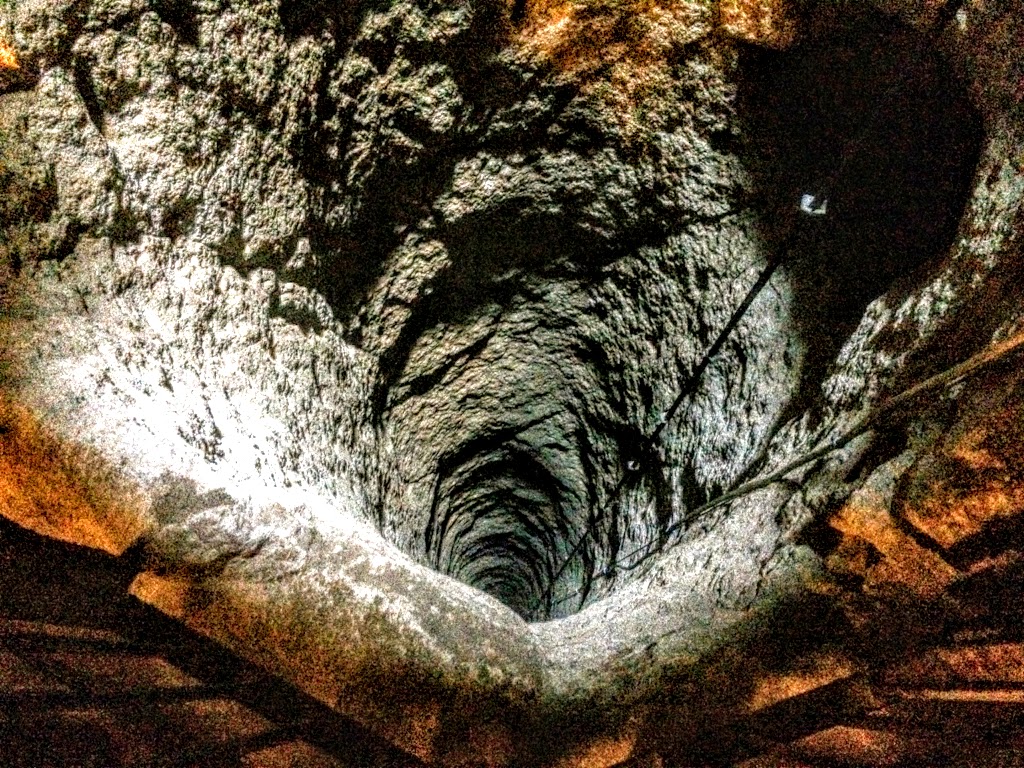
‘I am counted among those who go down to the Pit’ (Psalm 88: 4) … an ancient well in the underground city of Derinkuyu or Anakou in Cappadocia (Photograph: Patrick Comerford)

Psalm 88 (NRSVA):

A Song. A Psalm of the Korahites. To the leader: according to Mahalath Leannoth. A Maskil of Heman the Ezrahite.

1 O Lord, God of my salvation,
when, at night, I cry out in your presence,
2 let my prayer come before you;
incline your ear to my cry.

3 For my soul is full of troubles,
and my life draws near to Sheol.
4 I am counted among those who go down to the Pit;
I am like those who have no help,
5 like those forsaken among the dead,
like the slain that lie in the grave,
like those whom you remember no more,
for they are cut off from your hand.
6 You have put me in the depths of the Pit,
in the regions dark and deep.
7 Your wrath lies heavy upon me,
and you overwhelm me with all your waves.
Selah

8 You have caused my companions to shun me;
you have made me a thing of horror to them.
I am shut in so that I cannot escape;
9 my eye grows dim through sorrow.
Every day I call on you, O Lord;
I spread out my hands to you.
10 Do you work wonders for the dead?
Do the shades rise up to praise you?
Selah
11 Is your steadfast love declared in the grave,
or your faithfulness in Abaddon?
12 Are your wonders known in the darkness,
or your saving help in the land of forgetfulness?

13 But I, O Lord, cry out to you;
in the morning my prayer comes before you.
14 O Lord, why do you cast me off?
Why do you hide your face from me?
15 Wretched and close to death from my youth up,
I suffer your terrors; I am desperate.
16 Your wrath has swept over me;
your dread assaults destroy me.
17 They surround me like a flood all day long;
from all sides they close in on me.
18 You have caused friend and neighbour to shun me;
my companions are in darkness.

Today’s Prayer:

The theme in this week’s prayer diary of the Anglican mission agency USPG (United Society Partners in the Gospel) is ‘Mission in Australia.’ It is introduced this morning by Peter Burke, Manager at Mission and Anglican Community Engagement AnglicareSA, who writes:

‘My engagement in God’s Mission emanates from a sense of being loved by God, being a disciple of Jesus Christ, and recognising the gifts of the Holy Spirit in my life.

‘I seek to discern God’s Mission each day God gives me, through various involvements in church and community.

‘This includes Parish involvement in Mission Action Planning in hospitality, pastoral care, liturgy and learning, communications, and partnerships.

‘Through AnglicareSA, I support a small team of people who connect its many community services, aged care, and housing services with the Anglican Community with the care and justice ministries of the church.

‘Through the Anglican Board of Mission, I collaborate with others locally and nationally to support global mission, being mindful to learn from the missional experience of others globally to engage in mission locally.

‘Mission is an act of unity in diversity. It seeks to bring together things separated, disconnected or in conflict, where life in all its fullness is diminished.

‘Mission is an act of community. It involves watching and waiting with others as well as being active; to see what God is doing, to follow where God leads, and reconnect with God’s unconditional love.

The USPG Prayer Diary this morning (22 May 2022, Easter VI) invites us to pray:

Almighty God,
may we be united in our diversity.
Help us to follow your calling
and to encourage others to do the same.

Yesterday’s reflection

Continued tomorrow

Scripture quotations are from the New Revised Standard Version Bible: Anglicised Edition copyright © 1989, 1995, National Council of the Churches of Christ in the United States of America. Used by permission. All rights reserved worldwide. http://nrsvbibles.org

09 May 2021

‘This is my commandment,
that you love one another
as I have loved you’

A carved relief of Nike, the goddess of victory, on a paved street in Ephesus … but the author of I John writes to the Church in Ephesus about more important signs of victory (Photograph: Patrick Comerford)

Patrick Comerford

Sunday, 9 May 2021,

The Sixth Sunday of Easter (Easter VI), Rogation Sunday.

10 a.m.: The Parish Eucharist

The Readings: Acts 10: 44-48 or Isaiah 45: 11-13, 18-19; Psalm 98; I John 4: 7-10; John 15: 9-17.

There is a direct link to the readings HERE.

‘You are my friends if you do what I command you’ (John 15: 14) … detail on a sculpture in Knightstown on Valentia Island, Co Kerry (Photograph: Patrick Comerford, 2020)

Christ is risen!
The Lord is risen indeed. Alleluia!

We live in the age of globalisation.

In a recent visual challenge online, people were more likely to recognise seven brand logos than they were to recognise the Seven Wonders of the World, or the seven symbols of the major world faiths.

What symbols or logos do you easily recognise?

Which logos or symbols have you allowed to brand you?

And – what symbols in your life mark you out, make you visible as a Christian?

One of the best-known symbols of globalisation must be the Nike Swoosh logo. We find it on tracksuits, sweatshirts, trainers, sneakers, and T-shirts all over the world. There must be few people who do not recognise the Nike logo. It has been sported by the likes of Michael Jordan, Andre Agassi, Maria Sharapova and Venus and Serena Williams.

The company takes its name from Nike, the Greek goddess of victory, and the ‘Swoosh’ was designed in 1971 by Carolyn Davidson, a graphic design student at Portland State University. She met Phil Knight while he was teaching accounting classes and she started doing some freelance work for his company, Blue Ribbon Sports (BRS).

Have you ever heard of BRS? Well, BRS needed a new brand for a new line of athletic footwear it was preparing to introduce in 1972. Knight approached Davidson for some design ideas, and she agreed to provide them – at $2 an hour.

Carolyn Davidson presented Knight and BRS with a number of designs, and they finally selected the mark we now know as the Nike Swoosh – an abstract outline of an angel’s wing that some people think looks more like a checkmark or the tick used on school essays.

The company first used the logo as its brand in 1971, when the word ‘Nike’ was printed in orange over it. The logo is now so well-recognised all over the world, even by small children, that the company name itself is, perhaps, superfluous.

Carolyn Davidson’s bill for her work came to $35. Mind you, 12 years later, in 1983, Knight gave Davidson a gold Swoosh ring and an envelope filled with Nike stock to express his gratitude. It is surprising, then, to realise that her design was not registered as a trademark until 1995.

A logo representing victory is an appropriate and meaningful symbol for a company that manufactures and sells running shoes. A small symbol has brought victorious success to a once-small company.

It is said one of the earliest inspirations for the Nike tick sign is a carved relief of Nike, the goddess of victory, on a paved street in Ephesus.

But when Saint John was writing to the Church in Ephesus in our Epistle reading this morning (I John 5: 1-16), he expressed very different ideas about victory to his company of little children as he discussed love.

In this reading, we are reminded of the connection between faith and love, the two great themes of this epistle, and to victorious faith leading to eternal life. This letter (I John) talks about a very different type of victory than the victories associated with commercial branding, globalisation and the financial glory associated with brand names and over-commercialised sport.

Instead, the writer emphasises the victories associated with faith and love … faith in God, Father, Son, and Holy Spirit, and the love of God and love of one another that should be the victorious tick sign of Christians.

As we come to the end of a cycle of reading Saint John’s first letter, we are reminded that everyone who believes in Jesus as Christ and the Son of God is a child of God too. And so, if we believe in God and in Christ as his Son, we should love God and love his children, and this is the imperative for Christians to love one another.

The author of this letter refers to love, the Baptism, the death and resurrection of Christ, and the Eucharist as the enduring symbols of Christian life.

The Gospel reading (John 15: 9-17) reminds us that love is the enduring symbol of life in Christ, the one symbol that truly marks out a Christian in this world.

Christ tells us that he loves us as the Father loves him. We are to continue to love him, and to love one another to the point that this is all that matters in life.

He tells us this deep and lasting commitment to Christ is best expressed and found in the way that we love one another (verse 17).

And that love is the only branding, the only logo, the only label, that others should look for to know that we are Christians.

Christ is risen!
The Lord is risen indeed. Alleluia!

‘I do not call you servants any longer … but I have called you friends’ (John 15: 15) (Photograph: Patrick Comerford)

John 15: 9-17 (NRSVA):

[Jesus said:] 9 ‘As the Father has loved me, so I have loved you; abide in my love. 10 If you keep my commandments, you will abide in my love, just as I have kept my Father’s commandments and abide in his love. 11 I have said these things to you so that my joy may be in you, and that your joy may be complete.

12 ‘This is my commandment, that you love one another as I have loved you. 13 No one has greater love than this, to lay down one’s life for one’s friends. 14 You are my friends if you do what I command you. 15 I do not call you servants any longer, because the servant does not know what the master is doing; but I have called you friends, because I have made known to you everything that I have heard from my Father. 16 You did not choose me but I chose you. And I appointed you to go and bear fruit, fruit that will last, so that the Father will give you whatever you ask him in my name. 17 I am giving you these commands so that you may love one another.’

‘I appointed you to go and bear fruit, fruit that will last’ (John 15: 16) … fruit on a market stall in Rome (Photograph: Patrick Comerford)

Liturgical colour: White.

The Greeting (from Easter Day until Pentecost):

Christ is risen!
The Lord is risen indeed. Alleluia!

Penitential Kyries:

Lord God,
you raised your Son from the dead.
Lord, have mercy.
Lord, have mercy.

Lord Jesus,
through you we are more than conquerors.
Christ, have mercy.
Christ, have mercy.

Holy Spirit,
you help us in our weakness.
Lord, have mercy.
Lord, have mercy.

The Collect of the Day (Easter VI):

God our redeemer,
you have delivered us from the power of darkness
and brought us into the kingdom of your Son:
Grant, that as by his death he has recalled us to life,
so by his continual presence in us he may raise us to eternal joy;
through Jesus Christ our Lord.

The Collect on Rogation Days:

Almighty God,
whose will it is that the earth and the sea
should bear fruit in due season:
Bless the labours of those who work on land and sea,
grant us a good harvest
and the grace always to rejoice in your fatherly care;
through Jesus Christ our Lord.

Introduction to the Peace:

The risen Christ came and stood among his disciples and said, Peace be with you. Then were they glad when they saw the Lord. (John 20: 19, 20).

Preface:

Above all we praise you
for the glorious resurrection of your Son
Jesus Christ our Lord,
the true paschal lamb who was sacrificed for us;
by dying he destroyed our death;
by rising he restored our life:

The Post-Communion Prayer (Easter VI):

God our Father,
whose Son Jesus Christ gives the water of eternal life:
May we also thirst for you,
the spring of life and source of goodness,
through him who is alive and reigns with you
and the Holy Spirit,
one God, now and for ever.

The Post-Communion Prayer (Rogation Days):

God our creator,
you give seed for us to sow and bread for us to eat.
As you have blessed the fruit of our labour in this Eucharist,
so we ask you to give all your children their daily bread,
that the world may praise you for your goodness;
through Jesus Christ our Lord.

Blessing:

God the Father,
by whose glory Christ was raised from the dead,
raise you up to walk with him in the newness of his risen life:

Dismissal: (from Easter Day to Pentecost):

Go in the peace of the Risen Christ. Alleluia! Alleluia!
Thanks be to God. Alleluia! Alleluia!

‘As you have blessed the fruit of our labour in this Eucharist, so we ask you to give all your children their daily bread’ (the Post-Communion Prayer, Rogation Days) … fruit ripening on lemon trees in Platanias near Rethymnon in Crete (Photograph: Patrick Comerford)

Hymns:

515, ‘A new commandment I give unto you’
231, My song is love unknown

Scripture quotations are from the New Revised Standard Version Bible: Anglicised Edition copyright © 1989, 1995, National Council of the Churches of Christ in the United States of America. Used by permission. All rights reserved worldwide. http://nrsvbibles.org

Material from the Book of Common Prayer is copyright © 2004, Representative Body of the Church of Ireland.


26 May 2019

Are the boundaries of the church
too narrow and too exclusive?

A window depicting Christ the healer in the Chapel of Saint John’s Hospital, Lichfield, depicts Christ healing the crippled man at the pool of Bethesda (see John 5: 1-9) (Photograph: Patrick Comerford, 2018)

Patrick Comerford

Sunday 26 May 2019

The Sixth Sunday of Easter

11.30 a.m.: The Parish Eucharist (Holy Communion 2), Holy Trinity Church, Rathkeale, Co Limerick

Readings: Acts 16: 9-15; Psalm 67; Revelation 21: 10, 22 to 22: 5; John 5: 1-9.

Christ is risen!
The Lord is risen indeed. Alleluia!

This Sunday is also known as Rogation Sunday, the day on which the Church has traditionally offered prayer for God’s blessings on the fruits of the earth and the labours of those who produce our food.

The word ‘rogation’ comes from a Latin word (rogare), that means to ask or to beg. Historically, the Rogation Days – the three weekdays this week before Ascension Day – were a period of fasting and abstinence, asking for God’s blessing on the crops for a bountiful harvest.

This morning’s psalm (Psalm 67) is a song giving thanks for an abundant harvest and a prayer for a good harvest. In this psalm, the blessing God gives to the people is extended to all nations, for he is the universal just ruler and guide.

Even though fewer and fewer people today are directly involved in the production of food, it is still good for all of us to be reminded of our dependence on those of us do, and to be reminded of our responsibility for the environment.

There was a tradition or custom on Rogation days, certainly in England, of beating the bounds, a ceremony or procession of parishioners, led by the priest and churchwardens, walking around the boundaries of a parish, praying for God’s protection for the parish and the fields in the coming year.

Beating the bounds was also an effective way of passing from one generation to another the traditions and memories of the precise limits of a parish. In times before maps and written title deeds, it was important for clergy and residents to know the physical boundaries of their parish.

It is a tradition that continues to this day in Cambridge, Oxford, and other places in England, and although it is forgotten in many places, I have been involved in discussions with some other historians in Lichfield about whether this tradition could be revived there too.

But, please do not think for a moment that I am going to ever think of reviving that tradition in this group of parishes. I have no intention of getting on a horse and riding all the way from Ferrybridge and Kildimo in the east to Ballybunion in the west, and then down to Listowel and back through Astea and Newcastle West through Rathkeale and Croagh to the outer limits of Adare.

You would need more than one horse, you would take days to do it, and you would be saddle sore for weeks afterwards.

But it was a tradition that reminded us, long before ‘green issues’ were fashionable, that we needed to pray for specific elements of creation, including livestock, fields, orchards and gardens.

Beating the bounds was also an effective way of passing from one generation to another the traditions and memories of the precise limits of a parish – not only where was in, and where was out, but also who was in, and who was out.

In times before maps and written title deeds, it was important for priests and people to know the physical boundaries of their parish. Until 1834, the Poor Laws made the care of the poor the legal responsibility of a parish, and the parish was responsible for relieving the needy, supporting apprentice children and children in one-parent families, and caring for the destitute in the parish.

The parish boundaries embraced not only those who went to church on Sundays. The parish had responsibilities for all people within the parish bounds, and a greater responsibility for those who might otherwise be missed out on.

Our readings this morning are very much about who is in and who is out when it comes to God’s embrace, when it comes to God’s promises.

In our first reading (Acts 16: 9-15), Saint Paul and his two companions, Silas and Timothy, have arrived in Europe for the first time, in Philippi in Macedonia.

There, Saint Paul visits the Jewish community first. They meet for prayer ‘outside the gate by the river,’ perhaps because there is no synagogue within the bounds of the city, perhaps because they are excluded from the city because of their religious beliefs and ethnic background.

There he meets Lydia, a Gentile woman who already worships God and who is receptive to Saint Paul’s message. She is from Thyatira, a city in in the province of Lydia in Asia Minor, which seems to be an unusual coincidence of names. It sounds like meeting Clare from Clare or Kerry from Kerry. But, while Lydia may represent in many ways the woman who is an outsider, she is an independent businesswoman, selling purple cloth, which was a luxury fabric.

She and her household are the first people in Europe to convert to Christianity and to be baptised. Saint Paul and his companions are reluctant to accept her hospitality, but she insists, and they accept.

Lydia and her household are baptised, and she provides lengthy hospitality for Paul, Silas, Luke and whoever else is travelling with them. The Orthodox Church gives her the title of ‘Equal to the Apostles.’ Her home hosts the first church on what we now call European soil. We might even think of her as the first woman bishop, the first bishop, in Europe.

Our second reading (Revelation 21: 10, 22 to 22: 5) continues the vision of the New Jerusalem, the New Heaven and the New Earth, that we began reading last Sunday.

Once again, we have reminders of boundaries and who is counted in through God’s grace. The city lacks a physical temple, for the presence of God pervades the entire godly community, and they illuminate it. All peoples and all rulers will be guided by this light. The gates of the city are open to give everyone free access at all times, for they will live in perfect safety. People will, in entering the city, reflect God’s ‘glory … and honour.’

In the Gospel reading (John 5: 1-9), Christ meets the rank outsider at the Pool of ‘Beth-zatha’ or Bethesda, near the Temple. This man has been ill for 38 years and has been at the pool for some time. Only those who could get into the stirred-up waters first were cured.

Now, without having to wait for the stirred waters, the man is cured at Christ’s command. We are not told whether this man becomes a believer after his healing. Saint John wishes his readers to understand that the waters of life offered by Christ are more effective than the miracle waters expected spasmodically in a pool near the Temple.

This healing takes place on the Sabbath, yet the healed man is told to take up his bed and carry it away. This healing brings a new beginning. The man once counted out is counted in, the man once excluded from the Temple in Jerusalem for 38 years while no-one appeared to notice his plight is now called into the New Jerusalem where he finds the waters of life.

Where is home for you?

Do we draw our boundaries too tightly?

In the alternative Gospel reading for this morning, also from Saint John’s Gospel, Christ says: ‘Those who love me will keep my word, and my Father will love them, and we will come to them and make our home with them’ (John 14: 23).

That sounds good enough for me as a definition of home.

When do you ever feel you are an outsider?

Do you regret ever having made other people feel they are outsiders?

For Christ, there are only insiders and potential insiders.

The Risen Christ invites all to be within the bounds of his Kingdom, his city, his church, his parish, the New Jerusalem.

We are all invited, each and every one of us, to be part of the New Heaven and the New Earth, and to feast at his banquet.

Christ is risen!
The Lord is risen indeed. Alleluia!

The Great West Window by Alan Younger in Saint Editha’s Church, Tamworth … illustrating the vision in the Book of Revelation 21-22 (Photograph: Patrick Comerford, 2019)

John 5: 1-9:

1 After this there was a festival of the Jews, and Jesus went up to Jerusalem.

2 Now in Jerusalem by the Sheep Gate there is a pool, called in Hebrew Beth-zatha, which has five porticoes. 3 In these lay many invalids – blind, lame, and paralysed. 5 One man was there who had been ill for thirty-eight years. 6 When Jesus saw him lying there and knew that he had been there a long time, he said to him, ‘Do you want to be made well?’ 7 The sick man answered him, ‘Sir, I have no one to put me into the pool when the water is stirred up; and while I am making my way, someone else steps down ahead of me.’ 8 Jesus said to him, ‘Stand up, take your mat and walk.’ 9 At once the man was made well, and he took up his mat and began to walk.

Now that day was a sabbath.

‘Those who love me will keep my word, and my Father will love them, and we will come to them and make our home with them’ (John 14: 23) … a village home in the countryside near Rethymnon in Crete (Photograph: Patrick Comerford, 2019)

Liturgical Colour: White

The Greeting (from Easter Day until Pentecost):

Christ is risen!
The Lord is risen indeed. Alleluia!

Penitential Kyries:

Lord God,
you raised your Son from the dead.
Lord, have mercy.
Lord, have mercy.

Lord Jesus,
through you we are more than conquerors.
Christ, have mercy.
Christ, have mercy.

Holy Spirit,
you help us in our weakness.
Lord, have mercy.
Lord, have mercy.

The Collect:

God our redeemer,
you have delivered us from the power of darkness
and brought us into the kingdom of your Son:
Grant, that as by his death he has recalled us to life,
so by his continual presence in us he may raise us to eternal joy;
through Jesus Christ our Lord.

The Collect (Rogation Days):

Almighty God and Father,
you have so ordered our life
that we are dependent on one another:
Prosper those engaged in commerce and industry
and direct their minds and hands
that they may rightly use your gifts in the service of others;
through Jesus Christ our Lord.

A prayer for Rogation Day (Common Worship):

Almighty God,
whose will it is that the earth and sea
should bear fruit in due season:
bless the labours of those who work on land and sea,
grant us a good harvest
and the grace always to rejoice in your fatherly care;
through Jesus Christ your Son our Lord.

A prayer for Rogationtide:

Remember, Lord, your mercy and loving-kindness towards us.
Bless this good earth, and make it fruitful.
Bless our labour, and give us all things needed for our daily lives.
Bless the homes of our parish and all who live within them.
Bless our common life and our care for our neighbour.
Hear us, good Lord. Amen.

Introduction to the Peace:

The risen Christ came and stood among his disciples and said, Peace be with you. Then were they glad when they saw the Lord. (John 20: 19, 20).

Preface:

Above all we praise you
for the glorious resurrection of your Son
Jesus Christ our Lord,
the true paschal lamb who was sacrificed for us;
by dying he destroyed our death;
by rising he restored our life:

The Post Communion Prayer:

God our Father,
whose Son Jesus Christ gives the water of eternal life:
May we also thirst for you,
the spring of life and source of goodness,
through him who is alive and reigns with you
and the Holy Spirit,
one God, now and for ever.

The Post-Communion Prayer (Rogation Days):

God our creator,
you give seed for us to sow and bread for us to eat.
As you have blessed the fruit of our labour in this Eucharist,
so we ask you to give all your children their daily bread,
that the world may praise you for your goodness;
through Jesus Christ our Lord.

The Blessing:

God the Father,
by whose glory Christ was raised from the dead,
raise you up to walk with him in the newness of his risen life:

Dismissal: (from Easter Day to Pentecost):

Go in the peace of the Risen Christ. Alleluia! Alleluia!
Thanks be to God. Alleluia! Alleluia!

Hymns:

350, For the beauty of the earth (CD 21)
643, Be thou my vision (CD 37)
294, Come down, O Love divine (CD 18)

‘Then the angel showed me the river of the water of life … flowing … through the middle of the street of the city’ (Revelation 22: 1-2) … the Vltava River flowing under the Charles Bridge in Prague (Photograph: Patrick Comerford, 2019)

Scripture quotations are from the New Revised Standard Version Bible: Anglicised Edition copyright © 1989, 1995, National Council of the Churches of Christ in the United States of America. Used by permission. All rights reserved worldwide. http://nrsvbibles.org

Material from the Book of Common Prayer is copyright © 2004, Representative Body of the Church of Ireland.

Material from Common Worship and Times and Seasons is copyright © The Archbishops’ Council of the Church of England.

The West Window in Saint Editha’s Church, Tamworth, illustrating the vision in the Book of Revelation 21-22 … seen from the Chancel and the East End of the church (Photograph: Patrick Comerford, 2019)

When Christ promises
to make his home with
those who show love

‘Those who love me will keep my word, and my Father will love them, and we will come to them and make our home with them’ (John 14: 23) … a village home in the countryside near Rethymnon in Crete (Photograph: Patrick Comerford, 2019)

Patrick Comerford

Sunday 26 May 2019

The Sixth Sunday of Easter

9.30 a.m.: Morning Prayer, Castletown Church, Co Limerick

Readings: Acts 16: 9-15; Psalm 67; Revelation 21: 10, 22 to 22: 5; John 5: 1-9.

Christ is risen!
The Lord is risen indeed. Alleluia!

This Sunday is also known as Rogation Sunday, the day on which the Church has traditionally offered prayer for God’s blessings on the fruits of the earth and the labours of those who produce our food.

The word ‘rogation’ comes from a Latin word (rogare), that means to ask or to beg. Historically, the Rogation Days – the three weekdays this week before Ascension Day – were a period of fasting and abstinence, asking for God’s blessing on the crops for a bountiful harvest.

This morning’s psalm (Psalm 67) is a song giving thanks for an abundant harvest and a prayer for a good harvest. In this psalm, the blessing God gives to the people is extended to all nations, for he is the universal just ruler and guide.

Even though fewer and fewer people today are directly involved in the production of food, it is still good for all of us to be reminded of our dependence on those of us do, and to be reminded of our responsibility for the environment.

There was a tradition or custom on Rogation days, certainly in England, of beating the bounds, a ceremony or procession of parishioners, led by the priest and churchwardens, walking around the boundaries of a parish, praying for God’s protection for the parish and the fields in the coming year.

Beating the bounds was also an effective way of passing from one generation to another the traditions and memories of the precise limits of a parish. In times before maps and written title deeds, it was important for clergy and residents to know the physical boundaries of their parish.

It is a tradition that continues to this day in Cambridge, Oxford, and other places in England, and although it is forgotten in many places, I have been involved in discussions with some other historians in Lichfield about whether this tradition could be revived there too.

But, please do not think for a moment that I am going to ever think of reviving that tradition in this group of parishes. I have no intention of getting on a horse and riding all the way from Ferrybridge and Kildimo in the east to Ballybunion in the west, and then down to Listowel and back through Astea and Newcastle West through Rathkeale and Croagh to the outer limits of Adare.

You would need more than one horse, you would take days to do it, and you would be saddle sore for weeks afterwards.

But it was a tradition that reminded us, long before ‘green issues’ were fashionable, that we needed to pray for specific elements of creation, including livestock, fields, orchards and gardens.

Beating the bounds was also an effective way of passing from one generation to another the traditions and memories of the precise limits of a parish – not only where was in, and where was out, but also who was in, and who was out.

In times before maps and written title deeds, it was important for priests and people to know the physical boundaries of their parish. Until 1834, the Poor Laws made the care of the poor the legal responsibility of a parish, and the parish was responsible for relieving the needy, supporting apprentice children and children in one-parent families, and caring for the destitute in the parish.

The parish boundaries embraced not only those who went to church on Sundays. The parish had responsibilities for all people within the parish bounds, and a greater responsibility for those who might otherwise be missed out on.

Our readings this morning are very much about who is in and who is out when it comes to God’s embrace, when it comes to God’s promises.

In our first reading (Acts 16: 9-15), Saint Paul and his two companions, Silas and Timothy, have arrived in Europe for the first time, in Philippi in Macedonia.

There, Saint Paul visits the Jewish community first. They meet for prayer ‘outside the gate by the river,’ perhaps because there is no synagogue within the bounds of the city, perhaps because they are excluded from the city because of their religious beliefs and ethnic background.

There he meets Lydia, a Gentile woman who already worships God and who is receptive to Saint Paul’s message. She is from Thyatira, a city in in the province of Lydia in Asia Minor, which seems to be an unusual coincidence of names. It sounds like meeting Clare from Clare or Kerry from Kerry. But, while Lydia may represent in many ways the woman who is an outsider, she is an independent businesswoman, selling purple cloth, which was a luxury fabric.

She and her household are the first people in Europe to convert to Christianity and to be baptised. Saint Paul and his companions are reluctant to accept her hospitality, but she insists, and they accept.

Lydia and her household are baptised, and she provides lengthy hospitality for Paul, Silas, Luke and whoever else is travelling with them. The Orthodox Church gives her the title of ‘Equal to the Apostles.’ Her home hosts the first church on what we now call European soil. We might even think of her as the first woman bishop, the first bishop, in Europe.

Our second reading (Revelation 21: 10, 22 to 22: 5) continues the vision of the New Jerusalem, the New Heaven and the New Earth, that we began reading last Sunday.

Once again, we have reminders of boundaries and who is counted in through God’s grace. The city lacks a physical temple, for the presence of God pervades the entire godly community, and they illuminate it. All peoples and all rulers will be guided by this light. The gates of the city are open to give everyone free access at all times, for they will live in perfect safety. People will, in entering the city, reflect God’s ‘glory … and honour.’

In the Gospel reading (John 5: 1-9), Christ meets the rank outsider at the Pool of ‘Beth-zatha’ or Bethesda, near the Temple. This man has been ill for 38 years and has been at the pool for some time. Only those who could get into the stirred-up waters first were cured.

Now, without having to wait for the stirred waters, the man is cured at Christ’s command. We are not told whether this man becomes a believer after his healing. Saint John wishes his readers to understand that the waters of life offered by Christ are more effective than the miracle waters expected spasmodically in a pool near the Temple.

This healing takes place on the Sabbath, yet the healed man is told to take up his bed and carry it away. This healing brings a new beginning. The man once counted out is counted in, the man once excluded from the Temple in Jerusalem for 38 years while no-one appeared to notice his plight is now called into the New Jerusalem where he finds the waters of life.

Where is home for you?

Do we draw our boundaries too tightly?

In the alternative Gospel reading for this morning, also from Saint John’s Gospel, Christ says: ‘Those who love me will keep my word, and my Father will love them, and we will come to them and make our home with them’ (John 14: 23).

That sounds good enough for me as a definition of home.

When do you ever feel you are an outsider?

Do you regret ever having made other people feel they are outsiders?

For Christ, there are only insiders and potential insiders.

The Risen Christ invites all to be within the bounds of his Kingdom, his city, his church, his parish, the New Jerusalem.

We are all invited, each and every one of us, to be part of the New Heaven and the New Earth, and to feast at his banquet.

Christ is risen!
The Lord is risen indeed. Alleluia!

The Great West Window by Alan Younger in Saint Editha’s Church, Tamworth … illustrating the vision in the Book of Revelation 21-22 (Photograph: Patrick Comerford, 2019)

John 5: 1-9:

1 After this there was a festival of the Jews, and Jesus went up to Jerusalem.

2 Now in Jerusalem by the Sheep Gate there is a pool, called in Hebrew Beth-zatha, which has five porticoes. 3 In these lay many invalids – blind, lame, and paralysed. 5 One man was there who had been ill for thirty-eight years. 6 When Jesus saw him lying there and knew that he had been there a long time, he said to him, ‘Do you want to be made well?’ 7 The sick man answered him, ‘Sir, I have no one to put me into the pool when the water is stirred up; and while I am making my way, someone else steps down ahead of me.’ 8 Jesus said to him, ‘Stand up, take your mat and walk.’ 9 At once the man was made well, and he took up his mat and began to walk.

Now that day was a sabbath.

A window depicting Christ the healer in the Chapel of Saint John’s Hospital, Lichfield, depicts Christ healing the crippled man at the pool of Bethesda (see John 5: 1-9) (Photograph: Patrick Comerford, 2018)

Liturgical Colour: White

The Greeting (from Easter Day until Pentecost):

Christ is risen!
The Lord is risen indeed. Alleluia!

Penitential Kyries:

Lord God,
you raised your Son from the dead.
Lord, have mercy.
Lord, have mercy.

Lord Jesus,
through you we are more than conquerors.
Christ, have mercy.
Christ, have mercy.

Holy Spirit,
you help us in our weakness.
Lord, have mercy.
Lord, have mercy.

The Collect:

God our redeemer,
you have delivered us from the power of darkness
and brought us into the kingdom of your Son:
Grant, that as by his death he has recalled us to life,
so by his continual presence in us he may raise us to eternal joy;
through Jesus Christ our Lord.

The Collect (Rogation Days):

Almighty God and Father,
you have so ordered our life
that we are dependent on one another:
Prosper those engaged in commerce and industry
and direct their minds and hands
that they may rightly use your gifts in the service of others;
through Jesus Christ our Lord.

A prayer for Rogation Day (Common Worship):

Almighty God,
whose will it is that the earth and sea
should bear fruit in due season:
bless the labours of those who work on land and sea,
grant us a good harvest
and the grace always to rejoice in your fatherly care;
through Jesus Christ your Son our Lord.

A prayer for Rogationtide:

Remember, Lord, your mercy and loving-kindness towards us.
Bless this good earth, and make it fruitful.
Bless our labour, and give us all things needed for our daily lives.
Bless the homes of our parish and all who live within them.
Bless our common life and our care for our neighbour.
Hear us, good Lord. Amen.

Introduction to the Peace:

The risen Christ came and stood among his disciples and said, Peace be with you. Then were they glad when they saw the Lord. (John 20: 19, 20).

The Blessing:

God the Father,
by whose glory Christ was raised from the dead,
raise you up to walk with him in the newness of his risen life:

Dismissal: (from Easter Day to Pentecost):

Go in the peace of the Risen Christ. Alleluia! Alleluia!
Thanks be to God. Alleluia! Alleluia!

Hymns:

350, For the beauty of the earth (CD 21)
643, Be thou my vision (CD 37)
294, Come down, O Love divine (CD 18)

‘Then the angel showed me the river of the water of life … flowing … through the middle of the street of the city’ (Revelation 22: 1-2) … the Vltava River flowing under the Charles Bridge in Prague (Photograph: Patrick Comerford, 2019)

Scripture quotations are from the New Revised Standard Version Bible: Anglicised Edition copyright © 1989, 1995, National Council of the Churches of Christ in the United States of America. Used by permission. All rights reserved worldwide. http://nrsvbibles.org

Material from the Book of Common Prayer is copyright © 2004, Representative Body of the Church of Ireland.

Material from Common Worship and Times and Seasons is copyright © The Archbishops’ Council of the Church of England.

The West Window in Saint Editha’s Church, Tamworth, illustrating the vision in the Book of Revelation 21-22 … seen from the Chancel and the East End of the church (Photograph: Patrick Comerford, 2019)
06 May 2018

‘Almighty God, whose will
it is that the earth and
the sea should bear fruit’

‘As you have blessed the fruit of our labour in this Eucharist, so we ask you to give all your children their daily bread’ (the Post-Communion Prayer, Rogation Days) … fruit ripening on lemon trees in Platanes near Rethymnon on the Greek island of Crete (Photograph: Patrick Comerford)

Patrick Comerford

Sunday, 6 May 2018,

The Sixth Sunday of Easter


11.30 a.m.: Morning Prayer, Saint Brendan’s Church, Kilnaughtin, Tarbert, Co Kerry.

Readings: Acts 10: 44-48; Isaiah 45: 11-13, 18-19; Psalm 98; I John 4: 7-10; John 15: 9-17.

The White-Robed Army of Martyrs on the walls of Sant’Apollinare Nuovo in Ravenna … from left to right, Cornelius is the fifth white-robed figure (Photograph: Patrick Comerford)

May I speak to you in the name of God, + Father, Son and Holy Spirit. Amen.

In our first reading this morning (Acts 10: 44-48), the Apostle Peter baptises Cornelius and his household. Cornelius is a Roman centurion stationed in Caesarea, and both he and Saint Peter have had visions, very different visions.

The baptism of Cornelius and his household is an important event in the history of the early Church. Saint Peter takes many risks in deciding to accept Cornelius and his household into the family of faith and to eat with gentiles. But Cornelius too takes risks.

Centurions were not only professional military officers, but they were also law enforcers and tax collectors.

Cornelius now risks losing his position, his social status, and his income. All his family are put at risk too, and so this conversion has implications for his household, his family and for generations to come.

What risks are we being challenged to take in the Gospel reading, in our own Baptismal promises?

A carved relief of Nike, the goddess of victory, on a paved street in Ephesus … but the author of I John writes to the Church in Ephesus about more important signs of victory (Photograph: Patrick Comerford)

When we think of military figures taking risks, we sometimes think of one verse in this morning’s Gospel reading (John 15: 9-17). It is familiar to many of us because of the way one verse in it is often quoted on war memorials in our churches and cathedrals: ‘Greater love hath no man than this, that a man lay down his life for his friend’ (John 15: 13).

However, in this Gospel reading Christ is talking about death and victory in a very different context, as he continues the theme of us abiding in him and he abiding in us, which we discussed last week.

We are listening to him these Sundays as he continues to prepare his disciples for his physical departure from them. He has already told us that he is the ‘true vine’ (see John 15: 1), and that we are the fruit and the branches. We are to represent him in the world and to present him to the world, bearing fruit and acting in his name, loving one another as Christ loves us and as the Father loves him.

This kind of love leads to joy, the ultimate victory. Christ, who is the model for our behaviour, loves us so much that he gave his life for us, his friends.

One of the best-known symbols of globalisation is the Nike Swoosh logo. You find it on tracksuits, on sweatshirts, on trainers, on sneakers, on T-shirts, all over the world. There must be very few people who do not recognise the Nike logo, which has been sported by the likes of Michael Jordan, Andre Agassi, Maria Sharapova and Venus and Serena Williams.

The company takes its name from Nike, the Greek goddess of victory, and the ‘Swoosh’ was designed in 1971 by Carolyn Davidson, a graphic design student at Portland State University. She met Phil Knight while he was teaching accounting classes and she started doing some freelance work for his company, Blue Ribbon Sports (BRS). BRS needed a new brand for a new line of athletic footwear it was preparing to introduce in 1972. Knight approached Davidson for some design ideas, and she agreed to provide them – at $2 an hour.

Carolyn Davidson quickly presented Phil Knight and others at BRS with a number of designs, and they finally selected the mark now known globally as the Nike Swoosh – an abstract outline of an angel’s wing that some people think looks more like a checkmark or the tick used on some essays to indicate a positive mark.

The company first used the logo as its brand in 1971, when the word ‘Nike’ was printed in orange over. The logo has been used on sports shoes since then, and is now so well-recognised all over the world, even by little children, that the company name itself is, perhaps, superfluous.

Carolyn Davidson’s bill for her work came to $35. Mind you, 12 years later, in 1983, Knight gave Davidson a gold Swoosh ring and an envelope filled with Nike stock to express his gratitude. It is surprising to realise, therefore, that Carolyn Davidson’s design was not registered as a trademark until 1995.

A logo representing victory is an appropriate and meaningful symbol for a company that manufactures and sells running shoes. The logo is used in tandem with the slogan, ‘Just do it,’ and the branding campaign was so successful in communicating to their target market that the meaning for the logo evolved into a battle cry and the way of life for an entire generation. A small symbol has brought victorious success to a once-small company.

What is said to be one of the earliest inspirations for the Nike tick sign is a carved relief of Nike, the goddess of victory, on a paved street in Ephesus.

But when Saint John was writing to the Church in Ephesus, he expressed very different ideas about victory to his company of little children as he discussed love and told them to ‘just do it.’

In our Epistle reading (I John 5: 1-16), we are reminded of the connection between faith and love, the two great themes of this epistle, and to victorious faith leading to eternal life. I John talks about a very different type of victory than the victories associated with commercial branding, globalisation and the financial glory associated with brand names and over-commercialised sport. Instead, the writer emphasises the victories associated with faith and love … faith in God, Father, Son, and Holy Spirit, and the love of God and of one another that should be the victorious tick sign of Christians.

As we come towards the end of reading Saint John’s first letter, we are reminded that everyone who believes in Jesus as Christ and the Son of God is a child of God too. And so, if we believe in God and in Christ as his Son, we should love God and love his children, and this is the imperative for Christians to love one another.

But how do we know that we are doing this and showing that love? We know that know that we truly love the children of God when we love God and obey his commandments. Gestures of charity are simply not good enough – there must be a direct connection between loving others and living a life of holiness and sanctity.

Unlike the traditional observation and codification of the commandments, with their heavy-laden and burdensome listings and enumerations, the author tells us the love of God and love of others is not a great burden for the Christian. On the other hand, as the great German martyr of World War II Dietrich Bonhoeffer reminds us, there is no cheap grace, there is a cost to discipleship.

I was saying at the very beginning that this is Rogation. But it is not just the land and the fields that are supposed to be fruitful. Christ says in our Gospel reading: ‘I appointed you to go and bear fruit’ (John 15: 16).

Nobody said it was going to be easy being a Christian. But, because we are children of God, we know that our faith is a victory (Nίκη) that conquers the world. Christ has overcome the world, and our faith in him enables us to bear fruit, the sort of love that conquers the world, and only through love.

And so, may all we think, say and do be to the praise, honour and glory of God, + Father, Son and Holy Spirit. Amen.

‘Greater love hath no man than this, that a man lay down his life for his friend’ … John 15: 13 quoted on the World War I memorial in Holy Trinity Church, Rathkeale, Co Limerick (Photograph: Patrick Comerford)

John 15: 9-17:

[Jesus said:] 9 ‘As the Father has loved me, so I have loved you; abide in my love. 10 If you keep my commandments, you will abide in my love, just as I have kept my Father’s commandments and abide in his love. 11 I have said these things to you so that my joy may be in you, and that your joy may be complete.

12 ‘This is my commandment, that you love one another as I have loved you. 13 No one has greater love than this, to lay down one’s life for one’s friends. 14 You are my friends if you do what I command you. 15 I do not call you servants any longer, because the servant does not know what the master is doing; but I have called you friends, because I have made known to you everything that I have heard from my Father. 16 You did not choose me but I chose you. And I appointed you to go and bear fruit, fruit that will last, so that the Father will give you whatever you ask him in my name. 17 I am giving you these commands so that you may love one another.’

‘I appointed you to go and bear fruit, fruit that will last’ (John 15: 16) … fruit on a market stall in Rome (Photograph: Patrick Comerford)

Liturgical Resources:

Liturgical colour: White.

The Greeting (from Easter Day until Pentecost):

Christ is risen!
The Lord is risen indeed. Alleluia!

Introduction:

This Sunday, the Sunday before Ascension Day, is known traditionally as Rogation Sunday. This is the day when the Church prayed, ‘Almighty God, whose will it is that the earth and the sea should bear fruit in due season’ and traditionally offered prayers for God’s blessings on the fruits of the earth and the labours of those who produce our food.

The word ‘rogation’ comes from the Latin rogare, ‘to ask.’

Traditionally, the three Rogation Days – the Monday, Tuesday and Wednesday before Ascension Day – were a period of asking for God’s blessing on the crops and for a bountiful harvest. It is good to be reminded of our dependence on that work, on God’s blessing on that work, and of our responsibility for the environment.

Penitential Kyries:

Lord God,
you raised your Son from the dead.
Lord, have mercy.
Lord, have mercy.

Lord Jesus,
through you we are more than conquerors.
Christ, have mercy.
Christ, have mercy.

Holy Spirit,
you help us in our weakness.
Lord, have mercy.
Lord, have mercy.

The Collect of the Day (the Sixth Sunday of Easter):

God our redeemer,
you have delivered us from the power of darkness
and brought us into the kingdom of your Son:
Grant, that as by his death he has recalled us to life,
so by his continual presence in us he may raise us to eternal joy;
through Jesus Christ our Lord.

The Collect (Rogation Days):

Almighty God and Father,
you have so ordered our life
that we are dependent on one another:
Prosper those engaged in commerce and industry
and direct their minds and hands
that they may rightly use your gifts in the service of others;
through Jesus Christ our Lord.

Introduction to the Peace:

The risen Christ came and stood among his disciples and said,
Peace be with you.
Then were they glad when they saw the Lord. (John 20: 19, 20).

Blessing:

The God of peace,
who brought again from the dead our Lord Jesus
that great shepherd of the sheep,
through the blood of the eternal covenant,
make you perfect in every good work to do his will,
working in you that which is well-pleasing in his sight:

or:

God the Father,
by whose glory Christ was raised from the dead,
raise you up to walk with him in the newness of his risen life:

Dismissal: (from Easter Day to Pentecost):

Go in the peace of the Risen Christ. Alleluia! Alleluia!
Thanks be to God. Alleluia! Alleluia!

Hymns:

299, Holy Spirit, come, confirm us
39, For the fruits of his creation.
231, My song is love unknown

‘Almighty God, whose will it is that the earth and the sea should bear fruit in due season’ … spring fruit ripening on the trees in Thessaloniki earlier this month (Photograph: Patrick Comerford, 2018)

This sermon was prepared for Sunday 6 May 2018.

Scripture quotations are taken from the New Revised Standard Version Bible, copyright © 1989 by the Division of Christian Education of the National Council of Churches of Christ in the USA, and are used by permission. All rights reserved.