Showing posts with label Czech Republic. Show all posts

17 August 2026

Daily prayer in Ordinary Time 2026:
102, Monday 17 August 2026

‘He went away grieving, for he had many possessions’ (Matthew 19: 22) … inside an antiques shop in the old town in Rethymnon in Crete (Photograph: Patrick Comerford)

Patrick Comerford

We are continuing in Ordinary Time in the Church Calendar and this week began with the Eleventh Sunday after Trinity (Trinity XI, 16 August 2026).

Before today begins, I am taking some quiet time this morning to give thanks, for reflection, prayer and reading in these ways:

1, today’s Gospel reading;

2, a reflection on the Gospel reading;

3, a prayer from the USPG prayer diary;

4, the Collects and Post-Communion prayer of the day.

‘Give the money to the poor, and you will have treasure in heaven’ (Matthew 19: 21) … old coins in a tin box outside an antiques shop in Rethymnon (Photograph: Patrick Comerford)

Matthew 19: 16-22 (NRSVA):

16 Then someone came to him and said, ‘Teacher, what good deed must I do to have eternal life?’ 17 And he said to him, ‘Why do you ask me about what is good? There is only one who is good. If you wish to enter into life, keep the commandments.’ 18 He said to him, ‘Which ones?’ And Jesus said, ‘You shall not murder; You shall not commit adultery; You shall not steal; You shall not bear false witness; 19 Honour your father and mother; also, You shall love your neighbour as yourself.’ 20 The young man said to him, ‘I have kept all these; what do I still lack?’ 21 Jesus said to him, ‘If you wish to be perfect, go, sell your possessions, and give the money to the poor, and you will have treasure in heaven; then come, follow me.’ 22 When the young man heard this word, he went away grieving, for he had many possessions.

‘Sell your possessions, and give the money to the poor, and you will have treasure in heaven’ (Matthew 19: 21) … a market stall in Blackrock, Co Dublin (Photograph: Patrick Comerford)

Today’s Reflection:

The man who comes to Jesus for advice in this morning’s Gospel reading is first of all described as ‘someone’ or merely ‘one’ (εἷς). Later, in verses 20 and 22, he is a νεανίσκος (neanískos), a young man, a man in the early stages of adult life, even a young lad.

Earlier in this chapter, in Saturday’s reading (Matthew 19: 13-15), we came across the word παιδία (padía), a term of endearment, ‘my dear children,’ that is also used alongside a similar word τεκνία (teknía) in I John as a term of familiar address or endearment for adult members of the church – our equivalent today of men addressing their friends as ‘lads’, ‘boys’ or ‘guys’. The word is still used in this way in modern Greek, as found in the song Τα Παιδιά του Πειραιά (Ta Pediá tou Pireá, ‘The Children of Piraeus’), sung by Melina Mercouri in the film Never on Sunday (1960).

But, somehow, tradition has raised the young man in this morning’s Gospel reading to the status of the ‘rich young man’ or even a ‘rich young ruler’. The word ‘rich’ is used nowhere in the original text, although we are told ‘he had many possessions’ (verse 22).

He has many possessions, but he knows this is not enough. He wants to possess eternal life, and comes to Jesus for advice.

Jesus advises him to keep the commandments, and then cites just five of the Ten Commandments, and in an apparently random order: you shall not murder; you shall not commit adultery; you shall not steal; you shall not bear false witness; honour your father and mother.’ These are the social commandments, omitting the commandment not to covet, and none of the commandments about our relationship with God are cited.

Jesus then adds a commandment that is not in the Ten Commandments: ‘also, you shall love your neighbour as yourself.’

This too is the summation of Leviticus 19, the chapter that instructs the people on how to ‘be holy.’ Leviticus 19 begins with the commandment, ‘You shall be holy, for I the Lord your God am holy’ (19: 2), and then offers a list of laws that mainly have to do with relationships, from honouring parents (19: 3) to caring for the foreigners who live in the land (19: 33-34).

To ‘be holy,’ then, has to do with treating other people with justice and mercy, caring for the poor (19: 9-10), being honest (19: 11-13, 35-36), having respect for elders (19: 32), and, in general, acting with moral and ethical integrity.

At the heart of these laws is the commandment, ‘You shall love your neighbour as yourself’ (19: 18). It is part of a passage (19: 17-18) that instructs the people not to hate one another, not to take revenge or bear a grudge against one another, but to love one another. This verse and 14 other verses in this chapter in Leviticus end with the refrain of the Holiness Code: ‘I am the Lord.’

The point of the chapter seems to be that because the Lord is holy, and because humans are made in the image of God, those who are called to emulate God’s holiness are to do so by acting with mercy and love toward our fellow humans.

A very similar commandment is at the end of the chapter, in 19: 34: ‘The alien who resides with you shall be to you as the citizen among you; you shall love the alien as yourself, for you were aliens in the land of Egypt: I am the Lord your God.’

The commandment to ‘love your neighbour as yourself’ is not to be understood, then, as applying only to those we see as being like us. We are also commanded to love the ‘alien,’ that is, the foreigner or outsider in our midst.

The parable of the Good Samaritan – which begins by quoting Leviticus 19: 18 and the lawyer’s question, ‘Who is my neighbour?’ – makes much the same point (see Luke 10: 25-37).

Leviticus 19: 18 is, of course, the verse Jesus cites when he advises the ‘rich young man’ and he cites it again later as the second part of the greatest commandment.

A lawyer asks Jesus, ‘Teacher, which commandment in the law is the greatest?’ And Jesus replies: ‘“You shall love the Lord your God with all your heart, and with all your soul, and with all your mind.” This is the greatest and first commandment. And a second is like it: “You shall love your neighbour as yourself.” On these two commandments hang all the law and the prophets’ (Matthew 22: 34-40).

In this morning’s reading, the young man says he has kept all these commandments. Jesus then says to him, ‘If you wish to be perfect, go, sell your possessions, and give the money to the poor, and you will have treasure in heaven; then come, follow me.’ When the young man heard this word, ‘he went away grieving, for he had many possessions.’

Saint John of the Cross has written: ‘In the twilight of life, God will not judge us on our earthly possessions and human success, but rather on how much we have loved.’

Dietrich Bonhoeffer wrote in a similar vein in The Cost of Discipleship: ‘Earthly possessions dazzle our eyes and delude us into thinking that they can provide security and freedom from anxiety. Yet all the time they are the very source of anxiety.’

‘In the twilight of life, God will not judge us on our earthly possessions and human success, but rather on how much we have loved’ (Saint John of the Cross)

Today’s Prayers (Monday 17 August 2026):

In Pray with the World Church, the prayer diary of the Anglican mission agency USPG (United Society Partners in the Gospel), the theme this week, from 16 to 22 August 2026 (pp 30-31), is ‘Hope in the Making’. This theme was introduced yesterday with a reflection by Grace Murray, a USPG volunteer. The prayers this week come courtesy of passersby at Greenbelt Festival 2025.

The USPG Prayer Diary today (Monday 17 August 2026) invites us to pray:

God of all creation, bless the Earth and all its creatures, that they may thrive in safety and abundance. May your Spirit guide us to care for this world with love and attentiveness.

The Collect of the Day:

O God, you declare your almighty power
most chiefly in showing mercy and pity:
mercifully grant to us such a measure of your grace,
that we, running the way of your commandments,
may receive your gracious promises,
and be made partakers of your heavenly treasure;
through Jesus Christ your Son our Lord,
who is alive and reigns with you,
in the unity of the Holy Spirit,
one God, now and for ever.

The Post Communion Prayer:

Lord of all mercy,
we your faithful people have celebrated that one true sacrifice
which takes away our sins and brings pardon and peace:
by our communion
keep us firm on the foundation of the gospel
and preserve us from all sin;
through Jesus Christ our Lord.

Additional Collect:

God of glory,
the end of our searching,
help us to lay aside
all that prevents us from seeking your kingdom,
and to give all that we have
to gain the pearl beyond all price,
through our Saviour Jesus Christ.

Yesterday’s reflections

Continued tomorrow

The Ten Commandments represnted on the facade of the Spanish Synagogue in Prague (Photograph: Patrick Comerford)

Scripture quotations are from the New Revised Standard Version Bible: Anglicised Edition copyright © 1989, 1995, National Council of the Churches of Christ in the United States of America. Used by permission. All rights reserved worldwide. http://nrsvbibles.org

11 May 2026

Daily prayer in Easter 2026:
37, Monday 11 May 2026

‘And the fire and the rose are one’ (TS Eliot) … a candle and a rose on a dinner table in Minares on Vernardou Street, Rethymnon, in Crete (Photograph: Patrick Comerford)

Patrick Comerford

Easter is a 50-day season that beginning on Easter Day (4 April 2026) and that continues until the Day of Pentecost (24 May 2026), or Whit Sunday. This week began with the Sixth Sunday of Easter (Easter VI, 10 May 2026).

Before today begins, I am taking some quiet time this morning to give thanks, to reflect, to pray and to read in these ways:

1, reading today’s Gospel reading;

2, a short reflection;

3, a prayer from the USPG prayer diary;

4, the Collects and Post-Communion prayer of the day.

‘The Advocate … whom I will send to you from the Father’ (John 15: 26) … Christ with the Holy Spirit depicted above as a dove on a gravestone in Calverton Road Cemetery, Stony Stratford (Photograph: Patrick Comerford)

John 15: 26 to 16: 4 (NRSVA):

[Jesus said:] 26 ‘When the Advocate comes, whom I will send to you from the Father, the Spirit of truth who comes from the Father, he will testify on my behalf. 27 You also are to testify because you have been with me from the beginning.

1 ‘I have said these things to you to keep you from stumbling. 2 They will put you out of the synagogues. Indeed, an hour is coming when those who kill you will think that by doing so they are offering worship to God. 3 And they will do this because they have not known the Father or me. 4 But I have said these things to you so that when their hour comes you may remember that I told you about them.’

‘The Absinthe Drinker’ by Viktor Oliva in the Café Slavia in Prague (Photograph: Patrick Comerford)

Today’s Reflections:

The Café Slavia in Prague was once the traditional hangout of Czech writers, artists, intellectuals, and political dissidents. Although those days are long gone, the Café Slavia – or Kavarna Slavia – opposite the National Theatre and overlooking the Vltava River has been a national institution since it first opened in August 1884.

The café has changed in appearances over the years – from Art Nouveau to Social Realism – leaving us with the Functionalist interior with Art Deco wall decorations of today. The walls café are lined with photographs of the writers, artists, revolutionaries and intellectuals who once came here.

The café became a cultural place where writers, poets and intellectuals met to talk and debate. The original regular clientele included the composer Bedřich Smetana, the actor Jindřich Mošna, the poet Jaroslav Seifert, and the writer Vítězslav Nezval, Josef Čapek and many others. The list of guests and visitors has been described as ‘a who’s who of Bohemian culture at the time.’

The interior was changed to the popular style Art Deco style but has remained unchanged since then, with Tonet chairs, dark wood tables and green marble walls that evoke the 1920s. During the communist era, the café became state property, but continued to draw artists, writers and intellectuals, even after the Prague Spring and the invasion by Warsaw Pact troops in 1968, and it became the meeting place for dissidents.

Regular guests during the Velvet Revolution in 1989 included the poet, playwright and human rights activist Václav Havel, who later became the Czech president, and the poet and artist Jiří Kolář. More recent guests have included Hillary Clinton and the writer Arnošt Lustig. The café closed in 1992, but re-opened in 1997 with a glittering ceremony that also marked the eighth anniversary of the Velvet Revolution.

President Havel sent a message saying the re-opening of Cafe Slavia was a victory of ‘reason over stupidity.’ He said its reopening was a step towards renewing the natural structure of Czech spiritual life, stressing the café’s role as a meeting place for different artistic streams and currents of opinion.

The owners of the Café Slavia have tried to recapture the atmosphere of the 1930s, when the café was in its hey-day, and in the evenings, a live piano player helps to create a romantic atmosphere in the evening.

The café is also known for ‘The Absinthe Drinker,’ a copy of the large painting by Viktor Oliva (1861-1928). The original hangs in the Zlata Husa Gallery in Prague, but this copy has been on the wall of the artist’s favourite café since 1920. Viktor Oliva was part of the ‘Parisian Bohemians’, a group of Czech artists who lived in Paris in the late 19th and early 20th centuries, and it was there that he discovered the comforts of the absinthe, the anise-flavoured, green, highly alcoholic spirit often known in literature as la fée verte ‘the green fairy’. It has often been portrayed as a dangerously addictive psychoactive drug and hallucinogen, giving rise to the term ‘absinthism’.

In among the chairs and tables of Café Slavia, a man sits alone sipping a glass of absinthe, with an open newspaper to one side. In the background, a waiter is approaching to serve him. But the man’s eyes are fixed on the figure of an alluring but transparent young green woman perched on his table.

Is she his muse?

Is he reminiscing about a past or lost love?

Or, has he fallen in love with the ‘green fairy’ – another name for the strong hallucinating drink?

What is your comforting spirit? Where do you seek or find inspiration? Is any talk of the Holy Spirit as irrelevant to you as talk about green fairies’?

The Gospel reading at the Eucharist today (John 15: 26 to 16: 4) continues our readings from the ‘Farewell Discourse’ at the Last Supper in Saint John’s Gospel. Christ continues to prepare his followers for his departure, and repeats once again his promise of the gift of the Holy Spirit at Pentecost: ‘When the Advocate comes, whom I will send to you from the Father, the Spirit of truth who comes from the Father, he will testify on my behalf’ (verse 26).

Our thinking about the Holy Spirit is often made difficult by traditional images of a dove that looks more like a homing pigeon; or tongues of fire dancing around meekly-bowed heads of people cowering and hiding in the upper room in Jerusalem, rather than a room that is bursting at the seams and ready to overflow.

But the Holy Spirit is not something added on as an extra course, as an after-thought after the Resurrection and the Ascension.

Last year we marked the 1,700th anniversary of the Council of Nicaea and the agreement on the Nicene Creed, in which we say: ‘We believe in the Holy Spirit’. Do we really believe in the Holy Spirit as ‘the Lord, the giver of life,’ in the Holy Spirit as the way in which God ‘has spoken through the prophets’?

The gift of the Holy Spirit does not stop being effective the day after confirmation, the day after ordination, the day after hearing someone speaking in tongues, or the day after the Day of Pentecost.

God never leaves us alone. This is what Christ promises the disciples, the whole Church, in today’s Gospel reading. We need have no fears, for the Resurrection breaks through all the barriers of time and space, of gender and race, of language and colour.

If the Holy Spirit is the Advocate and is living in me and you, then who am I an advocate for? Who do I speak up for when there is no-one else to speak up for them?

Pentecost includes all – even those we do not like. Who do you not want in the Kingdom of God? Who do I find it easy to think of excluding from the demands the Holy Spirit makes on me and on the Church?

Pentecost promises hope. But hope is not certainty, manipulating the future for our own ends, it is trusting in God’s purpose.

‘Little Gidding,’ the fourth and final poem in the Four Quartets, is TS Eliot’s own Pentecost poem. ‘Little Gidding’ begins in ‘the dark time of the year’, when a brief and glowing afternoon sun ‘flames the ice, on pond and ditches’ as it ‘stirs the dumb spirit’, not with wind but with ‘pentecostal fire.’

At the end of the poem, Eliot describes how the eternal is contained within the present and how history exists in a pattern, and repeating the words of Julian of Norwich, he is assured:

And all shall be well and
All manner of thing shall be well
When the tongues of flame are in-folded
Into the crowned knot of fire
And the fire and the rose are one.


I have no doubts that the Holy Spirit works in so many ways that we cannot understand. And no doubts that the Holy Spirit works best and works most often in the quiet small ways that bring hope rather than in the big dramatic ways that seek to control.

Sometimes, even when it seems foolish, sometimes, even when it seems extravagant, it is worth being led by the Holy Spirit. Because the Holy Spirit may be leading us to surprising places, and, surprisingly, leading others there too, counting them in when we thought they were counted out.

Whether they are persecuted minorities in the Middle East, immigrants threatened with deportation to a third country, cowering asylum seekers isolated in hotels and subjected to barracking baying from flag-waving activists, or people who are marginalised at home, or those we are uncomfortable with because of how they sound, seem, look or smell, God’s generosity counts them in and offers them hope.

And if God counts them in, so should the Church. And so should I.

Christ is risen!
The Lord is risen indeed. Alleluia!

‘… all shall be well and / All manner of thing shall be well’ … sunset seen from the Sunset Taverna in Rethymnon (Photograph: Patrick Comerford)

Today’s Prayers (Monday 11 May 2026):

The theme this week (10-16 May 2026) in ‘Pray With the World Church’, the Prayer Diary of the Anglican mission agency USPG (United Society Partners in the Gospel) is ‘Parenting with Purpose’ (pp 54-55). This theme was introduced yesterday with a Programme Update from Ella Sibley, former Regional Manager for Europe and Oceania.

The USPG Prayer Diary today (Monday 11 May 2026) invites us to pray:

Lord, we pray for the Positive Parenting Programme and all its facilitators. May each parent, child, and community leader experience guidance, trust, and understanding that builds stronger, safer families.

The Collect:

God our redeemer,
you have delivered us from the power of darkness
and brought us into the kingdom of your Son:
grant, that as by his death he has recalled us to life,
so by his continual presence in us he may raise us
to eternal joy;
through Jesus Christ your Son our Lord,
who is alive and reigns with you,
in the unity of the Holy Spirit,
one God, now and for ever.

The Post-Communion Prayer:

God our Father,
whose Son Jesus Christ gives the water of eternal life:
may we thirst for you,
the spring of life and source of goodness,
through him who is alive and reigns, now and for ever.

Additional Collect:

Risen Christ,
by the lakeside you renewed your call to your disciples:
help your Church to obey your command
and draw the nations to the fire of your love,
to the glory of God the Father.

Yesterday’s Reflections

Continued Tomorrow

The Café Slavia was once a place where Prague’s writers, poets and intellectuals met to talk and debate (Photograph: Patrick Comerford)

Scripture quotations are from the New Revised Standard Version Bible: Anglicised Edition copyright © 1989, 1995 National Council of the Churches of Christ in the United States of America. Used by permission. All rights reserved worldwide. http://nrsvbibles.org

14 March 2026

Finding a sculpture by
Naomi Blake and works
of modern art in the parish
church in Little Walsingham

‘Genesis’, a sculpture in resin bronze by Naomi Blake (1924-2018) in Saint Mary and All Saints Church, Little Walsingham (Photograph: Patrick Comerford, 2026)

Patrick Comerford

The closing acts of worship during this week’s Ecumenical Pilgrimage to Walsingham were in the Shrine Church, led by Prebendary Norman Wallwork and the Revd Dr Richard Clutterbuck, and in the Parish Church of Saint Mary and All Saints in Little Walsingham, where the celebrant and preacher was Bishop Lindsay Urwin of the Diocese of Southwark.

The parish church in Little Walsingham, which I hope to describe in another posting, holds three important works of art from the 1980s, commissioned in association with ‘Art in Churches’: ‘Genesis’ (1986) by Naomi Blake; Ruth Duckworth’s untitled ceramic relief installed in 1988; and ‘Spring Carpet’ (1985), a painting by John Riches.

‘Genesis’ is a sculpture in resin bronze by Naomi Blake (1924-2018) which she ‘dedicated to the sanctity of life’ and depicts a mother and child. Both the title of the sculpture and its subject suggest her Jewish background and faith. Naomi Blake is a Jewish sculptor who was born in the former Czechoslovakia, and her work can be seen in cathedrals and churches and other locations throughout England.

Blake’s works that I have written about in the past include two sculptures at the Royal Foundation of Saint Katharine in Limehouse, London, ‘Genesis’ (1994) and ‘Love is My Meaning’ (2000), and ‘View’ in Fitzroy Square Garden, London.

Naomi Blake was born in Mukaĉevo, Czechoslovakia (now Mukacheve, Ukraine) to Jewish parents in 1924. The youngest of 10 children, her original name was Zisel Dum – she was named Zisel, meaning ‘sweet’, by her parents. She survived the Holocaust as a child in Auschwitz, although many members of her family died there.

In 1942, her family included 32 members: four grandparents, her parents, nine siblings, six spouses and 10 young nieces and nephews. In 1944, when Naomi was 20, most of her family was deported to Auschwitz and she was separated from everyone except her older sister Malchi; her father, another sister and her nieces and nephews were led into the gas chambers. She returned to Mukacevo in July 1945 to find her family home in ruins and that of the 32 family members before the war, only had seven survived by 1945.

After World War II, she lived in Milan, Rome and Jerusalem, before making her home in North London. She changed her name to Naomi in 1948 and she left Israel in 1952 to seek medical help and rejoin members of her family.

She met and married a young German refugee, Asher Blake, they settled in London, and they were the parents of two children, Jonathan and Anita (Nin). The early days were not easy as she knew no-one, spoke poor English and had no qualifications. But Asher encouraged Naomi to pursue her love of sculpture as a career. She enrolled at the Hornsey School of Art, now Middlesex University, and she studied there in 1955-1960.

Naomi’s work began with ceramic pots and portrait sculpture, progressing to figurative and then abstract work. Sculpting originally in clay and then in polystyrene for casting in bronze, she gradually reintroduced figurative elements in her work, showing the influences of Henry Moore and Barbara Hepworth.

Her work developed through a cycle of embryonic forms, enclosed and protected figures, gradually opening out ‘to free the figure from its haven to stand against all adversity and spread its free wings.’ With her great interest in Jewish life and learning, she also sculpted imposing, expressive Biblical figures, bringing to life their strength and character.

Through her work, Naomi Blake promoted understanding between faiths. Her work has been exhibited in many galleries in Britain and abroad, and her sculptures can be seen in many places of worship such as the cathedrals in Bristol, Chelmsford and Norwich, Saint Ethelburga’s Church, London, Saint Botolph’s Church, Aldgate, Saint James’ Church, Muswell Hill, All Saints’ Church, East Finchley, the Royal Foundation of Saint Katharine’s, Limehouse, and synagogues in Finchley, Hampstead Garden, Kingsbury, Leeds and Oxford, as well as the National Holocaust Centre in Newark, Nottinghamshire. Her work is also in many royal collections and in public places such as Great Ormond Street Hospital, the University of Leicester, and Fitzroy Square.

Naomi Blake’s ‘Genesis’ (1994) in the gardens of Saint Katharine’s, Limehouse … given ‘to promote understanding between people of different faiths’ (Photograph: Patrick Comerford)

Naomi Blake’s ‘Genesis’ (1994) in the Royal Foundation of Saint Katharine’s, Limehouse, is a figure of a mother and child with an inscription explaining that the work was given in honour of Lady Elizabeth Basset and ‘to promote understanding between people of different faiths.’

Her ‘Genesis’ (1984) in Little Walsingham predates that by ten years. The viewer may, perhaps, recall the words of Isaiah: ‘Look to the rock from when you were hewn, to the quarry from which you were dug; look to your father Abraham and to Sarah who gave you birth’ (Isaiah 51: 1-2).

In its present setting, in a church dedicated to the Virgin Mary, the sculpture is interpreted, inevitably, as a Madonna and Child. In this context, the title ‘Genesis’ reminds the Christian that the Incarnation is about a new beginning, or genesis for humanity.

‘Genesis’ was the gift of the artist to the church. She dedicated the sculpture to ‘The Sanctity of Life’ and this dedication proclaims the common conviction of Jew and Christian that human life has a special holiness through the gift of God.

In spite of her Holocaust experiences, Naomi Blake believed ‘there is something positive in the human figure – there is a lot of good in people … with my past, if I were pessimistic, somehow, it wouldn’t have been worthwhile surviving.’

Naomi Blake died on 7 November 2018. Her daughter Anita Peleg, published two books devoted to her life and work: Naomi Blake: Dedication in Sculpture, a comprehensive catalogue of her sculptures; and Glimmer of Hope: The Story of Naomi Blake, telling the story of how she defied the odds and survived to bring joy to thousands.

Ruth Duckworth’s untitled ceramic relief, installed in the church in Little Walsingham in 1988 (Photograph: Patrick Comerford, 2026)

Ruth Duckworth’s untitled ceramic relief was installed in the church in Little Walsingham in 1988 with the support of Art in Churches, and was the gift of Peter Palumbo. The artist has deliberately left the mural untitled so that no one interpretation is imposed on the person looking at it. It evokes different ideas and thoughts in different people, but ultimately the subtlety of line and colour is sufficient to make it appropriate to its setting. The coloured folds which emerge from the alcove in two distinct sections suggest, on some interpretations, this present life and the life to come.

Ruth Duckworth (1919-2009) was a modernist sculptor who specialised in ceramics, she worked in stoneware, porcelain and bronze. Her sculptures are mostly untitled. She is best known for Clouds over Lake Michigan, a wall sculpture.

She was born Ruth Windmüller in Hamburg, the daughter of Ellen Strack, a Lutheran, and Edgar Albert Windmüller, a Jewish lawyer. She left Nazi Germany in 1936 to study at the Liverpool College of Art and later studied at the Hammersmith School of Art and at the City and Guilds of London Art School.

She married the British artist Aidron Duckworth in 1949 and they later moved to the US in 1964, where Ruth taught at the University of Chicago and was a visiting professor of sculpture at the University of Illinois. The couple divorced in 1967.

‘Spring Carpet’, a painting by John Riches (1941-1999) in the church in Little Walsingham (Photograph: Patrick Comerford, 2026)

‘Spring Carpet’ in the church in Little Walsingham is a painting by John Riches (1941-1999), who was originally from Norwich and who returned in 1972 to teach at the Norwich School of Art. His later work was strongly influenced by his interest in church iconography and mediaeval decoration.

‘Spring Carpet’ speaks of new life by means of light filtered through branches speckling the earth which harbours the new buds of life.

It was appropriate that I saw this work in springtime, because The artist asked that his painting should hang in a place where the sunlight would fall on it, with the shadows made by the window tracery giving the impression the sunlight was filtering down through the branches of trees onto the earth, earth in which new plant life is springing up.

These three works of contemporary art were added to Saint Mary and All Saints Church following exhibitions in the church from 1985 to 1988 and with the support of Art in Churches. They were originally grouped at the entrance to the Lady Chapel. But Naomi Blake’s ‘Genesis’ has since been moved to a corner at the west end and sadly it is easily missed by people entering and leaving the church by the north door at the west end.

Naomi Blake's ‘Genesis’ is hidden when the north-west door is opened in the church in Little Walsingham (Photograph: Patrick Comerford, 2026)

25 February 2026

A book launch in Prague
links the Comerford family
with Walter Devereux and
the murder of Wallenstein

The Czech artist Josef Ryzec has spent decades seeking to prove a 400-year tradition in his family that they are descended from Walter Devereux

Patrick Comerford

This two-week visit to Kuching means I never even began to consider going to Prague for the launch of a new book that mentions several times for my genealogical research on the Comerford family and that includes several photographs of me.

My Irish-Norman Ancestor is a new book by Josef Ryzec, that has been adapted to English by Sean O’Sullivan from Dublin, edited by Louise Kelleher and published by the Wild Geese Historical Society of Czechia. It is being launched in the Irish Embassy in Prague this evening (25 February 2025) by Alan Gibbons, who has been the Irish ambassador to Prague for the past three years

The Irish embassy in the Wratislaw Palace in Prague is close to Charles Bridge, at the heart of the city’s historic Malá Strana (Lesser Town). This evening’s launch of Josef Ryzec’s book also marks the anniversary of the assassination of Albrecht von Wallenstein on 25 February 1634, a pivotal moment in the Thirty Years’ War (1618-1648).

The Thirty Years War, ostensibly beginning as a religious one, engaged nearly every European country in one way or another. The major forces involved were Sweden, supported by France, and the Hapsburg Empire, and the brunt was borne mainly by the German provinces and the Czech lands.

Wallenstein wasthe successful commander of the Austrian army, with several significant military victories. By December 1633, however, he was hoping to link up with the Swedes under Prince Bernhard. Colonel Walter Butler (1600-1634) of Ballinakill Castle, Roscrea, a direct descendant of James Butler, 3rd Earl of Ormond, was the commander of a regiment of Irish dragoons, remained loyal to the Habsburg Emperor. At the imperial command, Butler and two Scots colonels, Walter Leslie and John Gordon, plotted to get rid of Wallenstein.

Wallenstein’s trusted inner circle were invited to a feast at Eger Castle, where Butler’s kinsman, Captain Walter Devereux (1615) from Co Wexford, killed the traitorous general. The room were Devereux disposed of Wallenstein remains in the castle, now the Cheb Museum.

Butler died the following year and Devereux succeeded him as colonel of the regiment. He was rewarded for his deed with a confiscated estate and remained in the Czech lands. His brother had inherited the Devereux family castle at Balmagyr in Co Wexford and there was nothing to return to in Ireland.

The murder is described in a contemporary account by an Irish priest, FatherThomas Carew, who was a chaplain to both Butler and Devereux in the imperial army. It is also the subject of Schiller’s The Death of Wallenstein, one of a trilogy of plays about the general that holds a place in German culture akin to that of Shakespeare’s history plays.

Many historians of central Europe is regard Walter Devereux as a murderous mercenary, a drunk and a gambler. His son, or grandson, changed his family name to Ryzec, which is the name of a red-coloured Czech mushroom, suggesting that Walter was red-haired. He was reputedly buried in the Irish Franciscan church in Prague, to which he had contributed generously. The church is Malá Strana in Prague, beside the Charles Bridge and close to the Irish Embassy in the Wratislaw Palace.

The Thirty Years’ War had devastated Europe, killing millions through violence, famine or disease. It came to an end with the Peace of Westphalia in 1648 which united Europe for the first time in a treaty of peace – perhaps a foretaste of the European Union, as some suggest.

The religious differences, however, remained for much longer, and influenced markedly historians of the period. The end of the war left in the Austrian Empire to dominate the Czechs for hundreds of years, whereas Wallenstein’s reward, had he succeeded in his treachery, would have been to become king of the Czech lands.

Walter Butler is said to have been buried in the Irish Franciscan church beside the Charles Bridge in Prague (Photograph: Patrick Comerford)

The Czech artist Josef Ryzec has endeavoured for decades to prove a 400-year tradition in his family that they are descended from Walter Devereux. In the course of his research, he says, a DNA test proved that his family tradition is correct. The book being launched in Prague this evening tells of his driving obsession to establish his family’s tradition and the many obstacles he faced and overcame.

He is confident he has now traced his ancestry back to the assassin Walter Devereux from Co Wexford. Walter’s parents were Philip Devereux (1583-1635) of Ballymagir Castle, Co Wexford, and Joan Walsh (1587-1660); Joan’s sister, Ellinor Walsh, married the Revd Thomas Comerford (1596-1635), Vicar of The Rower from 1630 until his death. They were daughters of Walter Walsh of The Mountains, Co Kilkenny, and Courthoyle, near Carrigbyrne, Co Wexford, and his wife, Ellinor Butler of New Ross, Co Wexford, daughter of Richard Butler, 1st Viscount Mountgarret.

This connection with the Conerford family led artist Josef Ryzec to contact me, and eventually three photographs of me, and references to my genealogical research are part of his book being launched this evening.

He believes there is no verifiable evidence that Walter Butler was buried in the Irish Franciscan church beside the Charles Bridge in Prague. It has been presumed by many that Walter Devereux died in December 1639, but Josef suggests that at the age of 55 he fathered a son Matej Ryzec who was born in 1670, and that he may have lived on for many more years after.

Sean O’Sullivan, who has been a generous publisher and supporter of this research, is originally from Dublin, and first came to Prague as a Pre-Accession Adviser to the Czech Ministry of Finance in 2002, advising the Czech government on meeting the requirements for EU membership. He loved Prague so much and felt so at home there that he decided to stay on after retirement, and devotes much his time to the Wild Geese Society of Bohemia.

A former Ambassador, Alison Kelly, introduced him to Josef Ryzec and he helped Josef research his family legend that he is descended from Walter Devereux who was only 19 at the time of the assassination.

As for Ballymagyr Castle it is now part of Richfield House and Cottages in Duncormick, near Kilmore Quay, Co Wexford.

The Charles Bridge in Prague at dawn … close to the Irish Embassy and the Irish Franciscan Church (Photograph: Patrick Comerford)

27 January 2026

A ‘virtual tour’ of Holocaust
memorials on Holocaust
Memorial Day, a reminder
that we must never forget

‘Arbeit macht frei’ … the gate at Auschwitz … today is Holocaust Memorial Day (Photograph: Patrick Comerford)

Patrick Comerford

Today is Holocaust Memorial Day, marking the anniversary of the liberation of Auschwitz in 1945 and the beginning of the liberation of the concentration camps in Europe.

In a ‘virtual tour’ today, I visit Holocaust memorials in a dozen European countries: Austria, Czech Republic, England, France, Germany, Greece, Hungary, Ireland, Italy, Poland, Slovakia and Slovenia.

Looking back on many visits over the years, my images today include monuments, memorials, plaques, sculptures, shattered grave stones and Stolpersteine or ‘stumbling stones’, in cemeteries, libraries, museums, parks, schools, squares, streets, synagogues, railway stations, and bridges.

There are photographs from the concentration camps in Auschwitz, Birkenau and Sachsenhausen. There are Jewish families and individuals, mothers and children, the murdered and the survivors, resistance fighters and the ‘Righteous Among the Nations’.

Austria:

Rachel Whiteread’s Holocaust Memorial in Judenplatz in Vienna (Photograph: Patrick Comerford)

Czech Republic:

The walls of the Pinkas Synagogue in Prague are covered with the names of 78,000 victims of the Holocaust (Photograph: Patrick Comerford)

The names of the concentration camps surround the Aron haKodesh or Holy Ark in the Pinkas Synagogue, Prague (Photograph: Patrick Comerford)

England:

The Holocaust Memorial Stone at the east end of Bourton Park, Buckingham, was installed in 2021 (Photograph: Patrick Comerford)

France:

The Mur des Names or Wall of Names in the Mémorial de la Shoah lists 76,000 French Jews deported and murdered by the Nazis (Photograph: Patrick Comerford)

A plaque on a school in the Marais in Paris recalling the children of the Shoah (Photograph: Patrick Comerford)

Germany:

The Memorial to the Murdered Jews of Europe in Berlin (Photograph: Patrick Comerford)

A memorial to Jewish children at the Jewish Cemetery in Berlin (Photograph: Patrick Comerford)

The memorial to the victims of the Sachsenhausen Concentration Camp 1936-1945 … the victims included gays, Gypsies, political prisoners and disabled people (Photograph: Patrick Comerford)

Greece:

The Jewish Holocaust Memorial at Plateia Eleftherias (Liberty Square) in Thessaloniki (Photograph: Patrick Comerford)

Chief Rabbi Gabriel Negrin places candles in the Holocaust memorial in Etz Hayyim Synagogue in Chania (Photograph: Patrick Comerford)

The Holocaust Memorial by Georgios Karahalios (2001) in Corfu remembers the 2,000 Jews of Corfu who were murdered in Auschwitz in 1944 (Photograph: Patrick Comerford)

The monument in the Nuova or New Synagogue in Corfu to families who died in the Holocaust (Photograph: Patrick Comerford)

Hungary:

The Memorial of the Hungarian Jewish Martyrs by Imre Varga at the Dohány Street Synagogue in Budapest (Photograph: Patrick Comerford)

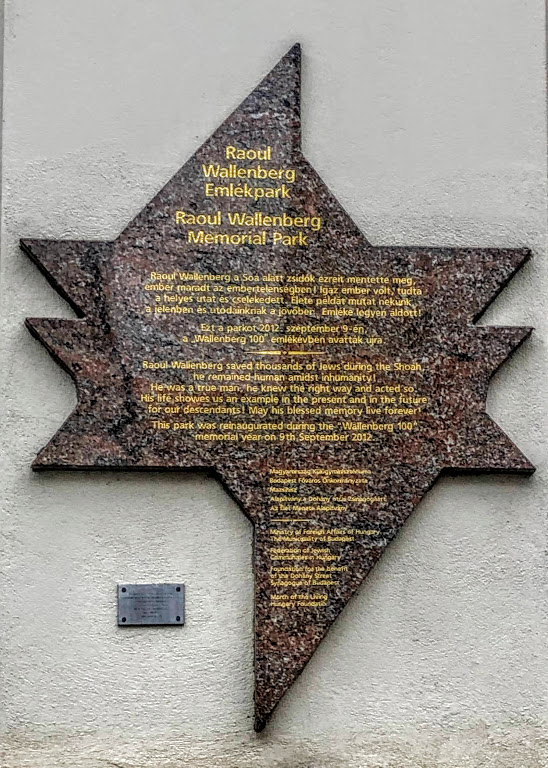
The Holocaust Memorial Park at the Dohány Street Synagogue in Budapest (Photograph: Patrick Comerford)

Italy:

A monument in Bologna commemorating victims of the Holocaust (Photograph: Patrick Comerford)

The Holocaust Memorial outside the railway station in Gorizia, a town that straddles the border of Italy and Slovenia (Photograph: Patrick Comerford)

The Holocaust Memorial at the Synagogue in Padua (Photograph: Patrick Comerford)

A monument to Jewish partisans and resistance to the Nazis and Fascists in Rome (Photograph: Patrick Comerford)

The memorial wall to victims of the Holocaust in the Ghetto in Venice (Photograph: Patrick Comerford)

The Holocaust memorial in the Ghetto in Venice (Photograph: Patrick Comerford)

Poland:

Multilingual memorials in Birkenau … a reminder of the many nationalities of the victims of the Holocaust (Photographs: Patrick Comerford)

Shattered gravestones make a Holocaust memorial in a Jewish cemetery in Kraków (Photograph: Patrick Comerford)

The Empty Chairs Memorial in Ghetto Heroes Square in Kazimierz , symbolising abandoned homes and mass deportations from the Kraków Ghetto in 1943 (Photograph: Patrick Comerford)

Slovakia:

The Holocaust Memorial in the centre of Bratislava on the site of the former Neolog Synagogue (Photograph: Patrick Comerford)

Stolpersteine or ‘stumbling stones’

Berlin:

Stolpersteine or Stumbling stones on Rosenthaler Straße 39, Berlin-Mitte, remembering members of the Salinger family murdered by the Nazis in Auschwtiz and Riga (Photograph: Patrick Comerford)

Dublin:

Dublin’s first Stolpersteine or ‘stumbling stones’, recalling six Irish Holocaust victims, at Saint Catherine’s National School on Donore Avenue (photograph: Patrick Comerford)

Prague:

‘Stolpersteine’ or ‘Stumbling Stones’ on the streets of Prague remember members of the Bergmann family deported to Terezín during the Holocaust (Photograph: Patrick Comerford)

Thessaloniki:

‘Stolpersteine’ or ‘Stumbling Stones’ on the pavement on Vassilisis Olgas Avenue in Thessaloniki commemorate Greek Jews deported to Auschwitz (Photograph: Patrick Comerford)

Venice:

Stolpersteine or stumbling stones (Pietre d’inciampo) in Venice recall victims of the Holocaust (Photograph: Patrick Comerford)

Remembering individuals:

Remembering Anne Frank in street art in Berlin (Photograph: Patrick Comerford)

The sculpture of Anne Frank by Doreen Kern in the British Library, London (Photograph: Patrick Comerford)

The Kindertransport monument at Liverpool Street Station … a reminder in the heart of London of the Holocaust (Photograph: Patrick Comerford)

A plaque on Heydukova Street in Bratislava marks the former home of Aron Grünhut (1895-1974), involved in heroic rescues during the Holocaust (Photograph: Patrick Comerford)

Monuments to ‘Righteous Among the Nations’:

Philip Jackson’s monument of the Swedish diplomat Raoul Wallenberg at Wallenberg Place, near Hyde Park, London (Photograph: Patrick Comerford)

A memorial to Raoul Wallenberg in the Raoul Wallenberg Holocaust Memorial Park at the Dohány Street Synagogue, Budapest (Photograph: Patrick Comerford)

The Mary Elmes Bridge in Cork … the centrepiece of the bridge is designed to look like a menorah (Photograph: Patrick Comerford)

The Wall of the Righteous in Paris lists 3,300 French people who have been recognised as ‘Righteous Among the Nations’ (Photograph: Patrick Comerford)

These images are reminders not only of the Holocaust and its victims, but of real individuals who suffered and were humiliated, whose lives were shattered and who were murdered.

They are reminders of why we must never forget. The Holocaust happened not just because of one evil man but because many good people stood by and remained silent.

Over 80 years after the end of the Holocaust, antisemitism is on the rise once again. We are seeing the rise of the far-right in Britain across Europe and a resurgence of the far-right in Latin America, far-right ideology and vocabulary has become part and parcel of the language of the Trump regime, its spokespersons and those who support street murders by ICE in Minneapolis.

We must never forget.

The Eternal Flame in the Mémorial de la Shoah, Paris (Patrick Comerford)