Showing posts with label Darwin. Show all posts

04 September 2026

50 million in modern slavery,
50 million Black Death victims,
50 million European ancestors,
50 million readers of this blog

Big Ben and the Palace of Westminster … the UK has a target to welcome 50 million international visitors annually by the year 2030 (Photograph: Patrick Comerford)

Patrick Comerford

Yet again I am overwhelmed by the viewing and reading figures for this blog. These figures reached a total of 50 million before dawn early this morning (4 September 2026). This comes soon after reaching the 49 million mark four days ago (31 August 2026), and passing the million mark on three other days last month: 48 million (24 August), 47 million (17 August) and 46 million (9 August).

I continue to find these viewing and reading figures overpowering at times, and this blog continues to reach volumes of readers I never expected when I first started blogging 16 years ago. At the end of last year, this blog had 21 million hits (31 December 2025). So far this year, there have been more than 29 million hits or visitors in 2026 alone.

Half of all hits or reader figures have been in little more than six months, with 25 million hits since 25 February 2026. I first began blogging in 2010, and it took almost two years until July 2012 to reach half a million readers. Throughout this year and last, the daily figures are overwhelming on many occasions. Of the 10 days of busiest traffic on this blog, one was this month (1 September 2026), three were in May (1, 6 and 14 May 2026), three were the previous month (26, 29 and 30 April 2026), two in March, and one in February:

• 1,124,925 (1 May 2026)
• 525,719 (14 May 2026)
• 509,644 (29 April 2026)
• 356,335 (1 September 2026)
• 344,003 (30 April 2026)

• 323,156 (27 March 2026)
• 322,038 (26 April 2026)
• 318,835 (6 May 2026)
• 318,307 (1 March 2026)
• 314,018 (28 February 2026)

The daily average was about 118,700 hits a day throughout August. Yet, I recall how 10 years ago, back in 2016, the daily average was around 1,000, or 30,000 a month.

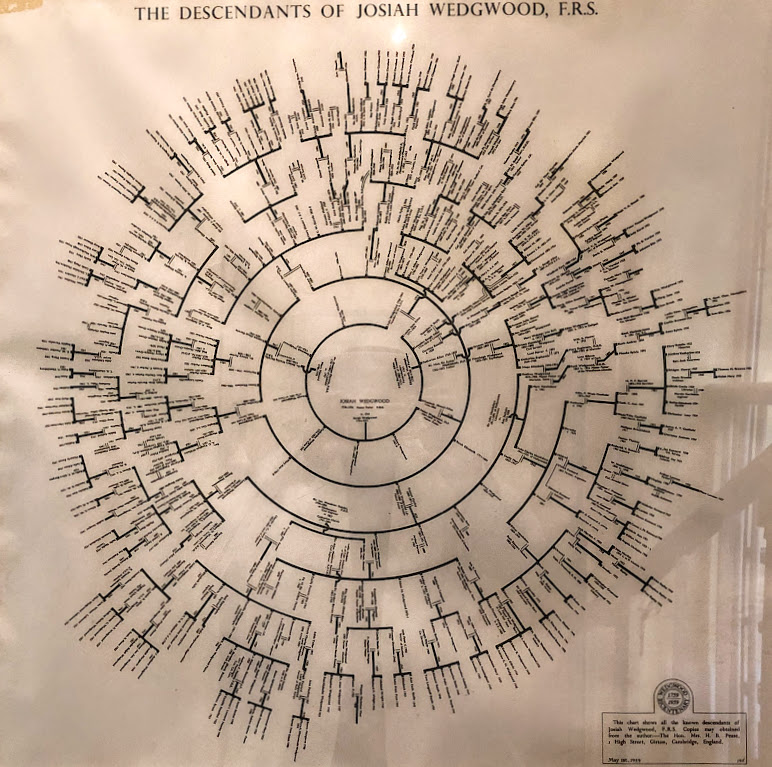
A large family tree of the Wedgwood and Darwin families in Erasmus Darwin House, Lichfield … mathematical projections in genealogy show how we are all related (Photograph: Patrick Comerford)

To put this new figure of 50 million into context:

Modern slavery entraps 50 million people on any given day: about 28 million people are working under duress in private economies, state projects or commercial exploitation, 22 million are living in forced marriages without consent, and one in four victims of modern slavery is a child.

Around 50 million people worldwide have epilepsy, making it one of the most common neurological diseases globally.

The UK government has set an official target to welcome 50 million international visitors annually by the year 2030. Greece too aims to attract 50 million annual tourist arrivals by 2030, according to a strategic target set by the Greek Tourism Confederation.

There are 29 countries with a population of more than 50 million. The population of the UK reached 50 million by 1948 and has been growing ever since: the population was 40 million in 1898, it reached 50 million by 1948 and 60 million by 2005, and is probably at 70 million this year (2026).

The Black Death killed 50 million people, or 60 per cent of Europe’s entire population, between 1346 and 1353. As a proportion of the population that lost their lives, the Black Death caused unrivalled mortality. It overshadows the horrors of World War II, and is twice the number murdered by Stalin’s regime in the Soviet Union.

In the year 1000, Europe had a population of ~50 million. Some simple maths shows that everyone who was alive in Europe around the year 1000 is either an ancestor of everyone in Europe today, or the ancestor of no one. This means that someone in Sweden, Norway or Italy has the same set of ancestors as someone who thinks their family is 100% British, Irish, French or Spanish.

At times I have used mathematical projections to help my genealogical projects, and the maths are quite simple. Every person has two parents, four grandparents and so on. Going just 30 generations back, say around 1066, that means I have one billion direct ancestors (2 to the power of 30), even though there were not one billion humans alive at that time.

A white paper published by FamilyTreeDNA used an example of a Swedish man with 8.5 billion genealogical ancestors (2^33) living in the year 1000. ‘Genealogical ancestors’ does not mean actual ancestors, as there were not even one billion living humans alive at that time, meaning many ancestors will appear multiple times across various branches.

The paper notes: ‘Think about that for a moment. If you have a single European ancestor, you are genealogically descended from every European from the year 1000 who has living descendants now.’

The population of ~50 million people in Europe in the year 1000 means we are all related in more ways than we imagine.

50 million minutes is 95 years, 24 days, 4 hours and 22 minutes. This means that if this blog was receiving just one hit a minute, I would need to have started blogging back in late September 1931.

I retired from active parish ministry about 4½ years ago, on 31 March 2022. These days, though, about 150 people on average are reading my daily prayer diary posted on this blog each morning, or more than 1,000 people each week.

This evening, as this blog passes 50 million hits, I am truly grateful to the real readers among those 50 million hits. In particular I am thankful for the faithful core group of people who join me in prayer, scripture reading and reflections each day.

William de Comberford’s monument in the Comberford Chapel, Tamworth … he died in 1349, a year after the Black Death killed one-third of Tamworth, at a time when the Black Death killed 50 million in Europe (Photograph: Patrick Comerford, 2026)

27 August 2026

Ludwig returns to Cambridge
with his identical twin brother,
but can I solve the mystery of
Darwin and the missing link?

The Backs and King’s College are among many of the familiar locations that appear as scenes in the BBC crime drama series ‘Ludwig’ (Photograph: Patrick Comerford, 2026)

Patrick Comerford

I am delighted that the detective drama Ludwig has returned to the BBC with a second series that began last week (20 August 2026), having enthusiastically watched the first series in 2024.

In both series of Ludwig, David Mitchell stars as John Taylor, a reclusive crossword setter and puzzle maker who publishes his books under the pen name ‘Ludwig’, and his missing identical twin brother, James Taylor, a successful detective chief inspector in the Cambridge police force.

As an enthusiastic fan of the Guardian crossword each day, I was interested to see that the Guardian’s crossword editor Alan Connor was involved in designing the crosswords used in the opening titles of the series; indeed, he also created a series of Ludwig-themed puzzles in the Guardian.

Throughout each episode, I am watching for familiar locations in Cambridge, where much of the plots and storylines are set, including the Backs and the River Cam, King’s College, Queens’ College, Queens’ Lane, Saint John’s College, the Bridge of Sighs, the Old Schools and All Saints’ Passage.

Almost three million viewers watched Episode 1 in Series 2 on BBC 1 last Thursday night (20 August 2026), with Episode 2 going out at 9 pm tonight (27 August 2026). The first three episodes in Series 2 are now available on BBC iPlayer and the remaining three episodes are due to be released on BBC iPlayer on 10 September.

‘Stands the Church clock at ten to three?’ (Rupert Brooke) … the clock at Grantchester Church, which features in the crime series ‘Grantchester’ (Photograph: Patrick Comerford)

In Series 1, John Taylor works his way into the Cambridgeshire Police posing as his missing identical twin brother James. As a fake cop, he uses his pedantic puzzle-solving skills to solve some complex murders in and around Cambridge that make normally sedate Cambridge look like a more dangerous place to live in than Albert Square in EastEnders.

Oxford has Inspector Morse, but Cambridge has had its share of television sleuths too, including the vicars in the ITV detective drama Grantchester (2014-2026), filmed mainly in the village of Grantchester and in central Cambridge, with locations that include King’s Parade, Saint John’s College and the River Cam.

In addition, the four episodes of Porterhouse Blue (1987), a Channel 4 comedy series adapted from Tom Sharpe’s 1974 novel, were filmed mainly in Sidney Sussex College, Cambridge, where I was a student over the years on a number of courses in association with the Institute of Orthodox Christian Studies (IOCS).

Sidney Sussex College provided the location for the Channel 4 comedy series ‘Porterhouse Blue’ (Photograph: Patrick Comerford, 2026)

BBC’s Ludwig is primarily set in and filmed in Cambridge. The actor David Mitchell went to Peterhouse in Cambridge in 1993 to study history, and as an undergraduate he joined the Cambridge Footlights dramatic club.

Ludwig inevitably includes numerous positioning shots – usually aerial – of Cambridge. The locations, backdrops and shots include King’s College, the River Cam, Saint John’s College and the Bridge of Sighs, Queens’ College, Queens’ Lane and the Mathematical Bridge, Silver Street, Silver StreetBridge and the Anchor, and the Millpond.

Episode 3 next week in the new series has many street scenes in central Cambridge, including Portugal Place, Market Hill, Trinity Lane and Garrett Hostel Bridge. But there are many fictional locations too, including the ‘Scholar's Fountain’ and Turing Lane. The theatre where last week’s murder scene is located is certainly not in Cambridge … it is, in fact, the Theatre Royal in Windsor.

The fictional Cambridge Police Authority station was filmed at Stockley Park Business Centre, a glass-fronted modern business park building in outer London. The grim offices of the fictional East Anglia Advertiser have been filmed at Pentland site off Squires Lane in Finchley. Its sad decline as a newspaper reminds me of the decline of the Lichfield Mercury a few years ago.

Locations beyond Cambridge include Moor Park Golf Club in Rickmansworth, Hertfordshire, North Mymms Park near Hatfield in Hertfordshire and locations in and around London including Ham Yard Hotel.

Doppelganger or ‘missing link’? … Charles Darwin’s plaque in the Great Gate at Christ’s College(Photograph: Patrick Comerford, 2026)

Back in Cambridge last month, introducing a friend from Ireland to the Cambridge I have known for 20 years, the question of a doppelganger or curious lookalike surfaced in a humorous moment at the Great Gate or porters’ lodge at Christ’s College.

This gate and tower, which have been restored and regilded in recent years, date back to the 16th century when Christ’s College was founded by Lady Margaret Beaufort. As we stood there looking into First Court and the chapel, an American couple commented, half joking and wholly in earnest, on the likeness of the plaque behind me of Charles Darwin.

I have been a guest in Christ’s College many times, and I have preached in the chapel and was a visiting lecturer back in 2009. So I have always been aware of Darwin’s place in the history of the college. But there have also been rumours in family lore and legend that Charles Darwin was related to the Comberford family of Comberford Hall.

The nearest thing I can find to an actual link, though. is through a web of marriages rather than any direct genealogical connection. Charles Darwin’s father, Robert Waring Darwin, grew up as the step-brother of Sacheverell Chandos-Pole. Sacheverell’s son, the Revd William Chandos-Pole, held a kinship equivalent to a first cousin of Charles Darwin through marriage, and his son later had family ties that had a brief connection with Comberford Hall.

First Court and the Chapel in Christ’s College, Cambridge (Photograph: Patrick Comerford, 2026)

I have described this tenuous relationship as a true ‘missing link’, but any direct connection between Charles Darwin and Comberford Hall is extremely remote, and indirect, and I have only traced these through collateral marital relations in Staffordshire. Perhaps I need Ludwig’s puzzle-solving skills if I am ever going to find this ‘missing link’.

But there is another puzzle in Ludwig: is the plot about a missing identical twin brother, about a doppelganger, or about a personality disorder?

The BBC confirmed last month that it has commissioned a third series of Ludwig. We may have to wait until then to put other pieces in the puzzle back into place.

All Saints’ Passage … one of the familiar scenes in Cambridge that provide locations for ‘Ludwig’ (Photograph: Patrick Comerford)

23 June 2026

Daily prayer in Ordinary Time 2026:
47, Tuesday 23 June 2026

‘Enter through the narrow gate; for the gate is wide and the road is easy that leads to destruction (Matthew 7: 13) … the gate behind Erasmus Darwin House leading into Dr Darwin’s Garden and Lichfield Cathedral (Photograph: Patrick Comerford, 2026)

Patrick Comerford

We are in Ordinary Time in the Church Calendar, and this week began with the Third Sunday after Trinity (Trinity III, 21 June 2025). The calendar of the Church of England in Common Worship today remembers Saint Etheldreda (ca 678), Abbess of Ely. Two days ago (21 June 2026), the Right Revd Sarah Elizabeth Clark was installed as the Seventieth Bishop of Ely in Ely Cathedral.

Before today begins, I am taking some quiet time this morning to give thanks, to reflect, to pray and to read in these ways:

1, reading today’s Gospel reading;

2, a short reflection;

3, a prayer from the USPG prayer diary;

4, the Collects and Post-Communion prayer of the day.

‘Do not throw your pearls before swine’ (Matthew 7: 6) … pigs on a farm at Packington, half-way between Lichfield and Tamwroth (Photograph: Patrick Comerford)

Matthew 7: 6, 12-14 (NRSVA):

[Jesus said to his disciples:] 6 ‘Do not give what is holy to dogs; and do not throw your pearls before swine, or they will trample them under foot and turn and maul you.

12 ‘In everything do to others as you would have them do to you; for this is the law and the prophets.

13 ‘Enter through the narrow gate; for the gate is wide and the road is easy that leads to destruction, and there are many who take it. 14 For the gate is narrow and the road is hard that leads to life, and there are few who find it.’

‘Enter through the narrow gate; for the gate is wide and the road is easy that leads to destruction (Matthew 7: 13) … a narrow gate and a wide gate leading into the former grounds of Wesley College in Dublin (Photograph: Patrick Comerford)

Today’s Reflections:

Our Gospel story (Matthew 7: 6, 12-14) continues our readings from the Sermon on the Mount. Today’s reading from the Sermon on the Mount omits verses 7-11 about prayer, and instead contains teachings of Jesus that at first reading seems to be unrelated. The Sermon on the Mount is an edited collection of sayings on the theme of the qualities found in a true disciple of Jesus.

1, In verse 6 , Jesus warns against giving what is holy to dogs; and do not throw your pearls before swine, lest they ‘trample them under foot and turn and maul you’.

In the ancient world, dogs and pigs represented uncleanness, hostility and worthlessness. They symbolise individuals who do not revere the truth and will instead disrespect it. In many parts of the East Mediterranean, and among Jews and Muslims to this day, dogs and pigs are unclean. And so, consecrated food from sacrifices in the Temple should not be given as food to the dogs.

We may remember how the state of Lazarus’s poverty at the gates of the rich man is made even more abject by describing how ‘even the dogs would come and lick his sores’ (Luke 16: 21).

In his conversation with the Syro-Phoenician woman, Jesus talks about not giving the food of children to dogs (Matthew 15: 21-28; Mark 7: 24-30).

Just as sacred or sacrificial food should not be fed to dogs, precious pearls should not be given to pigs. We might we remember the parable of the Prodigal Son (Luke 15: 1-3, 11-32), where the pitiable state of the young man is emphasised by saying the only job he could find was feeding pigs and he was so hungry he would have eaten the pigs’ food.

Casting pearls before swine is a proverbial that originates in this passage. It advises us to use discernment and to stop wasting our most precious spiritual truths, wisdom and resources with people who are hostile to Gospel values.

Christ advises his followers not to expose their beliefs indiscriminately to all and sundry. Of course, the Gospel is good news for all, but there are people who subject it to ridicule or who are abusing it for their own political ends. I think this morning of self-styled clerics who have brought crosses and Bibles to the far-right street marches in Britain, or the ‘Christian Nationalist’ pastors who have been allowed to infiltrate Donald Trump’s inner circle in Washington.

Verse 6 is also one of the many examples of poetic parallelism or indiscriminately in the original Greek of the New Testament:

Μὴ δῶτε τὸ ἅγιον τοῖς κυσίν,
μηδὲ βάλητε τοὺς μαργαρίτας ὑμῶν ἔμπροσθεν τῶν χοίρων,

Do not give what is holy to the dogs;
And do not cast your pearls before swine.


The Didache (Διδαχὴ), or ‘The Teaching of the Twelve Apostles’, was an early treatise used by the Church Fathers (Διδαχὴ τῶν δώδεκα ἀποστόλων). In Chapter 9, the Didache quotes prayers that might correspond with what we might call the Consecration and Communion prayers at the Eucharist. But this text also parallels what may have been the Jewish blessing of wine and bread at the time and with which the prayers in Chapter 9 have a close affinity.

μηδεις δε φαγετω μηδε πιετω απο της ευχαριστιας υμων,
αλλ' οι βαπτισθεντες εις ονομα κυριου,
και γαρ περι τουτου ειρηκεν ο κυριος.
μη δωτε το αγιον τοις κυσι.

No one is to eat or drink of your Eucharist
but those who have been baptised in the Name of the Lord;
for the Lord’s own saying applies here,
‘Give not that which is holy unto dogs’
(Didache 9: 5).

If we share sacred truths with people who are actively antagonistic or indifferent to the core values of the Gospel, they will trample them and potentially turn and attack you. We should be as vigorous in denying the Christian claims and credentials of these dangerous political extremists, no matter what religious symbols and labels they abuse, claim and arrogate to themselves, and we should be as offended by this behaviour as we would be if they were to abuse sacramental communion in a similar manner.

2, The second saying in today’s Gospel (verse 12) is a positive way of expressing the ‘Golden Rule’: ‘In everything do to others as you would have them do to you; for this is the law and the prophets’ (verse 12). The Golden Rule is not exclusive to Christianity or the Gospel, and is known in many cultures. The Golden Rule may have been first codified in Babylon in the Code of Hammurabi stele and tablets (ca 1754 BCE). A partial copy exists on a 2.25 metre stone stele, now in the Louvre in Paris, and a copy is on display in the Pergamon Museum in Berlin.

The term ‘Golden Rule’ or ‘Golden Law’ began to be used widely in the early 17th century in England by Anglican theologians and preachers. The earliest known usage is that of Anglicans Charles Gibbon and Thomas Jackson in 1604.

Hillel the Elder (ca 110 BCE to 10 CE), cited this as the most important message of the Torah in his teachings. Once, Hillel was challenged by a gentile who asked to be converted on condition that the Torah was explained to him while he stood on one foot. Hillel accepted him as a candidate for conversion to Judaism but, drawing on Leviticus 19:18, told the man: ‘Do not do to anyone else what is hateful to you: this is the whole Torah; the rest is the explanation; go and learn’ (Babylonian Talmud, Shabbath 31a).

The Golden Rule is often expressed in a negative way: ‘Do not do to others what you would not like them to do to you’. If I lived by the negative maxim, I might observe it by doing nothing at all. But the positive maxim, which Christ teaches in today’s reading, can only be lived out by actively doing good to others.

3, In the third saying (verses 13-14), Christ contrasts the narrow gate with the wide road. To follow the wide road allows me to do just about anything I feel like doing, following my likes and dislikes, my instincts and whims, wherever they lead me along the road of greed and self-centredness, of lies and deceit, of violence and destruction.

But the narrow gate is not for the narrow-minded. It is allowing my life to be guided by truth, principles and values that are at the heart of Gospel teachings. It requires discipline, but in the long run, it is the easier way because it conforms more to the deepest human needs and desires.

‘Do not give what is holy to dogs’ (Matthew 7: 6) … the Famine sculpture on the Quays in Dublin (Photograph: Patrick Comerford)

Today’s Prayers (Tuesday 23 June 2026):

In Pray with the World Church, the prayer diary of the Anglican mission agency USPG (United Society Partners in the Gospel), the theme this week, from 21 to 27 June 2026 (pp 12-13), is ‘Land Taken, Land Remembered’. This theme was introduced on Sunday with a reflection by the Venerable Rosalyn Kantlaht’ant Elm, Director of Indigenous Ministries, Anglican Church of Canada.

The USPG prayer diary today (Tuesday 23 June 2026) invites us to pray:

Creator God, guide your church as it continues the work of truth and reconciliation with Indigenous communities. Give us humility to listen and courage to act with justice.

The Collect of the Day:

Eternal God,
who bestowed such grace upon your servant Etheldreda
that she gave herself wholly to the life of prayer
and to the service of your true religion:
grant that we, like her,
may so live our lives on earth seeking your kingdom
that by your guiding
we may be joined to the glorious fellowship of your saints;
through Jesus Christ your Son our Lord,
who is alive and reigns with you,
in the unity of the Holy Spirit,
one God, now and for ever.

The Post-Communion Prayer:

Merciful God,
who gave such grace to your servant Etheldreda
that she served you with singleness of heart
and loved you above all things:
help us, whose communion with you
has been renewed in this sacrament,
to forsake all that holds us back from following Christ
and to grow into his likeness from glory to glory;
through Jesus Christ our Lord.

Collect on the Eve of the Birth of Saint John the Baptist:

Almighty God,
by whose providence your servant John the Baptist
was wonderfully born,
and sent to prepare the way of your Son our Saviour
by the preaching of repentance:
lead us to repent according to his preaching
and, after his example,
constantly to speak the truth, boldly to rebuke vice,
and patiently to suffer for the truth’s sake;
through Jesus Christ your Son our Lord,
who is alive and reigns with you,
in the unity of the Holy Spirit,
one God, now and for ever.

Yesterday’s Reflections

Continued Tomorrow

‘Enter through the narrow gate; for the gate is wide and the road is easy that leads to destruction (Matthew 7: 13) … a narrow gate leading into the Church of Agios Georgios Grotta in Rethymnon (Photograph: Patrick Comerford)

Scripture quotations are from the New Revised Standard Version Bible: Anglicised Edition copyright © 1989, 1995, National Council of the Churches of Christ in the United States of America. Used by permission. All rights reserved worldwide. http://nrsvbibles.org

01 November 2025

An autumn ramble around
Hanslope, with its thatched
cottages and stories of
prize fights and a murder

Autumn colours on the Village Green in Hanslope in north Buckinghamshire (Photograph: Patrick Comerford, 2025)

Patrick Comerford

I am continuing to enjoy exploring the neighbouring villages and towns that are close to Stony Stratford, exploring their history and legacy, architecture and churches. One of the great gifts from the early town planners and architects who had a vision for Milton Keynes over half a century ago was that each satellite town or village should retain its own identity and character.

Some days I just hop on a bus at random to see where it brings me and to enjoy seeing the unexpected. Recent morning escapades have included Roade in Northamptonshire and Addington in Buckinghamshire, as I continue to search for houses designed by Stony Stratford’s great architect of the Arts and Crafts Movement, Edward Swinfen Harris.

One recent morning , after breakfast, I took the 33 bus from Wolverton to Northampton and hopped off at Hanslope. The village, with a Village Green and Village Pond, is about 6.4 km (4 miles) north of Stony Stratford, a similar distance from Newport Pagnell and about 13 km (8 miles) north of Central Milton Keynes. The northern parish boundary is part of the county boundary between Buckinghamshire and Northamptonshire.

Green Manor and the 57 metre spire of Saint James the Great, the tallest in Buckinghamshire (Photograph: Patrick Comerford, 2025)

I particularly wanted to see the parish church in Hanslope, Saint James the Great, with its tall church spire which is the most prominent feature of the village. It is the tallest in Buckinghamshire and can be seen for many miles across the surrounding countryside. It was originally built in the early 15th century and was 61 metres (200 ft) high. It was struck by lightning in 1804 and collapsed in 1804 and it was rebuilt to the slightly lesser height of 57 metres (186 ft).

Hanslope probably takes its name from the Old English name for a slippery or muddy place belonging to Haema, or possibly ‘hemmed-in land at the slope’. This name has evolved over the centuries, and even in the 18th and 19th century, the variants in use included Anslapp, Hanslapp and Hanslape.

Hanslope Park, about half a mile south-east of the village, was once the manorial estate of the village. Hanslope was included in the grant of land to by William the Conqueror to Winemar of Flanders. It eventually passed by marriage to Maudit family, whose seat was at Hanslope Castle.

William Maudit built what is now the chancel of Saint James the Great Church. His son Robert Maudit sided with the barons against King John. When King John was in Northampton in 1215, he ordered Faulke de Breaute and his mercenaries to besiege and raze Hanslope Castle, and it was never rebuilt.

King John gave Hanslope Manor to Breaute and then to Hugh de Neville. Later, in 1217, Henry III gave to Henry de Brailof, but after he was attainted as a traitor Hanslope was restored to the Maudit family.

Earl Row, off Market Square, remembers the Earls of Warwick, who began the market in Hanslope in 1293 (Photograph: Patrick Comerford, 2025)

Hanslope was part of Salcey Forest in the Middle Ages and Hanslope Park was originally a mediaeval deer park. Before he died in 1222, Robert Maudit laid out a great park in the parish, and remnants of the park survive in Hanslope.

William Mauduit (1221-1268) eventually became the 8th Earl of Warwick in 1253 through an intricate line of descent, and the titles and estates then passed from his sister, Isabel Mauduit, to her son, William de Beauchamp (1237-1298), 9th Earl of Warwick.

The Earl of Warwick received a charter in 1293 for a weekly market in Hanslope on Thursdays and a three-day annual market on the eve, day and morrow of the feast of Saint James the Great (24, 25 and 26 July). This explains the name of Earl Row, off Market Square, running behind High Street and Gold Street.

Maltings Farmhouse, one of the oldest houses in Hanslope, dates from 1624 (Photograph: Patrick Comerford, 2025)

The manor and titles continued to be held by successive Earls of Warwick in the Beauchamp family and for another 200 years or so. Richard Neville (1428-1471) became the 16th Earl of Warwick through marriage, and he is remembered ever since as Warwick the Kingmaker. He was the wealthiest and most powerful English lord of his day and one of the leading figures in the Wars of the Roses. He switched his allegiance during the wars, and was instrumental in deposing two kings, Henry VI and Edward IV.

Warwick the Kingmaker was killed in battle at Barnet in 1471, and Hanslope Manor was given to his son-in-law Richard Plantagenet, Duke of Gloucester, later Richard III. After Richard was killed at Bosworth Field in 1485, Hanslope was restored to the Dowager Countess of Warwick. She surrendered Hanslope to the crown, and in 1550 it was granted to the future Queen Elizabeth I.

Hanslope Manor was one of the properties given in 1604 to the former Princess Anne of Denmark, after her husband became James I of England in 1603. Although she never lived there, it provided her with a private, personal income, and the lodge and barns were repaired in 1608.

Silent Night Cottage and Christmas Cottage, a pair of symmetrical thatched cottages on Gold Street (Photograph: Patrick Comerford, 2025)

Queen Anne died in 1619, and Hanslope Manor passed to her son, the future Charles I. His trustees leased it to Sir Kenelm Digby, John Digby and Isaac Penington, and Charles I later gave the manor to Admiral John Penington (1584-1646) in 1628.

The old manor house of Hanslope was fortified but appears to have been destroyed by fire. After the Caroline restoration, it passed to Sir Thomas Tyrell, a prominent judge, in 1663. The Tyrell family sold the manor in 1707 to Gervase Pierrepont (1649-1715), a grandson of Robert Pierrepont, 1st Earl of Kingston and MP for Appleby (1698-1705). He was given titles in the Irish and British peerages in 1702 and 1714, and when he died in 1715 the estate passed to his nephew Evelyn Pierrepont (1665-1726), Duke of Kingston.

The Watts family acquired Hanslope Manor in 1764 and remained until the 1930s (Photograph: Patrick Comerford, 2025)

Evelyn Pierrepont (1711-1773), 2nd and last Duke of Kingston, sold the manor in 1764 to William Watts, who had served in India under Clive as Governor of Fort William in Bengal. Watts had amassed a fortune and he was buying Hanslope Manor when he died in August 1764. The sale was completed on behalf of his son Edward Watts, who was born in Calcutta in 1752 and was still a minor.

The Watts family continued to live at Hanslope Manor for almost 200 years, and they commissioned Humphry Repton to landscape the estate grounds in the 1790s.

Edward Hanslope Watts married Sophia Edith Selby Lowndes of Bletchley, one of the ‘Eight Belles of Bletchley’, in 1868. Watts was shot and murdered by his gamekeeper William Farrow as he was on his way home from Saint James Church on Sunday 21 July 1912.

Auspiciously, the second reading that Sunday was from the Acts of the Apostles and included a reference to murderers. Watts was shot in the head and died immediately; Farrow then shot himself.

The widowed Sophia Watts lived on at Hanslope Park until she died in 1930. Her daughter Irene and husband Mark Poore took over until Mark Poore died in 1931. Irene remarried and her son Robert Poore-Watts sold Hanslope Park to the Hesketh Estates.

Hanslope Park was acquired by the War Office in 1941 and became the home of the Government Communications Centre. It provides electronics and software to support government communication needs and is closely linked with British intelligence agencies.

Stafford House, built in the 17th century by Sir Robert Stafford and Lady Jane Stafford (Photograph: Patrick Comerford, 2025)

Hanslope has one grade I listed building, 33 grade II listed buildings, including the Methodist Chapel and the Gospel Hall, and one scheduled monument.

Other listed buildings include:

• Green Manor on Market Square: once a pub known as the Green Man Inn, and now a private house.

• Stafford House: built in the 17th century and named after Sir Robert Stafford and Lady Jane Stafford, became a workhouse supported financially by Lady Pierrepont.

• Maltings Farmhouse: one of the oldest houses in the village, with the date 1624 set in stone on the façade.

• Silent Night Cottage and Christmas Cottage: a pair of symmetrical thatched cottages on Gold Street with an interesting pair of names and dating from the late 17th or early 18th century. They were originally approached from High Street along a long path between the gardens that are now part of the Cock Inn. The houses have been turned around so that their main entrance is on Gold Street.

• Horseshoe Cottages, with a thatched roof and gentle curve, once a terrace of four cottages built in the 17th and 18th centuries.

The Watts Arms, at the north end of the High Street, where the prize fighter Alexander McKay died in 1830 (Photograph: Patrick Comerford, 2025)

The Watts Arms at the north end of the High Street, was built ca 1820, and was first licensed in 1821. It was owned by the Watts family and probably replaced the Royal Oak at the other end of the High Street, demolished in 1819.

In a prize fight at Salcey Green on 2 June 1830, Alexander McKay (1804-1830), the champion of Scotland, fought Simon Byrne (1806-1833), an Irishman known as ‘The Emerald Gem’, at Salcey Green. The fight went on for 47 rounds, McKay was defeated and he was taken to the Watts Arms, where he died the next day.

His grave in Hanslope churchyard has an epitaph with a telling lesson in rhyme:

Strong and athletic was my frame,
far from my native home I came
and bravely fought with Simon Byrne
alas, but never to return.
Stranger take warning from my fate,
lest you should rue your case too late.
If you have ever fought before,
determine now to tight no more.

Simon Byrne was arrested some days later catching the boat from Liverpool to Dublin and charged with McKay’s murder. At his trial in Buckingham, Byrne was defended by three barristers and five solicitors. The jury took 10 minutes to return a verdict of Not Guilty.

But Byrne’s triumph was short-lived. Three years later, he fought James ‘Deaf’ Burke in a fight that went 99 rounds and lasted three hours and 16 minutes. Byrne died three days later after the longest recorded prize fight. Today, the village sign includes a depiction of McKay, poised for a bareknuckle fight.

The village sign includes a depiction of Alexander McKay, poised for a bareknuckle fight (Photograph: Patrick Comerford, 2025)

Other distinguished residents of Hanslope include the clockmaker Joseph Knibb (1640-1711), who retired from London to Hanslope in 1697. He acquired Green End Farm and continued to make clocks in Hanslope. Green End Farmhouse was a scheduled monument, but was demolished in 1954.

Walter Drawbridge Crick (1857-1903) from Hanslope was an amateur geologist and palaeontologist who published with Charles Darwin. Crick was born at Pinion End Farm in Hanslope on 15 December 1857, and first went into business in Northampton as a shoemaker. He corresponded with Darwin in the 1880s, and their letters are part of the Darwin Correspondence Project.

He was the grandfather of the Cambridge Nobel molecular geneticist Francis Crick (1916-2004). Alongside James Watson, Rosalind Franklin and Maurice Wilkins, Crick played a crucial role in deciphering the helical structure of the DNA molecule.

Horseshoe Cottages, with its thatched roof and gentle curve, once a terrace of four cottages built in the 17th and 18th centuries (Photograph: Patrick Comerford, 2025)

Hanslope has been part of Milton Keynes since 1973 and is in the Milton Keynes North constituency. It won the title of ‘Best Kept Village in Buckinghamshire’ in 2016.

The West Coast Main Line between Euston and Glasgow passes about 1.6 km (1 mile) west of Hanslope. But there are no train stations at Castlethrope, Hanslope or Roade, and the stations nearest to Hanslope are Wolverton and Milton Keynes Central.

There are many other attractive villages that I have been visiting these weeks, including Castlethorpe, Addington and Padbury, and I realise there are so many more to visit and to explore. Meanwhile, more about Saint James the Great Church in Hanslope and its tall spire, and about the chapels in Hanslope in the days to come, hopefully.

Autumn colours at the Village Pond in Hanslope (Photograph: Patrick Comerford, 2025)

31 July 2025

Is nobody going to
come to the rescue of
Davidson House in
Lichfield before it is lost?

Davidson House, Upper Saint John Street, once the home of one the finest of Lichfield’s architects, has been neglected for over a decade (Photograph: Patrick Comerford, 2025)

Patrick Comerford

As I was walking up Upper John Street in Lichfield last week, setting out in search of Borrowcop Hill and Borrowcop Gazebo, I stopped once again to look at the sad state of decay and neglect of Davidson House at 67 Upper Saint John Street. This Regency-era house, built ca 1810, is more than 200 years old. It faces a prominent corner at Davidson Road and is just a few metres south of Lichfield City train station, and north of both King Edward VI School and Holy Cross Church.

Back in 2015, I had written about the sad neglect of this fine house, which had once been a museum and, before that, the home of a distinguished Lichfield architect. But in the 10 years since then, the house has decayed even further and lost more of its key architectural features.

According to the local history group, Lichfield Discovered, and the local historian Kate Gomez, this house is part of Lichfield’s ‘at-risk’ heritage. Yet, despite its important place in the heritage of Lichfield, it looks forlorn and abandoned, and is rapidly becoming an eyesore on the landscape of Lichfield.

The windows in this once elegant house are boarded up, the stonework and façade are crumbling, and there is a sad air of abandonment about the whole site.

Davidson House was once the home of the Old Comrades Association of the South Staffordshire Regiment and the collection of the Regimental Museum from 1938 until 1963, when it moved to Whittington. But Davidson House is also of architectural interest because it was once the home of the Lichfield architect Thomas Johnson (1795-1865), who lived there for over 30 years, from 1834 until he died in 1865.

Thomas Johnson trained as a pupil of the Lichfield architect Joseph Potter (1756–1842) and was influenced by his method. Potter, who had a large practice in Staffordshire and the neighbouring counties in the late 18th and early 19th century, lived in Pipehill, south-west of Lichfield, but had his office in Saint John Street.

Apart from restorations to Lichfield Cathedral, Potter’s work included Newton’s College (1800-1802), the Causeway Bridge, Bird Street (1816), Freeford Hall, which he enlarged for William Dyott (1826-1827), and Holy Cross Church, Upper Saint John Street (1835), and his son designed the Guildhall (1846-1848).

By 1814, the Potter practice was run from a house on the north side of Saint John’s Hospital. Later it was continued by his son, Joseph Potter, who died in 1875.

Meanwhile, Thomas Johnson went on to work as a junior partner with the prolific Staffordshire architect James Trubshaw (1777-1853) of Little Haywood, near Colwich. Soon, Johnson married Trubshaw’s eldest daughter, Mary.

Johnson and Potter worked on the nave of Saint Mary’s Church (Church of England) in Uttoxeter in 1828. But a year later, in 1829, Johnson set up his own practice as an architect in Tamworth Street, Lichfield, and he continued to design churches, including the very large Saint James’s in Longton (1832-1834). By 1834, he was living in the house that later became Davidson House in Upper Saint John Street.

The portico of Davidson House and its Tuscan pillars have been removed or vandalised (Photograph: Patrick Comerford, 2025)

Around this time, Johnson fell under the influence of the Cambridge Camden Society, which was strongly influenced by AWN Pugin. The early members included Canon James Thomas Law (1790-1876), a prebendary and chancellor of Lichfield Cathedral and a former Master of Saint John’s Hospital (1821-1826).

Both Law and Johnson were founding members in 1841 of the Lichfield Society for the Encouragement of Ecclesiastical Architecture, and both were active committee members. Canon William Gresley (1801-1876) of Saint Mary’s, a leading Tractarian and former curate of Saint Chad’s, was the first chairman, and the committee met in Canon Law’s house in Market Street. Other committee members included the antiquarian and lawyer, William Salt of Stafford, and the Revd Richard Rawle (1812-1889), who was the Vicar of Tamworth in 1869-1872 and later the Bishop of Trinidad and Tobago (1872-1888).

Johnson also began working on the restoration of Saint Chad’s Church, Lichfield, in 1841, and he did further work there in 1848-1849.

He worked with the London-born architect Sydney Smirke, who also designed the Hinkley family home at Beacon Place, in the controversial restoration of Saint Michael’s Church, Lichfield, in 1842-1843. During that work, the original memorial stone commissioned by Samuel Johnson for his family was removed as Saint Michael’s was repaved, and much of the mediaeval fabric of the church was lost. But Johnson’s restoration work is a remarkable example of the strong influence of Pugin’s ideas on his work, and the historian of Staffordshire Gothic architecture, the Revd Michael J Fisher, says it is a surprisingly god example of Gothic for its time.

Johnson designed Saint Mary’s Church, Great Wyrley, two miles south of Cannock, in the Gothic style in 1844-1845.

Johnson completed his rebuilding of All Saints’ Church, Leigh, two miles off the A522 between Cheadle and Uttoxeter, in 1846. Michael Fisher, in his book Staffordshire and the Gothic Revival, describes this as ‘one of the most remarkable of Staffordshire’s Victorian churches’, and he laments that the importance of this church has not been fully recognised. This work was funded mainly by Richard Bagot of Blithfield, Bishop of Oxford and later Bishop of Bath and Wells, and a former rector of All Saints’.

The bishop’s son, the Revd Lewis Bagot, was the incumbent at the time of Johnson’s rebuilding, while the bishop’s nephew, the Revd Hervey Bagot was Rector of Blithfield and an active member of the Lichfield Society with Johnson. The chancel furnishings and floor tiles at Leigh have been attributed to Pugin and were donated by Herbert Minton, who also donated the reredos.

Johnson was also the architect for Christ Church, Lichfield, which was built in 1846-1847 on Christchurch Lane, just off Walsall Road. The church was designed in the Victorian Gothic Revival style and was built of sandstone quarried in Lichfield. It was consecrated on 26 October 1847 by the Bishop of Lichfield, John Lonsdale.

Christ Church was endowed by Ellen Jane Hinckley, daughter of John Chappel Woodhouse, Dean of Lichfield. She married her third husband, Richard Hinckley, a Lichfield solicitor, in 1835 and they lived in Beacon Place. Ellen had suffered tragic family losses: her first husband was the Revd William Robinson, and they were the parents of two daughters who died in childhood and are commemorated in the memorial known as Chantry’s ‘Sleeping Children’ in Lichfield Cathedral.

Thomas Johnson’s part of the old Grammar School now includes the council chambers of Lichfield District Council (Photograph: Patrick Comerford, 2025)

Johnson’s other works in Lichfield include a wing, school room and front wall built ca 1849 at the former Lichfield Grammar School on Saint John Street.

As I recalled in my posting on Borrowcop Hill yesterday, the school moved south to a site at Borrowcop Lane, off Upper Saint John Street in 1903. Johnson’s part of the old school now includes the council chambers of Lichfield District Council, while other parts of the school are being transformed by Lichfield Discovered since last February.

Johnson also designed the railway bridge crossing Upper Saint John Street which leads trains to and from Lichfield City Station, and which I once described in a feature in the Lichfield Gazette.

The bridge, close to Davidson House, was built in 1849 for the South Staffordshire Railway Company. In his design, Johnson tried to evoke a city gate, with battlements, heraldic decoration, and side towers containing multi-arched pedestrian ways. Bishop Lonsdale, who consecrated Christ Church a few years earlier, and the Bagot family are among the Lichfield notables he singled out for commemoration in the heraldic images on the bridge next to his home in Upper John Street, as well as a depiction of the 16th century seal of Lichfield, drawing on images of the three legendary kings said to have been slain in the third century and buried on Borrowcop Hill.

The Corn Exchange in Conduit Street was designed by Thomas Johnson in a Tudor style (Photograph: Patrick Comerford, 2025)

The Corn Exchange in Conduit Street was designed by Johnson in a Tudor style. It was built by a company formed for the purpose and was opened in 1850. The arcaded ground floor was a market hall, and the upper floor, with an octagonal north end, housed the corn exchange. A savings bank in the same style was built at the Bore Street end of the building.

Thomas Johnson of Saint John Street was 70 when he died in 1865, and he was buried at Saint Michael’s on 11 May 1865. He left an estate of less than £5,000 and his will was proved on 18 August. He was succeeded by his son, also Thomas Johnson, and the work of the two sons is sometimes confused.

Davudson House takes its name from Brigadier General Charles Steer Davidson. He donated the building to he South Staffordshire Regimental Museum, which was located in the house from 1938 to 1963.

Davidson House is a three-storey, three-window range house built ca 1810. It is a brick building with ashlar dressings, a hipped slate roof with two large brick stacks, a gable facing, with a front to the left. There is an ashlar plinth, with sill bands and a top modillioned cornice with a blocking course.

The central entrance once had an architrave and an overlight to paired three-panel doors, and there was a porch with slender Tuscan columns. But both the doors, porch and Tuscan pillars have long disappeared through negligence or vandalism or have been purloined.

The bay window to the left had a cornice, while the windows had pilasters, friezes and cornices. A tripartite bay window had colonnettes and 8:12:8-pane sashes, but these too have now been lost. A similar window to the right had brick piers and a central open pediment.

There were two similar tripartite windows on the first floor and these had colonnettes and central open pediments. They flanked a window with an open pediment over a 12-pane sash. The second floor windows had architraves to six-pane sashes that can still be seen.

The worn steps and neglected railings at Davidson House on Upper Saint John Street, Lichfield (Photograph: Patrick Comerford, 2025)

The terrace to the right end has steps to the street level and there are plain iron railings, though these too are sadly neglected.

The street façade has similar details. You can see a high plinth, tripartite windows to ground and first floors, and the plinth to the ground floor has brick piers. At the rear there is a two-storey gabled service range. The right return has a cogged brick cornice and varied fenestration, and at one time the windows inside had shutters, although this is impossible to verify today.

In recent years, Davidson House was divided into offices. But given its past association with one of Lichfield’s architectural giants, it is sad to consider the continuing neglect of this architectural gem.

Without immediate intervention and attention, this part of Lichfield’s architectural heritage is in danger of being beyond restoration and may be lost forever.

The windows of Davidson House are boarded up (Photograph: Patrick Comerford, 2025)

26 June 2025

It is such a good place,
spell it out in big block
letters on the walls and
in the parks of LICHFIELD

The sign in Beacon Park was made by Staffordshire Signs for Lichfield District Council and has the spires of Lichfield Cathedral as a backdrop (Photograph: Patrick Comerford, 2025)

Patrick Comerford

Two new works of public art in Lichfield are spelling out the name of the cathedral city in capital letters in their own way: one is a work of street art in a hidden alleyway off a car park, the other is in Beacon Park, with the three spires of the cathedral as a backdrop; both are becoming popular as locations for ‘selfies’ among visitors and local people alike.

The name of Lichfield appears in block capital letters in the new colourful mural on the side of the Iceland supermarket that stretches for 30 metres along the first stage of the alleyway running from the Bird Street car park to Market Street.

The artist Nacho Welles seeks to capture Lichfield’s heritage and history in a work that features many local buildings and people, including Lichfield Cathedral, Samuel Johnson, Anna Seward, the Sandfields Pumping station, and the Lichfield-born Olympic cycling champion Sophie Capewell, who was one of the patrons of the Sheriff’s Ride in Lichfield this year (2025). There too are the terrapin that sunbathes at Minster Pool, a playful rabbit and a fox, the Roman ruins at Wall and, at the suggestion of local historian and tour guide Jonathan Oates of Jono’s Tourism, the Minster Pool heron.

This colourful piece of street art by Nacho Welles was commissioned by Lichfield District Council and was completed in recent weeks. At an early stage, the council invited residents, communities and businesses to take part in shaping the new mural, which has been funded through the UK Shared Prosperity Fund.

Nacho Welles is a Spanish urban artist based in London who also goes by the name Core246. He has painted in street and graffiti art festivals across Europe, has painted murals all over the world, is the author of a sold-out series of books on graffiti, Not4 Profit, and paints with the graffiti crews Ghost Writers (GW) and Smile More Often (Smo).

His paintings on canvas reflect a mix of classic street art aesthetics, pop art and realistic portraiture, using vibrant colours and referencing popular movies, comics and videogames. He has taken part in street art festivals in Antwerp, Athens, Kosovo, Leicester, London, Madrid, Nara, Wiesbaden and Zagreb.

He began painting in oils at the age of 8, and soon moved on to spray painting in abandoned factories and tunnels, creating murals with friends for fun. After studying fine art at the University of Cuenca in Spain, he moved to London in 2011, and he continues creating freehand aerosol graffiti in situ, in addition to his studio practice.

Nacho Welles created the colourful mural that stretches for 30 metres along the alleyway running from the Bird Street car park to Market Street (Photograph: Patrick Comerford, 2025)
When the mural was being planned earlier this year, Councillor Richard Holland, Cabinet Member for High Street and Economic Development on Lichfield District Council, said the alleyway would be ‘transformed into a vibrant area that our residents can be proud of’ and that the mural would contribute ‘to our work to improve our high streets and will be an important contribution to our vibrant economy.’

Councillor Janice Silvester-Hall, Cabinet Member for Visitor Economy, Ecology and Climate Change, said: ‘This mural should represent everything that makes Lichfield the place it is; the people that live here, landmarks that shape our streets and famous figures that represent our heritage.’

Residents, communities and businesses were asked for their views on themes, colour schemes and key elements to bring the mural together. Alongside this, Nacho held workshops with students from Lichfield College in street art and involving them to create the final artwork.

L: Samuel Johnson in the new mural by Nacho Welles (Photograph: Patrick Comerford, 2025)

Samuel Johnson (1709-1784), often called Dr Johnson, was born in Lichfield. He was a poet, playwright, essayist, moralist, literary critic, biographer, editor, and compiler of one of the most important lexicographer. The Oxford Dictionary of National Biography says he is ‘arguably the most distinguished man of letters in English history’.

I: the Sandfields Pumping Station and life on Stowe Pool or Minster Pool in the new mural by Nacho Welles (Photograph: Patrick Comerford, 2025)

Sandfields Pumping Station, a disused pumping station in Lichfield, was built in 1873 to supply clean water from Minster Pool and Stowe Pool to towns in the Black Country, and is a Grade II* listed building. The historian, photographer and filmmaker David Moore, former chair of Lichfield Waterworks Trust, worked for several years to save this site, which he describes as a ‘magnificent cathedral to the industrial revolution’. He made four short video interviews with me in Saint John’s Hospital 10 years ago (2015), talking with me about my links with Lichfield.

C: a fox and the Lichfield-born Olympic cycling champion Sophie Capewell in the new mural by Nacho Welles (Photograph: Patrick Comerford, 2025)

Sophie Ellen Capewell was born in Lichfield and is a British professional racing cyclist. She won a gold medal at the 2024 Summer Olympics in the team sprint, and has won numerous national, Commonwealth, European and world medals. She was one of the patrons of the Sheriff’s Ride in Lichfield this year.

H: Anna Seward, the ‘Swan of Lichfield’ and Lichfield Cathedral in the new mural by Nacho Welles (Photograph: Patrick Comerford, 2025)

Anna Seward (1742-1809), a Romantic poet known as the ‘Swan of Lichfield’, was the daughter of Thomas Seward, a prebendary of Lichfield Cathedral. She lived in the Bishop’s Palace in the Cathedral Close and was part of the literary circle that included Erasmus Darwin, Samuel Johnson and James Boswell. She is buried under the choir stalls in Lichfield Cathedral.

F: the poems of Priscilla Pointon and Mrs Pickering and the Five Gables of Bore Street in the new mural by Nacho Welles (Photograph: Patrick Comerford, 2025)

Priscilla Pointon (1740-1801) was born in Lichfield and lost her eyesight at the age of 13. She published Poems on Several Occasions’ in 1770. She married James Pickering in 1780, and after his death she published a second volume, Poems by Mrs Pickering (1794). Her name may have been suggested for inclusion in the mural by the local historian Katie Cardigan of Lichfield Discovered.

I: Erasmus Darwin and the Guildhall in the new mural by Nacho Welles (Photograph: Patrick Comerford, 2025)

Erasmus Darwin (1731-1802), a doctor, natural historian, inventor and poet, and a founding member of the Lunar Society, lived in Lichfield for much of his life. He was one of the key thinkers of the Midlands Enlightenment and the grandfather of Charles Darwin.

E: Francis Barber between the Guildhall and the Friary Clocktower in the mural by Nacho Welles (Photograph: Patrick Comerford, 2025)

Francis Barber (1742-1801) was the Jamaican-born manservant and assistant of Samuel Johnson from 1752 until Johnson died 1784. Johnson left him a generous income, his books and papers, and a gold watch on the condition that Barber move to Lichfield. Barber, who had married a local woman, moved to Lichfield, opened a draper’s shop, and was an important source for James Boswell when he was writing about Johnson. Some of Barber’s descendants still live near Lichfield.

L: David Garrick in the mural by Nacho Welles (Photograph: Patrick Comerford, 2025)

David Garrick (1716-1779) was an actor, playwright, theatre manager and producer, and was a pupil and friend of Samuel Johnson. He built his career on his appearance in the title role of Shakespeare’s Richard III. He gives his name to the Garrick theatre in Lichfield.

D: between David Garrick and the Minster Pool heron and the Roman site at Wall in the mural by Nacho Welles (Photograph: Patrick Comerford, 2025)

Meanwhile, a new city sign spelling out the name of Lichfield in giant white block letters is becoming a popular photo opportunity and a location for ‘selfies’ for visitors and residents alike, and is often used as a backdrop for local presentations.

The sign in Beacon Park was unveiled in April and sits against the backdrop of Lichfield Cathedral. It was crafted by Staffordshire Signs, a Burntwood-based company, for Lichfield District Council and it too was funded through the UK Shared Prosperity Fund as part of a broader High Street Vibrancy initiative.

It is interesting to notice how 3D city signs have become popular features around the world – in recent months, I have noticed them in places as far apart and as diverse as Kuching in Sarawak, Rethymnon in Crete, and Watford in Hertfordshire – and in the age of social media they offer branding opportunities for small cities.

Lichfield District Council has invested almost £100,000 in enhancing public spaces in Lichfield and Burntwood. Additional improvements under the scheme include colourful new planters, festive bunting, decorative bollard covers and enhanced street cleaning.

In Anglo-Saxon times, I suppose we could say Lichfield was a capital of sorts, with Tamworth the political capital of Mercia and Lichfield the ecclesiastical capital. But the capital letters in Nacho Welles’s street art in the centre of the city and the large block letters in Beacon Park are making Lichfield a ‘capital’ city this summer.

The mural by Nacho Welles … spelling out pride in the cultural and literary history of Lichfield (Photograph: Patrick Comerford, 2025)