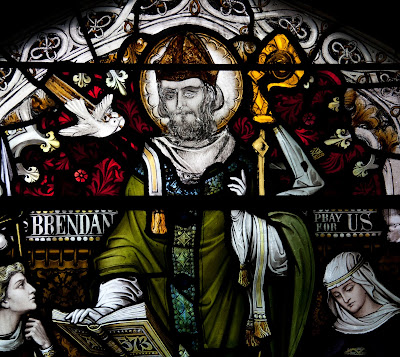
Saint Brendan of Birr in a stained-glass window in Saint Brendan’s Church, Birr, Co Offaly (Photograph: Window Andreas F. Borchert, Wikipedia / CC BY-SA 4.0)
Patrick Comerford
The Season of Advent began yesterday (Sunday 28 November 2021), and it was a busy day, concluding with the Advent Procession of Service of Light in Saint Mary’s Cathedral, Limerick.
Before a busy day and a busy week begins, I am taking some time early this morning for prayer, reflection and reading.
Each morning in the Advent, I am reflecting in these ways:
1, Reflections on a saint remembered in the calendars of the Church during Advent;
2, the day’s Gospel reading;
3, a prayer from the USPG prayer diary.
Today (29 November 2021) is the feast day of Saint Brendan of Birr, who died ca 572, one of the saints of this diocese.
Saint Brendan of Birr is one of the early saints of the sixth century. He was a monk and later an abbot, and he is known as Saint Brendan the Elder, to distinguish him from his contemporary and friend Saint Brendan the Navigator of Clonfert.
Saint Brendan of Birr as a friend and disciple of Saint Columba, and was one of the 12 students who studied under Saint Finian at Clonard and became known as the Twelve Apostles of Ireland.
These 12 holy men were:
● Saint Ciaran of Seir-Kieran;
● Saint Ciaran of Clonmacnoise;
● Saint Brendan of Birr;
● Saint Brendan of Clonfert;
● Saint Columba of Terryglass;
● Saint Columba of Kells and Iona;
● Saint Mobhi of Glasnevin;
● Saint Ruadhan of Lorrha;
● Saint Senan of Scattery Island;
● Saint Ninnidh of Inismacsaint on Loch Erne;
● Saint Lasserian of Leighlin;
● Saint Canice of Aghaboe.
At an early age, Brendan became a pupil in Saint Finian’s monastic school at Clonard Abbey, once said to have had up to 3,000 students. At Clonard, he became a friend and companion of Saint Ciarán of Saigir and Saint Brendan of Clonfert.
He founded the monastery at Birr in Co Offaly ca 540, and became its abbot. Early Irish writings depict him as a man of generous hospitality with a reputation for sanctity and spirituality who was an intuitive judge of character.
Saint Brenan attended the synod of Meltown, when Saint Columba was tried for his role in the Battle of Cúl Dreimhne. Saint Brendan spoke on behalf of Saint Columba, and the synod decided to sentence Columba to exile rather to excommunication.
The friendship between Brenan and Columba resulted in important links between Birr and the Columban foundations. It is said that Saint Columba had a vision of Saint Brendan’s soul being carried away by angels after his death.
Saint Brendan’s monastery in Birr later produced the MacRegol Gospels, now in the Bodleian Library in Oxford.
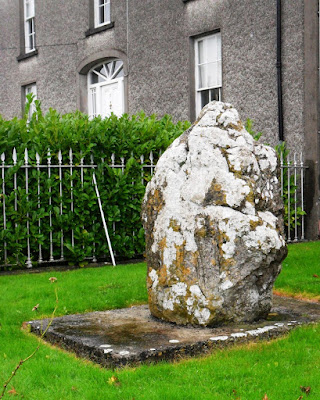
In the late 12th century, Giraldus Cambrensis referred to the ‘Birr Stone’ as umbilicus Hiberniae, the navel of Ireland. The stone is a block of limestone around 250 million years old, and was probably part of a megalithic monument. It is said to have marked a meeting place of the Fianna, and was taken from Birr in 1828 and was used as a Mass rock, but returned to Birr in 1974.
The Birr Stone … described by Giraldus Cambrensis as umbilicus Hiberniae, the navel of Ireland (Photograph: Patrick Comerford, 2010)
Matthew 8: 5-13 (NRSVA):
5 When he [Jesus] entered Capernaum, a centurion came to him, appealing to him 6 and saying, ‘Lord, my servant is lying at home paralysed, in terrible distress.’ 7 And he said to him, ‘I will come and cure him.’ 8 The centurion answered, ‘Lord, I am not worthy to have you come under my roof; but only speak the word, and my servant will be healed. 9 For I also am a man under authority, with soldiers under me; and I say to one, “Go”, and he goes, and to another, “Come”, and he comes, and to my slave, “Do this”, and the slave does it.’ 10 When Jesus heard him, he was amazed and said to those who followed him, ‘Truly I tell you, in no one in Israel have I found such faith. 11 I tell you, many will come from east and west and will eat with Abraham and Isaac and Jacob in the kingdom of heaven, 12 while the heirs of the kingdom will be thrown into the outer darkness, where there will be weeping and gnashing of teeth.’ 13 And to the centurion Jesus said, ‘Go; let it be done for you according to your faith.’ And the servant was healed in that hour.
The Prayer in the USPG Prayer Diary today (29 November 2021) invites us to pray:
Let us pray for the users of Hong Kong Sheng Kung Hui’s social and educational services; may they, through the work of the Church, come to know and experience God’s redemptive love for the humankind.
Yesterday: Saint Stephen the Younger
Tomorrow: Saint Andrew the Apostle
Scripture quotations are from the New Revised Standard Version Bible: Anglicised Edition copyright © 1989, 1995, National Council of the Churches of Christ in the United States of America. Used by permission. All rights reserved worldwide. http://nrsvbibles.org
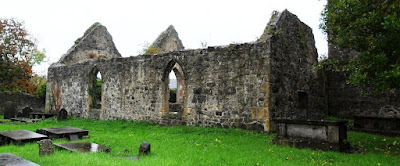
Saint Brendan’s … probably the site of the early monastic settlement in Birr (Photograph: Patrick Comerford)
Showing posts with label Saint Brendan. Show all posts
29 November 2021
03 June 2021
A sculpture in Cahersiveen
recalls the ‘Skellig Monks’
The ‘Skellig Monks’ … a landmark sculpture by Éamonn O’Doherty in Cahersiveen on the Ring of Kerry (Photograph: Patrick Comerford, 2021)
Patrick Comerford
The ‘Skellig Monks’ is a landmark sculpture on the eastern fringe of Cahersiveen, Co Kerry, looking out onto Dingle Bay. The monks have been there since 1995, and have become a well-known sight on the Ring of Kerry.
The ‘Skellig Monks’ are four monks in a crescent moon-shaped or sickle-shaped boat, originally with a mast in the shape of a cross. The sculpture stands in the air, between the mountains and the sea, supported on eight oars.
The sculpture, also known as ‘Saint Brendan’s Voyage,’ represents Saint Brendan and his fellow monks on their voyage to the monastery at Skellig Michael, where they founded an early monastery on the rocks off the Kerry coast.
Saint Brendan of Ardfert or Saint Brendan of Clonfert is also known as Saint Brendan the Navigator, and is said to have lived ca 484 to ca 577). He is known for his legendary quest for the ‘Isle of the Blessed’ and his encounter with a whale on his sea voyage.
The sculpture was completed in 1995 by the Irish sculptor, painter, printmaker, architect, photographer and lecturer Éamonn O’Doherty (1938 -2011), who is known for his sculptures in public places.
His well-known public sculptures include the Anna Livia monument, or the ‘Floozie in the Jacuzzi,’ moved in 2011 from O’Connell Street to the Croppies’ Acre Memorial Park in Dublin; the Quincentennial sculpture in Eyre Square, Galway; the Wind sculpture, Dublin; the James Connolly Memorial near Liberty Hall, Dublin; Crann an Oir at the Central Bank of Ireland, Dublin; and ‘Fuascailt,’ a sculpture of 1798 United Irish pikemen on the N25 outside Wexford near Barntown and Taghmon.
Éamonn O’Doherty was born and raised in Derry and studied architecture at University College Dublin (UCD). He was the first manager of Sweeney’s Men, and painted the band’s logo on the front of their van in 1966. That year he also toured Denmark with Andy Irvine.
Later he became a lecturer at the Department of Architecture at the Dublin Institute of Technology, and also taught at the Dún Laoghaire College of Art and Design, the École Spéciale d’Architecture, Paris, Harvard, the University of Nebraska and the University of Jordan. He received many awards for his paintings, and an exhibition of his photographs in the Irish Traditional Music Archive toured the US.
Éamonn O’Doherty married Barbara Ó Brolchain, and they were the parents of three daughters and a son. He died in Dublin on 4 August 2011 at the age of 72.
Since the sculpture was erected in 1995, the boat has lost its mast in the shape of a cross. I wonder too whether I am alone in noticing that the monks appear to be sailing into Dingle Bay rather than sailing out to the Skelligs Rocks and the Atlantic.
The ‘Skellig Monks’ between the mountains and the sea … but what has happed to their cross-shaped mast? (Photograph: Patrick Comerford, 2021)
Patrick Comerford
The ‘Skellig Monks’ is a landmark sculpture on the eastern fringe of Cahersiveen, Co Kerry, looking out onto Dingle Bay. The monks have been there since 1995, and have become a well-known sight on the Ring of Kerry.
The ‘Skellig Monks’ are four monks in a crescent moon-shaped or sickle-shaped boat, originally with a mast in the shape of a cross. The sculpture stands in the air, between the mountains and the sea, supported on eight oars.
The sculpture, also known as ‘Saint Brendan’s Voyage,’ represents Saint Brendan and his fellow monks on their voyage to the monastery at Skellig Michael, where they founded an early monastery on the rocks off the Kerry coast.
Saint Brendan of Ardfert or Saint Brendan of Clonfert is also known as Saint Brendan the Navigator, and is said to have lived ca 484 to ca 577). He is known for his legendary quest for the ‘Isle of the Blessed’ and his encounter with a whale on his sea voyage.
The sculpture was completed in 1995 by the Irish sculptor, painter, printmaker, architect, photographer and lecturer Éamonn O’Doherty (1938 -2011), who is known for his sculptures in public places.
His well-known public sculptures include the Anna Livia monument, or the ‘Floozie in the Jacuzzi,’ moved in 2011 from O’Connell Street to the Croppies’ Acre Memorial Park in Dublin; the Quincentennial sculpture in Eyre Square, Galway; the Wind sculpture, Dublin; the James Connolly Memorial near Liberty Hall, Dublin; Crann an Oir at the Central Bank of Ireland, Dublin; and ‘Fuascailt,’ a sculpture of 1798 United Irish pikemen on the N25 outside Wexford near Barntown and Taghmon.
Éamonn O’Doherty was born and raised in Derry and studied architecture at University College Dublin (UCD). He was the first manager of Sweeney’s Men, and painted the band’s logo on the front of their van in 1966. That year he also toured Denmark with Andy Irvine.
Later he became a lecturer at the Department of Architecture at the Dublin Institute of Technology, and also taught at the Dún Laoghaire College of Art and Design, the École Spéciale d’Architecture, Paris, Harvard, the University of Nebraska and the University of Jordan. He received many awards for his paintings, and an exhibition of his photographs in the Irish Traditional Music Archive toured the US.
Éamonn O’Doherty married Barbara Ó Brolchain, and they were the parents of three daughters and a son. He died in Dublin on 4 August 2011 at the age of 72.
Since the sculpture was erected in 1995, the boat has lost its mast in the shape of a cross. I wonder too whether I am alone in noticing that the monks appear to be sailing into Dingle Bay rather than sailing out to the Skelligs Rocks and the Atlantic.
The ‘Skellig Monks’ between the mountains and the sea … but what has happed to their cross-shaped mast? (Photograph: Patrick Comerford, 2021)
24 February 2021
Praying in Lent and Easter 2021:
8, Saint Brendan’s Church, Tarbert
Saint Brendan’s Church, Tarbert, Co Kerry, one of the four churches in the Rathkeale and Kilnaughtin Group of Parishes (Photograph: Patrick Comerford)
Patrick Comerford
During Lent and Easter this year, I am taking some time each morning to reflect in these ways:
1, a photograph of a church or place of worship that has been significant in my spiritual life;
2, the day’s Gospel reading;
3, a prayer from the prayer diary of the Anglican mission agency USPG (United Society, Partners in the Gospel).
This week I am offering photographs from seven churches in which I have served during my ministry. My photograph this morning (24 February 2021) is of Saint Brendan’s Church, Tarbert, Co Kerry, one of the four churches in the Rathkeale and Kilnaughtin Group of Parishes, where I have been the priest-in-charge since 2017.
Luke 11: 29-32 (NRSVA):
29 When the crowds were increasing, he began to say, ‘This generation is an evil generation; it asks for a sign, but no sign will be given to it except the sign of Jonah. 30 For just as Jonah became a sign to the people of Nineveh, so the Son of Man will be to this generation. 31 The queen of the South will rise at the judgement with the people of this generation and condemn them, because she came from the ends of the earth to listen to the wisdom of Solomon, and see, something greater than Solomon is here! 32 The people of Nineveh will rise up at the judgement with this generation and condemn it, because they repented at the proclamation of Jonah, and see, something greater than Jonah is here!’
Prayer in the USPG Prayer Diary:
The USPG Prayer Diary today (24 February 2021) invites us to pray:
Let us pray for the courage to spread the good news of the self-giving love of Christ.
Yesterday’s reflection
Continued tomorrow
Inside Saint Brendan’s Church, Tarbert, Co Kerry (Photograph: Patrick Comerford)
Scripture quotations are from the New Revised Standard Version Bible: Anglicised Edition copyright © 1989, 1995, National Council of the Churches of Christ in the United States of America. Used by permission. All rights reserved worldwide. http://nrsvbibles.org
Patrick Comerford
During Lent and Easter this year, I am taking some time each morning to reflect in these ways:
1, a photograph of a church or place of worship that has been significant in my spiritual life;
2, the day’s Gospel reading;
3, a prayer from the prayer diary of the Anglican mission agency USPG (United Society, Partners in the Gospel).
This week I am offering photographs from seven churches in which I have served during my ministry. My photograph this morning (24 February 2021) is of Saint Brendan’s Church, Tarbert, Co Kerry, one of the four churches in the Rathkeale and Kilnaughtin Group of Parishes, where I have been the priest-in-charge since 2017.
Luke 11: 29-32 (NRSVA):
29 When the crowds were increasing, he began to say, ‘This generation is an evil generation; it asks for a sign, but no sign will be given to it except the sign of Jonah. 30 For just as Jonah became a sign to the people of Nineveh, so the Son of Man will be to this generation. 31 The queen of the South will rise at the judgement with the people of this generation and condemn them, because she came from the ends of the earth to listen to the wisdom of Solomon, and see, something greater than Solomon is here! 32 The people of Nineveh will rise up at the judgement with this generation and condemn it, because they repented at the proclamation of Jonah, and see, something greater than Jonah is here!’
Prayer in the USPG Prayer Diary:
The USPG Prayer Diary today (24 February 2021) invites us to pray:
Let us pray for the courage to spread the good news of the self-giving love of Christ.
Yesterday’s reflection
Continued tomorrow
Inside Saint Brendan’s Church, Tarbert, Co Kerry (Photograph: Patrick Comerford)
Scripture quotations are from the New Revised Standard Version Bible: Anglicised Edition copyright © 1989, 1995, National Council of the Churches of Christ in the United States of America. Used by permission. All rights reserved worldwide. http://nrsvbibles.org
07 October 2020
Aghadoe Cathedral and its
ruins near Killarney … but
was this ever a cathedral?
The ruins of Aghadoe Cathedral, Co Kerry, above the Lakes of Killarney … but was this ever a diocesan cathedral? (Photograph: Patrick Comerford, 2020)
Patrick Comerford
Since being appointed Precentor of Limerick, Killaloe and Clonfert in early 2017, I have tried to visit all the cathedrals and former cathedrals in the diocese.
Last week, on my way back to Askeaton from Sneem and Kenmare, I stopped near Killarney, Co Kerry, to visit the ruins of Aghadoe Cathedral, below the Aghadoe Heights Hotel and about 5 km outside Killarney.
The cathedral ruins stand on a hilltop overlooking Lough Leane and the town and the Lakes of Killarney. Aghadoe may have been the site of a church as early as the seventh century, but the present remains date from a church built in the 11th and 12th centuries.
The name Aghadoe (Achadh Deo) means the ‘field of two yews.’ This may have been a pagan religious site. Although the Church of Ireland diocese in Co Kerry is called the Diocese of Ardfert and Aghadoe, historians continue to debate whether Aghadoe was ever the seat of a bishop or a cathedral, or whether there ever was a separate Diocese of Aghadoe.
The church site at Aghadoe has been associated with the fifth century missionary, Saint Abban, and legend says that Aghadoe was linked to Innisfallen and its island monastery by a causeway across Lough Leane, the largest of the Lakes of Killarney.
A surviving ogham stone cemented into the south wall of the chancel (Photograph: Patrick Comerford, 2020)
Two ogham stones found at Aghadoe suggest that this was an important church site from the mid-seventh century. One stone is now cemented in the south wall of the chancel and bears an inscription transcribed as ‘Brruanann.’ The inscription may have been intended as ‘Brreanann,’ a possible reference to Saint Brendan.
A second ogham stone is now missing, but its inscription was transcribed as ‘Ggvvss Mn.’
Another early Christian artefact, a ‘bullaun,’ is outside the church, at the north-west corner of the nave. It may have been a quern-stone, but was later used as a holy water receptacle and rainwater collected in the hollow of the stone was said to have healing properties.
An early ‘bullaun’ at the north-west corner of the nave (Photograph: Patrick Comerford, 2020)
The Annals of Innisfallen say Saint Finian the Leper, a disciple of Saint Columba, founded a monastery at Aghadoe in the seventh century. Saint Finian was part of the traditionalist party in the debate about the date of Easter. He died ca 635, and his feast-day is on 21 October.
The monastery at Aghadoe had close links with the neighbouring monastery on Innisfallen Island, and the first written record of a monastery at Aghadoe dates is in the Annals of Innisfallen in 939, when Aghadoe monastery is referred to as the ‘Old Abbey.’
Maelsuthain O Carroll, one of the finest scholars at Innisfallen, died in 1010 and was buried at Aghadoe.
The Annals of Innisfallen refer to the first stone building on the site in 1027, with the building of Damh Liag Maenig, Maenach’s house of stone. Building the round tower began that year too. O Cathail, the heir to the local dynasty of Eóganacht Locha Léin, was captured in the church in 1061, taken away and murdered.
Amhlaoibh Mór Ó Donoghue tried forcibly to move the see from Ardfert to Aghadoe (Photograph: Patrick Comerford, 2020)
When the Synod of Ráith Breasail delineated territorial diocese in 1111, the Diocese of Ardfert became the diocese for the Kingdom of Ciarraige (Kerry), but also included the territory of the Eóganacht Locha Léin, the dynastic rulers in the Killarney and south Kerry area.
In the mid-12th century, Amhlaoibh Mór Ó Donoghue, the leader of the Ó Donoghues – the new rulers of Eóganacht Locha Léin – began building a new stone church, later called the ‘Great Church,’ in the Romanesque style and dedicated to the Holy Trinity.
The new church was completed in 1158, and Amhlaoibh Mór Ó Donoghue tried forcibly to move the see from Ardfert to Aghadoe.
The Romanesque doorway at the west end of Aghadoe Cathedral (Photograph: Patrick Comerford, 2020)
The new church incorporated part of the old stone building in its north-west section and it forms the western section of the church that remains standing today. The western doorway is in the Romanesque style, with a three-order arch decorated with geometric patterns on the second and third order while the first is plain.
When Amhlaoibh Mór Ó Donoghue was defeated and killed by the O’Briens of Thomond, his body was carried to Aghadoe and buried in the church in 1166.
The final addition to the church in the 12th century This addition served as a chancel or choir, and was later separated from the rest of the church by a wall.
A detail of the Romanesque doorway at the west end of Aghadoe Cathedral (Photograph: Patrick Comerford, 2020)
The so-called nave is 11 metres long and 7 metres wide, and is entered through a fine, sandstone, Romanesque west doorway of three orders and with the remains of a fourth. It shows signs of rebuilding, and some of the stones have been reset incorrectly.
The arches show geometric patterns, and the shaft of the second order has interesting cut-away designs, while its arch has dog-tooth carving.
The south wall of the nave has been partly demolished, although one window survives, and there is a matching but smaller window in the north wall.
Inside the so-called nave of Aghadoe Cathedral (Photograph: Patrick Comerford, 2020)
The Gothic chancel or choir is 13.6 metres long and 7 metres wide. The east wall has two 13th century round-headed recessed lancet windows with carved head and flower stones at the interior intersection. The north wall is at full height but the south wall is only about chest high and survives in two sections. On one section rests the surviving ogham stone, on the other portion of a weathered red sandstone carving.
References in Papal letters in the 13th century support the notion that there was once a Diocese of Aghadoe. Dionysus, Archdeacon of Aghadoe, is said to have been made Bishop of Aghadoe in 1266. But after that, the clergy associated with Aghadoe are described as archdeacons.
According to the Annals of Innisfallen, Aghadoe Cathedral’s high cross fell in a strong wind in 1282.
Dermit Y’Sylleevayn or O’Sullivan, Archdeacon of Aghadoe and Vicar of Kilcrohane (Sneem) in the late 15th century, was accused of simony in in 1455, but managed to be reappointed to his positions.
Inside the so-called chancel of Aghadoe Cathedral (Photograph: Patrick Comerford, 2020)
From the 16th century, the Church of Ireland referred to the Diocese of Ardfert and Aghadoe, although Aghadoe was only a deanery within the Diocese of Ardfert. The church is mentioned in a 1615 report, but it is excluded from a list of abbeys in the report suggesting it had become only an archdeaconry.
When Richard O’Connell, the Roman Catholic Bishop of Ardfert and Aghadoe, died ca 1650, he was buried in Aghadoe.
The town that survived at Aghadoe was sacked by Cromwellian forces in the 1650s. After the Caroline restoration, the Diocese of Ardfert and Aghadoe was united with the Diocese of Limerick, with Edward Synge as Bishop of Limerick, Ardfert and Aghadoe.
John Smith was Archdeacon of Aghadoe (1664-1680) and Dean of Limerick (1666-1680) until he became Bishop of Killala. His successors, Thomas Hynde or Hinde and Ezekiel Weebe were also Archdeacons of Aghadoe and Deans of Limerick.
A surviving fragment of a red sandstone block with an a 17th or 18th century carving depicting the crucifixion (Photograph: Patrick Comerford, 2020)
The church at Aghadoe may have fallen into ruin in the later 17th century. Mortared onto the top of a portion of the south wall, close to the ogham stone, is a surviving fragment of red sandstone block with a 17th or 18th century carving, depicting the crucifixion, with the Virgin Mary passing a chalice to Christ on the cross and an angel. The survival of this stone suggests Aghadoe was still used as a church site in the 17th century.
Aghadoe is no longer listed as an active parish by 1740, and seems to have ceased functioning. Charles Smith, in The antient and present state of the county of Kerry, says in 1756, ‘The cathedral church of Aghadoe has been in ruins time out of mind.’
The Romanesque doorway was crudely rebuilt in the 18th or 19th century.
The cathedral at Aghadoe was in ruins by the mid-18th century (Photograph: Patrick Comerford, 2020)
Many of the later Archdeacons of Aghadoe were non-resident pluralists, and in 1788 Archdeacon Richard Leslie was deprived for non-residence, and was jailed for debt. He later became Archdeacon of Madras and died in Fort St George, Madras, in 1818.
Sir George Bishopp was Archdeacon of Aghadoe (1816-1834) at the same time as he was Dean of Lismore (1831-1834) and Sub-Dean of the Chapel Royal (1822-1831).
Samuel Lewis, in his Topographical Dictionary in 1837, mentions that another church was being ‘contemplated’ to stand beside the old cathedral ruins. A new parish church for Aghadoe was consecrated on 18 May 1842.
One of the finest artefacts related to Aghadoe is a 12th century crosier found in 1848, now at the National Museum in Dublin. The crosier was carved from walrus ivory and decorated in the Urnes style, most associated with Vikings. It depicts a foliage motif that develops and curves into the shape of a monster with a man in his open jaws. The carvings are similar to those on the jambs of the Romanesque doorway of the cathedral.
Another crosier, possibly associated with Aghadoe, was found in the Lakes of Killarney in 1867 by a fisherman, who thought it was a salmon.
Surviving fragments at the south wall of Aghadoe Cathedral (Photograph: Patrick Comerford, 2020)
Today, Aghadoe Cathedral is a small, roofless, two-chamber building. Tradition says the nave was dedicated to Saint Finian and the chancel to the Holy Trinity. But, despite these traditions and names, it is questionable whether they ever served as a nave and a chancel of a cathedral. The dividing wall shows no traces of a chancel arch, and only a small, blocked connecting doorway on its north side.
The position of Archdeacon of Aghadoe survived in the Church of Ireland until 1922, when it was amalgamated with that of Archdeacon of Ardfert, and the parish of Aghadoe was united with Killarney and Muckross.
The name of the Roman Catholic diocese was changed from Ardfert and Aghadoe to Kerry in 1952.
In the Church of Ireland, since 1972, Ardfert and Aghadoe has been part of the United Dioceses of Limerick, Ardfert, Aghadoe, Killaloe, Clonfert, Kilmacduagh and Emly.
The Victorian church in Aghadoe, which was never called a cathedral, was deconsecrated on 27 February 1992. The priest-in-charge of Killarney, the Ven Simon Lumby, has been Archdeacon of Limerick, Ardfert and Aghadoe since 2016.
The surviving stump of the round tower at Aghadoe Cathedral (Photograph: Patrick Comerford, 2020)
Patrick Comerford
Since being appointed Precentor of Limerick, Killaloe and Clonfert in early 2017, I have tried to visit all the cathedrals and former cathedrals in the diocese.
Last week, on my way back to Askeaton from Sneem and Kenmare, I stopped near Killarney, Co Kerry, to visit the ruins of Aghadoe Cathedral, below the Aghadoe Heights Hotel and about 5 km outside Killarney.
The cathedral ruins stand on a hilltop overlooking Lough Leane and the town and the Lakes of Killarney. Aghadoe may have been the site of a church as early as the seventh century, but the present remains date from a church built in the 11th and 12th centuries.
The name Aghadoe (Achadh Deo) means the ‘field of two yews.’ This may have been a pagan religious site. Although the Church of Ireland diocese in Co Kerry is called the Diocese of Ardfert and Aghadoe, historians continue to debate whether Aghadoe was ever the seat of a bishop or a cathedral, or whether there ever was a separate Diocese of Aghadoe.
The church site at Aghadoe has been associated with the fifth century missionary, Saint Abban, and legend says that Aghadoe was linked to Innisfallen and its island monastery by a causeway across Lough Leane, the largest of the Lakes of Killarney.
A surviving ogham stone cemented into the south wall of the chancel (Photograph: Patrick Comerford, 2020)
Two ogham stones found at Aghadoe suggest that this was an important church site from the mid-seventh century. One stone is now cemented in the south wall of the chancel and bears an inscription transcribed as ‘Brruanann.’ The inscription may have been intended as ‘Brreanann,’ a possible reference to Saint Brendan.
A second ogham stone is now missing, but its inscription was transcribed as ‘Ggvvss Mn.’
Another early Christian artefact, a ‘bullaun,’ is outside the church, at the north-west corner of the nave. It may have been a quern-stone, but was later used as a holy water receptacle and rainwater collected in the hollow of the stone was said to have healing properties.
An early ‘bullaun’ at the north-west corner of the nave (Photograph: Patrick Comerford, 2020)
The Annals of Innisfallen say Saint Finian the Leper, a disciple of Saint Columba, founded a monastery at Aghadoe in the seventh century. Saint Finian was part of the traditionalist party in the debate about the date of Easter. He died ca 635, and his feast-day is on 21 October.
The monastery at Aghadoe had close links with the neighbouring monastery on Innisfallen Island, and the first written record of a monastery at Aghadoe dates is in the Annals of Innisfallen in 939, when Aghadoe monastery is referred to as the ‘Old Abbey.’
Maelsuthain O Carroll, one of the finest scholars at Innisfallen, died in 1010 and was buried at Aghadoe.
The Annals of Innisfallen refer to the first stone building on the site in 1027, with the building of Damh Liag Maenig, Maenach’s house of stone. Building the round tower began that year too. O Cathail, the heir to the local dynasty of Eóganacht Locha Léin, was captured in the church in 1061, taken away and murdered.
Amhlaoibh Mór Ó Donoghue tried forcibly to move the see from Ardfert to Aghadoe (Photograph: Patrick Comerford, 2020)
When the Synod of Ráith Breasail delineated territorial diocese in 1111, the Diocese of Ardfert became the diocese for the Kingdom of Ciarraige (Kerry), but also included the territory of the Eóganacht Locha Léin, the dynastic rulers in the Killarney and south Kerry area.
In the mid-12th century, Amhlaoibh Mór Ó Donoghue, the leader of the Ó Donoghues – the new rulers of Eóganacht Locha Léin – began building a new stone church, later called the ‘Great Church,’ in the Romanesque style and dedicated to the Holy Trinity.
The new church was completed in 1158, and Amhlaoibh Mór Ó Donoghue tried forcibly to move the see from Ardfert to Aghadoe.
The Romanesque doorway at the west end of Aghadoe Cathedral (Photograph: Patrick Comerford, 2020)
The new church incorporated part of the old stone building in its north-west section and it forms the western section of the church that remains standing today. The western doorway is in the Romanesque style, with a three-order arch decorated with geometric patterns on the second and third order while the first is plain.
When Amhlaoibh Mór Ó Donoghue was defeated and killed by the O’Briens of Thomond, his body was carried to Aghadoe and buried in the church in 1166.
The final addition to the church in the 12th century This addition served as a chancel or choir, and was later separated from the rest of the church by a wall.
A detail of the Romanesque doorway at the west end of Aghadoe Cathedral (Photograph: Patrick Comerford, 2020)
The so-called nave is 11 metres long and 7 metres wide, and is entered through a fine, sandstone, Romanesque west doorway of three orders and with the remains of a fourth. It shows signs of rebuilding, and some of the stones have been reset incorrectly.
The arches show geometric patterns, and the shaft of the second order has interesting cut-away designs, while its arch has dog-tooth carving.
The south wall of the nave has been partly demolished, although one window survives, and there is a matching but smaller window in the north wall.
Inside the so-called nave of Aghadoe Cathedral (Photograph: Patrick Comerford, 2020)
The Gothic chancel or choir is 13.6 metres long and 7 metres wide. The east wall has two 13th century round-headed recessed lancet windows with carved head and flower stones at the interior intersection. The north wall is at full height but the south wall is only about chest high and survives in two sections. On one section rests the surviving ogham stone, on the other portion of a weathered red sandstone carving.
References in Papal letters in the 13th century support the notion that there was once a Diocese of Aghadoe. Dionysus, Archdeacon of Aghadoe, is said to have been made Bishop of Aghadoe in 1266. But after that, the clergy associated with Aghadoe are described as archdeacons.
According to the Annals of Innisfallen, Aghadoe Cathedral’s high cross fell in a strong wind in 1282.
Dermit Y’Sylleevayn or O’Sullivan, Archdeacon of Aghadoe and Vicar of Kilcrohane (Sneem) in the late 15th century, was accused of simony in in 1455, but managed to be reappointed to his positions.
Inside the so-called chancel of Aghadoe Cathedral (Photograph: Patrick Comerford, 2020)
From the 16th century, the Church of Ireland referred to the Diocese of Ardfert and Aghadoe, although Aghadoe was only a deanery within the Diocese of Ardfert. The church is mentioned in a 1615 report, but it is excluded from a list of abbeys in the report suggesting it had become only an archdeaconry.
When Richard O’Connell, the Roman Catholic Bishop of Ardfert and Aghadoe, died ca 1650, he was buried in Aghadoe.
The town that survived at Aghadoe was sacked by Cromwellian forces in the 1650s. After the Caroline restoration, the Diocese of Ardfert and Aghadoe was united with the Diocese of Limerick, with Edward Synge as Bishop of Limerick, Ardfert and Aghadoe.
John Smith was Archdeacon of Aghadoe (1664-1680) and Dean of Limerick (1666-1680) until he became Bishop of Killala. His successors, Thomas Hynde or Hinde and Ezekiel Weebe were also Archdeacons of Aghadoe and Deans of Limerick.
A surviving fragment of a red sandstone block with an a 17th or 18th century carving depicting the crucifixion (Photograph: Patrick Comerford, 2020)
The church at Aghadoe may have fallen into ruin in the later 17th century. Mortared onto the top of a portion of the south wall, close to the ogham stone, is a surviving fragment of red sandstone block with a 17th or 18th century carving, depicting the crucifixion, with the Virgin Mary passing a chalice to Christ on the cross and an angel. The survival of this stone suggests Aghadoe was still used as a church site in the 17th century.
Aghadoe is no longer listed as an active parish by 1740, and seems to have ceased functioning. Charles Smith, in The antient and present state of the county of Kerry, says in 1756, ‘The cathedral church of Aghadoe has been in ruins time out of mind.’
The Romanesque doorway was crudely rebuilt in the 18th or 19th century.
The cathedral at Aghadoe was in ruins by the mid-18th century (Photograph: Patrick Comerford, 2020)
Many of the later Archdeacons of Aghadoe were non-resident pluralists, and in 1788 Archdeacon Richard Leslie was deprived for non-residence, and was jailed for debt. He later became Archdeacon of Madras and died in Fort St George, Madras, in 1818.
Sir George Bishopp was Archdeacon of Aghadoe (1816-1834) at the same time as he was Dean of Lismore (1831-1834) and Sub-Dean of the Chapel Royal (1822-1831).
Samuel Lewis, in his Topographical Dictionary in 1837, mentions that another church was being ‘contemplated’ to stand beside the old cathedral ruins. A new parish church for Aghadoe was consecrated on 18 May 1842.
One of the finest artefacts related to Aghadoe is a 12th century crosier found in 1848, now at the National Museum in Dublin. The crosier was carved from walrus ivory and decorated in the Urnes style, most associated with Vikings. It depicts a foliage motif that develops and curves into the shape of a monster with a man in his open jaws. The carvings are similar to those on the jambs of the Romanesque doorway of the cathedral.
Another crosier, possibly associated with Aghadoe, was found in the Lakes of Killarney in 1867 by a fisherman, who thought it was a salmon.
Surviving fragments at the south wall of Aghadoe Cathedral (Photograph: Patrick Comerford, 2020)
Today, Aghadoe Cathedral is a small, roofless, two-chamber building. Tradition says the nave was dedicated to Saint Finian and the chancel to the Holy Trinity. But, despite these traditions and names, it is questionable whether they ever served as a nave and a chancel of a cathedral. The dividing wall shows no traces of a chancel arch, and only a small, blocked connecting doorway on its north side.
The position of Archdeacon of Aghadoe survived in the Church of Ireland until 1922, when it was amalgamated with that of Archdeacon of Ardfert, and the parish of Aghadoe was united with Killarney and Muckross.
The name of the Roman Catholic diocese was changed from Ardfert and Aghadoe to Kerry in 1952.
In the Church of Ireland, since 1972, Ardfert and Aghadoe has been part of the United Dioceses of Limerick, Ardfert, Aghadoe, Killaloe, Clonfert, Kilmacduagh and Emly.
The Victorian church in Aghadoe, which was never called a cathedral, was deconsecrated on 27 February 1992. The priest-in-charge of Killarney, the Ven Simon Lumby, has been Archdeacon of Limerick, Ardfert and Aghadoe since 2016.
The surviving stump of the round tower at Aghadoe Cathedral (Photograph: Patrick Comerford, 2020)
05 October 2020
Saint Michael’s Church,
Sneem, a Hardwick church
on the Ring of Kerry
Saint Michael’s Church, Sneem, Co Kerry, designed by Philip Charles Hardwick and built in 1861-1865 (Photograph: Patrick Comerford, 2020)
Patrick Comerford
On my visit to Sneem on the Ring of Kerry earlier this summer, I had visited the Church of Ireland parish church, the Church of the Transfiguration, on the west bank of the River Sneem, on the road from Kenmare to Waterville.
When I visited Sneem last week, I also stopped to visit the Roman Catholic parish church, Saint Michael’s Church, on the east bank of the river, with spectacular views of the River Sneem as it falls below the below the bridge and opens out on its way into Kenmare Bay.
The first known Roman Catholic church in Sneem was built on the site in the early 19th century. There has been a church in Kilcrohane or Sneem since at least the 14th century, and the first Roman Catholic parish church and the Church of Ireland parish church, the Church of the Transfiguration, may have been at the same time, ca 1810.
This early church was small, with a mud floor and no pews, and was unable to meet the needs of the village.
Saint Michael’s Church stands above the east bank of the River Sneem (Photograph: Patrick Comerford, 2020)
Edwin Richard Wyndham-Quin (1812-1871), 3rd Earl of Dunraven, who had become a Roman Catholic in 1855. He lived at Adare Manor, and was renting a holiday home near Sneem on Garnish Island, from the Bland family. He was appalled by the condition of the small church in Sneem, and in 1855 he resolved to build a fitting place for divine worship at his own expense.
He commissioned a leading London architect, Philip Charles Hardwick (1822-1892), who was then working on rebuilding Adare Manor, to build a new church in Sneem. Hardwick’s other works included the Bank of England, Saint John’s Cathedral, Limerick, the Redemptorist church at Mount Saint Alphonsus in Limerick, and the parish churches in Adare, Co Limerick.
The design for the new church in Sneem was cruciform, and in the Italian style, with the length from the chancel to nave 100 ft, and the breadth across the transepts 74 feet. The cost of the project was estimated at £3,000 in the Dublin Builder on 15 September 1863. But it had soared 33 per cent by 4 August 1865, when the Dublin Builder reported that Lord Dunraven had spent the ‘princely sum of £4,000.’
The round-headed main door has sandstone surrounds and limestone steps (Photograph: Patrick Comerford, 2020)
The demolition of the old church began in 1861, and Denis William Murphy (1799-1863), from Bantry, Co Cork, was the building contractor. But Murphy died suddenly before the foundation stone was laid. His eldest son William Martin Murphy (1845-1919), then a mere 19-year-old, took over the business and completed the building.
William Martin Murphy had laid the foundations for the fortune who built on by building railways and tram-tracks in England, Scotland and Argentina. He established the Irish Independent, was manager of the Dublin United Tramways Company, and played a controversial and antagonistic role in the workers’ strike and lockout in Dublin of 1913. He became the most hated man in Ireland before the outbreak of World War I.
The Bishop of Kerry, David Moriarty, blessed the foundation stone of the church in Sneem on 3 September 1863. He wrote in his diary that day: ‘Blessed the first stone on the new church in Sneem in honorem Sanctissimae Trinitatis et Sancti Michaelis Archangeli. Lord Dunraven, who donated the money for the church, was present. Dominus conservet eum et beatus faciat illium in terra! Father Michael Walsh, the most venerable of Irish priests PP, and Father Davis CC. A joyous day, bonfire and illuminations at night: I preached in English, and Archdeacon O’Sullivan in Irish. Lord Dunraven gave a very appropriate speech.’
Inside Saint Michael’s Church, Sneem, facing the liturgical east (Photograph: Patrick Comerford, 2020)
The Parish Priest of Sneem, Father Michael Walsh, was the subject of ‘Father O’Flynn,’ a celebrated ballad by the poet and songwriter, Arthur Perceval Graves (1846-1931). Graves was a son of Charles Graves (1812-1899), who had a summer residence home nearby at Parknasilla and who became Bishop of Limerick (1866-1899).
Local people packed the village for the ceremony that began at 1 p.m. The bishop and several clergy assembled on the Fair Green. The bishop led a procession to the site, and there they met the Earl of Dunraven. After the bishop preached, he blessed the foundation stone. Archdeacon O’Sullivan, from Kenmare, then stood on the foundation stone and spoke in Irish.
Lord Dunraven said he had travelled all over Ireland before deciding that Sneem was the place to build his holiday retreat. He recalled first going to Mass in the old church, and that while he was having his house built with every comfort, the House of God was ‘left desolate and in ruin.’ He praised the Bland family for leasing the site for the church, more land to plant the grounds, and refusing to take rent for the land. The original lease was for 91 years from Saint Michael’s Day, 29 September 1864, at a rent of one shilling a year.
Inside Saint Michael’s Church, Sneem, facing the liturgical west (Photograph: Patrick Comerford, 2020)
The contractors completed their work in less than two years. Bishop Moriarty returned to Sneem to open the new church on 27 July 1865 and to confirm 271 children.
In his diary on that date he wrote: ‘Blessed the church of Sneem sub invocatione SS Trinitatis et S Michaelis Archangeli. Doctor Butler celebrated High Mass. I preached. Lord Dunraven, the founder, was present, with Mr Maunsell and Mr S de Vere, Father Michael Walsh PP, Father Thomas Davis CC. Great festivities that evening in the village; confirmed 271. Well prepared.’
Dr George Butler (1815-1866) was the Bishop of Limerick (1864-1866); Maunsell was Dunraven’s brother-in-law, William Monsell (1812-1894) MP for Limerick (1847-1874) and later Lord Emly (1874); and Sir Stephen Edward de Vere (1812-1904) of Curraghchase, who was MP for Co Limerick (1854-1859), had become a Roman Catholic in 1847 and was a brother of the poet Aubrey de Vere (1814-1902), who is buried in Saint Mary’s churchyard in Askeaton.
Saint Michael’s Church, Sneem, has an open-truss roof and round arches in the transepts on circular columns (Photograph: Patrick Comerford, 2020)
Father Walsh entertained the guests to dinner in his presbytery. To cope with the numbers, he borrowed cutlery and crockery from his friend Dean Charles Graves of Parknasilla, then Dean of the Chapel Royal, Dublin, and of Saint Brendan’s Cathedral, Clonfert, and about to become Church of Ireland Bishop of Limerick in 1865. Dean Graves was a guest too at the celebrations that night. Whenever Father Walsh entertained his own bishop, it is said, he would borrow the quality tableware from the Graves household, but never let the bishop know he was dining off ‘Protestant plates.’
Press reports said Lord Dunraven and the other dignitaries left at 11 p.m. But the parishioners continued the festivities until the next morning. One account said that during the whole night there was not the least sign of disorder, and not a single man was to be seen with the signs of liquor on him.
Father Walsh died a year after the new church was completed and after a 37-year ministry in Sneem.
A stained-glass window in Saint Michael’s Church, Sneem, depicts the life of Saint Brendan the Navigator (Photograph: Patrick Comerford, 2020)
Saint Michael’s Church is a listed building. It is a cruciform-plan double-height Italianate style church, and it is oriented on a west-east axis rather that the traditional east-west liturgical axis. There is a three-bay double-height chancel at the west end, a three-bay double-height nave, single-bay double-height transepts, and a single-bay, three-stage tower that was renovated 1892.
The rubble stone walls have their original buttered mortar joints, and sandstone quoins with cement replacements at the lower levels. There are round-headed lancet windows with sandstone surrounds, including paired lancets in the nave. The round-headed doorways have sandstone surrounds and limestone steps.
Inside, the church has an open-truss roof, round arches in the transepts on circular columns, stained-glass windows and a marble font.
Saint Michael and two whales depicted in the Saint Brendant window in Sneem (Photograph: Patrick Comerford, 2020)
Major work was carried out on the roof in the early 1950s, and the church was reordered following the liturgical changes introduced by Vatican II, including the removal of the altar rails in the 1970s. Further restoration work was carried out in the 1980s.
The parish priest, Father Pat Murphy, launched an appeal in 2009 to raise €1 million for major renovation works.
The roof was insulated and re-slated, underfloor insulation and modern heating were installed, the floor was renewed – uncovering a Victorian mosaic – and the joints in the external walls were repointed. The lighting and sound systems were upgraded, wheelchair and vehicular access were provided, and the former ‘Nuns’ Chapel’ or ‘small church’ as it was known, was transformed into the sacristy. A new spacious entrance now faces the village. These recent renovations cost €1.2 million in total.
Father Pat Murphy became ill in December 2012, and the present parish priest is Father Liam O’Brien.
A whale depicted in the Saint Brendan window in Saint Michael’s Church, Sneem (Photograph: Patrick Comerford, 2020)
Patrick Comerford
On my visit to Sneem on the Ring of Kerry earlier this summer, I had visited the Church of Ireland parish church, the Church of the Transfiguration, on the west bank of the River Sneem, on the road from Kenmare to Waterville.
When I visited Sneem last week, I also stopped to visit the Roman Catholic parish church, Saint Michael’s Church, on the east bank of the river, with spectacular views of the River Sneem as it falls below the below the bridge and opens out on its way into Kenmare Bay.
The first known Roman Catholic church in Sneem was built on the site in the early 19th century. There has been a church in Kilcrohane or Sneem since at least the 14th century, and the first Roman Catholic parish church and the Church of Ireland parish church, the Church of the Transfiguration, may have been at the same time, ca 1810.
This early church was small, with a mud floor and no pews, and was unable to meet the needs of the village.
Saint Michael’s Church stands above the east bank of the River Sneem (Photograph: Patrick Comerford, 2020)
Edwin Richard Wyndham-Quin (1812-1871), 3rd Earl of Dunraven, who had become a Roman Catholic in 1855. He lived at Adare Manor, and was renting a holiday home near Sneem on Garnish Island, from the Bland family. He was appalled by the condition of the small church in Sneem, and in 1855 he resolved to build a fitting place for divine worship at his own expense.
He commissioned a leading London architect, Philip Charles Hardwick (1822-1892), who was then working on rebuilding Adare Manor, to build a new church in Sneem. Hardwick’s other works included the Bank of England, Saint John’s Cathedral, Limerick, the Redemptorist church at Mount Saint Alphonsus in Limerick, and the parish churches in Adare, Co Limerick.
The design for the new church in Sneem was cruciform, and in the Italian style, with the length from the chancel to nave 100 ft, and the breadth across the transepts 74 feet. The cost of the project was estimated at £3,000 in the Dublin Builder on 15 September 1863. But it had soared 33 per cent by 4 August 1865, when the Dublin Builder reported that Lord Dunraven had spent the ‘princely sum of £4,000.’
The round-headed main door has sandstone surrounds and limestone steps (Photograph: Patrick Comerford, 2020)
The demolition of the old church began in 1861, and Denis William Murphy (1799-1863), from Bantry, Co Cork, was the building contractor. But Murphy died suddenly before the foundation stone was laid. His eldest son William Martin Murphy (1845-1919), then a mere 19-year-old, took over the business and completed the building.
William Martin Murphy had laid the foundations for the fortune who built on by building railways and tram-tracks in England, Scotland and Argentina. He established the Irish Independent, was manager of the Dublin United Tramways Company, and played a controversial and antagonistic role in the workers’ strike and lockout in Dublin of 1913. He became the most hated man in Ireland before the outbreak of World War I.
The Bishop of Kerry, David Moriarty, blessed the foundation stone of the church in Sneem on 3 September 1863. He wrote in his diary that day: ‘Blessed the first stone on the new church in Sneem in honorem Sanctissimae Trinitatis et Sancti Michaelis Archangeli. Lord Dunraven, who donated the money for the church, was present. Dominus conservet eum et beatus faciat illium in terra! Father Michael Walsh, the most venerable of Irish priests PP, and Father Davis CC. A joyous day, bonfire and illuminations at night: I preached in English, and Archdeacon O’Sullivan in Irish. Lord Dunraven gave a very appropriate speech.’
Inside Saint Michael’s Church, Sneem, facing the liturgical east (Photograph: Patrick Comerford, 2020)
The Parish Priest of Sneem, Father Michael Walsh, was the subject of ‘Father O’Flynn,’ a celebrated ballad by the poet and songwriter, Arthur Perceval Graves (1846-1931). Graves was a son of Charles Graves (1812-1899), who had a summer residence home nearby at Parknasilla and who became Bishop of Limerick (1866-1899).
Local people packed the village for the ceremony that began at 1 p.m. The bishop and several clergy assembled on the Fair Green. The bishop led a procession to the site, and there they met the Earl of Dunraven. After the bishop preached, he blessed the foundation stone. Archdeacon O’Sullivan, from Kenmare, then stood on the foundation stone and spoke in Irish.
Lord Dunraven said he had travelled all over Ireland before deciding that Sneem was the place to build his holiday retreat. He recalled first going to Mass in the old church, and that while he was having his house built with every comfort, the House of God was ‘left desolate and in ruin.’ He praised the Bland family for leasing the site for the church, more land to plant the grounds, and refusing to take rent for the land. The original lease was for 91 years from Saint Michael’s Day, 29 September 1864, at a rent of one shilling a year.
Inside Saint Michael’s Church, Sneem, facing the liturgical west (Photograph: Patrick Comerford, 2020)
The contractors completed their work in less than two years. Bishop Moriarty returned to Sneem to open the new church on 27 July 1865 and to confirm 271 children.
In his diary on that date he wrote: ‘Blessed the church of Sneem sub invocatione SS Trinitatis et S Michaelis Archangeli. Doctor Butler celebrated High Mass. I preached. Lord Dunraven, the founder, was present, with Mr Maunsell and Mr S de Vere, Father Michael Walsh PP, Father Thomas Davis CC. Great festivities that evening in the village; confirmed 271. Well prepared.’
Dr George Butler (1815-1866) was the Bishop of Limerick (1864-1866); Maunsell was Dunraven’s brother-in-law, William Monsell (1812-1894) MP for Limerick (1847-1874) and later Lord Emly (1874); and Sir Stephen Edward de Vere (1812-1904) of Curraghchase, who was MP for Co Limerick (1854-1859), had become a Roman Catholic in 1847 and was a brother of the poet Aubrey de Vere (1814-1902), who is buried in Saint Mary’s churchyard in Askeaton.
Saint Michael’s Church, Sneem, has an open-truss roof and round arches in the transepts on circular columns (Photograph: Patrick Comerford, 2020)
Father Walsh entertained the guests to dinner in his presbytery. To cope with the numbers, he borrowed cutlery and crockery from his friend Dean Charles Graves of Parknasilla, then Dean of the Chapel Royal, Dublin, and of Saint Brendan’s Cathedral, Clonfert, and about to become Church of Ireland Bishop of Limerick in 1865. Dean Graves was a guest too at the celebrations that night. Whenever Father Walsh entertained his own bishop, it is said, he would borrow the quality tableware from the Graves household, but never let the bishop know he was dining off ‘Protestant plates.’
Press reports said Lord Dunraven and the other dignitaries left at 11 p.m. But the parishioners continued the festivities until the next morning. One account said that during the whole night there was not the least sign of disorder, and not a single man was to be seen with the signs of liquor on him.
Father Walsh died a year after the new church was completed and after a 37-year ministry in Sneem.
A stained-glass window in Saint Michael’s Church, Sneem, depicts the life of Saint Brendan the Navigator (Photograph: Patrick Comerford, 2020)
Saint Michael’s Church is a listed building. It is a cruciform-plan double-height Italianate style church, and it is oriented on a west-east axis rather that the traditional east-west liturgical axis. There is a three-bay double-height chancel at the west end, a three-bay double-height nave, single-bay double-height transepts, and a single-bay, three-stage tower that was renovated 1892.
The rubble stone walls have their original buttered mortar joints, and sandstone quoins with cement replacements at the lower levels. There are round-headed lancet windows with sandstone surrounds, including paired lancets in the nave. The round-headed doorways have sandstone surrounds and limestone steps.
Inside, the church has an open-truss roof, round arches in the transepts on circular columns, stained-glass windows and a marble font.
Saint Michael and two whales depicted in the Saint Brendant window in Sneem (Photograph: Patrick Comerford, 2020)
Major work was carried out on the roof in the early 1950s, and the church was reordered following the liturgical changes introduced by Vatican II, including the removal of the altar rails in the 1970s. Further restoration work was carried out in the 1980s.
The parish priest, Father Pat Murphy, launched an appeal in 2009 to raise €1 million for major renovation works.
The roof was insulated and re-slated, underfloor insulation and modern heating were installed, the floor was renewed – uncovering a Victorian mosaic – and the joints in the external walls were repointed. The lighting and sound systems were upgraded, wheelchair and vehicular access were provided, and the former ‘Nuns’ Chapel’ or ‘small church’ as it was known, was transformed into the sacristy. A new spacious entrance now faces the village. These recent renovations cost €1.2 million in total.
Father Pat Murphy became ill in December 2012, and the present parish priest is Father Liam O’Brien.
A whale depicted in the Saint Brendan window in Saint Michael’s Church, Sneem (Photograph: Patrick Comerford, 2020)
01 May 2018
Visiting Clonfert Cathedral
for the first time since
becoming Precentor
A detail in the great west doorway of Saint Brendan’s Cathedral, Clonfert, Co Galway (Photograph: Patrick Comerford, 2018)
Patrick Comerford
The Diocesan Training Programme for priests and readers in Limerick and Killaloe had a lively field trip yesterday [30 April 2018] to the three functioning cathedrals in the diocese.
We began in the morning in Saint Mary’s Cathedral, Limerick, moved on to Saint Flannan’s Cathedral, Killaloe, Co Clare, where we were shown around by the Dean of Killaloe, the Very Revd Gary Paulsen, before lunch, and finished at Saint Brendan’s Cathedral, Clonfert, Co Galway, where local parishioners welcomed us warmly and where I presided at our closing Eucharist.
It was a long day that no only took us to three cathedral, but also brought us through three provinces – Munster, Leinster and Connaught – and through five counties: Limerick, Clare, Tipperary, Offaly and Galway.
Although I have visited the cathedrals in Killaloe and Clonfert in the past, and have preached in Saint Flannan’s at an ordination in 1999 and again in 2016, this was my first time to visit both these cathedrals since I was installed as Precentor in the joint chapter of the three cathedrals on 19 February 2017, and my first opportunity to see the precentor’s stall in both Killaloe and Clonfert.
Saint Brendan’s Cathedral, Clonfert, was built in the 12th century at the site of an earlier 6th century monastic church said to have been founded by Saint Brendan.
The Diocese of Clonfert was definitively mapped out at the Synod of Rath Breasail in 1111, but the first stone cathedral on this site was not built for another half a century, ca 1167-1180.
The great west door of the cathedral has been described as the ‘crowning achievement’ of the Hiberno-Romanesque style (Photograph: Patrick Comerford, 2018)
The great west door of the cathedral has been described as the ‘crowning achievement’ of the Hiberno-Romanesque style in architecture and Irish Romanesque carving. It is a scheme depicting Christ in creation, with the Trinitarian theme of the pediment repeated in the triangles separating the human faces of the redeemed that project above animal heads, vegetable forms, animal-like inter-lacings, and the solid, mineral world.
The doorway consists of eight orders of jambs, all inclined inwards, surmounted first by seven orders of arches and then by a triangular pediment, bordered by carvings similar to rolled ropes or cables.
The rest of this doorway is an extraordinary mediaeval picture gallery. Above the apex of the pediment, two human heads protrude from the wall. In the pediment itself, ten more human heads – some bearded, some young and unshaven – appear between triangles with richly-carved ornamentations. Below this stage, more human heads are contained in the arches of a blind arcade immediately above the outermost order of the arch.
The orders of the arches display a variety of ornament, including flowers and beasts’ heads. The capitals are a veritable zoo of animal heads, including cats, horses, donkeys and dragons.
The innermost order is a replacement dating from the 15th century, and is a blue-grey limestone. Here, the carvings include an abbot, a bishop, a scroll of vine leaves and an angel.
Above the doorway, a pointed hood encloses triangles alternating with bizarre human heads. Below this, an arcade encloses more human heads. The supporting arches of the tower at the west end of the cathedral are also decorated with 15th century heads.
The chancel, altar and Romanesque windows in the chancel of Saint Brendan’s Cathedral, Clonfert (Photograph: Patrick Comerford, 2018)
I robed in the barrel-vaulted sacristy, off the north side of the chancel. This sacristy dates from the 15th century and has a fireplace as an unusual feature.
In the chancel, the early 13th century east windows are fine examples of late Romanesque windows. The stained-glass windows, depicting Saint Peter on the north and Saint Paul on the south, were donated by Thomas O’Connor in 1897 to celebrate Queen Victoria’s diamond jubilee.
The chancel arch was inserted in the 15th century, and is decorated with angels, a rosette and a mermaid holding a comb and mirror – perhaps a reference to the stories that grew up around Saint Brendan’s fabled voyages. The chancel floor is covered with encaustic tiles dating from 1870-1880.
A mermaid on the chancel arch in Saint Brendan’s Cathedral, Clonfert, Co Galway (Photograph: Patrick Comerford, 2018)
The cathedral had a Romanesque south transept, which is now in ruins, and a Gothic north transept, which has been removed.
The soft sandstone structure had weathered severely over the centuries. In 2000, Clonfert Cathedral was included in the 2000 World Monuments Watch by the World Monuments Fund. Because the cathedral has a small congregation and few parishioners with limited resources, outside support has been received from many organisations.
The bishop’s throne on the south side of the chancel dates from about 1850, and the altar, chapter stalls and pulpit date from around the same time, all beautifully carved in local oak.
The Precentor’s stall in the choir in Saint Brendan’s Cathedral, Clonfert, Co Galway (Photograph: Patrick Comerford, 2018)
The 16 stalls do not bear the titles of dignitaries or the names of prebendaries, but the Precentor’s stall is presumably the stall on the north side of the choir, opposite the dean’s stall.
Indeed, many reports in the 1830s and 1840s said repeatedly: ‘In the chapters of Tuam, Derry, Raphoe and Clonfert, there is neither precentor, chancellor, nor treasurer; in those of Elphin, Killalla and Achonry, there is neither chancellor nor treasurer; in those of Clogher and Emly, there is no treasurer; in those of Kildare and Waterford, the archdeacons are not members of the chapters.’
However, there is long list of Precentors of Clonfert, and one of my predecessors in this office was Robert Taylour (1689-1744), who built Ardgillan Castle, near Balbriggan, Co Dublin, in 1738.
Taylor was born in Cheshire, and studied at Trinity College, Dublin, before he was appointed Archdeacon of Kilmacduagh in 1714. He was appointed Precentor of Clonfert in 1722, while his brother-in-law, William Fitzgerald, was Bishop of Clonfert. Four years later , he was appointed Dean of Clonfert in 1726 succession to John Burdett.
Robert Taylor died unmarried in May 1744 and Ardgillan, together with its estate, passed to his eldest brother Sir Thomas Taylor (1686-1757), 2nd Baronet, of Headfort House, father of Thomas Taylor (1724-1795), 1st Earl of Bective.
The second earl became Marquess of Headfort and generations of the main branch of the Taylor or Taylour family continued to live at Headfort, Co Meath, and in Virginia, Co Cavan, while another branch of the family continued to live at Ardgillan Castle until 1962. The estate was sold in 1982 to Fingal County Council, which renovated the house, and it officially opened to the public in 1992.
Inside Saint Brendan’s Cathedral, Clonfert, Co Galway (Photograph: Patrick Comerford, 2018)
Patrick Comerford
The Diocesan Training Programme for priests and readers in Limerick and Killaloe had a lively field trip yesterday [30 April 2018] to the three functioning cathedrals in the diocese.
We began in the morning in Saint Mary’s Cathedral, Limerick, moved on to Saint Flannan’s Cathedral, Killaloe, Co Clare, where we were shown around by the Dean of Killaloe, the Very Revd Gary Paulsen, before lunch, and finished at Saint Brendan’s Cathedral, Clonfert, Co Galway, where local parishioners welcomed us warmly and where I presided at our closing Eucharist.
It was a long day that no only took us to three cathedral, but also brought us through three provinces – Munster, Leinster and Connaught – and through five counties: Limerick, Clare, Tipperary, Offaly and Galway.
Although I have visited the cathedrals in Killaloe and Clonfert in the past, and have preached in Saint Flannan’s at an ordination in 1999 and again in 2016, this was my first time to visit both these cathedrals since I was installed as Precentor in the joint chapter of the three cathedrals on 19 February 2017, and my first opportunity to see the precentor’s stall in both Killaloe and Clonfert.
Saint Brendan’s Cathedral, Clonfert, was built in the 12th century at the site of an earlier 6th century monastic church said to have been founded by Saint Brendan.
The Diocese of Clonfert was definitively mapped out at the Synod of Rath Breasail in 1111, but the first stone cathedral on this site was not built for another half a century, ca 1167-1180.
The great west door of the cathedral has been described as the ‘crowning achievement’ of the Hiberno-Romanesque style (Photograph: Patrick Comerford, 2018)
The great west door of the cathedral has been described as the ‘crowning achievement’ of the Hiberno-Romanesque style in architecture and Irish Romanesque carving. It is a scheme depicting Christ in creation, with the Trinitarian theme of the pediment repeated in the triangles separating the human faces of the redeemed that project above animal heads, vegetable forms, animal-like inter-lacings, and the solid, mineral world.
The doorway consists of eight orders of jambs, all inclined inwards, surmounted first by seven orders of arches and then by a triangular pediment, bordered by carvings similar to rolled ropes or cables.
The rest of this doorway is an extraordinary mediaeval picture gallery. Above the apex of the pediment, two human heads protrude from the wall. In the pediment itself, ten more human heads – some bearded, some young and unshaven – appear between triangles with richly-carved ornamentations. Below this stage, more human heads are contained in the arches of a blind arcade immediately above the outermost order of the arch.
The orders of the arches display a variety of ornament, including flowers and beasts’ heads. The capitals are a veritable zoo of animal heads, including cats, horses, donkeys and dragons.
The innermost order is a replacement dating from the 15th century, and is a blue-grey limestone. Here, the carvings include an abbot, a bishop, a scroll of vine leaves and an angel.
Above the doorway, a pointed hood encloses triangles alternating with bizarre human heads. Below this, an arcade encloses more human heads. The supporting arches of the tower at the west end of the cathedral are also decorated with 15th century heads.
The chancel, altar and Romanesque windows in the chancel of Saint Brendan’s Cathedral, Clonfert (Photograph: Patrick Comerford, 2018)
I robed in the barrel-vaulted sacristy, off the north side of the chancel. This sacristy dates from the 15th century and has a fireplace as an unusual feature.
In the chancel, the early 13th century east windows are fine examples of late Romanesque windows. The stained-glass windows, depicting Saint Peter on the north and Saint Paul on the south, were donated by Thomas O’Connor in 1897 to celebrate Queen Victoria’s diamond jubilee.
The chancel arch was inserted in the 15th century, and is decorated with angels, a rosette and a mermaid holding a comb and mirror – perhaps a reference to the stories that grew up around Saint Brendan’s fabled voyages. The chancel floor is covered with encaustic tiles dating from 1870-1880.
A mermaid on the chancel arch in Saint Brendan’s Cathedral, Clonfert, Co Galway (Photograph: Patrick Comerford, 2018)
The cathedral had a Romanesque south transept, which is now in ruins, and a Gothic north transept, which has been removed.
The soft sandstone structure had weathered severely over the centuries. In 2000, Clonfert Cathedral was included in the 2000 World Monuments Watch by the World Monuments Fund. Because the cathedral has a small congregation and few parishioners with limited resources, outside support has been received from many organisations.
The bishop’s throne on the south side of the chancel dates from about 1850, and the altar, chapter stalls and pulpit date from around the same time, all beautifully carved in local oak.
The Precentor’s stall in the choir in Saint Brendan’s Cathedral, Clonfert, Co Galway (Photograph: Patrick Comerford, 2018)
The 16 stalls do not bear the titles of dignitaries or the names of prebendaries, but the Precentor’s stall is presumably the stall on the north side of the choir, opposite the dean’s stall.
Indeed, many reports in the 1830s and 1840s said repeatedly: ‘In the chapters of Tuam, Derry, Raphoe and Clonfert, there is neither precentor, chancellor, nor treasurer; in those of Elphin, Killalla and Achonry, there is neither chancellor nor treasurer; in those of Clogher and Emly, there is no treasurer; in those of Kildare and Waterford, the archdeacons are not members of the chapters.’
However, there is long list of Precentors of Clonfert, and one of my predecessors in this office was Robert Taylour (1689-1744), who built Ardgillan Castle, near Balbriggan, Co Dublin, in 1738.
Taylor was born in Cheshire, and studied at Trinity College, Dublin, before he was appointed Archdeacon of Kilmacduagh in 1714. He was appointed Precentor of Clonfert in 1722, while his brother-in-law, William Fitzgerald, was Bishop of Clonfert. Four years later , he was appointed Dean of Clonfert in 1726 succession to John Burdett.
Robert Taylor died unmarried in May 1744 and Ardgillan, together with its estate, passed to his eldest brother Sir Thomas Taylor (1686-1757), 2nd Baronet, of Headfort House, father of Thomas Taylor (1724-1795), 1st Earl of Bective.
The second earl became Marquess of Headfort and generations of the main branch of the Taylor or Taylour family continued to live at Headfort, Co Meath, and in Virginia, Co Cavan, while another branch of the family continued to live at Ardgillan Castle until 1962. The estate was sold in 1982 to Fingal County Council, which renovated the house, and it officially opened to the public in 1992.
Inside Saint Brendan’s Cathedral, Clonfert, Co Galway (Photograph: Patrick Comerford, 2018)
16 May 2017
Thinking about planning
a ‘Brendan voyage’ in
his diocese on 16 May
Saint Brendan the Voyager … a new icon by Aidan Hart commemorates the saint whose feast day is celebrated today
Patrick Comerford
Saint Brendan’s feast day is celebrated today [16 May]. I am in the Rathkeale and Kilnaughtin Group of parishes less than four months, and I regret that I have not organised something liturgically appropriate and special today to mark Saint Brendan’s Day.
Saint Brendan’s feast day is celebrated on 16 May and in Ireland he is the patron saint of sailors, boatmen, mariners, travellers, elderly adventurers, and of the dioceses of Ardfert and Clonfert.
Saint Brendan is the patron saint of Saint Brendan’s Church in Kilnaughtin, Tarbert, Co Kerry, but is also the patron saint of Saint Brendan’s Cathedral, Clonfert, Co Galway, one of the three cathedrals of which I am the precentor – the other two are Saint Mary’s Cathedral, Limerick, and Saint Flannan’s Cathedral, Killaloe, Co Clare.
Another cathedral in the diocese was also named after him, but Saint Brendan’s Cathedral in Ardfert, Co Kerry, was destroyed by fire almost 400 years ago in 1641.
Saint Brendan’s Church, Kilnaughtin, in Tarbert, Co Kerry (Photograph: Patrick Comerford, 2017)
Saint Brendan of Kerry, or Saint Brendan of Clonfert, is also known as Brendan moccu Altae, Brendan the Navigator, Brendan the Voyager, and Brendan the Anchorite. He is known for his legendary journey to the Isle of the Blessed, narrated in The Voyage of Saint Brendan, and is described as one of the ‘Twelve Apostles of Ireland.’
However, many of the details of Saint Brendan’s life come to us from myth and legend in the Irish annals and genealogies rather than having reliable historical evidence.
He is first mentioned in Adamnan’s Vita Sancti Columbae, written sometime between 679 and 704. The first reference to him as a seafarer appears later in the ninth century in the Martyrology of Tallaght.
The several Latin and Irish versions of the Life of Brendan and the Voyage of Saint Brendan the Abbot (Navigatio sancti Brendani abbatis) date from the end of the 12th century, although earlier versions may have been composed around the year 1000. This makes it difficult to reconstruct details of the life of the real Brendan or to understand the nature of the Brendan legends.
Saint Brendan setting out on his voyage … a sculpture in the square in Bantry, Co Cork, unveiled by Brendan Howlin when he was a cabinet minister (Photograph: Patrick Comerford, 2017)
It is said that Saint Brendan was born in Tralee, Co Kerry, in 484 and was baptised at Tubrid, near Ardfert, by Saint Erc, and that he was later tutored by Saint Finnian of Clonard.
At the age of 26, Brendan was ordained priest by Saint Erc, and he later founded a number of monasteries. His first voyage took him to the Arran Islands, and he also visited Iona, where he is said to have met Saint Columcille or Columba. His travels also brought him to Wales and Brittany, on the northern coast of France.
But Saint Brendan is best known for a legendary journey with 16 pilgrims to the Isle of the Blessed, supposedly in search of the Garden of Eden. This group fasted for 40 days before embarking in the name of the Trinity, and their voyages created one of the most remarkable and enduring European legends.
Over the years there have been many interpretations of the possible geographical location of Saint Brendan’s Island, from places in the southern part of Ireland, to the Canary Islands, the Faroes or the Azores, and Madeira, or even the Americas. It is difficult to tell what is factual and what is folklore, but it is a story of salvation, monastic obedience, pilgrimage.
The Navigatio was known widely throughout mediaeval Europe. Some maps in the time of Christopher Columbus included an island called Saint Brendan’s Isle in the western Atlantic Ocean. But there was never any reliable evidence that Saint Brendan ever reached Greenland or America.
Tim Severin’s film The Brendan Voyage (1978) inspired the Irish composer Shaun Davey to compose his orchestral suite The Brendan Voyage.
The ruins of Saint Brendan’s ... probably the site of the early monastic settlement in Birr, Co Offaly (Photograph: Patrick Comerford)
It is said that after his voyages and after establishing a bishop’s see at Ardfert, Saint Brendan founded a monastery at Annaghdown, where he lived the rest of his life.
Among the many churches associated with Saint Brendan, the name of the Church of Ireland parish church in Birr, Co Offaly, continues the name of a monastery founded nearby on the banks of the River Camco, in the 6th century AD. An important work from this monastery is the illuminated text known as the Macregol Gospels or the Book of Birr, now in the Bodleian Library, Oxford.
In the late 12th century, Giraldus Cambrensis referred to the Birr Stone as umbilicus Hiberniae or the navel of Ireland.
The ruins of Saint Brendan’s Cathedral, Annaghdown, on the eastern shores of Lough Corrib, Co Galway (Photograph: Patrick Comerford)
Saint Brendan is also said to have founded the church and monastery in Clonfert, Co Galway, around 557. He died ca 577 at Annaghdown, Co Galway, and he arranged before his death to have his body carried back to his monastery at Clonfert, where he is buried at Saint Brendan’s Cathedral.
Saint Brendan’s Cathedral, Clonfert, is one of four cathedrals still open in the United Dioceses of Limerick and Killaloe, and the monastic site predates the stories of the saint’s voyages. Clonfert became one of the foremost monastic schools in Ireland and the inspiration for many great missionary ventures across Europe.
The monastery was burned in 1016, 1164, and again in 1179, but in its heyday Clonfert may have had 3,000 monks. The centuries-old Yew Walk, with its cross-shaped paths, looks like church transept with a green ceiling. Local lore says the monks walked under the trees in silence, reading their daily office. However, the Diocese of Clonfert was not organised until 1111 and the diocesan boundaries were not fixed until 1152.
The first stone cathedral here was built around 1167 by Bishop Petrus Ua Mórda, and the earliest part of the cathedral dates from this period. The West Doorway is the crowning glory of the cathedral and the greatest masterpiece of Hiberno-Romanesque work, and the cathedral is listed in the 2000 World Monuments Watch.
The doorway has eight orders of jambs, surmounted by seven orders of arches and crowned by a triangular pediment bordered by carved ropes. The triangular pointed hoods and decorations form a unique mediaeval gallery with a truly fabulous variety of motifs, including human faces, bizarre beasts, formalised flowers and interlacing geometrical shapes, representing the way all creation points to the Trinity.
The West Doorway of Clonfert Cathedral is the greatest Hiberno-Romanesque masterpiece (Photograph: Patrick Comerford)
At Ardfert, the ruins of the ancient Cathedral of Saint Brendan, with its chantries and chapels, form a complete reliquary of Irish ecclesiastical architecture, in its different orders and ages, from the seventh or eighth century to mediaeval Gothic. The cathedral was finally dismantled in 1641.
So, from the south-west of this diocese in many parts of Kerry, to the centre around Birr and the north-east at Clonfert, Saint Brendan is associated with many of the churches, cathedrals and early ecclesiastical centres.
It might be a good idea to organise something appropriate on Saint Brendan’s Day, 16 May, in Kilnaughtin next year, and it seems there is potential for a Saint Brendan’s Way or pilgrim-tourist trail through the diocese, from Ardfert, Tralee or Killarney, through Tarbert, to Birr and on to Clonfert.
Saint Brendan’s Cathedral, Clonfert, is listed in the 2000 World Monuments Watch (Photograph: Patrick Comerford)
Patrick Comerford
Saint Brendan’s feast day is celebrated today [16 May]. I am in the Rathkeale and Kilnaughtin Group of parishes less than four months, and I regret that I have not organised something liturgically appropriate and special today to mark Saint Brendan’s Day.
Saint Brendan’s feast day is celebrated on 16 May and in Ireland he is the patron saint of sailors, boatmen, mariners, travellers, elderly adventurers, and of the dioceses of Ardfert and Clonfert.
Saint Brendan is the patron saint of Saint Brendan’s Church in Kilnaughtin, Tarbert, Co Kerry, but is also the patron saint of Saint Brendan’s Cathedral, Clonfert, Co Galway, one of the three cathedrals of which I am the precentor – the other two are Saint Mary’s Cathedral, Limerick, and Saint Flannan’s Cathedral, Killaloe, Co Clare.
Another cathedral in the diocese was also named after him, but Saint Brendan’s Cathedral in Ardfert, Co Kerry, was destroyed by fire almost 400 years ago in 1641.
Saint Brendan’s Church, Kilnaughtin, in Tarbert, Co Kerry (Photograph: Patrick Comerford, 2017)
Saint Brendan of Kerry, or Saint Brendan of Clonfert, is also known as Brendan moccu Altae, Brendan the Navigator, Brendan the Voyager, and Brendan the Anchorite. He is known for his legendary journey to the Isle of the Blessed, narrated in The Voyage of Saint Brendan, and is described as one of the ‘Twelve Apostles of Ireland.’
However, many of the details of Saint Brendan’s life come to us from myth and legend in the Irish annals and genealogies rather than having reliable historical evidence.
He is first mentioned in Adamnan’s Vita Sancti Columbae, written sometime between 679 and 704. The first reference to him as a seafarer appears later in the ninth century in the Martyrology of Tallaght.
The several Latin and Irish versions of the Life of Brendan and the Voyage of Saint Brendan the Abbot (Navigatio sancti Brendani abbatis) date from the end of the 12th century, although earlier versions may have been composed around the year 1000. This makes it difficult to reconstruct details of the life of the real Brendan or to understand the nature of the Brendan legends.
Saint Brendan setting out on his voyage … a sculpture in the square in Bantry, Co Cork, unveiled by Brendan Howlin when he was a cabinet minister (Photograph: Patrick Comerford, 2017)
It is said that Saint Brendan was born in Tralee, Co Kerry, in 484 and was baptised at Tubrid, near Ardfert, by Saint Erc, and that he was later tutored by Saint Finnian of Clonard.
At the age of 26, Brendan was ordained priest by Saint Erc, and he later founded a number of monasteries. His first voyage took him to the Arran Islands, and he also visited Iona, where he is said to have met Saint Columcille or Columba. His travels also brought him to Wales and Brittany, on the northern coast of France.
But Saint Brendan is best known for a legendary journey with 16 pilgrims to the Isle of the Blessed, supposedly in search of the Garden of Eden. This group fasted for 40 days before embarking in the name of the Trinity, and their voyages created one of the most remarkable and enduring European legends.
Over the years there have been many interpretations of the possible geographical location of Saint Brendan’s Island, from places in the southern part of Ireland, to the Canary Islands, the Faroes or the Azores, and Madeira, or even the Americas. It is difficult to tell what is factual and what is folklore, but it is a story of salvation, monastic obedience, pilgrimage.
The Navigatio was known widely throughout mediaeval Europe. Some maps in the time of Christopher Columbus included an island called Saint Brendan’s Isle in the western Atlantic Ocean. But there was never any reliable evidence that Saint Brendan ever reached Greenland or America.
Tim Severin’s film The Brendan Voyage (1978) inspired the Irish composer Shaun Davey to compose his orchestral suite The Brendan Voyage.
It is said that after his voyages and after establishing a bishop’s see at Ardfert, Saint Brendan founded a monastery at Annaghdown, where he lived the rest of his life.
Among the many churches associated with Saint Brendan, the name of the Church of Ireland parish church in Birr, Co Offaly, continues the name of a monastery founded nearby on the banks of the River Camco, in the 6th century AD. An important work from this monastery is the illuminated text known as the Macregol Gospels or the Book of Birr, now in the Bodleian Library, Oxford.
In the late 12th century, Giraldus Cambrensis referred to the Birr Stone as umbilicus Hiberniae or the navel of Ireland.
The ruins of Saint Brendan’s Cathedral, Annaghdown, on the eastern shores of Lough Corrib, Co Galway (Photograph: Patrick Comerford)
Saint Brendan is also said to have founded the church and monastery in Clonfert, Co Galway, around 557. He died ca 577 at Annaghdown, Co Galway, and he arranged before his death to have his body carried back to his monastery at Clonfert, where he is buried at Saint Brendan’s Cathedral.
Saint Brendan’s Cathedral, Clonfert, is one of four cathedrals still open in the United Dioceses of Limerick and Killaloe, and the monastic site predates the stories of the saint’s voyages. Clonfert became one of the foremost monastic schools in Ireland and the inspiration for many great missionary ventures across Europe.
The monastery was burned in 1016, 1164, and again in 1179, but in its heyday Clonfert may have had 3,000 monks. The centuries-old Yew Walk, with its cross-shaped paths, looks like church transept with a green ceiling. Local lore says the monks walked under the trees in silence, reading their daily office. However, the Diocese of Clonfert was not organised until 1111 and the diocesan boundaries were not fixed until 1152.
The first stone cathedral here was built around 1167 by Bishop Petrus Ua Mórda, and the earliest part of the cathedral dates from this period. The West Doorway is the crowning glory of the cathedral and the greatest masterpiece of Hiberno-Romanesque work, and the cathedral is listed in the 2000 World Monuments Watch.
The doorway has eight orders of jambs, surmounted by seven orders of arches and crowned by a triangular pediment bordered by carved ropes. The triangular pointed hoods and decorations form a unique mediaeval gallery with a truly fabulous variety of motifs, including human faces, bizarre beasts, formalised flowers and interlacing geometrical shapes, representing the way all creation points to the Trinity.
The West Doorway of Clonfert Cathedral is the greatest Hiberno-Romanesque masterpiece (Photograph: Patrick Comerford)
At Ardfert, the ruins of the ancient Cathedral of Saint Brendan, with its chantries and chapels, form a complete reliquary of Irish ecclesiastical architecture, in its different orders and ages, from the seventh or eighth century to mediaeval Gothic. The cathedral was finally dismantled in 1641.
So, from the south-west of this diocese in many parts of Kerry, to the centre around Birr and the north-east at Clonfert, Saint Brendan is associated with many of the churches, cathedrals and early ecclesiastical centres.
It might be a good idea to organise something appropriate on Saint Brendan’s Day, 16 May, in Kilnaughtin next year, and it seems there is potential for a Saint Brendan’s Way or pilgrim-tourist trail through the diocese, from Ardfert, Tralee or Killarney, through Tarbert, to Birr and on to Clonfert.
Saint Brendan’s Cathedral, Clonfert, is listed in the 2000 World Monuments Watch (Photograph: Patrick Comerford)
Subscribe to:
Posts (Atom)


