Showing posts with label Cosgrove. Show all posts

16 April 2025

Daily prayer in Lent 2025:
43, Wednesday 16 April 2025,
Wednesday of Holy Week (‘Spy Wednesday’)

‘This Wednesday dazzles us with gift and newness and possibility’ … sunset seen this week on the Grand Union Canal in Cosgrove, Northamptonshire (Photograph: Patrick Comerford, 2025)

Patrick Comerford

We are half-way through Holy Week, the last week in Lent, as we prepare for Good Friday and Easter, and today is the Wednesday of Holy Week (16 April 2025), known in many places as ‘Spy Wednesday’. Passover also continues until next Sunday evening (20 April 2025), which is also Easter Day.

A parish retreat on the theme of ‘I will you rest’ is taking place in Saint Mary and Saint Giles Church, Stony Stratford, this week, with three days of prayer and reflection on Monday, yesterday and today, including Readings and Morning Prayer at 8:15, the Angelus and Mid-Day Prayer at 12 noon, Confessions at 5 pm, Daily Prayers at 6 pm, a talk at 6:30, Stations of the Cross at 7 pm, and Mass at 7:30 pm.

Later this afternoon, I am catching a flight from Luton to Iraklion, planning to spend the closing days of Holy Week and Easter in Rethymnon. I hope to follow the liturgies and cycle of daily prayer in both the Cathedral and the Church of the Four Martyrs, and perhaps to visit a monastery and meet some friends. But, before today begins and before I pack my bags and catch the bus to the airport, I am taking some quiet time this morning to give thanks, to reflect, to pray and to read in these ways:

1, reading today’s Gospel reading;

2, a short reflection;

3, a prayer from the USPG prayer diary;

4, the Collects and Post-Communion prayer of the day.

Caravaggio, ‘The Taking of Christ in the Garden’ (1598), the National Gallery of Ireland … the betrayal of Christ is a major theme for the Wednesday of Holy Week

John 13: 21-32 (NRSVA):

21 After saying this Jesus was troubled in spirit, and declared, ‘Very truly, I tell you, one of you will betray me.’ 22 The disciples looked at one another, uncertain of whom he was speaking. 23 One of his disciples – the one whom Jesus loved – was reclining next to him; 24 Simon Peter therefore motioned to him to ask Jesus of whom he was speaking. 25 So while reclining next to Jesus, he asked him, ‘Lord, who is it?’ 26 Jesus answered, ‘It is the one to whom I give this piece of bread when I have dipped it in the dish.’ So when he had dipped the piece of bread, he gave it to Judas son of Simon Iscariot. 27 After he received the piece of bread, Satan entered into him. Jesus said to him, ‘Do quickly what you are going to do.’ 28 Now no one at the table knew why he said this to him. 29 Some thought that, because Judas had the common purse, Jesus was telling him, ‘Buy what we need for the festival’; or, that he should give something to the poor. 30 So, after receiving the piece of bread, he immediately went out. And it was night.

31 When he had gone out, Jesus said, ‘Now the Son of Man has been glorified, and God has been glorified in him. 32 If God has been glorified in him, God will also glorify him in himself and will glorify him at once.

‘The Betrayal by Judas’, Giotto, ca 1304-1306

Today’s Reflection:

In our Gospel reading today (John 13: 21-32), we are at the Last Supper, and Jesus has finished washing his disciples’ feet.

He now tells them that one of them is about to betray him. He then tells Judas Iscariot to go and do quickly what he is planning to do.

On this final Wednesday in Lent, I am reading once again a poem by Walter Brueggemann, ‘Marked by Ashes,’ in which he says:

This Wednesday is a long way from Ash Wednesday,
but all our Wednesdays are marked by ashes


This poem is included in his book Prayers for a Privileged People (Nashville: Abingdon, 2008), pp 27-28. This is a poem, not only for Ash Wednesday, but for every Wednesday in Lent:

We are able to ponder our ashness with
some confidence, only because our every Wednesday of ashes
anticipates your Easter victory over that dry, flaky taste of death


Walter Brueggemann, who born in Nebraska in 1933, is a distinguished Old Testament scholar and theologian. An ordained minister of the United Church of Christ, he is Professor Emeritus of Old Testament Studies at Columbia Theological Seminary in Decatur, Georgia, and now lives in retirement in Cincinnati, Ohio.

He is the author of over 100 books, hundreds of articles, and several Biblical commentaries, and is known for his brilliant method of combining literary and sociological modes in reading the Bible.

Throughout his academic and writing career and a life of ministry, Walter Brueggemann has combined the best of critical scholarship with his love for the local church and its service to the kingdom of God. His experience as a long-standing member of his local church gave rise to his book Prayers for a Privileged People, which includes this poem.

The Very Revd Simon Cowling, who retires soon as the Dean of Wakefield (31 July 2025), wrote in a blog posting some years ago while he was Canon Precentor of Sheffield Cathedral: ‘At first reading the prayer, with its striking and insistent use of ‘Easter’ as an imperative verb, appears to be less about Lenten penitence and fasting than about Resurrection joy and feasting. Digging more deeply, we begin to understand that the prayer is an exploration of an archetypal, perhaps the archetypal, New Testament theme: the mysterious space between the ‘now’ and the ‘not yet’; between Christ’s resurrection victory and his coming again at the consummation of all things.’

In Brueggemann’s prayer, it is Ash Wednesday, or just ‘Wednesday’, that stands for this space. And God’s ‘eastering’ of this space continually reminds us that, even in the midst of our Lenten disciplines, the fruits of Christ’s resurrection continue to be known in our lives and the life of the Church.

Marked by Ashes by Walter Brueggemann

Ruler of the Night, Guarantor of the day …
This day – a gift from you.
This day – like none other you have ever given, or we have ever received.
This Wednesday dazzles us with gift and newness and possibility.
This Wednesday burdens us with the tasks of the day, for we are already halfway home
halfway back to committees and memos,
halfway back to calls and appointments,
halfway on to next Sunday,
halfway back, half frazzled, half expectant,
half turned toward you, half rather not.

This Wednesday is a long way from Ash Wednesday,
but all our Wednesdays are marked by ashes –
we begin this day with that taste of ash in our mouth:
of failed hope and broken promises,
of forgotten children and frightened women,
we ourselves are ashes to ashes, dust to dust;
we can taste our mortality as we roll the ash around on our tongues.
We are able to ponder our ashness with
some confidence, only because our every Wednesday of ashes
anticipates your Easter victory over that dry, flaky taste of death.

On this Wednesday, we submit our ashen way to you —
you Easter parade of newness.
Before the sun sets, take our Wednesday and Easter us,
Easter us to joy and energy and courage and freedom;
Easter us that we may be fearless for your truth.
Come here and Easter our Wednesday with
mercy and justice and peace and generosity.
We pray as we wait for the Risen One who comes soon.

Christ washes the feet of the Disciples … a fresco on a pillar in a church in Thessaloniki (Photograph: Patrick Comerford)

Today’s Prayers (Wednesday 16 April 2025, Wednesday of Holy Week, ‘Spy Wednesday’):

A ‘Holy Week Reflection’ provides the theme this week in ‘Pray With the World Church’, the Prayer Diary of the Anglican mission agency USPG (United Society Partners in the Gospel).’ This theme was introduced on Sunday with reflections by Bishop David Walker of Manchester, who is the chair of USPG trustees.

The USPG Prayer Diary today (Wednesday 16 April 2025, Wednesday of Holy Week, ‘Spy Wednesday’) invites us to pray:

Lord, we remember our sisters and brothers in Christ who are marking this Holy Week in lands where their faith subjects them to persecution. Surround them with your protection and give them courage and strength. May they feel your presence and know they are not alone.

The Collect:

Almighty and everlasting God,
who in your tender love towards the human race
sent your Son our Saviour Jesus Christ
to take upon him our flesh
and to suffer death upon the cross:
grant that we may follow the example of his patience and humility,
and also be made partakers of his resurrection;
through Jesus Christ your Son our Lord,
who is alive and reigns with you,
in the unity of the Holy Spirit,
one God, now and for ever.

The Post Communion Prayer:

Lord Jesus Christ,
you humbled yourself in taking the form of a servant,
and in obedience died on the cross for our salvation:
give us the mind to follow you
and to proclaim you as Lord and King,
to the glory of God the Father.

Additional Collect:

True and humble king,
hailed by the crowd as Messiah:
grant us the faith to know you and love you,
that we may be found beside you
on the way of the cross,
which is the path of glory.

Yesterday’s Reflection

Continued Tomorrow

Ashes (1894), by Edvard Munch (1863-1944)

Scripture quotations are from the New Revised Standard Version Bible: Anglicised Edition copyright © 1989, 1995 National Council of the Churches of Christ in the United States of America. Used by permission. All rights reserved worldwide. http://nrsvbibles.org

23 September 2023

Daily prayers in Ordinary Time
with USPG: (118) 23 September 2023

‘We have devalued the fine ecological mat that you wove with so much love’ (‘Litany of Repentance,’ Season of Creation) … street art in Mikrasiaton Square, Rethymnon (Photograph: Patrick Comerford)

Patrick Comerford

We are in Ordinary Time in the Church Calendar, and tomorrow is the Sixteenth Sunday after Trinity (Trinity XVI, 24 September 2023). We are also in the Season of Creation.

I am in London later this morning for the annual reunion and celebration day of the Anglican mission agency USPG (United Society Partners in the Gospel) in Holy Trinity Church, Sloane Street.

But, before the day gets busy, I am taking some time this morning for prayer and reflection.

This week, I have been reflecting each morning in these ways:

1, Reflecting on a theme in this Season of Creation, the annual Christian celebration to pray and respond together to the cry of Creation;

2, the Gospel reading of the day in the Church of England lectionary;

3, a prayer from the USPG prayer diary.

The theme of the Season of Creation this year is ‘Let Justice and Peace Flow’

‘Litany of Repentance’:

The Season of Creation is the annual Christian celebration to pray and respond together to the cry of Creation: the ecumenical family around the world unites to listen and care for our common home, the Oikos of God.

The Season of Creation began on 1 September, the World Day of Prayer for the Care of Creation, and it ends on 4 October, the Feast of Saint Francis of Assisi, the patron saint of ecology beloved by many Christian denominations.

Each year, the Season of Creation Ecumenical Steering Committee proposes a theme for the Season of Creation. This year, the theme is ‘Let Justice and Peace Flow,’ and the symbol is ‘A Mighty River’.

The ecumenical resources produced for the Season of Creation this year include a ‘Litany of Repentance’ written by the Revd James Shri Bhagwan, General Secretary of the Pacific Conference of Churches:

God of light, life and love,
God of land, and sea, and sky,
Who called creation into existence and wove it into a rich
tapestry, a fine mat, a web of life

Your Spirit hovered over the face of the primordial waters,
And was breathed into humankind after you made us
equally in your image.
Your Word was made flesh and embodied your divine
love as it took root and bore fruit in us, restoring our
relationship with you.

Yet we have not honoured this relationship with you and
the rest of your Creation.
We have disrespected the web of life
We have devalued the fine ecological mat that you wove
with so much love
We have uprooted Your tree of life and sold it as logs.
We have forgotten that we sweat and cry saltwater and
have polluted your oceans and rivers … oceans that cry for
Justice and rivers that call to righteousness.

Instead of everything that has breath praising you, all
creation groans in pain as trees and phytoplankton choke
on carbon belched from our desire for more, and our care
for less.
All around we see the consequences of our ecological sin
as we extract and exploit, as we defile and pillage our sister
and brother creation:
Heatwaves and wildfires
Bitter winters
Droughts and floods
Rising sea levels and rising ocean temperatures
More extreme cyclones, typhoons and hurricanes

Yet we are blind
Creation roars in pain
Yet we are deaf
You call us in Christ, to speak truth to power and peace to
this planet, our common home
Yet we are silent.

God of hope and healing
May your Rivers of Righteousness
Wash away our apathy, our greed and selfishness and
reveal the deep relationships You created for us with all
creation.
Nourish us with the water of life that restores, turning
deserts of despair into oases of hope.

May the waves of Your embrace
Transform us back into guardians of Your creation.
May the currents of Your justice
Carry us to Your lagoon of peace
Where all creation may enjoy
Life in abundance.

We pray in the name of the one who came so that the whole
cosmos may have everlasting life,
Jesus the Christ,
Amen.

Find out more about the Season of Creation HERE.

‘Nourish us with the water of life that restores’ (Season of Creation, ‘Litany of Repentance’) … the River Great Ouse at Calverton, Buckinghamshire (Photograph: Patrick Comerford)

Luke 8: 4-15 (NRSVA):

4 When a great crowd gathered and people from town after town came to him, he said in a parable: 5 ‘A sower went out to sow his seed; and as he sowed, some fell on the path and was trampled on, and the birds of the air ate it up. 6 Some fell on the rock; and as it grew up, it withered for lack of moisture. 7 Some fell among thorns, and the thorns grew with it and choked it. 8 Some fell into good soil, and when it grew, it produced a hundredfold.’ As he said this, he called out, ‘Let anyone with ears to hear listen!’

9 Then his disciples asked him what this parable meant. 10 He said, ‘To you it has been given to know the secrets of the kingdom of God; but to others I speak in parables, so that

“looking they may not perceive,
and listening they may not understand.”

11 ‘Now the parable is this: The seed is the word of God. 12 The ones on the path are those who have heard; then the devil comes and takes away the word from their hearts, so that they may not believe and be saved. 13 The ones on the rock are those who, when they hear the word, receive it with joy. But these have no root; they believe only for a while and in a time of testing fall away. 14 As for what fell among the thorns, these are the ones who hear; but as they go on their way, they are choked by the cares and riches and pleasures of life, and their fruit does not mature. 15 But as for that in the good soil, these are the ones who, when they hear the word, hold it fast in an honest and good heart, and bear fruit with patient endurance.’

‘May your Rivers of Righteousness wash away our apathy, our greed and selfishness (Season of Creation ‘Litany of Repentance’ … by the waterside in Cosgrove, Northamptonshire (Photograph: Patrick Comerford)

Today’s Prayer:

The theme this week in ‘Pray With the World Church,’ the Prayer Diary of the Anglican mission agency USPG (United Society Partners in the Gospel), has been ‘Let Justice and Peace Flow.’ This theme was introduced on Sunday.

The USPG Prayer Diary today (23 September 2023) invites us to pray in these words:

We thank you Lord for the infinite love and mercy you show all your people, for the blessings you bestow on your children.

The Collect:

God, who in generous mercy sent the Holy Spirit
upon your Church in the burning fire of your love:
grant that your people may be fervent
in the fellowship of the gospel
that, always abiding in you,
they may be found steadfast in faith and active in service;
through Jesus Christ your Son our Lord, who is alive and reigns with you,
in the unity of the Holy Spirit,
one God, now and for ever.

The Post Communion Prayer:

Keep, O Lord, your Church, with your perpetual mercy;
and, because without you our human frailty cannot but fall,
keep us ever by your help from all things hurtful,
and lead us to all things profitable to our salvation;
through Jesus Christ our Lord.

Yesterday’s Reflection

Continued Tomorrow

Scripture quotations are from the New Revised Standard Version Bible: Anglicised Edition copyright © 1989, 1995, National Council of the Churches of Christ in the United States of America. Used by permission. All rights reserved worldwide. http://nrsvbibles.org


24 January 2023

Praying through the Week of
Christian Unity and with USPG:
24 January 2023

‘He has scattered the proud in the thoughts of their hearts. He has brought down the powerful from their thrones, and lifted up the lowly; he has filled the hungry with good things’ (Luke 1: 51-53) … an image of the Virgin Mary in a quiet corner at the High Leigh Conference Centre in Hoddesdon, Hertfordshire (Photograph: Patrick Comerford)

Patrick Comerford

Christmas is not a season of 12 days, despite the popular Christmas song. Christmas is a 40-day season that lasts from Christmas Day (25 December) to Candlemas or the Feast of the Presentation (2 February).

Throughout the 40 days of this Christmas Season, I have been reflecting in these ways:

1, Reflecting on a seasonal or appropriate poem;

2, a prayer from the USPG prayer diary, ‘Pray with the World Church.’

However, the Week of Prayer for Christian Unity began last Wednesday (18 January 2023), and until tomorrow my morning reflections look at this year’s readings and prayers.

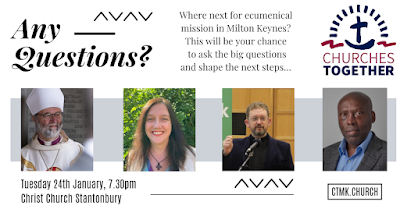
Later today, Churches Together in Milton Keynes continues to mark the Week of Prayer for Christian Unity this evening at 7:30 in Christ Church, Stantonbury, with an evening billed as ‘Any Questions?’

This has been a powerful week with great music, challenging ideas and powerful speakers. But, where next for ecumenical mission in Milton Keynes? This evening provides an opportunity to ask the big (or silly) questions? There may be a few answers, but this will definitely be a chance to shape the next steps.

The panellists include: the Right Revd Revd Alan Wilson, Bishop of Buckingham; Dorel Hayes, the Principal Officer for Ecumenical Development and Relations, Churches Together in England; Dr Fidèle Mutwarasibo, Lecturer in Work-Based Learning in the Faculty of Business and Law and Director of the Open University Centre for Voluntary Sector Leadership – Fidèle was a parishioner in Whitechurch Parish, Rathfarnham (Dublin), when I was a NSM curate there after ordination, and he has been a commissioner on the Irish Human Rights and Equality Commission; and the Revd Tim Norwood, Area Dean of Milton Keynes in the Diocese of Oxford and chair of Churches Together in Milton Keynes, who led Choral Evensong in Saint Mary and Saint Giles Church, Stony Stratford, last Thursday.

The words of the canticle Magnificat carved on the wooden screen at the west end of the monastic church in Mount Melleray Abbey, Cappoquin, Co Waterford (Photograph: Patrick Comerford)

Day 7: ‘What is now does not have to be’

Readings:

Job 5: 11-16:

So the poor have hope, and injustice shuts its mouth.

Luke 1: 46-55:

He has brought down the powerful from their thrones, and lifted up the lowly.

Reflection:

Job was living the good life and unexpectedly suffered the loss of his livestock and servants, and endured the devastation of the death of his children. He was suffering in his mind, body, and spirit. We all have suffering that is manifested in our minds, bodies, and spirits. We may pull away from God and others. We may lose hope. Yet, as Christians, we are unified in our belief that God is with us in the midst of our suffering.

On 11 April 2021 in Minnesota, Daunte Wright, a 20-year old, unarmed African-American man, was fatally shot by a white police officer during a routine traffic stop. This incident occurred during the Derek Chauvin trial for the killing of George Floyd.

It is easy to feel hopeless when we are once again reminded that we live in a fractured society that does not fully recognise, honour, and protect the human dignity and freedom of all human beings. According to Father Bryan Massingale, a leading Catholic social ethicist and scholar in racial justice, ‘Social life is made by human beings. The society we live in is the result of human choices and decisions. This means that human beings can change things. What human beings break, divide and separate, we can with God’s help, also heal, unite and restore. What is now does not have to be, therein lies the hope and the challenge.’

In prayer, Christians align their hearts to the heart of God, to love what he loves and to love as he loves. Prayer with integrity therefore aligns the hearts of all Christians beyond their divisions, to love what, whom and how God loves, and to express this love in our actions.

Christian Unity:

The Magnificat is Mary’s song of joy for all that she sees God is doing: restoring balance by raising up the lowly; righting injustice by feeding the hungry; and remembering Israel, his servant. The Lord never forgets his promises or abandons his people. It is easy to overlook or undervalue the faith of those who belong to other Christian communities, particularly if those communities are small. But the Lord makes his people whole by raising up the lowly so that the value of each is recognised. We are called to see as he sees and to value each of our Christian brothers and sisters as He values them.

Challenge:

How can we come together in Christ with hope and faith that God will ‘shut injustice’s mouth?’

Prayer:

God of Hope,
Help us to remember that you are with us in our suffering.
Help us to embody hope for one another when hopelessness is a frequent unwelcomed guest in our hearts.
Grant us the gift of being grounded in your loving Spirit as we work together to eradicate all forms of oppression and injustice.
Give us the courage to love what, whom and how you love, and to express this love in our actions.
Through Christ Our Lord. Amen.

‘They meet with darkness in the daytime, and grope at noonday as in the night’ (Job 5: 14) … at night in Cosgrove, Northamptonshire (Photograph: Patrick Comerford, 2023)

USPG Prayer Diary:

The Week of Prayer for Christian Unity began last Wednesday (18 January), and the theme in the USPG Prayer Diary last week was the Week of Prayer for Christian Unity. The theme this week is the ‘Myanmar Education Programme.’ This theme was introduced on Sunday with a reflection from a report from the Church of the Province of Myanmar.

The USPG Prayer Diary invites us to pray today in these words:

Let us pray for religious minorities persecuted for their faith. May their human rights be recognised and all forms of discrimination cease.

Yesterday’s reflection

Continued Tomorrow


10 May 2022

Praying with the Psalms in Easter:
10 May 2022 (Psalm 76)

‘At your rebuke, O God of Jacob, both rider and horse stunned’ (Psalm 76: 6) … a detail from the Parthenon Marbles in the Parthenon Museum in Athens (Photograph: Patrick Comerford)

Patrick Comerford

I am back in Dublin since yesterday and I hope to visit Askeaton, Co Limerick, later today (10 May 2022). But, before this day begins, I am continuing my morning reflections in this season of Easter continues, including my morning reflections drawing on the Psalms.

In my blog, I am reflecting each morning in this Prayer Diary in these ways:

1, Short reflections on a psalm or psalms;

2, reading the psalm or psalms;

3, a prayer from the USPG prayer diary.

Psalm 76:

Psalm 76 is found in Book 3 in the Book of Psalms, which includes Psalms 73 to 89. In the slightly different numbering scheme in the Greek Septuagint and the Latin Vulgate, this is psalm is numbered as Psalm 75.

This is the fifth of the ‘Psalms of Asaph.’ These are the 12 psalms numbered 50 and 73 to 83 in the Masoretic text and 49 and 72-82 in the Septuagint. Each psalm has a separate meaning, and these psalms cannot be summarised easily as a whole.

But throughout these 12 psalms is the shared theme of the judgment of God and how the people must follow God’s law.

The superscription of this psalm reads: ‘To the leader: with stringed instruments. A Psalm of Asaph. A Song.’ The attribution of a psalm to Asaph could mean that it was part of a collection from the Asaphites, identified as Temple singers, or that the psalm was performed in a style associated with Asaph, who was said to be the author or transcriber of these psalms.

Asaph who is identified with these psalms was a Levite, the son of Berechiah and descendant of Gershon, and he was the ancestor of the Asaphites, one the guilds of musicians in the first Temple in Jerusalem.

Asaph served both David and Solomon, and performed at the dedication of Solomon’s Temple (see II Chronicles 5: 12). His complaint against corruption among the rich and influential, recorded in Psalm 73, for example, might have been directed against some of court officials. The words used to describe the wicked come from words used by officials of the cult or sacrificial system.

Several of the Psalms of Asaph are categorised as communal laments because they are concerned for the well-being of the whole community. Many of these psalms forecast destruction or devastation in the future, but are balanced with God’s mercy and saving power for the people.

Psalm 76 refers to the majesty of God in judgment (see verses 4, 8, 9) and could be read as an ode to God the awe-inspiring. This psalm focuses on elaborating on the incredible saving power of God. It calls the people to worship and praise God om thanksgiving for his saving power.

Psalm 76 shows some similarities with Psalm 46 and 48. This psalm has been interpreted as:

1, a celebration of a victory over enemies;

2, a part of the New Year celebration in Jerusalem;

3, a prophecy of God’s future victory;

4, a post-exilic song of praise.

Psalm 76 can be divided into four sections:

1, verses 1-3: praise of God who chose Zion as his dwelling and defended the city.

2, verses 4-6: a description of God’s victory.

3, verses 7-9: God is portrayed as ‘a judge who saves the humble.’

4, verses 10-12: all humans will worship God, all rulers will learn to be inspired by and to fear God and to him they will perform their vows.

The Selah repeated in verses 3 and 9 provides a threefold structure to this psalm, with the middle section focussing on this psalm’s description of God.

This psalm explains that Judah and Israel are both names for the chosen people (see verse 1). Some commentators suggest that this psalm refers to the defeat of Sennacherib in the year 701 BCE at the gates of Jerusalem.

‘From the heavens you uttered judgement; the earth feared you and was still’ (Psalm 76: 8) … blue skies over the Iron Trunk Aqueduct near Cosgrove in Northamptonshire (Photograph: Patrick Comerford, 2022)

Psalm 76 (NRSVA):

To the leader: with stringed instruments. A Psalm of Asaph. A Song.

1 In Judah God is known,
his name is great in Israel.
2 His abode has been established in Salem,
his dwelling-place in Zion.
3 There he broke the flashing arrows,
the shield, the sword, and the weapons of war.
Selah

4 Glorious are you, more majestic
than the everlasting mountains.
5 The stout-hearted are stripped of their spoil;
they sank into sleep; none of the troops
was able to lift a hand.
6 At your rebuke, O God of Jacob,
both rider and horse lay stunned.

7 But you indeed are awesome!
Who can stand before you
when once your anger is roused?
8 From the heavens you uttered judgment,
the earth feared and was still
9 when God rose up to establish judgement,
to save all the oppressed of the earth.
Selah

10 Human wrath serves only to praise you,
when you bind the last bit of wrath around you.
11 Make your vows to the Lord your God, and perform them;
let all who are around him bring gifts to the one who is awesome,
12 who cuts off the spirit of princes,
who inspires fear in the kings of the earth.

Today’s Prayer:

The theme in this week’s prayer diary of the Anglican mission agency USPG (United Society Partners in the Gospel) is ‘Celebration in Casablanca.’ It was introduced on Sunday morning by the Right Revd David Hamid, Suffragan Bishop in Europe.

The USPG Prayer Diary this morning (10 May 2022) invites us to pray:

We give thanks for the diversity of worship styles encompassed by Anglicanism.

Yesterday’s reflection

Continued tomorrow

Scripture quotations are from the New Revised Standard Version Bible: Anglicised Edition copyright © 1989, 1995, National Council of the Churches of Christ in the United States of America. Used by permission. All rights reserved worldwide. http://nrsvbibles.org

25 April 2022

The ‘Iron Trunk’ is a feat
of Georgian engineering
high above the Great Ouse

Crossing the ‘Iron Trunk’ Aqueduct above the River Great Ouse, on the edges of Buckinghamshire and Northamptonshire (Photograph: Patrick Comerford, 2022)

Patrick Comerford

On a walk in the warm sunshine last week through the countryside on the edges of Buckinghamshire and Northamptonshire, two of us crossed the ‘Iron Trunk’ Aqueduct, also known as Cosgrove Aqueduct, between Wolverton and Cosgrove.

This navigable cast iron trough aqueduct outside Milton Keynes is a magnificent piece of Georgian engineering and is the world’s first wide canal cast iron trough aqueduct. It is more than 200 years old and it carries the Grand Union Canal, once an important trading route between London and the Midlands, over the River Great Ouse.

The aqueduct is formed of two cast iron trough spans, with a single central masonry pier. The abutments were also built in masonry but were re-faced in brick in the 20th century. The trough is 4.6 metres wide, 2 metres deep and 31 metres long. The canal surface is some 12 metres above the surface of the river, and the approach earthworks total 800 metres.

To cross the course of the River Great Ouse, the lowest point between the summits at Tring and Braunston, flights of locks were constructed for the Grand Junction Canal, later absorbed by the Grand Union Canal in 1800. Four flights were built at the south-east and five at the north-west, allowing the canal to descend to cross the river on the level.

The company engineer, William Jessop (1745-1814), is also known for his first major work, the Grand Canal of Ireland. Jessop designed a three-arch brick viaduct so that the Grand Union could cross the Great Ouse at a higher level, reducing the water loss and delay in locking down to river level.

Thesurface of the River Great Ouse is 12 metres below the aqueduct (Photograph: Patrick Comerford, 2022)

The structure was opened in 1805, but a section of the canal embankment soon collapsed. After repairs, the aqueduct structure itself collapsed in February 1808, severing the canal.

Jessop is sometimes blamed for the failure of the first structure, but the collapse actually led to a legal dispute with the original contractor. The dispute went to trial, and damages were awarded to the Grand Junction Company for the loss of trade while the canal was out of use, and the cost of replacing the aqueduct.

Another company engineer, Benjamin Bevan, began designing a replacement structure, and the original lock system was quickly reinstated.

By then, Thomas Telford had successfully built cast iron trough aqueducts at Pontcysyllte and at other places. Bevan decided to take forward the technology by designing the world’s first wide canal cast iron trough. The structure was cast at the Ketley foundry at Coalbrookdale which had produced the Longdon-on-Tern aqueduct for Telford.

The components were taken to Cosgrove by the canal itself. They were assembled and erected on the site, and the new structure was completed in January 1811. Bevan designed the floor sections to be arched, providing the additional strength needed to resist the substantial additional loading of a wide canal. The arch ribs are integral to the side plates of the trough and give additional shear strength.

The towpath is cantilevered from one side and are supported by diagonal struts. There is a cattle creep in the embankment on either side of the main structure to provide field-to-field access for cattle.

The aqueduct was refurbished in 2011 to celebrate its bicentenary. Today, the ‘Iron Trunk’ aqueduct and its towpath provide a popular cycling route and this is a breath-taking location to relax and watch the canal boats and to relax in some quiet and calm moments.

After crossing the aqueduct, two of us continued on to Cosgrove, where we had lunch in the April sunshine in the Barley Mow before returning to Stony Stratford.

A Constable-like scene on the canal at Cosgrove, close to the ‘Iron Trunk’ aqueduct (Photograph: Patrick Comerford)