COMERFORD WAY: Patrick Comerford’s online journal on Anglicanism, theology, spirituality, history, architecture, travel, poetry, beach walks ... and more
About 53 million people across Europe live in regions that are at risk from floods (Photograph: Patrick Comerford)
Patrick Comerford
This month is proving to be exceptionally busy time on this blog, with an overwhelming rise in figures for viewing and reading. These figures reached a total of 53 million hits by late this afternoon (9 September 2026), passing the million mark for the fifth time since the end of last month. The figures reached 52 million hits two days ago (7 September), only two days after reaching 51 million late on Saturday (5 September), 50 million the day before (4 September) and 49 million four days previously (31 August).
I continue to find these viewing and readership figures overpowering, and this blog continues to reach volumes of readers I never expected when I first started blogging 16 years ago. At the end of last year, this blog had 21 million hits (31 December 2025). So far this year, there have been more than 32 million hits or visitors in 2026 alone.
This means two-thirds of readers or hits have been this year alone (32 million out of a total of 53 million), and half of all hits or reader figures have been in little more than six months, with 26.5 million since 3 March 2026. I first began blogging in 2010, and it took almost two years until July 2012 to reach half a million readers. Throughout this year and last, the daily figures have often been overwhelming. Of the 10 days of busiest traffic on this blog, six or more than half of them were in this month alone (1, 4, 5, 7, 8 and 9 September), two were in May (1 and 14 May) and two were the previous month (29 and 30 April):
• 1,124,925 (1 May 2026)
• 647,187 (5 September 2026)
• 618,234 (8 September 2026)
• 563,301 (9 September 2026)*
• 525,719 (14 May 2026)
• 513,725 (7 September 2026)
• 509,644 (29 April 2026)
• 407,835 (4 September 2026)
• 356,335 (1 September 2026)
• 344,003 (30 April 2026)
The daily average has been about 490,000 a day so far this month. Yet, I recall how 10 years ago, back in 2016, the daily average was around 1,000, or 30,000 a month.
Floods in Saint Mark’s Square, Venice … about 53 million people across Europe live in regions identified as being at risk from floods (Photograph: Patrick Comerford)
Some curious though random statistics help to put this new figure of 53 million into perspective:
The richest 1% of the population in the United Kingdom holds wealth equivalent to the combined bottom 80%, or 53 million people.
According to Professor Alex de Waal of Tufts University, five men – Mao Zedong, Adolf Hitler, Josef Stalin, King Leopold II of Belgium and Pol Pot – each deliberately made famines that killed more than a million people, with a total of 53 million deaths, almost 40 per cent of aggregate global famine mortality since 1870.
The Securitas depot robbery in Tonbridge 20 years ago was the largest cash heist in the UK. It began with a kidnapping on the evening of 21 February 2006 and ended in the early hours of 22 February, when seven criminals stole almost £53 million. The gang left behind another £154 million because they did not have the means to move it.
About 53 million people across Europe live in regions identified as being at risk for floods.
Calculations earlier this year show that the EU population will fall by 11.7 per cent by 2100, losing approximately 53 million people. Japan’s population is projected to fall from a peak of 128 million in 2017 to less than 53 million by the end of the century.
About 53 million books are left unfinished in the UK each year because busy readers run out of time. Research shows that roughly 53,094,541 books are abandoned annually before reaching the final chapter.
53 million minutes is equal to 100 years, 9 months and 7 days. This means that if this blog was receiving just one hit a minute, I would need to have started blogging back at the turn of 1925 and 1926.
I retired from active parish ministry about 4½ years ago, on 31 March 2022. These days, though, about 150 people on average are reading my daily prayer diary posted on this blog each morning, or more than 1,000 people each week.
This evening, as this blog moves beyond 53 million hits, I am truly grateful to the real readers among that 53 million. In particular, I am thankful for the faithful core group of people who join me in prayer, scripture reading and reflections each day.
*Figure update at midnight to give the total figure for 9 September 2026
About 53 million books are left unfinished in the UK every year, abandoned before readers reach the final chapter (Photograph: Patrick Comerford)
Professor Scott M Kenworthy’s new biography of Patriarch Tikhon … launched in Cambridge this evening
Patrick Comerford
I an sorry to miss this evening’s launch of a new book in Cambridge, The People’s Patriarch: Tikhon Bellavin and the Orthodox Church in North America and Revolutionary Russia by Scott M Kenworthy, and published by Oxford University Press.
The book launch in Wesley House, Cambridge, this evening has been organised by the Institute for Orthodox Christian Studies, where I have been a student on many courses over the years, mainly in Sidney Sussex College.
This is the first scholarly and comprehensive biography of Patriarch Tikhon, and draws on documents from the Soviet leadership and secret police file that were previously inaccessible to researchers. It provides an in-depth account of a crucial period of Orthodox Christianity in North America and of Patriarch Tikhon’s vital contributions to its development. But it is also an important book at this crucial time of dissonate relationship between the Russian Church and the rest of the Orthodox world.
Professor Scott M Kenworthy is Professor of History in the History Department at Miami University, Oxford, Ohio, where he also teaches for the Russian, East European and Eurasian Studies, and Religious Studies programs, and is also Associate Professor of Comparative Religion.
He is the author of the prize-winning book The Heart of Russia: Trinity-Sergius, Monasticism and Society After 1825 and, with Alexander Agadjanian, Understanding World Christianity: Russia. He is a past president of the Association for the Study of Eastern Christianity and has held research fellowships in the US, Germany, Hungary and Romania.
On 28 October 1917, just days after the Bolsheviks seized power, the great Council of the Russian Orthodox Church voted to restore the patriarchate, which had been abolished by Tsar Peter the Great almost two centuries earlier in 1721. The council chose as the new patriarch Patriarch Tikhon (1865-1925), born Vasily Ivanovich Bellavin, the son of a humble village parish priest.
As the Orthodox Bishop of North America (1898-1907), Patriarch Tikhon had already started putting into practice his vision of the Church as an organic body that welcomed the participation of all believers. The Bolsheviks, who had other ideas, aimed to create a revolution that would be carried out by the state on behalf of the people. They sought to eradicate religion as superstition, to disestablish the church and to destroy it altogether.
The alternate Russia that Patriarch Tikhon represented was crushed by the superior force of the Bolsheviks. But he helped to navigate the Church through immense challenges and, in the end, the Orthodox Church outlived the Soviet experiment.
In The People’s Patriarch, Scott Kenworthy tells the story of the clash of visions for the new Russia through the lens of the humble man chosen to lead the Church, whose life exemplifies the transformations within the Orthodox Church in late Imperial Russia and its fate during the Revolution. This the first critical biography of one of the most important Orthodox Christian leaders of the 20th century, based on an exhaustive use of previously untapped primary sources, including Patriarch Tikhon’s letters and encyclicals, previously classified documents from the Bolshevik leadership and Soviet secret police, and material from a dozen archives in five countries.
Patriarch Tikhon has been overlooked by most historians of Russia and the former Soviet Union, who have seen the Russian Orthodox Church as irrelevant within an anti-religious Communist polity. This book tells his story from his humble beginnings in the Pskov province in north-west Russia, to his ordination and consecration, and then his ministry as bishop of a diocese in Poland, where he was Bishop of Lublin.
For almost a decade (1898-1907), he was a bishop in the US, where he came to appreciate democracy, the separation of Church and State, and the vital part played by the laity and parish clergy within the Church. When he was appointed Bishop of the Aleutian Islands and Alaska in 1898, he went to the US where he eventually became a naturalized American citizen. There he visited emerging Orthodox emigrant communities in cities such as New York and Chicago and in coal-mining and steel-making areas in in Pennsylvania and Ohio.
He reorganised the diocese, changed its name to the Diocese of the Aleutian Islands and North America, and he blessed the cornerstone of Saint Nicholas Cathedral, New York, in 1901. He built churches across North America, opened dialogue with Greek Orthodox churches, and took part in the consecration of Reginald Heber Weller as an Anglican bishop in Saint Paul’s Cathedral in the Episcopal Diocese of Fond du Lac, Wisconsin. He returned to Russia in 1907 when he was appointed Bishop of Yaroslavl.
When he was chosen in 1917 as the eleventh Patriarch of Moscow and the first since Peter the Great abolished the patriarchate 200 years earlier, Patriarch Tikhon quoted Ezekiel prophetically: ‘How many tears and groans will I have to swallow.’
After the abdication of the tsar in March 1917, the Russian Church was freed from its subjugation to the State and became once again respected by a large section of the educated population. But the church also faced years of persecution, and lost its legal status and right to own property. Lenin launched a ferocious attack on the church in 1922, and Patriarch Tikhon was imprisoned from May 1922 until June 1923.
Patriarch Tikhon was effectively a prisoner in the Donskoi Monastery and was frequently interrogated in the Lubyanka. But on the occasions when he was allowed to take walks along the monastery walls, crowds would regularly gather below the walls to receive his blessing.
Thanks to changes in the regime and to support from abroad, particularly from Britain, Patriarch Tikhon was not put on trial or executed. On 13 April 1923, the Archbishop Randall Davidson of Canterbury and other British religious leaders, including the Chief Rabbi, issued a statement condemning religious persecution in the Soviet Union.
The British Foreign Secretary issued an ultimatum to the Soviet government on 8 May 1923, condemning ‘the definite object of destroying all religion in Russia’ and threatening to break off relations. The Soviet leadership was desperate to preserve the 1921 Anglo-Soviet Trade Treaty and to maintain good relations with Britain.
When Patriarch Tikhon died on 12 April 1925, between 30,000 and 40,000 attended his funeral in the Donskoi Monastery, many more than attended Lenin’s funeral the previous year.
Patriarch Tikhon defies definition, challengec the capitulation of many Christian leaders to the Trump regime in the US, and stands in sharp contrast to Patriarch Kirill of Moscow
Patriarch Tikhon defies definition as either a dissident or a collaborator. He endeavoured to preserve the Russian Orthodox Church while he tried to remain apolitical, and he criticised the Communist regime without opposing it.
He is a challenge to the capitulation of many Christian leaders to the Trump regime in the US. During his time as a bishop in the US, he came to appreciate democracy, plurality and diversity, and the separation of Church and State.
He also stands in sharp contrast to the present head of the Russian Orthodox Church, Patriarch Kirill of Moscow, with his intimate relationship with the Putin regime, his autocratic approach to church leadership, and his persistent attempts to sow divisions within the Orthodox churches.
The Orthodox Public Affairs Committee (OPAC) said earlier this week: ‘Rather than serving as a prophetic voice for peace, reconciliation, and the sanctity of every human life, Patriarch Kirill has repeatedly offered religious justification for Russia’s unprovoked war of aggression against Ukraine. He has portrayed the invasion as a sacred struggle, blessed those waging war, and increasingly intertwined the mission of the Russian Orthodox Church with the geopolitical ambitions of the Kremlin.’
Patriarch Kirill’s recent statements are disturbing and troubling. He has described Russia’s nuclear arsenal as a manifestation of God's ‘grace and mercy’ and he has claimed that the creation of the Soviet atomic bomb came about through divine providence and the prayers of Saint Seraphim of Sarov (1754-1833), a Russian saint known for his life of contemplation and kindness.
His invocation of one of Orthodoxy’s most beloved saints in defence of nuclear weapons that are capable of unimaginable destruction is a profound distortion of the Christian faith. The Gospel proclaims peace, reconciliation, and the sacred dignity of every human person and must never be used to sanctify war, imperial conquest, or nuclear intimidation.
For more than four years, the Ukrainian people have endured the horrors of an unprovoked war with extraordinary courage, resilience, and unwavering faith. Families have been torn apart, cities have been reduced to rubble, and countless innocent lives have been changed forever.
In response, the Saint Nicholas National Shrine recently presented its Beacon of Hope Award to President Volodymyr Zelenskyy and the people of Ukraine, recognising their courage, sacrifice, and resilience.
The National Shrine of Saint Nicholas was established to bear witness to the Light of Christ in the midst of darkness. It stands at the World Trade Centre as a place of prayer, remembrance and healing, and a reminder that evil and hatred will never have the final word. The US is about to mark the 25th anniversary of the ‘9/11’ attacks on 11 September 2001, the shrine is a ‘beacon of hope’ to all who suffer from violence, war, terrorism, and despair.
The shrine’s decision to honour President Zelenskyy and the people of Ukraine has been criticised by Patriarch Kirill’s apologists, who have claimed that Ukraine is persecuting Christianity and ‘shutting down churches’.
Saint Nicholas National Shrine was consecrated in memory of lives lost to terrorism 25 years ago, and remains a reminder to the world, like Patriarch Tikhon, that the Light of Christ continues to shine in the darkness, and the darkness shall never overcome it.
The Institute for Orthodox Christian Studies is on Jesus Lane, Cambridge, beside Jesus College and Wesley House and across the street from Westcott House and Sidney Sussex College (Photograph: Patrick Comerford)
Čumil or ‘Man at Work’, a sculpture by Viktor Hulík in the old town in Bratislava … Slovakia covers 49 million sq metres or 49,000 sq km (Photograph: Patrick Comerford)
Patrick Comerford
I continue to be overwhelmed by the viewing and reading figures for this blog. These figures reached a total of 49 million about 10:30 last night (31 August 2026), having reached 48 million a week earlier (24 August 2026), 47 million a week before that (17 August 2026) and 46 million eight days previously (9 August 2026), and more than 3.6 readers for the month of August.
These viewing and reading figures are overpowering at times, and this blog continues to reach volumes of readers I never expected when I first started blogging 16 years ago. At the end of last year, this blog had 21 million hits (31 December 2025). So far this year, there have been more than 28 million hits or visitors in 2026 alone.
Half of all hits or reader figures have been in little more than six months, with 24.5 million hits since 23 February 2026. I first began blogging back in 2010, and it took almost two years until July 2012 to reach half a million readers. Throughout this year and last, the daily figures are overwhelming on many occasions. Of the ten days of busiest traffic on this blog, three were in May (1, 6 and 14 May 2026), three were the previous month (26, 29 and 30 April 2026), three in March, and one in February:
• 1,124,925 (1 May 2026)
• 525,719 (14 May 2026)
• 509,644 (29 April 2026)
• 344,003 (30 April 2026)
• 323,156 (27 March 2026)
• 322,038 (26 April 2026)
• 318,835 (6 May 2026)
• 318,307 (1 March 2026)
• 314,018 (28 February 2026)
• 301,449 (2 March 2026)
The daily average was about 118,700 hits a day throughout August. Yet, I recall how ten years ago, back in 2016, the daily average was around 1,000, or 30,000 a month.
There are 49 million child refugees and displaced minors across the globe, or 40% of all forcibly displaced people (Photograph: Patrick Comerford)
To put this latest figure of 49 million into perspective:
The UN World Food Programme warns that the strong El Niño weather that is forecast for later this year could push 49 million more people into acute hunger, raising total global food insecurity to roughly 274 million people.
There are 49 million child refugees and displaced minors across the globe who are impacted by conflict, violence, and persecution worldwide, representing 40% of all forcibly displaced people.
More than 49 million people are trapped in modern-day slavery worldwide, according to a recent report, and children account for 12 million of them. Human trafficking generates over $236 billion every year, making it one of the largest criminal economies in the world.
As of 2026, Spain has a total population of approximately 49.8 million people, having officially surpassed the 49 million threshold for the first time in 2025, largely driven by immigration over the past two decades.
Slovakia, officially the Slovak Republic, has territory of about 49,000 sq km or 49 million sq metres. The country is bordered by Poland, Ukraine, the Czech Republic, Hungary and Austria. Bratislava is the capital, and there is a population of over 5.4 million people.
Back in 2013, it was said in the US that 49 million Americans, including one-in-four children, go hungry every day, despite the US having the means to provide nutritious, affordable food for all. Inspired by the documentary A Place at the Table, a companion book edited by Peter Pringle offered insights from people at the front lines of tackling hunger in the US.
The contributors showed the inequities in America’s hunger crisis and suggested strategies for solving the crisis, argued the case for school lunch reform, uncovered the hidden persuaders of web food advertisers, explored the role of faith groups in feeding the hungry, discussed the health impacts of hunger and proposed increases in child nutrition programmes.
They argued for the need to move beyond charity-based emergency feeding programmes, and called for providing healthy food for all children. A Place at the Table showed how these problems could be solved once and for all, if the American public decided that making healthy food available and affordable is in the best interest of everyone.
But all those warnings and all those proposals were ignored by decision makers, while the rich get richer, the poor get poorer and the hungry continue to go hungry. And a good example of the rich getting richer came in recent financial disclosure filings that show that one day alone in June Donald Trump made over $49 million in stock and securities purchases during a portfolio reshuffling.
49 million minutes is equal to 93 years, 2 months, 21 days, 18 hours and 40 minutes. This means that if this blog was receiving just one hit a minute, I would need to have started blogging back in mid-June 1933.
I retired from active parish ministry over four years ago, on 31 March 2022. These days, though, about 130-140 people on average are reading my daily prayer diary posted on this blog each morning, or almost 1,000 people each week.
This evening, as this blog heads towards 50 million hits, I am truly grateful once again to the real readers among those 49 million hits to date. In particular I am thankful for the faithful core group of people who join me in prayer, scripture reading and reflections each day.
49 million Americans, including one-in-four children, go hungry every day, according to Peter Pringle’s book
The former Hotel Russell on Russell Square in Bloomsbury was designed by the architect Charles Fitzroy Doll (Photograph: Patrick Comerford, 2026)
Patrick Comerford
I have been in London six or seven times already this year, and when I find myself in the Bloomsbury area I often stop in Russell Square to admire the former Hotel Russell, even though it has lost the name it was known by for more than a century and is now called the Kimpton Fitzroy London.
The hotel at 1-8 Russell Square is a Grade II* listed building and was designed by the architect Charles Fitzroy Doll (1850-1929), who was the surveyor of the Bedford Estate. It was built in 1892-1898 and opened in 1900.
It is built of red brick with terracotta dressings, distinctively clad in decorative thé-au-lait (‘tea with milk’) terracotta, and was modelled on the Château de Madrid near the Bois de Boulogne in Paris. Its roofs and turrets have striking green fish-scale tiles, and the tall Victorian chimney-stacks have horizontal brick and terracotta bands. The hotel originally had a central copper dome and lantern instead of its present tiled mansard roof, and once must have been a more impressive site.
The architect Charles Fitzroy Doll specialised in designing hotels. He also designed the dining room on the Titanic, basing it on his design for the dining room in the Hotel Russell, known until recently known as Fitzroy Doll’s.
Doll was educated in Germany, then trained as an architect under Sir Matthew Digby Wyatt, and he was involved with Wyatt in designing the India Office in London in 1866-1868.
The sculptor Henry Charles Fehr modelled the life-size statues on the façade of four queens who look down on Russell Square from above the main entrance (Photograph: Patrick Comerford, 2026)
Doll was appointed surveyor to the Bedford Estates in Bloomsbury and Covent Garden in 1885. When he designed the Hotel Russell with its distinctive cladding, Doll engaged the sculptor Henry Charles Fehr to model the four life-size statues of British queens who look down on Russell Square from above the main entrance.
Doll was a member of Holborn Borough Council, and was Mayor of Holborn in 1904-1905 and 1912-1913. He died in 1929 aged 79. His children included Christian Charles Tyler Doll (1880-1955), who was involved in the reconstruction of the grand staircase of the Palace of King Minos at Knossos in Crete, working alongside Arthur Evans. He also designed the Villa Ariadne, a residence for Evans at Knossos that now houses the Knossos Research Centre.
The style of the Hotel Russell is described in its listing as ‘flamboyant French Renaissance … derived from engravings of the Château de Madrid, with elaborate decorations.’ The architectural historians Bridget Cherry and Sir Nikolaus Pevsner call it ‘monumental’.
The hotel is known for its palatial design, and its fixtures and fittings included an ornate Pyrenean marble staircase and an interior sunken garden. Each room was fitted with an en-suite bathroom, quite an innovation at the time.
Doll’s façade also displays the coats of arms of the world’s nations as they were in 1898, incorporated in the spandrels of the first floor. At the centre of the principal façade facing Russell Square, above the main entrance, are life-size terracotta statues of four reigning queens – Elizabeth I, Mary II, Anne and Victoria – and columns decorated with putti, both surmounted with knights flanking floral decoration above the decorative foundation date ‘1898’.
The larger than life terracotta statues represent idealised versions of the four queens. Elizabeth I is readily identifiable because of her ruff,while Victoria is depicted as a very young woman. But there is some confusion over who is who when it comes to Mary II and Anne, while a fifth reigning English queen, Mary I, is noticeably absent.
The statues of the four queens are the work of the sculptor Henry Charles Fehr (1867-1940), also created the busts of four Prime Ministers – Lord Derby, Lord Salisbury, William Gladstone and Benjamin Disraeli – on the Guilford Street façade of the hotel.
Queen Elizabeth and Queen Mary II among the four queens above the hotel entrance (Photograph: Patrick Comerford, 2026)
Fehr produced several notable public sculptures, war memorials and works for civic buildings, including sculptures for Middlesex Guildhall, Wakefield County Hall and Cardiff City Hall. His war memorials can be seen in for towns and cities throughout Britain and often feature detailed bronze statuary.
Doll also designed the Imperial Hotel (1905-1907) in Russell Square, described by the architectural historian Sir Niklaus Pevsner as a ‘vicious mixture of Art Nouveau Gothic and Art Nouveau Tudor’. The Imperial Hotel was demolished in 1967, and replaced by a contemporary, brutalist building designed by George Anthony Wilson Brandeth and where I stayed once when I was working with The Irish Times. Today it is known as the President Hotel.
Doll also designed the Flemish French-Gothic terrace of shops and apartments on the corner of Torrington Place and Gower Street. It was designed in 1907 and now includes the London University branch of Waterstones. The bookshop is in the heart of literary Bloomsbury and I, like many of my generation, still think of it as Dillon’s. Today, this branch of Waterstones claims it is the largest new and second-hand bookshop in Europe.
The Hotel Russell was one of the few hotels in this part of London not taken over by the War Office during World War II. It survived the war largely intact, but the magnificent dome was badly damaged in an air raid during the Blitz in 1941 and was never replaced.
The Hotel Russell continued to be known by that name for more than a century until 2018. After extensive renovations, the hotel reopened in 2018 as the Principal London. Three months later, it was bought by Covivio Hotels, which then transferred its management to InterContinental Hotels Group, and the hotel was renamed the Kimpton Fitzroy London later that year. The restaurant Doll designed was originally named after him but is now called Fitz’s.
Queen Anne and Queen Victoria among the four queens above the hotel entrance (Photograph: Patrick Comerford, 2026)
The Russell Group of universities, which was formed in 1994, is named after Hotel Russell, where the first informal meetings took place, and thankfully it has not changed its name.
The Russell Group now brings together 24 British universities that are often seen as Britain’s best. Together, they receive over three-quarters of all university research grant and contract income in the UK, they award 60% of all doctorates gained in the UK, they account for 65% of all world-leading research conducted in the UK, and their research is judged overwhelmingly to be world-leading or internationally excellent. Their graduates hold 61% of all UK jobs that require a university degree, despite being only 17% of all higher education graduates.
The Russell Group first included 17 universities: Birmingham, Bristol, Cambridge, Edinburgh, Glasgow, Imperial College London, Leeds, Liverpool, London School of Economics, Manchester, Newcastle, Nottingham, Oxford, Sheffield, Southampton, University College London and Warwick.
With the exception of Warwick, which was established in the 1960s, the founder members of the Russell Group were all universities or university colleges prior to World War I, and they included most of Britain’s ancient universities and ‘redbrick universities’. Cardiff University and King’s College London joined the Russell Group in 1998.
Queen’s University Belfast became the 20th member in 2006, and four more universities – Durham, Exeter, Queen Mary University of London, and York – joined the Russell Group in 2012.
The hotel may have changed its name in recent years, but the Russell and Bedford names continue in the streets and squares of Bloomsbury, and in some places there are memories too of the philosopher Bertrand Russell. But, perhaps, more about that in the days to come.
The Russell Group of universities is named after Hotel Russell, where the first informal meetings of the group took place in 1994 (Photograph: Patrick Comerford, 2026)
‘The field is the world, and the good seed are the children of the kingdom’ (Matthew 13: 38) … a field ready for the harvest near Lismore, Co Waterford (Photograph: Patrick Comerford)
Patrick Comerford
We are continuing in Ordinary Time in the Church and this week began with the Eighth Sunday after Trinity (Trinity VIII, 26 July 2026). I am on my way to Luton this morning to catch a flight to Dublin for a short, one-day family visit. But, as the day begins, I am taking some quiet time this morning to give thanks, to reflect, to pray and to read in these ways:
1, today’s Gospel reading;
2, a reflection on the Gospel reading;
3, a prayer from the USPG prayer diary;
4, the Collects and Post-Communion prayer of the day.
Harvest or weeds? … a field near Cross in Hand on the northern edges of Lichfield (Photograph: Patrick Comerford)
Matthew 13: 36-43 (NRSVA):
36 Then he left the crowds and went into the house. And his disciples approached him, saying, ‘Explain to us the parable of the weeds of the field.’ 37 He answered, ‘The one who sows the good seed is the Son of Man; 38 the field is the world, and the good seed are the children of the kingdom; the weeds are the children of the evil one, 39 and the enemy who sowed them is the devil; the harvest is the end of the age, and the reapers are angels. 40 Just as the weeds are collected and burned up with fire, so will it be at the end of the age. 41 The Son of Man will send his angels, and they will collect out of his kingdom all causes of sin and all evildoers, 42 and they will throw them into the furnace of fire, where there will be weeping and gnashing of teeth. 43 Then the righteous will shine like the sun in the kingdom of their Father. Let anyone with ears listen!’
Fields of green and gold beside Comberford Hall, between Lichfield and Tamworth in rural Staffordshire (Photograph: Patrick Comerford)
This morning’s reflection:
There are some positive images in today’s Gospel reading (Matthew 13: 36-43) of the righteous shining like the sun in God’s kingdom and chilling images of others being thrown into ‘the furnace of fire, where there will be weeping and gnashing of teeth’.
But throughout history, humanity has stooped to burn what we dislike and what we want to expunge, and we have done it constantly.
We have been burning books as Christians since Saint Athanasius ordered the burning of texts in Alexandria in the year 367. In the Middle Ages, and sometimes even later, we burned heretics at the stake. When that stopped, we burned anything deemed to be an occasions of sin.
They were burned publicly as an accompanying theme for the outdoor sermons of San Bernardino da Siena in the early 15th century. These included mirrors, cosmetics, fine dresses, playing cards … even musical instruments, and, of course, books, song sheets, artworks, paintings and sculpture. In his sermons, the book-burning friar regularly called for Jews and gays to be either isolated from society or eliminated from the human community.
Later in Florence, the supporters of Savonarola collected and publicly burned thousands of objects, including cosmetics, art, and books in 1497.
On the other hand, Franz Kafka’s last request to his friend Max Brod in 1921 was to ‘burn all my diaries, letters, manuscripts … completely and unread’.
But, more recently, the Nazis staged regular book burnings, especially burning books by Jewish writers, including Thomas Mann, Karl Marx and Albert Einstein. Extremists of all religious and political persuasions want to burn the symbols and totems of their opponents, whether it is Pastor Terry Jones burning the Quran and effigies of Bill Clinton and Barack Obama in Florida or jihadists burning the Twin Towers in New York.
Today we are witnessing efforts by the Trump regime to suppress free speech by journalists in the Wall Street Journal, the New York Times, the BBC and the Associated Press, capriciously excluding journalists from the White House press pool, demeaning women journalists as ‘Miss Piggy’ and threatening to strip NBC and ABC of their licences to broadcast.
The hypocrisy of these threats is aggravated by claims from the Trump regime that it is defending free speech when it attacked Britain and other European countries for seeking to curb violence and racism on US-based social media platforms.
The limits of our extremists seem to be defined by their inflammatory words.
But who is being burned in this morning’s Gospel reading?
Who is doing the burning?
And who will be weeping and gnashing their teeth?
Contrary to many shoddy reading of this Gospel reading, Christians are not asked to burn anyone or anything at all. And, if we have enemies, we are called not to burn them but to love them.
Christ has been speaking by the lake first to the crowd, telling them the parable of the wheat and the weeds (verse 24-30). The word that we have traditionally translated as tares or weeds (verses 25, 26, 27, 29, 30, 36, 38, 40) is the Greek word ζιζάνια (zizania), a type of wild rice grass, although Saint Matthew is probably referring to a type of darnel or noxious weed. It looks like wheat until the plants mature and the ears open, and the seeds are a strong soporific poison.
Christ then withdraws into a house, and has a private conversation with the Disciples (verses 36-43), in which he explains he is the sower (verse 37), the good seed is not the Word, but the Children of the Kingdom (verse 38), the weeds are the ‘Children of the Evil One’ (verse 38), and the field is the world (verse 38).
The harvest is not gathered by the disciples or the children of the kingdom, but by angels sent by the Son of Man (verses 39, 41). It is an apocalyptic image, describing poetically and dramatically a future cataclysm, and not an image to describe what should be happening today. It is imagery that draws on the apocalyptic images in the Book of Daniel, where the three young men who are faithful to God are tried in the fires of the furnace, yet come out alive, stronger and firmer in their faith (see Daniel 3: 1-10).
The slaves or δοῦλοι (douloi), the people who want to separate the darnel from the wheat (verse 27-28), are the disciples: Saint Paul introduces himself in his letters with phrases like Παῦλος δοῦλος Χριστοῦ Ἰησοῦ, Paul, a doulos, slave, or servant of Jesus Christ (see Romans 1: 1, Philippians 1: 1, Titus 1: 1). The same word is used by James (see James 1: 1), Peter (see II Peter 1: 1) and Jude (see Jude 1) to introduce themselves in their letters.
In the Book of Revelation, this word is used to describe the Disciples and the Church (see Revelation 1: 1; 22: 3).
In other words, the apostolic writers see themselves as slaves in the field, working at Christ’s command in the world.
This is one of eight parables about the last judgment found only in Saint Matthew’s Gospel, and six of the seven New Testament uses of the phrase ‘weeping and gnashing of teeth’ (ὁ κλαυθμὸς καὶ ὁ βρυγμὸς τῶν ὀδόντων) occur in this Gospel (Matthew 8: 12; 13: 42; 13: 50; 22: 13; 24: 51; and 25: 30; see also Luke 13: 28).
When it comes to explaining the parable to the disciples in today’s reading (verses 36-43), the earlier references to the slaves in the first part (verses 27-28) are no longer there. It is not that the slaves have disappeared – Christ is speaking directly to those who would want to uproot the tares but who would find themselves uprooting the wheat too.
The weeding of the field is God’s job, not ours. The reapers, not the slaves, will gather in both the weeds and the wheat, the weeds first and then the wheat (verse 30).
Farmers are baling the hay and taking in the harvest in many places already. In a few weeks’ time, many farmers will be seen burning off the stubble on their fields to prepare the soil for autumn sowing and planting new crops. In this sense, the farmer understands burning as purification and preparation – it is not as harsh as city dwellers think.
It is not for us to decide who is in and who is out in Christ’s field, in the kingdom of God. That is Christ’s task alone.
Christ gently cautions the Disciples against rash decisions about who is in and who is out. Gently, he lets them see that the tares are not damaging the growth of the wheat, they just grow alongside it and amidst it.
But so often we decide to assume God’s role. We do it constantly in society, and we do it constantly in the Church, deciding who should be in and who should be out.
The harvest comes at the end of time, not now, and I should not hasten it even if the reapers seem to tarry.
The weeds we identify and want to uproot may turn out to be wheat, what we presume to be wheat because it looks like us may turn out to be weeds.
We assume the role of the reapers every time we decide we would be better off without someone in our society or in the Church because we disagree with them about issues like sexuality, women bishops and priests, and other issues that we mistake for core values.
The core values, as Christ himself explains, again and again, are loving God and loving others.
It is not without good reason that the Patristic writers warn that schism is worse than heresy (see Saint John Chrysostom, Patrologia Græca, vol. lxii, col. 87, On Ephesians, Homily 11, §5). We do not need to demythologise this morning’s reading. Christ leaves that to the future. This morning we are called to grow and not to worry about the tares. That growth must always emphasise love first.
When some members of the Church have sought to ‘out’ or ‘throw out’ people because of their sexuality they have caused immense personal tragedy for individuals and their families and friends – weeping and gnashing of teeth indeed.
When I want a Church or society that looks like me, I eventually end up living on a desert island or as a member of a sect of one – and there I might just find out too how unhappy I am with myself!
But if I allow myself to grow in faith and trust and love with others, I may, I just may, to my surprise, find that they too are wheat rather than weeds, and hopefullu they may realise the same about me.
‘The field is the world, and the good seed are the children of the kingdom’ (Matthew 13: 38) … harvest fields in Fisherwick, between Lichfield and Tamworth (Photograph: Patrick Comerford)
Today’s Prayers (Tuesday 28 July 2026):
In Pray with the World Church, the prayer diary of the Anglican mission agency USPG (United Society Partners in the Gospel), the theme this week, from 26 July to 1 August 2026 (pp 22-23), is ‘Lives in Transit’. This theme was introduced on Sunday with a programme update by Rachel Weller, Communications Officer, USPG.
The USPG prayer diary today (Tuesday 28 July 2026) invites us to pray:
God of mercy, hold close all who are weary and long to return home, particularly refugees. In their endurance, be their strength; in their uncertainty, be their peace; and in their suffering, be their hope that does not fail.
The Collect of the Day:
Almighty Lord and everlasting God,
we beseech you to direct, sanctify and govern
both our hearts and bodies
in the ways of your laws
and the works of your commandments;
that through your most mighty protection, both here and ever,
we may be preserved in body and soul;
through our Lord and Saviour Jesus Christ,
who is alive and reigns with you,
in the unity of the Holy Spirit,
one God, now and for ever.
The Post Communion Prayer:
Strengthen for service, Lord,
the hands that have taken holy things;
may the ears which have heard your word
be deaf to clamour and dispute;
may the tongues which have sung your praise be free from deceit;
may the eyes which have seen the tokens of your love
shine with the light of hope;
and may the bodies which have been fed with your body
be refreshed with the fullness of your life;
glory to you for ever.
Additional Collect:
Lord God,
your Son left the riches of heaven
and became poor for our sake:
when we prosper save us from pride,
when we are needy save us from despair,
that we may trust in you alone;
through Jesus Christ our Lord.
‘There will be weeping and gnashing of teeth’ (Matthew 13: 42) … Gnasher and Gnipper in the ‘Beano’ always seemed ready to gnash their teeth
Patrick Comerford
We are in Ordinary Time in the Church Calendar and today is the Seventh Sunday after Trinity (Trinity VII, 19 July 2026). Later this morning I hope to take part in the Parish Eucharist in Saint Mary and Saint Giles, Stony Stratford, singing with the choir and reading the first lesson.
Having stayed up last night to see England beat France 6-4 for third place in the World Cup, there are two interesting sporting events attracting my attention later today: the All-Ireland hurling final between Limerick and Galway this afternoon, and the World Cup final between Argentina and Spain this evening. But, before today begins, I am taking some quiet time this morning to give thanks, to reflect, to pray and to read in these ways:
1, reading today’s Gospel reading;
2, a short reflection;
3, a prayer from the USPG prayer diary;
4, the Collects and Post-Communion prayer of the day.
A field ready for the harvest off Cross in Hand near Lichfield (Photograph: Patrick Comerford)
Matthew 13: 24-30, 36-43 (NRSVA):
24 He put before them another parable: ‘The kingdom of heaven may be compared to someone who sowed good seed in his field; 25 but while everybody was asleep, an enemy came and sowed weeds among the wheat, and then went away. 26 So when the plants came up and bore grain, then the weeds appeared as well. 27 And the slaves of the householder came and said to him, “Master, did you not sow good seed in your field? Where, then, did these weeds come from?” 28 He answered, “An enemy has done this.” The slaves said to him, “Then do you want us to go and gather them?” 29 But he replied, “No; for in gathering the weeds you would uproot the wheat along with them. 30 Let both of them grow together until the harvest; and at harvest time I will tell the reapers, Collect the weeds first and bind them in bundles to be burned, but gather the wheat into my barn”.’
36 Then he left the crowds and went into the house. And his disciples approached him, saying, ‘Explain to us the parable of the weeds of the field.’ 37 He answered, ‘The one who sows the good seed is the Son of Man; 38 the field is the world, and the good seed are the children of the kingdom; the weeds are the children of the evil one, 39 and the enemy who sowed them is the devil; the harvest is the end of the age, and the reapers are angels. 40 Just as the weeds are collected and burned up with fire, so will it be at the end of the age. 41 The Son of Man will send his angels, and they will collect out of his kingdom all causes of sin and all evildoers, 42 and they will throw them into the furnace of fire, where there will be weeping and gnashing of teeth. 43 Then the righteous will shine like the sun in the kingdom of their Father. Let anyone with ears listen!’
Fields of green close to Comberford village, between Tamworth and Lichfield in Staffordshire (Photograph: Patrick Comerford, 2026)
Today’s Reflections:
In my imagination, when I was a child, not only were the summers long and sunny, but weekend entertainment was simpler and less complicated. The highlights of the weekend seemed to be Dr Who and Dixon of Dock Green, and the weekly editions of the Eagle and the Beano.
I may have been just a little too old (16) for the first appearance of Gnasher (1968), the pet dog of Dennis the Menace in the Beano. The G- tagged onto the beginning of the name of both Gnasher and his son Gnipper is pronounced silently, just like the silent P at the beginning of Psmith, the Rupert Psmith in so many PG Wodehouse novels.
Most of the Beano speech bubbles for both Gnasher and Gnipper consist of normal English words beginning with the letter ‘N’ with a silent ‘G’ added to the beginning, as in ‘Gnight, Gnight.’
I was a little too old for the introduction of Gnasher, but nonetheless my friends in my late teens and early 20s loved Gnasher and Gniper, joked about those silent ‘Gs’ and even recalled how as children we had joked about ‘weeping and G-nashing of teeth.’
There is very little to joke about in today’s Gospel reading (Matthew 13: 36-43). The idea of people being thrown into the furnace of fire is not a very appealing image for children, and so to joke about it is a childhood method of coping.
But throughout history, humanity has stooped to burn what we dislike and what we want to expunge, and we have done it constantly.
We have been burning books as Christians since Saint Athanasius ordered the burning of texts in Alexandria in the year 367 CE. In the Middle Ages, and sometimes even later, we burned heretics at the stake. When that stopped, we burned anything deemed to be an occasions of sin.
They were burned publicly as an accompanying theme for the outdoor sermons of San Bernardino da Siena in the early 15th century. These included mirrors, cosmetics, fine dresses, playing cards … even musical instruments, and, of course, books, song sheets, artworks, paintings and sculpture. In his sermons, the book-burning friar regularly called for Jews and gays to be either isolated from society or eliminated from the human community.
Later in Florence, the supporters of Savonarola collected and publicly burned thousands of objects, including cosmetics, art, and books in 1497.
On the other hand, Franz Kafka’s last request to his friend Max Brod in 1921 was to ‘burn all my diaries, letters, manuscripts … completely and unread'.
But, more recently, the Nazis staged regular book burnings, especially burning books by Jewish writers, including Thomas Mann, Karl Marx and Albert Einstein.
Extremists of all religious and political persuasions want to burn the symbols and totems of their opponents, whether it is Pastor Terry Jones burning the Quran and effigies of Bill Clinton and Barack Obama in Florida or jihadists burning the Twin Towers in New York.
The limits of our extremists seem to be defined by their inflammatory words.
But who is being burned in this morning’s Gospel reading?
Who is doing the burning?
And who will be weeping and gnashing their teeth?
Contrary to many shoddy reading of this Gospel reading, Christians are not asked to burn anyone or anything at all. And, if we have enemies, we are called not to burn them but to love them.
Christ has been speaks by the lake first to the crowd, telling them the parable of the wheat and the weeds (verse 24-30). The word that we have traditionally translated as tares or weeds (verses 25, 26, 27, 29, 30, 36, 38, 40) is the Greek word ζιζάνια (zizania), a type of wild rice grass, although Saint Matthew is probably referring to a type of darnel or noxious weed. It looks like wheat until the plants mature and the ears open, and the seeds are a strong soporific poison.
Christ then withdraws into a house, and has a private conversation with the Disciples (verses 36-43), in which he explains he is the sower (verse 37), the good seed is not the Word, but the Children of the Kingdom (verse 38), the weeds are the ‘Children of the Evil One’ (verse 38), and the field is the world (verse 38).
The harvest is not gathered by the disciples or the children of the kingdom, but by angels sent by the Son of Man (verses 39, 41).
It is an apocalyptic image, describing poetically and dramatically a future cataclysm, and not an image to describe what should be happening today.
It is imagery that draws on the apocalyptic images in the Book of Daniel, where the three young men who are faithful to God are tried in the fires of the furnace, yet come out alive, stronger and firmer in their faith (see Daniel 3: 1-10).
The slaves or δοῦλοι (douloi), the people who want to separate the darnel from the wheat (verse 27-28), are the disciples: Saint Paul introduces himself in his letters with phrases like Παῦλος δοῦλος Χριστοῦ Ἰησοῦ (Paul, a doulos or slave, or servant of Jesus Christ), (see Romans 1: 1, Philippians 1: 1, Titus 1: 1), and the same word is used by James (see James 1: 1), Peter (see II Peter 1: 1) and Jude (see Jude 1) to introduce themselves in their letters.
In the Book of Revelation, this word is used to describe the Disciples and the Church (see Revelation 1: 1; 22: 3).
In other words, the Apostolic writers see themselves as slaves in the field, working at Christ’s command in the world.
This is one of eight parables about the last judgment that are found only in Saint Matthew’s Gospel, and six of the seven New Testament uses of the phrase ‘weeping and gnashing of teeth’ (ὁ κλαυθμὸς καὶ ὁ βρυγμὸς τῶν ὀδόντων) occur in this Gospel (Matthew 8: 12; 13: 42; 13: 50; 22: 13; 24: 51; and 25: 30; see also Luke 13: 28).
When it comes to explaining the parable to the disciples in today’s reading (verses 36-43), the earlier references to the slaves in the first part (verses 27-28) are no longer there. It is not that the slaves have disappeared – Christ is speaking directly to those who would want to uproot the tares but who would find themselves uprooting the wheat too.
The weeding of the field is God’s job, not ours. The reapers, not the slaves, will gather in both the weeds and the wheat, the weeds first and then the wheat (verse 30).
Farmers are baling the hay and taking in the harvest in many places already. In a few weeks’ time, many farmers will be seen burning off the stubble on their fields to prepare the soil for autumn sowing and the planting of new crops. In this sense, the farmer understands burning as purification and preparation – it is not as harsh as city dwellers think.
It is not for us to decide who is in and who is out in Christ’s field, in the kingdom of God. That is Christ’s task alone.
Christ gently cautions the Disciples against rash decisions about who is in and who is out. Gently, he lets them see that the tares are not damaging the growth of the wheat, they just grow alongside it and amidst it.
But so often we decide to assume God’s role. We do it constantly in society, and we do it constantly in the Church, deciding who should be in and who should be out.
The harvest comes at the end of time, not now, and I should not hasten it even if the reapers seem to tarry.
The weeds we identify and want to uproot may turn out to be wheat, what we presume to be wheat because it looks like us may turn out to be weeds.
We assume the role of the reapers every time we decide we would be better off without someone in our society or in the Church because we disagree with them about issues like sexuality, women bishops and priests, and other issues that we mistake for core values.
The core values, as Christ himself explains, again and again, are loving God and loving others.
It is not without good reason that the Patristic writers warn that schism is worse than heresy (see Saint John Chrysostom, Patrologia Græca, vol. lxii, col. 87, On Ephesians, Homily 11, §5). We do not need to demythologise this morning’s reading. Christ leaves that to the future. This morning we are called to grow and not to worry about the tares. That growth must always emphasise love first.
When some members of the Church have sought to ‘out’ or ‘throw out’ people because of their sexuality, they have caused immense personal tragedy for individuals and their families and friends – weeping and gnashing of teeth indeed.
When I want a Church or society that looks like me, I eventually end up living on a desert island or as a member of a sect of one – and there I might just find out too how unhappy I am with myself!
But if I allow myself to grow in faith and trust and love with others, I may, I just may, to my surprise, find that they too are wheat rather than weeds, and they may discover the same about me.
‘The field is the world, and the good seed are the children of the kingdom’ (Matthew 13: 38) … fields of green off Comberford Lane, between Wigginton and Comberford in south Staffordshire (Photograph: Patrick Comerford, 2026)
Today’s Prayers (Sunday 19 July 2026, Trinity VII):
In Pray with the World Church, the prayer diary of the Anglican mission agency USPG (United Society Partners in the Gospel), the theme this week, from 19 to 25 July 2026 (pp 20-21), is ‘Flood Relief in Mozambique’. This theme is introduced today with a programme update from the Revd Mauricio S Mugunhe, Executive Director Anglican Social Action, Igreja Anglicana de Moçambique e Angola (the Anglican Church of Mozambique and Angola):
Since late 2025, Mozambique has endured a severe cyclonic season that culminated in catastrophic flooding across the southern regions in January 2026. Following heavy rainfall, many rivers including the Umbeluzi, Maputo, and Incomati overflowed, while cities such as Matola, Xai-Xai, and Maxixe experienced severe flooding due to blocked drainage systems. The government declared a national red alert.
The scale of the disaster has been immense. According to national authorities, more than 720,000 people have been affected, over 120 lives lost, and tens of thousands of homes damaged or destroyed. In the Gaza Province in the south of Mozambique, where the new Anglican Diocese of Maciene is located, over 40% of its territory was submerged and over 150 km of roads destroyed. Communities remain displaced, with some cut off by damaged roads, and there is an increased risk of water-borne disease.
In the face of this suffering, the Church is called to respond. The Anglican Church in Mozambique has mobilised to provide food, clothing, blankets, mosquito nets, and other essentials, while also supporting the rebuilding of safer homes. With the support of USPG, we have been able to extend this ministry of compassion by offering immediate relief and contributing to longer-term recovery for displaced families. Even in the midst of loss, we trust in God’s presence among those who suffer, and in the calling of the Church to be a sign of hope and healing in the world.
The USPG prayer diary today (Sunday 19 July 2026, Trinity VII) invites us to pray as we read and meditate on Matthew 13: 24-30, 36-43.
‘But gather the wheat into my barn’ (Matthew 13: 30) … a barn near Comberford Hall, between Tamworth and Lichfield in Staffordshire (Photograph: Patrick Comerford, 2026)
The Collect of the Day:
Lord of all power and might,
the author and giver of all good things:
graft in our hearts the love of your name,
increase in us true religion,
nourish us with all goodness,
and of your great mercy keep us in the same;
through Jesus Christ your Son our Lord,
who is alive and reigns with you,
in the unity of the Holy Spirit,
one God, now and for ever.
The Post Communion Prayer:
Lord God, whose Son is the true vine and the source of life,
ever giving himself that the world may live:
may we so receive within ourselves
the power of his death and passion
that, in his saving cup,
we may share his glory and be made perfect in his love;
for he is alive and reigns, now and for ever.
Additional Collect
Generous God,
you give us gifts and make them grow:
though our faith is small as mustard seed,
make it grow to your glory
and the flourishing of your kingdom;
through Jesus Christ our Lord.
Inside the Forbidden City in Beijing … Asia covers about 44 million sq km … and this blog has had 44 million hits (Photograph: Patrick Comerford)
Patrick Comerford
I keep saying it, but it remains true: I continue to be overwhelmed by the viewing and reading figures for this blog. These figures reached 44 million early this morning (16 July 2026), having reached 43 million 12 days earlier (4 July 2026), 42 million 10 days previously (24 June 2026), 41 million mark two weeks before that (9 June 2026), and 40 million at the end of May (28 May 2026).
These viewing and reading figures are overwhelming and this blog continues to reach a volume of readers I never expected when I first started blogging 16 years ago. At the end of last year, this blog had 21 million hits (31 December 2025). So far this year, there have been more than 23 million hits or visitors in 2026 alone, and about 1.4 million hits half-way into July.
Half of all hits or reader figures have been within the past six months, with 22 million hits since 20 January 2026. I first began blogging back in 2010, and it took almost two years until July 2012 to reach half a million readers. Throughout this year and last, the daily figures continue to be overwhelming on many occasions. Of the ten days of busiest traffic on this blog, three were in May (1, 6 and 14 May 2026), three were the previous month (26, 29 and 30 April 2026), three in March, and one in February:
• 1,124,925 (1 May 2026)
• 525,719 (14 May 2026)
• 509,644 (29 April 2026)
• 344,003 (30 April 2026)
• 323,156 (27 March 2026)
• 322,038 (26 April 2026)
• 318,835 (6 May 2026)
• 318,307 (1 March 2026)
• 314,018 (28 February 2026)
• 301,449 (2 March 2026)
The daily average was over 187,000 throughout May, but that figure was distorted by the exceptionally high number of hits on three days. There were about 71,000 hits a day last month, and an average of about 90,000 a day so far this month. Yet, ten years ago, in 2016, the daily average was around 1,000.
Ukraine had an estimated population of 44 million before Russia’s invasion … Ukrainian refugees celebrating Christmas in central Budapest (Photograph: Patrick Comerford)
To put this latest figure of 44 million into perspective:
Elon Musk gave about $44 million to his pro-Trump spending group in two weeks in October 2024 alone. I closed my ‘X’ account a long, long time ago.
A question on a mural in central Kyiv asks: ‘What is cooler than a family of 44 million?’ Ukraine had an estimated population of 44 million people before Russia’s full-scale invasion. Today, the population of Ukraine is estimated at 37.7 million.
Asia covers an area of more than 44 million sq km, about 30% of Earth’s total land area and 8% of Earth’s total surface area. It is the largest continent in the world by both land area and population.
The England-Mexico World Cup match last week was watched by 44 million people.
After the heatwaves that have left Europe simmering in recent weeks, 44 million people across the United States have been under heatwave warnings since Saturday, with temperatures in the Rocky Mountains and northern plains reaching 43C at the weekend.
A global report on teachers published by Unesco last year shows an urgent need for 44 million primary and secondary teachers worldwide by 2030.
A new Freedom of Information (FOI) request finds that health and safety violations cost British employers over £44 million per year.
The Nationwide Building Society was fined £44 million last December by the Financial Conduct Authority (FCA), the City watchdog, for inadequate anti-financial crime systems and controls between October 2016 and July 2021. The ‘weak’ financial crime controls resulted in a serious case of Covid fraud that cost UK taxpayers £800,000. The FCA said Nationwide had been aware that some customers were using personal accounts for business activity, in a breach of its own terms.
An estimated 44 million people in the UK caught COVID-19 between April 2020 and February 2022.
It is said 6 per cent of Europeans – young and old, men and women – admit they have no one to talk to about their problems. It is not a personal failure, there are 44 million lonely people across Europe today.
The print edition of the Encyclopaedia Britannica had roughly 44 million words in 32 volumes and 33,000 pages. Reading the entire text is an immense challenge, and the author AJ Jacobs spent an entire year reading it cover-to-cover to write his book The Know-It-All (2004).
44 million minutes is equal to about 83 years, 7 months and 27 days. In other words, if this blog was getting only one hit a minute, it would take almost 84 years, from November 1942, to reach this morning’s figure of 44 million.
I retired from active parish ministry over four years ago, on 30 March 2022. These days, though, about 150 people on average are reading my daily prayer diary posted on this blog each morning. I imagine many of my priest-colleagues would be prayerfully thankful if the congregations in their churches totalled 1,000 or more people each week.
This evening, I am truly grateful to the real readers among those 44 million hits on this blog to date, and in particular I am thankful for the faithful core group of 150 or so people who join me in prayer, reading and reflections each morning.
AJ Jacobs spent a year reading all 44 million words in the ‘Encyclopaedia Britannica’ and reading all 32 volumes cover-to-cover to write his book ‘The Know-It-All’
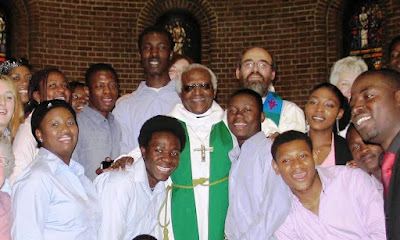
‘But you know, death is not the worst thing that could happen to a Christian’ … with Archbishop Desmond Tutu and members of the Discovery Gospel Choir in Dublin in 2005
Patrick Comerford
We are in Ordinary Time in the Church Calendar and tomorrow is the Sixth Sunday after Trinity (Trinity VI, 12 July 2026). The Calendar of the Church of England in Common Worship today remembers the life and witness of Saint Benedict of Nursia (550), Abbot of Monte Cassino and Father of Western Monasticism.
I may not venture out to the festival in the cricket club later today. But, before I make any decisions about what to do today, I am taking some quiet time this morning to give thanks, to reflect, to pray and to read in these ways:
1, reading today’s Gospel reading;
2, a short reflection;
3, a prayer from the USPG prayer diary;
4, the Collects and Post-Communion prayer of the day.
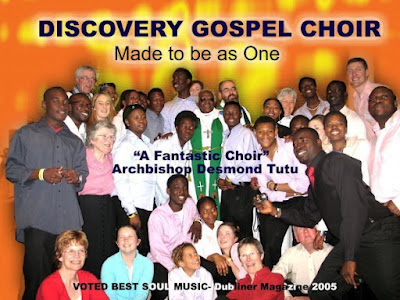
‘But you know, death is not the worst thing that could happen to a Christian’ … with Archbishop Desmond Tutu on the cover of a Discovery Gospel Choir CD
Matthew 10: 24-33 (NRSVA):
[Jesus said:] 24 ‘A disciple is not above the teacher, nor a slave above the master; 25 it is enough for the disciple to be like the teacher, and the slave like the master. If they have called the master of the house Beelzebul, how much more will they malign those of his household!
26 ‘So have no fear of them; for nothing is covered up that will not be uncovered, and nothing secret that will not become known. 27 What I say to you in the dark, tell in the light; and what you hear whispered, proclaim from the housetops. 28 Do not fear those who kill the body but cannot kill the soul; rather fear him who can destroy both soul and body in hell. 29 Are not two sparrows sold for a penny? Yet not one of them will fall to the ground unperceived by your Father. 30 And even the hairs of your head are all counted. 31 So do not be afraid; you are of more value than many sparrows.
32 ‘Everyone therefore who acknowledges me before others, I also will acknowledge before my Father in heaven; 33 but whoever denies me before others, I also will deny before my Father in heaven.’
‘What I say to you in the dark, tell in the light …’ (Matthew 10: 27) … 30 seconds of calm at Platanias in Rethymnon, Crete (Patrick Comerford)
Today’s Reflections:
When the late Archbishop Desmond Tutu (1931-2021) received the Nobel Peace Prize in 1984, I profiled him for The Irish Times. We had met previously, at events co-hosted by AfrI and Christian CND and at dinner in Roebuck House, Seán MacBride’s house in Clonskeagh, Dublin.
I asked him about the death threats he faced in South Africa at the height of apartheid. He engaged me with that look that confirmed his deep hope, commitment and faith, and said: ‘But you know, death is not the worst thing that could happen to a Christian.’
He must have been tempted at times to give up being a thorn in the side of the regime, to stop being a ‘turbulent priest,’ and to live a comfortable life. But his conscience would never have been comfortable.
While apartheid was still in force, Desmond Tutu became Dean of Saint Mary’s Cathedral, Johannesburg, and when I first met him he was the secretary general of the South African Council of Churches.
I was worried about the many death threats he was receiving, and I asked him how he lived with those threats. Was he worried about them? Did he ever consider modifying what he had to say because of them? His answer was similar to the one he gave when he was facing tough questioning before the regime’s Eloff Commission. He told that inquiry:
‘There is nothing the government can do to me that will stop me from being involved in what I believe God wants me to do. I do not do it because I like doing it. I do it because I am under what I believe to be the influence of God’s hand. I cannot help it. When I see injustice, I cannot keep quiet, for, as Jeremiah says, when I try to keep quiet, God’s Word burns like a fire in my breast. But what is it that they can ultimately do? The most awful thing that they can do is to kill me, and death is not the worst thing that could happen to a Christian.’
In 1987, Veritas invited me to write a short, 36-page biography of Archbishop Tutu, published as Desmond Tutu: Black Africa’s Man of Destiny. It was launched by the then Minister for Foreign Affairs, Brian Lenihan. It was a small book, hardly more than a pamphlet, but it came at an important time when both the Irish Government and the Irish Churches were becoming increasingly vocal about the evils of apartheid. It was republished in the US by Citadel (1988) and Hyperion Books (1989).
When I visited South Africa in 1990 with The Irish Times and Christian Aid, I met Archbishop Tutu in Cape Town, where once again he spoke powerfully about the changes that were beginning to take place.
Then, when my colleague Patsy McGarry was organising a monumental series of features in The Irish Times in 2000 to mark the millennium, Archbishop Tutu was one of the international contributors, along with Hans Küng, Andrew Greeley and Mary Robinson. The complete series was published by Veritas the following year as a book, Christianity, in which Part Two was my ‘Brief History of Christianity.’
I last met Archbishop Tutu when he visited Dublin in 2005, and he preached in Saint George’s and Saint Thomas’s Church in the inner city, where Canon (now Archdeacon) Katharine Poulton was then the Rector, as part of the Discovery Gospel Choir services.
His unforgettable words to me echo Christ’s words to the disciples in today’s Gospel reading: ‘Do not fear those who kill the body but cannot kill the soul; rather fear him who can destroy both soul and body in hell’ (Matthew 10: 28).
The Gospel reading at the Eucharist today (Matthew 10: 24-33) continues our readings from the commission and mission of the Twelve, as the Twelve continue to receive their instructions and commission for mission, even in the most hostile of environments.
‘What I say to you in the dark, tell in the light …’ (Matthew 10: 27) … walking through Galley Hill in Stony Stratford at night (Photograph: Patrick Comerford)
Today’s Prayers (Saturday 11 July 2026):
In Pray with the World Church, the prayer diary of the Anglican mission agency USPG (United Society Partners in the Gospel), the theme this week, from 5 to 11 July 2026 (pp 16-17), has been ‘Faith in the Midst of Fractures’. This theme was introduced last Sunday with a reflection by the Revd Godfrey Owino Adera, Anglican priest, theologian, and lecturer at Saint Paul’s University, Limuru, Kenya.
The USPG prayer diary today (Saturday 11 July 2026) invites us to pray:
God of truth and reconciliation, grant us courage to engage in difficult but necessary conversations. Where there is fear, give us boldness; where there is injustice, stir us to action; where there is brokenness, lead us toward healing and unity.
The Collect of the Day:
Eternal God,
who made Benedict a wise master
in the school of your service
and a guide to many called into community
to follow the rule of Christ:
grant that we may put your love before all else
and seek with joy the way of your commandments;
through Jesus Christ your Son our Lord,
who is alive and reigns with you,
in the unity of the Holy Spirit,
one God, now and for ever.
The Post-Communion Prayer:
Merciful God,
who gave such grace to your servant Benedict
that he served you with singleness of heart
and loved you above all things:
help us, whose communion with you
has been renewed in this sacrament,
to forsake all that holds us back from following Christ
and to grow into his likeness from glory to glory;
through Jesus Christ our Lord.
Collect on the Eve of Trinity VI:
Merciful God,
you have prepared for those who love you
such good things as pass our understanding:
pour into our hearts such love toward you
that we, loving you in all things and above all things,
may obtain your promises,
which exceed all that we can desire;
through Jesus Christ your Son our Lord,
who is alive and reigns with you,
in the unity of the Holy Spirit,
one God, now and for ever.
Collect on the Eve of Trinity VI:
O God, the protector of all who trust in you,
without whom nothing is strong, nothing is holy:
increase and multiply upon us your mercy;
that with you as our ruler and guide
we may so pass through things temporal
that we lose not our hold on things eternal;
grant this, heavenly Father,
for our Lord Jesus Christ’s sake,
who is alive and reigns with you,
in the unity of the Holy Spirit,
one God, now and for ever.
‘So do not be afraid; you are of more value than many sparrows’ (Matthew 10: 31) … Watching a mother sparrow feed her chicks in a nest in the ceiling of Aghias Anna Church, Maroulas, near Rethymnon in Crete (Patrick Comerford)