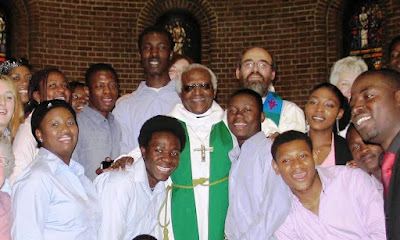
With Archbishop Desmond Tutu and members of the Discovery Gospel Choir in Dublin in 2005
Patrick Comerford
I was saddened to hear the news this morning that Archbishop Desmond Tutu has died at the age of 90.
When he received the Nobel Peace Prize in 1984, I profiled Archbishop Desmond Tutu for The Irish Times. We had met previously, at events co-hosted by AfrI and Christian CND and at dinner in Roebuck House, Seán MacBride’s house in Clonskeagh, Dublin.
I asked him about the death threats he faced in South Africa at the height of apartheid. He engaged me with that look that confirmed his deep hope, commitment and faith, and said: ‘But you know, death is not the worst thing that could happen to a Christian.’
He must have been tempted at times to give up being a thorn in the side of the regime, to stop being a ‘turbulent priest,’ and to live a comfortable life. But his conscience would never have been comfortable.
As a young adult who had recently come to experience the love of God and started to explore the challenges of Christian discipleship, I was deeply challenged by the witness of one of his predecessors as Dean of Johannesburg, who opened the doors of his cathedral and offered sanctuary to black protesters who were being beaten on the cathedral steps by white police using rhino whips.
Dean Gonville ffrench-Beytagh knew the consequences. He was jailed, and eventually exiled from South Africa. To use the words of the German martyr, Dietrich Bonhoeffer, he bore the ‘Cost of Discipleship.’ Some years later, while apartheid was still in force, Desmond Tutu became Dean of Saint Mary’s in Johannesburg, and when I first met him, he was the secretary general of the South African Council of Churches.
I was worried about the many death threats he was receiving, and I asked him how he lived with those threats. Was he worried about them? Did he ever consider modifying what he had to say because of them? His answer was similar to the one he gave when he was facing tough questioning before the regime’s Eloff Commission. He told that inquiry:
‘There is nothing the government can do to me that will stop me from being involved in what I believe God wants me to do. I do not do it because I like doing it. I do it because I am under what I believe to be the influence of God’s hand. I cannot help it. When I see injustice, I cannot keep quiet, for, as Jeremiah says, when I try to keep quiet, God’s Word burns like a fire in my breast. But what is it that they can ultimately do? The most awful thing that they can do is to kill me, and death is not the worst thing that could happen to a Christian.’
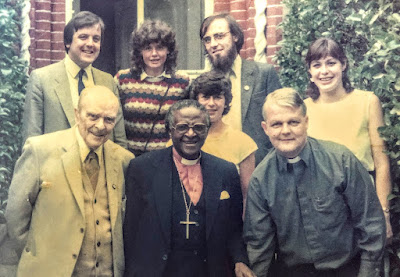
With Archbishop Desmond Tutu and Seán MacBride and Bruce Kent in Roebuck House, Dublin, in the early 1980s
In 1987, Veritas invited me to write a short, 36-page biography of Archbishop Tutu, published as Desmond Tutu: Black Africa’s Man of Destiny. It was launched by the then Minister for Foreign Affairs, Brian Lenihan. It was a small book, hardly more than a pamphlet, but it came at an important time when both the Irish Government and the Irish Churches were becoming increasingly vocal about the evils of apartheid.
It was republished as a paperback in the US by Citadel in 1988 and by Hyperion Books in 1989, and when I was visiting South Africa in 1990 with The Irish Times and Christian Aid, I met him in Cape Town, where once again he spoke powerfully about the changes that were beginning to take place.
We kept in touch for many years, exchanging Christmas cards and greetings, and I have many of his signed books on my bookshelves.
Then, when my colleague Patsy McGarry was organising a monumental series of one-page features in The Irish Times in 2000 to mark the millennium, Archbishop Tutu was one of the international writers who contributed, along with Hans Küng, Andrew Greeley and Mary Robinson. The complete series was published by Veritas the following year as a book, Christianity, in which Part Two was my ‘Brief History of Christianity.’
We last met when he visited Dublin in 2005, and he preached in Saint George’s and Saint Thomas’s Church in the inner city, where Canon Katharine Poulton was then the Rector, as part of the Discovery Gospel Choir services.
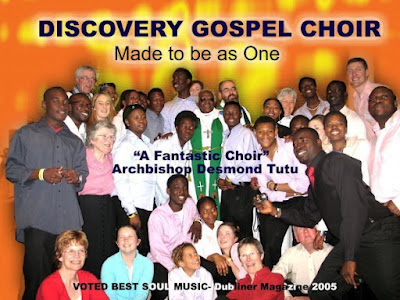
With Archbishop Desmond Tutu on the cover of a Discovery Gospel Choir CD
Showing posts with label Obituaries. Show all posts
26 December 2021
23 April 2016
Sir John Leslie: a reference in
his obituary in ‘The Irish Times’
Sir John Leslie: December 6th, 1916-April 18th, 2016. During the second World War he led a unit that held up the German advance at Boulogne-sur-Mer, buying time for the British evacuation at Dunkirk. Photograph: Naoise Culhane
My work on the genealogy of the Leslie family is referred to an obituary of Sir John Leslie in ‘The Irish Times’ this morning [23 April 2016], and provides much of the background information on his family history:
Sir John Leslie: A second world war hero who delighted in dance
Captain Sir John Leslie, who has died in his 100th year, was a proud Irishman who fought in the British army in the second World War, an Ulster landowner, an accomplished painter of watercolours and a disco-dancing enthusiast who celebrated his 85th birthday with a visit to Privilege, a vast venue dedicated to eardrum-shattering “house music” on the Spanish island of Ibiza.
In recent years he could fairly lay claim to the title of “Ireland’s oldest raver”. Announcing his death this week, his family described dance music as “perhaps his most endearing hobby”, along with membership of the Order of Malta and restoring historic buildings.
The Leslie family of Castle Leslie, Co Monaghan, was known for its allegiance to Ireland and Britain.
John Leslie was the eldest son of Sir Shane Leslie, a writer who had changed his first name from John, converted to Catholicism, embraced Irish nationalism while maintaining friendships with Éamon de Valera and Winston Churchill, to whom he was related. The family had a tradition of producing independent spirits, some would call them eccentrics, of which John Leslie – always known as Jack – was proud to be one.
Ancestry
In earlier centuries the Leslie family included warlike bishops, politicians, social reformers, agricultural innovators, philanthropic women, pre-Raphaelite painters, furniture collectors, writers and war heroes, and they claimed to trace their ancestry back to Attila the Hun, according to writer and Anglican clergyman Patrick Comerford.
Another Anglican clergyman, Jonathan Swift, after a visit to Castle Leslie, dipped his quill in acid and wrote about the library there: “With rows and rows of books upon the shelves Written by the Leslies/All about themselves”.
In 1940, when the British Expeditionary Force in France was retreating and being evacuated under fire, Leslie was an officer in the Irish Guards. He commanded a unit which held up the German advance at Boulogne-sur-Mer for two crucial hours, buying time for the British evacuation at Dunkirk and saving the lives of many of his comrades.
“Bullets were whizzing past my head on both sides,” he said afterwards. “Over and over again, I thought my time had come.”
Captured by the Germans, he spent five years as a prisoner of war, passing the time painting watercolours. He took a considerable risk by sending a postcard through the camp mail to British prime minister Winston Churchill asking him to intervene to exchange prisoners who were in a bad way.
This alerted the Germans to the fact they held a valuable hostage, Leslie’s paternal grandmother Leonie Jerome, and Churchill’s mother, Jennie Jerome, a celebrated society beauty, were sisters. That postcard is now in the Imperial War Museum in London.
New York
After the war, he moved to New York and later travelled around Europe, settling in Rome in a former monastery. At the age of 78 he returned to his family’s home at Castle Leslie.
He had earlier made over the house to his sister, the writer Anita Leslie. She too had served in the second World War as a mechanic and ambulance driver in the Middle East, and was honoured by France with the Croix de Guerre.
In turn she would pass Castle Leslie on to her younger brother Desmond, who was known for his interest in UFOs, and her son Richard King.
In 2002, Jack Leslie inadvertently disclosed to the press in advance the news that the castle would be used as the venue of the wedding of former Beatle Paul McCartney to Heather Mills.
Educated
John Norman Ide Leslie was the eldest son of Shane (John) Leslie and Marjorie Ide, whose father Henry had been governor general of the Philippines. Leslie was educated in England, at the Catholic Downside school and Magdalene College Cambridge. He joined the Irish Guards in 1937 at the age of 21. He became the fourth baronet of Glaslough and Pettigo when his father died in 1971.
In his 80s Leslie was to be seen “bopping” in nightclubs in the towns of Monaghan, Clones and Carrickmacross, waving his arms around in time to the beat and sporting his trademark Tam O’Shanter.
In 2015, Leslie received France’s highest decoration, the Légion d’honneur at a ceremony in the French embassy in Dublin in recognition of his wartime courage. Leslie never married. His older sister Anita died in 1985, and his younger brother Desmond in 2001.
My work on the genealogy of the Leslie family is referred to an obituary of Sir John Leslie in ‘The Irish Times’ this morning [23 April 2016], and provides much of the background information on his family history:
Sir John Leslie: A second world war hero who delighted in dance
Captain Sir John Leslie, who has died in his 100th year, was a proud Irishman who fought in the British army in the second World War, an Ulster landowner, an accomplished painter of watercolours and a disco-dancing enthusiast who celebrated his 85th birthday with a visit to Privilege, a vast venue dedicated to eardrum-shattering “house music” on the Spanish island of Ibiza.
In recent years he could fairly lay claim to the title of “Ireland’s oldest raver”. Announcing his death this week, his family described dance music as “perhaps his most endearing hobby”, along with membership of the Order of Malta and restoring historic buildings.
The Leslie family of Castle Leslie, Co Monaghan, was known for its allegiance to Ireland and Britain.
John Leslie was the eldest son of Sir Shane Leslie, a writer who had changed his first name from John, converted to Catholicism, embraced Irish nationalism while maintaining friendships with Éamon de Valera and Winston Churchill, to whom he was related. The family had a tradition of producing independent spirits, some would call them eccentrics, of which John Leslie – always known as Jack – was proud to be one.
Ancestry
In earlier centuries the Leslie family included warlike bishops, politicians, social reformers, agricultural innovators, philanthropic women, pre-Raphaelite painters, furniture collectors, writers and war heroes, and they claimed to trace their ancestry back to Attila the Hun, according to writer and Anglican clergyman Patrick Comerford.
Another Anglican clergyman, Jonathan Swift, after a visit to Castle Leslie, dipped his quill in acid and wrote about the library there: “With rows and rows of books upon the shelves Written by the Leslies/All about themselves”.
In 1940, when the British Expeditionary Force in France was retreating and being evacuated under fire, Leslie was an officer in the Irish Guards. He commanded a unit which held up the German advance at Boulogne-sur-Mer for two crucial hours, buying time for the British evacuation at Dunkirk and saving the lives of many of his comrades.
“Bullets were whizzing past my head on both sides,” he said afterwards. “Over and over again, I thought my time had come.”
Captured by the Germans, he spent five years as a prisoner of war, passing the time painting watercolours. He took a considerable risk by sending a postcard through the camp mail to British prime minister Winston Churchill asking him to intervene to exchange prisoners who were in a bad way.
This alerted the Germans to the fact they held a valuable hostage, Leslie’s paternal grandmother Leonie Jerome, and Churchill’s mother, Jennie Jerome, a celebrated society beauty, were sisters. That postcard is now in the Imperial War Museum in London.
New York
After the war, he moved to New York and later travelled around Europe, settling in Rome in a former monastery. At the age of 78 he returned to his family’s home at Castle Leslie.
He had earlier made over the house to his sister, the writer Anita Leslie. She too had served in the second World War as a mechanic and ambulance driver in the Middle East, and was honoured by France with the Croix de Guerre.
In turn she would pass Castle Leslie on to her younger brother Desmond, who was known for his interest in UFOs, and her son Richard King.
In 2002, Jack Leslie inadvertently disclosed to the press in advance the news that the castle would be used as the venue of the wedding of former Beatle Paul McCartney to Heather Mills.
Educated
John Norman Ide Leslie was the eldest son of Shane (John) Leslie and Marjorie Ide, whose father Henry had been governor general of the Philippines. Leslie was educated in England, at the Catholic Downside school and Magdalene College Cambridge. He joined the Irish Guards in 1937 at the age of 21. He became the fourth baronet of Glaslough and Pettigo when his father died in 1971.
In his 80s Leslie was to be seen “bopping” in nightclubs in the towns of Monaghan, Clones and Carrickmacross, waving his arms around in time to the beat and sporting his trademark Tam O’Shanter.
In 2015, Leslie received France’s highest decoration, the Légion d’honneur at a ceremony in the French embassy in Dublin in recognition of his wartime courage. Leslie never married. His older sister Anita died in 1985, and his younger brother Desmond in 2001.
16 November 2013
Cork-born priest with international
reputation in Biblical scholarship
■ Fr Jerome Murphy-O’Connor: Jerusalem, where he taught in the École Biblique, was his intellectual and personal home
Patrick Comerford
The Irish Times carries the following obituary on the top of the ‘Obituaries’ page, page 14, this morning [Saturday 16 November 2013]:
Cork-born priest who became leading Biblical scholar
Jerome
Murphy-O’Connor
………………….
Born: April 10th, 1935
Died: November 11th, 2013
………………….
The Revd Dr Jerome Murphy-O’Connor OP, who has died in Jerusalem aged 78, was a Cork-born Dominican theologian who earned international esteem as a Biblical scholar and a travel writer. He was a leading authority on St Paul and professor of New Testament at the École Biblique in Jerusalem.
He was born James (Jim) Murphy-O’Connor, the eldest of four children of Kerry Murphy-O’Connor and Mary McCrohan. The family was well known for its contributions to Irish rugby. Three of his uncles and his brother were parish priests in Cork; his cousin, Cardinal Cormac Murphy-O’Connor, was Archbishop of Westminster (2000-2009), and at least two other members of the family had been bishops in the 19th century.
The young James Murphy-O’Connor was educated at the Christian Brothers’ College and Castleknock College, Dublin, where he decided to become a Dominican priest. He entered the Dominican novitiate in Cork in September 1953, relinquishing his baptismal name, James, in favour of Jerome, in honour of the translator of the Vulgate Bible and patron saint of biblical studies.
He studied philosophy in Cork for a year before studying at the Dominican house in Tallaght and at the University of Fribourg, Switzerland. He was ordained a priest in 1960. His work on preaching in the life of Saint Paul developed into a thesis for which he was awarded a doctorate in theology (ThD) at Fribourg in 1962. He then studied in Rome, researched the Dead Sea Scrolls in Heidelberg and New Testament theology in Tübingen.
Professor in Jerusalem
In 1963, he went to the École Biblique in Jerusalem, an international centre founded by French Dominicans in 1890, becoming professor of New Testament there in 1972. Jerusalem remained his intellectual and personal home for the next four decades. His best-known book, The Holy Land, An Archaeological Guide from Earliest Times to 1700, was translated into several languages, ran to five editions and has become the standard guidebook to the region. Paul: His Story (2004), attained similar success and acclaim, while St Paul’s Ephesus: Texts and Archaeology (2008) also became a standard guide.
He regularly contributed to television panels and documentaries. He was a visiting professor at several American universities and at the Milltown Institute, Dublin, among other institutions.
Known to his friends as Jerry, he was described this week by a former colleague as “probably the most original Irish New Testament scholar of his generation”. He loved nothing more than uttering an iconoclastic remark and waiting for the reaction. A well-known story tells of an elderly nun at one of his Irish lectures asking whether the “brothers of Jesus” in the Gospel were his actual brothers. “Yes, sister,” he answered. “Any more questions?” A stormy debate ensued.
On one lecture, he spoke to a group of pilgrim priests in the Garden of Gethsemane in Jerusalem of how Christ was faced with a quick walk from there to the top of the Mount of Olives and escape; that for him was the real “Temptation in the Garden”.
Lifelong rugby follower
He received honorary degrees in the US and Australia, but particularly treasured the doctorate of literature conferred in 2002 by the National University of Ireland in University College Cork. He maintained a lifelong interest in the fortunes of Irish rugby.
In 2000, he contributed to a special series in The Irish Times edited by Patsy McGarry. His feature later became a chapter in Christianity (2001), alongside contributions from Hans Küng, Desmond Tutu, Mary Robinson and other international figures. One of his last publications is a contribution to the Dublin-based Dominican journal Doctrine and Life.
He is survived by his brothers, Archdeacon Kerry Murphy O’Connor, parish priest of Turner’s Cross, Cork, and Brian Murphy O’Connor, and his sister, Mrs Sheila Daly.
Patrick Comerford
The Irish Times carries the following obituary on the top of the ‘Obituaries’ page, page 14, this morning [Saturday 16 November 2013]:
Cork-born priest who became leading Biblical scholar
Jerome
Murphy-O’Connor
………………….
Born: April 10th, 1935
Died: November 11th, 2013
………………….
The Revd Dr Jerome Murphy-O’Connor OP, who has died in Jerusalem aged 78, was a Cork-born Dominican theologian who earned international esteem as a Biblical scholar and a travel writer. He was a leading authority on St Paul and professor of New Testament at the École Biblique in Jerusalem.
He was born James (Jim) Murphy-O’Connor, the eldest of four children of Kerry Murphy-O’Connor and Mary McCrohan. The family was well known for its contributions to Irish rugby. Three of his uncles and his brother were parish priests in Cork; his cousin, Cardinal Cormac Murphy-O’Connor, was Archbishop of Westminster (2000-2009), and at least two other members of the family had been bishops in the 19th century.
The young James Murphy-O’Connor was educated at the Christian Brothers’ College and Castleknock College, Dublin, where he decided to become a Dominican priest. He entered the Dominican novitiate in Cork in September 1953, relinquishing his baptismal name, James, in favour of Jerome, in honour of the translator of the Vulgate Bible and patron saint of biblical studies.
He studied philosophy in Cork for a year before studying at the Dominican house in Tallaght and at the University of Fribourg, Switzerland. He was ordained a priest in 1960. His work on preaching in the life of Saint Paul developed into a thesis for which he was awarded a doctorate in theology (ThD) at Fribourg in 1962. He then studied in Rome, researched the Dead Sea Scrolls in Heidelberg and New Testament theology in Tübingen.
Professor in Jerusalem
In 1963, he went to the École Biblique in Jerusalem, an international centre founded by French Dominicans in 1890, becoming professor of New Testament there in 1972. Jerusalem remained his intellectual and personal home for the next four decades. His best-known book, The Holy Land, An Archaeological Guide from Earliest Times to 1700, was translated into several languages, ran to five editions and has become the standard guidebook to the region. Paul: His Story (2004), attained similar success and acclaim, while St Paul’s Ephesus: Texts and Archaeology (2008) also became a standard guide.
He regularly contributed to television panels and documentaries. He was a visiting professor at several American universities and at the Milltown Institute, Dublin, among other institutions.
Known to his friends as Jerry, he was described this week by a former colleague as “probably the most original Irish New Testament scholar of his generation”. He loved nothing more than uttering an iconoclastic remark and waiting for the reaction. A well-known story tells of an elderly nun at one of his Irish lectures asking whether the “brothers of Jesus” in the Gospel were his actual brothers. “Yes, sister,” he answered. “Any more questions?” A stormy debate ensued.
On one lecture, he spoke to a group of pilgrim priests in the Garden of Gethsemane in Jerusalem of how Christ was faced with a quick walk from there to the top of the Mount of Olives and escape; that for him was the real “Temptation in the Garden”.
Lifelong rugby follower
He received honorary degrees in the US and Australia, but particularly treasured the doctorate of literature conferred in 2002 by the National University of Ireland in University College Cork. He maintained a lifelong interest in the fortunes of Irish rugby.
In 2000, he contributed to a special series in The Irish Times edited by Patsy McGarry. His feature later became a chapter in Christianity (2001), alongside contributions from Hans Küng, Desmond Tutu, Mary Robinson and other international figures. One of his last publications is a contribution to the Dublin-based Dominican journal Doctrine and Life.
He is survived by his brothers, Archdeacon Kerry Murphy O’Connor, parish priest of Turner’s Cross, Cork, and Brian Murphy O’Connor, and his sister, Mrs Sheila Daly.
Subscribe to:
Posts (Atom)

