Showing posts with label River Dodder. Show all posts

26 March 2023

On a quiet street where
old ghosts and poets meet
along the enchanted way

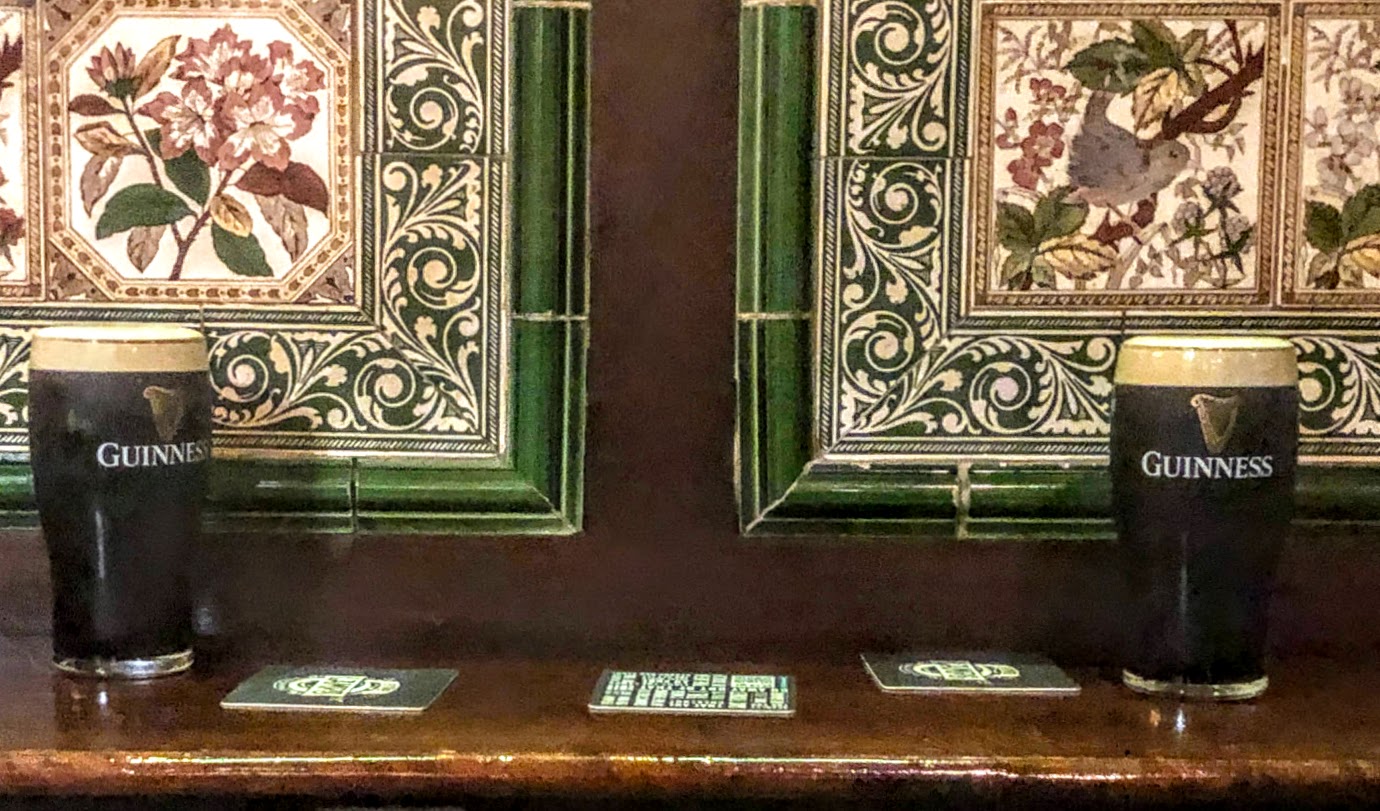
‘On Grafton Street … we tripped lightly along the ledge’ … two pints on the ledge in McDaid’s in Dublin (Photograph: Patrick Comerford, 2023)

Patrick Comerford

Two of us spent two days in Dublin last week while I was researching a chapter for a book due for publication later this year.

We stayed in Rathmines while I spent my two days of research working in the Church of Ireland library (the RCB Library) in Rathgar, just a 30-minute walk away, and the public library in Rathmines.

Although it was a very short, quick return visit, I had breakfast with an old friend in Churchtown, lunch in the Church of Ireland Theological Institute where I was on the academic staff for 15 years, strolled by banks of the River Dodder in Rathgar, and visited my older brother in Rathmines and the house on Beechwood Avenue in Ranelagh where my grandfather and great-grandfather had lived.

One evening, after dinner in Forno 500 in Dame Street, two of us strolled through Dublin in the night air, through Temple Bar, by the Ha’penny Bridge and the River Liffey, into Trinity College, where I was an adjunct assistant professor until 2017, and then along Grafton Street, before stopping off in McDaid’s for a late-night drink beneath the portraits of an array of Irish writers, including James Joyce, Brendan Behan, Sean O’Casey and Patrick Kavanagh.

We caught a bus from Redmond’s Hill back to Rathmines, discussing why we preferred one or other recording the poem ‘On Raglan Road’ by Patrick Kavanagh (1904-1967) – Charlotte’s choice is Luke Kelly, mine is Ronnie Drew. But our other nominees included Sinead O’Connor and Van Morrison.

‘On Grafton Street … where old ghosts meet’ … portraits of Irish writers on the wall in McDaid’s on Harry Street, including Patrick Kavanagh (Photograph: Patrick Comerford, 2023)

In the past, when I occasionally celebrated the Eucharist in Saint Bartholomew’s Church, I would take a quiet break in the stillness of the morning, and stroll through the neighbouring streets in Ballsbridge, including Herbert Park, Waterloo Road, Wellington Road, Pembroke Road, Elgin Road, Clyde Road and Raglan Road, the street that inspired the poem by Patrick Kavanagh:

On Raglan Road on an Autumn day, I saw her first and knew
that her dark hair would weave a snare that I might one day rue …


At the turn of the 19th and 20th centuries, the Victorian and Edwardian houses on Raglan Road and the surrounding streets in the Pembroke township and Pembroke estate became the new residential homes of people who had lived previously in the Georgian squares of Dublin, such as Fitzwilliam Square and Merrion Square.

In more recent years, Raglan Road has become one of Dublin’s most exclusive residential streets, with some of the most expensive houses on sale in Ireland. Recent residents of Raglan Road have included the billionaire businessman Denis O’Brien, and the road is also home to several ambassadors, including the Turkish and Belgian ambassadors, as well as the Mexican Embassy.

The Mexican Embassy at No 19 Raglan Road was the home of Patrick Kavanagh in 1940-1943. It was Mrs Kenny’s boarding house, and he paid 10 shillings a week in rent. Before that, he had lived nearby on 62 Pembroke Road, but his poetic genius is irreversibly linked with Raglan Road, and his best-known poem, ‘On Raglan Road.’

During those early Sunday morning strolls, as I walked along ‘the enchanted way’ that is wide, tree-lined Raglan Road, it was easy to imagine Kavanagh’s ‘Quiet street where old ghosts meet’:

On Raglan Road on an autumn day I met her first and knew.
That her dark hair would weave a snare that I might one day rue;
I saw danger, yet I walked along enchanted way.
And I said, let grief be a fallen leaf at dawning of day.


The poem was first published under the title ‘Dark Haired Miriam Ran Away’ in The Irish Press almost 80 years ago on 3 October 1946. But everyone at the time knew that Kavanagh’s poem was about Dr Hilda Moriarty from Dingle, Co Kerry.

Patrick Kavanagh met the beautiful, dark-haired Hilda Moriarty in 1944. She was a medical student at University College Dublin and was only in Dublin a few months, but she became one of most celebrated beauties of her time. She already knew Kavanagh’s poetry and writings; she was 22 and he was 40.

The penniless poet loved her, but there was an 18-year gap. She was flattered, but she did not reciprocate. When Hilda went home to Dingle for Christmas 1944, Kavanagh followed her but was not welcome in the Moriarty home. She was the young and beautiful daughter of the local doctor; he was a middle-aged, out-of-work journalist and the son of a small farmer. Kavanagh stayed at Kruger Kavanagh’s guesthouse in Dunquin and paid for his stay by writing an article on ‘My Christmas in Kerry’ in The Irish Press.

Back in Dublin, they met on-and-off throughout 1945. But eventually Hilda rejected him and in August 1947 she would marry Donogh O’Malley (1921-1968), later the Fianna Fail Minister for Education.

In the meantime, ‘Dark Haired Miriam Ran Away’ was published in The Irish Press on 3 October 1946. Patrick’s brother, Peter Kavanagh, said that ‘it was written about Patrick’s girlfriend Hilda, but to avoid embarrassment he used the name of my girlfriend in the title.’ A meaningless line in this edition, Synthetic sighs and fish-dim eyes and all death’s loud display, was later replaced with The Queen of Hearts still making tarts and I not making hay.

Kavanagh celebrated this unrequited love with a poem he dreamed of setting to the Irish traditional air, The Dawning of the Day (Fáinne Geal an Lae).

In the poem, the writer recalls a love affair that he had with a young woman while walking on a ‘quiet street.’ Although the speaker knew that he would risk being hurt if he initiated a relationship, he did so anyway:

I saw the danger, yet I walked along the enchanted way,
And I said, let grief be a fallen leaf at the dawning of the day.


Twenty years after Patrick Kavanagh wrote his poem, the Dubliners were playing one evening in 1966 in the Bailey in Duke Street, off Grafton Street, the other Dublin street named in this poem. On that evening, Patrick Kavanagh asked Luke Kelly of the Dubliners if he could adapt ‘On Raglan Road.’ Naturally, Luke Kelly chose the air of Fáinne Geal an Lae … and so was born a much-loved Irish song.

A year after his poem became part of the Dubliners’ repertoire, Patrick Kavanagh married his long-term companion Katherine Barry Moloney in April 1967 and they lived on Waterloo Road. He died a few months later, on 30 November 1967, in a Dublin nursing home. Hilda’s husband, Donogh O’Malley, died some weeks later on 10 March 1968.

In an interview with RTÉ in 1974, the writer Benedict Kiely recalled Kavanagh trying out the paired verse and tune for him soon after writing it.

Dr Hilda O’Malley was interviewed by RTÉ in 1987 for a documentary about Kavanagh, Gentle Tiger. In the interview, she said one of the main reasons for the failure of their relationship was that there was a wide age gap between them.

She recalled how ‘On Raglan Road’ was written by Kavanagh. He had described himself as the peasant poet but she was not impressed and teased him for writing about mundane things such as vegetables. She said he should write about something else so he agreed to do so. According to Dr Moriarty, he then went away and wrote ‘On Raglan Road.’

Dr Hilda O’Malley died in 1991 in Saint Vincent’s Hospital, Dublin.

Before leaving Dublin at the end of last week’s short visit, we returned to Grafton Street, and had coffee beneath the Harry Clarke windows in Bewley’s. As we headed back to the airport that evening, we were still discussing Patrick Kavanagh’s unrequited love and the competing merits of the different recordings of ‘On Raglan Road.’

‘Of the deep ravine where can be seen the worth of passion’s pledge’ … the Ha’penny Bridge at night in Dublin (Photograph: Patrick Comerford, 2023)

On Raglan Road, by Patrick Kavanagh

On Raglan Road on an autumn day I met her first and knew
That her dark hair would weave a snare that I might one day rue;
I saw the danger, yet I walked along the enchanted way,
And I said, let grief be a fallen leaf at the dawning of the day.

On Grafton Street in November we tripped lightly along the ledge
Of the deep ravine where can be seen the worth of passion’s pledge,
The Queen of Hearts still making tarts and I not making hay –
O I loved too much and by such and such is happiness thrown away.

I gave her gifts of the mind I gave her the secret sign that’s known
To the artists who have known the true gods of sound and stone
And word and tint. I did not stint for I gave her poems to say.
With her own name there and her own dark hair like clouds over fields of May.

On a quiet street where old ghosts meet I see her walking now
Away from me so hurriedly my reason must allow
That I had wooed not as I should a creature made of clay –
When the angel woos the clay he’d lose his wings at the dawn of day.

The Mexican Embassy on Raglan Road, where Patrick Kavanagh once lived (Photograph: Patrick Comerford)

12 May 2022

Praying with the Psalms in Easter:
12 May 2022 (Psalm 78)

‘Can God spread a table in the wilderness?’ (Psalm 78: 19) … on the beach below Profitis Ilias Church in Giorgioupoli in Crete (Photograph: Patrick Comerford)

Patrick Comerford

I have been in Askeaton, Co Limerick, since Tuesday, and plan to return to Dublin later this afternoon. Before this day begins (12 May 2022), I am continuing my morning reflections in this season of Easter continues, including my morning reflections drawing on the Psalms.

In my blog, I am reflecting each morning in this Prayer Diary in these ways:

1, Short reflections on a psalm or psalms;

2, reading the psalm or psalms;

3, a prayer from the USPG prayer diary.

Psalm 78:

Psalm 78 is found in Book 3 in the Book of Psalms, which includes Psalms 73 to 89. In the slightly different numbering scheme in the Greek Septuagint and the Latin Vulgate, this is psalm is numbered as Psalm 77.

This is the seventh of the ‘Psalms of Asaph.’ These are the 12 psalms numbered 50 and 73 to 83 in the Masoretic text and 49 and 72-82 in the Septuagint. Each psalm has a separate meaning, and these psalms cannot be summarised easily as a whole.

But throughout these 12 psalms is the shared theme of the judgment of God and how the people must follow God’s law.

The superscription of this psalm reads: ‘A Maskil of Asaph.’ The attribution of a psalm to Asaph could mean that it was part of a collection from the Asaphites, identified as Temple singers, or that the psalm was performed in a style associated with Asaph, who was said to be the author or transcriber of these psalms.

Asaph who is identified with these psalms was a Levite, the son of Berechiah and descendant of Gershon, and he was the ancestor of the Asaphites, one the guilds of musicians in the first Temple in Jerusalem.

Asaph served both David and Solomon, and performed at the dedication of Solomon’s Temple (see II Chronicles 5: 12). His complaint against corruption among the rich and influential, recorded in Psalm 73, for example, might have been directed against some of court officials. The words used to describe the wicked come from words used by officials of the cult or sacrificial system.

Several of the Psalms of Asaph are categorised as communal laments because they are concerned for the well-being of the whole community. Many of these psalms forecast destruction or devastation in the future, but are balanced with God’s mercy and saving power for the people.

Psalm 78 is described as a ‘maskil’ or ‘contemplation. This is the second-longest Psalm, with 72 verses (Psalm 119 has 176 verses). This is also the first of the three great history psalms – the others are Psalm 105 and Psalm 106.

Psalm 78 urges people to follow the law and it is meant to show the people of the time the pattern of God’s saving mercy.

The psalm encourages passing down from generation to generation the memory of ‘the glorious deeds of the Lord, and his might, and the wonders that he has done of the deeds of God.’ It reflects specifically on the time of Moses and the freed people in the wilderness.

‘He made streams come out of the rock, and caused waters to flow down like rivers’ (Psalm 78: 16) … the weir on the River Dodder at Firhouse, Co Dublin (Photograph: Patrick Comerford, 2022)

Psalm 78 (NRSVA):

A Maskil of Asaph.

1 Give ear, O my people, to my teaching;
incline your ears to the words of my mouth.
2 I will open my mouth in a parable;
I will utter dark sayings from of old,
3 things that we have heard and known,
that our ancestors have told us.
4 We will not hide them from their children;
we will tell to the coming generation
the glorious deeds of the Lord, and his might,
and the wonders that he has done.

5 He established a decree in Jacob,
and appointed a law in Israel,
which he commanded our ancestors
to teach to their children;
6 that the next generation might know them,
the children yet unborn,
and rise up and tell them to their children,
7 so that they should set their hope in God,
and not forget the works of God,
but keep his commandments;
8 and that they should not be like their ancestors,
a stubborn and rebellious generation,
a generation whose heart was not steadfast,
whose spirit was not faithful to God.

9 The Ephraimites, armed with the bow,
turned back on the day of battle.
10 They did not keep God’s covenant,
but refused to walk according to his law.
11 They forgot what he had done,
and the miracles that he had shown them.
12 In the sight of their ancestors he worked marvels
in the land of Egypt, in the fields of Zoan.
13 He divided the sea and let them pass through it,
and made the waters stand like a heap.
14 In the daytime he led them with a cloud,
and all night long with a fiery light.
15 He split rocks open in the wilderness,
and gave them drink abundantly as from the deep.
16 He made streams come out of the rock,
and caused waters to flow down like rivers.

17 Yet they sinned still more against him,
rebelling against the Most High in the desert.
18 They tested God in their heart
by demanding the food they craved.
19 They spoke against God, saying,
‘Can God spread a table in the wilderness?
20 Even though he struck the rock so that water gushed out
and torrents overflowed,
can he also give bread,
or provide meat for his people?’

21 Therefore, when the Lord heard, he was full of rage;
a fire was kindled against Jacob,
his anger mounted against Israel,
22 because they had no faith in God,
and did not trust his saving power.
23 Yet he commanded the skies above,
and opened the doors of heaven;
24 he rained down on them manna to eat,
and gave them the grain of heaven.
25 Mortals ate of the bread of angels;
he sent them food in abundance.
26 He caused the east wind to blow in the heavens,
and by his power he led out the south wind;
27 he rained flesh upon them like dust,
winged birds like the sand of the seas;
28 he let them fall within their camp,
all around their dwellings.
29 And they ate and were well filled,
for he gave them what they craved.
30 But before they had satisfied their craving,
while the food was still in their mouths,
31 the anger of God rose against them
and he killed the strongest of them,
and laid low the flower of Israel.

32 In spite of all this they still sinned;
they did not believe in his wonders.
33 So he made their days vanish like a breath,
and their years in terror.
34 When he killed them, they sought for him;
they repented and sought God earnestly.
35 They remembered that God was their rock,
the Most High God their redeemer.
36 But they flattered him with their mouths;
they lied to him with their tongues.
37 Their heart was not steadfast towards him;
they were not true to his covenant.
38 Yet he, being compassionate,
forgave their iniquity,
and did not destroy them;
often he restrained his anger,
and did not stir up all his wrath.
39 He remembered that they were but flesh,
a wind that passes and does not come again.
40 How often they rebelled against him in the wilderness
and grieved him in the desert!
41 They tested God again and again,
and provoked the Holy One of Israel.
42 They did not keep in mind his power,
or the day when he redeemed them from the foe;
43 when he displayed his signs in Egypt,
and his miracles in the fields of Zoan.
44 He turned their rivers to blood,
so that they could not drink of their streams.
45 He sent among them swarms of flies, which devoured them,
and frogs, which destroyed them.
46 He gave their crops to the caterpillar,
and the fruit of their labour to the locust.
47 He destroyed their vines with hail,
and their sycamores with frost.
48 He gave over their cattle to the hail,
and their flocks to thunderbolts.
49 He let loose on them his fierce anger,
wrath, indignation, and distress,
a company of destroying angels.
50 He made a path for his anger;
he did not spare them from death,
but gave their lives over to the plague.
51 He struck all the firstborn in Egypt,
the first issue of their strength in the tents of Ham.
52 Then he led out his people like sheep,
and guided them in the wilderness like a flock.
53 He led them in safety, so that they were not afraid;
but the sea overwhelmed their enemies.
54 And he brought them to his holy hill,
to the mountain that his right hand had won.
55 He drove out nations before them;
he apportioned them for a possession
and settled the tribes of Israel in their tents.

56 Yet they tested the Most High God,
and rebelled against him.
They did not observe his decrees,
57 but turned away and were faithless like their ancestors;
they twisted like a treacherous bow.
58 For they provoked him to anger with their high places;
they moved him to jealousy with their idols.
59 When God heard, he was full of wrath,
and he utterly rejected Israel.
60 He abandoned his dwelling at Shiloh,
the tent where he dwelt among mortals,
61 and delivered his power to captivity,
his glory to the hand of the foe.
62 He gave his people to the sword,
and vented his wrath on his heritage.
63 Fire devoured their young men,
and their girls had no marriage song.
64 Their priests fell by the sword,
and their widows made no lamentation.
65 Then the Lord awoke as from sleep,
like a warrior shouting because of wine.
66 He put his adversaries to rout;
he put them to everlasting disgrace.

67 He rejected the tent of Joseph,
he did not choose the tribe of Ephraim;
68 but he chose the tribe of Judah,
Mount Zion, which he loves.
69 He built his sanctuary like the high heavens,
like the earth, which he has founded for ever.
70 He chose his servant David,
and took him from the sheepfolds;
71 from tending the nursing ewes he brought him
to be the shepherd of his people Jacob,
of Israel, his inheritance.
72 With upright heart he tended them,
and guided them with skilful hand.

Today’s Prayer:

The theme in this week’s prayer diary of the Anglican mission agency USPG (United Society Partners in the Gospel) is ‘Celebration in Casablanca.’ It was introduced on Sunday morning by the Right Revd David Hamid, Suffragan Bishop in Europe.

The USPG Prayer Diary this morning (12 May 2022) invites us to pray:

We pray for initiatives such as the Programme for Christian-Muslim Relations in Africa, which seeks to build relationships between people of different faiths.

Yesterday’s reflection

Continued tomorrow

Scripture quotations are from the New Revised Standard Version Bible: Anglicised Edition copyright © 1989, 1995, National Council of the Churches of Christ in the United States of America. Used by permission. All rights reserved worldwide. http://nrsvbibles.org

09 March 2022

Praying with the Psalms in Lent:
9 March 2022 (Psalms 22, 23, 24)

God hears the cry of the poor and the afflicted (Psalm 22: 24-26) … ‘Christ the Beggar’, a sculpture by Timothy Schmalz on the steps of Santo Spirito Hospital near the Vatican (Photograph: Patrick Comerford)

Patrick Comerford

We are now a full week into Lent, which began last week on Ash Wednesday (2 March 2022). Before today begins, I am taking some time early this morning for prayer, reflection and reading.

During Lent this year, in this Prayer Diary on my blog each morning, I am reflecting in these ways:

1, Short reflections on a psalm or psalms;

2, reading the psalm or psalms;

3, a prayer from the USPG prayer diary.

‘My God, my God, why have you forsaken me?’ (Psalm 22: 1) … words repeated by the dying Christ on the Cross … a cross on the nave altar in Lichfield Cathedral (Photograph: Patrick Comerford)

Psalm 22:

Psalm 22 is a prayer for deliverance from illness. The psalmist, who is gravely ill, feels that God has forsaken himIn the past, God has helped his people (verses 4-5), and now he asks God to help him. He goes on to say that he will offer thanksgiving in assembly of the community, in the Temple (verse 22).

But he offers thanksgiving in the Temple and in this portion of the psalm he comes to the conclusion that God hears the voice of the poor and the hungry (verse 26).

In his dying moments on the cross, Christ quotes an Aramaic version of the opening words of this psalm: ‘My God, my God, why have you forsaken me?’ (Psalm 22: 1; see Matthew 27: 46; Mark 15: 34).

In his suffering, the psalmist feels deserted by God, despite his cries for help day and night. Even so, he is convinced that God is holy. His forebears trusted in God, as he does, and God helped them, so may God help him now.

Those who mock him aggravate his misery. They see his suffering as a sign of God’s ineffectiveness, and so they jeer him. But he is convinced that God has been with him since his infancy, and only God alone can help him now.

Now God hears the cry of the poor and the afflicted (verses 24-26). He provides perpetual life for the poor those who live in awe of him. May all people everywhere turn to God and worship him (verse 27). God is Lord of all (verse 28). All mortals, all who die or go down to the dust (verse 29), worship God. The psalmist says he will live following God’s ways, and so will his offspring. They will be God’s for ever, and will tell future generations about God’s saving deeds.

God is the God of all people and nations, to the ends of the earth, and the God of the generations to come, a people yet unborn (verse 31).

Christ as the Good Shepherd … a mosaic in the Mausoleum of Galla Placidia in Ravenna (Photograph: Patrick Comerford)

Psalm 23:

Psalm 23 is one of the best-known psalms, and is often known by its opening words in the King James Version, ‘The Lord is my Shepherd.’ In Latin, it is known by the incipit, Dominus reget me.

A metrical version of the psalm, traditionally sung to the hymn tune Crimond is attributed to Jessie Seymour Irvine (1836-1887), opens with the words ‘The Lord's My Shepherd,’ and is one of the best-known hymns among English-speakers.

The author of this psalm describes God as his shepherd, in the role of protector and provider. For Christians, the image of God as a shepherd evokes connections not only with David but with Christ as the Good Shepherd in Saint John’s Gospel (see John 10: 11, 14). The phrase about ‘the valley of the shadow of death’ is often understood as an allusion to eternal life.

The theme of God as a shepherd was common in ancient Israel and Mesopotamia. For example, King Hammurabi, in the conclusion to his famous legal code, wrote: ‘I am the shepherd who brings well-being and abundant prosperity; my rule is just … so that the strong might not oppress the weak, and that even the orphan and the widow might be treated with justice.’

Psalm 23 portrays God as a good shepherd, feeding and leading his flock. The ‘rod and staff’ are also used by shepherds. The shepherd is to know each of the sheep by name, leads them to green pastures and still waters so they may eat and drink.

In this psalm, we can also imagine King David acknowledging God’s protection throughout his life.

Christ the Good Shepherd (see Psalm 23), with the Virgin Mary and Saint John the Baptist on each side … a stained-glass window in Saint Mary’s Church, Lichfield (Photograph: Patrick Comerford)

Psalm 23:

Psalm 23 has enduring popularity because of its description of the Good Shepherd.

In the ancient Near East, the king was seen as shepherd (verse 1-4) and as host (verses 5-6). God faithfully provides for, and constantly cares for, his sheep. He revives our very lives, the ‘soul’ (verse 3), and guides us in godly ways or ‘right paths.’

Even when we are beset by evil or find ourselves in the ‘darkest valley’ (verse 4), we have nothing to fear. God’s ‘rod,’ the shepherd’s defence against wolves and lions, protects us. His ‘staff’ (verse 4), used for rescuing sheep from thickets, guides us.

The feast (verse 5) is even more impressive, for it is laid out for us, the table is set for us, in the presence of his foes. Kings were plenteously anointed with oil, a symbol of power and dedication to a holy purpose.

The psalmist trusts that God’s ‘goodness and mercy’ and God’s steadfast love (verse 6) will follow or pursue him, as do his enemies, throughout his life. He will continue to worship in the Temple or ‘dwell in the house of the Lord,’ as long as he lives.

‘Lift up your heads, O gates! and be lifted up, O ancient doors!’ (Psalm 24, 7, 9) … old doors seen through the gates of Cappoquin House, Co Waterford (Photograph: Patrick Comerford)

Psalm 24:

Psalm 24 is a song of joyous procession to the Temple. This psalm reflects an ancient myth that tells of the divine conquest of the unruly forces of chaos, but the psalm becomes a hymn of praise to God the creator, followed by a liturgy on entering the Temple. The opening verses mirror the act of creation. The connection between Creation and the Temple is based on the idea that the Temple was a microcosm of the universe, and its construction a human counterpart to the Divine creation of the cosmos.

With its question-and-answer format, it was probably sung antiphonally, as the Ark was borne to the Temple.

Psalm 24 begins with creation, ‘The earth is the Lord’s and all that is in it’ (verse 1), and moves directly to the moral requirements of religious life: ‘Who shall ascend to the hill of the Lord?’ (verse 3).

Verses 4-6 give the answer: those who are pure, who do not worship false gods, and who do not harm others with false oaths. They will be blessed by God, with prosperity. Just as God created an orderly universe, so we are commanded to create an orderly society. Worshipping God in the Temple is not divorced from honesty and integrity in daily life.

In the second half of this psalm (verses 7-10), the pilgrims identify God in terms traditionally associated with the Ark: he is ‘the King of glory,’ ‘the Lord of hosts,’ the victor and the hero of Israel.

The words ‘Lift up your heads, O gates!’ (verses 7, 9), are said, traditionally, to have been said by King Solomon when the Ark, containing the tablets of the covenant, was first brought into the Temple. The doors are those between the outer court and the sanctuary of the Temple. Perhaps a priest asks: ‘Who is the King of glory?’ (verse 8, 10) from within, and the people answer from the court. God dwells in the sanctuary.

Psalm 22 (NRSVA):

To the leader: according to The Deer of the Dawn. A Psalm of David.

1 My God, my God, why have you forsaken me?
Why are you so far from helping me, from the words of my groaning?
2 O my God, I cry by day, but you do not answer;
and by night, but find no rest.

3 Yet you are holy,
enthroned on the praises of Israel.
4 In you our ancestors trusted;
they trusted, and you delivered them.
5 To you they cried, and were saved;
in you they trusted, and were not put to shame.

6 But I am a worm, and not human;
scorned by others, and despised by the people.
7 All who see me mock at me;
they make mouths at me, they shake their heads;
8 ‘Commit your cause to the Lord; let him deliver—
let him rescue the one in whom he delights!’

9 Yet it was you who took me from the womb;
you kept me safe on my mother’s breast.
10 On you I was cast from my birth,
and since my mother bore me you have been my God.
11 Do not be far from me,
for trouble is near
and there is no one to help.

12 Many bulls encircle me,
strong bulls of Bashan surround me;
13 they open wide their mouths at me,
like a ravening and roaring lion.

14 I am poured out like water,
and all my bones are out of joint;
my heart is like wax;
it is melted within my breast;
15 my mouth is dried up like a potsherd,
and my tongue sticks to my jaws;
you lay me in the dust of death.

16 For dogs are all around me;
a company of evildoers encircles me.
My hands and feet have shrivelled;
17 I can count all my bones.
They stare and gloat over me;
18 they divide my clothes among themselves,
and for my clothing they cast lots.

19 But you, O Lord, do not be far away!
O my help, come quickly to my aid!
20 Deliver my soul from the sword,
my life from the power of the dog!
21 Save me from the mouth of the lion!

From the horns of the wild oxen you have rescued me.
22 I will tell of your name to my brothers and sisters;
in the midst of the congregation I will praise you:
23 You who fear the Lord, praise him!
All you offspring of Jacob, glorify him;
stand in awe of him, all you offspring of Israel!
24 For he did not despise or abhor
the affliction of the afflicted;
he did not hide his face from me,
but heard when I cried to him.

25 From you comes my praise in the great congregation;
my vows I will pay before those who fear him.
26 The poor shall eat and be satisfied;
those who seek him shall praise the Lord.
May your hearts live for ever!

27 All the ends of the earth shall remember
and turn to the Lord;
and all the families of the nations
shall worship before him.
28 For dominion belongs to the Lord,
and he rules over the nations.

29 To him, indeed, shall all who sleep in the earth bow down;
before him shall bow all who go down to the dust,
and I shall live for him.
30 Posterity will serve him;
future generations will be told about the Lord,
31 and proclaim his deliverance to a people yet unborn,
saying that he has done it.

Psalm 23 (NRSVA):

A Psalm of David.

1 The Lord is my shepherd, I shall not want.
2 He makes me lie down in green pastures;
he leads me beside still waters;
3 he restores my soul
He leads me in right paths
for his name’s sake.

4 Even though I walk through the darkest valley,
I fear no evil;
for you are with me;
your rod and your staff—
they comfort me.

5 You prepare a table before me
in the presence of my enemies;
you anoint my head with oil;
my cup overflows.
6 Surely goodness and mercy shall follow me
all the days of my life,
and I shall dwell in the house of the Lord
my whole life long.

Psalm 24 (NRSVA):

Of David. A Psalm.

1 The earth is the Lord’s and all that is in it,
the world, and those who live in it;
2 for he has founded it on the seas,
and established it on the rivers.

3 Who shall ascend the hill of the Lord?
And who shall stand in his holy place?
4 Those who have clean hands and pure hearts,
who do not lift up their souls to what is false,
and do not swear deceitfully.
5 They will receive blessing from the Lord,
and vindication from the God of their salvation.
6 Such is the company of those who seek him,
who seek the face of the God of Jacob.
Selah

7 Lift up your heads, O gates!
and be lifted up, O ancient doors!
that the King of glory may come in.
8 Who is the King of glory?
The Lord, strong and mighty,
the Lord, mighty in battle.
9 Lift up your heads, O gates!
and be lifted up, O ancient doors!
that the King of glory may come in.
10 Who is this King of glory?
The Lord of hosts,
he is the King of glory.
Selah

Today’s Prayer:

The Prayer in the USPG Prayer Diary this morning (9 March 2022) invites us to pray:

We pray for the Diocese of Luapula in the Church of the Province of Central Africa.

Yesterday’s reflection

Continued tomorrow

‘He makes me lie down in green pastures; he leads me beside still waters’ (Psalm 23: 2) … the River Dodder at Firhouse, Co Dublin, this week (Photograph: Patrick Comerford, 2022)

Scripture quotations are from the New Revised Standard Version Bible: Anglicised Edition copyright © 1989, 1995, National Council of the Churches of Christ in the United States of America. Used by permission. All rights reserved worldwide. http://nrsvbibles.org

05 March 2022

Tourville Lodge and a lost house in
the centre of Rathfarnham village

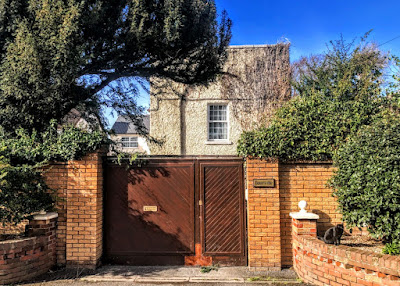
Tourville Lodge, the former gate of Tourville House, on Church Lane, Rathfarnham (Photograph: Patrick Comerford, 2022)

Patrick Comerford

A new car park has opened in recent months on Dodder View Road, beneath the slopes behind Rathfarnham Village and facing the new pedestrian bridge across the River Dodder, leading into Bushy Park.

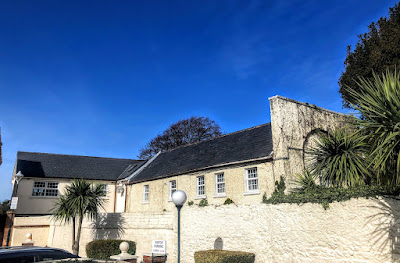
In Church Lane, behind the Church of Ireland parish church in the heart of Rathfarnham Village, Tourville Lodge is a simple, substantial former gate lodge that was linked to the now demolished Tourville House, probably built in the 18th century.

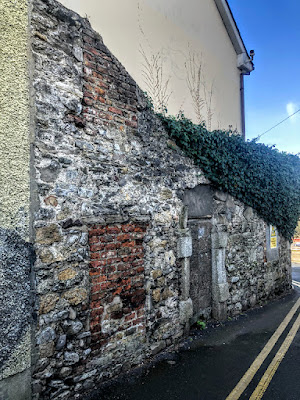
The house is in a quiet corner of Rathfarnham village, where it preserves the old street line. The impressive wall at the east gable indicates the original importance of this elevation, and the rubble stone wall on the north side of the house has window openings and a block and start doorway that are now blocked up.

Tourville Lodge is now as a private house. But during the War of Independence it was a police station and a school, and this enhances the historic significance of this interesting building.

This is a detached, five-bay two-storey former gate lodge, built ca 1800. It has roughcast rendered walls, with a shallow recessed double-height arch that has a high parapet at the east gable end.

The later two-bay wing at the west side of Tourville Lodge forms an L-plan. The house has uPVC casement windows, a uPVC door in the flat-roofed porch, and a pitched slate roof.

Tourville Lodge on Church Lane, Rathfarnham, is a former gate lodge, built around 1800 (Photograph: Patrick Comerford, 2022)

Church Lane opens between Rathfarnham Church and a bank built on the site of a Garda station and a former Royal Irish Constabulary barracks that was burned down during the ‘Troubles.’

From Rathfarnham village, Church Lane leads to Woodview Cottages, built partly on the site of an old paper mill. A mill race flowed from the grounds of Rathfarnham Castle, where it supplied water to fish ponds, and under Butterfield Lane to the paper mill and continued on below Ashfield to turn the wheel of the Ely Cloth Factory. It was later turned into the Owendoher River at Woodview Cottages.

Until recent years, when Dodder View Road was made to link Rathfarnham Road with Templeogue, the old mill race could still be traced through the grounds of Ashfield, where its dry bed was still spanned by several stone bridges.

For some unfathomable reason, the names of the former Tourville House and the surviving Tourville Lodge has been lost in the misspelt neighbouring housing estate which is known as Tournville Lodge.

But I am still left wondering how the original Tourville House got its original name? There are at least nine places in northern France alone with the name Tourville, and some key figures in French history with the name Tourville.

The blocked-up windows and doorway on the north side of Tourville Lodge, facing onto Church Lane (Photograph: Patrick Comerford, 2022)

09 January 2021

A first-time walk along
a stetch of the Dodder
River Valley in Firhouse

A new red pedestrian and cycling bridge spanning the Dodder was built and installed in November 2014 as part of the Dodder Greenway (Photograph: Patrick Comerford, 2021)

Patrick Comerford

I try to do something new or something different at least once a week. It keeps my mind open and inquisitive, and it usually involved exercise and walking, so it is good for both mind and body. In these times of Covd-19 restrictions and social distancing, doing something new does not have to involve traveling great distances, and it is interesting to find how many new, undiscovered and interesting places are on our own doorsteps.

Last week, I was in Dublin for a consultation with my GP, including a check-up on my pulmonary sarcoidosis and a much-needed injection for my Vitamin B12 deficiency. During that visit, I took opportunities to visit Dún Laoghaire, to research a photo-feature on the architecture of Kenilworth Square, to take a New Year’s Eve after-dark walk in Marlay Park, and to visit the Dublin Jewish Progressive community’s cemetery, just 2.5 km from my home in Knocklyon.

I also went for a walk for the first time along a stretch of the River Dodder between Firhouse and Old Bawn, along paths and riverside walks that have been newly opened in recent years.

During the years I was working in the Church of Ireland Theological Institute full-time (2006-2017) and part-time (2002-2006), I often walked along the Dodder banks from Rathfarnham to Firhouse. But this was my first time to walk further west on this stretch of the Dodder Valley Park and Nature Trail.

A new red pedestrian and cycling bridge spanning the Dodder was built and installed in November 2014 as part of the Dodder Greenway. It is a landmark, single-span, steel structure that was designed for accessibility and decreased impact on its environment, with near level access to both sides of the Dodder River Valley.

The bridge links the communities of Firhouse and Tallaght, midway between Old Bawn and the M50. It also offers a wonderful opportunity to view the river from directly overhead, allowing park users to experience the full grandeur of the Dodder and its riverbanks.

Winter skies in the Dodder River Valley between Firhouse and Old Bawn (Photograph: Patrick Comerford, 2021)

The Dodder River Valley is an important wildlife corridor in an urban environment, allowing protected species like bats and otters to pass through the urban environment at night-time when the park is quiet and dark. The public lighting along the bridge was designed to ensure there is no overspill of bright light onto the river below.

The lime-rich soils that underlie the slopes around the bridge support grasslands that are rich in flowering species. These include flowers such as Bird’s-foot Trefoil, Clover, Cowslips, Ox-eye Daisy, Fairy Flax, Wild Carrot and Pyramidial Orchids.

These meadows are also important for pollinating bees, bumblebees, hoverflies, and also for other insects like beetles, butterflies and moths.

The Dodder River Valley between Old Bawn Bridge and the City Weir at Balrothery and Firhouse is a proposed Natural Heritage Area and hosts a range of interesting habitats like wet woodlands, flowering grasslands, and natural gravel riverbeds. It also hosts species like Kingfishers, Heron, Otter, Dipper and Wagtails.

Two of us walked as far as the Old Bawn Bridge, which marks one of the earliest fords of the River Dodder. A three-arch bridge was first built there in 1800, but it was undermined by the frequent floods of the turbulent upper Dodder.

The current single-arch bridge at Old Bawn was built in 1840, spanning the point where the river drops down over the weir to become the wider, slower-moving middle Dodder that makes its way through Old Bawn Park.

At this point, the riverbank is lower on the left bank, along the park’s riverside path. Woodland covers much of this bank, with willows, alders, sycamore, birch and poplar trees. The riverbanks on the far side of the river are sometimes undercut by the power of winter floods, exposing the underlying glacial till, sands and gravel. As the river passes into the woodland, it splits into many small rivulets and streams that wind their way through the willow and alder trees.

The Dodder Valley is unique in being an urban river that still retains many of its natural river processes and its special habitat and species. All this has been on my doorstep since I moved to Knocklyon in 1996, but it took until last week for me to find and explore this part of the Dodder Valley for the first time.

The Dodder Valley is a unique urban river that retains many of its natural river processes and its special habitat and species (Photograph: Patrick Comerford, 2021)

02 October 2017

Making the best use of a
Monday visit to the doctor

Bright autumn skies at the weir on the River Dodder at Firhouse (Photograph: Patrick Comerford, 2017)

Patrick Comerford

It has been a few months since I last had a B12 injection and a check-up on my sarcoidosis. With a brief stopover in Dublin before returning to Co Limerick tomorrow, I decided to visit my GP for a check-up this morning.

GPs’ waiting rooms can be busy on Monday morning and, as I expected, I had a long wait today.

A colleague who was once an active trade unionist recalls how he was once called out in the middle of negotiations by a senior director in a company where the talks were getting rancorous, the management were digging in their heels, and the frustrated workforce was ready to down tools and walk out.

My friend was expecting a confrontational one-to-one session behind closed doors.

The director claimed he was exhausted by workers who were taking advantage of a benign company attitude to sickness and sick-pay.

He was challenged to produce figures to justify his hard-hearted attitude.

He dug his heels in and pointed out that 40% of sick days were taken on Fridays and Mondays, and claimed the workers were using these sick days to extend their weekends.

So, the calm response came, 60% of sick days are on Tuesdays, Wednesdays and Thursdays?

Indeed, they are, the director affirmed.

He was challenged to make a quick calculation. Still not aware of how he was exposing the way he was challenged mathematically, it was pointed out that in a five-day working week, Fridays and Mondays were 40% of the working days. There was no evidence of anyone taking advantage of the proximity of weekends, he was told. He might have been better off looking at work conditions and company policies were contributing to health problems in the workforce, he was told, and the union now demanded to call in health and safety experts.

Needless to say, the union’s demands were met, the prejudiced manager soon moved on, and the company now has a happier and healthier workforce.

The waiting room was crowded this morning, not because there were too many laggards looking for sick notes, but because I have an exceptionally good GP, who takes time with each and every patient, and deals with the whole person and not just the presenting symptoms.

My B12 levels are low, I have noticed an occasional stagger, I needed a prescription for my inhaler, and I need some more tests over the next few weeks.

When I left, 2½ hours after joining the morning queue at my GP’s practice, there was a bright blue autumn sky, and despite the wind there was bright warm sunshine.

I walked back through the Dodder Valley Park, along the banks of the River Dodder from Templeogue Bridge as far as their weir at Firhouse. It was time for solitude and for prayerful thankfulness for all that is good in God’s creation.

Bright autumn colours at the weir on the River Dodder at Firhouse (Photograph: Patrick Comerford, 2017)

13 August 2016

Remembering old houses on the banks of
the Dodder and some ‘Irish Times’ journalists

The Dodder Linear Park and the former grounds of Cherryfield House, once the home of ‘Pussy’ O’Mahony of ‘The Irish Times’ and his family(Photograph: Patrick Comerford, 2016; click on photograph for full-screen resolution)

Patrick Comerford

Earlier this week, on a damp and misty August morning, I walked some of the way into work along the banks of the River Dodder, from the weir at Firhouse through the Dodder Linear Park and the former grounds of Cherryfield House, to a point just past the junction of Firhouse Road and Knocklyon Road, by the travellers’ site at Cherryfield.

At a point on the river where Kilvare stands on the opposite bank, I came back up onto the main road just beyond the red-brick house once known as Saint Brendan’s and recently renamed Carrigburn, the former home of the actor and RTE radio personality, Ronnie Walsh, and close to the site of a house once known as Cherryfield.

Here at the bend on the river, the Dodder flows into a large pool famous for fishing called Pussy’s Leap, once a popular spot in the 1940s and the 1950s for fishing and swimming in the river.

Two more points along this stretch of the river that were once popular with swimmers were known in the 1940s and 1950s as Joe Alley’s Hole, close to Firhouse Bridge, and the Crusher, at Old Bawn. Closer to Pussy’s Leap, the Poet’s Pool took its name from former home of poet Austin Clarke at Templeogue Bridge.

The house that takes its name from Pussy’s Leap has been vacant for a few years (Photograph: Patrick Comerford, 2016)

Pussy’s Leap was at a point where the River Dodder flows at the back of Old Bridge Road. The pool was well known for trout fishing and was popular with swimmers. But in the 1980s a large part of the pool was washed away in Hurricane Charlie.

The pool has since rebuilt itself and now consists of a series of smaller pools that are still used at times by anglers and are known for holding trout. The house above that took its name from Pussy’s Leap has a ‘sale agreed’ sign outside but has been vacant for a long time.

Cherryfield House… once the home of Pussy O’Mahony (Photograph: Patrick Healy Collection, South Dublin County Council)

I sometimes wonder whether Pussy’s Leap took its name from ‘Pussy’ O’Mahony, who lived nearby in Cherryfield House, which was demolished in recent decades.

Pussy O’Mahony (1900-1948) was a colourful character in The Irish Times and in Dublin life for much of the 20th century. He was the General Manager of The Irish Times, a friend and drinking companion of Myles na gCopaleen (Brian O’Nolan, aka Flann O’Brien) and part of the literary and intellectual circles in Dublin life throughout the 1930s and 1940s.

Gerard John Cullen Tynan O’Mahony was born in Dublin on 1 January 1900, into a member of a family that was prominent in Irish literature and journalism. His father John O’Mahony, was a Cork-born barrister; his mother, Nora Tynan O’Mahony from Clondalkin, was a well-known writer and former women’s editor of the Freeman’s Journal. His aunt, Katherine Tynan Hinkson (1861-1931), who wrote under the name Katharine Tynan, was a poet and writer who is best known for her poem ‘All in the April evening.’ She was a close friend of WB Yeats, and it is said Yeats once proposed to her when he was a young man.

Pussy O’Mahony had two younger brothers: John Michael Finbar (‘Barry’) O’Mahony and Daniel (‘Donal’) J Patrick O’Mahony.

Because of one of his middle names, he was known to his family as ‘Cullie.’ But he was given the nickname ‘Pussy’ by his friends and contemporaries because of the bow ties he wore, said to be similar to a certain drawing of a kitten of the period.

O’Mahony was educated at Saint Mary’s College, Rathmines, the Catholic University School, Dublin, Claude Fulcher’s Military Academy and Trinity College Dublin.

During World War I, he was commissioned in 1918 as a second lieutenant in the Royal Irish Regiment from the OTC at Trinity College Dublin and he was posted to Egypt and Palestine.

After World War I, Pussy O’Mahony worked with the Ministry of Labour. He joined the Royal Irish Constabulary on 20 January 1921 and remained in the Auxiliary Division until March 1922. Then, through the British Colonial Office, he enlisted in the British gendarmerie in Palestine.

In Palestine, he was responsible with Major James Munro MC for drawing up defence plans for newly-built Jewish colonies in Galilee and Phoenicia, and for building a road across the Judean Hills, linking Samaria and Jaffa.

When he returned to London from the Middle East in 1925, he joined the commercial staff of the Daily News and later worked with the advertising and news departments of the Daily Express. In 1928, he moved back to Dublin and to The Irish Times, where he became the Arts Editor. Later he worked in the editorial, advertising, circulation and commercial departments.

In 1940, he became Assistant Manager, and when John O’Dockery died he was appointed Manager in 1942.

At some stage, he lost a leg, and for the rest of his life he used a wooden leg. In his history of The Irish Times, Hugh Oram recalls the story of O’Mahony going to a fancy dress party dressed as a toffee apple.

Pussy O’Mahony and Austin Clarke in ‘Dublin Culture’ by Alan Reeve, published in ‘The Irish Times’ in 1940

Both Pussy O’Mahony and his neighbour the poet Austin Clarke, who lived a little further east on the banks of the Dodder by Templeogue Bridge, were among the writers and journalists to feature in a well-known drawing, ‘Dublin Culture,’ by Alan Reeve, that was published in The Irish Times in 1940.

The cartoon shows the editor RM ‘Bertie’ Smyllie in the centre of a gathering in the back room of the Palace Bar in Fleet Street, where Smyllie liked to hold court. He is surrounded by some of the leading writers, painters, poets and critics of the day.

Back row, from left-hand corner: John P Colbert (with pipe), George Burrows, Francis McManus, Maurice Walsh, Patrick Kavanagh (standing), Brian O’Nolan (Myles na Gopaleen), Liam Redmond, Donagh McDonagh, John Chichester (standing).

Sseated right-hand corner: Austin Clarke, Padraic Fallon, FR Higgins.

Standing at left with camera: Alec Newman.

Seated at the table below Newman and camera: Ewart Milne, Lynn Doyle, Leslie Yodaiken, Roibeard O Faireachain, MJ McManus (in hat).

Standing centre left: barman Tom.

Centre table from left: RC Ferguson, Esmonde Little, Bertie Smyllie, Brinsley MacNamara, William Conor.

Looking at book: Seumas O’Sullivan.

Right-hand table far side: Cathal O’Shannon, Jerome Connor, David Sears.

Near side: George Leitch, Desmond Rushton.

Bottom left corner: Alan Reeve (bearded), ‘Pussy’ Tynan O'Mahony, AJ Leventhal, Edward Sheehy.

Front centre table: Patrick O’Connor, Harry Kernoff, Sean O’Sullivan.

Bottom right corner: three barmen Jack, Sean and Mick.

A copy of the cartoon still hangs in the back room of the Palace Bar in Fleet Street, where it was pointed out to me with pride soon after I joined the staff of The Irish Times about 35 years later.

In 1942, Pussy O’Mahony bought Cherryfield House, which stood on the site of an older house, ‘Cherrytree,’ where the ‘Templeogue Ballad’ was printed in 1730. The Fowler family extended the house and reclaimed part of the river bank.

In 1888-1889, the Sunday Literary Society met in Cherryfield, and those who took part included the poet Katherine Tynan, Maud Gonne and the future President of Ireland, Douglas Hyde. In 1897, the architect James Franklin Fuller (1835-1924) designed a gate lodge and greenhouse at the house for James Talbot Power (1851-1916), a surgeon major in the army. He was a younger son of Sir James Power (1800-1877) of Edermine House, Co Wexford, owner of the Power Disillery, while his mother Jane was a daughter of Pugin’s Irish patron, John Hyacinth Talbot. At the time, Cherryfield House stood in grounds extending to 174 acres, which were used as a stud farm. Power later moved to Leopardstown Park, where he died in 1916.

Cherryfield was inherited by John’s brother, Sir Thomas Talbot Power (1863–1930), and from 1909 until 1940, the Harrington family leased Cherryfield from the Power family. John ‘Borneo’ Harrington, who married Mary Seymour, owned the Tynt Arms in Dunlavin, Co Wicklow. He bought land in Dunlavin and Dublin, built a church in Grangecon, Co Kildare, and died at 5 Idrone Terrace, Blackrock, Co Dublin. Before buying Cherryfield he is said to have lived near Esher and to have owned a shipping company, Hope and Harrington. He is said to have brought the first shipload of cattle to Paris after the siege of 1870, and a large picture of a highland bull on the landing at Cherryfield House was supposedly a gift to him from Queen Victoria.

In 1940, the Dock Milling Company bought the house, and in 1942 it was sold to Pussy O’Mahony. He remained the general manager of The Irish Times until he resigned in 1948 because of a prolonged ill-health. He died a few months later.

His funeral in the Church of the Annunciation, Rathfarnham, was attended by the Taoiseach, John A Costello, and he was buried in Saint Maelruain’s churchyard in Tallaght. The O’Mahony family continued to live at Cherryfield House until 1950.

Pussy O’Mahony married Jean Ballantyne Archer in Spanish Place, London, and they had three sons: Peter Cullen Tynan O’Mahony (1930-2000), John Robert O’Mahony (born 1933) and David Edward Tynan O’Mahony (1936-2005).

The youngest son, David Edward Tynan O’Mahony, was later known as the comedian Dave Allen. Another son, Peter Cullen Tynan O’Mahony (1930-1970), was Deputy Chief Sub-Editor and later Design Editor of The Irish Times and editor of The O’Mahony Journal. Peter and the late Ken Grey interviewed me in the mid 1970s for my first position in The Irish Times. He also edited the first book I ever contributed to: Eamon de Valera, ed. PT O’Mahony (Dublin: Irish Times Books 1976).

The Delaney family later lived at Cherryfield, and the house used to house a number of enterprise projects during the 1970s. The house was demolished in 1986 as the gardens, lawns and grounds made way for the Dodder Linear Park that I had walked along on Wednesday morning on my way to work.

In his last Christmas message, Peter described the ruined state of the 200-year-old farmhouse where his father and his family had lived. He described it as the genius loci of the Irish literary revival, and said it ‘stands in a ruinous state, neglected and vandalised, a sad and damning testament to the indifference of modern society to our cultural heritage.’

The name of Cherryfield survives in the traveller site beside Carrigburn.

The River Dodder close to the former site of Pussy’s Leap (Photograph: Patrick Comerford, 2016)

29 July 2016

Two houses in Churchtown and Rathgar
with links to the playwright JM Synge

The birthplace of JM Synge (1871-1909) at Newtown Villas in Churchtown (Photograph: Patrick Comerford, 2016)

Patrick Comerford

My walks in search of mid-afternoon coffee or on the way home in the evening have led to two unexpected finds of houses in the Churchtown, Rathfarnham and Rathgar area that are associated with the great Irish playwright, John Millington Synge (1871-1909).

Synge was the author of plays, poems and essays, and played a pivotal role in the founding of the Abbey Theatre, alongside WB Yeats and Lady Gregory. His stylised realism set the tone for great writers who followed him, including Sean O’Casey, Brendan Behan and Samuel Beckett. Indeed, Beckett’s novels and plays are often indebted to Synge’s casts of tramps, beggars and peasants.

Around the corner from the Church of Ireland Theological Institute and Braemor Park, Synge House in Newtown Villas is now part of a discreetly-hidden gated community on the corner of Braemor Road.

Edmund John Millington Synge was born on 16 April 1871 in Newtown Little, then described as being in Rathfarnham and now Synge House, No 2 Newtown Villas, Churchtown, Dublin 14. Synge was the youngest son in a family of eight children and spent the first year of his life in this house.

The former country house has been converted into duplex accommodation, with one imposing two-storey-over-basement residence stuck back-to-back to an identical property. Both have steps leading up their main entrances on opposite sides, and have been divided into apartments.

Edmond John Millington Synge was born here in 1871, the youngest of five children. His father, John Hatch Synge, was from a landed gentry family that was seated at Glanmore Castle, Co Wicklow, and moved to Dublin to practice as a barrister.

The Synge family was descended from Edward Synge (1614-1678) from Shropshire, who became Bishop of Limerick and later Bishop of Cork. The family was closely identified with the Church of Ireland over several centuries, providing archbishops, bishops, deans, archdeacons, and clergy in abundance.

The playwright’s branch of the family derived its fortune from John Hatch, the son of Sir William Temple’s agent, who amassed estates in Co Wicklow, Co Meath and Dublin. In Dublin, John Hatch gave his name to Hatch Street, and he owned a townhouse on Harcourt Street that later became the High School.

Glanmore Castle, standing on a 4,000-acre estate in Co Wicklow that included Roundwood Park, was built by John Hatch’s son-in-law Francis Synge, who inherited Glanmore from his uncle, Sir Francis Hutchinson.

Francis Synge’s son, John Hatch Synge (died 1845), the playwright’s grandfather, was known as ‘Pestalozzi John’ after the Italian educationalist whose theories he applied in the estate school, incorporating its own printing-press for teaching materials.

The family estate in Co Wicklow was lost by his son, also John Hatch Synge, under the terms of the Encumbered Estates Act of 1848. The family bought back some of the estates at auction in 1850, and his brother Francis Synge re-established Glanmore Castle as the family seat. Both brothers were members of the Plymouth Brethren, which had a stronghold in Co Wicklow.

In 1856, John Hatch Synge married Kathleen Traill, daughter of the Revd Robert Traill, the Rector of Schull, Co Cork, who is described as having spent his life “waging war against popery.” He was the principal of the Schull Relief Committee during the Great Famine, and died of famine fever in 1847. His translation of Josephus’s The Jewish Wars was published posthumously.

Soon after John was born at Newtown Little, his father John Hatch Synge, a lawyer, contracted smallpox, and died in 1872. He was 49 and the child was just a year old.

No 4 Orwell Park, Rathgar (right) … the childhood of JM Synge; his grandmother lived in the neighbouring house (Photograph: Patrick Comerford, 2016)

The widowed Kathleen Synge was left with an income of £400 a year from a Galway property, bolstered by annuities for her children from an uncle. She moved to 4 Orwell Park, Rathgar, to be next door to her mother, Mrs Traill, whose house was afterwards occupied by his sister Annie and her family – maintaining the practice of living together as an extended family of evangelical religious temper under the tutelage of Kathleen.

John was always sickly and was kept at home by his domineering mother who tutored him there. Overshadowed by her through most of his early years, he would live with her for most of his life and even take his holidays with her. For her part, Kathleen Synge was her father’s daughter, a dour evangelical who mixed only in devout circles.

A neighbour wrote: “Mrs Synge conducted her household by a rule as strict as that of a religious order and supposed that her children would acquiesce without question.”

The banks of the River Dodder, behind Orwell Park, inspired Synge’s early interests in nature (Photograph: Patrick Comerford, 2016)

Nevertheless, Synge seems to have had a happy childhood. He developed an interest in nature and in bird-watching as he wandered behind Orwell Park along the banks of the River Dodder, with clusters of wild flowers and a variety of birds and wildlife, and in the grounds of nearby Rathfarnham Castle. Family holidays were spent at the seaside resort of Greystones, Co Wicklow, and at the family estate at Glanmore Castle, Co Wicklow.

The cruel irony for Kathleen Synge was that the long hours of reading she allowed her son to indulge in ultimately took him to Charles Darwin – as a 14 year old he kept The Origin Of The Species hidden under his pillow – and eventually he abandoned his religion completely.

Nos 1 and 2 Newtown Villas … John Millington Synge was born in No 2, the house to the right (Photograph: Patrick Comerford, 2016)

Robert Synge, a brother of the playwright, settled in Argentina as an engineer. Another brother, the Revd Dr Samuel Synge, was a CMS medical missionary in China (1896-1914) with the Church Mission Society (CMS) and the Dublin University Fukien Mission (now the Dublin University Far East Mission), before returning to Co Wicklow as Rector of Deralossary (1923-1951). In his letters to his daughter, he discussed JM Synge’s religious doubts and lack of paternal direction.

A third brother, Edward Synge, became land agent to the Synge estates and later to Lord Gormanston. He was involved in evictions in Galway and Wicklow, causing JM Synge to reproach his mother, to which she replied: “What would become of us if our tenants in Co Galway stopped paying their rents?”

His sister Annie also married a solicitor; an aunt Jane dandled Parnell on her knee and later lamented his politics.

The family later moved to two adjoining houses at Crosswaithe Terrace in Glasthule (Kingstown, Dun Laoghaire), where Mrs Synge continued to instruct her children and grandchildren. She wrote: “John – poor boy ... He had not found the Saviour yet.” He later wrote: “By the time I was 16 or 17, I had renounced Christianity after a good deal of wobbling.”

JM Synge was educated privately, at Mr Harick’s Classical and English School on Upper Leeson Street, and later briefly at Aravon School, Bray, Co Wicklow. The family spent summers in Delgany, Co Wicklow, and later in Duff House, a rented home at Lough Dan.

He studied the violin with Patrick Griffin for two years, and became a student at the Royal Irish Academy of Music, playing the piano, flute and violin and winning awards for counterpoint and harmony.

He entered TCD in 1889 and studied Irish with the Revd James Goodman (1828-1896), an “amiable old clergyman who made him read a crabbed version of the New Testament …” He studied Hebrew in his final year, read George Petrie on Irish antiquities and the Aran Islands, joined the academy orchestra in 1891, and graduated from TCD with a BA (Pass) in 1892.

In 1893, he campaigned against Home Rule in the belief that it would provoke sectarian conflict.

Later, he studied music in Koblenz, Wurzburg and Paris, and then studied literature and languages at the Sorbonne. In 1896, during a return visit to Dublin, he proposed to Cherrie Matheson, the daughter of a leading member of the Plymouth Brethren. Later that year in Paris, he met WB Yeats who encouraged him to visit the Aran Islands.

But in Paris, he also found Maud Gonne’s group – Irlande Libre, with a newspaper of the same name – to be mendacious and gave up attending their meetings. By then, however, he was suffering the first symptoms of Hodgkin’s Disease, and spent much time in hospital.

He travelled to Inishmore and the Aran Islands in 1898, and was invited to Coole Park, where he met Lady Gregory, Yeats, and Edward Martyn that summer 1898. He would spend the late summers of 1899-1902 on the Aran Islands. By coincidence, his uncle, the Revd Alexander Hamilton Synge, had been the Rector of the Aran Island, where he tried to ban Sunday games.

Synge stopped first at Aranmore but soon decided to “move on to Inishmaan, where Gaelic is more generally used and the life is perhaps the most primitive that is left in Europe.” He continued living mainly in Paris, but returned to the Aran Islands regularly.

This was followed in 1902 with two plays, Riders to the Sea and In the Shadow of the Glen, set in Glenmalure, Co Wicklow, near the Synge family home.

He left Paris in 1903 and moved to London. Later that year, In the Shadow of the Glen was staged for the first time by Irish National Theatre at the Molesworth Hall. It was criticised by Arthur Griffith in the United Irishman and other critics in the nationalist press as “a slur on Irish womanhood” and “a vile and inhuman story told in the foulest language we have ever listened to.”

When Riders to the Sea had its premiere in 1904, it was attacked by Patrick Pearse, who described it as “a sinister and unholy gospel.”

He was then living at 31 Crostwaithe Terrace, Glasthule, but he moved to 15 Maxwell Road, Rathmines, later that year.

He was appointed literary adviser to the Abbey Theatre at its foundation in December 1904. He became a director with Yeats and Lady Gregory when the limited liability company was formed in September 1905. His play The Well of the Saints also attacked by nationalists when it was stage at the Abbey in 1905.

Synge spent the summer of 1905 in Ballyferriter, Co Kerry, perfecting his Irish. He moved back to Croswaithe Terrace, in November 1906. At the time, he was writing The Playboy of the Western World, based on the story of a man who killed his father with a [turf-cutting implement.

The Playboy was first produced at the Abbey Theatre on 26 January 1907, with Riders to the Sea as a curtain-raiser, amid riots triggered by the phrase “chosen females in their shifts alone.” At the time, the word “shift” was also used in conversation as reference to Kitty O’Shea and her adultery with Charles Stewart Parnell. The rioters were egged on by a band of Trinity students who sang God Save the King. Theatre seats were torn up, Yeats turned up on the second night to appeal for calm, speaking as “The author of Cathleen Ni Houlihan,” and the Dublin Metropolitan Police were called into the theatre to keep the peace.

But Hodgkin’s Disease was taking its toll. He was working on his play Deirdre of the Sorrows, but spent much time in hospitals and nursing home. He was visited daily by Molly Allgood, aka Máire O’Neill, and they became engaged.

He read the Bible in a brown-paper wrapping during his last days, and he died on 24 March 1909, just short of his 38th birthday, in a private nursing home in Lower Mount Street, Dublin. He was buried in a Synge family grave in Mount Jerome. But the Synge family refused to permit Molly to attend his funeral. Deirdre, which was left uncompleted, was written for her and was performed at the Abbey in January 1910 in a version prepared by Yeats and Molly Allgood.

In his speech accepting the Nobel Award for Literature acceptance speech, Yeats said Synge was “incapable of a political thought or of a humanitarian purpose,” – meaning that he was pure imagination.

In 1927, Vaughan Williams wrote an operatic version of Riders to the Sea, which had its premiere in London in 1937 at the Royal College of Music.

The Abbey Theatre presented Pope John Paul II with a rare edition of The Playboy in 1979, during his visit to Ireland.

Today Newton Villas has been renamed Synge House. No 2 carries a plaque on the outside commemorating Synge’s birth, and Newtown Villas is surrounded by a gated residential scheme.

The plaque on Synge House, No 2 Newton Villas, commemorating JM Synge’s birth in the house (Photograph: Patrick Comerford, 2016)

For other postings on the architectural heritage of South Dublin see:

Berwick Hall.
The Bottle Tower, Churchtown.
Brookvale House, Rathfarnham.
Camberley House, Churchtown.
Dartry House, Orwell Park, Rathfarnham.
Ely Arch, Rathfarnham.
Ely House, Nutgrove Avenue, Rathfarnham.
Fernhurst, 14 Orwell Road, Rathgar.
Fortfield House, Hyde Park, Terenure.
No 201 Harold’s Cross Road, the birthplace of Richard Allen.
Homestead, Sandyford Road, Dundrum.
Kilvare House, also known as Cheeverstown House, Templeogue Road.
Knocklyon Castle.
Laurelmere Lodge, Marlay Park.
Marlay Park.
Mountain View House, Beaumont Avenue, Churchtown.
Newbrook House, Taylor’s Lane, Rathfarnham.
Old Bawn House, Tallaght.
Rathfarnham Castle.
Sally Park, Fihouse.
Scholarstown House, Knocklyon.
Silveracre House, off Sarah Curran Avenue, Rathfarnham.
Synge House, Newtwon Villas, Churchtown, and No 4 Orwell Park, Rathgar.
Templeogue House.
Washington House, Butterfield Avenue, Rathfarnham.
Westbourne House, off Rathfarnham Road.