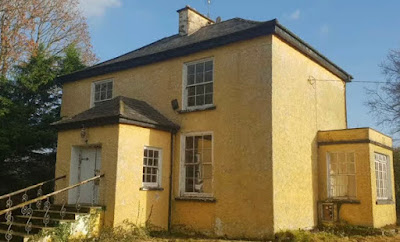
Nantenan Glebe was built about 200 years ago and has an opning asking price of €200,000
Patrick Comerford
On the road between Askeaton and Rathkeale last weekend, I noticed that Nantenan Glebe is for sale through DNG Michael Creedon by online auction on 13 January, with an asking price of €200,000.
Saint James’ Church at Nantenan and the surrounding churchyard, half-way between Askeaton and Rathkeale, in west Co Limerick, may date back to the late mediaeval period or even later. Nantenan Glebe, the former glebe house or rectory for the parish, was built by the Board of First Fruits in the early 19th century. Despite later additions, the house retains much of its modest form, and many of its features, including the slate roof and sash windows, help to conserve the original appearance of the house.
This detached, three-bay, two-storey over basement former rectory was built around 1819. Although I can find no records of the architect, I have wondered whether it was designed by James Pain, who designed the former rectory in Askeaton at the same time.
The house has a porch to the front or west elevation, a single-bay single-storey extension to the south, a two-bay three-storey block to the rear or east elevation, and a single-bay, single-storey extension to south elevation.
The house has roughcast rendered walls, a hipped slate sprocketed roof with rendered chimneystacks, a hipped slate roof on the rear block, flat roofs on the extensions, and a half-hipped slate roof on the porch.
There are square-headed openings with six-over-six pane timber sliding sash windows that have painted stone sills. There are square-headed windows in the extensions, some with timber casement windows. A flight of concrete steps with metal railings leads up to the porch and front door, where there is a square-headed opening with double-leaf timber panelled doors.
Much of the original glebe land still surrounds Nantenan Glebe (Photograph: Patrick Comerford)
Outside, it is possible to trace the former walled garden, the kitchen garden and the stables.
A two-bay single-storey outbuilding at the east courtyard has a pitched slate roof. The courtyard has rubble boundary walls, with an elliptical-headed carriage arch to the north wall with red brick voussoirs.
At the entrance to the drive to the west of the house, there is a pair of square-profile rubble limestone piers with double-leaf cast-iron gates and rubble limestone boundary walls.
The Board of First Fruits contributed a gift of £450 towards building the glebehouse in 1819, and a further loan of £50. Samuel Lewis described the house in the 1830s as a handsome residence. At that time, the glebe comprised six acres, which had been bought by the Board of First Fruits.
Until the disestablishment of the Church of Ireland, Nantenan union of parishes was part of the corps of the Precentorship of Saint Mary’s Cathedral. Nantenan parish was united with Rathkeale from 1918, and also with Ballingarry and Rathronan from 1958. So, my predecessors as precentors and as the priests in this parish had a particular interest in the glebehouse at Nantenan.
After almost 200 years, much of this glebe land still surrounds the house, and this week’s rain it reinforces my claim after the ‘Brexit’ referendum in Britain that Ireland too is ‘a green and pleasant land.’
The drive at Nantenan Glebe (Photograph: Patrick Comerford)
The death of the Revd Martha Gray-Stack (1935-2021) earlier this year reminded me that her late husband, Dean Charles Gray-Stack (1912-1985), was the last Church of Ireland priest to live in Nantenan Glebe. He was one of my predecessors as Precentor of Limerick, and long before me had been in ministry in the Rathkeale Group of Parishes in the 1940s and 1950s. He was also a well-known contributor to the The Irish Times in the 1950s and 1960s.
Charles Maurice Gray-Stack was born in Armagh, the son of the Revd William Bagot Stack (1878-1953), a grandson of Charles Maurice Stack (1825-1914), Bishop of Clogher (1886-1902), and a descendant of the Stack family of Stackstown and Crotta, Co Kerry.
The Stacks were a prominent clerical family in the Church of Ireland. The bishop’s father, the Revd Edward Stack, and grandfather, Canon Walter Bagot, were both priests, while his brothers included Canon Thomas Stack (1810-1871), an SPG missionary in New South Wales before moving to Sydney; and the Revd Richard Stack (1815-1851), curate of Saint Peter’s and known for his work as a ‘slum priest’ in Dublin.
The Revd William Bagot Stack (1878-1953) had worked in British colonial administration in Central Africa and was a lieutenant in the Royal Irish Fusiliers before being ordained deacon in 1907 and priest in 1908. Later in life, he was the Rector of Dundalk (1934-1941) and Rector of Inistioge, Co Kilkenny (1941-1946) in the Diocese of Ossory.
Charles Gray-Stack was educated at Campbell College Belfast and Trinity College Dublin (BA, MA), and was ordained deacon in 1937 and priest in 1939. He served his first curacies in Birr (1937-1938) and then in the dioceses of Ferns and Ossory: Ardamine (1938-1940), Kilnehue and Kilpipe (1940-1941) and Inistioge (1941-1944), where his father was the rector.
He then moved to the Diocese of Limerick and Ardfert, and for five years was the diocesan curate in Ardfert and Aghadoe and curate of Killarney (1944-1949). While he was there, he obtained a confirmation of the coat of arms of Bishop Charles Maurice Stack for the bishop’s descendants in 1948.
He moved to the Rathkeale and Nantenan Union of Parishes as curate in 1949, when Maurice Talbot, a future Dean of Limerick, was the rector, and lived for five years at Nantenan Glebe. During his time here, he changed his surname from Stack to Gray-Stack, recalling his maternal grandfather, Dr Robert Gray of Armagh.
He moved to Co Kerry as a parish rector in 1953, first in Kilgobbin (1953-1961), which included Dingle from 1957, and then in Kenmare and Sneem (1961-1985), which included Waterville and Valentia from 1984.
In the cathedral chapter, he was Prebendary of Ballycahane (1962-1963), Precentor of Limerick (1963-1966), and Chancellor of Limerick, Prebendary of Kilpeacon and Dean of Ardfert (1966-1985). Of course, the title of Dean of Ardfert was an honour or sinecure, often offered to the most senior rector in the Diocese of Ardfert: the cathedral in Ardfert had ceased to function for a long time, and the church there closed in the 1940s. Today, the Dean of Limerick is also the Dean of Ardfert.
He married Martha Mary Stewart-Clarke from Castledawson in Saint George’s Church, Belfast, in 1959.
Charlie Gray-Stack became a national figure for his regular contributions to The Irish Times and to RTÉ. He was known as a liturgist and for his engagement in social affairs. He was prominent in ecumenical activities, especially the Glenstal and Greenhills ecumenical conferences.
When he died on 25 July 1985, he was still Rector of Kenmare and Dean of Ardfert, and his funeral at Saint Patrick’s Church, Kenmare, was featured on the RTÉ news.
His widow, Martha-Gray Stack, was ordained deacon in 1990 and priest in 1991. She was an NSM curate in Saint Mary’s Cathedral and Saint Michael’s Church, Limerick (1990-1993), Rector of Clara (1993-2000), and the chaplain of Kingston College (2000-2010) in Mitchelstown, Co Cork. She died earlier this year (21 January 2021).
Nantenan Glebe … a regency-era rectory between Rathkeale and Askeaton (Photograph: Patrick Comerford)
Showing posts with label Nantenan. Show all posts
09 December 2021
28 August 2021
Charles Graves, Bishop
of Limerick, and his place
in the Celtic Revival
Gearóid Ó Cearúil is the author of a new biography, ‘Charles Graves agus an Athbheochan Cheilteach’
Patrick Comerford
It is always a delight to receive the gift of a new book. And it is always satisfying to find you are referenced in a new book.
Both pleasures were realised last week when the gift of a new book arrived at the Rectory in Askeaton.
Gearóid Ó Cearúil is the author of Charles Graves agus an Athbheochan Cheilteach, a new biography of Bishop Charles Graves, mathematician, academic, expert on Ogham stones, leading figure in the Celtic revival, and a towering figure in the Church of Ireland in the transformation brought about by disestablishment 150 years ago.
Charles Graves (1812-1899) was Erasmus Smith’s Professor of Mathematics at Trinity College Dublin (1843-1862), President of the Royal Irish Academy (1861-1866), Dean of the Chapel Royal, Dublin Castle (1860-1866), Dean of Clonfert (1864-1866) and Bishop of Limerick, Ardfert and Aghadoe (1866-1899).
Graves was, as the Victorians would say, well-connected: the Perceval part of his name indicated his close kinship to Spencer Perceval (1762-1812), the only British Prime Minister to have been assassinated and whose family was from north Cork.
A useful genealogical chart on p 146 helped me work y way through a fascinating family tree of theologians, academics, clerics, judges, senior civil servants and poets that is a key to working through this book and understanding what made this man, beginning with the Revd James Graves (1710-1784), a former Vicar of Ballingarry and Castlerobert – and, as such, one of my predecessors.
They include William Perceval, Dean of Emly; Professor Robert Perceval; the Revd Charles Perceval, Rector; Professor James Drought, Regius Professor of Divinity in TCD, and his successor and son-in-law Richard Graves, who was also Dean of Ardagh; Canon Richard Hastings Graves of Mitchelstown; Thomas Graves, Dean of Ardfert; Richard Graves McDonnell, Governor of Hong Kong; James King, 5th Earl of Kingston; and the poet Robert Graves.
A larger chart might have included the Revd James William Graves, Vicar of Nantenan; the Revd John Graves, who also served in this group of parishes, and many, many more.
Gearóid Ó Cearúil (Gerald O’Carrroll) from Tralee, studied at UCC, and has taught in Limerick, Zimbabwe and Spain. He has written four books, mainly on Munster history, and this is his first book in Irish.
All academics delight in being cited in other books – in fact, if we admitted, we can be quite smug about – and I found my own citation on p 133.
The book is illustrated with a selection of images and photographs, many by the author, including Parknasilla, the extravagant country home Graves built himself near Kenmare and now a luxury hotel.
It is interesting how the unexpected longevity of a bishop could bring a diocese to the brink of bankruptcy. He lived into his late 80s, and in his biographical note on Graves, Leslie notes: ‘He lived to an age which far exceeded that on which his Commutation Capital had been calculated, so that the General Synod had from its other funds to help the Diocese by a large grant to maintain the Income of the future Bishop.’
● Gearóid Ó Cearúil is the author of Charles Graves agus an Athbheochan Cheilteach (Dublin: Coiscéim, 2021), 185 pp, €10.
Patrick Comerford
It is always a delight to receive the gift of a new book. And it is always satisfying to find you are referenced in a new book.
Both pleasures were realised last week when the gift of a new book arrived at the Rectory in Askeaton.
Gearóid Ó Cearúil is the author of Charles Graves agus an Athbheochan Cheilteach, a new biography of Bishop Charles Graves, mathematician, academic, expert on Ogham stones, leading figure in the Celtic revival, and a towering figure in the Church of Ireland in the transformation brought about by disestablishment 150 years ago.
Charles Graves (1812-1899) was Erasmus Smith’s Professor of Mathematics at Trinity College Dublin (1843-1862), President of the Royal Irish Academy (1861-1866), Dean of the Chapel Royal, Dublin Castle (1860-1866), Dean of Clonfert (1864-1866) and Bishop of Limerick, Ardfert and Aghadoe (1866-1899).
Graves was, as the Victorians would say, well-connected: the Perceval part of his name indicated his close kinship to Spencer Perceval (1762-1812), the only British Prime Minister to have been assassinated and whose family was from north Cork.
A useful genealogical chart on p 146 helped me work y way through a fascinating family tree of theologians, academics, clerics, judges, senior civil servants and poets that is a key to working through this book and understanding what made this man, beginning with the Revd James Graves (1710-1784), a former Vicar of Ballingarry and Castlerobert – and, as such, one of my predecessors.
They include William Perceval, Dean of Emly; Professor Robert Perceval; the Revd Charles Perceval, Rector; Professor James Drought, Regius Professor of Divinity in TCD, and his successor and son-in-law Richard Graves, who was also Dean of Ardagh; Canon Richard Hastings Graves of Mitchelstown; Thomas Graves, Dean of Ardfert; Richard Graves McDonnell, Governor of Hong Kong; James King, 5th Earl of Kingston; and the poet Robert Graves.
A larger chart might have included the Revd James William Graves, Vicar of Nantenan; the Revd John Graves, who also served in this group of parishes, and many, many more.
Gearóid Ó Cearúil (Gerald O’Carrroll) from Tralee, studied at UCC, and has taught in Limerick, Zimbabwe and Spain. He has written four books, mainly on Munster history, and this is his first book in Irish.
All academics delight in being cited in other books – in fact, if we admitted, we can be quite smug about – and I found my own citation on p 133.
The book is illustrated with a selection of images and photographs, many by the author, including Parknasilla, the extravagant country home Graves built himself near Kenmare and now a luxury hotel.
It is interesting how the unexpected longevity of a bishop could bring a diocese to the brink of bankruptcy. He lived into his late 80s, and in his biographical note on Graves, Leslie notes: ‘He lived to an age which far exceeded that on which his Commutation Capital had been calculated, so that the General Synod had from its other funds to help the Diocese by a large grant to maintain the Income of the future Bishop.’
● Gearóid Ó Cearúil is the author of Charles Graves agus an Athbheochan Cheilteach (Dublin: Coiscéim, 2021), 185 pp, €10.
19 May 2021
Haydn and Handel or Brahms and Liszt
in Saint Mary’s Cathedral, Limerick
John Armour Haydn (1845-1920) had a life-time interest in the music of Saint Mary’s Cathedral, Limerick … was he related to Joseph Haydn?
Patrick Comerford
‘Brahms and Liszt’ is a description in rhyming slang in England for being drunk. But it seems Brahms and Liszt only ever met on one occasions, in Weimar in 1853, when Brahms presented some of his compositions to a group of composers that included Liszt.
Liszt played some of Brahms’s work, and then performed his own B-minor Piano Sonata. But Brahms was impressed neither with Liszt’s music nor with the work of most of the rest of the ‘New German School.’
In the Irish imagination, Keats and Chapman are inextricably linked, arm-in-arm, not because of the Keats poem, ‘On first looking into Chapman’s Homer,’ but because come together in so many of the writings of Myles na Gopaleen.
Which major figures in European culture are inextricably linked or inseparable opposites for you? Mozart and Beethoven? Keats and Shelley? Livingstone and Stanley? Crick and Watson? The Rolling Stones and the Beatles? Swann and Topping? Torvill and Dean? Saint and Greavsie?
Before my lunchtime lecture on John Desmond Bernal in Saint Mary’s Cathedral, Limerick, yesterday (18 May 2021), I was surprised to find that the cathedral offers a curious link – well, a musical link of sorts – between Haydn and Handel … and in the process, with this group of parishes.
Canon John Armour Haydn (1845-1920) was the Rector of Nantenan, between Askeaton and Rathkeale, Co Limerick, and was successively a canon, the Treasurer and the Chancellor of Saint Mary’s Cathedral, Limerick, and the Archdeacon of Limerick.
Haydn and his family are commemorated by a mural on the west wall of the cathedral. Dean Maurice Talbot, in The Monuments of St Mary’s Cathedral, says Haydn ‘was the mainstay for 40 years in the cathedral.’ He was the first secretary of the Friends of Saint Mary’s, and his whole family were ‘dedicated to Saint Mary’s and lived for its worship and its music.’
Haydn was born in Tallow, Co Waterford, and spent all his ordained ministry in the Diocese of Limerick, first as curate of Saint Michael’s (1868-1869), and then as Rector and Vicar of Chapel Russell (1869-1872), Rector of Nantenan (1873-1918), Prebendary of Saint Munchin’s (1891-1906), Treasurer of Limerick (1906-1912), Chancellor of Limerick (1912-1913), and Archdeacon of Limerick (1913-1918).
I have no idea whether this Haydn was related in any way to the Austrian composer Joseph Haydn (1732-1809). But John Haydn was a skilled musician and composed some church services and anthems. He also designed and made the pine cover for the ancient font in the cathedral. He died on 21 May 1920, and was buried with his wife in the cathedral churchyard.
John Haydn gave £4,000 – a substantial sum over 100 years ago – in gifts to the cathedral, including a substantial gift for the choir. He was also a keen campanologist and was ‘always at his ‘Sally’ mornings and evening, on Sundays.’
Without a curate in Nantenan, it is difficult to imagine how Haydn could devote so much time to the life and music of Saint Mary’s Cathedral, and still attend to his parochial and pastoral duties in Nantenan, where he was the rector for quarter of a century. Many of his parishioners in Nantenan were the descendants of Palatine families, religious refugees who settled in West Limerick in the early 18th century. Dean Talbot recalls that ‘he is perhaps the last priest who buried with its owner a German Bible.’
John Armour Haydn (1845-1920) … he was Rector of Nantenan, near Askeaton, in 1873-1918
A previously hidden 19th-century source documenting the story of the renovation of the cathedral in 1859-1863, is now in the Representative Church Body (RCB) Library in Dublin. Ms 1048 was assembled by John Armour Haydn to record how his predecessors raised funds and awareness of the cathedral.
The title page of this volume contains an explanatory ‘preliminary statement’ revealing why the mid-19th century restoration works were required in 1859, and the volume is a window on hidden history detailing the causes of the restoration and conservation. A detailed analysis of the Haydn volume was carried out at the RCB Library by Matthieu Isbell, a first-class honours graduate of Trinity College Dublin, who spent a two-month intern placement at the library.
Haydn’s son, Thomas James Armour Handel Haydn (1874-1892), was the assistant organist in Saint Mary’s Cathedral, and a scholar of the Royal College of Music, London. Another son, John Armour Haydn (1881-1957), who worked with Guinnesses, was secretary of the cathedral vestry from at least the 1930s, wrote a visitors’ guidebook in 1950 and a booklet on the 15th-century misericords, and presented a frontal press to the cathedral in 1947.
I also came across the name Handel in another cathedral monument too. Because of the current work on the new west porch in the cathedral, a number of monuments at the west end of the cathedral are screened by display boards.
However, close to the Glentworth Chapel, I caught a glimpse of the plaque that is ‘in loving memory of George Frederick Handel Rogers, born 7th September 1807, died 12th January 1892. For fifty years organist, thirty years vicar choral, of this cathedral. Also of Frances Phillips, his wife …’
Despite this monument in the cathedral, George Frederick Handel Rogers (1807-1892) and his wife Frances are actually buried in Saint Munchin’s churchyard in Limerick.
I cannot connect Rogers with the family of the German composer George Frideric Handel (1685-1759), no more than I can connect John Haydn and Joseph Haydn. In my imagination, I think, perhaps, the connection is even less tenuous than that between Brahms and Liszt. But, as the Precentor, I am supposed to take a particular interest in the music of the cathedral.
The monument to George Frederick Handel Rogers (1807-1892) in Saint Mary’s Cathedral, Limerick (Photograph: Patrick Comerford, 2021)
Patrick Comerford
‘Brahms and Liszt’ is a description in rhyming slang in England for being drunk. But it seems Brahms and Liszt only ever met on one occasions, in Weimar in 1853, when Brahms presented some of his compositions to a group of composers that included Liszt.
Liszt played some of Brahms’s work, and then performed his own B-minor Piano Sonata. But Brahms was impressed neither with Liszt’s music nor with the work of most of the rest of the ‘New German School.’
In the Irish imagination, Keats and Chapman are inextricably linked, arm-in-arm, not because of the Keats poem, ‘On first looking into Chapman’s Homer,’ but because come together in so many of the writings of Myles na Gopaleen.
Which major figures in European culture are inextricably linked or inseparable opposites for you? Mozart and Beethoven? Keats and Shelley? Livingstone and Stanley? Crick and Watson? The Rolling Stones and the Beatles? Swann and Topping? Torvill and Dean? Saint and Greavsie?
Before my lunchtime lecture on John Desmond Bernal in Saint Mary’s Cathedral, Limerick, yesterday (18 May 2021), I was surprised to find that the cathedral offers a curious link – well, a musical link of sorts – between Haydn and Handel … and in the process, with this group of parishes.
Canon John Armour Haydn (1845-1920) was the Rector of Nantenan, between Askeaton and Rathkeale, Co Limerick, and was successively a canon, the Treasurer and the Chancellor of Saint Mary’s Cathedral, Limerick, and the Archdeacon of Limerick.
Haydn and his family are commemorated by a mural on the west wall of the cathedral. Dean Maurice Talbot, in The Monuments of St Mary’s Cathedral, says Haydn ‘was the mainstay for 40 years in the cathedral.’ He was the first secretary of the Friends of Saint Mary’s, and his whole family were ‘dedicated to Saint Mary’s and lived for its worship and its music.’
Haydn was born in Tallow, Co Waterford, and spent all his ordained ministry in the Diocese of Limerick, first as curate of Saint Michael’s (1868-1869), and then as Rector and Vicar of Chapel Russell (1869-1872), Rector of Nantenan (1873-1918), Prebendary of Saint Munchin’s (1891-1906), Treasurer of Limerick (1906-1912), Chancellor of Limerick (1912-1913), and Archdeacon of Limerick (1913-1918).
I have no idea whether this Haydn was related in any way to the Austrian composer Joseph Haydn (1732-1809). But John Haydn was a skilled musician and composed some church services and anthems. He also designed and made the pine cover for the ancient font in the cathedral. He died on 21 May 1920, and was buried with his wife in the cathedral churchyard.
John Haydn gave £4,000 – a substantial sum over 100 years ago – in gifts to the cathedral, including a substantial gift for the choir. He was also a keen campanologist and was ‘always at his ‘Sally’ mornings and evening, on Sundays.’
Without a curate in Nantenan, it is difficult to imagine how Haydn could devote so much time to the life and music of Saint Mary’s Cathedral, and still attend to his parochial and pastoral duties in Nantenan, where he was the rector for quarter of a century. Many of his parishioners in Nantenan were the descendants of Palatine families, religious refugees who settled in West Limerick in the early 18th century. Dean Talbot recalls that ‘he is perhaps the last priest who buried with its owner a German Bible.’
John Armour Haydn (1845-1920) … he was Rector of Nantenan, near Askeaton, in 1873-1918
A previously hidden 19th-century source documenting the story of the renovation of the cathedral in 1859-1863, is now in the Representative Church Body (RCB) Library in Dublin. Ms 1048 was assembled by John Armour Haydn to record how his predecessors raised funds and awareness of the cathedral.
The title page of this volume contains an explanatory ‘preliminary statement’ revealing why the mid-19th century restoration works were required in 1859, and the volume is a window on hidden history detailing the causes of the restoration and conservation. A detailed analysis of the Haydn volume was carried out at the RCB Library by Matthieu Isbell, a first-class honours graduate of Trinity College Dublin, who spent a two-month intern placement at the library.
Haydn’s son, Thomas James Armour Handel Haydn (1874-1892), was the assistant organist in Saint Mary’s Cathedral, and a scholar of the Royal College of Music, London. Another son, John Armour Haydn (1881-1957), who worked with Guinnesses, was secretary of the cathedral vestry from at least the 1930s, wrote a visitors’ guidebook in 1950 and a booklet on the 15th-century misericords, and presented a frontal press to the cathedral in 1947.
I also came across the name Handel in another cathedral monument too. Because of the current work on the new west porch in the cathedral, a number of monuments at the west end of the cathedral are screened by display boards.
However, close to the Glentworth Chapel, I caught a glimpse of the plaque that is ‘in loving memory of George Frederick Handel Rogers, born 7th September 1807, died 12th January 1892. For fifty years organist, thirty years vicar choral, of this cathedral. Also of Frances Phillips, his wife …’
Despite this monument in the cathedral, George Frederick Handel Rogers (1807-1892) and his wife Frances are actually buried in Saint Munchin’s churchyard in Limerick.
I cannot connect Rogers with the family of the German composer George Frideric Handel (1685-1759), no more than I can connect John Haydn and Joseph Haydn. In my imagination, I think, perhaps, the connection is even less tenuous than that between Brahms and Liszt. But, as the Precentor, I am supposed to take a particular interest in the music of the cathedral.
The monument to George Frederick Handel Rogers (1807-1892) in Saint Mary’s Cathedral, Limerick (Photograph: Patrick Comerford, 2021)
13 February 2021
David Earl, a former
Precentor of Limerick who
became Dean of Ferns
Patrick Comerford
The Very Revd David Kaye Lee Earl (1928-2017), who was Dean of Ferns from 1979 until 1994, was one of my predecessors as Precentor of Limerick (1977-1979), and in the 1950s and 1960s he was also Rector of Rathkeale (1958-1965).
When a project looking at my predecessors as Precentors of Limerick was postponed some months ago due to the pandemic limits on public events, I thought it might still be interesting to continue looking at past precentors in a number of blog postings.
In earlier postings, I recalled some previous precentors who had been accused of ‘dissolute living’ or being a ‘notorious fornicator’ (Awly O Lonysigh), or who were killed in battle (Thomas Purcell). There were those who became bishops or archbishops: Denis O’Dea (Ossory), Richard Purcell (Ferns) and John Long (Armagh).
There was the tragic story too of Robert Grave, who became Bishop of Ferns while remaining Precentor of Limerick, but – only weeks after his consecration – drowned with all his family in Dublin Bay as they made their way by sea to their new home in Wexford (read more HERE).
In the 17th century, two members of the Gough family were also appointed Precentors of Limerick. In all, three brothers in this family were priests in the Church of Ireland and two were priests in the Church of England, and the Rathkeale branch of the family was the ancestral line of one of Ireland’s most famous generals (read more HERE).
In the mid to late 18th century, two members of the Maunsell family were Precentors of Limerick: Richard Maunsell (1745-1747) and William Thomas Maunsell (1786-1781) (read more HERE).
They were related to Canon John Warburton who was, perhaps, the longest-ever holder of the office, being Precentor of Limerick for 60 years from 1818 until he died to 1878 (red more HERE).
Last month, I looked at Warburton’ successor, Canon Frederic Charles Hamilton, who provides an interesting links with both this group of parishes, with the Mariners’ Church in Dún Laoghaire and the Anglican mission agency SPG, now USPG (United Society Partners in the Gospel), of which I am a trustee. (see HERE).
As I move to the end of the 19th and the early 20th century, Hamilton’s successor as Precentor, Francis Meredyth, was a published poet and dramatist, and some of the Precentors of Limerick were also among the last Deans of Ardfert, including Robert Archibald Adderley (1870-1946), who also served in Listowel and Ballybunion (see HERE).
Then, later last month, I told the story of Dean Charles Gray-Stack (1912-1985), one of the last Deans of Ardfert. He was one of my predecessors as Precentor of Limerick, and long before me had been in ministry in the Rathkeale Group of Parish in the 1940s and 1950s. He was also a well-known contributor to the The Irish Times in the 1950s and 1960s (see HERE).
David Earl was one of Charles Gray-Stack’s successors as Precentor of Limerick. He was born in Dublin in 1928, a son of Victor Earl of Grantstown House, Co Waterford, and was educated at Bishop Foy’s School, Waterford, and Trinity College Dublin (BA 1954).
He was ordained deacon in 1955 and priest in 1956, and he spent three years as a curate in Sant James’s, Dublin (1955-1958). While he was there, he married Christine Lepper from Clane in Clane Church, Co Kildare, in 1956.
He was appointed the Rector of Rathkeale, Nantenan, Ballingarry, Rathronan and Newcastle West in 1958. Saint David’s Church, Newcastle West, was closed that year, and it was demolished in 1962.
He remained in this group of parishes until 1965, when he became the Rector of Killarney, Aghdoe and Muckross, Co Kerry. In 1977, he was appointed the Precentor of Limerick, and Prebendary of Donaghmore and Ballycahane in the cathedral chapter in 1977.
He remained in this diocese until he was appointed Dean of Saint Edan’s Cathedral, Ferns, in 1979 in succession to the Very Revd Thomas Henry Crampton McFall, who had been dean from 1949 to 1979. He was also Rector of Ferns, Kilbride, Toombe and Ballycarney until he retired in 1994. He was succeeded by the Very Revd Leslie David Arthur Forrest, who was Dean of Ferns in 1995-2011.
In retirement, David Earl lived in Tramore, Co Waterford. He died in Waterford on 31 March 2017. He was survived by his wife Christine (née Lepper), his daughters and son, Alison, Judy, Susan and Jonathan, his sons-in-law Gerald Jephson, James Bourke and Elmer Dool, his daughter-in-law, Karen Cheevers, many grandchildren and a great-grandchild.
His funeral Eucharist took place in Christ Church, Tramore, on Sunday 2 April 2017, followed by burial in adjoining churchyard.
Bishop Michael Burrows of Cashel Ferns and Ossory said later that ‘the great throng of friends and former parishioners at the funeral was eloquent evidence of lives touched, enriched and guided by a ministry of great kindness and care for individuals.’
Bishop Burrows added, ‘To visit David was always a tonic … He was fun, wise, and had an incredible memory of people and events.’
Saint Mary’s Church, Killarney … David Earl was Rector of Killarney in 1965-1979 and Precentor of Limerick in 1977-1979 (Photograph: Patrick Comerford)
23 January 2021
Charles Gray-Stack (1912-1985): a former
Dean of Ardfert and Precentor of Limerick
Nantenan Glebe near Askeaton … Charles Gray-Stack lived there in the 1950s (Photograph: Patrick Comerford)
Patrick Comerford
The death of the Revd Martha Gray-Stack (1935-2021) earlier this week reminded me that her late husband, Dean Charles Gray-Stack (1912-1985), was one of my predecessors as Precentor of Limerick, and long before me he had been in ministry in the Rathkeale Group of Parish in the 1940s and 1950s. He was also a well-known contributor to the The Irish Times in the 1950s and 1960s.
When a project looking at my predecessors as Precentors of Limerick was postponed some months ago due to pandemic limits on public events, I thought it might still be interesting to continue looking at past precentors in a number of blog postings.
In earlier postings, I recalled some previous precentors who had been accused of ‘dissolute living’ or being a ‘notorious fornicator’ (Awly O Lonysigh), or who were killed in battle (Thomas Purcell). There were those who became bishops or archbishops: Denis O’Dea (Ossory), Richard Purcell (Ferns) and John Long (Armagh).
There was the tragic story too of Robert Grave, who became Bishop of Ferns while remaining Precentor of Limerick, but – only weeks after his consecration – drowned with all his family in Dublin Bay as they made their way by sea to their new home in Wexford (read more HERE).
In the 17th century, two members of the Gough family were also appointed Precentors of Limerick. In all, three brothers in this family were priests in the Church of Ireland and two were priests in the Church of England, and the Rathkeale branch of the family was the ancestral line of one of Ireland’s most famous generals (read more HERE).
In the mid to late 18th century, two members of the Maunsell family were Precentors of Limerick: Richard Maunsell (1745-1747) and William Thomas Maunsell (1786-1781) (read more HERE).
They were related to Canon John Warburton who was, perhaps, the longest-ever holder of the office, being Precentor of Limerick for 60 years from 1818 until he died to 1878 (red more HERE).
Earlier this week, I looked at Warburton’ successor, Canon Frederic Charles Hamilton, who provides an interesting links with both this group of parishes, with the Mariners’ Church in Dún Laoghaire and the Anglican mission agency SPG, now USPG (United Society Partners in the Gospel), of which I am a trustee. (see HERE).
As I move to the end of the 19th and the early 20th century, Hamilton’s successor as Precentor, Francis Meredyth, was a published poet and dramatist, and some of the Precentors of Limerick were also among the last Deans of Ardfert, including Robert Archibald Adderley (1870-1946), who also served in Listowel and Ballybunion (see HERE).
Charles Maurice Gray-Stack was born in Armagh, the son of the Revd William Bagot Stack (1878-1953), a grandson of Charles Maurice Stack (1825-1914), Bishop of Clogher (1886-1902), and a descendant of the Stack family of Stackstown and Crotta, Co Kerry.
The Stacks were a prominent clerical family in the Church of Ireland. The bishop’s father, the Revd Edward Stack, and grandfather, Canon Walter Bagot, were both priests, while his brothers included Canon Thomas Stack (1810-1871) was an SPG missionary in New South Wales before moving to Sydney; and the Revd Richard Stack (1815-1851), curate of Saint Peter’s and known for his work as a ‘slum priest’ in Dublin.
The Revd William Bagot Stack (1878-1953) had worked in British colonial administration in Central Africa and was a lieutenant in the Royal Irish Fusiliers before being ordained deacon in 1907 and priest in 1908. Later in life he was the Rector of Dundalk (1934-1941) and Rector of Inistioge, Co Kilkenny (1941-1946) in the Diocese of Ossory.
He was educated at Campbell College Belfast and Trinity College Dublin (BA, MA), and was ordained deacon in 1937 and priest in 1939. He served his first curacies in Birr (1937-1938) and then in the dioceses of Ferns and Ossory – Ardamine (1938-1940), Kilnehue and Kilpipe (1940-1941) and Inistioge (1941-1944), where his father was the rector.
He then moved to the Diocese of Limerick and Ardfert, and for five years was the diocesan curate in Ardfert and Aghadoe and curate of Killarney (1944-1949). While he was there, he obtained a confirmation of the coat of arms of Bishop Charles Maurice Stack for the bishop’s descendants in 1948.
He moved to the Rathkeale and Nantenan Union of Parishes as curate in 1949, when Maurice Talbot, a future Dean of Limerick, was the rector, and lived for five years at Nantenan Glebe. During his time here, he changed his surname from Stack to Gray-Stack, recalling his maternal grandfather, Dr Robert Gray of Armagh.
He moved to Co Kerry as a parish rector in 1953, first in Kilgobbin (1953-1961), which included Dingle from 1957, and then in Kenmare and Sneem (1961-1985), which included Waterville and Valentia from 1984.
In the cathedral chapter, he was Prebendary of Ballycahane (1962-1963), Precentor of Limerick (1963-1966), and Chancellor of Limerick, Prebendary of Kilpeacon and Dean of Ardfert (1966-1985). Of course, the title of Dean of Ardfert was an honour or sinecure, often offered to the most senior rector in the Diocese of Ardfert: the cathedral in Ardfert had ceased to function for a long time, and the church there closed in the 1940s.
He married Martha Mary Stewart-Clarke from Castledawson in Saint George’s Church, Belfast, in 1959.
Charlie Gray-Stack became a national figure for his regular contributions to The Irish Times and to RTÉ. He was known as a liturgist and for his engagement in social affairs. He was prominent in ecumenical activities, especially the Glenstal and Greenhills ecumenical conferences.
When he died on 25 July 1985, he was still Rector of Kenmare and Dean of Ardfert, and his funeral at Saint Patrick’s Church, Kenmare, was featured on the RTÉ news.
His widow, Martha-Gray Stack, was ordained deacon in 1990 and priest in 1991. She was an NSM curate in Saint Mary’s Cathedral and Saint Michael’s Church, Limerick (1990-1993), Rector of Clara (1993-2000), and the chaplain of Kingston College (2000-2010) in Mitchelstown, Co Cork. She died earlier this week (21 January 2021).
Saint Brendan’s Cathedral, Ardfert, Co Kerry … Charles Gray-Stack was the Dean of Ardfert in 1966-1985 (Photograph: Patrick Comerford)
Patrick Comerford
The death of the Revd Martha Gray-Stack (1935-2021) earlier this week reminded me that her late husband, Dean Charles Gray-Stack (1912-1985), was one of my predecessors as Precentor of Limerick, and long before me he had been in ministry in the Rathkeale Group of Parish in the 1940s and 1950s. He was also a well-known contributor to the The Irish Times in the 1950s and 1960s.
When a project looking at my predecessors as Precentors of Limerick was postponed some months ago due to pandemic limits on public events, I thought it might still be interesting to continue looking at past precentors in a number of blog postings.
In earlier postings, I recalled some previous precentors who had been accused of ‘dissolute living’ or being a ‘notorious fornicator’ (Awly O Lonysigh), or who were killed in battle (Thomas Purcell). There were those who became bishops or archbishops: Denis O’Dea (Ossory), Richard Purcell (Ferns) and John Long (Armagh).
There was the tragic story too of Robert Grave, who became Bishop of Ferns while remaining Precentor of Limerick, but – only weeks after his consecration – drowned with all his family in Dublin Bay as they made their way by sea to their new home in Wexford (read more HERE).
In the 17th century, two members of the Gough family were also appointed Precentors of Limerick. In all, three brothers in this family were priests in the Church of Ireland and two were priests in the Church of England, and the Rathkeale branch of the family was the ancestral line of one of Ireland’s most famous generals (read more HERE).
In the mid to late 18th century, two members of the Maunsell family were Precentors of Limerick: Richard Maunsell (1745-1747) and William Thomas Maunsell (1786-1781) (read more HERE).
They were related to Canon John Warburton who was, perhaps, the longest-ever holder of the office, being Precentor of Limerick for 60 years from 1818 until he died to 1878 (red more HERE).
Earlier this week, I looked at Warburton’ successor, Canon Frederic Charles Hamilton, who provides an interesting links with both this group of parishes, with the Mariners’ Church in Dún Laoghaire and the Anglican mission agency SPG, now USPG (United Society Partners in the Gospel), of which I am a trustee. (see HERE).
As I move to the end of the 19th and the early 20th century, Hamilton’s successor as Precentor, Francis Meredyth, was a published poet and dramatist, and some of the Precentors of Limerick were also among the last Deans of Ardfert, including Robert Archibald Adderley (1870-1946), who also served in Listowel and Ballybunion (see HERE).
Charles Maurice Gray-Stack was born in Armagh, the son of the Revd William Bagot Stack (1878-1953), a grandson of Charles Maurice Stack (1825-1914), Bishop of Clogher (1886-1902), and a descendant of the Stack family of Stackstown and Crotta, Co Kerry.
The Stacks were a prominent clerical family in the Church of Ireland. The bishop’s father, the Revd Edward Stack, and grandfather, Canon Walter Bagot, were both priests, while his brothers included Canon Thomas Stack (1810-1871) was an SPG missionary in New South Wales before moving to Sydney; and the Revd Richard Stack (1815-1851), curate of Saint Peter’s and known for his work as a ‘slum priest’ in Dublin.
The Revd William Bagot Stack (1878-1953) had worked in British colonial administration in Central Africa and was a lieutenant in the Royal Irish Fusiliers before being ordained deacon in 1907 and priest in 1908. Later in life he was the Rector of Dundalk (1934-1941) and Rector of Inistioge, Co Kilkenny (1941-1946) in the Diocese of Ossory.
He was educated at Campbell College Belfast and Trinity College Dublin (BA, MA), and was ordained deacon in 1937 and priest in 1939. He served his first curacies in Birr (1937-1938) and then in the dioceses of Ferns and Ossory – Ardamine (1938-1940), Kilnehue and Kilpipe (1940-1941) and Inistioge (1941-1944), where his father was the rector.
He then moved to the Diocese of Limerick and Ardfert, and for five years was the diocesan curate in Ardfert and Aghadoe and curate of Killarney (1944-1949). While he was there, he obtained a confirmation of the coat of arms of Bishop Charles Maurice Stack for the bishop’s descendants in 1948.
He moved to the Rathkeale and Nantenan Union of Parishes as curate in 1949, when Maurice Talbot, a future Dean of Limerick, was the rector, and lived for five years at Nantenan Glebe. During his time here, he changed his surname from Stack to Gray-Stack, recalling his maternal grandfather, Dr Robert Gray of Armagh.
He moved to Co Kerry as a parish rector in 1953, first in Kilgobbin (1953-1961), which included Dingle from 1957, and then in Kenmare and Sneem (1961-1985), which included Waterville and Valentia from 1984.
In the cathedral chapter, he was Prebendary of Ballycahane (1962-1963), Precentor of Limerick (1963-1966), and Chancellor of Limerick, Prebendary of Kilpeacon and Dean of Ardfert (1966-1985). Of course, the title of Dean of Ardfert was an honour or sinecure, often offered to the most senior rector in the Diocese of Ardfert: the cathedral in Ardfert had ceased to function for a long time, and the church there closed in the 1940s.
He married Martha Mary Stewart-Clarke from Castledawson in Saint George’s Church, Belfast, in 1959.
Charlie Gray-Stack became a national figure for his regular contributions to The Irish Times and to RTÉ. He was known as a liturgist and for his engagement in social affairs. He was prominent in ecumenical activities, especially the Glenstal and Greenhills ecumenical conferences.
When he died on 25 July 1985, he was still Rector of Kenmare and Dean of Ardfert, and his funeral at Saint Patrick’s Church, Kenmare, was featured on the RTÉ news.
His widow, Martha-Gray Stack, was ordained deacon in 1990 and priest in 1991. She was an NSM curate in Saint Mary’s Cathedral and Saint Michael’s Church, Limerick (1990-1993), Rector of Clara (1993-2000), and the chaplain of Kingston College (2000-2010) in Mitchelstown, Co Cork. She died earlier this week (21 January 2021).
Saint Brendan’s Cathedral, Ardfert, Co Kerry … Charles Gray-Stack was the Dean of Ardfert in 1966-1985 (Photograph: Patrick Comerford)
13 December 2019
Can conservation efforts
save the ruined church
at Castletown Conyers?
The church ruins in the graveyard at Castletown Conyers are all that survive of the mediaeval parish church of Corcomohide (Photograph: Patrick Comerford, 2019)
Patrick Comerford
I was at a funeral earlier this week in Castletown Conyers, 5 km south of Ballingarry, on the road from Rathkeale to Charleville.
The church ruins in the graveyard at Castletown Conyers are all that survive of the mediaeval parish church of Corcomohide. But the history of this unique mediaeval settlement is being uncovered slowly and revealed as part of an effort to preserve the remains of the building known locally as ‘the Abbey.’
‘The Abbey’ was, in fact, a parish church, and with a neighbouring motte and a castle or manor house it formed the centre of a mediaeval borough of up to 300 people that dates back to the 13th century.
The church ruins at Castletown Conyers seen from the south-west (Photograph: Patrick Comerford, 2019)
Castletown or Corcomhide was the ancestral or tribal area of the Mac Eniry family, and was known as Baile Caisleáin Mhic an Oighre or the town of Mac Eniry’s castle. The Mac Eniry remained a force in this area until the late 17th century.
Castletown became the site of a mediaeval borough, with a church, a motte, and a castle or manor house. The manor of Corkemoyd was granted by Maurice FitzMaurice to his son-in-law Thomas de Clare and his wife Juliana, who in turn granted the church, in 1276, to the Cathedral of Limerick.
Inside The church ruins at Castletown Conyers, looking east (Photograph: Patrick Comerford, 2019)
The manor was holding a weekly market by 1284, but it was destroyed by war in 1302, and the early church was destroyed that year too.
An inquisition of 1321 suggested that about 290 people were living there. Lewis suggests the Castle at Castletown was built by the chieftain of the Mac Eniry family in 1349, and says the Mac Eniry family founded an abbey.br />
There are a number of references to the castle during the 14th century, when it was held by the de Cliffords, amongst others.
The later church, built in the late 14th or early 15th century, was dedicated to the Purification of the Virgin Mary on 2 February 1402 or 1410.
The east end of the church ruins at Castletown Conyers, shrouded in cladding (Photograph: Patrick Comerford, 2019)
After the Reformation, the church served for some time as a Church of Ireland parish church and some alterations to the church were made in the 16th century.
The Book of Survey and Distribution in the 1660s referred to the area as Castleinenry.
Castletown Conyers acquired its present name when the estate was bought by Captain George Conyers in 1703, although Lewis said the parish of Castletown Conyers was granted to George Conyers by William III.
The church ruins at Castletown Conyers from the north-east (Photograph: Patrick Comerford, 2019)
There are some early 18th century headstones in the churchyard, the earliest marking the grave of Cornelius Ryan, who died in 1737 at the age of 34.
There is a still a reference in 1763 to ‘Castletown McEnyry.’
The Conyers vault was inserted in the west end of the church in the late 18th or early 19th century (Photograph: Patrick Comerford, 2019)
The Conyers vault was inserted in the west end of the church in the late 18th or early 19th century, although it is likely that the church was a ruin at this point.
Samuel Lewis in his Topographical Dictionary of Ireland in 1837, noted that Corcomohide was an ecclesiastical union, including the civil parishes of Castletown Conyers, Drumcolloher, and Kilmeedy, and had 10,742 inhabitants.
The tithes totalled to £900, of which £570 was payable to the Countess of Ormonde, as lessee under the Vicars Choral of Saint Mary’s Cathedral, Limerick, and £330 to the incumbent.
There were two public schools, supported by Mr Stevelly and Colonel White, and 12 private schools.
The church was certainly a ruin by the time of the first Ordnance Survey in the 1830s and 1840s (Photograph: Patrick Comerford, 2019)
The church was certainly a ruin by the time of the first Ordnance Survey in the 1830s and 1840s, there was neither glebe nor glebe house, and the vicarage was united with the vicarages of Kilmeedy and Dromcolloher.
In the mid-19th century, the Conyers estate was mainly in the Parish of Kilcolman, Barony of Shanid, but also in the Parish of Corcomohide, Barony of Connello Upper, Co Limerick.
Castletown Conyers, the seat of the Conyers family was the home of Charles Conyers (1758-1837) in the early 19th century, and he was succeeded by his son, the Revd Edward Fitzgerald Conyers (1787-1854). By the time of Griffith’s Valuation, the house was in use as an auxiliary workhouse, held by the Croom Guardians from Dr William Bailey, medical doctor, and valued at £25.
Members of the Conyers family still held considerable estates in the area in the 1870s, when Charles Conyers of Castletown Conyers owned 2,425 acres, Grady FitzGerald Conyers of Liskennet owned 1,023 acres and Edward Conyers of Liskennet owned 95 acres.
The Revd Edward Fitzgerald Conyers (1787-1854) and his wife Catherine Blennerhassett were the parents of the Revd Charles Conyers, who died in 1872. He was married twice – to Agnes Graham, and Margaret Drew. Castletown Conyers was the residence of Charles Conyers in 1894.
The remains of the piscina can be traced at the east end of the south wall (Photograph: Patrick Comerford, 2019)
Major Charles Conyers (1867-1915) of the Royal Munster Fusiliers was wounded at the Battle of Ypres in 1915 and is buried at Bradhoek Military Cemetery in Belgium. There is a memorial tablet with his name in Limerick Cathedral. The family Conyers family appears to have continued to live at Castletown Conyers until the 1920s.
Major Conyers had married Dorothea Blood-Smith (1869-1947) of Fedamore, Co Limerick, in Saint Mary’s Cathedral, Limerick, on 2 February 1892. She was the author of 54 novels and one autobiographical work of sporting reminiscences, published between 1900 and 1948.
The widowed Dorothea Conyers married Captain John Joseph White of Nantinan, Co Limerick, in University Church, Saint Stephen’s Green, Dublin, on 25 February 1917. When Captain White died at Nantinan on 14 April 1940, he was buried at Cappagh Church. Dorothea died on 26 May 1949 and was buried at Saint Mary’s Cathedral.
In places, the roots of trees and the ivy clinging to the walls appear to be the only things holding the fabric of the church together(Photograph: Patrick Comerford, 2019)
Today, trees are growing within the walls of the church, and in recent years a number of large stones have fallen from a height. Indeed, in places, the roots of trees and the ivy clinging to the walls appear to be the only things holding the fabric of the church together.
The archaeologist Sarah McCutcheon, who has carried out some investigations on the site, has told Norma Prendiville of the Limerick Leader that the work to stabilise the building would need to be done in several phases.
The first phase involves cutting back the trees and then drilling and treating the boles and roots. Later phases would involve repairing the cavities left by the roots, removing other vegetation, consolidating the south-east corner and north wall chancel and capping the walls. Some work on clearing the trees and ivy has been carried out under the direction of Ms McCutcheon and the north wall has been propped up.
The conservation works on the church ruins have been promoted by the Castletown Conyers Development Association and Limerick City and County Council.
An opening at the east end of the north wall (Photograph: Patrick Comerford, 2019)
A nearby holy well, known locally as Lady’s Well, is still visited regularly, and large numbers of people attend an annual Mass at the well on 15 August.
Another well, Saint Gobnait’s Well, also known as Saint Debora’s Well or Saint Deriola’s Well, was the venue for an annual pattern on 11 February, but this came to an end around 1870. The site of this well was in a high field, north of Ballagran to the left of the road to Castletown, and has long dried up.
A surviving lancet window in the south wall (Photograph: Patrick Comerford, 2019)
Patrick Comerford
I was at a funeral earlier this week in Castletown Conyers, 5 km south of Ballingarry, on the road from Rathkeale to Charleville.
The church ruins in the graveyard at Castletown Conyers are all that survive of the mediaeval parish church of Corcomohide. But the history of this unique mediaeval settlement is being uncovered slowly and revealed as part of an effort to preserve the remains of the building known locally as ‘the Abbey.’
‘The Abbey’ was, in fact, a parish church, and with a neighbouring motte and a castle or manor house it formed the centre of a mediaeval borough of up to 300 people that dates back to the 13th century.
The church ruins at Castletown Conyers seen from the south-west (Photograph: Patrick Comerford, 2019)
Castletown or Corcomhide was the ancestral or tribal area of the Mac Eniry family, and was known as Baile Caisleáin Mhic an Oighre or the town of Mac Eniry’s castle. The Mac Eniry remained a force in this area until the late 17th century.
Castletown became the site of a mediaeval borough, with a church, a motte, and a castle or manor house. The manor of Corkemoyd was granted by Maurice FitzMaurice to his son-in-law Thomas de Clare and his wife Juliana, who in turn granted the church, in 1276, to the Cathedral of Limerick.
Inside The church ruins at Castletown Conyers, looking east (Photograph: Patrick Comerford, 2019)
The manor was holding a weekly market by 1284, but it was destroyed by war in 1302, and the early church was destroyed that year too.
An inquisition of 1321 suggested that about 290 people were living there. Lewis suggests the Castle at Castletown was built by the chieftain of the Mac Eniry family in 1349, and says the Mac Eniry family founded an abbey.br />
There are a number of references to the castle during the 14th century, when it was held by the de Cliffords, amongst others.
The later church, built in the late 14th or early 15th century, was dedicated to the Purification of the Virgin Mary on 2 February 1402 or 1410.
The east end of the church ruins at Castletown Conyers, shrouded in cladding (Photograph: Patrick Comerford, 2019)
After the Reformation, the church served for some time as a Church of Ireland parish church and some alterations to the church were made in the 16th century.
The Book of Survey and Distribution in the 1660s referred to the area as Castleinenry.
Castletown Conyers acquired its present name when the estate was bought by Captain George Conyers in 1703, although Lewis said the parish of Castletown Conyers was granted to George Conyers by William III.
The church ruins at Castletown Conyers from the north-east (Photograph: Patrick Comerford, 2019)
There are some early 18th century headstones in the churchyard, the earliest marking the grave of Cornelius Ryan, who died in 1737 at the age of 34.
There is a still a reference in 1763 to ‘Castletown McEnyry.’
The Conyers vault was inserted in the west end of the church in the late 18th or early 19th century (Photograph: Patrick Comerford, 2019)
The Conyers vault was inserted in the west end of the church in the late 18th or early 19th century, although it is likely that the church was a ruin at this point.
Samuel Lewis in his Topographical Dictionary of Ireland in 1837, noted that Corcomohide was an ecclesiastical union, including the civil parishes of Castletown Conyers, Drumcolloher, and Kilmeedy, and had 10,742 inhabitants.
The tithes totalled to £900, of which £570 was payable to the Countess of Ormonde, as lessee under the Vicars Choral of Saint Mary’s Cathedral, Limerick, and £330 to the incumbent.
There were two public schools, supported by Mr Stevelly and Colonel White, and 12 private schools.
The church was certainly a ruin by the time of the first Ordnance Survey in the 1830s and 1840s (Photograph: Patrick Comerford, 2019)
The church was certainly a ruin by the time of the first Ordnance Survey in the 1830s and 1840s, there was neither glebe nor glebe house, and the vicarage was united with the vicarages of Kilmeedy and Dromcolloher.
In the mid-19th century, the Conyers estate was mainly in the Parish of Kilcolman, Barony of Shanid, but also in the Parish of Corcomohide, Barony of Connello Upper, Co Limerick.
Castletown Conyers, the seat of the Conyers family was the home of Charles Conyers (1758-1837) in the early 19th century, and he was succeeded by his son, the Revd Edward Fitzgerald Conyers (1787-1854). By the time of Griffith’s Valuation, the house was in use as an auxiliary workhouse, held by the Croom Guardians from Dr William Bailey, medical doctor, and valued at £25.
Members of the Conyers family still held considerable estates in the area in the 1870s, when Charles Conyers of Castletown Conyers owned 2,425 acres, Grady FitzGerald Conyers of Liskennet owned 1,023 acres and Edward Conyers of Liskennet owned 95 acres.
The Revd Edward Fitzgerald Conyers (1787-1854) and his wife Catherine Blennerhassett were the parents of the Revd Charles Conyers, who died in 1872. He was married twice – to Agnes Graham, and Margaret Drew. Castletown Conyers was the residence of Charles Conyers in 1894.
The remains of the piscina can be traced at the east end of the south wall (Photograph: Patrick Comerford, 2019)
Major Charles Conyers (1867-1915) of the Royal Munster Fusiliers was wounded at the Battle of Ypres in 1915 and is buried at Bradhoek Military Cemetery in Belgium. There is a memorial tablet with his name in Limerick Cathedral. The family Conyers family appears to have continued to live at Castletown Conyers until the 1920s.
Major Conyers had married Dorothea Blood-Smith (1869-1947) of Fedamore, Co Limerick, in Saint Mary’s Cathedral, Limerick, on 2 February 1892. She was the author of 54 novels and one autobiographical work of sporting reminiscences, published between 1900 and 1948.
The widowed Dorothea Conyers married Captain John Joseph White of Nantinan, Co Limerick, in University Church, Saint Stephen’s Green, Dublin, on 25 February 1917. When Captain White died at Nantinan on 14 April 1940, he was buried at Cappagh Church. Dorothea died on 26 May 1949 and was buried at Saint Mary’s Cathedral.
In places, the roots of trees and the ivy clinging to the walls appear to be the only things holding the fabric of the church together(Photograph: Patrick Comerford, 2019)
Today, trees are growing within the walls of the church, and in recent years a number of large stones have fallen from a height. Indeed, in places, the roots of trees and the ivy clinging to the walls appear to be the only things holding the fabric of the church together.
The archaeologist Sarah McCutcheon, who has carried out some investigations on the site, has told Norma Prendiville of the Limerick Leader that the work to stabilise the building would need to be done in several phases.
The first phase involves cutting back the trees and then drilling and treating the boles and roots. Later phases would involve repairing the cavities left by the roots, removing other vegetation, consolidating the south-east corner and north wall chancel and capping the walls. Some work on clearing the trees and ivy has been carried out under the direction of Ms McCutcheon and the north wall has been propped up.
The conservation works on the church ruins have been promoted by the Castletown Conyers Development Association and Limerick City and County Council.
An opening at the east end of the north wall (Photograph: Patrick Comerford, 2019)
A nearby holy well, known locally as Lady’s Well, is still visited regularly, and large numbers of people attend an annual Mass at the well on 15 August.
Another well, Saint Gobnait’s Well, also known as Saint Debora’s Well or Saint Deriola’s Well, was the venue for an annual pattern on 11 February, but this came to an end around 1870. The site of this well was in a high field, north of Ballagran to the left of the road to Castletown, and has long dried up.
A surviving lancet window in the south wall (Photograph: Patrick Comerford, 2019)
24 September 2018
In search of the well dedicated
to Saint James in Nantenan
Saint James’s Well, in the townland of Ardgoul in Nantenan is said to date back to a time before Saint Patrick (Photograph: Patrick Comerford, 2018)
Patrick Comerford
On my way back and forth between Askeaton and Rathkeale, I have often noticed the site of the holy well at Nantenan, close to Saint James’s Church, the former Church of Ireland parish church and its surrounding churchyard.
Nantenan is about 5 km south of Askeaton on the road to Rathkeale, on the east bank of the River Deel. There was an old mediaeval church on this site, and its dedication to Saint James probably indicates that this church may have been a late Anglo-Norman church associated with an old pilgrim route.
According to the historian of this area, Westropp, there was a church here in 1500. According to another local historian, Harry Gillard, there were three different church buildings on the present site.
Saint James’s Church in Nantenan has been closed since 1972, but it is still structurally sound. In the past, it was linked with the Precentors of Saint Mary’s Cathedral, Limerick, so it seems appropriate that this church is within my parochial boundaries.
Nantenan was united with Rathkeale parish in 1918, and they were both united with Ballingarry and Rathronan in 1958. The church was in use until it closed in 1972.
There was once a parochial school here too, with about 30 children, and it was supported mainly by Lord Southwell and the rector.
The graves in the churchyard include those of Church of Ireland and Roman Catholic families in the parish, as well as some of the original Palatine families. The sexton’s house is now in ruins, but it adds to the interest setting of this site.
At one time, fairs were held on a spacious green near the church on 10 July, 5 August and 12 November. Near the Green, a well dedicated to Saint James was enclosed by ancient stone walls.
I have often noticed this walled well, but had never visited it until the weekend, when I went walking through the trees and in the fields around behind the crumbling sexton’s house in search of the well.
Searching through the trees for the holy well in Nantenan (Photograph: Patrick Comerford, 2018)
This well, in the townland of Ardgoul, is supposed to date back to a time before Saint Patrick, and it is said it was originally dedicated to a holy man who was a follower of Saint Patrick.
It is believed that the Vikings or the later Anglo-Normans rededicated the well to Saint James.
In a paper in the Journal of the Royal Society of Antiquaries of Ireland in 1955, Caoimhín Ó Danachair identified 163 holy wells in Co Limerick, including 23 to Saint Mary or Our Lady, 19 dedicated to Saint Patrick, 12 to Saint Bridget and four to Saint James– in Ballymacave, Nantenan and Tervoe, where there were patterns on 25 July, the Feast of Saint James the Great, and at Ballinlough, where there was no tradition of a pattern.
All four wells named after Saint James may owe their dedication to mediaeval devotions associated with Saint James and the pilgrimage to Compostela. The well at Nantenan is the oldest of only three in Co Limerick with inscriptions dated before 1800, The well at Nantenan is the oldest, dated 1750, and other two are at Sunday Well, Lislaeen (1760), and Saint Lachtain’s, Knocknagranshee (1791).
The carving on the wall of the well, dated 1750, with an image of a fish (Photograph: Patrick Comerford, 2018)
A stone grotto was built over the well to protect it, with just enough room for one or two people to get in to reach the water. According to a plaque on the well, this is the work of Matt Flood in 1750:
S[ain]t J[ame]s [the] gr[e]at
This work was erected
By Mr Matt Flood in
honor of S[ain]t Jam[e]s Ap
ostle 1750
Initially, I thought the carving above represented a shell, an image associated with the pilgrimage to Compostela, but on closer inspection I realised it is a fish. A local legend says there was a large trout in the well, and if seen a cure followed.
It was also said that the well moved if vegetables were washed in it, that water from the well would not boil, and that a local landlord had filled in the well but it sprang up again in a new place close by.
The entrance to the well at Nantenan (Photograph: Patrick Comerford, 2018)
The water of the well was recommended for the cure of all diseases, especially for the cure of sore eyes. Other people who wanted to be cured drank the water, a glass of which they bought from two old women who were in charge of the well. This water could not be bought at any time except on Saint James’s Day or on the following Sunday.
Local people visited the well on Saint James’s Day, 25 July, but by the early 20th century this had been changed to the following Sunday. The ‘rounds’ were done, with people circling around the well and saying prayers on the narrow circular path around the well.
A cross from Saint James’s Church, Cappagh, with a small shamrock in the centre, was placed above the well in May 1982. The pattern day was revived in 2016, but was not celebrated this year.
According to Caoimhín Ó Danachair’s paper in 1955, the 163 other holy wells in Co Limerick included two holy wells in the parish of Askeaton and a well near Rathkeale, in Ballyallinan South, known as Saint Bernard’s Well and Saint Beinid’s Well, and close to a ruin called Saint Templebeinid.
Earlier this year, I visited Saint Patrick’s Well in Singland, Limerick. Obviously, I have to go in search of the other wells in this group of parishes.
Saint James’s Well is the oldest of only three wells in Co Limerick with inscriptions dated before 1800, and is one of the four wells dedicated to Saint James (Photograph: Patrick Comerford, 2018)
Patrick Comerford
On my way back and forth between Askeaton and Rathkeale, I have often noticed the site of the holy well at Nantenan, close to Saint James’s Church, the former Church of Ireland parish church and its surrounding churchyard.
Nantenan is about 5 km south of Askeaton on the road to Rathkeale, on the east bank of the River Deel. There was an old mediaeval church on this site, and its dedication to Saint James probably indicates that this church may have been a late Anglo-Norman church associated with an old pilgrim route.
According to the historian of this area, Westropp, there was a church here in 1500. According to another local historian, Harry Gillard, there were three different church buildings on the present site.
Saint James’s Church in Nantenan has been closed since 1972, but it is still structurally sound. In the past, it was linked with the Precentors of Saint Mary’s Cathedral, Limerick, so it seems appropriate that this church is within my parochial boundaries.
Nantenan was united with Rathkeale parish in 1918, and they were both united with Ballingarry and Rathronan in 1958. The church was in use until it closed in 1972.
There was once a parochial school here too, with about 30 children, and it was supported mainly by Lord Southwell and the rector.
The graves in the churchyard include those of Church of Ireland and Roman Catholic families in the parish, as well as some of the original Palatine families. The sexton’s house is now in ruins, but it adds to the interest setting of this site.
At one time, fairs were held on a spacious green near the church on 10 July, 5 August and 12 November. Near the Green, a well dedicated to Saint James was enclosed by ancient stone walls.
I have often noticed this walled well, but had never visited it until the weekend, when I went walking through the trees and in the fields around behind the crumbling sexton’s house in search of the well.
Searching through the trees for the holy well in Nantenan (Photograph: Patrick Comerford, 2018)
This well, in the townland of Ardgoul, is supposed to date back to a time before Saint Patrick, and it is said it was originally dedicated to a holy man who was a follower of Saint Patrick.
It is believed that the Vikings or the later Anglo-Normans rededicated the well to Saint James.
In a paper in the Journal of the Royal Society of Antiquaries of Ireland in 1955, Caoimhín Ó Danachair identified 163 holy wells in Co Limerick, including 23 to Saint Mary or Our Lady, 19 dedicated to Saint Patrick, 12 to Saint Bridget and four to Saint James– in Ballymacave, Nantenan and Tervoe, where there were patterns on 25 July, the Feast of Saint James the Great, and at Ballinlough, where there was no tradition of a pattern.
All four wells named after Saint James may owe their dedication to mediaeval devotions associated with Saint James and the pilgrimage to Compostela. The well at Nantenan is the oldest of only three in Co Limerick with inscriptions dated before 1800, The well at Nantenan is the oldest, dated 1750, and other two are at Sunday Well, Lislaeen (1760), and Saint Lachtain’s, Knocknagranshee (1791).
The carving on the wall of the well, dated 1750, with an image of a fish (Photograph: Patrick Comerford, 2018)
A stone grotto was built over the well to protect it, with just enough room for one or two people to get in to reach the water. According to a plaque on the well, this is the work of Matt Flood in 1750:
S[ain]t J[ame]s [the] gr[e]at
This work was erected
By Mr Matt Flood in
honor of S[ain]t Jam[e]s Ap
ostle 1750
Initially, I thought the carving above represented a shell, an image associated with the pilgrimage to Compostela, but on closer inspection I realised it is a fish. A local legend says there was a large trout in the well, and if seen a cure followed.
It was also said that the well moved if vegetables were washed in it, that water from the well would not boil, and that a local landlord had filled in the well but it sprang up again in a new place close by.
The entrance to the well at Nantenan (Photograph: Patrick Comerford, 2018)
The water of the well was recommended for the cure of all diseases, especially for the cure of sore eyes. Other people who wanted to be cured drank the water, a glass of which they bought from two old women who were in charge of the well. This water could not be bought at any time except on Saint James’s Day or on the following Sunday.
Local people visited the well on Saint James’s Day, 25 July, but by the early 20th century this had been changed to the following Sunday. The ‘rounds’ were done, with people circling around the well and saying prayers on the narrow circular path around the well.
A cross from Saint James’s Church, Cappagh, with a small shamrock in the centre, was placed above the well in May 1982. The pattern day was revived in 2016, but was not celebrated this year.
According to Caoimhín Ó Danachair’s paper in 1955, the 163 other holy wells in Co Limerick included two holy wells in the parish of Askeaton and a well near Rathkeale, in Ballyallinan South, known as Saint Bernard’s Well and Saint Beinid’s Well, and close to a ruin called Saint Templebeinid.
Earlier this year, I visited Saint Patrick’s Well in Singland, Limerick. Obviously, I have to go in search of the other wells in this group of parishes.
Saint James’s Well is the oldest of only three wells in Co Limerick with inscriptions dated before 1800, and is one of the four wells dedicated to Saint James (Photograph: Patrick Comerford, 2018)
28 June 2017
Visiting Nantenan Glebe,
a regency-era rectory,
in the summer rain
Nantenan Glebe … a regency-era rectory between Rathkeale and Askeaton (Photograph: Patrick Comerford, 2017)
Patrick Comerford
I was writing at the end of last week about the church at Nantenan, which may date back to the late mediaeval period or even later, and the surrounding churchyard, half-way between Askeaton and Rathkeale in west Co Limerick.
Earlier this week I also visited Nantenan Glebe, the former glebe house or rectory for the parish that was built by the Board of First Fruits and which, retains much of its modest form, despite later additions.
Many of the features of this house, including the slate roof and sash windows, help to conserve the original appearance of the house.
This detached, three-bay, two-storey over basement former rectory was built around 1819. Although I can find no records of the architect, I wondered whether it was designed by James Pain, who designed the former rectory in Askeaton at the same time.
The house has a porch to the front or west elevation, a single-bay single-storey extension to the south, a two-bay three-storey block to the rear or east elevation, and a single-bay, single-storey extension to south elevation.
The house has roughcast rendered walls. There is a hipped slate sprocketed roof with rendered chimneystacks, a hipped slate roof on the rear block, flat roofs on the extensions, and a half-hipped slate roof on the porch.
There are square-headed openings with six-over-six pane timber sliding sash windows that have painted stone sills. There are square-headed openings to the extensions, some with timber casement windows, and a square-headed opening at the porch with double-leaf timber panelled doors.
A flight of concrete steps with metal railings leads up to the porch and front door.
Much of the original glebe land still surrounds Nantenan Glebe (Photograph: Patrick Comerford, 2017)
Outside, it is possible to trace the former walled garden, the kitchen garden and the stables.
A two-bay single-storey outbuilding at the east courtyard has a pitched slate roof. There are rubble boundary walls to the courtyard with an elliptical-headed carriage arch to the north wall with red brick voussoirs.
There is a pair of square-profile rubble limestone piers to the west with double-leaf cast-iron gates and rubble limestone boundary walls.
The Board of First Fruits contributed a gift of £450 towards building the glebehouse in 1819, and a further loan of £50. Samuel Lewis described the house in the 1830s as a handsome residence. At that time, the glebe comprised six acres, which had been bought by the Board of First Fruits.
Until the disestablishment of the Church of Ireland, Nantenan union of parishes was part of the corps of the Precentorship of Saint Mary’s Cathedral. Nantenan parish was united with Rathkeale from 1918, and also with Ballingarry and Rathronan from 1958. So, my predecessors as precentors and as the priests in this parish had a particular interest in the glebehouse at Nantenan.
After almost 200 years, much of this glebe land still surrounds the house, and in this week’s summer rain it reinforced my claim last year after the ‘Brexit’ referendum in Britain that Ireland too is ‘a green and pleasant land.’
The drive at Nantenan Glebe in the summer rain (Photograph: Patrick Comerford, 2017)
Patrick Comerford
I was writing at the end of last week about the church at Nantenan, which may date back to the late mediaeval period or even later, and the surrounding churchyard, half-way between Askeaton and Rathkeale in west Co Limerick.
Earlier this week I also visited Nantenan Glebe, the former glebe house or rectory for the parish that was built by the Board of First Fruits and which, retains much of its modest form, despite later additions.
Many of the features of this house, including the slate roof and sash windows, help to conserve the original appearance of the house.
This detached, three-bay, two-storey over basement former rectory was built around 1819. Although I can find no records of the architect, I wondered whether it was designed by James Pain, who designed the former rectory in Askeaton at the same time.
The house has a porch to the front or west elevation, a single-bay single-storey extension to the south, a two-bay three-storey block to the rear or east elevation, and a single-bay, single-storey extension to south elevation.
The house has roughcast rendered walls. There is a hipped slate sprocketed roof with rendered chimneystacks, a hipped slate roof on the rear block, flat roofs on the extensions, and a half-hipped slate roof on the porch.
There are square-headed openings with six-over-six pane timber sliding sash windows that have painted stone sills. There are square-headed openings to the extensions, some with timber casement windows, and a square-headed opening at the porch with double-leaf timber panelled doors.
A flight of concrete steps with metal railings leads up to the porch and front door.
Much of the original glebe land still surrounds Nantenan Glebe (Photograph: Patrick Comerford, 2017)
Outside, it is possible to trace the former walled garden, the kitchen garden and the stables.
A two-bay single-storey outbuilding at the east courtyard has a pitched slate roof. There are rubble boundary walls to the courtyard with an elliptical-headed carriage arch to the north wall with red brick voussoirs.
There is a pair of square-profile rubble limestone piers to the west with double-leaf cast-iron gates and rubble limestone boundary walls.
The Board of First Fruits contributed a gift of £450 towards building the glebehouse in 1819, and a further loan of £50. Samuel Lewis described the house in the 1830s as a handsome residence. At that time, the glebe comprised six acres, which had been bought by the Board of First Fruits.
Until the disestablishment of the Church of Ireland, Nantenan union of parishes was part of the corps of the Precentorship of Saint Mary’s Cathedral. Nantenan parish was united with Rathkeale from 1918, and also with Ballingarry and Rathronan from 1958. So, my predecessors as precentors and as the priests in this parish had a particular interest in the glebehouse at Nantenan.
After almost 200 years, much of this glebe land still surrounds the house, and in this week’s summer rain it reinforced my claim last year after the ‘Brexit’ referendum in Britain that Ireland too is ‘a green and pleasant land.’
The drive at Nantenan Glebe in the summer rain (Photograph: Patrick Comerford, 2017)
23 June 2017
Strolling through the churchyard
beside the old church in Nantenan
Saint James’s Church, Nantenan … closed in 1972 but still standing (Photograph: Patrick Comerford, 2017)
Patrick Comerford
On my journeys around these parishes, I sometimes stop to visit churches that were once open in the Rathkeale and Kilnaughtin Group of parishes.
Last Sunday afternoon, on my way from Tarbert to Rathkeale, I stopped to visit the ruined church in Shangolden and the surrounding churchyard. Half-way between Askeaton and Rathkeale, Saint James’s Church in Nantenan still stands out in the landscape as an elegant building, although it has been closed since 1972.
Like the church in Shanagolden, Saint James’s Church in Nantenan was also linked with the Precentors of Saint Mary’s Cathedral, Limerick, so it seems appropriate that this church is within my parochial boundaries.
Nantenan is about 5 km south of Askeaton on the road to Rathkeale, on the east bank of the River Deel. There was an old mediaeval church on this site, and its dedication to Saint James probably indicates that this church may have been a late Anglo-Norman church associated with an old pilgrim route.
At one time, there was a spacious green near the church, and fairs were held on the green on 10 July, 5 August and 12 November. Near the Green a well dedicated to Saint James was enclosed by ancient massive stone walls.
According to the historian of this area, Westropp, there was a church here in 1500. According to another local historian Harry Gillard, there were three different church buildings on the present site.
Very little is known of the first church. The church that was standing in 1500 is said to have been small with a thatched roof. Local people used to say that it was destroyed by fire and that part of its foundation wall can still be seen.
Saint James’s Church, Nantenan, was rebuilt in 1817-1821 and in 1852 (Photograph: Patrick Comerford, 2017)
It was another two centuries before the next church was built at Nantenan. The present church was built early in 1817-1821, and a tablet on the wall in the porch reads ‘Enter into the courts of the Lord, Anno Domine 1821.’
The Board of First Fruits granted a loan of £800 towards building a new parish church, which was built or rebuilt the Early English style on the site of an earlier church. The architect’s name is unknown. In 1852, the interior was remodelled, with Joseph Welland, giving it is present appearance, while retaining the west tower.
Peering inside Saint James’s Church, Nantenan … closed in 1972 but still standing (Photograph: Patrick Comerford, 2017)
The church is built in the Early English style, and many of the original features and materials survive, including the slate roof and the limestone copings. The church includes a four-bay nave, a chancel at the east end, a vestry to the north and a three-stage, square, embattled tower to the west, surmounted by an octagonal spire, and there is a lean-to at the north side. The tower is enhanced by the finely carved, decorative pinnacles and crenellations.
There are pointed arch openings throughout the building, tripartite Y-tracery quarry glazed windows and lancet openings to the nave, west elevation and tower.
The detailed features of the church illustrate high quality craftsmanship. This can be seen particularly in the ornate timber windows, the stone dressings and the carved entrance piers.
Heraldic details on a gravestone in the churchyard at Nantenan (Photograph: Patrick Comerford, 2017)
There was once a parochial school with about 30 children, and it supported mainly by Lord Southwell and the rector.
The sexton’s house to the south, the carved headstones in the surrounding churchyard, many with heraldic details, and the barrel-vaulted tombs contribute to making this an interesting site.
The graves include those of Church of Ireland and Roman Catholic families in the parish, as well as some of the original Palatine families. Headstones of note include one in memory of the Revd Thomas Royce of Nantenan House, who died in 1747, aged 43, and a headstone dating from 10 July 1777, in memory of John Welesh, aged 22 years.
Nantenan was a rectory and perpetual curacy in the Diocese of Limerick. The rectory was united from an early date with the rectories and vicarages of Kilfenny and Loughill, the rectories of Shanagolden, Knocknegaul, and Dromdeely, and the vicarage of Morgans. They formed the corps of the Precentorship of Saint Mary’s Cathedral, Limerick.
Because the Precentors of Limerick were the Rectors of Nantenan until the disestablishment of the Church of Ireland, the church in Nantenan was served by curates and perpetual curates or vicars until 1873, when the Revd John Armour Haydn was appointed Rector of Nantenan.
In 1918, Nantenan was united with Rathkeale parish, and they were both united with Ballingarry and Rathronan in 1958. The church was in use until it closed in 1972.
Until disestablishment, the Precentors of Limerick were also the Rectors of Nantenan (Photograph: Patrick Comerford, 2017)
Patrick Comerford
On my journeys around these parishes, I sometimes stop to visit churches that were once open in the Rathkeale and Kilnaughtin Group of parishes.
Last Sunday afternoon, on my way from Tarbert to Rathkeale, I stopped to visit the ruined church in Shangolden and the surrounding churchyard. Half-way between Askeaton and Rathkeale, Saint James’s Church in Nantenan still stands out in the landscape as an elegant building, although it has been closed since 1972.
Like the church in Shanagolden, Saint James’s Church in Nantenan was also linked with the Precentors of Saint Mary’s Cathedral, Limerick, so it seems appropriate that this church is within my parochial boundaries.
Nantenan is about 5 km south of Askeaton on the road to Rathkeale, on the east bank of the River Deel. There was an old mediaeval church on this site, and its dedication to Saint James probably indicates that this church may have been a late Anglo-Norman church associated with an old pilgrim route.
At one time, there was a spacious green near the church, and fairs were held on the green on 10 July, 5 August and 12 November. Near the Green a well dedicated to Saint James was enclosed by ancient massive stone walls.
According to the historian of this area, Westropp, there was a church here in 1500. According to another local historian Harry Gillard, there were three different church buildings on the present site.
Very little is known of the first church. The church that was standing in 1500 is said to have been small with a thatched roof. Local people used to say that it was destroyed by fire and that part of its foundation wall can still be seen.
Saint James’s Church, Nantenan, was rebuilt in 1817-1821 and in 1852 (Photograph: Patrick Comerford, 2017)
It was another two centuries before the next church was built at Nantenan. The present church was built early in 1817-1821, and a tablet on the wall in the porch reads ‘Enter into the courts of the Lord, Anno Domine 1821.’
The Board of First Fruits granted a loan of £800 towards building a new parish church, which was built or rebuilt the Early English style on the site of an earlier church. The architect’s name is unknown. In 1852, the interior was remodelled, with Joseph Welland, giving it is present appearance, while retaining the west tower.
Peering inside Saint James’s Church, Nantenan … closed in 1972 but still standing (Photograph: Patrick Comerford, 2017)
The church is built in the Early English style, and many of the original features and materials survive, including the slate roof and the limestone copings. The church includes a four-bay nave, a chancel at the east end, a vestry to the north and a three-stage, square, embattled tower to the west, surmounted by an octagonal spire, and there is a lean-to at the north side. The tower is enhanced by the finely carved, decorative pinnacles and crenellations.
There are pointed arch openings throughout the building, tripartite Y-tracery quarry glazed windows and lancet openings to the nave, west elevation and tower.
The detailed features of the church illustrate high quality craftsmanship. This can be seen particularly in the ornate timber windows, the stone dressings and the carved entrance piers.
Heraldic details on a gravestone in the churchyard at Nantenan (Photograph: Patrick Comerford, 2017)
There was once a parochial school with about 30 children, and it supported mainly by Lord Southwell and the rector.
The sexton’s house to the south, the carved headstones in the surrounding churchyard, many with heraldic details, and the barrel-vaulted tombs contribute to making this an interesting site.
The graves include those of Church of Ireland and Roman Catholic families in the parish, as well as some of the original Palatine families. Headstones of note include one in memory of the Revd Thomas Royce of Nantenan House, who died in 1747, aged 43, and a headstone dating from 10 July 1777, in memory of John Welesh, aged 22 years.
Nantenan was a rectory and perpetual curacy in the Diocese of Limerick. The rectory was united from an early date with the rectories and vicarages of Kilfenny and Loughill, the rectories of Shanagolden, Knocknegaul, and Dromdeely, and the vicarage of Morgans. They formed the corps of the Precentorship of Saint Mary’s Cathedral, Limerick.
Because the Precentors of Limerick were the Rectors of Nantenan until the disestablishment of the Church of Ireland, the church in Nantenan was served by curates and perpetual curates or vicars until 1873, when the Revd John Armour Haydn was appointed Rector of Nantenan.
In 1918, Nantenan was united with Rathkeale parish, and they were both united with Ballingarry and Rathronan in 1958. The church was in use until it closed in 1972.
Until disestablishment, the Precentors of Limerick were also the Rectors of Nantenan (Photograph: Patrick Comerford, 2017)
Subscribe to:
Posts (Atom)


