Showing posts with label India. Show all posts

17 May 2026

Mar Thoma Church to open
new Indian church in former
Central Methodist Church
on Aldergate in Tamworth

The Central Methodist Church on Aldergate, Tamworth, closed in 2022 and has been acquired by the Mar Thoma Church (Photograph: Patrick Comerford, 2026)

Patrick Comerford

The former Methodist church in the centre of Tamworth, the Central Methodist Church in Aldergate, closed four years ago, after its last service on Sunday 22 May 2022. When it went for sale at auction a year later (18 May 2023), many fears among local people in Tamworth about the future for the building. The Victorian chapel, with a Gothic-style street frontage, had a guide price of over £150,000.

But now it appears that the church has been saved is going to continue in use as a church having been acquired by the Mar Thoma Church. Hermon Mar Thoma Church is based in Birmingham and its liturgy and services are in the tradition of the Mar Thoma Syrian Church of Malabar.

The Mar Thoma Church is in formal ‘full communion’ with the Anglican Communion, including the Church of England, the Church of Ireland and the Episcopal Church in the US, with mutual recognition of each other's sacraments and full interchangeably of clergy.

In many places, Mar Thoma parishes have the endorsement of local Anglican bishops, and the theology of the Mar Thoma Church is close to Anglican traditions while maintaining Eastern liturgical heritage. It uses a reformed variant of the West Syriac Rite Divine Liturgy of Saint James, translated into Malayalam.

The Mar Thoma Church sees itself as continuation of the Saint Thomas Christians, a community traditionally believed to have been founded in the first century by Saint Thomas the Apostle, who is known as Mar Thoma n Syriac. The church describes itself as ‘Apostolic in origin, Universal in nature, Biblical in faith, Evangelical in principle, Ecumenical in outlook, Oriental in worship, Democratic in function, and Episcopal in character’.

Hermon Mar Thoma Church, Midlands, is a parish of the Mar Thoma Syrian Church of Malabar, and held its first services in 1996. The church grew with the arrival of a new group of Diaspora Indians in the UK in 2002, including doctors, nurses, teachers and other professionals. A Midlands prayer group was formed in 2004 and it became a congregation in 2006 and later given the status of a parish church.

Hermon Mar Thoma Church was formed in May 2007. The present vicar is the Revd Saju Chacko, and there are five area prayer groups: Birmingham and Solihull; Coventry, Warwick and Nuneaton; Walsall, Wolverhampton and Stafford; Leicester; Nottingham, Derby and Burton on Trent.

Hermon Mar Thoma Church … a sign outside the former Central Methodist Church in Tamworth (Photograph: Patrick Comerford, 2026)

The former Central Methodist Church on the west side of Aldergate, between St John’s Street and Lichfield Street, was one of 184 lots at Bond Wolfe’s auction on 18 May 2023. Ian Tudor of Bond Wolfe said at the time of the sale: ‘This former church … has been an important focal point for Tamworth for more than 130 years.’ He said the property was ‘suitable for a wide variety of alternative uses, subject to planning permission.’

The last service was held at the Central Methodist Church in Aldergate, Tamworth, on Sunday 22 May 2022, and the church building, which started life in Tamworth in 1886, closed. A decision has been taken to refocus the congregation on the 1960s building of Saint Andrew's Methodist Church in Thackeray Drive, Leyfields, now known as New Life Methodist Church.

The decision to close the church has left the town centre in Tamworth without a Methodist congregation or building for the first time since Methodism began in the 18th century.

The Methodist Church in Aldergate dated from a split that divided Tamworth’s Methodists in the mid-19th century. A new group was formed calling itself the Wesleyan Reformers and later the Free Methodists. When they left the Bolebridge Street Chapel, they met in a room nearby before acquiring a room in Aldergate that was known as ‘The Hut.’

By the late 19th century, the Free Methodists realised that the Hut did not meet the needs of a growing congregation. They bought a plot of land in Aldergate for £250. The memorial stones were laid at Easter 1886, and the building was completed late that summer, with a spire. The Gothic-style building cost £2,250 and opened for worship on 29 September 1886.

The Free Methodists became part of the United Methodists in 1907. In 1933, the United, Wesleyan and Primitive Methodist Churches became one Methodist Church, but it was many years before this became a reality in Tamworth. Meanwhile, the original spire was removed in the 1950s.

When they were joined by the Victoria Street Methodists in 1972, the new congregation in Aldergate became known as the Central Methodist Church.

But the premises in Aldergate were inadequate for the needs of the new congregation. It was impossible to extend laterally so it was decided to extend vertically, and a large part of the cost was met by grants from the Joseph Rank Benevolent Trust.

The church reopened on 16 September 1978. The front of the building was originally single storey. A mezzanine floor was added in the 1970s resulting in two storeys, while at the rear the original two-storey section was once used as school rooms. At the time of sale, the accommodation included a lobby, a vestry, a lower school room, a meeting room, two kitchens and toilets on the ground floor, a landing, the main worship room and an upper school room on the first floor.

The Central Methodist Church on Aldergate had an organ by Nicholson and Lord of Walsall (1903) that was Grade II* listed in its own right due to its quality. There were many fine monuments, memorials and features, some of which had been moved there from the Bolebridge Street Methodist Church and the Wesleyan Temple in Victoria Road when they closed.

With its spacious rooms, the church had welcomed many community groups for hold meetings and activities over 136 years. The Tamworth and District Civic Society (TDCS) was memorably re-launched there in 2015.

The former Wesleyan Temple, later Victoria Street Methodist Church, has been converted into apartments as Victoria Mews (Photograph: Patrick Comerford)

John Wesley (1703-1791), the founding Methodist, first visited Tamworth in 1743. Following disturbances in the Black Country, Wesley rode over to Tamworth to take legal advice from a Counsellor Littleton who lived there. However, the first visit of Methodist preachers to Tamworth was not recorded until 1771.

The early Methodists in Tamworth first met in the home of Samuel and Ann Watton and later in a room in Bolebridge Street. In 1787, John Wesley met the first Sir Robert Peel, who gave the Methodists a site for a permanchapel in Bolebridge Street. He told them: ‘My lads, do not build your chapel too large. People would like to go to a little chapel well filled better than a large one half full.’

The new chapel was opened on 15 July 1794. But it was clearly not built ‘too large,’ for by 1815 it was proving to be too small. In 1816, a new and larger chapel that could seat a congregation of 300 was built at a cost of £1,000.

But just as the first Wesleyan chapel in Bolebridge Street had proved too small, the second one also became inadequate, and in the 1870s it was decided to build a new one.

In 1877, Thomas Argyle, a Methodist solicitor, donated a plot of land for a new chapel on the corner of Victoria Road and Back Lane, now Mill Lane. The foundation stones for what would become the Wesleyan Temple were laid on 21 May 1877 and ‘topping out’ ceremony was held on 28 November 1877. The Wesleyan Temple, which opened on 9 April 1878, had an inspiring façade and could seat 650 people.

The Sunday School continued to use Bolebridge Street Chapel until new schoolrooms were built in 1898. The old chapel was sold to Woodcocks’ Printers, who used it for many years. Later, in the 1960s, the congregation at Victoria Road was joined by families from the Bolebridge Street Mission when it closed.

However, serious defects were detected at Victoria Road Methodist Church, as it became known, and the costs of remedying them were beyond the resources of the church. In early 1972, a decision was taken to close the church on Victoria Road and to amalgamate with the Methodist Church in Aldergate. The magnificent Victorian edifice of the church was preserved and at first accommodated squash courts. The inside was stripped out in 1974 and it has since been converted into residential apartments, although the façade remains part of the architectural legacy of Tamworth’s church history.

Today, there are also Methodist Churches at Glascote and Hopwas, and the ecumenical church at Saint Martin’s-in the-Delph at Stonydelph is shared between the Church of England and Methodists.

The name ‘Methodist Free Church’ and the date ‘1886’ can still be seen on the former Central Methodist Church on Aldergate in Tamworth (Photograph: Patrick Comerford, 2026)

18 April 2026

Daily prayer in Easter 2026:
14, Saturday 18 April 2026

‘His disciples went down to the lake, got into a boat, and started across the lake’ (John 6: 16-17) … boats on the Trent and Mersey Canal in Rugeley this week (Photograph: Patrick Comerford, 2026)

Patrick Comerford

Our Easter celebrations continue in the Church Calendar, and tomorrow is the Third Sunday of Easter (Easter III). Easter is a 50-day season that continues until the Day of Pentecost.

As a prelude to the new Cricket season, Stony Stratford Cricket Club is blowing off the cobwebs with an interclub training game in Ostler’s Lane today. This an opportunity for players to shake off the winter rust and for everyone else to catch up as the club marks the start of the season, which begins officially next Saturday (25 April). But, before today begins, I am taking some quiet time this morning to give thanks, to reflect, to pray and to read in these ways:

1, reading today’s Gospel reading;

2, a short reflection;

3, a prayer from the USPG prayer diary;

4, the Collects and Post-Communion prayer of the day.

‘When they had rowed about three or four miles, they saw Jesus walking on the lake’ (John 6: 19) … a lone rower at the Sidney Sussex Boat Club on the Backs in Cambridge (Photograph: Patrick Comerford)

John 6: 16-21 (NRSVA):

16 When evening came, his disciples went down to the lake, 17 got into a boat, and started across the lake to Capernaum. It was now dark, and Jesus had not yet come to them. 18 The lake became rough because a strong wind was blowing. 19 When they had rowed about three or four miles, they saw Jesus walking on the lake and coming near the boat, and they were terrified. 20 But he said to them, ‘It is I; do not be afraid.’ 21 Then they wanted to take him into the boat, and immediately the boat reached the land towards which they were going.

‘His disciples went down to the lake, got into a boat, and started across the lake’ (John 6: 16-17) … an old fishing boat on the Sarawak River in Kuching (Photograph: Patrick Comerford, 2026)

Today’s Reflections:

This morning’s Gospel reading at the Eucharist follows immediately after the account of the feeding of the 5,000 (John 6: 1-15), which we read about yesterday.

These are two of the seven signs in Saint John’s Gospel:

• Turning water into wine in Cana (John 2: 1-11)
• Healing with a word (John 4: 46-51)
• Healing a crippled man at Bethesda (John 5: 1-9)
• The feeding of 5,000 (John 6: 1-14)
• Walking on water (John 6: 16-21)
• The healing of the man born blind (John 9: 1-7)
• The Raising of Lazarus from the dead (John 11: 1-46).

The Dominican author and theologian, Cardinal Timothy Radcliffe, points out that that in the Bible, seven is the number of perfection. We know of the six days of creation and how God rested on the seventh. In Saint John’s Gospel, we have seven signs and seven ‘I AM’ sayings disclosing for us who Christ truly is.

The feeding with the bread and fish is also a prelude to, looks forward to, another meal by the shores of Lake Tiberias. We read tomorrow about that breakfast with the disciples when Jesus feeds them with bread and fish (John 21: 1-19).

Immediately after he hears and responds to the cry of the poor, Christ hears the cry of creation. He calms the waves and the waters and brings his light into the darkest fears of the disciples.

‘It is I; do not be afraid.’

We can be transfixed by fear or paralysed into inaction.’ But poverty, the wars in the Middle East and Ukraine, and the assault on the earth challenge us to hear the groaning of creation, and we need to be reminded that there can be no salvation for humanity that does not include creation.

Let the breaking of the bread and the sharing of the cup take us to the heart of creation.

Christ is risen!
The Lord is risen indeed. Alleluia!

An icon of the Church as a boat, including Christ, the Apostles and the Church Fathers (Icon: Deacon Matthew Garrett, www.holy-icons.com)

Today’s Prayers (Saturday 18 April 2026):

‘Stocked with Hope’ has been the theme this week in ‘Pray With the World Church’, the Prayer Diary of the Anglican mission agency USPG (United Society Partners in the Gospel), pp 46-47. This theme was introduced last Sunday with a Programme Update by Mayank Thomas, Programme Manager, the Synodical Board of Social Services, Church of North India.

The USPG Prayer Diary today (Saturday 18 April 2026) invites us to pray:

Heavenly Father, we lift up the wider Church of North India. May it flourish as a beacon of hope, justice, and equality, reaching people across every village and town it serves with the love of Christ.

The Collect:

Almighty Father,
you have given your only Son to die for our sins
and to rise again for our justification:
grant us so to put away the leaven of malice and wickedness
that we may always serve you
in pureness of living and truth;
through the merits of your Son Jesus Christ our Lord,
who is alive and reigns with you,
in the unity of the Holy Spirit,
one God, now and for ever.

The Post-Communion Prayer:

Lord God our Father,
through our Saviour Jesus Christ
you have assured your children of eternal life
and in baptism have made us one with him:
deliver us from the death of sin
and raise us to new life in your love, in the fellowship of the Holy Spirit,
by the grace of our Lord Jesus Christ.

Additional Collect:

Risen Christ,
for whom no door is locked, no entrance barred:
open the doors of our hearts,
that we may seek the good of others
and walk the joyful road of sacrifice and peace,
to the praise of God the Father.

Collect on the Eve of Easter III:

Almighty Father,
who in your great mercy gladdened the disciples
with the sight of the risen Lord:
give us such knowledge of his presence with us,
that we may be strengthened and sustained by his risen life
and serve you continually in righteousness and truth;
through Jesus Christ your Son our Lord,
who is alive and reigns with you,
in the unity of the Holy Spirit,
one God, now and for ever.

Yesterday’s Reflections

Continued Tomorrow


Canal boats on the Trent and Mersey Canal by the Hawkesyard Estate in Armitage, Staffordshire, this week (Patrick Comerford, 2026)

Scripture quotations are from the New Revised Standard Version Bible: Anglicised Edition copyright © 1989, 1995 National Council of the Churches of Christ in the United States of America. Used by permission. All rights reserved worldwide. http://nrsvbibles.org

16 April 2026

Daily prayer in Easter 2026:
12, Thursday 16 April 2026

An icon of the Holy Trinity by Hanna-Leena Ward in her recent exhibition in Lichfield Cathedral … there is explicit Trinitarian language in John 3: 34-35 (Photograph: Patrick Comerford, 2026)

Patrick Comerford

Our Easter celebrations continue in the Church Calendar, and this week began with the Second Sunday of Easter (Easter II) or, in the calendar of the Greek Orthodox Church, with Easter Day. The Calendar of the Church of England in Common Worship today remembers Isabella Gilmore (1842-1923), Deaconess; she was also a sister of the poet, artist and designer William Morris.


Before today begins I am taking some quiet time early this morning to give thanks, to reflect, to pray and to read in these ways:

1, reading today’s Gospel reading;

2, a short reflection;

3, a prayer from the USPG prayer diary;

4, the Collects and Post-Communion prayer of the day.

Who is speaking in John 3: 31-36? … an icon of John the Baptist by Hanna-Leena Ward in her recent exhibition in Lichfield Cathedral (Photograph: Patrick Comerford, 2026)

John 3: 31-36 (NRSVA):

31 The one who comes from above is above all; the one who is of the earth belongs to the earth and speaks about earthly things. The one who comes from heaven is above all. 32 He testifies to what he has seen and heard, yet no one accepts his testimony. 33 Whoever has accepted his testimony has certified this, that God is true. 34 He whom God has sent speaks the words of God, for he gives the Spirit without measure. 35 The Father loves the Son and has placed all things in his hands. 36 Whoever believes in the Son has eternal life; whoever disobeys the Son will not see life, but must endure God’s wrath.

Who is speaking in John 3: 31-36? … an icon of John the Baptist by Hanna-Leena Ward in her recent exhibition in Lichfield Cathedral (Photograph: Patrick Comerford, 2026)

Today’s Reflections:

Today’s Gospel reading (John 3: 31-36) is a problematic text, with inherent problems in the text itself and problems with the interpretations of the passage.

Traditionally, this passage has been taken as the continued testimony of John the Baptist, which began in John 3: 27. Many recent scholars have seen verses 31-36 as the comments of the author of the Fourth Gospel. But some translations have quotation marks, others do not, and there are no quotation marks in the original text to indicate who is speaking, or who is commenting or making observations.

Typically, the passage is interpreted as a contrast between Jesus, the one coming from above, and John, the one from the earth. It is traditionally understood that this speaks of the ontology of these two figures, Christ being divine in nature, having come from heaven to earth, and John being of human nature, having his origin on earth. Some commentators have expanded the contrast with Christ to include all the Hebrew prophets before John.

But is this interpretation consistent with the flow of thought of the immediate context?

In verses 27-30, John testifies that Jesus has the greater role to play and that he must become greater while he himself must become less. Then verse 31, in this view, contrasts Christ and John, or perhaps John and all the prophets, asserting Christ’s superiority to John.

Verses 32-34 then tell why Christ’s testimony is superior to John’s and the remainder speaks of Christ’s position in God’s plan. But this interpretation is not without its problems.

These passages follow the conversation Jesus has been having with Nicodemus, which we have been reading over the past three days, from Monday to Wednesday.

Who is talking here, and who is speaking?

Is the speaker Jesus, who has been speaking to Nicodemus (John 3: 1-21)?

Is the speaker John the Baptist, who has been answering questions put to him (see John 3: 22-24)?

Or is the speaker the author of Saint John’s Gospel?

Since there is no punctuation in the original Greek, no quotation marks, no commas, no semicolons, no full stops, no question marks, it is a judgment call whether this is John the Baptist, John the Gospel writer, or even a summary of Jesus words to Nicodemus earlier in this Gospel. Certainly, the Greek text can be interpreted in any of these ways way precisely because quotation marks and punctuation marks are not there.

In the traditional interpretation, John 3: 31-36 is a continuation of John’s testimony about Jesus that began at verse 27. Another interpretation sees verses 31-36 as commentary by the Gospel writer. In this view, John’s testimony ends at verse 30 and verses 31-36 are the comments of the author on John and John’s testimony about Christ, as compared to that of the religious leaders.

The speech in this smaller section at the end of Chapter 3 appears to be a repetition of Christ’s address to Nicodemus earlier in the chapter, according to Raymond Brown, who points out that almost every one of the six verses here have a counterpart there.

I suppose, therefore, we should understand these verses in the light of the problem of Nicodemus. They represent the revelation of Jesus even if they appear, because of the context, to be the words of John the Baptist.

But some commentators see this passage as an explanation by John the Baptist for the reasons he must decrease while Christ must increase, and of the ways in which he is different from Jesus.

It is interesting that the words for testify and testimony in verses 33-34 are derived from the word μαρτυρία (martyria), which not only means witness, testimony or judicial evidence but also gives us the word martyr.

I am interested too in the Trinitarian interpretation that we may read into verses 34-35. We are witnesses not only to the mission, life and work of Jesus but witnesses to, martyrs for, the God who is revealed and who acts as Father, Son and Holy Spirit.

Χριστὸς ἀνέστη!
Christ is Risen!


‘The Father loves the Son and has placed all things in his hands’ (John 3: 35) … an icon of the Trinity in Saint Nektarios Church in Tsesmes, near Rethymnon in Crete (Photograph: Patrick Comerford)

Today’s Prayers (Thursday 16 April 2026):

‘Stocked with Hope’ provides the theme this week in ‘Pray With the World Church’, the Prayer Diary of the Anglican mission agency USPG (United Society Partners in the Gospel), pp 46-47. This theme was introduced on Sunday with a Programme Update by Mayank Thomas, Programme Manager, the Synodical Board of Social Services, Church of North India.

The USPG Prayer Diary today (Thursday 16 April 2026) invites us to pray:

Lord, bless Christians in North India. Inspire them through informal interactions, prayers, and community events to find acceptance in the God who sees them.

The Collect:

Almighty Father,
you have given your only Son to die for our sins
and to rise again for our justification:
grant us so to put away the leaven of malice and wickedness
that we may always serve you
in pureness of living and truth;
through the merits of your Son Jesus Christ our Lord,
who is alive and reigns with you,
in the unity of the Holy Spirit,
one God, now and for ever.

The Post-Communion Prayer:

Lord God our Father,
through our Saviour Jesus Christ
you have assured your children of eternal life
and in baptism have made us one with him:
deliver us from the death of sin
and raise us to new life in your love, in the fellowship of the Holy Spirit,
by the grace of our Lord Jesus Christ.

Additional Collect:

Risen Christ,
for whom no door is locked, no entrance barred:
open the doors of our hearts,
that we may seek the good of others
and walk the joyful road of sacrifice and peace,
to the praise of God the Father.

Yesterday’s Reflections

Continued Tomorrow

A modern icon of the Trinity in the Cathedral of the Holy Trinity, Gibraltar (Photograph: Patrick Comerford)

Scripture quotations are from the New Revised Standard Version Bible: Anglicised Edition copyright © 1989, 1995 National Council of the Churches of Christ in the United States of America. Used by permission. All rights reserved worldwide. http://nrsvbibles.org

15 April 2026

Daily prayer in Easter 2026:
11, Wednesday 15 April 2026

‘For God so loved the world that he gave his only Son, so that everyone who believes in him may not perish but may have eternal life’ (John 3: 16) … a sculpture at ‘Bloom’ in the Phoenix Park, Dublin, in 2018 (Photograph: Patrick Comerford)

Patrick Comerford

Our Easter celebrations continue in the Church Calendar, and this week began with the Second Sunday of Easter (Easter II) or, in the calendar of the Greek Orthodox Church, with Easter Day.

The choir in Saint Mary and Saint Giles Church in Stony Stratford is still taking a break after the busy demands of Holy Week and Easter, so there are no rehearsals this evening. Meanwhile, I have anothermedical consultation later this morning. But, before today begins, I am taking some quiet time this morning to give thanks, to reflect, to pray and to read in these ways:

1, reading today’s Gospel reading;

2, a short reflection;

3, a prayer from the USPG prayer diary;

4, the Collects and Post-Communion prayer of the day.

‘Those who do what is true come to the light, so that it may be clearly seen that their deeds have been done in God’ (John 3: 21) … darkness and light looking out into the world at the Church of the Transfiguration in Piskopiano in Crete (Photograph: Patrick Comerford)

John 3: 16-21 (NRSVA):

[Jesus said:] 16 ‘For God so loved the world that he gave his only Son, so that everyone who believes in him may not perish but may have eternal life.

17 ‘Indeed, God did not send the Son into the world to condemn the world, but in order that the world might be saved through him. 18 Those who believe in him are not condemned; but those who do not believe are condemned already, because they have not believed in the name of the only Son of God. 19 And this is the judgement, that the light has come into the world, and people loved darkness rather than light because their deeds were evil. 20 For all who do evil hate the light and do not come to the light, so that their deeds may not be exposed. 21 But those who do what is true come to the light, so that it may be clearly seen that their deeds have been done in God.’

The statue of Pythagoras by Nikolaos Ikaris (1989) on the harbour front in Pythagóreio on the Greek island of Samos (Photograph: Patrick Comerford)

Today’s Reflections:

In the readings for three days this week, from Monday to today, we are meeting Nicodemus, a prominent Pharisee, a rabbi, a teacher and a member of the Sanhedrin. He has a Greek name – Νικοδημος (Nikodemos) means ‘victory of the people’ – and this Greek name probably indicates he is an urbane and sophisticated man.

Nicodemus appears three times in Saint John’s Gospel:

1, He visits Christ at night to discuss Christ’s teachings (John 3: 1-21)
2, He reminds his colleagues in the Sanhedrin that the law requires that a person should be heard before being judged (John 7: 50-51)
3, At the Crucifixion, he provides the embalming spices and helps Joseph of Arimathea to prepare the body of Christ for burial (John 19: 39-42)

In this first encounter, Nicodemus comes to Christ by night. Perhaps he did not want to be seen consulting Jesus, who is newly-arrived in Jerusalem and is already causing a stir. But we should remember too that Saint John’s Gospel uses poetic and dramatic contrasts: heaven and earth, water and wine, seeing and believing, faith and doubt, truth and falseness. Here too we have the contrast between darkness and light, the world that is in darkness is being brought into the light of Christ.

Nicodemus is a good and pious Pharisee and member of the Sanhedrin, the highest Jewish religious court. But, despite his positive attitudes to the Mosaic Law, what is the foundation of his faith?

Nicodemus acknowledges Christ is a teacher sent by God. But is this enough – is it simply an understanding of Christ without faith? At this point, Nicodemus sees but does not believe; he has insight but does not have faith.

Christ’s reply puts the emphasis back on faith rather than on law, on believing more than seeing. But does Nicodemus understand this?

Nicodemus seems to misunderstand what he hears. He thinks Christ is speaking about a second physical, natural birth from a mother’s womb.

The dialogue that follows includes two of the most quoted passages in Saint John’s Gospel:

• ‘Very truly, I tell you, no one can see the kingdom of God without being born from above’ or ‘born again’ (verse 5)

• ‘For God so loved the world that he gave his only Son, so that everyone who believes in him may not perish but may have eternal life’ (verse 16)

For many, this saying in verse 6 is a summary of the whole Gospel. Martin Luther called this much-quoted verse ‘the Gospel in miniature’.

This passage is a favourite inscription to place on the outside walls of churches in China. But it is often translated in Chinese as ‘God so loved man (humanity) …’ It is not that God so loved the saved, or even all of humanity, or even the world, but that God so loved the cosmos (κόσμος), the whole created order, that he gave, or rather sent (ἔδωκεν, from δίδωμι) his only-begotten Son.

In Pythagorean thinking – and it is relevant that Saint John was in exile on Patmos, the neighbouring island of Samos, where Pythagoras was born – the cosmos (κόσμος) includes the arrangement of the stars, ‘the heavenly hosts’, as the ornament of the heavens (see I Peter 3: 3); it is not just the whole world, but the whole universe, the whole created order; it is earth and all that encircles the earth like its skin.

And this love is the beginning of Missio Dei, God’s mission – he sent (ἔδωκεν, from δίδωμι) his only-begotten Son.

To perish and to have eternal life are absolute alternatives.

By now, in today’s reading, the dialogue between Nicodemus and Christ turns to a monologue.

In verse 17, the same Greek verb (κρίνω) can mean to separate, to select or to condemn, and to approve and to judge. God’s purpose is not to condemn but to save. In verses 18-19, individuals judge themselves by hiding their evil deeds from the light of Christ’s holiness.

So what happened to Nicodemus who came to meet Christ in the darkness?

This is his first of three appearances in Saint John’s Gospel. He would have left Jesus that night challenged to ask whether he needed to move beyond the Law to an encounter with the living God, an encounter that brings death and rebirth. But we meet him again a second time when he states the law concerning the arrest of Christ during the Feast of Tabernacles (John 7: 45-51).

The third time we encounter Nicodemus follows the Crucifixion, when he helps Joseph of Arimathea in taking the body of Christ down from the cross before dark, and preparing the body for burial (John 19: 39-42).

So in the story of Nicodemus, we find birth is linked with death, new birth is linked with new life, and before darkness falls Nicodemus really comes to possess the Body of Christ, to hold the Body of Christ in his hands.

Nicodemus comes to Christ in the darkness, and is brought into the light. In this reading we come across, once again, the Johannine theme of the seeing and believing.

What would you miss if you could not see? What would you miss if you were blind?

So often, we take for granted not just our health and well-being but our physical senses too – our sight, speech, hearing, sense of smell and touch.

Many grieving and suffering people often wonder how or whether their suffering and the suffering of their children fit into God’s plans for the fullness of creation. Indeed, so often, too many of us turn aside from the needs of other people in their plight, and how many of us still believe that those in poverty and deprivation simply need to ‘pull themselves up’ or ‘to see the light’?

Christ’s compassion, caring and non-judgmental stance are in stark contrast with some who would like to claim the ground for conservative evangelicalism today, but who ignore the example of Christ.

Some years ago, in what looked like an interview with himself – the ultimate verbal equivalent of a ‘selfie’ – Professor Don Carson of Trinity Evangelical Divinity School arrogantly argued: ‘Christians who by their failure to proclaim the Christ of the gospel of the kingdom while they treat AIDS victims in their suffering here and now show themselves not really to believe all that the Bible says about fleeing the wrath to come. In the end, it is a practical atheism and a failure in love.’

Practical Christianity is reduced to practical atheism in this sharp judgment without any reference to the example of Christ in the Gospel.

On the dark side of evangelicalism, voices on the Christian right in the US, increasingly, are preaching that empathy has become a vice that manipulates caring people into accepting views such as abortion access, LGBTQ+ rights, illegal immigration and issues such as social and racial justice and the #MeToo movement.

Allie Beth Stuckey, the evangelical Baptist host of the podcast Relatable and a regular guest on Fox News, is the author of Toxic Empathy: How Progressives Exploit Christian Compassion (2024), arguing against many accepted Christian expressions of empathy. Joe Rigney of New Saint Andrews College, a fundamentalist college in Idaho, has published The Sin of Empathy: Compassion and its Counterfeits. He is part of the Communion of Reformed Evangelical Churches (CREC), whose members include the US Defence Secretary Pete Hegseth, who prayed publicly for ‘overwhelming violence of action against those who deserve no mercy’ and for God to ‘break the teeth of the ungodly.’

Stuckey and Rigney appeal to audiences that are firmly among Trump’s supposedly Christian base. As early as 2018, Rigney shared a platform with Hegseth’s far-right pastor, Doug Wilson, discussing ‘the sin of empathy’ and since 2023 Rigney has worked at Wilson’s Idaho church and seminary. After Bishop Mariann Budde’s sermon pleading with Trump to ‘have mercy’ on immigrants and LGBTQ+ people, Rigney accused her of ‘feminism is a cancer that enables the politics of empathetic manipulation’.

Canon Dana Colley Corsello, in a sermon in Washington National Cathedral, warned that ‘the arguments about toxic empathy are finding open ears because far-right-wing, white evangelicals are looking for a moral framework around which they can justify President Trump’s executive orders and policies.’

In today’s Gospel reading, Christ reminds Nicodemus that he has come into the world not to condemn the world, but in order that the world might be saved. He puts this into practice in the ways he heals the sick, feeds the hungry, brings sight to the blind, comforts those who mourn, putting into action what he proclaims in the synagogue in Nazareth immediately after his temptations in the wilderness, as being the heart of the Gospel:

‘The Spirit of the Lord is upon me,
because he has anointed me
to bring good news to the poor.
He has sent me to proclaim release to the captives
and recovery of sight to the blind,
to let the oppressed go free,
to proclaim the year of the Lord’s favour.’ (Luke 4: 18-19)

He sees their plight, and responds by showing what the Gospel truly means, what the Kingdom of God is truly like, with true empathy and compassion. As Saint Matthew’s Gospel records, ‘Then Jesus went about all the cities and villages, teaching in their synagogues, and proclaiming the good news of the kingdom, and curing every disease and every sickness. When he saw the crowds, he had compassion for them’ (Matthew 9: 35-36).

Χριστὸς ἀνέστη!
Christ is Risen!


’God so loved man (humanity)’ … Guizhou Theological Training Centre in Guiyang Province in central China (Photograph: Patrick Comerford)

Today’s Prayers (Wednesday 15 April 2026):

‘Stocked with Hope’ provides the theme this week in ‘Pray With the World Church’, the Prayer Diary of the Anglican mission agency USPG (United Society Partners in the Gospel), pp 46-47. This theme was introduced on Sunday with a Programme Update by Mayank Thomas, Programme Manager, the Synodical Board of Social Services, Church of North India.

The USPG Prayer Diary today (Wednesday 15 April 2026) invites us to pray:

Heavenly Father, guide the formation of grassroots women’s agencies in villages across CNI’s reach. May these groups act courageously to address domestic violence, access government schemes, and protect women’s rights.

The Collect:

Almighty Father,
you have given your only Son to die for our sins
and to rise again for our justification:
grant us so to put away the leaven of malice and wickedness
that we may always serve you
in pureness of living and truth;
through the merits of your Son Jesus Christ our Lord,
who is alive and reigns with you,
in the unity of the Holy Spirit,
one God, now and for ever.

The Post-Communion Prayer:

Lord God our Father,
through our Saviour Jesus Christ
you have assured your children of eternal life
and in baptism have made us one with him:
deliver us from the death of sin
and raise us to new life in your love, in the fellowship of the Holy Spirit,
by the grace of our Lord Jesus Christ.

Additional Collect:

Risen Christ,
for whom no door is locked, no entrance barred:
open the doors of our hearts,
that we may seek the good of others
and walk the joyful road of sacrifice and peace,
to the praise of God the Father.

Yesterday’s Reflections

Continued Tomorrow

‘Those who do what is true come to the light, so that it may be clearly seen that their deeds have been done in God.’ (John 3: 21) … darkness and light at the Harbour in Rethymnon in Crete (Photograph: Patrick Comerford)

Scripture quotations are from the New Revised Standard Version Bible: Anglicised Edition copyright © 1989, 1995 National Council of the Churches of Christ in the United States of America. Used by permission. All rights reserved worldwide. http://nrsvbibles.org

14 April 2026

Daily prayer in Easter 2026:
10, Tuesday 14 April 2026

Nicodemus visits Christ at night … a window in Saint John-at-Hampstead Church, London (Photograph: Patrick Comerford)

Patrick Comerford

Our Easter celebrations continue in the Church Calendar, and this week began with the Second Sunday of Easter (Easter II) or, in the calendar of the Greek Orthodox Church, with Easter Day.

Before today begins, I am taking some quiet time this morning to give thanks, to reflect, to pray and to read in these ways:

1, reading today’s Gospel reading;

2, a short reflection;

3, a prayer from the USPG prayer diary;

4, the Collects and Post-Communion prayer of the day.

‘Just as Moses lifted up the serpent in the wilderness, so must the Son of Man be lifted up’ (John 3: 14) … a window in Saint Editha’s Church, Tamworth, in memory of Joseph Gray of Maids Moreton (Photograph: Patrick Comerford)

John 3: 7-15 (NRSVA):

[Jesus said:] 7 Do not be astonished that I said to you, “You must be born from above.” 8 The wind blows where it chooses, and you hear the sound of it, but you do not know where it comes from or where it goes. So it is with everyone who is born of the Spirit.’ 9 Nicodemus said to him, ‘How can these things be?’ 10 Jesus answered him, ‘Are you a teacher of Israel, and yet you do not understand these things?

11 ‘Very truly, I tell you, we speak of what we know and testify to what we have seen; yet you do not receive our testimony. 12 If I have told you about earthly things and you do not believe, how can you believe if I tell you about heavenly things? 13 No one has ascended into heaven except the one who descended from heaven, the Son of Man. 14 And just as Moses lifted up the serpent in the wilderness, so must the Son of Man be lifted up, 15 that whoever believes in him may have eternal life.’

‘The wind blows where it chooses, and you hear the sound of it, but you do not know where it comes from or where it goes’ (John 3: 8) … travelling from Dalkey to Bray on the Dart at Killiney (Photograph: Patrick Comerford)

Today’s Reflections:

In the readings for three days this week, from Monday to Wednesday, we meet Nicodemus, a prominent Pharisee, a rabbi, a teacher and a member of the Sanhedrin. He has a Greek name – Νικοδημος (Nikodemos) means ‘victory of the people’ – and this Greek name probably indicates he is an urbane and sophisticated man.

Nicodemus appears three times in Saint John’s Gospel:

1, He visits Christ at night to discuss Christ’s teachings (John 3: 1-21)
2, He reminds his colleagues in the Sanhedrin that the law requires that a person should be heard before being judged (John 7: 50-51)
3, At the Crucifixion, he provides the embalming spices and helps Joseph of Arimathea to prepare the body of Christ for burial (John 19: 39-42)

In this first encounter, Nicodemus comes to Christ by night. Perhaps he did not want to be seen consulting Jesus, who is newly-arrived in Jerusalem and is already causing a stir. But we should remember too that Saint John’s Gospel uses poetic and dramatic contrasts: heaven and earth, water and wine, seeing and believing, faith and doubt, truth and falseness. Here too we have the contrast between darkness and light, the world that is in darkness is being brought into the light of Christ.

Nicodemus is a good and pious Pharisee and member of the Sanhedrin, the highest Jewish religious court. But, despite his positive attitudes to the Mosaic Law, what is the foundation of his faith?

Nicodemus acknowledges Christ is a teacher sent by God. But is this enough – is it simply an understanding of Christ without faith? At this point, Nicodemus sees but does not believe; he has insight but does not have faith.

Christ’s reply puts the emphasis back on faith rather than on law, on believing more than seeing. But does Nicodemus understand this?

Nicodemus seems to misunderstand what he hears. He thinks Christ is speaking about a second physical, natural birth from a mother’s womb.

The dialogue that follows includes two of the most quoted passages in Saint John’s Gospel:

• ‘Very truly, I tell you, no one can see the kingdom of God without being born from above’ or ‘born again’ (verse 5)

• ‘For God so loved the world that he gave his only Son, so that everyone who believes in him may not perish but may have eternal life’ (verse 16)

Today’s reading is placed between these two well-known sayings. Christ tells Nicodemus: ‘The wind blows where it chooses, and you hear the sound of it, but you do not know where it comes from or where it goes. So it is with everyone who is born of the Spirit’ (verse 8).

Nicodemus is confused or perplexed and asks: ‘How can these things be?’ (verse 9). Christ responds, asking him: ‘Are you a teacher of Israel, and yet you do not understand these things?’ (verse 10).

The conversation moves from the general to the particular, from the faith of many to the faith of one individual. When Jesus recalls in verse 7, ‘Do not be astonished that I said to you’, the Greek pronoun used (ὑμᾶς) is in the accusative plural form of the second-person pronoun. It signifies ‘you’ as the direct object when the speaker or writer addresses a group; so Jesus has been teaching a number of people, a group, or many people.

But when Jesus goes on to say, ‘Very truly, I tell you … yet you do not receive our testimony’ (verse 11), the first use of the word ‘you’ is singular, meaning you yourself, but the second use is plural.

It is difficult to notice these shifts in the English translations, to notice how Jesus moves from the second person singular to the first personal plural, from ‘you’ to we, then ‘you’ (plural) and ‘our’.

Who is the ‘we’ here, who owns what is ‘our’?

Too often, in the evangelical traditions, there is an emphasis on personal faith and personal salvation that makes no connection with collective faith, the faith of the Church, and makes no connection with the message of salvation not just for individuals, for humanity, or even the world, but the whole created cosmos.

When Christ speaks of the wind in verse 8, the Greek word used (πνεῦμα, pneuma) means both spirit and wind, while the word ‘sound’ (φωνή, phōnē) can also be translated as ‘voice’. I am reminded of Ezekiel 36: 25-27, where it says: ‘I will sprinkle clean water upon you, and you shall be clean from all your uncleanliness, and from all your idols I will cleanse you. A new heart I will give you, and a new spirit I will put within you; and I will remove from your body the heart of stone and give you a heart of flesh. I will put my spirit within you, and make you follow my statutes and be careful to observe my ordinances.’

Nicodemus has floundered around; he really fails to grasp what Jesus is saying and its implications. His question is phrased: ‘How can this be?’ (RSV), or: ‘How can these things be?’ (NRSV). Others suggest that his question should be translated as: ‘How can these things happen?’ or even more literally: ‘How is it possible for these things to happen?’

A teacher ought to be aware of the truth. But Nicodemus seems to be behaving like a weak pupil.

In verse 12, we find a contrast between earthly things, such as the parable of the wind (see verse 8), and heavenly things, as in supreme spiritual realities. And Nicodemus is offered a choice. Which choice does he make?

Christ descended from heaven to bring eternal life, participation in God’s life. In verse 13, we read the first of Saint John’s three sayings about the Son of Man being lifted up, and it is comparable to three passages in Saint Mark’s Gospel on the Son of Man’s passion (see Mark 8: 31; Mark 9: 31; Mark 10: 33).

The word ‘lift up’ (verse 14) refers to both Christ being lifted up on the Cross and Christ being lifted up into heaven – the cross is the first step on the ladder of the ascension. For the imagery being drawn on here see also Numbers 21: 4-9. The writer of the Book of Wisdom calls the serpent a symbol of salvation (Wisdom 16: 6). But this verse also recalls the earlier remark to Nathanael that he would see the heavens opened and the angels of God ascending and descending on the Son of Man (see John 1: 51).

Nicodemus would have left Jesus that night challenged to ask whether he needed to move beyond the Law to an encounter with the living God, an encounter that brings death and rebirth. But the dialogue continues in tomorrow’s Gospel reading (John 3: 16-21).

Χριστὸς ἀνέστη!
Christ is Risen!


Nicodemus depicted in a wall-painting in Saint Guthlac’s Church in Passenham, Northamptonshire (Photograph: Patrick Comerford)

Today’s Prayers (Tuesday 14 April 2026):

‘Stocked with Hope’ provides the theme this week in ‘Pray With the World Church’, the Prayer Diary of the Anglican mission agency USPG (United Society Partners in the Gospel), pp 46-47. This theme was introduced on Sunday with a Programme Update by Mayank Thomas, Programme Manager, the Synodical Board of Social Services, Church of North India.

The USPG Prayer Diary today (Tuesday 14 April 2026) invites us to pray:

God, bless all who join CNI’s sessions on dignity and equal rights in various parts of North India. Strengthen their voices to guide others toward respect, fairness, and equality.

The Collect:

Almighty Father,
you have given your only Son to die for our sins
and to rise again for our justification:
grant us so to put away the leaven of malice and wickedness
that we may always serve you
in pureness of living and truth;
through the merits of your Son Jesus Christ our Lord,
who is alive and reigns with you,
in the unity of the Holy Spirit,
one God, now and for ever.

The Post-Communion Prayer:

Lord God our Father,
through our Saviour Jesus Christ
you have assured your children of eternal life
and in baptism have made us one with him:
deliver us from the death of sin
and raise us to new life in your love, in the fellowship of the Holy Spirit,
by the grace of our Lord Jesus Christ.

Additional Collect:

Risen Christ,
for whom no door is locked, no entrance barred:
open the doors of our hearts,
that we may seek the good of others
and walk the joyful road of sacrifice and peace,
to the praise of God the Father.

Yesterday’s Reflections

Continued Tomorrow

‘Just as Moses lifted up the serpent in the wilderness, so must the Son of Man be lifted up’ (John 3: 14) … an icon of the Elevation of the Holy Cross in Arkadi Monastery, near Rethymnon in Crete (Photograph: Patrick Comerford)

Scripture quotations are from the New Revised Standard Version Bible: Anglicised Edition copyright © 1989, 1995 National Council of the Churches of Christ in the United States of America. Used by permission. All rights reserved worldwide. http://nrsvbibles.org

13 April 2026

Daily prayer in Easter 2026:
9, Monday 13 April 2026

‘Christ Instructing Nicodemus,’ attributed to Crijn Hendricksz Volmarijn (ca 1604-1645), oil on panel, 87.5 x 111.4 cm, sold by Sotheby’s, London, 1994

Patrick Comerford

Our Easter celebrations continue in the Church Calendar, and yesterday was the Second Sunday of Easter (Easter II), while in the calendar of the Greek Orthodox Church it was Easter Day.

Later today, we are having a small family celebration. But, before today begins, I am taking some quiet time this morning to give thanks, to reflect, to pray and to read in these ways:

1, reading today’s Gospel reading;

2, a short reflection;

3, a prayer from the USPG prayer diary;

4, the Collects and Post-Communion prayer of the day.

Christ and Nicodemus depicted in a window in Saint Mary de Castro Church, Leicester (Photograph: Patrick Comerford)

John 3: 1-8 (NRSVA):

1 Now there was a Pharisee named Nicodemus, a leader of the Jews. 2 He came to Jesus by night and said to him, ‘Rabbi, we know that you are a teacher who has come from God; for no one can do these signs that you do apart from the presence of God.’ 3 Jesus answered him, ‘Very truly, I tell you, no one can see the kingdom of God without being born from above.’ 4 Nicodemus said to him, ‘How can anyone be born after having grown old? Can one enter a second time into the mother’s womb and be born?’ 5 Jesus answered, ‘Very truly, I tell you, no one can enter the kingdom of God without being born of water and Spirit. 6 What is born of the flesh is flesh, and what is born of the Spirit is spirit. 7 Do not be astonished that I said to you, “You must be born from above.” 8 The wind blows where it chooses, and you hear the sound of it, but you do not know where it comes from or where it goes. So it is with everyone who is born of the Spirit.’

Jesus is laid in the tomb … Nicodemus is included in the tableau by Vincenzo Onofri in the Basilica of San Petronio in Bologna (Photograph: Patrick Comerford)

Today’s Reflections:

In the readings for three days this week, from Monday to Wednesday, we meet Nicodemus, a prominent Pharisee, a rabbi, a teacher and a member of the Sanhedrin. He has a Greek name – Νικοδημος (Nikodemos) means ‘victory of the people’ – and this Greek name probably indicates he is an urbane and sophisticated man.

Nicodemus appears three times in Saint John’s Gospel:

1, He visits Christ at night to discuss Christ’s teachings (John 3: 1-21)
2, He reminds his colleagues in the Sanhedrin that the law requires that a person should be heard before being judged (John 7: 50-51)
3, At the Crucifixion, he provides the embalming spices and helps Joseph of Arimathea to prepare the body of Christ for burial (John 19: 39-42)

In this first encounter, Nicodemus comes to Christ by night. Perhaps he did not want to be seen consulting Jesus, who is newly-arrived in Jerusalem and is already causing a stir. But we should remember too that Saint John’s Gospel uses poetic and dramatic contrasts: heaven and earth, water and wine, seeing and believing, faith and doubt, truth and falseness. Here too we have the contrast between darkness and light, the world that is in darkness is being brought into the light of Christ.

Nicodemus is a good and pious Pharisee and member of the Sanhedrin, the highest Jewish religious court. But, despite his positive attitudes to the Mosaic Law, what is the foundation of his faith?

Nicodemus acknowledges Christ is a teacher sent by God. But is this enough – is it simply an understanding of Christ without faith? At this point, Nicodemus sees but does not believe; he has insight but does not have faith.

Christ’s reply puts the emphasis back on faith rather than on law, on believing more than seeing. But does Nicodemus understand this?

Nicodemus seems to misunderstand what he hears. He thinks Christ is speaking about a second physical, natural birth from a mother’s womb.

The dialogue that follows includes two of the most quoted passages in Saint John’s Gospel:

• ‘Very truly, I tell you, no one can see the kingdom of God without being born from above’ or ‘born again’ (verse 5)

• ‘For God so loved the world that he gave his only Son, so that everyone who believes in him may not perish but may have eternal life’ (verse 16)

Nicodemus finds it difficult to understand what Christ is saying, and that first saying, the phrase, ‘being born from above’ or ‘being born again’?

The key word (ἄνωθεν) here has the double meaning of ‘from above’ and ‘again.’ A new birth, a second birth, getting a whole new take on life, a new beginning, a fresh, refreshing start … what does it mean here?

The way we hear the phrase ‘born-again’ being used today may be derived from this event in Saint John’s Gospel. But that understanding is not available to Nicodemus, because it can only be traced to American evangelicalism in the second half of the 20th century.

Until the 20th century, most discussions about this phrase focussed on questions about baptismal regeneration. The key references are in Article 15 and Article 27 in in the 39 Articles. Article 15 seems to imply that all who are baptised are ‘born again in Christ’ – which is not the phrase used in this reading. Article 27 says, ‘Baptism is not only a sign of profession and mark of difference … but it is also a sign of Regeneration or new Birth …’

Despite its present-day use, the term ‘born again’ has been widely associated with evangelical Christians only since the late 1960s, beginning in the US. The phrase ‘born again’ now refers to a particular type of individual conversion experience – although the plural is used grammatically in verse 7 in this Gospel story.

The phrase gained popularity 50 years ago, after the Watergate conspirator Chuck Colson published his book Born Again in 1976. The term was so prevalent within a few years that in an interview during his presidential campaign Jimmy Carter described himself as ‘born again’.

But Nicodemus could not have anticipated late 20th century, evangelical, American uses of this phrase, let alone decide to answer the words of Jesus in an individual way that is promoted by the modern ‘born again’ movement.

So, what could a pious Jew and rabbi like Nicodemus have understood Jesus to mean in his own time?

According to the Mishnah, the duty of loving God ‘with all your soul’ (see Deuteronomy 6: 5) means ‘even if he takes your soul.’ Love of God is a total commitment – unto death. In commenting on this insight in the Mishnah, the rabbis quoted the psalms, ‘Because of you we are being killed all day long, and accounted as sheep for the slaughter’ (Psalm 44: 22, NRSVA).

One rabbi, Rabbi Simeon ben Menasya, asked what it could possibly mean for a righteous person to die many times throughout the day. He answered: ‘It is not possible for one to be killed every day; but God reckons the life of the pious as though they died a martyr’s death daily’ (Sifre Deuteronomy, 32).

Tradition said that when the people in the wilderness heard the words of the Ten Commandments revealed to Moses on Mount Sinai, the revelation struck death into their hearts. But Rabbi Joshua ben Levi said they were brought back to new life ‘by God’s power. Rabbi Joshua ben Levi here quotes Songs 5: 6 and Psalm 68: 10.

In this way, the Ten Commandments were given to the people through a succession of deaths and rebirths. In other versions, death and rebirth come with direct encounters with God’s glory, with the miraculous rebirth of each of the 600,000 people present as they continuously encounter God face-to-face.

In this way, an encounter with the living God brings death and rebirth, a rabbinic tradition that a pious rabbi like Nicodemus would be familiar with.

It was believed that longing for spiritual transcendence is expressed through overcoming material desire. In this way, a life imprisoned by desire is a living death, but dying into God by total self-giving brings true life.

This tradition of interpretation continued into the Middle Ages. Rabbi Yehuda Halevi (1075/1086-1141), in his poems, says he would gladly die, for life without God ‘is death’.

In other words, in the rabbinic tradition, life without God is like death, but life committed to loving God with the whole heart is lived as though I had died and had been given back my life as a new life by God.

In line with this rabbinic tradition, Nicodemus would have left Jesus that night challenged to ask whether he needed to move beyond the Law to an encounter with the living God, an encounter that brings death and rebirth.

This is his first of three appearances in this Gospel. We meet him again when he states the law concerning the arrest of Jesus during the Feast of Tabernacles (John 7: 45-51).

The third time follows the Crucifixion, when he helps Joseph of Arimathea in taking the body of Christ down from the cross before dark, and preparing the body for burial (John 19: 39-42).

So, in this Gospel reading, in the story of Nicodemus, birth is linked with death, new birth is linked with new life, and before darkness falls Nicodemus really comes to possess the Body of Christ, to hold the Body of Christ in his hands.

In the Anglican tradition, as we are invited to receive the Body of Christ in our hands at the Eucharist, the Prayer of Humble Access invites us again and again into that new life where ‘we may evermore dwell in him, and he in us’:

We do not presume
to come to this your table, merciful Lord,
trusting in our own righteousness,
but in your manifold and great mercies.
We are not worthy
so much as to gather up the crumbs under your table.
But you are the same Lord
whose nature is always to have mercy.
Grant us therefore, gracious Lord,
so to eat the flesh of your dear Son Jesus Christ
and to drink his blood,
that our sinful bodies may be made clean by his body,
and our souls washed through his most precious blood,
and that we may evermore dwell in him, and he in us.

Χριστὸς ἀνέστη!
Christ is Risen!


The Communion vessels on a side altar after a celebration of the Eucharist in Christ Church Cathedral, Oxford (Photograph: Patrick Comerford, 2026)

Today’s Prayers (Monday 13 April 2026):

‘Stocked with Hope’ provides the theme this week in ‘Pray With the World Church’, the Prayer Diary of the Anglican mission agency USPG (United Society Partners in the Gospel), pp 46-47. This theme was introduced yesterday with a Programme Update by Mayank Thomas, Programme Manager, the Synodical Board of Social Services, Church of North India.

The USPG Prayer Diary today (Monday 13 April 2026) invites us to pray:

Lord, we give thanks for USPG and its partnership with the Church of North India (CNI). May this collaboration continue to support women with skills, income opportunities, and confidence.

The Collect:

Almighty Father,
you have given your only Son to die for our sins
and to rise again for our justification:
grant us so to put away the leaven of malice and wickedness
that we may always serve you
in pureness of living and truth;
through the merits of your Son Jesus Christ our Lord,
who is alive and reigns with you,
in the unity of the Holy Spirit,
one God, now and for ever.

The Post-Communion Prayer:

Lord God our Father,
through our Saviour Jesus Christ
you have assured your children of eternal life
and in baptism have made us one with him:
deliver us from the death of sin
and raise us to new life in your love, in the fellowship of the Holy Spirit,
by the grace of our Lord Jesus Christ.

Additional Collect:

Risen Christ,
for whom no door is locked, no entrance barred:
open the doors of our hearts,
that we may seek the good of others
and walk the joyful road of sacrifice and peace,
to the praise of God the Father.

Yesterday’s Reflections

Continued Tomorrow

‘Entombed’ … Christ is laid in the tomb by Nicodemus, Station XIV in the Stations of the Cross in the Chapel of Saint John’s Hospital, Lichfield (Photograph: Patrick Comerford)

Scripture quotations are from the New Revised Standard Version Bible: Anglicised Edition copyright © 1989, 1995 National Council of the Churches of Christ in the United States of America. Used by permission. All rights reserved worldwide. http://nrsvbibles.org

12 April 2026

Daily prayer in Easter 2026:
8, Sunday 12 April 2026,
the Second Sunday of Easter

The doors of the house … were locked … Jesus came and stood among them and said, ‘Peace be with you’ (John 20: 19) … an icon in Saint Mary and All Saints Church, Walsingham (Photograph: Patrick Comerford, 2026)

Patrick Comerford

Our Easter celebrations continue in the Church Calendar, and today is the Second Sunday of Easter (Easter II). In the calendar of the Greek Orthodox Church, however, today is Easter Day.

I was at the celebrations of Easter Eve in the Greek Orthodox Church in Stony Stratford late last night, and they continued until after 3 am this morning. Later this morning, I hope to be at the Parish Eucharist in Saint Mary and Saint Giles Church, Stony Stratford, and to read one of the lessons. Then, at lunchtime today, there is a Greek community barbeque in the grounds of the Greek Orthodox Church in Stony Stratford.

But, before today begins, I am taking some quiet time this morning to give thanks, to reflect, to pray and to read in these ways:

1, reading today’s Gospel reading;

2, a short reflection;

3, a prayer from the USPG prayer diary;

4, the Collects and Post-Communion prayer of the day.

An icon of the Incredulity of Saint Thomas in the Greek Orthodox Church in Stony Stratford (Photograph: Patrick Comerford)

John 20: 19-31 (NRSVA):

19 When it was evening on that day, the first day of the week, and the doors of the house where the disciples had met were locked for fear of the Jews, Jesus came and stood among them and said, ‘Peace be with you.’ 20 After he said this, he showed them his hands and his side. Then the disciples rejoiced when they saw the Lord. 21 Jesus said to them again, ‘Peace be with you. As the Father has sent me, so I send you.’ 22 When he had said this, he breathed on them and said to them, ‘Receive the Holy Spirit. 23 If you forgive the sins of any, they are forgiven them; if you retain the sins of any, they are retained.’

24 But Thomas (who was called the Twin), one of the twelve, was not with them when Jesus came. 25 So the other disciples told him, ‘We have seen the Lord.’ But he said to them, ‘Unless I see the mark of the nails in his hands, and put my finger in the mark of the nails and my hand in his side, I will not believe.’

26 A week later his disciples were again in the house, and Thomas was with them. Although the doors were shut, Jesus came and stood among them and said, ‘Peace be with you.’ 27 Then he said to Thomas, ‘Put your finger here and see my hands. Reach out your hand and put it in my side. Do not doubt but believe.’ 28 Thomas answered him, ‘My Lord and my God!’ 29 Jesus said to him, ‘Have you believed because you have seen me? Blessed are those who have not seen and yet have come to believe.’

30 Now Jesus did many other signs in the presence of his disciples, which are not written in this book. 31 But these are written so that you may come to believe that Jesus is the Messiah, the Son of God, and that through believing you may have life in his name.

Saint Thomas and the Risen Christ depicted in a fresco in a church in Athens (Photograph: Patrick Comerford)

Today’s Reflections:

This Second Sunday of Easter (Easter II) is traditionally known as Low Sunday. In the past this has also been known as Saint Thomas Sunday, because of the Gospel reading (John 20: 19-31) recalling the story of ‘Doubting Thomas.’

Some people say this Sunday was called ‘Low Sunday’ because today’s liturgy is something of an anti-climax after the solemn Easter liturgy and celebrations a week ago. Some even joke that today is known as Low Sunday because this is the Sunday choirs take off after their hard work during Holy Week and Easter.

In these difficult times, with a continuing conflict in the Middle East and an unsteady ceasefire in the Gul, with between Russia and Ukraine, and global tensions exacerbated by the actions of the Trump regime, many people are feeling low, feeling isolated and looking for hope. Like the disciples in the Gospel reading, they may feel they are living locked away in fear. But the Gospel reading is not just a reminder, but a triple reminder, that the primary message of the Risen Christ is ‘Peace be with you.’ In Saint John’s Gospel, this phrase has the same impact as the message of the Risen Christ in Saint Matthew’s Gospel, ‘Be not afraid.’

In the Gospels, Saint Thomas is named ‘Thomas, also called the Twin (Didymus)’. But the name ‘Thomas’ comes from the Aramaic word for twin, T'oma (תאומא), so there is a tautological wordplay going on here.

Syrian tradition says the apostle’s full name was Judas Thomas, or Jude Thomas, but who was his twin brother (or sister)?

I have often visited Didyma on the southern Anatolian coast. There the Didymaion was one of the most important shrines and temples in the classical world to Apollo and his twin sister Artemis. Apollo was the sun-god, the sun of Zeus; he was the patron of shepherds and the guardian of truth, and in Greek and Roman mythology he died and rose again.

Is the story of Saint Thomas’s doubts an invitation to the followers of the cult of Apollo to turn to Christ, the true Son of God the Father, who is the Good Shepherd, who is the way, the truth and the light, who has died and who is truly risen?

We can never be quite sure about Saint Thomas in Saint John’s Gospel. After the death of Lazarus, the disciples resist Christ’s decision to return to Judea, where there had been an attempt to stone Jesus. But Thomas shows he has no idea of the real meaning of death and resurrection when he suggests that the disciples should go to Bethany with Jesus: ‘Let us also go, that we may die with him’ (John 11: 16).

And while Thomas saw the raising of Lazarus, what did he believe in?

Could seeing ever be enough for a doubting Thomas to believe?

The Apostle Thomas also speaks at the Last Supper (John 14: 5). When Christ assures his disciples that they know where he is going, Thomas protests that they do not know at all. He has been with Christ now for three years, and still he does not believe or understand. Seeing and explanations are not enough for him. Christ replies to this and to Philip’s requests with a detailed exposition of his relationship to God the Father.

In the Resurrection story in Saint John’s Gospel, Mary does not recognise the Risen Christ at first. For her, appearances could be deceiving, and she thinks he is the gardener. But when he speaks to her, she recognises his voice, and then wants to hold on to him. From that moment of seeing and believing, she rushes off to tell the Disciples: ‘I have seen the Lord.’

Two of the disciples, John the Beloved and Simon Peter, have already seen the empty tomb, but they fail to make the vital connection between seeing and believing. When they hear Mary’s testimony, they still fail to believe fully. They only believe when they see the Risen Lord standing among them, when he greets them, ‘Peace be with you,’ and when he shows them his pierced hands and side.

They had to see and to hear, they had to have the Master stand over them in their presence, before they could believe.

On the first Easter Day, the Disciples locked themselves away out of fear. But where is Thomas? Is he fearless? Or is he foolish?

For a full week, Thomas is absent and does not join in the Easter experience of the remaining disciples. He has not seen and so he refuses to believe. When they tell him what has happened, Thomas refuses to accept their stories of the Resurrection. For him hearing, even seeing, are not enough.

Thomas wants to see, hear and touch. He wants to use all his learning faculties before he can believe this story. He has heard, but he wants to see. When he sees, he wants to touch … he demands not only to touch the Risen Christ, but to touch his wounds too before being convinced.

And so for a second time within eight days, Christ comes and stands among his disciples, and says: ‘Peace be with you.’

Mary was asked in the garden on Easter morning not to cling on to Christ. But Thomas is invited to touch him in the most intimate way. He is told to place his finger in Christ’s wounded hands and his hand in Christ’s pierced side.

Caravaggio has depicted this scene in his painting, The Incredulity of Saint Thomas. Yet we are never told whether Thomas actually touched those wounds with his fingers. All we are told is that once he has seen the Risen Christ, Thomas simply professes his faith in Jesus: ‘My Lord and my God!’

In that moment, we hear the first expression of faith in the two natures of Christ, that he is both divine and human. For all his doubts, Saint Thomas provides us with an exquisite summary of the apostolic faith.

Too often, perhaps, we talk about ‘Doubting Thomas.’ Instead, we might better call him ‘Believing Thomas.’ His doubting leads him to question. But his questioning leads to listening. And when he hears, he sees, perhaps he even touches. Whatever he does, he learns in his own way, and he comes not only to faith but to faith that for this first time is expressed in that eloquent yet succinct acknowledgment of Christ as both ‘My Lord and My God.’

In our society today, are we easily deceived by appearances?

Do we confuse what pleases me with beauty and with truth?

Do we allow those who have power to define the boundaries of trust and integrity merely to serve their own interests?

Too often, in this world, we are deceived easily by the words of others and deceived by what they want us to see. Seeing is not always believing today. Hearing does not always mean we have heard the truth, as we know with the decline in honesty and integrity in political life in the US in the past three months. It is easy to deceive and to be deceived by a good presentation and by clever words.

Too often, we accept or judge people by their appearances, and we are easily deceived by the words of others because of their office or their privilege. But there are times when our faith, however simple or sophisticated, must lead us to ask appropriate questions, not to take everything for granted, and not to confuse what looks like being in our own interests with real beauty and truth.

The Second Sunday of Easter is traditionally called ‘Low Sunday.’ But we need not be low in spirit; instead, we can be in high spirits because of the Risen Christ. ‘Peace be with you!’

Χριστὸς ἀνέστη!
Christ is Risen!


The Temple of Apollo in Didyma … one of the most important shrines and temples in the classical world to Apollo and his twin sister Artemis (Photograph: Patrick Comerford)

Today’s Prayers (Sunday 12 April 2026, Easter II):

‘Stocked with Hope’ provides the theme this week in ‘Pray With the World Church’, the Prayer Diary of the Anglican mission agency USPG (United Society Partners in the Gospel), pp 46-47. This theme is introduced today with a Programme Update by Mayank Thomas, Programme Manager, the Synodical Board of Social Services, Church of North India:

Many women in North India face economic and social barriers due to long-standing inequalities. The Church of North India believes in the dignity of all and is therefore responding by supporting skills development, income opportunities, and community advocacy, helping women gain economic independence and a stronger voice in decision-making.

Shaila*, a resident of a remote village, lives with her husband and their eight-year-old daughter. With her husband’s income coming from irregular daily wage labour and her own small grocery shop bringing in only limited earnings, the family often struggles to make ends meet. Shaila’s greatest worry is her daughter’s education, which she fears could be interrupted by financial constraints. In December, a ray of hope arrived when the Church of North India extended financial support through its social services programme. Shaila used this support to expand her grocery shop, increasing both the variety and quantity of goods on offer, which in turn began attracting more customers.

As her income grew, Shaila gained more than financial relief – it brought dignity, confidence, and purpose. She can now send her daughter to school and manage her shop with pride, knowing she is securing her family’s future. Shaila expresses her heartfelt appreciation to the Church of North India, saying, “Thanks to their support, women like me are slowly becoming economically stronger. I’m truly thankful.” Her story is one of quiet strength and transformation, shaped by a Church that notices, cares, and acts.

*name changed.

The USPG Prayer Diary today (Sunday 12 April 2026, Easter II) invites us to pray as we read and meditate on John 20: 19-31.

The Collect:

Almighty Father,
you have given your only Son to die for our sins
and to rise again for our justification:
grant us so to put away the leaven of malice and wickedness
that we may always serve you
in pureness of living and truth;
through the merits of your Son Jesus Christ our Lord,
who is alive and reigns with you,
in the unity of the Holy Spirit,
one God, now and for ever.

The Post-Communion Prayer:

Lord God our Father,
through our Saviour Jesus Christ
you have assured your children of eternal life
and in baptism have made us one with him:
deliver us from the death of sin
and raise us to new life in your love, in the fellowship of the Holy Spirit,
by the grace of our Lord Jesus Christ.

Additional Collect:

Risen Christ,
for whom no door is locked, no entrance barred:
open the doors of our hearts,
that we may seek the good of others
and walk the joyful road of sacrifice and peace,
to the praise of God the Father.

Yesterday’s Reflections

Continued Tomorrow

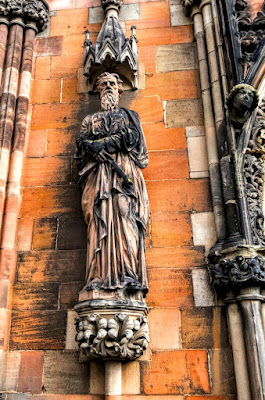
Saint Thomas the Apostle … a sculpture on the west façade of Lichfield Cathedral (Photograph: Patrick Comerford)

Scripture quotations are from the New Revised Standard Version Bible: Anglicised Edition copyright © 1989, 1995 National Council of the Churches of Christ in the United States of America. Used by permission. All rights reserved worldwide. http://nrsvbibles.org


The Easter celebrations come to a conclusion in the Greek Orthodox Church in Stony Stratford early this morning … today is Easter Day in the Orthodox calendar (Patrick Comerford, 2026)