The Synaxis of the Apostles … an icon in the Cathedral in Rethymnon in Crete (Photograph: Patrick Comerford)
Patrick Comerford
We are continuing in Ordinary Time in the Church Calendar and the week began with the Festival of Creation in Christ or the Fourteenth Sunday after Trinity (Trinity XIV, 6 September 2026). Today the Church celebrates the Birth of the Blessed Virgin Mary (8 September).
I have yet another medical appointment later this morning, and a meeting of the Stony Stratford Town Centre Working Group, a working committee of the town council, later this evening. But, before today begins, I am taking some quiet time this morning to give thanks, for reflection, prayer and reading in these ways:
1, today’s Gospel reading;
2, a reflection on the Gospel reading;
3, a prayer from the USPG prayer diary;
4, the Collects and Post-Communion prayer of the day.
The Twelve Apostles … an icon in the church in Panormos, east of Rethymnon in Crete (Photograph: Patrick Comerford)
Luke 6: 12-19 (NRSVA):
12 Now during those days he went out to the mountain to pray; and he spent the night in prayer to God. 13 And when day came, he called his disciples and chose twelve of them, whom he also named apostles: 14 Simon, whom he named Peter, and his brother Andrew, and James, and John, and Philip, and Bartholomew, 15 and Matthew, and Thomas, and James son of Alphaeus, and Simon, who was called the Zealot, 16 and Judas son of James, and Judas Iscariot, who became a traitor.
17 He came down with them and stood on a level place, with a great crowd of his disciples and a great multitude of people from all Judea, Jerusalem, and the coast of Tyre and Sidon. 18 They had come to hear him and to be healed of their diseases; and those who were troubled with unclean spirits were cured. 19 And all in the crowd were trying to touch him, for power came out from him and healed all of them.
The Twelve Apostles depicted in the East Window in Saint Editha’s Church, Tamworth (Photograph: Patrick Comerford)
Today’s Reflections:
The Gospel reading for the Feast of the Birth of the Blessed Virgin Mary today, Matthew 1: (1-16,) 18-23, gives us Saint Matthew’s account of the genealogy of Jesus.
The lectionary provision today following the weekday readings this week from Saint Luke’s Gospel (Luke 6: 12-19) tells of the selection of the Twelve from among the disciples, and naming of the Twelve. Their selection comes not only after a night of prayer alone on the mountain top, but between the stories of two healing miracles: a man in the synagogue whose right hand was withered (Luke 6: 6-11), which we read about yesterday, and the large number of people who come to hear Jesus and to be healed of their diseases (Luke 6: 17-19), which is the second part of today’s Gospel reading.
The call and ministry of the Twelve seems to be grounded firmly in the need of ordinary, everyday people, from far and wide, for healing, wholeness, restoration and acceptance.
Cardinal Karl Lehmann (1936-2018) was described as the face and voice of Catholicism in Germany for over 35 years. He was the Bishop of Mainz and former Professor of Dogmatic Theology at the University of Mainz, and during the Second Vatican Council he had been an assistant to Karl Rahner, the Jesuit theologian.
Dr Johanna Rahner, who succeeded Hans Küng as Professor of Dogmatics, History of Dogma and Ecumenical Theology at the Catholic Theological Faculty of Tübingen University, told the German weekly Die Zeit some years ago that Cardinal Lehmann ‘interpreted the Church’s teaching as a seelsorger (a ‘carer of souls’ – the German word for priest) and not in the narrow, doctrinal, sense.’
I like the idea of seeing the priest or the pastor as the physician or doctor of souls. The German theological journal Seelsorger describes itself as a ‘Journal for the Contemporary Cure of Souls,’ and the topics on pastoral care it discusses range from sexuality to post-modernity, the conscience to the use of story, vice, virtue, and baptism and the dangers and blessings of a long-term pastorate.
The soul is the deepest centre of the psyche. Problems at the level of the soul radiate out to all levels of the psyche and even the body.
The priest, the soul doctor, traces the problem to its deepest point. A hurting person should be addressed at all of those levels, but it is the soul doctor who addresses the very deepest level.
Among the Patristic writers, Saint John Chrysostom says that every priest is, as it were, the father of the whole world, and therefore should have care of all the souls to whose salvation he can co-operate by his labours. Besides, priests are appointed by God as physicians to cure every soul that is infirm. Origen has called priests ‘physicians of souls,’ while Saint Jerome calls us ‘spiritual physicians.’ Later, Saint Bonaventure asks: ‘If the physician flees from the sick, who will cure them?’
Canon 21 of the Fourth Lateran Council in 1215 drew an analogy between the physicians of the body and the physicians of the soul. This analogy between medical or physical care and spiritual or pastoral care was enthusiastically developed in mediaeval sermons and penitential literature, opening the door to many further comparisons.
The English word curate refers to a person who is charged with the care or cure (cura) of souls in a parish. In this sense, ‘curate’ correctly means a parish priest. In France, the cure is the principal priest in a parish, as is the Italian curato and the Spanish cura. But in English-speaking places, the term curate is commonly used to describe priests who are assistants to the parish priest.
However, the word curate in the 1662 Book of Common Prayer means the incumbent of a benefice, who is licensed by the bishop to the ‘cure of souls.’ The shared cure of souls is made clear by the traditional wording of the bishop’s deed of institution to a new incumbent, ‘habere curam animarum, et accipe curam tuam et meam, receive the cure of souls which is both mine and thine.’
In other words, when a parish priest begins his or her new ministry, the bishop is sharing the care of the parish – described traditionally as ‘the cure of souls’ – with the priest, but the bishop does not give it away. In the Church of Ireland, the 43 Canons listed in Chapter IX of the Constitution refer specifically to cures rather than parishes.
The soul is just as complicated as the body, just as rich and strange and puzzling. And it needs just as much attention. That does not mean that any priest can necessarily address these soul problems. But the true soul doctor is the depth psychologist.
When we think about salvation, it is worth recalling that the English word ‘salve’ is derived from the Latin salvus, which means healing. The priest, as an alter Christus, is seen as one who mends broken hearts, heals hurting souls, and applies God’s soothing balm on pained and wounded lives.
The priest truly is the ‘doctor of souls.’ Perhaps theology is the technical language of soul doctoring. But the prescription is the word and the medicine is the Eucharist, regular confession and daily prayer. The proper exercise is found in prayer, regular good deeds and acts of kindness.
The popular German word for priest means ‘carer of souls’ (Photograph: Patrick Comerford)
Today’s Prayers (Tuesday 8 September 2026):
In my prayers this morning, I am remembering my parents, who were married on this day 81 years ago, 8 September 1945, having waited until the end of World War II for their wedding.
In Pray with the World Church, the prayer diary of the Anglican mission agency USPG (United Society Partners in the Gospel), the theme this week, from 6-12 September 2026 (pp 36-37), is ‘Turning Pain into Glory’. This theme was introduced on Sunday with a Reflection by Nolene Sheppard, Leader of a Women’s Empowerment Group, Magnificat, and Ukraine Aid Project Support Lead at Saint Thomas à Becket, Hamburg, Germany.
The USPG Prayer Diary today (Tuesday 8 September 2026) invites us to pray:
Heavenly Father, thank you that you provide strength in times of loneliness and weakness. Grant wisdom to support those who feel like strangers in unfamiliar places.
The Collect of the Day:
Almighty God,
whose only Son has opened for us
a new and living way into your presence:
give us pure hearts and steadfast wills
to worship you in spirit and in truth;
through Jesus Christ your Son our Lord,
who is alive and reigns with you,
in the unity of the Holy Spirit,
one God, now and for ever.
or:
Almighty and everlasting God,
who stooped to raise fallen humanity
through the child–bearing of blessed Mary:
grant that we, who have seen your glory
revealed in our human nature
and your love made perfect in our weakness,
may daily be renewed in your image
and conformed to the pattern of your Son,
Jesus Christ our Lord,
who is alive and reigns with you,
in the unity of the Holy Spirit,
one God, now and for ever.
The Post-Communion Prayer:
God most high,
whose handmaid bore the Word made flesh:
we thank you that in this sacrament of our redemption
you visit us with your Holy Spirit
and overshadow us by your power;
strengthen us to walk with Mary the joyful path of obedience
and so to bring forth the fruits of holiness;
through Jesus Christ our Lord.
or:
Lord God, the source of truth and love,
keep us faithful to the apostles’ teaching and fellowship,
united in prayer and the breaking of bread,
and one in joy and simplicity of heart,
in Jesus Christ our Lord.
Additional Collect:
Merciful God:
your Son came to save us
and bore our sins on the cross:
may we trust in your mercy
and know your love,
rejoicing in the righteousness
that is ours through Jesus Christ our Lord.
Yesterday’s reflections
Continued tomorrow
Saint John Chrysostom says priests are appointed by God as physicians to cure every soul that is infirm (Photograph: Patrick Comerford)
Scripture quotations are from the New Revised Standard Version Bible: Anglicised Edition copyright © 1989, 1995, National Council of the Churches of Christ in the United States of America. Used by permission. All rights reserved worldwide. http://nrsvbibles.org
A traditional Greek icon of the Nativity of the Blessed Virgin Mary, celebrated on 8 September
Showing posts with label Tamworth. Show all posts
08 September 2026
04 September 2026
50 million in modern slavery,
50 million Black Death victims,
50 million European ancestors,
50 million readers of this blog
Big Ben and the Palace of Westminster … the UK has a target to welcome 50 million international visitors annually by the year 2030 (Photograph: Patrick Comerford)
Patrick Comerford
Yet again I am overwhelmed by the viewing and reading figures for this blog. These figures reached a total of 50 million before dawn early this morning (4 September 2026). This comes soon after reaching the 49 million mark four days ago (31 August 2026), and passing the million mark on three other days last month: 48 million (24 August), 47 million (17 August) and 46 million (9 August).
I continue to find these viewing and reading figures overpowering at times, and this blog continues to reach volumes of readers I never expected when I first started blogging 16 years ago. At the end of last year, this blog had 21 million hits (31 December 2025). So far this year, there have been more than 29 million hits or visitors in 2026 alone.
Half of all hits or reader figures have been in little more than six months, with 25 million hits since 25 February 2026. I first began blogging in 2010, and it took almost two years until July 2012 to reach half a million readers. Throughout this year and last, the daily figures are overwhelming on many occasions. Of the 10 days of busiest traffic on this blog, one was this month (1 September 2026), three were in May (1, 6 and 14 May 2026), three were the previous month (26, 29 and 30 April 2026), two in March, and one in February:
• 1,124,925 (1 May 2026)
• 525,719 (14 May 2026)
• 509,644 (29 April 2026)
• 356,335 (1 September 2026)
• 344,003 (30 April 2026)
• 323,156 (27 March 2026)
• 322,038 (26 April 2026)
• 318,835 (6 May 2026)
• 318,307 (1 March 2026)
• 314,018 (28 February 2026)
The daily average was about 118,700 hits a day throughout August. Yet, I recall how 10 years ago, back in 2016, the daily average was around 1,000, or 30,000 a month.
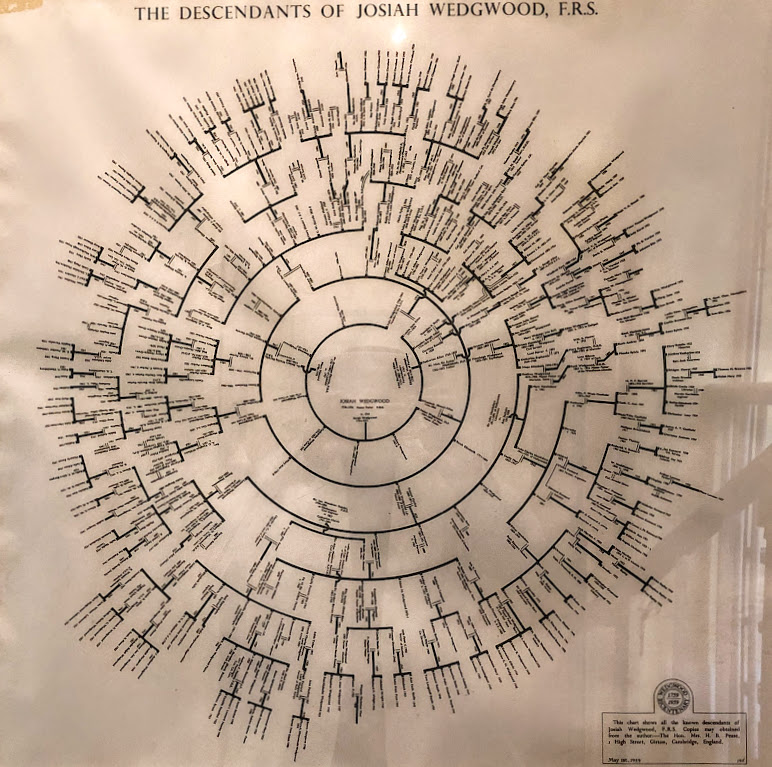
A large family tree of the Wedgwood and Darwin families in Erasmus Darwin House, Lichfield … mathematical projections in genealogy show how we are all related (Photograph: Patrick Comerford)
To put this new figure of 50 million into context:
Modern slavery entraps 50 million people on any given day: about 28 million people are working under duress in private economies, state projects or commercial exploitation, 22 million are living in forced marriages without consent, and one in four victims of modern slavery is a child.
Around 50 million people worldwide have epilepsy, making it one of the most common neurological diseases globally.
The UK government has set an official target to welcome 50 million international visitors annually by the year 2030. Greece too aims to attract 50 million annual tourist arrivals by 2030, according to a strategic target set by the Greek Tourism Confederation.
There are 29 countries with a population of more than 50 million. The population of the UK reached 50 million by 1948 and has been growing ever since: the population was 40 million in 1898, it reached 50 million by 1948 and 60 million by 2005, and is probably at 70 million this year (2026).
The Black Death killed 50 million people, or 60 per cent of Europe’s entire population, between 1346 and 1353. As a proportion of the population that lost their lives, the Black Death caused unrivalled mortality. It overshadows the horrors of World War II, and is twice the number murdered by Stalin’s regime in the Soviet Union.
In the year 1000, Europe had a population of ~50 million. Some simple maths shows that everyone who was alive in Europe around the year 1000 is either an ancestor of everyone in Europe today, or the ancestor of no one. This means that someone in Sweden, Norway or Italy has the same set of ancestors as someone who thinks their family is 100% British, Irish, French or Spanish.
At times I have used mathematical projections to help my genealogical projects, and the maths are quite simple. Every person has two parents, four grandparents and so on. Going just 30 generations back, say around 1066, that means I have one billion direct ancestors (2 to the power of 30), even though there were not one billion humans alive at that time.
A white paper published by FamilyTreeDNA used an example of a Swedish man with 8.5 billion genealogical ancestors (2^33) living in the year 1000. ‘Genealogical ancestors’ does not mean actual ancestors, as there were not even one billion living humans alive at that time, meaning many ancestors will appear multiple times across various branches.
The paper notes: ‘Think about that for a moment. If you have a single European ancestor, you are genealogically descended from every European from the year 1000 who has living descendants now.’
The population of ~50 million people in Europe in the year 1000 means we are all related in more ways than we imagine.
50 million minutes is 95 years, 24 days, 4 hours and 22 minutes. This means that if this blog was receiving just one hit a minute, I would need to have started blogging back in late September 1931.
I retired from active parish ministry about 4½ years ago, on 31 March 2022. These days, though, about 150 people on average are reading my daily prayer diary posted on this blog each morning, or more than 1,000 people each week.
This evening, as this blog passes 50 million hits, I am truly grateful to the real readers among those 50 million hits. In particular I am thankful for the faithful core group of people who join me in prayer, scripture reading and reflections each day.
William de Comberford’s monument in the Comberford Chapel, Tamworth … he died in 1349, a year after the Black Death killed one-third of Tamworth, at a time when the Black Death killed 50 million in Europe (Photograph: Patrick Comerford, 2026)
Patrick Comerford
Yet again I am overwhelmed by the viewing and reading figures for this blog. These figures reached a total of 50 million before dawn early this morning (4 September 2026). This comes soon after reaching the 49 million mark four days ago (31 August 2026), and passing the million mark on three other days last month: 48 million (24 August), 47 million (17 August) and 46 million (9 August).
I continue to find these viewing and reading figures overpowering at times, and this blog continues to reach volumes of readers I never expected when I first started blogging 16 years ago. At the end of last year, this blog had 21 million hits (31 December 2025). So far this year, there have been more than 29 million hits or visitors in 2026 alone.
Half of all hits or reader figures have been in little more than six months, with 25 million hits since 25 February 2026. I first began blogging in 2010, and it took almost two years until July 2012 to reach half a million readers. Throughout this year and last, the daily figures are overwhelming on many occasions. Of the 10 days of busiest traffic on this blog, one was this month (1 September 2026), three were in May (1, 6 and 14 May 2026), three were the previous month (26, 29 and 30 April 2026), two in March, and one in February:
• 1,124,925 (1 May 2026)
• 525,719 (14 May 2026)
• 509,644 (29 April 2026)
• 356,335 (1 September 2026)
• 344,003 (30 April 2026)
• 323,156 (27 March 2026)
• 322,038 (26 April 2026)
• 318,835 (6 May 2026)
• 318,307 (1 March 2026)
• 314,018 (28 February 2026)
The daily average was about 118,700 hits a day throughout August. Yet, I recall how 10 years ago, back in 2016, the daily average was around 1,000, or 30,000 a month.
A large family tree of the Wedgwood and Darwin families in Erasmus Darwin House, Lichfield … mathematical projections in genealogy show how we are all related (Photograph: Patrick Comerford)
To put this new figure of 50 million into context:
Modern slavery entraps 50 million people on any given day: about 28 million people are working under duress in private economies, state projects or commercial exploitation, 22 million are living in forced marriages without consent, and one in four victims of modern slavery is a child.
Around 50 million people worldwide have epilepsy, making it one of the most common neurological diseases globally.
The UK government has set an official target to welcome 50 million international visitors annually by the year 2030. Greece too aims to attract 50 million annual tourist arrivals by 2030, according to a strategic target set by the Greek Tourism Confederation.
There are 29 countries with a population of more than 50 million. The population of the UK reached 50 million by 1948 and has been growing ever since: the population was 40 million in 1898, it reached 50 million by 1948 and 60 million by 2005, and is probably at 70 million this year (2026).
The Black Death killed 50 million people, or 60 per cent of Europe’s entire population, between 1346 and 1353. As a proportion of the population that lost their lives, the Black Death caused unrivalled mortality. It overshadows the horrors of World War II, and is twice the number murdered by Stalin’s regime in the Soviet Union.
In the year 1000, Europe had a population of ~50 million. Some simple maths shows that everyone who was alive in Europe around the year 1000 is either an ancestor of everyone in Europe today, or the ancestor of no one. This means that someone in Sweden, Norway or Italy has the same set of ancestors as someone who thinks their family is 100% British, Irish, French or Spanish.
At times I have used mathematical projections to help my genealogical projects, and the maths are quite simple. Every person has two parents, four grandparents and so on. Going just 30 generations back, say around 1066, that means I have one billion direct ancestors (2 to the power of 30), even though there were not one billion humans alive at that time.
A white paper published by FamilyTreeDNA used an example of a Swedish man with 8.5 billion genealogical ancestors (2^33) living in the year 1000. ‘Genealogical ancestors’ does not mean actual ancestors, as there were not even one billion living humans alive at that time, meaning many ancestors will appear multiple times across various branches.
The paper notes: ‘Think about that for a moment. If you have a single European ancestor, you are genealogically descended from every European from the year 1000 who has living descendants now.’
The population of ~50 million people in Europe in the year 1000 means we are all related in more ways than we imagine.
50 million minutes is 95 years, 24 days, 4 hours and 22 minutes. This means that if this blog was receiving just one hit a minute, I would need to have started blogging back in late September 1931.
I retired from active parish ministry about 4½ years ago, on 31 March 2022. These days, though, about 150 people on average are reading my daily prayer diary posted on this blog each morning, or more than 1,000 people each week.
This evening, as this blog passes 50 million hits, I am truly grateful to the real readers among those 50 million hits. In particular I am thankful for the faithful core group of people who join me in prayer, scripture reading and reflections each day.
William de Comberford’s monument in the Comberford Chapel, Tamworth … he died in 1349, a year after the Black Death killed one-third of Tamworth, at a time when the Black Death killed 50 million in Europe (Photograph: Patrick Comerford, 2026)
20 August 2026
Daily prayer in Ordinary Time 2026:
105, Thursday 20 August 2026
Waiting for guests at the Tai Tai restaurant in Kuching … we are all invited to the heavenly banquet, but are we ready to accept the invitation? (Photograph: Patrick Comerford, 2026)
Patrick Comerford
We are continuing in Ordinary Time in the Church Calendar and this week began with the Eleventh Sunday after Trinity (Trinity XI, 16 August 2026). The calendar of the Church of England in Common Worship today remembers Saint Bernard (1112-1153), Abbot of Clairvaux, Teacher of the Faith; and William Booth (1829-1912) and Catherine Booth (1829-1890), founders of the Salvation Army.
I hope to be involved in a drama group meeting in the library in Stony Stratford this evening, when we are reading the appropriately topical Peace by Aristophanes. This play was first staged just a few days before the validation of Peace of Nicias, which promised to end the ten-year-old Peloponnesian War, in 421 BCE. Earlier in the day, I have a number of tests, including blood tests, heart monitoring and an ECG, as my Vitamin B12 deficiency and sarcoidosis continue to be monitored. But, before today begins, I am taking some quiet time this morning to give thanks, for reflection, prayer and reading in these ways:
1, today’s Gospel reading;
2, a reflection on the Gospel reading;
3, a prayer from the USPG prayer diary;
4, the Collects and Post-Communion prayer of the day.
‘Go therefore into the … streets, and invite everyone you find to the … banquet’ (Matthew 22: 9) … empty tables at restaurants in the side streets in Rethymnon in Crete (Photograph: Patrick Comerford, 2025)
Matthew 22: 1-14 (NRSVA):
1 Once more Jesus spoke to them in parables, saying: 2 ‘The kingdom of heaven may be compared to a king who gave a wedding banquet for his son. 3 He sent his slaves to call those who had been invited to the wedding banquet, but they would not come. 4 Again he sent other slaves, saying, “Tell those who have been invited: Look, I have prepared my dinner, my oxen and my fat calves have been slaughtered, and everything is ready; come to the wedding banquet.” 5 But they made light of it and went away, one to his farm, another to his business, 6 while the rest seized his slaves, maltreated them, and killed them. 7 The king was enraged. He sent his troops, destroyed those murderers, and burned their city. 8 Then he said to his slaves, “The wedding is ready, but those invited were not worthy. 9 Go therefore into the main streets, and invite everyone you find to the wedding banquet.” 10 Those slaves went out into the streets and gathered all whom they found, both good and bad; so the wedding hall was filled with guests.
11 ‘But when the king came in to see the guests, he noticed a man there who was not wearing a wedding robe, 12 and he said to him, “Friend, how did you get in here without a wedding robe?” And he was speechless. 13 Then the king said to the attendants, “Bind him hand and foot, and throw him into the outer darkness, where there will be weeping and gnashing of teeth.” 14 For many are called, but few are chosen.’
‘A Peasant Wedding’ (1620), Peter Brueghel the Younger, the National Gallery of Ireland (Photograph: Patrick Comerford)
Today’s Reflection:
‘For many are called, but few are chosen.’
Sometimes, the ways I can behave as a snob can catch me off-guard and unexpectedly, and I shame myself.
When I was growing up, the snobberies and class distinctions of previous generations were challenged over 60 years ago in an old-fashioned way in the film My Fair Lady (1964), based on George Bernard Shaw’s earlier play, Pygmalion (1913).
But Pygmalion also inspired what I think is a much funnier film, Hoi Polloi (1935), with the Three Stooges, Larry, Curly and Moe.
Two professors are arguing about whether our social behaviour is caused by environment or heredity. It is a very funny take on the old Nature v Nurture argument.
To settle a bet, the two professors take three binmen – Larry, Curly and Moe – train and coach them for three months, dress them up, and send them off to a posh society dinner.
Their behaviour descends into farce, and it looks as if one professor has won his bet: our social behaviour is dictated by inherited class.
But then the tables are turned – literally. Everyone else at the party descends to the same riotous behaviour. At a base level, we are all the same, even if some refuse to accept it.
Nature or nurture? It was an important statement that we all share the same humanity, coming as racism and the Nazis were on the rise in the 1930s.
The title of the film, Hoi Polloi, is a way of expressing class-based social prejudice. It is a Greek phrase, meaning ‘the many’ and it was used in Victorian England by people who had the benefit of a classical education in English public schools and the universities, to describe the masses, who they presumed did not understand the phrase.
Gilbert and Sullivan use the phrase to mock those who used it in their comic opera Iolanthe. Later, it was used by English public schoolboys in the 1950s and the 1960s, when they referred to ‘oips’ and ‘oiks’.
The term hoi polloi also appears in a scene in the film Dead Poets Society (1989). Professor John Keating, played by Robin Williams, speaks negatively about the use of the definite article ‘the’ in front of the phrase.
Steven Meeks (Allelon Ruggiero) raises his hands and speaks: ‘The hoi polloi. Doesn’t it mean the herd?’
Keating replies: ‘Precisely, Meeks. Greek for the herd. However, be warned that, when you say “the hoi polloi” you are actually saying “the the herd.” Indicating that you too are “hoi polloi”.’
This morning’s Gospel reading (Matthew 22: 1-14) begins with a very joyful occasion – a posh nosh, a planned wedding, and generous invitations to a lavish banquet. But, instead of the farce in that film with the Three Stooges, it quickly descends into very difficult images: slaves who are kidnapped, mistreated and killed; cities that are burned down; a man who is bound hand and feet and thrown into outer darkness.
The images of the wedding banquet and the wedding covenant are important ways of describing our relationship with God.
But the parable in this morning’s Gospel reading is particularly difficult.
The king has invited a long list of guests, but even after being repeatedly sought out, none of these guests comes to the banquet.
To refuse to come, to refuse a king’s command, is treason; to kill his slaves amounts to insurrection. So the king sends out troops to put down the rebellion.
The king then sends his slaves into the streets to find enough people to sit at the tables at the wedding banquet. The phrase translated as ‘the main streets’ (διεξόδους τῶν ὁδῶν, verse 9), means not the main fashionable, shopping streets in a chic part of a city centre. It refers to dirty, gritty, street corners and junctions, perhaps the main junctions outside the city gates.
This is the place where those who want to be hired as labour gather, where those who are refused entry wait without hope, this is where those who are on margins are found. Other translations catch these images when they talk about the highways and the byways.
And the king’s invitation, in verse 10, goes out to all people, ‘both good and bad.’
Yet, when the king sees that a man is not dressed appropriately for the event, the king throws him into the outer darkness. In this case, the robe probably symbolises the white robe worn for baptism.
Do we wear that robe all the time? In other words, do we live up to our promises of discipleship made at Baptism – summarised in the call to love God and to love others?
If you were to imagine yourself as one of the characters in this parable, who would you be?
And would you behave that way?
Are you the king, throwing a lavish wedding banquet?
Are you a wedding guest who has denied the generosity of the king?
Are you the bride or groom, sidelined and marginalised at our own wedding, incidental to all the power playing and role playing?
Are you one of the people brought in from the streets, but not prepared for the celebration about to take place?
Where do you find Good News in this parable?
What is meant by the many and the few here?
In our western way of thinking, the word many is a quantity much more than the majority, while few is many less than the majority. But in eastern thought, one less than 100% would be considered few.
We could put the Greek use of ‘few’ and ‘many’ by Christ in this parable in its cultural context. Pericles, in his ‘Funeral Oration’ in Athens, according to Thucydides in his History of the Peloponnesian War, uses ‘the many,’ οἱ πολλοί (hoi polloi), in a positive way when he extols democracy in Athens.
He contrasts ‘the many’ with ‘the few’ (οἱ ὀλίγοι, hoi oligoi), the few who abuse power and create an oligarchy, rule by the few. Pericles demands equal justice for ‘the many’, ‘the all’, before the law, against the selfish interests of the few.
When we celebrate the Eucharist, we remember that Christ is the victim, and that he said his blood is shed ‘for you and for many.’ The word ‘you’ here means us, the Church, the few in this parable. But the phrase ‘the many’ here, οἱ πολλοί (hoi polloi), refers to the masses, the multitude, the great unwashed, who are called to the banquet too.
Christ’s invitation is not just to you and me, who know we are invited to the banquet. It is also for the many, the lumpen masses, all people, the ones who are not usually invited to the posh nosh, the Larry, Curly and Moe in our midst.
The invitation to come in, to celebrate at the banquet, symbolised in the Eucharist this morning, is not just for the few, the oligarchs. The many are invited to this banquet this morning.
Who are we to behave like a tyrannical despot and exclude them? For if we exclude them, we are in danger of excluding Christ himself.
‘Look, I have prepared my dinner … and everything is ready’ (Matthew 22: 3) … waiting for diners at the Black Horse in Great Linford, Buckinghamshire (Photograph: Patrick Comerford)
Today’s Prayers (Thursday 20 August 2026):
In Pray with the World Church, the prayer diary of the Anglican mission agency USPG (United Society Partners in the Gospel), the theme this week, from 16 to 22 August 2026 (pp 30-31), is ‘Hope in the Making’. This theme was introduced on Sunday with a reflection by Grace Murray, a USPG volunteer. The prayers this week come courtesy of passersby at Greenbelt Festival 2025.
The USPG Prayer Diary today (Thursday 20 August 2026) invites us to pray:
Dear God, please forgive us for we have been selfish and misused your creation. We are sorry that nature has been hurt by humans. Help us to do better, Lord!
The Collect of the Day:
Merciful redeemer,
who, by the life and preaching of your servant Bernard,
rekindled the radiant light of your Church:
grant us, in our generation,
to be inflamed with the same spirit of discipline and love
and ever to walk before you as children of light;
through Jesus Christ your Son our Lord,
who is alive and reigns with you,
in the unity of the Holy Spirit,
one God, now and for ever.
The Post-Communion Prayer:
God of truth,
whose Wisdom set her table
and invited us to eat the bread and drink the wine
of the kingdom:
help us to lay aside all foolishness
and to live and walk in the way of insight,
that we may come with Bernard to the eternal feast of heaven;
through Jesus Christ our Lord.
Yesterday’s reflections
Continued tomorrow
‘Those who had been invited to the wedding banquet … would not come’ (Matthew 22: 3) … empty tables at the Moat House, the former Comberford family home on Lichfield Street, Tamworth (Photograph: Patrick Comerford)
Scripture quotations are from the New Revised Standard Version Bible: Anglicised Edition copyright © 1989, 1995, National Council of the Churches of Christ in the United States of America. Used by permission. All rights reserved worldwide. http://nrsvbibles.org
A grave in Kerameikós, Athens, where Pericles delivered his funeral oration (Photograph: Patrick Comerford)
Patrick Comerford
We are continuing in Ordinary Time in the Church Calendar and this week began with the Eleventh Sunday after Trinity (Trinity XI, 16 August 2026). The calendar of the Church of England in Common Worship today remembers Saint Bernard (1112-1153), Abbot of Clairvaux, Teacher of the Faith; and William Booth (1829-1912) and Catherine Booth (1829-1890), founders of the Salvation Army.
I hope to be involved in a drama group meeting in the library in Stony Stratford this evening, when we are reading the appropriately topical Peace by Aristophanes. This play was first staged just a few days before the validation of Peace of Nicias, which promised to end the ten-year-old Peloponnesian War, in 421 BCE. Earlier in the day, I have a number of tests, including blood tests, heart monitoring and an ECG, as my Vitamin B12 deficiency and sarcoidosis continue to be monitored. But, before today begins, I am taking some quiet time this morning to give thanks, for reflection, prayer and reading in these ways:
1, today’s Gospel reading;
2, a reflection on the Gospel reading;
3, a prayer from the USPG prayer diary;
4, the Collects and Post-Communion prayer of the day.
‘Go therefore into the … streets, and invite everyone you find to the … banquet’ (Matthew 22: 9) … empty tables at restaurants in the side streets in Rethymnon in Crete (Photograph: Patrick Comerford, 2025)
Matthew 22: 1-14 (NRSVA):
1 Once more Jesus spoke to them in parables, saying: 2 ‘The kingdom of heaven may be compared to a king who gave a wedding banquet for his son. 3 He sent his slaves to call those who had been invited to the wedding banquet, but they would not come. 4 Again he sent other slaves, saying, “Tell those who have been invited: Look, I have prepared my dinner, my oxen and my fat calves have been slaughtered, and everything is ready; come to the wedding banquet.” 5 But they made light of it and went away, one to his farm, another to his business, 6 while the rest seized his slaves, maltreated them, and killed them. 7 The king was enraged. He sent his troops, destroyed those murderers, and burned their city. 8 Then he said to his slaves, “The wedding is ready, but those invited were not worthy. 9 Go therefore into the main streets, and invite everyone you find to the wedding banquet.” 10 Those slaves went out into the streets and gathered all whom they found, both good and bad; so the wedding hall was filled with guests.
11 ‘But when the king came in to see the guests, he noticed a man there who was not wearing a wedding robe, 12 and he said to him, “Friend, how did you get in here without a wedding robe?” And he was speechless. 13 Then the king said to the attendants, “Bind him hand and foot, and throw him into the outer darkness, where there will be weeping and gnashing of teeth.” 14 For many are called, but few are chosen.’
‘A Peasant Wedding’ (1620), Peter Brueghel the Younger, the National Gallery of Ireland (Photograph: Patrick Comerford)
Today’s Reflection:
‘For many are called, but few are chosen.’
Sometimes, the ways I can behave as a snob can catch me off-guard and unexpectedly, and I shame myself.
When I was growing up, the snobberies and class distinctions of previous generations were challenged over 60 years ago in an old-fashioned way in the film My Fair Lady (1964), based on George Bernard Shaw’s earlier play, Pygmalion (1913).
But Pygmalion also inspired what I think is a much funnier film, Hoi Polloi (1935), with the Three Stooges, Larry, Curly and Moe.
Two professors are arguing about whether our social behaviour is caused by environment or heredity. It is a very funny take on the old Nature v Nurture argument.
To settle a bet, the two professors take three binmen – Larry, Curly and Moe – train and coach them for three months, dress them up, and send them off to a posh society dinner.
Their behaviour descends into farce, and it looks as if one professor has won his bet: our social behaviour is dictated by inherited class.
But then the tables are turned – literally. Everyone else at the party descends to the same riotous behaviour. At a base level, we are all the same, even if some refuse to accept it.
Nature or nurture? It was an important statement that we all share the same humanity, coming as racism and the Nazis were on the rise in the 1930s.
The title of the film, Hoi Polloi, is a way of expressing class-based social prejudice. It is a Greek phrase, meaning ‘the many’ and it was used in Victorian England by people who had the benefit of a classical education in English public schools and the universities, to describe the masses, who they presumed did not understand the phrase.
Gilbert and Sullivan use the phrase to mock those who used it in their comic opera Iolanthe. Later, it was used by English public schoolboys in the 1950s and the 1960s, when they referred to ‘oips’ and ‘oiks’.
The term hoi polloi also appears in a scene in the film Dead Poets Society (1989). Professor John Keating, played by Robin Williams, speaks negatively about the use of the definite article ‘the’ in front of the phrase.
Steven Meeks (Allelon Ruggiero) raises his hands and speaks: ‘The hoi polloi. Doesn’t it mean the herd?’
Keating replies: ‘Precisely, Meeks. Greek for the herd. However, be warned that, when you say “the hoi polloi” you are actually saying “the the herd.” Indicating that you too are “hoi polloi”.’
This morning’s Gospel reading (Matthew 22: 1-14) begins with a very joyful occasion – a posh nosh, a planned wedding, and generous invitations to a lavish banquet. But, instead of the farce in that film with the Three Stooges, it quickly descends into very difficult images: slaves who are kidnapped, mistreated and killed; cities that are burned down; a man who is bound hand and feet and thrown into outer darkness.
The images of the wedding banquet and the wedding covenant are important ways of describing our relationship with God.
But the parable in this morning’s Gospel reading is particularly difficult.
The king has invited a long list of guests, but even after being repeatedly sought out, none of these guests comes to the banquet.
To refuse to come, to refuse a king’s command, is treason; to kill his slaves amounts to insurrection. So the king sends out troops to put down the rebellion.
The king then sends his slaves into the streets to find enough people to sit at the tables at the wedding banquet. The phrase translated as ‘the main streets’ (διεξόδους τῶν ὁδῶν, verse 9), means not the main fashionable, shopping streets in a chic part of a city centre. It refers to dirty, gritty, street corners and junctions, perhaps the main junctions outside the city gates.
This is the place where those who want to be hired as labour gather, where those who are refused entry wait without hope, this is where those who are on margins are found. Other translations catch these images when they talk about the highways and the byways.
And the king’s invitation, in verse 10, goes out to all people, ‘both good and bad.’
Yet, when the king sees that a man is not dressed appropriately for the event, the king throws him into the outer darkness. In this case, the robe probably symbolises the white robe worn for baptism.
Do we wear that robe all the time? In other words, do we live up to our promises of discipleship made at Baptism – summarised in the call to love God and to love others?
If you were to imagine yourself as one of the characters in this parable, who would you be?
And would you behave that way?
Are you the king, throwing a lavish wedding banquet?
Are you a wedding guest who has denied the generosity of the king?
Are you the bride or groom, sidelined and marginalised at our own wedding, incidental to all the power playing and role playing?
Are you one of the people brought in from the streets, but not prepared for the celebration about to take place?
Where do you find Good News in this parable?
What is meant by the many and the few here?
In our western way of thinking, the word many is a quantity much more than the majority, while few is many less than the majority. But in eastern thought, one less than 100% would be considered few.
We could put the Greek use of ‘few’ and ‘many’ by Christ in this parable in its cultural context. Pericles, in his ‘Funeral Oration’ in Athens, according to Thucydides in his History of the Peloponnesian War, uses ‘the many,’ οἱ πολλοί (hoi polloi), in a positive way when he extols democracy in Athens.
He contrasts ‘the many’ with ‘the few’ (οἱ ὀλίγοι, hoi oligoi), the few who abuse power and create an oligarchy, rule by the few. Pericles demands equal justice for ‘the many’, ‘the all’, before the law, against the selfish interests of the few.
When we celebrate the Eucharist, we remember that Christ is the victim, and that he said his blood is shed ‘for you and for many.’ The word ‘you’ here means us, the Church, the few in this parable. But the phrase ‘the many’ here, οἱ πολλοί (hoi polloi), refers to the masses, the multitude, the great unwashed, who are called to the banquet too.
Christ’s invitation is not just to you and me, who know we are invited to the banquet. It is also for the many, the lumpen masses, all people, the ones who are not usually invited to the posh nosh, the Larry, Curly and Moe in our midst.
The invitation to come in, to celebrate at the banquet, symbolised in the Eucharist this morning, is not just for the few, the oligarchs. The many are invited to this banquet this morning.
Who are we to behave like a tyrannical despot and exclude them? For if we exclude them, we are in danger of excluding Christ himself.
‘Look, I have prepared my dinner … and everything is ready’ (Matthew 22: 3) … waiting for diners at the Black Horse in Great Linford, Buckinghamshire (Photograph: Patrick Comerford)
Today’s Prayers (Thursday 20 August 2026):
In Pray with the World Church, the prayer diary of the Anglican mission agency USPG (United Society Partners in the Gospel), the theme this week, from 16 to 22 August 2026 (pp 30-31), is ‘Hope in the Making’. This theme was introduced on Sunday with a reflection by Grace Murray, a USPG volunteer. The prayers this week come courtesy of passersby at Greenbelt Festival 2025.
The USPG Prayer Diary today (Thursday 20 August 2026) invites us to pray:
Dear God, please forgive us for we have been selfish and misused your creation. We are sorry that nature has been hurt by humans. Help us to do better, Lord!
The Collect of the Day:
Merciful redeemer,
who, by the life and preaching of your servant Bernard,
rekindled the radiant light of your Church:
grant us, in our generation,
to be inflamed with the same spirit of discipline and love
and ever to walk before you as children of light;
through Jesus Christ your Son our Lord,
who is alive and reigns with you,
in the unity of the Holy Spirit,
one God, now and for ever.
The Post-Communion Prayer:
God of truth,
whose Wisdom set her table
and invited us to eat the bread and drink the wine
of the kingdom:
help us to lay aside all foolishness
and to live and walk in the way of insight,
that we may come with Bernard to the eternal feast of heaven;
through Jesus Christ our Lord.
Yesterday’s reflections
Continued tomorrow
‘Those who had been invited to the wedding banquet … would not come’ (Matthew 22: 3) … empty tables at the Moat House, the former Comberford family home on Lichfield Street, Tamworth (Photograph: Patrick Comerford)
Scripture quotations are from the New Revised Standard Version Bible: Anglicised Edition copyright © 1989, 1995, National Council of the Churches of Christ in the United States of America. Used by permission. All rights reserved worldwide. http://nrsvbibles.org
Labels:
Aristophanes,
Athens,
Classics,
Crete 2026,
Great Linford,
Greece 2026,
Kuching,
Mission,
Prayer,
Rethymnon,
Saint Matthew's Gospel,
Stony Stratford,
Tamworth,
Theatre,
USPG,
War and peace,
Weddings
13 August 2026
There was no Earl of Comberford
in Hopwas in the 16th century,
but a Regency blockbuster has
a fictious Earl of Cumberford
The Earl of Cumberford is a fictional character in the Regency romance novel ‘Contrary Cousins’ (1981) by Judith Harkness
Patrick Comerford
When I was walking around Hopwas in one of my recent treks through the countryside in Staffordshire, I came across a blog posting from 2010 on ‘Tamworth Time Hikes’ in which a blogger, writing about the Woodhouse in Hopwas Wood back in 2010, said the house was ‘probably built on orders of the Marquess of Donegal around 1750 for use as a hunting lodge and retreat, being close to his Fisherwick estate.’
The blogger goes on to claim: ‘Local hearsay reports that there was a site here as far back as 1540, from the wife of the earl of Comberford, I cannot confirm any of this but its [sic] worth investigating.’
Of course, the blogger could never have confirmed any of this. The family of the Marquess of Donegall owned Comberford Hall in the 18th century, and before them the Comberford family owned large tracts of Hopwas, which is west of Comberford, on the road between Lichfield and Tamworth.
But there never was an Earl of Comberford, nor was there a Countess of Comberford who built the Woodhouse in Hopwas in the mid-16th century. Much as the conceited side of my inner personality might delight in the prospect of inheriting such a title, the nearest there ever was to an Earl of Comberford is a fictional character in a blockbuster or ‘chick-lit’ novel by the American romantic fiction writer Judith Harkness.
’A Mapp of Staffordshire with its Hundreds’ by Richard Blome (1715) names Comberford as Cumberford
The spelling ‘Cumberford’ is used on the Comberford family monument erected by Joseph Comerford in the Comberford Chapel in Saint Editha’s Church, Tamworth, in 1725. Ten years earlier, Richard Blome’s ‘A Mapp of Staffordshire with its Hundreds’ (1715) is unusual in tilting Staffordshire, viewing it from south to north on a left-to-right axis. Like many maps of the name, it spells Comberford as ‘Cumberford’. The same spelling was used 20 years before that in Robert Morden’s map, ‘Staffordshire’, for Camden’s Britannia (1695). Reviewers claim Judith Harkness often makes historical errors in her English settings. But, at least in her spelling of this fictitious aristocrat’s title she is not being entirely unhistorical.
The Earl of Cumberford is a fictional character in her Regency romance novel Contrary Cousins (1981), and she portrays him as a pompous English nobleman who detests the American branch of his family. Cumberford hates his American relatives and when his nieces arrive in London, the romantic comedy begins. When the Powell cousins take London society by storm, Cumberford is livid with rage. Lady Pendleton was certain her plan would succeed, for lively Antonia was irresistibly pretty, and Serena merely required the attentions of a first-rate dressmaker and a more confident manner to attract the notice of London’s most eligible bachelors.
But if Lady Pendleton could have foreseen how well her scheme would work and just which lords would soon be courting her charges in earnest, she would never have let Antonia and Serena off the boat from America.
Judith Harkness paints the fashionable world of Regency England, when styles were dictated by Beau Brummel, the Duchess of Devonshire held court, and dandies paraded in their phaetons and four. Groomed by their mothers to capture the hearts of the most eligible bachelors of the day, fashionable young ladies passed the Season in London and at Bath, where they were presented at a string of assemblies and balls in their finery and feathers.
Brimming with period detail, Contrary Cousins was written to appeal to readers who enjoy a good, old-fashioned romantic caper in the tradition of Jane Austen and Georgette Heyer.
Judith Harkness is the author of five classic Regency romances: The Montague Scandal, The Admiral’s Daughter, The Determined Bachelor, Contrary Cousins, and Lady Charlotte’s Ruse, all originally published by Signet. She is the co-author of a screenplay, Emma in New York, an updated version of the classic Jane Austen novel set in contemporary Manhattan.
As JH Richardson, Judith Harkness also writes non-fiction on subjects ranging from children with learning and developmental issues to profiles of notable creative artists. She lives in Rhode Island with her husband, Will Taft.
The Woodhouse in Hopwas was also known as Hopwas Hayes Lodge and was built in 1730 by Zachary Babington
As for the Woodhouse in Hopwas, it was also known known as Hopwas Hayes Lodge. It was built in 1730 by Zachary Babington (1690-1745) as part of the Fisherwick estate. It was situated on the highest part of Hopwas Wood.
Zachary Babington was a barrister and was High Sheriff of Staffordshire in 1713 and 1724. He was the son of John Babington (High Sheriff in 1702), and was named after his grandfather, the Revd Canon Dr Zachary Babington (1549-1613), Chancellor of Lichfield Cathedral and Master of Saint John’s Hospital. He was distantly related to Anthony Babington, who in 1586 was hung, drawn and quartered on Tower Hill for his role in the Babington Plot to put Mary Queen of Scots, on the English throne.
Although there never was an Earl of Comberford, it is here we find a link with the Comberford family: Zachary’s grandfather, Humphrey Babington, married one of three sisters who jointly became heiresses to the vast Beaumont estates, including Wednesbury:
• Jane or Joan Beaumont, the eldest daughter, married William Babington of Teremore;
• Dorothy Beaumont, the second daughter and co-heir, married Humphrey Comberford of Comberford, Staffordshire;
• Eleanor Beaumont, the youngest daughter, married William Babington’s brother Humphrey Babington of Rothley Temple, Leicestershire.
The grandson of Canon Zachary Babington, the younger Zachary Babington, lived at Curborough Hall, near Lichfield, and later at Whittington Old Hall. His daughter Mary married Theophilus Levett, town clerk of Lichfield, and so the Levett family inherited the Babington estates at Curborough and Packington, including the Woodhouse.
The Woodhouse was altered in the 19th and 20th centuries, but it fell into disrepair and was demolished in 2010.
The Earl of Cumberford is a fictional character in a novel by Judith Harkness
Patrick Comerford
When I was walking around Hopwas in one of my recent treks through the countryside in Staffordshire, I came across a blog posting from 2010 on ‘Tamworth Time Hikes’ in which a blogger, writing about the Woodhouse in Hopwas Wood back in 2010, said the house was ‘probably built on orders of the Marquess of Donegal around 1750 for use as a hunting lodge and retreat, being close to his Fisherwick estate.’
The blogger goes on to claim: ‘Local hearsay reports that there was a site here as far back as 1540, from the wife of the earl of Comberford, I cannot confirm any of this but its [sic] worth investigating.’
Of course, the blogger could never have confirmed any of this. The family of the Marquess of Donegall owned Comberford Hall in the 18th century, and before them the Comberford family owned large tracts of Hopwas, which is west of Comberford, on the road between Lichfield and Tamworth.
But there never was an Earl of Comberford, nor was there a Countess of Comberford who built the Woodhouse in Hopwas in the mid-16th century. Much as the conceited side of my inner personality might delight in the prospect of inheriting such a title, the nearest there ever was to an Earl of Comberford is a fictional character in a blockbuster or ‘chick-lit’ novel by the American romantic fiction writer Judith Harkness.
’A Mapp of Staffordshire with its Hundreds’ by Richard Blome (1715) names Comberford as Cumberford
The spelling ‘Cumberford’ is used on the Comberford family monument erected by Joseph Comerford in the Comberford Chapel in Saint Editha’s Church, Tamworth, in 1725. Ten years earlier, Richard Blome’s ‘A Mapp of Staffordshire with its Hundreds’ (1715) is unusual in tilting Staffordshire, viewing it from south to north on a left-to-right axis. Like many maps of the name, it spells Comberford as ‘Cumberford’. The same spelling was used 20 years before that in Robert Morden’s map, ‘Staffordshire’, for Camden’s Britannia (1695). Reviewers claim Judith Harkness often makes historical errors in her English settings. But, at least in her spelling of this fictitious aristocrat’s title she is not being entirely unhistorical.
The Earl of Cumberford is a fictional character in her Regency romance novel Contrary Cousins (1981), and she portrays him as a pompous English nobleman who detests the American branch of his family. Cumberford hates his American relatives and when his nieces arrive in London, the romantic comedy begins. When the Powell cousins take London society by storm, Cumberford is livid with rage. Lady Pendleton was certain her plan would succeed, for lively Antonia was irresistibly pretty, and Serena merely required the attentions of a first-rate dressmaker and a more confident manner to attract the notice of London’s most eligible bachelors.
But if Lady Pendleton could have foreseen how well her scheme would work and just which lords would soon be courting her charges in earnest, she would never have let Antonia and Serena off the boat from America.
Judith Harkness paints the fashionable world of Regency England, when styles were dictated by Beau Brummel, the Duchess of Devonshire held court, and dandies paraded in their phaetons and four. Groomed by their mothers to capture the hearts of the most eligible bachelors of the day, fashionable young ladies passed the Season in London and at Bath, where they were presented at a string of assemblies and balls in their finery and feathers.
Brimming with period detail, Contrary Cousins was written to appeal to readers who enjoy a good, old-fashioned romantic caper in the tradition of Jane Austen and Georgette Heyer.
Judith Harkness is the author of five classic Regency romances: The Montague Scandal, The Admiral’s Daughter, The Determined Bachelor, Contrary Cousins, and Lady Charlotte’s Ruse, all originally published by Signet. She is the co-author of a screenplay, Emma in New York, an updated version of the classic Jane Austen novel set in contemporary Manhattan.
As JH Richardson, Judith Harkness also writes non-fiction on subjects ranging from children with learning and developmental issues to profiles of notable creative artists. She lives in Rhode Island with her husband, Will Taft.
The Woodhouse in Hopwas was also known as Hopwas Hayes Lodge and was built in 1730 by Zachary Babington
As for the Woodhouse in Hopwas, it was also known known as Hopwas Hayes Lodge. It was built in 1730 by Zachary Babington (1690-1745) as part of the Fisherwick estate. It was situated on the highest part of Hopwas Wood.
Zachary Babington was a barrister and was High Sheriff of Staffordshire in 1713 and 1724. He was the son of John Babington (High Sheriff in 1702), and was named after his grandfather, the Revd Canon Dr Zachary Babington (1549-1613), Chancellor of Lichfield Cathedral and Master of Saint John’s Hospital. He was distantly related to Anthony Babington, who in 1586 was hung, drawn and quartered on Tower Hill for his role in the Babington Plot to put Mary Queen of Scots, on the English throne.
Although there never was an Earl of Comberford, it is here we find a link with the Comberford family: Zachary’s grandfather, Humphrey Babington, married one of three sisters who jointly became heiresses to the vast Beaumont estates, including Wednesbury:
• Jane or Joan Beaumont, the eldest daughter, married William Babington of Teremore;
• Dorothy Beaumont, the second daughter and co-heir, married Humphrey Comberford of Comberford, Staffordshire;
• Eleanor Beaumont, the youngest daughter, married William Babington’s brother Humphrey Babington of Rothley Temple, Leicestershire.
The grandson of Canon Zachary Babington, the younger Zachary Babington, lived at Curborough Hall, near Lichfield, and later at Whittington Old Hall. His daughter Mary married Theophilus Levett, town clerk of Lichfield, and so the Levett family inherited the Babington estates at Curborough and Packington, including the Woodhouse.
The Woodhouse was altered in the 19th and 20th centuries, but it fell into disrepair and was demolished in 2010.
The Earl of Cumberford is a fictional character in a novel by Judith Harkness
11 August 2026
Daily prayer in Ordinary Time 2026:
96, Tuesday 11 August 2026
‘Truly I tell you, unless you change and become like children, you will never enter the kingdom of heaven’ (Matthew 18: 3) … a stained-glass window in the Comberford Chapel in Saint Editha’s Church, Tamworth (Photograph: Patrick Comerford)
Patrick Comerford
We are continuing in Ordinary Time in the Church Calendar and the week began with the Tenth Sunday after Trinity (Trinity X).
In the calendar in Common Worship, the Church of England today remembers Saint Clare of Assisi (1193-1253), founder of the Minoresses (Poor Clares), and Cardinal John Henry Newman (1801-1890), Priest, Tractarian and newly-proclaimed Doctor of the Church. As this day begins, I am taking some quiet time this morning to give thanks, for reflection, prayer and reading in these ways:
1, today’s Gospel reading;
2, a reflection on the Gospel reading;
3, a prayer from the USPG prayer diary;
4, the Collects and Post-Communion prayer of the day.
The Preaching of the Kingdom of God … an icon in the Lady Chapel in Lichfield Cathedral (Photograph: Patrick Comerford)
Matthew 18: 1-5, 10, 12-14 (NRSVA):
1 At that time the disciples came to Jesus and asked, ‘Who is the greatest in the kingdom of heaven?’ 2 He called a child, whom he put among them, 3 and said, ‘Truly I tell you, unless you change and become like children, you will never enter the kingdom of heaven. 4 Whoever becomes humble like this child is the greatest in the kingdom of heaven. 5 Whoever welcomes one such child in my name welcomes me.
10 ‘Take care that you do not despise one of these little ones; for, I tell you, in heaven their angels continually see the face of my Father in heaven.
12 ‘What do you think? If a shepherd has a hundred sheep, and one of them has gone astray, does he not leave the ninety-nine on the mountains and go in search of the one that went astray? 13 And if he finds it, truly I tell you, he rejoices over it more than over the ninety-nine that never went astray. 14 So it is not the will of your Father in heaven that one of these little ones should be lost.’
‘Whoever becomes humble like this child is the greatest in the kingdom of heaven’ (Matthew 18: 4) … a stained-glass window in the Chapel in Saint John’s Hospital, Lichfield (Photograph: Patrick Comerford)
Today’s Reflections:
All of us are disturbed in recent years months abobyut the terrors that are being rained down on children in the world today, in the war in the Gaza Strip, the war in Ukraine, the US bombing of Iran, and among the children who are part of the plight of refugees and migrants in small boats on the seas.
I say ‘children’ and not ‘innocent children,’ because there is no such being as a guilty child – there are only innocent children.
And the suffering and plight of children is all the more distressing when is caused by the calculations of adults who dismiss this suffering as merely the collateral damage brought about by war or because these children are dismissed as foreigners or outsiders.
For Christians, this distress must always be acute, must always demand our compassion, must always call for our response.
Surely it should never matter what label is placed on these children – whether the suffering Palestinian children in the Gaza Strip are Christians or Muslims; whether the children kidnapped from a kibbutz in Israel are from secular or religious Jewish families; whether the 120 children bombed to death in a school in Minab in southern Iran come from families that support or oppose the regime; whether the children on boats in the English Channel are from Africa, Asia or the Middle East; whether the refugee children Charlotte and I visited across Europe on behalf of USPG three years ago are Ukrainian or Russian.
The disciples ask Christ in today’s Gospel reading at the Eucharist (Matthew 18: 1-5, 10, 12-14): ‘Who is the greatest in the kingdom of heaven?’ He responds by calling a child, puts the child among them, and tells them: ‘Truly I tell you, unless you change and become like children, you will never enter the kingdom of heaven. Whoever becomes humble like this child is the greatest in the kingdom of heaven. Whoever welcomes one such child in my name welcomes me.’
We are not told whether this child is a boy or girl, Jew or Samaritan, Greek or Roman, a street urchin or the child of one of the Disciples.
Indeed, in all likelihood, the Disciples never noticed, for at that time a child was of no economic value and a burden on families until the child could earn his or her own way, or become the equivalent of a pension scheme for parents.
But Christ tells us: ‘Take care that you do not despise one of these little ones; for, I tell you, in heaven their angels continually see the face of my Father in heaven … it is not the will of your Father in heaven that one of these little ones should be lost.’
The Kingdom of Heaven is like little things. The Gospels remind us time and again that the Kingdom of Heaven is like small things:
• Sowing a seed;
• Giving a nest to the birds of the air;
• Mixing yeast;
• Turning small amounts of flour into generous portions of bread;
• Finding hidden treasure;
• Rushing out in joy;
• Selling all that I have because something I have found is worth more – much, much more, again and again;
• Searching for pearls;
• Finding just one pearl;
• Casting a net into the sea;
• Catching an abundance of fish;
• Drawing that abundance of fish ashore, realising there is too much there for my personal needs, and sharing it;
• Writing about it so that others can enjoy the benefit and rewards of treasures new and old.
And this morning we are told that Kingdom of God is like a little child – imagine a child playing on a beach in Gaza, falsely feeling secure in a school or hospital in Ukraine, Russia or Iran, maimed and injured in a mother’s arms at home, dying in a Gaza hospital, kidnapped at a music festival in Israel or in her parent’s home in a kibbutz, caught in terror in the midst of a far-right riot on our city streets, starving and despised in a refugee camp or in the war the world ignores in Sudan, sea-sick in a crowded small boat in the English Channel, cowering in a cramped hotel room as rioters try to set the hotel alight.
In the face of these images I find myself thinking of the prophets, like Ezekiel who was called to speak ‘words of lamentation and mourning and woe’ and compelled to ‘go to the house of Israel and speak [God’s] very words to them’ (see Ezekiel 2: 8 to 3: 4).
But I have hope too, for I hear Christ’s words today: ‘in heaven their angels continually see the face of my Father in heaven … it is not the will of your Father in heaven that one of these little ones should be lost.’
‘Whoever welcomes one such child in my name welcomes me’ (Matthew 18: 5) … a stained-glass window in Saint Mary’s Church, Lichfield (Photograph: Patrick Comerford)
Today’s Prayers (Tuesday 11 August 2026):
In Pray with the World Church, the prayer diary of the Anglican mission agency USPG (United Society Partners in the Gospel), the theme this week (9-15 August 2026, pp 28-29), is ‘Mission to the Mangyans’. This theme was introduced on Sunday with a Programme Update by the Revd Jewel B Tumaliuan, Programme Director, Iglesia Filipina Independiente (IFI).
The USPG Prayer Diary today (Tuesday 11 August 2026) invites us to pray:
Heavenly Father, we give thanks for lay leaders like Nanay Norma Abnay, serving with dedication and care. Grant strength, wisdom, and joy in leadership, as communities gather in faith and unity.
The Collect of the Day:
God of peace,
who in the poverty of the blessed Clare
gave us a clear light to shine in the darkness of this world:
give us grace so to follow in her footsteps
that we may, at the last, rejoice with her in your eternal glory;
through Jesus Christ your Son our Lord,
who is alive and reigns with you,
in the unity of the Holy Spirit,
one God, now and for ever.
The Post-Communion Prayer:
Merciful God,
who gave such grace to your servant Clare
that she served you with singleness of heart
and loved you above all things:
help us, whose communion with you
has been renewed in this sacrament,
to forsake all that holds us back from following Christ
and to grow into his likeness from glory to glory;
through Jesus Christ our Lord.
‘So it is not the will of your Father in heaven that one of these little ones should be lost’ (Matthew 18: 14) … a stained-glass window in Saint Michael’s Church, St Albans (Photograph: Patrick Comerford)
Yesterday’s reflections
Continued tomorrow
Scripture quotations are from the New Revised Standard Version Bible: Anglicised Edition copyright © 1989, 1995, National Council of the Churches of Christ in the United States of America. Used by permission. All rights reserved worldwide. http://nrsvbibles.org
Patrick Comerford
We are continuing in Ordinary Time in the Church Calendar and the week began with the Tenth Sunday after Trinity (Trinity X).
In the calendar in Common Worship, the Church of England today remembers Saint Clare of Assisi (1193-1253), founder of the Minoresses (Poor Clares), and Cardinal John Henry Newman (1801-1890), Priest, Tractarian and newly-proclaimed Doctor of the Church. As this day begins, I am taking some quiet time this morning to give thanks, for reflection, prayer and reading in these ways:
1, today’s Gospel reading;
2, a reflection on the Gospel reading;
3, a prayer from the USPG prayer diary;
4, the Collects and Post-Communion prayer of the day.
The Preaching of the Kingdom of God … an icon in the Lady Chapel in Lichfield Cathedral (Photograph: Patrick Comerford)
Matthew 18: 1-5, 10, 12-14 (NRSVA):
1 At that time the disciples came to Jesus and asked, ‘Who is the greatest in the kingdom of heaven?’ 2 He called a child, whom he put among them, 3 and said, ‘Truly I tell you, unless you change and become like children, you will never enter the kingdom of heaven. 4 Whoever becomes humble like this child is the greatest in the kingdom of heaven. 5 Whoever welcomes one such child in my name welcomes me.
10 ‘Take care that you do not despise one of these little ones; for, I tell you, in heaven their angels continually see the face of my Father in heaven.
12 ‘What do you think? If a shepherd has a hundred sheep, and one of them has gone astray, does he not leave the ninety-nine on the mountains and go in search of the one that went astray? 13 And if he finds it, truly I tell you, he rejoices over it more than over the ninety-nine that never went astray. 14 So it is not the will of your Father in heaven that one of these little ones should be lost.’
‘Whoever becomes humble like this child is the greatest in the kingdom of heaven’ (Matthew 18: 4) … a stained-glass window in the Chapel in Saint John’s Hospital, Lichfield (Photograph: Patrick Comerford)
Today’s Reflections:
All of us are disturbed in recent years months abobyut the terrors that are being rained down on children in the world today, in the war in the Gaza Strip, the war in Ukraine, the US bombing of Iran, and among the children who are part of the plight of refugees and migrants in small boats on the seas.
I say ‘children’ and not ‘innocent children,’ because there is no such being as a guilty child – there are only innocent children.
And the suffering and plight of children is all the more distressing when is caused by the calculations of adults who dismiss this suffering as merely the collateral damage brought about by war or because these children are dismissed as foreigners or outsiders.
For Christians, this distress must always be acute, must always demand our compassion, must always call for our response.
Surely it should never matter what label is placed on these children – whether the suffering Palestinian children in the Gaza Strip are Christians or Muslims; whether the children kidnapped from a kibbutz in Israel are from secular or religious Jewish families; whether the 120 children bombed to death in a school in Minab in southern Iran come from families that support or oppose the regime; whether the children on boats in the English Channel are from Africa, Asia or the Middle East; whether the refugee children Charlotte and I visited across Europe on behalf of USPG three years ago are Ukrainian or Russian.
The disciples ask Christ in today’s Gospel reading at the Eucharist (Matthew 18: 1-5, 10, 12-14): ‘Who is the greatest in the kingdom of heaven?’ He responds by calling a child, puts the child among them, and tells them: ‘Truly I tell you, unless you change and become like children, you will never enter the kingdom of heaven. Whoever becomes humble like this child is the greatest in the kingdom of heaven. Whoever welcomes one such child in my name welcomes me.’
We are not told whether this child is a boy or girl, Jew or Samaritan, Greek or Roman, a street urchin or the child of one of the Disciples.
Indeed, in all likelihood, the Disciples never noticed, for at that time a child was of no economic value and a burden on families until the child could earn his or her own way, or become the equivalent of a pension scheme for parents.
But Christ tells us: ‘Take care that you do not despise one of these little ones; for, I tell you, in heaven their angels continually see the face of my Father in heaven … it is not the will of your Father in heaven that one of these little ones should be lost.’
The Kingdom of Heaven is like little things. The Gospels remind us time and again that the Kingdom of Heaven is like small things:
• Sowing a seed;
• Giving a nest to the birds of the air;
• Mixing yeast;
• Turning small amounts of flour into generous portions of bread;
• Finding hidden treasure;
• Rushing out in joy;
• Selling all that I have because something I have found is worth more – much, much more, again and again;
• Searching for pearls;
• Finding just one pearl;
• Casting a net into the sea;
• Catching an abundance of fish;
• Drawing that abundance of fish ashore, realising there is too much there for my personal needs, and sharing it;
• Writing about it so that others can enjoy the benefit and rewards of treasures new and old.
And this morning we are told that Kingdom of God is like a little child – imagine a child playing on a beach in Gaza, falsely feeling secure in a school or hospital in Ukraine, Russia or Iran, maimed and injured in a mother’s arms at home, dying in a Gaza hospital, kidnapped at a music festival in Israel or in her parent’s home in a kibbutz, caught in terror in the midst of a far-right riot on our city streets, starving and despised in a refugee camp or in the war the world ignores in Sudan, sea-sick in a crowded small boat in the English Channel, cowering in a cramped hotel room as rioters try to set the hotel alight.
In the face of these images I find myself thinking of the prophets, like Ezekiel who was called to speak ‘words of lamentation and mourning and woe’ and compelled to ‘go to the house of Israel and speak [God’s] very words to them’ (see Ezekiel 2: 8 to 3: 4).
But I have hope too, for I hear Christ’s words today: ‘in heaven their angels continually see the face of my Father in heaven … it is not the will of your Father in heaven that one of these little ones should be lost.’
‘Whoever welcomes one such child in my name welcomes me’ (Matthew 18: 5) … a stained-glass window in Saint Mary’s Church, Lichfield (Photograph: Patrick Comerford)
Today’s Prayers (Tuesday 11 August 2026):
In Pray with the World Church, the prayer diary of the Anglican mission agency USPG (United Society Partners in the Gospel), the theme this week (9-15 August 2026, pp 28-29), is ‘Mission to the Mangyans’. This theme was introduced on Sunday with a Programme Update by the Revd Jewel B Tumaliuan, Programme Director, Iglesia Filipina Independiente (IFI).
The USPG Prayer Diary today (Tuesday 11 August 2026) invites us to pray:
Heavenly Father, we give thanks for lay leaders like Nanay Norma Abnay, serving with dedication and care. Grant strength, wisdom, and joy in leadership, as communities gather in faith and unity.
The Collect of the Day:
God of peace,
who in the poverty of the blessed Clare
gave us a clear light to shine in the darkness of this world:
give us grace so to follow in her footsteps
that we may, at the last, rejoice with her in your eternal glory;
through Jesus Christ your Son our Lord,
who is alive and reigns with you,
in the unity of the Holy Spirit,
one God, now and for ever.
The Post-Communion Prayer:
Merciful God,
who gave such grace to your servant Clare
that she served you with singleness of heart
and loved you above all things:
help us, whose communion with you
has been renewed in this sacrament,
to forsake all that holds us back from following Christ
and to grow into his likeness from glory to glory;
through Jesus Christ our Lord.
‘So it is not the will of your Father in heaven that one of these little ones should be lost’ (Matthew 18: 14) … a stained-glass window in Saint Michael’s Church, St Albans (Photograph: Patrick Comerford)
Yesterday’s reflections
Continued tomorrow
Scripture quotations are from the New Revised Standard Version Bible: Anglicised Edition copyright © 1989, 1995, National Council of the Churches of Christ in the United States of America. Used by permission. All rights reserved worldwide. http://nrsvbibles.org
Labels:
Children,
Comberford,
Ezekiel,
Franciscans,
Lichfield,
Lichfield Cathedral,
Mission,
Newman,
Philippines,
Prayer,
Saint Matthew's Gospel,
St Albans,
Stained Glass,
Tamworth,
USPG,
War and peace
28 July 2026
Daily prayer in Ordinary Time 2026:
82, Tuesday 28 July 2026
‘The field is the world, and the good seed are the children of the kingdom’ (Matthew 13: 38) … a field ready for the harvest near Lismore, Co Waterford (Photograph: Patrick Comerford)
Patrick Comerford
We are continuing in Ordinary Time in the Church and this week began with the Eighth Sunday after Trinity (Trinity VIII, 26 July 2026). I am on my way to Luton this morning to catch a flight to Dublin for a short, one-day family visit. But, as the day begins, I am taking some quiet time this morning to give thanks, to reflect, to pray and to read in these ways:
1, today’s Gospel reading;
2, a reflection on the Gospel reading;
3, a prayer from the USPG prayer diary;
4, the Collects and Post-Communion prayer of the day.
Harvest or weeds? … a field near Cross in Hand on the northern edges of Lichfield (Photograph: Patrick Comerford)
Matthew 13: 36-43 (NRSVA):
36 Then he left the crowds and went into the house. And his disciples approached him, saying, ‘Explain to us the parable of the weeds of the field.’ 37 He answered, ‘The one who sows the good seed is the Son of Man; 38 the field is the world, and the good seed are the children of the kingdom; the weeds are the children of the evil one, 39 and the enemy who sowed them is the devil; the harvest is the end of the age, and the reapers are angels. 40 Just as the weeds are collected and burned up with fire, so will it be at the end of the age. 41 The Son of Man will send his angels, and they will collect out of his kingdom all causes of sin and all evildoers, 42 and they will throw them into the furnace of fire, where there will be weeping and gnashing of teeth. 43 Then the righteous will shine like the sun in the kingdom of their Father. Let anyone with ears listen!’
Fields of green and gold beside Comberford Hall, between Lichfield and Tamworth in rural Staffordshire (Photograph: Patrick Comerford)
This morning’s reflection:
There are some positive images in today’s Gospel reading (Matthew 13: 36-43) of the righteous shining like the sun in God’s kingdom and chilling images of others being thrown into ‘the furnace of fire, where there will be weeping and gnashing of teeth’.
But throughout history, humanity has stooped to burn what we dislike and what we want to expunge, and we have done it constantly.
We have been burning books as Christians since Saint Athanasius ordered the burning of texts in Alexandria in the year 367. In the Middle Ages, and sometimes even later, we burned heretics at the stake. When that stopped, we burned anything deemed to be an occasions of sin.
They were burned publicly as an accompanying theme for the outdoor sermons of San Bernardino da Siena in the early 15th century. These included mirrors, cosmetics, fine dresses, playing cards … even musical instruments, and, of course, books, song sheets, artworks, paintings and sculpture. In his sermons, the book-burning friar regularly called for Jews and gays to be either isolated from society or eliminated from the human community.
Later in Florence, the supporters of Savonarola collected and publicly burned thousands of objects, including cosmetics, art, and books in 1497.
On the other hand, Franz Kafka’s last request to his friend Max Brod in 1921 was to ‘burn all my diaries, letters, manuscripts … completely and unread’.
But, more recently, the Nazis staged regular book burnings, especially burning books by Jewish writers, including Thomas Mann, Karl Marx and Albert Einstein. Extremists of all religious and political persuasions want to burn the symbols and totems of their opponents, whether it is Pastor Terry Jones burning the Quran and effigies of Bill Clinton and Barack Obama in Florida or jihadists burning the Twin Towers in New York.
Today we are witnessing efforts by the Trump regime to suppress free speech by journalists in the Wall Street Journal, the New York Times, the BBC and the Associated Press, capriciously excluding journalists from the White House press pool, demeaning women journalists as ‘Miss Piggy’ and threatening to strip NBC and ABC of their licences to broadcast.
The hypocrisy of these threats is aggravated by claims from the Trump regime that it is defending free speech when it attacked Britain and other European countries for seeking to curb violence and racism on US-based social media platforms.
The limits of our extremists seem to be defined by their inflammatory words.
But who is being burned in this morning’s Gospel reading?
Who is doing the burning?
And who will be weeping and gnashing their teeth?
Contrary to many shoddy reading of this Gospel reading, Christians are not asked to burn anyone or anything at all. And, if we have enemies, we are called not to burn them but to love them.
Christ has been speaking by the lake first to the crowd, telling them the parable of the wheat and the weeds (verse 24-30). The word that we have traditionally translated as tares or weeds (verses 25, 26, 27, 29, 30, 36, 38, 40) is the Greek word ζιζάνια (zizania), a type of wild rice grass, although Saint Matthew is probably referring to a type of darnel or noxious weed. It looks like wheat until the plants mature and the ears open, and the seeds are a strong soporific poison.
Christ then withdraws into a house, and has a private conversation with the Disciples (verses 36-43), in which he explains he is the sower (verse 37), the good seed is not the Word, but the Children of the Kingdom (verse 38), the weeds are the ‘Children of the Evil One’ (verse 38), and the field is the world (verse 38).
The harvest is not gathered by the disciples or the children of the kingdom, but by angels sent by the Son of Man (verses 39, 41). It is an apocalyptic image, describing poetically and dramatically a future cataclysm, and not an image to describe what should be happening today. It is imagery that draws on the apocalyptic images in the Book of Daniel, where the three young men who are faithful to God are tried in the fires of the furnace, yet come out alive, stronger and firmer in their faith (see Daniel 3: 1-10).
The slaves or δοῦλοι (douloi), the people who want to separate the darnel from the wheat (verse 27-28), are the disciples: Saint Paul introduces himself in his letters with phrases like Παῦλος δοῦλος Χριστοῦ Ἰησοῦ, Paul, a doulos, slave, or servant of Jesus Christ (see Romans 1: 1, Philippians 1: 1, Titus 1: 1). The same word is used by James (see James 1: 1), Peter (see II Peter 1: 1) and Jude (see Jude 1) to introduce themselves in their letters.
In the Book of Revelation, this word is used to describe the Disciples and the Church (see Revelation 1: 1; 22: 3).
In other words, the apostolic writers see themselves as slaves in the field, working at Christ’s command in the world.
This is one of eight parables about the last judgment found only in Saint Matthew’s Gospel, and six of the seven New Testament uses of the phrase ‘weeping and gnashing of teeth’ (ὁ κλαυθμὸς καὶ ὁ βρυγμὸς τῶν ὀδόντων) occur in this Gospel (Matthew 8: 12; 13: 42; 13: 50; 22: 13; 24: 51; and 25: 30; see also Luke 13: 28).
When it comes to explaining the parable to the disciples in today’s reading (verses 36-43), the earlier references to the slaves in the first part (verses 27-28) are no longer there. It is not that the slaves have disappeared – Christ is speaking directly to those who would want to uproot the tares but who would find themselves uprooting the wheat too.
The weeding of the field is God’s job, not ours. The reapers, not the slaves, will gather in both the weeds and the wheat, the weeds first and then the wheat (verse 30).
Farmers are baling the hay and taking in the harvest in many places already. In a few weeks’ time, many farmers will be seen burning off the stubble on their fields to prepare the soil for autumn sowing and planting new crops. In this sense, the farmer understands burning as purification and preparation – it is not as harsh as city dwellers think.
It is not for us to decide who is in and who is out in Christ’s field, in the kingdom of God. That is Christ’s task alone.
Christ gently cautions the Disciples against rash decisions about who is in and who is out. Gently, he lets them see that the tares are not damaging the growth of the wheat, they just grow alongside it and amidst it.
But so often we decide to assume God’s role. We do it constantly in society, and we do it constantly in the Church, deciding who should be in and who should be out.
The harvest comes at the end of time, not now, and I should not hasten it even if the reapers seem to tarry.
The weeds we identify and want to uproot may turn out to be wheat, what we presume to be wheat because it looks like us may turn out to be weeds.
We assume the role of the reapers every time we decide we would be better off without someone in our society or in the Church because we disagree with them about issues like sexuality, women bishops and priests, and other issues that we mistake for core values.
The core values, as Christ himself explains, again and again, are loving God and loving others.
It is not without good reason that the Patristic writers warn that schism is worse than heresy (see Saint John Chrysostom, Patrologia Græca, vol. lxii, col. 87, On Ephesians, Homily 11, §5). We do not need to demythologise this morning’s reading. Christ leaves that to the future. This morning we are called to grow and not to worry about the tares. That growth must always emphasise love first.
When some members of the Church have sought to ‘out’ or ‘throw out’ people because of their sexuality they have caused immense personal tragedy for individuals and their families and friends – weeping and gnashing of teeth indeed.
When I want a Church or society that looks like me, I eventually end up living on a desert island or as a member of a sect of one – and there I might just find out too how unhappy I am with myself!
But if I allow myself to grow in faith and trust and love with others, I may, I just may, to my surprise, find that they too are wheat rather than weeds, and hopefullu they may realise the same about me.
‘The field is the world, and the good seed are the children of the kingdom’ (Matthew 13: 38) … harvest fields in Fisherwick, between Lichfield and Tamworth (Photograph: Patrick Comerford)
Today’s Prayers (Tuesday 28 July 2026):
In Pray with the World Church, the prayer diary of the Anglican mission agency USPG (United Society Partners in the Gospel), the theme this week, from 26 July to 1 August 2026 (pp 22-23), is ‘Lives in Transit’. This theme was introduced on Sunday with a programme update by Rachel Weller, Communications Officer, USPG.
The USPG prayer diary today (Tuesday 28 July 2026) invites us to pray:
God of mercy, hold close all who are weary and long to return home, particularly refugees. In their endurance, be their strength; in their uncertainty, be their peace; and in their suffering, be their hope that does not fail.
The Collect of the Day:
Almighty Lord and everlasting God,
we beseech you to direct, sanctify and govern
both our hearts and bodies
in the ways of your laws
and the works of your commandments;
that through your most mighty protection, both here and ever,
we may be preserved in body and soul;
through our Lord and Saviour Jesus Christ,
who is alive and reigns with you,
in the unity of the Holy Spirit,
one God, now and for ever.
The Post Communion Prayer:
Strengthen for service, Lord,
the hands that have taken holy things;
may the ears which have heard your word
be deaf to clamour and dispute;
may the tongues which have sung your praise be free from deceit;
may the eyes which have seen the tokens of your love
shine with the light of hope;
and may the bodies which have been fed with your body
be refreshed with the fullness of your life;
glory to you for ever.
Additional Collect:
Lord God,
your Son left the riches of heaven
and became poor for our sake:
when we prosper save us from pride,
when we are needy save us from despair,
that we may trust in you alone;
through Jesus Christ our Lord.
Yesterday’s reflection
Continued tomorrow
Franz Kafka’s last wishes … a video in the recent exhibition, ‘Kafka: Making of an Icon’, in the Weston Library in Oxford (Patrick Comerford)
Scripture quotations are from the New Revised Standard Version Bible: Anglicised Edition copyright © 1989, 1995, National Council of the Churches of Christ in the United States of America. Used by permission. All rights reserved worldwide. http://nrsvbibles.org
Patrick Comerford
We are continuing in Ordinary Time in the Church and this week began with the Eighth Sunday after Trinity (Trinity VIII, 26 July 2026). I am on my way to Luton this morning to catch a flight to Dublin for a short, one-day family visit. But, as the day begins, I am taking some quiet time this morning to give thanks, to reflect, to pray and to read in these ways:
1, today’s Gospel reading;
2, a reflection on the Gospel reading;
3, a prayer from the USPG prayer diary;
4, the Collects and Post-Communion prayer of the day.
Harvest or weeds? … a field near Cross in Hand on the northern edges of Lichfield (Photograph: Patrick Comerford)
Matthew 13: 36-43 (NRSVA):
36 Then he left the crowds and went into the house. And his disciples approached him, saying, ‘Explain to us the parable of the weeds of the field.’ 37 He answered, ‘The one who sows the good seed is the Son of Man; 38 the field is the world, and the good seed are the children of the kingdom; the weeds are the children of the evil one, 39 and the enemy who sowed them is the devil; the harvest is the end of the age, and the reapers are angels. 40 Just as the weeds are collected and burned up with fire, so will it be at the end of the age. 41 The Son of Man will send his angels, and they will collect out of his kingdom all causes of sin and all evildoers, 42 and they will throw them into the furnace of fire, where there will be weeping and gnashing of teeth. 43 Then the righteous will shine like the sun in the kingdom of their Father. Let anyone with ears listen!’
Fields of green and gold beside Comberford Hall, between Lichfield and Tamworth in rural Staffordshire (Photograph: Patrick Comerford)
This morning’s reflection:
There are some positive images in today’s Gospel reading (Matthew 13: 36-43) of the righteous shining like the sun in God’s kingdom and chilling images of others being thrown into ‘the furnace of fire, where there will be weeping and gnashing of teeth’.
But throughout history, humanity has stooped to burn what we dislike and what we want to expunge, and we have done it constantly.
We have been burning books as Christians since Saint Athanasius ordered the burning of texts in Alexandria in the year 367. In the Middle Ages, and sometimes even later, we burned heretics at the stake. When that stopped, we burned anything deemed to be an occasions of sin.
They were burned publicly as an accompanying theme for the outdoor sermons of San Bernardino da Siena in the early 15th century. These included mirrors, cosmetics, fine dresses, playing cards … even musical instruments, and, of course, books, song sheets, artworks, paintings and sculpture. In his sermons, the book-burning friar regularly called for Jews and gays to be either isolated from society or eliminated from the human community.
Later in Florence, the supporters of Savonarola collected and publicly burned thousands of objects, including cosmetics, art, and books in 1497.
On the other hand, Franz Kafka’s last request to his friend Max Brod in 1921 was to ‘burn all my diaries, letters, manuscripts … completely and unread’.
But, more recently, the Nazis staged regular book burnings, especially burning books by Jewish writers, including Thomas Mann, Karl Marx and Albert Einstein. Extremists of all religious and political persuasions want to burn the symbols and totems of their opponents, whether it is Pastor Terry Jones burning the Quran and effigies of Bill Clinton and Barack Obama in Florida or jihadists burning the Twin Towers in New York.
Today we are witnessing efforts by the Trump regime to suppress free speech by journalists in the Wall Street Journal, the New York Times, the BBC and the Associated Press, capriciously excluding journalists from the White House press pool, demeaning women journalists as ‘Miss Piggy’ and threatening to strip NBC and ABC of their licences to broadcast.
The hypocrisy of these threats is aggravated by claims from the Trump regime that it is defending free speech when it attacked Britain and other European countries for seeking to curb violence and racism on US-based social media platforms.
The limits of our extremists seem to be defined by their inflammatory words.
But who is being burned in this morning’s Gospel reading?
Who is doing the burning?
And who will be weeping and gnashing their teeth?
Contrary to many shoddy reading of this Gospel reading, Christians are not asked to burn anyone or anything at all. And, if we have enemies, we are called not to burn them but to love them.
Christ has been speaking by the lake first to the crowd, telling them the parable of the wheat and the weeds (verse 24-30). The word that we have traditionally translated as tares or weeds (verses 25, 26, 27, 29, 30, 36, 38, 40) is the Greek word ζιζάνια (zizania), a type of wild rice grass, although Saint Matthew is probably referring to a type of darnel or noxious weed. It looks like wheat until the plants mature and the ears open, and the seeds are a strong soporific poison.
Christ then withdraws into a house, and has a private conversation with the Disciples (verses 36-43), in which he explains he is the sower (verse 37), the good seed is not the Word, but the Children of the Kingdom (verse 38), the weeds are the ‘Children of the Evil One’ (verse 38), and the field is the world (verse 38).
The harvest is not gathered by the disciples or the children of the kingdom, but by angels sent by the Son of Man (verses 39, 41). It is an apocalyptic image, describing poetically and dramatically a future cataclysm, and not an image to describe what should be happening today. It is imagery that draws on the apocalyptic images in the Book of Daniel, where the three young men who are faithful to God are tried in the fires of the furnace, yet come out alive, stronger and firmer in their faith (see Daniel 3: 1-10).
The slaves or δοῦλοι (douloi), the people who want to separate the darnel from the wheat (verse 27-28), are the disciples: Saint Paul introduces himself in his letters with phrases like Παῦλος δοῦλος Χριστοῦ Ἰησοῦ, Paul, a doulos, slave, or servant of Jesus Christ (see Romans 1: 1, Philippians 1: 1, Titus 1: 1). The same word is used by James (see James 1: 1), Peter (see II Peter 1: 1) and Jude (see Jude 1) to introduce themselves in their letters.
In the Book of Revelation, this word is used to describe the Disciples and the Church (see Revelation 1: 1; 22: 3).
In other words, the apostolic writers see themselves as slaves in the field, working at Christ’s command in the world.
This is one of eight parables about the last judgment found only in Saint Matthew’s Gospel, and six of the seven New Testament uses of the phrase ‘weeping and gnashing of teeth’ (ὁ κλαυθμὸς καὶ ὁ βρυγμὸς τῶν ὀδόντων) occur in this Gospel (Matthew 8: 12; 13: 42; 13: 50; 22: 13; 24: 51; and 25: 30; see also Luke 13: 28).
When it comes to explaining the parable to the disciples in today’s reading (verses 36-43), the earlier references to the slaves in the first part (verses 27-28) are no longer there. It is not that the slaves have disappeared – Christ is speaking directly to those who would want to uproot the tares but who would find themselves uprooting the wheat too.
The weeding of the field is God’s job, not ours. The reapers, not the slaves, will gather in both the weeds and the wheat, the weeds first and then the wheat (verse 30).
Farmers are baling the hay and taking in the harvest in many places already. In a few weeks’ time, many farmers will be seen burning off the stubble on their fields to prepare the soil for autumn sowing and planting new crops. In this sense, the farmer understands burning as purification and preparation – it is not as harsh as city dwellers think.
It is not for us to decide who is in and who is out in Christ’s field, in the kingdom of God. That is Christ’s task alone.
Christ gently cautions the Disciples against rash decisions about who is in and who is out. Gently, he lets them see that the tares are not damaging the growth of the wheat, they just grow alongside it and amidst it.
But so often we decide to assume God’s role. We do it constantly in society, and we do it constantly in the Church, deciding who should be in and who should be out.
The harvest comes at the end of time, not now, and I should not hasten it even if the reapers seem to tarry.
The weeds we identify and want to uproot may turn out to be wheat, what we presume to be wheat because it looks like us may turn out to be weeds.
We assume the role of the reapers every time we decide we would be better off without someone in our society or in the Church because we disagree with them about issues like sexuality, women bishops and priests, and other issues that we mistake for core values.
The core values, as Christ himself explains, again and again, are loving God and loving others.
It is not without good reason that the Patristic writers warn that schism is worse than heresy (see Saint John Chrysostom, Patrologia Græca, vol. lxii, col. 87, On Ephesians, Homily 11, §5). We do not need to demythologise this morning’s reading. Christ leaves that to the future. This morning we are called to grow and not to worry about the tares. That growth must always emphasise love first.
When some members of the Church have sought to ‘out’ or ‘throw out’ people because of their sexuality they have caused immense personal tragedy for individuals and their families and friends – weeping and gnashing of teeth indeed.
When I want a Church or society that looks like me, I eventually end up living on a desert island or as a member of a sect of one – and there I might just find out too how unhappy I am with myself!
But if I allow myself to grow in faith and trust and love with others, I may, I just may, to my surprise, find that they too are wheat rather than weeds, and hopefullu they may realise the same about me.
‘The field is the world, and the good seed are the children of the kingdom’ (Matthew 13: 38) … harvest fields in Fisherwick, between Lichfield and Tamworth (Photograph: Patrick Comerford)
Today’s Prayers (Tuesday 28 July 2026):
In Pray with the World Church, the prayer diary of the Anglican mission agency USPG (United Society Partners in the Gospel), the theme this week, from 26 July to 1 August 2026 (pp 22-23), is ‘Lives in Transit’. This theme was introduced on Sunday with a programme update by Rachel Weller, Communications Officer, USPG.
The USPG prayer diary today (Tuesday 28 July 2026) invites us to pray:
God of mercy, hold close all who are weary and long to return home, particularly refugees. In their endurance, be their strength; in their uncertainty, be their peace; and in their suffering, be their hope that does not fail.
The Collect of the Day:
Almighty Lord and everlasting God,
we beseech you to direct, sanctify and govern
both our hearts and bodies
in the ways of your laws
and the works of your commandments;
that through your most mighty protection, both here and ever,
we may be preserved in body and soul;
through our Lord and Saviour Jesus Christ,
who is alive and reigns with you,
in the unity of the Holy Spirit,
one God, now and for ever.
The Post Communion Prayer:
Strengthen for service, Lord,
the hands that have taken holy things;
may the ears which have heard your word
be deaf to clamour and dispute;
may the tongues which have sung your praise be free from deceit;
may the eyes which have seen the tokens of your love
shine with the light of hope;
and may the bodies which have been fed with your body
be refreshed with the fullness of your life;
glory to you for ever.
Additional Collect:
Lord God,
your Son left the riches of heaven
and became poor for our sake:
when we prosper save us from pride,
when we are needy save us from despair,
that we may trust in you alone;
through Jesus Christ our Lord.
Yesterday’s reflection
Continued tomorrow
Franz Kafka’s last wishes … a video in the recent exhibition, ‘Kafka: Making of an Icon’, in the Weston Library in Oxford (Patrick Comerford)
Scripture quotations are from the New Revised Standard Version Bible: Anglicised Edition copyright © 1989, 1995, National Council of the Churches of Christ in the United States of America. Used by permission. All rights reserved worldwide. http://nrsvbibles.org
19 July 2026
Daily prayer in Ordinary Time 2026:
73, Sunday 19 July 2026,
Seventh Sunday after Trinity (Trinity VII)
‘There will be weeping and gnashing of teeth’ (Matthew 13: 42) … Gnasher and Gnipper in the ‘Beano’ always seemed ready to gnash their teeth
Patrick Comerford
We are in Ordinary Time in the Church Calendar and today is the Seventh Sunday after Trinity (Trinity VII, 19 July 2026). Later this morning I hope to take part in the Parish Eucharist in Saint Mary and Saint Giles, Stony Stratford, singing with the choir and reading the first lesson.
Having stayed up last night to see England beat France 6-4 for third place in the World Cup, there are two interesting sporting events attracting my attention later today: the All-Ireland hurling final between Limerick and Galway this afternoon, and the World Cup final between Argentina and Spain this evening. But, before today begins, I am taking some quiet time this morning to give thanks, to reflect, to pray and to read in these ways:
1, reading today’s Gospel reading;
2, a short reflection;
3, a prayer from the USPG prayer diary;
4, the Collects and Post-Communion prayer of the day.
A field ready for the harvest off Cross in Hand near Lichfield (Photograph: Patrick Comerford)
Matthew 13: 24-30, 36-43 (NRSVA):
24 He put before them another parable: ‘The kingdom of heaven may be compared to someone who sowed good seed in his field; 25 but while everybody was asleep, an enemy came and sowed weeds among the wheat, and then went away. 26 So when the plants came up and bore grain, then the weeds appeared as well. 27 And the slaves of the householder came and said to him, “Master, did you not sow good seed in your field? Where, then, did these weeds come from?” 28 He answered, “An enemy has done this.” The slaves said to him, “Then do you want us to go and gather them?” 29 But he replied, “No; for in gathering the weeds you would uproot the wheat along with them. 30 Let both of them grow together until the harvest; and at harvest time I will tell the reapers, Collect the weeds first and bind them in bundles to be burned, but gather the wheat into my barn”.’
36 Then he left the crowds and went into the house. And his disciples approached him, saying, ‘Explain to us the parable of the weeds of the field.’ 37 He answered, ‘The one who sows the good seed is the Son of Man; 38 the field is the world, and the good seed are the children of the kingdom; the weeds are the children of the evil one, 39 and the enemy who sowed them is the devil; the harvest is the end of the age, and the reapers are angels. 40 Just as the weeds are collected and burned up with fire, so will it be at the end of the age. 41 The Son of Man will send his angels, and they will collect out of his kingdom all causes of sin and all evildoers, 42 and they will throw them into the furnace of fire, where there will be weeping and gnashing of teeth. 43 Then the righteous will shine like the sun in the kingdom of their Father. Let anyone with ears listen!’
Fields of green close to Comberford village, between Tamworth and Lichfield in Staffordshire (Photograph: Patrick Comerford, 2026)
Today’s Reflections:
In my imagination, when I was a child, not only were the summers long and sunny, but weekend entertainment was simpler and less complicated. The highlights of the weekend seemed to be Dr Who and Dixon of Dock Green, and the weekly editions of the Eagle and the Beano.
I may have been just a little too old (16) for the first appearance of Gnasher (1968), the pet dog of Dennis the Menace in the Beano. The G- tagged onto the beginning of the name of both Gnasher and his son Gnipper is pronounced silently, just like the silent P at the beginning of Psmith, the Rupert Psmith in so many PG Wodehouse novels.
Most of the Beano speech bubbles for both Gnasher and Gnipper consist of normal English words beginning with the letter ‘N’ with a silent ‘G’ added to the beginning, as in ‘Gnight, Gnight.’
I was a little too old for the introduction of Gnasher, but nonetheless my friends in my late teens and early 20s loved Gnasher and Gniper, joked about those silent ‘Gs’ and even recalled how as children we had joked about ‘weeping and G-nashing of teeth.’
There is very little to joke about in today’s Gospel reading (Matthew 13: 36-43). The idea of people being thrown into the furnace of fire is not a very appealing image for children, and so to joke about it is a childhood method of coping.
But throughout history, humanity has stooped to burn what we dislike and what we want to expunge, and we have done it constantly.
We have been burning books as Christians since Saint Athanasius ordered the burning of texts in Alexandria in the year 367 CE. In the Middle Ages, and sometimes even later, we burned heretics at the stake. When that stopped, we burned anything deemed to be an occasions of sin.
They were burned publicly as an accompanying theme for the outdoor sermons of San Bernardino da Siena in the early 15th century. These included mirrors, cosmetics, fine dresses, playing cards … even musical instruments, and, of course, books, song sheets, artworks, paintings and sculpture. In his sermons, the book-burning friar regularly called for Jews and gays to be either isolated from society or eliminated from the human community.
Later in Florence, the supporters of Savonarola collected and publicly burned thousands of objects, including cosmetics, art, and books in 1497.
On the other hand, Franz Kafka’s last request to his friend Max Brod in 1921 was to ‘burn all my diaries, letters, manuscripts … completely and unread'.
But, more recently, the Nazis staged regular book burnings, especially burning books by Jewish writers, including Thomas Mann, Karl Marx and Albert Einstein.
Extremists of all religious and political persuasions want to burn the symbols and totems of their opponents, whether it is Pastor Terry Jones burning the Quran and effigies of Bill Clinton and Barack Obama in Florida or jihadists burning the Twin Towers in New York.
The limits of our extremists seem to be defined by their inflammatory words.
But who is being burned in this morning’s Gospel reading?
Who is doing the burning?
And who will be weeping and gnashing their teeth?
Contrary to many shoddy reading of this Gospel reading, Christians are not asked to burn anyone or anything at all. And, if we have enemies, we are called not to burn them but to love them.
Christ has been speaks by the lake first to the crowd, telling them the parable of the wheat and the weeds (verse 24-30). The word that we have traditionally translated as tares or weeds (verses 25, 26, 27, 29, 30, 36, 38, 40) is the Greek word ζιζάνια (zizania), a type of wild rice grass, although Saint Matthew is probably referring to a type of darnel or noxious weed. It looks like wheat until the plants mature and the ears open, and the seeds are a strong soporific poison.
Christ then withdraws into a house, and has a private conversation with the Disciples (verses 36-43), in which he explains he is the sower (verse 37), the good seed is not the Word, but the Children of the Kingdom (verse 38), the weeds are the ‘Children of the Evil One’ (verse 38), and the field is the world (verse 38).
The harvest is not gathered by the disciples or the children of the kingdom, but by angels sent by the Son of Man (verses 39, 41).
It is an apocalyptic image, describing poetically and dramatically a future cataclysm, and not an image to describe what should be happening today.
It is imagery that draws on the apocalyptic images in the Book of Daniel, where the three young men who are faithful to God are tried in the fires of the furnace, yet come out alive, stronger and firmer in their faith (see Daniel 3: 1-10).
The slaves or δοῦλοι (douloi), the people who want to separate the darnel from the wheat (verse 27-28), are the disciples: Saint Paul introduces himself in his letters with phrases like Παῦλος δοῦλος Χριστοῦ Ἰησοῦ (Paul, a doulos or slave, or servant of Jesus Christ), (see Romans 1: 1, Philippians 1: 1, Titus 1: 1), and the same word is used by James (see James 1: 1), Peter (see II Peter 1: 1) and Jude (see Jude 1) to introduce themselves in their letters.
In the Book of Revelation, this word is used to describe the Disciples and the Church (see Revelation 1: 1; 22: 3).
In other words, the Apostolic writers see themselves as slaves in the field, working at Christ’s command in the world.
This is one of eight parables about the last judgment that are found only in Saint Matthew’s Gospel, and six of the seven New Testament uses of the phrase ‘weeping and gnashing of teeth’ (ὁ κλαυθμὸς καὶ ὁ βρυγμὸς τῶν ὀδόντων) occur in this Gospel (Matthew 8: 12; 13: 42; 13: 50; 22: 13; 24: 51; and 25: 30; see also Luke 13: 28).
When it comes to explaining the parable to the disciples in today’s reading (verses 36-43), the earlier references to the slaves in the first part (verses 27-28) are no longer there. It is not that the slaves have disappeared – Christ is speaking directly to those who would want to uproot the tares but who would find themselves uprooting the wheat too.
The weeding of the field is God’s job, not ours. The reapers, not the slaves, will gather in both the weeds and the wheat, the weeds first and then the wheat (verse 30).
Farmers are baling the hay and taking in the harvest in many places already. In a few weeks’ time, many farmers will be seen burning off the stubble on their fields to prepare the soil for autumn sowing and the planting of new crops. In this sense, the farmer understands burning as purification and preparation – it is not as harsh as city dwellers think.
It is not for us to decide who is in and who is out in Christ’s field, in the kingdom of God. That is Christ’s task alone.
Christ gently cautions the Disciples against rash decisions about who is in and who is out. Gently, he lets them see that the tares are not damaging the growth of the wheat, they just grow alongside it and amidst it.
But so often we decide to assume God’s role. We do it constantly in society, and we do it constantly in the Church, deciding who should be in and who should be out.
The harvest comes at the end of time, not now, and I should not hasten it even if the reapers seem to tarry.
The weeds we identify and want to uproot may turn out to be wheat, what we presume to be wheat because it looks like us may turn out to be weeds.
We assume the role of the reapers every time we decide we would be better off without someone in our society or in the Church because we disagree with them about issues like sexuality, women bishops and priests, and other issues that we mistake for core values.
The core values, as Christ himself explains, again and again, are loving God and loving others.
It is not without good reason that the Patristic writers warn that schism is worse than heresy (see Saint John Chrysostom, Patrologia Græca, vol. lxii, col. 87, On Ephesians, Homily 11, §5). We do not need to demythologise this morning’s reading. Christ leaves that to the future. This morning we are called to grow and not to worry about the tares. That growth must always emphasise love first.
When some members of the Church have sought to ‘out’ or ‘throw out’ people because of their sexuality, they have caused immense personal tragedy for individuals and their families and friends – weeping and gnashing of teeth indeed.
When I want a Church or society that looks like me, I eventually end up living on a desert island or as a member of a sect of one – and there I might just find out too how unhappy I am with myself!
But if I allow myself to grow in faith and trust and love with others, I may, I just may, to my surprise, find that they too are wheat rather than weeds, and they may discover the same about me.
‘The field is the world, and the good seed are the children of the kingdom’ (Matthew 13: 38) … fields of green off Comberford Lane, between Wigginton and Comberford in south Staffordshire (Photograph: Patrick Comerford, 2026)
Today’s Prayers (Sunday 19 July 2026, Trinity VII):
In Pray with the World Church, the prayer diary of the Anglican mission agency USPG (United Society Partners in the Gospel), the theme this week, from 19 to 25 July 2026 (pp 20-21), is ‘Flood Relief in Mozambique’. This theme is introduced today with a programme update from the Revd Mauricio S Mugunhe, Executive Director Anglican Social Action, Igreja Anglicana de Moçambique e Angola (the Anglican Church of Mozambique and Angola):
Since late 2025, Mozambique has endured a severe cyclonic season that culminated in catastrophic flooding across the southern regions in January 2026. Following heavy rainfall, many rivers including the Umbeluzi, Maputo, and Incomati overflowed, while cities such as Matola, Xai-Xai, and Maxixe experienced severe flooding due to blocked drainage systems. The government declared a national red alert.
The scale of the disaster has been immense. According to national authorities, more than 720,000 people have been affected, over 120 lives lost, and tens of thousands of homes damaged or destroyed. In the Gaza Province in the south of Mozambique, where the new Anglican Diocese of Maciene is located, over 40% of its territory was submerged and over 150 km of roads destroyed. Communities remain displaced, with some cut off by damaged roads, and there is an increased risk of water-borne disease.
In the face of this suffering, the Church is called to respond. The Anglican Church in Mozambique has mobilised to provide food, clothing, blankets, mosquito nets, and other essentials, while also supporting the rebuilding of safer homes. With the support of USPG, we have been able to extend this ministry of compassion by offering immediate relief and contributing to longer-term recovery for displaced families. Even in the midst of loss, we trust in God’s presence among those who suffer, and in the calling of the Church to be a sign of hope and healing in the world.
The USPG prayer diary today (Sunday 19 July 2026, Trinity VII) invites us to pray as we read and meditate on Matthew 13: 24-30, 36-43.
‘But gather the wheat into my barn’ (Matthew 13: 30) … a barn near Comberford Hall, between Tamworth and Lichfield in Staffordshire (Photograph: Patrick Comerford, 2026)
The Collect of the Day:
Lord of all power and might,
the author and giver of all good things:
graft in our hearts the love of your name,
increase in us true religion,
nourish us with all goodness,
and of your great mercy keep us in the same;
through Jesus Christ your Son our Lord,
who is alive and reigns with you,
in the unity of the Holy Spirit,
one God, now and for ever.
The Post Communion Prayer:
Lord God, whose Son is the true vine and the source of life,
ever giving himself that the world may live:
may we so receive within ourselves
the power of his death and passion
that, in his saving cup,
we may share his glory and be made perfect in his love;
for he is alive and reigns, now and for ever.
Additional Collect
Generous God,
you give us gifts and make them grow:
though our faith is small as mustard seed,
make it grow to your glory
and the flourishing of your kingdom;
through Jesus Christ our Lord.
Yesterday’s reflections
Continued tomorrow
Franz Kafka's last wishes … a video in the recent exhibition ‘Kafka: Making of an Icon’ in the Weston Library in Oxford (Patrick Comerford)
Scripture quotations are from the New Revised Standard Version Bible: Anglicised Edition copyright © 1989, 1995, National Council of the Churches of Christ in the United States of America. Used by permission. All rights reserved worldwide. http://nrsvbibles.org
Patrick Comerford
We are in Ordinary Time in the Church Calendar and today is the Seventh Sunday after Trinity (Trinity VII, 19 July 2026). Later this morning I hope to take part in the Parish Eucharist in Saint Mary and Saint Giles, Stony Stratford, singing with the choir and reading the first lesson.
Having stayed up last night to see England beat France 6-4 for third place in the World Cup, there are two interesting sporting events attracting my attention later today: the All-Ireland hurling final between Limerick and Galway this afternoon, and the World Cup final between Argentina and Spain this evening. But, before today begins, I am taking some quiet time this morning to give thanks, to reflect, to pray and to read in these ways:
1, reading today’s Gospel reading;
2, a short reflection;
3, a prayer from the USPG prayer diary;
4, the Collects and Post-Communion prayer of the day.
A field ready for the harvest off Cross in Hand near Lichfield (Photograph: Patrick Comerford)
Matthew 13: 24-30, 36-43 (NRSVA):
24 He put before them another parable: ‘The kingdom of heaven may be compared to someone who sowed good seed in his field; 25 but while everybody was asleep, an enemy came and sowed weeds among the wheat, and then went away. 26 So when the plants came up and bore grain, then the weeds appeared as well. 27 And the slaves of the householder came and said to him, “Master, did you not sow good seed in your field? Where, then, did these weeds come from?” 28 He answered, “An enemy has done this.” The slaves said to him, “Then do you want us to go and gather them?” 29 But he replied, “No; for in gathering the weeds you would uproot the wheat along with them. 30 Let both of them grow together until the harvest; and at harvest time I will tell the reapers, Collect the weeds first and bind them in bundles to be burned, but gather the wheat into my barn”.’
36 Then he left the crowds and went into the house. And his disciples approached him, saying, ‘Explain to us the parable of the weeds of the field.’ 37 He answered, ‘The one who sows the good seed is the Son of Man; 38 the field is the world, and the good seed are the children of the kingdom; the weeds are the children of the evil one, 39 and the enemy who sowed them is the devil; the harvest is the end of the age, and the reapers are angels. 40 Just as the weeds are collected and burned up with fire, so will it be at the end of the age. 41 The Son of Man will send his angels, and they will collect out of his kingdom all causes of sin and all evildoers, 42 and they will throw them into the furnace of fire, where there will be weeping and gnashing of teeth. 43 Then the righteous will shine like the sun in the kingdom of their Father. Let anyone with ears listen!’
Fields of green close to Comberford village, between Tamworth and Lichfield in Staffordshire (Photograph: Patrick Comerford, 2026)
Today’s Reflections:
In my imagination, when I was a child, not only were the summers long and sunny, but weekend entertainment was simpler and less complicated. The highlights of the weekend seemed to be Dr Who and Dixon of Dock Green, and the weekly editions of the Eagle and the Beano.
I may have been just a little too old (16) for the first appearance of Gnasher (1968), the pet dog of Dennis the Menace in the Beano. The G- tagged onto the beginning of the name of both Gnasher and his son Gnipper is pronounced silently, just like the silent P at the beginning of Psmith, the Rupert Psmith in so many PG Wodehouse novels.
Most of the Beano speech bubbles for both Gnasher and Gnipper consist of normal English words beginning with the letter ‘N’ with a silent ‘G’ added to the beginning, as in ‘Gnight, Gnight.’
I was a little too old for the introduction of Gnasher, but nonetheless my friends in my late teens and early 20s loved Gnasher and Gniper, joked about those silent ‘Gs’ and even recalled how as children we had joked about ‘weeping and G-nashing of teeth.’
There is very little to joke about in today’s Gospel reading (Matthew 13: 36-43). The idea of people being thrown into the furnace of fire is not a very appealing image for children, and so to joke about it is a childhood method of coping.
But throughout history, humanity has stooped to burn what we dislike and what we want to expunge, and we have done it constantly.
We have been burning books as Christians since Saint Athanasius ordered the burning of texts in Alexandria in the year 367 CE. In the Middle Ages, and sometimes even later, we burned heretics at the stake. When that stopped, we burned anything deemed to be an occasions of sin.
They were burned publicly as an accompanying theme for the outdoor sermons of San Bernardino da Siena in the early 15th century. These included mirrors, cosmetics, fine dresses, playing cards … even musical instruments, and, of course, books, song sheets, artworks, paintings and sculpture. In his sermons, the book-burning friar regularly called for Jews and gays to be either isolated from society or eliminated from the human community.
Later in Florence, the supporters of Savonarola collected and publicly burned thousands of objects, including cosmetics, art, and books in 1497.
On the other hand, Franz Kafka’s last request to his friend Max Brod in 1921 was to ‘burn all my diaries, letters, manuscripts … completely and unread'.
But, more recently, the Nazis staged regular book burnings, especially burning books by Jewish writers, including Thomas Mann, Karl Marx and Albert Einstein.
Extremists of all religious and political persuasions want to burn the symbols and totems of their opponents, whether it is Pastor Terry Jones burning the Quran and effigies of Bill Clinton and Barack Obama in Florida or jihadists burning the Twin Towers in New York.
The limits of our extremists seem to be defined by their inflammatory words.
But who is being burned in this morning’s Gospel reading?
Who is doing the burning?
And who will be weeping and gnashing their teeth?
Contrary to many shoddy reading of this Gospel reading, Christians are not asked to burn anyone or anything at all. And, if we have enemies, we are called not to burn them but to love them.
Christ has been speaks by the lake first to the crowd, telling them the parable of the wheat and the weeds (verse 24-30). The word that we have traditionally translated as tares or weeds (verses 25, 26, 27, 29, 30, 36, 38, 40) is the Greek word ζιζάνια (zizania), a type of wild rice grass, although Saint Matthew is probably referring to a type of darnel or noxious weed. It looks like wheat until the plants mature and the ears open, and the seeds are a strong soporific poison.
Christ then withdraws into a house, and has a private conversation with the Disciples (verses 36-43), in which he explains he is the sower (verse 37), the good seed is not the Word, but the Children of the Kingdom (verse 38), the weeds are the ‘Children of the Evil One’ (verse 38), and the field is the world (verse 38).
The harvest is not gathered by the disciples or the children of the kingdom, but by angels sent by the Son of Man (verses 39, 41).
It is an apocalyptic image, describing poetically and dramatically a future cataclysm, and not an image to describe what should be happening today.
It is imagery that draws on the apocalyptic images in the Book of Daniel, where the three young men who are faithful to God are tried in the fires of the furnace, yet come out alive, stronger and firmer in their faith (see Daniel 3: 1-10).
The slaves or δοῦλοι (douloi), the people who want to separate the darnel from the wheat (verse 27-28), are the disciples: Saint Paul introduces himself in his letters with phrases like Παῦλος δοῦλος Χριστοῦ Ἰησοῦ (Paul, a doulos or slave, or servant of Jesus Christ), (see Romans 1: 1, Philippians 1: 1, Titus 1: 1), and the same word is used by James (see James 1: 1), Peter (see II Peter 1: 1) and Jude (see Jude 1) to introduce themselves in their letters.
In the Book of Revelation, this word is used to describe the Disciples and the Church (see Revelation 1: 1; 22: 3).
In other words, the Apostolic writers see themselves as slaves in the field, working at Christ’s command in the world.
This is one of eight parables about the last judgment that are found only in Saint Matthew’s Gospel, and six of the seven New Testament uses of the phrase ‘weeping and gnashing of teeth’ (ὁ κλαυθμὸς καὶ ὁ βρυγμὸς τῶν ὀδόντων) occur in this Gospel (Matthew 8: 12; 13: 42; 13: 50; 22: 13; 24: 51; and 25: 30; see also Luke 13: 28).
When it comes to explaining the parable to the disciples in today’s reading (verses 36-43), the earlier references to the slaves in the first part (verses 27-28) are no longer there. It is not that the slaves have disappeared – Christ is speaking directly to those who would want to uproot the tares but who would find themselves uprooting the wheat too.
The weeding of the field is God’s job, not ours. The reapers, not the slaves, will gather in both the weeds and the wheat, the weeds first and then the wheat (verse 30).
Farmers are baling the hay and taking in the harvest in many places already. In a few weeks’ time, many farmers will be seen burning off the stubble on their fields to prepare the soil for autumn sowing and the planting of new crops. In this sense, the farmer understands burning as purification and preparation – it is not as harsh as city dwellers think.
It is not for us to decide who is in and who is out in Christ’s field, in the kingdom of God. That is Christ’s task alone.
Christ gently cautions the Disciples against rash decisions about who is in and who is out. Gently, he lets them see that the tares are not damaging the growth of the wheat, they just grow alongside it and amidst it.
But so often we decide to assume God’s role. We do it constantly in society, and we do it constantly in the Church, deciding who should be in and who should be out.
The harvest comes at the end of time, not now, and I should not hasten it even if the reapers seem to tarry.
The weeds we identify and want to uproot may turn out to be wheat, what we presume to be wheat because it looks like us may turn out to be weeds.
We assume the role of the reapers every time we decide we would be better off without someone in our society or in the Church because we disagree with them about issues like sexuality, women bishops and priests, and other issues that we mistake for core values.
The core values, as Christ himself explains, again and again, are loving God and loving others.
It is not without good reason that the Patristic writers warn that schism is worse than heresy (see Saint John Chrysostom, Patrologia Græca, vol. lxii, col. 87, On Ephesians, Homily 11, §5). We do not need to demythologise this morning’s reading. Christ leaves that to the future. This morning we are called to grow and not to worry about the tares. That growth must always emphasise love first.
When some members of the Church have sought to ‘out’ or ‘throw out’ people because of their sexuality, they have caused immense personal tragedy for individuals and their families and friends – weeping and gnashing of teeth indeed.
When I want a Church or society that looks like me, I eventually end up living on a desert island or as a member of a sect of one – and there I might just find out too how unhappy I am with myself!
But if I allow myself to grow in faith and trust and love with others, I may, I just may, to my surprise, find that they too are wheat rather than weeds, and they may discover the same about me.
‘The field is the world, and the good seed are the children of the kingdom’ (Matthew 13: 38) … fields of green off Comberford Lane, between Wigginton and Comberford in south Staffordshire (Photograph: Patrick Comerford, 2026)
Today’s Prayers (Sunday 19 July 2026, Trinity VII):
In Pray with the World Church, the prayer diary of the Anglican mission agency USPG (United Society Partners in the Gospel), the theme this week, from 19 to 25 July 2026 (pp 20-21), is ‘Flood Relief in Mozambique’. This theme is introduced today with a programme update from the Revd Mauricio S Mugunhe, Executive Director Anglican Social Action, Igreja Anglicana de Moçambique e Angola (the Anglican Church of Mozambique and Angola):
Since late 2025, Mozambique has endured a severe cyclonic season that culminated in catastrophic flooding across the southern regions in January 2026. Following heavy rainfall, many rivers including the Umbeluzi, Maputo, and Incomati overflowed, while cities such as Matola, Xai-Xai, and Maxixe experienced severe flooding due to blocked drainage systems. The government declared a national red alert.
The scale of the disaster has been immense. According to national authorities, more than 720,000 people have been affected, over 120 lives lost, and tens of thousands of homes damaged or destroyed. In the Gaza Province in the south of Mozambique, where the new Anglican Diocese of Maciene is located, over 40% of its territory was submerged and over 150 km of roads destroyed. Communities remain displaced, with some cut off by damaged roads, and there is an increased risk of water-borne disease.
In the face of this suffering, the Church is called to respond. The Anglican Church in Mozambique has mobilised to provide food, clothing, blankets, mosquito nets, and other essentials, while also supporting the rebuilding of safer homes. With the support of USPG, we have been able to extend this ministry of compassion by offering immediate relief and contributing to longer-term recovery for displaced families. Even in the midst of loss, we trust in God’s presence among those who suffer, and in the calling of the Church to be a sign of hope and healing in the world.
The USPG prayer diary today (Sunday 19 July 2026, Trinity VII) invites us to pray as we read and meditate on Matthew 13: 24-30, 36-43.
‘But gather the wheat into my barn’ (Matthew 13: 30) … a barn near Comberford Hall, between Tamworth and Lichfield in Staffordshire (Photograph: Patrick Comerford, 2026)
The Collect of the Day:
Lord of all power and might,
the author and giver of all good things:
graft in our hearts the love of your name,
increase in us true religion,
nourish us with all goodness,
and of your great mercy keep us in the same;
through Jesus Christ your Son our Lord,
who is alive and reigns with you,
in the unity of the Holy Spirit,
one God, now and for ever.
The Post Communion Prayer:
Lord God, whose Son is the true vine and the source of life,
ever giving himself that the world may live:
may we so receive within ourselves
the power of his death and passion
that, in his saving cup,
we may share his glory and be made perfect in his love;
for he is alive and reigns, now and for ever.
Additional Collect
Generous God,
you give us gifts and make them grow:
though our faith is small as mustard seed,
make it grow to your glory
and the flourishing of your kingdom;
through Jesus Christ our Lord.
Yesterday’s reflections
Continued tomorrow
Franz Kafka's last wishes … a video in the recent exhibition ‘Kafka: Making of an Icon’ in the Weston Library in Oxford (Patrick Comerford)
Scripture quotations are from the New Revised Standard Version Bible: Anglicised Edition copyright © 1989, 1995, National Council of the Churches of Christ in the United States of America. Used by permission. All rights reserved worldwide. http://nrsvbibles.org
Labels:
Books,
Comberford,
Country Walks,
Football,
Humour,
hurling,
Kafka,
Lichfield,
Mission,
Mozambique,
Oxford,
Patristics,
Prayer,
Saint Matthew's Gospel,
Staffordshire,
Tamworth,
USPG,
Wigginton
Subscribe to:
Posts (Atom)


