Showing posts with label Ukraine. Show all posts

10 September 2026

Daily prayer in Ordinary Time 2026:
125, Thursday 10 September 2026

‘Forgive, and you will be forgiven’ (Luke 6: 36) … street art on North Street, Leighton Buzzard (Photograph: Patrick Comerford)

Patrick Comerford

We are continuing in Ordinary Time in the Church Calendar and the week began with the and the week began with the Festival of Creation in Christ or the Fourteenth Sunday after Trinity (Trinity XIV, 6 September 2026). But, before today begins, I am taking some quiet time this morning to give thanks, for reflection, prayer and reading in these ways:

1, today’s Gospel reading;

2, a reflection on the Gospel reading;

3, a prayer from the USPG prayer diary;

4, the Collects and Post-Communion prayer of the day.

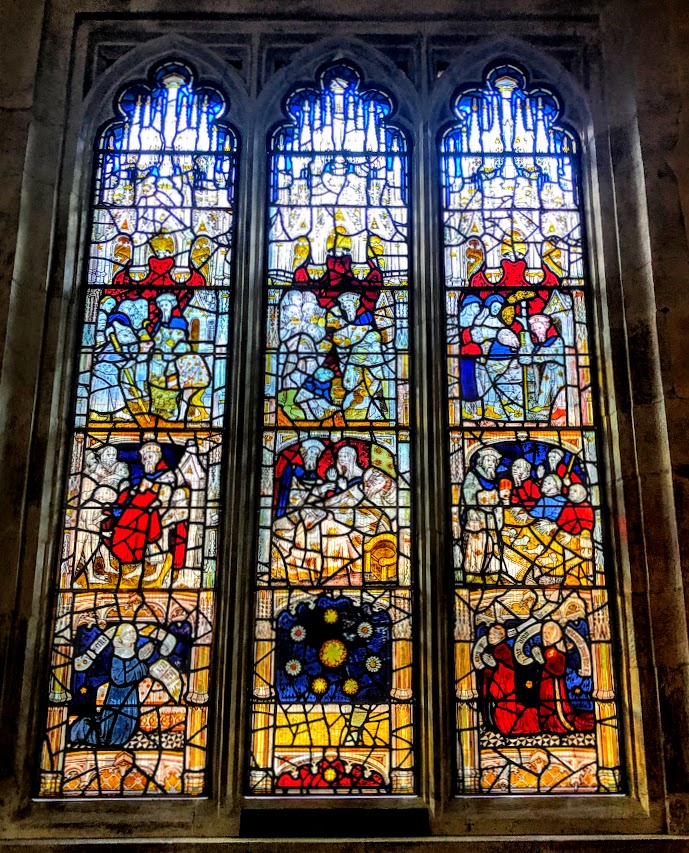
‘Be merciful, just as your Father is merciful’ (Luke 6: 36) … the ‘Corporal Works of Mercy’ window in All Saints’ Church, North Street, York (Photograph: Patrick Comerford)

Luke 6: 27-38 (NRSVA):

[Jesus said:] 27 ‘But I say to you that listen, Love your enemies, do good to those who hate you, 28 bless those who curse you, pray for those who abuse you. 29 If anyone strikes you on the cheek, offer the other also; and from anyone who takes away your coat do not withhold even your shirt. 30 Give to everyone who begs from you; and if anyone takes away your goods, do not ask for them again. 31 Do to others as you would have them do to you.

32 ‘If you love those who love you, what credit is that to you? For even sinners love those who love them. 33 If you do good to those who do good to you, what credit is that to you? For even sinners do the same. 34 If you lend to those from whom you hope to receive, what credit is that to you? Even sinners lend to sinners, to receive as much again. 35 But love your enemies, do good, and lend, expecting nothing in return. Your reward will be great, and you will be children of the Most High; for he is kind to the ungrateful and the wicked. 36 Be merciful, just as your Father is merciful.

37 ‘Do not judge, and you will not be judged; do not condemn, and you will not be condemned. Forgive, and you will be forgiven; 38 give, and it will be given to you. A good measure, pressed down, shaken together, running over, will be put into your lap; for the measure you give will be the measure you get back.’

‘If anyone strikes you on the cheek, offer the other also’ (Luke 6: 29) … street art in Plaza de la Judería in Malaga (Photograph: Patrick Comerford)

Today’s Reflections:

Today’s Gospel reading continues reading from the ‘Sermon on the Level Place’, Saint Luke’s equivalent of the Sermon on the Mount, which we began reading yesterday with Saint Luke’s version of the Beatitudes (Luke 6: 20-26).

After the blessings and woes of the Beatitudes, we read this morning that Jesus tells us as his followers to be merciful as God is merciful. Mercy is one of God’s primary qualities (see Exodus 34: 6-7), and the concept of mercy in Luke 6 has an eschatological frame of reference. God is merciful by offering the possibility of turning away from disobedience through repentance and turning towards him and receiving forgiveness and restoration.

In Mary’s song Magnificat, God is twice identified as merciful (Luke 1: 50, 54). Zechariah too identifies mercy as a sign of God’s faithfulness to God’s promises, creating a people who ‘might serve God without fear in holiness and righteousness’ (Luke 1: 72-78). In today’s reading, Christ shows how to put this mercy into practice.

Luke 6: 27-29 presuppose a situation of conflict, in a time when the religious and political leaders of day were seen by many as their enemies. But Christ calls on us to respond and act in ways that seek the good of the other. This form of nonviolence goes beyond non-retaliation and takes positive steps that promote the welfare of the other parties in the conflict.

Verse 30 presupposes an economic situation in which many people are exploited, live in poverty, and seek to survive by begging. The give to those who beg implies that we have an abundance from which to share (see Luke 6: 39).

Verse 31 repeats the ‘Golden Rule’: ‘Do to others as you would have them do to you.’ But the golden rule is not enough for us, the Children of God (see verse 35) in our covenant relationship with God.

Verses 32-34 challenges the widely accepted notion in the Hellenistic world that relationships are reciprocal, and calls on us to go beyond behaviour is guided merely by the expectation of similar responses.

Verse 35 calls on us to replace old-age pattens of behaviour with ways that reflect the Kingdom of God, and to imitate God who is kind also to the ungrateful and the wicked. To be kind does not mean to approve but means to seek their best interest. Even the ungrateful and the wicked have the potential and the possibility of becoming part of the Kingdom of God.

Verse 36 sums up how to live a life that reflects the Kingdom of God.

Verse 37 is a reminder that we not have the final say ourselves on who is in and who is outside the Kingdom of God. We do not live in the apocalyptic moment, and when he exclude others from the Church we risk finding we have excluded ourselves too.

Verse 38 reminds us that God’s generosity is overflowing and overwhelming and goes beyond any possibility we have of measuring it.

As Shakespeare reminds us, in the words of Portia in The Merchant of Venice,

The quality of mercy is not strained;
It droppeth as the gentle rain from heaven …
(The Merchant of Venice, Act IV, Scene 1).

‘Love your enemies, do good to those who hate you’ (Luke 6: 26) … street art on North Street, Leighton Buzzard (Photograph: Patrick Comerford)

Today’s Prayers (Thursday 10 September 2026):

In Pray with the World Church, the prayer diary of the Anglican mission agency USPG (United Society Partners in the Gospel), the theme this week, from 6-12 September 2026 (pp 36-37), is ‘Turning Pain into Glory’. This theme was introduced on Sunday with a Reflection by Nolene Sheppard, Leader of a Women’s Empowerment Group, Magnificat, and Ukraine Aid Project Support Lead at Saint Thomas à Becket, Hamburg, Germany.

The USPG Prayer Diary today (Thursday 10 September 2026) invites us to pray:

Dear Father, we pray for the refugee women and children supported by the Magnificat group. Grant safety and strength, and may these new friendships be refreshing to their souls.

The Collect of the Day:

Almighty God,
whose only Son has opened for us
a new and living way into your presence:
give us pure hearts and steadfast wills
to worship you in spirit and in truth;
through Jesus Christ your Son our Lord,
who is alive and reigns with you,
in the unity of the Holy Spirit,
one God, now and for ever.

The Post-Communion Prayer:

Lord God, the source of truth and love,
keep us faithful to the apostles’ teaching and fellowship,
united in prayer and the breaking of bread,
and one in joy and simplicity of heart,
in Jesus Christ our Lord.

Additional Collect:

Merciful God:
your Son came to save us
and bore our sins on the cross:
may we trust in your mercy
and know your love,
rejoicing in the righteousness
that is ours through Jesus Christ our Lord.

Yesterday’s reflections

Continued tomorrow

‘A good measure, pressed down, shaken together, running over … the measure you give will be the measure you get back’ (Luke 6: 38) … street art in Dublin (Photograph: Patrick Comerford)

Scripture quotations are from the New Revised Standard Version Bible: Anglicised Edition copyright © 1989, 1995, National Council of the Churches of Christ in the United States of America. Used by permission. All rights reserved worldwide. http://nrsvbibles.org

03 September 2026

A new biography of Patriarch Tikhon – a challenge to religious trends in Russia and the US today

Professor Scott M Kenworthy’s new biography of Patriarch Tikhon … launched in Cambridge this evening

Patrick Comerford

I an sorry to miss this evening’s launch of a new book in Cambridge, The People’s Patriarch: Tikhon Bellavin and the Orthodox Church in North America and Revolutionary Russia by Scott M Kenworthy, and published by Oxford University Press.

The book launch in Wesley House, Cambridge, this evening has been organised by the Institute for Orthodox Christian Studies, where I have been a student on many courses over the years, mainly in Sidney Sussex College.

This is the first scholarly and comprehensive biography of Patriarch Tikhon, and draws on documents from the Soviet leadership and secret police file that were previously inaccessible to researchers. It provides an in-depth account of a crucial period of Orthodox Christianity in North America and of Patriarch Tikhon’s vital contributions to its development. But it is also an important book at this crucial time of dissonate relationship between the Russian Church and the rest of the Orthodox world.

Professor Scott M Kenworthy is Professor of History in the History Department at Miami University, Oxford, Ohio, where he also teaches for the Russian, East European and Eurasian Studies, and Religious Studies programs, and is also Associate Professor of Comparative Religion.

He is the author of the prize-winning book The Heart of Russia: Trinity-Sergius, Monasticism and Society After 1825 and, with Alexander Agadjanian, Understanding World Christianity: Russia. He is a past president of the Association for the Study of Eastern Christianity and has held research fellowships in the US, Germany, Hungary and Romania.

On 28 October 1917, just days after the Bolsheviks seized power, the great Council of the Russian Orthodox Church voted to restore the patriarchate, which had been abolished by Tsar Peter the Great almost two centuries earlier in 1721. The council chose as the new patriarch Patriarch Tikhon (1865-1925), born Vasily Ivanovich Bellavin, the son of a humble village parish priest.

As the Orthodox Bishop of North America (1898-1907), Patriarch Tikhon had already started putting into practice his vision of the Church as an organic body that welcomed the participation of all believers. The Bolsheviks, who had other ideas, aimed to create a revolution that would be carried out by the state on behalf of the people. They sought to eradicate religion as superstition, to disestablish the church and to destroy it altogether.

The alternate Russia that Patriarch Tikhon represented was crushed by the superior force of the Bolsheviks. But he helped to navigate the Church through immense challenges and, in the end, the Orthodox Church outlived the Soviet experiment.

In The People’s Patriarch, Scott Kenworthy tells the story of the clash of visions for the new Russia through the lens of the humble man chosen to lead the Church, whose life exemplifies the transformations within the Orthodox Church in late Imperial Russia and its fate during the Revolution. This the first critical biography of one of the most important Orthodox Christian leaders of the 20th century, based on an exhaustive use of previously untapped primary sources, including Patriarch Tikhon’s letters and encyclicals, previously classified documents from the Bolshevik leadership and Soviet secret police, and material from a dozen archives in five countries.

Patriarch Tikhon has been overlooked by most historians of Russia and the former Soviet Union, who have seen the Russian Orthodox Church as irrelevant within an anti-religious Communist polity. This book tells his story from his humble beginnings in the Pskov province in north-west Russia, to his ordination and consecration, and then his ministry as bishop of a diocese in Poland, where he was Bishop of Lublin.

For almost a decade (1898-1907), he was a bishop in the US, where he came to appreciate democracy, the separation of Church and State, and the vital part played by the laity and parish clergy within the Church. When he was appointed Bishop of the Aleutian Islands and Alaska in 1898, he went to the US where he eventually became a naturalized American citizen. There he visited emerging Orthodox emigrant communities in cities such as New York and Chicago and in coal-mining and steel-making areas in in Pennsylvania and Ohio.

He reorganised the diocese, changed its name to the Diocese of the Aleutian Islands and North America, and he blessed the cornerstone of Saint Nicholas Cathedral, New York, in 1901. He built churches across North America, opened dialogue with Greek Orthodox churches, and took part in the consecration of Reginald Heber Weller as an Anglican bishop in Saint Paul’s Cathedral in the Episcopal Diocese of Fond du Lac, Wisconsin. He returned to Russia in 1907 when he was appointed Bishop of Yaroslavl.

When he was chosen in 1917 as the eleventh Patriarch of Moscow and the first since Peter the Great abolished the patriarchate 200 years earlier, Patriarch Tikhon quoted Ezekiel prophetically: ‘How many tears and groans will I have to swallow.’

After the abdication of the tsar in March 1917, the Russian Church was freed from its subjugation to the State and became once again respected by a large section of the educated population. But the church also faced years of persecution, and lost its legal status and right to own property. Lenin launched a ferocious attack on the church in 1922, and Patriarch Tikhon was imprisoned from May 1922 until June 1923.

Patriarch Tikhon was effectively a prisoner in the Donskoi Monastery and was frequently interrogated in the Lubyanka. But on the occasions when he was allowed to take walks along the monastery walls, crowds would regularly gather below the walls to receive his blessing.

Thanks to changes in the regime and to support from abroad, particularly from Britain, Patriarch Tikhon was not put on trial or executed. On 13 April 1923, the Archbishop Randall Davidson of Canterbury and other British religious leaders, including the Chief Rabbi, issued a statement condemning religious persecution in the Soviet Union.

The British Foreign Secretary issued an ultimatum to the Soviet government on 8 May 1923, condemning ‘the definite object of destroying all religion in Russia’ and threatening to break off relations. The Soviet leadership was desperate to preserve the 1921 Anglo-Soviet Trade Treaty and to maintain good relations with Britain.

When Patriarch Tikhon died on 12 April 1925, between 30,000 and 40,000 attended his funeral in the Donskoi Monastery, many more than attended Lenin’s funeral the previous year.

Patriarch Tikhon defies definition, challengec the capitulation of many Christian leaders to the Trump regime in the US, and stands in sharp contrast to Patriarch Kirill of Moscow

Patriarch Tikhon defies definition as either a dissident or a collaborator. He endeavoured to preserve the Russian Orthodox Church while he tried to remain apolitical, and he criticised the Communist regime without opposing it.

He is a challenge to the capitulation of many Christian leaders to the Trump regime in the US. During his time as a bishop in the US, he came to appreciate democracy, plurality and diversity, and the separation of Church and State.

He also stands in sharp contrast to the present head of the Russian Orthodox Church, Patriarch Kirill of Moscow, with his intimate relationship with the Putin regime, his autocratic approach to church leadership, and his persistent attempts to sow divisions within the Orthodox churches.

The Orthodox Public Affairs Committee (OPAC) said earlier this week: ‘Rather than serving as a prophetic voice for peace, reconciliation, and the sanctity of every human life, Patriarch Kirill has repeatedly offered religious justification for Russia’s unprovoked war of aggression against Ukraine. He has portrayed the invasion as a sacred struggle, blessed those waging war, and increasingly intertwined the mission of the Russian Orthodox Church with the geopolitical ambitions of the Kremlin.’

Patriarch Kirill’s recent statements are disturbing and troubling. He has described Russia’s nuclear arsenal as a manifestation of God's ‘grace and mercy’ and he has claimed that the creation of the Soviet atomic bomb came about through divine providence and the prayers of Saint Seraphim of Sarov (1754-1833), a Russian saint known for his life of contemplation and kindness.

His invocation of one of Orthodoxy’s most beloved saints in defence of nuclear weapons that are capable of unimaginable destruction is a profound distortion of the Christian faith. The Gospel proclaims peace, reconciliation, and the sacred dignity of every human person and must never be used to sanctify war, imperial conquest, or nuclear intimidation.

For more than four years, the Ukrainian people have endured the horrors of an unprovoked war with extraordinary courage, resilience, and unwavering faith. Families have been torn apart, cities have been reduced to rubble, and countless innocent lives have been changed forever.

In response, the Saint Nicholas National Shrine recently presented its Beacon of Hope Award to President Volodymyr Zelenskyy and the people of Ukraine, recognising their courage, sacrifice, and resilience.

The National Shrine of Saint Nicholas was established to bear witness to the Light of Christ in the midst of darkness. It stands at the World Trade Centre as a place of prayer, remembrance and healing, and a reminder that evil and hatred will never have the final word. The US is about to mark the 25th anniversary of the ‘9/11’ attacks on 11 September 2001, the shrine is a ‘beacon of hope’ to all who suffer from violence, war, terrorism, and despair.

The shrine’s decision to honour President Zelenskyy and the people of Ukraine has been criticised by Patriarch Kirill’s apologists, who have claimed that Ukraine is persecuting Christianity and ‘shutting down churches’.

Saint Nicholas National Shrine was consecrated in memory of lives lost to terrorism 25 years ago, and remains a reminder to the world, like Patriarch Tikhon, that the Light of Christ continues to shine in the darkness, and the darkness shall never overcome it.

The Institute for Orthodox Christian Studies is on Jesus Lane, Cambridge, beside Jesus College and Wesley House and across the street from Westcott House and Sidney Sussex College (Photograph: Patrick Comerford)

23 August 2026

Saint Athanasius III of
Rethymnon and stories
of Byzantine intrigues,
murders and persecution

An icon Saint Athanasius Patellarios of Rethymnon, Patriarch of Constantinople, completed by Alexandra Kaouki in 2011 (icon © Alexandra Kaouki)

Patrick Comerford

Saint Athanasius was a 17th century saint who was born in Rethymnon and who was twice Patriarch of Constantinople on two brief occasions, in 1634 and 1652. His story is entwined and entangled with Ottoman intrigue, that saw patriarchs removed, returned, deposed, exiled and even strangled at the whim of capricious sultans. Many Patriarchs held office for a few days and no more, while others returned to the throne, two, three, four and five times, and in one case six times.

I was reminded on Friday of these intrigues and the persecutions and traumas that faced the church in Orthodox Church over the centuries after my friend Alexandra Kaouki (Αλεξανδρα Καουκι), the foremost icon writer in Rethymnon, posted an icon she had completed in 2011 of Saint Athanasius.

Saint Athanasius Patellarios ((Άγιος Αθανάσιος ο Πατελάρος), commonly known as Saint Athanasius of Lubny or the Wonderworker, was the Ecumenical Patriarch of Constantinople for two brief periods, in 1634 and again in 1652, and had also been the Metropolitan of Thessaloniki.

He was born Ἀλέξιος Πατελλάριος (Alexios Patellarios) ca in 1597 in the village of Axos, in the hills above Panormos, east of Rethymnon, when Crete was under Venetian rule. His ancestors were Greek noble family with ancestry dating back to the Byzantine imperial house of Palaiologos. His father Georgios was a scientist and publisher, and his elder brother Eustaphios became a physician.

Saint Athanasius studied at Arkadi Monastery, near Rethymnon and his home village of Axos (Photograph: Patrick Comerford)

He studied at Arkadi Monastery, near Rethymnon, where his studies included studied rhetoric, grammar and poetry, mathematics and astronomy, music and literature, theology and philosophy, sciences and languages (Greek, Latin, Italian, Arabic and Hebrew). He lived at Arkadi until he was 26 and then, after his parents died, he shared his property among the poor and with the name Ananias was became a novice in a monastery in Thessaloniki.

From Thessaloniki, he moved to the Monastery of Esphigmenou on Mount Athos, then travelled on to monasteries in Jerusalem, Palestine and Mount Sinai, and was tonsured with the name Athanasius.

When he returned to Thessaloniki he was ordained priest and worked as a missionary among the Vlachs and the Moldovians. At times, he returned to Mount Athos in search of solitude.

His work drew him to the attention of the controversial Patriarch Cyril I (Lukaris) of Constantinople (1621-1623), who appointed him a preacher of the patriarchal throne. He became the Metropolitan of Thessaloniki in 1622, and remained there as bishop until 1634 when he was chosen as the Ecumenical Patriarch in controversial circumstances.

The Church of Saint Gregory Palamas has been the cathedral of Thessaloniki since the end of the 16th century … Saint Athansius became the Metropolitan of Thessaloniki in 1622 (Photograph: Patrick Comerford)

Cyril I, who was also from Crete, was a controversial patriarch, known for his supposed attempts to reform the Eastern Orthodox Church along Calvinist lines, although those attempts were rejected and his actions, motivations and opinions are still debated.

Cyril I, who had been the Patriarch of Alexandria as Cyril III, was the Ecumenical Patriarch of Constantinople on six occasions, constantly deposed, banished or forced to resign several times at the instigation of both his Orthodox opponents and the French and Austrian ambassadors. He was the Patriarch for 21 days in October 1612; for 29 months from 4 November 1620 to 12 April 1623; for about 10 years from 22 September 1623 to 4 October 1633; for 4½ months from 11 October 1633 to 25 February 1634; for 11 months from April 1634 to March 1635; and, finally, for 15 months from March 1637 to 20 June 1638.

When Cyril I was deposed for a fourth time in 1634, he was succeeded by Saint Athanasius, who lasted as Patriarch for little more than month, and Cyril returned to the patriarchal throne for a fifth time.

Cyril Lucaris was born in Candia, present-day Iraklion, in Crete in 1572, and travelled throughout Europe, studying theology in Venice, Wittenberg and Padua, and in Geneva, where he was influenced by Calvinism and Reformed theology and developed great antipathy for Roman Catholicism. During that time, he may also have been the Rector of Ostroh Academy, in present-day Ukraine. In 1596 he was sent to Poland by Patriarch Meletius I of Constantinople to lead Orthodox opposition to the Union of Brest, a proposed union of Kiev with Rome.

He became the Patriarch of Alexandria at the age of 29 in 1601. Apart from his first brief time as Patriarch of Constantinople in 1612, he remained in Alexandria for 20 years until he became the Patriarch of Constantinople for the second time.

As Patriarch, Cyril I adopted a theology that was heavily influenced by Reformation theology. Faced with Turkish oppression on the one hand, and on the other by Jesuit missionaries working among Orthodox people, he recognised the need for schools teaching Orthodoxy and the Greek language, and founded a theological seminary on Mount Athos and a Greek printing press in Constantinople. However, the French government protested when the press began publishing anti-Catholic pamphlets and the Ottoman authorities forced it to close.

In his efforts to reform the Eastern Orthodox Church along Calvinist lines, Cyril I sent young Greek theologians to study in Switzerland, the Netherlands and England. He was particularly interested in the Church of England, corresponded with William Laud, Archbishop of Canterbury, and sent Metrophanes Kritopoulos, a future Patriarch of Alexandria (1636-1639), to study at Balliol College, Oxford.

His Confessio or the Eastern Confession of the Christian Faith, was published in Geneva in two Latin editions In 1629, with four French, one German and one English edition, and a Greek edition in 1633.

Saint Athansios moved to the Monastery of Esphigmenou on Mount Athos at an early stage in his life (Photograph: Patrick Comerford)

Cyril I was deposed by the sultan for a fourth time on 25 February 1634, and was imprisoned on the island of Tenedos. He was succeeded by Athanasius III, who assumed the Patriarchal throne on the Feast of the Annunciation, 25 March 1634. But he was Patriarch only for less than 40 days until April 1634, and he was deposed in intrigues that brought Cyril I back to the throne.

After he was deposed, Saint Athanasius was exiled to the island of Rhodes. He then lived in solitude on Mount Athos for over a year, fasting and praying at a that later became the Skete of the Prophet Elijah, near the Pantocrator Monastery.

For a time, Saint Athanasius lived in Ancona and Venice in Italy, where the Pope tried him to induce him to become a Catholic, promising to make him a cardinal.

Meanwhile, Cyril I, who had returned to Constantinople and replaced Athanasius as Patriarch, remained in office for only 11 months, and was deposed yet again in March 1635. Cyril returned as patriarch for his sixth and final time in March 1637 but was deposed on 20 June 1638. When Sultan Murad IV was to setting out for the Persian War, the Patriarch was accused of a design to stir up the Cossacks. To avoid trouble during his absence, the Sultan had him strangled by the Janissaries on 27 June 1638 aboard a ship in the Bosporus, and his body was thrown into the sea. The Council of Constantinople in September 1638 anathematised both Cyril I and his Eastern Confession.

Meanwhile Athanasius became Bishop of Thessaloniki once again in 1638. Because of a problem with paying metropolitan taxes, he was imprisoned and but was released through the intercession of Tsar Mikhail Romanov.

Athanasius was invited to Moscow in 1643, but on the way he fell ill in Moldova. He stayed there and founded there the monastery of Saint Nicholas near Galaţi, where he remained until 1651, returning often to Mount Athos where he hoped to spend his last days.

However, at the beginning of 1651 he returned to Constantinople. When Patriarch Cyril III was deposed in June 1652 after eight days, Athanasius was called back as Patriarch and was enthroned once again on 25 May was again enthroned. But on this occasions he remained patriarch for only 15 days. He found he was not acceptable to either the Muslims or the Catholics in the city, and in his sermon at his final Patriarchal service he denounced papal claims to universal jurisdiction over the whole Church.

After two weeks, he stepped down as Patriarch of Constantinople in favour of Metropolitan Paisius of Laureia, who remained in office as Patriarch Paisius I for only nine months, from July 1652 to April 1653.

After he was deposed a second time, Athanasius returned to Thessaloniki once again and renewed his connections with Mount Athos, expressing the hope that he could live out his life there.

Saint Athanasius visited Russia in April 1653, and he was met with honour in Moscow by Tsar Alexis Mikhailovich and Patriarch Nikon (1652-1658) who donated generously to his monastery. He left to return to Galaţi in December 1653, but on the journey he fell ill and stayed at the Monastery of Transfiguration Mhar near Lubny in Ukraine in February 1654. When he died on 5 April at the Mhar Monastery, Abbot Petronios and the monks buried the former patriarch in a sitting position, according to the Greek custom for a bishop.

Saint Athanasius was recognised as a saint by the Russian Church on 1 February 1662 and his feast day was 2 May, the feast of Saint Athanasius the Great. His relics were later moved to Cathedral of the Annunciation in Kharkiv in Ukraine. Today the Mhar Monastery is part of the Ukrainian Orthodox Church, affiliated to the Moscow Patriarchate, while the Annunciation Cathedral is the main Orthodox church of Kharkiv and the seat of the Kharkiv and Bohodukhiv Eparchy of the Ukrainian Orthodox Church (Moscow Patriarchate).

A part of the saint’s relics, said to be a fragment of a finger, was brought to his home village of Axos near Rethymnon in 1993, and is kept in the Church of the Saint Athanasius Patellarios, built in 2008. The day the relic was moved, 21 August, is kept as his feast day in Crete. Alexandra Kaouki shared her icon of Saint Athanasius last Friday (21 August) to mark that feast day in Crete.

As for Cyril I – the controversial patriarch whose career is intertwined with the life story of Saint Athanasius – his body was recovered from the Bosphorus and was buried in Nicomedia, and after many years was brought back to Constantinople. He has been reappraised in recent decades, and the overwhelming majority of Greek and Russian Orthodox scholars today deny the authenticity of the Eastern Confession. This recent rehabilitation has led to the canonisation of Cyril I by the Greek Orthodox Patriarchate of Alexandria in 2009 and by the Ecumenical Patriarch of Constantinople in 2022.

The Church of the Four Martyrs in Rethymnon (Photograph: Patrick Comerford)

There is widening chasm between the Ecumenical Patriarchate and the Church of Russia today, and it is in danger of becoming a real schism. On the surface, these problems centre around the attitude of the two churches to the competing claims of Orthodox churches in Ukraine at a time of war in Ukraine. But at its heart this is a deeper conflict about the attitude of the Patriarchate of Moscow towards the Ecumenical Patriarchate.

Moscow has refused to take part in many Pan-Orthodox initiatives, including the synod in Kolymbari in Crete ten years ago (19-26 June 2016) and has since continued to undermine the Ecumenical Patriarchate in intrigues and conflicts that have drawn in other Orthodox churches, including those in Greece, Romania and Alexandria.

An example of how divisions within Orthodoxy have been exploited by the Patriarchate of Moscow has been seen in recent days with the visit to Moscow by Metropolitan Nektarios of Corfu with relics of Saint Spyridon. The bishop’s decision to concelebrate with Patriarch Kirill of Moscow has caused controversy within the Orthodox Church of Greece, with church circles in Greece describing the visit as a ‘coup’ and questioning why the bishop celebrated with a patriarch who does not commemorate Archbishop Ieronymos of Athens, the head of the Church of Greece.

The Moscow Patriarchate suspended Eucharistic communion with the Church of Greece in October 2019 after the Church of Greece recognised the autocephalous Orthodox Church of Ukraine. Metropolitan has been criticised for praising and presenting honours and medals to Patriarch Kirill who supports Russia’s war in Ukraine. There are in Greece that visit is being exploited by Moscow for its own purposes.

The life of Saint Athanasius is a reminder that there is nothing new in these conflicts and intrigues and that they stretch back many centuries. But there is also a reminder in the story of this one saint from Rethymnon of the thread that links together all these churches, including Constantinople, Greece, Crete, Alexandria, Romania, Ukraine and Russia.

The Cathedral of the Presentation of the Theotokos in Rethymnon … Saint Athanasius is commemorated in Crete on 21 August (Photograph: Patrick Comerford)

16 July 2026

44 million people in Ukraine,
44 million sq km in Asia,
44 million watching football,
and 44 million blog readers

Inside the Forbidden City in Beijing … Asia covers about 44 million sq km … and this blog has had 44 million hits (Photograph: Patrick Comerford)

Patrick Comerford

I keep saying it, but it remains true: I continue to be overwhelmed by the viewing and reading figures for this blog. These figures reached 44 million early this morning (16 July 2026), having reached 43 million 12 days earlier (4 July 2026), 42 million 10 days previously (24 June 2026), 41 million mark two weeks before that (9 June 2026), and 40 million at the end of May (28 May 2026).

These viewing and reading figures are overwhelming and this blog continues to reach a volume of readers I never expected when I first started blogging 16 years ago. At the end of last year, this blog had 21 million hits (31 December 2025). So far this year, there have been more than 23 million hits or visitors in 2026 alone, and about 1.4 million hits half-way into July.

Half of all hits or reader figures have been within the past six months, with 22 million hits since 20 January 2026. I first began blogging back in 2010, and it took almost two years until July 2012 to reach half a million readers. Throughout this year and last, the daily figures continue to be overwhelming on many occasions. Of the ten days of busiest traffic on this blog, three were in May (1, 6 and 14 May 2026), three were the previous month (26, 29 and 30 April 2026), three in March, and one in February:

• 1,124,925 (1 May 2026)
• 525,719 (14 May 2026)
• 509,644 (29 April 2026)
• 344,003 (30 April 2026)
• 323,156 (27 March 2026)

• 322,038 (26 April 2026)
• 318,835 (6 May 2026)
• 318,307 (1 March 2026)
• 314,018 (28 February 2026)
• 301,449 (2 March 2026)

The daily average was over 187,000 throughout May, but that figure was distorted by the exceptionally high number of hits on three days. There were about 71,000 hits a day last month, and an average of about 90,000 a day so far this month. Yet, ten years ago, in 2016, the daily average was around 1,000.

Ukraine had an estimated population of 44 million before Russia’s invasion … Ukrainian refugees celebrating Christmas in central Budapest (Photograph: Patrick Comerford)

To put this latest figure of 44 million into perspective:

Elon Musk gave about $44 million to his pro-Trump spending group in two weeks in October 2024 alone. I closed my ‘X’ account a long, long time ago.

A question on a mural in central Kyiv asks: ‘What is cooler than a family of 44 million?’ Ukraine had an estimated population of 44 million people before Russia’s full-scale invasion. Today, the population of Ukraine is estimated at 37.7 million.

Asia covers an area of more than 44 million sq km, about 30% of Earth’s total land area and 8% of Earth’s total surface area. It is the largest continent in the world by both land area and population.

The England-Mexico World Cup match last week was watched by 44 million people.

After the heatwaves that have left Europe simmering in recent weeks, 44 million people across the United States have been under heatwave warnings since Saturday, with temperatures in the Rocky Mountains and northern plains reaching 43C at the weekend.

A global report on teachers published by Unesco last year shows an urgent need for 44 million primary and secondary teachers worldwide by 2030.

A new Freedom of Information (FOI) request finds that health and safety violations cost British employers over £44 million per year.

The Nationwide Building Society was fined £44 million last December by the Financial Conduct Authority (FCA), the City watchdog, for inadequate anti-financial crime systems and controls between October 2016 and July 2021. The ‘weak’ financial crime controls resulted in a serious case of Covid fraud that cost UK taxpayers £800,000. The FCA said Nationwide had been aware that some customers were using personal accounts for business activity, in a breach of its own terms.

An estimated 44 million people in the UK caught COVID-19 between April 2020 and February 2022.

It is said 6 per cent of Europeans – young and old, men and women – admit they have no one to talk to about their problems. It is not a personal failure, there are 44 million lonely people across Europe today.

The print edition of the Encyclopaedia Britannica had roughly 44 million words in 32 volumes and 33,000 pages. Reading the entire text is an immense challenge, and the author AJ Jacobs spent an entire year reading it cover-to-cover to write his book The Know-It-All (2004).

44 million minutes is equal to about 83 years, 7 months and 27 days. In other words, if this blog was getting only one hit a minute, it would take almost 84 years, from November 1942, to reach this morning’s figure of 44 million.

I retired from active parish ministry over four years ago, on 30 March 2022. These days, though, about 150 people on average are reading my daily prayer diary posted on this blog each morning. I imagine many of my priest-colleagues would be prayerfully thankful if the congregations in their churches totalled 1,000 or more people each week.

This evening, I am truly grateful to the real readers among those 44 million hits on this blog to date, and in particular I am thankful for the faithful core group of 150 or so people who join me in prayer, reading and reflections each morning.

AJ Jacobs spent a year reading all 44 million words in the ‘Encyclopaedia Britannica’ and reading all 32 volumes cover-to-cover to write his book ‘The Know-It-All’

25 June 2026

42 million blog readers and
why 42 is the ‘Answer to
the Ultimate Question of Life,
the Universe and Everything’

Title 42, from John Vernon Lord’s sketchbook

Patrick Comerford

I continue to be overwhelmed by the viewing and reading figures for this blog, although the figures have slowed down this month after record-breaking and overpowering statistics last month. These figures passed 42 million late yesterday afternoon (24 June 2026), having passed the 41 million mark two weeks earlier (9 June 2026), the 40 million mark at the end of last month (28 May 2026) and 39 million a week earlier (22 May 2026). These figures passed the million mark six times last month (May 2026) and four times the month before (April 2026).

These viewing and reading figures are overwhelming and this blog continues to reach a volume of readers that I never have expected when I first started blogging 16 years ago. At the end of last year, this blog had 21 million hits (31 December 2025). So far this year, there have been more than 21 million hits or visitors in 2026 alone.

The total number of hits last month was the highest ever, with over 5.8 million hits in May 2026, compared with previous one-month highs in March 2026 (over 4.5 million) and April (almost 4.4 million). May’s figure of over 5.8 million was astonishing, considering it took almost 11 years, from July 2010 until 27 March 2021, to reach what I then thought was the staggering figure of 5 million hits.

I first began blogging back in 2010, and it took almost two years until July 2012 to reach half a million readers. Throughout this year and last, the daily figures continue to be overwhelming on many occasions. Of the ten days of busiest traffic on this blog, three were last month (1, 6 and 14 May 2026), three were the previous month (26, 29 and 30 April 2026), three were in March, and one was in February:

• 1,124,925 (1 May 2026)
• 525,719 (14 May 2026)
• 509,644 (29 April 2026)
• 344,003 (30 April 2026)
• 323,156 (27 March 2026)

• 322,038 (26 April 2026)
• 318,835 (6 May 2026)
• 318,307 (1 March 2026)
• 314,018 (28 February 2026)
• 301,449 (2 March 2026)

The daily average was over 187,000 throughout May, but that figure was distorted by the exceptionally high number of hits on three days. There were about 145,000 or more hits a day last month, but they are about 60,000-70,000 a day in June, with over 1.6 million hits in June so far. Yet, ten years ago, in 2016, the daily average was around 1,000.

The London Marathon in 2024 raised £42 million exclusively through the JustGiving platform

To put this latest figure of 42 million into perspective:

Jakarta is the world's most populous city, with an estimated population of almost 42 million residents. The Indonesian capital city has officially surpassed Tokyo to become the world's largest megacity, according to the UN World Urbanisation Prospects report.

The UN High Commissioner for Refugees has called on the international community to strengthen support for the nearly 42 million refugees worldwide who have fled their homes to escape conflict, violence or persecution.

An estimated 42 million people across six IGAD member states – Djibouti, Kenya, Somalia, South Sudan, the Sudan and Uganda – face high levels of acute hunger.

In the US, 42 million people rely on Supplemental Nutritional Assistance Program (SNAP) or food stamps to put food on the table. They include 16 million children, 8 million people over the age of 60, and million veterans.

The French data protection authority (CNIL) fined the telecoms provider Free Mobile €42 million for GDPR and data breach failings.

The UK Financial Conduct Authority (FCA) fined Barclays Bank £42 million due to historical lax management of financial crime risks.

A record-breaking £42 million was raised exclusively through the JustGiving platform during the London Marathon in 2024.

The World Health Organization (WHO) launched an appeal for $42 million to sustain essential health services and trauma care across Ukraine.

But, instead, let’s just humour ourselves with the figure 42 instead for a few moments.

In The Hitchhiker’s Guide to the Galaxy by Douglas Adams, the number 42 is the ‘Answer to the Ultimate Question of Life, the Universe, and Everything’, calculated by an enormous supercomputer named Deep Thought over a period of 7.5 million years. Unfortunately, no one knows what the question is. Thus, to calculate the Ultimate Question, a special computer the size of a small planet was built from organic components and named ‘Earth’.

The Ultimate Question, ‘What do you get when you multiply six by nine’, is found by Arthur Dent and Ford Prefect in the second book of the series, The Restaurant at the End of the Universe. This appeared first in the radio play and later in the book versions of The Hitchhiker’s Guide to the Galaxy. It has been pointed out that 6 X 9 = 42 is in fact true … in base 13. That’s because 54=4*13+2 while ‘forty-two’ is 4*10+2. However, Adams claims not to have known that when he wrote it.

The fourth book in the series, the novel So Long, and Thanks for All the Fish, has 42 chapters. According to the novel Mostly Harmless, 42 is the street address of Stavromula Beta.

In 1994, Adams created the 42 Puzzle, a game based on the number 42. There is some speculation that he chose the number 42 because it is also significant in Lewis Carrol’s Hunting of the Snark. But Adams says he picked the number simply as a joke, with no deeper meaning.

Lewis Carroll had famously recurring numbers in his works. He used Rule 42 in both Alice’s Adventures in Wonderland and the introduction to The Hunting of the Snark, and Snark had a reference to the Baker having 42 boxes of clothes packed. Lewis Carroll was 42 when he wrote Snark, there are 42 illustrations in Wonderland and in Wonderland the King of Hearts announces in court: ‘Rule Forty-two. All persons more than a mile high to leave the court’.

Carroll lived in room number six, accessible through the seventh stairs in Christ Church, Oxford.

The number 42 also appears in James Joyce’s Finnegans Wake – as ‘fortytwo hairs off his uncrown’ and ‘as a taste for storik’s fortytooth’.

As for 42 million, 42 million minutes add up to approximately 79 years, 10 months and 7 days, using standard calendar averages. In other words, if this blog was getting only one hit a minute, it would take almost 80 years, from July or August 1946, to reach today’s figure of 42 million.

I retired from active parish ministry over four years ago, on 30 March 2022. These days, though, about 100-120 people on average continue to read my daily prayer diary on this blog each morning. I imagine many of my priest-colleagues would be prayerfully thankful if the congregations in their churches totalled 700 to 840 or more people each week.

This evening, I am truly grateful to the real readers among those 42 million hits on this blog to date, and in particular I am thankful for the faithful core group of 100-120 people who join me in prayer, reading and reflections each morning.


08 June 2026

Daily prayer in Ordinary Time 2026:
32, Monday 8 June 2026

The Berliner Dom in Berlin, popularly known as Berlin Cathedral … the images inside the dome illustrate the Beatitudes (Photograph: Patrick Comerford)

Patrick Comerford

We are in Ordinary Time in the Church Calendar, and yesterday was the First Sunday after Trinity (Trinity I, 7 June 2026). The calendar of the Church of England in Common Worship today recalls Thomas Ken (1637-1711), Bishop of Bath and Wells, Nonjuror, Hymn Writer.

Before today begins, I am taking some quiet time this morning to give thanks, to reflect, to pray and to read in these ways:

1, reading today’s Gospel reading;

2, a short reflection;

3, a prayer from the USPG prayer diary;

4, the Collects and Post-Communion prayer of the day.

‘Blessed are those who mourn, for they will be comforted’ (Matthew 5: 4) … a child’s painting in Ukrainian Space in Budapest (Photograph: Patrick Comerford)

Matthew 5: 1-12 (NRSVA):

1 When Jesus saw the crowds, he went up the mountain; and after he sat down, his disciples came to him. 2 Then he began to speak, and taught them, saying:

3 ‘Blessed are the poor in spirit, for theirs is the kingdom of heaven.

4 ‘Blessed are those who mourn, for they will be comforted.

5 ‘Blessed are the meek, for they will inherit the earth.

6 ‘Blessed are those who hunger and thirst for righteousness, for they will be filled.

7 ‘Blessed are the merciful, for they will receive mercy.

8 ‘Blessed are the pure in heart, for they will see God.

9 ‘Blessed are the peacemakers, for they will be called children of God.

10 ‘Blessed are those who are persecuted for righteousness’ sake, for theirs is the kingdom of heaven.

11 ‘Blessed are you when people revile you and persecute you and utter all kinds of evil against you falsely on my account. 12 Rejoice and be glad, for your reward is great in heaven, for in the same way they persecuted the prophets who were before you.

12 ‘Rejoice and be glad, for your reward is great in heaven, for in the same way they persecuted the prophets who were before you.’

‘Blessed are those who mourn, for they will be comforted’ (Matthew 5: 4) … ‘Divine Teardrop’ by Peter Cassidy in an exhibition in Wexford in 2016 (Photograph: Patrick Comerford)

Today’s Reflection:

The Gospel reading at the Eucharist today (Matthew 5: 1-12) begins a series of weekday readings from the Sermon on the Mount, beginning with the Beatitudes. The scene opens with Christ leaving the crowds and climbing up the mountain, like Moses in the Book Exodus leaving the crowd behind him, and climbing Mount Sinai. In the Sermon on the Mount in Chapters 5 to 7, Saint Matthew presents us with a covenant renewal document.

The Beatitudes are a declaration of the happy or fortunate state of the children of God who possesses particular qualities, and who, because of them, will inherit divine blessings.

It is interesting to compare the delivery of the Beatitudes to the delivery of the Ten Commandments. Here we have the renewal of the covenant, and a restatement, a re-presentation, of who the Children of God are.

Just as we sometimes find the Ten Commandments grouped into two sets, so we might see the Beatitudes set out in two groups of four, the first four being inward looking, the second four being outward looking.

We might see the first four Beatitudes as addressing attitudes, while the second four deal with resulting actions.

Are they ethical requirements for the present?

Or are they eschatological blessings for the future?

Or are they are statements of present fact, identifying the qualities of a child of God and the consequent blessings that follow?

Few of us, I imagine, are ever going to commit murder.

But we all get ‘angry with a brother’ sooner or later.

The Sermon on the Mount exposes our own present reality in a very stark and real way, and the Beatitudes are a core text for Dietrich Bonhoeffer in The Cost of Discipleship and in the writings of towering Christian figures such as Dorothy Day, Martin Luther King, Thomas Merton and Oscar Romero.

Father Brian D’Arcy once recalled during a radio interview how Dorothy Day once spoke of how her fellow Roman Catholics went to confession regularly and confessed to ‘breaking’ one of the Ten Commandments, but she wondered how often they confessed to ‘breaking’ one of the Eight Beatitudes.

Μακάριοι (Makárioi): Does this mean ‘blessed’? Archbishop Makarios was the President of Cyprus in 1974 when he was deposed in a coup that was followed by the Turkish invasion of the island. ‘His Beatitude’ is a term of respect for archbishops and metropolitans in the Orthodox Church.

The word ‘blessed’ is not the best translation for μακάριος (makários). ‘Fortunate,’ ‘well off,’ or ‘happy’ might fit better.

Christ is telling those who hear him that they are fortunate to be this way. They are fortunate to possess these qualities of life. Why? Because it means they inherit the blessings or fortunes of God’s promised kingdom.

The Beatitudes are culturally embedded in our society, in our literature, in our arts. They are so familiar that we all understand the irreverent humour found in a scene in Monty Python’s The Life of Brian.

‘Blessed are the Meek’ – which means the humble, patient, submissive and gentle – is misheard in The Life of Brian as: ‘Blessed is the Greek – apparently he’s going to inherit the earth.’ When they finally get what Jesus actually says, a woman says, ‘Oh it’s the Meek … blessed are the Meek! That’s nice, I’m glad they’re getting something, ’cause they have a hell of a time.’

The political activist and agitator Reg then says: ‘What Jesus blatantly fails to appreciate is that it’s the meek who are the problem.’ This sums up the growing annoyance of the violent with the peaceful attitude of Christ. But it also highlights that the Beatitudes are about ordinary, everyday people.

Too often we see the saints celebrated by the Church as martyrs and apostles, missionaries and hermits, bishops and theologians. How often do we see them as ordinary, meek, everyday people, the people who too often are dismissed as problems, who are living with problems, who often go without attention from politicians and activists alike?

The mother and child separated at birth in the ‘mother and baby’ home and blocked at every stage as they tried to find each other.

The middle-aged mother who hopes that life is going to get better as the years move on, but then finds instead every waking hour is devoted to an adult child with special needs, or to an elderly parent who now needs to be looked after like a child.

The couple filled with faith but afraid to come to church, marginalised because of their colour, class, language, marital status or sexuality.

The lone protester who stands outside a government office or embassy, ignored by those inside and berated outside by passing, hooting motorists, but who knows right is on her side … ‘Blessed are those who hunger and thirst for righteousness.’

If the Church is a sign of the Kingdom of God, a foretaste of that heavenly liturgy, how does our life as the Church, in the parish and in the diocese, offer solace, comfort, a foretaste, hope for the meek, the downtrodden, the lonely, the oppressed, who are praised in the Beatitudes and who are invited as part of the great multitude, the countless number from every nation, tribe, people and language, to gather before the Lamb on the throne?

‘Blessed are the poor in spirit … those who mourn … the meek … those who hunger and thirst …’

May theirs be the kingdom of heaven, may they be comforted, may they inherit the earth, may they be filled.

‘Blessed are the merciful … the pure in heart … the peacemakers … those who are persecuted for righteousness’ sake …’

May we be generous in showing mercy, may we see God, be called children of God, find ourselves in the kingdom of heaven.

Blessed are we even when others revile us for standing up for these values … when we stand up for those values, may we rejoice and be glad.

Writing on the Financial pages of The Guardian many years ago (17 January 2011), Terry Macalister wrote: ‘From Tolstoy to Dostoevsky to Chekov, if anyone can tell a good story it’s the Russians.’ Well, in Chapter 2 of Boris Pasternak’s great Russian novel Doctor Zhivago, we meet Larissa Feodorovna Guishar, who ‘was not religious’ and ‘did not believe in ritual,’ but was startled by the Beatitudes, for she thought they were about herself.

How do we apply the Beatitudes to ourselves, to our own lives?

The reredos in the Unitarian Church, Dublin, is inscribed with the Beatitudes, one on each panel (Photograph: Patrick Comerford)

Today’s Prayers (Monday 8 June 2026):

In Pray with the World Church, the prayer diary of the Anglican mission agency USPG (United Society Partners in the Gospel), the theme this week, from 7 to 13 June 2026 (pp 8-9), is ‘Safe Churches in Zambia’. This theme was introduced yesterday with a programme update from Fran Mate, Senior Regional Manager for Africa, USPG.

The USPG prayer diary today (Monday 8 June 2026) invites us to pray:

Lord of love, thank you for the challenge that ‘documents alone will not keep people safe.’ Stir clergy and congregants alike with courage to act, wisdom to protect, and compassion to care.

The Collect:

O God, from whom all blessings flow,
by whose providence we are kept
and by whose grace we are directed:
help us, through the example of your servant Thomas Ken,
faithfully to keep your word,
humbly to accept adversity
and steadfastly to worship you;
through Jesus Christ your Son our Lord,
who is alive and reigns with you,
in the unity of the Holy Spirit,
one God, now and for ever.

The Post-Communion Prayer:

God, shepherd of your people,
whose servant Thomas Ken revealed the loving service of Christ
in his ministry as a pastor of your people:
by this eucharist in which we share
awaken within us the love of Christ
and keep us faithful to our Christian calling;
through him who laid down his life for us,
but is alive and reigns with you, now and for ever.

Yesterday’s Reflections

Continued Tomorrow

‘Blessed are the pure in heart, for they shall see God’ (Matthew 5: 8) … a window in Saint Mary’s Collegiate Church, Youghal, Co Cork (Photograph: Patrick Comerford)

Scripture quotations are from the New Revised Standard Version Bible: Anglicised Edition copyright © 1989, 1995 National Council of the Churches of Christ in the United States of America. Used by permission. All rights reserved worldwide. http://nrsvbibles.org

24 May 2026

Daily prayer in Easter 2026:
50, Sunday 24 May 2026,
Day of Pentecost (Whit Sunday)

The Day of Pentecost depicted in a fresco in the Church of the Transfiguration in Piskopiano in Crete (Photograph: Patrick Comerford)

Patrick Comerford

Easter is a 50-day season, beginning on Easter Day (5 April 2026) and continuing through Ascension Day until today, the Day of Pentecost or Whit Sunday (24 May 2026).

Later this morning, I hope to be part of the Parish Eucharist in Saint Mary and Saint Giles Church, Stony Stratford, singing with the choir. But, before today begins, I am taking some quiet time this morning to give thanks, to reflect, to pray and to read in these ways:

1, reading today’s Gospel reading;

2, a short reflection;

3, a prayer from the USPG prayer diary;

4, the Collects and Post-Communion prayer of the day.

‘Come Holy Spirit’ … the holy water stoup in the Chapel of Saint John’s Hospital, Lichfield (Photograph: Patrick Comerford)

John 14: 8-17 (25-27), NRSVA:

8 Philip said to him, ‘Lord, show us the Father, and we will be satisfied.’ 9 Jesus said to him, ‘Have I been with you all this time, Philip, and you still do not know me? Whoever has seen me has seen the Father. How can you say, “Show us the Father”? 10 Do you not believe that I am in the Father and the Father is in me? The words that I say to you I do not speak on my own; but the Father who dwells in me does his works. 11 Believe me that I am in the Father and the Father is in me; but if you do not, then believe me because of the works themselves. 12 Very truly, I tell you, the one who believes in me will also do the works that I do and, in fact, will do greater works than these, because I am going to the Father. 13 I will do whatever you ask in my name, so that the Father may be glorified in the Son. 14 If in my name you ask me for anything, I will do it.

15 ‘If you love me, you will keep my commandments. 16 And I will ask the Father, and he will give you another Advocate, to be with you for ever. 17 This is the Spirit of truth, whom the world cannot receive, because it neither sees him nor knows him. You know him, because he abides with you, and he will be in you.

[25 ‘I have said these things to you while I am still with you. 26 But the Advocate, the Holy Spirit, whom the Father will send in my name, will teach you everything, and remind you of all that I have said to you. 27 Peace I leave with you; my peace I give to you. I do not give to you as the world gives. Do not let your hearts be troubled, and do not let them be afraid.’]

Pentecost or the Descent of the Holy Spirit, by Titian, in the Church of Santa Maria della Salute, Venice (Photograph: Patrick Comerford)

Today’s Reflections:

Rabbi David Aaron opens one of his books with a story about the comedian Henny Youngman, the ‘King of One-Liners,’ who once said, ‘I tried being an atheist, but I gave it up. There are no holidays.’

There are three great holidays in the Calendar of the Church when canon law expects the Eucharist to be celebrated in every cathedral and church: Christmas Day, Easter Day and the Day of Pentecost, today.

Each of these holidays or holy days is a day that celebrates how God has come among us and how God invites us to be with him.

They are just like our own holidays.

How often do you remember a holiday as a time when someone came to visit you, or you went to visit someone special in your family?

I have fond memories of long, extended holidays spent on my grandmother’s farm near Cappoquin in West Waterford.

How many of us know Christmas would not be Christmas without visiting the homes of family members, or special people in our lives and families coming to visit us, or even stay with us?

We have had two family members visiting our small flat in Stony Stratford in recent weeks. Despite its size, we have tried to make this flat a place of hospitality, where people can come and visit us, and sometimes stay with, live with us, even if only for a short time.

These principal holy days or holidays in the life of the Church – Christmas, Easter and Pentecost – are holidays to celebrate how God comes to dwell with us.

1, At Christmas, we celebrate the Incarnation: God comes as Christ to live among us, as one of us.

2, At Easter, God invites to us to come and dwell with him, to become what we are truly made to be.

3, At Pentecost, God as the Holy Spirit comes and dwells with us.

In a typical American way of telling it, David Aaron in that book, Inviting God In (Boston and London: Trumpeter, 2006), makes a distinction between a vacation and a holiday.

He argues that a vacation is a time to get away, such as time on the beach, playing golf or going to a good concert.

A holiday, on the other hand, is a time to celebrate. ‘A holiday,’ he says, ‘is not an escape from everyday life to paradise. Rather, it is a time to infuse paradise into everyday life.’

Playing with the words celebrate and celestial, he says a holiday is a holy day in which we see the celestial within the terrestrial.

The Hebrew name for a holy day, moed (מועד), is used especially for the three great Biblical festivals of Passover, Shavout or Pentecost, which was celebrated over the last few days (21-23 May 2026), and Sukkot (Booths). This Biblical word describes special days set apart from non-sacred days. It actually means ‘date,’ ‘appointed time’ or ‘meeting.’ In other words, these great holidays are actually times to meet God, they truly are dates with God.

And a date with someone special, involves getting dressed up, going somewhere special, perhaps having a special meal together, all in the hope and with the promise of getting to know each other better, of enjoying each other’s company.

David Aaron points out that each of these holy days is a date with God and celebrates a critical ingredient in the recipe for a loving relationship with God and with our fellow human beings – freedom, responsibility, fallibility, accountability, forgiveness, spontaneity, integrity, wholeness, intimacy, anticipation, hope and trust.

Those great holy days are about recalling the great encounters, dates with God in the past, making them real in the present, and looking forward to the promises that they are imbued with, that they may become real in the future.

David Aaron points out that each of these holy days is a date with God. Each holiday is an opportunity to relive the dramatic events that occurred on those days – to remember and celebrate God’s timeless love for us.

In the Feast of Pentecost, we remember how God the Holy Spirit comes to dwell with us, and the Church is formed on the Day of Pentecost.

Until then, they were a small collection of followers of Jesus. Now they become one body. And the Holy Spirit is living in this body.

There is a wise old maxim that you do not really know someone until you live with them. As Sean O’Casey has Joxer say in his play Juno and the Paycock (1925), ‘if you want to know me, come an’ live with me.’

In the ‘reality television’ series First Dates, now in its eleventh series on RTÉ, when people have their first dates, they behave so nicely to one another. They put on their best clothes and finest perfume or aftershave, they are polite, they try to have the best table manners, show they know the best wine and food, and are oh so courteous, considerate and caring.

But when you live with someone, you get to know that person really. Their highs and their lows, their habits and their fads, what they really smell like, how short their fuses may be … even what they really think.

Pentecost celebrates how the Holy Spirit comes to dwell among us, how God wants to live with us and wants us to live with God.

This is the promise of Jesus to his Disciples at the Last Supper that we hear in the Gospel reading this morning (John 14: 8-17, 25-27):

He tells them first that he is alive in God the Father, and that God the Father is alive in him, and that he will ask the Father to send the Holy Spirit, who ‘abides with you, and he will be in you.’

It is the promise at our Confirmation, it is the promise at my ordination. But it is God’s promise to all, at Pentecost.

Because of Pentecost, God lives with us, and we live with God. We have been formed into one body, the Body of Christ. There are no more barriers, based on social class, gender, birth, job title, language, sexuality, nationality, ethnicity … or any of the other barriers we search for to separate us one from another.

The Holy Spirit breaks down all those barriers.

It sounds crazy.

It is crazy … by the normal pushy standards we see all around us. No wonder some people who saw what happened that first Pentecost in Jerusalem sneered and said, ‘They are filled with new wine’ (Acts 2: 13).

But then, God loves us, and wants more than a first date. God wants to live with us, and wants us to live with God.

Like a holy date, our Pentecost Eucharist or Holy Communion later this morning includes some of the elements we might expect on a date with God. We dress up nicely, we tell stories, we ask about one another, in our prayers we share our hopes and dreams and sorrows, we eat with another.

God has come to live with us, and now invites us to share his love, and to show this love in how we care for one another, pray for another, and how we now look at the world through the love-tinted glasses of being filled with the Holy Spirit.

Christ is risen!
The Lord is risen indeed. Alleluia!

Pentecost breaks down the doors we lock and the walls we build to separate ourselves from God and from each other … a locked old door in the streets of the old town in Rethymnon in Crete (Photograph: Patrick Comerford)

Acts 2: 1-21 (NRSVA):

1 When the day of Pentecost had come, they were all together in one place. 2 And suddenly from heaven there came a sound like the rush of a violent wind, and it filled the entire house where they were sitting. 3 Divided tongues, as of fire, appeared among them, and a tongue rested on each of them. 4 All of them were filled with the Holy Spirit and began to speak in other languages, as the Spirit gave them ability.

5 Now there were devout Jews from every nation under heaven living in Jerusalem. 6 And at this sound the crowd gathered and was bewildered, because each one heard them speaking in the native language of each. 7 Amazed and astonished, they asked, ‘Are not all these who are speaking Galileans? 8 And how is it that we hear, each of us, in our own native language? 9 Parthians, Medes, Elamites, and residents of Mesopotamia, Judea and Cappadocia, Pontus and Asia, 10 Phrygia and Pamphylia, Egypt and the parts of Libya belonging to Cyrene, and visitors from Rome, both Jews and proselytes, 11 Cretans and Arabs – in our own languages we hear them speaking about God’s deeds of power.’ 12 All were amazed and perplexed, saying to one another, ‘What does this mean?’ 13 But others sneered and said, ‘They are filled with new wine.’

14 But Peter, standing with the eleven, raised his voice and addressed them: ‘Men of Judea and all who live in Jerusalem, let this be known to you, and listen to what I say. 15 Indeed, these are not drunk, as you suppose, for it is only nine o’clock in the morning. 16 No, this is what was spoken through the prophet Joel:

17 “In the last days it will be, God declares,
that I will pour out my Spirit upon all flesh,
and your sons and your daughters shall prophesy,
and your young men shall see visions,
and your old men shall dream dreams.
18 Even upon my slaves, both men and women,
in those days I will pour out my Spirit;
and they shall prophesy.
19 And I will show portents in the heaven above
and signs on the earth below,
blood, and fire, and smoky mist.
20 The sun shall be turned to darkness
and the moon to blood,
before the coming of the Lord’s great and glorious day.
21 Then everyone who calls on the name of the Lord shall be saved.”

The Day of Pentecost depicted in an icon in the Greek Orthodox Church in Stony Stratford (Photograph: Patrick Comerford)

Today’s Prayers (Sunday 24 May 2026, Day of Pentecost, Whit Sunday):

This week in Pray with the World Church, the prayer diary of the Anglican mission agency USPG (United Society Partners in the Gospel), from 24 to 30 May 2026 (pp 58-59), the theme is ‘Carriers of the Flame’ and is introduced today with reflections by Carol Miller, Church Engagement Manager, USPG:

‘At Pentecost we remember how the Holy Spirit came like fire, igniting the hearts of the first disciples and sending them out into the world. That same Spirit continues to inspire USPG supporters today – people whose faith has led them to champion mission, justice, and care across generations.

Some have served overseas: “I was a missionary in Zimbabwe from 1981 to 1985 … I keep USPG and the church in Zimbabwe in my prayers.” Others have shared professional skills: “I first volunteered in the USPG library in Tufton Street in 1980 and shortly after was appointed Librarian.”

‘For some, USPG is part of their heritage: “My mother was an SPG medical missionary in Delhi in the late 1930s and early 40s, so it has always been part of my heritage.” For others, it has shaped a lifelong vocation: “We went as missionaries to Southern Africa with USPG between 1983–1991 … later I joined the staff.”

‘At Pentecost we give thanks for this great cloud of witnesses - ordinary people carrying the flame of faith, passing it on to the next generation, and reminding us that the Spirit still calls, still sends, and still empowers us to serve God’s world.

‘USPG continues this mission today. You can be part of it; by praying, volunteering, becoming a parish contact or representative in your diocese, or giving to support life-changing projects. Together, we carry the flame.’

The USPG prayer diary today (Sunday 24 May 2026, Day of Pentecost, Whit Sunday) invites us to pray and to reflect by reading and meditating on John 20: 19-23, celebrating the gift of the Holy Spirit.

The Collect:

God, who as at this time
taught the hearts of your faithful people
by sending to them the light of your Holy Spirit:
grant us by the same Spirit
to have a right judgement in all things
and evermore to rejoice in his holy comfort;
through the merits of Christ Jesus our Saviour,
who is alive and reigns with you,
in the unity of the Holy Spirit,
one God, now and for ever.

The Post-Communion Prayer:

Faithful God,
who fulfilled the promises of Easter
by sending us your Holy Spirit
and opening to every race and nation
the way of life eternal:
open our lips by your Spirit,
that every tongue may tell of your glory;
through Jesus Christ our Lord.

Additional Collect:

Holy Spirit, sent by the Father,
ignite in us your holy fire;
strengthen your children with the gift of faith,
revive your Church with the breath of love,
and renew the face of the earth,
through Jesus Christ our Lord.

Yesterday’s Reflections

Continued Tomorrow

The Day of Pentecost depicted in the iconostasis in the Ukrainian Catholic Cathedral in London (Photograph: Patrick Comerford)

Scripture quotations are from the New Revised Standard Version Bible: Anglicised Edition copyright © 1989, 1995 National Council of the Churches of Christ in the United States of America. Used by permission. All rights reserved worldwide. http://nrsvbibles.org