Showing posts with label Saint John's Gospel. Show all posts

25 October 2026

Daily prayer in Ordinary Time 2026:
170, Sunday 25 October 2026,
Last Sunday after Trinity, Bible Sunday

The Lichfield Gospels or Saint Chad’s Gospel, dating from 730, is the greatest treasure in the mediaeval library at Lichfield Cathedral (Photograph: Patrick Comerford)

Patrick Comerford

We are continuing in Ordinary Time in the Church Calendar, we returned to ordinary time in the secular time too when the clocks went back overnight, and today is the Last Sunday after Trinity (25 October 2026). Dare I say it, but we are also just two months from Christmas.

Later this morning, I am reading one of the readings and leading the intercessions at the Parish Eucharist in Saint Mary and Saint Giles Church, Stony Stratford.

In many parishes this morning, the Gospel reading in the lectionary is Matthew 22: 34-46. But in places, including Stony Stratford, where this Sunday is being marked as Bible Sunday, the readings are: Nehemiah 8: 1-4a [5-6] 8-12; Psalm 119: 9-16; Colossians 3: 12-17; Matthew 24: 30-35.

Before today begins, meanwhile, I am taking some quiet time early this morning to give thanks, and for reflection, prayer and reading in these ways:

1, today’s Gospel reading;

2, a short reflection;

3, a prayer from the USPG prayer diary;

4, the Collects and Post-Communion prayer of the day.

‘Give thanks for those whose inspiration is the Law, the Prophets and the Writings of Holy Scripture’ … pages from a hand-made copy of Saint John’s Gospel in the ‘Holy Writ’ exhibition in Lichfield Cathedral some years ago (Photograph: Patrick Comerford)

Matthew 24: 30-35 (NRSVA):

[Jesus said:] 30 ‘Then the sign of the Son of Man will appear in heaven, and then all the tribes of the earth will mourn, and they will see “the Son of Man coming on the clouds of heaven” with power and great glory. 31 And he will send out his angels with a loud trumpet call, and they will gather his elect from the four winds, from one end of heaven to the other.

32 ‘From the fig tree learn its lesson: as soon as its branch becomes tender and puts forth its leaves, you know that summer is near. 33 So also, when you see all these things, you know that he is near, at the very gates. 34 Truly I tell you, this generation will not pass away until all these things have taken place. 35 Heaven and earth will pass away, but my words will not pass away.’
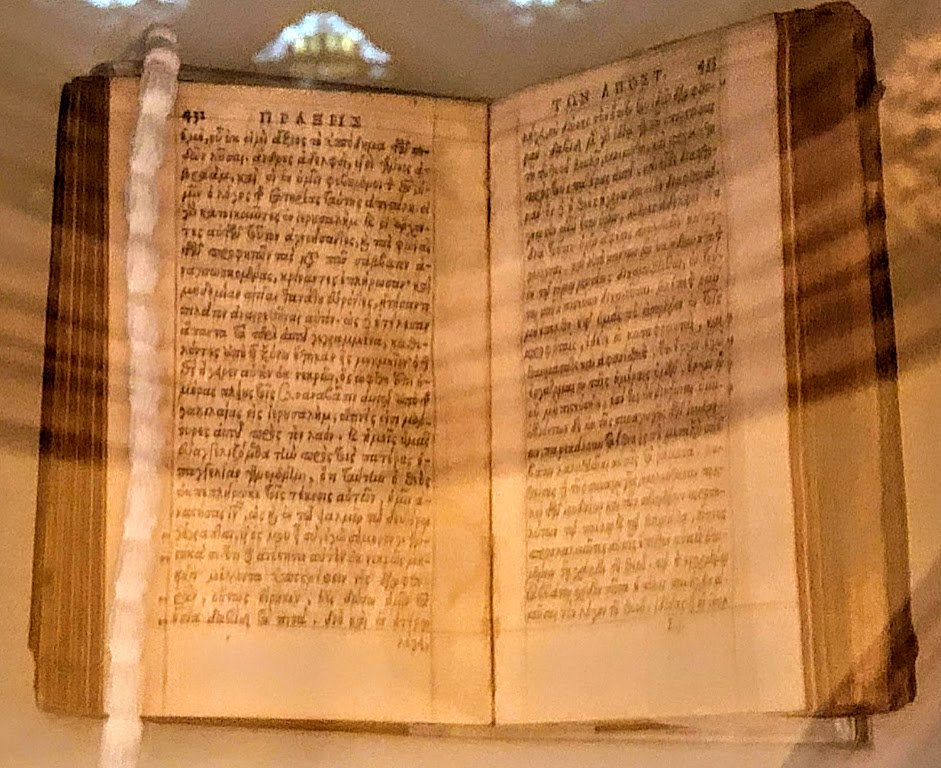
A Greek New Testament in the library in Lichfield Cathedral was published in Paris in 1569 (Photograph: Patrick Comerford)

Today’s Reflections:

My idea of indulgence is spending hours on end in the bookshops – new and second-hand – in Dublin, in Cambridge and in Oxford, and I still miss the old Staffs Bookshop in Lichfield, once my favourite second-hand bookshop.

But, as I navigate my way through the aisles and shelves of bookshops, I find I cannot help noticing the very limited versions of Bibles on many shelves. I seldom set out to buy a new Bible – my bookshelves have been stacked with a variety of translations and versions, usually known by their Initials (NRSV, NRSVA, JB, RSV, NIV, AV … ), and with Bibles in many languages, including English, Irish, Greek, Hebrew, French, Italian, Latin and Chinese – bought in Shanghai … I once had a version in Xhosa, bought in South Africa.

For a long-time I I clung onto some of these Bibles, even when they were bruised and battered, torn and dog-eared. I still have a King James Version that I think I was given during my school days.

There was a Living Bible, paraphrased by Kenneth Taylor … this version was printed in 1972 and sold for £1. It was heavily marked and stained, having endured being packed into rucksacks and travelling with me as I hitch-hikeded around Ireland and England at the age of 20.

My copy of the New English Bible had a note of where and when it was bought over 50 years ago: ‘Lichfield, 10.9.1973’ … I still remember that day, because the coup against Allende was staged in Chile the following day. The art nouveau illustrations by Horace Knowles are still a pleasure to come across.

I bought my first version of the Common Bible, with its ecumenical presentation of western and eastern canonical books, when I was working in Wexford in 1974. It was a paperback edition that fell apart through years of use, and was replaced over time with a later edition.

My many copies of the NRSVA have been lost, misplaced, borrowed or lent over the years, and the latest copy was found in the basement of the Oxfam bookshop on St Giles in Oxford.

A range of translations and commentaries is important for anyone who is interested in Biblical scholarship. And so, I was a little surprised at the very limited range of Bibles available on the shelves of one bookshop recently: four stacks of the King James Version, and one copy of the English Standard Version … and that was it.

The translations of the Bible we favour indicate a theological bias even before we start reading it.

The beauty of the English language in the King James Version is beyond question. Its influence on literary English places it alongside the works of Chaucer and Shakespeare and the Book of Common Prayer.

But, apart from historical, dramatic, poetic or comparative reasons, there are limited reasons for using the King James Version today, and if this was given to someone today as their first Bible, I would not expect them to continue reading it for very long.

The single, sole alternative of the English Standard Version in that bookshop that particular day took me aback.

There is a saying in Italian that I learned in Ealing Abbey while studying patristic and liturgical Latin: Traduttore, traditore – ‘The translator is a traitor.’

Every translation of the Bible is an interpretation as well as a translation, and the new text always betrays the old prejudices of the translators.

There was an interesting debate in the letters columns of the The Tablet some years ago when the Roman Catholic bishops of England and Wales approved the English Standard Version for a revised Lectionary.

The Irish-born historian Eamon Duffy, Emeritus Professor of the History of Christianity at Cambridge and author of The Stripping of the Altars, finds the ESV reflects ‘a deep-rooted dimension of Anglophone culture.’

He finds the Jerusalem Bible ‘is often woefully flat-footed, most painfully-obvious in Passiontide and at Christmas, when what is read in our churches falls so far short of versions given familiarity and valence by their presence in cultural touch-points like Handel’s Messiah or the Festival of Nine Lessons and Carols.’

Dr Sara Parvis of the University of Edinburgh was generously kind when she described the ESV as a ‘low-church evangelical Protestant translation.’ Neil Xavier O’Donoghue of Saint Patrick’s College, Maynooth, conceded that the ESV ‘was produced by conservative Evangelical scholars in the United States and is often described as Calvinist in philosophy.’

In fact, the ESV is deeply ‘fundamentalist,’ unnecessarily imposing the translators’ extreme ‘conservative evangelical’ views and dogmas on the text and on the reader.

The ESV’s general editor, Wayne Grudem, argued in paper published in 2016 ‘Why Voting for Donald Trump Is a Morally Good Choice.’

In recent years, Grudem and his colleagues have challenged the consensus on the Trinity, arguing that Christ is eternally subordinate to God the Father and that this provides a pattern for how men and women should relate to each other – that is, women should be subordinate to men.

This is a radical departure from what the Church has taught for more than 1,500 years, and a serious misunderstanding of a core Christian belief that needs to be rejected by anyone concerned for biblical orthodoxy.

The concept of the Eternal Subordination of the Son (ESS) has been created by Grudem and the Neo-Calvinists. Grudem, Bruce Ware of Southern Baptist Theological Seminary, Owen Strachen, and other Neo-Calvinists believe that Christ submitted to God for all eternity, a concept that reflects the teachings of Arius of Alexandria. Arianism is the belief that the Father, and the Son, and the Holy Spirit are not equal, instead Jesus was created by God and is eternally subordinate to the Father.

Grudem and his supporters have been challenged by some leading evangelicals, including Carl Trueman and Liam Goligher, who have asked whether he is creating a new deity. They have contrasted statements from Grudem and Ware with quotations from the historic creeds.

One critic concluded: ‘It comes down to this; if they are right we have been worshipping an idol since the beginning of the church; and if they are wrong they are constructing a new deity – a deity in whom there are degrees of power, differences of will, and diversity of thought. Because, mark this, to have an eternally subordinate Son intrinsic to the Godhead creates the potential of three minds, wills and powers. What they have done is to take the passages referring to the economic Trinity and collapse them into the ontological Trinity.’

Grudem also drafted the ‘Guidelines’ of the Council of Biblical Manhood and Womanhood (1997) that reject gender-inclusive approaches. This is due to their patriarchy-based objective of excluding women from leadership in the Church. But it may explain why the ESV, again and again, uses masculine pronouns and male gender-specific words that are absent from the Greek original, where other translations do not.

For example, although the ESV in its preface claims that ‘people rather than men is regularly used where the original languages refer to both men and women,’ this is not so. A good example would be when the generic Greek ἄνθρωποι (anthropoi), ‘human beings,’ is used to refer to a mixed group containing both women and men. To translate the term ‘men’ in such a case is in fact to misrepresent the meaning of the word since women were also present and were not mere ciphers or appendages of the men present.

But there are at least 100 instances in the ESV New Testament where ‘men’ translates the Greek ἄνθρωποι.

In some places the word ‘men’ is even added unnecessarily. For example, πρῶτοι τοῦ λαοῦ (protoi tou lao), ‘leaders of the people’ (NRSV and RNJB) or, more literally, ‘the first in rank among the people,’ in Luke 19: 47, becomes ‘principal men of the people’ in the ESV.

Earlier, the ESV translate Luke 18: 27, ‘What is impossible with man is possible with God.’ The NRSV renders this as, ‘What is impossible for mortals is possible for God.’ The original Greek says, Τὰ ἀδύνατα παρὰ ἀνθρώποις δυνατὰ παρὰ τῷ θεῷ ἐστιν.

The ESV translates I Corinthians 1: 25 as ‘For the foolishness of God is wiser than men, and the weakness of God is stronger than men.’ The NRSV says, ‘For God’s foolishness is wider than human wisdom, and God’s weakness is stronger than human strength.’ The RNJB says, ‘God’s folly is wiser than human wisdom, and God’s weakness is stronger than human strength.’ The original Greek says, ὅτι τὸ μωρὸν τοῦ θεοῦ σοφώτερον τῶν ἀνθρώπων ἐστίν, καὶ τὸ ἀσθενὲς τοῦ θεοῦ ἰσχυρότερον τῶν ἀνθρώπων.

When I am asked to recommend ‘versions’ of the Bible, I say without hesitation, ‘read the original.’ There is nothing to compare with wrestling with the original texts in Hebrew and Greek. But if I must recommend a translation to students and readers then it is the RSV and NRSV, for their scholarship and despite all their weaknesses.

Have I ever recommended the ESV?

Never.

Why?

Traduttore, traditore.

Bibles on a shelf in a bookshop … which translation would you recommend? (Photograph: Patrick Comerford)

Today’s Prayers (Sunday 25 October 2026, Bible Sunday):

The theme this week (25 to 31 October) in Pray with the World Church, the prayer diary of the Anglican mission agency USPG (United Society Partners in the Gospel), is ‘Update from Myanmar’ (pp 50-51). This theme was introduced today with a programme update from the Revd Davidson Solanki, Senior Regional Manager for Asia and the Middle East, USPG:

On 28 March 2025, a 7.7-magnitude earthquake hit central Myanmar, destroying homes, churches, and important infrastructure. Many communities were already struggling because of ongoing conflict and displacement since the 2021 military coup. The Church in Myanmar (CPM), together with USPG, responded quickly with emergency relief, putting faith into action by supporting those most in need.

Since then, CPM has been strengthening its longer-term development work. Church staff and leaders have met in workshops and discussions to reflect on what they have learned in the field, look at the impact of their programmes, and agree on shared priorities. This has helped ensure that work across dioceses is better coordinated and shaped by local communities.

This teamwork between leaders and practitioners is helping CPM move from short-term crisis response to more planned and sustainable programmes. Bishops have affirmed that development is a key part of the Church’s mission and have committed to supporting staff, improving systems, and reducing reliance on outside funding.

The aim is simple but important: to help communities be better prepared not only for emergencies like earthquakes, but also for ongoing social and economic challenges. Faith, experience, and leadership are coming together to build stronger, more resilient communities.

The USPG Prayer Diary today (Sunday 25 October 2026, Bible Sunday) invites us to pray:

Bible Sunday in the Anglican Church is a day to celebrate Scripture as God’s living Word, shaping our faith, worship, and daily life.

Consider: how would you summarise the Gospel in 60 seconds? Perhaps you could take inspiration from the lectionary reading for today, Matthew 22: 34-46, where Jesus teaches the greatest commandments: to love God and love our neighbour.

A copy of William Bedell’s Bible in Irish in a bookshop window in Camden Street, Dublin (Photograph: Patrick Comerford)

The Collect of the Day:

Blessed Lord,
who caused all holy Scriptures to be written for our learning:
help us so to hear them,
to read, mark, learn and inwardly digest them
that, through patience, and the comfort of your holy word,
we may embrace and for ever hold fast
the hope of everlasting life,
which you have given us in our Saviour Jesus Christ,
who is alive and reigns with you,
in the unity of the Holy Spirit,
one God, now and for ever.

The Post Communion Prayer:

God of all grace,
your Son Jesus Christ fed the hungry
with the bread of his life
and the word of his kingdom:
renew your people with your heavenly grace,
and in all our weakness
sustain us by your true and living bread;
who is alive and reigns, now and for ever.

Additional Collect:

Merciful God,
teach us to be faithful in change and uncertainty,
that trusting in your word
and obeying your will
we may enter the unfailing joy of Jesus Christ our Lord.

Yesterday’s Reflections

Continued Tomorrow:

I always recommend reading the Bible in the original texts … bookshelves in the synagogue in Porto (Photograph: Patrick Comerford)

Scripture quotations are from the New Revised Standard Version Bible: Anglicised Edition copyright © 1989, 1995, National Council of the Churches of Christ in the United States of America. Used by permission. All rights reserved worldwide. http://nrsvbibles.org

29 September 2026

Daily prayer in Ordinary Time 2026:
144, Tuesday 29 September 2026,
Saint Michael and All Angels

‘Archangel Michael The Protector’ by Emily Young at Saint Pancras Church, London … today is the Feast of Saint Michael and All Angels (Photograph: Patrick Comerford, 2026)

Patrick Comerford

We are continuing in Ordinary Time in the Church Calendar. This week began with the Seventeenth Sunday after Trinity (Trinity XVII, 27 September 2026) and today is the Feast of Saint Michael and All Angels (29 September 2026). Many churches are holding special events to mark this day. In Pusey House, Oxford, the preacher at Evensong and High Mass this evening is my friend, the Revd Dr Jonathan Lewis-Jong, Vicar of Saint Mary Magdalene Church, Oxford. Later this evening, I plan to write about my visit to the Church of Saint Michael and All Angels in New Marston, Oxford.

Meanwhile, this morning, before this day begins, I am taking some quiet time to give thanks, and for reflection, prayer and reading in these ways:

1, today’s Gospel reading;

2, a reflection on the Gospel reading;

3, a prayer from the USPG prayer diary;

4, the Collects and Post-Communion prayer of the day.

Angel I by Emily Young (2003), Paternoster Square, London (Photograph: Patrick Comerford)

John 4: 47-51 (NRSVA):

47 When Jesus saw Nathanael coming towards him, he said of him, ‘Here is truly an Israelite in whom there is no deceit!’ 48 Nathanael asked him, ‘Where did you come to know me?’ Jesus answered, ‘I saw you under the fig tree before Philip called you.’ 49 Nathanael replied, ‘Rabbi, you are the Son of God! You are the King of Israel!’ 50 Jesus answered, ‘Do you believe because I told you that I saw you under the fig tree? You will see greater things than these.’ 51 And he said to him, ‘Very truly, I tell you, you will see heaven opened and the angels of God ascending and descending upon the Son of Man.’

Angel II by Emily Young (2003), Paternoster Square, London (Photograph: Patrick Comerford)

Today’s Reflections:

Like many people, I never cease to be fascinated by the Caryatids that make Saint Pancras Church facing Euston Station in London a unique and captivating church. But I wonder how many pass by in the daily commute and miss the opportunity to appreciate Emily Young’s ‘Archangel Michael The Protector’ in the church gardens.

I stopped to look again at ‘Archangel Michael The Protector’ yesterday between train journeys to and from Euston when I was meeting a long-standing friend for coffee. This sculpture in onyx and can be viewed in the church grounds from Upper Woburn Place, around the corner from Euston Road. An inscription on a plaque between the sculpture and the railings reads: ‘In memory of the victims of the 7th July 2005 bombings and all victims of violence. ‘I will lift up my eyes unto the hills’ Psalm 121.’

Nothing moves in this image, a silent reminder of what is being commemorated in the sculpture. Because Saint Michael’s face has only one eye, and this is closed, some critics have wondered whether the quotation is ill-chosen. But the full context is provided in Psalm 121: 1-2:

1 I lift up my eyes to the hills –
from where will my help come?
2 My help comes from the Lord,
who made heaven and earth.

The London bombings over 20 years ago on 7 July 2005, often referred to as 7/7, were a series of four co-ordinated suicide attacks that targeted commuters on the public transport system in the morning rush hour.

Three homemade bombs packed into backpacks were detonated in quick succession on Underground trains on the Circle line near Aldgate and at Edgware Road, and on the Piccadilly line near Russell Square; later, a fourth bomb went off on a bus in Tavistock Square, near Upper Woburn Place and Saint Pancras Church.

Apart from the four bombers, 52 people of 18 different nationalities were killed and more than 700 people were injured in the attacks. It was Britain’s deadliest terrorist incident since the 1988 bombing of Pan Am Flight 103 near Lockerbie, and the first Islamist suicide attack in the UK.

Emily Young has been described as ‘Britain’s foremost female stone sculptor’ and ‘Britain’s greatest living stone sculptor.’ On different occasions, as I have strolled through London, I stopped and taken time at an open-air exhibition at ENO Southbank of works by Emily Young.

A number of her works have formed a sculpture trail or garden at the NEO Bankside development on South Bank in ‘Emily Young: Sculptor Trail.’ The exhibition was both a continuation and a broadening of her presence on the South Bank, echoing three large-scale works on long-loan facing the Tate Modern from NEO Bankside.

Emily Young’s sculptures of five angel heads in stone stand on five columns in Saint Paul’s Churchyard, London. The sequence of heads are mounted on columns under the arcade of a new classical-inspired building to the north west side of Saint Paul's, redeveloped as part of the redesign of Paternoster Square at the top of Ludgate Hill.

Her five angels’ heads are placed dramatically on columns in the arcade of Juxon House and almost face the west front of Saint Paul’s Cathedral.

Emily Young’s works are instantly recognisable and accessible. She deals in spectacular lumps of stone – quartzite, onyx, marble, alabaster – to which she gives an identity by carving a face but leaving the remainder of the rock displayed in its raw, craggy intensity, as if the face had grown or evolved organically. The Financial Times says: ‘Her sculptures meditate on time, nature, memory, man’s relationship to the Earth.’

Emily Young was born in London in 1951 into a family of writers, artists and politicians. Her grandmother, the sculptor Kathleen Scott (1878-1947), was a colleague of Auguste Rodin, and the widow of the Polar explorer, Captain Robert Falcon Scott, ‘Scott of the Antarctic’. Her works include a statue of Edward Smith, the captain of the Titanic, now in Beacon Park, Lichfield. She later married Emily Young’s paternal grandfather, the politician and writer Edward Hilton Young, 1st Lord Kennet.

Emily Young’s father, Wayland Hilton Young, 2nd Lord Kennet, was also a politician, conservationist and writer. Her mother was the writer and commentator Elizabeth Young; her uncle was the ornithologist, conservationist and painter, Sir Peter Scott.

She was still a student when she achieved fame (or notoriety) in 1971 as the inspiration for the Pink Floyd song See Emily Play written by Syd Barrett of Pink Floyd. But the song had earlier origins in the 1960s. She was 15 when she met Syd Barrett at the London Free School in 1965. ‘I used to go there because there were a lot of Beat philosophers and poets around,’ she said many years later. ‘There were fundraising concerts with The Pink Floyd Sound, as they were then called. I was more keen on poets than rockers. I was educating myself. I was a seeker. I wanted to meet everyone and take every drug.’

As a young woman, Emily Young worked primarily as a painter while she was studying at Chelsea School of Art in 1968 and later at Central Saint Martins. She travelled around the world in the late 1960s and 1970s, spending time in the US, Afghanistan, Pakistan, India, France, Italy, Africa, South America, the Middle East and China, encountering a variety of cultures and developing her experiences of art.

In the early 1980s, she abandoned painting and turned to carving, sourcing stone from all over the world. Travelling from a London childhood, to a European education, to a life lived as an artist round the world, she began to interact with the timeless quality of stone to produce breath-taking sculptures of luminous intensity and great beauty.

As well as marble, she carves in semi-precious stone – agate, alabaster, lapis lazuli. These not only reflect and refract the light – but glow with a passionate intensity (as Winged Golden Onyx Head), revealing the hidden crystalline structure of the material and the subtle layers the time has laid down, showing the liquid qualities of hard rock.

The primary objective of her sculpture is to bring the natural beauty and energy of stone to the fore. Her sculptures have unique characters because each stone has an individual geological history and geographical source. Her approach allows the viewer to comprehend a deep grounding across time, land and cultures. She combines traditional carving skills with technology to produce work that is both contemporary and ancient, with a unique, serious and poetic presence.

Emily Young now divides her time between her studios in London and Italy. Her permanent installations and public collections can be seen in many places, including Saint Paul’s Churchyard, Saint Pancras Church, NEO Bankside, and the Imperial War Museum in London; La Defense, Paris; Salisbury Cathedral, Wiltshire; the Whitworth Art Gallery, Manchester; and the Cloister of Madonna Dell’Orto, Venice.

After years of being feted as ‘Britain’s foremost female stone sculptor,’ the art critic of the Financial Times called her ‘Britain’s greatest living stone sculptor.’ The Daily Telegraph has written: ‘Emily Young has inherited the mantle as Britain’s greatest female stone sculptor from Dame Barbara Hepworth.’

She recently explained: ‘So my work is a kind of temple activity now, devotional; when I work a piece of stone, the mineral occlusions of the past are revealed, the layers of sediment unpeeled; I may open in one knock something that took millions of years to form: dusts settling, water dripping, forces pushing, minerals growing – material and geological revelations: the story of time on Earth shows here, sometimes startling, always beautiful.’

She told an interviewer: ‘I carve in stone the fierce need in millions of us to retrieve some semblance of dignity for the human race in its place on Earth. We can show ourselves to posterity as a primitive and brutal life form – that what we are best at is rapacity, greed, and wilful ignorance, and we can also show that we are creatures of great love for our whole planet, that everyone of us is a worshipper in her temple of life.’

The American composer Fran Schultz, who lives in Howell, New Jersey, said some years ago that my writing about Emily Young’s angels have inspired her composition and recording, ‘How Many Angels Can Dance on the Head of a Pin.’

Fran describes the composition as in the genre of rock, instrumental and digital electronic music. The musical instruments include a Steinway Grand Piano, Oak Piano Dream Synthesiser, Stutter Stack and Classic D6.

She is generous on her website when she extends ‘special thanks to Patrick Comerford for his writing and his allowing me use of his photos.’ She said she wrote ‘How Many Angels Can Dance on the Head of a Pin’ because of my ‘inspirational writing.’

She added: ‘I also enjoyed reading all the links he provided about the artist, Emily Young, his thoughts and quotes by her. I thank him very much for letting me make use of his photographs for this piece of music and to the artist Emily Young for making them.’

She continued: ‘The connection point for me in his writing was immediate in his succinct and direct insightful recognition of such questions and in my seeing how in social media distracts us into questions that are essentially “A metaphor for wasting time discussing trivial topics that have no practical value, or asking questions whose answers hold no practical value, or asking questions whose answers hold no consequence, at times when we have more urgent concerns to debate”.’

She was unexpectedly generous when she said my ‘writing has many layers of depth to it that I particularly am drawn to in the subjects of architecture, sculptures, history, theology, questions, the deeper meaning of things and the beauty of things we might not have noticed or fully appreciated before. I love his thoughtful responses to the questions and what brought those very questions up upon reflecting the sculptures made by Emily Young as he was taking a walk in London … and taking photos. Hope you enjoy his writing and enjoy my music too!’

She then offered a link to my website and my article of 25 February 2023, ‘Emily Young’s Five Angels on Columns,’ HERE.

You can listen to Fran Schultz’s composition, ‘How Many Angels Can Dance on the Head of a Pin’, HERE.

Angel III by Emily Young (2003), Paternoster Square, London (Photograph: Patrick Comerford)

Today’s Prayers (Tuesday 29 September 2026, Saint Michael and All Angels):

In Pray with the World Church, the prayer diary of the Anglican mission agency USPG (United Society Partners in the Gospel), the theme this week, from 27 September to 3 October 2026 (pp 42-43), is ‘Power of Language’. This theme was introduced on Sunday with a reflection by Rachel Weller, Communications Officer, USPG.

The USPG Prayer Diary today (Tuesday 29 September 2026, Saint Michael and All Angels) invites us to pray:

Lord God, through the example of Saint Michael, defend and guide those who work for reconciliation. Give them courage so every voice may be heard and every community united in peace.

Angel IV by Emily Young (2003), Paternoster Square, London (Photograph: Patrick Comerford)

The Collect:

Everlasting God,
you have ordained and constituted
the ministries of angels and mortals in a wonderful order:
grant that as your holy angels always serve you in heaven,
so, at your command,
they may help and defend us on earth;
through Jesus Christ your Son our Lord,
who is alive and reigns with you,
in the unity of the Holy Spirit,
one God, now and for ever.

The Post Communion Prayer:

Lord of heaven,
in this eucharist you have brought us near
to an innumerable company of angels
and to the spirits of the saints made perfect:
as in this food of our earthly pilgrimage
we have shared their fellowship,
so may we come to share their joy in heaven;
through Jesus Christ our Lord.

Yesterday’s Reflections

Continued Tomorrow

Angel V by Emily Young (2003), Paternoster Square, London (Photograph: Patrick Comerford)

Scripture quotations are from the New Revised Standard Version Bible: Anglicised Edition copyright © 1989, 1995 National Council of the Churches of Christ in the United States of America. Used by permission. All rights reserved worldwide. http://nrsvbibles.org

‘Archangel Michael The Protector’ by Emily Young in the gardens of Saint Pancras Church near Euston Station (Photograph: Patrick Comerford, 2026)

14 September 2026

Daily prayer in Ordinary Time 2026:
129, Monday 14 September 2026,
Holy Cross Day

The Elevation of the Holy Cross … an icon in the Monastery of Arkadi in Crete (Photograph: Patrick Comerford)

Patrick Comerford

We are continuing in Ordinary Time in the Church Calendar and the week began with the Fifteenth Sunday after Trinity (Trinity XV).

Today in the Church Calendar is Holy Cross Day. But, before today begins, I am taking some quiet time this morning to give thanks, for reflection, prayer and reading in these ways:

1, today’s Gospel reading;

2, a reflection on the Gospel reading;

3, a prayer from the USPG prayer diary;

4, the Collects and Post-Communion prayer of the day.

The Elevation of the Holy Cross … an icon in Analipsi Church in Georgioupoli in Crete (Photograph: Patrick Comerford)

John 3.13–17 (NRSVA):

[Jesus said to Nicodemus] 13 ‘No one has ascended into heaven except the one who descended from heaven, the Son of Man. 14 And just as Moses lifted up the serpent in the wilderness, so must the Son of Man be lifted up, 15 that whoever believes in him may have eternal life.

16 ‘For God so loved the world that he gave his only Son, so that everyone who believes in him may not perish but may have eternal life.

17 ‘Indeed, God did not send the Son into the world to condemn the world, but in order that the world might be saved through him.’

The Elevation of the Holy Cross … an icon in the Greek Orthodox Church in Stony Stratford (Photograph: Patrick Comerford)

Today’s Reflection:

The cross on which Christ was crucified has become the universal symbol of Christianity, replacing the Ichthus or fish symbol of the early Church. After the early persecutions ended, early in the fourth century, pilgrims began to travel to Jerusalem to visit the places associated with the life of Christ. Saint Helena, the mother of the emperor, was a Christian and, while she was overseeing excavations in the city, it is said, she uncovered a cross she believed to be the Cross of Christ. A basilica was built on the site of the Holy Sepulchre and dedicated on this day, 14 September 335.

Nicodemus only appears in Saint John’s Gospel, and in today’s Gospel reading at the Eucharist (John 3: 13-17) we read the first of his three appearances. He is a leading Jew of the day, a Pharisee and a rabbi, a doctor of the law, a member of the ruling Sanhedrin. He comes to visit Jesus at night, and he comes with a bundle of questions.

But, despite his erudite learning, he finds it difficult to understand the answers Christ gives. Yet, it is all so simple: ‘God so loved the world …’ (verse 16).

In fact, what Jesus says here is deeply profound. The Greek mathematician and philosopher Pythagoras was born on the island of Samos, the neighbouring island of Patmos, the island to which Saint John was exiled.

Most of us know about Pythagoras because of his calculations about right-angle triangles. But he also provides an insight into one of the key concepts in Saint John’s writings. His understanding of the cosmos (κόσμος) includes the earth, the planets, the stars, the whole created order.

It is an idea derived from the mathematician and philosopher, Pythageros of Samos. In Pythagorean thinking, the cosmos (κόσμος) includes the arrangement of the stars, ‘the heavenly hosts’ as the ornament of the heavens (see I Peter 3: 3). It is not just the whole world, but the whole universe, the whole created order. It is earth and all that encircles the earth like its skin.

It is as if everything is wrapped into and lives within God’s skin, that we live in God’s womb, and it is there that God loves us. It is not that God so loved the saved, or men, or humanity, or even the world. What Christ says here is that God so loved the cosmos, the whole created order, that he gave, or rather sent, his only-begotten Son.

This key phrase is often translated as ‘God so loved the world’ (John 3: 16). Indeed, in China, I was shocked to see this verse translated into Chinese in a way that it means ‘God so loved humanity’ … ‘that he gave his only Son.’

The original text tells us that God so loved the κόσμος – the whole pulsating, created order as imagined by Pythagoras and the philosophers – God so loved the cosmos that he sent his only son … [Οὕτως γὰρ ἠγάπησεν ὁ Θεὸς τὸν κόσμον, ὥστε τὸν Υἱὸν τὸν μονογενῆ ἔδωκεν …] Not that he gave insipidly, but that he sent actively, sent him on a mission.

Nicodemus is a little nonplussed, but he comes back again and again, a second time (John 7: 45-51) and a third time (John 19: 39-42), and the third encounter is on Good Friday.

When Christ dies on the Cross, and the women come to bury him, Joseph of Arimathea provides the grave (Matthew 27: 57; Mark 15: 43; Luke 23: 50-56; John 19: 39-40), and Nicodemus steps forward to provide the customary embalming spices, and he assists them in preparing the body of Christ for burial (John 19: 39-42).

Nicodemus brings a mixture of myrrh and aloes, estimated at about 33 kg, to embalm Christ’s body. In his book Jesus of Nazareth: Holy Week, the late Pope Benedict XVI observes that ‘the quantity of the balm is extraordinary and exceeds all normal proportions. This is a royal burial.’

So, in the story of Nicodemus, we find birth is linked with death, new birth is linked with new life, and before darkness falls Nicodemus really comes to possess the Body of Christ, to hold the Body of Christ in his hands, and in anointing him to recognise him as priest, prophet and king.

If being a priest is about presenting God through Christ to the world in word and sacrament, and presenting the world through the Christ to God in word and sacrament, then Nicodemus both receives and presents the Body of Christ, in a very Eucharistic way, and is a model for priesthood.

But we could say the same too of the women who seek to comfort and console Christ as he carries his cross to Calvary, who stay with him at the Crucifixion, who bury him, and who at great personal risk set off early on Easter morning to anoint his body, not knowing then that the Cross is not the end of the Christ story, but that it reaches its climax at the Resurrection.

The Body of Christ is the Church. Nicodemus claims his place in the Church. He acts on his faith. But he could never have known what the consequences would be for him, for the Church and for the world because he first came to Jesus in the dark, because he engaged with the fact that this Jesus would die, because he claimed the Body of Christ and because he engaged in an Epiphany-like moment, revealing that the Christ who became his teacher, the Christ who was to be betrayed, the Christ who was executed, is also the Risen Christ.

Saint Constantine and Saint Helen hold the Holy Cross … an icon in the church in Arkadi Monastery in Crete (Photograph: Patrick Comerford)

Today’s Prayers (Monday 14 September 2026, Holy Cross Day):

The theme this week (13 -19 September 2026) in ‘Pray With the World Church,’ the Prayer Diary of the Anglican mission agency USPG (United Society Partners in the Gospel), is ‘Witness as With-ness’ (pp 38-39). This theme was introduced yesterday with a reflection by the Revd Canon Dr Peniel Rajkumar, Director of Global Mission and Theologian, USPG.

The USPG Prayer Diary today (Monday 14 September 2026, Holy Cross Day) invites us to pray:

Gracious God, we thank you for the cross of Christ, where sin is defeated and your saving love is revealed. Help me to live in the freedom and hope won there, bearing witness with faith and courage.

The Collect:

Almighty God,
who in the passion of your blessed Son
made an instrument of painful death
to be for us the means of life and peace:
grant us so to glory in the cross of Christ
that we may gladly suffer for his sake;
who is alive and reigns with you,
in the unity of the Holy Spirit,
one God, now and for ever.

The Post Communion Prayer:

Faithful God,
whose Son bore our sins in his body on the tree
and gave us this sacrament to show forth his death until he comes:
give us grace to glory in the cross of our Lord Jesus Christ,
for he is our salvation, our life and our hope,
who reigns as Lord, now and for ever.

Yesterday’s reflections

Continued tomorrow

The Emperor Constantine and Saint Helena hold the Holy Cross … a fresco in Piskopianó in Crete (Photograph: Patrick Comerford)

Scripture quotations are from the New Revised Standard Version Bible: Anglicised Edition copyright © 1989, 1995, National Council of the Churches of Christ in the United States of America. Used by permission. All rights reserved worldwide. http://nrsvbibles.org

Saint Constantine and Saint Helen hold the Holy Cross … an icon in the church in Panormos, east of Rethymnon (Photograph: Patrick Comerford)

06 September 2026

Daily prayer in Ordinary Time 2026:
121, Sunday 6 September 2026,
Creation in Christ, Trinity XIV

‘All things came into being through him, and without him not one thing came into being’ (John 1: 3) … Christ the Pantocrator in the dome of the parish church in Panormos in Crete (Photograph: Patrick Comerford, 2025)

Patrick Comerford

We are continuing in Ordinary Time in the Church Calendar and today is the Festival of Creation in Christ or the Fourteenth Sunday after Trinity (Trinity XIV, 6 September 2026).

This weekend includes the Festal Weekend in Saint Mary and Saint Giles Church, Stony Stratford, coming between the Feast of Saint Giles (1 September) and the Feast of the Birth of the Blessed Virgin Mary (8 September). There were children’s activities in the church yesterday, a Festal Eucharist this morning at which I hope to sing with the choir, and Calverton Fete is at All Saints’ Church, Calverton, this afternoon.

Before today begins, I am taking some quiet time this morning to give thanks, for reflection, prayer and reading in these ways:

1, today’s Gospel reading;

2, a reflection on the Gospel reading;

3, a prayer from the USPG prayer diary;

4, the Collects and Post-Communion prayer of the day.

‘The light shines in the darkness, and the darkness did not overcome it’ (John 1: 5) … light pours into the darkness in the Church of the Transfiguration in Piskopiano in Crete (Photograph: Patrick Comerford)

John 1: 1-14 (NRSVA):

1 In the beginning was the Word, and the Word was with God, and the Word was God. 2 He was in the beginning with God. 3 All things came into being through him, and without him not one thing came into being. What has come into being 4 in him was life, and the life was the light of all people. 5 The light shines in the darkness, and the darkness did not overcome it.

6 There was a man sent from God, whose name was John. 7 He came as a witness to testify to the light, so that all might believe through him. 8 He himself was not the light, but he came to testify to the light. 9 The true light, which enlightens everyone, was coming into the world.

10 He was in the world, and the world came into being through him; yet the world did not know him. 11 He came to what was his own, and his own people did not accept him. 12 But to all who received him, who believed in his name, he gave power to become children of God, 13 who were born, not of blood or of the will of the flesh or of the will of man, but of God.

14 And the Word became flesh and lived among us, and we have seen his glory, the glory as of a father’s only son, full of grace and truth.

The statue of Pythagoras (1989) by Nikolaos Ikaris (1920-1994) on the harbour front in Pythagóreio on the Greek island of Samos (Photograph: Patrick Comerford)

Today’s Reflections:

The Prologue to Saint John’s Gospel is the traditional Gospel reading on Christmas morning. Now we hear it again this morning (John 1: 1-14), when the Church Calendar in the Church of England marks Creation in Christ.

These opening verses in Saint John’s Gospel are like the opening verses of the Bible, in the Book of Genesis. They talk of a new creation, and a creation in which God is pleased, God is very pleased.

In this reading, we are introduced to key concepts in Saint John’s thinking: word or logos (λόγος, logos), life (ζωή, zoe), light (φῶς, phos), belief and being sent, testimony or witness, truth, and the cosmos (κόσμος, cosmos).

The word cosmos appears in this passage four times, and later, when Saint John goes on to tell us that ‘God so loved the world …’, he actually says ‘God so loved the cosmos that he sent his only Son …’ (John 3: 16).

The cosmos is the Universe, but the word specifically refers to a complex and orderly system or entity, the very opposite of chaos. The word cosmos gives us words in the English language like: cosmology, trying to understand the reasons for existence and its significance; or, more simply, cosmetics, an equal presence of order and beauty, an attempt to bring order or even beauty to the chaos of our skin, our facial appearance.

The term was first used by the Greek philosopher Pythagoras (ca 570 BCE to ca 495 BCE), the philosopher we remember because everyone in school learned the theorem to which he gives his name: ‘The square on the hypotenuse is equal to the sum of the squares on the other two sides.’

Pythagoras lived on the Greek island of Samos, and he influenced every Greek philosopher who came after him, including Plato and Aristotle. He is said to have been the first to prove that the earth is a sphere; he shaped how we think of numbers and musical notation, the perfect consonances of music; he taught the immortality of the soul; … and he was the first philosopher to develop the concept of the cosmos, the harmony of the created universe.

His followers, the Pythagoreans, believed in a superior divinity, the One God, above all other gods. Because of this belief in one God, and their rejection of the pantheon of mythical Greek gods, Pythagoras and his followers were labelled as atheists.

He was the first philosopher to give the word cosmos to the universe on the basis of his concepts of order and harmony which he believed govern all things.

He said that humanity and the universe are made in the image and likeness of God, and that understanding God, the universe and humanity are inter-connected.

In Pythagorean thinking, the cosmos is not just the whole world, but the whole universe, the whole created order; it is the earth and all that encircles the earth like its skin.

For Pythagoras, all things are related, just as in an ecosystem. In this thinking, the universe is a living organism and not an inanimate machine.

His followers compared a just and well-ordered society to a well-tuned lyre. While each note retains its individuality, all are proportionally linked together in a larger whole to form a musical scale, and all are interdependent in terms of their reliance on one another (Plato, Republic 443 D-444). Justice is present in any well-functioning organism, society, and the soul.

The word cosmopolitan, an important concept in modern philosophy and political discourse, is, of course, derived from the κοσμοπολίτης (kosmopoliítes) found in classical and koine Greek, formed from the words κόσμος (kosmos), world, universe, cosmos or created order, and πολίτης (politês), citizen, one of a city.

Contemporary usage defines the term as ‘citizen of the world’. But the word cosmopolitan was coined by the Greek philosopher Diogenes the Cynic or Diogenes of Sinope in the fourth century BCE. When Diogenes was asked from what city he hailed, he replied that he was a citizen of the world, κόσμος πολίτης (kósmos polítēs), or κοσμοπολίτης (kosmopolites), a citizen of the world, rejecting narrow local loyalties.

The plural, κόσμου πολῖται (kosmou politai), means ‘citizens of the world’ or even ‘citizens of the universe’, of the whole created order. The phrase originates from Cynic and Stoic philosophy, describing the idea that human beings belong to a single, universal community rather than being defined solely by their local city-state or nation. At the time, the broadest basis of social identity among Greeks was either the individual city-state or the culturally and linguistically homogeneous Hellenic group.

Diogenes lived from ca 413/403 to ca 324/321 BCE, and he was one of the founders of Cynicism. He was renowned for his ascetic lifestyle and radical critiques of social conventions, and he became a legendary figure whose life and teachings have been recounted, often through anecdote, in both antiquity and modernity. He Diogenes advocated a return to nature, the renunciation of wealth, and introduced early ideas of cosmopolitanism by proclaiming himself a citizen of the world. Rather than declaring his lineage, city, social class, or gender, he defined himself as a human being, implicitly asserting the equal worth of all human beings.

When Saint John the Divine wrote the Book of Revelation, he was in exile on Patmos, the neighbouring island of Samos, where Pythagoras was born, and like Pythagoras, he too was in exile in a cave.

So, is it any wonder that the idea of the cosmos, the harmony of the created universe, is a key concept in the writings of Saint John?

The word cosmos occurs 188 times in the New Testament, and the vast majority of these occurrences (104) are in Saint John’s Gospel and his three letters.

The first use of the word cosmos in the New Testament is in the Gospel reading this morning. When Saint John uses the word here – ‘He was in the cosmos, and the cosmos came into being because of him’ (John 1: 10) – he is referring not to humanity, not to the world as our planet Earth, but to the created universe, the sum total of everything, not here and now but past, present and future, the orderly universe created by God to be in harmony.

When we care for the cosmos, the created order, we reflect the life of Christ. It is not a marginal, side issue for the Church, but it is at the heart of the mission of the Church, because it is at the heart of why the Word has become flesh and dwells among us (John 1: 14).

The fifth of the five marks of mission agreed in the Anglican Communion is: ‘To strive to safeguard the integrity of creation and sustain and re-new the life of the earth.’

As we celebrate Creation in Christ and continue to mark Creation Time, it is good to be reminded that the care of creation, the cosmos, is not an added-on extra to our priorities in mission; rather, it underpins and explains all we do in mission. When we care for the cosmos, the integrity of creation, we are being like Christ.

The Tower of Lysicrates in the Plaka in Athens was once known as the Lantern of Diogenes (Photograph: Patrick Comerford)

Today’s Prayers (Sunday 6 September 2026, Creation in Christ):

In Pray with the World Church, the prayer diary of the Anglican mission agency USPG (United Society Partners in the Gospel), the theme this week, from 6 to 12 September 2026 (pp 36-37), is ‘Turning Pain into Glory’. This theme is introduced today with a Reflection by Nolene Sheppard, Leader of a Women’s Empowerment Group, Magnificat, and Ukraine Aid Project Support Lead at Saint Thomas à Becket, Hamburg, Germany:

It was a deep pain that hurt so bad it made me feel sick. I looked into the mirror and saw black and brown lines. The image couldn’t possibly be me - an unrecognisable, swollen face. My head continued to spin out of control. All I felt was helplessness, anger and frustration.

Traumatic experiences like these are not an unusual experience – a first for me, but nothing that other women haven’t experienced. Could I find my way back from the depths of such overwhelming despair? How can I do this when I am in a country where I am a foreigner, and at a disadvantage in every aspect of the word.

“Are other women going through this same emotional and psychological torture due to similar experiences?”, I asked myself. The findings were overwhelming. With the power of prayer, I knew I was not walking the journey back to the top on my own. God was at my side every step of the way. He showed me the path, gave me wisdom, strength and vision.

Now on a road better than I could have ever imagined, in the same country, I created a group within the English Anglican Church in Hamburg called “Magnificat”. This group is all about empowering women. We give financial support to Ukrainian refugees, made up of women and children, in Romania and put on activities for women in Hamburg too. I listen to each of their stories. It’s been a year now and the bond is still there. Magnificat continues to uplift them, as it does me.

The USPG Prayer Diary today (Sunday 6 September 2026, Creation in Christ) invites us to pray as we read and meditate on Matthew 18: 15-20.

‘The light shines in the darkness, and the darkness did not overcome it’ (John 1: 4) … by Minster Pool in Lichfield at night (Photograph: Patrick Comerford)

The Collect of the Day:

Holy and eternal God,
you are the Maker of heaven and earth,
you are the Word through whom all things were made,
and you are the Spirit, the giver of life:
draw us into the mystery of your love,
that with all creation we may proclaim your praise,
through Jesus Christ our Lord.

or

O God and Father of all that was, is and ever shall be,
help us to be thankful for all that is made
at the hands of your Son
and through the wisdom of your Spirit,
that we may care in heart and in deed for the life of our world,
to the praise and glory of your holy name.

The Post-Communion Prayer:

God our Creator,
by your gift the tree of life was set
at the heart of the earthly paradise,
and the bread of life at the heart of your Church:
may we who have been nourished at your table on earth
be transformed by the glory of the Saviour’s cross
and enjoy the delights of eternity;
through Jesus Christ our Lord.

Yesterday’s reflections

Continued tomorrow

‘The light shines in the darkness, and the darkness did not overcome it’ (John 1: 4) … My Village Barok by the Sarawak River in Kuching at night (Photograph: Patrick Comerford)

Scripture quotations are from the New Revised Standard Version Bible: Anglicised Edition copyright © 1989, 1995, National Council of the Churches of Christ in the United States of America. Used by permission. All rights reserved worldwide. http://nrsvbibles.org

29 July 2026

Daily prayer in Ordinary Time 2026:
83, Wednesday 29 July 2026

Mary anoints the feet of Jesus in Bethany … a window in the north aisle of Saint Mary’s Church in St Neots, Cambridgeshire (Photograph: Patrick Comerford)

Patrick Comerford

We are continuing in Ordinary Time in the Church and this week began with the Eighth Sunday after Trinity (Trinity VIII, 26 July 2026). The calendar of the Church of England in Common Worship today remembers Mary, Martha and Lazarus with a Lesser Festival. I got back to Stony Stratford late last night after a short, one-day family visit to Dublin.

Later today, Stony Stratford Cricket Club is organising a special charity day at Ostler’s Lane, starting at 11:30, with what promises to be a day of high-quality cricket as a Stony representative side takes on an MCC representative side. This is also a fundraising day for Breast Cancer Now. Ro Whitehead is giving all food for the day in return for a donation to Breast Cancer Now. After the players’ tea break, supporters are invited to enjoy Ro’s teas, with special treats, in return for a donation. The bar is open from midday and all are welcome.

This morning, as this new day begins, I am taking some quiet time this morning to give thanks, to reflect, to pray and to read in these ways:

1, reading today’s Gospel reading;

2, a short reflection;

3, a prayer from the USPG prayer diary;

4, the Collects and Post-Communion prayer of the day.

The Hardman window in Saint Mary’s Church, St Neots, with the Anointing of Jesus’ feet by Mary of Bethany (Photograph: Patrick Comerford)

John 12: 1-11 (NRSVA):

1 Six days before the Passover Jesus came to Bethany, the home of Lazarus, whom he had raised from the dead. 2 There they gave a dinner for him. Martha served, and Lazarus was one of those at the table with him. 3 Mary took a pound of costly perfume made of pure nard, anointed Jesus’ feet, and wiped them with her hair. The house was filled with the fragrance of the perfume. 4 But Judas Iscariot, one of his disciples (the one who was about to betray him), said, 5 ‘Why was this perfume not sold for three hundred denarii and the money given to the poor?’ 6 (He said this not because he cared about the poor, but because he was a thief; he kept the common purse and used to steal what was put into it.) 7 Jesus said, ‘Leave her alone. She bought it so that she might keep it for the day of my burial. 8 You always have the poor with you, but you do not always have me.’

9 When the great crowd of the Jews learned that he was there, they came not only because of Jesus but also to see Lazarus, whom he had raised from the dead. 10 So the chief priests planned to put Lazarus to death as well, 11 since it was on account of him that many of the Jews were deserting and were believing in Jesus.

‘There they gave a dinner for him. Martha served, and Lazarus was one of those at the table with him’ (John 12: 2) … dinner in Sidney Sussex College, Cambridge (Photograph: Patrick Comerford)

Today’s Reflections:

Today’s Gospel reading at the Eucharist in the lectionary (John 12: 1-11) is for the Lesser Festival in Common Worship for Mary, Martha and Lazarus.

Many years ago, when I was in my early 20s, the then Rector of Killanne and Killegney, Co Wexford, Canon Norman Ruddock, invited me to speak at one of his Lenten reflections in Clonroche, Co Wexford.

I was then living on High Street in Wexford, working as a journalist with the Wexford People, and I was probably invited as a Lenten speaker because I also had a weekly column in the local newspapers in Co Wexford and Co Wicklow.

I remember how Philip Corish kindly drove me to and from Wexford that evening. Later that year, he was elected an Alderman on Wexford Corporation, and he would go on to become a Mayor of Wexford, while Norman Ruddock later became the Rector of Wexford, and he was a constant encouragement to me throughout my 20s, 30s and 40s to go forward for ordination.

I remember that evening as a balmy spring evening, and Norman Ruddock remarked on how my talk was challenging politically and socially. There was only one written follow-up: an anonymous parishioner sent me an unsigned letter, telling me I had abused the Gospel for political purposes. She (or he) chose to remind me of a saying in today’s Gospel reading: ‘You always have the poor with you’ (John 12: 8), or perhaps? ‘The poor will always be among us!’ (Matthew 26: 11).

That was more than half a century ago. I never kept that letter, but I still think about it when I hear far-right activists criticising people like me, accusing us of being ‘Woke’ or showing ‘empathy’.

These verses continue to be misinterpreted and weaponised as a justification of wealth accumulation and ignoring the plight of the poor and the causes of their poverty.

As today’s Gospel reading makes very clear, it is Judas Iscariot who elicits this response from Jesus. The setting in John 12 is a destitute village, Bethany, whose name means ‘house of the poor’, ‘house of affliction’ or ‘house of misery’. In Matthew 26, Bethany is the house of Simon the Leper, one of the poorest of the poor in a village full of poor people.

In the parallel story in Mark 14: 7, Jesus says: ‘For you always have the poor with you, and you can show kindness to them whenever you wish’. If anyone thinks ‘the poor will always be among you’ is a universal statement that somehow allows them to avoid responsibility from seeking to eliminate poverty, Mark 14: 7 turns that interpretation on its head.

In addition, we should remember that when Jesus cites Scripture he expects those who are listening to be familiar with the passage, and that they should be able to finish the quotation as they take it to heart. Jesus here is quoting from Deuteronomy 15, but the full passage (Deuteronomy 15: 1-11) he cites provides the context:

15 Every seventh year you shall grant a remission of debts. 2 And this is the manner of the remission: every creditor shall remit the claim that is held against a neighbour, not exacting it from a neighbour who is a member of the community, because the Lord’s remission has been proclaimed. 3 From a foreigner you may exact it, but you must remit your claim on whatever any member of your community owes you. 4 There will, however, be no one in need among you, because the Lord is sure to bless you in the land that the Lord your God is giving you as a possession to occupy, 5 if only you will obey the Lord your God by diligently observing this entire commandment that I command you today. 6 When the Lord your God has blessed you, as he promised you, you will lend to many nations, but you will not borrow; you will rule over many nations, but they will not rule over you.

7 If there is among you anyone in need, a member of your community in any of your towns within the land that the Lord your God is giving you, do not be hard-hearted or tight-fisted towards your needy neighbour. 8 You should rather open your hand, willingly lending enough to meet the need, whatever it may be. 9 Be careful that you do not entertain a mean thought, thinking, ‘The seventh year, the year of remission, is near’, and therefore view your needy neighbour with hostility and give nothing; your neighbour might cry to the Lord against you, and you would incur guilt. 10 Give liberally and be ungrudging when you do so, for on this account the Lord your God will bless you in all your work and in all that you undertake. 11 Since there will never cease to be some in need on the earth, I therefore command you, ‘Open your hand to the poor and needy neighbour in your land.’

I suppose all I was doing that Lenten evening over 50 years ago was sharing my interpretation of Biblical economics – an interpretation that is even more relevant today.

‘Christ the Beggar’, a sculpture by Timothy Schmalz in Rome (Photograph: Patrick Comerford)

Today’s Prayers (Wednesday 29 July 2026):

In Pray with the World Church, the prayer diary of the Anglican mission agency USPG (United Society Partners in the Gospel), the theme this week, from 26 July to 1 August 2026 (pp 22-23), is ‘Lives in Transit’. This theme was introduced on Sunday with a programme update by Rachel Weller, Communications Officer, USPG.

The USPG prayer diary today (Wednesday 29 July 2026) invites us to pray:

God of justice, we pray for systems that bind workers into vulnerability and fear. Stir the conscience of governments and employers to act with fairness and integrity.

The Collect of the Day:

God our Father,
whose Son enjoyed the love of his friends,
Mary, Martha and Lazarus,
in learning, argument and hospitality:
may we so rejoice in your love
that the world may come to know
the depths of your wisdom, the wonder of your compassion,
and your power to bring life out of death;
through the merits of Jesus Christ,
our friend and brother,
who is alive and reigns with you,
in the unity of the Holy Spirit,
one God, now and for ever.

The Post Communion Prayer:

Father,
from whom every family in heaven and on earth takes its name,
your servants Mary, Martha and Lazarus revealed your goodness
in a life of tranquillity and service:
grant that we who have gathered in faith around this table
may like them know the love of Christ that surpasses knowledge
and be filled with all your fullness;
through Jesus Christ our Lord.

Yesterday’s reflection

Continued tomorrow

The ‘Homeless Christ’ by the Canadian sculptor Timothy Schmalz in the grounds of Christ Church Cathedral, Dublin (Photograph: Patrick Comerford)

Scripture quotations are from the New Revised Standard Version Bible: Anglicised Edition copyright © 1989, 1995 National Council of the Churches of Christ in the United States of America. Used by permission. All rights reserved worldwide. http://nrsvbibles.org

22 July 2026

Daily prayer in Ordinary Time 2026:
76, Wednesday 22 July 2026,
Saint Mary Magdalene

A modern icon of Aghia Magdalini or Saint Mary Magdalene by Alexandra Kaouki in Rethymnon (Icon © Alexandra Kaouki)

Patrick Comerford

We are in Ordinary Time in the Church Calendar; this week began with the Seventh Sunday after Trinity (Trinity VII, 19 July 2026), and today is the Feast of Saint Mary Magdalene (22 July 2026).

Later this evening, I hope to rehearse with the choir in Saint Mary Magdalene Church, Stony Stratford, our last rehearsal before the summer recess. Meanwhile, before the day begins, I am taking some quiet time this morning to give thanks, to reflect, to pray and to read in these ways:

1, reading today’s Gospel reading;

2, a short reflection;

3, a prayer from the USPG prayer diary;

4, the Collects and Post-Communion prayer of the day.

Saint Mary Magdalene depicted in a statue in Saint Mary Magdalene Church, Comerford Road, in Brockley, south London (Photograph: Patrick Comerford, 2026)

John 20: 1-2, 11-18 (NRSVA):

1 Early on the first day of the week, while it was still dark, Mary Magdalene came to the tomb and saw that the stone had been removed from the tomb. 2 So she ran and went to Simon Peter and the other disciple, the one whom Jesus loved, and said to them, ‘They have taken the Lord out of the tomb, and we do not know where they have laid him.’

11 But Mary stood weeping outside the tomb. As she wept, she bent over to look[a] into the tomb; 12 and she saw two angels in white, sitting where the body of Jesus had been lying, one at the head and the other at the feet. 13 They said to her, ‘Woman, why are you weeping?’ She said to them, ‘They have taken away my Lord, and I do not know where they have laid him.’ 14 When she had said this, she turned round and saw Jesus standing there, but she did not know that it was Jesus. 15 Jesus said to her, ‘Woman, why are you weeping? For whom are you looking?’ Supposing him to be the gardener, she said to him, ‘Sir, if you have carried him away, tell me where you have laid him, and I will take him away.’ 16 Jesus said to her, ‘Mary!’ She turned and said to him in Hebrew, ‘Rabbouni!’ (which means Teacher). 17 Jesus said to her, ‘Do not hold on to me, because I have not yet ascended to the Father. But go to my brothers and say to them, “I am ascending to my Father and your Father, to my God and your God.”’ 18 Mary Magdalene went and announced to the disciples, ‘I have seen the Lord’; and she told them that he had said these things to her.

Μη μου άπτου, ‘Noli me Tangere,’ an icon by Mikhail Damaskinos in the Museum of Christian Art in the former church of Saint Catherine of Sinai in Iraklion (Photograph: Patrick Comerford)

Today’s Reflections:

When I was visiting Comerford Road in Brockley, South London, two weeks ago, I also visited Saint Mary Magdalene Church, the Roman Catholic parish church on Comerford Road. The church has a statue of Mary Magdalene on the façade facing Howson Road, another statue of her on the steps of the sanctuary beside the baptismal font, and she is also depicted at the foot of the cross in the reredos above the High Altar.

At times on my way back down the mountains from the Monastery of Arkadi to the coast of Rethymnon in Crete, I have stopped briefly to see the small church in Nea Magnesia that is dedicated to Aghia Magdalini or Saint Mary Magdalene.

This is one of only two churches dedicated to Saint Mary Magdalene on the island of Crete.

Nea Magnesia is 12 km east of Rethymnon, near Skaleta and off the road to Panormos. Today it is fast becoming part of the resort facilities building up east of Rethymnon. But in the 1920s, this village was first settled by Greek-speaking people who had been expelled from their homes in western Anatolia.

They arrived in Crete with their Greek language, traditions and culture and dedicated their church to Saint Mary Magdalene, whose feast in the Church calendar, east and west, falls today [22 July 2026].

The other church in Crete dedicated to Saint Mary Magdalene is an impressive Russian-style church on Dagli Street in Chania, with an onion dome and surrounded by a beautiful garden in the district of Chalepa. The church was built in 1901-1903 by Prince George, the High Commissioner of Crete before the island was incorporated into the modern Greek state.

The church was funded by Czarist Russia and was opened in 1903 in the presence of Queen Olga, Prince George, Bishop Evgenios of Crete and a small number of invited guests.

I often pass Chalepa on my way to the and from Chania Airport. With its imposing mansions and luxury villas, Chalepa is a beautiful part of Chania, east of the city on the coastal road to the airport and Akrotiri.

Chalepa was the venue for some of the most important political events in Crete in the 19th century. Here Prince George had his palace as the High Commissioner or governor of the semi-autonomous Cretan state in the closing days of Ottoman rule, and here too the Great Powers had their consulates.

Chalepa was also the home of Eleftherios Venizelos, who played a decisive role as Prime Minister of Greece during a critical time in Greek history in the early 20th century. The family house was built by his father, Kyriakos Venizelos, in 1877. Today, his family home houses the Eleftherios K Venizelos National Research and Study Foundation, which plans to turn the house into a museum.

An icon of Saint Mary Magdalene at the Resurrection, Μη μου άπτου (Noli me Tangere) by Mikhail Damaskinos, is one of the important exhibits at the Museum of Christian Art in the former church of Saint Catherine of Sinai in Iraklion. This icon dates from ca 1585-1591. Initially it was in the Monastery of Vrondissi and was transferred to old church of Saint Menas in Iraklion in 1800.

One of the most inspirational icons of Saint Mary Magdalene I have seen in Crete is an icon by Alexandra Kaouki when she had her old workshop near the Fortezza in Rethymnon.

According to Greek tradition, Saint Mary Magdalene evangelised the island of Zakynthos in the year 34 CE on her way to Rome with Saint Mary of Cleopas. The village of Maries on the island is said to be named after both Saint Mary Magdalene and Saint Mary of Cleopas. A relic of her left hand is said to be preserved in the monastery of Simonopetra on Mount Athos, where she is revered as a co-founder of the monastery.

During the Middle Ages, Saint Mary Magdalene was regarded in Western Christianity as a repentant prostitute or promiscuous woman, but these claims are not supported in any of the four Gospels. Instead, the Gospels tell us she travelled with Jesus as one of his followers, and that she was a witness to his Crucifixion and his Resurrection. Indeed, she is named at least 12 times in the four Gospels, more times than most of the apostles. Two Gospels specifically name her as the first person to see Christ after the Resurrection (see Mark 16: 9 and John 20).

Ten years ago, in 2016, the late Pope Francis recognised Saint Mary Magdalene and her role as the first to witness Christ’s resurrection and as a ‘true and authentic evangeliser’ and he raised her commemoration today [22 July] from a memorial to a feast in the liturgical calendar.

The Vatican’s Congregation for Divine Worship issued a decree formalising the decision, and both the decree and the article were titled Apostolorum Apostola (‘Apostle of the Apostles’).

Archbishop Arthur Roche, secretary of the congregation, said that in celebrating ‘an evangelist who proclaims the central joyous message of Easter,’ Saint Mary Magdalene’s feast day is a call for all Christians to ‘reflect more deeply on the dignity of women, the new evangelisation and the greatness of the mystery of divine mercy.’

Archbishop Roche said that in giving Saint Mary Magdalene the honour of being the first person to see the empty tomb and the first to listen to the truth of the resurrection, Christ ‘has a special consideration and mercy for this woman, who manifests her love for him, looking for him in the garden with anguish and suffering.’

The decision means Saint Mary Magdalene has the same level of feast as that given to the celebration of the apostles and makes her a ‘model for every woman in the church.’

The Church of Aghia Magdalini or Saint Mary Magdalene, in Nea Magnesia, near Rethymnon (Photograph: Patrick Comerford)

Today’s Prayers (Wednesday 22 July 2026, Saint Mary Magadelene):

In Pray with the World Church, the prayer diary of the Anglican mission agency USPG (United Society Partners in the Gospel), the theme this week, from 19 to 25 July 2026 (pp 20-21), is ‘Flood Relief in Mozambique’. This theme was introduced on Sunday with a programme update from the Revd Mauricio S Mugunhe, Executive Director Anglican Social Action, Igreja Anglicana de Moçambique e Angola (the Anglican Church of Mozambique and Angola).

The USPG prayer diary today (Wednesday 22 July 2026, Saint Mary Magadelene) invites us to pray:

Faithful God, as you called Mary Magdalene to witness to the resurrection, bring hope and new life to communities in despair. Restore what has been broken and renew their strength.

The Collect of the Day:

Almighty God,
whose Son restored Mary Magdalene
to health of mind and body
and called her to be a witness to his resurrection:
forgive our sins and heal us by your grace,
that we may serve you in the power of his risen life;
who is alive and reigns with you,
in the unity of the Holy Spirit,
one God, now and for ever.

The Post Communion Prayer:

God of life and love,
whose risen Son called Mary Magdalene by name
and sent her to tell of his resurrection to his apostles:
in your mercy, help us,
who have been united with him in this Eucharist,
to proclaim the good news
that he is alive and reigns, now and for ever.

Yesterday’s reflections

Continued tomorrow

Mary Magdalene at Easter … a sculpture by Mary Grant at the west door of Lichfield Cathedral (Photograph: Patrick Comerford)

Scripture quotations are from the New Revised Standard Version Bible: Anglicised Edition copyright © 1989, 1995, National Council of the Churches of Christ in the United States of America. Used by permission. All rights reserved worldwide. http://nrsvbibles.org