As Jesus was walking along, he saw a man called Matthew sitting at the tax booth; and he said to him, ‘Follow me’ (Matthew 9: 9) … the Triptych of Saint Matthew by Andrea di Cione (1343-1368), also known as Orcagna, in the Uffizi, Florence
Patrick Comerford
We are in Ordinary Time in the Church Calendar and today is the First Sunday after Trinity (7 June 2026). Stony Live 2026, Stony Stratford’s Festival of music, dance and arts, began yesterday (6 June 2026) and continues until next Friday (14 June 2026), and today’s events include Stony Classic, with the town filled with displays of classic and vintage cars. The afternoon events include the Big Lunch @The Riverside Fair from 12 noon to 4 pm on the Millfield, and is being opened by the Mayor of Milton Keynes Paul Trendall, and local author Sarah Pinborough.
Later this morning, I hope to take part in the Parish Eucharist in Saint Mary and Saint Giles Church, Stony Stratford. But, before today even begins, I am taking some quiet time this morning to give thanks, to reflect, to pray and to read in these ways:
1, reading today’s Gospel reading;
2, a short reflection;
3, a prayer from the USPG prayer diary;
4, the Collects and Post-Communion prayer of the day.
Saint Matthew represented in a group of the Four Evangelists on columns at the porch in University Church, Dublin (Photograph: Patrick Comerford)
Matthew 9: 9-13, 18-26 (NRSVA):
9 As Jesus was walking along, he saw a man called Matthew sitting at the tax booth; and he said to him, ‘Follow me.’ And he got up and followed him.
10 And as he sat at dinner in the house, many tax-collectors and sinners came and were sitting with him and his disciples. 11 When the Pharisees saw this, they said to his disciples, ‘Why does your teacher eat with tax-collectors and sinners?’ 12 But when he heard this, he said, ‘Those who are well have no need of a physician, but those who are sick. 13 Go and learn what this means, “I desire mercy, not sacrifice.” For I have come to call not the righteous but sinners.’
18 While he was saying these things to them, suddenly a leader of the synagogue came in and knelt before him, saying, ‘My daughter has just died; but come and lay your hand on her, and she will live.’ 19 And Jesus got up and followed him, with his disciples. 20 Then suddenly a woman who had been suffering from haemorrhages for twelve years came up behind him and touched the fringe of his cloak, 21 for she said to herself, ‘If I only touch his cloak, I will be made well.’ 22 Jesus turned, and seeing her he said, ‘Take heart, daughter; your faith has made you well.’ And instantly the woman was made well. 23 When Jesus came to the leader’s house and saw the flute-players and the crowd making a commotion, 24 he said, ‘Go away; for the girl is not dead but sleeping.’ And they laughed at him. 25 But when the crowd had been put outside, he went in and took her by the hand, and the girl got up. 26 And the report of this spread throughout that district.
Saint Matthew the Evangelist represented in a carving on the choir stalls in the Church of Saint Michael and All Angels, Penkridge (Photograph: Patrick Comerford)
Today’s reflections:
This morning’s Gospel reading (Matthew 9: 9-13, 18-26) in the Lectionary is divided into two parts: verses 9-13 tell of the call of Matthew the tax collector, and the questions that are raised by the dinner that follows in Matthew’s house; verses 18-26 tell of two healing miracles – the daughter of a leader of the synagogue (verses 18-19, 23-26), and a woman who is healed when she touches the fringe of Jesus’ cloak (verses 20-22).
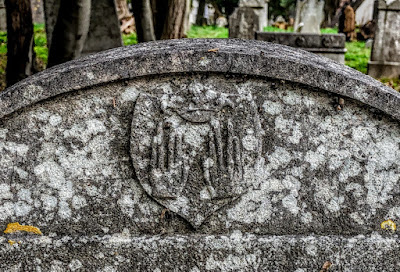
The gravestone of a Levite family in the Jewish cemetery in the Lido, Venice … hand-washing and foot-washing for the priests are part of the ministry of Levites (Photograph: Patrick Comerford)
Part 1 (verses 9-13):
Saint Matthew the Evangelist (מתי/מתתיהו, Gift of Yahweh; Ματθαίος) is one of the Twelve and is identified with both the author of the first of the four gospels and with Levi the publican or tax collector in the Gospels according to Saint Mark and Saint Luke.
Tax collectors were considered unclean ritually, they worked for the occupying power and they were suspect financially. As with Peter and Andrew, Christ sees Matthew the tax collector beside the sea, and he responds immediately to Christ’s call to follow him.
Christ first called fishers as first four disciples: Andrew and Peter, then James and John. His next choice of a tax collector seems a bold move. Tax collectors were typically local Jews who were employed by the Romans to collect taxes from the people. They extracted money from their neighbours and local people to cover the expenses of the foreign rulers and occupiers.
Some translations use the word publican instead of tax-collector. The word publican is a translation of the Greek word for tax-farmer, and we come across it also in the Parable of the Pharisee and the Publican (Luke 18: 9-14).
The Romans paid tax collectors well, and seemingly did not care if the collectors took more than the tax required. They were free to take as much as they could for themselves – once the Romans had been paid.
Rome collected three principal kinds of taxes: a land tax, a head tax, and a customs tax of 2% to 5% of the value on goods being moved around. A tax office or booth stood near a city gate or port to collect the custom tax from people engaged in commercial trade, such as fishers exporting dried fish or farmers sending surplus crops to a larger city.
Tax collectors were seen as collaborators and as greedy, and they were despised. This attitude was reflected in the words of Jesus when he said: ‘If the member refuses to listen to them, tell it to the church; and if the offender refuses to listen even to the church, let such a one be to you as a Gentile and a tax-collector’ (Matthew 18: 17).
The Greek terminology indicates Matthew is a low-level tax collector. Unlike Zacchaeus, he is not a chief tax collector. The words tax booth, or tax office translate the Greek τὸ τελώνιον (to telōnion, ‘revenue or tax office’). Perhaps the booth indicates he collects tolls along the road along the west shore of the Sea of Galilee. He would have been seen as a state-sponsored thief who socialised on the fringes of respectable society.
But when Jesus calls Matthew to follow him, Matthew becomes the disciple of a rabbi who is well-respected, invited him into his home, and organises a welcoming banquet for Jesus, to which he invites other tax collectors.
Dining with Matthew damages Jesus’ reputation in the eyes of the religious leaders, local Pharisees and teachers of the law. To eat with a Gentile or tax collector was regarded by strict Pharisees as rendering one spiritually or ceremonially unclean, to the point that even a house entered by a tax collector could be considered unclean.
Matthew is a Greek form of a Hebrew name, מַתִּתְיָהוּ (Matityahu), meaning ‘Gift of God’ and transliterated into Greek as Ματταθίας (Mattathias). Many New Testament figures have two names: Simon becomes Cephas or Peter, Saul becomes Paul. Mark and Luke name the tax collector as Levi, indicating he may have been a descendent of the tribe of Levi, which included the priests and Levites. But instead of a holy service in the Temple, this Levi is an unholy civil servant in his tax booth.
The roles of the Levites include washing the hands, and sometimes the feet of the kohanim after they remove their shoes and before they ascend the bimah or platform to give the priestly blessing to the congregation. As this custom developed, the association of the Levites with this washing led to iconographic depictions of pitchers, ewers, and bowls on the tombstones of Levite families.
Mattew abandons his lucrative business as a tax collector, and is called too to be a new form of Levite, to minister hand and foot to Christ the great high priest. In accepting Jesus’ invitation, Matthew extends his own invitation: he invited Jesus to dinner in his house, and a large crowd of tax collectors and others eat with them in his large house, suited to a wealthy man. Yet those who are invited are seen as thieves, unbelievers, open sinners and social pariahs.
Did the guests also include Peter and Andrew, James and John, who once despised Matthew who extracted tolls on their fish exports? When they see Jesus warmly accepting Matthew, did they too accept him? Or did it take time? Were they hurt to hear their new fellow disciple put down with the question put not to Jesus but to them: ‘Why does your teacher eat with tax-collectors and sinners?’ (Matthew 9: 11).
Christ dines with people whose trades made them ritually unclean and social outcasts. When the religiously powerful question his actions, Christ replies: ‘Those who are well have no need of a physician, but those who are sick. 13 Go and learn what this means, “I desire mercy, not sacrifice.” For I have come to call not the righteous but sinners’ (verse 13). Christ calls and invite into his Kingdom those in need of repentance, not those who think they are righteous in God’s eyes.
Christ healing the woman in the crowd … a modern Orthodox icon
Part 2 (verses 18-26):
The second part of this Gospel reading (Matthew 9: 18-26) tells two stories about Christ’s response to the plight of two very different women: a 12-year-old girl who is on her deathbed, and a woman who has been suffering for the previous 12 years, as long as the young girl has lived.
Both of them remain unnamed, like so many women in the New Testament. One is the daughter of a leading male figure in the synagogue. But religious position and social status in the local community are of precious little value when a small girl is at the point of death.
In both cases hope has run out, for a little girl and for an old woman. In restoring their health, Christ teaches what faith means, Christ offers new hope, and Christ shows what love is.
In both cases, these women are ritually unclean … a bleeding older woman, and a dying young woman. Jesus should not touch them. Yet their plight touches his heart, and he reaches out to them with a healing touch.
This passage presents us with a large cast of dramatis personae, people who receive the gentle, caring, loving pastoral attention of Christ in equal measure, each within the list of people we are told should be our priority.
They include:
The crowd who gather around Jesus by the lake are going to learn what the Kingdom of God is like, not through another sermon or another lecture, but by seeing what Jesus does. After hearing this Gospel story, would each and every one of them be happy to wear one of those wristbands with the initials ‘WWJD’ – ‘What Would Jesus Do?’ If they looked at our actions for an example of Christian lifestyle, would they know what Jesus does?
Jairus, as he is named in the parallel passage in Saint Mark’s Gospel (Mark 5: 21-43), is a respected provincial leader. He shows what true worship truly is when he throws himself at the feet of Jesus. He prays, entreats, begs, not on behalf of himself, but on behalf of a sick and dying girl. If we were to look at ourselves today, would we see ourselves placing our lives at the feet of Christ, and making our first priorities the needs of others who cannot speak for themselves?
By now the large crowd is pressing in on Jesus. They really want to see what he is on about, what the Christian lifestyle is about. And who becomes the focus of attention within this crowd?
Too often in a crowd, it is those who get to the front first, who have the loudest voices, who are heard and whose demands are met.
In this case, though, it is not the loud and the proud, the rich or the famous, who grab the attention of Christ – it is a weak, timid, neglected impoverished, exploited and sick woman. All her money has gone on quacks, and she has no man to speak up for her.
But look at what Christ does for her. Without knowing it, he heals her. And when he realises what has happened, in very affectionate language, he calls her ‘Daughter’ (verse 22).
In a society where men had the only voices, where to have a full place in society was to be known as a Son of Israel, he takes hearts and calls her ‘Daughter.’ She too has a full and equal place in society, she is commended for her faith, she is restored personally and communally, she is offered healing, and she is also offered peace. From now on, she can be at one with herself, with her society, with the world and with God.
But perhaps there was a danger that all this could become a sideshow for the crowd. The young girl’s father appears to have been forgotten. His household – perhaps religious and community leaders too – tell him to give up on Christ.
Christ does not want to put on a sideshow, either to impress the pressing crowd or to prove wrong the inner circle around this man. In Saint Mark’s account, accompanied by just his three closest friends – Peter, James and John … the three disciples who would soon witness the Transfiguration – he goes directly to the house of the dying girl, where her family and neighbours are in great distress, where the funeral the funeral dirges can already be heard.
It is shocking that the first reactions of some of the key local figures seem to be to upbraid the father for seeking whatever help he can find for his daughter, and not to offer him comfort and sympathy. We can see that in his despair this man was finding no hope from his own community.
Their lack of compassion and sympathy contrasts sharply with the compassion Christ shows for the woman who has been suffering for 12 years. She has spent all her money with consultants and doctors and specialists. None of them has been able to offer her a cure, and now that all her money has run out, all her hope has run out too. All this is compounded by the fact that she is ritually unclean … no man should come near her.
Even as he is being told not to bother coming, even when he is being laughed at, Christ keeps focussed on who is important here – not those who shout the loudest and who press their demands.
Twelve-year-olds have no say, no voice, no power. But Jesus now offers this girl new life, new hope, a new future, a full place in society. When Jesus was her age, he was in the Temple, lost in discussion and debate with the doctors of the law. God becomes present in the presence of the young and vulnerable.
I missed the three-day annual conference of the Anglican mission agency USPG (the United Society Partners in the Gospel) in High Leigh, Hertfordshire last week (2 to 4 June). But I recall how many years ago at this conference (2015), I heard powerful and engaging stories of projects supported by USPG that are empowering women, from these islands to South Africa, from the West Indies and West Africa to India and Pakistan.
Canon Delene Mark from South Africa, gave harrowing accounts of gender-based violence, people trafficking, child murder and forced prostitution.
Sheba Sultan from the Church of Pakistan described the lives of women in Pakistan, from tribal people with few resources and many restrictions, to the elite women who have lives of luxury but find cultural values also stop them from living life to the full.
Anjun Anwar, a Muslim woman born in Pakistan, spoke of her experiences on the staff of Blackburn Cathedral. The Revd Dr Monodeep Daniel shared the work of the Delhi Brotherhood in challenging gender-based violence, including rape and murder. The Revd Dr Evie Vernon spoke of women challenging injustice and violence in Jamaica and in Liberia.
The Revd Dr Miranda Threlfall-Holmes, now the Archdeacon of Liverpool, talked about gender justice and shared a vision of equality for men and women who are created equally in the image and likeness of God, who are made one in Christ, who are called and equipped by the Holy Spirit, and who live with the promise of abundant life for all.
We were challenged that year to ask ourselves: how is the Gospel good news for women? Speaker after speaker insisted it is Good News – but only if we read it, accept its consequences for us, and then live it out.
The Gospel is Good News for the two women in oday’s Gospel reading: they are at opposite ends of the scale in terms of both social status and age. Yet one does not come before the other. The younger woman is restored to her place in her family and in her community. The older woman, who has lost everything, who is at risk of being marginalised even by the Disciples, is offered the hope of her proper place.
Christ has equal compassion for both, and restores them to full life, physically, spiritually and socially, despite objections from men on the scene – the privileged men who have access to the house of Jairus, or the men around Christ who find that a poor, old sick woman is embarrassing.
The Gospel is Good News for women like these two women in this morning's reading, for the women I have heard at USPG conferences year after year. But it is only good news if we hear it and then put it into practice.
‘The Daughter of Jairus’ by James Tissot (1836-1902)
Today’s Prayers (Sunday 7 June 2026, Trinity I):
In Pray with the World Church, the prayer diary of the Anglican mission agency USPG (United Society Partners in the Gospel), the theme this week, from 7 to 13 June 2026 (pp 8-9), is ‘Safe Churches in Zambia’. This theme is introduced today with a programme update from Fran Mate, Senior Regional Manager for Africa, USPG:
‘Across the Anglican Communion, churches are working to strengthen safeguarding and create safer environments for children, young people and vulnerable adults. In Zambia, church leaders gathered in Lusaka earlier this year to take this work forward within the Church in the Province of Central Africa.
‘At the meeting, Dr K Mwanza reminded participants that Safe Church work is not only about policies and procedures, but about everyday behaviour and how people are treated in church communities: “Safe Church work is broader than safeguarding. It involves treating everyone with dignity and respect.”
‘This was reinforced by the Most Revd Albert Chama, Archbishop of the Province of Central Africa and Bishop of Lusaka, who warned: “Documents alone will not keep people safe.” He emphasised that real protection requires committed leadership, practical action, and communities willing to speak up when harm occurs.
‘The gathering also looked to the future by strengthening learning and training. Evangelist Canon Janet Munde highlighted the importance of building “a foundation of knowledge that will be passed on to the next generation.” The Very Revd Canon Jacob Manda added: “Our mindsets and attitudes have been changed, and we have been empowered to go out and [create] safe spaces partners in global mission 8 for all.”
‘The meeting reflects a growing commitment across the Anglican Communion to ensure churches are places of trust and care. Safeguarding is not separate from mission, but part of faithful discipleship, where children, young people and vulnerable adults are protected and able to flourish.’
The USPG Prayer Diary today (Sunday 7 June 2026, Trinity I) invites us to pray by reading and meditating on Matthew 9: 9-13, 18-26.
The Collect:
O God,
the strength of all those who put their trust in you,
mercifully accept our prayers
and, because through the weakness of our mortal nature
we can do no good thing without you,
grant us the help of your grace,
that in the keeping of your commandments
we may please you both in will and deed;
through Jesus Christ your Son our Lord,
who is alive and reigns with you,
in the unity of the Holy Spirit,
one God, now and for ever.
The Post-Communion Prayer:
Eternal Father,
we thank you for nourishing us
with these heavenly gifts:
may our communion strengthen us in faith,
build us up in hope,
and make us grow in love;
for the sake of Jesus Christ our Lord.
Additional Collect:
God of truth,
help us to keep your law of love
and to walk in ways of wisdom,
that we may find true life
in Jesus Christ your Son.
Yesterday’s Reflections
Continued Tomorrow
‘Christ raises the daughter of Jairus’ (left), in the Hardman window by JH Powell at the west end of the nave in Saint Nicholas Church, Adare, Co Limerick (Photograph: Patrick Comerford)
Scripture quotations are from the New Revised Standard Version Bible: Anglicised Edition copyright © 1989, 1995 National Council of the Churches of Christ in the United States of America. Used by permission. All rights reserved worldwide. http://nrsvbibles.org
Showing posts with label Lido. Show all posts
07 June 2026
17 January 2026
Daily prayer in Christmas 2025-2026:
24, Saturday 17 January 2026
The Triptych of Saint Matthew by Andrea di Cione (1343-1368), also known as Orcagna, in the Uffizi, Florence … Saint Matthew is also identified with Levi
Patrick Comerford
The 40-day season of Christmas continues until Candlemas or the Feast of the Presentation (2 February). Tomorrow is the Second Sunday of Epiphany (Epiphany II, 18 January 2026), with readings that continue to focus on the Baptism of Christ by Saint John the Baptist, one of the three great Epiphany theme, alongside the Visit of the Magi and the Wedding at Cana.
The calendar of the Church of England in Common Worship today remembers Antony of Egypt (356), Hermit and Abbot, and Charles Gore (1835-1932), Bishop and Founder of the Community of the Resurrection.
Meanwhile, before today begins, I am taking some quiet time this morning to give thanks, to reflect, to pray and to read in these ways:
1, today’s Gospel reading;
2, a short reflection;
3, a prayer from the USPG prayer diary;
4, the Collects and Post-Communion prayer of the day.
Saint Matthew represented in a group of the Four Evangelists on columns at the porch in University Church, Dublin (Photograph: Patrick Comerford)
Mark 2: 13-17 (NRSVA):
13 Jesus went out again beside the lake; the whole crowd gathered around him, and he taught them. 14 As he was walking along, he saw Levi son of Alphaeus sitting at the tax booth, and he said to him, ‘Follow me.’ And he got up and followed him.
15 And as he sat at dinner in Levi’s house, many tax-collectors and sinners were also sitting with Jesus and his disciples – for there were many who followed him. 16 When the scribes of the Pharisees saw that he was eating with sinners and tax-collectors, they said to his disciples, ‘Why does he eat with tax-collectors and sinners?’ 17 When Jesus heard this, he said to them, ‘Those who are well have no need of a physician, but those who are sick; I have come to call not the righteous but sinners.’
The gravestone of a Levite family in the Jewish cemetery in the Lido, Venice … hand-washing and foot-washing are part of the ministry of Levites (Photograph: Patrick Comerford)
Today’s Reflections:
In the Gospel reading at the Eucharist today (Mark 2: 13-17), Christ is in Capernaum, on the western shore of the Sea of Galilee. He has told a paralytic man that his sins are forgiven, but some religious authorities doubt his ability to do this, saying only God can forgive sins. He has proved that he is from God by also healing the man.
Tax collectors were considered unclean ritually, they worked for the occupying power and they were suspect financially. As with Peter and Andrew, Christ sees Levi the tax collector beside the sea, and he responds immediately to Christ’s call to follow him. Is this the same person as Matthew (see Matthew 9:9), the author of the first Gospel?
Christ first called fishers as first four disciples: Andrew and Peter, then James and John. His next choice of a tax collector seems a bold move. Tax collectors were typically local Jews who were employed by the Romans to collect taxes from the people. They extracted money from their neighbours and local people to cover the expenses of the foreign rulers and occupiers.
Some translations use the word publican instead of tax-collector. The word publican is a translation of τελώνης (telōnēs) the Greek word for tax-farmer, a collector of revenue or tolls, and we come across the same word in the Parable of the Pharisee and the Publican (Luke 18: 9-14).
The Romans paid tax collectors well, and seemingly did not care if the collectors took more than the tax required. They were free to take as much as they could for themselves – once the Romans had been paid.
Rome collected three principal kinds of taxes: a land tax, a head tax, and a customs tax of 2% to 5% of the value on goods being moved around. A tax office or booth stood near a city gate or port to collect the custom tax from people engaged in commercial trade, such as fishers exporting dried fish or farmers sending surplus crops to a larger city.
Tax collectors were seen as collaborators and as greedy, and they were despised. This attitude was reflected in the words of Jesus when he said: ‘If the member refuses to listen to them, tell it to the church; and if the offender refuses to listen even to the church, let such a one be to you as a Gentile and a tax-collector’ (Matthew 18: 17).
The Greek terminology indicates Levi is a low-level tax collector. Unlike Zacchaeus, he is not a chief tax collector. The words tax booth, or tax office translate the Greek τὸ τελώνιον (to telōnion, ‘revenue or tax office’ (Mark 2: 14). Perhaps Levi’s booth indicates he collects tolls along the road along the west shore of the Sea of Galilee. He would have been seen as a state-sponsored thief who socialised on the fringes of respectable society.
When Jesus walks along the shore (Mark 2: 13-14), he sees Levi. But instead of passing by, ignoring Levi or showing contempt or disgust, he calls him to follow him. Levi now becomes the disciple of a rabbi who is well-respected, who invites him into his home, and he organises a welcoming banquet for Jesus, to which he invites other tax collectors.
Dining with Levi damages Jesus’ reputation in the eyes of the religious leaders, local Pharisees and teachers of the law (Mark 2: 16). To eat with a Gentile or tax collector was regarded by strict Pharisees as rendering one spiritually or ceremonially unclean, to the point that even a house entered by a tax collector could be considered unclean.
The identity of Levi and his identification with Matthew are the subject of much speculation. Saint Mark also identifies Levi as the son of Alphaeus (Mark 2: 14). But he is also identified with Matthew in lists of the Twelve (see Luke 6: 14-16). Saint Matthew’s Gospel lists him specifically as Matthew the tax collector (see Matthew 10: 3), identified with the author of Saint Matthew’s Gospel.
Matthew is a Greek form of a Hebrew name, מַתִּתְיָהוּ (Matityahu), meaning ‘Gift of God’ and transliterated into Greek as Ματταθίας (Mattathias). It is similar to but not to be confused with the name Matthias (Ματθίας), another apostle, and the Greek word μαθητής (mathētēs), meaning disciple or learner, often used in the New Testament for followers of Jesus.
Many New Testament figures have two names: Simon becomes Cephas or Peter, Saul becomes Paul.
Mark and Luke name the tax collector as Levi, indicating he may have been a descendent of the tribe of Levi, which included the priests and Levites. But instead of a holy service in the Temple, this Levi is an unholy civil servant in his tax booth.
The roles of the Levites include washing the hands, and sometimes the feet of the kohanim after they remove their shoes and before they ascend the bimah or platform in the synagogue to give the priestly blessing to the congregation. As this custom developed, the association of the Levites with this washing led to iconographic depictions of pitchers, ewers and bowls on the tombstones of Levite families.
Levi abandons his lucrative business as a tax collector, and is called too to be a new form of Levite, to minister hand and foot to Christ the great high priest.
In accepting Jesus’ invitation, Levi extends his own invitation: he invited Jesus to dinner in his house, and a large crowd of tax collectors and others eat with them in his large house, suited to a wealthy man. Yet those who are invited are seen as thieves, unbelievers, open sinners and social pariahs.
Did the guests also include Peter and Andrew, James and John, who once despised Levi who extracted tolls on their fish exports? When they see Jesus warmly accepting Levi, do they too accept him? Or does it take time? Are they hurt to hear their new fellow disciple put down with the question put not to Jesus but to them: ‘Why does he eat with tax-collectors and sinners?’ (Mark 2: 16).
Christ dines with people whose trades make them ritually unclean and social outcasts. When the religiously powerful question his actions, Christ replies: ‘Those who are well have no need of a physician, but those who are sick; I have come to call not the righteous but sinners’ (Mark 2: 16). He comes to call and to invite into his Kingdom those in need of repentance, not those who think they are righteous in God’s eyes.
Saint Matthew the Evangelist represented in a carving on the choir stalls in the Church of Saint Michael and All Angels, Penkridge (Photograph: Patrick Comerford)
Today’s Prayers (Saturday 17 January 2026):
The theme this week (11-17 January 2026) in Pray with the World Church, the prayer diary of the Anglican mission agency USPG (United Society Partners in the Gospel), has been ‘Gaza Crisis Response’ (pp 18-19). This theme was introduced last Sunday with a Programme Update from the Diocese of Jerusalem.
The USPG Prayer Diary today (Saturday 17 January 2026) invites us to pray:
We pray for the Christian Care Centre in Honiara and the women and children who find refuge there. May they experience safety, healing, and hope, and may the Sisters be strengthened in compassion and wisdom.
The Collect:
Most gracious God,
who called your servant Antony to sell all that he had
and to serve you in the solitude of the desert:
by his example may we learn to deny ourselves
and to love you before all things;
through Jesus Christ your Son our Lord,
who is alive and reigns with you,
in the unity of the Holy Spirit,
one God, now and for ever.
The Post-Communion Prayer:
Merciful God,
who gave such grace to your servant Antony
that he served you with singleness of heart
and loved you above all things:
help us, whose communion with you
has been renewed in this sacrament,
to forsake all that holds us back from following Christ
and to grow into his likeness from glory to glory;
through Jesus Christ our Lord.
Collect on the Eve of Epiphany II:
Almighty God,
in Christ you make all things new:
transform the poverty of our nature by the riches of your grace,
and in the renewal of our lives
make known your heavenly glory;
through Jesus Christ your Son our Lord,
who is alive and reigns with you,
in the unity of the Holy Spirit,
one God, now and for ever.
Yesterday’s Reflections
Continued Tomorrow
An image of Saint Antony above the entrance to Saint Antony’s Church in Mitropolis Square, Rethymnon … he is commemorated in the Church Calendar on 17 January (Photograph: Patrick Comerford, 2025)
Scripture quotations are from the New Revised Standard Version Bible: Anglicised Edition copyright © 1989, 1995 National Council of the Churches of Christ in the United States of America. Used by permission. All rights reserved worldwide. http://nrsvbibles.org
Patrick Comerford
The 40-day season of Christmas continues until Candlemas or the Feast of the Presentation (2 February). Tomorrow is the Second Sunday of Epiphany (Epiphany II, 18 January 2026), with readings that continue to focus on the Baptism of Christ by Saint John the Baptist, one of the three great Epiphany theme, alongside the Visit of the Magi and the Wedding at Cana.
The calendar of the Church of England in Common Worship today remembers Antony of Egypt (356), Hermit and Abbot, and Charles Gore (1835-1932), Bishop and Founder of the Community of the Resurrection.
Meanwhile, before today begins, I am taking some quiet time this morning to give thanks, to reflect, to pray and to read in these ways:
1, today’s Gospel reading;
2, a short reflection;
3, a prayer from the USPG prayer diary;
4, the Collects and Post-Communion prayer of the day.
Saint Matthew represented in a group of the Four Evangelists on columns at the porch in University Church, Dublin (Photograph: Patrick Comerford)
Mark 2: 13-17 (NRSVA):
13 Jesus went out again beside the lake; the whole crowd gathered around him, and he taught them. 14 As he was walking along, he saw Levi son of Alphaeus sitting at the tax booth, and he said to him, ‘Follow me.’ And he got up and followed him.
15 And as he sat at dinner in Levi’s house, many tax-collectors and sinners were also sitting with Jesus and his disciples – for there were many who followed him. 16 When the scribes of the Pharisees saw that he was eating with sinners and tax-collectors, they said to his disciples, ‘Why does he eat with tax-collectors and sinners?’ 17 When Jesus heard this, he said to them, ‘Those who are well have no need of a physician, but those who are sick; I have come to call not the righteous but sinners.’
The gravestone of a Levite family in the Jewish cemetery in the Lido, Venice … hand-washing and foot-washing are part of the ministry of Levites (Photograph: Patrick Comerford)
Today’s Reflections:
In the Gospel reading at the Eucharist today (Mark 2: 13-17), Christ is in Capernaum, on the western shore of the Sea of Galilee. He has told a paralytic man that his sins are forgiven, but some religious authorities doubt his ability to do this, saying only God can forgive sins. He has proved that he is from God by also healing the man.
Tax collectors were considered unclean ritually, they worked for the occupying power and they were suspect financially. As with Peter and Andrew, Christ sees Levi the tax collector beside the sea, and he responds immediately to Christ’s call to follow him. Is this the same person as Matthew (see Matthew 9:9), the author of the first Gospel?
Christ first called fishers as first four disciples: Andrew and Peter, then James and John. His next choice of a tax collector seems a bold move. Tax collectors were typically local Jews who were employed by the Romans to collect taxes from the people. They extracted money from their neighbours and local people to cover the expenses of the foreign rulers and occupiers.
Some translations use the word publican instead of tax-collector. The word publican is a translation of τελώνης (telōnēs) the Greek word for tax-farmer, a collector of revenue or tolls, and we come across the same word in the Parable of the Pharisee and the Publican (Luke 18: 9-14).
The Romans paid tax collectors well, and seemingly did not care if the collectors took more than the tax required. They were free to take as much as they could for themselves – once the Romans had been paid.
Rome collected three principal kinds of taxes: a land tax, a head tax, and a customs tax of 2% to 5% of the value on goods being moved around. A tax office or booth stood near a city gate or port to collect the custom tax from people engaged in commercial trade, such as fishers exporting dried fish or farmers sending surplus crops to a larger city.
Tax collectors were seen as collaborators and as greedy, and they were despised. This attitude was reflected in the words of Jesus when he said: ‘If the member refuses to listen to them, tell it to the church; and if the offender refuses to listen even to the church, let such a one be to you as a Gentile and a tax-collector’ (Matthew 18: 17).
The Greek terminology indicates Levi is a low-level tax collector. Unlike Zacchaeus, he is not a chief tax collector. The words tax booth, or tax office translate the Greek τὸ τελώνιον (to telōnion, ‘revenue or tax office’ (Mark 2: 14). Perhaps Levi’s booth indicates he collects tolls along the road along the west shore of the Sea of Galilee. He would have been seen as a state-sponsored thief who socialised on the fringes of respectable society.
When Jesus walks along the shore (Mark 2: 13-14), he sees Levi. But instead of passing by, ignoring Levi or showing contempt or disgust, he calls him to follow him. Levi now becomes the disciple of a rabbi who is well-respected, who invites him into his home, and he organises a welcoming banquet for Jesus, to which he invites other tax collectors.
Dining with Levi damages Jesus’ reputation in the eyes of the religious leaders, local Pharisees and teachers of the law (Mark 2: 16). To eat with a Gentile or tax collector was regarded by strict Pharisees as rendering one spiritually or ceremonially unclean, to the point that even a house entered by a tax collector could be considered unclean.
The identity of Levi and his identification with Matthew are the subject of much speculation. Saint Mark also identifies Levi as the son of Alphaeus (Mark 2: 14). But he is also identified with Matthew in lists of the Twelve (see Luke 6: 14-16). Saint Matthew’s Gospel lists him specifically as Matthew the tax collector (see Matthew 10: 3), identified with the author of Saint Matthew’s Gospel.
Matthew is a Greek form of a Hebrew name, מַתִּתְיָהוּ (Matityahu), meaning ‘Gift of God’ and transliterated into Greek as Ματταθίας (Mattathias). It is similar to but not to be confused with the name Matthias (Ματθίας), another apostle, and the Greek word μαθητής (mathētēs), meaning disciple or learner, often used in the New Testament for followers of Jesus.
Many New Testament figures have two names: Simon becomes Cephas or Peter, Saul becomes Paul.
Mark and Luke name the tax collector as Levi, indicating he may have been a descendent of the tribe of Levi, which included the priests and Levites. But instead of a holy service in the Temple, this Levi is an unholy civil servant in his tax booth.
The roles of the Levites include washing the hands, and sometimes the feet of the kohanim after they remove their shoes and before they ascend the bimah or platform in the synagogue to give the priestly blessing to the congregation. As this custom developed, the association of the Levites with this washing led to iconographic depictions of pitchers, ewers and bowls on the tombstones of Levite families.
Levi abandons his lucrative business as a tax collector, and is called too to be a new form of Levite, to minister hand and foot to Christ the great high priest.
In accepting Jesus’ invitation, Levi extends his own invitation: he invited Jesus to dinner in his house, and a large crowd of tax collectors and others eat with them in his large house, suited to a wealthy man. Yet those who are invited are seen as thieves, unbelievers, open sinners and social pariahs.
Did the guests also include Peter and Andrew, James and John, who once despised Levi who extracted tolls on their fish exports? When they see Jesus warmly accepting Levi, do they too accept him? Or does it take time? Are they hurt to hear their new fellow disciple put down with the question put not to Jesus but to them: ‘Why does he eat with tax-collectors and sinners?’ (Mark 2: 16).
Christ dines with people whose trades make them ritually unclean and social outcasts. When the religiously powerful question his actions, Christ replies: ‘Those who are well have no need of a physician, but those who are sick; I have come to call not the righteous but sinners’ (Mark 2: 16). He comes to call and to invite into his Kingdom those in need of repentance, not those who think they are righteous in God’s eyes.
Saint Matthew the Evangelist represented in a carving on the choir stalls in the Church of Saint Michael and All Angels, Penkridge (Photograph: Patrick Comerford)
Today’s Prayers (Saturday 17 January 2026):
The theme this week (11-17 January 2026) in Pray with the World Church, the prayer diary of the Anglican mission agency USPG (United Society Partners in the Gospel), has been ‘Gaza Crisis Response’ (pp 18-19). This theme was introduced last Sunday with a Programme Update from the Diocese of Jerusalem.
The USPG Prayer Diary today (Saturday 17 January 2026) invites us to pray:
We pray for the Christian Care Centre in Honiara and the women and children who find refuge there. May they experience safety, healing, and hope, and may the Sisters be strengthened in compassion and wisdom.
The Collect:
Most gracious God,
who called your servant Antony to sell all that he had
and to serve you in the solitude of the desert:
by his example may we learn to deny ourselves
and to love you before all things;
through Jesus Christ your Son our Lord,
who is alive and reigns with you,
in the unity of the Holy Spirit,
one God, now and for ever.
The Post-Communion Prayer:
Merciful God,
who gave such grace to your servant Antony
that he served you with singleness of heart
and loved you above all things:
help us, whose communion with you
has been renewed in this sacrament,
to forsake all that holds us back from following Christ
and to grow into his likeness from glory to glory;
through Jesus Christ our Lord.
Collect on the Eve of Epiphany II:
Almighty God,
in Christ you make all things new:
transform the poverty of our nature by the riches of your grace,
and in the renewal of our lives
make known your heavenly glory;
through Jesus Christ your Son our Lord,
who is alive and reigns with you,
in the unity of the Holy Spirit,
one God, now and for ever.
Yesterday’s Reflections
Continued Tomorrow
An image of Saint Antony above the entrance to Saint Antony’s Church in Mitropolis Square, Rethymnon … he is commemorated in the Church Calendar on 17 January (Photograph: Patrick Comerford, 2025)
Scripture quotations are from the New Revised Standard Version Bible: Anglicised Edition copyright © 1989, 1995 National Council of the Churches of Christ in the United States of America. Used by permission. All rights reserved worldwide. http://nrsvbibles.org
Labels:
Christmas 2025,
Crete 2026,
Dublin Churches,
Egypt,
Epiphany 2026,
Florence,
Greece 2026,
Jewish Spirituality,
Lido,
Middle East,
Mission,
Penkridge,
Prayer,
Rethymnon,
Saint Mark's Gospel,
Saint Matthew,
USPG,
Venice
23 December 2025
Daily prayer in Advent 2025:
24, Tuesday 23 December 2025
Saint John the Baptist with his parents, Saint Zechariah and Saint Elizabeth, in a mosaic at the Monastery of Saint John the Baptist in Tolleshunt Knights, Essex (Photograph: Patrick Comerford)
Patrick Comerford
We are drawing near to the end of Advent and tomorrow is Christmas Eve. Later this morning I am involved in Santa’s visit to the Christmas Fayre and Farmers’ Market in Stoy Stratford. But, before today begins, I am taking some quiet time this morning to give thanks, to reflect, to pray and to read in these ways:
1, today’s Gospel reading;
2, a short reflection;
3, a prayer from the USPG prayer diary;
4, the Collects and Post-Communion prayer of the day.
A priest’s hands raised for the blessing of the cohanim … a gravestone in the new Jewish cemetery on the Lido in Venice (Photograph: Patrick Comerford)
Luke 1: 57-66 (NRSVA):
57 Now the time came for Elizabeth to give birth, and she bore a son. 58 Her neighbours and relatives heard that the Lord had shown his great mercy to her, and they rejoiced with her.
59 On the eighth day they came to circumcise the child, and they were going to name him Zechariah after his father. 60 But his mother said, ‘No; he is to be called John.’ 61 They said to her, ‘None of your relatives has this name.’ 62 Then they began motioning to his father to find out what name he wanted to give him. 63 He asked for a writing-tablet and wrote, ‘His name is John.’ And all of them were amazed. 64 Immediately his mouth was opened and his tongue freed, and he began to speak, praising God. 65 Fear came over all their neighbours, and all these things were talked about throughout the entire hill country of Judea. 66 All who heard them pondered them and said, ‘What then will this child become?’ For, indeed, the hand of the Lord was with him.
Dreidels in a synagogue in Prague, part of children’s games at Hanukkah … did John the Baptist and Jesus spin dredels together at Hanukkah? (Photograph: Patrick Comerford)
Today’s Reflections:
In the Gospel reading at the Eucharist today (Luke 1: 57-66), we continue a series of readings before Christmas that draw on the two nativity narratives found in Matthew 1: 1-24 and Luke 1: 5-79.
During the week before Christmas, the great canticle Magnificat at Evensong traditionally has a refrain or antiphon attached to it proclaiming the ascriptions or ‘names’ given to God through the Old Testament. Each name develops into a prophecy of the coming of the Messiah.
O Sapientia, or O Wisdom, is the first of these days, and was marked on Wednesday (17 December). It was followed on Thursday (18 December) by O Adonai, by O Root of Jesse on Friday (19 December), O Key of David on Saturday (20 December), O Dayspring on Sunday (21 December), O King of the Nations yesterday (22 December), and, finally O Emmanuel today (23 December).
The seven majestic Messianic titles for Christ are based on Biblical prophecies, and they help the Church to recall the variety of the ills of humanity before the coming of the Redeemer as each antiphon in turn pleads with mounting impatience for Christ to save his people.
The Gospel reading at the Eucharist today (Luke 1: 57-66) continues on from the story of the Visitation of the Virgin Mary to her cousin Saint Elizabeth, with the only Gospel account of the birth, circumcision and naming of Saint John the Baptist.
Zechariah (זְכַרְיָה or Ζαχαρίας), also named in translations as Zacharias, Zachariah and Zachary, the husband of Elizabeth and the father of John the Baptist, is a priest, one of the cohanim descended from the sons of Aaron. Origen suggests that the Zechariah mentioned in Matthew 23: 35 as being killed between the temple and the altar may be the father of John the Baptist.
His name means ‘remember Yah’ or ‘remember God’ or ‘God remembers’. There are several Biblical figures with the name, including the Prophet Zachariah in Judah, a martyred son of a high priest, a king who reigned in Judah for six months, and several minor characters.
On the other hand, the Greek name Ἰωάννης (Ioannes) is a rendering of the Hebrew name Yohanan (יוֹחָנָן), a shorter form of the name Yəhôḥānān (יְהוֹחָנָן), which means ‘God is gracious’.
In the Hebrew Bible, Yohanan was the son of King Josiah of Judah (7th century BCE); Yohanan, son of Kareah, was a leader of the army who led the remnant of the population of Judah to Egypt for safety after the Babylonian dismantling of the kingdom in 586 BCE; Yohanan ben Yehoyada is a high priest named in the Book of Nehemiah and was the fourth in the line of high priests after Joshua the High Priest, who returned from the Babylonian captivity with Zerubbabel.
During the Hasmonean or Maccabean period, Yohanan was the father of Matityahu; John Gaddi, the eldest of the sons of Mattathias and brother of Judas Maccabeus, was one of the leaders of the revolt of the Maccabees in the 2nd century BCE; John Hyrcanus was a Maccabean leader and Jewish high priest from 134 BCE until his death in 104 BCE; and John Hyrcanus II (1st century BCE) was a member of the Hasmonean dynasty, High Priest, King, and ethnarch of Judea.
So, the name John, in its variant forms, was both a priestly and a royal name, and was associated with the leaders of resistance to occupation and resistance.
In idle moments, I sometimes wonder whether Jesus and John grew up knowing each other.
Did Mary and Joseph regularly visit Zechariah and Elizabeth?
Was Zechariah present as a priest in the Temple at the Presentation, or when the teenage Jesus was lost in the Temple?
Did Jesus and John send birthday greetings to one another?
Did they go to each other’s bar mitzvah?
Did they celebrate and major holidays of Holy Days together … Purim, Passover, Shavuot, Sukkot, Rosh Hashanah, Yom Kippur, Simchat Torah, Hanukkah … ?
Did they dress up together at Purim?
Did they spin dreidels with each other and play games together at Hanukkah? – Incidentally, yesterday (Monday) was the last day of Hanukkah this year, but Christmas Day and the first day of Hanukkah fell on the same day last year, for the first time in 19 years.
Did John the Baptist ever take up his duties and responsibilities as a priest in the Temple before going out into the Wilderness?
Was he in the Temple when Jesus visited, healed, taught, debated Caesar’s coins, or overturned the tables of the moneychangers?
Did John offer Jesus the priestly blessing that the cohanim alone impart?
The priestly blessing (Numbers 6: 24-26) that Zechariah and John would have pronounced, with their hands outstretched in the traditional way, is:
May the Lord bless and protect you.
May the Lord make his face shine on you and be gracious to you
May the Lord turn his face toward you, and give you peace.
The Priestly Blessing (ברכת כהנים, birkat cohanim) is known in rabbinic literature as raising the hands or rising to the platform because the blessing is given from a raised rostrum.
The Jewish Sages stressed that although the priests are the ones carrying out the blessing, it is not them or the ceremonial practice of raising their hands that results in the blessing, but rather it is God’s desire that his blessing should be symbolised by the hands of the cohanim.
The former Chief Rabbi, the late Lord (Jonathan) Sacks, says the Torah explicitly says that while the cohanim say the words, it is God who sends the blessing: ‘When the cohanim bless the people, they are not doing anything in and of themselves. Instead they are acting as channels through which God’s blessing flows into the world and into our lives.’
He adds, ‘Only love does this. Love means that we are focused not on ourselves but on another. Love is selflessness. And only selflessness allows us to be a channel through which flows a force greater than ourselves, the love that as Dante said, “moves the sun and the other stars”, the love that brings new life into the world.’
Hands raised in the priestly blessing on a gravestone in the Jewish cemetery in Kraków (Photograph: Patrick Comerford)
Today’s Prayers (Tuesday 23 December 2025):
The theme this week (21 to 27 December 2025) in Pray with the World Church, the prayer diary of the Anglican mission agency USPG (United Society Partners in the Gospel), is ‘Love Brings Life in Tanzania’ (pp 12-13). This theme was introduced on Sunday with a Programme Update by Imran Englefield, Individual Giving Manager, USPG.
The USPG Prayer Diary today (Tuesday 23 December 2025) invites us to pray:
Gracious Lord, we give thanks for the success of the Prevention of Mother-to-Child Transmission programme. Strengthen those who care, comfort those who suffer, and let hope, healing, and life flourish in this place.
The Collect:
God our redeemer,
who prepared the Blessed Virgin Mary
to be the mother of your Son:
grant that, as she looked for his coming as our saviour,
so we may be ready to greet him
when he comes again as our judge;
who is alive and reigns with you,
in the unity of the Holy Spirit,
one God, now and for ever.
The Post-Communion Prayer:
Heavenly Father,
who chose the Blessed Virgin Mary
to be the mother of the promised saviour
: fill us your servants with your grace,
that in all things we may embrace your holy will
and with her rejoice in your salvation;
through Jesus Christ our Lord.
Additional Collect:
Eternal God,
as Mary waited for the birth of your Son,
so we wait for his coming in glory;
bring us through the birth pangs of this present age
to see, with her, our great salvation
in Jesus Christ our Lord.
Yesterday’s Reflections
Continued Tomorrow
Hands raised in the priestly blessing on a Holocaust memorial in Berlin (Photograph: Patrick Comerford)
Scripture quotations are from the New Revised Standard Version Bible: Anglicised Edition copyright © 1989, 1995 National Council of the Churches of Christ in the United States of America. Used by permission. All rights reserved worldwide. http://nrsvbibles.org
Patrick Comerford
We are drawing near to the end of Advent and tomorrow is Christmas Eve. Later this morning I am involved in Santa’s visit to the Christmas Fayre and Farmers’ Market in Stoy Stratford. But, before today begins, I am taking some quiet time this morning to give thanks, to reflect, to pray and to read in these ways:
1, today’s Gospel reading;
2, a short reflection;
3, a prayer from the USPG prayer diary;
4, the Collects and Post-Communion prayer of the day.
A priest’s hands raised for the blessing of the cohanim … a gravestone in the new Jewish cemetery on the Lido in Venice (Photograph: Patrick Comerford)
Luke 1: 57-66 (NRSVA):
57 Now the time came for Elizabeth to give birth, and she bore a son. 58 Her neighbours and relatives heard that the Lord had shown his great mercy to her, and they rejoiced with her.
59 On the eighth day they came to circumcise the child, and they were going to name him Zechariah after his father. 60 But his mother said, ‘No; he is to be called John.’ 61 They said to her, ‘None of your relatives has this name.’ 62 Then they began motioning to his father to find out what name he wanted to give him. 63 He asked for a writing-tablet and wrote, ‘His name is John.’ And all of them were amazed. 64 Immediately his mouth was opened and his tongue freed, and he began to speak, praising God. 65 Fear came over all their neighbours, and all these things were talked about throughout the entire hill country of Judea. 66 All who heard them pondered them and said, ‘What then will this child become?’ For, indeed, the hand of the Lord was with him.
Dreidels in a synagogue in Prague, part of children’s games at Hanukkah … did John the Baptist and Jesus spin dredels together at Hanukkah? (Photograph: Patrick Comerford)
Today’s Reflections:
In the Gospel reading at the Eucharist today (Luke 1: 57-66), we continue a series of readings before Christmas that draw on the two nativity narratives found in Matthew 1: 1-24 and Luke 1: 5-79.
During the week before Christmas, the great canticle Magnificat at Evensong traditionally has a refrain or antiphon attached to it proclaiming the ascriptions or ‘names’ given to God through the Old Testament. Each name develops into a prophecy of the coming of the Messiah.
O Sapientia, or O Wisdom, is the first of these days, and was marked on Wednesday (17 December). It was followed on Thursday (18 December) by O Adonai, by O Root of Jesse on Friday (19 December), O Key of David on Saturday (20 December), O Dayspring on Sunday (21 December), O King of the Nations yesterday (22 December), and, finally O Emmanuel today (23 December).
The seven majestic Messianic titles for Christ are based on Biblical prophecies, and they help the Church to recall the variety of the ills of humanity before the coming of the Redeemer as each antiphon in turn pleads with mounting impatience for Christ to save his people.
The Gospel reading at the Eucharist today (Luke 1: 57-66) continues on from the story of the Visitation of the Virgin Mary to her cousin Saint Elizabeth, with the only Gospel account of the birth, circumcision and naming of Saint John the Baptist.
Zechariah (זְכַרְיָה or Ζαχαρίας), also named in translations as Zacharias, Zachariah and Zachary, the husband of Elizabeth and the father of John the Baptist, is a priest, one of the cohanim descended from the sons of Aaron. Origen suggests that the Zechariah mentioned in Matthew 23: 35 as being killed between the temple and the altar may be the father of John the Baptist.
His name means ‘remember Yah’ or ‘remember God’ or ‘God remembers’. There are several Biblical figures with the name, including the Prophet Zachariah in Judah, a martyred son of a high priest, a king who reigned in Judah for six months, and several minor characters.
On the other hand, the Greek name Ἰωάννης (Ioannes) is a rendering of the Hebrew name Yohanan (יוֹחָנָן), a shorter form of the name Yəhôḥānān (יְהוֹחָנָן), which means ‘God is gracious’.
In the Hebrew Bible, Yohanan was the son of King Josiah of Judah (7th century BCE); Yohanan, son of Kareah, was a leader of the army who led the remnant of the population of Judah to Egypt for safety after the Babylonian dismantling of the kingdom in 586 BCE; Yohanan ben Yehoyada is a high priest named in the Book of Nehemiah and was the fourth in the line of high priests after Joshua the High Priest, who returned from the Babylonian captivity with Zerubbabel.
During the Hasmonean or Maccabean period, Yohanan was the father of Matityahu; John Gaddi, the eldest of the sons of Mattathias and brother of Judas Maccabeus, was one of the leaders of the revolt of the Maccabees in the 2nd century BCE; John Hyrcanus was a Maccabean leader and Jewish high priest from 134 BCE until his death in 104 BCE; and John Hyrcanus II (1st century BCE) was a member of the Hasmonean dynasty, High Priest, King, and ethnarch of Judea.
So, the name John, in its variant forms, was both a priestly and a royal name, and was associated with the leaders of resistance to occupation and resistance.
In idle moments, I sometimes wonder whether Jesus and John grew up knowing each other.
Did Mary and Joseph regularly visit Zechariah and Elizabeth?
Was Zechariah present as a priest in the Temple at the Presentation, or when the teenage Jesus was lost in the Temple?
Did Jesus and John send birthday greetings to one another?
Did they go to each other’s bar mitzvah?
Did they celebrate and major holidays of Holy Days together … Purim, Passover, Shavuot, Sukkot, Rosh Hashanah, Yom Kippur, Simchat Torah, Hanukkah … ?
Did they dress up together at Purim?
Did they spin dreidels with each other and play games together at Hanukkah? – Incidentally, yesterday (Monday) was the last day of Hanukkah this year, but Christmas Day and the first day of Hanukkah fell on the same day last year, for the first time in 19 years.
Did John the Baptist ever take up his duties and responsibilities as a priest in the Temple before going out into the Wilderness?
Was he in the Temple when Jesus visited, healed, taught, debated Caesar’s coins, or overturned the tables of the moneychangers?
Did John offer Jesus the priestly blessing that the cohanim alone impart?
The priestly blessing (Numbers 6: 24-26) that Zechariah and John would have pronounced, with their hands outstretched in the traditional way, is:
May the Lord bless and protect you.
May the Lord make his face shine on you and be gracious to you
May the Lord turn his face toward you, and give you peace.
The Priestly Blessing (ברכת כהנים, birkat cohanim) is known in rabbinic literature as raising the hands or rising to the platform because the blessing is given from a raised rostrum.
The Jewish Sages stressed that although the priests are the ones carrying out the blessing, it is not them or the ceremonial practice of raising their hands that results in the blessing, but rather it is God’s desire that his blessing should be symbolised by the hands of the cohanim.
The former Chief Rabbi, the late Lord (Jonathan) Sacks, says the Torah explicitly says that while the cohanim say the words, it is God who sends the blessing: ‘When the cohanim bless the people, they are not doing anything in and of themselves. Instead they are acting as channels through which God’s blessing flows into the world and into our lives.’
He adds, ‘Only love does this. Love means that we are focused not on ourselves but on another. Love is selflessness. And only selflessness allows us to be a channel through which flows a force greater than ourselves, the love that as Dante said, “moves the sun and the other stars”, the love that brings new life into the world.’
Hands raised in the priestly blessing on a gravestone in the Jewish cemetery in Kraków (Photograph: Patrick Comerford)
Today’s Prayers (Tuesday 23 December 2025):
The theme this week (21 to 27 December 2025) in Pray with the World Church, the prayer diary of the Anglican mission agency USPG (United Society Partners in the Gospel), is ‘Love Brings Life in Tanzania’ (pp 12-13). This theme was introduced on Sunday with a Programme Update by Imran Englefield, Individual Giving Manager, USPG.
The USPG Prayer Diary today (Tuesday 23 December 2025) invites us to pray:
Gracious Lord, we give thanks for the success of the Prevention of Mother-to-Child Transmission programme. Strengthen those who care, comfort those who suffer, and let hope, healing, and life flourish in this place.
The Collect:
God our redeemer,
who prepared the Blessed Virgin Mary
to be the mother of your Son:
grant that, as she looked for his coming as our saviour,
so we may be ready to greet him
when he comes again as our judge;
who is alive and reigns with you,
in the unity of the Holy Spirit,
one God, now and for ever.
The Post-Communion Prayer:
Heavenly Father,
who chose the Blessed Virgin Mary
to be the mother of the promised saviour
: fill us your servants with your grace,
that in all things we may embrace your holy will
and with her rejoice in your salvation;
through Jesus Christ our Lord.
Additional Collect:
Eternal God,
as Mary waited for the birth of your Son,
so we wait for his coming in glory;
bring us through the birth pangs of this present age
to see, with her, our great salvation
in Jesus Christ our Lord.
Yesterday’s Reflections
Continued Tomorrow
Hands raised in the priestly blessing on a Holocaust memorial in Berlin (Photograph: Patrick Comerford)
Scripture quotations are from the New Revised Standard Version Bible: Anglicised Edition copyright © 1989, 1995 National Council of the Churches of Christ in the United States of America. Used by permission. All rights reserved worldwide. http://nrsvbibles.org
Labels:
Advent 2025,
Berlin,
Christmas 2025,
Hanukkah,
Kraków,
Lido,
Mission,
Prague,
Prayer,
Saint John the Baptist,
Saint Luke's Gospel,
Stony Stratford,
Tanzania,
Tolleshunt Knights,
USPG,
Venice
18 January 2025
Daily prayer in Christmas 2024-2025:
25, Saturday 18 January 2025
The Triptych of Saint Matthew by Andrea di Cione (1343-1368), also known as Orcagna, in the Uffizi, Florence … Saint Matthew is also identified with Levi
Patrick Comerford
The 40-day season of Christmas continues until Candlemas or the Feast of the Presentation (2 February). Tomorrow is the Second Sunday of Epiphany (Epiphany II, 19 January 2025), with readings that focus on the Wedding at Cana, the third great Epiphany theme, alongside the Visit of the Magi and the Baptism of Christ.
Today is the First Day of the Week of Prayer for Christian Unity. The calendar of the Church of England in Common Worship today remembers the life and work of Amy Carmichael (1951), founder of the Dohnavur Fellowship and spiritual writer.
Two of us are in York for the weekend, having arrived late yesterday, and we are hoping to join a family celebration in Harrogate later in the day. But, before today begins, I am taking some quiet time this morning to give thanks, to reflect, to pray and to read in these ways:
1, today’s Gospel reading;
2, a short reflection;
3, a prayer from the USPG prayer diary;
4, the Collects and Post-Communion prayer of the day.
Saint Matthew represented in a group of the Four Evangelists on columns at the porch in University Church, Dublin (Photograph: Patrick Comerford)
Mark 2: 13-17 (NRSVA):
13 Jesus went out again beside the lake; the whole crowd gathered around him, and he taught them. 14 As he was walking along, he saw Levi son of Alphaeus sitting at the tax booth, and he said to him, ‘Follow me.’ And he got up and followed him.
15 And as he sat at dinner in Levi’s house, many tax-collectors and sinners were also sitting with Jesus and his disciples – for there were many who followed him. 16 When the scribes of the Pharisees saw that he was eating with sinners and tax-collectors, they said to his disciples, ‘Why does he eat with tax-collectors and sinners?’ 17 When Jesus heard this, he said to them, ‘Those who are well have no need of a physician, but those who are sick; I have come to call not the righteous but sinners.’
The gravestone of a Levite family in the Jewish cemetery in the Lido, Venice … hand-washing and foot-washing are part of the ministry of Levites (Photograph: Patrick Comerford)
Today’s Reflection:
Christ is in Capernaum, on the western shore of the Sea of Galilee. He has told a paralytic man that his sins are forgiven, but some religious authorities doubt his ability to do this, saying only God can forgive sins. He has proved that he is from God by also healing the man.
Tax collectors were considered unclean ritually, they worked for the occupying power and they were suspect financially. As with Peter and Andrew, Christ sees Levi the tax collector beside the sea, and he responds immediately to Christ’s call to follow him. Is this the same person as Matthew (see Matthew 9:9), the author of the first Gospel?
Christ first called fishers as first four disciples: Andrew and Peter, then James and John. His next choice of a tax collector seems a bold move. Tax collectors were typically local Jews who were employed by the Romans to collect taxes from the people. They extracted money from their neighbours and local people to cover the expenses of the foreign rulers and occupiers.
Some translations use the word publican instead of tax-collector. The word publican is a translation of the Greek word for tax-farmer, and we come across it also in the Parable of the Pharisee and the Publican (Luke 18: 9-14).
The Romans paid tax collectors well, and seemingly did not care if the collectors took more than the tax required. They were free to take as much as they could for themselves – once the Romans had been paid.
Rome collected three principal kinds of taxes: a land tax, a head tax, and a customs tax of 2% to 5% of the value on goods being moved around. A tax office or booth stood near a city gate or port to collect the custom tax from people engaged in commercial trade, such as fishers exporting dried fish or farmers sending surplus crops to a larger city.
Tax collectors were seen as collaborators and as greedy, and they were despised. This attitude was reflected in the words of Jesus when he said: ‘If the member refuses to listen to them, tell it to the church; and if the offender refuses to listen even to the church, let such a one be to you as a Gentile and a tax-collector’ (Matthew 18: 17).
The Greek terminology indicates Levi is a low-level tax collector. Unlike Zacchaeus, he is not a chief tax collector. The words tax booth, or tax office translate the Greek τὸ τελώνιον (to telōnion, ‘revenue or tax office’ (Mark 2: 14). Perhaps Levi’s booth indicates he collects tolls along the road along the west shore of the Sea of Galilee. He would have been seen as a state-sponsored thief who socialised on the fringes of respectable society.
When Jesus walks along the shore (Mark 2: 13-14), he sees Levi. But instead of passing by, ignoring Levi or showing contempt or disgust, he calls him to follow him. Levi becomes now the disciple of a rabbi who is well-respected, invited him into his home, and organises a welcoming banquet for Jesus, to which he invites other tax collectors.
Dining with Levi damages Jesus’ reputation in the eyes of the religious leaders, local Pharisees and teachers of the law (Mark 2: 16). To eat with a Gentile or tax collector was regarded by the strict Pharisees as rendering one spiritually or ceremonially unclean, to the point that even a house entered by a tax collector could be considered unclean.
The identity of Levi and his identity with Matthew are the subject of much speculation. Saint Mark also identifies Levi as the son of Alphaeus (Mark 2: 14). But he is also identified with Matthew in lists of the Twelve (see Luke 6: 14-16). Saint Matthew’s Gospel lists him specifically as Matthew the tax collector (see Matthew 10: 3), identified with the author of Saint Matthew’s Gospel.
Matthew is a Greek form of a Hebrew name, מַתִּתְיָהוּ (Matityahu), meaning ‘Gift of God’ and transliterated into Greek as Ματταθίας (Mattathias). Many New Testament figures have two names: Simon becomes Cephas or Peter, Saul becomes Paul.
Mark and Luke name the tax collector as Levi, indicating he may have been a descendent of the tribe of Levi, which included the priests and Levites. But instead of a holy service in the Temple, this Levi is an unholy civil servant in his tax booth.
The roles of the Levites include washing the hands, and sometimes the feet of the kohanim after they remove their shoes and before they ascend the bimah or platform to give the priestly blessing to the congregation. As this custom developed, the association of the Levites with this washing led to iconographic depictions of pitchers, ewers, and bowls on the tombstones of Levite families.
Levi abandons his lucrative business as a tax collector, and is called too to be a new form of Levite, to minister hand and foot to Christ the great high priest.
In accepting Jesus’ invitation, Levi extends his own invitation: he invited Jesus to dinner in his house, and a large crowd of tax collectors and others eat with them in his large house, suited to a wealthy man. Yet those who are invited are seen as thieves, unbelievers, open sinners and social pariahs.
Did the guests also include Peter and Andrew, James and John, who once despised Levi who extracted tolls on their fish exports. When they see Jesus warmly accepting Levi, did they too accept him? Or did it take time? Were they hurt to hear their new fellow disciple put down with the question put not to Jesus but to them: ‘Why does he eat with tax-collectors and sinners?’ (Mark 2: 16).
Christ dines with people whose trades made them ritually unclean and social outcasts. When the religiously powerful question his actions, Christ replies: ‘Those who are well have no need of a physician, but those who are sick; I have come to call not the righteous but sinners’ (Mark 2: 16). comes to call and to invite into his Kingdom those in need of repentance, not those who think they are righteous in God’s eyes.
Saint Matthew the Evangelist represented in a carving on the choir stalls in the Church of Saint Michael and All Angels, Penkridge (Photograph: Patrick Comerford)
Today’s Prayers (Saturday 18 January 2025):
The theme this week in ‘Pray With the World Church’, the Prayer Diary of the Anglican mission agency USPG (United Society Partners in the Gospel), has been ‘A Bag of Flour’. This theme was introduced last Sunday with a Programme Update by Rachel Weller, Communications Officer, USPG.
The USPG Prayer Diary today (Saturday 18 January 2025) invites us to pray:
Heavenly Father, we praise you that Al-Ahli Anglican Hospital can provide important medical services. We thank you for the Anglican Alliance Partnership network that supports the Diocese of Jerusalem in its ministry of healing.
The Collect:
Eternal Father,
who at the baptism of Jesus
revealed him to be your Son,
anointing him with the Holy Spirit:
grant to us, who are born again by water and the Spirit,
that we may be faithful to our calling as your adopted children;
through Jesus Christ your Son our Lord,
who is alive and reigns with you,
in the unity of the Holy Spirit,
one God, now and for ever.
The Post-Communion Prayer:
Lord of all time and eternity,
you opened the heavens and revealed yourself as Father
in the baptism of Jesus your beloved Son:
by the power of your Spirit
complete the heavenly work of our rebirth
through the waters of the new creation;
through Jesus Christ our Lord.
Additional Collect:
Heavenly Father,
at the Jordan you revealed Jesus as your Son:
may we recognize him as our Lord
and know ourselves to be your beloved children;
through Jesus Christ our Saviour.
Collect on the Eve of Epiphany II:
Almighty God,
in Christ you make all things new:
transform the poverty of our nature by the riches of your grace,
and in the renewal of our lives
make known your heavenly glory;
through Jesus Christ your Son our Lord,
who is alive and reigns with you,
in the unity of the Holy Spirit,
one God, now and for ever.
Yesterday’s Reflection
Continued Tomorrow
Two evangelists, Saint Matthew and Saint Mark, depicted in a window in All Saints’ Church, Calverton (Photograph: Patrick Comerford)
Scripture quotations are from the New Revised Standard Version Bible: Anglicised Edition copyright © 1989, 1995 National Council of the Churches of Christ in the United States of America. Used by permission. All rights reserved worldwide. http://nrsvbibles.org
Patrick Comerford
The 40-day season of Christmas continues until Candlemas or the Feast of the Presentation (2 February). Tomorrow is the Second Sunday of Epiphany (Epiphany II, 19 January 2025), with readings that focus on the Wedding at Cana, the third great Epiphany theme, alongside the Visit of the Magi and the Baptism of Christ.
Today is the First Day of the Week of Prayer for Christian Unity. The calendar of the Church of England in Common Worship today remembers the life and work of Amy Carmichael (1951), founder of the Dohnavur Fellowship and spiritual writer.
Two of us are in York for the weekend, having arrived late yesterday, and we are hoping to join a family celebration in Harrogate later in the day. But, before today begins, I am taking some quiet time this morning to give thanks, to reflect, to pray and to read in these ways:
1, today’s Gospel reading;
2, a short reflection;
3, a prayer from the USPG prayer diary;
4, the Collects and Post-Communion prayer of the day.
Saint Matthew represented in a group of the Four Evangelists on columns at the porch in University Church, Dublin (Photograph: Patrick Comerford)
Mark 2: 13-17 (NRSVA):
13 Jesus went out again beside the lake; the whole crowd gathered around him, and he taught them. 14 As he was walking along, he saw Levi son of Alphaeus sitting at the tax booth, and he said to him, ‘Follow me.’ And he got up and followed him.
15 And as he sat at dinner in Levi’s house, many tax-collectors and sinners were also sitting with Jesus and his disciples – for there were many who followed him. 16 When the scribes of the Pharisees saw that he was eating with sinners and tax-collectors, they said to his disciples, ‘Why does he eat with tax-collectors and sinners?’ 17 When Jesus heard this, he said to them, ‘Those who are well have no need of a physician, but those who are sick; I have come to call not the righteous but sinners.’
The gravestone of a Levite family in the Jewish cemetery in the Lido, Venice … hand-washing and foot-washing are part of the ministry of Levites (Photograph: Patrick Comerford)
Today’s Reflection:
Christ is in Capernaum, on the western shore of the Sea of Galilee. He has told a paralytic man that his sins are forgiven, but some religious authorities doubt his ability to do this, saying only God can forgive sins. He has proved that he is from God by also healing the man.
Tax collectors were considered unclean ritually, they worked for the occupying power and they were suspect financially. As with Peter and Andrew, Christ sees Levi the tax collector beside the sea, and he responds immediately to Christ’s call to follow him. Is this the same person as Matthew (see Matthew 9:9), the author of the first Gospel?
Christ first called fishers as first four disciples: Andrew and Peter, then James and John. His next choice of a tax collector seems a bold move. Tax collectors were typically local Jews who were employed by the Romans to collect taxes from the people. They extracted money from their neighbours and local people to cover the expenses of the foreign rulers and occupiers.
Some translations use the word publican instead of tax-collector. The word publican is a translation of the Greek word for tax-farmer, and we come across it also in the Parable of the Pharisee and the Publican (Luke 18: 9-14).
The Romans paid tax collectors well, and seemingly did not care if the collectors took more than the tax required. They were free to take as much as they could for themselves – once the Romans had been paid.
Rome collected three principal kinds of taxes: a land tax, a head tax, and a customs tax of 2% to 5% of the value on goods being moved around. A tax office or booth stood near a city gate or port to collect the custom tax from people engaged in commercial trade, such as fishers exporting dried fish or farmers sending surplus crops to a larger city.
Tax collectors were seen as collaborators and as greedy, and they were despised. This attitude was reflected in the words of Jesus when he said: ‘If the member refuses to listen to them, tell it to the church; and if the offender refuses to listen even to the church, let such a one be to you as a Gentile and a tax-collector’ (Matthew 18: 17).
The Greek terminology indicates Levi is a low-level tax collector. Unlike Zacchaeus, he is not a chief tax collector. The words tax booth, or tax office translate the Greek τὸ τελώνιον (to telōnion, ‘revenue or tax office’ (Mark 2: 14). Perhaps Levi’s booth indicates he collects tolls along the road along the west shore of the Sea of Galilee. He would have been seen as a state-sponsored thief who socialised on the fringes of respectable society.
When Jesus walks along the shore (Mark 2: 13-14), he sees Levi. But instead of passing by, ignoring Levi or showing contempt or disgust, he calls him to follow him. Levi becomes now the disciple of a rabbi who is well-respected, invited him into his home, and organises a welcoming banquet for Jesus, to which he invites other tax collectors.
Dining with Levi damages Jesus’ reputation in the eyes of the religious leaders, local Pharisees and teachers of the law (Mark 2: 16). To eat with a Gentile or tax collector was regarded by the strict Pharisees as rendering one spiritually or ceremonially unclean, to the point that even a house entered by a tax collector could be considered unclean.
The identity of Levi and his identity with Matthew are the subject of much speculation. Saint Mark also identifies Levi as the son of Alphaeus (Mark 2: 14). But he is also identified with Matthew in lists of the Twelve (see Luke 6: 14-16). Saint Matthew’s Gospel lists him specifically as Matthew the tax collector (see Matthew 10: 3), identified with the author of Saint Matthew’s Gospel.
Matthew is a Greek form of a Hebrew name, מַתִּתְיָהוּ (Matityahu), meaning ‘Gift of God’ and transliterated into Greek as Ματταθίας (Mattathias). Many New Testament figures have two names: Simon becomes Cephas or Peter, Saul becomes Paul.
Mark and Luke name the tax collector as Levi, indicating he may have been a descendent of the tribe of Levi, which included the priests and Levites. But instead of a holy service in the Temple, this Levi is an unholy civil servant in his tax booth.
The roles of the Levites include washing the hands, and sometimes the feet of the kohanim after they remove their shoes and before they ascend the bimah or platform to give the priestly blessing to the congregation. As this custom developed, the association of the Levites with this washing led to iconographic depictions of pitchers, ewers, and bowls on the tombstones of Levite families.
Levi abandons his lucrative business as a tax collector, and is called too to be a new form of Levite, to minister hand and foot to Christ the great high priest.
In accepting Jesus’ invitation, Levi extends his own invitation: he invited Jesus to dinner in his house, and a large crowd of tax collectors and others eat with them in his large house, suited to a wealthy man. Yet those who are invited are seen as thieves, unbelievers, open sinners and social pariahs.
Did the guests also include Peter and Andrew, James and John, who once despised Levi who extracted tolls on their fish exports. When they see Jesus warmly accepting Levi, did they too accept him? Or did it take time? Were they hurt to hear their new fellow disciple put down with the question put not to Jesus but to them: ‘Why does he eat with tax-collectors and sinners?’ (Mark 2: 16).
Christ dines with people whose trades made them ritually unclean and social outcasts. When the religiously powerful question his actions, Christ replies: ‘Those who are well have no need of a physician, but those who are sick; I have come to call not the righteous but sinners’ (Mark 2: 16). comes to call and to invite into his Kingdom those in need of repentance, not those who think they are righteous in God’s eyes.
Saint Matthew the Evangelist represented in a carving on the choir stalls in the Church of Saint Michael and All Angels, Penkridge (Photograph: Patrick Comerford)
Today’s Prayers (Saturday 18 January 2025):
The theme this week in ‘Pray With the World Church’, the Prayer Diary of the Anglican mission agency USPG (United Society Partners in the Gospel), has been ‘A Bag of Flour’. This theme was introduced last Sunday with a Programme Update by Rachel Weller, Communications Officer, USPG.
The USPG Prayer Diary today (Saturday 18 January 2025) invites us to pray:
Heavenly Father, we praise you that Al-Ahli Anglican Hospital can provide important medical services. We thank you for the Anglican Alliance Partnership network that supports the Diocese of Jerusalem in its ministry of healing.
The Collect:
Eternal Father,
who at the baptism of Jesus
revealed him to be your Son,
anointing him with the Holy Spirit:
grant to us, who are born again by water and the Spirit,
that we may be faithful to our calling as your adopted children;
through Jesus Christ your Son our Lord,
who is alive and reigns with you,
in the unity of the Holy Spirit,
one God, now and for ever.
The Post-Communion Prayer:
Lord of all time and eternity,
you opened the heavens and revealed yourself as Father
in the baptism of Jesus your beloved Son:
by the power of your Spirit
complete the heavenly work of our rebirth
through the waters of the new creation;
through Jesus Christ our Lord.
Additional Collect:
Heavenly Father,
at the Jordan you revealed Jesus as your Son:
may we recognize him as our Lord
and know ourselves to be your beloved children;
through Jesus Christ our Saviour.
Collect on the Eve of Epiphany II:
Almighty God,
in Christ you make all things new:
transform the poverty of our nature by the riches of your grace,
and in the renewal of our lives
make known your heavenly glory;
through Jesus Christ your Son our Lord,
who is alive and reigns with you,
in the unity of the Holy Spirit,
one God, now and for ever.
Yesterday’s Reflection
Continued Tomorrow
Two evangelists, Saint Matthew and Saint Mark, depicted in a window in All Saints’ Church, Calverton (Photograph: Patrick Comerford)
Scripture quotations are from the New Revised Standard Version Bible: Anglicised Edition copyright © 1989, 1995 National Council of the Churches of Christ in the United States of America. Used by permission. All rights reserved worldwide. http://nrsvbibles.org
29 July 2022
Praying with the World Church in
Ordinary Time: Friday, 29 July 2022
‘Christ at the home of Martha and Mary,’ Georg Friedrich Stettner (1639)
Patrick Comerford
The annual conference of the Anglican mission agency USPG (United Society Partners in the Gospel) took place in the High Leigh Conference Centre at Hoddesdon in Hertfordshire this week. The conference theme was ‘Living Stones, Living Hope.’
Today, the Church of England calendar in Common Worship remembers Mary, Martha and Lazarus, ‘Companions of our Lord,’ with a lesser festival.
I am continuing my prayer diary each morning this week in this way:
1,Reading the Gospel reading of the morning;
2,a short reflections on the reading;
3, a prayer from the USPG prayer diary, ‘Pray with the World Church.’
The Risen Christ with Mary of Bethany (left) and Mary Magdalene (right) … a stained glass window in Saint Nicholas’s Church, Adare, Co Limerick (Photograph: Patrick Comerford)
As we recall Mary, Martha and Lazarus, ‘Companions of our Lord,’ with a lesser festival, the Gospel reading for Morning Prayer in Common Worship this morning is:
John 12: 1-8 (NRSVA):
1 Six days before the Passover Jesus came to Bethany, the home of Lazarus, whom he had raised from the dead. 2 There they gave a dinner for him. Martha served, and Lazarus was one of those at the table with him. 3 Mary took a pound of costly perfume made of pure nard, anointed Jesus’ feet, and wiped them with her hair. The house was filled with the fragrance of the perfume. 4 But Judas Iscariot, one of his disciples (the one who was about to betray him), said, 5 ‘Why was this perfume not sold for three hundred denarii and the money given to the poor?’ 6 (He said this not because he cared about the poor, but because he was a thief; he kept the common purse and used to steal what was put into it.) 7 Jesus said, ‘Leave her alone. She bought it so that she might keep it for the day of my burial. 8 You always have the poor with you, but you do not always have me.’
Today’s reflection:
The gospels describe how Mary, Martha and their brother Lazarus offered Jesus hospitality in their home at Bethany outside Jerusalem. Jesus is said to have loved all three. After the death of Lazarus, Jesus wept and was moved by the sisters’ grief to bring Lazarus back from the dead.
Martha recognised Jesus as the Messiah, while Mary anointed his feet.
On another occasion, Mary was commended by Jesus for her attentiveness to his teaching while Martha served (see Luke 10: 38-42, Sunday 17 July 2022).
From these readings, Mary is traditionally portrayed as an example of the contemplative life while Martha is given often an example of the active spiritual life.
In both Gospel narratives, it seems to me, Mary’s actions show she is being trained for and anticipates her future discipleship and future ministry.
In Saint Luke’s account of this incident in the home in Bethany, we are told Mary ‘sat at the Lord’s feet and listened to what he was saying’ or ‘listened to his teaching’ (Luke 10: 39). Traditionally, this reading seems to say that Mary is physically sitting at the feet of Jesus, listening to him as he is teaching. Was it unusual for a woman to sit at the feet of a Jewish religious teacher in those days?
Saint Paul says ‘I am a Jew, born in Tarsus in Cilicia, but brought up in this city at the feet of Gamaliel, educated strictly according to our ancestral law, being zealous for God, just as all of you are today’ (Acts 22: 3).
Sitting ‘at the feet of’ or ‘alongside of’ a rabbi is an idiom, a metaphor for being formally trained by a rabbi. The rabbis sat in a high chair, and their scholars on the ground, and so they were literally at their master’s feet.
Mary is learning at the feet of Jesus as Paul sits at the feet of Gamaliel, both being taught by their teachers, their rabbis. Mary is being taught as a disciple, in rabbinic language, she is becoming a disciple, a worthy future follower in her rabbi’s ministry.
In Saint John’s account of Jesus’ visit to the home in Bethany, Mary ‘anointed Jesus’ feet, and wiped them with her hair’ (John 12: 3). To wash and anoint the feet of Jesus is act comparable to the custom of the Levites washing the hands, and sometimes the feet of the kohanim after they remove their shoes and before they ascend the platform to give the priestly blessing to the congregation.
As this custom developed, the association of the Levites with this washing led to iconographic depictions of pitchers, ewers, and bowls on the tombstones of Levite families.
Mary is acknowledging the public ministry of Jesus, similar to that of the ministry of a priest among the congregation. But in doing so, she also opens herself to her own future role in sharing in priestly – even sacramental – ministry.
As I reflect on what the speakers had to say at this week’s USPG conference in High Leigh, I ask myself how do we live a life of discipleship that balances both teaching and serving? How do we live a full prayer life that finds a meaningful expression in a life of active discipleship reflecting our inner, spiritual life?
The Collect:
God our Father,
whose Son enjoyed the love of his friends,
Mary, Martha and Lazarus,
in learning, argument and hospitality:
may we so rejoice in your love
that the world may come to know
the depths of your wisdom, the wonder of your compassion,
and your power to bring life out of death;
through the merits of Jesus Christ,
our friend and brother,
who is alive and reigns with you,
in the unity of the Holy Spirit,
one God, now and for ever. Amen.
Today’s Prayer:
The theme in the prayer diary of the Anglican mission agency USPG (United Society Partners in the Gospel) this week is ‘The Way Towards Healing,’ looking at the work for peace of the Churches in Korea. This theme was introduced on Sunday by Shin Seung-min, National Council of Churches in Korea.
Friday 29 July 2022:
The USPG Prayer Diary invites us to pray today in these words:
We pray for the people of Korea. May divisions in the country be resolved in a fair and peaceful manner.
Yesterday’s reflection
Continued tomorrow
A gravestone for a Levite family in the Jewish cemetery in the Lido of Venice … hand-washing and foot-washing are integral to acknowledging priestly ministry (Photograph: Patrick Comerford, 2021)
Scripture quotations are from the New Revised Standard Version Bible: Anglicised Edition copyright © 1989, 1995, National Council of the Churches of Christ in the United States of America. Used by permission. All rights reserved worldwide. http://nrsvbibles.org
Patrick Comerford
The annual conference of the Anglican mission agency USPG (United Society Partners in the Gospel) took place in the High Leigh Conference Centre at Hoddesdon in Hertfordshire this week. The conference theme was ‘Living Stones, Living Hope.’
Today, the Church of England calendar in Common Worship remembers Mary, Martha and Lazarus, ‘Companions of our Lord,’ with a lesser festival.
I am continuing my prayer diary each morning this week in this way:
1,Reading the Gospel reading of the morning;
2,a short reflections on the reading;
3, a prayer from the USPG prayer diary, ‘Pray with the World Church.’
The Risen Christ with Mary of Bethany (left) and Mary Magdalene (right) … a stained glass window in Saint Nicholas’s Church, Adare, Co Limerick (Photograph: Patrick Comerford)
As we recall Mary, Martha and Lazarus, ‘Companions of our Lord,’ with a lesser festival, the Gospel reading for Morning Prayer in Common Worship this morning is:
John 12: 1-8 (NRSVA):
1 Six days before the Passover Jesus came to Bethany, the home of Lazarus, whom he had raised from the dead. 2 There they gave a dinner for him. Martha served, and Lazarus was one of those at the table with him. 3 Mary took a pound of costly perfume made of pure nard, anointed Jesus’ feet, and wiped them with her hair. The house was filled with the fragrance of the perfume. 4 But Judas Iscariot, one of his disciples (the one who was about to betray him), said, 5 ‘Why was this perfume not sold for three hundred denarii and the money given to the poor?’ 6 (He said this not because he cared about the poor, but because he was a thief; he kept the common purse and used to steal what was put into it.) 7 Jesus said, ‘Leave her alone. She bought it so that she might keep it for the day of my burial. 8 You always have the poor with you, but you do not always have me.’
Today’s reflection:
The gospels describe how Mary, Martha and their brother Lazarus offered Jesus hospitality in their home at Bethany outside Jerusalem. Jesus is said to have loved all three. After the death of Lazarus, Jesus wept and was moved by the sisters’ grief to bring Lazarus back from the dead.
Martha recognised Jesus as the Messiah, while Mary anointed his feet.
On another occasion, Mary was commended by Jesus for her attentiveness to his teaching while Martha served (see Luke 10: 38-42, Sunday 17 July 2022).
From these readings, Mary is traditionally portrayed as an example of the contemplative life while Martha is given often an example of the active spiritual life.
In both Gospel narratives, it seems to me, Mary’s actions show she is being trained for and anticipates her future discipleship and future ministry.
In Saint Luke’s account of this incident in the home in Bethany, we are told Mary ‘sat at the Lord’s feet and listened to what he was saying’ or ‘listened to his teaching’ (Luke 10: 39). Traditionally, this reading seems to say that Mary is physically sitting at the feet of Jesus, listening to him as he is teaching. Was it unusual for a woman to sit at the feet of a Jewish religious teacher in those days?
Saint Paul says ‘I am a Jew, born in Tarsus in Cilicia, but brought up in this city at the feet of Gamaliel, educated strictly according to our ancestral law, being zealous for God, just as all of you are today’ (Acts 22: 3).
Sitting ‘at the feet of’ or ‘alongside of’ a rabbi is an idiom, a metaphor for being formally trained by a rabbi. The rabbis sat in a high chair, and their scholars on the ground, and so they were literally at their master’s feet.
Mary is learning at the feet of Jesus as Paul sits at the feet of Gamaliel, both being taught by their teachers, their rabbis. Mary is being taught as a disciple, in rabbinic language, she is becoming a disciple, a worthy future follower in her rabbi’s ministry.
In Saint John’s account of Jesus’ visit to the home in Bethany, Mary ‘anointed Jesus’ feet, and wiped them with her hair’ (John 12: 3). To wash and anoint the feet of Jesus is act comparable to the custom of the Levites washing the hands, and sometimes the feet of the kohanim after they remove their shoes and before they ascend the platform to give the priestly blessing to the congregation.
As this custom developed, the association of the Levites with this washing led to iconographic depictions of pitchers, ewers, and bowls on the tombstones of Levite families.
Mary is acknowledging the public ministry of Jesus, similar to that of the ministry of a priest among the congregation. But in doing so, she also opens herself to her own future role in sharing in priestly – even sacramental – ministry.
As I reflect on what the speakers had to say at this week’s USPG conference in High Leigh, I ask myself how do we live a life of discipleship that balances both teaching and serving? How do we live a full prayer life that finds a meaningful expression in a life of active discipleship reflecting our inner, spiritual life?
The Collect:
God our Father,
whose Son enjoyed the love of his friends,
Mary, Martha and Lazarus,
in learning, argument and hospitality:
may we so rejoice in your love
that the world may come to know
the depths of your wisdom, the wonder of your compassion,
and your power to bring life out of death;
through the merits of Jesus Christ,
our friend and brother,
who is alive and reigns with you,
in the unity of the Holy Spirit,
one God, now and for ever. Amen.
Today’s Prayer:
The theme in the prayer diary of the Anglican mission agency USPG (United Society Partners in the Gospel) this week is ‘The Way Towards Healing,’ looking at the work for peace of the Churches in Korea. This theme was introduced on Sunday by Shin Seung-min, National Council of Churches in Korea.
Friday 29 July 2022:
The USPG Prayer Diary invites us to pray today in these words:
We pray for the people of Korea. May divisions in the country be resolved in a fair and peaceful manner.
Yesterday’s reflection
Continued tomorrow
A gravestone for a Levite family in the Jewish cemetery in the Lido of Venice … hand-washing and foot-washing are integral to acknowledging priestly ministry (Photograph: Patrick Comerford, 2021)
Scripture quotations are from the New Revised Standard Version Bible: Anglicised Edition copyright © 1989, 1995, National Council of the Churches of Christ in the United States of America. Used by permission. All rights reserved worldwide. http://nrsvbibles.org
05 July 2022
Praying with the Psalms in Ordinary Time:
5 July 2022 (Psalm 132)
Patrick Comerford
In the Calendar of the Church, we are in Ordinary Time. Before today begins, I am taking some time this morning to continue my reflections drawing on the Psalms.
In my blog, I am reflecting each morning in this Prayer Diary in these ways:
1, Short reflections on a psalm or psalms;
2, reading the psalm or psalms;
3, a prayer from the USPG prayer diary.
Psalm 132:
Psalm 132 is the thirteenth in a series of 15 short psalms (Psalm 120-134) known as the ‘Songs of Ascents.’ These psalms begin with the Hebrew words שיר המעלות (Shir Hama’a lot). In the slightly different numbering system in the Greek Septuagint and the Latin Vulgate, this is counted as Psalm 131.
Many scholars say these psalms were sung by worshippers as they ascended the road to Jerusalem to attend the three pilgrim festivals. Others say they were sung by the Levite singers as they ascended the 15 steps to minister at the Temple in Jerusalem.
The Mishnah notes the correspondence between the 15 songs and the 15 steps between the men’s court and the women’s courtyards in the Temple. A Talmudic legend says King David composed or sang the 15 songs to calm the rising waters at the foundation of the Temple.
One view says the Levites first sang the Songs of Ascent at the dedication of Solomon’s Temple during the night of 15 Tishri 959 BCE. Another study suggests they were composed for a celebration after Nehemiah’s rebuilding of the walls of Jerusalem in 445 BCE. Others suggest they may originally have been songs sung by the exiles returning from Babylon, ascending to Jerusalem or individual poems later collected together and given the title linking them to pilgrimage after the Babylonian captivity.
These psalms are cheerful and hopeful, and they place an emphasis on Zion. They were suited for being sung because of their poetic style and the sentiments they express. They are brief, almost like epigrams, and they are marked by the use of a keyword or repeated phrase that serves as a rung on which the poem ascends to its final theme.
Psalm 132 is the longest of the psalms in the Songs of Ascent, with 18 verses.
The New Revised Standard Version associates Psalm 132 with ‘the Eternal Dwelling of God in Zion.’ The Jerusalem Bible describes it as a messianic hymn and an anniversary hymn recalling the finding and translation of the Ark of the Covenant, recounted in I Samuel 6 and II Samuel 6. The former Chief Rabbi, the late Lord (Jonathan) Sacks, says this is a psalm about the Temple and its priests.
Verses 1-5 describe David’s determination to build a house for God: ‘See now, I am living in a house of cedar, but the ark of God stays in a tent’ (II Samuel 7: 2).
Verses 10-12 describe God’s promise to David that the monarchy would be an ternal gift for his descendants: ‘Your house and your kingdom shall be made sure for ever before me; your throne shall be established for ever’ (II Samuel 7: 16). Psalms.
At Saint George’s Church in Balbriggan, Co Dublin, there is biblical text on a plaque above the main door on the south side of tower that quotes from this psalm:
I will not suffer mine eyes
to sleep nor mine eye-lids
to slumber • neither the
temples of my head to
take any rest;
Until I find out a place
for the temple of the Lord:, an habitation
for the mighty God of
Jacob. – Psalm 132: 4-5.
The quotation may have been chosen to give thanks for the rebuilding of the church after a fire in 1833.
‘This is my resting-place for ever … Its priests I will clothe with salvation, and its faithful will shout for joy’ (Psalm 132: 14-16) … a priest’s hands raised for the blessing of the cohenim on a gravestone in the new Jewish cemetery on the Lido in Venice (Photograph: Patrick Comerford, 2021)
Psalm 132 (NRSVA):
A Song of Ascents.
1 O Lord, remember in David’s favour
all the hardships he endured;
2 how he swore to the Lord
and vowed to the Mighty One of Jacob,
3 ‘I will not enter my house
or get into my bed;
4 I will not give sleep to my eyes
or slumber to my eyelids,
5 until I find a place for the Lord,
a dwelling-place for the Mighty One of Jacob.’
6 We heard of it in Ephrathah;
we found it in the fields of Jaar.
7 ‘Let us go to his dwelling-place;
let us worship at his footstool.’
8 Rise up, O Lord, and go to your resting-place,
you and the ark of your might.
9 Let your priests be clothed with righteousness,
and let your faithful shout for joy.
10 For your servant David’s sake
do not turn away the face of your anointed one.
11 The Lord swore to David a sure oath
from which he will not turn back:
‘One of the sons of your body
I will set on your throne.
12 If your sons keep my covenant
and my decrees that I shall teach them,
their sons also, for evermore,
shall sit on your throne.’
13 For the Lord has chosen Zion;
he has desired it for his habitation:
14 ‘This is my resting-place for ever;
here I will reside, for I have desired it.
15 I will abundantly bless its provisions;
I will satisfy its poor with bread.
16 Its priests I will clothe with salvation,
and its faithful will shout for joy.
17 There I will cause a horn to sprout up for David;
I have prepared a lamp for my anointed one.
18 His enemies I will clothe with disgrace,
but on him, his crown will gleam.’
Today’s Prayer:
The theme in the prayer diary of the Anglican mission agency USPG (United Society Partners in the Gospel) this week is ‘Tackling Poverty.’ It was introduced on Sunday by Niall Cooper, Director at Church Action on Poverty.
Tuesday 5 July 2022:
The USPG Prayer Diary invites us to pray today in these words:
We pray and give thanks for the work of Church Action on Poverty over the last 40 years.
Yesterday’s reflection
Continued tomorrow
Scripture quotations are from the New Revised Standard Version Bible: Anglicised Edition copyright © 1989, 1995, National Council of the Churches of Christ in the United States of America. Used by permission. All rights reserved worldwide. http://nrsvbibles.org
29 March 2022
Praying with the Psalms in Lent:
29 March 2022 (Psalms 49)
‘I will solve my riddle to the music of the harp’ (Psalm 49: 4) … a carving in Saint Botolph without Aldgate, London, shows King David playing the harp (Photograph: Patrick Comerford)
Patrick Comerford
My treatment in hospital continues for the stroke I had 11 days ago (18 March 2022). I waited all afternoon yesterday and then through the night for two expected tranfers that I wa told to prepare for but that never took place from Milton Keynes University Hospital to the John Radcliff Hospital in Oxford. Hopefull that transfer takes place later this morning and I expect more tests and consultations during the day. But, before this day begins, I am taking some time early this morning (29 March 2022) for prayer, reflection and reading.
During Lent this year, in this Prayer Diary on my blog each morning, I am reflecting in these ways:
1, Short reflections on a psalm or psalms;
2, reading the psalm or psalms;
3, a prayer from the USPG prayer diary.
Psalm 49:
Psalm 49 is attributed to the sons of Korah and is closely connected with the Wisdom literature in the Bible. In the slightly different numbering system in the Greek Septuagint and the Latin Vulgate translations, this is Psalm 48.
In Jewish tradition, this psalm is recited during prayer services in the house of a mourner during the week of shiva following a funeral.
Psalm 49 is attributed to the sons of Korah after recognising their father’s greed for wealth as the root of his downfall. This is the final psalm by the sons of Korah in this series, although we hear more from them again later.
Commentators note that this Psalm addresses all peoples with a theme of common interest to all humanity: is not wealth, after all, the master-force in the world? Must not the poor tremble before its power and pay court to its splendour? In reply, the Psalmist expresses his own faith that righteousness will be finally triumphant.
The author tells all the nations of this world to pay attention. All of us, rich and poor alike, are subject to the same worldly distractions (verse 1-2). The author will impart words of wisdom, which are the result of his thoughtful contemplations. He will consider a parable (verse 3) that Rashi, the mediaeval rabbinical sage, says refers to the Torah. The author understands he is unravelling the mysteries of the universe on his harp (verse 4).
The author asks why he should be afraid in ‘times of trouble’ (verse 5). This could mean this world in general or old age in particular, as health declines.
All of a sudden, the sins we once did not consider significant come to accuse us. Many people put their faith in money, but in the end, their wealth cannot save them. You cannot pay off God and get an extension. The soul is priceless – it can only be redeemed with deeds, not with money.
A person’s body does not live forever; it will eventually be buried. Wise people die physically, but people who waste their lives in foolish pursuits do not even live on spiritually. The money they spent all their efforts acquiring will be inherited by others, so what was the point? They think they have built some eternal legacy, but they are deluding themselves.
People die and our material pursuits are no more lasting than the accomplishments of simple animals. Yet this is how some people choose to spend their lives.
People who waste their lives acquiring only wealth to the exclusion of merits leave. The souls of evil people are eradicated. Righteous people triumph in the end. The wicked are worn away, but God saves the faithful and brings them to him.
When a person makes a lot of money, he may build a beautiful house, but when he dies it will not go with him. If the only thing he worships in his lifetime was himself, then his life is over. But a person who works on himself will be praised by those he leaves behind and will live on. The souls of the good will rise to light, while those of the evil will fall in darkness. A person does not truly comprehend his mission in this world, distracted by materialistic goals like an animal.
‘Why should I fear in times of trouble … those who trust in their wealth’ (Psalm 49: 5-6) … torn and ragged banknotes in an antiques shop in Rethymnon (Photograph: Patrick Comerford)
Psalm 49 (NRSVA):
To the leader. Of the Korahites. A Psalm.
1 Hear this, all you peoples;
give ear, all inhabitants of the world,
2 both low and high,
rich and poor together.
3 My mouth shall speak wisdom;
the meditation of my heart shall be understanding.
4 I will incline my ear to a proverb;
I will solve my riddle to the music of the harp.
5 Why should I fear in times of trouble,
when the iniquity of my persecutors surrounds me,
6 those who trust in their wealth
and boast of the abundance of their riches?
7 Truly, no ransom avails for one’s life,
there is no price one can give to God for it.
8 For the ransom of life is costly,
and can never suffice,
9 that one should live on for ever
and never see the grave.
10 When we look at the wise, they die;
fool and dolt perish together
and leave their wealth to others.
11 Their graves are their homes for ever,
their dwelling-places to all generations,
though they named lands their own.
12 Mortals cannot abide in their pomp;
they are like the animals that perish.
13 Such is the fate of the foolhardy,
the end of those who are pleased with their lot
Selah
14 Like sheep they are appointed for Sheol;
Death shall be their shepherd;
straight to the grave they descend,
and their form shall waste away;
Sheol shall be their home.
15 But God will ransom my soul from the power of Sheol,
for he will receive me.
Selah
16 Do not be afraid when some become rich,
when the wealth of their houses increases.
17 For when they die they will carry nothing away;
their wealth will not go down after them.
18 Though in their lifetime they count themselves happy
—for you are praised when you do well for yourself—
19 they will go to the company of their ancestors,
who will never again see the light.
20 Mortals cannot abide in their pomp;
they are like the animals that perish.
Today’s Prayer:
The USPG Prayer Diary this week, under the heading ‘Let my people go,’ focuses on the approximately 230 million Dalits living in India. Considered outcasts, these communities suffer systematic exclusion and discrimination under the caste system, a system of social stratification. The USPG Prayer Diary this morning (29 March 2022) invites us to pray:
Let us pray for the many schools, universities and hospitals administered by the Church of North India (CNI). May we look to the CNI’s community work as an example to be followed.
Yesterday’s reflection
Continued tomorrow
‘Their graves are their homes for ever, their dwelling-places to all generations’ (Psalm 49: 11) … graves in the old Jewish cemetery in Lido in Venice (Photograph: Patrick Comerford)
Scripture quotations are from the New Revised Standard Version Bible: Anglicised Edition copyright © 1989, 1995, National Council of the Churches of Christ in the United States of America. Used by permission. All rights reserved worldwide. http://nrsvbibles.org
Patrick Comerford
My treatment in hospital continues for the stroke I had 11 days ago (18 March 2022). I waited all afternoon yesterday and then through the night for two expected tranfers that I wa told to prepare for but that never took place from Milton Keynes University Hospital to the John Radcliff Hospital in Oxford. Hopefull that transfer takes place later this morning and I expect more tests and consultations during the day. But, before this day begins, I am taking some time early this morning (29 March 2022) for prayer, reflection and reading.
During Lent this year, in this Prayer Diary on my blog each morning, I am reflecting in these ways:
1, Short reflections on a psalm or psalms;
2, reading the psalm or psalms;
3, a prayer from the USPG prayer diary.
Psalm 49:
Psalm 49 is attributed to the sons of Korah and is closely connected with the Wisdom literature in the Bible. In the slightly different numbering system in the Greek Septuagint and the Latin Vulgate translations, this is Psalm 48.
In Jewish tradition, this psalm is recited during prayer services in the house of a mourner during the week of shiva following a funeral.
Psalm 49 is attributed to the sons of Korah after recognising their father’s greed for wealth as the root of his downfall. This is the final psalm by the sons of Korah in this series, although we hear more from them again later.
Commentators note that this Psalm addresses all peoples with a theme of common interest to all humanity: is not wealth, after all, the master-force in the world? Must not the poor tremble before its power and pay court to its splendour? In reply, the Psalmist expresses his own faith that righteousness will be finally triumphant.
The author tells all the nations of this world to pay attention. All of us, rich and poor alike, are subject to the same worldly distractions (verse 1-2). The author will impart words of wisdom, which are the result of his thoughtful contemplations. He will consider a parable (verse 3) that Rashi, the mediaeval rabbinical sage, says refers to the Torah. The author understands he is unravelling the mysteries of the universe on his harp (verse 4).
The author asks why he should be afraid in ‘times of trouble’ (verse 5). This could mean this world in general or old age in particular, as health declines.
All of a sudden, the sins we once did not consider significant come to accuse us. Many people put their faith in money, but in the end, their wealth cannot save them. You cannot pay off God and get an extension. The soul is priceless – it can only be redeemed with deeds, not with money.
A person’s body does not live forever; it will eventually be buried. Wise people die physically, but people who waste their lives in foolish pursuits do not even live on spiritually. The money they spent all their efforts acquiring will be inherited by others, so what was the point? They think they have built some eternal legacy, but they are deluding themselves.
People die and our material pursuits are no more lasting than the accomplishments of simple animals. Yet this is how some people choose to spend their lives.
People who waste their lives acquiring only wealth to the exclusion of merits leave. The souls of evil people are eradicated. Righteous people triumph in the end. The wicked are worn away, but God saves the faithful and brings them to him.
When a person makes a lot of money, he may build a beautiful house, but when he dies it will not go with him. If the only thing he worships in his lifetime was himself, then his life is over. But a person who works on himself will be praised by those he leaves behind and will live on. The souls of the good will rise to light, while those of the evil will fall in darkness. A person does not truly comprehend his mission in this world, distracted by materialistic goals like an animal.
‘Why should I fear in times of trouble … those who trust in their wealth’ (Psalm 49: 5-6) … torn and ragged banknotes in an antiques shop in Rethymnon (Photograph: Patrick Comerford)
Psalm 49 (NRSVA):
To the leader. Of the Korahites. A Psalm.
1 Hear this, all you peoples;
give ear, all inhabitants of the world,
2 both low and high,
rich and poor together.
3 My mouth shall speak wisdom;
the meditation of my heart shall be understanding.
4 I will incline my ear to a proverb;
I will solve my riddle to the music of the harp.
5 Why should I fear in times of trouble,
when the iniquity of my persecutors surrounds me,
6 those who trust in their wealth
and boast of the abundance of their riches?
7 Truly, no ransom avails for one’s life,
there is no price one can give to God for it.
8 For the ransom of life is costly,
and can never suffice,
9 that one should live on for ever
and never see the grave.
10 When we look at the wise, they die;
fool and dolt perish together
and leave their wealth to others.
11 Their graves are their homes for ever,
their dwelling-places to all generations,
though they named lands their own.
12 Mortals cannot abide in their pomp;
they are like the animals that perish.
13 Such is the fate of the foolhardy,
the end of those who are pleased with their lot
Selah
14 Like sheep they are appointed for Sheol;
Death shall be their shepherd;
straight to the grave they descend,
and their form shall waste away;
Sheol shall be their home.
15 But God will ransom my soul from the power of Sheol,
for he will receive me.
Selah
16 Do not be afraid when some become rich,
when the wealth of their houses increases.
17 For when they die they will carry nothing away;
their wealth will not go down after them.
18 Though in their lifetime they count themselves happy
—for you are praised when you do well for yourself—
19 they will go to the company of their ancestors,
who will never again see the light.
20 Mortals cannot abide in their pomp;
they are like the animals that perish.
Today’s Prayer:
The USPG Prayer Diary this week, under the heading ‘Let my people go,’ focuses on the approximately 230 million Dalits living in India. Considered outcasts, these communities suffer systematic exclusion and discrimination under the caste system, a system of social stratification. The USPG Prayer Diary this morning (29 March 2022) invites us to pray:
Let us pray for the many schools, universities and hospitals administered by the Church of North India (CNI). May we look to the CNI’s community work as an example to be followed.
Yesterday’s reflection
Continued tomorrow
‘Their graves are their homes for ever, their dwelling-places to all generations’ (Psalm 49: 11) … graves in the old Jewish cemetery in Lido in Venice (Photograph: Patrick Comerford)
Scripture quotations are from the New Revised Standard Version Bible: Anglicised Edition copyright © 1989, 1995, National Council of the Churches of Christ in the United States of America. Used by permission. All rights reserved worldwide. http://nrsvbibles.org
Subscribe to:
Posts (Atom)


