‘Forgive, and you will be forgiven’ (Luke 6: 36) … street art off Carpenter Street in Kuching (Photograph: Patrick Comerford, 2026)
Patrick Comerford
Lent began almost two weeks ago on Ash Wednesday (18 February 2026), and yesterday was the Second Sunday in Lent (Lent II). The Diocese of Lichfield and the calendar of the Church of England today (2 March) celebrates the life and mission of Saint Chad of Lichfield (672), Bishop of Lichfield and Missionary. The Jewish holiday of Purim also begins this evening and continues tomorrow (3 March).
But, before today begins, I am taking some quiet time this morning to give thanks, to reflect, to pray and to read in these ways:
1, reading today’s Gospel reading;
2, a short reflection;
3, a prayer from the USPG prayer diary;
4, the Collects and Post-Communion prayer of the day.
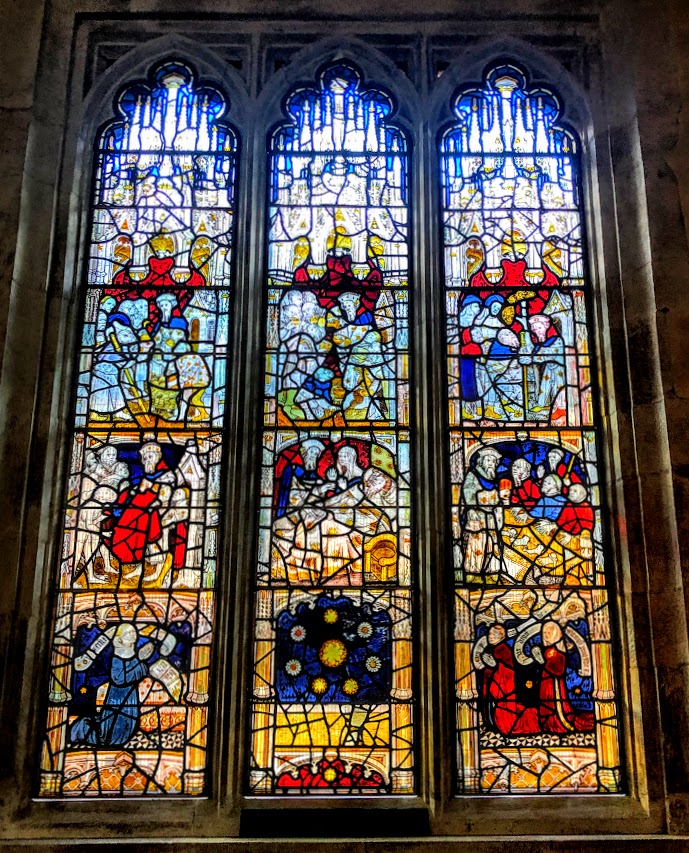
‘Be merciful, just as your Father is merciful’ (Luke 6: 36) … the ‘Corporal Works of Mercy’ window in All Saints’ Church, North Street, York (Photograph: Patrick Comerford)
Luke 6: 36-38 (NRSVA):
[Jesus said:] 36 ‘Be merciful, just as your Father is merciful.
37 ‘Do not judge, and you will not be judged; do not condemn, and you will not be condemned. Forgive, and you will be forgiven; 38 give, and it will be given to you. A good measure, pressed down, shaken together, running over, will be put into your lap; for the measure you give will be the measure you get back.’
‘If anyone strikes you on the cheek, offer the other also (Luke 6: 29) … street art in Plaza de la Judería in Malaga (Photograph: Patrick Comerford)
Today’s Reflections:
The Gospel reading at the Eucharist today is Luke 6: 36-38, which is from the ‘Sermon on the Level Place’, Saint Luke’s equivalent of the Sermon on the Mount.
After the blessings and woes of the Beatitudes, Jesus tells us to be merciful as God is merciful. Mercy is one of God’s primary qualities (see Exodus 34: 6-7), and the concept of mercy in Luke 6 has an eschatological frame of reference. God is merciful by offering the possibility of turning away from disobedience through repentance and turning towards him and receiving forgiveness and restoration.
In Mary’s song Magnificat, God is twice identified as merciful (Luke 1: 50, 54). Zechariah too identifies mercy as a sign of God’s faithfulness to God’s promises, creating a people who ‘might serve God without fear in holiness and righteousness (Luke 1: 72-78). In this morning’s reading, Christ shows how to put this mercy into practice.
In the verses immediately before today’s reading, Luke 6: 27-29 presupposes a situation of conflict, in a time when the religious and political leaders of day were seen by many as their enemies. But Christ calls on us to respond and act in ways that seek the good of the other. This form of nonviolence goes beyond non-retaliation and takes positive steps that promote the welfare of the other parties in the conflict.
Luke 6: 30 presupposes an economic situation in which many people are exploited, live in poverty, and seek to survive by begging. The give to those who beg implies that we have an abundance from which to share (see Luke 6: 39).
Luke 6: 31 repeats the ‘Golden Rule’: ‘Do to others as you would have them do to you.’ But the golden rule is not enough for us, the Children of God (see verse 35) in our covenant relationship with God.
Luke 6: 32-34 challenges the widely accepted notion in the Hellenistic world that relationships are reciprocal, and calls on us to go beyond behaviour is guided merely by the expectation of similar responses.
Luke 6: 35 calls on to replace old-age pattens of behaviour with ways that reflect the Kingdom of God, and to imitate God who is kind also to the ungrateful and the wicked. To be kind does not mean to approve but means to seek the best interest. Even the ungrateful and the wicked have the potential and the possibility of becoming part of the Kingdom of God.
Now, Luke 6: 36 sums up how to live a life that reflects the Kingdom of God.
Luke 6: 37 is a reminder that we not have the final say ourselves on who is in and who is outside the Kingdom of God. We do not live in the apocalyptic moment, and when he exclude others from the Church we risk finding we have excluded ourselves too.
Luke 6: 38 reminds us that God’s generosity is overflowing and overwhelming and goes beyond any possibility we have of measuring it.
As Shakespeare reminds us, in the words of Portia in The Merchant of Venice,
The quality of mercy is not strained;
It droppeth as the gentle rain from heaven … (The Merchant of Venice, Act IV, Scene 1).
‘Love Being Awake’ … ‘Love your enemies, do good to those who hate you’ (Luke 6: 26) … a sign in a café in Charleville, Co Cork (Photograph: Patrick Comerford)
Today’s Prayers (Monday 2 March 2026):
The theme this week (1-7 March 2026) in ‘Pray With the World Church,’ the Prayer Diary of the Anglican mission agency USPG (United Society Partners in the Gospel), is: ‘Saint David’s Day’ (pp 34-35). This theme was introduced yesterday with Reflections by the Revd Sarah Rosser, Team Vicar in the Netherwent Ministry Area, Diocese of Monmouth, Church in Wales.
The USPG Prayer Diary today (Monday 2 March 2026) invites us to pray:
We thank you for Saint David, for his love of the Gospel and his passion for sharing it. Renew your Church’s mission, give us wisdom and courage to share your love, and help us ‘do the little things’ that glorify you..
The Collect:
Almighty God,
from the first fruits of the English nation who turned to Christ,
you called your servant Chad
to be an evangelist and bishop of his own people:
give us grace so to follow his peaceable nature,
humble spirit and prayerful life,
that we may truly commend to others
the faith which we ourselves profess;
through Jesus Christ your Son our Lord,
who is alive and reigns with you,
in the unity of the Holy Spirit,
one God, now and for ever.
The Post Communion Prayer:
Holy Father,
who gathered us here around the table of your Son
to share this meal with the whole household of God:
in that new world where you reveal
the fullness of your peace,
gather people of every race and language
to share with Chad and all your saints
in the eternal banquet of Jesus Christ our Lord.
Yesterday’s Reflections
Continued Tomorrow
Peter Walker’s statue of Saint Chad at the south-east side of Lichfield Cathedral (Photograph: Patrick Comerford, 2026)
Scripture quotations are from the New Revised Standard Version Bible: Anglicised Edition copyright © 1989, 1995 National Council of the Churches of Christ in the United States of America. Used by permission. All rights reserved worldwide. http://nrsvbibles.org
Showing posts with label Charleville. Show all posts
18 January 2026
Daily prayer in Christmas 2025-2026:
25, Sunday 18 January 2026,
Second Sunday of Epiphany (Epiphany II)
The Lamb of God on the throne (see John 1: 36) … a stained glass window in Saint Mary’s Cathedral, Limerick (Photograph: Patrick Comerford)
Patrick Comerford
The 40-day season of Christmas continues until Candlemas or the Feast of the Presentation (2 February). Today is the Second Sunday after the Epiphany (Epiphany II, 18 January 2026), with readings that continue to focus on the Baptism of Christ by Saint John the Baptist, one of the three great Epiphany themes, alongside the Visit of the Magi and the Wedding at Cana.
Later this morning, I hope to be involved in the Parish Eucharist in Saint Mary and Saint Giles Church, Stony Stratford, singing with the choir and leading the intercessions.
Today is also the first day of the Week of Prayer for Christian Unity (WPCU), from 18 to 25 January. This ecumenical celebration provides an opportunity to focus our prayers on Christian unity and to know that we are joining with international brothers and sisters in Christ. This year’s theme is ‘One Body, One Spirit’ -- from Ephesians 4: 1-13 – which was prepared by the Armenian Apostolic Church, along with the Armenian Catholic and Evangelical Churches.
The opening Ecumenical Service for the week in Milton Keynes is in Saint James Church, New Bradwell, at 6 pm. The preacher is Doral Hayes of Churches Together in England, and music is from One Voice, the MK Christian Community Choir. The Hope for the World Concert in Christ the Cornerstone Church, also this evening, is raising funds for two local charities, Camphill MK and Bridgebuilder Trust.
Meanwhile, before today begins, I am taking some quiet time this morning to give thanks, to reflect, to pray and to read in these ways:
1, today’s Gospel reading;
2, a short reflection;
3, a prayer from the USPG prayer diary;
4, the Collects and Post-Communion prayer of the day.
‘This is the Lamb of God’ … Saint John the Baptist (left) with Christ in the centre depicted as the Good Shepherd and the Virgin Mary (right) … a window in Saint Mary’s Church, Lichfield (Photograph: Patrick Comerford)
John 1: 29-42 (NRSVA):
29 The next day he [John the Baptist] saw Jesus coming towards him and declared, ‘Here is the Lamb of God who takes away the sin of the world! 30 This is he of whom I said, “After me comes a man who ranks ahead of me because he was before me.” 31 I myself did not know him; but I came baptizing with water for this reason, that he might be revealed to Israel.’ 32 And John testified, ‘I saw the Spirit descending from heaven like a dove, and it remained on him. 33 I myself did not know him, but the one who sent me to baptize with water said to me, “He on whom you see the Spirit descend and remain is the one who baptizes with the Holy Spirit.” 34 And I myself have seen and have testified that this is the Son of God.’
35 The next day John again was standing with two of his disciples, 36 and as he watched Jesus walk by, he exclaimed, ‘Look, here is the Lamb of God!’ 37 The two disciples heard him say this, and they followed Jesus. 38 When Jesus turned and saw them following, he said to them, ‘What are you looking for?’ They said to him, ‘Rabbi’ (which translated means Teacher), ‘where are you staying?’ 39 He said to them, ‘Come and see.’ They came and saw where he was staying, and they remained with him that day. It was about four o’clock in the afternoon. 40 One of the two who heard John speak and followed him was Andrew, Simon Peter’s brother. 41 He first found his brother Simon and said to him, ‘We have found the Messiah’ (which is translated Anointed). 42 He brought Simon to Jesus, who looked at him and said, ‘You are Simon son of John. You are to be called Cephas’ (which is translated Peter).
The Lamb of God depicted in a stained-glass window in Charleville, Co Cork (Photograph: Patrick Comerford)
Today’s Reflections
Saint John’s Gospel has no story of the first Christmas, no child in the crib, and no Visit of the Magi. The manifestation of the Incarnate Christ in Saint John’s Gospel is revealed with the witness of Saint John the Baptist to Christ as the Lamb of God, the one who ‘existed before me,’ and as ‘the Son of God’ or ‘God’s Chosen One.’
In the Fourth Gospel, Christ first walks onto the stage, like the principal character in a Greek drama, as Saint John the Baptist is baptising in the River Jordan and talking about what is to be. And, in good dramatic style, letting us know what to expect as the drama unfolds on this stage, Saint John the Baptist uses three ways to describe Christ.
He is:
• ‘The Lamb of God who takes away the sin of the world’ (John 1: 29 and 36);
• ‘A man … who was before me’ (John 1: 30);
• ‘The Son of God’ (John 1: 34).
That manifestation of the Christ in Saint John’s Gospel will close with the witness of the Beloved Disciple – the other John – to the Paschal Lamb dying on the Cross on the eve of Passover.
His description of Christ as the ‘Lamb of God who takes away the sin of the world’ presents Christ as the Servant of God described by the Prophet Isaiah as being led without complaint like a lamb before the shearers, a man who ‘bore the sin of many and made intercession for the transgressors’ (see Isaiah 53: 7-12).
With the benefit of hindsight, this is also as a reference to the Lamb sacrificed at the Passover – in Saint John’s Gospel, the crucifixion takes place at the same time as the Passover.
But the Lamb of God is taking away not just my sin, not just our sin, not just the sin of many, of Christians, or those we judge as transgressors, those we still have a grudge against – not even the sin of the world, but the sin of the κόσμος (cosmos), which means not merely planet earth, but the whole created order.
Secondly, Saint John the Baptist describes Christ (verse 30) as the one who ‘existed before me’ (RSV) or who ‘was before me’ (NRSV), which reflects a recurring theme in Johannine literature of the pre-existence of the Word.
Thirdly, he describes him as ‘the Son of God’ or ‘God’s Chosen One’ (verse 34). This is the first time in this Gospel that Christ is given the messianic title of ‘the Son of God.’ This title, ‘The Son of God’ is another reference to the Suffering Servant of Isaiah.
We then move on in this reading to find the disciples of Saint John the Baptist turning to follow Christ. So this reading links the baptism of Christ with the call of the Disciples, links seeing and believing, being and doing, baptism and discipleship.
The first two disciples are called to follow Jesus (verse 37) in word and action, ‘Come and see’ (verse 39). In Saint John’s Gospel, ‘seeing,’ in the true sense, means believing. Think of the later insistence by Saint Thomas that he cannot believe unless he also sees (see John 20: 24-29). And to come and see is to abide in Christ. Those first disciples come, see and stay (verse 39).
But who do the disciples say Christ is?
They have three very different descriptions from those given by Saint John the Baptist. They describe him as:
• Rabbi or Teacher (verse 38)
• the one to see and follow (verse (verse 39)
• the Messiah or the anointed one (verse 41)
Who is Christ for you?
This is a question each and every one of us must ask ourselves anew time and time again.
He must be more than a good rabbi or teacher, because the expectations of a good religious leader or a good teacher change over time.
Who is the Messiah for you?
Again, many people at the time had false expectations of the Messiah.
But who is Christ for you?
George Fox, the founding Quaker, challenged his contemporaries: ‘You may say Christ saith this, and the apostles say this, but what canst thou say? Art thou a child of the Light and hast thou walked in the Light, and what thou speakest is it inwardly from God?”
Who is Christ for you?
Is he a personal saviour?
One who comforts you?
Or is he more than that for you?
Who do you say Christ is?
It is a question that challenges Saint Peter later in Saint Matthew’s Gospel (see Matthew 16: 15, which is part of the reading on 22 August 2026, the Twelfth Sunday after Trinity, Matthew 16: 13-20).
Not who do others say he is, but who do you say Christ is?
There is a difference in translations that speak of the ‘sins of the world’ and the ‘sin of the world.’
The word in this Gospel reading (see verse 29) is the singular sin of the cosmos (ἁμαρτίαν τοῦ κόσμου). The word indicates being without a share in something, in this case God’s intention or design … missing the mark.
So often the world has missed the mark in terms of shaping up to Gods plan and intention for the whole creation, the whole cosmos.
Christmas has passed, and the Epiphany season concludes with the Feast of the Presentation of Christ in the Temple, Candlemas, in two weeks’ time (2 February 2026).
Today’s Gospel reading is a reminder at Epiphany time that Christ has come, not just as a cuddly baby at Christmas, not just to give me personal comfort, not just to give me a personal revelation, but to confront the whole created order, and to reconcile the whole created order to God’s plan.
I find it is a beautiful presentation in this Gospel that the beginning of Christ’s ministry is set out over six days. And on the seventh day of that new beginning we have a sabbath – God rests; Christ goes to the wedding at Cana, the third of the Epiphany moments. And there we have a sign, a sacrament, a token of the complete transformation of the created order, a sacramental or symbolic token of the heavenly banquet (John 2: 1-12; see John 2: 1-11, the Gospel reading on Sunday 1 February 2026, Epiphany IV).
Who is Christ for you? He confronts the evils of the world; he suffers with us; he invites you and me to come and see; he calls us into the new Creation; he makes us equal in the Kingdom of God; and we are guests at his banquet. He is God among us.
As Saint John the Baptist says, ‘I myself have seen and have testified that this is the Son of God’ (John 1: 34)
Robert Spence (1871-1964), ‘Woe to the Bloody City of Lichfield,’ depicts George Fox preaching barefooted in the snow in Lichfield in 1651 … George Fox challenged his followers to say who Christ is for them (Lichfield Museum)
Today’s Prayers (Sunday 18 January 2026, Epiphany II):
The theme this week (18-24 January 2026) in Pray with the World Church, the prayer diary of the Anglican mission agency USPG (United Society Partners in the Gospel), is ‘Freedom Theologies’ (pp 20-21). This theme is introduced today with Reflections from Dr Thandi Gamedze, poet, theologian, and senior researcher at the Desmond Tutu Centre for Religion and Social Justice:
‘Growing up in South Africa, I was surrounded by the Church, but I didn’t know the full story of its role in our history. For decades, the voices of Black South Africans who resisted apartheid were often silenced or forgotten, even within faith communities. One of the most powerful examples is the Kairos Document, written in 1985 during a State of Emergency. It boldly confronted the Church’s complicity with apartheid and called people of faith to stand for justice. Reading it was like discovering a hidden heartbeat of courage and hope.
‘These stories inspired me to create Freedom Theologies: South Africa, a card game that brings these untold stories to life. Players explore moments like the Peace March of 1989 or the Christian Institute Agape meals, swapping stories and mapping them on timelines to see how the movement grew.
‘The game grew out of a simple idea: learning can be participatory and fun, but still deeply meaningful. These stories of everyday prophetic theologies and actions are really important because all of us have different roles to play in this work of ‘world making’. Whether that happens through art, or a march, or even something as simple as a weekly meal. That’s what the Cape Director of the Christian Institute did. The meals he hosted were more than food. It was a lively space where people connected, prayed, and planned together, fuelling the fight against apartheid with shared spirit and action. We could do with more of that.’
The USPG Prayer Diary today (Sunday 18 January 2026) invites us to pray as we read and meditate on John 1: 29-42.
The Collect:
Almighty God,
in Christ you make all things new:
transform the poverty of our nature by the riches of your grace,
and in the renewal of our lives
make known your heavenly glory;
through Jesus Christ your Son our Lord,
who is alive and reigns with you,
in the unity of the Holy Spirit,
one God, now and for ever.
The Post-Communion Prayer:
God of glory,
you nourish us with your Word
who is the bread of life:
fill us with your Holy Spirit
that through us the light of your glory
may shine in all the world.
We ask this in the name of Jesus Christ our Lord.
Additional Collect:
Eternal Lord,
our beginning and our end:
bring us with the whole creation
to your glory, hidden through past ages
and made known
in Jesus Christ our Lord.
Yesterday’s Reflections
Continued Tomorrow
The Lamb of God … a surviving detail in Saint Senanus Church, Foynes, Co Limerick (Photograph: Patrick Comerford)
Scripture quotations are from the New Revised Standard Version Bible: Anglicised Edition copyright © 1989, 1995, National Council of the Churches of Christ in the United States of America. Used by permission. All rights reserved worldwide. http://nrsvbibles.org
28 August 2025
Daily prayer in Ordinary Time 2025:
110, Thursday 28 August 2025
‘You have one teacher, and you are all students’ (Matthew 23: 8) … ‘Teacher and Student’ (1904), J Gerberhole, burnished clay, the Old Synagogue Museum, Kraków (Photograph: Patrick Comerford)
Patrick Comerford
We are continuing in Ordinary Time in the Church Calendar and this week began the Tenth Sunday after Trinity (Trinity X) and then the Summer bank holiday on Monday. The calendar of the Church of England in Common Worship today remembers Saint Augustine (430), Bishop of Hippo, Teacher of the Faith, whose mother, Saint Monica (387), was commemorated yesterday (27 August).
Later today, we are planning to visit London. But, before today begins, I am taking some quiet time this morning to give thanks, for reflection, prayer and reading in these ways:
1, today’s Gospel reading;
2, a reflection on the Gospel reading;
3, a prayer from the USPG prayer diary;
4, the Collects and Post-Communion prayer of the day.
’The greatest among you will be your servant’ (Matthew 23: 11) … service at a table for two in Rethymnon in Crete (Photograph: Patrick Comerford)
Matthew 23: 8-12 (NRSVA):
[Jesus said to the crowds and to his disciples:] 8 ‘But you are not to be called rabbi, for you have one teacher, and you are all students. 9 And call no one your father on earth, for you have one Father – the one in heaven. 10 Nor are you to be called instructors, for you have one instructor, the Messiah. 11 The greatest among you will be your servant. 12 All who exalt themselves will be humbled, and all who humble themselves will be exalted.’
Do I need a manual, a discourse or a lecture on how to use a fork … or to love? … at a table in Piskopiano in Crete (Photograph: Patrick Comerford)
Today’s Reflection:
This morning’s Gospel reading (Matthew 23: 8-12) is part of the Gospel reading we looked at last Saturday (Matthew 23: 1-12, 23 August 2025). This morning, we hear a more general rebuke of those among the Scribes and the Pharisees who ‘do not practise what they teach’ (verse 4), who ‘do all their deeds to be seen by others’ (verse 5) and who ‘love to have the place of honour at banquets and the best seats in the synagogues, and to be greeted with respect in the market-places, and to have people call them rabbi’ (verses 6-7).
We are warned about the dangers built into loving honorific titles, such as ‘teacher,’ ‘father’ and instructor (see verses 8-10) – perhaps for me that may mean ‘Father’, ‘Canon’ and ‘Professor’ – because, of course, we are all students, we are all brothers and sisters, we are all disciples and children of God.
Yet I too am a father and have been a teacher and a tutor. Is Christ warning against the position; or is he warning against seeking honours that have not been earned?
It is a truism that parents must earn the respect of their children, not seek or demand it. Most parents have, at one time or another, said to their children: ‘Do what I tell you, not what I do.’ Needless to say, children never listen to parents when we say something so silly. All parents know, on the other hand, that actions speak louder than words.
This morning’s reading must not be understood as a general rebuke of all scribes and Pharisees, for Jesus prefaces all he says here by reminding those present that they ‘sit on Moses’ seat; therefore, do whatever they teach you and follow it’ (verses 2-3).
Perhaps this morning’s reading reflects later tensions between the Jewish synagogue and the new Christian community. But, in Christ’s own days, people expected a Pharisee to be a careful observer of the Law. Unlike the Temple priests and village elders, the Pharisees did not have a high social status.
Before the destruction of the Temple in Jerusalem in the year 70 CE, the Pharisees were a relatively modest group of people without political power and they tried to live out Jewish tradition and the Torah seriously and conscientiously in their daily lives. The Pharisees saw the Law as applying not only to every aspect of public life, but to every aspect of private, domestic, daily life too.
There is a well-worn saying that advises: ‘It’s not where you start out but where you end up.’ The Pharisees started out with good intentions, but some of them ended by seeking to be great, seeking to be exalted (verses 11-12). They started out being concerned for holiness, but some ended at exclusion. They started out seeking to recognise God in all aspects of life, but some of them ended by seeking recognition at banquets and in the synagogue (verses 6-7).
Christ calls us to live in such a way that we can say to the world: ‘Do as we say and do as we do.’
As I was suggesting in my reflections last Saturday, the problem here may not so much be a conflict between words and actions, but the need to make the connection between words and actions. Words must mean what they point to, and the actions must be capable of being described in words.
Most of us, as children, learned by watching how adults behave, we learn as members of the human community. As a child, when I needed to learn how to use a fork, I did not need a lecture on the hygienic and sanitary contributions that forks have made to the benefit European lifestyles since the introduction of the fork through Byzantium and Venice to mediaeval Europe.
I did not need an engineering lecture on the practicalities and difficulties of balancing the prongs and the handle.
I would have been too young to read a delightful discussion by Judith Herrin of how the fork-using Byzantines were much more sophisticated than their western allies or rivals who ate with their hands (Judith Herrin, Byzantium – the Surprising Life of a Mediaeval Empire, London: Allen Lane, 2007).
The same principle applies to everything else. I recalled on Saturday how Andrew Davison, Regius Professor of Divinity, Oxford, points out in his contribution to Imaginative Apologetics (London: SCM Press, 2011), that the same principle applies to how we learn about everything else in life – cups, books, bicycles and so on.
He might have added love – the love of God and the love of one another.
Thinking requires language, language is a communal experience, and, as Andrew Davison points out, we learn language as members of a human community and through induction into common human practices.
We can talk about prayer, forgiveness, and most of all about love itself, to others. But if it only remains talk and has no application, then the words have no meaning.
We may say we believe in the two great commandments, but we only show we believe in them with credibility when we live them out in our lives. There must be no gap that separates what we teach and how we live out what we teach in our lives.
Saint Augustine depicted in a stained glass window by George W Walsh in Saint Augustine’s Church, Galway (Photograph: Patrick Comerford)
Today’s Prayers (Thursday 28 August 2025):
The theme this week (24 to 30 August) in Pray with the World Church, the prayer diary of the Anglican mission agency USPG (United Society Partners in the Gospel), is been ‘From Strangers to Neighbours’ (pp 32-33) This theme was introduced on Sunday with a programme update from the Right Revd Antonio Ablon, Chaplain of Saint Catherine’s Anglican Church, Stuttgart, Germany.
The USPG Prayer Diary today (Thursday 28 August 2025) invites us to pray:
God of the journey, sustain those facing hardships in foreign lands. When they feel unseen or unheard, may they be reminded that you are near. May their faith be their refuge, and may they find kindness in those they meet.
The Collect:
Merciful Lord,
who turned Augustine from his sins
to be a faithful bishop and teacher:
grant that we may follow him in penitence and discipline
till our restless hearts find their rest in you;
through Jesus Christ your Son our Lord,
who is alive and reigns with you,
in the unity of the Holy Spirit,
one God, now and for ever.
The Post Communion Prayer:
God of truth,
whose Wisdom set her table
and invited us to eat the bread and drink the wine
of the kingdom:
help us to lay aside all foolishness
and to live and walk in the way of insight,
that we may come with Augustine to the eternal feast of heaven;
through Jesus Christ our Lord.
Yesterday’s reflections
Continued tomorrow
Saint Augustine and Saint Monica, in a window by J Clarke and Sons in Holy Cross Church, Charleville, Co Cork … they are commemorated on 27 and 28 August (Photograph: Patrick Comerford)
Scripture quotations are from the New Revised Standard Version Bible: Anglicised Edition copyright © 1989, 1995, National Council of the Churches of Christ in the United States of America. Used by permission. All rights reserved worldwide. http://nrsvbibles.org
Patrick Comerford
We are continuing in Ordinary Time in the Church Calendar and this week began the Tenth Sunday after Trinity (Trinity X) and then the Summer bank holiday on Monday. The calendar of the Church of England in Common Worship today remembers Saint Augustine (430), Bishop of Hippo, Teacher of the Faith, whose mother, Saint Monica (387), was commemorated yesterday (27 August).
Later today, we are planning to visit London. But, before today begins, I am taking some quiet time this morning to give thanks, for reflection, prayer and reading in these ways:
1, today’s Gospel reading;
2, a reflection on the Gospel reading;
3, a prayer from the USPG prayer diary;
4, the Collects and Post-Communion prayer of the day.
’The greatest among you will be your servant’ (Matthew 23: 11) … service at a table for two in Rethymnon in Crete (Photograph: Patrick Comerford)
Matthew 23: 8-12 (NRSVA):
[Jesus said to the crowds and to his disciples:] 8 ‘But you are not to be called rabbi, for you have one teacher, and you are all students. 9 And call no one your father on earth, for you have one Father – the one in heaven. 10 Nor are you to be called instructors, for you have one instructor, the Messiah. 11 The greatest among you will be your servant. 12 All who exalt themselves will be humbled, and all who humble themselves will be exalted.’
Do I need a manual, a discourse or a lecture on how to use a fork … or to love? … at a table in Piskopiano in Crete (Photograph: Patrick Comerford)
Today’s Reflection:
This morning’s Gospel reading (Matthew 23: 8-12) is part of the Gospel reading we looked at last Saturday (Matthew 23: 1-12, 23 August 2025). This morning, we hear a more general rebuke of those among the Scribes and the Pharisees who ‘do not practise what they teach’ (verse 4), who ‘do all their deeds to be seen by others’ (verse 5) and who ‘love to have the place of honour at banquets and the best seats in the synagogues, and to be greeted with respect in the market-places, and to have people call them rabbi’ (verses 6-7).
We are warned about the dangers built into loving honorific titles, such as ‘teacher,’ ‘father’ and instructor (see verses 8-10) – perhaps for me that may mean ‘Father’, ‘Canon’ and ‘Professor’ – because, of course, we are all students, we are all brothers and sisters, we are all disciples and children of God.
Yet I too am a father and have been a teacher and a tutor. Is Christ warning against the position; or is he warning against seeking honours that have not been earned?
It is a truism that parents must earn the respect of their children, not seek or demand it. Most parents have, at one time or another, said to their children: ‘Do what I tell you, not what I do.’ Needless to say, children never listen to parents when we say something so silly. All parents know, on the other hand, that actions speak louder than words.
This morning’s reading must not be understood as a general rebuke of all scribes and Pharisees, for Jesus prefaces all he says here by reminding those present that they ‘sit on Moses’ seat; therefore, do whatever they teach you and follow it’ (verses 2-3).
Perhaps this morning’s reading reflects later tensions between the Jewish synagogue and the new Christian community. But, in Christ’s own days, people expected a Pharisee to be a careful observer of the Law. Unlike the Temple priests and village elders, the Pharisees did not have a high social status.
Before the destruction of the Temple in Jerusalem in the year 70 CE, the Pharisees were a relatively modest group of people without political power and they tried to live out Jewish tradition and the Torah seriously and conscientiously in their daily lives. The Pharisees saw the Law as applying not only to every aspect of public life, but to every aspect of private, domestic, daily life too.
There is a well-worn saying that advises: ‘It’s not where you start out but where you end up.’ The Pharisees started out with good intentions, but some of them ended by seeking to be great, seeking to be exalted (verses 11-12). They started out being concerned for holiness, but some ended at exclusion. They started out seeking to recognise God in all aspects of life, but some of them ended by seeking recognition at banquets and in the synagogue (verses 6-7).
Christ calls us to live in such a way that we can say to the world: ‘Do as we say and do as we do.’
As I was suggesting in my reflections last Saturday, the problem here may not so much be a conflict between words and actions, but the need to make the connection between words and actions. Words must mean what they point to, and the actions must be capable of being described in words.
Most of us, as children, learned by watching how adults behave, we learn as members of the human community. As a child, when I needed to learn how to use a fork, I did not need a lecture on the hygienic and sanitary contributions that forks have made to the benefit European lifestyles since the introduction of the fork through Byzantium and Venice to mediaeval Europe.
I did not need an engineering lecture on the practicalities and difficulties of balancing the prongs and the handle.
I would have been too young to read a delightful discussion by Judith Herrin of how the fork-using Byzantines were much more sophisticated than their western allies or rivals who ate with their hands (Judith Herrin, Byzantium – the Surprising Life of a Mediaeval Empire, London: Allen Lane, 2007).
The same principle applies to everything else. I recalled on Saturday how Andrew Davison, Regius Professor of Divinity, Oxford, points out in his contribution to Imaginative Apologetics (London: SCM Press, 2011), that the same principle applies to how we learn about everything else in life – cups, books, bicycles and so on.
He might have added love – the love of God and the love of one another.
Thinking requires language, language is a communal experience, and, as Andrew Davison points out, we learn language as members of a human community and through induction into common human practices.
We can talk about prayer, forgiveness, and most of all about love itself, to others. But if it only remains talk and has no application, then the words have no meaning.
We may say we believe in the two great commandments, but we only show we believe in them with credibility when we live them out in our lives. There must be no gap that separates what we teach and how we live out what we teach in our lives.
Saint Augustine depicted in a stained glass window by George W Walsh in Saint Augustine’s Church, Galway (Photograph: Patrick Comerford)
Today’s Prayers (Thursday 28 August 2025):
The theme this week (24 to 30 August) in Pray with the World Church, the prayer diary of the Anglican mission agency USPG (United Society Partners in the Gospel), is been ‘From Strangers to Neighbours’ (pp 32-33) This theme was introduced on Sunday with a programme update from the Right Revd Antonio Ablon, Chaplain of Saint Catherine’s Anglican Church, Stuttgart, Germany.
The USPG Prayer Diary today (Thursday 28 August 2025) invites us to pray:
God of the journey, sustain those facing hardships in foreign lands. When they feel unseen or unheard, may they be reminded that you are near. May their faith be their refuge, and may they find kindness in those they meet.
The Collect:
Merciful Lord,
who turned Augustine from his sins
to be a faithful bishop and teacher:
grant that we may follow him in penitence and discipline
till our restless hearts find their rest in you;
through Jesus Christ your Son our Lord,
who is alive and reigns with you,
in the unity of the Holy Spirit,
one God, now and for ever.
The Post Communion Prayer:
God of truth,
whose Wisdom set her table
and invited us to eat the bread and drink the wine
of the kingdom:
help us to lay aside all foolishness
and to live and walk in the way of insight,
that we may come with Augustine to the eternal feast of heaven;
through Jesus Christ our Lord.
Yesterday’s reflections
Continued tomorrow
Saint Augustine and Saint Monica, in a window by J Clarke and Sons in Holy Cross Church, Charleville, Co Cork … they are commemorated on 27 and 28 August (Photograph: Patrick Comerford)
Scripture quotations are from the New Revised Standard Version Bible: Anglicised Edition copyright © 1989, 1995, National Council of the Churches of Christ in the United States of America. Used by permission. All rights reserved worldwide. http://nrsvbibles.org
Labels:
Augustine,
Augustinians,
Byzantium,
Charleville,
Crete 2025,
Eating Out,
Galway,
Greece 2025,
Harry Clarke,
Kraków,
Love,
Mission,
Piskopiano,
Prayer,
refugees,
Rethymnon,
Saint Matthew's Gospel,
Sculpture,
Stained Glass,
USPG
17 March 2025
Daily prayer in Lent 2025:
13, Monday 17 March 2025,
Saint Patrick’s Day
‘Forgive, and you will be forgiven’ (Luke 6: 36) … street art in Dublin (Photograph: Patrick Comerford)
Patrick Comerford
Lent began almost two weeks ago on Ash Wednesday (5 March 2025), and yesterday was the Second Sunday in Lent (Lent II). But today is Saint Patrick’s Day (17 March 2025), and it offers Irish people a respite in the rigours and disciplines of Lent.
I hope to say a little more about Saint Patrick and Saint Patrick’s Day later today. But, before today begins, I am taking some quiet time this morning to give thanks, to reflect, to pray and to read in these ways:
1, reading today’s Gospel reading;
2, a short reflection;
3, a prayer from the USPG prayer diary;
4, the Collects and Post-Communion prayer of the day.
‘Be merciful, just as your Father is merciful’ (Luke 6: 36) … the ‘Corporal Works of Mercy’ window in All Saints’ Church, North Street, York (Photograph: Patrick Comerford)
Luke 6: 36-38 (NRSVA):
[Jesus said:] 36 ‘Be merciful, just as your Father is merciful.
37 ‘Do not judge, and you will not be judged; do not condemn, and you will not be condemned. Forgive, and you will be forgiven; 38 give, and it will be given to you. A good measure, pressed down, shaken together, running over, will be put into your lap; for the measure you give will be the measure you get back.’
‘If anyone strikes you on the cheek, offer the other also (Luke 6: 29) … street art in Plaza de la Judería in Malaga (Photograph: Patrick Comerford)
Today’s Reflection:
The Gospel reading in the lectionary for Saint Patrick’s Day is Matthew 10: 16-23, and I hope to say a little more about Saint Patrick and Saint Patrick’s Day in a blog posting later today. But the Lenten reading for the Eucharist today is Luke 6: 36-38, which is from the ‘Sermon on the Level Place’, Saint Luke’s equivalent of the Sermon on the Mount.
After the blessings and woes of the Beatitudes, Jesus tells us as his followers to be merciful as God is merciful. Mercy is one of God’s primary qualities (see Exodus 34: 6-7), and the concept of mercy in Luke 6 has an eschatological frame of reference. God is merciful by offering the possibility of turning away from disobedience through repentance and turning towards him and receiving forgiveness and restoration.
In Mary’s song Magnificat, God is twice identified as merciful (Luke 1: 50, 54). Zechariah too identifies mercy as a sign of God’s faithfulness to God’s promises, creating a people who ‘might serve God without fear in holiness and righteousness (Luke 1: 72-78). In this morning’s reading, Christ shows how to put this mercy into practice.
In the verses immediately before today’s reading, Luke 6: 27-29 presupposes a situation of conflict, in a time when the religious and political leaders of day were seen by many as their enemies. But Christ calls on us to respond and act in ways that seek the good of the other. This form of nonviolence goes beyond non-retaliation and takes positive steps that promote the welfare of the other parties in the conflict.
Luke 6: 30 presupposes an economic situation in which many people are exploited, live in poverty, and seek to survive by begging. The give to those who beg implies that we have an abundance from which to share (see Luke 6: 39).
Luke 6: 31 repeats the ‘Golden Rule’: ‘Do to others as you would have them do to you.’ But the golden rule is not enough for us, the Children of God (see verse 35) in our covenant relationship with God.
Luke 6: 32-34 challenges the widely accepted notion in the Hellenistic world that relationships are reciprocal, and calls on us to go beyond behaviour is guided merely by the expectation of similar responses.
Luke 6: 35 calls on to replace old-age pattens of behaviour with ways that reflect the Kingdom of God, and to imitate God who is kind also to the ungrateful and the wicked. To be kind does not mean to approve but means to seek the best interest. Even the ungrateful and the wicked have the potential and the possibility of becoming part of the Kingdom of God.
Now, Luke 6: 36 sums up how to live a life that reflects the Kingdom of God.
Luke 6: 37 is a reminder that we not have the final say ourselves on who is in and who is outside the Kingdom of God. We do not live in the apocalyptic moment, and when he exclude others from the Church we risk finding we have excluded ourselves too.
Luke 6: 38 reminds us that God’s generosity is overflowing and overwhelming and goes beyond any possibility we have of measuring it.
As Shakespeare reminds us, in the words of Portia in The Merchant of Venice,
The quality of mercy is not strained;
It droppeth as the gentle rain from heaven … (The Merchant of Venice, Act IV, Scene 1).
‘Love Being Awake’ … ‘Love your enemies, do good to those who hate you’ (Luke 6: 26) … a sign in a café in Charleville, Co Cork (Photograph: Patrick Comerford)
Today’s Prayers (Monday 17 March 2025, Saint Patrick’s Day):
The theme this week in ‘Pray With the World Church’, the Prayer Diary of the Anglican mission agency USPG (United Society Partners in the Gospel), is ‘Truth: The Path to Reconciliation’. This theme was introduced yesterday with a programme update by Rachel Weller, Communications Officer, USPG.
The USPG Prayer Diary today (Monday 17 March 2025, Saint Patrick’s Day) invites us to pray:
Dear God, grant us the courage to seek and speak the truth in all aspects of our lives. May we find the strength to acknowledge our own roles in the injustices we witness and strive to be agents of reconciliation.
The Collect:
Almighty God,
who in your providence chose your servant Patrick
to be the apostle of the Irish people:
keep alive in us the fire of the faith he kindled
and strengthen us in our pilgrimage
towards the light of everlasting life;
through Jesus Christ your Son our Lord,
who is alive and reigns with you,
in the unity of the Holy Spirit,
one God, now and for ever.
The Post Communion Prayer:
Holy Father,
who gathered us here around the table of your Son
to share this meal with the whole household of God:
in that new world where you reveal
the fullness of your peace,
gather people of every race and language
to share with Patrick and all your saints
in the eternal banquet of Jesus Christ our Lord.
Yesterday’s Reflection
Continued Tomorrow
‘A good measure, pressed down, shaken together, running over … the measure you give will be the measure you get back’ (Luke 6: 38) … street art in Dublin (Photograph: Patrick Comerford)
Scripture quotations are from the New Revised Standard Version Bible: Anglicised Edition copyright © 1989, 1995 National Council of the Churches of Christ in the United States of America. Used by permission. All rights reserved worldwide. http://nrsvbibles.org
12 September 2024
Daily prayer in Ordinary Time 2024:
125, Thursday 12 September 2024
‘Forgive, and you will be forgiven’ (Luke 6: 36) … street art in Dublin (Photograph: Patrick Comerford)
Patrick Comerford
We are continuing in Ordinary Time in the Church Calendar and the week began with the Fifteenth Sunday after Trinity (8 September 2024).
Before today begins, I am taking some quiet time this morning to give thanks, for reflection, prayer and reading in these ways:
1, today’s Gospel reading;
2, a reflection on the Gospel reading;
3, a prayer from the USPG prayer diary;
4, the Collects and Post-Communion prayer of the day.
‘Be merciful, just as your Father is merciful’ (Luke 6: 36) … the ‘Corporal Works of Mercy’ window in All Saints’ Church, North Street, York (Photograph: Patrick Comerford)
Luke 6: 27-38 (NRSVA):
[Jesus said:] 27 ‘But I say to you that listen, Love your enemies, do good to those who hate you, 28 bless those who curse you, pray for those who abuse you. 29 If anyone strikes you on the cheek, offer the other also; and from anyone who takes away your coat do not withhold even your shirt. 30 Give to everyone who begs from you; and if anyone takes away your goods, do not ask for them again. 31 Do to others as you would have them do to you.
32 ‘If you love those who love you, what credit is that to you? For even sinners love those who love them. 33 If you do good to those who do good to you, what credit is that to you? For even sinners do the same. 34 If you lend to those from whom you hope to receive, what credit is that to you? Even sinners lend to sinners, to receive as much again. 35 But love your enemies, do good, and lend, expecting nothing in return. Your reward will be great, and you will be children of the Most High; for he is kind to the ungrateful and the wicked. 36 Be merciful, just as your Father is merciful.
37 ‘Do not judge, and you will not be judged; do not condemn, and you will not be condemned. Forgive, and you will be forgiven; 38 give, and it will be given to you. A good measure, pressed down, shaken together, running over, will be put into your lap; for the measure you give will be the measure you get back.’
‘If anyone strikes you on the cheek, offer the other also’ (Luke 6: 29) … street art in Plaza de la Judería in Malaga (Photograph: Patrick Comerford)
Today’s Reflection:
Today’s Gospel reading continues reading from the ‘Sermon on the Level Place’, Saint Luke’s equivalent of the Sermon on the Mount, which we began reading yesterday with Saint Luke’s version of the Beatitudes (Luke 6: 20-26).
After the blessings and woes of the Beatitudes, we read this morning that Jesus tells us as his followers to be merciful as God is merciful. Mercy is one of God’s primary qualities (see Exodus 34: 6-7), and the concept of mercy in Luke 6 has an eschatological frame of reference. God is merciful by offering the possibility of turning away from disobedience through repentance and turning towards him and receiving forgiveness and restoration.
In Mary’s song Magnificat, God is twice identified as merciful (Luke 1: 50, 54). Zechariah too identifies mercy as a sign of God’s faithfulness to God’s promises, creating a people who ‘might serve God without fear in holiness and righteousness (Luke 1: 72-78). In this morning’s reading, Christ shows how to put this mercy into practice.
Luke 6: 27-29 presuppose a situation of conflict, in a time when the religious and political leaders of day were seen by many as their enemies. But Christ calls on us to respond and act in ways that seek the good of the other. This form of nonviolence goes beyond non-retaliation and takes positive steps that promote the welfare of the other parties in the conflict.
Luke 6: 30 presupposes an economic situation in which many people are exploited, live in poverty, and seek to survive by begging. The give to those who beg implies that we have an abundance from which to share (see Luke 6: 39).
Luke 6: 31 repeats the ‘Golden Rule’: ‘Do to others as you would have them do to you.’ But the golden rule is not enough for us, the Children of God (see verse 35) in our covenant relationship with God.
uke 6: 32-34 challenges the widely accepted notion in the Hellenistic world that relationships are reciprocal, and calls on us to go beyond behaviour is guided merely by the expectation of similar responses.
Luke 6: 35 calls on to replace old-age pattens of behaviour with ways that reflect the Kingdom of God, and to imitate God who is kind also to the ungrateful and the wicked. To be kind does not mean to approve but means to seek the best interest. Even the ungrateful and the wicked have the potential and the possibility of becoming part of the Kingdom of God.
Luke 6: 36 sums up how to live a life that reflects the Kingdom of God.
Luke 6: 37 is a reminder that we not have the final say ourselves on who is in and who is outside the Kingdom of God. We do not live in the apocalyptic moment, and when he exclude others from the Church we risk finding we have excluded ourselves too.
Luke 6: 38 reminds us that God’s generosity is overflowing and overwhelming and goes beyond any possibility we have of measuring it.
As Shakespeare reminds us, in the words of Portia in The Merchant of Venice,
The quality of mercy is not strained;
It droppeth as the gentle rain from heaven … (The Merchant of Venice, Act IV, Scene 1).
‘Love Being Awake’ … ‘Love your enemies, do good to those who hate you’ (Luke 6: 26) … a sign in a café in Charleville, Co Cork (Photograph: Patrick Comerford)
Today’s Prayers (Thursday 12 September 2024):
Each year, on 14 September, the Church celebrates the Feast of the Holy Cross, known as ‘Holy Cross Day’ throughout the majority of the Anglican Communion. The theme this week in ‘Pray With the World Church,’ the Prayer Diary of the Anglican mission agency USPG (United Society Partners in the Gospel), is ‘What does the holy cross mean to you?’ This theme was introduced on Sunday with a reflection by Rachael Anderson, Senior Communications and Engagement Manager, USPG.
The USPG Prayer Diary today (Thursday 12 September 2024) invites us to pray:
We pray Lord that we may be active participants in the good works you have planned for us. Help us listen and discern your plans for our lives.
The Collect:
God, who in generous mercy sent the Holy Spirit
upon your Church in the burning fire of your love:
grant that your people may be fervent
in the fellowship of the gospel
that, always abiding in you,
they may be found steadfast in faith and active in service;
through Jesus Christ your Son our Lord,
who is alive and reigns with you,
in the unity of the Holy Spirit,
one God, now and for ever.
The Post Communion Prayer:
Keep, O Lord, your Church, with your perpetual mercy;
and, because without you our human frailty cannot but fall,
keep us ever by your help from all things hurtful,
and lead us to all things profitable to our salvation;
through Jesus Christ our Lord.
Additional Collect:
Lord God,
defend your Church from all false teaching
and give to your people knowledge of your truth,
that we may enjoy eternal life
in Jesus Christ our Lord.
Yesterday’s reflection
Continued tomorrow
‘A good measure, pressed down, shaken together, running over … the measure you give will be the measure you get back’ (Luke 6: 38) … street art in Dublin (Photograph: Patrick Comerford)
Scripture quotations are from the New Revised Standard Version Bible: Anglicised Edition copyright © 1989, 1995, National Council of the Churches of Christ in the United States of America. Used by permission. All rights reserved worldwide. http://nrsvbibles.org
15 July 2024
Daily prayer in Ordinary Time 2024:
67, Monday 15 July 2024, Saint Swithun
Saint Swithun depicted on the gateway at Magdalen College, Oxford … is today’s weather going to last for 40 days? (Photograph: Patrick Comerford)
Patrick Comerford
We are continuing in Ordinary Time in the Church and this week began with the Seventh Sunday after Trinity (Trinity VII). The Calendar of the Church of England in Common Worship today (15 July) remembers Saint Swithun (ca 862), Bishop of Winchester, and Saint Bonaventure (1274), Friar, Bishop and Teacher of the Faith.
I am planning to visit Tamworth and Lichfield later today. But, before the day begins, I am taking some quiet time this morning to give thanks, for reflection, prayer and reading in these ways:
1, today’s Gospel reading;
2, a reflection on the Gospel reading;
3, a prayer from the USPG prayer diary;
4, the Collects and Post-Communion prayer of the day.
The gateway at Magdalen College, Oxford with Saint Mary Magdalen (centre) between Saint Swithun (right) and Bishop William Waynflete (left) of Winchester (Photograph: Patrick Comerford)
Matthew 5: 43-48 (NRSVA):
[Jesus said:] 43 ‘You have heard that it was said, “You shall love your neighbour and hate your enemy.” 44 But I say to you, Love your enemies and pray for those who persecute you, 45 so that you may be children of your Father in heaven; for he makes his sun rise on the evil and on the good, and sends rain on the righteous and on the unrighteous. 46 For if you love those who love you, what reward do you have? Do not even the tax-collectors do the same? 47 And if you greet only your brothers and sisters, what more are you doing than others? Do not even the Gentiles do the same? 48 Be perfect, therefore, as your heavenly Father is perfect.’
Patrick Gale’s ‘A Perfectly Good Man’ … a reminder of how we speak of being ‘Good Enough’ and being ‘Perfect’
This morning’s reflection:
We are half-through July, yet this has hardly been perfect summer weather. Today is Saint Swithun’s Day, so many people – in a very traditional English way of being superstitious – may be half concerned that whatever weather we have today is going to continue for the next 40 days, imperfect as it may be.
Last night’s England v Spain Euro final could have been a very perfect evening indeed. But iin many ways it was a good end to what has been a very good championship for an English team that represents so much that is good in England today. They were more than good enough as a team, but too often in our lives we demand what is perfect at the expense of delighting in what is good and what is good enough.
However, this morning I am wrestling with the advice in this Gospel reading: ‘Be perfect, therefore, as your heavenly Father is perfect’ (Matthew 5: 48).
I certainly cannot ever see myself as being perfect, or even aspiring to be perfect. But this Gospel advice this morning reminds me of Patrick Gale’s novel, A Perfectly Good Man, one of the books that was part of my holiday reading some years ago.
I had never read any of his novels before, but this book was recommended to me by someone who felt she was eerily reading a book about someone who knew more about me than she realised was possible.
TS Eliot’s ‘East Coker’ begins with the words:
In my beginning is my end.
And it closes:
In my end is my beginning.
Without giving away the story line of this book, in many ways these two lines could describe how Patrick Gale narrates his story in A Perfectly Good Man. As I read it, I was not waiting to discover what happens in the end, but was waiting for an end that could tell me why all that is happening is taking place.
I was surprised at the writer’s twists and turns, but more taken aback when I felt I was holding up a mirror to myself.
There is the description of farm life that brought me back to a time when I lived on my grandmother’s farm.
There was the religious experience in teenage years that become life-changing for the main character, Father Barnaby Johnson.
There is his approach to spirituality and liturgy, his choice of reading, and the off-centre involvement of Quakers.
I am more positive about my experiences of old second-hand bookshops, but I could identify with his experience of visiting the old ancestral home in rural England.
There is his dysfunctional relationship with his father, his liberal boarding school or minor public school education, a sibling who died while he is still in his teens, an adoption, and a feeling of being marginalised or even being an outsider at a parent’s funeral.
There is his participation in street protests in 1980s England that parallels my own role in CND protests.
There are developed interests in art and the artist, in museums and music.
And there is the powerful use of a Facebook group today and the impact of social media.
Even the graffiti on the church walls, which may shock many readers, even those who are not church-going, reminded me of graffiti I found on a church wall many years ago while I was providing Sunday cover.
And there is the chilling parishioner, Modest Carlsson, who shows that cruelty and evil can stalk the land.
This is a very Anglican story about a very Anglican priest.
It is a life story presented almost like a series of photographs that have fallen out of a family album and that are put back in a random way, yet only make sense when they are all looked at each in turn. The primary suspense in this novel lies not in the ‘what’, but the ‘when’ and ‘how.’
Time and again, in recent months, I have asked who decided in recent years that ‘good enough’ is simply not good enough, that we have to excel?
‘Please don’t feel you always have to be good,’ eight-year-old Barnaby Johnson is advised close to the end of this novel. ‘Sometimes you’re so good it hurts to watch you.’
They are wise words, indeed. But too often they go largely unheeded. Father Barnaby is a complex and nuanced character. Yet he is also an ordinary man, with all the sinfulness, temptations and ambiguities of a good but ordinary man.
It is also about cruelty, deception and love, and it is written with compassion and understanding.
I have only been to Cornwall once, but many his descriptions of England could be of places I know and love near Lichfield and in rural south Staffordshire, or in East Anglia, North Wiltshire or the West Country, although the setting could easily be moved to many parts of Ireland too.
This is a discussion of what it means to be a good person that should be read by every priest and every aspiring priest. Once again, it is an example of a novelist dealing with religion and belief in the 21st century, and with so many of the issues debated in pastoral theology today.
In the many flashbacks I have from my childhood, one is of being told I needed to try harder.
‘I’m doing my best,’ was my quick retort.
‘Well, your best is simply not good enough’ was the cruel response from an adult who thought this was being smart and witty, but who never knew how to be loving and encouraging.
Rather than crumbling under his response, I have been content enough ever since to try to do my best and to accept that as being good enough. I do not seek to be perfect or need to be perfect in the eyes of others.
‘The Perfect Blend’ … a sign in a café in Charleville, Co Cork (Photograph: Patrick Comerford)
Today’s Prayers (Monday 15 July 2024):
The theme this week in ‘Pray With the World Church,’ the Prayer Diary of the Anglican mission agency USPG (United Society Partners in the Gospel), is ‘Advocacy, human, environmental and territorial rights programme in Brazil.’ This theme was introduced yesterday by the Revd Dr Rodrigo Espiúca dos Anjos Siqueira, Diocesan Officer for human, environmental and territorial rights in the Anglican Diocese of Brasilia.
The USPG Prayer Diary today (Monday 15 July 2024) invites us to pray:
Pray for the advancement of sexual and reproductive rights for all, especially women and those affected by gender-based prejudice and violence.
The Collect:
Almighty God,
by whose grace we celebrate again
the feast of your servant Swithun:
grant that, as he governed with gentleness
the people committed to his care,
so we, rejoicing in our Christian inheritance,
may always seek to build up your Church in unity and love;
through Jesus Christ your Son our Lord,
who is alive and reigns with you,
in the unity of the Holy Spirit,
one God, now and for ever.
Post Communion Prayer:
God, shepherd of your people,
whose servant Swithun revealed the loving service of Christ
in his ministry as a pastor of your people:
by this eucharist in which we share
awaken within us the love of Christ
and keep us faithful to our Christian calling;
through him who laid down his life for us,
but is alive and reigns with you, now and for ever.
Saint Swithun (second from left) in the second row of saints and martyrs on the Great Screen in Southwark Cathedral (Photograph: Patrick Comerford; click on images for full-screen viewing)
Yesterday’s reflection
Continued tomorrow
• Patrick Gale A Perfectly Good Man (HarperCollins UK/Fourth Estate, 2012).
Scripture quotations are from the New Revised Standard Version Bible: Anglicised Edition copyright © 1989, 1995, National Council of the Churches of Christ in the United States of America. Used by permission. All rights reserved worldwide. http://nrsvbibles.org
08 December 2020
The church ruins and castle
in Toomdeely and links with
the Precentors of Limerick
The ruins of the Bishop’s Palace or castle and Toomdeely Church, seen through the mist on a winter afternoon (Photograph: Patrick Comerford, 2020)
Patrick Comerford
I was writing yesterday how, apart from Saint Mary’s Church, there are three church ruins within walking distance of Askeaton that have served as Church of Ireland parish churches in times past: the church at Morgans North (or Dysert), which I visited at the end of last month, and the churches at Lismakeery, near Creeves and Toomdeely, near the point where the River Deel flows into the Shannon Estuary.
I recently visited the site of the church ruins at Toomdeely, north of Askeaton, and although the ecclesiastical ruins were difficult to see in the winter fog moving in from the Shannon Estuary, it was an interesting visit because of the links of the former parish with my predecessors as Precentors of Limerick, and the links of the castle ruins with the mediaeval and early modern Bishops of Limerick.
The church at Toomdeely, about 3 km north of Askeaton, near the mouth of the River Deel, was built ca 1201. Research shows that Toomdeely or Droomdeely was an independent parish.
The name of Toomdeely or Droomdeely is said to be derived from the tuaim, tumulus or burial ground, represented by a group of pillar stones near Knockeegan fort nearby. However, the 19th century antiquarian and topographer John O’Donovan (1806-1861), who surveyed the site for the Ordnance Survey, believed the name signifies the ‘Bush of the River Deel.’
Other spellings of the name include Drumdell, Orundell, Tonndaily, Drimdel, Arundel, Dromdily, Dromdelthy, Drumdyll, Drumdele and Drumdelie.
The parish of Toomdeely, measuring 1,275 acres, was bounded on the east by Askeaton, separated from it by the River Deel, bounded on the west by the parishes of Morgans and Robertstown, and on the south by Lismakeery.
The church and parish were granted by Henry Mineter in the early 13th century to Hubert de Burgo, Bishop of Limerick (1223-1250). The imposing building attached to the church was known as the Bishop’s Palace, although other local accounts say the castle was built by the O’Mahony family.
Hubert de Burgh was a Dominican friar and Prior of Athassel in Co Tipperary. He was one of the great benefactors of Saint Mary’s Cathedral, Limerick. The Pope ordered commission in 1226 to investigate if the Bishop of Limerick was illegitimate, simoniacal, ignorant and disobedient to his metropolitan, the Archbishop of Cashel.
He was favoured by the Crown, and the king asked the clergy of Armagh to elect de Burgh as Archbishop of Armagh in 1227 in succession to Luke Netterville. Instead, however, they elected Donatus Ó Fidabra, Bishop of Clogher.
Meanwhile, de Burgh refused to co-operate with the papal commission, and was declared illegitimate in 1238. However, perhaps through royal favour, he remained Bishop of Limerick until he died on 14 September 1250.
The lands of Toomdeely were granted to Margery, widow of Tyrry de Kardyff, in 1251. She was probably related to Thomas de Cardiff or Thomas de Kerdiff, who was the Chancellor of Limerick ca 1223-1250 and Vicar of Askeaton in 1237.
The church and parish of Toomdeely were in the possession of Maurice de Rupe forte or de Rochfort, when he became Bishop of Limerick in 1336. He died in 1353.
Thomas fitzJames FitzGerald held Toomdeely in 1580 as part of the Lordship of Cleanlish, which probably took its name from Greenish Island at the mouth of the River Deel, where it meets the estuary of the River Shannon.
Toomdeely was granted in 1590 to Francis Berkeley, whose brother, Edward Berkeley, had been sent to Askeaton ten years earlier by the Lord Deputy, Leonard Grey, to assist the Crown in the suppression of the Desmond rebellion.
The inhabitants of Toomdeely were pardoned in 1601 for supporting the rebellion of James FitzThomas FitzGerald, the ‘Sugán’ Earl of Desmond. The Sugán Earl had attacked Askeaton Castle in 1598, but he was captured in May 1601 and he later died at the Tower of London in 1608. The title was then claimed by his younger brother, John FitzThomas FitzGerald, who had fled to Barcelona with his wife, a Comerford from Danganmore, Co Kilkenny, and their son, Gerald FitzGerald, known as the ‘Conde de Desmond.’
Toomdeely is listed in 1615 as a manor of the Bishop of Limerick, at a rent of 5 Marks, or £2 13s 4d. This rent was probably paid to Maurice Berkeley, son of Francis Berkeley, at Askeaton Castle that same year. However, by then, the manor was in a state of neglect, and the rent was only paid by the bishop as a nominal fee.
Roger Boyle (1621-1679), Lord Broghill, third surviving son of Richard Boyle, Earl of Cork, was the landlord of Toomdeely in 1655. He spent many years abroad, and when he returned to Ireland, he became a leading Cromwellian or Parliamentarian officer.
Boyle was MP for Arundel, which may explain why the name of Toomdeely was sometimes rendered as Arundel. At the restoration of Charles II, he was given the title of Earl of Orrery in 1660 and became Lord President of Munster. He was also responsible for the early development of Charleville, Co Cork, which was named in honour of Charles II.
The church ruin at Toomdeely dates from the 15th century. John O’Donovan noted in the mid-19th century that the church was divided into a nave and choir or chancel. The nave then measured 34 ft by 24 ft 2 in and the chancel measuring 21 ft by 15 ft 3 in. The side walls of the choir were 10 ft 6 in high and those of the nave 12 ft 6 in.
He said that by then all the features of the church were destroyed but that one could ‘clearly see from the breaches in the walls where its doorway and windows were placed.’ The was gable was ‘in good preservation and remarkably sharp at the top, but the east gable, which was of considerable size, entirely disfigured.’
The south wall of the nave was near the west gable but had been reduced to ‘a formless breach.’ He also found a small window on the south wall near the choir arch, but it was entirely disfigured.
The north wall and west gable had no features.
All the walls were built of limestones of considerable size, and cemented with lime and sand mortar.
O’Donovan also notes that the surrounding churchyard had been tilled and by then was part of a green field.
The ruins of the rectangular, castle-like house to the south and west of the church measured about 72 ft in length and 40 ft in breadth.
The living was in the gift of the Precentors of Limerick, who were Rectors of Dromdeely, and the parish was part of the Union of Nantenan and what was known as the ‘corps’ of the precentorship.
The tithes once amounted to £75, of which £50 was paid to the Precentor and £25 to the Vicar. In the Church of Ireland, a list of Vicars of Dromdeely or Tomdeely survives from 1622, when the Revd John O’Teagh was vicar. He was followed by the Revd John Wood, who was in the parish in 1628.
From the mid-17th century, many of these Vicars of Dromdeely were also Vicars of Askeaton.
The last appointed Vicar of Dromdeely was Canon Henry Wilson Stewart (1772-1857), who was vicar from 1812 until he died on 14 April 1857 at the age of 84. At the same time, he was the rector of parishes in the Diocese of Ross in Co Cork, and never lived in the Askeaton area.
The parish was finally suspended in 1862, although the Revd George Maxwell (1809-1870), Rector of Askeaton (1838-1870), is listed as the Curate of Dromdelly in 1862-1869.
The banks of the River Deel, near Toomdeely, on misty and foggy afternoon (Photograph: Patrick Comerford, 2020)
05 December 2020
De Valera’s old school
on Charleville’s Main Street
is still on the market
CBS Charleville, the former school of Eamon de Valera, has been on the market since early 2016 (Photograph: Patrick Comerford, 2020)
Patrick Comerford
The former north Cork school that Eamon de Valera attended has been on the market for almost six years.
The former Christian Brothers School in Charleville has been on the market since early 2015, and even had its listing as a protected structure reversed to allow redevelopment, but it has still not sold.
As a teenage schoolboy, the future President Eamon de Valera (1882-1975) walked or cycled seven miles each day from Bruree, Co Limerick, to the school on Main Street, Charleville, for three years, from 1896 to 1898.
In his younger days, the future Fianna Fail leader attended Bruree National School in Co Limerick. At the age of 16, he went to Blackrock College, Co Dublin, on a scholarship.
The CBS school in Charleville dates from 1866. It closed in 1972, when a new school was built. At the end of 2014, Charleville community council and the town’s chamber of commerce sought to have the 8,000 sq ft property delisted, noting it had been remodelled in the 1920s.
The former school is on a 0.43 acre site, with good parking, street frontage, and a further 1,200 sq ft of other buildings.
A local estate agent, PJ O’Gorman, has been quoting a price of €300,000 for the old school, although the website now indicates ‘POA’ (price on application). The premises are close to the AIB bank branch and Dunne’s Stores, and Charleville is a major employment centre in food and engineering, with 3,000 jobs.
Eamon de Valera is one of the many former past pupils commemorated in plaques at the school gates (Photograph: Patrick Comerford, 2020)
Other past pupils at CBS Charleville who are commemorated in plaques on the wall of the former school include Archbishop Croke of Cashel, patron of the GAA, Archbishop Cardinal Daniel Mannix, Archbishop of Melbourne, Bishop Daniel Foley of Ballarat, Bishop Henry Murphy of Limerick; the author and historian Dr Mannix Joyce, Professor Patrick Quinlan, UCC President Professor Michael Mortell; the writer Dan Binchy, Owen Binchy, former President of the Law Society; Tom O’Donnell, Fine Gael cabinet minister and MEP, Rory Kiely, Cathaoirleach of the Senate; RTÉ radio personalities Tim Lehane and Donnacha O Dulaing; and champion jockey Martin Moloney.
Cardinal Mannix was president of Saint Patrick’s College, Maynooth, when de Valera held a temporary post there as a mathematics professor.
The selling agent’s suggested uses for Dev’s old school include a micro-brewery, a distillery, a retail or outlet centre, a hostel, a restaurant or cookery school, and industrial incubation units. But they are all subject to planning.
The selling agent has many imaginative suggestions for the site (Photograph: Patrick Comerford, 2020)
Subscribe to:
Posts (Atom)


