Showing posts with label Diversity. Show all posts

26 July 2025

Daily prayer in Ordinary Time 2025:
78, Saturday 26 July 2025

‘The kingdom of heaven may be compared to someone who sowed good seed in his field’ (Matthew 13: 24) … fields at Frating Hall Farm, near Colchester, Essex, at the end of the day (Photograph: Patrick Comerford, 2025)

Patrick Comerford

We are continuing in Ordinary Time in the Church and tomorrow is the Sixth Sunday after Trinity (Trinity VI, 27 July 2025). Today, the Church Calendar remembers Anne and Joachim, Parents of the Blessed Virgin Mary (26 July).

Before today begins, I am taking some quiet time this morning to give thanks, for reflection, prayer and reading in these ways:

1, today’s Gospel reading;

2, a reflection on the Gospel reading;

3, a prayer from the USPG prayer diary;

4, the Collects and Post-Communion prayer of the day.

‘Gather the wheat into my barn’ (Matthew 13: 30) … a barn near Comberford Hall, between Lichfield and Tamworth in rural Staffordshire (Photograph: Patrick Comerford, 2025)

Matthew 13: 24-30 (NRSVA):

24 He [Jesus] put before them another parable: ‘The kingdom of heaven may be compared to someone who sowed good seed in his field; 25 but while everybody was asleep, an enemy came and sowed weeds among the wheat, and then went away. 26 So when the plants came up and bore grain, then the weeds appeared as well. 27 And the slaves of the householder came and said to him, “Master, did you not sow good seed in your field? Where, then, did these weeds come from?” 28 He answered, “An enemy has done this.” The slaves said to him, “Then do you want us to go and gather them?” 29 But he replied, “No; for in gathering the weeds you would uproot the wheat along with them. 30 Let both of them grow together until the harvest; and at harvest time I will tell the reapers, Collect the weeds first and bind them in bundles to be burned, but gather the wheat into my barn”.’

‘Gather the wheat into my barn’ (Matthew 13: 30) … an old barn at Comberford Manor Farm, between Lichfield and Tamworth in rural Staffordshire (Photograph: Patrick Comerford, 2025)

This morning’s reflection:

Like many of my neighbours, I have been excited by the performance of the Lionesses, the English team in the UEFA European Women’s Championship. The last two matches have been nail-biting to the very last minute, the very last kick, and I am looking forward to tomorrow’s final between England and Spain.

England’s 2025 squad has four players with Black ancestry that equates to 17%. Compared to the 64% in the recent England men’s squad, the diversity in the Lionesses appears to be low. But there may be greater diversity when we take into account the family names of many of the players: Chloe Kelly, for example, has Irish parents.

Michelle Agyemang, the star player in the semi-final, grew up in South Ockendon in Essex, and her parents of Ghanaian descent. So much vile racism and misogyny has directed at Jess Carter is unacceptable that many MPs have signed a cross-party letter calling on social media companies to step up and take responsibility.

In the Church, we have become very vocal in condemning racism and in promoting ethnic and culutural diversity, I hope. But, when it comes to other areas of life where we need to promote tolerance, diversity and peace, how good are we at valuing and respecting difference? Are there othere areas of life wehere we concentrate too much on our divisions, seeking perfection within the church at the expense of respect, tolerance, diversity, understanding and love?

These are questions I am challenged to ask as I read this morning’s Gospel passage.

In the Gospel reading at the Eucharist today (Matthew 13: 24-30), Christ speaks by the lake first to the crowd, telling them the parable of the wheat and the weeds (verse 24-30). The word that we have traditionally translated as tares or weeds (verses 25, 26, 27, 29, 30, 36, 38, 40) is the Greek word ζιζάνια (zizania), a type of wild rice grass, although Saint Matthew is probably referring to a type of darnel or noxious weed. It looks like wheat until the plants mature and the ears open, and the seeds are a strong soporific poison.

In the verses that follow, Christ then withdraws into a house, and has a private conversation with the Disciples (verses 36-43), in which he explains he is the sower (verse 37), the good seed is not the Word, but the Children of the Kingdom (verse 38), the weeds are the ‘Children of the Evil One’ (verse 38), and the field is the world (verse 38).

The harvest is not gathered by the disciples or the children of the kingdom, but by angels sent by the Son of Man (verses 39, 41).

It is an apocalyptic image, describing poetically and dramatically a future cataclysm, and not an image to describe what should be happening today.

It is imagery that draws on the apocalyptic images in the Book of Daniel, where the three young men who are faithful to God are tried in the fires of the furnace, yet come out alive, stronger and firmer in their faith (see Daniel 3: 1-10).

The slaves or δοῦλοι (douloi), the people who want to separate the darnel from the wheat (verse 27-28), are the disciples: Saint Paul introduces himself in his letters with phrases like Παῦλος δοῦλος Χριστοῦ Ἰησοῦ (Paul, a doulos or slave, or servant of Jesus Christ), (see Romans 1: 1, Philippians 1: 1, Titus 1: 1), and the same word is used by James (see James 1: 1), Peter (see II Peter 1: 1) and Jude (see Jude 1), to introduce themselves in their letters.

In the Book of Revelation, this word is used to describe the Disciples and the Church (see Revelation 1: 1; 22: 3). In other words, the Apostolic writers see themselves as slaves in the field, working at Christ’s command in the world.

This is one of eight parables about the last judgment found only in Saint Matthew’s Gospel, and six of the seven New Testament uses of the phrase ‘weeping and gnashing of teeth’ (ὁ κλαυθμὸς καὶ ὁ βρυγμὸς τῶν ὀδόντων) occur in this Gospel (Matthew 8: 12; 13: 42; 13: 50; 22: 13; 24: 51; and 25: 30; see also Luke 13: 28).

When it comes to explaining the parable to the disciples in the second part of our verses that follow this reading (verses 36-43), the references to the slaves in the first part (verses 27-28) are no longer there. It is not that the slaves have disappeared – Christ is speaking directly to those who would want to uproot the tares but who would find themselves uprooting the wheat too.

The weeding of the field is God’s job, not ours. The reapers, not the slaves, will gather in both the weeds and the wheat, the weeds first and then the wheat (verse 30).

As I travelled through the Staffordshire countryside yesterday, around Tamworth and Lichfield, I could see how farmers are already baling the hay and taking in the harvest in many places. In the coming weeks, many farmers will be seen burning off the stubble on their fields to prepare the soil for autumn sowing and the planting of new crops. In this sense, the farmer understands burning as purification and preparation – it is not as harsh as city dwellers think.

It is not for us to decide who is in and who is out in Christ’s field, in the kingdom of God. That is Christ’s task alone.

Christ gently cautions the Disciples against rash decisions about who is in and who is out. Gently, he lets them see that the tares are not damaging the growth of the wheat, they just grow alongside it and amidst it.

But so often we decide to assume God’s role. We do it constantly in society, and we do it constantly in the Church, deciding who should be in and who should be out.

The harvest comes at the end of time, not now, and I should not hasten it even if the reapers seem to tarry.

The weeds we identify and want to uproot may turn out to be wheat; what we presume to be wheat because it looks like us may turn out to be weeds.

We assume the role of the reapers every time we decide we would be better off without someone in our society or in the Church because we disagree with them about issues like sexuality, women bishops and priests, and other issues that we mistake for core values.

The core values, as Christ himself explains, again and again, are loving God and loving others.

It is not without good reason that the Patristic writers warn that schism is worse than heresy (see Saint John Chrysostom, Patrologia Græca, vol. lxii, col. 87, On Ephesians, Homily 11, §5). We do not need to demythologise this reading. Christ leaves that to the future. This morning we are called to grow and not to worry about the tares. That growth must always emphasise love first.

When some members of the Church have sought to ‘out’ or ‘throw out’ people because of their sexuality, they have caused immense personal tragedy for individuals and their families and friends – weeping and gnashing of teeth indeed.

How painful it is that in the wars waged in the name of democracy and freedom we have eventually violated the basic concepts of human rights and dignity. In recent decades, across the word, we have seen murdered innocent children murdered while playing on a beach, innocent women and children murdered in their homes, in hospitals, in schools and at weddings. There have been disturbing rises in antisemitism and Islamophobia across the western world in these recent years.

When I want a Church or a society that looks like me, I eventually end up living on a desert island or as a member of a sect of one – and there I might just find out too how unhappy I am with myself!

But if I allow myself to grow in faith and trust and love with others, I may, I just may, to my surprise, find that they too are wheat rather than weeds, and they may discover the same about me.

An empty barn on my grandmother’s former farm near Cappoquin, Co Waterford (Photograph: Patrick Comerford)

Today’s Prayers (Saturday 26 July 2025):

The theme this week (20 to 26 July) in Pray with the World Church, the prayer diary of the Anglican mission agency USPG (United Society Partners in the Gospel), has been ‘Diversity in Sarawak’ (pp 20-21). I introduced this theme last Sunday with reflections from Sarawak and the Diocese of Kuching.

The USPG prayer diary today (Saturday 26 July 2025) invites us to pray:

We pray that ecumenical relations and inter-faith dialogue in Kuching and throughout Sarawak and Malaysia may be enriched by the role of the Diocese of Kuching and may continue to bring new insights and fresh hope.

The Collect:

Lord God of Israel,
who bestowed such grace on Anne and Joachim
that their daughter Mary grew up obedient to your word
and made ready to be the mother of your Son:
help us to commit ourselves in all things to your keeping
and grant us the salvation you promised to your people;
through Jesus Christ your Son our Lord,
who is alive and reigns with you,
in the unity of the Holy Spirit,
one God, now and for ever.

Post Communion Prayer:

Father,
from whom every family in heaven and on earth takes its name,
your servants Anne and Joachim revealed your goodness
in a life of tranquillity and service:
grant that we who have gathered in faith around this table
may like them know the love of Christ that surpasses knowledge
and be filled with all your fullness;
through Jesus Christ our Lord.

Collect on the Eve of Trinity VI:

Merciful God,
you have prepared for those who love you
such good things as pass our understanding:
pour into our hearts such love toward you
that we, loving you in all things and above all things,
may obtain your promises,
which exceed all that we can desire;
through Jesus Christ your Son our Lord,
who is alive and reigns with you,
in the unity of the Holy Spirit,
one God, now and for ever.

Yesterday’s reflection

Continued tomorrow

‘We pray that … inter-faith dialogue in Kuching and throughout Sarawak and Malaysia may be enriched by the role of the Diocese of Kuching’ (USPG Prayer Diary) … the ‘Floating Mosque’ in Kuching (Photograph: Patrick Comerford, 2024)

Scripture quotations are from the New Revised Standard Version Bible: Anglicised Edition copyright © 1989, 1995, National Council of the Churches of Christ in the United States of America. Used by permission. All rights reserved worldwide. http://nrsvbibles.org

25 July 2025

‘Our debt to memory will
always be unpaid.’ New life
for the Etz Hayyim Synagogue
as it reopens in Larissa

The Etz Hayyim synagogue – the last of seven synagogues in Larissa – has been refurbished, and reopened last month (Photograph: Kehila Kadosha Janina Facebook)

Patrick Comerford

The Etz Hayyim synagogue in Larissa, in central Greece, has reopened after a full-scale restoration and reconstruction project that began in 2019 but that was stalled due to Covid restrictions and other issues.

The Etz Hayyim (Tree of Life) Synagogue on Kentavron street is one of the oldest buildings in Larissa. It was built in 1866 in the heart of the Jewish neighbourhood of a traditional Sephardic community that has been there continuously for centuries.

Larissa (Λάρισα) is the capital of the Thessaly region in Greece and the fifth largest city in Greece, with a population of over 160,000 people, and the Jewish population of 300 people is the third largest in Greece. Legend says Achilles was born in Larissa and that Hippocrates, the Father of Medicine, died here.

While the synagogue was closed, Rabbi Elias Shabethai and the community kept Jewish religious life and traditions alive in Larissa. Services were held in the small community centre, Rosh Hashanah, Yom Kippur and High Holy Days were celebrated under a tent in the schoolyard, while weddings and other events were hosted in hotel halls.

The Jewish community of Larissa, including Romaniotes and Sephardim, dates back to the 2nd century BCE. More Jews settled there after the Spanish Inquisition, and they included scientists, philosophers and entrepreneurs. Numbers increased with the arrival of Jews from Puglia and the Peloponnese.

The community had a large number of Talmudists, including Joseph Ben Ezra. Isaac Shalom, a philanthropist from Larissa, supported a yeshiva in Thessaloniki.

As the community developed in the 15th to 18th century, close connections were maintained with other Jewish communities in Thessaloniki, Izmir, Andrianopoulos and Sarajevo.

By the mid-19th century, the Jewish community in Larissa included 2,000 people, and there were seven synagogues. Most Jews lived and still live in the Exi Dromoi (‘Six Streets’) district in the centre of the city, but this was never a ghetto.

Much of the Jewish quarter was destroyed in a fire in 1857, including two of the seven synagogues in Larissa. But the synagogues had been rebuilt by 1860, and a Jewish school was founded in 1865.

There were 2,800 Jews in Larissa in 1882, and they were mainly involved in mercantile activities. After Thessaloniki was absorbed in the modern Greek state in 1913, many Jews from Larissa went there to set up businesses, while others moved to Athens.

On the eve of World War II, there were 2,000 Jews and seven synagogues in Larissa. When the Germans began mass arrests throughout Greece in 1943, 950 of the remaining 1,175 Jews in Larissa escaped into the mountains, where many joined the resistance movements. The 250 Jews who had remained in town were arrested and deported to Auschwitz, where most of them were murdered by the Nazis.

The Etz Hayyim synagogue, at the corner of Kentavron Street and Kyprou Street, is the only one of seven synagogues in the city to have survived. It was looted during the Nazi occupation and was used as a stable, but it was rebuilt by Holocaust survivors and has continued to keep the Jewish community alive in Larissa. The synagogue is believed to have been originally a Romaniote structure, but in the post-war restoration it was laid out in a traditional Sephardic style: the echal (Ark) on the east wall and the tevah (bimah) in the centre.

A monument to the Jewish Martyrs was erected in 1987 on the on the square called Plateia Evraion Martyron Katohis (Square of the Jewish Martyrs of the Holocaust). A monument to Anne Frank was unveiled in 1999 in memory of the children who died during the Shoah. The old Jewish cemetery in the Neapoli district was in use until 1900. The new Jewish cemetery is south of the city, in the Alexandroupoleos district.

Rabbi Elias Shabethai at the reopening and rededication of the Etz Hayim synagogue in Larissa (Photograph: Kehila Kadosha Janina Facebook)

The restoration and reconstruction project for the Etz Hayyim synagogue was filled with challenges, setbacks, and unforeseen obstacles, the community says on its website. It required relentless dedication by successive community administrations, a project committee, and a team of skilled engineers and technicians. At the same time, the community ensured Jewish community life continued over the last five or six years.

The synagogue reopened last month with three days of celebrations from 12 to 15 June that have been reported extensively on Jewish community sites in Greece and on the Jewish Heritage Europe site. The VIP attendance included the Mayor of Larissa, senior Greek government representative, Jewish and Christian leaders, German diplomats and senior figures from Jewish communities throughout Greece and abroad.

The synagogue was one of eight historic, living synagogues chosen for a new series of six Greek postage stamps and two first covers launched last year.

The Etz Hayyim synagogue in Larissa (bottow right) in a series of commemorative stamps launched last year

The President of the Larissa Jewish Community, Moses Manoah, said the restoration of the Etz Hayyim Synagogue ‘seemed like a dream’ 5½ years ago. ‘Today it is a reality, with which we honour our past, celebrate the unity, co-operation and faith that brought this result, and make a promise for the future – a future where our values will continue to be passed on to future generations.’

He said: ‘Etz Hayyim Synagogue is not just a building. It is the heart of our Community. And today it stands tall again, like a tree of life – rooted in the past, turned towards the light.’ He pointed out that ‘our synagogue has stood proud for over 150 years, a symbol of the centuries-old presence of the Jewish Community in Larissa.’

The project was also supported by the Greek Ministry of Culture, the regional government of Thessaly, and the German state through the German-Hellenic Fund for the Future Programme and the German Consulate in Thessaloniki.

During the ceremonies, tributes were also paid to the support of the Greek Orthodox Church in Larissa, Rhodes, Volos and Thessaloniki, and they closed with singing by the choir of the Greek Orthodox Church of Thessaloniki.

David Saltiel, President of the Central Board of Jewish Communities in Greece and president of and the Jewish Community of Thessaloniki, said: ‘I am certain that the Etz Hayyim Synagogue, the ‘Tree of Life’ of the Jews of Larissa, will remain a living beacon of Judaism in Greece – a place open, warm, full of devotion, melodies of prayer and deep emotions.’

The Governor of Thessaly, Professor Dimitrios Kouretas, said ‘the preservation of the history and heritage of the Jewish Community of Larissa is an important chapter for understanding the multidimensional character of the local society. The Jewish Community deserves congratulations for its intense social and charitable activity, its cultural contribution, as the traditions, customs and religious events of the community enriched the cultural mosaic of Larissa and cultivated a spirit of mutual understanding and coexistence … Our debt to memory will always be unpaid.’

He recalled how ‘Thessaly has a long history that is multicultural, Christian, Muslim, Jewish, a history that respects religious tolerance. Thessaly is historically a place of co-existence and mutual respect, a proud place that does not forget its past, a place for natives and refugees, a place for people of every religion. Deep respect for these principles is the axis that leads us to the future. They are fundamental principles on which our democracy is built and which constitute the most effective shield against the nightmares of intolerance and racism.’

Shabbat Shalom, שבת שלום


Daily prayer in Ordinary Time 2025:
77, Friday 25 July 2025,
Saint James the Apostle

Saint James the Apostle, or Saint James the Great … his statue among the apostles on the west front of Lichfield Cathedral (Photograph: Patrick Comerford)

Patrick Comerford

We are continuing in Ordinary Time in the Church and this week began with the Fifth Sunday after Trinity (Trinity V, 20 July 2025). The Church Calendar today celebrates the Feast of Saint James the Apostle (25 July).

Saint James the Apostle is often known as Saint James the Great. He was called with his brother John as one of the first apostles. The two brothers were with Christ at the Transfiguration, they were with him again in Gethsemane, and were present for his resurrection appearances. He was put to death by the sword on the order of Herod Agrippa, said to have been in the year 44 CE.

Before today begins, I am taking some quiet time this morning to give thanks, for reflection, prayer and reading in these ways:

1, today’s Gospel reading;

2, a reflection on the Gospel reading;

3, a prayer from the USPG prayer diary;

4, the Collects and Post-Communion prayer of the day.

Saint James the Apostle, or Saint James the Great … his statue in the shrine in the cathedral in Santiago de Compostella (Photograph: Patrick Comerford)

Matthew 20: 20-28 (NRSVA):

20 Then the mother of the sons of Zebedee came to him [Jesus] with her sons, and kneeling before him, she asked a favour of him. 21 And he said to her, ‘What do you want?’ She said to him, ‘Declare that these two sons of mine will sit, one at your right hand and one at your left, in your kingdom.’ 22 But Jesus answered, ‘You do not know what you are asking. Are you able to drink the cup that I am about to drink?’ They said to him, ‘We are able.’ 23 He said to them, ‘You will indeed drink my cup, but to sit at my right hand and at my left, this is not mine to grant, but it is for those for whom it has been prepared by my Father.’

24 When the ten heard it, they were angry with the two brothers. 25 But Jesus called them to him and said, ‘You know that the rulers of the Gentiles lord it over them, and their great ones are tyrants over them. 26 It will not be so among you; but whoever wishes to be great among you must be your servant, 27 and whoever wishes to be first among you must be your slave; 28 just as the Son of Man came not to be served but to serve, and to give his life a ransom for many.’

Saint James (in the light green robes) with Saint Peter (white beard) and Saint John … a fresco of the Transfiguration in the Church of the Transfiguration in Piskopiano in Crete (Photograph: Patrick Comerford, 2024; click on image for full-screen view)

This morning’s reflection:

The English name James comes from Italian Giacomo, a variant of Giacobo, which is derived from Iacobus in Latin and Ἰάκωβος in Greek. It is the same name as Jacob in the Hebrew Bible. In French, the name is Jacques, in Spanish it is Jaime, and in Catalan it is Jaume. Variations include Diego in Spanish, giving us San Diego and Santiago, and Diogo in Portuguese.

This Saint James, traditionally regarded as the first apostle to be martyred, is said to have been a son of Zebedee and Salome, and brother of Saint John the Evangelist. He is also called Saint James the Great to distinguish him from Saint James, son of Alphaeus, and Saint James, the Brother of the Lord, or Saint James the Just.

His father Zebedee was a fisherman on the Sea of Galilee, and probably lived in or near Bethsaida in present Galilee, perhaps in Capernaum. His mother Salome was one of the pious women who followed Christ and ‘ministered unto him of their substance.’ But James and John are also known as ‘the Sons of Thunder’ (see Mark 3: 17).

This Saint James is one of the first disciples. The Synoptic Gospels say James and John were with their father by the seashore when Christ called them to follow him (see Matthew 4: 21-22; Mark 1: 19-20). James was one of the three disciples, along with Saint Peter and Saint John, who witnesses to the Transfiguration, which we celebrate on Saturday 6 August.

Saint James and Saint John, or their mother, ask Christ to be seated on his right and left in his glory. They also want to call down fire on a Samaritan town, but they are rebuked for this (see Luke 9: 51-6).

The Acts of the Apostles records that Herod (probably Herod Agrippa) had Saint James executed by sword, making him the only apostle whose martyrdom is recorded in the New Testament (see Acts 12: 1-2).

Saint James is linked with the Camino, a mediaeval pilgrimage that has become popular in recent decades with people seeking spiritual rootings that are relevant to the demands of modern life. The Cathedral of Santiago de Compostela in northern Spain is the reputed burial place of Saint James the Great.

According to Spanish legends, Saint James spent time preaching in Iberia, but returned to Jerusalem after seeing a vision of the Virgin Mary on the bank of the Ebro River. One version says that after his death, his disciples shipped his body to the Iberian Peninsula, to be buried in what is now Santiago. Off the coast of Spain, a heavy storm hit the ship, and the body was lost in the ocean. After some time, however, it washed ashore undamaged, covered in scallops.

A second version of the legend says that after Saint James died his body was transported by a ship piloted by an angel, back to the Iberian Peninsula to be buried in Santiago. As the ship approached land, a wedding was taking place on the shore. The young groom was on horseback, and on seeing the ship approaching, his horse took fright and horse and rider were plunged into the sea. Through miraculous intervention, both horse and rider emerged from the water alive, covered in seashells.

Saint James became the patron saint of Spain, and Santiago de Compostela became the end point of the popular pilgrim route known as the Camino. The emblem of Saint James is the scallop, which has become a general symbol of pilgrims and pilgrimage. The name Santiago is a local Galician form of the late Latin name Sancti Iacobi, Saint James.

The history of the Camino de Santiago dates back to the early ninth century and the discovery of the tomb of Saint James in the year 814. Since then, Santiago de Compostela has been a destination for pilgrims from throughout Europe.

The Way of Saint James became one of the most important pilgrimages in the Middle Ages, alongside those to Rome and Jerusalem. With the Muslim occupation of Jerusalem and later during the Crusades, the Camino became a safe and popular alternative to pilgrimages to the Holy Land.

The flow of people along the Camino brought about a growth in the number of hostels and hospitals, churches, monasteries and abbeys along the pilgrim route.

The scallop shell has long been the symbol of the Camino de Santiago. Along the Camino, the shell is seen frequently on posts and signs to guide pilgrims, and the shell is commonly worn by pilgrims too. Most pilgrims receive a shell at the beginning of the journey and either sew it onto their clothes, wear it around their necks or keep it in their backpacks.

I am reflecting this morning on where I am in my own pilgrimage in life, asking questions about the role am I playing in the Kingdom of God, and wondering how I might truly serve God’s kingdom rather than serving my own interests in life.

Saint James’s Church, Quop, was built in 1863-1865, and is one of the oldest church buildings in Sarawak (Photograph: Patrick Comerford, 2024)

Today’s Prayers (Friday 25 July 2025, Saint James the Apostle):

The theme this week (20 to 26 July) in Pray with the World Church, the prayer diary of the Anglican mission agency USPG (United Society Partners in the Gospel), is ‘Diversity in Sarawak’ (pp 20-21). I introduced this theme last Sunday with reflections from Sarawak and the Diocese of Kuching.

The USPG prayer diary today (Friday 25 July 2025, Saint James the Apostle) invites us to pray:

We give thanks for the ethnic and cultural diversity of the Diocese of Kuching, and we pray that this diversity may enrich community life in Sarawak and throughout Malaysia.

The Collect:

Merciful God,
whose holy apostle Saint James,
leaving his father and all that he had,
was obedient to the calling of your Son Jesus Christ
and followed him even to death:
help us, forsaking the false attractions of the world,
to be ready at all times to answer your call without delay;
through Jesus Christ your Son our Lord,
who is alive and reigns with you,
in the unity of the Holy Spirit,
one God, now and for ever.

Post Communion Prayer:

Almighty God,
who on the day of Pentecost
sent your Holy Spirit to the apostles
with the wind from heaven and in tongues of flame,
filling them with joy and boldness to preach the gospel:
by the power of the same Spirit
strengthen us to witness to your truth
and to draw everyone to the fire of your love;
through Jesus Christ our Lord.

Yesterday’s reflection

Continued tomorrow

Saint James’s Church, Quop, still uses the bell donated by the banking heiress Angela Burdett-Coutts (Photograph: Patrick Comerford, 2024)

Scripture quotations are from the New Revised Standard Version Bible: Anglicised Edition copyright © 1989, 1995, National Council of the Churches of Christ in the United States of America. Used by permission. All rights reserved worldwide. http://nrsvbibles.org

24 July 2025

Daily prayer in Ordinary Time 2025:
76, Thursday 24 July 2025

Looking with eyes and listening with ears … street art in Rathmines, Dublin (Photograph: Patrick Comerford, 2024)

Patrick Comerford

We are continuing in Ordinary Time in the Church and this week began with the Fifth Sunday after Trinity (Trinity V, 20 July 2025).

Before today begins, I am taking some quiet time this morning to give thanks, for reflection, prayer and reading in these ways:

1, today’s Gospel reading;

2, a reflection on the Gospel reading;

3, a prayer from the USPG prayer diary;

4, the Collects and Post-Communion prayer of the day.

‘Seeing they do not perceive, and hearing they do not listen, nor do they understand’ (Matthew 13: 8) … street art in Iraklion (Photograph: Patrick Comerford, 2025)

Matthew 13: 10-17 (NRSVA):

10 Then the disciples came and asked him, ‘Why do you speak to them in parables?’ 11 He answered, ‘To you it has been given to know the secrets of the kingdom of heaven, but to them it has not been given. 12 For to those who have, more will be given, and they will have an abundance; but from those who have nothing, even what they have will be taken away. 13 The reason I speak to them in parables is that “seeing they do not perceive, and hearing they do not listen, nor do they understand.” 14 With them indeed is fulfilled the prophecy of Isaiah that says:

“You will indeed listen, but never understand,
and you will indeed look, but never perceive.
15 For this people’s heart has grown dull,
and their ears are hard of hearing,
and they have shut their eyes;
so that they might not look with their eyes,
and listen with their ears,
and understand with their heart and turn –
and I would heal them.”

16 But blessed are your eyes, for they see, and your ears, for they hear. 17 Truly I tell you, many prophets and righteous people longed to see what you see, but did not see it, and to hear what you hear, but did not hear it.’

‘They … listen with their ears, and understand with their heart and turn’ (Matthew 13: 15) … ‘Reflections of Bedford’, a sculpture by Rick Kirby on Silver Street (Photograph: Patrick Comerford, 2024)

This morning’s reflection:

In the Gospel reading at the Eucharist yesterday (Matthew 13: 1-9), the quotation from Jesus began and ended with the word ‘Listen.’ In this morning’s reading, he speaks about those who seeing but do not perceive, who hearing but do not listen or understand.

Today’s reading continues from the Parables of the Kingdom and forms an interlude between the parable of the sower and its interpretation. Jesus is asked by the disciples why he speaks to the people in parables.

There seems to be an implication that Jesus is speaking clearly to his disciples, who are insiders, but in riddles to the people because they are outsiders. But this also seem to contradict the purpose of speaking in parables, which is to use helpful and familiar images to lead people to a better understanding of a deeper message. Indeed, the parable of the sower is a good example.

Perhaps once again we are dealing with the difference between ‘insiders’ and ‘outsiders’. The ‘insiders’ are those who give Jesus a ready hearing. Naturally, they are more open to hearing about the ‘mysteries’ of the Kingdom and to assimilating what they hear. The ‘outsiders’, on the other hand, are precisely so because they have closed minds and are not ready to listen.

Speaking of the ‘insiders’, Jesus says: ‘For to those who have, more will be given, and they will have an abundance, but from those who have nothing, even what they have will be taken away’ (verse 12). Those who have opened themselves to the Word of God will find themselves evermore enriched.

But those who have not even begun to accept the Word will end up in an even worse predicament than the one they are in now, for they look but do not see, they listen but do not hear or understand (verse 13).

This happens, not because the parables are difficult, but because the hearers are not prepared to listen.

Jesus then quotes from the Prophet Isaiah (9: 13), who might better understood as speaking in an audibly sarcastic tone:

“You will indeed listen, but never understand,
and you will indeed look, but never perceive.
15 For this people’s heart has grown dull,
and their ears are hard of hearing,
and they have shut their eyes;
so that they might not look with their eyes,
and listen with their ears,
and understand with their heart and turn –
and I would heal them.”

I find it disturbing when I realise someone is talking at me rather than to me, and certainly not talking with me. In a similar way it is disturbing to realise someone hears me, but is not actually listening to me.

At one stage during tense trade union negotiations many years ago, the employer’s representative responded to my presentation, saying: ‘I hear what you are saying.’

I retorted: ‘Yes, but does it just go in one ear and out the other?’

I asked for an adjournment, and from the union side we said we would return to the talks when he indicated he would not only listen to us, but engage with us and commit his side to meaningful discussions. We waited outside for 10 or 15 minutes, and felt we truly were outsiders. We were about to leave the building when we were called back inside. He had heard, and he had listened, and instead of talking to and at us, he began to talk with us. Confidence was restored, and we soon reached a settlement.

If we are prepared to see and to listen actively and to be fully engaged, both actions can make radical changes in our lives, in our attitudes, in our values and priorities, in our relationships. But too many people remain effectively blind and deaf.

‘Lord God, we pray for the House of the Epiphany, bless its mission in training clergy and laity’ (USPG Prayer Diary, 24 July 2025) … the House of the Epiphany, Kuching (Photograph: Patrick Comerford, 2024)

Today’s Prayers (Thursday 24 July 2025):

The theme this week (20 to 26 July) in Pray with the World Church, the prayer diary of the Anglican mission agency USPG (United Society Partners in the Gospel), is ‘Diversity in Sarawak’ (pp 20-21). I introduced this theme on Sunday with reflections from Sarawak and the Diocese of Kuching.

The USPG prayer diary today (Thursday 24 July 2025) invites us to pray:

Lord God, we pray for the House of the Epiphany, bless its mission in training clergy and laity. We pray too for diocesan schools, including Saint Thomas’s and Saint Mary’s in Kuching.

The Collect:

Almighty and everlasting God,
by whose Spirit the whole body of the Church
is governed and sanctified:
hear our prayer which we offer for all your faithful people,
that in their vocation and ministry
they may serve you in holiness and truth
to the glory of your name;
through our Lord and Saviour Jesus Christ,
who is alive and reigns with you,
in the unity of the Holy Spirit,
one God, now and for ever.

The Post-Communion Prayer:

Grant, O Lord, we beseech you,
that the course of this world may be so peaceably ordered
by your governance,
that your Church may joyfully serve you in all godly quietness;
through Jesus Christ our Lord.

Additional Collect:

Almighty God,
send down upon your Church
the riches of your Spirit,
and kindle in all who minister the gospel
your countless gifts of grace;
through Jesus Christ our Lord.

Collect on the Eve of James:

Merciful God,
whose holy apostle Saint James,
leaving his father and all that he had,
was obedient to the calling of your Son Jesus Christ
and followed him even to death:
help us, forsaking the false attractions of the world,
to be ready at all times to answer your call without delay;
through Jesus Christ your Son our Lord,
who is alive and reigns with you,
in the unity of the Holy Spirit,
one God, now and for ever.

Yesterday’s reflection

Continued tomorrow

‘Lord God, we pray for … diocesan schools, including Saint Thomas’s and Saint Mary’s in Kuching’ (USPG Prayer Diary, 24 July 2025) … Saint Mary’s School, Kuching (Photograph: Patrick Comerford, 2024)

Scripture quotations are from the New Revised Standard Version Bible: Anglicised Edition copyright © 1989, 1995, National Council of the Churches of Christ in the United States of America. Used by permission. All rights reserved worldwide. http://nrsvbibles.org

21 July 2025

The Fitzrovia Mural at
Whitefield Gardens shows
life in the 1970s and 1980s
on Tottenham Court Road

The Fitzrovia Mural fills a gable end facing onto the Whitefield Gardens and Tottenham Court Road (Photograph: Patrick Comerford, 2025)

Patrick Comerford

I was discussing yesterday a recent visit to the Whitefield Memorial Church and the American International Church on Tottenham Court Road, London, with the colourful food stalls lining the footpaths in front of the church.

On the south side of the church, the Fitzrovia Mural is a huge mural that fills the gable end of a building at the east end of Whitefield Road, off Tottenham Court Road and faces onto the Whitefield Gardens.

The former graveyard the Whitefield Memorial Church is now an open plaza, and has been left as an open space for the past 80 years, ever since the last V2 bomb in World War II destroyed many buildings in the area on Palm Sunday, 25 March 1945.

Today, Whitefield Gardens is a popular place to sit and relax on these sunny summer days for shoppers strolling between Euston Road and Oxford Street or between Bloomsbury and Fitzrovia and Soho and for people enjoying the fast food stalls that line the stretch of Tottenham Court Road in front of the church.

Simone the charismatic Italian waiter says the Fitzrovia Mural was painted in 1980 by Mick Jones and Simon Barber, working as the Art-Workers Co-Op (Photograph: Patrick Comerford, 2025)

The Fitzrovia Mural was commissioned by Camden Council for the Fitzrovia community and was painted in 1980 by Mick Jones and Simon Barber, working together as the Art-Workers Co-Op. It was financed by the Greater London Artists’ Association and Camden Town Council.

The two split the work between them, with Mick Jones working on the top half and Simon Barber creating the images lower down. Inspired by local life and people, as well as wider themes in the area, they took six months to plan out the mural, and another 10 weeks to execute.

They used highly-figurative, narrative, cartoon-style humour, and acknowledge the influence of the Mexican muralist Diego Rivera (1886-1957). Their work comes together as one whole cohesive work of art, with a montage of scenes frozen in time, all telling the story of this part of Central London half a century ago. All of Fitzrovia life is there, from bars and restaurants to local market workers.

There to be seen are building sites, the Post Office Tower, now the BT Tower, an angry cat, a television ad for cigarettes, footballers, and people around a table, others ironing, reading a newspaper named Tower, reading a book or writing. Here too is the Welsh poet Dylan Thomas, who lived in Fitzrovia and drank regularly in the pubs. He died in 1953, long before the mural was painted, and is seen with his wife Caitlin Macnamara (1913-1994), whose family were from Ennistymon, Co Clare.

Horace Cutler is dressed like Dracula, while Dylan Thomas sits to dinner, bills are churned out and an architect plans more buildings (Photograph: Patrick Comerford, 2025)

Horace Cutler was the leader of the Greater London Council (1977-1981) before it was abolished when Ken Livingstone was in office. The mural depicts Cutler dressed like Dracula, as though he was a vampire sucking the life out of London, dangling from a crane, pointing at Council Hall plans for skyscrapers and clutching blueprints for even more tower blocks.

There are many references to people with money riding roughshod over the common people: a greedy developer is worshipping his pile of money, which looks like a tower block; a clockwork architect on roller-skates at a drawing board churns out new plans; and a man in a fur coat reaches for a stack of bank notes with dice and cards nearby.

Office workers using early computer-like machines may be council workers or civil servants, churning out bills, rent demands and final notices.

Memories of the Middlesex Hospital, once part of life in Fitzrovia (Photograph: Patrick Comerford, 2025)

There are scenes that refer to the Middlesex Hospital, where Peter Sellers died in 1980, the same year the mural was painted, and there is a nurse holding an umbrella for a pregnant woman as she gets into an ambulance.

For 260 years, the Middlesex Hospital was part of life in central Fitzrovia, and in 1747 it was the first hospital in England to provide maternity beds. The hospital was closed in 2005, and the site has been redeveloped as office and hospitality complex, with the former hospital chapel, the Fitzrovia Chapel, at its heart.

There is an array of men and women in non-European clothes such as saris: Fitzrovia and neighbouring parts of Camden have long been home to a thriving South Asian community and some of the best Indian and Bangladeshi restaurants in London.

Fitzrovia is known for its restaurants, especially around Charlotte Street and Goodge Street. Food is well represented on the mural with diners and waiting staff. The bow-tied epicure to the right of the mural shows how the area was increasingly attracting a more affluent clientele.

There some drinkers in a pub, there is a man mixing cocktails, and there is a central section of rush-hour traffic in the rain with taxis, buses, motorbikes and a cyclist.

Rush-hour traffic in the rain on Tottenham Court Road, with taxis, buses, motorbikes and a cyclist (Photograph: Patrick Comerford, 2025)

If you click on my images, they come up in full-screen size. See if you can spot Simone the charismatic Italian waiter, an ace window-cleaner behaving like a Peeping Tom as he catches a glimpse of a woman in the shower, the disk jockey, the innocent-looking boy, or the tailor who is part of a trade that has long been part of life in the area.

Over time, the mural suffered damage and had problems with mould, bleaching from the sun, peeling paint peeling and graffiti on parts of the lower section. But the mural has been rescued and restored recently, with help from Global Street Art, and its vivid colours have been refreshed.

The Fitzrovia Mural at Whitefield Gardens on Tottenham Court Road is a short walk from Goodge Street station and it continues to offer a window onto life in the area in 1980s and earlier decades.

The Fitzrovia Mural has been refreshed and continues to offer a window onto life almost half a century ago (Photograph: Patrick Comerford, 2025)

20 July 2025

Daily prayer in Ordinary Time 2025:
72, Sunday 20 July 2025,
Fifth Sunday after Trinity (Trinity V)

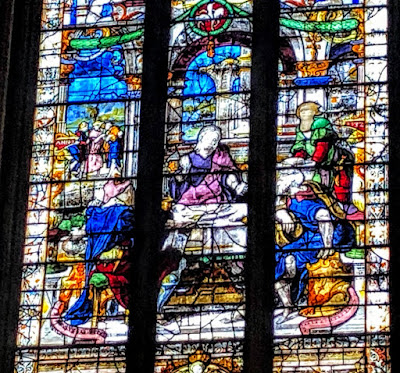
Christ in the home of Mary, Martha and Lazarus … a panel in the Herkenrode glass windows in the Lady Chapel in Lichfield Cathedral (Photograph: Patrick Comerford)

Patrick Comerford

We are in Ordinary Time in the Church Calendar and today is the Fifth Sunday after Trinity (Trinity V, 20 July 2025). Later this morning, I hope to present at the Parish Eucharist in Saint Mary and Saint Giles Church, Stony Stratford.

Before today begins, I am taking some quiet time this morning to give thanks, to reflect, to pray and to read in these ways:

1, reading today’s Gospel reading;

2, a short reflection;

3, a prayer from the USPG prayer diary;

4, the Collects and Post-Communion prayer of the day.

Christ in the home of Mary and Martha … the East Window in Saint Peter and Saint Paul Church, Watford, Northamptonshire (Photograph: Patrick Comerford)

Luke 10: 38-42 (NRSVA):

38 Now as they went on their way, he entered a certain village, where a woman named Martha welcomed him into her home. 39 She had a sister named Mary, who sat at the Lord’s feet and listened to what he was saying. 40 But Martha was distracted by her many tasks; so she came to him and asked, ‘Lord, do you not care that my sister has left me to do all the work by myself? Tell her then to help me.’ 41 But the Lord answered her, ‘Martha, Martha, you are worried and distracted by many things; 42 there is need of only one thing. Mary has chosen the better part, which will not be taken away from her.’

Christ in the House of Martha and Mary by Diego Velázquez (1630)

Today’s Reflection:

Saint Luke’s story of the meal that Jesus has with his friends Mary and Martha is not found in the other synoptic gospels, and the only other parallel is in the Fourth Gospel, where Jesus visits Mary and Martha after the death of Lazarus.

So the meals Jesus has with Mary and Martha must be understood in the light of the Resurrection, which is prefigured by the raising of Lazarus from the dead.

For many women, and for many men too, the story of the meal with Martha and Mary raises many problems, often created by insights that may not have been possible to have at the time when Saint Luke’s Gospel was written.

Our approach to understanding and explaining this meal very often depends on the way in which I understand Martha and the busy round of activities that have her distracted, and that cause her to complain to Jesus about her sister’s apparent lack of zeal and activity.

These activities in the Greek are described as Martha’s service – she is the deacon at the table: where the NRSV says ‘But Martha was distracted by her many tasks,’ the Greek says: ἡ δὲ Μάρθα περιεσπᾶτο περὶ πολλὴν διακονίαν (‘But Martha was being distracted by much diaconal work, service at the table’).

Quite often, when this story is told, over and over, again and again, it is told as if Martha is getting stroppy about having to empty the dishwasher while Mary is lazing, sitting around, making small talk with Jesus.

Does Martha see that Mary should only engage in kitchen work too?

Does she think, perhaps, that only Lazarus should be out at the front of the house, keeping Jesus engaged in lads’ banter about the latest league match between Bethany United and Jerusalem City?

Is Jesus being too dismissive of Martha’s complaints?

Or is he defending Mary’s right to engage in a full discussion of the Word, to engage in an alive ministry of the Word?

Martha is presented in this story as the dominant, leading figure. It is she who takes the initiative and who welcomes Jesus into her home (verse 38); it is she who offers the hospitality, who is the host at the meal, who is the head of the household – in fact, Lazarus isn’t even on the stage for this scene, and Mary is merely ‘her sister’ – very much the junior partner in the household.

Yet it is Mary, the figure on the margins, who offers the sort of hospitality that Jesus commends and praises.

Mary simply listens to Jesus, sitting at his feet, like a student would sit at the feet of a great rabbi or teacher, waiting and willing to learn what is being taught.

Martha is upset about this, and comes out from the back and asks Jesus to pack off Mary to the kitchen where she can help Martha.

But perhaps Martha was being too busy with her household tasks.

I was once invited to dinner by people I knew as good friends. And for a long time I was left on my own with the other guest as the couple busied themselves with things in the kitchen – they had decided to do the washing up before bringing out the coffee … the wife knew that if she left the washing up until later, the husband would shirk his share of the task.

But being left on our own was a little embarrassing. Part of the joy of being invited to someone’s home for dinner is the conversation around the table.

When I have been on retreats, at times, in Greek Orthodox and Benedictine monasteries, conversation at the table has been discouraged by a monk reading, usually from the writings of the Early Fathers, from the Patristic writings.

A good meal, good table fellowship, good hospitality, are not just about the food that is served, but about the ideas and words shared, heard and listened to around the table too.

One commentator suggests that Martha has gone overboard in her duties of hospitality. She has spent too much time preparing the food, and has failed to pay real attention to her guest.

On the other hand, Mary has chosen her activity (verse 42). It does not just happen by accident. Mary has chosen to offer Jesus the real hospitality that a guest should receive. She talks to Jesus, and real conversation is about both talking and listening.

If she is sent back into the kitchen, then – in the absence of Lazarus, indeed, in the notable absence of the disciples – Jesus would be left without hospitality, without words of welcome, without conversation.

Perhaps Martha might have been better off if she had a more simple lifestyle, if she prepared just one dish for her guest and for her family – might I be bold enough to suggest, if she had been content for them to sup on bread and wine alone.

She could have joined Mary in her hospitality, in welcoming Jesus to their home and to their table; they could have been in full communion with one another.

In this way, Martha will experience what her sister is experiencing, but which she is too busy to notice – their visitor’s invitation into the hospitality of God.

One commentator, Brendan Byrne, points out the subtle point being made in this story:

‘Frenetic service, even service of the Lord, can be a deceptive distraction from what the Lord really wants. Luke has already warned that the grasp of the word can be choked by the cares and worries of life … Here the cares and worries seem well justified – are they not in the service of the Lord? But precisely therein lies the power of the temptation, the great deceit. True hospitality – even that given directly to the Lord – attends to what the guest really wants.’

Saint Augustine’s Church, Mambong … illustrating reflections on ‘Diversity in Sarawak’ in the USPG prayer diary this week (Photograph: Patrick Comerford, 2024)

Today’s Prayers (Sunday 20 July 2025, Trinity V):

The theme this week (20 to 26 July) in Pray with the World Church, the prayer diary of the Anglican mission agency USPG (United Society Partners in the Gospel), is ‘Diversity in Sarawak’ (pp 20-21). This theme is introduced today with these reflections:

The Revd Canon Prof Patrick Comerford – Former Professor of Theology and retired parish priest in the Diocese of Limerick and Killaloe, Church of Ireland. Following five weeks travelling throughout the Diocese of Kuching in East Malaysia, Canon Patrick writes:

“Sarawak, on the island of Borneo, is the largest of the 13 states in Malaysia, spanning 48,000 square miles and about 3 million people. The Anglican presence on Borneo dates from 1848, when Thomas McDougall arrived in Kuching at the invitation of the Rajah of Sarawak. The chancel of Saint Thomas’s Cathedral, Kuching, was built by SPG (USPG) to mark more than 100 years of links between the diocese and SPG. A plaque above the lectern reads: ‘Borneo Mission Association, 1909-2015, For its memorial look around you.’

During my stay, I worshipped regularly in Saint Thomas’s Cathedral but also went on a whirlwind tour of various churches and chapels, mission stations and schools, throughout the Malaysian state of Sarawak. I was led by Father Jeffry, who leads churches in the mission area of Mambong. He was a most genial host. It was a privilege to see his ministry and mission, in urban and rural settings. Sarawak is a richly diverse place with Indigenous people groups, including the Iban and Bidayuh, making up almost half the population.

It was good for me to see at first-hand that the legacy of SPG and USPG’s work in the past has led to a truly incarnational local diocese. Sarawak is in a unique position to become a model for interfaith harmony and dialogue and for cultural and ethnic diversity and co-operation,” Patrick concluded.

The USPG prayer diary today (Sunday 20 July 2025, Trinity V) invites us to pray:

Lord God, we pray for the Church of the Province of southeast Asia, the Diocese of Kuching, and for the ministry and mission of the bishops, including the Right Revd Danald Jute, Bishop of Kuching and Brunei since 2017.

The Collect:

Almighty and everlasting God,
by whose Spirit the whole body of the Church
is governed and sanctified:
hear our prayer which we offer for all your faithful people,
that in their vocation and ministry
they may serve you in holiness and truth
to the glory of your name;
through our Lord and Saviour Jesus Christ,
who is alive and reigns with you,
in the unity of the Holy Spirit,
one God, now and for ever.

The Post-Communion Prayer:

Grant, O Lord, we beseech you,
that the course of this world may be so peaceably ordered
by your governance,
that your Church may joyfully serve you in all godly quietness;
through Jesus Christ our Lord.

Additional Collect:

Almighty God,
send down upon your Church
the riches of your Spirit,
and kindle in all who minister the gospel
your countless gifts of grace;
through Jesus Christ our Lord.

Yesterday’s reflections

Continued tomorrow

‘Diversity in Sarawak’ is the theme in the USPG Prayer Diary this week (Photograph: Patrick Comerford, 2025)

Scripture quotations are from the New Revised Standard Version Bible: Anglicised Edition copyright © 1989, 1995, National Council of the Churches of Christ in the United States of America. Used by permission. All rights reserved worldwide. http://nrsvbibles.org

04 November 2024

A morning visiting
the Sarawak Cultural
Village and learning
about local diversity

Sarawak Cultural Village is an award-winning Living Museum at the foot of Mount Santubong (Photograph: Patrick Comerford, 2024)

Patrick Comerford

One day at the end of last week, I spent a full morning at the Sarawak Cultural Village, an award-winning Living Museum at the foot of Mount Santubong and close to the Damai Beach Resort and hotels.

Father Jeffry Renos Nawie of Saint Augustine’s Church, Mambong, in the Diocese of Kuching, brought me on the 45-minute drive from Kuching to Sarawak Cultural Village, said to be the finest living museum in South-East Asia. Its features include seven traditional houses across a 17.5-acre site to the north of Kuching, tucked in at the foothills of Mount Santubong at Damai Beach.

Sarawak is the largest state in Malaysia, with a population of 2.8 million and has more than two dozen different ethnic groups. Apart from the Chinese (23 per cent), and the Malays (23 per cent), the biggest ethnic groups are within the indigenous communities: the Iban were once known as the ‘Sea Dayak’ (30 per cent), and the Bidayuh were once known as the ‘Land Dayak’ (8 per cent). The other indigenous groups include the Orang Ulu (6 per cent), Melanau (5 per cent), Murut, Kenyah, Kayan, Kedayan, Kelabit, Berawan, Penan and Bisayah.

Sarawak Cultural Village celebrates this rich cultural diversity and the lifestyles of many of these ethnic groups, and has been acclaimed by many as one of the best heritage experiences in Malaysia.

The Melanau Tall House in Sarawak Cultural Village … a massive house built 40 ft above the ground (Photograph: Patrick Comerford, 2024)

Sarawak Cultural Village was established in 1991 and has become an unique award-winning living museum, featuring replicas of local houses and buildings, as well as offering a comprehensive narration of various cultures and rituals of the tribes and people of Sarawak, with insights into their lifestyle and history.

The village highlights seven of the major ethnic groups: Iban, Bidayuh, Orang Ulu, Chinese, Malay, Melanau and Penan. Visitors are encouraged to become immersed in a hands-on experience of what once was daily life for these people in their houses, including the Bidayuh longhouse, the Iban longhouse, the Penan hut, the Orang Ulu longhouse, the Melanau Rumah Tinggi, the Malay house and the Chinese farmhouse.

There are opportunities to taste traditional food, join in dances, listen to musical instruments, and see different weapons from the past, as well as chances to take part in crafting and agricultural activities, such as bead-making and paddy-pounding.

All the buildings are staffed with members of the relevant ethnic groups in traditional costume and engaging in traditional activities, and storytellers describe and interpret their people’s traditions and way of life.

Unlike other local houses in the village, the Chinese farmhouse is built at ground level (Photograph: Patrick Comerford, 2024)

Father Jeffry and I began our tour of the village at the Chinese farmhouse. Unlike other houses in the village, the Chinese farmhouse is built at ground level with doorposts protected by the application of strips of red paper, inscribed with protection verses. The clay floor is made of trodden earth, the walls of whitewashed sawn timber, and the roof is thatched with leaf attap.

The house has two main parts, the main room and the bedroom, with the household shrine a focal point in the main room. Outside is a pepper garden.

The wooden Malay House is a gracious structure, adapted to Sarawak’s tropical climate. It is built on stilts and is reached by a staircase. The front room is an area for the men, used for official occasions and entertaining guests.

The windows are down to floor level to allow in the breeze. Much skill is used in decorating the stair and window railings, fascia boards under the eaves and the ventilation grills above and beside the doors.

The Bidayuh house, known as the Barok, is a round head-house with bamboo and carvings (Photograph: Patrick Comerford, 2024)

The Melanau build massive houses 40 ft above the ground. Traditionally, they lived near the sea and need to protected themselves from pirates. We climbed the first staircase of the Melanau Tall House to the first floor, with its displays of tools and utensils. A second staircase leads up to the bedroom.

Next was the Orang Ulu Longhouse, built many feet above the ground, with lush tropical greenery below. It is filled with musical instruments, including the stringed Sape and Jatung Utang instruments. Here too, Orang Ulu women demonstrate their intricate beadwork.

The Bidayuh house known as the Barok is a round head-house with bamboo and carvings. The Barok is the assembly place for the Bidayuh warriors and is filled with gongs, war drums, weapons and wooden masks, and is connected by bamboo walkways with the Bidayuh longhouses. Bidayuh daily life included sugar cane crushing, paddy pounding and winnowing rice.

Notched logs serves as stairs leading up to many of the longhouses (Photograph: Patrick Comerford, 2024)

As in so many places in the village, a notched log serves as stairs leading up to the Iban Longhouse.

The Iban were once known as the ‘Sea Dayaks’ and now account for about a third of the people in Sarawak, the biggest native group in the region. An open veranda faces the Iban traditional longhouse built of axe-hewn timber, secured with creeper fibre and roofed with leaf thatch.

Visitors to the Iban Longhouse are entertained with drums and gongs, Pua weaving, and Kuih Jala and Kuih Chap making. Hanging skulls hint at tales from by-gone days.

A Penan man making blowpipes at the Penan Hut … ‘Do not blow from your mouth. Blow from your chest and your stomach’ (Photograph: Patrick Comerford, 2024)

The Penans are shy nomadic people who live in the dense jungle of Central Borneo, among some of the state’s most precious timber resources. Because of their roaming lifestyle, their shelters are quickly built to last for few weeks or months.

They are the last of the hunters and gatherers, and their huts or shelters are built quickly to last for a few weeks or months at most. They are built near wild sago trees, the staple food of the Penan people, and once the supply has been used up the family moves on.

The Penans specialise in making and using blowpipes. You can watch them making blowpipes at the Penan Hut and even try using one. The Penan advice is, ‘Do not blow from your mouth. Blow from your chest and your stomach.’

The other sites in the village include the Chinese Pavilion near the grand entrance, a bamboo bridge once used by villagers to cross rivers, a souvenir shop and a restaurant.

Our morning visit to the village ended in the theatre at the multi-cultural performance by award-winning dancers and musicians in colourful costumes.

Their elegant dance routines range from young Orang Ulu women following the pattern of the hornbills to a rugged Iban warrior performing the ngajat, shield in hand, dancing with the rhythm of deep gongs and rainforest musical instruments. The 45-minute multicultural performances take place twice a day, at 11:30 am and 4 pm, and are a fitting climax to a visit to the village.

Traditional dancing at Sarawak Cultural Village (Patrick Comerford, 2024)

25 October 2024

Belfast’s innovative
and award-winning
synagogue opened
60 years ago in 1964

The synagogue on Somerton Road, Belfast, was designed by the Slovak modernist architect Eugene Rosenberg

Patrick Comerford

During last month’s visit to Belfast, I visited the sites of the former synagogue on Annesley Street (1904-1964) and its predecessor on Great Victoria Street (1871-1904), and went in search of the site of the former Belfast New Synagogue at 2 Jackson Street and the former United Hebrew Congregation, which used the premises of the Jewish National School at 5 Regent Street.

On those few days, I also visited the restored Jaffé Memorial Fountain and was wrote about the influence of Sir Otto Jaffé on so many aspects of life in Belfast.

However, that visit last month was so short that I never had an opportunity to visit Belfast’s present synagogue, an architecturally-acclaimed and prize-winning building on Somerton Road that first opened 60 years ago today, on 25 October 1964.

The Jewish community in Belfast has been known as Belfast Jewish Community since 2004, and was previously known as Belfast Hebrew Congregation and Belfast Synagogue.

Much of my knowledge of the Jewish community in Belfast, its synagogues and its people has been gleaned from research by the Belfast-born Jewish historian Steven Jaffe.

The synagogue on Somerton Road was designed by the Slovak modernist architect Eugene Rosenberg, assisted by associate architect Karl Kapolka. The foundation stone was laid on 3 May 1964 and the synagogue was consecrated 25 October 1964.

Rosenberg’s award-winning design for the building was unusual and innovative. The synagogue is circular, not rectangular. There is no balcony for women, and instead there is a raised platform on either side, separated from the main part of the sanctuary by a railing. The roof is held up by concrete-covered beams that form the shape of a Star of David. The candelabrum and the Ner Tamid or eternal light, as well as the bronze and silver letters adorning the Ark doors, are by the Israeli sculptor Nehemia Azaz.

The synagogue has a plaque in memory of Jews killed during the Holocaust. The English part of the inscription reads, ‘In memory of the martyred millions of European Jewry 1933-1945.’

The architect Eugene (Evžen) Rosenberg (1907-1990) was born in Topoľčany, Slovakia, on 24 February 1907. He studied engineering in Bratislava, Brno and Prague in 1920-1928 and architecture at the Academy of Fine Arts in Prague in 1929-1932 as a pupil of Josef Gočár. In between his studies, he worked with Le Corbusier in Paris and with Josef Havlíček and Karel Honzík in Prague.

He set up his own practice in Prague in 1934 but left Czechoslovakia for Britain in 1939 to escape the Nazi occupation of Czechoslovakia and encouraged by his friendship with the architects Maxwell Fry and FRS Yorke. He was interned in 1940 and sent to Australia, but was able to return to London in 1942.

He established Yorke Rosenberg Mardall in 1944 with FRS Yorke and CS Mardall and they were responsible for a number of innovative architectural projects such as Gatwick Airport, the John Radcliffe Hospital, Oxford, and the Manchester Magistrates Court. Altnagelvin Hospital (1959-1961) in Derry was the first post-war NHS Hospital in the United Kingdom.

When the new synagogue on Somerton Road opened in 1964, it was known as the Woolfson Centre. It has been described as ‘one of the most sophisticated small synagogues built in the United Kingdom.’

The synagogue was partitioned in two in the early 1990s to make way for an on-site social centre. It was designated a Listed Historic Building in 2015.

Eugene Rosenberg’s award-winning design for the Belfast synagogue was unusual and innovative (Photograph © Michael Black)

During the ‘Troubles’, the Belfast Jewish Institute was burnt down in 1981. Leonard Kaitcer was one of three Jews to be killed as a result of the ‘Troubles’. Leonard Steinberg, a local businessman, left Belfast for Manchester after a shooting attack and later expanded his business, Stanley Leisure, and was raised to the peerage as Lord Steinberg of Belfast. The last kosher butchers in Belfast and the Levy’s delicatessen and grocery shop, both on the Antrim Road, are long closed.

On the other hand, the synagogue complex became a neutral venue during the ‘Troubles’ and the community hosted efforts at reconciliation between communities in North Belfast. However, the community found it difficult to attract the services of a minister and for a number of years relied on clergy who visited during the festivals.

Although the community and the synagogue follow Ashkenazi traditions and liturgies, the synagogue in Belfast has been served by at least one Sephardi minister. Rabbi Moshe Perez was born in Casablanca in Morocco in 1958, and was educated at yeshivot in Morocco, New York, Manchester and Israel. He was a shochet and assistant minister with the Dublin Jewish Community when he was appointed minister to the Belfast Hebrew Congregation (1988-1990). He later served in Nottingham (1990-2018), and received semicha or rabbinical ordination in 1995.

The present rabbi in Belfast is Rabbi David Kale, who served Jewish congregations in Staines and Bournemouth, before being moving to Belfast in 2018. He obtained semicha in 2022 and was made an MBE in the New Year Honours List on 30 December 2022.

The Jewish community in Belfast is one of the oldest ethnic and religious minorities in Northern Ireland and has thrived over four or five generations. Although numbers have fallen in recent years, the Jewish community continues to play a significant role in the religious and cultural life of Northern Ireland.

The synagogue has about 80 members today, but the Belfast Jewish community continues to make a contribution to life that is out of proportion to its numbers in Northern Ireland, which is an increasingly diverse and multicultural society.

Steven Jaffe continues to lead occasional Jewish heritage walking tours in Belfast city centre.

Shabbat Shalom, שבת שלום

The Jewish community in Belfast is one of the oldest ethnic and religious minorities in Northern Ireland