Showing posts with label #WeRemember. Show all posts

26 January 2024

The Fragility of Freedom
is the theme of this year’s
Holocaust Memorial Day

‘One of the most precious monuments of Jewish culture in Poland is dead’ … the Izaak Jakubowicz Synagogue in Kazimierz, the historic Jewish district of Kraków (Photograph: Patrick Comerford)

Patrick Comerford

Tomorrow marks Holocaust Memorial Day (HMD), which takes place each year on 27 January. The theme for Holocaust Memorial Day this year (2024) is Fragility of Freedom.

The Holocaust Memorial Day Trust encourages remembrance in a world scarred by genocide. The day remembers the 6 million Jews murdered during the Holocaust, alongside the millions of people murdered under Nazi persecution of other groups and during more recent genocides in Cambodia, Rwanda, Bosnia and Darfur.

The date 27 January was chosen because it marks the anniversary of the liberation of Auschwitz-Birkenau, the largest Nazi death camp, on 27 January 1945.

This year, 27 January is also Shabbat Shirah, the Sabbath of Singing, in the Jewish calendar. Many congregations highlight this Shabbat by creating services brimming with extraordinary music to celebrate Moses and Miriam leading the people out of Egypt and across the Red Sea of Reeds into liberation and freedom. Shabbat Shirah we celebrates a very special moment in the Torah, a very musical moment in Jewish biblical history.

Each year on Holocaust Memorial Day, thousands of people come together to learn about the past and to take action to create a safer future. The Holocaust threatened the fabric of civilisation, and genocide must still be resisted every day. This world often feels fragile and vulnerable and we cannot be complacent. Even in Britain, prejudice and the language of hatred must be challenged by all.

This year’s theme, ‘Fragility of Freedom’, was inspired by words written by Anne Frank in her diary after the Germans invaded the Netherlands: ‘That is when the trouble started for the Jews. Our freedom was severely restricted by a series of anti-Jewish decrees.’

Anne Frank and her family went into hiding. But they were betrayed and Anne died in Bergen-Belsen Concentration Camp, three months short of her 16th birthday. Her comment concludes: ‘You couldn’t do this and you couldn’t do that, but life went on’. But of course, for Anne Frank, and millions of others, life did not go on. Building on the multiple restrictions on their freedoms, their freedom of life was destroyed, and they were deliberately murdered.

Inside the Izaak Jakubowicz Synagogue … seriously threatened by large cracks in its high barrel vault (Photograph: Patrick Comerford)

Like many people who have visited Auschwitz, I have stayed in Kazimierz, the historic Jewish district of Kraków, where I have visited many of the surviving synagogues and Jewish sites. They include seven of the most prominent synagogues in Kazimierz: the Old Synagogue, the High Synagogue, Remu'h Synagogue, Wolf Popper Synagogue, the Tempel Synagogue, Kupa Synagogue and the Izaak Jakubowicz Synagogue.

The synagogues of Kraków represent virtually all the European styles of architecture, including the Gothic, Renaissance, Baroque, Neoclassical, and the Modernist. They were built between the end of the 15th century and the end of the 19th century, and are on the UNESCO World Heritage List.

Three of these synagogues are still active, some also serve as houses of prayer, and the district also has two Jewish cemeteries. The architectural historian Carol Herselle Krinsky regards the Izaac Synagogue as ‘the most architecturally important’ of all the old synagogues of Kraków.

So, I was saddened to learn through Jewish Heritage Europe earlier this week that the structural integrity of the 17th century Izaak Jakubowicz Synagogue, a jewel of Kazimierz, is seriously threatened by large cracks that have appeared in its high barrel vault.

In an announcement on Facebook earlier this month, the Social Committee for the Restoration of Kraków Monuments (SKOZK) pledged support to save the Baroque building, which dates from 1644.

The Izaak Synagogue is knowm for its colourful wall paintings of prayers and ritual imagery and the elaborate stucco work on the vault (Photograph: Patrick Comerford)

The announcement on Facebook declared dramatically: ‘One of the most precious monuments of Jewish culture in Poland is dead.’

The Izaak Jakubowicz Synagogue is the largest synagogue in Kazimirz. It is believed to have designed by either the Italian-born architect Francesco Olivierri or Giovanni Trevano, an Italian royal architect working in Kraków in the mid-17th century, and its construction was completed in 1644.

The Izaak Synagogue is noted for its colourful wall paintings of prayers and ritual imagery, as well as the elaborate stucco work on the vault, which soars to a height of 14 metres.

After cracks appeared on the vault above the prayer hall in the synagogue in 2018, investigations showed large and wide cracks that were spreading and that the surface of the vault is decaying and can no longer bear the load.

Last year, with the support of SKOZK, a technical project began in an effort to secure the vault and its beautiful stucco decorations, using carbon fibre tapes that fasten the vault from the roof.

The report concluded that the ‘the basic cause of the damage’ appeared to be ‘the faulty geometry of the vault structure … compounded by other problems, including, above all, deformation of the roof structure.’

Less serious cracks had already been detected in the vault in 1988, it said, and renovation in the late 1980s and early 1990s had seemed to have resolved the problem. But, ‘as it turned out, this was a wrong assumption.’

Maciej Wilamowski, director of the SKOZK office, was quoted in local media as describing the situation as ‘truly one of the most serious failures in a monument of this class in Kraków in recent decades. It covers the entire vault above the nave.’

Reports estimate the repairs will involve considerable costs, because the technology involving the installation of carbon fibres from the top is expensive. Other proposals would have involved removing and replacing a very large part of the 17th-century stucco work.

The Izaak Synagogue once had a widely-admired, wooden, baroque Aron haKodesh or holy ark, destroyed by the Nazis in 1939 (Photograph: Patrick Comerford)

The Izaak Synagogue (Synagoga Izaaka), formally known as the Isaak Jakubowicz Synagogue, dates from 1644 and is named for its donor, Izaak Jakubowicz, who died in 1673. He was also known as Isaac the Rich, a banker to King Ladislaus IV of Poland. The founding legend of the synagogue was first told in the early 19th century by the Polish rabbi, Simcha Bunim of Peshischa.

The interior walls of the synagogue are decorated with painted prayers, visible once again after conservation removed covering layers of paint. The vaulted ceiling is decorated with baroque plasterwork wreaths and garlands.

Before the Nazi occupation of Poland, the synagogue boasted a widely-admired, wooden, baroque Aron haKodesh or holy ark. On 5 December 1939 the Gestapo came to the Kraków Judenrat building and ordered Maximilian Redlich, the Jewish official on duty that day, to burn the scrolls of the Torah. When Redlich refused he was shot dead. The Nazis then destroyed the interior and furnishings, including the bimah and Aron haKodesh.

After the war, the synagogue was used as a sculpture and conservation workshop and then by a theatre company as a studio and for storing props. Until recently it was an exhibition space. A fire in 1981 damaged the interior. Renovation work began in 1983 and the building was returned to the Jewish community in 1989. It is a practicing Orthodox synagogue once again, and houses Kraków’s Chabad Lubavitch community and the Jewish Education Centre.

Holocaust Memorial Day this year is an opportunity to reflect on how freedom is fragile and vulnerable to abuse. It is an invitation to pledge not to take our freedoms for granted, and to consider what we can do to strengthen freedoms around the world.

• Holocaust Memorial Day is being marked in Milton Keynes tomorrow (27 January 2024) with a short service at 2 pm at the Milton Keynes Rose, including readings and a performance by a local choir.

Shabbat Shalom

‘Arbeit macht frei’ … the gate at Auschwitz … this weekend marks Holocaust Memorial Day (Photograph: Patrick Comerford)

27 January 2022

‘The Objects of Love’: intimate
story of love, loss, and
survival in the Holocaust

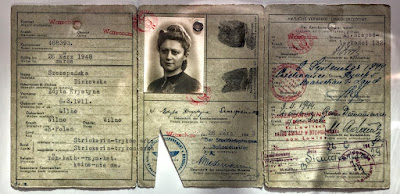
Forged identity papers from Warsaw 1941 in the name of Krystyna Szczepanska, a pseudonym for Edyta Rozenfeld, the grandmother of Oliver Sears … one of the exhibits in ‘The Objects of Love’ an exhibition in Dublin Castle (Photograph: Patrick Comerford, 2022

Patrick Comerford

Today is Holocaust Memorial Day, marking the anniversary of the liberation of Auschwitz in 1945 and the beginning of the liberation of the concentration camps in Europe. Earlier this week I attended ‘The Objects of Love’ an exhibition in Dublin Castle organised by the Office of Public Works in association with Holocaust Awareness Ireland.

‘The Objects of Love’ is an exhibition of powerful mementoes that tell the story of one Jewish family before, during and after World War II. The exhibition in the Bedford Hall opened on 12 January, a fortnight before Holocaust Memorial Day, and this is a poignant exhibition telling the fate of individual lives torn asunder in Nazi-occupied Poland and beyond.

Their story is told through a curated collection of precious family objects, photographs and documents. The Dublin-based art dealer Oliver Sears vividly brings to life this extreme edge of European history where his mother Monika and grandmother Kryszia are the beating hearts of an epic and intimate story of love, loss, and survival.

Oliver Sears, who grew up in London and owns an art gallery in Dublin, is the founder of Holocaust Awareness Ireland. His family came from the Polish city of Lodz, which had a population of 200,000 Jews before the war.

He has painstakingly chronicled how their lives were torn apart following the Nazi invasion in 1939. He said: ‘They were ordinary people. It's just that fate intervened and ensured that they had extraordinary lives. This is my family story, told through my eyes, the only way I know how, using fragments of memory I have recorded, together with the collection of objects and documents, the emotional debris of dislocation and disaster.’

The items in the exhibition include forged identity papers belonging to his grandmother. ‘They show a passport sized photograph of my grandmother with freshly dyed blonde hair staring straight ahead. A new and necessary look to heighten her Aryan credentials, along with her acquired, nondescript Polish name and unlikely declared profession of ‘typist’.’

‘When I think about the Holocaust and what happened to my family, strangely I don't feel anger. It's humiliation. What could be more humiliating than having to pretend that you are something you are not, because your life depends on it.’

Oliver Sears hopes the exhibition raises awareness and understanding of a subject that ‘is still not widely known in Ireland.’ He says the exhibition is important to illustrate the generational impact the Holocaust had on families, and in the context of antisemitism that still persists today.

He explains how he felt he was honouring his family by bringing their story to Dublin Castle. ‘I think the fact that we were invited by the OPW to produce this exhibition at Dublin Castle gives us, in a nutshell, the imprimatur of the State. I do have a very keen sense of needing to honour my family. At an almost biblical level, they were humiliated.

‘Not only were they murdered, every trace that they ever existed was wiped out. So, there is a sense of triumph that I, somehow, at State-level can give them a voice, bring them back to life briefly, and give them a value that was stripped from them.’

In November 2020, he had found a cache of photographs and documents relating to his family in the US Holocaust Memorial Museum in Washington DC.

By organising this exhibition, he says he can honour his family, he told The Irish Times. ‘You can have massive gaps in your family, there are all these ghosts. There are people who you never knew, who you should have known. Then there are the living ghosts, who are badly traumatised, who weave in and out of your childhood, some of whom you are related to.’
The forged identity papers of Oliver Sears’s grandmother Kryszia Wandstein (Edyta Rosenfeld). In spring 1943, Edyta bought forged identity papers that allowed her and her daughter Monika to live outside a ghetto.

When his grandmother and mother came to England in 1947, his grandmother married a Polish Jewish dentist who was stranded in London during the war. He had lost every single member of his family, including his pregnant wife. ‘He married my grandmother. He was the only grandfather I knew. I didn’t know he wasn’t my real grandfather until the day he died.’

The photographs from before the war are the most moving to Oliver Sears, as they show ordinary people, with hopes, dreams and aspirations, and that was all destroyed. However, he feels the exhibition is an act of resistance in itself, as the Nazis’ goal was to eradicate Jewish people completely. ‘It says: ‘No. Where are you, with your thousand-year reich? We are still here’.’

The exhibition was opened by Lenny Abrahamson and is accompanied by an audio narration and an illustrated booklet.

Speaking before the exhibition, the Minister at the OPW, Patrick O’Donovan, said: ‘The Holocaust represents an event at the limits, a core event in which a shared European memory is rooted that we in Ireland are part of. But it is only through our own personal engagement with the past that we can understand its legacy and continued relevance to our present and future. This exhibition particularises the experience of one family and offers us a unique opportunity to both relate to and bear witness to the fate of those persecuted by the Nazis.’

The exhibition continues until 13 February 2022. Opening times daily are 10 am to 5 pm (closed 1 to 2), and admission is free.

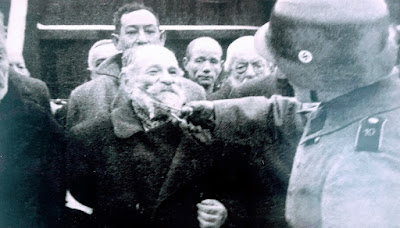
Nazis humiliating Jews publicly in the Kraków ghetto in 1941

29 January 2021

‘Forever enfold them in
the embrace of Your wings;
secure their souls in eternity’

Smashed gravestones in the New Jewish Cemetery in Kraków have been collected to form a Holocaust Memorial (Photograph: Patrick Comerford)

Patrick Comerford

Earlier this week, on Holocaust Memorial Day (27 January 2021), I recalled the many survivors and victims of the Holocaust who had once lived in Ireland, who moved to Ireland, or who died in Ireland.

El Malei Rachamim (אֵל מָלֵא רַחֲמִים, ‘God full of compassion’) is a prayer for the departed that asks for comfort and everlasting care of the deceased. It is usually said at the graveside during the burial service and at memorial services during the year:

God, full of mercy, Who dwells above, provide a sure rest on the wings of the Divine Presence, amongst the holy, pure and glorious who shine like the sky, to the soul of (Hebrew name), son/daughter of (Hebrew name) for the sake of charity which was given to the memory of his/her soul. Therefore, the Merciful One will protect him/her forever in the hiding of his wings, and will tie his/her soul with the rope of life. The Everlasting is his/her heritage, and he/she shall rest peacefully at his/her lying place, and let us say: Amen.

But different versions of this prayer are provided for different moments. The version for the Remembrance of Victims of the Holocaust says:

God, full of mercy, who dwells in the heights, provide a sure rest upon the Divine Presence’s wings, within the range of the holy and the pure, whose shining resemble the sky’s, all the souls of the six million Jews, victims of the European Holocaust, who were murdered, slaughtered, burnt and exterminated for the Sanctification of the Name, by the German Nazi assassins and their helpers from the rest of the peoples. Therefore, the Master of Mercy will protect them forever, from behind the hiding of his wings, and will tie their souls with the rope of life. The Everlasting is their heritage, the Garden of Eden shall be their resting room, and they shall rest peacefully upon their lying place, they will stand for their fate in the end of days, and let us say: Amen.

For my Friday evening reflections and readings this evening, I am reading the version for the Shoah (Holocaust) is found in the Reform prayer book, Mishkan T’filah. I have prayed with this prayer before, and on Holocaust Memorial Day a version of this prayer was circulated among priests in the Diocese of Limerick and Killaloe by the Revd Kevin O’Brien of Ennis, Co Clare:

Fully compassionate God on high:
To our six million brothers and sisters
murdered because they were Jews,
grant clear and certain rest with You
in the lofty heights of the sacred and pure
whose brightness shines like the very glow of heaven.

Source of mercy:
Forever enfold them in the embrace of Your wings;
secure their souls in eternity.
Adonai: they are Yours.
They will rest in peace. Amen.

May their memories be a blessing, זצ״ל


27 January 2021

Remembering victims and
survivors of the Holocaust
who have lived in Ireland

The Nazis planned to exterminate 11 million Jews in Europe, including 4,000 people in Ireland … an exhibition in Auschwitz (Photograph: Patrick Comerford)

Patrick Comerford

Today is Holocaust Memorial Day (27 January 2021), marking the 76th anniversary of the liberation of the concentration camps at Auschwitz and Birkenau on 27 January 1945, before the Holocaust and of World War II.

In Birkenau, a series of memorials in over 20 languages commemorates the victims of the Holocaust who were murdered by the Nazis in Auschwitz and Birkenau, representing the variety of languages spoken by and nationalities among the victims.

There is no plaque in Irish, but we should not think that the Holocaust was something that was a far distance from Ireland, for the Nazis were planning to extend their genocide to Ireland too. One exhibition in Auschwitz shows that the Nazis planned to exterminate 11 million Jews in Europe, including 4,000 in Ireland.

Like many people, I watched the streaming of the Holocaust Memorial Service in Dublin on Sunday night (24 January 2021), which was addressed by the two Holocaust survivors still living in Ireland, Tomi Reichental who was born in Bratislava, Slovakia, and Suzi Diamond, who was born near Debrecen in Hungary.

Inside the Spanish Synagogue in Prague … Helen and Harry Lewis were married in Prague in 1947 before leaving for Belfast (Photograph: Patrick Comerford)

There were many other Holocaust survivors who lived in Ireland and who have died in recent years.

Helen Lewis (1916-2009) was born Helena Katz into a German-speaking Jewish family in Trutnov in Bohemia, 160 km north-east of Prague, now in the Czech Republic, close to the border with Poland.

In Prague, she studied dance in Prague, where she also studied philosophy and took lessons in French, and there she married Paul Hermann, from a Czech Jewish family, in June 1938.

Helen and Paul were sent to Terezín (Theresianstadt), 70 km north of Prague, in August 1942. There she worked in the children’s homes and spent months in the camp hospital.

Helena and Paul were separated in May 1944 when they were moved to Auschwitz and they never met again. He died on a forced march in April 1945.

She was among the remaining people forced to leave Auschwitz on 27 January 1945 and marched forcibly for weeks through the Polish winter. When she fell in the snow, she was abandoned, and when she reached her uncle’s house in Prague, she weighed only 30 kg.

She married Harry Lewis in in Prague in June 1947, and they left to begin new lives in Belfast, where he set up a handkerchief-making business and she returned to teaching dance and choreography, bring ‘a whole European dimension to dance in the theatre.’

Her memoir, A Time to Speak, became a bestseller, was translated into many languages, and was serialised by RTÉ and the BBC. Helen died at her home in Belfast on 31 December 2009, aged 93.

Geoffrey Phillips from Germany escaped on the Kindertransports to England in 1938. He came to Ireland in 1951 and died in 2011.

Rosel Siev escaped from Germany to England, but nearly all her family died in the Holocaust. When she was a widow, Rosel married a widowed Irish solicitor, Stanley Siev, and they lived in Rathgar, Dublin, until 2012 when they moved to Manchester. Stanley died in 2014. One of Rosel’s sisters, Laura, was saved by Oskar Schindler and is included on the scroll of names at the end of the movie Schindler’s List.

Inge Radford (1936-2016), who was born in Vienna, escaped to England on the Kindertransports in 1939. Her widowed mother and five of her brothers were murdered in the Holocaust.

Inge was a social worker, a probation officer, and worked in the Royal Victoria Hospital, Belfast. Her husband, Professor Colin Buchanan Radford, was a French academic and dean of the Faculty of Arts at Queen’s University Belfast. Inge lived in Northern Ireland with her husband Colin, until she died in 2016.

Edith Sekules (née Mendel) was born in Vienna in 1916. She spoke of her experiences at Women’s Institutes and in schools, and spoke at the first two years of Holocaust Memorial Day in Northern Ireland. She later lived in Kilkeel, Co Down, and died in 2008. According to her obituary in the Jewish Chronicle, she attributed her survival to her determination to save her family.

Edith Zinn-Collis was brought to Ireland in 1946 with her brother Zoltan by Dr Bob Collis. She lived in Wicklow and died in 2012.

Her brother, Zoltan Zinn-Collis was born around 1940 in Czechoslovakia and was sent to Ravensbruck and Bergen Belsen with his sister and brothers. He was brought to Ireland in 1946 by Dr Bob Collis with his sister Edith. He died in 2012.

Doris Segal from Czechoslovakia came to Ireland with her parents in the 1930s, and later lived in Dublin. She died in 2018, shortly before Holocaust Memorial Day.

Jan Kaminski was born in Poland in 1932. At the age of 10, he escaped a round-up of the Jews, fled into the forests and spent the war on the run. He survived but his entire family perished. He later lived in Dublin, and died in 2019.

Ludwig Hopf moved to Dublin on 17 July 1939 (Photograph: Deutsches Museum, München / Sommerfeld Sammlung)

Professor Ludwig Hopf (1884-1939), a German Jewish refugee who escaped the Holocaust when he fled to Dublin in the weeks immediately before the outbreak of World War II, lived and died at No 65 Kenilworth Square, Rathgar.

He was a theoretical physicist who had been the first assistant to Albert Einstein, and he introduced Einstein to the psychoanalyst Carl Jung. As a theoretical physicist, Hopf made contributions to mathematics, special relativity, hydrodynamics and aerodynamics.

He was dismissed from position as professor of applied mathematics in Aachen on racist, anti-Semitic grounds soon after the Nazis seized power. After Krtistallnacht on the night of 9/10 November 1938, he escaped arrest at the hands of the SS and in early February 1939, he received a research grant in Cambridge. The Hopf family moved to Dublin on 17 July 1939 when Ludwig was offered a specially created professorship of mathematics at Trinity College Dublin, and they moved to No 65 Kenilworth Square.

However, became seriously ill and died at 65 Kenilworth Square on the evening of 21 December 1939. The speakers at his funeral in Mount Jerome were two fellow refugee, Hans Sachs and Erwin Schrödinger.

Dr Ernst Scheyer (1890-1958), who lived at No 67 Kenilworth Square, was a Jewish refugee from Nazi Germany in the late 1930s. He was born in Oppeln in Upper Silesia in 1890, was decorated for his bravery in the Germany army in World War I, and later earned a PhD in Breslau (Wroclaw). Later, he was a practising lawyer and a respected member of the Jewish community in Liegnitz, Silesia. He married Marie Margareta (Mieze) Epstein, who was five years younger than him and was born in Breslau.

He was rounded up after Krtistallnacht and spent almost a month in Sachsenhausen, a concentration camp near Berlin. He arrived in Dublin on 14 January 1939, and the Scheyer family made their home at 67 Kenilworth Square. He later taught German at Saint Columba’s College, Rathfarnham, and in Trinity College Dublin. When he died in 1958, he was buried in the Progressive Jewish community’s cemetery in Woodtown, Rathfarnham.

His daughter Renate married another refugee, Robert Weil (1924-1989), in 1948. It was the first wedding in the newly-established Progressive Jewish Synagogue. Robert Weil had arrived in Ireland in 1939 as a young Jewish refugee from Nazi Germany. He went to school at Newtown in Waterford, studied at TCD, and became a teacher of modern languages, especially German, in Belfast.

In her biography, Renate Weil recalls that both sides of her family had been non-Orthodox Jews for generations but remained Jewish. ‘Our family proved that assimilation did not mean the loss of Judaism. We were German Jews and proud of it.’

Dr Marianne Neuman (1913-2008) was born Marianne Heilfron in Berlin in 1913, the daughter of Curt Solomon Heilfron. During her medical studies in Berlin in the 1930s, it became dangerous to continue living in Germany as a Jew. She left in August 1936 and later arrived in London, where she married another German Jewish refugee doctor, Dr Rudi Neuman.

Rudi travelled to Edinburgh to pass his British medical exams, with the hope of settling in Ireland. They found a large house on Upper Rathmines Road, in which they lived and practised. Both were active and committed founder members of the Dublin Jewish Progressive Congregation.

Dr Rudi Neuman died suddenly in the synagogue at the end of the Yom Kippur service in October 1965. Dr Marianne Neuman chaired the board of management of the Dublin Jewish Burial Society for many years, and was elected honorary life president on her 80th birthday in 1993.

She died at the age of 94 on 17 March 2008 and was buried in Woodtown. Four members of the Heilfron family who were murdered in Minsk in 1941 during the Holocaust are remembered by Stolpersteine or stumbling stones in Berlin.

Hans Borchardt was the son of a Jewish dentist in Berlin Charlottenburg. He was working with a business specialising in surgical and dental instruments when it was ‘Aryanised’ in 1934. He fled to England in September 1934, became a British citizen, and was an agent for a firm importing gloves from Ireland when he chose to make his home in Ireland in 1939. He died in Dublin in 1986, and was also buried in Woodtown.

Sophie Raffalovich O’Brien (1860-1960), was a writer and Irish nationalist, and although she converted to Christianity shortly before her wedding in 1890, she continued to insist on her Jewish identity, and later survived the Holocaust in France.

Sophie Raffalovich was born in the Black Sea port in Odessa. She was a daughter of Herman Raffalovich (1828-1893) and his wife Marie Raffalovich (1832-1891).

The Raffalovich family was Jewish with rabbinical ancestry. When Sophie was four, the family moved in 1864 to France in 1864 to escape to pressure to convert to Christianity.

She first met the Irish Home Rule politician and journalist, William O’Brien, from Mallow, Co Cork, in Paris in 1889. To her father’s dismay, Sophie converted to Catholicism before her marriage in 1890. But, while, she gave up the Judaism of her childhood, she never abandoned her Jewish identity, and suffered attacks from French and Irish anti-Semites.

William died in 1928, and Sophie moved back to France in 1938 to live near Amiens with Fernande and Lucie Guilmart, sisters who had been pupils in the orphanage and school she had supported all her life.

When World War II began and Germany invaded France, the sisters helped her to escape with them to a region near the Pyrenees. While Sophie was living in semi-hiding under the Vichy regime and in Nazi-occupied France, she refused to change her name or to disavow her Jewish identity. Two members of the Raffalovich family – a nephew and a cousin – died in Nazi concentration camps.

By the end of the war, Sophie was extremely impoverished. She died at Neuilly on 8 January 1960, a week before her 100th birthday.

No 65 Kenilworth Square … home of Ludwig Hopf, a Jewish refugee from Nazi Germany, in 1939 (Photograph: Patrick Comerford, 2021)

At least five Irish citizens were murdered in the Holocaust: Ettie Steinberg and her son Leon died in Auschwitz; Ephrem and Lena Saks from Dublin were murdered in Auschwitz; and Isaac Shishi from Dublin and his family were murdered by the Nazis in Lithuania

The Steinberg family moved to Ireland in the 1920s and lived at 28 Raymond Terrace, in ‘Little Jerusalem’ off the South Circular Road in Dublin. The seven Steinberg children went to school at Saint Catherine’s School, the Church of Ireland parish school on Donore Avenue.

Ettie married Vogtjeck Gluck, originally from Belgium, in the Greenville Hall Synagogue on the South Circular Road on 22 July 1937. They later moved to Antwerp. As World War II was looming, they moved to Paris, where their son Leon was born on 28 March 1939. By 1942 they were living in an hotel in Toulouse.

When the Vichy puppet regime began rounding up Jews in southern France at the behest of Nazi Germany, Ettie, Vogtjeck and Leon were arrested. Back in Ireland, her family in Dublin secured visas that would allow the Gluck family to travel to Northern Ireland. But when the visas arrived in Toulouse, it was too late. Ettie, Vogtjeck and Leon had been arrested the day before.

Ettie, her husband and their son were taken first to Drancy, a transit camp outside Paris. The Glucks were then deported from Drancy on 2 September 1942 and arrived in Auschwitz two days later, on 4 September 1942. It is assumed that they were put to death immediately.

Isaac Shishi, whose family came to Ireland from Lithuania, was born in Dublin on 29 January 1891, when his family was living at 36 St Alban’s Road, off the South Circular Road. He was murdered along with his wife Chana and their daughter Sheine were murdered by the Nazis in Vieksniai in Lithuania in 1941.

Ephrem and Lena Saks were born in Dublin on 19 April 1915 and 2 February 1918. Ephraim Sacks was murdered in Auschwitz on 24 August 1942. Lena was murdered there in 1942 or 1943.

Some years ago, I was chilled when I realised that a direct descendant of the Comerford family of Cork, and through that line a descendant of the Comerfords of Co Wexford, suffered horribly with her husband after the German invasion of France and that both died in the Holocaust – one in Ravensbrück and the other in Dachau.

Hedwige Marie Renée Lannes de Montebello (1881-1944) and her husband, Louis d’Ax de Vaudricourt (1879-1945) of Château Vaudricourt, were French aristocrats and did not bear the Comerford family name. Nevertheless, they are part of my own family tree, no matter how distant a branch. Their fate brought home to me how even today we are all close to the evils of racism and its destructive force across Europe and in North America, and we must never forget that.

May their memories be a blessing, זצ״ל


30 April 2020

When memories of
the Holocaust haunt
the extended family

A group Jewish prisoners released from Ravensbrück when it was liberated on 30 April 1945

Patrick Comerford

Today marks the 75th anniversary of the liberation of the concentration camp at Ravensbrück on 30 April 1945. The end of the Holocaust and of World War II 75 years ago has brought a number of anniversaries and commemorations this year, including the 75th anniversary of the liberation of the concentration camps at Auschwitz and Birkenau (27 January), Buchenwald (11 April), Bergen-Belsen (15 April), Sachsenhausen (22 April), Dachau (29 April), Ravensbrück (30 April), Mauthausen (5 May) and Theresienstadt (8 May).

About 130,000 women and girls from about 20 different countries ended up at Ravensbrück. Their stories have been told by the British journalist Sarah Helm, whose meticulous research and thorough analysis of survivors' stories has been published in her books, Ravensbrück: Life and Death in Hitler's Concentration Camp for Women and If this is a woman: Inside Ravensbrück – Hitler’s Concentration Camp for Women. In a feature in the Sunday Times Magazine last Sunday (26 April 2020), she told how her research continues, and how the full story of Ravensbrück has not yet been uncovered.

Some years ago, I was chilled when I realised that a direct descendant of the Comerford family of Cork, and through that line a descendant of the Comerfords of Co Wexford, suffered horribly with her husband after the German invasion of France and that both died in the Holocaust – one in Ravensbrück and the other in Dachau.

Hedwige Marie Renée Lannes de Montebello (1881-1944) and her husband, Louis d’Ax de Vaudricourt (1879-1945) of Château Vaudricourt, were French aristocrats and did not bear the Comerford family name. Nevertheless, they are part of my own family tree, no matter how distant a branch. Their fate brought home to me how even today we are all close to the evils of racism and its destructive force across Europe and in North America, and we must never forget that.

Mary Teresa Comerford (1776-1840) was a little-known poet and author in the early 19th century who wrote under the name Mary Boddington. Some of her songs were written to Irish airs, but while she and her husband Thomas Boddington are referred to frequently in Thomas Moore’s Diary, her poetry is now regarded as vain doggerel, remembered only because of her prolific output and because she was a woman writer who managed to publish so much at a time when men dominated the world of literature and publishing.

Mary was born in Cork in 1776, the daughter of Patrick Comerford (d. 1796), of George’s Quay, Cork, and Summerville, Co Cork. He was a wine merchant in Cork in partnership with his father John Comerford, who was directly descended from the Comerford family of Co Wexford, while his mother Elizabeth Hennessy was a member of the well-known Hennessy family of Cognac fame.

In Bath in 1770, Patrick Comerford married Anne (Teresa), daughter of Thomas Gleadowe (1700-1766) of Castle Street, Dublin, and sister of Sir William Gleadowe-Newcomen (1730-1806), the banker, of Killester, Co Dublin.

Patrick’s younger surviving daughter, Belinda Isabella, married the Revd Francis Law (1768-1807), Vicar of Attanagh in the Diocese of Ossory and Rector of Cork, and they are part of the Comerford family stories.

Many of Belinda’s descendants kept the Comerford family name, including her son, the Revd Patrick Comerford Law. There were interesting family connections with clerical families, with Lewis Carroll, the creator of Alice in Wonderland, and with Sir Edward Fitzgerald Law (1846-1908) of Athens, who was involved in reforming the Greek economy in the 1890s and in the negotiations leading to the eventual restoration of Crete to the Greek state.

Belinda (Comerford) Law’s elder sister, Mary (Comerford) Boddington, wrote verse frequently for the Cork papers before she left Cork for London in 1803. On 16 April 1805, she was married in the fashionable at Saint George’s Church, Hanover Square, London, to Thomas Boddington (1774-1862), a wealthy West Indies merchant of Upper Brooke Street, London, and Marylebone.

Saint George’s was a fashionable church for weddings at the time. There the architect Henry Holland married Capability Brown’s daughter Bridget in 1773, the architect John Nash married Mary Ann Bradley in 1798, and a century later Theodore Roosevelt, the future US President, married Edith Carow (25), in 1886. In the musical My Fair Lady, Alfred Doolittle (Stanley Holloway), having just received an inheritance and having to move into ‘middle-class morality,’ invites his daughter Eliza Doolittle (Audrey Hepburn) to his wedding at this church, leading to the song, Get Me to the Church on Time.

After her marriage, Mary (Comerford) Boddington continued to write and published some entertaining volumes on her travels on the Continent of Europe from 1815 on. She died in 1840, and the popularity of her poetry and her travel writing faded soon after her death.

Mary and Thomas Boddington had a son and two daughters. Their elder daughter, Mary Theresa (1806-1898), was born in London on 13 January 1806. She moved to France and at the age of 25 she was married in the British embassy in Paris on 27 April 1831, to Jean Ernest Lannes de Montebello (1803-1882), Baron de Montebello.

Jean Ernest was born on 20 July 1803 in Lisbon, where his father was Napoleon’s ambassador to Portugal. He died on 24 November 1882 in Pau, France, and Mary died there on 15 May 1898. There the memories of their side of the family might have died out in the narratives of the Comerford genealogies if I had not decided in some idle moment to explore what had happened to Mary Comerford’s daughter and her descendants.

A pile of shoes among the personal belongings plundered from the victims of the Holocaust (Photograph: Patrick Comerford)

When Mary Boddington married Jean Ernest, he was chef de cabinet at the French Foreign Ministry and a chevalier of the Légion d’Honneur. His father, Jean Lannes, 1st Duc de Montebello (1769-1809), was a Marshal of the French Empire. He was one of Napoleon’s most daring and talented generals. In his exile on Saint Helena, Napoleon said of the duke: ‘I found him a pygmy and left him a giant.’

Marshall Lannes was born on 10 April 1769 in the small town of Lectoure, in the Gers department in the south of France, the son of a Gascon farmer. He had little education and was first apprenticed to a dyer. But after enlisting in the army he quickly rose through the ranks and alongside Louis Nicolas Davout and André Masséna he is regarded as one the ablest of all of Napoleon’s marshals.

In 1801, Napoleon sent him as ambassador to Portugal. In 1804, Lannes bought the 17th century Château de Maisons, near Paris, and had one of its state apartments redecorated for a visit by Napoleon.

When the French empire was founded, he was named a Marshal of France (1804), and he commanded the advanced guard of a great French army in the campaign of Austerlitz. Napoleon took him to Spain in 1808, and gave him a detached wing of the army, with which he won a victory over Castaños at Tudela. As a reward in 1808, Napoleon gave him the title of Duc de Montebello.

He was sent to capture Saragossa in 1809. After his last campaign in Spain, he said: ‘This damned Bonaparte is going to get us all killed.’ That year, for the last time, he had command of the advanced guard. He took part in the engagements around Eckmühl and the advance on Vienna. With his corps he led the French army across the Danube, and bore the brunt, with Masséna, of the terrible battle of Aspern-Essling. He received a mortal wound on 22 May, and died on 31 May 1809.

Marshall Lannes and his second wife, Louise Antoinette, Comtesse de Guéhéneuc (1782-1856), had five children, including Jean Ernest Lannes, Baron de Montebello (1803-1882), who married Mary (Comerford) Boddington’s daughter, Mary Theresa.

Mary Theresa and Jean Ernest Lannes de Montebello were the parents of six children:

1, Marie (1832-1917), who married Henri O’Shea, a descendant of the family of wine merchants who had once been in partnership with the Comerford family in Cork.
2, Eveline (1837-1868), a nun in the Sisters of Saint Vincent de Paul.
3, Berthe (1838-1893), who married Auguste Guillemin.
4, Jean Gaston (1840-1926), 2nd Baron de Montebello, an artillery officer and a chevalier of the Légion d’Honneur.
5, René (1845-1925), whose story continues this exploration of Comerford family connections.
6, Roger (1850-1878), who died in Paris.

Marie Lannes de Montebello (1847-1930), born Princess Marie Lubmirska … mother of Hedwige Marie Renée Lannes de Montebello (1881-1944), a descendant of the Comerfords of Wexford who died in Ravensbrück (Detroit Institute of Arts)

René Lannes de Montbello (1845-1925) was born in Gelos on 13 September 1845, and inherited some of the family fame and titles. In Paris on 4 November 1875, he married Princess Marie Lubmirska (1847-1930), the daughter of a celebrated Polish composer, Prince Kazimierz Anastazy Karol Lubomirski (1813-1871), whose family lived near Lviv in what is now Ukraine.

René was an army major and was known by the courtesy title of Baron de Montebello. But, when his son Henry was born in Paris in 1876, he assumed the title of count. Henry died in childhood, but René and his Polish princess were the parents of four other children. He died on 27 December 1925, and Princess Marie died on 18 May 1930.

One of their sons, Count André Roger Lannes de Montebello (1908-1986), was involved in the French resistance during World War II, and was the father of Count Guy Philippe Henri Lannes de Montebello, who, as plain Philippe de Montebello, was the director of the Metropolitan Museum of Art in New York until 2008.

But it is the fate of André’s elder sister that I have found distressing. Hedwige Marie Renée Lannes de Montebello (1881-1944), was born in Pau on 10 Mar 1881, and on 17 September 1910 she married in Biarritz Louis d’Ax de Vaudricourt (1879-1945), of the Château Vaudricourt, who was born on 20 May 1879.

Like her brother, Hedwige was involved in the French resistance. She was captured, and on 7 April 1944, named simply as Hedwig Ax, she was sent on a train from Gare de l’Est in Paris to the transit camp at Neue Bremm in Saarbrücken, Germany. She was transferred to the women’s concentration camp in Ravensbrück, 90 km north of Berlin, where her unique number was 47135. She died in Ravensbrück on 19 November 1944.

Her husband, named simply in his deportation papers as Louis Ax, died in the concentration camp in Dachau in January 1945.

Hedwige Marie Renée Lannes de Montebello (1881-1944), a direct descendant of the Comerfords of Wexford and Cork, died in Ravensbrück on 19 November 1944

I know no more than this about Hedwige Marie Renée Lannes de Montebello and her husband. They may seem like very distant twigs on a distant branch of the Comerford family tree. But if we don’t claim them as part of the family, they stop being part of ‘us’ and part being part of ‘them.’ And therein lies the beginning of all the dangerous thoughts that lead to racism and violent racism.

Hedwige Marie Renée Lannes de Montebello (1881-1944), a direct descendant of the Comerfords of Wexford and Cork, died in Ravensbrück on 19 November 1944.

The rise of the far-right in Europe and America and this year’s 75th anniversary of the end of the Holocaust and the end of World War II are stark reminders of the need to keep these stories alive, and to respect and honour the memories of the dead. We have got to stop making some people ‘us’ and some people ‘them.’ We are all part of the one, larger family.

Arbeit Mach Frei ... the slogan on the gates of Dachau, where Louis d’Ax de Vaudricourt died in 1945

03 March 2020

Parishioners in Rathkeale group
mark Holocaust Memorial Day

Canon Patrick Comerford at the launch of Holocaust Memorial Day prayers and resources in the House of Lords

This year marks the 75th anniversary of the liberation of Auschwitz and other concentration camps, the end of the Holocaust, and the end of World War II.

Canon Patrick Comerford of the Rathkeale and Kilnaughtin Group of Parishes, who is a member of the Church of Ireland Interfaith Working Group, was invited to the House of Lords recently for the launch of resources for churches produced by the Council of Christians and Jews to mark Holocaust Memorial Day 2020.

The resources were launched by the Moderator of the General Assembly of the Church of Scotland, the Right Revd Colin Sinclair, and the Bishop of London, the Right Revd Sarah Mullally.

The launch was introduced by Bishop Michael Ipgrave of Lichfield, and the other speakers included and Rabbi Jonathan Wittenberg, Senior Rabbi of Masorti Judaism and the Archbishop-elect of York Stephen Cottrell. Senior Christian and Jewish leaders present included six bishops of the Church of England.

Parishioners in the Rathkeale and Kilnaughtin Group of Parishes used these prayers for Holocaust Memorial Day on two successive Sundays in all four churches – Askeaton, Kilnaughtin, Castletown and Tarbert – and also displayed boards with the hashtag #WeRemember, used universally to mark Holocaust remembrances.


Parishioners in the Rathkeale and Kilnaughtin Group of Parishes marked Holocaust Memorial Day with the hashtag #WeRemember

This half-page news report is published in the March 2020 edition of ‘Newslink’, the magazine of the Church of Ireland United Dioceses of Limerick, Killaloe and Ardfert (page 19)

02 March 2020

Rathkeale and Kilnaughtin
Group parish notes in
‘Newslink’ March 2020

Parishioners in Saint Mary’s Church, Askeaton, mark World Holocaust Memorial Day (see separate news report)

Rathkeale and Kilnaughtin Group of Parishes

Rathkeale, Askeaton, Castletown and Kilnaughtin

Priest-in-Charge: Revd Canon Patrick Comerford

We have moved from Epiphany and Candlemas, the Feast of the Presentation, through ‘Ordinary Time’ and arrived at Lent.

In the in-between time, the children in Sunday School in Holy Trinity Church, Rathkeale, made Valentine’s Day cards and hearts for God as a sign of their love.

As we prepare to journey through Lent, we remember God’s love shown to us in Christ at Good Friday and on Easter Day.

Holocaust Memorial Day:

In preparation for Holocaust Memorial Day on 27 January, Canon Patrick Comerford and Barbara were invited to a reception in the House of Lords to launch resources for the churches prepared by the Council for Christians and Jews.

The launch was chaired by Bishop Michael Ipgrave of Lichfield, and the speakers included the Bishop of London, the Moderator of the Church of Scotland, and a number of rabbis.

The resources were used in all four churches in the group of parishes, and many parishioners joined in displaying boards with the hashtag #WeRemember (see the separate report in this month’s edition of Newslink).

Ministry, Mission and Hospitality:

The Rectory in Askeaton was the venue for another Ministry Training Day on 18 February, when the Diocesan Communications Officer, Mr Stephen Fletcher, and the co-editor of Newslink, Ros Stevenson, looked at communications, including the use of social media, radio and television.

Later in March, the Anglican mission agency USPG (United Society Partners in the Gospel) has asked Patrick to visit Myanmar and to represent USPG at the celebrations of the 50th anniversary of the Anglican Church in the country once known as Burma.

Please pray for Patrick as he travels in mission.

Church Services in March:

Sunday 1 March 2020 (The First Sunday in Lent):

9.30 a.m., Saint Mary’s Church, Askeaton, the Parish Eucharist (Holy Communion 2);
11.30 a.m., Saint Brendan’s Church, Kilnaughtin (Tarbert), Morning Prayer 2.

Sunday 8 March (The Second Sunday in Lent):

9.30 a.m., Castletown Church, The Parish Eucharist (Holy Communion 2);
11.30 a.m., Holy Trinity Church, Rathkeale, Morning Prayer.

Sunday 15 March (The Third Sunday in Lent):

9.30 a.m., Askeaton, Morning Prayer;
11.30 a.m., Tarbert, The Parish Eucharist (Holy Communion 2)

Tuesday 17 March (Saint Patrick’s Day):

11 a.m., Saint Patrick’s Day Eucharist, Saint Mary’s Church, Askeaton.

Sunday 22 March (The Fourth Sunday in Lent):

9.30 a.m., Castletown Church, Morning Prayer;
11.30 a.m., Rathkeale, The Parish Eucharist (Holy Communion 2).

Sunday 29 March (The Fifth Sunday in Lent, ‘Passion Sunday’):

11 a.m.: United Group Service: The Parish Eucharist, Saint Brendan’s Church, Kilnaughtin (Tarbert) with the Revd Joe Hardy.

Advance dates for April and Easter:

5-11 April: Holy Week
5 April: Palm Sunday.
10 April: Good Friday.
12 April: Easter Day

This is an edited version of the Rathkeale and Kilnaughtin Group of Parishes parish notes in the March 2020 edition of ‘Newslink,’ the magazine of the Church of Ireland United Dioceses of Limerick, Killaloe and Ardfert (page 27)

27 January 2020

Remembering Holocaust
Memorial Day 75 years after
the liberation of Auschwitz

Four ‘Stolpersteine’ or ‘Stumbling Stones’ on Rosenthaler strasse in Berlin by Gunther Demnig commemorate the Salinger family (Photograph: Patrick Comerford, 2018)

Patrick Comerford

Today is Holocaust Memorial Day and also marks the 75th anniversary of the liberation of the concentration camps at Auschwitz-Birkenau by Soviet troops on 27 January 1945.

Throughout Europe, I regularly come across the Stolpersteine or ‘Stumbling Stones’ by the German artist Gunter Demnig.

These Stolpersteine are memorials to the victims of Nazi persecution, including Jews, homosexuals, Romani and the disabled.

‘Stolpersteine’ or ‘Stumbling Stones’ on the pavement on Vassilisis Olgas Avenue in Thessaloniki by Gunther Demnig commemorate Greek Jews deported to Auschwitz (Photograph: Patrick Comerford, 2018)

His project places engraved brass stones in front of the former homes of Holocaust victims who were deported and murdered by Nazi Germany. This project began in Germany and has since spread across Europe.

Demnig’s Stolpersteine are small, cobblestone-sized brass memorials set into the pavement or footpath in front of these apartments or houses, calling attention both to the individual victim and the scope of the Nazi war crimes.

So far, at least 61,000 Stolpersteine have been laid in almost two dozen countries across Europe, making this dispersed project the world’s largest memorial. The cities where I have seen them include Berlin, Bratislava, Prague, Thessaloniki, Venice and Vienna.

Three ‘Stolpersteine’ or ‘Stumbling Stones’ in Prague by Gunther Demnig commemorate members of the Bergmann family (Photograph: Patrick Comerford, 2019)

El Malei Rachamim (‘God full of compassion’) is a prayer for the departed that asks for comfort and everlasting care of the deceased. It is said at Jewish funeral services, but different versions exist for different moments.

The version for the Shoah (Holocaust) is found in the Reform prayer book, Mishkan T’filah:

Fully compassionate God on high:
To our six million brothers and sisters
murdered because they were Jews,
grant clear and certain rest with You
in the lofty heights of the sacred and pure
whose brightness shines like the very glow of heaven.

Source of mercy:
Forever enfold them in the embrace of Your wings;
secure their souls in eternity.
Adonai: they are Yours.
They will rest in peace. Amen.

Four ‘Stolpersteine’ or ‘Stumbling Stones’ in the Ghetto in Venice by Gunther Demnig remember people deported to Auschwitz (Photograph: Patrick Comerford, 2019)

21 January 2020

We have to start claiming
all victims of the Holocaust
as part of one big family

Marie Lannes de Montebello (1847-1930), born Princess Marie Lubmirska … mother of Hedwige Marie Renée Lannes de Montebello (1881-1944), a descendant of the Comerfords of Wexford who died in Ravensbrück (Detroit Institute of Arts)

I spent much of yesterday afternoon [20 January 2020] at a reception in the House of Lords to mark the 75th anniversary of the liberation of the concentration camps at Auschwitz and Birkenau and to launch resources for Holocaust Memorial Day next Monday [27 January 2020], which will be marked in many churches and at a public commemoration in Dublin on Sunday [26 January].

The speakers included Bishop Sarah Mullally of London, Bishop Michael Ipgrave of Lichfield and Rabbi Jonathan Wittenberg, Senior Rabbi of Masorti Judaism.

We were reminded during the afternoon by Olivia Marks-Woldman, Chief Executive of the Holocaust Memorial Day Trust that as well 6 million Jews, the victims of the Nazis during the Holocaust included Gypsies, Gays, Jehovah’s Witnesses, conscientious objectors, people with disabilities, and people who joined the Resistance throughout Europe.

Some years ago, I was chilled when I realised that a direct descendant of the Comerford family of Cork, and through that line a descendant of the Comerfords of Co Wexford, suffered horribly with her husband after the German invasion of France and that both died in the Holocaust – one in Ravensbrück and the other in Dachau.

Hedwige Marie Renée Lannes de Montebello (1881-1944) and her husband, Louis d’Ax de Vaudricourt (1879-1945) of Château Vaudricourt, were French aristocrats and did not bear the Comerford family name. Nevertheless, they are part of my own family tree, no matter how distant a branch. Their fate brought home to me how even today we are all close to the evils of racism and its destructive force across Europe, and must never forget that.

Mary Teresa Comerford (1776-1840) was a little-known poet and author in the early 19th century who wrote under the name Mary Boddington. Some of her songs were written to Irish airs, but while she and her husband Thomas Boddington are referred to frequently in Thomas Moore’s Diary, her poetry is now regarded as vain doggerel, remembered only because of her prolific output and because she was a woman writer who managed to publish so much at a time when men dominated the world of literature and publishing.

Mary was born in Cork in 1776, the daughter of Patrick Comerford (d. 1796), of George’s Quay, Cork, and Summerville, Co Cork. He was a wine merchant in Cork in partnership with his father John Comerford, who was directly descended from the Comerford family of Co Wexford, while his mother Elizabeth Hennessy was a member of the well-known Hennessy family of Cognac fame.

In Bath in 1770, Patrick Comerford married Anne (Teresa), daughter of Thomas Gleadowe (1700-1766) of Castle Street, Dublin, and sister of Sir William Gleadowe-Newcomen (1730-1806), the banker, of Killester, Co Dublin.

Patrick’s younger surviving daughter, Belinda Isabella, married the Revd Francis Law (1768-1807), Vicar of Attanagh in the Diocese of Ossory and Rector of Cork, and they are part of the Comerford family stories.

Many of Belinda’s descendants kept the Comerford family name, including her son, the Revd Patrick Comerford Law, and there were interesting family connections with clerical families, with Lewis Carroll, the creator of Alice in Wonderland, and with Sir Edward Fitzgerald Law (1846-1908), of Athens, who was involved in reforming the Greek economy in the 1890s and in the negotiations leading to the eventual restoration of Crete to the Greek state.

Belinda (Comerford) Law’s elder sister, Mary (Comerford) Boddington, wrote verse frequently for the Cork papers before she left Cork for London in 1803. On 16 April 1805, she was married in the fashionable at Saint George’s Church, Hanover Square, London, to Thomas Boddington (1774-1862), a wealthy West Indies merchant of Upper Brooke Street, London, and Marylebone.

Saint George’s was a fashionable church for weddings at the time. There the architect Henry Holland married Capability Brown’s daughter Bridget in 1773, the architect John Nash married Mary Ann Bradley in 1798, and much later 28-year-old Theodore Roosevelt, the future US President, married Edith Carow (25), in 1886. In the musical My Fair Lady, Alfred Doolittle (Stanley Holloway), having just been provided with an inheritance and having to move into ‘middle-class morality,’ invites his daughter Eliza Doolittle (Audrey Hepburn) to his wedding at this church, leading to the song, Get Me to the Church on Time.

After her marriage, Mary continued to write and published some entertaining volumes on her travels on the Continent of Europe from 1815 on. She died in 1840, and the popularity of her poetry and her travel writing faded soon after her death.

Mary and Thomas Boddington had a son and two daughters. Their elder daughter, Mary Theresa (1806-1898), was born in London on 13 January 1806. She moved to France and at the age of 25 she was married in the British embassy in Paris on 27 April 1831, to Jean Ernest Lannes de Montebello (1803-1882), Baron de Montebello.

Jean Ernest was born on 20 July 1803 in Lisbon, where his father was Napoleon’s ambassador to Portugal. He died on 24 November 1882 in Pau, France, and Mary died there on 15 May 1898. There the memories of their side of the family might have died out in the narratives of the Comerford genealogies if I had not decided in some idle moment to explore what had happened to Mary Comerford’s daughter and her descendants.

A pile of shoes among the personal belongings plundered from the victims of the Holocaust (Photograph: Patrick Comerford)

When Mary Boddington married Jean Ernest, he was chef de cabinet at the French Foreign Ministry and a chevalier of the Légion d’Honneur. His father, Jean Lannes, 1st Duc de Montebello (1769-1809), was a Marshal of the French Empire. He was one of Napoleon’s most daring and talented generals. In his exile on Saint Helena, Napoleon said of Lannes: ‘I found him a pygmy and left him a giant.’

Marshall Lannes was born on 10 April 1769 in the small town of Lectoure, in the Gers department in the south of France, the son of a Gascon farmer. He had little education and was first apprenticed to a dyer. But after enlisting in the army he quickly rose through the ranks and alongside Louis Nicolas Davout and André Masséna he is regarded as one the ablest of all of Napoleon’s marshals.

In 1801, Napoleon sent him as ambassador to Portugal. In 1804, Lannes bought the 17th century Château de Maisons, near Paris, and had one of its state apartments redecorated for a visit by Napoleon.

When the French empire was founded, he was named a Marshal of France (1804), and he commanded the advanced guard of a great French army in the campaign of Austerlitz. Napoleon took him to Spain in 1808, and gave him a detached wing of the army, with which he won a victory over Castaños at Tudela. As a reward in 1808, Napoleon gave him the title of Duc de Montebello.

He was sent to capture Saragossa in 1809. After his last campaign in Spain, he said: ‘This damned Bonaparte is going to get us all killed.’ That year, for the last time, he had command of the advanced guard. He took part in the engagements around Eckmühl and the advance on Vienna. With his corps he led the French army across the Danube, and bore the brunt, with Masséna, of the terrible battle of Aspern-Essling. He received a mortal wound on 22 May and died on 31 May 1809.

Marshall Lannes and his second wife, Louise Antoinette, Comtesse de Guéhéneuc (1782-1856), had five children, including Jean Ernest Lannes, Baron de Montebello (1803-1882), who married Mary (Comerford) Boddington’s daughter, Mary Theresa.

Mary Theresa and Jean Ernest Lannes de Montebello had six children:

1, Marie (1832-1917), who married Henri O’Shea, a descendant of the family of wine merchants who had once been in partnership with the Comerford family in Cork.
2, Eveline (1837-1868), a nun in the Sisters of Saint Vincent de Paul.
3, Berthe (1838-1893), who married Auguste Guillemin.
4, Jean Gaston (1840-1926), 2nd Baron de Montebello, an artillery officer and a chevalier of the Légion d’Honneur.
5, René (1845-1925), whose story continues this exploration of Comerford family connections.
6, Roger (1850-1878), who died in Paris.

Hedwige Marie Renée Lannes de Montebello (1881-1944), a direct descendant of the Comerfords of Wexford and Cork, died in Ravensbrück on 19 November 1944

René Lannes de Montbello (1845-1925) was born in Gelos on 13 September 1845, and inherited some of the family fame and titles. In Paris on 4 November 1875, he married Princess Marie Lubmirska (1847-1930), the daughter of a celebrated Polish composer, Prince Kazimierz Anastazy Karol Lubomirski (1813-1871) whose family lived near Lviv in what is now Ukraine.

René was an army major and was known by the courtesy title of Baron de Montebello. But, when his son Henry was born in Paris in 1876, he assumed the title of count. Henry died in childhood, but René and his Polish princess were the parents of four other children. He died on 27 December 1925, and Princess Marie died on 18 May 1930.

One of their sons, Count André Roger Lannes de Montebello (1908-1986), was involved in the French resistance during World War II, and was the father of Count Guy Philippe Henri Lannes de Montebello, who, as plain Philippe de Montebello, was the director of the Metropolitan Museum of Art in New York until 2008.

But it is the fate of André’s elder sister that I have found distressing. Hedwige Marie Renée Lannes de Montebello (1881-1944), was born in Pau on 10 Mar 1881, and on 17 September 1910 she married in Biarritz Louis d’Ax de Vaudricourt, of the Château Vaudricourt, who was born on 20 May 1879.

Like her brother, Hedwige was involved in the French resistance. She was captured, and on 7 April 1944, named simply as Hedwig Ax, she was sent on a train from Gare de l’Est in Paris to the transit camp at Neue Bremm in Saarbrücken, Germany. She was transferred to the women’s concentration camp in Ravensbrück, where her unique number was 47135. She died in Ravensbrück on 19 November 1944.

Her husband, named simply in his deportation papers as Louis Ax, died in the concentration camp in Dachau in January 1945.

I know no more than this about Hedwige Marie Renée Lannes de Montebello and her husband. They may seem like very distant twigs on a distant branch of the Comerford family tree. But if we don’t claim them as part of the family, they stop being part of ‘us’ and part being part of ‘them.’ And therein lies the beginning of all the dangerous thoughts that lead to racism and violent racism.

Hedwige Marie Renée Lannes de Montebello (1881-1944), a direct descendant of the Comerfords of Wexford and Cork, died in Ravensbrück on 19 November 1944.

The rise of the far-right in Europe and this month’s 75th anniversary are stark reminders of the need to keep these stories alive, and to respect and honour the memories of the dead. We have got to stop making some people ‘us’ and some people ‘them.’ We are all part of the one, larger family.

Arbeit Mach Frei ... the slogan on the gates of Dachau, where Louis d’Ax de Vaudricourt died in 1945

Remembering the many
Irish victims of Auschwitz
75 years after the Holocaust

The Nazis planned to exterminate 11 million Jews in Europe, including 4,000 Jews in Ireland … a list on display in Auschwitz (Photograph: Patrick Comerford)

Patrick Comerford

I spent much of yesterday afternoon [20 January 2019] at a reception in the House of Lords to mark the 75th anniversary of the liberation of the concentration camps at Auschwitz and Birkenau and to launch resources for Holocaust Memorial Day next Monday [27 January 2020], which will be marked in many churches and at a public commemoration in Dublin on Sunday [26 January].

A series of memorials in a variety of languages in Birkenau commemorates the victims of the Holocaust who were murdered by the Nazis in Auschwitz and Birkenau.

Over 20 languages can be read on separate plaques, including English, Greek, Italian, Romanian, French, Russian, Hebrew, Polish and German. They represent the variety of languages spoken by and nationalities among the victims.

There is no plaque in Irish, but we should not think that the Holocaust was something that was a far distance from Ireland, for the Nazis were planning to extend their genocide to Ireland too.

One exhibition in Auschwitz shows that the Nazis planned to exterminate 11 million Jews in Europe, including 4,000 in Ireland.

Until recently, it was known that two Irish citizens– Ettie Steinberg and her son Leon – died in Auschwitz. But recent research has shown that Ephrem and Lena Saks from Dublin were also murdered in Auschwitz, and that Isaac Shishi from Dublin and his family were murdered by the Nazis in Lithuania

The historian Conan Kennedy has researched the sad story of this mother and her child, and in recent years her story was the subject of a play, Ode to Ettie Steinberg, by Deirdre Kinahan.

The story begins in the former Czechoslovakia, where Ettie was one of the seven children of Aaron Hirsh Steinberg and his wife Bertha Roth. The family moved to Ireland in the 1920s and lived in a small house at 28 Raymond Terrace, in ‘Little Jerusalem’ off the South Circular Road in Dublin.

The seven Steinberg children went to school at Saint Catherine’s School, the Church of Ireland parish school on Donore Avenue, off the South Circular Road.

Ettie later worked as a seamstress in Dublin before her marriage. Her sister Fanny Frankel later recalled in Toronto that Ettie had ‘golden hands’ and that she was an excellent and creative seamstress. Other people who could remember Ettie said she was a ‘beautiful girl and tall and slim with wonderful hands.’

Ettie married Vogtjeck Gluck, originally from Belgium, in the Greenville Hall Synagogue on the South Circular Road, Dublin, on 22 July 1937. They later moved to Antwerp, where Vogtjeck’s family was in business, and they set up home in Steenbokstraat 25 in Antwerp.

A year or so later, as World War II was looming on the horizon, they moved to Paris, where their son Leon was born on 28 March 1939. But they continued to move from house to house in France, and by 1942 they were living in an hotel in Toulouse.

When the Vichy puppet regime began rounding up Jews in southern France at the behest of Nazi Germany, Ettie, Vogtjeck and Leon were arrested. Back in Ireland, her family in Dublin secured visas that would allow the Gluck family to travel to Northern Ireland. But when the visas arrived in Toulouse, it was too late. Ettie, Vogtjeck and Leon had been arrested the day before.

As she was being transported to the death camps, Ettie wrote a final postcard to her family in Ireland and threw it out a train window. A passer-by found the postcard, posted it, and it postcard found its way to Dublin. It was coded with Hebrew terms and read: ‘Uncle Lechem, we did not find, but we found Uncle Tisha B’av.’

Ettie’s family understood her tragic message very well: Lechem is the Hebrew word for bread and Tisha B’Av is the Jewish fast day commemorating the destruction of the Temple in Jerusalem. The Steinberg family tried desperately to find out what had become of their daughter, their grandson and their son-in-law, writing desperately to the Red Cross and to the Vatican.

Ettie’s sister-in-law, Freda Steinberg, who had married Ettie’s brother Solomon, recalled some years ago: ‘In August 1947, Solly and I were in a kosher restaurant in Prague, where we met many survivors. One of them told us that they had escaped from Antwerp together with Ettie and family and made their difficult way to the south of France, where they slept in different houses most nights.’

There was a period of relative quiet at one time and so Ettie decided that she would stay where they were. Unfortunately, she did not heed the advice of friends.

Ettie, her husband and their son were taken first to Drancy, a transit camp outside Paris. The Glucks were then deported from Drancy on 2 September 1942 and arrived in Auschwitz two days later, on 4 September 1942. It is assumed that they were put to death immediately.

Ettie’s young brother, Joshua Solomon (Solly), went to school in Wesley College, Dublin, before going on to Trinity College Dublin. He graduated the same year his sister died in Auschwitz. Later he would move to Israel and become a professor in Haifa.

Research by Dr David Jackson, presented in Dublin last year shows how Isaac Shishi, Ephraim Saks and his sister Lena Saks, were all born in Ireland, but their families returned to Europe when they were children.

Isaac Shishi’s family came from Lithuania to Ireland in 1890, and he was born in Dublin on 29 January 1891, when his family was living at 36 St Alban’s Road, off the South Circular Road. He was murdered along with his wife Chana and their daughter Sheine were murdered by the Nazis in Vieksniai in Lithuania in 1941.

Ephrem and Lena Saks were born in Dublin on 19 April 1915 and 2 February 1918. Ephraim Sacks was murdered in Auschwitz on 24 August 1942. Lena was murdered there in 1942 or 1943.

Starvation … a sculpture in Auchwitz by Meiczyslaw Stobierski (Photograph: Patrick Comerford)

But there is yet another chilling story from Auschwitz that challenges any complacence we may have the potential consequences of the Holocaust for Ireland.

The Irish chargé d’affaires in Berlin at the time was William Warnock, who held strong anti-British views. In a breach of diplomatic protocol, he had publicly applauded Hitler’s triumphant Reichstag speech in July 1940. In a dispatch to Dublin, he predicted with smug confidence that the Luftwaffe’s blitz of London would have a ‘shattering effect on the morale of the self-centred and self-satisfied British.’

Warnock also advised against seeking the release of James Joyce’s Jewish friend Paul Léon from Auschwitz. Léon had rescued many of Joyce’s original manuscripts in 1940 when Joyce fled the Nazi occupation of Paris. These manuscripts included the only known drafts of the ‘Ithaca,’ ‘Scylla and Charybdis’ and ‘Penelope’ episodes in Ulysses.

Warnock was asked by Dublin to intervene ‘in case there is danger that Léon be shot.’ But Warnock claimed that the real danger was that such intervention might affect Ireland’s ‘good relations’ with Nazi Germany. The authorities in Dublin deferred to Warnock’s judgment, and Léon was executed in Auschwitz in April 1942.

Eventually, Dublin realised that Warnock’s sympathy for Hitler and the Nazis was damaging to Irish interests. In late 1943, he was replaced by Con Cremin, whose view of Nazism appears to have been a good deal more critical. Cremin sent reports back to Dublin of the Nazis’ genocidal treatment of Europe’s Jews, and even tried – albeit unsuccessfully – to rescue some of them.

Sixty years later, the Irish Government paid €11 million to acquire the Joyce manuscripts.

Throughout European cities, from Berlin to Thessaloniki, Krakow, Bratislava, Prague, Vienna and Venice, I have seen places where the German artist Volker Spitzenberger has laid tens of thousands of Stolpersteine or stumbling stones outside the former homes of victims of the Holocaust.

They have become the world’s largest decentralised monument to the Holocaust.

We need to start laying some Stolpersteine in Ireland to mark where Irish victims of the Holocaust once lived.

Bishop Sarah Mullally of London, Bishop Michael Ipgrave of Lichfield and Rabbi Jonathan Wittenberg, Senior Rabbi of Masorti Judaism at yesterday’s reception in the House of Lords (Photograph: Patrick Comerford, 2020)