Showing posts with label Co Cork. Show all posts

08 February 2025

Daily prayer in Ordinary Time 2025:
6, Saturday 8 February 2025

‘Look with compassion on the whole human family; take away the arrogance and hatred which infect our hearts’ … Bishop Mariann Edgar Budde preaching in Washington last month (Photograph: Washington National Cathedral / Facebook)

Patrick Comerford

We are in Ordinary Time in the Church Calendar, Ash Wednesday and the beginning of Lent are less than four weeks away (5 March 2025) and tomorrow is the Fourth Sunday before Lent.

My fall on Oxford Street yesterday, with brusing, cuts and swelling on my face, eye, nose, lips and limbs, left me in University College London Hospital for some time. But, thanks to the people who picked me up on the street, to the NHS and to Charlotte, I got home safely early last night. Now I am looking forward to viewing wall-to-wall Six Nations rugby fixtures this weekend, and I still hope to find appropriate places to see this afternoon’s matches between Italy and Wales (14:15) and England and France (16:30) and tomorrow’s game between Scotland and Ireland (15:00).

Before today begins, however, I am taking some quiet time this morning to give thanks, to reflect, to pray and to read in these ways:

1, today’s Gospel reading;

2, a short reflection;

3, a prayer from the USPG prayer diary;

4, the Collects and Post-Communion prayer of the day.

‘The Gulf of Empathy’ (Watercolour: Jerome Steuart)

Mark 6: 30-34 (NRSVA):

30 The apostles gathered around Jesus, and told him all that they had done and taught. 31 He said to them, ‘Come away to a deserted place all by yourselves and rest a while.’ For many were coming and going, and they had no leisure even to eat. 32 And they went away in the boat to a deserted place by themselves. 33 Now many saw them going and recognized them, and they hurried there on foot from all the towns and arrived ahead of them. 34 As he went ashore, he saw a great crowd; and he had compassion for them, because they were like sheep without a shepherd; and he began to teach them many things.

A quotation from Psalm 82 reposted on social media many times after Bishop Mariann Budde’s sermon in Washinton

Today’s Reflection:

In the Gospel reading at the Eucharist today (Mark 6: 30-34), we read what might be described as the ‘curtain-raiser’ to the feeding of the 5,000.

The feeding of the multitude is the only miracle recorded in all four Gospels (see Matthew 14: 13-21; Mark 6: 30-44; Luke 9: 12-17; John 6: 1-15), with only minor variations on the place and the circumstances.

In the verses immediately before, in yesterday’s reading, Saint Mark tells of the beheading of Saint John the Baptist, who was executed after he denounced Herod Antipas for marrying his brother Philip’s wife, while Philip was still alive (see Mark 6: 14-29).

The disciples of Saint John the Baptist took his body and buried it – a foreshadowing of how his disciples are going to desert Christ at his own death and burial – and they then go to Christ to tell him the news (verses 29-30).

When Jesus hears this, he takes a boat and withdraws to a deserted place. But the crowds follow him on foot around the shore and find him, and when he comes ashore there is a great crowd waiting for him. He has ‘compassion for them, and because they were like sheep without a shepherd; and he began to teach them many things’ (verse 34).

I cannot help but think this morning of the immediate relevance of the sequence of events where the cruel actions of a despotic leader are followed immediately by Jesus showing compassion for the wandering and oppressed people ‘because they were like sheep without a shepherd’ and he teaches them and then feeds them.

Bishop Mariann Edgar Budde, in her sermon at the National Cathedral prayer service in Washington last month (21 January 2025), urged Donald Trump to show mercy and compassion toward scared individuals, including ‘gay, lesbian and transgender children in Democratic, Republican and independent families’, as well as immigrants and those fleeing war and persecution.

But Trump’s response was to attack Bishop Budde online, and in a lengthy, bullying social media post the next day, labelling her a ‘Radical Left hard line Trump hater’ who had ‘brought her church into the World of politics in a very ungracious way’ and claiming her tone was ‘nasty’.

Bishop Mariann opened her sermon by praying: ‘O God, you made us in your own image and redeemed us through Jesus your Son: Look with compassion on the whole human family; take away the arrogance and hatred which infect our hearts; break down the walls that separate us; unite us in bonds of love; and work through our struggle and confusion to accomplish your purposes on Earth; that, in your good time, all nations and races may serve you in harmony around your heavenly throne; through Jesus Christ our Lord. Amen.’

And she concluded her sermon: ‘Have mercy, Mr President, on those in our communities whose children fear that their parents will be taken away. Help those who are fleeing war zones and persecution in their own lands to find compassion and welcome here. Our God teaches us that we are to be merciful to the stranger, for we were once strangers in this land.

‘May God grant us all the strength and courage to honor the dignity of every human being, speak the truth in love, and walk humbly with one another and our God, for the good of all the people of this nation and the world.’

As Sarah Jones, senior writer for Intelligencer, has written, ‘For MAGA, the Line Between God and Trump Has Blurred.’ She writes, ‘MAGA has chosen its god-king … The god-king is human, fallible, and frail, and his worship distorts the world.’ For some, the choice between Herod and Jesus may have been difficult at the time, with severe consequences. But for many the choice was stark, and the moral options were clear, no matter what the cost was going to be.

‘Come away to a deserted place all by yourselves and rest a while’ (Mark 6: 31) … searching in a deserted place for a place of rest (Photograph: Patrick Comerford)

Today’s Prayers (Saturday 8 February 2025):

The theme this week in ‘Pray With the World Church’, the Prayer Diary of the Anglican mission agency USPG (United Society Partners in the Gospel), has been ‘Common Humanity and Love for Religious “Other”.’ This theme was introduced last Sunday with a Reflection by the Revd Dr Salli Effungani, Programme Officer for the Programme for Christian-Muslim Relations in Africa (PROCMURA) and Adjunct Lecturer on Interfaith Relations at Saint Paul’s University, Limuru, Kenya.

The USPG Prayer Diary today (Saturday 8 February 2025) invites us to pray:

Lord God, we need your justice, which rolls like a river (Amos 5: 24), and your peace, which passes all human understanding (Philippians 4: 7).

The Collect:

Almighty God,
by whose grace alone we are accepted
and called to your service:
strengthen us by your Holy Spirit
and make us worthy of our calling;
through Jesus Christ your Son our Lord,
who is alive and reigns with you,
in the unity of the Holy Spirit,
one God, now and for ever.

The Post-Communion Prayer:

God of truth,
we have seen with our eyes and touched with our hands the bread of life:
strengthen our faith
that we may grow in love for you and for each other;
through Jesus Christ our Lord.

Additional Collect:
God of our salvation,
help us to turn away from those habits which harm our bodies
and poison our minds
and to choose again your gift of life,
revealed to us in Jesus Christ our Lord.

Collect on the Eve of the Fourth Sunday before Lent:

O God,
you know us to be set
in the midst of so many and great dangers,
that by reason of the frailty of our nature
we cannot always stand upright:
grant to us such strength and protection
as may support us in all dangers
and carry us through all temptations;
through Jesus Christ your Son our Lord,
who is alive and reigns with you,
in the unity of the Holy Spirit,
one God, now and for ever.

Yesterday’s Reflection

Continued Tomorrow

‘They went away in the boat to a deserted place by themselves’ (Mark 6: 32) … a deserted boat in a deserted place in west Cork (Photograph: Patrick Comerford)

Scripture quotations are from the New Revised Standard Version Bible: Anglicised Edition copyright © 1989, 1995 National Council of the Churches of Christ in the United States of America. Used by permission. All rights reserved worldwide. http://nrsvbibles.org

01 February 2025

My Garnish Island photograph
illustrates February 2025 in
a calendar from Glengarriff

Bryce House at the east end of Garnish Island … my illustration for February in the 2025 calendar produced in Glengarriff, Co Cork (Photograph: Patrick Comerford)

Patrick Comerford

February began today, and at the beginning of the month, as I turned the pages of a calendar, I was reminded of my visit to Garnish Island in June 2021. It was a road trip or ‘staycation’ as the Covid-19 pandemic travel restrictions were being eased, and it included three stopovers: two nights each in Dingle, Co Kerry, the West Cork Hotel in Skibbereen and Casey’s Hotel Glengarriff on the Beara Peninsula in West Cork.

It was also a three-island road holiday, with visits to the Great Blasket Island, Cape Clear Island, and then, from Glengarriff, to Garinish Island.

Glengarriff is about 20 km west of Bantry and 30 km east of Castletownbere, and the economy is heavily dependent on tourism. It is the gateway to the Beara Peninsula, connecting Bantry and Kenmare and there is a variety of shops, galleries, hotels, restaurants and pubs.

During that stay in Glengarriff, I took the Harbour Queen ferry from Glengarriff Pier on 18 June 2021 to visit Garnish Island in Bantry Bay. Garnish Island extends to 15 hectares (37 acres) and is also known by the alternative names of Garinish Island, Ilnacullin and Illaunacullin (‘island of holly’).

The island is renowned for its gardens, laid out in beautiful walks and it has specimen plants that are rare in this climate. The ferry trip came close to seal island, with its tame seal colony, and offered a sighting of an eagle’s nest.

It was my first and – so far – my only visit to the island. But now, four years later, one of my photographs on the island has been used to illustrate the month of February in a calendar for 2025 produced in Glengarriff by Deirdre Goyvaerts as a fundraiser, with the proceeds going to a local school, Scoil Fhiachna National School.

Garnish Island owes its present attractive presentation to John Annan Bryce (1841-1923), a Belfast-born Scottish politician who bought the island from the War Office in 1910, and his wife Violet L’Estrange. John Bryce and the architect and garden designer Harold Peto (1854-1933) were a creative partnership, and left us with an island that is now renowned for its gardens and buildings and the richness of plant form and colour that changes continuously with the seasons.

Bryce House, the gardens and the island have been open to the public since 2015 and are cared for the Office of Public Works.

The Goyvaerts family came to Glengarriff almost 60 years ago when Deirdre’s grandparents, Theo and Maria Goyvaerts moved from Belgium with their 11 children in 1965. Now, 60 years later, Deirdre Goyvaerts has assembled a collection of 12 photographs by seven photographers for her Garnish Island Calendar 2025, which also tells the story of Bryace House and the island.

My photograph of Bryce House is her chosen image for this month (February 2025), and also appears in the collage of photographs on the back of the calendar. The other photographs are by: Chris Hill (January, April, June, July and December), Robert Harding (March), Katharina Scnitzer (May, August), Lyne Media (September), Eoin Fealy (October) and Tim Squire (November).

The Garnish Calendar 2025 is produced by Deirdre Goyvaerts and sells at €10. It is available in most shops in Glengarriff.

28 January 2025

Ten photographs from
Clare and Kerry in new
visitor guides for tourists

The Cascades at Ennistymon … one of my photographs in the new ‘Co Clare Visitor Guide’ edited by Sally Davies (Photograph: Patrick Comerford)

Patrick Comerford

The site SmartTraveller365 is an online tourist service in Ireland providing tourists and visitors to Ireland with free online services and information on what to see and do in Ireland.

The SmartTraveller365 website and service include smart phone coupons that offer shopping and entrance discounts at many of Ireland’s top attractions, shops and experiences.

Sally Davies, Senior Manager of Irish County Visitor Guides with SmartTraveller365, is producing a new series of colourgul, slimeline, ocket-size and user-friendly visitor guides that now include: the Co. Clare Visitor Guide, the County Kerry Visitor Guide, the West Cork Visitor Guide and the West Cork Visitor Guide.

Nine of my photographs have been published as part of the Co. Clare Visitor Guide, and one more also appears in the County Kerry Visitor Guide.

The Harbour at Ballyvaughan … one of my photographs in the ‘Co Clare Visitor Guide’ edited by Sally Davies (Photograph: Patrick Comerford)

Initially, Sally Davies asked to use just one or two of my photographs from my blog. But eventually, she decided to use nine of my photographs in the 64-page Co. Clare Visitor Guide she has edited and one in her guide to Co Kerry.

I am reluctant to allow my photographs to be used commercially. Businesses need to be realistic about their costings and margins, and professional photographers need to be paid for their work, without being undercut by amateurs who use their phones for images on social media. I am also anxious to retain the copyright of my own creative work, and certainly do not want my work being used to promote religious, social, political or business values I would not otherwise endorse.

On the other hand, I firmly believe in promoting small, local enterprises of the sort that are facilitated by guides like guidebooks such as these new publications, and it is a pleasure to be involved in areas that I know so well.

During my five years in parish ministry in west Limerick and north Kerry, living in the rectory in Askeaton, my parochial areas included parts of the River Shannon and some of the islands in the estuary – although I was never quite sure which islands, such as Scattery or Canon Island were in my parishes and which were linked with my colleagues.

Tarbert in Co Kerry was at the heart of Kilnaughtin parish, and the ferry across the mouth of the Shannon to Killimer brought me directly to many of the places described in the latest Co. Clare Visitor Guide.

My role as Precentor in the chapters of the Diocesan Cathedrals also made me familiar with the two cathedrals in Co Clare, in Killaloe and Kilfenora. In addition, I was eager during those years to explore Comerford family stories in many parts of Co Clare, including Miltown Malbay, Spanish Point and Ballyvaughan.

So I was delighted that Sally Davies has used nine of my photographs in her Co. Clare Visitor Guide, which arrived a few days ago. These photographs are of:

• the Duck Inn in Sixmilebridge (p 7)

• the Teardrop Memorial, Kilkee (p 26)

• the Cascades at Ennistymon (p 36)

• Quin Abbey (p 38)

• Canon Island Abbey (p 38)

• Canon Island (p 46)

• Scattery Island (p 47)

• and two photographs of the beach and harbour at Ballyvaughan (p 49).

Georgie Comerford is remembered as Miltown Malbay’s greatest-ever footballer … he played for four counties and two provinces

In addition, the pages on Miltown Malbay in this new publication include the story of Georgie Comerford (p 31), a sporting star in the 1930s, drawing on biographical details and images on my blog:

Teenage Years
Underage Success


• In 1929 George captained Clare to win the inaugural All Ireland minor championship

.. In the Munster final Clare defeated Waterford 1-6 to 0-4

.. In the All-Ireland final Clare defeated Longford 5-3 to 3-5, with George scoring 1-2 of the Clare total from full forward

.. This remains Clare’s only All-Ireland title at this grade.

• In 1930 George was on the Clare minor team that retained the Munster title defeating Tipperary 2-1 to 1-3, but Clare were unable to repeat success at All-Ireland level.

Georgie Comerford is remembered as Miltown Malbay’s greatest ever footballer and played for four counties and two provinces …

In addition, Sally Davies has used one of my photographs in another guide to Co Kerry. My photograph of the Daniel O’Connell Memorial Church in Cahersiveen appears on p 42 in the 76-page County Kerry Visitor Guide.

The ‘Duck Inn’ at Sixmilebridge … one of my photographs in the ‘Co Clare Visitor Guide’ edited by Sally Davies (Photograph: Patrick Comerford,)

• The SmartTraveller365 guides are available to read online and to download HERE

18 June 2024

An island photograph
illustrates February
in a calendar from
Glengarriff for 2025

Bryce House at the east end of Garnish Island … my illustration for February 2025 in a new calendar produced in Glengarriff, Co Cork (Photograph: Patrick Comerford)

Patrick Comerford

It is three years since I visited Garnish Island in 2021 during a road trip or ‘staycation’ that included three stopovers: two nights each in Dingle, Co Kerry, the West Cork Hotel in Skibbereen and Casey’s Hotel Glengarriff on the Beara Peninsula in West Cork.

It was also a three-island road holiday, with visits to the Great Blasket Island, Cape Clear Island, and then, from Glengarriff, to Garinish Island.

Glengarriff is about 20 km west of Bantry and 30 km east of Castletownbere, and the economy is heavily dependent on tourism. It is the gateway to the Beara Peninsula, connecting Bantry and Kenmare and there is a variety of shops, galleries, hotels, restaurants and pubs.

During that stay in Glengarriff, I took the Harbour Queen ferry from Glengarriff Pier on 18 June 2021 to visit Garnish Island in Bantry Bay. Garnish Island extends to 15 hectares (37 acres) and is also known by the alternative names of Garinish Island, Ilnacullin and Illaunacullin (‘island of holly’).

The island is renowned for its gardens, laid out in beautiful walks and it has specimen plants that are rare in this climate. The ferry trip came close to seal island, with its tame seal colony, and offered a sighting of an eagle’s nest.

It was my first and – so far – my only visit to the island. But now, three years later, in June 2024, one of my photographs on the island has been used in a calendar for 2025 produced in Glengarriff by Deirdre Goyvaerts as a fundraiser, with the proceeds going to a local school, Scoil Fhiachna National School.

Garnish Island owes its present attractive presentation to John Annan Bryce, (1841-1923) a Belfast-born Scottish politician who bought the island from the War Office in 1910, and his wife Violet L’Estrange. John Bryce and the architect and garden designer Harold Peto (1854-1933) were a creative partnership, and left us with an island that is now renowned for its gardens and buildings and the richness of plant form and colour that changes continuously with the seasons.

Bryce House, the gardens and the island have been open to the public since 2015 and are cared for the Office of Public Works.

The Goyvaerts family came to Glengarriff almost 60 years ago when Deirdre’s grandparents, Theo and Maria Goyvaerts moved from Belgium with their 11 children in 1965. Deirdre Goyvaerts has assembled a collection of 12 photographs by seven photographers for her Garnish Island Calendar 2025, which also tells the story of Bryace House and the island.

My photograph of Bryce House is her chosen image for February 2025, and also appears in the collage of photographs on the back of the calendar. The other photographs are by: Chris Hill (January, April, June, July and December), Robert Harding (March), Katharina Scnitzer (May, August), Lyne Media (September), Eoin Fealy (October) and Tim Squire (November).

The Garnish Calendar 2025 is produced by Deirdre Goyvaerts and sells at €10. It is available in most shops in Glengarriff.

18 December 2022

The janitor and drinking
earl who gave his name to
two streets in Stony Stratford

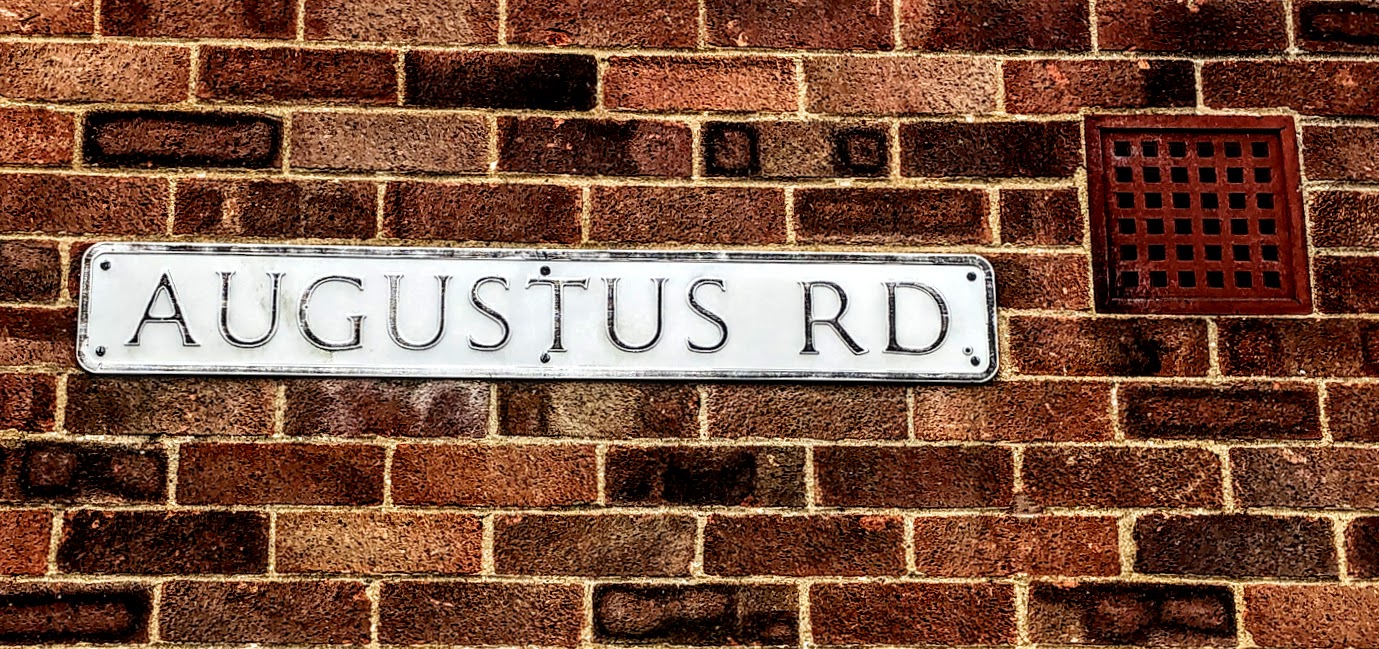
Augustus Road and Egmont Avenue in Stony Stratford are reminders of the story of Augustus Perceval, Earl of Egmont (Photographs: Patrick Comerford, 2022)

Patrick Comerford

Two neighbouring streets in Stony Stratford – Augustus Road off Calverton Road, and Egmont Avenue, which leads off Augustus Road – take their names from Augustus Arthur Perceval (1856-1910), 8th Earl of Egmont, whose family once owned the land on which the houses on both streets are built.

Lord Egmont was a colourful if enigmatic figure. He had run away in his teens to become a sailor, married a waitress, was later a fireman and a town hall janitor or caretaker and worked in salt mines and cement factories before inheriting the family titles and estates in Wolverton and Stony Stratford following a series of coincidental deaths of successive family members.

But, in anticipation of inheriting the Perceval family titles and estates, Augustus had borrowed heavily against the family estates in Ireland that were already heavily indebted and being sold off because of the debauched lifestyle who had died half a century earlier.

By the early 20th century, Augustus had effectively lost any grip on his finances and had squandered all he might have inherited before ever getting his hands on it. He was forced to sell off the last estates he had mortgaged or borrowed against. When he sold off the lands between Calverton and Stony Stratford for housing, the developers kindly acknowledged his name when it came to developing Egmont Avenue and Augustus Road.

The Egmont estate in Stony Calverton and Wolverton dated back to 1806, when it was bought by Augustus Perceval’s great-grandfather, Charles George Perceval (1756-1840), 2nd Baron Arden, a half-brother of John James Perceval (1738-1822), 3rd Earl of Egmont.

Calverton Manor … Charles Perceval, Lord Arden, bought large portions of the Calverton estate in 1806 (Photograph: Patrick Comerford, 2022)

For centuries, from the Middle Ages until the Tudor era, Calverton Manor belonged to the de Vere family, Earls of Oxford, and then the Nevil family, who held the title of Lord Latimer, remembered in the name of Latimer estate. From them, the Calverton estate descended to the Percy family, Earls of Northumberland. It was sold to Sir Thomas Bennet, a former Lord Mayor of London, in 1616, and then descended to the Cecil family, Earls of Salisbury.

When James Cecil (1748-1823), Marquess of Salisbury, sold the manors of Calverton and Beachampton, they were bought at an auction in the Cock Hotel in Stony Startford on 18 October 1806 by William Selby Lowndes of Whaddon, while other interests in Calverton bought by Charles Perceval, Lord Arden. Perceval was a half-brother of Spencer Perceval (1762-1812), who would become Prime Minister in 1809 and who was assassinated in the House of Commons in 1812 – the only British prime minister to have been assassinated. They were half-brothers of John James Perceval, 3rd Earl of Egmont.

The Perceval family were extensive and titled landowners in Ireland. They were descended from Sir Richard Percivale or Perceval (1550-1620), who acquired hundreds of thousands of acres of land in Ireland at the beginning of the 17th century, making him one of the largest landowners in Co Cork.

Sir John Perceval (1629-1665), who amassed over 100,000 acres in Co Cork, including Kanturk Castle and Liscarroll Castle, received the title of baronet at the Caroline restoration in 1661. There is a family connection, for this Sir John Perceval was the recipient of extensive correspondence in 1650s from his cousin William Dobbyns about the living conditions and life circumstances of the mapmaker Nicholas Comerford or Comberford in Stepney in the East End of London.

Sir John Perceval’s grandson, also Sir John Perceval (1683-1748), was MP for Cork (1703-1715) until he received a string of Irish peerage titles, becoming the 1st Earl of Egmont. His son, John Perceval (1711-1770), was MP for Dingle, Co Kerry, in the Irish Parliament, and was the father of two half-brothers who bought out the Cecil family’s interest in the estates in the Calverton and Stony Stratford area.

The third earl’s grandson, Henry Perceval (1796-1841), 5th Earl of Egmont, began the process of selling off the family silver to sustain a life of debauchery, marked by his alcoholism and loose living. In his mad scramble for ready cash, this Lord Egmont appointed Sir Edward Tierney from Rathkeale, Co Limerick, as his agent at his Irish estates in 1823, including Liscarroll Castle and thousands of acres around Churchtown, Kanturk and Buttevant in north Cork.

After living a dissolute lifestyle, this Lord Egmont left all his estates in England and Ireland to Tierney, while the family titles passed to his distant cousin, George Perceval (1794-1874), 3rd Lord Arden, who became the sixth earl.

All Saints’ Church, Calverton, rebuilt in 1818-1824 by Charles Perceval (Photograph: Patrick Comerford, 2022)

His father Charles Perceval, as the 2nd Lord Arden, had bought a portion of Calverton Manor, including the advowson or the right to present or nominate the Rector of Calverton. He exercised this right in 1814 when he presented Dr Butler as a temporary Rector of Calverton, to hold the parish until his son was ‘of a proper age.’ The patronage of the living later descended in the Perceval family to the Earls of Egmont.

Lord Arden commissioned the architect William Pilkington to rebuild All Saints’ Church between 1818 and 1824, on the foundations of the earlier All Hallows’ Church, and the church opened or reopened in October 1818.

Lord Arden was assisted in this work by Dr Butler. Arden also built a new rectory at his own expense, and the foundations of the house were laid in July 1819.

Butler was succeeded in 1821 by Lord Arden’s third son, the Revd the Hon Charles George Perceval (1796-1858), who came to live at Calverton as Rector on 26 March 1821, at the relatively young age of 24.

Charles Perceval was a devout High Churchman and a supporter of the Tractarians. Much of the decoration in the church, the stained glass windows and other embellishments, owes its origins to Perceval.

Many of the Tractarian leaders met in the Rectory at this time, including Edward Bouverie Pusey (1800-1882), John Henry Newman and Edward Manning, and some of the Tracts for the Times were planned if not written at Calverton.

The Revd Charles Perceval of Calverton, was a younger brother of George Perceval (1794-1874), who became the 6th Earl of Egmont in 1841. However, the new earl received not a penny from his ancestral estates.

Sir Edward Tierney had died in 1856 at the age of 76, and his title and his interest in the vast Perceval title had passed to his son, Sir Matthew Edward Tierney (1818-1860), but he left his estates acquired from the Egmonts to his son-in-law, the Revd Sir Lionel Darell (1817-1883).

The sixth earl went to court against Darell to recover the estates in a remarkable case before the Summer Assizes at Cork in 1863. After four days, the case was settled. Egmont recovered Liscarroll Castle and his ancestral estates, but Darell was awarded £125,000 and costs.

Kanturk Castle, Co Cork … given to the National Trust before Augustus Perceval could inherit it, is now in ruins (Photograph: Patrick Comerford, 2021)

Egmont died on 2 August 1874 and – for want of a male heir – was succeeded by his first cousin’s son, Charles George Perceval (1845-1897), 7th Earl of Egmont, who was born in Calverton Rectory. In 1889, this earl sold the Perceval estates in Co Cork, including Liscarroll Castle, near Buttevant, and 62,500 acres of land, to his tenants under the Ashbourne Land Act in 1895. After the seventh earl died in 1897, his widowed countess donated the majestic ruins of Kanturk Castle to the National Trust in 1900.

The seventh earl, like so many of his immediate predecessors, had no immediate male heir, and so his Irish peerage titles passed to his first cousin’s son Augustus Arthur Perceval (1856-1910), who became 8th Earl of Egmont in the Irish peerage, but without the once grand Irish castles at Kanturk and Liscarroll.

Augustus Perceval was born at Papanui, Canterbury, in New Zealand, in 1856. He ran away from his Royal Navy training ship to become a common sailor. He married Kate Howell, daughter of Warwick Howell of South Carolina, in 1881. The New York Times in a report described as a waitress.

A year after Kate and Augustus married, he joined the fire brigade of Southwark, and by 1887 he was working as a janitor or caretaker at Chelsea Town Hall. He later worked in salt mines in Cheshire, and then in South Africa in a cement factory.

He eventually succeeded to the family titles on 5 September 1897. Those titles were daunting and an impressive if not overpowering list: 8th Earl of Egmont, Co Cork, 8th Viscount Perceval of Kanturk, Co Cork, 8th Baron Perceval of Burton, Co Cork, 7th Lord Lovel and Holland, Baron Lovel and Holland of Enmore, Co Somerset, 4th Baron Arden, of Arden, Co Warwick, and 9th baronet. The runaway sailor and former janitor now had a list of titles that would have suited any Gilbert and Sullivan stage production.

Known among his drinking companions as Gussie, he scandalised his fellow peers regularly. He was arrested for being inordinately intoxicated in Piccadilly while accompanied by a young prostitute. The young woman attempted suicide in her cell and Gussie caused a sensation when he refused to remove his hat when arraigned in court the next morning.

In a risk that never paid off, the new earl borrowed heavily, gambling that he would inherit the vast Perceval estates totalling 120,00 acres. Instead, there was little for him to inherit, and he sold off what was left in a piecemeal manner in the hopes of acquiring a lifestyle commensurate with his new status. Finally, he sold Cowdray Park in Sussex in 1910, shortly before he died. Perhaps the only legacy in property that he could leave was giving his names to Augustus Road and Egmont Avenue, which were developed in the early 1900s.

Egmont Avenue in Stony Stratford is a distant reminder of Augustus Perceval, 8th of Egmont (Photograph: Patrick Comerford, 2022)

Gussie and Kate had no children: he died at The Hollies, Thames Ditton, Surrey, in 1910 at the age of 54; Kate, the former waitress who survived as the Dowager Countess of Egmont, died in 1926.

The titles continued to struggle to find heirs among members of the Perceval family who were living in suburban Birmingham. Three claimants to the titles came forward in the late 1920s and early 1930s. Two of the claims, by a baker and a derelict, were dismissed by the Master of the Court of Chancery, who instead accepted of a rancher living in Canada, who at first wanted nothing more than to remain a simple farmer, living in a sparsely-furnished, two-room log house in the Rockies.

The Perceval titles eventually died out in 2011 with the death of the 12th Earl of Egmont. Both Liscarroll Castle and Kanturk Castle in Co Cork are elegant but in ruins. All Saints’ Church in Calverton remains a beautiful historical and architectural legacy of the Perceval family. But the only properies left in Stony Stratford as reminders of this family in name are two suburban streets in Stony Startford: Augustus Road and Egmont Avenue, off Calverton Road.

Augustus Road in Stony Stratford is a distant reminder of Augustus Perceval, 8th of Egmont (Photograph: Patrick Comerford, 2022)

26 September 2022

Two Oxford war heroes with
many interesting family
connections with Ireland

Captain Noel Godfrey Chavasse is commemorated by a paving stone depicting a pair of Victoria Crosses outside Saint Peter’s College, Oxford (Photograph: Patrick Comerford, 2022)

Patrick Comerford

As I was wandering around Oxford almost aimlessly earlier this month, I stumbled unexpectedly upon a plaque to Noel Chavasse that reminded me of the connections between a distinguished Oxford clerical family and a family with an interesting role in life in Ireland.

Captain Noel Godfrey Chavasse (1884 -1917) was a medical doctor, an Olympic athlete, a war hero, and one of only three people to be awarded the Victoria Cross twice – indeed, the only man to be awarded the VC twice during World War I.

During the Battle of Guillemont in 1916, he was hit by shell splinters while rescuing men in no-man’s land, but continued in his heroic throughout the night under a constant rain of sniper bullets and bombing. He carried similar heroic acts at Passchendaele in 1917, becoming the most highly decorated British officer in World War I, although he died of his wounds on 4 August 1917.

Noel Chavasse was the younger of identical twin sons of the Rev Francis Chavasse, later Bishop of Liverpool and founder of Saint Peter's College, Oxford. His twin brother, the Revd Christopher Maude Chavasse (1884-1962), was also an Olympic athlete, was decorated with the Military Cross (MC) during World War I, and later became Bishop of Rochester.

Christopher and Noel Chavasse were born at Saint Peter-le-Bailey Rectory on New Inn Hall Street, Oxford, where their father was Rector. They both attended Magdalen College School in Oxford, followed by Liverpool College, before going on to Trinity College Oxford.

During his medical training, Noel Chavase had a placement at the Rotunda Hospital in Dublin. He is commemorated by more war memorials in the United Kingdom than any other individual: 16 have currently recorded by the National Inventory of War Memorials, including two paving stones in Oxford, each depicting a pair of crosses: one outside Saint Peter’s College and one near Magdalen College School.

Christopher and Noel Chavasse were born at Saint Peter-le-Bailey Rectory on New Inn Hall Street, Oxford, now part of Saint Peter’s College (Photograph: Patrick Comerford, 2022) (Photograph: Patrick Comerford, 2022)

The twin’s father, Francis James Chavasse (1846-1928), was the Rector of Saint Peter-le-Bailey in Oxford when they were born at the Rectory. Later, after being Principal of Wycliffe Hall, Oxford, and Bishop of Liverpool, Bishop Chavasse returned to Oxford in 1923, and moved back into the vacant rectory of Saint Peter-le-Bailey on New Inn Hall Street.

He was instrumental in founding Saint Peter’s Hall in 1928, and church took on the combined role of the parish church and a college chapel. The first master of Saint Peter’s Hall was the Revd Christopher Chavasse. Saint Peter’s Hall became a full Oxford University college in 1961, the parish was merged with Saint Ebbe’s and the church became the college chapel.

The Chavasse family was rooted in the West Midlands but originally came from south-east France in the 17th century. The family was close, and the twins were closely related to the Chavasse families in Ireland.

Claude Chavasse (1886-1971), who was just two years younger than the twins, was also born in Oxford and was one of the Irish nationalists rounded up in the aftermath of the Easter Rising in 1916.

Brendan Behan is said to have based the character ‘Monsewer’ in The Hostage on Claude Chavasse.

Claude first came to the attention of the authorities when he was stopped by a police sergeant in Co Cork in February 1916 and gave his name in Irish. He was arrested and spent two nights in prison in Macroom, where he alleged he was beaten for refusing to speak English.

He was arrested again after the Easter Rising and took part in a hunger strike in the prison. He took the Republican side in the civil war, taught at Scoil Acla on Achill Island, and remained active in the Irish language movement until his death in 1971. His sister Marguerite also attended Scoil Acla and through her friendship with the Trench family persuaded Switzer’s in Dublin to sell Achill knitting produce.

Colonel Kendal George Fleming Chavasse (1904-2001) from Co Waterford, played a distinguished role in Tunisia and Italy in World War II, and commanded the Royal Irish Fusiliers 2nd Battalion in Italy, Egypt and Palestine.

I remember him from my childhood in Co Waterford, when he was an innovative farmer, a founder member of the Irish Farmers’ Association and was involved in West Waterford Hunt and the Dungarvan Show. He was the longest-serving lay reader in the Church of Ireland and a member of the General Synod.

His son, Henry Perceval Kendal (Hal) Chavasse (1933-2022) of Cappagh House, between Cappoquin and Dungarvan, was once the British military attaché in Mexico and Panama, and then in Columbia. When he retired and returned to west Waterford, he was the forestry manager at Lismore Castle and a farmer, and for many years he was the treasurer and ‘the voice’ of the annual Dungarvan Show. He died earlier this year on 21 February 2022.

Teampol na mBocht or the Church of the Poor, at Altar or Toormore, west of Schull, Co Cork … Canon Claude Lionel Chavasse was rector in 1934-1940 (Photograph: Patrick Comerford)

Canon Claude Lionel Chavasse (1897-1983) also fought in World War I before graduating from Exeter College, Oxford, Oxfordshire, and studied for ordination at Saint Stephen’s House, Oxford. He was ordained in 1929, and was the Rector of Teampol-na-mBocht, west of Schull, Co Cork (1934-1940), of Mallow, Co Cork (1940-1944), and Baltinglass, Co Wicklow (1957-1967). In retirement, he lived in Lemybrien, outside Dungarvan, Co Waterford.

I have fond memories of his daughter, Judith Mary Chavasse (1933-2018), who was an encouraging parishioner in Saint George’s Church, Balbriggan, when I did regular Sunday duty in the Holmpatrick and Balbriggan Group of Parishes.

She trained as a nurse at Saint Thomas’s in London, and returned to Ireland, becoming head of nursing in University College Dublin. Judith was a visionary and a great thinker. She led the development of nursing towards its recognition as a profession and academic discipline in Ireland, and was awarded an honorary doctorate by TCD.

After her retirement in 1996, she moved to Balbriggan, where was an active parishioner in Saint George’s, securing heritage grants for its restoration.

Earlier this year, a special service on 19 June 2022 marked the opening of the Judith Chavasse Centre – formerly Saint George’s School – in Hampton Street, Balbriggan. The guest preacher was a former parishioner, the Revd Trevor Sargent, now Rector of Bunclody, Co Wexford and a trustee of the Anglican mission agency USPG.

When Saint Peter’s parish was merged with Saint Ebbe’s, Saint Peter’s Church became the chapel of Saint Peter’s College (Photograph: Patrick Comerford, 2022)

18 October 2021

Praying in Ordinary Time 2021:
142, Buttevant Friary, Co Cork

The ruins of the Franciscan Friary beside Saint Mary’s Church, on the Main Street, Buttevant (Photograph: Patrick Comerford)

Patrick Comerford

Today is the Feast of Saint Luke the Evangelist (18 October). The annual clergy conference for priests of the Diocese of Limerick and Killaloe and the Diocese of Tuam, Killala and Achonry begins later today in Adare, Co Limerick.

This year’s conference comes just two weeks before the two dioceses are merged into one following the retirement of both Bishop Kenneth Kearon and Bishop Patrick Rooke.

Before the day begins, I am taking a little time this morning for prayer, reflection and reading. Each morning in the time in the Church Calendar known as Ordinary Time, I am reflecting in these ways:

1, photographs of a church or place of worship;

2, the day’s Gospel reading;

3, a prayer from the USPG prayer diary.

My theme for these few weeks is churches in the Franciscan (and Capuchin) tradition. My photographs this morning (18 October 2021) are of the ruins of the Franciscan Friary in Buttevant, Co Cork.

The east window in the Franciscan friary church (Photograph: Patrick Comerford)

The ruins of the Franciscan Friary are in the centre of Buttevant, beside Saint Mary’s Roman Catholic Church on the Main Street. The friary was also dedicated to Saint Thomas à Becket of Canterbury and housed a thriving community from the mid-13th to mid-16th century. It still possesses some of the earliest examples of Franciscan architecture in Ireland.

The first friary of the Observant Franciscans in Ireland was founded at Youghal, Co Cork, by Maurice FitzGerald in 1224. The friary in Buttevant was founded from Youghal and was the only Franciscan house in North Cork.

The Annals of the Four Masters record it was founded and endowed in 1251 by David Óg de Barry. The townland of Lagfrancis was assigned as the glebe for its mensa.

At first, the Franciscan friary had a rectangular church. A transept was added later, with a triumphal arch that faced south, towards the Barry family’s castle. The Bell Tower was added in the final phase and was placed equidistant from both gables of the friary.

The Franciscans were mendicant friars who lived by preaching and on charity. But their patrons in Buttevant, the Barry family, financed several major redevelopments of the friary. Over the centuries, these expansions showed the growing wealth and power of the Barrys.

By 1324, Buttevant friary consisted of a community of Irish and Anglo-Norman friars and was important enough to maintain its own stadium or house of studies.

However, the community was divided by tensions between the Anglo-Norman and Irish friars. A Papal commission investigated a decision to transfer a Gaelic friar from Buttevant to one of the Gaelic friaries, and the Friary in the 1320s, at the time when the friary in Buttevant had been transferred to a new jurisdiction, separating it from other Irish friaries and linking it to Anglo-Norman friaries.

The Cloyne diocesan records from the 1400s show that the law courts in Buttevant operated at the door of the friary church. In mediaeval Buttevant, the friary porch was the place to make legal agreements, renew or grant leases on Lady Day and Michaelmas, to swear fealty, to do homage and to marriages. These records also record the same legal functions at the front door of the parish church of Saint Bridget, the site later of Saint John’s Church, the Church of Ireland parish church in Buttevant.

When of the monastic houses were dissolved during the Tudor reformation in the 1540s, the Franciscan friary in Buttevant included the friary church, the conventual buildings, a garden, a cemetery, and a watermill.

James de Barry (1520-1581), 4th Viscount Buttevant, obtained a 21-year lease of the friary in 1571. At the outbreak of the Desmond Rebellions, he joined the rebels and when his estates were confiscated, the friary in Buttevant passed to Edmund Spenser in the Plantation of Munster. However, by 1615 or earlier, the friary had reverted to his son, David de Barry (1550-1617), 5th Viscount Buttevant.

Evidence shows the Franciscan friars continued to live at the friary in late Elizabethan and Jacobean Buttevant. Reports in 1615 and 1629 show the large friary church was still roofed and held many of the tombs of the local nobility, and the friary buildings ‘were spacious and numerous.’

At the Irish Rebellion in 1641, the Franciscan community in Buttevant welcomed the Confederate army of Lord Mountgarret, and the guardian, Father Boetius Egan, attended the Confederate Parliament in Kilkenny in 1642. But Murrough O’Brien, Earl of Inchiquin, assembled the Parliamentarian army in Buttevant and burned the friary church.

The friars returned to Buttevant at the Restoration. Two friars continued to live in Buttevant in the 18th century, and the friary was still being used by friars in 1731, according to a report presented to the House of Lords.

By 1800, only one old friar was left in Buttevant, and he died soon afterwards. The great Bell Tower, which had been silent for centuries but continued to dominate the friary ruins, collapsed in 1814, and greatly damaged an already fragile, crumbling building. By 1820, the Franciscan presence in Buttevant had come to end after almost 600 years.

Canon Cornelius Buckley, who built Saint Mary’s Church in the 1830s, removed the rubble inside the friary nave and chancel , and collected the architectural remnants that were inserted in the north wall, as a ‘sort of mediaeval museum for the curious,’ as the antiquarian, Richard Brash described it.

A large quantity of human remains and bones was collected at this stage. For some years, they were of ghoulish interest to visitors, but were later reburied in the crypt under the friary.

Samuel Lewis noted in his Topographical Dictionary in 1837, that the tomb of the founder, David de Barry, ‘is supposed to be in the centre of the chancel, but is marked only by some broken stones which appear to have formed an enclosure.’ Other families buried in the nave and chancel included the Barrys, Fitzgeralds, Lombards, and others.

The remains of the friary today include a church with a piscina and a number of elaborate carvings. The church and transept are complete, many stones belonging to the cloister arcade are stored in the upper vault under the choir, while there are good carved stones in the lower vault, and some windows in the church have been rebuilt.

Inside the church of the Franciscan friary in Buttevant (Photograph: Patrick Comerford)

Luke 10: 1-9 (NRSVA):

10 After this the Lord appointed seventy others and sent them on ahead of him in pairs to every town and place where he himself intended to go. 2 He said to them, ‘The harvest is plentiful, but the labourers are few; therefore ask the Lord of the harvest to send out labourers into his harvest. 3 Go on your way. See, I am sending you out like lambs into the midst of wolves. 4 Carry no purse, no bag, no sandals; and greet no one on the road. 5 Whatever house you enter, first say, “Peace to this house!” 6 And if anyone is there who shares in peace, your peace will rest on that person; but if not, it will return to you. 7 Remain in the same house, eating and drinking whatever they provide, for the labourer deserves to be paid. Do not move about from house to house. 8 Whenever you enter a town and its people welcome you, eat what is set before you; 9 cure the sick who are there, and say to them, “The kingdom of God has come near to you”.’

The Franciscan friars continued to live in Buttevant until the early 19th century (Photograph: Patrick Comerford)

The Prayer in the USPG Prayer Diary today (18 October 2021, Saint Luke the Evangelist) invites us to pray:

Let us give thanks for the life and works of Saint Luke. May we be a healing presence in the world.

Architectural remains and portions of graves were inserted in the north wall of the friary church in the 1830s (Photograph: Patrick Comerford, 2020

Yesterday’s reflection

Continued tomorrow

Portion of a carved mediaeval crucifixion, inserted in a wall in the south transept (Photograph: Patrick Comerford)

Scripture quotations are from the New Revised Standard Version Bible: Anglicised Edition copyright © 1989, 1995, National Council of the Churches of Christ in the United States of America. Used by permission. All rights reserved worldwide. http://nrsvbibles.org

05 October 2021

Saint Fursey’s Church in
Banteer, Co Cork, site of
Ireland’s last pitched battle

Saint Fursey’s Church in Banteer, Co Cork, dates from 1828 (Photograph: Patrick Comerford, 2021)

Patrick Comerford

One of the many small towns and villages I visited in Co Cork during this year’s summer ‘road trip’ was Banteer, south of Kanturk and west of Mallow in north Cork.

Banteer was at the centre of the last pitched battle of the Irish Confederate Wars, the Battle of Knocknaclashy, which was fought near Banteer in 1651, when an Irish force under Donagh MacCarthy, Viscount Muskerry, was defeated by a Cromwellian force under Roger Boyle, 1st Earl of Orrery.

Dr Patrick ‘Pat’ O’Callaghan (1906-1991) was born in Banteer on 28 January 1906. He was the first Irish athlete from Ireland to win an Olympic medal under the Irish flag rather than the British flag. He won gold medals at Amsterdam in 1928 and in Los Angeles in 1932, and he was the flag bearer for Ireland at the 1932 Olympic Games.

Saint Fursey’s Church, Banteer, Co Cork, facing the liturgical east (Photograph: Patrick Comerford, 2021)

Banteer never grew as a town or reached its promising potential. Banteer railway station, on the Mallow to Tralee line, opened on 16 April 1853 but was closed for goods traffic on 2 September 1976, although it remains open for passenger trains on the Dublin-Tralee route.

Today, the most notable building in Banteer is Saint Fursey’s Roman Catholic Church, a simple, single-cell church, with long side elevations and a stone façade.

Saint Fursey was involved in early missions to East Anglia and France and was said to have experienced angelic visions of the afterlife before he died in 650.

Saint Fursey’s Church, Banteer, Co Cork, facing the liturgical west (Photograph: Patrick Comerford, 2021)

Sant Fursey’s Church occupies a prominent corner site in Banteer, enhanced by the boundary walls and railings and by the piers and gate to the entrance.

The decoration on the façade of the church is minimal and is restricted to the cross finials and window surrounds. Inside, the church is more ornate, but retains its stained-glass windows and carved plaque.

This church dates from 1828, and was restored and enlarged in 1952. The decoration of the façade is minimal and restricted to the cross finials and window surrounds. It has a five-bay nave, a single-bay flat-roofed addition at the south gable, a pitched slate roof with carved limestone cross finials and dressed limestone coping at the gables, with a dressed limestone eaves course.

There are snecked sandstone walls on the east and north side, with a rendered south gable. The north gable has carved limestone plaques. The carved limestone font at the north doorway has a carved limestone stoup set into a pointed arch recess at the south doorway.

A carved limestone memorial in the church is dated 1834 (Photograph: Patrick Comerford, 2021)

The round-headed windows have dressed limestone voussoirs and sills and are filled wth stained-glass. The round-headed door openings have timber battened double-leaf doors, dressed limestone voussoirs and ornate cast-iron strap hinges.

Inside, the church is more ornate, but retains its stained-glass windows and an interesting carved plaque. There is a coffered ceiling, a carved timber gallery, carved confession boxes and a carved limestone memorial dated 1834, with an urn and heraldic motifs in relief.

The cast-iron bellstand at the north-west of church has fluted, cast-iron, circular-profile columns with a cast-iron bell.

Saint Colman, patron sain of the Diocese of Cloyne, depicted in a stained glass window in the church (Photograph: Patrick Comerford, 2021)

At the east side of the site, the churchyard has carved limestone gravestones and cast-iron and dressed limestone grave surrounds. The snecked sandstone boundary walls have cut sandstone square-profile piers at the entrance.

The simple single-cell form of this church, along with its long side elevations and stone façade, make it a notable feature in Banteer. It stands on a prominent corner site, enhanced by its boundary walls and railings and by the piers and entrance gate.

Hub caps become street art in Banteer (Photograph: Patrick Comerford, 2021)

04 October 2021

Youghal’s charms include
its mediaeval church and
legends about Walter Raleigh

Saint Mary’s Collegiate Church is a national monument and the principal tourist attraction in Youghal (Photograph: Patrick Comerford, 2021)

Patrick Comerford

The charms of West Cork, with its small towns, harbours, bookshops, cafés and offshore islands, are well-known. But during this year’s ‘road trip’ or summer ‘staycation,’ I also rediscovered the charms of Youghal, in east Cork Cork, on the estuary of the River Blackwater, and 30 km south of Cappoquin, which holds so many of my childhood memories.

Youghal, with a population of about 8,000, stands on the edge of a steep riverbank, and has long, narrow streets and narrow side lanes. The town dates back to a Viking settlement in the 11th century, and received its first charter in 1209.

Canon Andrew Orr, and two parishioners, Lydia Mossop and Norman McDonald, offered a personalised tour of Saint Mary’s Collegiate Church, the largest and most important mediaeval building in Youghal and one of the largest churches in Ireland.

The church may stand on the site of a monastic settlement associated with Saint Declan of Ardmore, ca 450. It was rebuilt ca 750, the roof timbers have been carbon dated to 1170, and the Great Nave was erected in 1220. The marks of the masters are still found on the pillars of the gothic arches.

In the chancel, a sepulchre tomb on the north side of the altar is a rare example of this liturgical feature. It was a major focus for mediaeval piety in Holy Week, but was defaced during the Reformation.

The font dates from ca 1400; the unusual fortified bell tower probably dates from the 15th century. The mediaeval remains include effigies, head-slabs, canopy tombs, and the Bennet chantry chapel that later became the Boyle Chapel.

Saint Mary’s became a Collegiate Church in 1464 with the foundation of a college that included a Warden and Clerks, or priests, with eight fellows and eight singing men.

Inside Saint Mary’s Collegiate Church, Youghal … the timbers of the roof have been carbon dated to 1170 (Photograph: Patrick Comerford, 2021)

***

After the Desmond rebellion, Sir Walter Raleigh was granted vast tracts of land in Lismore and Youghal. They were later bought by Richard Boyle (1566-1643), 1st Earl of Cork. Boyle rebuilt the church in 1608, and erected a marble monument for himself and his family in the Boyle Chapel.

The Boyle monument shows a reclining Boyle between his first wife, Joan Apsley, and his second wife, Catherine Fenton, and their children below them, including Robert Boyle, who gives his name to ‘Boyle’s Law.’

Oliver Cromwell delivered a funeral oration from the top of a chest still in the church. A sword rest once held the ceremonial sword of the Mayors of Youghal. The pulpit dates from the 1730s.

Large-scale restoration in 1851-1854 included rebuilding the chancel. The stonework in the great East Window, dating from the 1460s, was restored, and the glass depicts the coats-of-arms of many leading families associated with the church.

A Chapel of Remembrance in the North Transept was created in the late 1980s, with furnishings from the closed church in Templemichael.

Saint Mary’s is now a National Monument under the care of the government, and is leased by Representative Church Body to the local council.

The Boyle Monument in the Boyle Chapel in Saint Mary’s Church (Photograph: Patrick Comerford, 2021)

Youghal and the first
Jewish Mayor in Ireland


During my visit I was reminded that Youghal is the first town in either Ireland or Britain to have a Jewish mayor. William Annyas or William Moses Annyas Eanes (Ben Yohanan) was elected Mayor of Youghal in 1555.

His grandfather, Gil Anes, was a Marrano Jew or converso who had emigrated from Belmonte in Portugal. Belmonte was the birthplace of Pedro Álvares Cabral, the Portuguese navigator who discovered the land of Vera Cruz, now known as Brazil.

Many of the first Jews to come to Ireland were Marrano merchants from Spain and Portugal, who arrived as religious refugees fleeing the persecutions of Inquisition.

The surname of William Annyas is sometimes written as Ãnes and anglicised to Ames. It has been suggested that in some cases the family may have used the surname Ennis. His daughter married Yacov Kassin, son of Yehuda Kassin (Juan Cassin), a Marrano merchant who had moved to Galway.

Later, in the late 16th century, Francis Annyas was a three-time Mayor of Youghal in 1569, 1576 and again in 1581. He commanded the English garrison in Youghal during the Desmond Rebellions and had a colourful life working as a spy for Sir Francis Drake in the Azores. However, his exact kinship or family ties with William Annyas are not known.

The Town Hall in Youghal, Co Cork … Youghal elected Jewish mayors in 1555, 1569, 1576 and 1581 (Photograph: Patrick Comerford, 2021)

***

There never seems to have been being a synagogue in Youghal. The first Sephardic synagogue in Cork City may date from the later arrivals of merchants and families from Portugal and Spain in the late 17th and early 18th centuries.

The site of the Sephardic cemetery in Cork was discovered in the last century in Kemp Street, on the south-east corner of White Street, to the rear of the Cork Hebrew Congregation’s synagogue in South Terrace, which closed in 2016. However, no traces of a Sephardic synagogue have been found in the city.

As for Belmonte, it is, perhaps, the Portuguese town with the strongest Jewish presence. Hebrew culture and tradition have survived there continuously from the early 16th century until today, keeping their existence secret from their neighbours in the centuries after the Inquisition.

The Jewish community in Belmonte dates from the Middle Ages and the town’s first synagogue may have been founded in 1297. King Manuel issued an edict in 1496 expelling all Jews from Portugal, but a group of Crypto-Jews remained in Belmonte and they were the immediate, direct ancestors of the community that has survived until today.

They were a closed community, where the women preserved their Jewish traditions, keeping them alive in their isolation and handing them down through the generations for 500 years. The post-Inquisition Jewish presence in Belmonte was first documented in 1917 by Samuel Schwarz, a Jewish engineer from Poland. He was working at a nearby tin mine when he noticed the secretive habits of many families in the town.

The Sephardic Jews in Belmonte returned to Judaism formally in 1989 and founded the Jewish Community of Belmonte.

The Clock Gate Tower, the symbol of Youghal, was built in 1777 (Photograph: Patrick Comerford, 2021)

Myrtle Grove and
the first potatoes


The streets around Saint Mary’s Church have been renamed the ‘Raleigh Quarter’ and Youghal is attracting a new generation of tourists. Myrtle Grove, the Tudor house beside Saint Mary’s Collegiate Church, was once the home of Sir Walter Raleigh, and was also the home of the writer and journalist Claud Cockburn.

Myrtle Grove is said to stand on the site of the house of the Wardens of Youghal. With its tall chimneys, oriel windows and many gables, it is a rare Irish example of an unfortified, late mediaeval Tudor style stone house. It is said to have been built by Sir Walter Raleigh, and there are many legends associated with his time in the house.

One legend says a panicked servant at Myrtle Grove dowsed Raleigh in water while he was smoking the first tobacco in Ireland. Another says Raleigh brought the first potatoes from Virginia to Ireland in 1585 and planted them at Myrtle Grove.

For the following two years, Raleigh was mayor of Youghal, where Queen Elizabeth I granted him 170 sq km (42,000 acres) of land. At Myrtle Grove, he entertained the poet Edmund Spenser, who is said to have been inspired to write the last verse of the ‘Faerie Queene’ while looking out the window of Myrtle Grove.

Four yew trees in the gardens are said to have been planted by Raleigh, and he made his final trip from Cork to the West Indies in 1617.

However, many of the legends about his days in Youghal may be romantic myths created in the 1850s by Samuel Hayman, whose family acquired Myrtle Grove in the previous century.

Myrtle Grove, Youghal, Co Cork … associated with many of the legends about Sir Walter Raleigh (Photograph: Patrick Comerford, 2021)

***

In the early 20th century, Myrtle Grove was the home of Sir Henry Arthur Blake (1840-1918), who had been Governor of the Bahamas, Newfoundland, Jamaica, Hong Kong and Ceylon (Sri Lanka). He was born in Limerick and died at Myrtle Grove in 1918.

Blake’s daughter, Olive, and her husband, Major John Bernard Arbuthnot, moved into Myrtle Grove with their family in 1916. Their youngest child was the writer and artist Patricia Evangeline Anne Cockburn (1914-1989). When her parents moved to London in 1918, Patricia was left at Myrtle Grove with her widowed grandmother.

Patricia married the journalist Claud Cockburn (1904-1981) in 1940, and they returned to Youghal to live at Myrtle Grove in 1947.

For many years, Claud Cockburn was a columnist with The Irish Times while I worked there, and some of his sons, including Patrick Cockburn, also contributed to The Irish Times. Patrick’s godmother, Lady Clodagh Anson, once lived at the Towers in Ballysaggartmore, an exotic Gothic folly near Lismore, Co Waterford.

Patricia and Claud Cockburn moved to Ardmore, Co Waterford, in 1980. Claud died in 1980, Patricia died in 1989, and they are buried in Saint Mary’s Churchyard, close to the gates of Myrtle Grove.

Myrtle Grove remains in private ownership and is closed to the public, but it is being renovated and restored.

The grave of Patricia and Claud Cockburn in the churchyard of Saint Mary’s Collegiate Church (Photograph: Patrick Comerford, 2021)

This two-page feature was first published in the Church Review (Dublin and Glendalough) in October 2021

A two-page feature on Youghal, Co Cork, in the October 2021 edition of the ‘Church Review’