Big Ben and the Palace of Westminster … the UK has a target to welcome 50 million international visitors annually by the year 2030 (Photograph: Patrick Comerford)
Patrick Comerford
Yet again I am overwhelmed by the viewing and reading figures for this blog. These figures reached a total of 50 million before dawn early this morning (4 September 2026). This comes soon after reaching the 49 million mark four days ago (31 August 2026), and passing the million mark on three other days last month: 48 million (24 August), 47 million (17 August) and 46 million (9 August).
I continue to find these viewing and reading figures overpowering at times, and this blog continues to reach volumes of readers I never expected when I first started blogging 16 years ago. At the end of last year, this blog had 21 million hits (31 December 2025). So far this year, there have been more than 29 million hits or visitors in 2026 alone.
Half of all hits or reader figures have been in little more than six months, with 25 million hits since 25 February 2026. I first began blogging in 2010, and it took almost two years until July 2012 to reach half a million readers. Throughout this year and last, the daily figures are overwhelming on many occasions. Of the 10 days of busiest traffic on this blog, one was this month (1 September 2026), three were in May (1, 6 and 14 May 2026), three were the previous month (26, 29 and 30 April 2026), two in March, and one in February:
• 1,124,925 (1 May 2026)
• 525,719 (14 May 2026)
• 509,644 (29 April 2026)
• 356,335 (1 September 2026)
• 344,003 (30 April 2026)
• 323,156 (27 March 2026)
• 322,038 (26 April 2026)
• 318,835 (6 May 2026)
• 318,307 (1 March 2026)
• 314,018 (28 February 2026)
The daily average was about 118,700 hits a day throughout August. Yet, I recall how 10 years ago, back in 2016, the daily average was around 1,000, or 30,000 a month.
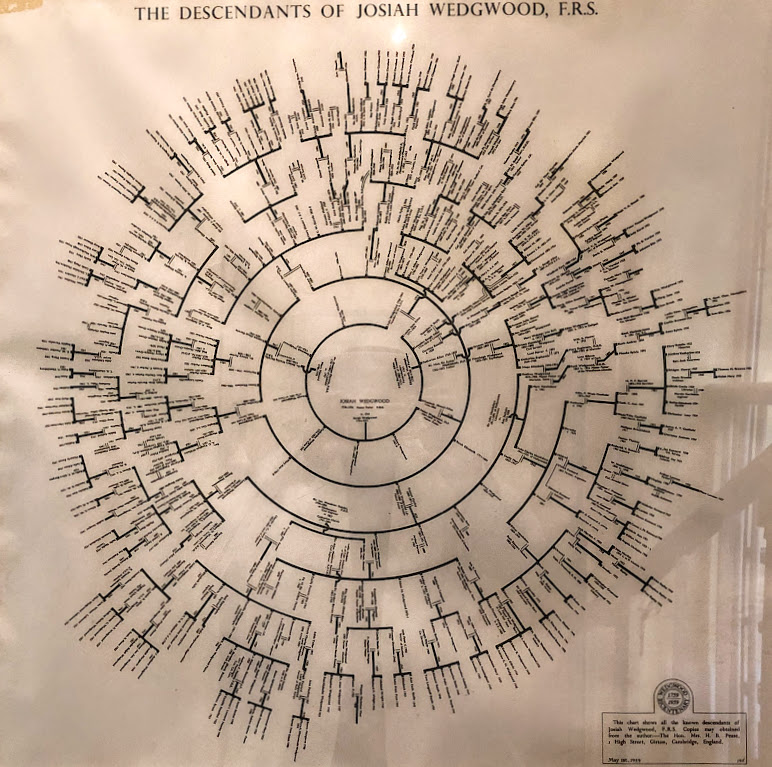
A large family tree of the Wedgwood and Darwin families in Erasmus Darwin House, Lichfield … mathematical projections in genealogy show how we are all related (Photograph: Patrick Comerford)
To put this new figure of 50 million into context:
Modern slavery entraps 50 million people on any given day: about 28 million people are working under duress in private economies, state projects or commercial exploitation, 22 million are living in forced marriages without consent, and one in four victims of modern slavery is a child.
Around 50 million people worldwide have epilepsy, making it one of the most common neurological diseases globally.
The UK government has set an official target to welcome 50 million international visitors annually by the year 2030. Greece too aims to attract 50 million annual tourist arrivals by 2030, according to a strategic target set by the Greek Tourism Confederation.
There are 29 countries with a population of more than 50 million. The population of the UK reached 50 million by 1948 and has been growing ever since: the population was 40 million in 1898, it reached 50 million by 1948 and 60 million by 2005, and is probably at 70 million this year (2026).
The Black Death killed 50 million people, or 60 per cent of Europe’s entire population, between 1346 and 1353. As a proportion of the population that lost their lives, the Black Death caused unrivalled mortality. It overshadows the horrors of World War II, and is twice the number murdered by Stalin’s regime in the Soviet Union.
In the year 1000, Europe had a population of ~50 million. Some simple maths shows that everyone who was alive in Europe around the year 1000 is either an ancestor of everyone in Europe today, or the ancestor of no one. This means that someone in Sweden, Norway or Italy has the same set of ancestors as someone who thinks their family is 100% British, Irish, French or Spanish.
At times I have used mathematical projections to help my genealogical projects, and the maths are quite simple. Every person has two parents, four grandparents and so on. Going just 30 generations back, say around 1066, that means I have one billion direct ancestors (2 to the power of 30), even though there were not one billion humans alive at that time.
A white paper published by FamilyTreeDNA used an example of a Swedish man with 8.5 billion genealogical ancestors (2^33) living in the year 1000. ‘Genealogical ancestors’ does not mean actual ancestors, as there were not even one billion living humans alive at that time, meaning many ancestors will appear multiple times across various branches.
The paper notes: ‘Think about that for a moment. If you have a single European ancestor, you are genealogically descended from every European from the year 1000 who has living descendants now.’
The population of ~50 million people in Europe in the year 1000 means we are all related in more ways than we imagine.
50 million minutes is 95 years, 24 days, 4 hours and 22 minutes. This means that if this blog was receiving just one hit a minute, I would need to have started blogging back in late September 1931.
I retired from active parish ministry about 4½ years ago, on 31 March 2022. These days, though, about 150 people on average are reading my daily prayer diary posted on this blog each morning, or more than 1,000 people each week.
This evening, as this blog passes 50 million hits, I am truly grateful to the real readers among those 50 million hits. In particular I am thankful for the faithful core group of people who join me in prayer, scripture reading and reflections each day.
William de Comberford’s monument in the Comberford Chapel, Tamworth … he died in 1349, a year after the Black Death killed one-third of Tamworth, at a time when the Black Death killed 50 million in Europe (Photograph: Patrick Comerford, 2026)
Showing posts with label tourism. Show all posts
04 September 2026
24 August 2026
£48 million Cambridge grants,
48 million in tourism saturation,
48 million litres in wine fraud,
and 48 million blog hits
Trinity College and the University of Cambridge are providing £48 million in the Trinity Cambridge Research Studentships programme, supporting up to 300 PhD students (Photograph: Patrick Comerford)
Patrick Comerford
I continue to be overwhelmed by the viewing and reading figures for this blog. These figures reached a total of 48 million early this morning (24 August 2026), having reached 47 million a week ago (17 August 2026) and 46 million eight days previously (9 August 2026), the third time this month these figures passed the million mark. Last month, the readership figures also passed the million mark three times: 45 million on 29 July, 44 million less than a fortnight earlier (16 July 2026), and 43 million 12 days before that (4 July 2026).
These viewing and reading figures are overpowering at times, and this blog continues to reach volumes of readers I never expected when I first started blogging 16 years ago. At the end of last year, this blog had 21 million hits (31 December 2025). So far this year, there have been more than 27 million hits or visitors in 2026 alone, and almost 2.7 million hits already this month.
Half of all hits or reader figures have been in the past six months or so, with 24 million hits since 20 February 2026. I first began blogging back in 2010, and it took almost two years until July 2012 to reach half a million readers. Throughout this year and last, the daily figures are overwhelming on many occasions. Of the ten days of busiest traffic on this blog, three were in May (1, 6 and 14 May 2026), three were the previous month (26, 29 and 30 April 2026), three in March, and one in February:
• 1,124,925 (1 May 2026)
• 525,719 (14 May 2026)
• 509,644 (29 April 2026)
• 344,003 (30 April 2026)
• 323,156 (27 March 2026)
• 322,038 (26 April 2026)
• 318,835 (6 May 2026)
• 318,307 (1 March 2026)
• 314,018 (28 February 2026)
• 301,449 (2 March 2026)
The daily average was over 187,000 throughout May, but that figure was distorted by the exceptionally high number of hits on three days. There was an average of almost 88,000 hits a day last month, and an average of about 110,000-120,000 a day so far this month. Yet, I remember that ten years ago, back in 2016, the daily average was around 1,000, or 30,000 a month.
Anti-fraud authorities in France uncovered a massive wine scam involving over 48 million litres or 64 million bottles of wine (Photograph: Patrick Comerford)
To put this latest figure of 48 million into perspective:
Sudan, Uganda, Iraq and Algeria have populations of about 48 million people – although that depends on who is counting and how they are counting.
Save the Children reports that 48 million children a year are affected by climate disasters.
The US Centre for Disease Control estimates that roughly 1-in-6 Americans – or 48 million people – fall ill from contaminated food each year, leading to 128,000 hospital cases and 3,000 deaths.
Greece continues to experience an unprecedented surge in tourism, with predictions that it could be heading for record-shattering visitor numbers by the end of the year, near to or exceeding 48 million over the annual cycle. These figures are driven by major increases in arrivals from the EU, the UK, and the US, and Greece’s South Aegean and Ionian island regions have recorded the highest tourism saturation of any region in the EU.
The islands of Santorini, Rhodes and Kos are proving to be particularly popular, and the Ionian islands, which include Corfu and Zakynthos, are in second place when it comes to tourism saturation.
Trinity College Cambridge and the University of Cambridge are providing £48 million in the Trinity Cambridge Research Studentships (TCRS) programme, funding up to 300 fully supported PhD students over a decade.
About 48 million tons of plastic waste is generated in the US each year – and less than 10% of it is recycled.
About 48 million kangaroos live in Australia, outnumbering human residents by nearly two to one.
The Еuropeana online archive collection contains digitised versions of more than 48 million works of art that include thousands of photographs, paintings, books and other artefacts, collected from more than 100 museums and archives all over Europe.
48 million litres is equal to 13 Olympic-sized swimming pools or 64 million bottles of wine. French anti-fraud authorities uncovered a massive wine scam involving over 48 million litres of table wine falsely sold under prestigious regional labels like Côtes du Rhône and Châteauneuf-du-Pape between 2013 and 2016.
The Pan-American Highway is the world’s longest motorable road network. It spans roughly 48,000 km (48 million metres) from Prudhoe Bay in Alaska to the southern tip of Argentina. It crosses 14 countries, including Canada, the US and Mexico, and several in Central and South America, but the route is interrupted by the Darién Gap, a 160 km swampy jungle between Panama and Colombia with no paved road. 48 million minutes is equal to 91 years, 3 months, 28 days and 8 hours. In other words, if this blog was getting only one hit a minute, I would need to have been blogging since April or May 1935, more than four year before World War II began.
I retired from active parish ministry over four years ago, on 31 March 2022. These days, though, about 130-140 people on average are reading my daily prayer diary posted on this blog each morning, or up to 1,000 people each week.
This evening, once again, I am truly grateful to the real readers among those 48 million hits on this blog to date, and in particular I am thankful for the faithful core group of 150 or so people who join me in prayer, reading and reflections each day.
The blue-domed churches of Santorini in a poster in Milton Keynes … with predictions of 48 million or more tourists visiting Greece, islands like Santorini are suffering from tourism saturation (Photograph: Patrick Comerford)
Patrick Comerford
I continue to be overwhelmed by the viewing and reading figures for this blog. These figures reached a total of 48 million early this morning (24 August 2026), having reached 47 million a week ago (17 August 2026) and 46 million eight days previously (9 August 2026), the third time this month these figures passed the million mark. Last month, the readership figures also passed the million mark three times: 45 million on 29 July, 44 million less than a fortnight earlier (16 July 2026), and 43 million 12 days before that (4 July 2026).
These viewing and reading figures are overpowering at times, and this blog continues to reach volumes of readers I never expected when I first started blogging 16 years ago. At the end of last year, this blog had 21 million hits (31 December 2025). So far this year, there have been more than 27 million hits or visitors in 2026 alone, and almost 2.7 million hits already this month.
Half of all hits or reader figures have been in the past six months or so, with 24 million hits since 20 February 2026. I first began blogging back in 2010, and it took almost two years until July 2012 to reach half a million readers. Throughout this year and last, the daily figures are overwhelming on many occasions. Of the ten days of busiest traffic on this blog, three were in May (1, 6 and 14 May 2026), three were the previous month (26, 29 and 30 April 2026), three in March, and one in February:
• 1,124,925 (1 May 2026)
• 525,719 (14 May 2026)
• 509,644 (29 April 2026)
• 344,003 (30 April 2026)
• 323,156 (27 March 2026)
• 322,038 (26 April 2026)
• 318,835 (6 May 2026)
• 318,307 (1 March 2026)
• 314,018 (28 February 2026)
• 301,449 (2 March 2026)
The daily average was over 187,000 throughout May, but that figure was distorted by the exceptionally high number of hits on three days. There was an average of almost 88,000 hits a day last month, and an average of about 110,000-120,000 a day so far this month. Yet, I remember that ten years ago, back in 2016, the daily average was around 1,000, or 30,000 a month.
Anti-fraud authorities in France uncovered a massive wine scam involving over 48 million litres or 64 million bottles of wine (Photograph: Patrick Comerford)
To put this latest figure of 48 million into perspective:
Sudan, Uganda, Iraq and Algeria have populations of about 48 million people – although that depends on who is counting and how they are counting.
Save the Children reports that 48 million children a year are affected by climate disasters.
The US Centre for Disease Control estimates that roughly 1-in-6 Americans – or 48 million people – fall ill from contaminated food each year, leading to 128,000 hospital cases and 3,000 deaths.
Greece continues to experience an unprecedented surge in tourism, with predictions that it could be heading for record-shattering visitor numbers by the end of the year, near to or exceeding 48 million over the annual cycle. These figures are driven by major increases in arrivals from the EU, the UK, and the US, and Greece’s South Aegean and Ionian island regions have recorded the highest tourism saturation of any region in the EU.
The islands of Santorini, Rhodes and Kos are proving to be particularly popular, and the Ionian islands, which include Corfu and Zakynthos, are in second place when it comes to tourism saturation.
Trinity College Cambridge and the University of Cambridge are providing £48 million in the Trinity Cambridge Research Studentships (TCRS) programme, funding up to 300 fully supported PhD students over a decade.
About 48 million tons of plastic waste is generated in the US each year – and less than 10% of it is recycled.
About 48 million kangaroos live in Australia, outnumbering human residents by nearly two to one.
The Еuropeana online archive collection contains digitised versions of more than 48 million works of art that include thousands of photographs, paintings, books and other artefacts, collected from more than 100 museums and archives all over Europe.
48 million litres is equal to 13 Olympic-sized swimming pools or 64 million bottles of wine. French anti-fraud authorities uncovered a massive wine scam involving over 48 million litres of table wine falsely sold under prestigious regional labels like Côtes du Rhône and Châteauneuf-du-Pape between 2013 and 2016.
The Pan-American Highway is the world’s longest motorable road network. It spans roughly 48,000 km (48 million metres) from Prudhoe Bay in Alaska to the southern tip of Argentina. It crosses 14 countries, including Canada, the US and Mexico, and several in Central and South America, but the route is interrupted by the Darién Gap, a 160 km swampy jungle between Panama and Colombia with no paved road. 48 million minutes is equal to 91 years, 3 months, 28 days and 8 hours. In other words, if this blog was getting only one hit a minute, I would need to have been blogging since April or May 1935, more than four year before World War II began.
I retired from active parish ministry over four years ago, on 31 March 2022. These days, though, about 130-140 people on average are reading my daily prayer diary posted on this blog each morning, or up to 1,000 people each week.
This evening, once again, I am truly grateful to the real readers among those 48 million hits on this blog to date, and in particular I am thankful for the faithful core group of 150 or so people who join me in prayer, reading and reflections each day.
The blue-domed churches of Santorini in a poster in Milton Keynes … with predictions of 48 million or more tourists visiting Greece, islands like Santorini are suffering from tourism saturation (Photograph: Patrick Comerford)
09 August 2026
46 million Methodists worldwide,
46 million visitors to Spain,
46 million Muslims in Europe,
and 46 million blog readers
La Sagrada Família by Antoni Gaudí in Barcelona … Spain received more than 46 million foreign visitors in the first six months of the year (Photograph: Patrick Comerford)
Patrick Comerford
I continue to be overwhelmed by the viewing and reading figures for this blog. These figures reached 46 million by mid-morning this morning (9 August 2026). Last month, the readership figures passed the million mark three times: 45 million 11 days ago (29 July), 44 million less than a fortnight earlier (16 July 2026), and 43 million 12 days before that (4 July 2026).
These viewing and reading figures are overpowering at time, with this blog continuing to reach volumes of readers I never expected when I first started blogging 16 years ago. At the end of last year, this blog had 21 million hits (31 December 2025). So far this year, there have been more than 25 million hits or visitors in 2026 alone, and almost 740,000 hits already this month.
Half of all hits or reader figures have been within the past six months, with 23 million hits since 12 February 2026. I first began blogging back in 2010, and it took almost two years until July 2012 to reach half a million readers. Throughout this year and last, the daily figures continue to be overwhelming on many occasions. Of the ten days of busiest traffic on this blog, three were in May (1, 6 and 14 May 2026), three were the previous month (26, 29 and 30 April 2026), three in March, and one in February:
• 1,124,925 (1 May 2026)
• 525,719 (14 May 2026)
• 509,644 (29 April 2026)
• 344,003 (30 April 2026)
• 323,156 (27 March 2026)
• 322,038 (26 April 2026)
• 318,835 (6 May 2026)
• 318,307 (1 March 2026)
• 314,018 (28 February 2026)
• 301,449 (2 March 2026)
The daily average was over 187,000 throughout May, but that figure was distorted by the exceptionally high number of hits on three days. There was an average of almost 88,000 hits a day last month, and an average of about 82,000 a day so far this month. Yet, ten years ago, in 2016, the daily average was around 1,000.
Castle Street Methodist Church in Cambridge … there is an estimated 46 million Methodists worldwide (Photograph: Patrick Comerford)
To put this latest figure of 46 million into perspective:
Iraq has a population of over 46 million and an area of 438,317 sq km, making it the 31st most populous in the world and the 58th largest country by area. The populations of both Argentina and Algeria are also estimated at 46 million, although that depends on who is counting, and how they count.
The Ethiopian Orthodox Tewahedo Church, the largest Oriental Orthodox Christian church, has an estimated 60 million members, with 46 million members in Ethiopia. It is in communion with the Eritrean Orthodox Tewahedo Church, the Coptic Orthodox Church of Alexandria, the Malankara Orthodox Syrian Church, the Armenian Apostolic Church and the Syriac Orthodox Church.
Methodism, including the Holiness Movement, is estimated to have about 46 million members worldwide.
Most figures suggest there are 46 million Muslims in Europe, representing about 6% of the continent’s total population of about 745 million.
There are 46 million people of African origin living outside their country of birth, matching population figures such as the pre-conflict population of Sudan and regional displacement tallies. They include 25 million living in another African country, 11 million in Europe and 10 million in other regions around the world.
More than 46 million foreign visitors have visited Spain in the first six months of the year, 4.6% more than in the same period last year, and Spain is on course for a record-breaking 100 million tourists this year. Belgium had a record number of tourists in 2025, with more than 46 million overnight stays registered across the country.
The Trump administration is cancelling direct federal funding of community-based organisations that work on HIV prevention. It is latest step in his push to eliminate funding for DEI-focused initiatives that help the LGBTQ community, but directly runs against the White House’s push to end the HIV epidemic by 2030. It means the loss of $46 million in funding for 96 community-based organisations to provide HIV testing, linkage to care, referrals for pre- and post-exposure drug treatment and outbreak response.
46 million minutes is equal to 87 years, 6 months and 9 days, assuming a standard calendar baseline of 365 days per year and 30 days per month. But factoring in variables such as leap days and the actual number of days in a month, the total comes to about 87 years, 5 months and 18 days. In other words, if this blog was getting only one hit a minute,, I would have had to start blogging around January or February 1939, before World War II started.
I retired from active parish ministry over four years ago, on 30 March 2022. These days, though, about 120 people on average are reading my daily prayer diary posted on this blog each morning. I imagine many of my priest-colleagues would be prayerfully thankful if the congregations in their churches totalled 800-900 or more people each week.
This evening, once again, I am truly grateful to the real readers among those 46 million hits on this blog to date, and in particular I am thankful for the faithful core group of 150 or so people who join me in prayer, reading and reflections each morning.
The minaret of a former mosque in Rethymnon in Crete … most figures suggest there are 46 million Muslims in Europe (Photograph: Patrick Comerford)
Patrick Comerford
I continue to be overwhelmed by the viewing and reading figures for this blog. These figures reached 46 million by mid-morning this morning (9 August 2026). Last month, the readership figures passed the million mark three times: 45 million 11 days ago (29 July), 44 million less than a fortnight earlier (16 July 2026), and 43 million 12 days before that (4 July 2026).
These viewing and reading figures are overpowering at time, with this blog continuing to reach volumes of readers I never expected when I first started blogging 16 years ago. At the end of last year, this blog had 21 million hits (31 December 2025). So far this year, there have been more than 25 million hits or visitors in 2026 alone, and almost 740,000 hits already this month.
Half of all hits or reader figures have been within the past six months, with 23 million hits since 12 February 2026. I first began blogging back in 2010, and it took almost two years until July 2012 to reach half a million readers. Throughout this year and last, the daily figures continue to be overwhelming on many occasions. Of the ten days of busiest traffic on this blog, three were in May (1, 6 and 14 May 2026), three were the previous month (26, 29 and 30 April 2026), three in March, and one in February:
• 1,124,925 (1 May 2026)
• 525,719 (14 May 2026)
• 509,644 (29 April 2026)
• 344,003 (30 April 2026)
• 323,156 (27 March 2026)
• 322,038 (26 April 2026)
• 318,835 (6 May 2026)
• 318,307 (1 March 2026)
• 314,018 (28 February 2026)
• 301,449 (2 March 2026)
The daily average was over 187,000 throughout May, but that figure was distorted by the exceptionally high number of hits on three days. There was an average of almost 88,000 hits a day last month, and an average of about 82,000 a day so far this month. Yet, ten years ago, in 2016, the daily average was around 1,000.
Castle Street Methodist Church in Cambridge … there is an estimated 46 million Methodists worldwide (Photograph: Patrick Comerford)
To put this latest figure of 46 million into perspective:
Iraq has a population of over 46 million and an area of 438,317 sq km, making it the 31st most populous in the world and the 58th largest country by area. The populations of both Argentina and Algeria are also estimated at 46 million, although that depends on who is counting, and how they count.
The Ethiopian Orthodox Tewahedo Church, the largest Oriental Orthodox Christian church, has an estimated 60 million members, with 46 million members in Ethiopia. It is in communion with the Eritrean Orthodox Tewahedo Church, the Coptic Orthodox Church of Alexandria, the Malankara Orthodox Syrian Church, the Armenian Apostolic Church and the Syriac Orthodox Church.
Methodism, including the Holiness Movement, is estimated to have about 46 million members worldwide.
Most figures suggest there are 46 million Muslims in Europe, representing about 6% of the continent’s total population of about 745 million.
There are 46 million people of African origin living outside their country of birth, matching population figures such as the pre-conflict population of Sudan and regional displacement tallies. They include 25 million living in another African country, 11 million in Europe and 10 million in other regions around the world.
More than 46 million foreign visitors have visited Spain in the first six months of the year, 4.6% more than in the same period last year, and Spain is on course for a record-breaking 100 million tourists this year. Belgium had a record number of tourists in 2025, with more than 46 million overnight stays registered across the country.
The Trump administration is cancelling direct federal funding of community-based organisations that work on HIV prevention. It is latest step in his push to eliminate funding for DEI-focused initiatives that help the LGBTQ community, but directly runs against the White House’s push to end the HIV epidemic by 2030. It means the loss of $46 million in funding for 96 community-based organisations to provide HIV testing, linkage to care, referrals for pre- and post-exposure drug treatment and outbreak response.
46 million minutes is equal to 87 years, 6 months and 9 days, assuming a standard calendar baseline of 365 days per year and 30 days per month. But factoring in variables such as leap days and the actual number of days in a month, the total comes to about 87 years, 5 months and 18 days. In other words, if this blog was getting only one hit a minute,, I would have had to start blogging around January or February 1939, before World War II started.
I retired from active parish ministry over four years ago, on 30 March 2022. These days, though, about 120 people on average are reading my daily prayer diary posted on this blog each morning. I imagine many of my priest-colleagues would be prayerfully thankful if the congregations in their churches totalled 800-900 or more people each week.
This evening, once again, I am truly grateful to the real readers among those 46 million hits on this blog to date, and in particular I am thankful for the faithful core group of 150 or so people who join me in prayer, reading and reflections each morning.
The minaret of a former mosque in Rethymnon in Crete … most figures suggest there are 46 million Muslims in Europe (Photograph: Patrick Comerford)
29 July 2026
45 million olive trees in Crete,
a €45 million scandal in Greece,
a €45 million resort in Fodele,
and 45 million blog readers
Olive groves near Loutra, in the hills above Rethymnon, near Arkadi Monastery … Crete has about 45 million olive trees (Photograph: Patrick Comerford)
Patrick Comerford
I keep on saying it, again and again, and it remains true: I am overwhelmed by the viewing and reading figures for this blog. These figures are about to reach 45 million this evening (29 July 2026), the third time this month the figures have passed the million mark, reaching 44 million less than a fortnight ago (16 July 2026), and 43 million 12 days earlier (4 July 2026).
These viewing and reading figures are overpowering at time, with this blog continuing to reach volumes of readers I never expected when I first started blogging 16 years ago. At the end of last year, this blog had 21 million hits (31 December 2025). So far this year, there have been more than 24 million hits or visitors in 2026 alone, and about 2.4 million hits before the end of July.
Half of all hits or reader figures have been within the past five or six months, with 22.5 million hits since 4 February 2026. I first began blogging back in 2010, and it took almost two years until July 2012 to reach half a million readers. Throughout this year and last, the daily figures continue to be overwhelming on many occasions. Of the ten days of busiest traffic on this blog, three were in May (1, 6 and 14 May 2026), three were the previous month (26, 29 and 30 April 2026), three in March, and one in February:
• 1,124,925 (1 May 2026)
• 525,719 (14 May 2026)
• 509,644 (29 April 2026)
• 344,003 (30 April 2026)
• 323,156 (27 March 2026)
• 322,038 (26 April 2026)
• 318,835 (6 May 2026)
• 318,307 (1 March 2026)
• 314,018 (28 February 2026)
• 301,449 (2 March 2026)
The daily average was over 187,000 throughout May, but that figure was distorted by the exceptionally high number of hits on three days. There were about 71,000 hits a day last month, and an average of about 80,000-90,000 a day so far this month. Yet, ten years ago, in 2016, the daily average was around 1,000.
A monument to El Greco in Iraklion … a new €45 million resort is being developed at Fodele, his birthplace west of Iraklion (Photograph: Patrick Comerford)
To put this latest figure of 45 million into perspective:
The continuing conflict in Iran and the Middle East has pushed an additional 45 million people into acute hunger and food insecurity because of price rises, including food, oil and shipping costs. These are 45 million people Trump does not care about.
Israel has launched a multi-million-dollar campaign to reshape public opinion in the US amid declining support for its policies, according to a Wall Street Journal report last month (July 2026). The report says the Israeli government has signed a contract worth more than $45 million with Brad Parscale, a long-time ally of Trump, as part of a broader effort that includes AI-powered messaging, digital outreach and media campaigns.
One element of the initiative involves AI-generated text messages sent to millions of Americans by a supposed group called ‘Friends for Peace,’ encouraging recipients to discuss Israel, Iran and regional security.
With all the hype about Christopher Nolan’s Odyssey, I am reminded that Homer called olive oil ‘Liquid Gold’ and it has been part of Greece’s history since antiquity. Crete has about 45 million olive trees that produce around 50% of all Greek olive oil. These olive trees outnumber the island’s human population by roughly 50 to 1. The groves produce more olive oil than all the rest of Greece combined, with the majority belonging to the highly regarded Koroneiki variety.
The world’s oldest olive tree is in the village of Ano Vouves near Kissamos in the Chania area. The tree is 3,000 years old and still produces olives. It has a trunk with a circumference of 12.5 metres and a diameter of 4.6 metres, and has been declared a Natural Monument.
A €45 million tourism development is being built in Fodele on the north coast of Crete, about 26 km west of Iraklion, on the road to Rethymnon. Fodele Hills is planned as a new tourist complex with a capacity for 298 people. Fodele is the birthplace of the artist El Greco and until now it has attracted visitors because of its orange and lemon groves, the house where it is said Doménikos Theotokópoulos (El Geco) was born, the Byzantine-era Panagia Church with its frescoes, and the monastery of Agiou Panteleimona with several 17th-century icons.
A widespread agricultural subsidy fraud ring in Greece siphoned off up to €45 million a year, with false claims to owning pastures, archaeological sites, and even non-existent land to collect European farming subsidies. The plot, uncovered by the European Public Prosecutor's Office (EPPO) and local authorities, reached all levels of political life in Greece. The 22 people charged included four sitting deputies in parliament from the ruling New Democracy party and former officials of the state agricultural payment agency.
The scheme exploited a poorly maintained land registry following EU policy changes in 2014. Fraudsters declared fictitious plots, fake livestock, and impossible locations – such as banana plantations on Mount Olympus – to siphon off millions.
The fraud went detected for years, and the Greek prime minister Kyriakos Mitsotakis was forced to admit the scandal had revealed ‘the state’s inadequacy’ in dealing with corruption. The scandal forced the resignation of five senior government officials, including the migration minister, Makis Voridis, a one-time far-right activist who was the agriculture minister when the scheme was being run.
Trump’s vanity parade last year, with a massive display of military might, cost $45 million. Although the parade was supposed celebrate the 250th birthday of the US army, Trump monopolised it to celebrate his own 79th birthday.
Larry Ellison, the billionaire co-founder of Oracle who now owns the Eagle and Child in Oxford, gave about $45 million to a nonprofit backing Trump’s 2024 election campaign. According to The Wall Street Journal. The funding was not subject to disclosure rules and was not been reported until a few weeks ago (June 2026). Meanwhile, the restoration work on the Eagle and Child in Oxford seems to be inadequately funded and remains closed, with the buildings covered in cladding and scaffolding.
45 million sq metres is 45,000 sq km. Although Estonia, the most northerly of the three Baltic States, is often described as a small country, it has an area of 45,000 sq km and is larger than Belgium, the Netherlands, Denmark or Switzerland.
Paris is one of the most popular tourist destinations in the world, with 45 million tourists every year in the Paris Region. With 45 million tourists a year, Mexico is the sixth most visited country in the world, according to UN statistics. France is top of the list, followed by Spain, the US, Turkey, Italy and then Mexico. Forecasts by VisitBritain predict over 45 million inbound visitors to the UK in 2026.
Six publishers turned down The Tale of Peter Rabbit by Beatrix Potter, but it went on to sell 45 million copies.
45 million minutes is equal to 85 years, 7 months, 15 days and 16 hours. In other words, if this blog was getting only one hit a minute, it would take over 85½ years, from mid-December 1940, to reach today’s figure of 45 million.
I retired from active parish ministry over four years ago, on 30 March 2022. These days, though, about 150 people on average are reading my daily prayer diary posted on this blog each morning. I imagine many of my priest-colleagues would be prayerfully thankful if the congregations in their churches totalled 1,000 or more people each week.
This evening, I am truly grateful to the real readers among those 45 million hits on this blog to date, and in particular I am thankful for the faithful core group of 150 or so people who join me in prayer, reading and reflections each morning.
Paris is one of the most popular tourist destinations in the world, with 45 million tourists every year in the Paris Region (Photograph: Patrick Comerford)
Patrick Comerford
I keep on saying it, again and again, and it remains true: I am overwhelmed by the viewing and reading figures for this blog. These figures are about to reach 45 million this evening (29 July 2026), the third time this month the figures have passed the million mark, reaching 44 million less than a fortnight ago (16 July 2026), and 43 million 12 days earlier (4 July 2026).
These viewing and reading figures are overpowering at time, with this blog continuing to reach volumes of readers I never expected when I first started blogging 16 years ago. At the end of last year, this blog had 21 million hits (31 December 2025). So far this year, there have been more than 24 million hits or visitors in 2026 alone, and about 2.4 million hits before the end of July.
Half of all hits or reader figures have been within the past five or six months, with 22.5 million hits since 4 February 2026. I first began blogging back in 2010, and it took almost two years until July 2012 to reach half a million readers. Throughout this year and last, the daily figures continue to be overwhelming on many occasions. Of the ten days of busiest traffic on this blog, three were in May (1, 6 and 14 May 2026), three were the previous month (26, 29 and 30 April 2026), three in March, and one in February:
• 1,124,925 (1 May 2026)
• 525,719 (14 May 2026)
• 509,644 (29 April 2026)
• 344,003 (30 April 2026)
• 323,156 (27 March 2026)
• 322,038 (26 April 2026)
• 318,835 (6 May 2026)
• 318,307 (1 March 2026)
• 314,018 (28 February 2026)
• 301,449 (2 March 2026)
The daily average was over 187,000 throughout May, but that figure was distorted by the exceptionally high number of hits on three days. There were about 71,000 hits a day last month, and an average of about 80,000-90,000 a day so far this month. Yet, ten years ago, in 2016, the daily average was around 1,000.
A monument to El Greco in Iraklion … a new €45 million resort is being developed at Fodele, his birthplace west of Iraklion (Photograph: Patrick Comerford)
To put this latest figure of 45 million into perspective:
The continuing conflict in Iran and the Middle East has pushed an additional 45 million people into acute hunger and food insecurity because of price rises, including food, oil and shipping costs. These are 45 million people Trump does not care about.
Israel has launched a multi-million-dollar campaign to reshape public opinion in the US amid declining support for its policies, according to a Wall Street Journal report last month (July 2026). The report says the Israeli government has signed a contract worth more than $45 million with Brad Parscale, a long-time ally of Trump, as part of a broader effort that includes AI-powered messaging, digital outreach and media campaigns.
One element of the initiative involves AI-generated text messages sent to millions of Americans by a supposed group called ‘Friends for Peace,’ encouraging recipients to discuss Israel, Iran and regional security.
With all the hype about Christopher Nolan’s Odyssey, I am reminded that Homer called olive oil ‘Liquid Gold’ and it has been part of Greece’s history since antiquity. Crete has about 45 million olive trees that produce around 50% of all Greek olive oil. These olive trees outnumber the island’s human population by roughly 50 to 1. The groves produce more olive oil than all the rest of Greece combined, with the majority belonging to the highly regarded Koroneiki variety.
The world’s oldest olive tree is in the village of Ano Vouves near Kissamos in the Chania area. The tree is 3,000 years old and still produces olives. It has a trunk with a circumference of 12.5 metres and a diameter of 4.6 metres, and has been declared a Natural Monument.
A €45 million tourism development is being built in Fodele on the north coast of Crete, about 26 km west of Iraklion, on the road to Rethymnon. Fodele Hills is planned as a new tourist complex with a capacity for 298 people. Fodele is the birthplace of the artist El Greco and until now it has attracted visitors because of its orange and lemon groves, the house where it is said Doménikos Theotokópoulos (El Geco) was born, the Byzantine-era Panagia Church with its frescoes, and the monastery of Agiou Panteleimona with several 17th-century icons.
A widespread agricultural subsidy fraud ring in Greece siphoned off up to €45 million a year, with false claims to owning pastures, archaeological sites, and even non-existent land to collect European farming subsidies. The plot, uncovered by the European Public Prosecutor's Office (EPPO) and local authorities, reached all levels of political life in Greece. The 22 people charged included four sitting deputies in parliament from the ruling New Democracy party and former officials of the state agricultural payment agency.
The scheme exploited a poorly maintained land registry following EU policy changes in 2014. Fraudsters declared fictitious plots, fake livestock, and impossible locations – such as banana plantations on Mount Olympus – to siphon off millions.
The fraud went detected for years, and the Greek prime minister Kyriakos Mitsotakis was forced to admit the scandal had revealed ‘the state’s inadequacy’ in dealing with corruption. The scandal forced the resignation of five senior government officials, including the migration minister, Makis Voridis, a one-time far-right activist who was the agriculture minister when the scheme was being run.
Trump’s vanity parade last year, with a massive display of military might, cost $45 million. Although the parade was supposed celebrate the 250th birthday of the US army, Trump monopolised it to celebrate his own 79th birthday.
Larry Ellison, the billionaire co-founder of Oracle who now owns the Eagle and Child in Oxford, gave about $45 million to a nonprofit backing Trump’s 2024 election campaign. According to The Wall Street Journal. The funding was not subject to disclosure rules and was not been reported until a few weeks ago (June 2026). Meanwhile, the restoration work on the Eagle and Child in Oxford seems to be inadequately funded and remains closed, with the buildings covered in cladding and scaffolding.
45 million sq metres is 45,000 sq km. Although Estonia, the most northerly of the three Baltic States, is often described as a small country, it has an area of 45,000 sq km and is larger than Belgium, the Netherlands, Denmark or Switzerland.
Paris is one of the most popular tourist destinations in the world, with 45 million tourists every year in the Paris Region. With 45 million tourists a year, Mexico is the sixth most visited country in the world, according to UN statistics. France is top of the list, followed by Spain, the US, Turkey, Italy and then Mexico. Forecasts by VisitBritain predict over 45 million inbound visitors to the UK in 2026.
Six publishers turned down The Tale of Peter Rabbit by Beatrix Potter, but it went on to sell 45 million copies.
45 million minutes is equal to 85 years, 7 months, 15 days and 16 hours. In other words, if this blog was getting only one hit a minute, it would take over 85½ years, from mid-December 1940, to reach today’s figure of 45 million.
I retired from active parish ministry over four years ago, on 30 March 2022. These days, though, about 150 people on average are reading my daily prayer diary posted on this blog each morning. I imagine many of my priest-colleagues would be prayerfully thankful if the congregations in their churches totalled 1,000 or more people each week.
This evening, I am truly grateful to the real readers among those 45 million hits on this blog to date, and in particular I am thankful for the faithful core group of 150 or so people who join me in prayer, reading and reflections each morning.
Paris is one of the most popular tourist destinations in the world, with 45 million tourists every year in the Paris Region (Photograph: Patrick Comerford)
Labels:
Blogging,
Chania,
Crete 2026,
El Greco,
Greece 2026,
Homer,
Iraklion,
Mexico,
olives,
Oxford,
Paris,
Rethymnon,
tourism,
Travel,
Writing
22 July 2026
A walking tour of the Cambridge
I know for 20 years, with its cafés,
colleges, chapels, and the Cam
Walking along the backs in Cambridge this week, with views of the chapel of King’s College and the buildings of Clare College (Photograph: Patrick Comerford, 2026)
Patrick Comerford
I spent a day in Cambridge earlier this week, meeting a friend from Ireland who has been staying in Saint John’s College and taking a short top-up course in theology organised by the Diocese of Ely.
Cambridge is always beautiful in the sunshine, even if it is suffering under the crush of over-tourism. The weight of tourism means many colleges have signs saying they are closed to visitors, even though this is the height of the tourist season and the pressures of exams and graduations have passed.
Still, it was good to introduce my friend to the Cambridge that I have known so well for almost 20 years and still feel a part of.
We met at the train station, walked along Station Road and Hills Road back into the centre of Cambridge and stopped for a long coffee and the opportunity to catch up on old times before beginning our walk around Cambridge in earnest.
First Court and the chapel in Christ’s College (Photograph: Patrick Comerford, 2026)
We had dropped into Our Lady and the English Martyrs Church, and had glimpses of Downing and Emmanuel, of Parker’s Piece and of Saint Andrew’s Baptist Church. But our first real stopping point was Christ’s College, where the castle-like gatehouse on Saint Andrew’s Street has had its vibrant colours and paintwork repainted in a project that was completed in 2018.
The statue of the college founder, Lady Margaret Beaufort, has been spruced up too, although the tourists peering into First Court were more image in the plaque with an image of Charles Darwin, a former undergraduate. I tried to explain how I once, in vain, searched for the supposed links between Darwin and the Comberford family, but recalled how it is said that even before the chapel was consecrated Lady Margaret heard Mass from a gallery now represented by a window in the south wall of the chapel, although the chapel was not formally consecrated until a year after her death.
I preached in the chapel and was a visiting lecturer in Christ’s College in 2009, and I stayed there again the following year before taking part in the summer school at Sidney Sussex College organised by the Institute for Orthodox Christian Studies.
From Christ’s College, we strolled along Petty Curry into Market Square, then along Peas Hill and into Saint Edward’s Passage to see David’s Bookshop, the most charming bookshop in England, and Saint Edward’s Church where they recently marked the 500th anniversary of the sermon by Robert Barnes at midnight mass on Christmas Eve 1525 that is said to have sparked the Reformation in England.
Inside the chapel at King’s College, Cambride (Photograph: Patrick Comerford, 2026)
On King’s Parade we gave the tourist shops a healthy miss and instead looked at the Senate House, Great Saint Mary’s, the University Church, and Gonville and Gaius College, turning into Senate House Passage, and passing Trinity Hall and Clare College, where I have also stayed, to visit King’s College.
There we spent some time admiring King’s Chapel, and, although it thronged with tourists there were quiet places to sit and reflect, think and pray, and to talk quietly.
We strolled through Back Lawn, filled with wild flowers and still without its summer mowing, and walked along the Backs and the banks of the Cam, crossing King’s College Bridge to enjoy views of the punters on the river – some with copious supplies of Pimm’s – and to catch a glimpse of Clare Bridge, where one of the 14 decorative stone balls is missing a neatly sliced wedge or segment.
Cambridge lore says the builder cut out the wedge in a pay dispute or to avoid taxes, but the true explanation is probably that it is a weathered repair.
The Corpus Clock, where the Grasshopper is eating up time (Photograph: Patrick Comerford, 2026)
We walked back through Front Court onto King’s Parade, where we watched the Corpus Clock, unveiled by Stephen Hawking, where the Chronophage or the Grasshopper clock is eating up time.
We had to step into the Eagle, where Crick and Watson announced in 1953 announced they had discovered the ‘Secret of Life’ or the double helix structure of DNA, and then visited Saint Bene’t’s Church which, for the years I was following courses with IOCS at Sidney Sussex College, was almost like a parish church for me.
We were soon back on Margaret Street, and we skipped through Market Passage with its associations with Oliver Cromwell, to see Sidney Sussex College, where lingering wisteria is still trailing over the wall onto Sidney Street. Walking through Sussex Street and the commercial developments owned by Sidney Sussex, we ended up the corner of King Street and Hobson Street, and shared stories of the ways in life we have often been confronted a ‘Hobson’s Choice’ – take it or leave it.
Bikes and cyclists at on Sidney Street at Sidney Sussex College (Photograph: Patrick Comerford, 2026)
A long and lengthy late lunch in King Street Brewhouse provided more opportunities to catch up on life in Ireland, England and further life, to talk about church life, teaching, theology, journalism and families, and compared notes about working visits to and time in different parts of Europe and Africa.
With Sidney Sussex to our left, we cut along Malcolm Street to Westcott House, where we compared theological education in Ireland and England, had a glimpse of All Saints’ Church, and crossed Jesus Lane to a warm welcome in Jesus College.
On Jesus Lane, we looked at the Institute for Orthodox Christian Studies and Wesley House, both now within the ambit of Jesus College, and walked on past Little Trinity, the ADC Theatre, home of the the Cambridge Footlights, whose members came to dominate British comedy in the 1970s, the 1980s, and beyond, and we peered into the former Pitt Club, now a Japanese restaurant.
Punters on the Cam below Magdalene Bridge (Photograph: Patrick Comerford, 2026)
We squeezed our way along Bridge Street, with the Round Church, the side of Saint John’s College and Saint Clement’s, where we turned in to picturesque Portugal Place, where returning Jews first settled in Cambridge in the 17th century. We ended up back at the Cam and Magdalene Bridge, by Magdalene College. Our time had run out, and we never even considered the offers of taking a short journey on a punt on the Cam.
Cambridge had been beautiful in this July sunshine. In the throngs of tourists, I did not see myself as a tourist or visitor, even for a moment, but felt I was back in the Cambridge I have known and that has been part of me for almost 20 years.
I had shown my friend my Cambridge and the Cambridge that John Betjeman describes as ‘The white of windy Cambridge courts, the cobbles brown and dry’, where choirs and organs join to ‘praise Eternity contained in Time and coloured glass.’ Walking back to catch a train home at the end of my Odyssey in Cambridge and feeling wistful, I could not but have another look at Sidney Sussex College and its glorious wisteria.
I should get back more often. And I should write more about those colleges, chapels and the Cam in the days to come.
A wistful look at the wisteria at Sidney Sussex before leaving Cambridge (Photograph: Patrick Comerford, 2026)
Patrick Comerford
I spent a day in Cambridge earlier this week, meeting a friend from Ireland who has been staying in Saint John’s College and taking a short top-up course in theology organised by the Diocese of Ely.
Cambridge is always beautiful in the sunshine, even if it is suffering under the crush of over-tourism. The weight of tourism means many colleges have signs saying they are closed to visitors, even though this is the height of the tourist season and the pressures of exams and graduations have passed.
Still, it was good to introduce my friend to the Cambridge that I have known so well for almost 20 years and still feel a part of.
We met at the train station, walked along Station Road and Hills Road back into the centre of Cambridge and stopped for a long coffee and the opportunity to catch up on old times before beginning our walk around Cambridge in earnest.
First Court and the chapel in Christ’s College (Photograph: Patrick Comerford, 2026)
We had dropped into Our Lady and the English Martyrs Church, and had glimpses of Downing and Emmanuel, of Parker’s Piece and of Saint Andrew’s Baptist Church. But our first real stopping point was Christ’s College, where the castle-like gatehouse on Saint Andrew’s Street has had its vibrant colours and paintwork repainted in a project that was completed in 2018.
The statue of the college founder, Lady Margaret Beaufort, has been spruced up too, although the tourists peering into First Court were more image in the plaque with an image of Charles Darwin, a former undergraduate. I tried to explain how I once, in vain, searched for the supposed links between Darwin and the Comberford family, but recalled how it is said that even before the chapel was consecrated Lady Margaret heard Mass from a gallery now represented by a window in the south wall of the chapel, although the chapel was not formally consecrated until a year after her death.
I preached in the chapel and was a visiting lecturer in Christ’s College in 2009, and I stayed there again the following year before taking part in the summer school at Sidney Sussex College organised by the Institute for Orthodox Christian Studies.
From Christ’s College, we strolled along Petty Curry into Market Square, then along Peas Hill and into Saint Edward’s Passage to see David’s Bookshop, the most charming bookshop in England, and Saint Edward’s Church where they recently marked the 500th anniversary of the sermon by Robert Barnes at midnight mass on Christmas Eve 1525 that is said to have sparked the Reformation in England.
Inside the chapel at King’s College, Cambride (Photograph: Patrick Comerford, 2026)
On King’s Parade we gave the tourist shops a healthy miss and instead looked at the Senate House, Great Saint Mary’s, the University Church, and Gonville and Gaius College, turning into Senate House Passage, and passing Trinity Hall and Clare College, where I have also stayed, to visit King’s College.
There we spent some time admiring King’s Chapel, and, although it thronged with tourists there were quiet places to sit and reflect, think and pray, and to talk quietly.
We strolled through Back Lawn, filled with wild flowers and still without its summer mowing, and walked along the Backs and the banks of the Cam, crossing King’s College Bridge to enjoy views of the punters on the river – some with copious supplies of Pimm’s – and to catch a glimpse of Clare Bridge, where one of the 14 decorative stone balls is missing a neatly sliced wedge or segment.
Cambridge lore says the builder cut out the wedge in a pay dispute or to avoid taxes, but the true explanation is probably that it is a weathered repair.
The Corpus Clock, where the Grasshopper is eating up time (Photograph: Patrick Comerford, 2026)
We walked back through Front Court onto King’s Parade, where we watched the Corpus Clock, unveiled by Stephen Hawking, where the Chronophage or the Grasshopper clock is eating up time.
We had to step into the Eagle, where Crick and Watson announced in 1953 announced they had discovered the ‘Secret of Life’ or the double helix structure of DNA, and then visited Saint Bene’t’s Church which, for the years I was following courses with IOCS at Sidney Sussex College, was almost like a parish church for me.
We were soon back on Margaret Street, and we skipped through Market Passage with its associations with Oliver Cromwell, to see Sidney Sussex College, where lingering wisteria is still trailing over the wall onto Sidney Street. Walking through Sussex Street and the commercial developments owned by Sidney Sussex, we ended up the corner of King Street and Hobson Street, and shared stories of the ways in life we have often been confronted a ‘Hobson’s Choice’ – take it or leave it.
Bikes and cyclists at on Sidney Street at Sidney Sussex College (Photograph: Patrick Comerford, 2026)
A long and lengthy late lunch in King Street Brewhouse provided more opportunities to catch up on life in Ireland, England and further life, to talk about church life, teaching, theology, journalism and families, and compared notes about working visits to and time in different parts of Europe and Africa.
With Sidney Sussex to our left, we cut along Malcolm Street to Westcott House, where we compared theological education in Ireland and England, had a glimpse of All Saints’ Church, and crossed Jesus Lane to a warm welcome in Jesus College.
On Jesus Lane, we looked at the Institute for Orthodox Christian Studies and Wesley House, both now within the ambit of Jesus College, and walked on past Little Trinity, the ADC Theatre, home of the the Cambridge Footlights, whose members came to dominate British comedy in the 1970s, the 1980s, and beyond, and we peered into the former Pitt Club, now a Japanese restaurant.
Punters on the Cam below Magdalene Bridge (Photograph: Patrick Comerford, 2026)
We squeezed our way along Bridge Street, with the Round Church, the side of Saint John’s College and Saint Clement’s, where we turned in to picturesque Portugal Place, where returning Jews first settled in Cambridge in the 17th century. We ended up back at the Cam and Magdalene Bridge, by Magdalene College. Our time had run out, and we never even considered the offers of taking a short journey on a punt on the Cam.
Cambridge had been beautiful in this July sunshine. In the throngs of tourists, I did not see myself as a tourist or visitor, even for a moment, but felt I was back in the Cambridge I have known and that has been part of me for almost 20 years.
I had shown my friend my Cambridge and the Cambridge that John Betjeman describes as ‘The white of windy Cambridge courts, the cobbles brown and dry’, where choirs and organs join to ‘praise Eternity contained in Time and coloured glass.’ Walking back to catch a train home at the end of my Odyssey in Cambridge and feeling wistful, I could not but have another look at Sidney Sussex College and its glorious wisteria.
I should get back more often. And I should write more about those colleges, chapels and the Cam in the days to come.
A wistful look at the wisteria at Sidney Sussex before leaving Cambridge (Photograph: Patrick Comerford, 2026)
12 June 2026
Five photographs of
Dublin are included
in a new pocket guide
for visitors and tourists
The new 100-page ‘Dublin Visitor Guide 2025-2026’, edited by Sally Davies, includes five of my photographs
Patrick Comerford
I was back in Dublin last week for a family visit, and naturally there was a rush of memories even in the short gap of five of six hours, between arriving in the airport and leaving for the airport once again.
I visited the house in Knocklyon where I lived for over 20 years from 1996 to 2017, and Christ Church Cathedral, where I had been a canon for 10 years. But I also saw schools and I had attended, childhood and family homes, the church where I had been confirmed, streets I had played on, suburbs where I spent some of my childhood and teenage years, places where I had worked, and bookshops I once frequently browsed in.
It is not a good idea to have fly-in/fly-out-again to places you have once lived in, and not to have time to meet family members, friends and former colleagues and neighbours. I need time to amble around, to stop and talk, to sit and sip coffee, to stroll through old haunts.
When I moved back to Dublin in my mid-20s, from the Wexford People to The Irish Times, I felt out of place, and it took many years to adjust to life there. I left this time with memories and a small degree of feeling out of place, but also the hope of being back again in the weeks or months ahead, for family visits and perhaps the possibility of a reunion of the 1969 year from Gormanston.
But I left too with the pleasure of knowing that five of my photographs have been used by Sally Davies in her new slimline 100-page Dublin Visitor Guide 2025-2026, which she has edited for Smarttraveller.
Three of these photographs were taken last year, and my photographs in this new guide include churches, street art and photographs of the Portobello and ‘Little Jerusalem’ area of Dublin.
Last year, she used nine of my photographs in her Co. Clare Visitor Guide and one photograph in her County Kerry Visitor Guide, both also published by Smarttraveller365.
The Dublin Visitor Guide 2025-2026is a 100-page publication produced as a comprehensive directory for tourists. It features travel ideas, local business listings and discount coupons and covers a wide range of visitor essentials, including where to eat and stay, directories of restaurants, pubs, and accommodation, and highlights of major historical landmarks, museums and hidden gems, as well as special deals, exclusive offers and service discounts.
In her introduction, Sally Davies says ‘we have a deep passion for Ireland and have crafted this guide to share the hidden gems and unforgettable experiences to be had in the city’.
Saint Bartholomew’s Church, Ballsbridge (Photograph: Patrick Comerford)
My photograph of Saint Bartholomew’s Church, Ballsbridge (p 24), has this accompanying text:
Close to the US Embassy, and Herbert Park, is St Bartholomew’s Church, designed by Thomas Henry Wyatt, built in the Gothic revival style with sandstone facings and Dublin granite. The stairway to the clock tower is in the shape of an Irish round tower, the influence of the Celtic Romantic period. It is also known for its fine music and the choir of boys and men is the only remaining all-male parish church choir in the Church of Ireland. Formed in 2003, the girls choir also plays a prominent role.
Saint Ann’s Church, Dawson Street, Dublin, seen from Grafton Street and Ann Street (Photograph: Patrick Comerford)
My photograph of Anne Street (p 30) has this accompanying text:
Home to John Brereton Jewellers, which has five star reviews for their excellent customer service and help with choosing from their unique pieces of diamond jewellery. The street has pharmacies, several cafés one of which is Dolce Sicily, serving showstopping delights from poached cod with orange and fennel salad to pistachio tiramisu, delicious!
Sheridan’s Cheesemongers, which is a rustic shop selling a huge array of cheeses, and accompaniments, who teamed up with the Centre of Food Culture and Samhain Festival to create a mouthwatering festival every November. The imposing St Ann’s Church faces you, known for its concerts, recitals and stained glass windows.
Sir David Attenborough in street art on the corner of Longwood Avenue and the South Circular Road in ‘Little Jerusalem’ (Photograph: Patrick Comerford, 2025)
Three of photographs from the Portobello, ‘Little Jerusalem and Rathmines areas (pp 44-45) are published with these paragraphs:
Portobello, meaning “beautiful harbour” in Irish, came to be in the 18th century.
So folks say …
In 1861 there was a terrible tragedy on Portobello Bridge. Horses pulling a horse-drawn bus reared up and broke through the bridge railings and plunged the bus down into the canal lock. All but the driver and conductor drowned. One was the father of the Gunne brothers who opened the Gaiety Theatre and one was the niece of Daniel O’Connell. It is said this was the work of the vindictive ghost of the lock keeper, who himself drowned after being sacked for drunkenness. All passengers had to alight before crossing the bridge and walk over after the incident.
In the 1800s, the land round Portobello was part of the Kingsland estate with parkland and fountains before the developers built housing on it, and many entertainers performed there. One of which was Charles Blondin -who had previously crossed the Niagara Falls on a tightrope and cooked omelettes on a stove on the tightrope, which he distributed to lookers-on. His performance in Dublin though, ended in disaster, when his tightrope broke, leading to the scaffolding collapsing which killed two workers, who fell.
In 1858, the Portobello Gardens was leased and while a band played, acrobats entertained and fireworks were set off.
In the mid 1900s, Ever-Ready Batteries was the main employer for the area at Portobello Harbour. When the factory closed, small businesses took over the area and the remainder of the harbour was drained and mainly filled in.
During the late 1900s, many Ashkenazi Jews, fleeing Russia and Eastern Europe settled in Portobello, which was given the nickname “Little Jerusalem”.
The area is vibrant with many walls covered in street art, this one of David Attenborough.
Or this on the side of a Chinese restaurant.
A mural on the side of a Chinese restaurant in Rathmines on the corner of Lower Rathmines and Richmond Hill (Photograph: Patrick Comerford, 2025)
You must visit the fabulous Bretzel Bakery, who strongly believe in the nutritional goodness of sourdough bread.
The Bretzel Bakery & Cafe serves award winning breads, pastries, cakes, sandwiches & coffee until 4pm every day of the week on Lennox Street, Portobello.
Along the western edge of Portobello, you will find cafés and bars along Clanbrassil Street Lower and dozens on the eastern side at St Kevins Camden Street Lower and Harcourt Street.
The Bretzel on Lennox Street has survived the many social changes in ‘Little Jerusalem’ (Photograph: Patrick Comerford, 2025)
In her acknowledgements towards the end of the guide (p 94), Sally Davies is generous in her tribute to me when she writes:
‘Thank you for your continuing support with your incredible knowledge (of the world!) and help in allowing me to use your photos Patrick Comerford’
She also provides a link to this blog: www.patrickcomerford.com
I hope she produces more of these guides to other parts of Ireland.
Saying goodbye to Dublin at Dublin Airport last week (Photograph: Patrick Comerford, 2026)
Patrick Comerford
I was back in Dublin last week for a family visit, and naturally there was a rush of memories even in the short gap of five of six hours, between arriving in the airport and leaving for the airport once again.
I visited the house in Knocklyon where I lived for over 20 years from 1996 to 2017, and Christ Church Cathedral, where I had been a canon for 10 years. But I also saw schools and I had attended, childhood and family homes, the church where I had been confirmed, streets I had played on, suburbs where I spent some of my childhood and teenage years, places where I had worked, and bookshops I once frequently browsed in.
It is not a good idea to have fly-in/fly-out-again to places you have once lived in, and not to have time to meet family members, friends and former colleagues and neighbours. I need time to amble around, to stop and talk, to sit and sip coffee, to stroll through old haunts.
When I moved back to Dublin in my mid-20s, from the Wexford People to The Irish Times, I felt out of place, and it took many years to adjust to life there. I left this time with memories and a small degree of feeling out of place, but also the hope of being back again in the weeks or months ahead, for family visits and perhaps the possibility of a reunion of the 1969 year from Gormanston.
But I left too with the pleasure of knowing that five of my photographs have been used by Sally Davies in her new slimline 100-page Dublin Visitor Guide 2025-2026, which she has edited for Smarttraveller.
Three of these photographs were taken last year, and my photographs in this new guide include churches, street art and photographs of the Portobello and ‘Little Jerusalem’ area of Dublin.
Last year, she used nine of my photographs in her Co. Clare Visitor Guide and one photograph in her County Kerry Visitor Guide, both also published by Smarttraveller365.
The Dublin Visitor Guide 2025-2026is a 100-page publication produced as a comprehensive directory for tourists. It features travel ideas, local business listings and discount coupons and covers a wide range of visitor essentials, including where to eat and stay, directories of restaurants, pubs, and accommodation, and highlights of major historical landmarks, museums and hidden gems, as well as special deals, exclusive offers and service discounts.
In her introduction, Sally Davies says ‘we have a deep passion for Ireland and have crafted this guide to share the hidden gems and unforgettable experiences to be had in the city’.
Saint Bartholomew’s Church, Ballsbridge (Photograph: Patrick Comerford)My photograph of Saint Bartholomew’s Church, Ballsbridge (p 24), has this accompanying text:
Close to the US Embassy, and Herbert Park, is St Bartholomew’s Church, designed by Thomas Henry Wyatt, built in the Gothic revival style with sandstone facings and Dublin granite. The stairway to the clock tower is in the shape of an Irish round tower, the influence of the Celtic Romantic period. It is also known for its fine music and the choir of boys and men is the only remaining all-male parish church choir in the Church of Ireland. Formed in 2003, the girls choir also plays a prominent role.
Saint Ann’s Church, Dawson Street, Dublin, seen from Grafton Street and Ann Street (Photograph: Patrick Comerford)
My photograph of Anne Street (p 30) has this accompanying text:
Home to John Brereton Jewellers, which has five star reviews for their excellent customer service and help with choosing from their unique pieces of diamond jewellery. The street has pharmacies, several cafés one of which is Dolce Sicily, serving showstopping delights from poached cod with orange and fennel salad to pistachio tiramisu, delicious!
Sheridan’s Cheesemongers, which is a rustic shop selling a huge array of cheeses, and accompaniments, who teamed up with the Centre of Food Culture and Samhain Festival to create a mouthwatering festival every November. The imposing St Ann’s Church faces you, known for its concerts, recitals and stained glass windows.
Sir David Attenborough in street art on the corner of Longwood Avenue and the South Circular Road in ‘Little Jerusalem’ (Photograph: Patrick Comerford, 2025)
Three of photographs from the Portobello, ‘Little Jerusalem and Rathmines areas (pp 44-45) are published with these paragraphs:
Portobello, meaning “beautiful harbour” in Irish, came to be in the 18th century.
So folks say …
In 1861 there was a terrible tragedy on Portobello Bridge. Horses pulling a horse-drawn bus reared up and broke through the bridge railings and plunged the bus down into the canal lock. All but the driver and conductor drowned. One was the father of the Gunne brothers who opened the Gaiety Theatre and one was the niece of Daniel O’Connell. It is said this was the work of the vindictive ghost of the lock keeper, who himself drowned after being sacked for drunkenness. All passengers had to alight before crossing the bridge and walk over after the incident.
In the 1800s, the land round Portobello was part of the Kingsland estate with parkland and fountains before the developers built housing on it, and many entertainers performed there. One of which was Charles Blondin -who had previously crossed the Niagara Falls on a tightrope and cooked omelettes on a stove on the tightrope, which he distributed to lookers-on. His performance in Dublin though, ended in disaster, when his tightrope broke, leading to the scaffolding collapsing which killed two workers, who fell.
In 1858, the Portobello Gardens was leased and while a band played, acrobats entertained and fireworks were set off.
In the mid 1900s, Ever-Ready Batteries was the main employer for the area at Portobello Harbour. When the factory closed, small businesses took over the area and the remainder of the harbour was drained and mainly filled in.
During the late 1900s, many Ashkenazi Jews, fleeing Russia and Eastern Europe settled in Portobello, which was given the nickname “Little Jerusalem”.
The area is vibrant with many walls covered in street art, this one of David Attenborough.
Or this on the side of a Chinese restaurant.
A mural on the side of a Chinese restaurant in Rathmines on the corner of Lower Rathmines and Richmond Hill (Photograph: Patrick Comerford, 2025)
You must visit the fabulous Bretzel Bakery, who strongly believe in the nutritional goodness of sourdough bread.
The Bretzel Bakery & Cafe serves award winning breads, pastries, cakes, sandwiches & coffee until 4pm every day of the week on Lennox Street, Portobello.
Along the western edge of Portobello, you will find cafés and bars along Clanbrassil Street Lower and dozens on the eastern side at St Kevins Camden Street Lower and Harcourt Street.
The Bretzel on Lennox Street has survived the many social changes in ‘Little Jerusalem’ (Photograph: Patrick Comerford, 2025)
In her acknowledgements towards the end of the guide (p 94), Sally Davies is generous in her tribute to me when she writes:
‘Thank you for your continuing support with your incredible knowledge (of the world!) and help in allowing me to use your photos Patrick Comerford’
She also provides a link to this blog: www.patrickcomerford.com
I hope she produces more of these guides to other parts of Ireland.
Saying goodbye to Dublin at Dublin Airport last week (Photograph: Patrick Comerford, 2026)
08 May 2026
37 million people in Tokyo,
37 million visitors to Greece,
Trump’s $37 million steel ‘gift’,
and 37 million blog readers
The fountain and the gardens at the Hedgehog Vintage Inn in Lichfield this afternoon … 37 million people visit Staffordshire each year (Photograph: Patrick Comerford, 2026)
Patrick Comerford
The viewing and reading figures for this blog continue to overwhelm me. These figures reached the 37 million mark today shortly before noon this morning (8 May 2026), having reached 36 million six days ago (2 May 2026) and 35 million last Friday (1 May 2026). The figures have passed the million mark three times so far this month, having passed that mark four times last month: 34 million (29 April), 33 million (25 April), 32 million (19 April) and 31 million (8 April).
These viewing and reading figures have been overwhelming in these recent weeks and months and this blog continues to reach a volume of readers that I could never have expected when I first started blogging 16 years ago. Half the total hits (18.5 million) have been within less than six months, since 27 November 2025. The total hits in March 2026 were the highest monthly total ever (4,523,648), followed by 4,365,464 hits for last month (April 2026).
At the end of last year, this blog had 21 million hits (31 December 2025). So far this year, there have been more than 16 million hits or visitors in 2026.
I first began blogging in 2010, and it took almost two years until July 2012 to reach half a million readers. Throughout this year and last, the daily figures continue to be overwhelming on many occasions. Of the 12 days of busiest traffic on this blog, two were this month (1 and 6 May 2026), three were last month (26, 29 and 30 April 2026), three were in March, two were in February, and two were in January 2025:
• 1,124,925 (1 May 2026)
• 509,644 (29 April 2026)
• 344,003 (30 April 2026)
• 323,156 (27 March 2026)
• 322,038 (26 April 2026)
• 318,835 (6 May 2026)
• 318,307 (1 March 2026)
• 314,018 (28 February 2026)
• 301,449 (2 March 2026)
• 289,076 (11 January 2025)
• 285,366 (12 January 2025)
• 280,802 (26 February 2026)
The daily averages were about 145,000 or more hits a day last month; ten years ago, in 2016, the daily average was around 1,000.
As a student in Tokyo in 1979, I stayed at Asia Bunka Kaikan … today Tokyo has a population of 37 million
To put this figure of 37 million into perspective:
Greece broke all its tourism records last year (2025), with almost nearly 37 million visitors (over 36.7 million) and generating €23 billion in revenue. The surge was driven by strong demand, with 14 regional airports managed by Fraport Greece handling over 37 million passengers. Germany and the UK were the top source markets, and the record figures highlight a successful move to promote year-round tourism in Greece.
Of the 37 million people who came to Staffordshire in 2024, around four million stayed overnight.
The Japanese capital Tokyo, where I was a student in 1979, is now the largest city on Earth, with a population of 37.4 million people. This makes Tokyo which is over four times the population of New York City, and it means that around one-third of Japan's population live in the Tokyo region.
Last year Donald Trump said he had received a contribution of steel worth $37 million from a ‘great steel company’ as a gift to him to use in his project to build a $400 million ballroom at the White House. A senior executive at the steelmaker ArcelorMittal in Luxembourg has confirmed in recent weeks that the company made this gift of steel.
At the time, a White House official denied that ArcelorMittal received anything in return for the donation. But days after the president’s remarks, made at a White House event for donors to the ballroom project, the US adjusted its tariffs in a way that could benefit ArcelorMittal, according to a report in The New York Times, by slashing by half tariffs applied to automotive steel exports from its Canadian plant.
The use of a foreign steel company to provide materials for the White House flies in the face of Trump’s pledges to support the US steel industry and his boasts about ‘saving’ the industry.
The Iranian regime’s crackdown, internet shutdowns, digital blackouts and instability are causing Iran’s economy an estimated $37 million per day in losses.
The Empire State Building has an internal volume of 37 million cubic ft.
37 million minutes is about 70 years, 4 months, and 5 days. In other words, if this blog was getting only one hit a minute, it would take more than 70 years, from early January 1956, to reach today’s latest figure of 37 million.
I retired from active parish ministry over four years ago, on 30 March 2022. These days, though, about 120-140 people on average are reading my daily prayer diary posted on this blog each morning. A similar number have been reading my current series of postings on churches and local history in Staffordshire, and were reading my recent series of postings on the churches and chapels of Walsingham. I imagine many of my priest-colleagues would be prayerfully thankful if the congregations in their churches totalled 800-1,000 or more people each week.
This afternoon, I am truly grateful to the real readers among those 37 million hits on this blog to date, and in particular I am thankful for the faithful core group of 120-140 people who join me in prayer, reading and reflections each morning.
Vicars Close beside Lichfield Cathedral this afternoon … 37 million people visit Staffordshire each year (Photograph: Patrick Comerford, 2025)
Patrick Comerford
The viewing and reading figures for this blog continue to overwhelm me. These figures reached the 37 million mark today shortly before noon this morning (8 May 2026), having reached 36 million six days ago (2 May 2026) and 35 million last Friday (1 May 2026). The figures have passed the million mark three times so far this month, having passed that mark four times last month: 34 million (29 April), 33 million (25 April), 32 million (19 April) and 31 million (8 April).
These viewing and reading figures have been overwhelming in these recent weeks and months and this blog continues to reach a volume of readers that I could never have expected when I first started blogging 16 years ago. Half the total hits (18.5 million) have been within less than six months, since 27 November 2025. The total hits in March 2026 were the highest monthly total ever (4,523,648), followed by 4,365,464 hits for last month (April 2026).
At the end of last year, this blog had 21 million hits (31 December 2025). So far this year, there have been more than 16 million hits or visitors in 2026.
I first began blogging in 2010, and it took almost two years until July 2012 to reach half a million readers. Throughout this year and last, the daily figures continue to be overwhelming on many occasions. Of the 12 days of busiest traffic on this blog, two were this month (1 and 6 May 2026), three were last month (26, 29 and 30 April 2026), three were in March, two were in February, and two were in January 2025:
• 1,124,925 (1 May 2026)
• 509,644 (29 April 2026)
• 344,003 (30 April 2026)
• 323,156 (27 March 2026)
• 322,038 (26 April 2026)
• 318,835 (6 May 2026)
• 318,307 (1 March 2026)
• 314,018 (28 February 2026)
• 301,449 (2 March 2026)
• 289,076 (11 January 2025)
• 285,366 (12 January 2025)
• 280,802 (26 February 2026)
The daily averages were about 145,000 or more hits a day last month; ten years ago, in 2016, the daily average was around 1,000.
As a student in Tokyo in 1979, I stayed at Asia Bunka Kaikan … today Tokyo has a population of 37 million
To put this figure of 37 million into perspective:
Greece broke all its tourism records last year (2025), with almost nearly 37 million visitors (over 36.7 million) and generating €23 billion in revenue. The surge was driven by strong demand, with 14 regional airports managed by Fraport Greece handling over 37 million passengers. Germany and the UK were the top source markets, and the record figures highlight a successful move to promote year-round tourism in Greece.
Of the 37 million people who came to Staffordshire in 2024, around four million stayed overnight.
The Japanese capital Tokyo, where I was a student in 1979, is now the largest city on Earth, with a population of 37.4 million people. This makes Tokyo which is over four times the population of New York City, and it means that around one-third of Japan's population live in the Tokyo region.
Last year Donald Trump said he had received a contribution of steel worth $37 million from a ‘great steel company’ as a gift to him to use in his project to build a $400 million ballroom at the White House. A senior executive at the steelmaker ArcelorMittal in Luxembourg has confirmed in recent weeks that the company made this gift of steel.
At the time, a White House official denied that ArcelorMittal received anything in return for the donation. But days after the president’s remarks, made at a White House event for donors to the ballroom project, the US adjusted its tariffs in a way that could benefit ArcelorMittal, according to a report in The New York Times, by slashing by half tariffs applied to automotive steel exports from its Canadian plant.
The use of a foreign steel company to provide materials for the White House flies in the face of Trump’s pledges to support the US steel industry and his boasts about ‘saving’ the industry.
The Iranian regime’s crackdown, internet shutdowns, digital blackouts and instability are causing Iran’s economy an estimated $37 million per day in losses.
The Empire State Building has an internal volume of 37 million cubic ft.
37 million minutes is about 70 years, 4 months, and 5 days. In other words, if this blog was getting only one hit a minute, it would take more than 70 years, from early January 1956, to reach today’s latest figure of 37 million.
I retired from active parish ministry over four years ago, on 30 March 2022. These days, though, about 120-140 people on average are reading my daily prayer diary posted on this blog each morning. A similar number have been reading my current series of postings on churches and local history in Staffordshire, and were reading my recent series of postings on the churches and chapels of Walsingham. I imagine many of my priest-colleagues would be prayerfully thankful if the congregations in their churches totalled 800-1,000 or more people each week.
This afternoon, I am truly grateful to the real readers among those 37 million hits on this blog to date, and in particular I am thankful for the faithful core group of 120-140 people who join me in prayer, reading and reflections each morning.
Vicars Close beside Lichfield Cathedral this afternoon … 37 million people visit Staffordshire each year (Photograph: Patrick Comerford, 2025)
30 April 2026
34 million blog readers, and
how the Mayor of Athens
is responding to the arrival
of 34 million tourists
A welcome sign at Athens International Airport … 34 million passengers passed through the airport in 2025 (Photograph: Patrick Comerford)
Patrick Comerford
The viewing and reading figures for this blog continue to surprise me. These figures have passed the million mark four times this month, reaching the 34 million mark shortly before mid-day yesterday (29 April 2026), having reached the 33 million mark last Saturday (25 April 2026), 32 million at the beginning of last week (19 April 2026) and 31 million earlier this month (8 April 2026).
This blog had already passed the million figure in readership numbers five times last month, reaching the 30 million mark by 29 March, 29 million four days earlier (25 March), 28 million on 20 March, 27 million on 12 March, and 26 million at the beginning of that month (1 March). The number of hits yesterday was 509,644, the highest figure for one single day, and follows the recrods set on two days last month: 323,156 on 27 March 2026 and 318,307 on 1 March.
I have seen a phenomenal amount of traffic on this blog so far this year, and it continues to reach a volume of readers that I could never have expected when I first started blogging 16 years ago. Half the total hits (17 million) have been within little more than seven months, since 30 September 2025. The total hits in March 2026 were the highest monthly total ever (4,523,648), and the figures the following month were close to equalling that, with 4,365,464* hits by the end of April 2026.
At the end of last year, this blog had 21 million hits (31 December 2025). So far this year, there have been more than 13.6 million hits or visitors in 2026.
I first began blogging in 2010, and it took almost two years until July 2012 to reach half a million readers. Throughout this year and last, the daily figures continue to be overwhelming on many occasions. Of the 12 days of busiest traffic on this blog, three were this month (26, 29 and 30 April 2026), four were last month, three were in February, and two were in January 2025:
• 509,644 (29 April 2026)
• 344,003 (30 April 2026)*
• 323,156 (27 March 2026)
• 322,038 (26 April 2026)
• 318,307 (1 March 2026)
• 314,018 (28 February 2026)
• 301,449 (2 March 2026)
• 289,076 (11 January 2025)
• 285,366 (12 January 2025)
• 280,802 (26 February 2026)
• 273,022 (27 February 2026)
• 270,983 (25 March 2026)
The number of readers continues to be overpowering and the daily averages have been about 145,000* or more hits a day this month. Ten years ago, in 2016, the daily average was around 1,000.
‘We cannot become Barcelona’, the Mayor of Athens, Dr Haris Doukas, said last weekend (Photograph: Patrick Comerford)
To put today’s figure of 34 million in context:
Last year alone, 34 million passengers passed through Athens International Airport, an all-time high and a 33% rise compared with the pre-COVID figures. Of that huge traffic, more than 8.7 million direct arrivals by foreign tourists were recorded in Athens.
But these figures mean Athens is facing a crisis in overtourism. With the number of annual visitors pushing out residents, the mayor has been prompted to seek hotel freezes and short-term rental limits. ‘We cannot become Barcelona’, the Mayor of Athens, Dr Haris Doukas, said last weekend. He believes the historic heart of the Greek capital is now at risk of ‘tourism suffocation’.
‘Athens cannot operate as if it were a giant hotel,’ the Mayor of Athens told Helena Smith of The Guardian. ‘Restrictions and rules are needed. Cities must also have a say in the way they develop.’ He warns of the reality on the ground: with 700,000 residents facing nearly 8 million tourists, tourism development becomes unrestrained and simply pushes local residents out of their neighbourhoods.
Haris Doukas is stepping up his campaign and plans to use a bill on tourism-related land use to introduce a sweeping ban on new business activity in the historic centre and to set a cap on hotel beds.
‘We’ll be stopping all tourist investment in Plaka, which I am on a mission to save. There’s no more room. Not for short-term rental, not for serviced apartments, not for hotels, or any other tourism use. The area is oversaturated. We want to say ‘enough is enough’ in a bill that is enshrined in law.’
In neighbourhoods with views of the Acropolis, the number of overnight stays has doubled since 2018 and rental prices have soared for local residents. Even the head of Greece’s hoteliers’ association, Evgenios Vassilikos, has joined calls to impose quotas on building new hotels.
City officials and the tourism sector in Athens are repeating the same mantra: ‘Athens cannot become Barcelona.’ Barcelona hosted the 1992 Olympic Games; Athens hosted the Olympics in 2004, and is now watching as Barcelona’s residents struggle with the same problems. Doukas has drawn considerable encouragement from the Mayor of Barcelona Mayor, Jaume Collboni, who recently announced a drastic move of his own: a complete ban on short-term rentals starting in November 2028 and revoking licences for more than 10,000 tourist apartments.
Haris Doukas was a professor of energy and climate policy at the National Technical University of Athens, with an impressive track record of academic publications, before entering politics. He became the Mayor of Athens in 2024 after unexpectedly winning victory with the support of the main opposition Pasok party and the Athens Now party on a pledge ‘to green’ what is widely seen as Europe’s ‘hottest capital’.
His environmental agenda goes beyond restrictions on the holiday rental model. So far, he has planted 3,855 trees in the historic centre and has introduced sweeping measures such as demolishing buildings to create public spaces, parks and playgrounds. At the same time, all of Athens is currently being dug up to upgrades the city’s electricity, water and drainage systems, which are not suited to the large number of visitors.
The mayor’s campaign extends to the bars and restaurants popping up on city rooftops and offering views of the Acropolis, some operating without licenses and creating noise nuisances. At the same time, he wants to block building companies and property developers from building high-rises along the first line facing the Acropolis to protect the city’s historic skyline.
‘Athens is for its people,’ he says. ‘It is not only for those who simply want to exploit it.’
34 million square metres is 34,000 sq km, the approximate land area of Macedonia in Northern Greece, the largest and second most-populous geographic region in Greece, with a population of almost 2. 4 million people. The major urban centres include Thessaloniki, Katerini and Kavala, and Macedonia also includes the autonomous monastic community of Mount Athos, under the shared jurisdiction of the Greek Ministry of Foreign Affairs and of the Ecumenical Patriarch of Constantinople.
Mozambique has a population of over 34 million, and 34 million people aged 16+ are in employment in the UK.
34 million minutes is about 64 years, 7 months, and 22 days. In other words, if this blog was getting only one hit a minute, it would take more than 64½ years, from mid-1962, to reach today’s latest figure of 34 million.
I retired from active parish ministry more than four years ago, on 30 March 2022. These days, though, about 120-140 people on average are reading my daily prayer diary posted on this blog each morning. A similar number have been reading my current series of postings on churches and local history in Staffordshire, and were reading my recent series of postings on the churches and chapels of Walsingham. I imagine many of my priest-colleagues would be prayerfully thankful if the congregations in their churches totalled 800-1,000 or more people each week.
This evening, I am truly grateful to the real readers among those 34 million hits on this blog to date, and in particular I am thankful for the faithful core group of 120-140 people who join me in prayer, reading and reflections each morning.
The peaks of Mount Athos … Macedonia has a land area of 34,000 sq km or 34 million square metres (Photograph: Patrick Comerford)
* These figures were adjusted after midnight on 30 April 2026 to give the full figures for that day and for April 2026
Patrick Comerford
The viewing and reading figures for this blog continue to surprise me. These figures have passed the million mark four times this month, reaching the 34 million mark shortly before mid-day yesterday (29 April 2026), having reached the 33 million mark last Saturday (25 April 2026), 32 million at the beginning of last week (19 April 2026) and 31 million earlier this month (8 April 2026).
This blog had already passed the million figure in readership numbers five times last month, reaching the 30 million mark by 29 March, 29 million four days earlier (25 March), 28 million on 20 March, 27 million on 12 March, and 26 million at the beginning of that month (1 March). The number of hits yesterday was 509,644, the highest figure for one single day, and follows the recrods set on two days last month: 323,156 on 27 March 2026 and 318,307 on 1 March.
I have seen a phenomenal amount of traffic on this blog so far this year, and it continues to reach a volume of readers that I could never have expected when I first started blogging 16 years ago. Half the total hits (17 million) have been within little more than seven months, since 30 September 2025. The total hits in March 2026 were the highest monthly total ever (4,523,648), and the figures the following month were close to equalling that, with 4,365,464* hits by the end of April 2026.
At the end of last year, this blog had 21 million hits (31 December 2025). So far this year, there have been more than 13.6 million hits or visitors in 2026.
I first began blogging in 2010, and it took almost two years until July 2012 to reach half a million readers. Throughout this year and last, the daily figures continue to be overwhelming on many occasions. Of the 12 days of busiest traffic on this blog, three were this month (26, 29 and 30 April 2026), four were last month, three were in February, and two were in January 2025:
• 509,644 (29 April 2026)
• 344,003 (30 April 2026)*
• 323,156 (27 March 2026)
• 322,038 (26 April 2026)
• 318,307 (1 March 2026)
• 314,018 (28 February 2026)
• 301,449 (2 March 2026)
• 289,076 (11 January 2025)
• 285,366 (12 January 2025)
• 280,802 (26 February 2026)
• 273,022 (27 February 2026)
• 270,983 (25 March 2026)
The number of readers continues to be overpowering and the daily averages have been about 145,000* or more hits a day this month. Ten years ago, in 2016, the daily average was around 1,000.
‘We cannot become Barcelona’, the Mayor of Athens, Dr Haris Doukas, said last weekend (Photograph: Patrick Comerford)
To put today’s figure of 34 million in context:
Last year alone, 34 million passengers passed through Athens International Airport, an all-time high and a 33% rise compared with the pre-COVID figures. Of that huge traffic, more than 8.7 million direct arrivals by foreign tourists were recorded in Athens.
But these figures mean Athens is facing a crisis in overtourism. With the number of annual visitors pushing out residents, the mayor has been prompted to seek hotel freezes and short-term rental limits. ‘We cannot become Barcelona’, the Mayor of Athens, Dr Haris Doukas, said last weekend. He believes the historic heart of the Greek capital is now at risk of ‘tourism suffocation’.
‘Athens cannot operate as if it were a giant hotel,’ the Mayor of Athens told Helena Smith of The Guardian. ‘Restrictions and rules are needed. Cities must also have a say in the way they develop.’ He warns of the reality on the ground: with 700,000 residents facing nearly 8 million tourists, tourism development becomes unrestrained and simply pushes local residents out of their neighbourhoods.
Haris Doukas is stepping up his campaign and plans to use a bill on tourism-related land use to introduce a sweeping ban on new business activity in the historic centre and to set a cap on hotel beds.
‘We’ll be stopping all tourist investment in Plaka, which I am on a mission to save. There’s no more room. Not for short-term rental, not for serviced apartments, not for hotels, or any other tourism use. The area is oversaturated. We want to say ‘enough is enough’ in a bill that is enshrined in law.’
In neighbourhoods with views of the Acropolis, the number of overnight stays has doubled since 2018 and rental prices have soared for local residents. Even the head of Greece’s hoteliers’ association, Evgenios Vassilikos, has joined calls to impose quotas on building new hotels.
City officials and the tourism sector in Athens are repeating the same mantra: ‘Athens cannot become Barcelona.’ Barcelona hosted the 1992 Olympic Games; Athens hosted the Olympics in 2004, and is now watching as Barcelona’s residents struggle with the same problems. Doukas has drawn considerable encouragement from the Mayor of Barcelona Mayor, Jaume Collboni, who recently announced a drastic move of his own: a complete ban on short-term rentals starting in November 2028 and revoking licences for more than 10,000 tourist apartments.
Haris Doukas was a professor of energy and climate policy at the National Technical University of Athens, with an impressive track record of academic publications, before entering politics. He became the Mayor of Athens in 2024 after unexpectedly winning victory with the support of the main opposition Pasok party and the Athens Now party on a pledge ‘to green’ what is widely seen as Europe’s ‘hottest capital’.
His environmental agenda goes beyond restrictions on the holiday rental model. So far, he has planted 3,855 trees in the historic centre and has introduced sweeping measures such as demolishing buildings to create public spaces, parks and playgrounds. At the same time, all of Athens is currently being dug up to upgrades the city’s electricity, water and drainage systems, which are not suited to the large number of visitors.
The mayor’s campaign extends to the bars and restaurants popping up on city rooftops and offering views of the Acropolis, some operating without licenses and creating noise nuisances. At the same time, he wants to block building companies and property developers from building high-rises along the first line facing the Acropolis to protect the city’s historic skyline.
‘Athens is for its people,’ he says. ‘It is not only for those who simply want to exploit it.’
34 million square metres is 34,000 sq km, the approximate land area of Macedonia in Northern Greece, the largest and second most-populous geographic region in Greece, with a population of almost 2. 4 million people. The major urban centres include Thessaloniki, Katerini and Kavala, and Macedonia also includes the autonomous monastic community of Mount Athos, under the shared jurisdiction of the Greek Ministry of Foreign Affairs and of the Ecumenical Patriarch of Constantinople.
Mozambique has a population of over 34 million, and 34 million people aged 16+ are in employment in the UK.
34 million minutes is about 64 years, 7 months, and 22 days. In other words, if this blog was getting only one hit a minute, it would take more than 64½ years, from mid-1962, to reach today’s latest figure of 34 million.
I retired from active parish ministry more than four years ago, on 30 March 2022. These days, though, about 120-140 people on average are reading my daily prayer diary posted on this blog each morning. A similar number have been reading my current series of postings on churches and local history in Staffordshire, and were reading my recent series of postings on the churches and chapels of Walsingham. I imagine many of my priest-colleagues would be prayerfully thankful if the congregations in their churches totalled 800-1,000 or more people each week.
This evening, I am truly grateful to the real readers among those 34 million hits on this blog to date, and in particular I am thankful for the faithful core group of 120-140 people who join me in prayer, reading and reflections each morning.
The peaks of Mount Athos … Macedonia has a land area of 34,000 sq km or 34 million square metres (Photograph: Patrick Comerford)
* These figures were adjusted after midnight on 30 April 2026 to give the full figures for that day and for April 2026
29 March 2026
The ‘30 million-word-gap’,
$30 million for the rich few,
30 million tourists in Greece,
and 30 million blog readers
Professor Dana Suskind, the founder and director of the Thirty Million Words Initiative … this blog had an accumulated a total of 30 million hits by late yesterday afternoon
Patrick Comerford
The viewing and reading figures for this blog continue to surprise me, and these figures passed the 30 million mark by lunchtime this afternoon (29 March 2026).
This is the fifth time this month alone that the million figure in readership numbers has been passed: 29 million four days ago (25 March), 28 million on 20 March, 27 million on 12 March, and 26 million at the beginning of the month (1 March). The number of hits on two days this month have been the highest daily figures I have ever recorded: 323,156 on Friday (27 March 2026) and 318,307 on 1 March.
This year so far has seen a phenomenal amount of traffic on this blog, reaching a volume of readers that I never have expected when I first started blogging 16 years ago. Half the total hits (15 million) have been within little more than eight months, since 25 July 2025. The total hits last month (February 2026) had been the highest monthly total ever (3,386,504), but that figure has already been outpaced this month, with a total of over 4.2 million by early this afternoon.
At the end of last year, this blog had 21 million hits (31 December 2025). So far this year, there have been more than 9 million hits or visitors in 2026.
I first began blogging in 2010, and it took almost two years until July 2012 to reach half a million readers – a number reached eight times this month alone. Half of the 29.5 million hits have been within the last nine or ten months, since mid-July.
Throughout this year and last, the daily figures have been overwhelming on many occasions. Of the 12 days of busiest traffic on this blog, six were this month (March), three were in February, one was in January, and two were in January 2025:
• 323,156 (27 March 2026)
• 318,307 (1 March 2026)
• 314,018 (28 February 2026)
• 301,449 (2 March 2026)
• 289,076 (11 January 2025)
• 285,366 (12 January 2025)
• 280,802 (26 February 2026)
• 273,022 (27 February 2026)
• 270,983 (25 March 2026)
• 261,422 (13 January 2026)
• 234,737 (26 March 2026)
• 228,931 (18 March 2026)
The number of readers continues to be overpowering and the daily averages are currently running at almost 145,000 hits a day so far this month. Ten years ago, the daily average was around 1,000.
The west façade of the cathedral in Santiago de Compostela … Galicia in Spain covers 30 million square metres or 30,000 sq km (Photograph: Patrick Comerford)
To put today’s figure of 30 million in context:
In her book Thirty Million Words: Building a Child’s Brain, Professor Dana Suskind, the founder and director of the Thirty Million Words Initiative, explains why the most important yet simple thing a parent can do for a child’s future success in life is to talk to him or her. Her book, first published in 2015, looks at the recent science behind this truth, and outlines how parents can best put it into practice.
She argues that academic achievement begins on the first day of life with the first word said by a mother just after birth.
A study by Betty Hart and Todd Risley in 1995 found that some children heard 30 million fewer words by their fourth birthdays than others. The children who heard more words were better prepared when they entered school. These same children, when followed into third grade, had bigger vocabularies, were stronger readers, and got higher test scores. This disparity in learning is referred to as the achievement gap.
Professor Dana Suskind learned of this 30 million word gap in the course of her work as a cochlear implant surgeon at University of Chicago Medical School and began a new research programme along with her sister-in-law, Beth Suskind, to find the best ways to bridge that gap.
The Thirty Million Word Initiative has developed programmes for parents to show the kind of parent-child communications that enables optimal neural development and has tested the programmes in and around Chicago across demographic groups.
They encourage parents to follow the three Ts:
• Tune in to what the child is doing;
• Talk more to the child using lots of descriptive words;
• Take turns with your child as you engage in conversation.
She shows parents how to make the words they serve up more enriching. For example, instead of telling a child, ‘Put your shoes on,’ one might say instead, ‘It is time to go out. What do we have to do?’ The lab’s five-year longitudinal research programme received funding so they can further corroborate their results.
The neuroscience of brain plasticity could contribute to some of the valuable and revolutionary research in medical science today. It enables us to think and do better and is making a difference in the lives of people both the old and young.
The term ‘30-million-word gap’, often shortened to ‘word gap’, was originally coined by Betty Hart and Todd R Risley in their book Meaningful Differences in the Everyday Experience of Young American Children and later reprinted in the paper ‘The Early Catastrophe: The 30 Million Word Gap by Age 3’. In their study of 42 Midwestern families in the US, Hart and Risley recorded an hour’s worth of language in each home once a month over 2½ years.
Prior to the 30-million-word-gap study, extensive research had noted strong institutional variation in student success on standardised tests. Sperry, Sperry, and Miller (2018) replicated Hart and Risley's study and found that the number of word gaps varied within the same backgrounds of socioeconomic status. Garcia and Otheguy (2016) were interested in the origins and validity of the Language Gap, and how the preconceptions of it impact bilingual and bidialectical children, specifically from Latino and Black backgrounds.
Hart and Risley’s research has been criticised by scholars. Paul Nation criticises the methodology, noting that comparing the tokens (words produced) and number of types (number of different words) in unequal samples is not comparing vocabulary sizes. Other critics theorise that the language and achievement gaps are not a result of the amount of words a child is exposed to, but rather alternative theories suggest it could derive from the disconnect of linguistic practices between home and school.
A recent replication of Hart and Risley’s study with more participants has found that the ‘word gap’ may be closer to 4 million words, not the oft-cited 30 million words previously proposed. Hart and Risley’s research has also been criticised for a perceived racial bias, with the majority of the welfare families and working-class families being African American, or that it ignores the fact that language and culture are taught differently.
Nonetheless, the 30-million-word gap has received widespread attention. The Clinton foundation’s ‘Too Small to Fail’ initiative which hosted the White House Word Gap event in 2014, resulted in the US Department of Health and Human services funding remedial efforts to address the Word Gap.
The University of Chicago, School of Medicine's Thirty Million Words Initiative provides intervention for caregivers and teaches to show them how to optimise their talk with their children. The Word Gap theory can be seen as part of a larger development in modern educational reform and movement: the Achievement Gap discourse.
The effects of the Achievement Gap Discourse cause several cultural phenomena – ‘cultural gate-keeping’, in which policy makers and education reformers decide and label students as more or less capable and worthy than others. The achievement gap became an especially strong interest for study at the turn of the century, and the early 2000s when a plethora of studies looked at factors such as standardised test scores, presence in class, GPA, enrolment, and dropout rates in secondary and post-secondary education.
The Oxford Word Gap is used to describe the word gap found between ethnic groups and socioeconomic classes in the UK.
Meanwhile, in other measurements, according to the 2024 Knight Frank Wealth Report, there are about 225,000 individuals in the US with net assets of $30 million or more, just 0.07% of the population. Yet, about a third of Americans cannot cover a $500 emergency, and more than 11% – almost 38 million people – live in poverty in the US. Meanwhile, a tiny fraction of individuals control more wealth than entire nations.
This imbalance destabilises democracy, distorts our economy, and limits human potential. A recent report in Time magazine points out that far from expanding opportunity, this excessive wealth locks millions out of the chance to innovate and build, weakening growth for all. The report says a simple wealth tax of 50% annually on household wealth above $30 million would not dismantle ambition. Instead, it would convert excessive wealth for the very few into opportunity for all.
Countries with populations of about 30 million people include the Ivory Coast and Nepal. Greece is one of the world's most popular tourist destinations – more than 30 million visitors travel there every year. But a report by ABC in Australia last month suggests the population of Greece is in freefall, with predictions it will drop by 20 per cent by 2050.
30 million square metres is 30,000 sq km, or the size of Lesotho, a country that is landlocked in Southern Africa and the largest of only three sovereign enclaves in the world, the others being San Marino and Vatican City, which are surrounded by Italy. It is also the approximate size of Armenia and of Galicia in Spain and Normandy in France.
30 million minutes is 57 years and 14 days. In other words, if this blog was getting only one hit a minute, it would take 57 years, from March 1969, to reach this latest figure of 30 million.
It is four years since I retired from active parish ministry on 30 March 2022. These days, though, about 100-120 people on average are reading my daily prayer diary posted on this blog each morning. A similar number have been reading my recent series of postings on the churches and chapels of Walsingham over the past two weeks. I imagine many of my priest-colleagues would be prayerfully thankful if the congregations in their churches totalled 700-800 or more people each week.
This afternoon, I am very grateful to the real readers among those 30 million hits on this blog to date, and in particular I remain thankful to the faithful core group of about 100-120 people who join me in prayer, reading and reflections each day.
Greece has more than 30 million visitors travel there every year, but an Australian news report suggests the population of Greece will drop by 20 per cent by 2050 (Photograph: Patrick Comerford)
Patrick Comerford
The viewing and reading figures for this blog continue to surprise me, and these figures passed the 30 million mark by lunchtime this afternoon (29 March 2026).
This is the fifth time this month alone that the million figure in readership numbers has been passed: 29 million four days ago (25 March), 28 million on 20 March, 27 million on 12 March, and 26 million at the beginning of the month (1 March). The number of hits on two days this month have been the highest daily figures I have ever recorded: 323,156 on Friday (27 March 2026) and 318,307 on 1 March.
This year so far has seen a phenomenal amount of traffic on this blog, reaching a volume of readers that I never have expected when I first started blogging 16 years ago. Half the total hits (15 million) have been within little more than eight months, since 25 July 2025. The total hits last month (February 2026) had been the highest monthly total ever (3,386,504), but that figure has already been outpaced this month, with a total of over 4.2 million by early this afternoon.
At the end of last year, this blog had 21 million hits (31 December 2025). So far this year, there have been more than 9 million hits or visitors in 2026.
I first began blogging in 2010, and it took almost two years until July 2012 to reach half a million readers – a number reached eight times this month alone. Half of the 29.5 million hits have been within the last nine or ten months, since mid-July.
Throughout this year and last, the daily figures have been overwhelming on many occasions. Of the 12 days of busiest traffic on this blog, six were this month (March), three were in February, one was in January, and two were in January 2025:
• 323,156 (27 March 2026)
• 318,307 (1 March 2026)
• 314,018 (28 February 2026)
• 301,449 (2 March 2026)
• 289,076 (11 January 2025)
• 285,366 (12 January 2025)
• 280,802 (26 February 2026)
• 273,022 (27 February 2026)
• 270,983 (25 March 2026)
• 261,422 (13 January 2026)
• 234,737 (26 March 2026)
• 228,931 (18 March 2026)
The number of readers continues to be overpowering and the daily averages are currently running at almost 145,000 hits a day so far this month. Ten years ago, the daily average was around 1,000.
The west façade of the cathedral in Santiago de Compostela … Galicia in Spain covers 30 million square metres or 30,000 sq km (Photograph: Patrick Comerford)
To put today’s figure of 30 million in context:
In her book Thirty Million Words: Building a Child’s Brain, Professor Dana Suskind, the founder and director of the Thirty Million Words Initiative, explains why the most important yet simple thing a parent can do for a child’s future success in life is to talk to him or her. Her book, first published in 2015, looks at the recent science behind this truth, and outlines how parents can best put it into practice.
She argues that academic achievement begins on the first day of life with the first word said by a mother just after birth.
A study by Betty Hart and Todd Risley in 1995 found that some children heard 30 million fewer words by their fourth birthdays than others. The children who heard more words were better prepared when they entered school. These same children, when followed into third grade, had bigger vocabularies, were stronger readers, and got higher test scores. This disparity in learning is referred to as the achievement gap.
Professor Dana Suskind learned of this 30 million word gap in the course of her work as a cochlear implant surgeon at University of Chicago Medical School and began a new research programme along with her sister-in-law, Beth Suskind, to find the best ways to bridge that gap.
The Thirty Million Word Initiative has developed programmes for parents to show the kind of parent-child communications that enables optimal neural development and has tested the programmes in and around Chicago across demographic groups.
They encourage parents to follow the three Ts:
• Tune in to what the child is doing;
• Talk more to the child using lots of descriptive words;
• Take turns with your child as you engage in conversation.
She shows parents how to make the words they serve up more enriching. For example, instead of telling a child, ‘Put your shoes on,’ one might say instead, ‘It is time to go out. What do we have to do?’ The lab’s five-year longitudinal research programme received funding so they can further corroborate their results.
The neuroscience of brain plasticity could contribute to some of the valuable and revolutionary research in medical science today. It enables us to think and do better and is making a difference in the lives of people both the old and young.
The term ‘30-million-word gap’, often shortened to ‘word gap’, was originally coined by Betty Hart and Todd R Risley in their book Meaningful Differences in the Everyday Experience of Young American Children and later reprinted in the paper ‘The Early Catastrophe: The 30 Million Word Gap by Age 3’. In their study of 42 Midwestern families in the US, Hart and Risley recorded an hour’s worth of language in each home once a month over 2½ years.
Prior to the 30-million-word-gap study, extensive research had noted strong institutional variation in student success on standardised tests. Sperry, Sperry, and Miller (2018) replicated Hart and Risley's study and found that the number of word gaps varied within the same backgrounds of socioeconomic status. Garcia and Otheguy (2016) were interested in the origins and validity of the Language Gap, and how the preconceptions of it impact bilingual and bidialectical children, specifically from Latino and Black backgrounds.
Hart and Risley’s research has been criticised by scholars. Paul Nation criticises the methodology, noting that comparing the tokens (words produced) and number of types (number of different words) in unequal samples is not comparing vocabulary sizes. Other critics theorise that the language and achievement gaps are not a result of the amount of words a child is exposed to, but rather alternative theories suggest it could derive from the disconnect of linguistic practices between home and school.
A recent replication of Hart and Risley’s study with more participants has found that the ‘word gap’ may be closer to 4 million words, not the oft-cited 30 million words previously proposed. Hart and Risley’s research has also been criticised for a perceived racial bias, with the majority of the welfare families and working-class families being African American, or that it ignores the fact that language and culture are taught differently.
Nonetheless, the 30-million-word gap has received widespread attention. The Clinton foundation’s ‘Too Small to Fail’ initiative which hosted the White House Word Gap event in 2014, resulted in the US Department of Health and Human services funding remedial efforts to address the Word Gap.
The University of Chicago, School of Medicine's Thirty Million Words Initiative provides intervention for caregivers and teaches to show them how to optimise their talk with their children. The Word Gap theory can be seen as part of a larger development in modern educational reform and movement: the Achievement Gap discourse.
The effects of the Achievement Gap Discourse cause several cultural phenomena – ‘cultural gate-keeping’, in which policy makers and education reformers decide and label students as more or less capable and worthy than others. The achievement gap became an especially strong interest for study at the turn of the century, and the early 2000s when a plethora of studies looked at factors such as standardised test scores, presence in class, GPA, enrolment, and dropout rates in secondary and post-secondary education.
The Oxford Word Gap is used to describe the word gap found between ethnic groups and socioeconomic classes in the UK.
Meanwhile, in other measurements, according to the 2024 Knight Frank Wealth Report, there are about 225,000 individuals in the US with net assets of $30 million or more, just 0.07% of the population. Yet, about a third of Americans cannot cover a $500 emergency, and more than 11% – almost 38 million people – live in poverty in the US. Meanwhile, a tiny fraction of individuals control more wealth than entire nations.
This imbalance destabilises democracy, distorts our economy, and limits human potential. A recent report in Time magazine points out that far from expanding opportunity, this excessive wealth locks millions out of the chance to innovate and build, weakening growth for all. The report says a simple wealth tax of 50% annually on household wealth above $30 million would not dismantle ambition. Instead, it would convert excessive wealth for the very few into opportunity for all.
Countries with populations of about 30 million people include the Ivory Coast and Nepal. Greece is one of the world's most popular tourist destinations – more than 30 million visitors travel there every year. But a report by ABC in Australia last month suggests the population of Greece is in freefall, with predictions it will drop by 20 per cent by 2050.
30 million square metres is 30,000 sq km, or the size of Lesotho, a country that is landlocked in Southern Africa and the largest of only three sovereign enclaves in the world, the others being San Marino and Vatican City, which are surrounded by Italy. It is also the approximate size of Armenia and of Galicia in Spain and Normandy in France.
30 million minutes is 57 years and 14 days. In other words, if this blog was getting only one hit a minute, it would take 57 years, from March 1969, to reach this latest figure of 30 million.
It is four years since I retired from active parish ministry on 30 March 2022. These days, though, about 100-120 people on average are reading my daily prayer diary posted on this blog each morning. A similar number have been reading my recent series of postings on the churches and chapels of Walsingham over the past two weeks. I imagine many of my priest-colleagues would be prayerfully thankful if the congregations in their churches totalled 700-800 or more people each week.
This afternoon, I am very grateful to the real readers among those 30 million hits on this blog to date, and in particular I remain thankful to the faithful core group of about 100-120 people who join me in prayer, reading and reflections each day.
Greece has more than 30 million visitors travel there every year, but an Australian news report suggests the population of Greece will drop by 20 per cent by 2050 (Photograph: Patrick Comerford)
15 December 2025
19.5 million tourists in Greece,
19.5 million people in Cairo,
Tump’s secret $19.5 million loan,
and 19.5 million blog readers
St Ives is the best-known beach in Cornwall … the United Kingdom has a total coastline of about 19.5 million metres or 19,500 km (Photograph: Patrick Comerford)
Patrick Comerford
This blog continues to reach more and more readers, and has reached yet another staggering landmark, with 19.5 million hits by early afternoon yesterday (14 December 2025) and already heading towards 20 million hits, with more than 1.08 million readers so far this month, an average of about 72,000 hits each day in the first half of December, and over 130,000 hits by 6 pm today.
I first began blogging back in 2010, and the 19 million mark was reached less than a week ago (9 December), having passed the 18.5 million mark less than a fortnight earlier at the end of last month (27 November 2025), the 18 million earlier that month (2 November 2025), 17.5 million the previous month (18 October) and 17 million less than three weeks earlier (30 September 2025).
The latest figure of 19.5 million is all the more staggering as more than half of those hits (10 million) have been within this year, since January 2025. The rise in the number of readers has been phenomenal throughout this year, and the daily figures have been overwhelming at times. With this latest landmark figure of 19.5 million readers today, I once again find myself asking questions such as:
• What do 19.5 million people look like?
• Where do we find 19.5 million people?
• What does £19.5 million, €19.5 million or $19.5 million mean?
• What would it buy, how far would it stretch, how much of a difference would that much make to people’s lives?
Minarets on the skyline in Cairo … Cairo has a population of 19.5 million people (Photograph: Patrick Comerford)
Official estimate earlier this year show that both Somalia and Chile each has a population of about 19.5 million.
Cairo, the capital of Egypt, has a population of about 19.5 million permanent inhabitants, while Greater Cairo has over 20 million people. Over 19.5 million people live in Dhaka, the capital of Bangladesh, which is known as one of the most densely populated cities in the world. The New York metropolitan area was estimated to have a population of 19.75 million people in one ranking.
Florida, with the population of 19.5 million people, is one of the five largest states in the US.
The major global refugee crisis means there are about 19.5 million refugees worldwide. There are 19.5 million refugees in a world population of 7 billion, which means, of course, that it is a manageable problem but lacks the political will on the part of world leadership to solve it.
Among the top 10 most visited cities in 2025, Istanbul and Dubai rank fifth and sixth, with about 19.5 million visitors each.
In Greece, 19.5 million passengers passed through the 14 regional airports managed by Fraport Greece between January and July 2025, a 2.1% increase from the previous year. These airports are in Corfu, Chania (Crete), Kefalonia, Kavala, Aktion (Preveza), Thessaloniki (Makedonia), Zakynthos, Mykonos, Skiathos, Santorini (Thira), Kos, Mytilene (Lesvos), Rhodes and Samos.
Matenisa Trading, owned by the Melissanidis family, recently bought the Agia Triada Beach and Camping resort in Thessaloniki for a total of €19.5 million at a digital auction. The final price was 140.7% higher than the original starting price of €8.1 million.
The United Kingdom has a total coastline of about 19.5 million metres or 19,500 km, including larger islands. Although the shoreline of Great Britain’s mainland is about 17,820 km, adding major islands brings it close to the 19,500 km mark.
The Kruger National Park in South Africa covers 19.5 million sq metres or 19,500 sq km.
Winston Churchill’s former home in London was on the market last year with an asking price of £19.5 million. Churchill lived at 27 Hyde Park Gate from 1946 until he died in 1965. He bought the house in Kensington in 1946 for a £7,000 – the equivalent of about £250,00 today.
Donald Trump failed to disclose a loan of $19.5 million loan from a company with ties to North Korea while he was president the first time round, according to reports in 2022. The $19.8 million loan was from the South Korean firm Daewoo, which has historic ties to North Korea, and that debt remained more or less static between 2011 and 2016. Trump did not list the debt in financial disclosure filings while running for office in 2016, and only repaid the loan five months into his first presidency, the Forbes report said. Trump frequently brags about his close relationship with the North Korean dictator Kim Jong Un.
Chania airport is one of the 14 regional airports in Greece that together have handled 19.5 million visitors in the first half of this year (Photograph: Patrick Comerford)
And 19.5 million minutes is almost 13,542 days or about 37.1 years. If this blog was getting one hit a minute, it would have taken over 37 years to reach this 19.5 million mark.
So, yet again, this blog has reached another humbling statistic and a sobering figure, and once more I am left with a feeling of gratitude to all who read and support this blog and my writing.
A continuing and warming figure in the midst of all these statistics continues to be the one that shows my morning prayer diary continues to reach up to 80-100 people each day, with similar figures for my daily Advent Calendar postings at noon. It is almost four years now since I retired from active parish ministry, but I think many of my priest-colleagues would be prayerfully thankful if the congregations in their churches averaged or totalled 560 to 700 people twice a week.
Today, I am very grateful to all the 19.5 million readers of this blog to date, and in particular I am grateful for the small and faithful core group among you who join me in prayer, reading and reflection each morning.
On the shores of Lake Eola in downtown Orlando … Florida has a population of 19.5 million people (Photograph: Patrick Comerford)
Patrick Comerford
This blog continues to reach more and more readers, and has reached yet another staggering landmark, with 19.5 million hits by early afternoon yesterday (14 December 2025) and already heading towards 20 million hits, with more than 1.08 million readers so far this month, an average of about 72,000 hits each day in the first half of December, and over 130,000 hits by 6 pm today.
I first began blogging back in 2010, and the 19 million mark was reached less than a week ago (9 December), having passed the 18.5 million mark less than a fortnight earlier at the end of last month (27 November 2025), the 18 million earlier that month (2 November 2025), 17.5 million the previous month (18 October) and 17 million less than three weeks earlier (30 September 2025).
The latest figure of 19.5 million is all the more staggering as more than half of those hits (10 million) have been within this year, since January 2025. The rise in the number of readers has been phenomenal throughout this year, and the daily figures have been overwhelming at times. With this latest landmark figure of 19.5 million readers today, I once again find myself asking questions such as:
• What do 19.5 million people look like?
• Where do we find 19.5 million people?
• What does £19.5 million, €19.5 million or $19.5 million mean?
• What would it buy, how far would it stretch, how much of a difference would that much make to people’s lives?
Minarets on the skyline in Cairo … Cairo has a population of 19.5 million people (Photograph: Patrick Comerford)
Official estimate earlier this year show that both Somalia and Chile each has a population of about 19.5 million.
Cairo, the capital of Egypt, has a population of about 19.5 million permanent inhabitants, while Greater Cairo has over 20 million people. Over 19.5 million people live in Dhaka, the capital of Bangladesh, which is known as one of the most densely populated cities in the world. The New York metropolitan area was estimated to have a population of 19.75 million people in one ranking.
Florida, with the population of 19.5 million people, is one of the five largest states in the US.
The major global refugee crisis means there are about 19.5 million refugees worldwide. There are 19.5 million refugees in a world population of 7 billion, which means, of course, that it is a manageable problem but lacks the political will on the part of world leadership to solve it.
Among the top 10 most visited cities in 2025, Istanbul and Dubai rank fifth and sixth, with about 19.5 million visitors each.
In Greece, 19.5 million passengers passed through the 14 regional airports managed by Fraport Greece between January and July 2025, a 2.1% increase from the previous year. These airports are in Corfu, Chania (Crete), Kefalonia, Kavala, Aktion (Preveza), Thessaloniki (Makedonia), Zakynthos, Mykonos, Skiathos, Santorini (Thira), Kos, Mytilene (Lesvos), Rhodes and Samos.
Matenisa Trading, owned by the Melissanidis family, recently bought the Agia Triada Beach and Camping resort in Thessaloniki for a total of €19.5 million at a digital auction. The final price was 140.7% higher than the original starting price of €8.1 million.
The United Kingdom has a total coastline of about 19.5 million metres or 19,500 km, including larger islands. Although the shoreline of Great Britain’s mainland is about 17,820 km, adding major islands brings it close to the 19,500 km mark.
The Kruger National Park in South Africa covers 19.5 million sq metres or 19,500 sq km.
Winston Churchill’s former home in London was on the market last year with an asking price of £19.5 million. Churchill lived at 27 Hyde Park Gate from 1946 until he died in 1965. He bought the house in Kensington in 1946 for a £7,000 – the equivalent of about £250,00 today.
Donald Trump failed to disclose a loan of $19.5 million loan from a company with ties to North Korea while he was president the first time round, according to reports in 2022. The $19.8 million loan was from the South Korean firm Daewoo, which has historic ties to North Korea, and that debt remained more or less static between 2011 and 2016. Trump did not list the debt in financial disclosure filings while running for office in 2016, and only repaid the loan five months into his first presidency, the Forbes report said. Trump frequently brags about his close relationship with the North Korean dictator Kim Jong Un.
Chania airport is one of the 14 regional airports in Greece that together have handled 19.5 million visitors in the first half of this year (Photograph: Patrick Comerford)
And 19.5 million minutes is almost 13,542 days or about 37.1 years. If this blog was getting one hit a minute, it would have taken over 37 years to reach this 19.5 million mark.
So, yet again, this blog has reached another humbling statistic and a sobering figure, and once more I am left with a feeling of gratitude to all who read and support this blog and my writing.
A continuing and warming figure in the midst of all these statistics continues to be the one that shows my morning prayer diary continues to reach up to 80-100 people each day, with similar figures for my daily Advent Calendar postings at noon. It is almost four years now since I retired from active parish ministry, but I think many of my priest-colleagues would be prayerfully thankful if the congregations in their churches averaged or totalled 560 to 700 people twice a week.
Today, I am very grateful to all the 19.5 million readers of this blog to date, and in particular I am grateful for the small and faithful core group among you who join me in prayer, reading and reflection each morning.
On the shores of Lake Eola in downtown Orlando … Florida has a population of 19.5 million people (Photograph: Patrick Comerford)
Subscribe to:
Posts (Atom)