‘Whoever does not take the cross and follow me is not worthy of me’ (Matthew 10: 38) … the Byzantine-style crucifix by Laurence King (1907-1981) in the crypt of Saint Mary le Bow on Cheapside in London (Photograph: Patrick Comerford)
Patrick Comerford
We are in Ordinary Time in the Church Calendar, and this is the Third Sunday after Trinity (Trinity III, 21 June 2026). Tomorrow is also Father’s Day and the Summer Solstice, although next Wednesday (24 June) is officially Midsummer’s Day.
I hope to be involved in the Parish Eucharist in Saint Mary and Saint Giles Church later this morning. Meanwhile, before today begins, I am taking some quiet time this morning to give thanks, to reflect, to pray and to read in these ways:
1, reading today’s Gospel reading;
2, a short reflection;
3, a prayer from the USPG prayer diary;
4, the Collects and Post-Communion prayer of the day.
‘Whoever does not take up the cross and follow me is not worthy of me’ (Matthew 10: 37) … Station 5 in the Chapel at Saint John’s Hospital, Lichfield, Simon of Cyrene helps Jesus carry the Cross (Photograph: Patrick Comerford)
Matthew 10: 24-39 (NRSVA):
[Jesus said:] 24 ‘A disciple is not above the teacher, nor a slave above the master; 25 it is enough for the disciple to be like the teacher, and the slave like the master. If they have called the master of the house Beelzebul, how much more will they malign those of his household!
26 ‘So have no fear of them; for nothing is covered up that will not be uncovered, and nothing secret that will not become known. 27 What I say to you in the dark, tell in the light; and what you hear whispered, proclaim from the housetops. 28 Do not fear those who kill the body but cannot kill the soul; rather fear him who can destroy both soul and body in hell. 29 Are not two sparrows sold for a penny? Yet not one of them will fall to the ground unperceived by your Father. 30 And even the hairs of your head are all counted. 31 So do not be afraid; you are of more value than many sparrows.
32 ‘Everyone therefore who acknowledges me before others, I also will acknowledge before my Father in heaven; 33 but whoever denies me before others, I also will deny before my Father in heaven.
34 ‘Do not think that I have come to bring peace to the earth; I have not come to bring peace, but a sword.
35 For I have come to set a man against his father,
and a daughter against her mother,
and a daughter-in-law against her mother-in-law;
36 and one’s foes will be members of one’s own household.
37 Whoever loves father or mother more than me is not worthy of me; and whoever loves son or daughter more than me is not worthy of me; 38 and whoever does not take up the cross and follow me is not worthy of me. 39 Those who find their life will lose it, and those who lose their life for my sake will find it.’
‘What I say to you in the dark, tell in the light …’ (Matthew 10: 27) … a moment of prayer in Saint Titus Church, Iraklion (Photograph: Patrick Comerford, 2025)
Today’s Reflections:
In the Gospel reading last Sunday (Matthew 9: 35 to 10: 8 or 10: 23, Sunday 14 June 2026), Christ calls the Twelve together to prepare them for their ministry and mission. In today’s Gospel reading (Matthew 10: 24-39), Christ continues to prepare the Twelve for this mission, as both their teacher and their master. They are his students, and they are to be like him, they are told, and they receive their instructions and commission for mission, even in the most hostile of environments.
When the late Archbishop Desmond Tutu (1931-2021) received the Nobel Peace Prize in 1984, I profiled him for The Irish Times. We had met previously, at events co-hosted by AfrI and Christian CND and at dinner in Roebuck House, Seán MacBride’s house in Clonskeagh, Dublin.
I asked him about the death threats he faced in South Africa at the height of apartheid. He engaged me with that look that confirmed his deep hope, commitment and faith, and said: ‘But you know, death is not the worst thing that could happen to a Christian.’
He must have been tempted at times to give up being a thorn in the side of the regime, to stop being a ‘turbulent priest,’ and to live a comfortable life. But his conscience would never have been comfortable.
While apartheid was still in force, Desmond Tutu became Dean of Saint Mary’s Cathedral in Johannesburg, and when I first met him, he was the secretary general of the South African Council of Churches.
I was worried about the many death threats he was receiving, and I asked him how he lived with those threats. Was he worried about them? Did he ever consider modifying what he had to say because of them? His answer was similar to the one he gave when he was facing tough questioning before the regime’s Eloff Commission. He told that inquiry:
‘There is nothing the government can do to me that will stop me from being involved in what I believe God wants me to do. I do not do it because I like doing it. I do it because I am under what I believe to be the influence of God’s hand. I cannot help it. When I see injustice, I cannot keep quiet, for, as Jeremiah says, when I try to keep quiet, God’s Word burns like a fire in my breast. But what is it that they can ultimately do? The most awful thing that they can do is to kill me, and death is not the worst thing that could happen to a Christian.’
In 1987, Veritas invited me to write a short, 36-page biography of Archbishop Tutu, published as Desmond Tutu: Black Africa’s Man of Destiny. It was launched by the then Minister for Foreign Affairs, Brian Lenihan. It was a small book, hardly more than a pamphlet, but it came at an important time when both the Irish Government and the Irish Churches were becoming increasingly vocal about the evils of apartheid. It was republished in the US by Citadel (1988) and Hyperion Books (1989).
When I visited South Africa in 1990 with The Irish Times and Christian Aid, I met Archbishop Tutu in Cape Town, where once again he spoke powerfully about the changes that were beginning to take place.
Then, when my colleague Patsy McGarry was organising a monumental series of features in The Irish Times in 2000 to mark the millennium, Archbishop Tutu was one of the international contributors, along with Hans Küng, Andrew Greeley and Mary Robinson. The complete series was published by Veritas the following year as a book, Christianity, in which Part Two was my ‘Brief History of Christianity.’
I last met Archbishop Tutu when he visited Dublin in 2005, and he preached in Saint George’s and Saint Thomas’s Church in the inner city, where Canon Katharine Poulton was then the Rector, as part of the Discovery Gospel Choir services.
His unforgettable words to me echo Christ’s words to the disciples in today’s Gospel reading: ‘Do not fear those who kill the body but cannot kill the soul; rather fear him who can destroy both soul and body in hell’ (Matthew 10: 28).
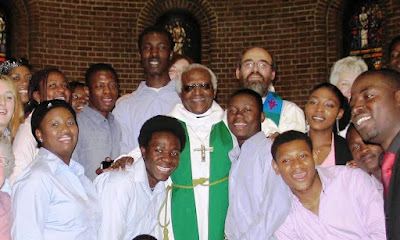
‘The most awful thing that they can do is to kill me, and death is not the worst thing that could happen to a Christian’ … Archbishop Desmond Tutu visiting Saint George’s and Saint Thomas’s Church, Dublin, and the Discovery Gospel Choir
Today’s Prayers (Sunday 21 June 2026, Trinity III, Fathers Day):
In Pray with the World Church, the prayer diary of the Anglican mission agency USPG (United Society Partners in the Gospel), the theme this week, from 21 to 27 June 2026 (pp 12-13), is ‘Land Taken, Land Remembered’. This theme is introduced today with a reflection by the Venerable Rosalyn Kantlaht’ant Elm, Director of Indigenous Ministries, Anglican Church of Canada:
When I think about how land was taken from Indigenous communities in Canada, I see that it was not the work of one person or a single event. It happened slowly, over more than four hundred years. In the early days of European settlement, Indigenous peoples and settlers often lived and worked alongside one another. Though imperfect, there was a time of coexistence.
As Canada developed, laws such as the Civilization Act and the Indian Act enabled the government to take Indigenous lands and move our people onto reserves – fenced-in areas often far from our traditional territories, languages, medicines, ceremonies, and rituals. This process unfolded over generations. Today, Indigenous peoples occupy only a small fraction of our original lands. Much of the rest remains under treaty dispute or is unceded territory, often threatened by mining, forestry, and oil and gas development.
Churches also played a significant role. In partnership with the government, they sought to ‘civilise’ Indigenous children, attempting to erase our cultures. In doing so, they became complicit in what can rightly be described as a legislative form of cultural genocide.
These truths are difficult to speak and to hear. But just as Christians cannot have Easter without Good Friday, we cannot skip the hard history and move straight to celebration. Facing these truths together allows us to lament, to pray, and to understand ourselves not by what we own, but as people created by God, called to care for one another and for the land.
The USPG prayer diary today (Sunday 21 June 2026, Trinity III, Fathers Day, National Indigenous Peoples Day, Canada) invites us to pray:
Creator God, from you every family in heaven and earth takes its name. Rooted and grounded in your covenant love, empowered by your Spirit, help us speak the truth in love and walk in your way towards justice and wholeness. (Anglican Church of Canada)
The Collect of the Day:
Almighty God,
you have broken the tyranny of sin
and have sent the Spirit of your Son into our hearts
whereby we call you Father:
give us grace to dedicate our freedom to your service,
that we and all creation may be brought
to the glorious liberty of the children of God;
through Jesus Christ your Son our Lord,
who is alive and reigns with you,
in the unity of the Holy Spirit,
one God, now and for ever.
The Post-Communion Prayer:
O God, whose beauty is beyond our imagining
and whose power we cannot comprehend:
show us your glory as far as we can grasp it,
and shield us from knowing more than we can bear
until we may look upon you without fear;
through Jesus Christ our Saviour.
Additional Collect:
God our saviour,
look on this wounded world
in pity and in power;
hold us fast to your promises of peace
won for us by your Son,
our Saviour Jesus Christ.
Yesterday’s Reflections
Continued Tomorrow
‘Whoever does not take up the cross and follow me is not worthy of me’ (Matthew 10: 37) … Christ is given his cross, a fresco in Analipsi Church in Georgioupoli, Crete (Photograph: Patrick Comerford)
Scripture quotations are from the New Revised Standard Version Bible: Anglicised Edition copyright © 1989, 1995, National Council of the Churches of Christ in the United States of America. Used by permission. All rights reserved worldwide. http://nrsvbibles.org
‘Are not two sparrows sold for a penny? … you are of more value than many sparrows’ (Matthew 10: 29-30) … a mother sparrow feds her chicks in a church in the ceiling of Aghias Anna Church, Maroulas, near Rethymnon in Crete (Patrick Comerford)
Showing posts with label CND. Show all posts
21 June 2026
Daily prayer in Ordinary Time 2026:
45, Sunday 21 June 2026,
Third Sunday after Trinity (Trinity III)
Labels:
Apartheid,
Canada,
CND,
Crete 2026,
Father's Day,
Georgioupoli,
Greece 2026,
Iraklion,
Lichfield,
Maroulas,
Mission,
Prayer,
Rethymnon,
Saint Matthew's Gospel,
South Africa,
The Irish Times,
USPG
15 June 2026
Changes in Bloomsbury
reflect how William Penn
is losing his place in
the memory of Quakers
Friends’ House in London … William Penn’s name has been removed from one of the rooms (Photograph: Patrick Comerford)
Patrick Comerford
I was meeting some people in the café in Friends’ House, London, the other day, to discuss shared literary projects, historical research and books. Our conversations over lunch and copious cups of coffee ranged over a wide range of topics, from family history and youth hostelling in Ireland, to the work of the International Atomic Research Agency in Vienna, church architecture and the role of the churches in providing a welcome for refugees and asylum seekers, to football and life in New Zealand, Ireland, Stockton on Tees and Milton Keynes.
It was one of those lingering lunches, where our conversations and imaginations ran apace, and we lost track of time.
But, having arrived at Euston Station a little earlier than I expected, and with a short amount of time on my hands before catching the train back to Milton Keynes, I spent some time strolling through the squares of Bloomsbury and also rummaging in the Quaker bookshop at Friends’ House.
Friends International Centre was once on the corner of Torrington Place and Byng Place, close to Gordon Square (Photograph: Patrick Comerford, 2026)
In the past, on working trips to London when I was a trustee of USPG, I occasionally stayed at the Penn Club in Bedford Place off Russell Square. It was a tradition or habit that dated back to taking part in CND protests and meetings in the 1970s and 1980s, and other members of my family have stayed there too.
So, it was with sadness that I heard a few years ago that the Penn Club was closing at the end of March 2021.
I have vague memories too of staying at another Quaker-run guesthouse in Bloomsbury in the early or mid 1970s. Friends International Centre was in an elegant cluster of houses at the corner of Torrington Place and Byng Place, close to Gordon Square, and a five or seven minute walk from both Friends House and the Penn Club.
The houses at the corner of Torrington Place and Byng Place stand close to the Church of Christ the King on Gordon Square (Photograph: Patrick Comerford, 2026)
Those houses are built right up against the Church of Christ the King on Gordon Square, once the University Church and now shared by Forward in Faith and Euston Church. The houses now seem to have been incorporated into the conglomerate of university buildings around Bloomsbury. But I was reminded of their past Quaker associations a few days ago when I noticed that one of the houses is now known as William Penn House.
That reminder was all the more surprising because the memory of William Penn has been falling out of favour among Quakers in recent years. Shortly after the Penn Club closed on Bedford Place, Britain Yearly Meeting (BYM) announced on 10 April 2021, ‘In a step towards becoming an actively anti-racist church, Quakers will cease to name a room in their London offices after William Penn.
Friends’ House on Euston Road houses contains the central offices of Quakers and has conference space that is available to outside groups. About 20 rooms in the building are named after Quakers who have made a difference in the world as a way to share the Quaker story with hundreds of thousands of visitors to Friends’ House each year.
Following much discussion, the decision to end naming a room in Friends’ House after William Penn was made by the yearly meeting trustees, working with the staff at Friends’ House.
William Penn’s name remains on one of the houses (Photograph: Patrick Comerford, 2026)
The statement in 2021 noted that ‘Penn, born in 1644, founded the state of Pennsylvania. He was an avid writer, defending religious freedom, democracy and pacifism … However, he also owned enslaved people.’
Paul Parker, recording clerk for Quakers in Britain, said, ‘Racism today is rooted in the trade of enslaved people. We are committed to tackle racism and to build an anti-racist culture. Commemorating William Penn by having a room named after him is incompatible with that. Some might say we’re rewriting history. Rather, we’re completing history, by telling the whole story and deciding not to commemorate someone who had a direct involvement in slavery. Part of telling a complete history is to acknowledge how it might previously have been understood from a limited perspective. We owe it to those who live with the legacy of slavery to take steps to redress this.’
Friends in Britain were not alone in thinking again about William Penn and other Quaker historic figures. Friends Committee on National Legislation, in Washington DC decided to rename William Penn House, a Quaker-run hostel, due to Penn’s slaveholding.
Back in Friends’ House, I spent a little time browsing in the bookshop beside the café. Looking at the history shelves, I imagine it may take a little longer to change the way William Penn is remembered among Friends. His name remains on one of the paving slabs in the garden celebrating milestones in Quaker history.
William Penn’s name remains on one of the history paving slabs in the garden at Friends’ House (Photograph: Patrick Comerford)
Patrick Comerford
I was meeting some people in the café in Friends’ House, London, the other day, to discuss shared literary projects, historical research and books. Our conversations over lunch and copious cups of coffee ranged over a wide range of topics, from family history and youth hostelling in Ireland, to the work of the International Atomic Research Agency in Vienna, church architecture and the role of the churches in providing a welcome for refugees and asylum seekers, to football and life in New Zealand, Ireland, Stockton on Tees and Milton Keynes.
It was one of those lingering lunches, where our conversations and imaginations ran apace, and we lost track of time.
But, having arrived at Euston Station a little earlier than I expected, and with a short amount of time on my hands before catching the train back to Milton Keynes, I spent some time strolling through the squares of Bloomsbury and also rummaging in the Quaker bookshop at Friends’ House.
Friends International Centre was once on the corner of Torrington Place and Byng Place, close to Gordon Square (Photograph: Patrick Comerford, 2026)
In the past, on working trips to London when I was a trustee of USPG, I occasionally stayed at the Penn Club in Bedford Place off Russell Square. It was a tradition or habit that dated back to taking part in CND protests and meetings in the 1970s and 1980s, and other members of my family have stayed there too.
So, it was with sadness that I heard a few years ago that the Penn Club was closing at the end of March 2021.
I have vague memories too of staying at another Quaker-run guesthouse in Bloomsbury in the early or mid 1970s. Friends International Centre was in an elegant cluster of houses at the corner of Torrington Place and Byng Place, close to Gordon Square, and a five or seven minute walk from both Friends House and the Penn Club.
The houses at the corner of Torrington Place and Byng Place stand close to the Church of Christ the King on Gordon Square (Photograph: Patrick Comerford, 2026)
Those houses are built right up against the Church of Christ the King on Gordon Square, once the University Church and now shared by Forward in Faith and Euston Church. The houses now seem to have been incorporated into the conglomerate of university buildings around Bloomsbury. But I was reminded of their past Quaker associations a few days ago when I noticed that one of the houses is now known as William Penn House.
That reminder was all the more surprising because the memory of William Penn has been falling out of favour among Quakers in recent years. Shortly after the Penn Club closed on Bedford Place, Britain Yearly Meeting (BYM) announced on 10 April 2021, ‘In a step towards becoming an actively anti-racist church, Quakers will cease to name a room in their London offices after William Penn.
Friends’ House on Euston Road houses contains the central offices of Quakers and has conference space that is available to outside groups. About 20 rooms in the building are named after Quakers who have made a difference in the world as a way to share the Quaker story with hundreds of thousands of visitors to Friends’ House each year.
Following much discussion, the decision to end naming a room in Friends’ House after William Penn was made by the yearly meeting trustees, working with the staff at Friends’ House.
William Penn’s name remains on one of the houses (Photograph: Patrick Comerford, 2026)
The statement in 2021 noted that ‘Penn, born in 1644, founded the state of Pennsylvania. He was an avid writer, defending religious freedom, democracy and pacifism … However, he also owned enslaved people.’
Paul Parker, recording clerk for Quakers in Britain, said, ‘Racism today is rooted in the trade of enslaved people. We are committed to tackle racism and to build an anti-racist culture. Commemorating William Penn by having a room named after him is incompatible with that. Some might say we’re rewriting history. Rather, we’re completing history, by telling the whole story and deciding not to commemorate someone who had a direct involvement in slavery. Part of telling a complete history is to acknowledge how it might previously have been understood from a limited perspective. We owe it to those who live with the legacy of slavery to take steps to redress this.’
Friends in Britain were not alone in thinking again about William Penn and other Quaker historic figures. Friends Committee on National Legislation, in Washington DC decided to rename William Penn House, a Quaker-run hostel, due to Penn’s slaveholding.
Back in Friends’ House, I spent a little time browsing in the bookshop beside the café. Looking at the history shelves, I imagine it may take a little longer to change the way William Penn is remembered among Friends. His name remains on one of the paving slabs in the garden celebrating milestones in Quaker history.
William Penn’s name remains on one of the history paving slabs in the garden at Friends’ House (Photograph: Patrick Comerford)
29 April 2026
Daily prayer in Easter 2026:
25, Wednesday 29 April 2026
‘I have come as light into the world, so that everyone who believes in me should not remain in the darkness’ (John 12: 46) … looking out into the village of Piskopiano in Crete from the Church of the Transfiguration (Photograph: Patrick Comerford)
Patrick Comerford
Easter is a 50-day season, beginning on Easter Day (5 April 2026) and continuing until the Day of Pentecost (24 May 2026), or Whit Sunday. This week began with the Fourth Sunday of Easter (Easter IV, 26 April 2026), sometimes known as ‘Good Shepherd Sunday’.
The calendar of the Church of England in Common Worship today remembers Saint Catherine of Siena (1347-1380), Teacher of the Faith. Today also marks the 75th anniversary of the death of the philsopher Ludwig Wittgenstein, and I hope to say more about that anniversary in a blog posting later today. Later this evening, I hope to take part choir rehearsals in Saint Mary and Saint Giles Church, Stony Stratford. But, before today begins, I am taking some quiet time this morning to give thanks, to reflect, to pray and to read in these ways:
1, reading today’s Gospel reading;
2, a short reflection;
3, a prayer from the USPG prayer diary;
4, the Collects and Post-Communion prayer of the day.
‘Whoever sees me sees him who sent me’ (John 12: 45) … the Ancient of Days depicted in a fresco in the Church of the Transfiguration in Piskopiano in Crete (Photograph: Patrick Comerford)
John 12: 44-50 (NRSVA):
44 Then Jesus cried aloud: ‘Whoever believes in me believes not in me but in him who sent me. 45 And whoever sees me sees him who sent me. 46 I have come as light into the world, so that everyone who believes in me should not remain in the darkness. 47 I do not judge anyone who hears my words and does not keep them, for I came not to judge the world, but to save the world. 48 The one who rejects me and does not receive my word has a judge; on the last day the word that I have spoken will serve as judge, 49 for I have not spoken on my own, but the Father who sent me has himself given me a commandment about what to say and what to speak. 50 And I know that his commandment is eternal life. What I speak, therefore, I speak just as the Father has told me.’
‘The Light of the World’ by William Holman Hunt (1827-1910) in a side chapel in Keble College, Oxford (Photograph: Patrick Comerford)
Today’s Reflections:
In the Gospel reading at the Eucharist today (John 12: 44-50), we come to the end of what is known as the ‘Book of Signs’ in Saint John’s Gospel (chapters 1 to 12). Through these seven signs, Christ clearly indicates who he is and what his mission is.
Today’s reading recapitulates all that Christ has said in the ‘Book of Signs’. We hear how Jesus ‘cried aloud’ and spoke. This gives extra emphasis to what he is proclaiming. It is once again a call to believe in Jesus where ‘believing in’ means much more than mere acceptance of the truth of his words. It implies too a personal commitment to Christ and to his mission.
To believe in Christ is also to believe in, to surrender oneself entirely to, the One who sent him, the Father. All through this Gospel, Jesus emphasises the inseparability of the Father and the Son.
The Father sends Christ as light into the world so that ‘whoever sees me sees him who sent me. I have come as light into the world, so that everyone who believes in me should not remain in the darkness’ (John 12: 45-46).
One of the first images of Christ that I remember being show as a child by my grandmother in her house in Cappoquin, Co Waterford, is Holman Hunt’s ‘The Light of the World’. It remains my favourite image of Christ and my favourite Pre-Raphaelite painting.
Saint Catherine of Siena, the Dominican doctor of the church remembered today, says, ‘It is only through shadows that one comes to know the light.’ Addressing Chrit in The Dialogue of Saint Catherine, where she touches topics on prayer, divine providence, and obedience, she writes, ‘You are the Fire that takes away the cold, illuminates the mind with its light, and causes me to know the truth’.
The ‘word’ of Christ is a challenge. It offers a way of living and of inter-relating with God, with others and with ourselves. Christ tells us that his Father’s commands – which he also observes – mean eternal life. Everything that Jesus did was the carrying out of his Father’s will. We are called to follow the same path, which is the way to total freedom.
But how do we follow that path, how do we walk that path?
During the week, I found myself re-reading the hymn ‘Attend and Keep this Happy Fast’ by the English Roman Catholic theologian and one-time Dominican priest, Roger Ruston. He has been strongly influential in Christian CND and similar movements. He is best known for both his careful critique of the ‘deterrence’ theory and the reliance on nuclear weapons and for his work on human rights, including his book Human Rights and the Image of God (SCM-Canterbury Press, 2004), and the conference with that name organised that year by the Dominican Justice and Peace Commission at Blackfriars, Oxford.
Roger Ruston’s insights have a pressing relevance in today’s dismal global political realities. He has also written a number of hymns that are informed by his theological priorities. His hymn ‘Attend and Keep this Happy Fast’ is based on Isaiah 58: 5-9 and expresses the idea that love is better than fasting, and looks to ‘the dawn your light will break’ and that time when ‘the glory of the Lord will shine’:
Attend and keep this happy fast
I preach to you this day.
Is this the fast that pleases me,
that takes your joy away?
Do I delight in sorrow’s dress,
says God, who reigns above,
the hanging head, the dismal look,
will they attract my love?
But is this not the fast I choose,
that shares the heavy load;
that seeks to bring the poor man in
who’s weary of the road;
that gives the hungry bread to eat,
to strangers gives a home;
that does not let you hide your face
from your own flesh and bone?
Then like the dawn your light will break,
to life you will be raised.
And all will praise the Lord for you;
be happy in your days.
The glory of the Lord will shine,
and in your steps his grace.
And when you call he’ll answer you;
He will not hide his face.
Christ is risen!
The Lord is risen indeed. Alleluia!
Rembering Mika Chrysaki who gave her name to Mika Villas in Piskopiano in Crete (Photograph: Patrick Comerford)
Today’s Prayers (Wednesday 29 April 2026):
I have been recalling my own grandmother in my reflections this morning. In my prayers, I am also remebering a family of dear friends in Crete who are burying a dear mother, mother-in-law and grandmother, in Iraklion this afternoon. Mika was a warm, welcoming member of the family, and her son proudly gave her name to the family hotel in Piskopiano in the hills above Hersonissos. I have stayed in or visited there countless times since the mid-1990s.
‘Prayer and Action in Pakistan’ provides the theme this week (26 April to 2 May 2026) in ‘Pray With the World Church’, the Prayer Diary of the Anglican mission agency USPG (United Society Partners in the Gospel), pp 50-51. This theme was introduced on Sunday with Reflections from the Revd Davidson Solanki, Senior Regional Manager for Asia and the Middle East.
The USPG Prayer Diary today (Wednesday 29 April 2026) invites us to pray:
Lord, bless the Church of Pakistan as they seek to serve all neighbours. Particularly after the devastation of the floods, may their acts of care demonstrate Christ’s love in action even across faiths.
The Collect:
God of compassion,
who gave your servant Catherine of Siena
a wondrous love of the passion of Christ:
grant that your people may be united to him in his majesty
and rejoice for ever in the revelation of his glory;
who is alive and reigns with you,
in the unity of the Holy Spirit,
one God, now and for ever.
The Post-Communion Prayer:
God of truth,
whose Wisdom set her table
and invited us to eat the bread and drink the wine
of the kingdom:
help us to lay aside all foolishness
and to live and walk in the way of insight,
that we may come with Catherine to the eternal feast of heaven;
through Jesus Christ our Lord.
Yesterday’s Reflections
Continued Tomorrow
‘It is only through shadows that one comes to know the light’ … Saint Catherine of Siena seen in a window in Saint Giles Church, Cambridge (Photograph: Patrick Comerford)
Scripture quotations are from the New Revised Standard Version Bible: Anglicised Edition copyright © 1989, 1995 National Council of the Churches of Christ in the United States of America. Used by permission. All rights reserved worldwide. http://nrsvbibles.org
Patrick Comerford
Easter is a 50-day season, beginning on Easter Day (5 April 2026) and continuing until the Day of Pentecost (24 May 2026), or Whit Sunday. This week began with the Fourth Sunday of Easter (Easter IV, 26 April 2026), sometimes known as ‘Good Shepherd Sunday’.
The calendar of the Church of England in Common Worship today remembers Saint Catherine of Siena (1347-1380), Teacher of the Faith. Today also marks the 75th anniversary of the death of the philsopher Ludwig Wittgenstein, and I hope to say more about that anniversary in a blog posting later today. Later this evening, I hope to take part choir rehearsals in Saint Mary and Saint Giles Church, Stony Stratford. But, before today begins, I am taking some quiet time this morning to give thanks, to reflect, to pray and to read in these ways:
1, reading today’s Gospel reading;
2, a short reflection;
3, a prayer from the USPG prayer diary;
4, the Collects and Post-Communion prayer of the day.
‘Whoever sees me sees him who sent me’ (John 12: 45) … the Ancient of Days depicted in a fresco in the Church of the Transfiguration in Piskopiano in Crete (Photograph: Patrick Comerford)
John 12: 44-50 (NRSVA):
44 Then Jesus cried aloud: ‘Whoever believes in me believes not in me but in him who sent me. 45 And whoever sees me sees him who sent me. 46 I have come as light into the world, so that everyone who believes in me should not remain in the darkness. 47 I do not judge anyone who hears my words and does not keep them, for I came not to judge the world, but to save the world. 48 The one who rejects me and does not receive my word has a judge; on the last day the word that I have spoken will serve as judge, 49 for I have not spoken on my own, but the Father who sent me has himself given me a commandment about what to say and what to speak. 50 And I know that his commandment is eternal life. What I speak, therefore, I speak just as the Father has told me.’
‘The Light of the World’ by William Holman Hunt (1827-1910) in a side chapel in Keble College, Oxford (Photograph: Patrick Comerford)
Today’s Reflections:
In the Gospel reading at the Eucharist today (John 12: 44-50), we come to the end of what is known as the ‘Book of Signs’ in Saint John’s Gospel (chapters 1 to 12). Through these seven signs, Christ clearly indicates who he is and what his mission is.
Today’s reading recapitulates all that Christ has said in the ‘Book of Signs’. We hear how Jesus ‘cried aloud’ and spoke. This gives extra emphasis to what he is proclaiming. It is once again a call to believe in Jesus where ‘believing in’ means much more than mere acceptance of the truth of his words. It implies too a personal commitment to Christ and to his mission.
To believe in Christ is also to believe in, to surrender oneself entirely to, the One who sent him, the Father. All through this Gospel, Jesus emphasises the inseparability of the Father and the Son.
The Father sends Christ as light into the world so that ‘whoever sees me sees him who sent me. I have come as light into the world, so that everyone who believes in me should not remain in the darkness’ (John 12: 45-46).
One of the first images of Christ that I remember being show as a child by my grandmother in her house in Cappoquin, Co Waterford, is Holman Hunt’s ‘The Light of the World’. It remains my favourite image of Christ and my favourite Pre-Raphaelite painting.
Saint Catherine of Siena, the Dominican doctor of the church remembered today, says, ‘It is only through shadows that one comes to know the light.’ Addressing Chrit in The Dialogue of Saint Catherine, where she touches topics on prayer, divine providence, and obedience, she writes, ‘You are the Fire that takes away the cold, illuminates the mind with its light, and causes me to know the truth’.
The ‘word’ of Christ is a challenge. It offers a way of living and of inter-relating with God, with others and with ourselves. Christ tells us that his Father’s commands – which he also observes – mean eternal life. Everything that Jesus did was the carrying out of his Father’s will. We are called to follow the same path, which is the way to total freedom.
But how do we follow that path, how do we walk that path?
During the week, I found myself re-reading the hymn ‘Attend and Keep this Happy Fast’ by the English Roman Catholic theologian and one-time Dominican priest, Roger Ruston. He has been strongly influential in Christian CND and similar movements. He is best known for both his careful critique of the ‘deterrence’ theory and the reliance on nuclear weapons and for his work on human rights, including his book Human Rights and the Image of God (SCM-Canterbury Press, 2004), and the conference with that name organised that year by the Dominican Justice and Peace Commission at Blackfriars, Oxford.
Roger Ruston’s insights have a pressing relevance in today’s dismal global political realities. He has also written a number of hymns that are informed by his theological priorities. His hymn ‘Attend and Keep this Happy Fast’ is based on Isaiah 58: 5-9 and expresses the idea that love is better than fasting, and looks to ‘the dawn your light will break’ and that time when ‘the glory of the Lord will shine’:
Attend and keep this happy fast
I preach to you this day.
Is this the fast that pleases me,
that takes your joy away?
Do I delight in sorrow’s dress,
says God, who reigns above,
the hanging head, the dismal look,
will they attract my love?
But is this not the fast I choose,
that shares the heavy load;
that seeks to bring the poor man in
who’s weary of the road;
that gives the hungry bread to eat,
to strangers gives a home;
that does not let you hide your face
from your own flesh and bone?
Then like the dawn your light will break,
to life you will be raised.
And all will praise the Lord for you;
be happy in your days.
The glory of the Lord will shine,
and in your steps his grace.
And when you call he’ll answer you;
He will not hide his face.
Christ is risen!
The Lord is risen indeed. Alleluia!
Rembering Mika Chrysaki who gave her name to Mika Villas in Piskopiano in Crete (Photograph: Patrick Comerford)
Today’s Prayers (Wednesday 29 April 2026):
I have been recalling my own grandmother in my reflections this morning. In my prayers, I am also remebering a family of dear friends in Crete who are burying a dear mother, mother-in-law and grandmother, in Iraklion this afternoon. Mika was a warm, welcoming member of the family, and her son proudly gave her name to the family hotel in Piskopiano in the hills above Hersonissos. I have stayed in or visited there countless times since the mid-1990s.
‘Prayer and Action in Pakistan’ provides the theme this week (26 April to 2 May 2026) in ‘Pray With the World Church’, the Prayer Diary of the Anglican mission agency USPG (United Society Partners in the Gospel), pp 50-51. This theme was introduced on Sunday with Reflections from the Revd Davidson Solanki, Senior Regional Manager for Asia and the Middle East.
The USPG Prayer Diary today (Wednesday 29 April 2026) invites us to pray:
Lord, bless the Church of Pakistan as they seek to serve all neighbours. Particularly after the devastation of the floods, may their acts of care demonstrate Christ’s love in action even across faiths.
The Collect:
God of compassion,
who gave your servant Catherine of Siena
a wondrous love of the passion of Christ:
grant that your people may be united to him in his majesty
and rejoice for ever in the revelation of his glory;
who is alive and reigns with you,
in the unity of the Holy Spirit,
one God, now and for ever.
The Post-Communion Prayer:
God of truth,
whose Wisdom set her table
and invited us to eat the bread and drink the wine
of the kingdom:
help us to lay aside all foolishness
and to live and walk in the way of insight,
that we may come with Catherine to the eternal feast of heaven;
through Jesus Christ our Lord.
Yesterday’s Reflections
Continued Tomorrow
‘It is only through shadows that one comes to know the light’ … Saint Catherine of Siena seen in a window in Saint Giles Church, Cambridge (Photograph: Patrick Comerford)
Scripture quotations are from the New Revised Standard Version Bible: Anglicised Edition copyright © 1989, 1995 National Council of the Churches of Christ in the United States of America. Used by permission. All rights reserved worldwide. http://nrsvbibles.org
Labels:
Cambridge,
Cappoquin,
CND,
Crete 2026,
Dominicans,
Easter 2026,
Funerals,
Greece 2026,
Human Rights,
Iraklion,
Mission,
Oxford,
Pakistan,
Piskopiano,
Prayer,
Pre-Raphaelites,
Saint John's Gospel,
Siena,
USPG,
Wittgenstein
22 April 2026
A return visit to Spode House
and Hawkesyard Esate, with
memories of philosophers
and folk masses in the 1970s
Hawkesyard Hall and Spode House in Armitage, where the Dominicans had a priory until 1988 (Photograph: Patrick Comerford, 2026)
Patrick Comerford
In recent days, I have been visiting a number of churches in the Rugeley area that I first got to know when I was about 19 or 20. They include Saint Michael’s Church in Brereton and the now-closed Brereton Methodist Church; the old and new Saint Augustine’s Church, the ruins of the early mediaeval parish church, now known as the ‘Old Chancel’, and the early 19th century church across the street that replaced it in the 1820s; and Saint Joseph and Saint Etheldreda Catholic Churchin Rugeley, with its many associations with the Wolseley family.
Some of my most cherished memories from those youthful days in the 1970s are of Hawkesyard Hall and Spode House in Armitage, where the Dominicans once had a priory, only ten minutes from Lichfield and five minutes from Brereton and Rugeley, and on the edges of Armitage village. My friends from Rugeley and Brereton often brought me there with them to the Folk Masses on Sundays.
So, when I was on the bus from Brereton to Lichfield last week, I hopped off near Armitage, went for a walk along the canal towpaths, and visited Hawkesyard Hall and Spode House.
Hawkesyard Hall and Spode House were known for the Folk Masses and gatherings of the Philosophical Enquiry Group (Photograph: Patrick Comerford, 2026)
Hawkesyard has been known over the generations by a variety of names, including Hawkesyard Hall, Armitage Park, Spode House and Hawkesyard Priory. The estate dates from the 13th century, and has links to the Rugeley family, the poet and author Nathaniel Lister, Josiah Spode the potter, and Sir Robert Peel – and even some tenuous links in the dim distant past through the Rugeley family with the Comberford family.
The story of the estate dates back to 1270 when the land was used for hunting. Simon de Rugeley commissioned the construction on Hawkesyard Hall in 1337. The first house owned by the Rugeley family was a moated manor closer to the River Trent, about half a mile west of Armitage Church.
Anne Comberford of Comberford, Tamworth and Wednesbury, who was a daughter of William Comberford, and was born in 1609. In 1634, she married Benjamin Rugeley of Dunstall in Tatenhill, a younger brother of Colonel Simon Rugeley, a key leader of the Parliamentarians during the English Civil War.
Benjamin Rugeley was a younger son of Richard Rugeley (1564-1623) of Shenstone and his wife Mary Rugeley, daughter and co-heir of Thomas Rugeley (1539-1623) of Hawkesyard. Benjamin’s father, Richard Rugeley, died at Hawkesyard in 1623 and was buried in Mavesyn Ridware.
Benjamin’s eldest brother, Colonel Simon Rugeley of Shenstone and Tatenhill (1598-1666), was a member of the parliamentary committee at Stafford. He inherited Hawkesyard but sold it to Sir Richard Skeffington of Fisherwick, whose family eventually acquired Comberford Hall. The original Hawkesyard Hall lay in ruins by 1660, and was pulled down in 1665.
The towers and turrets of Hawkesyard Hall and Spode House rising above the canal between Armitage and Rugeley (Photograph: Patrick Comerford, 2026)
The estate was bought in 1759 by Nathaniel Lister (1725-1793), poet and author. Lister renamed the Hawkesyard estate as Armitage Park in 1760, and in 1761 in Lichfield Cathedral he married Martha Fletcher, a Lichfield heiress and daughter of John Fletcher, Senior Proctor of the Diocese of Lichfield. They rebuilt the house in its present location as a Gothic-style mansion in red-brick stuccoed with ashlar and standing on the sandstone hill above the site of the original hall.
Lister also bought a house on Beacon Street in Lichfield in 1780, and in 1791 he acquired the lease on Erasmus Darwin’s house beside the Cathedral Close. When he died in 1793, Armitage Park was inherited by his son, John Fletcher Lister.
Mary Spode, widow of the potter Josiah Spode III, bought the estate in 1839 for her six-year-old son Josiah Spode IV (1823-1893), great-grandson of Josiah Spode and the fourth generation of the pottery dynasty but the first not to work in the family business.
The hall was altered and extended, and the cast-iron orangery was added, as well manicured gardens, statues and other buildings. Cellars and six underground tunnels were cut out of the rock by Richard Benton to allow the estate workers to move quickly around the locality, and two tunnels were said to lead to Lichfield and Armitage.
When the Spode family lived there, the hall was known as Spode House and Josiah Spode was appointed High Sheriff of Staffordshire in 1850. Mary died in 1860, and Josiah’s wife Helen died eight years later. Both are buried at Saint John the Baptist Church, Armitage, where Josiah was the organ player and warden. Josiah Spode of Hawkesyard also gave a new organ to Lichfield Cathedral that was installed in 1860 to complement the restoration of the quire by Sir George Gilbert Scott.
Despite these links with Lichfield Cathedral and Saint John’s Church, Armitage, Josiah Spode became a Roman Catholic in 1885, along with his niece Helen Gulson who lived with him at Hawkesyard. At the beginning of Lent 1886, they attended a parish retreat at Saint Joseph and Saint Etheldreda Catholic Churchin Rugeley given by Father Pius Cavanagh. Father Pius soon became in Gulson’s words ‘our best friend and advisor’. Towards the end of 1888, both Josiah Spode and Helen Gulson were clothed as tertiaries by Father Pius in their private chapel, becoming lay Dominicans.
The elaboratre reredos above the High Altar in the former Domician chapel (Photograph: Dominican Archives)
WhenJosiah Spode died in 1893, he asked that Helen should continue to live at Hawkesyard until she died, after which the estate would pass to the English Dominican Order.
However, Helen decided to move out of the hall in 1894 and into Gulson House on the estate, and work on the new priory and church began immediately. Some accounts say her decision was inspired by an apparition of the Virgin Mary in the grounds of the estate, and that the altar of the new priory church of Saint Thomas Aquinas was placed over the site of her vision.
The Dominicans built a new priory within the grounds in 1898, and the priory church was designed by the architect Edward Goldie (1856-1921). Josiah Spode and Helen Gulson were buried in a small chapel within the priory church, and outside in the gardens simple concrete crosses marked the graves of the Dominican community.
The priory was home to a community of nuns until the early 20th century. The convent then became a priory, and the Dominican monks or friars ran a boarding school for young aspiring Dominicans and a theological college.
The towers and turrets of Hawkesyard Hall and Spode House rising above the canal between Armitage and Rugeley (Photograph: Patrick Comerford, 2026)
I knew Hawkesyard Priory and Spode House well in my late teens and early 20s, when the Philosophical Enquiry Group was still meeting there with Father Columba Ryan and involved the Limerick-born philosopher Elizabeth Anscombe (1919-2001). At the time, the Folk Masses in the priory chapel were popular with many of my friends from Rugeley, Brereton and Lichfield.
The friars there in those heady days in the early 1970s included Father Conrad Pepler (1908-1993), the founding warden of Spode House, where he ran the first Catholic conference centre in England. We did not know then that it was he who provided a Catholic funeral in Cambridge in 1951 for the philosopher Ludwig Wittgenstein, a mentor to both Elizabeth Anscombe and her husband Peter Geach.
The Dominicans at Spode in the early 1970s also included Father Columba Ryan (1916-2009), philosopher, university chaplain and peace activist, who took part in many CND marches and protests in London. He was also the bursar at the Hawkesyard Priory, and in the 1950s and 1960s he set up the Philosophical Enquiry Group at Spode in 1954.
He was born Patrick Ryan, a son of the Cork-born diplomat Sir Andrew Ryan (1876-1949), the last dragoman in Constantinople (1907-1921). He joined the Dominicans at Woodchester Priory, Gloucestershire, in 1935, took the name Columba, was ordained in 25 July 1941, and completed his DPhil at Oxford in 1946.
He was one of the friars who was on the Peace Pilgrimage to Vézelay in Burgundy, selecting ‘30 strong men’ to carry a heavy wooden cross across France in thanksgiving for the end of World War II. On his return he was instrumental in founding Student Cross, the annual Holy Week pilgrimage to Walsingham.
The drive from Armitage Lane leading up to the former Hawkesyard Priory (Photograph: Patrick Comerford, 2026)
Father Columba was teaching philosophy at Hawkesyard Priory when he set up the Philosophical Enquiry Group in 1954. This annual meeting for Catholic philosophers continued to take place at Spode House for 20 years, until 1974.
Elizabeth Anscombe and Peter Geach were among the first philosophers invited to those gatherings at Spode House. They remained leading figures of the group for the 20 years it lasted. They were Wittgenstein’s literary executors and were buried beside him in Cambridge. Other participants the Philosophical Enquiry Group included Sir Anthony Kenny of Oxford and Father Herbert McCabe (1926-2001), editor of New Blackriars. Father Columba had been the novice master of Herbert McCabe, who is attributed with once saying, ‘If you don’t love, you’re dead, and if you do, they’ll kill you.’
Father Columba remained true to his values and joined the hundreds of thousands of people who marched in London on 15 February 2003 in protest at the invasion of Iraq. He continued preaching until shortly before he died at Saint Dominic’s Priory at Haverstock Hill, London, on 4 August 2009, aged 93. It was then the Feast of Saint Dominic, and it was the church in which he had been baptised as an infant; he had just celebrated 68 years of priesthood. His brother John Ryan (1921-2009), who had created the character of Captain Pugwash for the Eagle in 1950, had died two weeks earlier on 22 July 2009 at 88.
Meanwhile, the priory and conference centre at Spode House had closed and the last Dominicans moved out in 1988. When they left Hawkesyard, the hall had fallen into disrepair and had been boarded up. Still, in June 1998, the choristers of Lichfield Cathedral, directed by Andrew Lumsden made a recording, Begone Dull Care (Lammas Records, LAMM 107D), in Hawkesyard Priory.
The emblem of the Dominicans is recalled in the logo of the Hawkesyard Estate (Photograph: Patrick Comerford, 2026)
Hawkesyard was bought in 1999 by Relaine Estates Ltd which was determined to return the building and the estate. The company returned to the original name of Hawkesyard and set about restoring the building, partly relying on photographs from the collection at Shugborough Hall, the seat of the Earls of Lichfield, halfway between Rugeley and Stafford.
The transformation of the hall and other buildings was completed in 2007. The former priory building has been a nursing home since 1989, and the grounds have been turned into Saint Thomas’s Priory Golf Club. Hawkesyard Estate is now a popular venue for civil weddings, golf, conferences, and for three successive years it was the home of the Wolseley National Car Rally.
After visiting Hawkesyard estate, I lingered for a while by the canal towpath, sipping a glass of wine in the April sunshine at the Ash Tree, before continuing on the bus journey to Lichfield, for lunch at the Hedgehog and Evening Prayer in Lichfield Cathedral.
I remember a lengthy lunch in the Hedgehog in Lichfield a few years ago, when some of us recalled so many of our friends who loved Hawkesyard, the folk masses there and the extended Sunday afternoons that inevitably followed.
We talked that afternoon about the underground tunnels at Hawkesyard, including the tunnels said to lead to Lichfield and Armitage. We never seemed to wander down to the canal, as far as I recall. But was I really the one who was so fearless to lead a group of us through those unexplored tunnels and vaults? And are the tunnels still there?
A glass of wine in mid-April sunshine by the canal at the Ash Tree (Photograph: Patrick Comerford, 2026)
Patrick Comerford
In recent days, I have been visiting a number of churches in the Rugeley area that I first got to know when I was about 19 or 20. They include Saint Michael’s Church in Brereton and the now-closed Brereton Methodist Church; the old and new Saint Augustine’s Church, the ruins of the early mediaeval parish church, now known as the ‘Old Chancel’, and the early 19th century church across the street that replaced it in the 1820s; and Saint Joseph and Saint Etheldreda Catholic Churchin Rugeley, with its many associations with the Wolseley family.
Some of my most cherished memories from those youthful days in the 1970s are of Hawkesyard Hall and Spode House in Armitage, where the Dominicans once had a priory, only ten minutes from Lichfield and five minutes from Brereton and Rugeley, and on the edges of Armitage village. My friends from Rugeley and Brereton often brought me there with them to the Folk Masses on Sundays.
So, when I was on the bus from Brereton to Lichfield last week, I hopped off near Armitage, went for a walk along the canal towpaths, and visited Hawkesyard Hall and Spode House.
Hawkesyard Hall and Spode House were known for the Folk Masses and gatherings of the Philosophical Enquiry Group (Photograph: Patrick Comerford, 2026)
Hawkesyard has been known over the generations by a variety of names, including Hawkesyard Hall, Armitage Park, Spode House and Hawkesyard Priory. The estate dates from the 13th century, and has links to the Rugeley family, the poet and author Nathaniel Lister, Josiah Spode the potter, and Sir Robert Peel – and even some tenuous links in the dim distant past through the Rugeley family with the Comberford family.
The story of the estate dates back to 1270 when the land was used for hunting. Simon de Rugeley commissioned the construction on Hawkesyard Hall in 1337. The first house owned by the Rugeley family was a moated manor closer to the River Trent, about half a mile west of Armitage Church.
Anne Comberford of Comberford, Tamworth and Wednesbury, who was a daughter of William Comberford, and was born in 1609. In 1634, she married Benjamin Rugeley of Dunstall in Tatenhill, a younger brother of Colonel Simon Rugeley, a key leader of the Parliamentarians during the English Civil War.
Benjamin Rugeley was a younger son of Richard Rugeley (1564-1623) of Shenstone and his wife Mary Rugeley, daughter and co-heir of Thomas Rugeley (1539-1623) of Hawkesyard. Benjamin’s father, Richard Rugeley, died at Hawkesyard in 1623 and was buried in Mavesyn Ridware.
Benjamin’s eldest brother, Colonel Simon Rugeley of Shenstone and Tatenhill (1598-1666), was a member of the parliamentary committee at Stafford. He inherited Hawkesyard but sold it to Sir Richard Skeffington of Fisherwick, whose family eventually acquired Comberford Hall. The original Hawkesyard Hall lay in ruins by 1660, and was pulled down in 1665.
The towers and turrets of Hawkesyard Hall and Spode House rising above the canal between Armitage and Rugeley (Photograph: Patrick Comerford, 2026)
The estate was bought in 1759 by Nathaniel Lister (1725-1793), poet and author. Lister renamed the Hawkesyard estate as Armitage Park in 1760, and in 1761 in Lichfield Cathedral he married Martha Fletcher, a Lichfield heiress and daughter of John Fletcher, Senior Proctor of the Diocese of Lichfield. They rebuilt the house in its present location as a Gothic-style mansion in red-brick stuccoed with ashlar and standing on the sandstone hill above the site of the original hall.
Lister also bought a house on Beacon Street in Lichfield in 1780, and in 1791 he acquired the lease on Erasmus Darwin’s house beside the Cathedral Close. When he died in 1793, Armitage Park was inherited by his son, John Fletcher Lister.
Mary Spode, widow of the potter Josiah Spode III, bought the estate in 1839 for her six-year-old son Josiah Spode IV (1823-1893), great-grandson of Josiah Spode and the fourth generation of the pottery dynasty but the first not to work in the family business.
The hall was altered and extended, and the cast-iron orangery was added, as well manicured gardens, statues and other buildings. Cellars and six underground tunnels were cut out of the rock by Richard Benton to allow the estate workers to move quickly around the locality, and two tunnels were said to lead to Lichfield and Armitage.
When the Spode family lived there, the hall was known as Spode House and Josiah Spode was appointed High Sheriff of Staffordshire in 1850. Mary died in 1860, and Josiah’s wife Helen died eight years later. Both are buried at Saint John the Baptist Church, Armitage, where Josiah was the organ player and warden. Josiah Spode of Hawkesyard also gave a new organ to Lichfield Cathedral that was installed in 1860 to complement the restoration of the quire by Sir George Gilbert Scott.
Despite these links with Lichfield Cathedral and Saint John’s Church, Armitage, Josiah Spode became a Roman Catholic in 1885, along with his niece Helen Gulson who lived with him at Hawkesyard. At the beginning of Lent 1886, they attended a parish retreat at Saint Joseph and Saint Etheldreda Catholic Churchin Rugeley given by Father Pius Cavanagh. Father Pius soon became in Gulson’s words ‘our best friend and advisor’. Towards the end of 1888, both Josiah Spode and Helen Gulson were clothed as tertiaries by Father Pius in their private chapel, becoming lay Dominicans.
The elaboratre reredos above the High Altar in the former Domician chapel (Photograph: Dominican Archives)
WhenJosiah Spode died in 1893, he asked that Helen should continue to live at Hawkesyard until she died, after which the estate would pass to the English Dominican Order.
However, Helen decided to move out of the hall in 1894 and into Gulson House on the estate, and work on the new priory and church began immediately. Some accounts say her decision was inspired by an apparition of the Virgin Mary in the grounds of the estate, and that the altar of the new priory church of Saint Thomas Aquinas was placed over the site of her vision.
The Dominicans built a new priory within the grounds in 1898, and the priory church was designed by the architect Edward Goldie (1856-1921). Josiah Spode and Helen Gulson were buried in a small chapel within the priory church, and outside in the gardens simple concrete crosses marked the graves of the Dominican community.
The priory was home to a community of nuns until the early 20th century. The convent then became a priory, and the Dominican monks or friars ran a boarding school for young aspiring Dominicans and a theological college.
The towers and turrets of Hawkesyard Hall and Spode House rising above the canal between Armitage and Rugeley (Photograph: Patrick Comerford, 2026)
I knew Hawkesyard Priory and Spode House well in my late teens and early 20s, when the Philosophical Enquiry Group was still meeting there with Father Columba Ryan and involved the Limerick-born philosopher Elizabeth Anscombe (1919-2001). At the time, the Folk Masses in the priory chapel were popular with many of my friends from Rugeley, Brereton and Lichfield.
The friars there in those heady days in the early 1970s included Father Conrad Pepler (1908-1993), the founding warden of Spode House, where he ran the first Catholic conference centre in England. We did not know then that it was he who provided a Catholic funeral in Cambridge in 1951 for the philosopher Ludwig Wittgenstein, a mentor to both Elizabeth Anscombe and her husband Peter Geach.
The Dominicans at Spode in the early 1970s also included Father Columba Ryan (1916-2009), philosopher, university chaplain and peace activist, who took part in many CND marches and protests in London. He was also the bursar at the Hawkesyard Priory, and in the 1950s and 1960s he set up the Philosophical Enquiry Group at Spode in 1954.
He was born Patrick Ryan, a son of the Cork-born diplomat Sir Andrew Ryan (1876-1949), the last dragoman in Constantinople (1907-1921). He joined the Dominicans at Woodchester Priory, Gloucestershire, in 1935, took the name Columba, was ordained in 25 July 1941, and completed his DPhil at Oxford in 1946.
He was one of the friars who was on the Peace Pilgrimage to Vézelay in Burgundy, selecting ‘30 strong men’ to carry a heavy wooden cross across France in thanksgiving for the end of World War II. On his return he was instrumental in founding Student Cross, the annual Holy Week pilgrimage to Walsingham.
The drive from Armitage Lane leading up to the former Hawkesyard Priory (Photograph: Patrick Comerford, 2026)
Father Columba was teaching philosophy at Hawkesyard Priory when he set up the Philosophical Enquiry Group in 1954. This annual meeting for Catholic philosophers continued to take place at Spode House for 20 years, until 1974.
Elizabeth Anscombe and Peter Geach were among the first philosophers invited to those gatherings at Spode House. They remained leading figures of the group for the 20 years it lasted. They were Wittgenstein’s literary executors and were buried beside him in Cambridge. Other participants the Philosophical Enquiry Group included Sir Anthony Kenny of Oxford and Father Herbert McCabe (1926-2001), editor of New Blackriars. Father Columba had been the novice master of Herbert McCabe, who is attributed with once saying, ‘If you don’t love, you’re dead, and if you do, they’ll kill you.’
Father Columba remained true to his values and joined the hundreds of thousands of people who marched in London on 15 February 2003 in protest at the invasion of Iraq. He continued preaching until shortly before he died at Saint Dominic’s Priory at Haverstock Hill, London, on 4 August 2009, aged 93. It was then the Feast of Saint Dominic, and it was the church in which he had been baptised as an infant; he had just celebrated 68 years of priesthood. His brother John Ryan (1921-2009), who had created the character of Captain Pugwash for the Eagle in 1950, had died two weeks earlier on 22 July 2009 at 88.
Meanwhile, the priory and conference centre at Spode House had closed and the last Dominicans moved out in 1988. When they left Hawkesyard, the hall had fallen into disrepair and had been boarded up. Still, in June 1998, the choristers of Lichfield Cathedral, directed by Andrew Lumsden made a recording, Begone Dull Care (Lammas Records, LAMM 107D), in Hawkesyard Priory.
The emblem of the Dominicans is recalled in the logo of the Hawkesyard Estate (Photograph: Patrick Comerford, 2026)
Hawkesyard was bought in 1999 by Relaine Estates Ltd which was determined to return the building and the estate. The company returned to the original name of Hawkesyard and set about restoring the building, partly relying on photographs from the collection at Shugborough Hall, the seat of the Earls of Lichfield, halfway between Rugeley and Stafford.
The transformation of the hall and other buildings was completed in 2007. The former priory building has been a nursing home since 1989, and the grounds have been turned into Saint Thomas’s Priory Golf Club. Hawkesyard Estate is now a popular venue for civil weddings, golf, conferences, and for three successive years it was the home of the Wolseley National Car Rally.
After visiting Hawkesyard estate, I lingered for a while by the canal towpath, sipping a glass of wine in the April sunshine at the Ash Tree, before continuing on the bus journey to Lichfield, for lunch at the Hedgehog and Evening Prayer in Lichfield Cathedral.
I remember a lengthy lunch in the Hedgehog in Lichfield a few years ago, when some of us recalled so many of our friends who loved Hawkesyard, the folk masses there and the extended Sunday afternoons that inevitably followed.
We talked that afternoon about the underground tunnels at Hawkesyard, including the tunnels said to lead to Lichfield and Armitage. We never seemed to wander down to the canal, as far as I recall. But was I really the one who was so fearless to lead a group of us through those unexplored tunnels and vaults? And are the tunnels still there?
A glass of wine in mid-April sunshine by the canal at the Ash Tree (Photograph: Patrick Comerford, 2026)
Labels:
Architecture,
Armitage,
Brereton,
Canals,
Church History,
CND,
Comberford,
Family History,
Hawkesyard,
Lichfield,
Lichfield Cathedral,
Local History,
Philosophy,
Rugeley,
Spode,
Staffordshire,
Staffordshire Churches,
Wittgenstein
31 December 2025
2025: a year that must be
remembered for far more than
than Trump’s rule and his
violence, vulgarity and vitriol
The sun sets on another year … sunset beneath the Fortezza in Rethymnon earlier this year (Photograph: Patrick Comerford, 2025)
This year seems to have been dominated by war and violence in Russia and Ukraine, in Gaza, Israel and Palestine, continuing wars and violence involving the US, Iran, Yemen, Sudan and Nigeria, the continuing rise in antimsemitism, Islamophobia and racism everywhere, and by the upsurge in ugly right-wing nationalism in Britain and across the world that hijacks the name of Christianity and its symbolism without heeding any of its values, teachings or demands.
The changes in the world this year included the return of Donald Trump to power in the US, the death of Pope Francis, the election of Pope Leo, the resignation of Archbishop Justin Welby, and the appointment of his successor, Bishop Sarah Mullally.
This year also marked the 80th anniversaries of the atomic bombings of Hiroshima and Nagasaki, the liberation of the death camps, the end of the Holocaust, VE Day and VJ Day, and the end of World War II. This year would also have marked the 80th anniversary of the marriage of my parents, who waited until the end of World War II to get married on 8 September 1945.
Michael D Higgins, who retired last month as President of Ireland after two seven-year terms of office, was a life-long supporter of CND and many other campaigns I was involved in. We have known each other since the Labour Party conference in Cork in 1973, and I only wish that the values that marked his 14-year presidency could be mirrored by other world leaders today.
With President Michael D Higgins and Brendan Howlin during the 2011 Presidential election campaign at the Wexford Ambassadors initiative in Iveagh House, Dublin … President Higgins retired last month after two seven-year terms in office
One of the emotional difficulties of having moved from Ireland to England is not being able to attend the funerals of dear friends and family members.
Don Buckley was a lifelong friend, a work colleague in The Irish Times for many decades, and my second cousin on the Crowley side of the family. His paternal grandmother and my maternal grandmother were sisters, and although his family live in Mallow, Co Cork, I knew him since childhood due to the amount of time he spent in hospitals in Dublin because of his haemophilia.
He encouraged me to follow him into journalism, and visited me in Wexford while I was with the Wexford People trying to persuade me to move to The Irish Times. He was a brave and pioneering journalist, who achieved national prominence for his work on fake charities, the ‘Heavy Gang’ and the ‘Kerry Babies’ case. He was a bon viveur and I enjoyed his parties and dinners, but we also shared similar political values and hopes and many cultural interests.
Other former colleagues from those days in The Irish Times who died during the years include Johnny Hughes, Ed Moloney, a former Northern Editor, Mickey McConnell and the writer Mary Russell, and Philip Molloy from my days with the Wexford People.
Father Louis Brennan, who died on 12 August, had been the Rector of Gormanston, and was perhaps the most inspiring teacher I had in my schooldays. He encouraged my interests in debating, drama and development and human rights issues, got me on stage, involved me in carol singing at Christmas, and counted me in on a drama production during the Easter holidays in 1969. Later, he was Minister Provincial of the Franciscan Province of Ireland, Definitor General of the Order, Secretary General of the Order.
Canon Billy Marshall, who died at the age of 90 on 26 September, had been the Vice-Principal of the Church of Ireland Theological College when I was training for ordination, and our lives overlapped in many ways. The Revd Canon Dr William John Marshall had spent a decade in North India with the Dublin University Mission to Chota Nagpur and USPG (1962-1972). Back in Ireland, he was Assistant Chaplain at Trinity College Dublin (1973-1976), where he completed his doctoral research on the Church of North India, and later was the Rector of Rathmichael (1976-1992), Chancellor of Christ Church Cathedral (1990-2002), and Vice-Principal of CITC (1992-2002).
He was a life-long supporter of USPG and he was one of the ‘go-to’ people when I was planning doctoral research on Irish Anglican missionaries. He continued his engagement with both CITC (later CITI) when I was on the staff and with Christ Church Cathedral when I was a chapter member.
Canon Walter Lewis died on 5 March aged 79. I first got to know him when I was on a student placement with the Irish School of Ecumenics on the Shankill Road in Belfast in the early 1980s. His style of ministry then impressed me so much that he was one of three priests I later asked to sign my pre-ordination papers in 2000, along with Canon Norman Ruddock and the Revd Robert Kingston.
The Revd Dr Ron Elsdon, who was 81 when he died on 25 July, was ordained a year before me, and together we shared in many mission projects. I first met him when he was a lecturer in geology and UCD, and we joked at times about the tectonic shift from geology to theology.
The Revd Mark Wilson, who died on 29 August, was originally Castlecomer, Co Kilkenny. Mark’s ministry brought him to parishes in Ireland, the UK, and the Algarve in Portugal, he was an army chaplain in Northern Ireland and Germany, and for 12 years he was the chaplain of Tallaght University Hospital, Dublin.
Canon Robert Deane, who died on 21 September, was the same age as me. We were canons of Christ Church Cathedral, Dublin, at the same time, and when he was the Rector of Swords, with Donabate and Kilsallaghan (2000-2018), he invited me to preach in his churches, to do occasional Sunday duty, and to conduct a baptism in Saint Patrick’s Church, Donabate. He also made the church in Donabate available one year for the Ash Wednesday retreat for CITI staff and students, and I remember his kindness when he was the acting chaplain in Tallaght Hospital.
Canon Ian Coulter, who died on 22 November, was the Canon Treasurer of Saint Canice’s Cathedral, Kilkenny and priest-in-charge of Templemore. We regularly bumped into each other in Kilkenny, where he was active in many civic, charitable and local organisations in Kilkenny, including Kilkenny Archaeological Society, the Rotary Club, Kilkenny Arts Festival, Saint Canice’s Credit Union, the Good Shepherd Centre and the Butler Gallery.
Father Dermod McCarthy, who died at 83, was once the editor of religious programmes at RTÉ. He was part of the team that produced the ground-breaking Radharc programmes for RTÉ from 1965, including documentaries on the famine in Nigeria and the last interview with Oscar Romero before he was martyred in 1980. Dermod was the administrator of the Pro-Cathedral, Dublin, from 1982 to 1991, and the editor of religious programmes until 2007.
Canon Michael Woods died on 17 December, a week before Christmas and only days after he had visited us in Stony Stratford. At different times he had been deputy principal and warden of the House of the Epiphany, the Anglican theological college in Kuching.
Other people I had known in Church life and who died this year include John Martin of CMS, from Australia – we travelled together on a number of church ventures, including China and Egypt; Brother Kevin Crowley of the Capuchins at Church Street; and Sister Stanislaus Kennedy (Sister Stan).
Recording Hiroshima Day reflections for Christian CND and the Anglican Pacifist Fellowship at the Japanese Peace Pagoda at Willen Lake
The writer and historian Dr Brid McGrath was also a long-time supporter of the Irish Campaign for Nuclear Disarmament. Another long-time supporter of CND, John Goodwillie, died last December, although I only heard of his death well into this year.
Dr Martin Mansergh, who died aged 78, was known to many for his political role alongside Charlie Haughey and Bertie Aherne. But now that both he and Haughey are dead, I can tell how we once met quietly in Lincoln’s Inn at the back of TCD and Government Buildings, where he persuaded me to draft a speech for Haughey on nuclear disarmament. He was an academic historian, and at one reception in the Taoiseach’s office during Aherne’s tenure, we ended up having a lengthy discussion on how his ancestor Bryan Mansergh had acquired Ballybur Castle from my ancestor John Comerford in the 1650s and how the Mansergh family had usurped the Comerford family.
Martin was quietly supportive of the CND, the Anti-Apartheid Movement and other campaigns and during the 1798 bicentenary encouraged my research on the role of clergy and members of the Church of Ireland.
Another quiet supporter of CND was Henry Mountcharles, who died on 18 June at 74. Although he never paid his subscription or had a fundraiser at Slane Castle, he donated to the Festival of Life long before he ever succeeded as the 8th Marquess Conyngham.
Peter Watkins, the filmmaker best-known for The War Game also died this year. I once borrowed The War Game from the Revd George Ferguson and the peace film library of the Glencree Centre in Belgrave Square, Rathmines, for Irish CND and was surprised to find the small theatre in Liberty Hall was filled beyond capacity, with many people disappointed at not being able to get in.
This year marked the 80th anniversary of the atomic bombing of Hiroshima and I was invited to record Hiroshima Day addresses for Christian CND and Anglican Pacifist Fellowship and for the Peace and Neutrality Alliance in Ireland. Later, on the evening of 6 August, Charlotte and I attended the annual commemorations at the Japanese Peace Pagoda by Willen Lake.
Throughout the year, I had visits to Milton Keynes University Hospital, the John Radcliffe Hospital and the Churchill Hospital, Oxford, University College Hospital London, and clinics in both Milton Keynes and Oxford, as doctors continue to monitor my progress following a stroke almost four years ago and as I continue to have concerns about my sarcoidosis and B12 levels.
A health scare caused me to cancel a planned visit to Dublin in June, but I was back in Dublin in August and December for family visits and a pre-Christmas book launch, staying in Rathmines and Harcourt Street.
The pilgrim arrives at Lichfield Cathedral in afternoon summer sunshine
I stayed at home in Stony Stratford while Charlotte visited Kuching and Singapore this year, but I did return to Crete, spending Holy Week and Easter in Rethymnon. There was time to meet old friends in Rethymnon, Platanias, Tsesmes, Iraklion and Panormos, and walks on the beaches and around the harbours. But this was also a time for pilgrimage and for spiritual retreat.
I also need my regular retreats and spiritual refreshment in the Chapel of Saint John’s Hospital, Lichfield, and in Lichfield Cathedral, including the mid-day Eucharist and Choral Evensong. There were four return visits to Lichfield, and three each to Tamworth and Comberford during the year.
These included speaking in the Comberford Chapel in Saint Editha’s Church on the tercentenary of the Comberford family memorial plaque erected by Joseph Comerford in 1725, being a guest at the opening of the new facilities for Lichfield Discovered in the Old Grammar School on John Street, Lichfield, and work on Samuel Johnson that still has to bear fruit.
I was at the patronal festival celebrations in Saint John’s, had lunch in the Hedgehog, walked along Cross in Hand Lane, in Beacon Park and by Stowe Pool and climbed Borrowcop Hill in Lichfield, walked by the Tame in Tamworth and through the fields and by the river in Comberford, and visited both Comberford Hall and the Moat House, the former Comberford family home on Lichfield Street in Tamworth.
A visit to Comberford Hall in April sunshine
My continuing research on the work of the Stony Stratford architect Edward Swinfen Harris has brought me to Addington, Buckingham, Maids Moreton, Newport Pagnell, Road and Wolverton and back to Stony Stratford, and brought invitations to speak at events organised by the Milton Keynes Forum for Heritage Week, the Friends of Stony Stratford Library, the Wolverton and District Archaeological Society and the architecture group of the University of the Third Age in Buckingham.
There have been four or five visits to Oxford, including one overnight visit. But apart from hospital appointments, these have included opportunities to browse in the bookshops, visit college chapels, to walk by the river and to attend Choral Evensong in Pusey House. Regrettably, I never got to attend the ‘Receiving Nicaea’ conference in Pusey House last month. Nor did I get to Cambridge this year, and another conference I missed this year was ‘Rebooting Ecumenism: New Paradigms for the 21st Century’, organised by the Institute for Orthodox Christian Studies in Cambridge earlier this month.
We stayed over in York twice during family visits in January and September, which also included visits to Durham Cathedral and Durham Cathedral for the first time and family meals in Harrogate and York, and Sunday mornings in Saint Olave’s Church, York.
My visits to London included Choral Evensong in Southwark Cathedral marking the retirement of Paul Timms, coffee with family members and friends in Friends’ House, visits to churches in Bloomsbury, Clarence Gate, Fitzrovia, Marylebone, Mayfair and Soho and close to Euston Station. On one visit to London in February, I tripped and fell on Oxford Street, badly injuring many part of my face and I ended up in A&E in UCL Hospital in London.
There has been afternoon tea at Saint Guthlac’s Church in Passenham, another guided tour of Bradwell Abbey, pleasant afternoon and evening visits toand meals in Ye Olde Swan in Woughton on the Green, the Swan Inn in Milton Keynes village, the Black Horse, Great Linford, the Cock Hotel in Stony Stratford, and the Cosy Club in Milton Keynes.
My ‘escapades’ and short visits during the year included exploring churches, architecture, local history and sometimes the local countryside in Addington, Aylesbury, Bedford, Bicester, Bradwell, Buckingham, Castlethorpe, Colchester, Durham, Deanshanger, Frating, Friern Barnet, Gawcott, Gerards Cross, Hanslope, Leighton Buzzard, Knaresborough, Leighton Buzzard, Linslade, Luton, Maids Moreton, Middleton, Newport Pagnell, Olney, Padbury, Seer Green, Shire Oak, Stantonbury, Thame, Towcester, Watford, Wavendon, Wolverton, Winslow and Watford. And there have been visits to synagogues and synagogue sites in London, Luton, Watford, Durham Colchester and Rethymnon, and to mosques in Luton.
There have been walks by the Thames in London, the Wear in Durham, the Ouse in York, and the Great Ouse in Stony Stratford and Buckingham, by the Grand Union Canal at Campbell Wharf, and in Cosgrove, Great Linford, Leighton Buzzard, Wolverton and Woughton in the Green and by Willen Lake.
I have enjoyed Cricket on long sunny Saturday afternoons throughout the summer, spent some afternoons watching Irish and English rugby in the Old George, and I have been entertained and delighted by Aston Villa’s record-breaking performance in the Premiership that came to end last night with a stunning defeat by Arsenal. I have enjoyed street art in London, Oxford, Wolverton and Dublin, Greek coffee mornings and festivals in Stony Stratford, meals out in Milton Keynes, Harrogate, Stony Stratford, York, Dublin, Lichfield, Great Linford, Tamworth and Cosgrove, and explored bookshops in Oxford, London and Dublin, and had my first visits that I can recall to both Hatchard’s and Dillons bookshops in London.
With Professor Salvador Ryan (editor, second from left) and some of the other contributors at the launch of ‘Childhood and the Irish, A miscellany’ in the Royal Irish Academy, Dublin, on 1 December 2025
My publications this year included two chapters in Salvador Ryan’s latest book, Childhood and the Irish, A miscellany (Dublin: Wordwell), launched in the Royal Irish Academy, Dublin, at the beginning of this month; a brief introduction to ‘Diversity in Sarawak’ in Pray with the World Church: Prayers And Reflections from The Anglican Communion, 1 June 2025 – 29 November 2025 (London: USPG); a paper on ‘The Ikerrin Crown’, in Under Crimblin Hill, Historical journal of Dunkerrin Parish History Society (Vol V, 2026); a book review in the Irish Theological Quarterly (Maynooth, Volume 90 Issue 2, April 2025); and photographs in the Co Clare Visitor Guide and the County Kerry Visitor Guide (ed Sally Davies), and in Herald Malaysia. I have also been cited in a new Spanish book on the Duke of Wharton, who had Comerford family connections and links with Rathfarnham Castle.
I continue to blog twice a day, and this blog has had about 11.5 million hits this year alone, over half the total of 21 million hits since I began blogging over 15 years ago in August 2010.
During the year, I have celebrated the 25th anniversary of my ordination to the diaconate, and in the year to come I shall celebrate the 25th anniversary of my ordination to the priesthood. It is almost four years since I retired, and I continue to find support from colleagues at local clergy meetings, which took place this year in Wavendon, Furzton, Water Eaton, Shenley Church End and Wolverton.
Summer sunshine in Beacon Park during a visit to Lichfield
Although I missed this year’s USPG conference in Swanwick, Derbyshire, I continue to support the work of USPG, writing for the Prayer Diary, taking part in this year’s celebrations of Founder’s Day or Bray Day in Saint James’s Church, Piccadilly, and drawing on USPG prayers for own prayer diary on this blog each morning.
I continue to sing with the choir in Saint Mary and Saint Giles Church, Stony Stratford, where I am involved in leading intercessions and readings. Charlotte and I were invited guests at the visit of Archbishop Nikitas to the Greek Orthodox Church in Stony Stratford, I spent Kol Nidre, the evening of Yom Kippur, in my local synagogue in Milton Keynes, and we attended the Holocaust Memorial Day commemoration in Christ the Cornerstone Church in Milton Keynes.
Locally, I am a member of the Town Centre Working Group of Stony Stratford Town Council, I am a trustee of the Retreat, a local almshouse and charity, I am part of the Stony Playreaders, currently rehearsing for production in the Stony Words Festival next month, and I was asked toplay Santa in Stony Stratford at the Christmas Fair and Farmers Market in the Market Square.
With Archbishop Nikitas at Matins and the Divine Liturgy during his visit to the Greek Orthodox Church in Stony Stratford
This past year must not become Trump’s year, with his violence, vulgarity and vitriol, stoking up racism and hatred, shattering the lives and hopes of families, the marginalised and the most vulnerable, denying any wrong-doing yet suppressing the Epstein files and shifting the blame to the BBC and to journalists in other mainstream media who asking plain and direct questions. Nor must we allow his capricious and authoritarian rule to dim our hopes for the future.
Instead, for me, the Person of the Year is Bishop Mariann Edgar Budde, who spoke truth to power at the inaugural prayer service in Washington National Cathedral in January.
She spoke directly to Trump with a plea for mercy toward LGBTQ people and immigrant families, and then suffered a torrent of attacks and even calls for her deportation for defending. Her response was clear, sI am not going to apologize for asking for mercy for others.’
She called on him ‘to have mercy upon the people in our country who are scared now … some who fear for their lives.’
The backlash was swift and severe, but many theologians welcomed her sermon as a clear depiction of moral leadership and moral clarity, her book How We Learn to Be Brave: Decisive Moments in Life and Faith, has become a New York Times bestseller, and she was invited to deliver a Christmas meditation on BBC Radio 4.
Preaching at the funeral of Dr Jane Goodall in Washington National Cathedral, Bishop Budde said: ‘In the place where I am now, I want to make sure that you understand that each of you has a role to play. Even where the planet is dark, there is still hope. Get up. Go ahead. Do something. Move to preserve our beautiful planet for all living beings.’
‘We can do this,’ she has said throughout the year, ‘especially if we remember we are never alone. Together, God will work through us to bring about the kind of society, the kind of community we all deserve and that we want to pass on to those who come after us. Take good care, have courage, and remember that together, we can all be brave.’
I am enveloped in Love, upheld by Faith, encouraged by Hope. The sun will rise tomorrow.
Happy New Year.
The sun sets on another year … looking across Stowe Pool to Lichfield Cathedral after sunset (Photograph: Patrick Comerford, 2025)
This year seems to have been dominated by war and violence in Russia and Ukraine, in Gaza, Israel and Palestine, continuing wars and violence involving the US, Iran, Yemen, Sudan and Nigeria, the continuing rise in antimsemitism, Islamophobia and racism everywhere, and by the upsurge in ugly right-wing nationalism in Britain and across the world that hijacks the name of Christianity and its symbolism without heeding any of its values, teachings or demands.
The changes in the world this year included the return of Donald Trump to power in the US, the death of Pope Francis, the election of Pope Leo, the resignation of Archbishop Justin Welby, and the appointment of his successor, Bishop Sarah Mullally.
This year also marked the 80th anniversaries of the atomic bombings of Hiroshima and Nagasaki, the liberation of the death camps, the end of the Holocaust, VE Day and VJ Day, and the end of World War II. This year would also have marked the 80th anniversary of the marriage of my parents, who waited until the end of World War II to get married on 8 September 1945.
Michael D Higgins, who retired last month as President of Ireland after two seven-year terms of office, was a life-long supporter of CND and many other campaigns I was involved in. We have known each other since the Labour Party conference in Cork in 1973, and I only wish that the values that marked his 14-year presidency could be mirrored by other world leaders today.
With President Michael D Higgins and Brendan Howlin during the 2011 Presidential election campaign at the Wexford Ambassadors initiative in Iveagh House, Dublin … President Higgins retired last month after two seven-year terms in office
One of the emotional difficulties of having moved from Ireland to England is not being able to attend the funerals of dear friends and family members.
Don Buckley was a lifelong friend, a work colleague in The Irish Times for many decades, and my second cousin on the Crowley side of the family. His paternal grandmother and my maternal grandmother were sisters, and although his family live in Mallow, Co Cork, I knew him since childhood due to the amount of time he spent in hospitals in Dublin because of his haemophilia.
He encouraged me to follow him into journalism, and visited me in Wexford while I was with the Wexford People trying to persuade me to move to The Irish Times. He was a brave and pioneering journalist, who achieved national prominence for his work on fake charities, the ‘Heavy Gang’ and the ‘Kerry Babies’ case. He was a bon viveur and I enjoyed his parties and dinners, but we also shared similar political values and hopes and many cultural interests.
Other former colleagues from those days in The Irish Times who died during the years include Johnny Hughes, Ed Moloney, a former Northern Editor, Mickey McConnell and the writer Mary Russell, and Philip Molloy from my days with the Wexford People.
Father Louis Brennan, who died on 12 August, had been the Rector of Gormanston, and was perhaps the most inspiring teacher I had in my schooldays. He encouraged my interests in debating, drama and development and human rights issues, got me on stage, involved me in carol singing at Christmas, and counted me in on a drama production during the Easter holidays in 1969. Later, he was Minister Provincial of the Franciscan Province of Ireland, Definitor General of the Order, Secretary General of the Order.
Canon Billy Marshall, who died at the age of 90 on 26 September, had been the Vice-Principal of the Church of Ireland Theological College when I was training for ordination, and our lives overlapped in many ways. The Revd Canon Dr William John Marshall had spent a decade in North India with the Dublin University Mission to Chota Nagpur and USPG (1962-1972). Back in Ireland, he was Assistant Chaplain at Trinity College Dublin (1973-1976), where he completed his doctoral research on the Church of North India, and later was the Rector of Rathmichael (1976-1992), Chancellor of Christ Church Cathedral (1990-2002), and Vice-Principal of CITC (1992-2002).
He was a life-long supporter of USPG and he was one of the ‘go-to’ people when I was planning doctoral research on Irish Anglican missionaries. He continued his engagement with both CITC (later CITI) when I was on the staff and with Christ Church Cathedral when I was a chapter member.
Canon Walter Lewis died on 5 March aged 79. I first got to know him when I was on a student placement with the Irish School of Ecumenics on the Shankill Road in Belfast in the early 1980s. His style of ministry then impressed me so much that he was one of three priests I later asked to sign my pre-ordination papers in 2000, along with Canon Norman Ruddock and the Revd Robert Kingston.
The Revd Dr Ron Elsdon, who was 81 when he died on 25 July, was ordained a year before me, and together we shared in many mission projects. I first met him when he was a lecturer in geology and UCD, and we joked at times about the tectonic shift from geology to theology.
The Revd Mark Wilson, who died on 29 August, was originally Castlecomer, Co Kilkenny. Mark’s ministry brought him to parishes in Ireland, the UK, and the Algarve in Portugal, he was an army chaplain in Northern Ireland and Germany, and for 12 years he was the chaplain of Tallaght University Hospital, Dublin.
Canon Robert Deane, who died on 21 September, was the same age as me. We were canons of Christ Church Cathedral, Dublin, at the same time, and when he was the Rector of Swords, with Donabate and Kilsallaghan (2000-2018), he invited me to preach in his churches, to do occasional Sunday duty, and to conduct a baptism in Saint Patrick’s Church, Donabate. He also made the church in Donabate available one year for the Ash Wednesday retreat for CITI staff and students, and I remember his kindness when he was the acting chaplain in Tallaght Hospital.
Canon Ian Coulter, who died on 22 November, was the Canon Treasurer of Saint Canice’s Cathedral, Kilkenny and priest-in-charge of Templemore. We regularly bumped into each other in Kilkenny, where he was active in many civic, charitable and local organisations in Kilkenny, including Kilkenny Archaeological Society, the Rotary Club, Kilkenny Arts Festival, Saint Canice’s Credit Union, the Good Shepherd Centre and the Butler Gallery.
Father Dermod McCarthy, who died at 83, was once the editor of religious programmes at RTÉ. He was part of the team that produced the ground-breaking Radharc programmes for RTÉ from 1965, including documentaries on the famine in Nigeria and the last interview with Oscar Romero before he was martyred in 1980. Dermod was the administrator of the Pro-Cathedral, Dublin, from 1982 to 1991, and the editor of religious programmes until 2007.
Canon Michael Woods died on 17 December, a week before Christmas and only days after he had visited us in Stony Stratford. At different times he had been deputy principal and warden of the House of the Epiphany, the Anglican theological college in Kuching.
Other people I had known in Church life and who died this year include John Martin of CMS, from Australia – we travelled together on a number of church ventures, including China and Egypt; Brother Kevin Crowley of the Capuchins at Church Street; and Sister Stanislaus Kennedy (Sister Stan).
Recording Hiroshima Day reflections for Christian CND and the Anglican Pacifist Fellowship at the Japanese Peace Pagoda at Willen Lake
The writer and historian Dr Brid McGrath was also a long-time supporter of the Irish Campaign for Nuclear Disarmament. Another long-time supporter of CND, John Goodwillie, died last December, although I only heard of his death well into this year.
Dr Martin Mansergh, who died aged 78, was known to many for his political role alongside Charlie Haughey and Bertie Aherne. But now that both he and Haughey are dead, I can tell how we once met quietly in Lincoln’s Inn at the back of TCD and Government Buildings, where he persuaded me to draft a speech for Haughey on nuclear disarmament. He was an academic historian, and at one reception in the Taoiseach’s office during Aherne’s tenure, we ended up having a lengthy discussion on how his ancestor Bryan Mansergh had acquired Ballybur Castle from my ancestor John Comerford in the 1650s and how the Mansergh family had usurped the Comerford family.
Martin was quietly supportive of the CND, the Anti-Apartheid Movement and other campaigns and during the 1798 bicentenary encouraged my research on the role of clergy and members of the Church of Ireland.
Another quiet supporter of CND was Henry Mountcharles, who died on 18 June at 74. Although he never paid his subscription or had a fundraiser at Slane Castle, he donated to the Festival of Life long before he ever succeeded as the 8th Marquess Conyngham.
Peter Watkins, the filmmaker best-known for The War Game also died this year. I once borrowed The War Game from the Revd George Ferguson and the peace film library of the Glencree Centre in Belgrave Square, Rathmines, for Irish CND and was surprised to find the small theatre in Liberty Hall was filled beyond capacity, with many people disappointed at not being able to get in.
This year marked the 80th anniversary of the atomic bombing of Hiroshima and I was invited to record Hiroshima Day addresses for Christian CND and Anglican Pacifist Fellowship and for the Peace and Neutrality Alliance in Ireland. Later, on the evening of 6 August, Charlotte and I attended the annual commemorations at the Japanese Peace Pagoda by Willen Lake.
Throughout the year, I had visits to Milton Keynes University Hospital, the John Radcliffe Hospital and the Churchill Hospital, Oxford, University College Hospital London, and clinics in both Milton Keynes and Oxford, as doctors continue to monitor my progress following a stroke almost four years ago and as I continue to have concerns about my sarcoidosis and B12 levels.
A health scare caused me to cancel a planned visit to Dublin in June, but I was back in Dublin in August and December for family visits and a pre-Christmas book launch, staying in Rathmines and Harcourt Street.
The pilgrim arrives at Lichfield Cathedral in afternoon summer sunshine
I stayed at home in Stony Stratford while Charlotte visited Kuching and Singapore this year, but I did return to Crete, spending Holy Week and Easter in Rethymnon. There was time to meet old friends in Rethymnon, Platanias, Tsesmes, Iraklion and Panormos, and walks on the beaches and around the harbours. But this was also a time for pilgrimage and for spiritual retreat.
I also need my regular retreats and spiritual refreshment in the Chapel of Saint John’s Hospital, Lichfield, and in Lichfield Cathedral, including the mid-day Eucharist and Choral Evensong. There were four return visits to Lichfield, and three each to Tamworth and Comberford during the year.
These included speaking in the Comberford Chapel in Saint Editha’s Church on the tercentenary of the Comberford family memorial plaque erected by Joseph Comerford in 1725, being a guest at the opening of the new facilities for Lichfield Discovered in the Old Grammar School on John Street, Lichfield, and work on Samuel Johnson that still has to bear fruit.
I was at the patronal festival celebrations in Saint John’s, had lunch in the Hedgehog, walked along Cross in Hand Lane, in Beacon Park and by Stowe Pool and climbed Borrowcop Hill in Lichfield, walked by the Tame in Tamworth and through the fields and by the river in Comberford, and visited both Comberford Hall and the Moat House, the former Comberford family home on Lichfield Street in Tamworth.
A visit to Comberford Hall in April sunshine
My continuing research on the work of the Stony Stratford architect Edward Swinfen Harris has brought me to Addington, Buckingham, Maids Moreton, Newport Pagnell, Road and Wolverton and back to Stony Stratford, and brought invitations to speak at events organised by the Milton Keynes Forum for Heritage Week, the Friends of Stony Stratford Library, the Wolverton and District Archaeological Society and the architecture group of the University of the Third Age in Buckingham.
There have been four or five visits to Oxford, including one overnight visit. But apart from hospital appointments, these have included opportunities to browse in the bookshops, visit college chapels, to walk by the river and to attend Choral Evensong in Pusey House. Regrettably, I never got to attend the ‘Receiving Nicaea’ conference in Pusey House last month. Nor did I get to Cambridge this year, and another conference I missed this year was ‘Rebooting Ecumenism: New Paradigms for the 21st Century’, organised by the Institute for Orthodox Christian Studies in Cambridge earlier this month.
We stayed over in York twice during family visits in January and September, which also included visits to Durham Cathedral and Durham Cathedral for the first time and family meals in Harrogate and York, and Sunday mornings in Saint Olave’s Church, York.
My visits to London included Choral Evensong in Southwark Cathedral marking the retirement of Paul Timms, coffee with family members and friends in Friends’ House, visits to churches in Bloomsbury, Clarence Gate, Fitzrovia, Marylebone, Mayfair and Soho and close to Euston Station. On one visit to London in February, I tripped and fell on Oxford Street, badly injuring many part of my face and I ended up in A&E in UCL Hospital in London.
There has been afternoon tea at Saint Guthlac’s Church in Passenham, another guided tour of Bradwell Abbey, pleasant afternoon and evening visits toand meals in Ye Olde Swan in Woughton on the Green, the Swan Inn in Milton Keynes village, the Black Horse, Great Linford, the Cock Hotel in Stony Stratford, and the Cosy Club in Milton Keynes.
My ‘escapades’ and short visits during the year included exploring churches, architecture, local history and sometimes the local countryside in Addington, Aylesbury, Bedford, Bicester, Bradwell, Buckingham, Castlethorpe, Colchester, Durham, Deanshanger, Frating, Friern Barnet, Gawcott, Gerards Cross, Hanslope, Leighton Buzzard, Knaresborough, Leighton Buzzard, Linslade, Luton, Maids Moreton, Middleton, Newport Pagnell, Olney, Padbury, Seer Green, Shire Oak, Stantonbury, Thame, Towcester, Watford, Wavendon, Wolverton, Winslow and Watford. And there have been visits to synagogues and synagogue sites in London, Luton, Watford, Durham Colchester and Rethymnon, and to mosques in Luton.
There have been walks by the Thames in London, the Wear in Durham, the Ouse in York, and the Great Ouse in Stony Stratford and Buckingham, by the Grand Union Canal at Campbell Wharf, and in Cosgrove, Great Linford, Leighton Buzzard, Wolverton and Woughton in the Green and by Willen Lake.
I have enjoyed Cricket on long sunny Saturday afternoons throughout the summer, spent some afternoons watching Irish and English rugby in the Old George, and I have been entertained and delighted by Aston Villa’s record-breaking performance in the Premiership that came to end last night with a stunning defeat by Arsenal. I have enjoyed street art in London, Oxford, Wolverton and Dublin, Greek coffee mornings and festivals in Stony Stratford, meals out in Milton Keynes, Harrogate, Stony Stratford, York, Dublin, Lichfield, Great Linford, Tamworth and Cosgrove, and explored bookshops in Oxford, London and Dublin, and had my first visits that I can recall to both Hatchard’s and Dillons bookshops in London.
With Professor Salvador Ryan (editor, second from left) and some of the other contributors at the launch of ‘Childhood and the Irish, A miscellany’ in the Royal Irish Academy, Dublin, on 1 December 2025
My publications this year included two chapters in Salvador Ryan’s latest book, Childhood and the Irish, A miscellany (Dublin: Wordwell), launched in the Royal Irish Academy, Dublin, at the beginning of this month; a brief introduction to ‘Diversity in Sarawak’ in Pray with the World Church: Prayers And Reflections from The Anglican Communion, 1 June 2025 – 29 November 2025 (London: USPG); a paper on ‘The Ikerrin Crown’, in Under Crimblin Hill, Historical journal of Dunkerrin Parish History Society (Vol V, 2026); a book review in the Irish Theological Quarterly (Maynooth, Volume 90 Issue 2, April 2025); and photographs in the Co Clare Visitor Guide and the County Kerry Visitor Guide (ed Sally Davies), and in Herald Malaysia. I have also been cited in a new Spanish book on the Duke of Wharton, who had Comerford family connections and links with Rathfarnham Castle.
I continue to blog twice a day, and this blog has had about 11.5 million hits this year alone, over half the total of 21 million hits since I began blogging over 15 years ago in August 2010.
During the year, I have celebrated the 25th anniversary of my ordination to the diaconate, and in the year to come I shall celebrate the 25th anniversary of my ordination to the priesthood. It is almost four years since I retired, and I continue to find support from colleagues at local clergy meetings, which took place this year in Wavendon, Furzton, Water Eaton, Shenley Church End and Wolverton.
Summer sunshine in Beacon Park during a visit to Lichfield
Although I missed this year’s USPG conference in Swanwick, Derbyshire, I continue to support the work of USPG, writing for the Prayer Diary, taking part in this year’s celebrations of Founder’s Day or Bray Day in Saint James’s Church, Piccadilly, and drawing on USPG prayers for own prayer diary on this blog each morning.
I continue to sing with the choir in Saint Mary and Saint Giles Church, Stony Stratford, where I am involved in leading intercessions and readings. Charlotte and I were invited guests at the visit of Archbishop Nikitas to the Greek Orthodox Church in Stony Stratford, I spent Kol Nidre, the evening of Yom Kippur, in my local synagogue in Milton Keynes, and we attended the Holocaust Memorial Day commemoration in Christ the Cornerstone Church in Milton Keynes.
Locally, I am a member of the Town Centre Working Group of Stony Stratford Town Council, I am a trustee of the Retreat, a local almshouse and charity, I am part of the Stony Playreaders, currently rehearsing for production in the Stony Words Festival next month, and I was asked toplay Santa in Stony Stratford at the Christmas Fair and Farmers Market in the Market Square.
With Archbishop Nikitas at Matins and the Divine Liturgy during his visit to the Greek Orthodox Church in Stony Stratford
This past year must not become Trump’s year, with his violence, vulgarity and vitriol, stoking up racism and hatred, shattering the lives and hopes of families, the marginalised and the most vulnerable, denying any wrong-doing yet suppressing the Epstein files and shifting the blame to the BBC and to journalists in other mainstream media who asking plain and direct questions. Nor must we allow his capricious and authoritarian rule to dim our hopes for the future.
Instead, for me, the Person of the Year is Bishop Mariann Edgar Budde, who spoke truth to power at the inaugural prayer service in Washington National Cathedral in January.
She spoke directly to Trump with a plea for mercy toward LGBTQ people and immigrant families, and then suffered a torrent of attacks and even calls for her deportation for defending. Her response was clear, sI am not going to apologize for asking for mercy for others.’
She called on him ‘to have mercy upon the people in our country who are scared now … some who fear for their lives.’
The backlash was swift and severe, but many theologians welcomed her sermon as a clear depiction of moral leadership and moral clarity, her book How We Learn to Be Brave: Decisive Moments in Life and Faith, has become a New York Times bestseller, and she was invited to deliver a Christmas meditation on BBC Radio 4.
Preaching at the funeral of Dr Jane Goodall in Washington National Cathedral, Bishop Budde said: ‘In the place where I am now, I want to make sure that you understand that each of you has a role to play. Even where the planet is dark, there is still hope. Get up. Go ahead. Do something. Move to preserve our beautiful planet for all living beings.’
‘We can do this,’ she has said throughout the year, ‘especially if we remember we are never alone. Together, God will work through us to bring about the kind of society, the kind of community we all deserve and that we want to pass on to those who come after us. Take good care, have courage, and remember that together, we can all be brave.’
I am enveloped in Love, upheld by Faith, encouraged by Hope. The sun will rise tomorrow.
Happy New Year.
The sun sets on another year … looking across Stowe Pool to Lichfield Cathedral after sunset (Photograph: Patrick Comerford, 2025)
Labels:
Books,
CND,
Comberford,
Crete 2025,
End of year review,
Greece 2025,
Hiroshima,
Holocaust,
Hospitals,
Lichfield,
Lichfield Cathedral,
Living with sarcoidosis,
Milton Keynes,
Ministry,
pacifism,
Racism,
Rethymnon,
The Irish Times
29 December 2025
Daily prayer in Christmas 2025-2026:
5, Monday 29 December 2025,
The Holy Innocents
The Killing of the Holy Innocents, by Giotto (ca 1304-1306), in the Scrovegni Chapel in Padua
Patrick Comerford
On the fifth day of Christmas my true love sent to me … ‘five golden rings, four colly birds, three French hens, two turtle doves, and a partridge in a pear tree’.
This is the fifth day of Christmas and the calendar of the Church of England today remembers the Holy Innocents. The Festival of The Holy Innocents is usually observed on 28 December, and was observed in Saint Mary and Saint Giles Church, Stony Stratford, yesterday. But many churches and parishes marked yesterday as the first Sunday of Christmas, and for them the observance has been moved to today (Monday 29 December 2025).
If the Holy Innocents were commemorated yesterday, then the Church of England remembers Thomas Becket (1170), Archbishop of Canterbury and Martyr, today. The calendar of Eastern Orthodox Church also remembers the Holy Innocents on 29 December.
Before today begins, I am taking some quiet time this morning to give thanks, to reflect, to pray and to read in these ways:
1, today’s Gospel reading;
2, a short reflection;
3, a prayer from the USPG prayer diary;
4, the Collects and Post-Communion prayer of the day.
A detail from The Killing of the Holy Innocents, by Giotto (ca 1304-1306), in the Scrovegni Chapel in Padua (Photograph: Patrick Comerford)
Matthew 2: 13-18 (NRSVA):
13 Now after they had left, an angel of the Lord appeared to Joseph in a dream and said, ‘Get up, take the child and his mother, and flee to Egypt, and remain there until I tell you; for Herod is about to search for the child, to destroy him.’ 14 Then Joseph got up, took the child and his mother by night, and went to Egypt, 15 and remained there until the death of Herod. This was to fulfil what had been spoken by the Lord through the prophet, ‘Out of Egypt I have called my son.’
16 When Herod saw that he had been tricked by the wise men, he was infuriated, and he sent and killed all the children in and around Bethlehem who were two years old or under, according to the time that he had learned from the wise men. 17 Then was fulfilled what had been spoken through the prophet Jeremiah:
18 ‘A voice was heard in Ramah,
wailing and loud lamentation,
Rachel weeping for her children;
she refused to be consoled, because they are no more.’
A detail from the Killing of the Holy Innocents, by Giotto (ca 1304-1306), in the Scrovegni Chapel in Padua (Photograph: Patrick Comerford)
Today’s Reflections:
The Christian interpretation of the song ‘The 12 Days of Christmas’ often sees the five gold or golden rings as figurative representations of the first five books of the Bible (Genesis, Exodus, Leviticus, Numbers, Deuteronomy), the Pentateuch or the Torah.
It is theologically important to remind ourselves in the days after Christmas Day of the important link between the Incarnation and bearing witness to the Resurrection faith.
Saint Stephen’s Day on Friday (26 December), Holy Innocents’ Day (usually 28 December), and the commemoration of Thomas à Beckett (usually today, 29 December), are reminders that Christmas, far from being surrounded by sanitised images of the crib, angels and wise men, is followed by martyrdom and violence. When the Church Calendar recalls the massacre of the Holy Innocents, they are sometimes revered as the first Christian martyrs.
These dates have nothing to do with the chronological order of the event. Instead, the Holy Innocents are remembered within the octave of Christmas because they gave their life for the new-born Saviour. Saint Stephen the first martyr (martyr by will, love and blood, 26 December), Saint John the Evangelist (27 December, martyr by will and love), and these first flowers of the Church (martyrs by blood alone) accompany the Christ Child entering this world on Christmas Day.
This commemoration first appears as a feast of the western church at the end of the fifth century, and the earliest commemorations were connected with the Feast of the Epiphany (6 January), bringing together the murder of the Innocents and the visit of the Magi.
The story of the massacre of the Innocents is the biblical narrative of infanticide by King Herod the Great in today’s Gospel reading (Matthew 2: 13-18). According to Saint Matthew’s Gospel, Herod ordered the execution of all young male children in the village of Bethlehem to save him from losing his throne to a new-born king whose birth had been announced to him by the Magi.
In Saint Matthew’s Gospel, the visiting magi from the east arrive in Judea in search of the new-born king of the Jews, having ‘observed his star at its rising’ (Matthew 2: 2). Herod directs them to Bethlehem, and asks them to let him know who this king is when they find him. They find the Christ Child and honour him, but an angel tells them not to alert Herod, and they return home by another way. Meanwhile, Joseph has taken Mary and the Christ Child and they have fled to Egypt.
Saint Matthew’s Gospel provides the only account of the Massacre. This incident is not mentioned in the other three gospels, nor is it mentioned by the Jewish historian Josephus, who records Herod’s murder of his own sons. When the Emperor Augustus heard that Herod had ordered the murder of his own sons, he remarked: ‘It is better to be Herod’s pig, than his son.’
Saint Matthew’s story recalls passages in Hosea referring to the exodus, and in Jeremiah referring to the Babylonian exile, and the accounts in Exodus of the birth of Moses and the slaying of the first-born children by Pharaoh.
Estimates of the number of infants at the time in Bethlehem, a town with a total population of about 1,000, would be about 20. But Byzantine liturgy estimated 14,000 Holy Innocents were murdered, while an early Syrian list of saints put the number at 64,000. Coptic sources raise the number to 144,000 and also place the event on 29 December.
In previous years, Christian CND and the Anglican Pacifist Fellowship have come together to mark Holy Innocents’ Day and to pray for peace with prayers, readings, singing and reflections on all the innocent victims of war and violence, especially children. This morning, as I reflect on the day ahead, my heart is weighed down by the plight of the children who have been caught in war and violence in Gaza, Isreal and Palestine, in Syria and Lebanon, and in Ukraine and Russia, the forgotten child refugees on Greek islands, in Lampedusa and in Calais, in cheap hotels across this land and across Europe, and the child refugees and innocent children who have become the victims of the appalling decisions about to be made by the Trump regime in the past year.
It was distressing, to say the least, to read a report by my former colleague Helena Smith from Athens in the Guardian last Christmas of a refugee ‘children’s emergency’ facing Greece, where the number of unaccompanied minors reaching the country rising and concerns growing over a lack of ‘safe zones’ to host them.
Large numbers of children arrived last year (2025) along a new trafficking route from Libya to Crete, prompting NGOs to urge Greek authorities to take emergency measures that would allow children to be transferred to protected shelters or other EU member states.
‘What we are seeing amounts to a children’s emergency of the kind that we haven’t witnessed in years,’ said Sofia Kouvelaki, who heads the Home Project, an organisation that supports refugee and migrant children in Athens.
Ten years after Greece was at the centre of a refugee crisis, when nearly a million EU-bound asylum seekers crossed its borders, child arrivals had doubled last year, according to the UN refugee agency, UNHCR. More than 13,000 minors arrived in Greece by sea in the first 11 months of thats year. Landings by unaccompanied and separated children have also risen sharply, from 1,490 in 2023 to approximately 3,000 so far this year.
‘There are a huge number of kids turning up on boats every day and an urgent need for the creation of more safe spaces to house them,’ Sofia Kouvelaki said. Recent arrivals referred to the Home Project included exceptionally young children from Syria and Egypt.
Greece’s migration minister, Nikos Panagiotopoulos, predicted last Christmas that pressure on east Mediterranean migration routes to Greece was likely to continue this year (2025). By the end of last year, 60,000 people had entered Greece, and camps on the Aegean islands were at full capacity, he said.
Aid groups report hundreds of children on the frontline isles of Samos, Leros and Kos without clothes or shoes and little or no access to essential services. Spending cuts by the Greek government resulted in fewer protective shelters and about 1,500 unaccompanied children were forced to fend for themselves throughout Greece. Incidents of violence and abuse proliferated in overcrowded state-run reception facilities that frequently host children and adults together. There were shocking reports of a teenager from Egypt being gang-raped, beaten and burned at the Malakasa refugee camp outside Athens.
Save the Children and other aid organisations report critical failures in Greece’s reception system, overcrowding in camps and asylum seeker facilities, shortages in basic services, placing children at risk as their asylum requests are put on EU funding is blocked from reaching shelters.
The Greek Council for Refugees and Save the Children reported alarming living conditions that minors continue to face in the camps. ‘It is unacceptable that, even now, when so much money has been invested in Greece and we are no longer in crisis mode, that we should be discussing such basic issues,’ according to Lefteris Papagiannakis, the director of the Greek Council for Refugees.
The situation has continued to deteriorate in the past 12 months. Last month (November 2025), the International Commission of Jurists (ICJ) and the European Council for Refugees and Exiles (ECRE) submitted comments to the European Committee of Social Rights (ECSR) on the follow-up to the collective complaint ICJ and ECRE v Greece. Their submission details several aspects of Greece’s continuing non-compliance with the European Social Charter (ESC) concerning the rights of migrant and refugee children.
Their concerns include continued resort to detention or detention-like restrictions of migrant and refugee children as a substitute for reception; prolonged confinement in what should be ‘safe zones’ with unrelated adults; persistent substandard reception conditions on the islands; the continued lack of appropriate shelter for unaccompanied children on the mainland; recurrent barriers to healthcare and schooling; a deficient current age-assessment framework; concerns about medical tests, lengthy appeal deadlines; and violations of children’s rights.
Malcolm Guite is a Cambridge poet and priest. At the request of King Charles, one of his poems was read by Dame Kristin Scott Thomas on the Sunday before Christmas (21 December) at the Chapel Royal Carol Service:
We think of him as safe beneath the steeple,
Or cosy in a crib beside the font,
But he is with a million displaced people
On the long road of weariness and want.
For even as we sing our final carol
His family is up and on that road,
Fleeing the wrath of someone else’s quarrel,
Glancing behind and shouldering their load.
Whilst Herod rages still from his dark tower
Christ clings to Mary, fingers tightly curled,
The lambs are slaughtered by the men of power,
And death squads spread their curse across the world.
But every Herod dies, and comes alone
To stand before the Lamb upon the throne.
‘Joseph got up, took the child and his mother by night, and went to Egypt’ (Matthew 2: 14) … a window in Saint Peter’s Church, Kuching (Photograph: Patrick Comerford)
Today’s Prayers (Monday 29 December 2025, the Holy Innocents):
The theme this week (28 December 2025 to 3 January 2026) in Pray with the World Church, the prayer diary of the Anglican mission agency USPG (United Society Partners in the Gospel), is ‘Mother and Child’ (pp 14-15). This theme was introduced yesterday with a Programme Update by Imran Englefield, Individual Giving Manager, USPG.
The USPG Prayer Diary today (Monday 29 December 2025) invites us to pray:
God of compassion, we continue to ask that you bless the faith and dedication of those working at Mvumi.
The Collect:
Heavenly Father,
whose children suffered at the hands of Herod,
though they had done no wrong:
by the suffering of your Son
and by the innocence of our lives
frustrate all evil designs
and establish your reign of justice and peace;
through Jesus Christ your Son our Lord,
who is alive and reigns with you,
in the unity of the Holy Spirit,
one God, now and for ever.
The Post-Communion Prayer:
Lord Jesus Christ,
in your humility you have stooped to share our human life
with the most defenceless of your children:
may we who have received these gifts of your passion
rejoice in celebrating the witness of the Holy Innocents
to the purity of your sacrifice
made once for all upon the cross;
for you are alive and reign, now and for ever.
Yesterday’s Reflections
Continued Tomorrow
‘Rest on the Flight into Egypt’ (1879) by Luc-Olivier Merson (1846-1920) … a reminder of the stark reality of the hardship and deprivation suffered by a family on the run (Museum of Fine Arts Boston)
Scripture quotations are from the New Revised Standard Version Bible: Anglicised Edition copyright © 1989, 1995 National Council of the Churches of Christ in the United States of America. Used by permission. All rights reserved worldwide. http://nrsvbibles.org
Patrick Comerford
On the fifth day of Christmas my true love sent to me … ‘five golden rings, four colly birds, three French hens, two turtle doves, and a partridge in a pear tree’.
This is the fifth day of Christmas and the calendar of the Church of England today remembers the Holy Innocents. The Festival of The Holy Innocents is usually observed on 28 December, and was observed in Saint Mary and Saint Giles Church, Stony Stratford, yesterday. But many churches and parishes marked yesterday as the first Sunday of Christmas, and for them the observance has been moved to today (Monday 29 December 2025).
If the Holy Innocents were commemorated yesterday, then the Church of England remembers Thomas Becket (1170), Archbishop of Canterbury and Martyr, today. The calendar of Eastern Orthodox Church also remembers the Holy Innocents on 29 December.
Before today begins, I am taking some quiet time this morning to give thanks, to reflect, to pray and to read in these ways:
1, today’s Gospel reading;
2, a short reflection;
3, a prayer from the USPG prayer diary;
4, the Collects and Post-Communion prayer of the day.
A detail from The Killing of the Holy Innocents, by Giotto (ca 1304-1306), in the Scrovegni Chapel in Padua (Photograph: Patrick Comerford)
Matthew 2: 13-18 (NRSVA):
13 Now after they had left, an angel of the Lord appeared to Joseph in a dream and said, ‘Get up, take the child and his mother, and flee to Egypt, and remain there until I tell you; for Herod is about to search for the child, to destroy him.’ 14 Then Joseph got up, took the child and his mother by night, and went to Egypt, 15 and remained there until the death of Herod. This was to fulfil what had been spoken by the Lord through the prophet, ‘Out of Egypt I have called my son.’
16 When Herod saw that he had been tricked by the wise men, he was infuriated, and he sent and killed all the children in and around Bethlehem who were two years old or under, according to the time that he had learned from the wise men. 17 Then was fulfilled what had been spoken through the prophet Jeremiah:
18 ‘A voice was heard in Ramah,
wailing and loud lamentation,
Rachel weeping for her children;
she refused to be consoled, because they are no more.’
A detail from the Killing of the Holy Innocents, by Giotto (ca 1304-1306), in the Scrovegni Chapel in Padua (Photograph: Patrick Comerford)
Today’s Reflections:
The Christian interpretation of the song ‘The 12 Days of Christmas’ often sees the five gold or golden rings as figurative representations of the first five books of the Bible (Genesis, Exodus, Leviticus, Numbers, Deuteronomy), the Pentateuch or the Torah.
It is theologically important to remind ourselves in the days after Christmas Day of the important link between the Incarnation and bearing witness to the Resurrection faith.
Saint Stephen’s Day on Friday (26 December), Holy Innocents’ Day (usually 28 December), and the commemoration of Thomas à Beckett (usually today, 29 December), are reminders that Christmas, far from being surrounded by sanitised images of the crib, angels and wise men, is followed by martyrdom and violence. When the Church Calendar recalls the massacre of the Holy Innocents, they are sometimes revered as the first Christian martyrs.
These dates have nothing to do with the chronological order of the event. Instead, the Holy Innocents are remembered within the octave of Christmas because they gave their life for the new-born Saviour. Saint Stephen the first martyr (martyr by will, love and blood, 26 December), Saint John the Evangelist (27 December, martyr by will and love), and these first flowers of the Church (martyrs by blood alone) accompany the Christ Child entering this world on Christmas Day.
This commemoration first appears as a feast of the western church at the end of the fifth century, and the earliest commemorations were connected with the Feast of the Epiphany (6 January), bringing together the murder of the Innocents and the visit of the Magi.
The story of the massacre of the Innocents is the biblical narrative of infanticide by King Herod the Great in today’s Gospel reading (Matthew 2: 13-18). According to Saint Matthew’s Gospel, Herod ordered the execution of all young male children in the village of Bethlehem to save him from losing his throne to a new-born king whose birth had been announced to him by the Magi.
In Saint Matthew’s Gospel, the visiting magi from the east arrive in Judea in search of the new-born king of the Jews, having ‘observed his star at its rising’ (Matthew 2: 2). Herod directs them to Bethlehem, and asks them to let him know who this king is when they find him. They find the Christ Child and honour him, but an angel tells them not to alert Herod, and they return home by another way. Meanwhile, Joseph has taken Mary and the Christ Child and they have fled to Egypt.
Saint Matthew’s Gospel provides the only account of the Massacre. This incident is not mentioned in the other three gospels, nor is it mentioned by the Jewish historian Josephus, who records Herod’s murder of his own sons. When the Emperor Augustus heard that Herod had ordered the murder of his own sons, he remarked: ‘It is better to be Herod’s pig, than his son.’
Saint Matthew’s story recalls passages in Hosea referring to the exodus, and in Jeremiah referring to the Babylonian exile, and the accounts in Exodus of the birth of Moses and the slaying of the first-born children by Pharaoh.
Estimates of the number of infants at the time in Bethlehem, a town with a total population of about 1,000, would be about 20. But Byzantine liturgy estimated 14,000 Holy Innocents were murdered, while an early Syrian list of saints put the number at 64,000. Coptic sources raise the number to 144,000 and also place the event on 29 December.
In previous years, Christian CND and the Anglican Pacifist Fellowship have come together to mark Holy Innocents’ Day and to pray for peace with prayers, readings, singing and reflections on all the innocent victims of war and violence, especially children. This morning, as I reflect on the day ahead, my heart is weighed down by the plight of the children who have been caught in war and violence in Gaza, Isreal and Palestine, in Syria and Lebanon, and in Ukraine and Russia, the forgotten child refugees on Greek islands, in Lampedusa and in Calais, in cheap hotels across this land and across Europe, and the child refugees and innocent children who have become the victims of the appalling decisions about to be made by the Trump regime in the past year.
It was distressing, to say the least, to read a report by my former colleague Helena Smith from Athens in the Guardian last Christmas of a refugee ‘children’s emergency’ facing Greece, where the number of unaccompanied minors reaching the country rising and concerns growing over a lack of ‘safe zones’ to host them.
Large numbers of children arrived last year (2025) along a new trafficking route from Libya to Crete, prompting NGOs to urge Greek authorities to take emergency measures that would allow children to be transferred to protected shelters or other EU member states.
‘What we are seeing amounts to a children’s emergency of the kind that we haven’t witnessed in years,’ said Sofia Kouvelaki, who heads the Home Project, an organisation that supports refugee and migrant children in Athens.
Ten years after Greece was at the centre of a refugee crisis, when nearly a million EU-bound asylum seekers crossed its borders, child arrivals had doubled last year, according to the UN refugee agency, UNHCR. More than 13,000 minors arrived in Greece by sea in the first 11 months of thats year. Landings by unaccompanied and separated children have also risen sharply, from 1,490 in 2023 to approximately 3,000 so far this year.
‘There are a huge number of kids turning up on boats every day and an urgent need for the creation of more safe spaces to house them,’ Sofia Kouvelaki said. Recent arrivals referred to the Home Project included exceptionally young children from Syria and Egypt.
Greece’s migration minister, Nikos Panagiotopoulos, predicted last Christmas that pressure on east Mediterranean migration routes to Greece was likely to continue this year (2025). By the end of last year, 60,000 people had entered Greece, and camps on the Aegean islands were at full capacity, he said.
Aid groups report hundreds of children on the frontline isles of Samos, Leros and Kos without clothes or shoes and little or no access to essential services. Spending cuts by the Greek government resulted in fewer protective shelters and about 1,500 unaccompanied children were forced to fend for themselves throughout Greece. Incidents of violence and abuse proliferated in overcrowded state-run reception facilities that frequently host children and adults together. There were shocking reports of a teenager from Egypt being gang-raped, beaten and burned at the Malakasa refugee camp outside Athens.
Save the Children and other aid organisations report critical failures in Greece’s reception system, overcrowding in camps and asylum seeker facilities, shortages in basic services, placing children at risk as their asylum requests are put on EU funding is blocked from reaching shelters.
The Greek Council for Refugees and Save the Children reported alarming living conditions that minors continue to face in the camps. ‘It is unacceptable that, even now, when so much money has been invested in Greece and we are no longer in crisis mode, that we should be discussing such basic issues,’ according to Lefteris Papagiannakis, the director of the Greek Council for Refugees.
The situation has continued to deteriorate in the past 12 months. Last month (November 2025), the International Commission of Jurists (ICJ) and the European Council for Refugees and Exiles (ECRE) submitted comments to the European Committee of Social Rights (ECSR) on the follow-up to the collective complaint ICJ and ECRE v Greece. Their submission details several aspects of Greece’s continuing non-compliance with the European Social Charter (ESC) concerning the rights of migrant and refugee children.
Their concerns include continued resort to detention or detention-like restrictions of migrant and refugee children as a substitute for reception; prolonged confinement in what should be ‘safe zones’ with unrelated adults; persistent substandard reception conditions on the islands; the continued lack of appropriate shelter for unaccompanied children on the mainland; recurrent barriers to healthcare and schooling; a deficient current age-assessment framework; concerns about medical tests, lengthy appeal deadlines; and violations of children’s rights.
Malcolm Guite is a Cambridge poet and priest. At the request of King Charles, one of his poems was read by Dame Kristin Scott Thomas on the Sunday before Christmas (21 December) at the Chapel Royal Carol Service:
We think of him as safe beneath the steeple,
Or cosy in a crib beside the font,
But he is with a million displaced people
On the long road of weariness and want.
For even as we sing our final carol
His family is up and on that road,
Fleeing the wrath of someone else’s quarrel,
Glancing behind and shouldering their load.
Whilst Herod rages still from his dark tower
Christ clings to Mary, fingers tightly curled,
The lambs are slaughtered by the men of power,
And death squads spread their curse across the world.
But every Herod dies, and comes alone
To stand before the Lamb upon the throne.
‘Joseph got up, took the child and his mother by night, and went to Egypt’ (Matthew 2: 14) … a window in Saint Peter’s Church, Kuching (Photograph: Patrick Comerford)
Today’s Prayers (Monday 29 December 2025, the Holy Innocents):
The theme this week (28 December 2025 to 3 January 2026) in Pray with the World Church, the prayer diary of the Anglican mission agency USPG (United Society Partners in the Gospel), is ‘Mother and Child’ (pp 14-15). This theme was introduced yesterday with a Programme Update by Imran Englefield, Individual Giving Manager, USPG.
The USPG Prayer Diary today (Monday 29 December 2025) invites us to pray:
God of compassion, we continue to ask that you bless the faith and dedication of those working at Mvumi.
The Collect:
Heavenly Father,
whose children suffered at the hands of Herod,
though they had done no wrong:
by the suffering of your Son
and by the innocence of our lives
frustrate all evil designs
and establish your reign of justice and peace;
through Jesus Christ your Son our Lord,
who is alive and reigns with you,
in the unity of the Holy Spirit,
one God, now and for ever.
The Post-Communion Prayer:
Lord Jesus Christ,
in your humility you have stooped to share our human life
with the most defenceless of your children:
may we who have received these gifts of your passion
rejoice in celebrating the witness of the Holy Innocents
to the purity of your sacrifice
made once for all upon the cross;
for you are alive and reign, now and for ever.
Yesterday’s Reflections
Continued Tomorrow
‘Rest on the Flight into Egypt’ (1879) by Luc-Olivier Merson (1846-1920) … a reminder of the stark reality of the hardship and deprivation suffered by a family on the run (Museum of Fine Arts Boston)
Scripture quotations are from the New Revised Standard Version Bible: Anglicised Edition copyright © 1989, 1995 National Council of the Churches of Christ in the United States of America. Used by permission. All rights reserved worldwide. http://nrsvbibles.org
Subscribe to:
Posts (Atom)