
COMERFORD WAY: Patrick Comerford’s online journal on Anglicanism, theology, spirituality, history, architecture, travel, poetry, beach walks ... and more
Showing posts with label Co Galway. Show all posts
Showing posts with label Co Galway. Show all posts
28 March 2026
Mowbray Stephen O’Rorke,
the bishop with the ‘tallest
mitre in Christendom’ and
his family roots in Ballinasloe

Patrick Comerford
For many years, I maintained a website and Facebook page for a project I had called the Dead Anglican Theologians Society. The project has been moribund for the past five years, but should I ever have thoughts about breathing new life into it, some of the 20th century theologians I ought to include are Alfred Hope Patten (1885-1958), Bishop Mowbray Stephen O’Rorke (1869-1953) and Eric Milner-White (1884-1963), three key Anglican theologians I was reminded of when I was in Walsingham earlier this month, speaking at the Ecumenical Pilgrimage.
The ashes of Bishop Mowbray Stephen O’Rorke are buried in the Shrine Church, beneath a very impressive, mediaeval-style effigy, close to the Holy House, the Annunciation Altar and a similar effigy memorialising Alfred Hope Patten.
It was said Bishop O’Rorke wore the ‘tallest mitre in Christendom’. He had been a bishop in what is now Ghana, where he was supported by the Anglican mission agency SPG (now USPG), and was one of the leading figures in the Anglo-Catholic movement throughout the first half of the 20th century. He also had very strong family links with Ireland, and his parents were married in Saint Peter’s Church, Dublin, before they emigrated to Birmingham.
The Right Revd Mowbray Stephen O’Rorke (1869-1953), second Bishop of Accra, was the second of five sons of William Joseph O’Rorke of Ballinasloe, Co Galway, and later of Birmingham and Nottingham, and Annie Elizabeth Wilson, daughter of William Wilson of Saunders Grove, near Baltinglass, Co Wicklow.
Although he was born in England, Bishop O’Rorke was proud of his Irish family background and chose to do his theological training at Trinity College, Dublin.
William Joseph O’Rorke may have romanticised that he was related to James Rorke (1827-1875), the Irish-born adventurer who gave his name to Rorke’s Drift in South Africa, explaining why William gave the name ‘The Drift' to the family home on Magdala Road in Nottingham.
However, it is more likely William Joseph O’Rorke was a closely related to a well-known clerical and land-owning branch of the O’Rorke family in Co Galway that once owned the Clonbern and Bermingham House estates. Some sources suggest he may have been related to the Revd John O’Rorke (1775-1849), and through him to Charles Dennis O'Rorke (1827-1915), of Clonbern House, Co Galway, and Sir George Maurice O’Rorke, the Irish-born Speaker of the House of Representatives, New Zealand.
The Revd John O’Rorke born in 1775, the son of the Revd Timothy O’Rorke, also known known as Timothy or Teige, Thaddeus or Thady, or later in late as Thomas O’Rorke. The Rev Thaddeus O’Rorke joined the Church of Ireland and after that was always known as Thomas O’Rorke. He was the Curate of Cong, Co Mayo, and his headstone bears the name Thomas. The Revd Timothy O’Rorke always referred to himself and to his father as Thomas.
John O’Rorke was educated at Trinity College Dublin (BA 1800), and from 1801 he was the curate of Moylough, Co Galway. He later became Rector of Foxford, Co Mayo, and Vicar of Straid, in the Diocese of Achonry, but he continued to live in Moylough.
He leased land from the Bellews of Mountbellew and bought the Clonbern estate in Co Galway from the family of Archbishop Beresford of Tuam in 1828. His landholdings included over 1,600 acres in Co Roscommon and 217 acres in Co Westmeath. He was not popular in the Moylough area and was frequently was involved in law suits, particularly with a neighbouring landholder, Daniel Moore Kilkelly.
John O’Rorke was married three times, and had a large number of children before he died at Moylough House, Co Galway, on 31 January 1849 at the age of 73 after a fall from his horse.
His son, Charles Dennis O’Rorke, built Clonbern House in the early 1850s and inherited Bermingham House, near Tuam, from his uncle, John Dennis, a famous huntsman. By the 1870s, Charles O’Rorke owned 1,302 acres in Co Galway and over 1,000 acres in Co Kerry. The Land Commission acquired an estate of over 5,200 acres belonging to Charles Trench O’Rorke of Clonbern in 1927.
The bishop’s father, William Joseph O’Rorke, was born in Ballinasloe, Co Galway, in 1835, the son of Owen O’Rorke; his mother, Ann Elizabeth Wilson (1840-1912), was the daughter of William Wilson of Sander’s Court, near Baltinglass, Co Wicklow.
The couple were married in Saint Peter’s Church, Dublin, on 23 September 1862. He gave his address as 20 Union Square, Islington, London, and she was living at 38 Longwood Avenue, Dublin. (No 39 Longwood Avenue was later the home of Adelaide Margaret Field (1878-1953) who was baptised in Saint Peter’s in 1878 and married Charles William Comerford (1877-1953) in Holy Trinity Church, Rathmines, in 1910).
Anne and William O’Rorke moved to Birmingham, and they were the proprietors of a temperance hotel in Yardley. Later they ran the Caledonian Hotel on Lister Gate, Nottingham, which was bombed on 24 September 1916 in the only Zeppelin raid on the city. They were the parents of six children, five sons and a daughter, who were born in Birmingham and Nottingham between 1863 and 1879.

Mowbray Stephen O’Rorke was born in Birmingham on 21 May 1869 and he was baptised in the Wesleyan Methodist Chapel, Bristol Street, Birmingham, on 1 August 1869.
He was educated at University School, Nottingham, and Wesley College, Sheffield. He was engaged in business in London from 1885 to early 1899, and was called to the Bar at the Middle Temple. He moved to Dublin in 1899, where he studied theology at Trinity College, Dublin in preparation for ordination (BA, Div Test 1902; MA, 1905; BD and DD 1912).
He was ordained deacon on 21 September 1902 and priest on 20 December 1903 by the Bishop of Durham, Handley Moule, previously Norrisian Professor of Divinity at Cambridge.
His first appointments were as a curate in Jarrow (1902-1905) and at Saint Margaret’s, Durham (1905-1910). He then spent a year in Australia as the priest-in-charge of Saint Paul’s Cathedral, Rockhampton, Queensland (1910-1911). He returned to England and the Diocese of Durham on 14 May 1912 as the curate of Saint Oswald’s, Durham (1912-1913). While he was there, his mother Ann Elizabeth (Wilson) O’Rorke died in Nottingham on 29 June 1912.
When Nathaniel Temple Hamlyn (1864-1929) retired as the first Bishop of Accra on the Gold Coast (now Ghana), he was succeeded by O’Rorke as the second Bishop (1913-1924). He was consecrated bishop in the chapel Lambeth Palace on 25 January 1913 by Randall Davidson, Archbishop of Canterbury; AF Winnington-Ingram, Bishop of London; George Nickson, Bishop of Jarrow; Henry Montgomery, secretary of SPG (now USPG) and former Bishop of Tasmania; Bishop Nathanael Temple Hamlyn; and Herbert Mather, former Bishop of Antigua, who had been in charge of the Diocese of Accra during the vacancy.
In the Diocese of Accra, he worked hard to train local priests, introduced a number of Anglo-Catholic liturgical practices and oversaw the establishment of new churches. However, he understood that the success of the Anglican Mission depended on the development of Ghanaian leadership, and he ordained two Ghanaian priests in 1916. But O’Rorke was aware too of the factors that led to the listlessness of the Anglican mission in Ghana. His work was hampered at times by interference from the colonial government.
He attended the sixth Lambeth Conference of bishops in July 1920 and August 1920 and also took part in the Anglo-Catholic Congress that year. On Tuesday 29 June 1920, he was among the 1,200 robed priests and 22 bishops who walked through Holborn in central London to Mass in Saint Alban’s Church and the opening of the first Anglo-Catholic Congress.
He returned to England in 1924, and was succeeded by John Aglionby as Bishop of Accra (1924-1951). By then, there were only three African clergy in the diocese, and it was not until O’Rorke left in 1924, that a theological college was started.
He was the Rector of Blakeney and Langham Parva in the Diocese of Norwich in 1924-1934, and with Cockthorpe in 1924-1929. As the Rector of Blakeney, Norfolk, he was the close neighbour of Father Hope Paten when he was restoring the shrine and pilgrimage in Walsingham.
O’Rorke offered the necessary pontifical services, from the consecration of churches to the blessing of bell and became and became one of the first Guardians of the Shrine at Our Lady of Walsingham. He was the episcopal presence on 13 October 1931, when the image of Our Lady of Walsingham was moved from the parish church of Saint Mary and enthroned in the newly-built Holy House, and consecrated the Holy House and the Shrine Church. As a founding priest guardian (1931-1953), he had Saint Cuthbert’s stall on the south side of the chancel, although he did not sign the Guardians’ Roll.
When he retired to the west country for health reasons, he remained a guardian and he returned to Walsingham in 1938 to bless the newly-built Shrine Church. He held a general licence in the Diocese Bath and Wells (1934-1939) as chaplain of Saint Audries School, West Quantoxhead, Somerset and then of King’s College, Taunton.
O’Rorke retired in 1939, and had a general licence in London from 1939 and Exeter from 1947. He lived in Roborough, South Devon, and died in a nursing home in Eastbourne, Sussex, on 15 March 1953. His will included a £500 bequest to SPG (now USPG). He was also a friend and supporter of exiled Russian Orthodox Christians.
His ashes were buried in the Shrine Church in Walsingham under his stately effigy beside the Annunciation Altar, close to the Holy House and to the monument to Hope Patten. He is depicted in one of the six carved heads in the shrine church roof.

Bishop O’Rorke’s siblings also led interesting lives. He was one of the two brothers among five who were ordained, one was an army chaplain and prisoner of war, and another brother was a vet and army officer.
His parents, Ann Elizabeth (Wilson) O’Rorke, who died in Nottingham on 29 June 1912 and William Joseph O’Rorke who died in Nottingham on 2 March 1924, were the parents of six children, a daughter and five sons:
1, Owen William Wilson O’Rorke (born 1863), born Birmingham, later lived in New Orleans, Louisiana, where he married Celina Marie Bonnafon (1875-1945) and was the father of two sons and a daughter.
2, George Samuel O’Rorke MA LLD (1866-1963), born Birmingham, a solicitor in Nottingham.
3, (Right Revd) Mowbray Stephen O'Rorke MA DD (1869-1953), later Bishop of Accra.
4, Annie Elizabeth O’Rorke (1874-1962), born Nottingham.
5, (Revd) Benjamin Garniss O’Rorke MA DSO (1875-1918), was an army chaplain and prisoner of war. He studied at Oxford and was ordained deacon in Exeter Cathedral in 1898 and priest in 1899, serving his title at Saint Peter's, Tiverton, until 1901.
He was a chaplain during the Boer War, and became assistant deputy chaplain general with the British Expeditionary Force. He was captured during the retreat from Mons on 25 August 1914 when the Coldstream Guards and others fought a rear guard action to hold off the Germans as the British forces escaped. He was a prisoner of war in Germany for 10 months before being repatriated as a non-combatant. He returned to France with the 33rd Division as senior chaplain. He was mentioned in Despatches and awarded the DSO. He died from pneumonia in Falmouth Military Hospital, Cornwall, on Christmas Day 1918, aged 43, and is buried in Falmouth Cemetery. His book In the Hands of the Enemy, was one of the first books to describe what it was like to be a POW.
He was also the author of Our opportunity in the West Indies, published by SPG in 1913.
He married Myra Roberta MacDougall (1872-1958), daughter of the Revd Henry MacDougall (1820-1900). They were the parents of one daughter, Kathleen Myra Frances O’Rorke (1910-2010), who later lived in Ithaca, New York. The widowed Myra O’Rorke married Major Steuart Menzies (1862-1939) in 1928.
6, (Lieut-Col) Frederick Charles O’Rorke FRCVS (1879-1976), born Nottingham, was a vet with the Army Veterinary Corps on the Western Front, 1914-1919. He also served in World War II. He married Dorothy Violet Whitaker (1880-1963), who died in Castlebar, Co Mayo, and they were the parents of (Lieut-Col) Frederick Denis Whitaker O’Rorke (1909-1998).


04 February 2025
Daily prayer in Ordinary Time 2025:
2, Tuesday 4 February 2025

Patrick Comerford
The 40-day season of Christmas came to end on Sunday with the Feast of the Presentation of Christ in the Temple (2 February 2025) or Candlemas. We have returned to Ordinary Time in the Church Calendar, the liturgical colour has returned from white to green, and it is little more than a month before Ash Wednesday (5 March 2025) and the beginning of Lent.
Today, the calendar of the Church of England in Common Worship remembers Saint Gilbert of Sempringham (1189), founder of the Gilbertine Order. Before today begins, I am taking some quiet time this morning to give thanks, to reflect, to pray and to read in these ways:
1, today’s Gospel reading;
2, a short reflection;
3, a prayer from the USPG prayer diary;
4, the Collects and Post-Communion prayer of the day.

Mark 5: 21-43 (NRSVA):
21 When Jesus had crossed again in the boat to the other side, a great crowd gathered round him; and he was by the lake. 22 Then one of the leaders of the synagogue named Jairus came and, when he saw him, fell at his feet 23 and begged him repeatedly, ‘My little daughter is at the point of death. Come and lay your hands on her, so that she may be made well, and live.’ 24 So he went with him.
And a large crowd followed him and pressed in on him. 25 Now there was a woman who had been suffering from haemorrhages for twelve years. 26 She had endured much under many physicians, and had spent all that she had; and she was no better, but rather grew worse. 27 She had heard about Jesus, and came up behind him in the crowd and touched his cloak, 28 for she said, ‘If I but touch his clothes, I will be made well.’ 29 Immediately her haemorrhage stopped; and she felt in her body that she was healed of her disease. 30 Immediately aware that power had gone forth from him, Jesus turned about in the crowd and said, ‘Who touched my clothes?’ 31 And his disciples said to him, ‘You see the crowd pressing in on you; how can you say, “Who touched me?” ’ 32 He looked all round to see who had done it. 33 But the woman, knowing what had happened to her, came in fear and trembling, fell down before him, and told him the whole truth. 34 He said to her, ‘Daughter, your faith has made you well; go in peace, and be healed of your disease.’
35 While he was still speaking, some people came from the leader’s house to say, ‘Your daughter is dead. Why trouble the teacher any further?’ 36 But overhearing what they said, Jesus said to the leader of the synagogue, ‘Do not fear, only believe.’ 37 He allowed no one to follow him except Peter, James, and John, the brother of James. 38 When they came to the house of the leader of the synagogue, he saw a commotion, people weeping and wailing loudly. 39 When he had entered, he said to them, ‘Why do you make a commotion and weep? The child is not dead but sleeping.’ 40 And they laughed at him. Then he put them all outside, and took the child’s father and mother and those who were with him, and went in where the child was. 41 He took her by the hand and said to her, ‘Talitha cum’, which means, ‘Little girl, get up!’ 42 And immediately the girl got up and began to walk about (she was twelve years of age). At this they were overcome with amazement. 43 He strictly ordered them that no one should know this, and told them to give her something to eat.

Today’s Reflection:
The Gospel reading at the Eucharist today (Mark 5: 21-43) tells the stories of how Christ responds to the plight of two very different people: a young girl who is on her deathbed, and a woman who has been suffering for the previous 12 years, as long as the young girl has lived.
The women in this reading remain unnamed, like so many women in the New Testament: three women in all, the dying girl, the older woman, and the girl’s mother.
The young girl who is on her deathbed and her mother are from a religious family; the older woman who interrupts this story, and who disrupts Jesus and intrudes on the crowd, has endured a lifetime of suffering. The two principal women in this story both suffer and are marginalised, are seen as not worth bothering about, because of their gender and because of their age.
This reading reminds us that Christ calls the unnamed, the marginalised, and the long-suffering from the outside into the community. They call out, just as the psalmist cries out, ‘Out of the depths I cry to you, O Lord’ (Psalm 130: 1).
God is attentive to our pleas, despite everything that has gone wrong, God forgives, God is merciful, God offers unfailing love and freedom, God’s love for us surpasses the love of any father or mother for their children.
In this Gospel reading, one of the key people is the daughter of a leading member of the local synagogue. But religious position and social status are of little value when a small child is struck with a death-threatening illness or disease.
In both cases these women are ritually unclean … a bleeding woman, a dying or dead women. Jesus should not touch them. Yet their plight touches his heart, and he reaches out to them with a healing touch.
One young woman is restored to her place in her family and in her community. One older woman, who has lost everything, who is at risk of being marginalised, even by the Disciples, is offered the hope of her proper place.
The crowd who gather around Jesus by the lake becomes a large crowd pressing in on him.
Too often in a crowd, it is those who get to the front first, who have the loudest voices, who are heard, whose demands are met.
But in this case, it is not the loud and the proud, the rich or the famous, who grab the attention of Christ – it is a weak, timid, neglected impoverished, exploited and sick woman. All her money has gone on quacks, and she has no man to speak up for her.
But look at what Christ does for her. Without knowing it, he heals her. And when he realises what has happened, he calls her ‘Daughter.’
In a society where men had the only voices, where to have a full place in society was to be known as a Son of Israel, she is called ‘Daughter.’ She too has a full and equal place in society, in the world, and before God.
It is shocking that when the unnamed girl dies the first reaction of some key local figures is to upbraid her father for seeking help, and not to offer him comfort and sympathy.
Their lack of compassion and sympathy contrasts sharply with the compassion Christ shows for both the older and the younger woman.
Some years ago at the annual conference of the Anglican mission agency USPG (the United Society Partners in the Gospel) in High Leigh, I heard powerful and engaging stories of how projects supported by USPG are empowering women around the world.
Canon Delene Mark from South Africa gave harrowing accounts of gender-based violence, people trafficking, child murder and forced prostitution.
Sheba Sultan from the Church of Pakistan reminded us that women in Pakistan cannot achieve anything without tackling bigotry and intolerance.
We heard from India where the Delhi Brotherhood is challenging gender-based violence, including rape and murder.
The Revd Dr Miranda Threlfall-Holmes, now the Archdeacon of Liverpool, talked about gender justice, which is much more than ending gender-based violence. She shared a vision of equality for men and women created equally in the image and likeness of God, made one in Christ, called and equipped by the Holy Spirit, and living with the promise of abundant life for all.
We were challenged each day to ask ourselves: how is the Gospel good news for women? Speaker after speaker insisted that the Gospel is Good News – but only if we read it, accept its consequences for us, and then live it out.
The Gospel is Good News for women like the two women in the Gospel story and for the women I heard about at that USPG conference. But … only if we read it and if we put it into practice.

Today’s Prayers (Tuesday 4 February 2025):
The theme this week in ‘Pray With the World Church’, the Prayer Diary of the Anglican mission agency USPG (United Society Partners in the Gospel), is ‘Common Humanity and Love for Religious “Other”.’ This theme was introduced on Sunday with a Reflection by the Revd Dr Salli Effungani, a minister in the Presbyterian Church in Cameroon (PCC), Programme Officer for the Programme for Christian-Muslim Relations in Africa (PROCMURA), and Adjunct Lecturer on Interfaith Relations at Saint Paul’s University, Limuru, Kenya.
The USPG Prayer Diary today (Tuesday 4 February 2025) invites us to pray:
God, reveal yourself to us in ways that we can understand, so that we can live a life that is worthy of our calling.
The Collect:
Almighty God,
by whose grace alone we are accepted
and called to your service:
strengthen us by your Holy Spirit
and make us worthy of our calling;
through Jesus Christ your Son our Lord,
who is alive and reigns with you,
in the unity of the Holy Spirit,
one God, now and for ever.
The Post-Communion Prayer:
God of truth,
we have seen with our eyes and touched with our hands the bread of life:
strengthen our faith
that we may grow in love for you and for each other;
through Jesus Christ our Lord.
Additional Collect:
God of our salvation,
help us to turn away from those habits which harm our bodies
and poison our minds
and to choose again your gift of life,
revealed to us in Jesus Christ our Lord.
Yesterday’s Reflection
Continued Tomorrow

Scripture quotations are from the New Revised Standard Version Bible: Anglicised Edition copyright © 1989, 1995 National Council of the Churches of Christ in the United States of America. Used by permission. All rights reserved worldwide. http://nrsvbibles.org
03 October 2024
DNA and a scientist’s
challenge to racism
show how we are all
related since 1400

Patrick Comerford
Book Launch,
‘Clancarty: The high times and humble of a noble Irish family’
by Rod Smith
Kwanglim Room, Wesley’s Chapel,
City Road, London
2:15 pm, 3 October 2024
Genealogy goes through swings and trends in fashion.
At one time, it was the preserve of titled and landed families, families who appeared in Burke’s or Debrett’s peerage. But that was such a sad way of doing genealogy and of tracing family history. It was reduced to collecting the names and dates of lineal ancestors, often failed to look at contexts or touch the real people, and was oh so badly class laden.
Thankfully, the television series Roots in the mid-1970s created an interest in the genealogy of the oppressed, but also recognised the role of collective family memory in creating identity.
For the past 20 years or more, the television series Who Do You Think You Are? has shown us how the stories of ordinary working class families and families from diverse ethnic and cultural backgrounds have equally colourful and romantic stories to tell.
A new trend has emerged with the popularity and accessibility of cheap DNA tests, which is good for finding long-lost or discreetly hidden half-siblings and lost cousins, but very poor at telling us the real stories that went into creating that sample of spittle.
Genealogy and family trees are always dependent on collective imaginations and identities. In any family tree, some ancestors are counted in and some are counted out. All genealogists make choices that are based on the needs of a family or an individual to provide a colourful illustration of their sense of identity within community, with place and across generations and down through the centuries.
But a new aid that many genealogists are unwilling to give adequate attention to involves the use of mathematical projections.
I was perplexed by the title of Dr Adam Rutherford’s recent book, How to argue with a racist. Genealogy, when properly pursued, shows the inherent stupidity of every form of racism. And Dr Rutherford, in fact, is not arguing with racists – he is totally dismissive of racism, and points out the absurdity of all racist arguments.
One way he does this is through his critical examination of genealogy, its purposes and its methods, in Chapter 2, headed ‘Your ancestors are my ancestors’ (pp 67-107).
He points out that in the study of genetics, there is an assumed generational time of 24 to 30 years, and he points out that in every generation back through time the number of ancestors you have doubles.
What this means is that over a 500-year period, I have 1,048,576 ancestors. By 1,000 years ago, I have 1,099,511,627,776 ancestors – that is, over a trillion people, a number that is about 10 times the number of people that ever existed.
He says, ‘This apparent paradox reveals quite how incorrectly we think about our ancestry.’ Our family trees coalesce and collapse in on themselves as we go back in time. I certainly have a trillion positions on my family tree 1,000 years ago. But the further I go back, the more frequently these positions will be occupied by the same individual multiple times.
He points out that family trees coalesce with startling speed. ‘The last common ancestors of all people with longstanding European ancestries lived only 600 years ago – meaning that if we could draw a perfect family tree for all Europeans, at least one branch on each tree would pass through a single person who lived around 1400 CE. This person would appear on all our family trees, as would all of their ancestors.’
I have taken part in some of the programmes in the series Who Do You Think You Are?. Alan Rutherford recalls an episode in which the actor Danny Dyer found he was 22 generations in direct descent from King Edward III in the 14th century. But, as he points out, ‘the chances of anyone with long-standing British ancestry being similarly descended from Edward III is effectively 100 per cent. It is true for Danny Dyer, and it is true for the majority of British people too.’
It is true for everyone in this room, and it is true for everyone in this new book by Rod Smith that we are celebrating this afternoon.
But it goes so much wider than that. In conversation, a Muslim theologian asked me did I know that as humans we share 50 percent of the same DNA as bananas. Actually, there is some truth to that startling statistic, although it is not the whole truth.
This idea may have originated in a programme in the US run by the National Human Genome Research Institute in 2013 and led by a genetics expert, Dr Lawrence Brody, as part of an educational video from Smithsonian Museum of Natural History, The Animated Genome. That video noted that DNA between a human and a banana is ‘41 percent similar.’
The scientists working with Dr Brody compared the protein sequence from each banana gene to every human gene. Essentially, they took all of the banana genes and compared them one at a time to human genes. Their study shows that about 60 percent of our genes have a recognisable counterpart in the banana genome. ‘Of those 60 percent, the proteins encoded by them are roughly 40 percent identical when we compare the amino acid sequence of the human protein to its equivalent in the banana.’
It may seem shocking that so many genes are similar in two such vastly different things as a person and a banana. But actually, it’s not. ‘If you think about what we do for living and what a banana does there’s a lot of things we do the same way, like consuming oxygen. A lot of those genes are just fundamental to life,’ Dr Brody says.
As humans, we not only just share a high percentage of DNA with bananas – we also share 85 percent DNA with a mouse and 61 percent with a fruit fly. The remarkable thing is that, despite being very far apart in evolutionary time, we can still find a common signature in the genome of a common ancestor. And all of this is because all life that exists on earth has evolved from a single cell that originated about 1.6 billion years ago.
As Dr Brody says gleefully, ‘In a sense, we are all relatives!’
We are all related, but for a long time we have told our stories in different ways, not realising that your story is my story too.
It is a delight to be part of this book, and not just because I have written one of the forewords, taken one of the photographs, and am quoted on the back cover. But there is a way in which the story of the Trench family – and the story of the Guinness family in Rod’s previous book ( Guinness Down Under) – is your story and my story too … and not simply because of DNA tests or mathematical projections.
As Rod points out, the members of the Trench family not special because of an accident of birth or perceptions of inherited privilege. They lived a mixture of high and humble lives. They are part of the broad canvas of Irish history, and they must not be relegated to the margins and the footnotes of Irish social and political history to the footnotes of Irish history.
As I say in my foreword, the way we understand the place of landed, titled families in Ireland and their contribution to Irish life has changed profoundly in recent years.
This reappraisal has been helped, in part, by the Lthe works in refer to at the University of Galway and Maynooth University, and the work of historians in response to the ‘Decade of Centenaries’, including the Easter Rising in 1916, the War of Independence and the Irish Civil War.
In the past, writers were often dismissive of the roles of families such as these, caricaturing them as oppressive or capricious landlords, portraying them as quaint or eccentric, or finding them relative to nation-building narratives only when they included writers such as William Butler Yeats or George Bernard Shaw, or identified with nationalist causes, as with Henry Grattan, William Smith O’Brien or Douglas Hyde.
Too often, the Irish identity of these families was easily questioned or traduced, with pejorative labels such as ‘planters’ or hyphenated stereotyping such as ‘Anglo-Irish’ that doubted their identity and that implied Irish identity depends on particular cultural, linguistic or supposed ethnic backgrounds.
The recent and unsettling rise of populist racism in Ireland is a consequence of cultivating a definition of Irish identity that is neither broad enough nor tolerant enough, that is not visionary enough, to embrace the variety and breadth of ethnicity and culture that contributes to the mosaic making up the full, beautiful, diverse and rich picture of Irish identity.
The contribution of the Trench family to that mosaic is both rich and beautiful in its scope. They were French Huguenots in their origins, so offering an early contribution to linguistic and religious pluralism in Ireland. And their lives have embraced church life, and the cultural, political, architectural, educational and social life of Ireland.
Thankfully, this new book, lavishly illustrated, thoroughly researched and beautifully produced, introduces the truth that the stories of families such as this must never be confined to the margins and the footnotes of Irish social and political history.
In a blog posting last week, I quoted Leo Tolstoy (1828-1910) and his opening sentence in Anna Karenina: ‘All happy families are alike; each unhappy family is unhappy in its own way.’
As you read this book, you will find, contrary to Tolstoy’s oft-quoted saying, that the Trench family has, at times, been a happy family, like all happy families, and at times an unhappy family, ‘in its own way’ too.
But is that not so with all families? It is certainly true of the different branches of Comerford family too, as I know – at times, a happy family, like all happy families, and at times an unhappy family, ‘in its own way’ too.
But then, why should we be surprised? We all share many common ancestors, somewhere in the recent past – recent in terms of European and human history. Enjoy this book, for it offers insights into the stories of your family, and your story too.
What I had planned to say at today’s book launch (Patrick Comerford)
12 September 2024
Clancarty: The high times
and humble origins of
a noble Irish family
Patrick Comerford
It is always a delight to receive a new book in the post, particularly a book that I am part of, even though that may be a very small part.
Rod Smith is a journalist and family historian living in New Zealand. He has already researched and published a history of the Guinness family, Guinness Down Under, and now he has written an equally fascinating book about the Trench family and the Earls of Clancarty, Clancarty: The high times and humble origins of a noble Irish family.
I have been invited to speak at the London launch of his new book next month. But he also invited me to contribute one of the forewords and has used my photograph of a memorial to the 3rd Earl of Clancarty in Saint Brendan’s Church, Loughrea, Co Galway.
In addition, part of my foreword has been quoted on the back cover of this exciting new book.
The book arrived in the post today, and I hope to say more about it when it is launched in London next month.
Foreword
How we understand the place of landed, titled families in Ireland and their contribution to Irish life has changed profoundly in recent years. This reappraisal has been helped, in part, by the Landed Estates project at the University of Galway, the fresh approach and publications programme at the Centre for the Study of Historic Irish Houses and Estates at Maynooth University, pioneered by Professor Terence Dooley, and the work of historians in response to the ‘Decade of Centenaries’, including the Easter Rising in 1916, the War of Independence and the Irish Civil War.
In the past, writers were often dismissive of the roles of families such as these, caricaturing them as oppressive or capricious landlords, portraying them as quaint or eccentric, or finding them relative to nation-building narratives only when their scions were creative writers such as WB Yeats or George Bernard Shaw, or identified with nationalist causes, as with Henry Grattan, William Smith O’Brien or Douglas Hyde.
Too often, the Irish identity of these families was easily questioned or traduced, with pejorative labels such as ‘planters’ or hyphenated stereotyping such as ‘Anglo-Irish’ that doubted their identity and that implied Irish identity depends on particular cultural, linguistic or supposed ethnic backgrounds. The unsettling rise of populist racism in Ireland is a consequence of cultivating a definition of Irish identity that is neither broad enough nor tolerant enough, that is not visionary enough to embrace the variety and breadth of ethnicity and culture that contributes to the mosaic making up the full, beautiful, diverse and rich picture of Irish identity.
The contribution of the Trench family to that mosaic is both rich and beautiful in its scope. They were French Huguenots in their origins, so offering an early contribution to linguistic and religious pluralism in Ireland. And their lives have embraced church life, and the cultural, political, architectural, educational and social life of Ireland.
In this book, Rod Smith retells the Clancarty story, a remarkable tale of a family whose members are more than eccentric title holders or benign landowners. Every family has its surfeit of embarrassing members, in this case the eighth earl, who openly sympathised with Hitler and the Nazis, and later believed in flying saucers and aliens living at the centre of the earth. On the other hand, the ninth earl is an artist and crossbench peer who is vocal about the arts and Europe and those on society’s margins.
A wider study of the Trench family would include Richard Chenevix Trench, Archbishop of Dublin and a key figure in initiating the Oxford English Dictionary; Wilbraham Fitzjohn Trench, Professor of English Literature at Trinity College Dublin and a trenchant critic of both Yeats and Joyce; Terry Trench, a founding figure in An Óige, the Irish Youth Hostel Association; and the academic and journalist Brian Trench and his brother the musician and composer Fiachra Trench.
One of the untold stories that continues to fascinate me is that of Archbishop Power Le Poer Trench of Tuam. Although a vigorous evangelical, he was sensitive to Irish culture and was loathe to ordain any man for his diocese who did not speak Irish. His portrait was inherited by his direct descendant, the psychiatrist Dr Maurice O’Connor Drury (1907-1976). Con Drury first met Ludwig Wittenstein in Cambridge in 1929 and their friendship lasted until Wittgenstein died in 1951. Drury was the psychiatrist who helped to restore Wittgenstein to full health in Ireland in the 1930s and 1940s, and so a descendant of the Clancarty Trenches rescued one of the greatest philosophers of the 20th century.
These untold stories offer a wider perspective on a family whose rich and varied biographies and contributions to Irish life are introduced in this insightful study. Thankfully, this book introduces the truth that the stories of families such as this must never be confined to the margins and the footnotes of Irish social and political history.
(Revd Professor) Patrick Comerford,
formerly Trinity College Dublin and the Church of Ireland Theological Institute

27 May 2023
Morning prayers in Easter
with USPG: (49) 27 May 2023

Patrick Comerford
Eastertide and Ascensiontide continue until the Day of Pentecost tomorrow (28 May 2023).
Before this day gets busy, I am taking some time this morning for prayer and reflection.
I have been reflecting each morning during Ascensiontide in these ways:
1, Looking at a depiction of the Ascension in images or stained glass windows in a church or cathedral I know;
2, the Gospel reading of the day in the Church of England lectionary;
3, a prayer from the USPG prayer diary.

The Ascension Window, Cathedral of the Assumption, Tuam, Co Galway:
The Cathedral of the Assumption off Bishop Street, Tuam, Co Galway, is the cathedral of the Roman Catholic Diocese of Tuam, which includes half of Co Galway, half of Co Mayo and part of Co Roscommon.
This is one of the finest early 19th century Roman Catholic cathedrals in Ireland and one of the finest church buildings in Ireland.
From start to finish, the cathedral design was carried through by the same architect, Dominick Madden.
Dominick Madden or O’Madden was active in Dublin in the early 19th century and in the midlands and the west from 1817 until the late 1820s. In 1802-1805, he was working on several buildings in the Phoenix Park with Robert Woodgate, architect to the Board of Works. In 1808, he succeeded John Behan as measurer to the Board of Works. But he was dismissed in 1810 for irregular conduct, including the theft of furniture from the Vice-Regal Lodge, and was succeeded by Bryan Bolger.
Following his disgrace in Dublin, Madden moved to the West, where he worked for Christopher St George at Kilcolgan Castle, Co Galway (1814), for Martin Kirwan at Dalgan Park, Shrule, Co Mayo (1817-1822), as well as working at Mount Bellew, Co Galway, and Ballyfin, Co Laois.
Madden went on to design three major Roman Catholic churches in the west: Saint Jarlath’s Cathedral, Tuam, Co Galway (1827), Saint Muiredach’s Cathedral, Ballina, Co Mayo (1827), and Saint Peter and Saint Paul Pro-Cathedral, Ennis, Co Clare (1828).
However, Madden was dismissed as the architect of Saint Jarlath’s in 1829, apparently after a disagreement over the design of the east end, and Bernard Mullins (1772-1851) of Birr and Dublin was asked to act as a consultant for the completion of the cathedral.
In an anonymous letter to Archbishop Oliver Kelly of Tuam, his nephew and assistant, Peter Madden, accused the building committee and its chair, Martin Loftus, of treating his uncle unfairly and not paying him.
No more works by Dominick Madden are recorded after 1829. One account says he ‘abandoned his Irish practice to become chief engineer of one of the South American republics.’ But by 1832 he was living in Galway, and he died there in March 1837.
After Madden’s dismissal, the architect Marcus Murray of Roscommon was responsible for the ornamentation of cathedral, while the cut-stone work is by his son William Murray. The stucco work is by John Daven of Galway.
The foundation stone of the cathedral was laid by Archbishop Oliver Kelly on 30 April 1827, two years before Catholic Emancipation, and the cathedral was consecrated by Archbishop Kelly’s successor, Archbishop John MacHale (1791-1881), on 18 August 1836.
Throughout the cathedral there are pointed windows with chamfered surrounds and hood-mouldings, filled with stained glass. The nave and transepts have triple-light windows, and there is a five-light East Window. The East Window has elaborate tracery and sculpted hood-moulding with a finial. Madden’s design for most of the tracery in the East Window is based on the Franciscan friary in Claregalway, Co Galway.
The side chapels have small two-light windows with cusped heads and with tracery above, and with sculpted hood-mouldings that have finials.
The three-light stained glass north window in the north transept depicts the Ascension of Christ with eleven apostles and attendant angels. It was designed and manufactured by Joshua Clarke (1858-1921) and the Harry Clarke Studios (1889-1931) of 33 North Frederick Street, Dublin, in 1907-1908.
The window was commissioned by John Healy (1841-1918), Archbishop of Tuam (1903-1918).
The design for this window was also used for stained-glass windows commissioned by the Revd J Cole for Saint Patrick’s Church or Saint Paul’s French Church, Portarlington, Co Laois, on 30 November 1907, and by the Revd J Kenny for Saint Patrick’s Church, Glenamaddy, Co Galway.

John 21: 20-25 (NRSVA):
20 Peter turned and saw the disciple whom Jesus loved following them; he was the one who had reclined next to Jesus at the supper and had said, ‘Lord, who is it that is going to betray you?’ 21 When Peter saw him, he said to Jesus, ‘Lord, what about him?’ 22 Jesus said to him, ‘If it is my will that he remain until I come, what is that to you? Follow me!’ 23 So the rumour spread in the community that this disciple would not die. Yet Jesus did not say to him that he would not die, but, ‘If it is my will that he remain until I come, what is that to you?’
24 This is the disciple who is testifying to these things and has written them, and we know that his testimony is true. 25 But there are also many other things that Jesus did; if every one of them were written down, I suppose that the world itself could not contain the books that would be written.

Today’s prayer:
The theme in the prayer diary of the Anglican mission agency USPG (United Society Partners in the Gospel) this week has ‘been Accountability and Care.’ USPG’s Research and Learning Advisor, Jo Sadgrove, introduced this theme last Sunday, when she reflected on accountability on the anniversary of George Floyd’s death on Thursday (25 May 2023).
The USPG Prayer invites us to pray this morning (Saturday 27 May 2023):
Let us give thanks for friendships across divisions. May we always strive to understand difference and to build bridges that foster unity and community.
Collect:
O God the King of glory,
you have exalted your only Son Jesus Christ
with great triumph to your kingdom in heaven:
we beseech you, leave us not comfortless,
but send your Holy Spirit to strengthen us
and exalt us to the place where our Saviour Christ is gone before,
who is alive and reigns with you,
in the unity of the Holy Spirit,
one God, now and for ever.
Post Communion:
Eternal God, giver of love and power,
your Son Jesus Christ has sent us into all the world
to preach the gospel of his kingdom:
confirm us in this mission,
and help us to live the good news we proclaim;
through Jesus Christ our Lord.

Yesterday’s reflection
Continued tomorrow
Scripture quotations are from the New Revised Standard Version Bible: Anglicised Edition copyright © 1989, 1995, National Council of the Churches of Christ in the United States of America. Used by permission. All rights reserved worldwide. http://nrsvbibles.org
23 February 2022
The old courthouse in
Kinvara has a connection
with the arts since the 1860s
Patrick Comerford
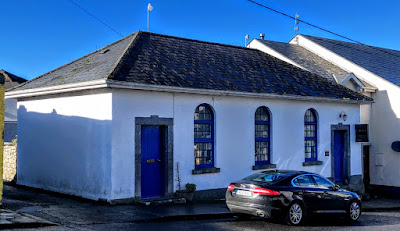
The Old Courthouse in Kinvara, Co Galway, is now home to Kinvara Area Visual Arts (KAVA), run by a committee representing local volunteers. The Georgian building has been used as a performance space as well as a courthouse since the 1860s, and dates back to ca 1820-1840.
The building has been described as ‘an almost vernacular version of the courthouse type.’ It has a symmetrical façade flanked by doors at either end. The tooled limestone surrounds and plinth course add an element of grandeur to what is otherwise quite a simple building.
This is a detached five-bay, single-storey building, with a hipped slate roof with cut limestone eaves. The roughcast rendered walls have a tooled limestone plinth course. The square-headed door openings at the end bays of the front elevation have tooled limestone surrounds, keystones and plinth blocks, and timber battened doors. There are rendered steps at the entrances. The round-headed window openings in the middle bays have tooled limestone sills and replacement timber windows.
The poet and songwriter Francis Arthur Fahy (1854-1935), whose songs include ‘Galway Bay,’ was born in Kinvara and produced his first play, The Last of the O’Learys, in the courthouse in Kinvara. It was performed by the local dramatic society in aid of the dependents of Fenian prisoners in 1869.
Fahy was born at Kinvara, the son of Thomas Fahy, who came from the Burren area in Co Clare, and Celia Marlborough from Gort, Co Galway. He wrote ‘Galway Bay’ while living in London, and his other songs include ‘The Bog Road’ and ‘The Ould Plaid Shawl.’
The courthouse was also used to lay out corpses, particularly the bodies of people who died of unnatural causes in the 19th and early 20th centuries. Petty Sessions were held there until 1920, when the original building was almost completely demolished in an attack by a group of local nationalists.
The courthouse was eventually rebuilt and District Court sittings took place there from 1926 until 2008. It also accommodated a community playschool from 1980, which ran alongside the district court sittings. The playschool moved to new purpose-built premises in 2009, and since then the building has been a venue for wide variety of events, including use as a solicitor’s office and housing the Kinvara Youth Project from 2010 to 2015.
The courthouse became the home of KAVA in 2015, with the support of the Kinvara Community Council and the Parish Council. Since opening the courthouse as a community art gallery and art space, KAVA has revitalised the building.
Francis Fahy’s version of ‘Galway Bay’ is hardly as well-known as Arthur Colahan’s song, written in Leicester and popularised by Bing Crosby in 1947. But as I came down the hill from the courthouse to the harbour in Kinvara and looked out onto Galway Bay, I wondered how many of the poor tenants of Kinvara who faced eviction by Henry Comerford after he bought the Kinvara estate from Sir William Gregory (1816-1892) in 1857 ended up in Kinvara Courthouse.
22 February 2022
The romantic ruins of
Muckinish Castle in the Burren,
overlooking Galway Bay

Patrick Comerford
When I was searching recently for Comerford family houses and graves in Kinvara, Co Galway, and Ballyvaughan, Co Clare, I stopped on the road between both locations to admire the ruins of Shanmuckinish Castle, or Muckinish Castle, a ruined tower house in Drumcreehy parish, Co Clare, not far from the churchyard with Henry Comerford’s mausoleum.
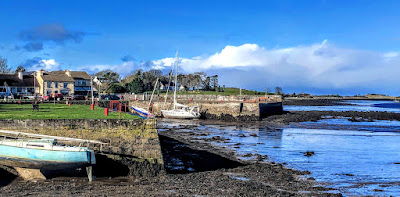
The name Muckinish comes from the Irish meaning ‘pig island,’ but the castle ruins stand in a romantic location halfway between Kinvara and Ballyvaughan, on the narrowest part of a small peninsula on the northern edge of the Burren, looking out onto Galway Bay.
Shanmuckinish was also known for a time as Ballynacragga Castle. It sits on a narrow part of an isthmus jutting into Pouldoody Bay and once had a strategic position. The castle was built by the O’Loughlin family ca 1450. However, the exact date of its original construction is unknown.
The castle is first mentioned in the Annals of the Four Masters in 1584 when Turlough, son of Owny, son of McLoughlin O’Loughlin, owner of the castle, was taken prisoner and later put to death.
Muckinish Castle was inhabited until the 19th century by members of the O’Loghlen, Neylon and Blake families. The castle was repaired around 1836, and it was still habitable in 1897.
Today, the tower house represents the ruins of a square-plan, single-bay, four-storey rubble stone-built tower house, ca 1450. It reaches almost to its original height of around 17 metres and is partially collapsed, exposing a cross-sectional view of the interior floors. The stairways have not survived.

The striking castle ruins, with their magnificent views over Pouldoody Bay and Galway Bay, stand off the road between Kinvara and Ballyvaughan. From the road, the castle appears intact, but only the south wall is complete. The ruins stand tall over the bay and it is possible to look inside at the ground floor through one of the windows.
Parts of the east and west wall remain, while the coastal north wall has completely fallen into a pile of rubble that prevents exploring the lower floors on that side.
From the shore, it is possible to see partially demolished arches and hanging vaults above the first and third floors. But it is sad to see huge blocks of masonry in the shoreline rubble.
However, the ruin still features the remains of two vaulted ceilings, intra-mural passages and stairs. The lower windows are defensive loops, while the upper floors feature larger decorative windows.
A bawn wall survives and is in relatively good repair due to repair work in the 18th and 19th centuries. The first floor reception room had a large fireplace in the west wall and some of the internal wall rendering can still be seen. The house also has a wall walk and two of the original four machicolations survive.
Below a machicolation that juts out from the parapet is a three-light mullioned window that may have been inserted in the 17th century. All other windows are single narrow slits and may be original work. The parapet on the east wall projects from the wall with corbels, but these features are not repeated on the south or west walls.
It is hard to miss this ruined castle off the coast road between Kinvara and Ballyvaughan. A laneway provides access from the main road, and new holiday homes beside the ruins make it easy to find parking.

14 February 2022
A curious Comerford link
with colonial administration
on the island of St Lucia
Patrick Comerford
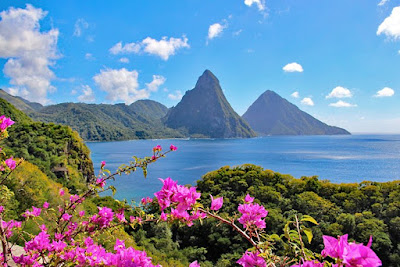
My recent search for the Comerford mausoleum near Ballyvaughan, Co Clare, and houses associated with the Comerford family in Galway, unearthed an interesting, if not curious, family connection with British colonial administration in the Caribbean island of St Lucia.
Henrietta Emily Comerford (1837-1881) was the ninth and youngest daughter of Henry Comerford (1796-1861), JP, of Merchant’s Road, Galway, and Ballykeel House, Kilfenora, Co Clare, and his wife, who are buried in the Comerford mausoleum. Henrietta was named after her father when she was born in Galway on 8 May 1837 and baptised that day in Saint Nicholas Church, Galway.
Henrietta Comerford was twice married. She married her first husband, Isaac Breen Daly (1835-1871), in Dublin on 25 January 1858.
Isaac Breen Daly was a son of Michael Daly (1810-1901) and his wife Mary (née Breen). His father, Michael Daly, was living at Ballykeel House with the Comerford family in 1861. His mother, Mary Daly (née Breen), was a sister of Henry Hegart Breen (1805-1882), Governor of St Lucia.
Henry Hegart Breen, who was born in Kerry on 26 June 1805, claimed direct descent from the ancient Irish chiefs of Tyrone. Following the Battle of Kinsale and during the Plantation of Ulster, the Breen family were adherents of Hugh O’Neil, Earl of Tyrone, the Breens were dispossessed of their lands in Ulster during the reign of James I in 1607, and they were banished from there to Co Kerry.
On his mother’s side, Henry Hegart Breen was also related to the poet Thomas Moore, whose father, the son of a Kerry farmer, settled in Dublin in 1775.
Henry Hegart Breen was educated at grammar schools in Co Kerry, and at the age of 18 he was sent to the College of St Esprit, in Paris. During his five years there, he studied philosophy, theology and French literature.
Breen moved to the West Indies in 1829, and in 1833 he was appointed Secretary of the Courts of Justice in the island of St Lucia. Britain had taken control of St Lucia as a colony from the French in 1814, but the French language continued to be used for many years as the language of the courts. Slavery was abolished on St Lucia in 1836, and slaves were granted full freedom in 1838.
Breen was appointed Administrator of the Government of St Lucia in April 1857, in succession to Maurice Power from Skibbereen, Co Cork, who had been Lieutenant Governor since 1852.
Breen continued as the de factio Governor of St Lucia until October 1861. As administrator, he was present in Martinique in August 1859 at the inauguration of a statue to the Empress Josephine. Breen’s speech in French received special thanks from the Emperor Napoleon III.
Queen Victoria’s son, Prince Alfred, Duke of Edinburgh, visited St Lucia officially in March 1861. Breen retired later that year and he died in the West Indies on 2 November 1882.
Meanwhile, Henry Breen’s nephew, Isaac Breen Daly, died in Salthill, Galway, on 16 December 1871. Isaac and his wife Henrietta (Comerford) were the parents of eight children: Henry Joseph Daly (1858-1903), of Corrib Castle, Galway; Michael Joseph Daly (1860-1894), of Castleblakeney, Co Galway; Hyacinth John Daly (1861-1930), who died in South Africa; George William Daly (1861-1935); Charles Nicholas Daly (1862-1917); Mary ‘Minnie’ (1864-1956); Henrietta (1865-1948), who died in Los Angeles; and Margaret (born 1869).
Henrietta (Comerford) was still a young widow when she married her second husband, John Joseph Ireland, in Galway on 28 November 1872. At their wedding, he gave his age as 23 and he was living in Dominick Street; she gave her age as 30, she was living at Montpelier Terrace, and described rself as ‘Lady.’
They were living at Bushy Park, Galway in 1875. He was 27 when he died the following year at Forster House, the Blake-Forester family home in Forster Street, Galway, on 16 October 1876. She died at Forster House within five years on 20 April 1881, aged 43.
Henrietta and John were the parents of two daughters and a son: Henrietta (Henryeta) Josephine (1873-1960); Elizabeth (1875-1934), known in the family as Ida (1875-1934); and John Francis Ireland (1876-1878), who was an infant when he died in Forster House, Galway, on 14 December 1878.
As for Henry Breen, he was the author of St Lucia, Historical, Statistical, and Descriptive (1844); The Diamond Rock and other Poems (1849); Modern English Literature: its Blemishes and Defects (1857); Warrawarra, the Carib Chief, a Tale of 1770 (2 vols, 1876); and some other works that appeared anonymously. He also contributed to many periodicals.
08 February 2022
In search of a family mausoleum
and finding John Betjeman
cycling with Emily in the Burren

Patrick Comerford
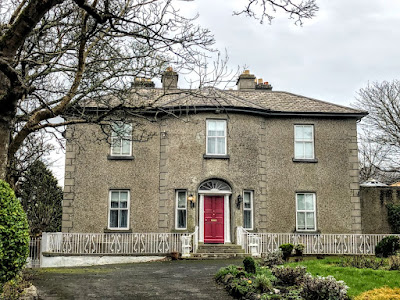
During the weekend, two of us went in search of some more Comerford family stories in Kinvara, Co Galway, and some Comerford family graves and mausoleums in Ballyvaughan, Co Clare.
Ballyvaughan overlooks Galway Bay and stands as the gateway on the North Clare coast to the Burren. Corkscrew Hill is a narrow road that rises up from Ballyvaughan, on the road on to Lisdoonvarna, bending and folding several steps, and providing breath-taking views back down across Ballyvaughan and out to Galway Bay.
John Betjeman visited the Burren with ‘Emily’ in the summer of 1943, and described the landscape in his poem ‘Ireland with Emily,’ first published two years later in New Bats in Old Belfries (1945).
As I gazed on the Comerford mausoleum in Bishop’s Quarter in Ballyvaughan, I thought too of John Betjeman and his reference to a ‘fantastic mausoleum’ as he recalled cycling along Corkscrew Hill with Emily almost 80 years ago.
John Betjeman and Emily Sears cycled over Corkscrew Hill on a road built to provide work for starving labourers during the Great Famine a century earlier.
His wrote:
Stony seaboard, far and foreign,
Stony hills poured over space,
Stony outcrop of the Burren,
Stones in every fertile place,
Little fields with boulders dotted,
Grey-stone shoulders saffron-spotted,
Stone-walled cabins thatched with reeds,
Where a Stone Age people breeds
The last of Europe’s stone age race.
These words are quoted in a sign at the viewing point near the top of the hill, where I had a vista of the natural amphitheatre carved out by giant ice sheets of ancient ice ages. The ice sheets left behind a fertile valley surrounded by Aillwee Mountain to the east, Cappanwalla Mountain to the west, and opening out onto Galway Bay to the north.
The typical and often contrasting characteristics of the Burren are on view there: bare limestone terraces, fertile fields, dense overgrowth of hazel scrub alongside areas of incredible biodiversity created by traditional farming practices.
There are other literary links too. JRR Tolkien often stayed in Gregans Castle, nestling in the valley below, and many have asked whether he was influenced by this view when he was writing Lord of the Rings.
John Betjeman’s lines on the Burren in ‘Ireland with Emily’ may not be the most comprehensive description of this uniquely valuable area of north-west Clare. But he conveys a sense of the overwhelming bareness of its characteristic limestone landscape.
The ‘soil-less, treeless, waterless’ hills of the Burren also made an impression on Robert Lloyd Praeger. In his classic, The Way That I Went, he wrote: ‘The strangeness of this grey limestone country must be seen to be realised; it is like nothing else in Ireland or in Britain.
According to the Belfast-born environmentalist Gordon D’Arcy, 70 per cent of Ireland’s wild plants grow here in less than 0.5 per cent of Ireland’s land area.
The archaeological heritage of the Burren is also disproportionately large, with evidence of human settlement in the upland area stretching back through 6,000 years. It includes no less than 350 ring forts, notably Cahercommaun, as well as 70 wedge tombs, the highest concentration known, and numerous fulacht fiadha or cooking sites.
John Betjeman’s relationship with Emily Sears did not last that long. He returned to England, and later became Poet Laureate; she later married Ion Villiers-Stuart. ‘They did, however, remain good friends right up to the end of his life,’ according to her ddaughter, Barbara Grubb, who now lives at Dromana House, near Cappoquin, Co Waterford.
‘Ireland With Emily’ by John Betjeman
Bells are booming down the bohreens,
White the mist along the grass,
Now the Julias, Maeves and Maureens
Move between the fields to Mass.
Twisted trees of small green apple
Guard the decent whitewashed chapel,
Gilded gates and doorway grained,
Pointed windows richly stained
With many-coloured Munich glass.
See the black-shawled congregations
On the broidered vestment gaze
Murmer past the painted stations
As Thy Sacred Heart displays
Lush Kildare of scented meadows,
Roscommon, thin in ash-tree shadows, And Westmeath the lake-reflected,
Spreading Leix the hill-protected,
Kneeling all in silver haze?
In yews and woodbine, walls and guelder,
Nettle-deep the faithful rest,
Winding leagues of flowering elder,
Sycamore with ivy dressed,
Ruins in demesnes deserted,
Bog-surrounded bramble-skirted –
Townlands rich or townlands mean as
These, oh, counties of them screen us
In the Kingdom of the West.
Stony seaboard, far and foreign,
Stony hills poured over space,
Stony outcrop of the Burren,
Stones in every fertile place,
Little fields with boulders dotted,
Grey-stone shoulders saffron-spotted,
Stone-walled cabins thatched with reeds,
Where a Stone Age people breeds
The last of Europe’s stone age race.
Has it held, the warm June weather?
Draining shallow sea-pools dry,
When we bicycled together
Down the bohreens fuchsia-high.
Till there rose, abrupt and lonely,
A ruined abbey, chancel only,
Lichen-crusted, time-befriended,
Soared the arches, splayed and splendid,
Romanesque against the sky.
There in pinnacled protection,
One extinguished family waits
A Church of Ireland resurrection
By the broken, rusty gates.
Sheepswool, straw and droppings cover,
Graves of spinster, rake and lover,
Whose fantastic mausoleum,
Sings its own seablown Te Deum,
In and out the slipping slates.

07 February 2022
Finding a Comerford
family mausoleum in
the Burren in Co Clare

Patrick Comerford
I was searching last weekend for some more Comerford family houses and family graves in Kinvara, Co Galway, and Ballyvaughan, Co Clare, at the weekend.
It was a journey along the south coast of Galway Bay and along the northern edges of the Burren, and it eventually took me to Drumcreehy Church, overlooking the tiny bay and beach at Bishop’s Quarter.
Bishop’s Quarter, about 2 km north-east of Ballyvaughan, once had a religious house belonging, perhaps, to the Bishops of Kilfenora. Today, the most prominent features of the landscape in the area are the ruins of Saint Colman’s Abbey or Drumcreehy Church and an attractive little beach backing onto some sandhills, with a sandy pool almost totally enclosed by sand to the rear of the hills.
The beach, with its tidal lagoon, is said to be a good place for swimming or to collect sea shells, and there is a car park close to the shore. Seaweed is still harvested there and left to dry out of the tide’s reach until it is collected.

Drumcreehy Church takes its name from ‘Druimcriche,’ the original church built on a hillside in the territory of Crioch Maille. Today, the church is a picturesque but decaying ruin overlooking the Burren and the southern shoreline of Galway Bay.
The church, like many other religious sites in the area, is associated with Saint Colman and is known locally as Saint Colman’s Abbey, but this seems to be a later association.
Some records suggest the church was founded in 1302 by Drumcruth. Other sources point out that the windows and some aspects of the building may date from the 11th century and may have been integrated into the later design.
The north door, which reflects the style of west doors of the nearby Quin Friary, and the chancel may have only been added in the 15th or 16th century. What we see today, however, is a rubble stone-built, single-cell church that may have been built ca 1500.
Most of the church and its details are now destroyed. It appears the church was already in a very poor state by the 1839 when the ordnance survey letters of John O’ Donovan and Eugene Curry describe the church as ‘five centuries old and in a state of dilapidation.’

However, burials continued to take place in the surrounding churchyard. The most conspicuous tomb is the mausoleum of Henry Comerford (1796-1861), JP, of Merchant’s Road, Galway, and Ballykeel House, Kilfenora, Co Clare.
Henry died at Ballykeel House on 6 September 1861, and was buried in Bishop’s Quarters Cemetery, Ballyvaughan, Co Clare, with his wife Margaret (McDonagh) Comerford, who died ten years earlier in Salthill, Galway, on 31 August 1851.
Henry Comerford was a prosperous merchant, landowner and magistrate in Galway, but his actions during and after the famine led to infamy.
Henry was the owner of the famine migration ship, St John that sailed from Galway to the US but was wrecked off the coast of Massachusetts on 7 October 1849, leading to 100 deaths.
This was only the beginning of his misfortunes. During the decade immediately after the Famine, emigration continued and economic distress intensified. The migration of tenants and the social upheavalbrought about by the Famine was compounded in the decade that followed by the change of landlords. In 1857, Henry Comerford bought the estates around Kinvara that belonged to the Sir William Gregory, MP for Galway and husband of Isabella Augusta Gregory, better known as Lady Gregory, a key figure in the Irish literary revival and co-founder of the Abbey Theatre.
Henry obtained a bank loan to buy the Gregory estates in Kinvara on the basis of his plans to increase revenue from the lands by raising the rents. Sir William Gregory had a relatively good relationship with his tenants, but Henry set out to double and triple the rents of an already disparate and dwindling community.
In his History and Antiquities of the Diocese of Kilmacduagh, Monsignor Jerome Fahy says after Henry Comerford bought the Kinvara estate, ‘the comparatively short interval of about twenty years witnessed the ruin of over a thousand homesteads in one Parish’.
Another priest, Father Francis Arthur, wrote, ‘The change of landlords for the greatest portion of this place has rendered this one of the most wretched and deplorable parishes in Ireland’. He added that it was impossible to get credit from the merchants of Kinvara as they were ‘bereft of all hope’ after Comerford tried to raise the rents so steeply.
Henry Comerford died at Ballykeel House, Kilfenora, Co Clare, on 6 September 1861. He is buried in the churchyard at Drumcreehy, overlooking Bishop’s Quarter and Galway Bay on one side, and looking across the landscape of the Burren on the other side. It is a monumental statement of his sense of importance in the Kinvara and Ballyvaughan area.

The Comerford Mausoleum is a single-bay two-storey cut-stone mausoleum, erected ca 1865, with a rusticated underground burial chamber, channelled walls with pilasters above, surmounted by a cut-stone obelisk with a ball finial and surrounded by cast-iron railings.
The inscription reads: ‘Sacred to the memory of Henry Comerford Esqr J.P. who died in the 67[th] year of his age at Ballykeal on the 6th day of Sept[ember] 1861. A fond parent. A faithful friend. A prudent adviser. And in all his dealings just. May the Lord have mercy on his soul. This monument has been erected for him and posterity by his attached and beloved brother Isaac.’
The carved coat-of-arms above the inscription and below the obelisk represents the coat-of-arms of the Comerford family of Co Kilkenny and Co Wexford, blazoned, ‘Azure, a bugle horn argent, stringed gules, between three mullets or. Crest, A peacock in its pride proper. Motto, So Ho Ho Dea Ne.’

Henry Comerford’s grandson, Francis O’Donnellan Blake Forster (1853-1912), and his family, are buried in the lower part of the mausoleum. The plaque at the lower level is inscribed:
‘In loving memory of Francis O’Donnellan Blake Forster, who died June 27 1912, his wife Marcella died June 26 1917, also their children Francis died March 26 1919, O’Donnellan (Donny) died July 7 1938, Mrs Mollie Pearson, died July 16 1939’.
Marcella Blake-Forster was related to the MacNamara family of Ennistymon, and there lies a link with the poet Dylan Thomas. But that’s a story for another day, as is the story of the Comyn family, who are also related to this branch of the Comerford family and who are buried at Drumcreehy Church too.

Subscribe to:
Posts (Atom)