Showing posts with label Harvest. Show all posts

28 July 2026

Daily prayer in Ordinary Time 2026:
82, Tuesday 28 July 2026

‘The field is the world, and the good seed are the children of the kingdom’ (Matthew 13: 38) … a field ready for the harvest near Lismore, Co Waterford (Photograph: Patrick Comerford)

Patrick Comerford

We are continuing in Ordinary Time in the Church and this week began with the Eighth Sunday after Trinity (Trinity VIII, 26 July 2026). I am on my way to Luton this morning to catch a flight to Dublin for a short, one-day family visit. But, as the day begins, I am taking some quiet time this morning to give thanks, to reflect, to pray and to read in these ways:

1, today’s Gospel reading;

2, a reflection on the Gospel reading;

3, a prayer from the USPG prayer diary;

4, the Collects and Post-Communion prayer of the day.

Harvest or weeds? … a field near Cross in Hand on the northern edges of Lichfield (Photograph: Patrick Comerford)

Matthew 13: 36-43 (NRSVA):

36 Then he left the crowds and went into the house. And his disciples approached him, saying, ‘Explain to us the parable of the weeds of the field.’ 37 He answered, ‘The one who sows the good seed is the Son of Man; 38 the field is the world, and the good seed are the children of the kingdom; the weeds are the children of the evil one, 39 and the enemy who sowed them is the devil; the harvest is the end of the age, and the reapers are angels. 40 Just as the weeds are collected and burned up with fire, so will it be at the end of the age. 41 The Son of Man will send his angels, and they will collect out of his kingdom all causes of sin and all evildoers, 42 and they will throw them into the furnace of fire, where there will be weeping and gnashing of teeth. 43 Then the righteous will shine like the sun in the kingdom of their Father. Let anyone with ears listen!’

Fields of green and gold beside Comberford Hall, between Lichfield and Tamworth in rural Staffordshire (Photograph: Patrick Comerford)

This morning’s reflection:

There are some positive images in today’s Gospel reading (Matthew 13: 36-43) of the righteous shining like the sun in God’s kingdom and chilling images of others being thrown into ‘the furnace of fire, where there will be weeping and gnashing of teeth’.

But throughout history, humanity has stooped to burn what we dislike and what we want to expunge, and we have done it constantly.

We have been burning books as Christians since Saint Athanasius ordered the burning of texts in Alexandria in the year 367. In the Middle Ages, and sometimes even later, we burned heretics at the stake. When that stopped, we burned anything deemed to be an occasions of sin.

They were burned publicly as an accompanying theme for the outdoor sermons of San Bernardino da Siena in the early 15th century. These included mirrors, cosmetics, fine dresses, playing cards … even musical instruments, and, of course, books, song sheets, artworks, paintings and sculpture. In his sermons, the book-burning friar regularly called for Jews and gays to be either isolated from society or eliminated from the human community.

Later in Florence, the supporters of Savonarola collected and publicly burned thousands of objects, including cosmetics, art, and books in 1497.

On the other hand, Franz Kafka’s last request to his friend Max Brod in 1921 was to ‘burn all my diaries, letters, manuscripts … completely and unread’.

But, more recently, the Nazis staged regular book burnings, especially burning books by Jewish writers, including Thomas Mann, Karl Marx and Albert Einstein. Extremists of all religious and political persuasions want to burn the symbols and totems of their opponents, whether it is Pastor Terry Jones burning the Quran and effigies of Bill Clinton and Barack Obama in Florida or jihadists burning the Twin Towers in New York.

Today we are witnessing efforts by the Trump regime to suppress free speech by journalists in the Wall Street Journal, the New York Times, the BBC and the Associated Press, capriciously excluding journalists from the White House press pool, demeaning women journalists as ‘Miss Piggy’ and threatening to strip NBC and ABC of their licences to broadcast.

The hypocrisy of these threats is aggravated by claims from the Trump regime that it is defending free speech when it attacked Britain and other European countries for seeking to curb violence and racism on US-based social media platforms.

The limits of our extremists seem to be defined by their inflammatory words.

But who is being burned in this morning’s Gospel reading?

Who is doing the burning?

And who will be weeping and gnashing their teeth?

Contrary to many shoddy reading of this Gospel reading, Christians are not asked to burn anyone or anything at all. And, if we have enemies, we are called not to burn them but to love them.

Christ has been speaking by the lake first to the crowd, telling them the parable of the wheat and the weeds (verse 24-30). The word that we have traditionally translated as tares or weeds (verses 25, 26, 27, 29, 30, 36, 38, 40) is the Greek word ζιζάνια (zizania), a type of wild rice grass, although Saint Matthew is probably referring to a type of darnel or noxious weed. It looks like wheat until the plants mature and the ears open, and the seeds are a strong soporific poison.

Christ then withdraws into a house, and has a private conversation with the Disciples (verses 36-43), in which he explains he is the sower (verse 37), the good seed is not the Word, but the Children of the Kingdom (verse 38), the weeds are the ‘Children of the Evil One’ (verse 38), and the field is the world (verse 38).

The harvest is not gathered by the disciples or the children of the kingdom, but by angels sent by the Son of Man (verses 39, 41). It is an apocalyptic image, describing poetically and dramatically a future cataclysm, and not an image to describe what should be happening today. It is imagery that draws on the apocalyptic images in the Book of Daniel, where the three young men who are faithful to God are tried in the fires of the furnace, yet come out alive, stronger and firmer in their faith (see Daniel 3: 1-10).

The slaves or δοῦλοι (douloi), the people who want to separate the darnel from the wheat (verse 27-28), are the disciples: Saint Paul introduces himself in his letters with phrases like Παῦλος δοῦλος Χριστοῦ Ἰησοῦ, Paul, a doulos, slave, or servant of Jesus Christ (see Romans 1: 1, Philippians 1: 1, Titus 1: 1). The same word is used by James (see James 1: 1), Peter (see II Peter 1: 1) and Jude (see Jude 1) to introduce themselves in their letters.

In the Book of Revelation, this word is used to describe the Disciples and the Church (see Revelation 1: 1; 22: 3).

In other words, the apostolic writers see themselves as slaves in the field, working at Christ’s command in the world.

This is one of eight parables about the last judgment found only in Saint Matthew’s Gospel, and six of the seven New Testament uses of the phrase ‘weeping and gnashing of teeth’ (ὁ κλαυθμὸς καὶ ὁ βρυγμὸς τῶν ὀδόντων) occur in this Gospel (Matthew 8: 12; 13: 42; 13: 50; 22: 13; 24: 51; and 25: 30; see also Luke 13: 28).

When it comes to explaining the parable to the disciples in today’s reading (verses 36-43), the earlier references to the slaves in the first part (verses 27-28) are no longer there. It is not that the slaves have disappeared – Christ is speaking directly to those who would want to uproot the tares but who would find themselves uprooting the wheat too.

The weeding of the field is God’s job, not ours. The reapers, not the slaves, will gather in both the weeds and the wheat, the weeds first and then the wheat (verse 30).

Farmers are baling the hay and taking in the harvest in many places already. In a few weeks’ time, many farmers will be seen burning off the stubble on their fields to prepare the soil for autumn sowing and planting new crops. In this sense, the farmer understands burning as purification and preparation – it is not as harsh as city dwellers think.

It is not for us to decide who is in and who is out in Christ’s field, in the kingdom of God. That is Christ’s task alone.

Christ gently cautions the Disciples against rash decisions about who is in and who is out. Gently, he lets them see that the tares are not damaging the growth of the wheat, they just grow alongside it and amidst it.

But so often we decide to assume God’s role. We do it constantly in society, and we do it constantly in the Church, deciding who should be in and who should be out.

The harvest comes at the end of time, not now, and I should not hasten it even if the reapers seem to tarry.

The weeds we identify and want to uproot may turn out to be wheat, what we presume to be wheat because it looks like us may turn out to be weeds.

We assume the role of the reapers every time we decide we would be better off without someone in our society or in the Church because we disagree with them about issues like sexuality, women bishops and priests, and other issues that we mistake for core values.

The core values, as Christ himself explains, again and again, are loving God and loving others.

It is not without good reason that the Patristic writers warn that schism is worse than heresy (see Saint John Chrysostom, Patrologia Græca, vol. lxii, col. 87, On Ephesians, Homily 11, §5). We do not need to demythologise this morning’s reading. Christ leaves that to the future. This morning we are called to grow and not to worry about the tares. That growth must always emphasise love first.

When some members of the Church have sought to ‘out’ or ‘throw out’ people because of their sexuality they have caused immense personal tragedy for individuals and their families and friends – weeping and gnashing of teeth indeed.

When I want a Church or society that looks like me, I eventually end up living on a desert island or as a member of a sect of one – and there I might just find out too how unhappy I am with myself!

But if I allow myself to grow in faith and trust and love with others, I may, I just may, to my surprise, find that they too are wheat rather than weeds, and hopefullu they may realise the same about me.

‘The field is the world, and the good seed are the children of the kingdom’ (Matthew 13: 38) … harvest fields in Fisherwick, between Lichfield and Tamworth (Photograph: Patrick Comerford)

Today’s Prayers (Tuesday 28 July 2026):

In Pray with the World Church, the prayer diary of the Anglican mission agency USPG (United Society Partners in the Gospel), the theme this week, from 26 July to 1 August 2026 (pp 22-23), is ‘Lives in Transit’. This theme was introduced on Sunday with a programme update by Rachel Weller, Communications Officer, USPG.

The USPG prayer diary today (Tuesday 28 July 2026) invites us to pray:

God of mercy, hold close all who are weary and long to return home, particularly refugees. In their endurance, be their strength; in their uncertainty, be their peace; and in their suffering, be their hope that does not fail.

The Collect of the Day:

Almighty Lord and everlasting God,
we beseech you to direct, sanctify and govern
both our hearts and bodies
in the ways of your laws
and the works of your commandments;
that through your most mighty protection, both here and ever,
we may be preserved in body and soul;
through our Lord and Saviour Jesus Christ,
who is alive and reigns with you,
in the unity of the Holy Spirit,
one God, now and for ever.

The Post Communion Prayer:

Strengthen for service, Lord,
the hands that have taken holy things;
may the ears which have heard your word
be deaf to clamour and dispute;
may the tongues which have sung your praise be free from deceit;
may the eyes which have seen the tokens of your love
shine with the light of hope;
and may the bodies which have been fed with your body
be refreshed with the fullness of your life;
glory to you for ever.

Additional Collect:

Lord God,
your Son left the riches of heaven
and became poor for our sake:
when we prosper save us from pride,
when we are needy save us from despair,
that we may trust in you alone;
through Jesus Christ our Lord.

Yesterday’s reflection

Continued tomorrow


Franz Kafka’s last wishes … a video in the recent exhibition, ‘Kafka: Making of an Icon’, in the Weston Library in Oxford (Patrick Comerford)

Scripture quotations are from the New Revised Standard Version Bible: Anglicised Edition copyright © 1989, 1995, National Council of the Churches of Christ in the United States of America. Used by permission. All rights reserved worldwide. http://nrsvbibles.org

24 July 2026

Daily prayer in Ordinary Time 2026:
78, Friday 24 July 2026

The sower and the seed … a window in Saint Leonard’s Church, Wigginton, between Lichfield and Tamworth in Staffordshire (Photograph: Patrick Comerford, 2026)

Patrick Comerford

We are continuing in Ordinary Time in the Church and this week began with the Seventh Sunday after Trinity (Trinity VII, 19 July 2026).

We are attending a funeral later today. But, before today begins, I am taking some quiet time this morning to give thanks, for reflection, prayer and reading in these ways:

1, today’s Gospel reading;

2, a reflection on the Gospel reading;

3, a prayer from the USPG prayer diary;

4, the Collects and Post-Communion prayer of the day.

The Gospel reading today (Matthew 13: 18-23) continues this week’s themes of the sower and the seed … fields in Stoke Bruerne, Northamptonshire (Photograph: Patrick Comerford)

Matthew 13: 18-23 (NRSVA):

18 ‘Hear then the parable of the sower. 19 When anyone hears the word of the kingdom and does not understand it, the evil one comes and snatches away what is sown in the heart; this is what was sown on the path. 20 As for what was sown on rocky ground, this is the one who hears the word and immediately receives it with joy; 21 yet such a person has no root, but endures only for a while, and when trouble or persecution arises on account of the word, that person immediately falls away. 22 As for what was sown among thorns, this is the one who hears the word, but the cares of the world and the lure of wealth choke the word, and it yields nothing. 23 But as for what was sown on good soil, this is the one who hears the word and understands it, who indeed bears fruit and yields, in one case a hundredfold, in another sixty, and in another thirty.’

Sowing and planting in the fields in Comberford, Staffordshire, east of Lichfield and north of Tamworth (Photograph: Patrick Comerford)

Today’s Reflections:

In the Gospel reading at the Eucharist today (Matthew 13: 18-23), we continue a series of readings about the Parable of the Sower and the Seed and its interpretation.

Sometimes these readings have seemed more relevant for Harvest thanksgiving services, which are still many weeks. But as I travelled by train to an from Cambridge earlier this week, I realised the time of sowing has past and work of harvesting is now in full swing.

This morning’s reading concludes with Jesus comparing the seed that was sown on good soil with ‘the one who hears the word and understands it, who indeed bears fruit and yields, in one case a hundredfold, in another sixty, and in another thirty.’

Do you think that the apostles, as they preached or sowed the word and the Good News had debriefing and review meetings, as good management practice might expect today, and compared notes about their ‘yields’, one 100-fold, another 60-fold, and yet another 30-fold?

I sometimes find I am ill-at-ease with the discussion how hear about church-growth, with people boasting their church attendance over recent years has increased 30-fold, 60-fold or even 100-fold. In some parishes I ministered in, church attendance on Sunday mornings was often below 100, below 60, most often even below 30.

To judge my ‘performance in ministry’ based on those figures, others might have judged me a failure. But they were faithful, they were caring, they believed, they were generous, and they came Sunday-after-Sunday, with failure, even when the crops and the fields and the cattle had to be attended to, the shops opened, customers’ needs attended, and the margins were so slow that everything was run on a shoestring.
When the harvest was gathered in, they would share generously in the bounties of creation.

The late Father Herbert Edwin William Slade (1912-1999), a priest of the Society of Saint John the Evangelist or the Cowley Fathers in Oxford, once wrote: ‘The Eucharist is the supreme model of an intimacy with nature which is universal. All creation is God’s body. God indwells all of his creatures. God’s Spirit is present in all that God has made. Therefore, our intimacy with creation must never stop short at contemplative admiration.’

God’s harvest, the Kingdom of God, is all-embracing, is greater than my imagination. It includes all aspects and dimensions of creation, the harvest of the fields, and a harvest of people, including even those I am in danger of thinking do no count, even in danger of ignoring and leaving behind.

Who are the small people, the small numbers, the 30-fold rather than 100-fold the church who think they are successful in terms of numbers and church growth are in danger of counting out, leaving to one side?

The harvest is greater than we can imagine, greater than we want to admit.

In a recent posting, my friend and colleague, the Revd David Messer, has helped me to draw a comparison between my daily blogging and some of my experiences in ministry:

‘I wish I had something worthwhile of my own to say, but at the moment, I haven’t the wherewithal … because rural ministry means living in a permanent state of failure – which is exhausting. So instead, here’s a wonderful quote from Giles Fraser, which gives me heart:

‘In a world where we semaphore our successes to each other at every possible opportunity, churches cannot be blamed for failing to live up to this austere and wonderful message. The worst of them judge their success in entirely worldly terms, by counting their followers.

‘Their websites show images of happy, uncomplicated people doing good improving stuff in the big community. But if I am right about the meaning of Christ’s passion, then a church is at its best when it fails, when it gives up on all the ecclesiastical glitter, when the weeds start to break through the floor, and when it shows others that failure is absolutely nothing of the sort.

‘This is the site of real triumph, the moment of success.

‘Failure is redeemed.

‘Hallelujah.’

Moving from ideas such as these into prayer, I might pray in these words, although I do not know who wrote them:

‘May God bless you with discomfort at easy answers, half-truths, superficial relationships, so that you will live deep within your heart.

‘May God bless you with anger at injustice, oppression and exploitation of people, so that you will work for justice, equality and peace.

‘May God bless you with tears to shed for those who suffer from pain, rejection, starvation and war, so that you will reach out your hand to comfort them and change their pain into joy.’

In July fields off Cross in Hand Lane in Lichfield (Photograph: Patrick Comerford)

Today’s Prayers (Friday 24 July 2026):

In Pray with the World Church, the prayer diary of the Anglican mission agency USPG (United Society Partners in the Gospel), the theme this week, from 19 to 25 July 2026 (pp 20-21), is ‘Flood Relief in Mozambique’. This theme was introduced on Sunday with a programme update from the Revd Mauricio S Mugunhe, Executive Director Anglican Social Action, Igreja Anglicana de Moçambique e Angola (the Anglican Church of Mozambique and Angola).

The USPG prayer diary today (Friday 24 July 2026) invites us to pray:

Lord God, we pray for the Igreja Anglicana de Moçambique e Angola, for its bishops, clergy, and lay leaders. Strengthen the ministry through Anglican Social Action, that the Church may shine like a light to all in need.

The Collect of the Day:

Lord of all power and might,
the author and giver of all good things:
graft in our hearts the love of your name,
increase in us true religion,
nourish us with all goodness,
and of your great mercy keep us in the same;
through Jesus Christ your Son our Lord,
who is alive and reigns with you,
in the unity of the Holy Spirit,
one God, now and for ever.

The Post Communion Prayer:

Lord God, whose Son is the true vine and the source of life,
ever giving himself that the world may live:
may we so receive within ourselves
the power of his death and passion
that, in his saving cup,
we may share his glory and be made perfect in his love;
for he is alive and reigns, now and for ever.

Additional Collect

Generous God,
you give us gifts and make them grow:
though our faith is small as mustard seed,
make it grow to your glory
and the flourishing of your kingdom;
through Jesus Christ our Lord.

Collect on the Eve of Saint James:

Merciful God,
whose holy apostle Saint James,
leaving his father and all that he had,
was obedient to the calling of your Son Jesus Christ
and followed him even to death:
help us, forsaking the false attractions of the world,
to be ready at all times to answer your call without delay;
through Jesus Christ your Son our Lord,
who is alive and reigns with you,
in the unity of the Holy Spirit,
one God, now and for ever.

Yesterday’s reflections

Continued tomorrow

Sowing, reaping and working in the fields in north Co Dublin (Photograph: Patrick Comerford)

Scripture quotations are from the New Revised Standard Version Bible: Anglicised Edition copyright © 1989, 1995, National Council of the Churches of Christ in the United States of America. Used by permission. All rights reserved worldwide. http://nrsvbibles.org

26 July 2025

Daily prayer in Ordinary Time 2025:
78, Saturday 26 July 2025

‘The kingdom of heaven may be compared to someone who sowed good seed in his field’ (Matthew 13: 24) … fields at Frating Hall Farm, near Colchester, Essex, at the end of the day (Photograph: Patrick Comerford, 2025)

Patrick Comerford

We are continuing in Ordinary Time in the Church and tomorrow is the Sixth Sunday after Trinity (Trinity VI, 27 July 2025). Today, the Church Calendar remembers Anne and Joachim, Parents of the Blessed Virgin Mary (26 July).

Before today begins, I am taking some quiet time this morning to give thanks, for reflection, prayer and reading in these ways:

1, today’s Gospel reading;

2, a reflection on the Gospel reading;

3, a prayer from the USPG prayer diary;

4, the Collects and Post-Communion prayer of the day.

‘Gather the wheat into my barn’ (Matthew 13: 30) … a barn near Comberford Hall, between Lichfield and Tamworth in rural Staffordshire (Photograph: Patrick Comerford, 2025)

Matthew 13: 24-30 (NRSVA):

24 He [Jesus] put before them another parable: ‘The kingdom of heaven may be compared to someone who sowed good seed in his field; 25 but while everybody was asleep, an enemy came and sowed weeds among the wheat, and then went away. 26 So when the plants came up and bore grain, then the weeds appeared as well. 27 And the slaves of the householder came and said to him, “Master, did you not sow good seed in your field? Where, then, did these weeds come from?” 28 He answered, “An enemy has done this.” The slaves said to him, “Then do you want us to go and gather them?” 29 But he replied, “No; for in gathering the weeds you would uproot the wheat along with them. 30 Let both of them grow together until the harvest; and at harvest time I will tell the reapers, Collect the weeds first and bind them in bundles to be burned, but gather the wheat into my barn”.’

‘Gather the wheat into my barn’ (Matthew 13: 30) … an old barn at Comberford Manor Farm, between Lichfield and Tamworth in rural Staffordshire (Photograph: Patrick Comerford, 2025)

This morning’s reflection:

Like many of my neighbours, I have been excited by the performance of the Lionesses, the English team in the UEFA European Women’s Championship. The last two matches have been nail-biting to the very last minute, the very last kick, and I am looking forward to tomorrow’s final between England and Spain.

England’s 2025 squad has four players with Black ancestry that equates to 17%. Compared to the 64% in the recent England men’s squad, the diversity in the Lionesses appears to be low. But there may be greater diversity when we take into account the family names of many of the players: Chloe Kelly, for example, has Irish parents.

Michelle Agyemang, the star player in the semi-final, grew up in South Ockendon in Essex, and her parents of Ghanaian descent. So much vile racism and misogyny has directed at Jess Carter is unacceptable that many MPs have signed a cross-party letter calling on social media companies to step up and take responsibility.

In the Church, we have become very vocal in condemning racism and in promoting ethnic and culutural diversity, I hope. But, when it comes to other areas of life where we need to promote tolerance, diversity and peace, how good are we at valuing and respecting difference? Are there othere areas of life wehere we concentrate too much on our divisions, seeking perfection within the church at the expense of respect, tolerance, diversity, understanding and love?

These are questions I am challenged to ask as I read this morning’s Gospel passage.

In the Gospel reading at the Eucharist today (Matthew 13: 24-30), Christ speaks by the lake first to the crowd, telling them the parable of the wheat and the weeds (verse 24-30). The word that we have traditionally translated as tares or weeds (verses 25, 26, 27, 29, 30, 36, 38, 40) is the Greek word ζιζάνια (zizania), a type of wild rice grass, although Saint Matthew is probably referring to a type of darnel or noxious weed. It looks like wheat until the plants mature and the ears open, and the seeds are a strong soporific poison.

In the verses that follow, Christ then withdraws into a house, and has a private conversation with the Disciples (verses 36-43), in which he explains he is the sower (verse 37), the good seed is not the Word, but the Children of the Kingdom (verse 38), the weeds are the ‘Children of the Evil One’ (verse 38), and the field is the world (verse 38).

The harvest is not gathered by the disciples or the children of the kingdom, but by angels sent by the Son of Man (verses 39, 41).

It is an apocalyptic image, describing poetically and dramatically a future cataclysm, and not an image to describe what should be happening today.

It is imagery that draws on the apocalyptic images in the Book of Daniel, where the three young men who are faithful to God are tried in the fires of the furnace, yet come out alive, stronger and firmer in their faith (see Daniel 3: 1-10).

The slaves or δοῦλοι (douloi), the people who want to separate the darnel from the wheat (verse 27-28), are the disciples: Saint Paul introduces himself in his letters with phrases like Παῦλος δοῦλος Χριστοῦ Ἰησοῦ (Paul, a doulos or slave, or servant of Jesus Christ), (see Romans 1: 1, Philippians 1: 1, Titus 1: 1), and the same word is used by James (see James 1: 1), Peter (see II Peter 1: 1) and Jude (see Jude 1), to introduce themselves in their letters.

In the Book of Revelation, this word is used to describe the Disciples and the Church (see Revelation 1: 1; 22: 3). In other words, the Apostolic writers see themselves as slaves in the field, working at Christ’s command in the world.

This is one of eight parables about the last judgment found only in Saint Matthew’s Gospel, and six of the seven New Testament uses of the phrase ‘weeping and gnashing of teeth’ (ὁ κλαυθμὸς καὶ ὁ βρυγμὸς τῶν ὀδόντων) occur in this Gospel (Matthew 8: 12; 13: 42; 13: 50; 22: 13; 24: 51; and 25: 30; see also Luke 13: 28).

When it comes to explaining the parable to the disciples in the second part of our verses that follow this reading (verses 36-43), the references to the slaves in the first part (verses 27-28) are no longer there. It is not that the slaves have disappeared – Christ is speaking directly to those who would want to uproot the tares but who would find themselves uprooting the wheat too.

The weeding of the field is God’s job, not ours. The reapers, not the slaves, will gather in both the weeds and the wheat, the weeds first and then the wheat (verse 30).

As I travelled through the Staffordshire countryside yesterday, around Tamworth and Lichfield, I could see how farmers are already baling the hay and taking in the harvest in many places. In the coming weeks, many farmers will be seen burning off the stubble on their fields to prepare the soil for autumn sowing and the planting of new crops. In this sense, the farmer understands burning as purification and preparation – it is not as harsh as city dwellers think.

It is not for us to decide who is in and who is out in Christ’s field, in the kingdom of God. That is Christ’s task alone.

Christ gently cautions the Disciples against rash decisions about who is in and who is out. Gently, he lets them see that the tares are not damaging the growth of the wheat, they just grow alongside it and amidst it.

But so often we decide to assume God’s role. We do it constantly in society, and we do it constantly in the Church, deciding who should be in and who should be out.

The harvest comes at the end of time, not now, and I should not hasten it even if the reapers seem to tarry.

The weeds we identify and want to uproot may turn out to be wheat; what we presume to be wheat because it looks like us may turn out to be weeds.

We assume the role of the reapers every time we decide we would be better off without someone in our society or in the Church because we disagree with them about issues like sexuality, women bishops and priests, and other issues that we mistake for core values.

The core values, as Christ himself explains, again and again, are loving God and loving others.

It is not without good reason that the Patristic writers warn that schism is worse than heresy (see Saint John Chrysostom, Patrologia Græca, vol. lxii, col. 87, On Ephesians, Homily 11, §5). We do not need to demythologise this reading. Christ leaves that to the future. This morning we are called to grow and not to worry about the tares. That growth must always emphasise love first.

When some members of the Church have sought to ‘out’ or ‘throw out’ people because of their sexuality, they have caused immense personal tragedy for individuals and their families and friends – weeping and gnashing of teeth indeed.

How painful it is that in the wars waged in the name of democracy and freedom we have eventually violated the basic concepts of human rights and dignity. In recent decades, across the word, we have seen murdered innocent children murdered while playing on a beach, innocent women and children murdered in their homes, in hospitals, in schools and at weddings. There have been disturbing rises in antisemitism and Islamophobia across the western world in these recent years.

When I want a Church or a society that looks like me, I eventually end up living on a desert island or as a member of a sect of one – and there I might just find out too how unhappy I am with myself!

But if I allow myself to grow in faith and trust and love with others, I may, I just may, to my surprise, find that they too are wheat rather than weeds, and they may discover the same about me.

An empty barn on my grandmother’s former farm near Cappoquin, Co Waterford (Photograph: Patrick Comerford)

Today’s Prayers (Saturday 26 July 2025):

The theme this week (20 to 26 July) in Pray with the World Church, the prayer diary of the Anglican mission agency USPG (United Society Partners in the Gospel), has been ‘Diversity in Sarawak’ (pp 20-21). I introduced this theme last Sunday with reflections from Sarawak and the Diocese of Kuching.

The USPG prayer diary today (Saturday 26 July 2025) invites us to pray:

We pray that ecumenical relations and inter-faith dialogue in Kuching and throughout Sarawak and Malaysia may be enriched by the role of the Diocese of Kuching and may continue to bring new insights and fresh hope.

The Collect:

Lord God of Israel,
who bestowed such grace on Anne and Joachim
that their daughter Mary grew up obedient to your word
and made ready to be the mother of your Son:
help us to commit ourselves in all things to your keeping
and grant us the salvation you promised to your people;
through Jesus Christ your Son our Lord,
who is alive and reigns with you,
in the unity of the Holy Spirit,
one God, now and for ever.

Post Communion Prayer:

Father,
from whom every family in heaven and on earth takes its name,
your servants Anne and Joachim revealed your goodness
in a life of tranquillity and service:
grant that we who have gathered in faith around this table
may like them know the love of Christ that surpasses knowledge
and be filled with all your fullness;
through Jesus Christ our Lord.

Collect on the Eve of Trinity VI:

Merciful God,
you have prepared for those who love you
such good things as pass our understanding:
pour into our hearts such love toward you
that we, loving you in all things and above all things,
may obtain your promises,
which exceed all that we can desire;
through Jesus Christ your Son our Lord,
who is alive and reigns with you,
in the unity of the Holy Spirit,
one God, now and for ever.

Yesterday’s reflection

Continued tomorrow

‘We pray that … inter-faith dialogue in Kuching and throughout Sarawak and Malaysia may be enriched by the role of the Diocese of Kuching’ (USPG Prayer Diary) … the ‘Floating Mosque’ in Kuching (Photograph: Patrick Comerford, 2024)

Scripture quotations are from the New Revised Standard Version Bible: Anglicised Edition copyright © 1989, 1995, National Council of the Churches of Christ in the United States of America. Used by permission. All rights reserved worldwide. http://nrsvbibles.org

20 October 2024

Daily prayer in Ordinary Time 2024:
163, Monday 21 October 2024

A large barn at Comberford Manor Farm, between Lichfield and Tamworth in Staffordshire (Photograph: Patrick Comerford)

Patrick Comerford

We are continuing in Ordinary Time in the Church Calendar, and yesterday was the Twenty-First Sunday after Trinity (Trinity XXI, 20 October 2024).

We are still in the Marian boutique lodging house, waiting for the air conditioning in the flat to be repaired. But I’m not complaining, and hope to have the opportunity to go for a swim later this morning. But, before the day begins, before having breakfast, I am taking some quiet time this morning to give thanks, and for reflection, prayer and reading in these ways:

1, today’s Gospel reading;

2, a short reflection;

3, a prayer from the USPG prayer diary;

4, the Collects and Post-Communion prayer of the day.

A barn on a farm at Cross in Hand Lane, outside Lichfield (Photograph: Patrick Comerford)

Luke 12: 13-21 (NRSVA):

13 Someone in the crowd said to him, ‘Teacher, tell my brother to divide the family inheritance with me.’ 14 But he said to him, ‘Friend, who set me to be a judge or arbitrator over you?’ 15 And he said to them, ‘Take care! Be on your guard against all kinds of greed; for one’s life does not consist in the abundance of possessions.’ 16 Then he told them a parable: ‘The land of a rich man produced abundantly. 17 And he thought to himself, “What should I do, for I have no place to store my crops?” 18 Then he said, “I will do this: I will pull down my barns and build larger ones, and there I will store all my grain and my goods. 19 And I will say to my soul, Soul, you have ample goods laid up for many years; relax, eat, drink, be merry.” 20 But God said to him, “You fool! This very night your life is being demanded of you. And the things you have prepared, whose will they be?” 21 So it is with those who store up treasures for themselves but are not rich towards God.’

A barn on a farm in Co Wexford waiting for the harvest (Photograph: Patrick Comerford)

Today’s Reflection:

If money was no barrier, what would I buy?

Would it make me happy?

Would it make anyone else happy?

Would it tell anyone that they are loved, loving, worth loving, that I love them, that I really enjoy their love?

On the other hand, I understand why the man in today’s Gospel reading (Luke 12: 13-21) does many of the things he does.

He has a bumper crop one year, and not enough room to store it in. Was he to leave what he could not store to rot in the fields?

It is a foundational principle of all economics, whatever your political values – from Marx and Malthus to Milton Friedman – that the production of surplus food is the beginning of the creation of wealth and the beginning of economic prosperity.

Even if you are a complete suburbanite, it should have brought joy to your heart the see the fields of green and gold in recent week, for the abundance of the earth is truly a blessing from God.

And it would have been wrong for this man to leave the surplus food to rot in the fields because he failed to have the foresight to build larger barns to store the surplus grain.

It provides income, creates wealth, allows us to export and so to import. Surplus food is the foundation of economics … and makes possible generosity, charity and care for the impoverished.

For the people who first heard this story, just image those people who first heard this parable – they would have imagined so many Biblical images of the benefits of producing surplus food.

Joseph told Pharaoh to store surplus food in Egypt and to prepare and plan ahead for years of famine (see Genesis 41: 1-36). In the long run, this provides too for the survival of the very brothers who had sold him into slavery (see Genesis 42), and, eventually, for the salvation of the people of God.

The production of extra grain in the fields at the time of the harvest allows Ruth and her mother-in-law Naomi to glean in the corners of the field behind the reapers (Ruth 2: 1-4). In the long run, this provides too for the survival of Boaz and his family line, and, eventually, for the salvation of the people of God.

When the people of God go hungry, the provision of surplus food is seen as a sign of God’s love and God’s protection … whether it is:

• the hungry people in the wilderness who are fed with manna (see Exodus 16), which is also referred to in the psalm (see Psalm 107: 1-9, 43);

• or the way the Prophet Hosea reminds the people that God is the God who can say throughout their history: ‘I bent down to them and fed them’ (Hosea 11: 4);

• or the hungry people who are fed with the abundant distribution of five loaves and two fish (Matthew 14: 13-21; Mark 6: 30-44; Luke 9: 10-17; John 6: 1-14; see Mark 8: 1-9);

• or the Disciples who find the Risen Christ has provided for their needs with breakfast (John 21: 9-14).

Surplus food, wealth, providing for the future, building bigger and better barns … it is never an excuse to ‘relax, eat, drink, [and] be merry.’

Today’s Gospel reading offers the abundance and generosity of God’s provision as a sign of God’s love, for us as individuals and for all around us.

The rich man is not faulted for being an innovative farmer who manages to grow an abundant crop.

The rich man is not faulted for storing up those crops.

The rich man is not condemned for tearing down his barns and building larger ones to store not only his grain but his goods too.

The rich man is not even condemned for being rich.

The man condemns himself, he makes himself look foolish, for thinking that all that matters in life is our own pleasure and personal satisfaction.

We are human because we are made to relate to other humans.

There is no shared humanity without relationship.

We are made in the image and likeness of God, but that image and likeness is only truly found in relationship … or God is already relational, God is already revealed as community, in God’s existence as Trinity.

This man thinks not of his needs, but of his own pleasures. He has a spiritual life … we are told he speaks to his Soul. But he speaks only to his own soul. His spiritual life extends only to his own spiritual needs, to his own Soul, it never reaches out to God who has blessed him so abundantly, the God who reminds us in the Psalms that he ‘fills the hungry soul with good’ (Psalm 107: 9).

His spiritual persona never reaches out to or acknowledges God who has blessed him so abundantly, or to the people around him who have needs and who could benefit from his charitable generosity or from his business acumen.

In failing to take account of the needs of others, he fails to realise his own true needs: for a true and loving relationship with God, and a true and loving relationship with others.

He has no concern for the needs of others, physical or spiritual. He is spiritually dead. No wonder Saint Paul says that greed is idolatry (Colossians 3: 5).

But if he has stopped speaking to God, God has not stopped speaking to him. And God tells him that night in a dream that this man is spiritually dead.

God says to him in that dream that his life is being demanded of him (Luke 12: 20).

Curiously, we never hear how he responds, we never hear whether he dies.

The story ends just there.

Unlike the story of the rich man who kept Lazarus at the gate, and then died (Luke 16: 19-31), we are never told what happened to the rich man in today’s Gospel reading.

Did he die of fright?

Did he die after drinking too much?

Did he wake up and carry on regardless?

Or, like Scrooge in A Christmas Carol, did he wake up and realise his folly, and embrace the joys of the Incarnation?

I am challenged not to pass judgment on this Rich Man. Instead, Christ challenges me, in the first part of this reading (Luke 12: 13-15), to put myself in the place of this man.

If we are to take the earlier part of this Gospel reading to heart, perhaps we might reserve judgment on this foolish rich man.

Perhaps, instead of judging this young man with the benefit of hearing this story over and over again, perhaps in the light of the first part of this Gospel reading, I might reflect on this Gospel reading by asking myself two questions again:

‘If money was no barrier, what would I buy?’

and:

‘Would that choice reflect the priorities Christ sets us of loving God and loving one another?’

A full barn on my grandmother’s former farm near Cappoquin, Co Waterford (Photograph: Patrick Comerford)

Today’s Prayers (Monday 21 October 2024):

The theme this week in ‘Pray With the World Church’, the Prayer Diary of the Anglican mission agency USPG (United Society Partners in the Gospel), is ‘Persistence in Prayer’. This theme was introduced yesterday with a reflection by Ella Sibley, Regional Manager Europe & Oceania, USPG.

The USPG Prayer Diary today (Monday 21 October 2024) invites us to pray:

Merciful God, we pray for your concerns for the world. Teach us and show us your cares, for people, situations and creation. Let our hearts beat with yours.

The Collect:

Grant, we beseech you, merciful Lord,
to your faithful people pardon and peace,
that they may be cleansed from all their sins
and serve you with a quiet mind;
through Jesus Christ your Son our Lord,
who is alive and reigns with you,
in the unity of the Holy Spirit,
one God, now and for ever.

The Post Communion Prayer:

Father of light,
in whom is no change or shadow of turning,
you give us every good and perfect gift
and have brought us to birth by your word of truth:
may we be a living sign of that kingdom
where your whole creation will be made perfect in Jesus Christ our Lord.

Additional Collect:

Almighty God,
in whose service lies perfect freedom:
teach us to obey you
with loving hearts and steadfast wills;
through Jesus Christ our Lord.

Yesterday’s reflection

Continued tomorrow

Filling the barn at harvest time in Calverton, near Stony Stratford (Photograph: Patrick Comerford)

Scripture quotations are from the New Revised Standard Version Bible: Anglicised Edition copyright © 1989, 1995 National Council of the Churches of Christ in the United States of America. Used by permission. All rights reserved worldwide. http://nrsvbibles.org

29 September 2024

Daily prayer in Ordinary Time 2024:
141, Sunday 29 September 2024

‘Archangel Michael The Protector’ by Emily Young at Saint Pancras Church, London … today is the Feast of Saint Michael and All Angels (Photograph: Patrick Comerford)

Patrick Comerford

We are continuing in Ordinary Time in the Church Calendar and today is the Eighteenth Sunday after Trinity (Trinity XVIII) and the Feast of Saint Michael and All Angels (29 September).

Later this morning, I hope to be present at the Parish Eucharist in the Church of Saint Mary and Saint Giles in Stony Stratford, which is also the Harvest Eucharist. But this morning, before today begins, I am taking some quiet time to give thanks, and for reflection, prayer and reading in these ways:

1, today’s Gospel reading;

2, a reflection on the Gospel reading;

3, a prayer from the USPG prayer diary;

4, the Collects and Post-Communion prayer of the day.

Sir Jacob Epstein’s Saint Michael and the Devil on the façade of Coventry Cathedral (Photograph: Patrick Comerford)

John 4: 47-51 (NRSVA):

47 When Jesus saw Nathanael coming towards him, he said of him, ‘Here is truly an Israelite in whom there is no deceit!’ 48 Nathanael asked him, ‘Where did you come to know me?’ Jesus answered, ‘I saw you under the fig tree before Philip called you.’ 49 Nathanael replied, ‘Rabbi, you are the Son of God! You are the King of Israel!’ 50 Jesus answered, ‘Do you believe because I told you that I saw you under the fig tree? You will see greater things than these.’ 51 And he said to him, ‘Very truly, I tell you, you will see heaven opened and the angels of God ascending and descending upon the Son of Man.’

A statue of Saint Michael on the wall of Saint Michael’s Church, Lichfield (Photograph: Patrick Comerford)

Today’s Reflection:

There are few references to Saint Michael in the Bible (Daniel 10: 13, 21, 12: 1; Jude 9; Revelation 12: 7-9; see also Revelation 20: 1-3). Yet he has inspired great works in our culture, from Milton’s Paradise Lost to Jacob Epstein’s powerful sculpture at Coventry Cathedral.

But culturally, this has been an important day for the Church: the beginning of terms, the end of the harvest season, the settling of accounts. It is the beginning of autumn, and we were told as children not to pick blackberries after this day.

In all our imagery, in all our poetry, Saint Michael is depicted and seen as crushing or slaying Satan, often Satan as a dragon.

Our ideas of dragons are also culturally conditioned. For the Chinese, dragons symbolise gift and blessing, and represent the majesty of the imperial household.

In most European languages, the word for a dragon is derived from the same Greek word used for a serpent. In European folklore and mythology, legendary dragons have symbolised danger and evil. We are warned in the Greek classics against sowing dragon’s teeth.

Most of us in life meet our own dragons and know how they are going to ensnare us if we do not face them and slay them.

Because of the Blitz during World War II, the poet Philip Larkin (1922-1985) spent some of his late teen and early adult years living with his father’s family, close to Saint Michael’s Church on Greenhill in Lichfield, where generations of the Larkin family are buried. On the north wall of the church, in a large, looming sculpted image, Saint Michael is crushing the dragon under his feet.

Memories of this image and this churchyard may have inspired the imagery in at least two poems written by Larkin some years later. In his poem ‘At the chiming of light upon sleep’, first drafted on this day 78 years ago [29 September 1946], Larkin links Michaelmas and a lost paradise with chances and opportunities he failed to take in his youth.

In his poem ‘To Failure,’ written a year before he moved to Belfast, Larkin realises that failure does not come ‘dramatically, with dragons / that rear up with my life between their paws.’ Failure comes with more subtlety in those wasted opportunities and lost chances.

Throughout life, we have your own dragons to slay. We must not mistake them for old friends. We have opportunities and chances to do that, and as the days pass quicker than we can count, we can find you have wasted those opportunities and lost those chances.

We must get to know our dragons. But we must also pay heed to the opportunities that pass far too quickly. And take the opportunities we are presented with, like Nathanael waiting beneath the fig tree, to prepare for the next stage in life and ministry.

Even when there appear to be few dramatic conflicts with our inner dragons, in the years to come we may regret not paying attention to the little opportunities, the minor details of life. We may not notice the changes, the days passing more quickly, and the years pass by.

Philip Larkin writes:

It is these sunless afternoons, I find,
Install you at my elbow like a bore.
The chestnut trees are caked with silence. I’m
Aware the days pass quicker than before,
Smell staler too. And once they fall behind
They look like ruin. (You have been here some time.)


Sitting under his tree, Nathanael was aware of the opportunities and did not allow them to pass him by. And when we seize these opportunities we may find ourselves ready to ‘see heaven opened and the angels of God ascending and descending upon the Son of Man’ (John 1: 51).

Dragons on Chinese silk ties … our ideas of dragons are also culturally conditioned (Photograph: Patrick Comerford)

Today’s Prayers (Sunday 29 September 2024):

The theme this week in ‘Pray With the World Church’, the Prayer Diary of the Anglican mission agency USPG (United Society Partners in the Gospel), is ‘One God: many languages.’ This theme is introduced today in reflections by Rachel Weller, Communications Officer, USPG:

Whenever we share the Eucharist together in the USPG office, staff are invited to say the Lord’s Prayer in a language of their choice. Together we pray to the God of all nations unlimited by language: ‘Our Father in heaven … laat u Naam geheilig word … venha o teu reino …’ I’m reminded at such times of God’s power to unite believers across the world, something USPG mirrors in its aim to make connections between the churches of the Anglican Communion.

Although the origins of Anglicanism are resoundingly British, being Anglican does not equate to being English. The Bible is God’s Word to us and is something that everyone should be able to understand for themselves. There is power in encountering Jesus through scripture in your own language. After all, how do the crowd react to the fluency of the apostles at Pentecost? In amazement and astonishment.

This prayer diary is now available in two languages, and we hope to continue to grow this portfolio. Find out more: uspg.org.uk/pray

The USPG Prayer Diary today (Sunday 29 September 2024) invites us to pray in these words:

Everlasting God, you have ordained and constituted the ministries of angels and mortals in a wonderful order. Grant that as your holy angels always serve you in heaven, so, at your command, they may help and defend us on earth. Through Jesus Christ your Son our Lord, Amen.

The Collect:

Everlasting God,
you have ordained and constituted
the ministries of angels and mortals in a wonderful order:
grant that as your holy angels always serve you in heaven,
so, at your command,
they may help and defend us on earth;
through Jesus Christ your Son our Lord,
who is alive and reigns with you,
in the unity of the Holy Spirit,
one God, now and for ever.

The Post Communion Prayer:

Lord of heaven,
in this eucharist you have brought us near
to an innumerable company of angels
and to the spirits of the saints made perfect:
as in this food of our earthly pilgrimage
we have shared their fellowship,
so may we come to share their joy in heaven;
through Jesus Christ our Lord.

Yesterday’s reflection

Continued tomorrow

Saint Michael depicted in the mosaic floor of Minton’s tesserae and tiles in the chancel of Saint Michael’s Church, Cornhill, London (Photograph: Patrick Comerford)

Scripture quotations are from the New Revised Standard Version Bible: Anglicised Edition copyright © 1989, 1995 National Council of the Churches of Christ in the United States of America. Used by permission. All rights reserved worldwide. http://nrsvbibles.org

Saint Michael (centre) with Saint Gabriel and Saint Raphael, in the west window in Saint Michael’s Church, St Albans (Photograph: Patrick Comerford, 2024)

30 July 2024

Daily prayer in Ordinary Time 2024:
82, Tuesday 30 July 2024

Gnasher and Gnipper in the ‘Beano’ always seemed ready to gnash their teeth

Patrick Comerford

We are continuing in Ordinary Time in the Church and the week began with the Ninth Sunday after Trinity (Trinity IX). Today (30 July), the calendar of the Church of England in Common Worship remembers William Wilberforce (1833), Social Reformer, Olaudah Equiano (1797) and Thomas Clarkson (1846), Anti–Slavery Campaigners.

Before today begins, I am taking some quiet time this morning to give thanks, for reflection, prayer and reading in these ways:

1, today’s Gospel reading;

2, a reflection on the Gospel reading;

3, a prayer from the USPG prayer diary;

4, the Collects and Post-Communion prayer of the day.

A field ready for the harvest off Cross in Hand near Lichfield (Photograph: Patrick Comerford, 2024)

Matthew 13: 36-43 (NRSVA):

36 Then he left the crowds and went into the house. And his disciples approached him, saying, ‘Explain to us the parable of the weeds of the field.’ 37 He answered, ‘The one who sows the good seed is the Son of Man; 38 the field is the world, and the good seed are the children of the kingdom; the weeds are the children of the evil one, 39 and the enemy who sowed them is the devil; the harvest is the end of the age, and the reapers are angels. 40 Just as the weeds are collected and burned up with fire, so will it be at the end of the age. 41 The Son of Man will send his angels, and they will collect out of his kingdom all causes of sin and all evildoers, 42 and they will throw them into the furnace of fire, where there will be weeping and gnashing of teeth. 43 Then the righteous will shine like the sun in the kingdom of their Father. Let anyone with ears listen!’

Fields of green beside Comberford Hall, between Tamworth and Lichfield in Staffordshire (Photograph: Patrick Comerford, 2024)

This morning’s reflection:

In my imagination, when I was a child, not only were the summers long and sunny, but weekend entertainment was simpler and less complicated. The highlights of the weekend seemed to be Dr Who and Dixon of Dock Green, and the weekly editions of the Eagle and the Beano.

I may have been just a little too old (16) for the first appearance of Gnasher (1968), the pet dog of Dennis the Menace in the Beano. The G- tagged onto the beginning of the name of both Gnasher and his son Gnipper is pronounced silently, just like the silent P at the beginning of Psmith, the Rupert Psmith in so many PG Wodehouse novels.

Most of the Beano speech bubbles for both Gnasher and Gnipper consist of normal English words beginning with the letter ‘N’ with a silent ‘G’ added to the beginning, as in ‘Gnight, Gnight.’

I was a little too old for the introduction of Gnasher, but nonetheless my friends in my late teens and early 20s loved Gnasher and Gniper, joked about those silent ‘Gs’ and even recalled how as children we had joked about ‘weeping and G-nashing of teeth.’

There is very little to joke about in today’s Gospel reading (Matthew 13: 36-43). The idea of people being thrown into the furnace of fire is not a very appealing image for children, and so to joke about it is a childhood method of coping.

But throughout history, humanity has stooped to burn what we dislike and what we want to expunge, and we have done it constantly.

We have been burning books as Christians since Saint Athanasius ordered the burning of texts in Alexandria in the year 367. In the Middle Ages, and sometimes even later, we burned heretics at the stake. When that stopped, we burned anything deemed to be an occasions of sin.

They were burned publicly as an accompanying theme for the outdoor sermons of San Bernardino da Siena in the early 15th century. These included mirrors, cosmetics, fine dresses, playing cards … even musical instruments, and, of course, books, song sheets, artworks, paintings and sculpture. In his sermons, the book-burning friar regularly called for Jews and gays to be either isolated from society or eliminated from the human community.

Later in Florence, the supporters of Savonarola collected and publicly burned thousands of objects, including cosmetics, art, and books in 1497.

On the other hand, Franz Kafka’s last request to his friend Max Brod in 1921 was to ‘burn all my diaries, letters, manuscripts … completely and unread'.

But, more recently, the Nazis staged regular book burnings, especially burning books by Jewish writers, including Thomas Mann, Karl Marx and Albert Einstein.

Extremists of all religious and political persuasions want to burn the symbols and totems of their opponents, whether it is Pastor Terry Jones burning the Quran and effigies of Bill Clinton and Barack Obama in Florida or jihadists burning the Twin Towers in New York.

The limits of our extremists seem to be defined by their inflammatory words.

But who is being burned in this morning’s Gospel reading?

Who is doing the burning?

And who will be weeping and gnashing their teeth?

Contrary to many shoddy reading of this Gospel reading, Christians are not asked to burn anyone or anything at all. And, if we have enemies, we are called not to burn them but to love them.

Christ has been speaks by the lake first to the crowd, telling them the parable of the wheat and the weeds (verse 24-30). The word that we have traditionally translated as tares or weeds (verses 25, 26, 27, 29, 30, 36, 38, 40) is the Greek word ζιζάνια (zizania), a type of wild rice grass, although Saint Matthew is probably referring to a type of darnel or noxious weed. It looks like wheat until the plants mature and the ears open, and the seeds are a strong soporific poison.

Christ then withdraws into a house, and has a private conversation with the Disciples (verses 36-43), in which he explains he is the sower (verse 37), the good seed is not the Word, but the Children of the Kingdom (verse 38), the weeds are the ‘Children of the Evil One’ (verse 38), and the field is the world (verse 38).

The harvest is not gathered by the disciples or the children of the kingdom, but by angels sent by the Son of Man (verses 39, 41).

It is an apocalyptic image, describing poetically and dramatically a future cataclysm, and not an image to describe what should be happening today.

It is imagery that draws on the apocalyptic images in the Book of Daniel, where the three young men who are faithful to God are tried in the fires of the furnace, yet come out alive, stronger and firmer in their faith (see Daniel 3: 1-10).

The slaves or δοῦλοι (douloi), the people who want to separate the darnel from the wheat (verse 27-28), are the disciples: Saint Paul introduces himself in his letters with phrases like Παῦλος δοῦλος Χριστοῦ Ἰησοῦ (Paul, a doulos or slave, or servant of Jesus Christ), (see Romans 1: 1, Philippians 1: 1, Titus 1: 1), and the same word is used by James (see James 1: 1), Peter (see II Peter 1: 1) and Jude (see Jude 1) to introduce themselves in their letters.

In the Book of Revelation, this word is used to describe the Disciples and the Church (see Revelation 1: 1; 22: 3).

In other words, the Apostolic writers see themselves as slaves in the field, working at Christ’s command in the world.

This is one of eight parables about the last judgment that are found only in Saint Matthew’s Gospel, and six of the seven New Testament uses of the phrase ‘weeping and gnashing of teeth’ (ὁ κλαυθμὸς καὶ ὁ βρυγμὸς τῶν ὀδόντων) occur in this Gospel (Matthew 8: 12; 13: 42; 13: 50; 22: 13; 24: 51; and 25: 30; see also Luke 13: 28).

When it comes to explaining the parable to the disciples in today’s reading (verses 36-43), the earlier references to the slaves in the first part (verses 27-28) are no longer there. It is not that the slaves have disappeared – Christ is speaking directly to those who would want to uproot the tares but who would find themselves uprooting the wheat too.

The weeding of the field is God’s job, not ours. The reapers, not the slaves, will gather in both the weeds and the wheat, the weeds first and then the wheat (verse 30).

Farmers are baling the hay and taking in the harvest in many places already. In a few weeks’ time, many farmers will be seen burning off the stubble on their fields to prepare the soil for autumn sowing and the planting of new crops. In this sense, the farmer understands burning as purification and preparation – it is not as harsh as city dwellers think.

It is not for us to decide who is in and who is out in Christ’s field, in the kingdom of God. That is Christ’s task alone.

Christ gently cautions the Disciples against rash decisions about who is in and who is out. Gently, he lets them see that the tares are not damaging the growth of the wheat, they just grow alongside it and amidst it.

But so often we decide to assume God’s role. We do it constantly in society, and we do it constantly in the Church, deciding who should be in and who should be out.

The harvest comes at the end of time, not now, and I should not hasten it even if the reapers seem to tarry.

The weeds we identify and want to uproot may turn out to be wheat, what we presume to be wheat because it looks like us may turn out to be weeds.

We assume the role of the reapers every time we decide we would be better off without someone in our society or in the Church because we disagree with them about issues like sexuality, women bishops and priests, and other issues that we mistake for core values.

The core values, as Christ himself explains, again and again, are loving God and loving others.

It is not without good reason that the Patristic writers warn that schism is worse than heresy (see Saint John Chrysostom, Patrologia Græca, vol. lxii, col. 87, On Ephesians, Homily 11, §5). We do not need to demythologise this morning’s reading. Christ leaves that to the future. This morning we are called to grow and not to worry about the tares. That growth must always emphasise love first.

When some members of the Church have sought to ‘out’ or ‘throw out’ people because of their sexuality they have caused immense personal tragedy for individuals and their families and friends – weeping and gnashing of teeth indeed.

When I want a Church or society that looks like me, I eventually end up living on a desert island or as a member of a sect of one – and there I might just find out too how unhappy I am with myself!

But if I allow myself to grow in faith and trust and love with others, I may, I just may, to my surprise, find that they too are wheat rather than weeds, and they may discover the same about me.

‘The field is the world, and the good seed are the children of the kingdom’ (Matthew 13: 38) … fields of green and gold north of Cambridge (Photograph: Patrick Comerford)

Today’s Prayers (Tuesday 30 July 2024):

The theme this week in ‘Pray With the World Church,’ the Prayer Diary of the Anglican mission agency USPG (United Society Partners in the Gospel), is ‘Fighting and Preventing Human Trafficking in Durgapur.’ This theme was introduced on Sunday with a reflection by the Revd Davidson Solanki, Regional Manager for Asia and Middle East, USPG.

The USPG Prayer Diary today (Tuesday 30 July 2024, World Day Against Trafficking in Persons) invites us to pray:

Heavenly Father, we pray for your Spirit to bring comfort, safety and peace to people who are survivors of trafficking. Please give them means of escape and access to safe havens.

The Collect:

God our deliverer,
who sent your Son Jesus Christ
to set your people free from the slavery of sin:
grant that, as your servants
William Wilberforce, Olaudah Equiano and Thomas Clarkson
toiled against the sin of slavery,
so we may bring compassion to all
and work for the freedom of all the children of God;
through Jesus Christ your Son our Lord,
who is alive and reigns with you,
in the unity of the Holy Spirit,
one God, now and for ever.

Post Communion Prayer:

God our redeemer,
who inspired William Wilberforce, Olaudah Equiano and Thomas Clarkson
to witness to your love
and to work for the coming of your kingdom:
may we, who in this sacrament share the bread of heaven,
be fired by your Spirit to proclaim the gospel in our daily living
and never to rest content until your kingdom come,
on earth as it is in heaven;
through Jesus Christ our Lord.

Franz Kafka's last wishes … a video in the exhibition Kafka: Making of an Icon in the Weston Library in Oxford (Patrick Comerford, 2024)

Yesterday’s reflection

Continued tomorrow

Scripture quotations are from the New Revised Standard Version Bible: Anglicised Edition copyright © 1989, 1995, National Council of the Churches of Christ in the United States of America. Used by permission. All rights reserved worldwide. http://nrsvbibles.org

09 September 2023

Daily prayers in Ordinary Time
with USPG: (104) 9 September 2023

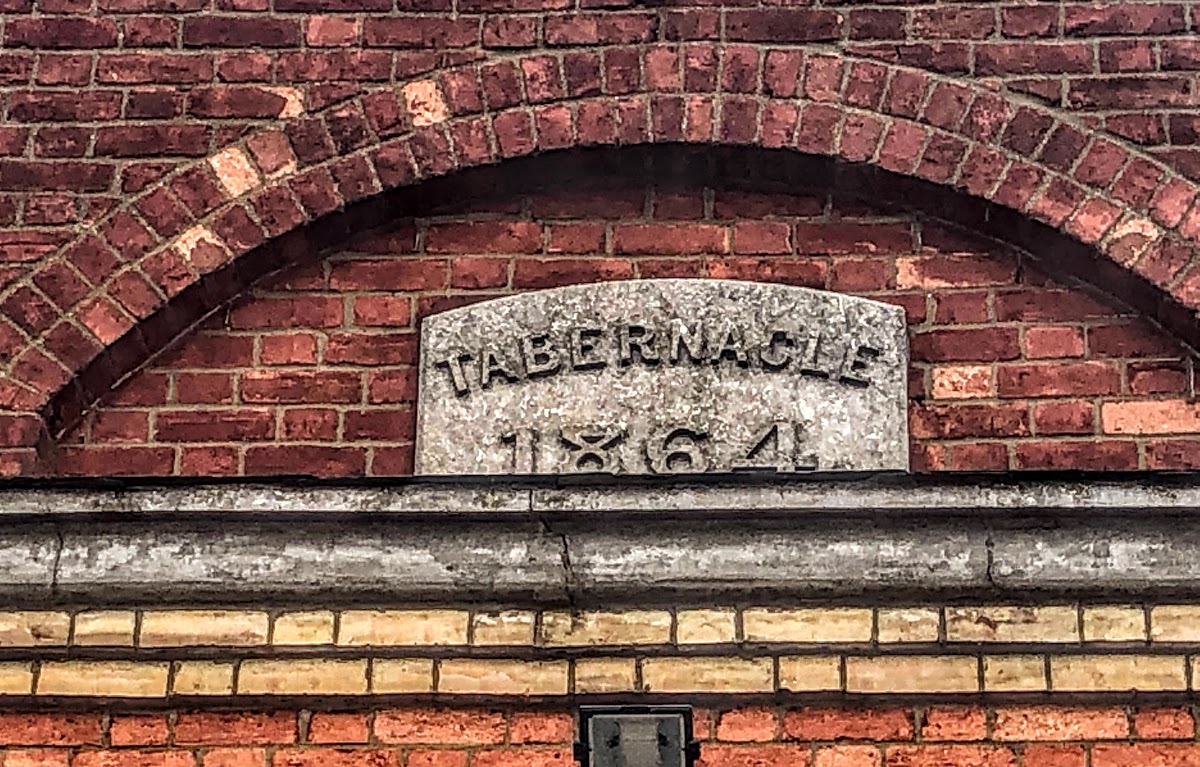
Winslow Tabernacle, the former Baptist Chapel off High Street in Winslow (Photograph: Patrick Comerford)

Patrick Comerford

We are in Ordinary Time in the Church Calendar, and tomorrow is the Fourteenth Sunday after Trinity (Trinity XIV, 10 September 2023). The calendar of the Church of England today (9 September 2023) remembers the life and witness of Charles Fuge Lowder, priest (1880).

Before today begins, I am taking some time this morning for prayer and reflection.

This week, I have been reflecting each morning in these ways:

1, Looking at a church on the route of the annual Ride + Stride, organised by Buckinghamshire Historic Churches Trust and taking place today (9 September 2023);

2, the Gospel reading of the day in the Church of England lectionary;

3, a prayer from the USPG prayer diary.

Keach’s Meeting House is tucked away in Bell Walk, Winslow (Photograph: Patrick Comerford)

The annual Ride + Stride organised by Buckinghamshire Historic Churches Trust takes place today, 9 September 2023. Participants may be cyclists, walkers, horse-riders or drivers of mobility scooters. They can be of any age, but under-13s must be accompanied by an adult. All denominations are welcome.

Participants may visit as many churches as they like, planning their own route, and are asked to seek sponsorship from friends, relations and colleagues: so much per church visited or a lump sum. https://ridestride.org/

Ride + Stride offers opportunities find out what lies behind the churchyard gates of Buckinghamshire’s many churches and chapels.

Ride + Stride is open to walkers as well as horse-riders and cyclists. It always takes place on the second Saturday of September, between 10 am and 6 pm, and aims to raise money for the repair and restoration of churches and chapels of any Christian denomination in Buckinghamshire.

Half the money raised goes to the church or chapel of the participant’s choice, and the other half is added to a general fund administered by the Buckinghamshire Historic Churches Trust.

Churches are encouraged to make applications to the trust for grants to help with church repairs and restoration. Last year’s Ride + Stride event raised more than £26,610. Last year, the trust awarded grants totalling £28,000 to 11 churches that applied for funding to assist with both major and minor works.

My photographs this week have been from some of the churches taking part in this year’s Ride + Stride today. Two of the participating churches are Keach’s Meeting House and the Baptist Tabernacle in Winslow, Buckinghamshire. My photographs this morning are of these two buildings, with some additional photographs of Saint Laurence’s Church, the Church of England parish church in Winslow.

The Revd JA Spurgeon opened the new Baptist chapel in Winslow in 1864 (Photograph: Patrick Comerford)

Luke 6: 1-5 (NRSVA):

6 One sabbath while Jesus was going through the cornfields, his disciples plucked some heads of grain, rubbed them in their hands, and ate them. 2 But some of the Pharisees said, ‘Why are you doing what is not lawful on the sabbath?’ 3 Jesus answered, ‘Have you not read what David did when he and his companions were hungry? 4 He entered the house of God and took and ate the bread of the Presence, which it is not lawful for any but the priests to eat, and gave some to his companions?’ 5 Then he said to them, ‘The Son of Man is lord of the sabbath.’

Keach’s Meeting House is hidden behind fences and rich foliage in a back garden in Winslow (Photograph: Patrick Comerford)

Today’s Prayer:

The theme this week in ‘Pray With the World Church,’ the Prayer Diary of the Anglican mission agency USPG (United Society Partners in the Gospel), has been ‘Harvest.’ This theme was introduced on Sunday. To find out more, visit www.uspg.org.uk

The USPG Prayer Diary today (9 September 2023) invites us to pray in these words:

May God the Son, who fed the five thousand and turned water into wine, feed us with his life and transform us in his love.

Saint Laurence’s Church dates from Saxon times and dominates the west side of the High Street in Winslow, Buckinghamshire (Photograph: Patrick Comerford)

The Collect:

Almighty God,
who called your Church to bear witness
that you were in Christ reconciling the world to yourself:
help us to proclaim the good news of your love,
that all who hear it may be drawn to you;
through him who was lifted up on the cross,
and reigns with you in the unity of the Holy Spirit,
one God, now and for ever.

The Post Communion Prayer:

God our creator,
you feed your children with the true manna,
the living bread from heaven:
let this holy food sustain us through our earthly pilgrimage
until we come to that place
where hunger and thirst are no more;
through Jesus Christ our Lord.

Inside Saint Laurence’s Church, Winslow, facing the east end (Photograph: Patrick Comerford)

Yesterday’s Reflection

Continued Tomorrow

Scripture quotations are from the New Revised Standard Version Bible: Anglicised Edition copyright © 1989, 1995, National Council of the Churches of Christ in the United States of America. Used by permission. All rights reserved worldwide. http://nrsvbibles.org

The East Window in Saint Laurence’s Church, Winslow, is by Charles Eamer Kempe (1897); the reredos was painted by Cherie Rush in 2000 (Photograph: Patrick Comerford)