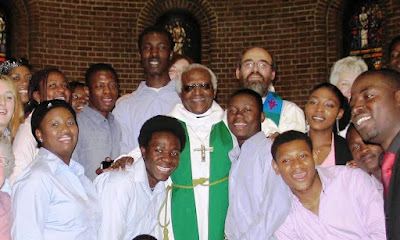
‘But you know, death is not the worst thing that could happen to a Christian’ … with Archbishop Desmond Tutu and members of the Discovery Gospel Choir in Dublin in 2005
Patrick Comerford
We are in Ordinary Time in the Church Calendar and tomorrow is the Sixth Sunday after Trinity (Trinity VI, 12 July 2026). The Calendar of the Church of England in Common Worship today remembers the life and witness of Saint Benedict of Nursia (550), Abbot of Monte Cassino and Father of Western Monasticism.
I may not venture out to the festival in the cricket club later today. But, before I make any decisions about what to do today, I am taking some quiet time this morning to give thanks, to reflect, to pray and to read in these ways:
1, reading today’s Gospel reading;
2, a short reflection;
3, a prayer from the USPG prayer diary;
4, the Collects and Post-Communion prayer of the day.

‘But you know, death is not the worst thing that could happen to a Christian’ … with Archbishop Desmond Tutu on the cover of a Discovery Gospel Choir CD
Matthew 10: 24-33 (NRSVA):
[Jesus said:] 24 ‘A disciple is not above the teacher, nor a slave above the master; 25 it is enough for the disciple to be like the teacher, and the slave like the master. If they have called the master of the house Beelzebul, how much more will they malign those of his household!
26 ‘So have no fear of them; for nothing is covered up that will not be uncovered, and nothing secret that will not become known. 27 What I say to you in the dark, tell in the light; and what you hear whispered, proclaim from the housetops. 28 Do not fear those who kill the body but cannot kill the soul; rather fear him who can destroy both soul and body in hell. 29 Are not two sparrows sold for a penny? Yet not one of them will fall to the ground unperceived by your Father. 30 And even the hairs of your head are all counted. 31 So do not be afraid; you are of more value than many sparrows.
32 ‘Everyone therefore who acknowledges me before others, I also will acknowledge before my Father in heaven; 33 but whoever denies me before others, I also will deny before my Father in heaven.’
‘What I say to you in the dark, tell in the light …’ (Matthew 10: 27) … 30 seconds of calm at Platanias in Rethymnon, Crete (Patrick Comerford)
Today’s Reflections:
When the late Archbishop Desmond Tutu (1931-2021) received the Nobel Peace Prize in 1984, I profiled him for The Irish Times. We had met previously, at events co-hosted by AfrI and Christian CND and at dinner in Roebuck House, Seán MacBride’s house in Clonskeagh, Dublin.
I asked him about the death threats he faced in South Africa at the height of apartheid. He engaged me with that look that confirmed his deep hope, commitment and faith, and said: ‘But you know, death is not the worst thing that could happen to a Christian.’
He must have been tempted at times to give up being a thorn in the side of the regime, to stop being a ‘turbulent priest,’ and to live a comfortable life. But his conscience would never have been comfortable.
While apartheid was still in force, Desmond Tutu became Dean of Saint Mary’s Cathedral, Johannesburg, and when I first met him he was the secretary general of the South African Council of Churches.
I was worried about the many death threats he was receiving, and I asked him how he lived with those threats. Was he worried about them? Did he ever consider modifying what he had to say because of them? His answer was similar to the one he gave when he was facing tough questioning before the regime’s Eloff Commission. He told that inquiry:
‘There is nothing the government can do to me that will stop me from being involved in what I believe God wants me to do. I do not do it because I like doing it. I do it because I am under what I believe to be the influence of God’s hand. I cannot help it. When I see injustice, I cannot keep quiet, for, as Jeremiah says, when I try to keep quiet, God’s Word burns like a fire in my breast. But what is it that they can ultimately do? The most awful thing that they can do is to kill me, and death is not the worst thing that could happen to a Christian.’
In 1987, Veritas invited me to write a short, 36-page biography of Archbishop Tutu, published as Desmond Tutu: Black Africa’s Man of Destiny. It was launched by the then Minister for Foreign Affairs, Brian Lenihan. It was a small book, hardly more than a pamphlet, but it came at an important time when both the Irish Government and the Irish Churches were becoming increasingly vocal about the evils of apartheid. It was republished in the US by Citadel (1988) and Hyperion Books (1989).
When I visited South Africa in 1990 with The Irish Times and Christian Aid, I met Archbishop Tutu in Cape Town, where once again he spoke powerfully about the changes that were beginning to take place.
Then, when my colleague Patsy McGarry was organising a monumental series of features in The Irish Times in 2000 to mark the millennium, Archbishop Tutu was one of the international contributors, along with Hans Küng, Andrew Greeley and Mary Robinson. The complete series was published by Veritas the following year as a book, Christianity, in which Part Two was my ‘Brief History of Christianity.’
I last met Archbishop Tutu when he visited Dublin in 2005, and he preached in Saint George’s and Saint Thomas’s Church in the inner city, where Canon (now Archdeacon) Katharine Poulton was then the Rector, as part of the Discovery Gospel Choir services.
His unforgettable words to me echo Christ’s words to the disciples in today’s Gospel reading: ‘Do not fear those who kill the body but cannot kill the soul; rather fear him who can destroy both soul and body in hell’ (Matthew 10: 28).
The Gospel reading at the Eucharist today (Matthew 10: 24-33) continues our readings from the commission and mission of the Twelve, as the Twelve continue to receive their instructions and commission for mission, even in the most hostile of environments.
‘What I say to you in the dark, tell in the light …’ (Matthew 10: 27) … walking through Galley Hill in Stony Stratford at night (Photograph: Patrick Comerford)
Today’s Prayers (Saturday 11 July 2026):
In Pray with the World Church, the prayer diary of the Anglican mission agency USPG (United Society Partners in the Gospel), the theme this week, from 5 to 11 July 2026 (pp 16-17), has been ‘Faith in the Midst of Fractures’. This theme was introduced last Sunday with a reflection by the Revd Godfrey Owino Adera, Anglican priest, theologian, and lecturer at Saint Paul’s University, Limuru, Kenya.
The USPG prayer diary today (Saturday 11 July 2026) invites us to pray:
God of truth and reconciliation, grant us courage to engage in difficult but necessary conversations. Where there is fear, give us boldness; where there is injustice, stir us to action; where there is brokenness, lead us toward healing and unity.
The Collect of the Day:
Eternal God,
who made Benedict a wise master
in the school of your service
and a guide to many called into community
to follow the rule of Christ:
grant that we may put your love before all else
and seek with joy the way of your commandments;
through Jesus Christ your Son our Lord,
who is alive and reigns with you,
in the unity of the Holy Spirit,
one God, now and for ever.
The Post-Communion Prayer:
Merciful God,
who gave such grace to your servant Benedict
that he served you with singleness of heart
and loved you above all things:
help us, whose communion with you
has been renewed in this sacrament,
to forsake all that holds us back from following Christ
and to grow into his likeness from glory to glory;
through Jesus Christ our Lord.
Collect on the Eve of Trinity VI:
Merciful God,
you have prepared for those who love you
such good things as pass our understanding:
pour into our hearts such love toward you
that we, loving you in all things and above all things,
may obtain your promises,
which exceed all that we can desire;
through Jesus Christ your Son our Lord,
who is alive and reigns with you,
in the unity of the Holy Spirit,
one God, now and for ever.
Collect on the Eve of Trinity VI:
O God, the protector of all who trust in you,
without whom nothing is strong, nothing is holy:
increase and multiply upon us your mercy;
that with you as our ruler and guide
we may so pass through things temporal
that we lose not our hold on things eternal;
grant this, heavenly Father,
for our Lord Jesus Christ’s sake,
who is alive and reigns with you,
in the unity of the Holy Spirit,
one God, now and for ever.
Yesterday’s reflections
Continued tomorrow
‘So do not be afraid; you are of more value than many sparrows’ (Matthew 10: 31) … Watching a mother sparrow feed her chicks in a nest in the ceiling of Aghias Anna Church, Maroulas, near Rethymnon in Crete (Patrick Comerford)
Scripture quotations are from the New Revised Standard Version Bible: Anglicised Edition copyright © 1989, 1995, National Council of the Churches of Christ in the United States of America. Used by permission. All rights reserved worldwide. http://nrsvbibles.org
Showing posts with label Galley Hill. Show all posts
11 July 2026
Daily prayer in Ordinary Time 2026:
65, Saturday 11 July 2026
Labels:
Apartheid,
Benedictines,
Books,
Crete 2026,
Galley Hill,
Greece 2026,
Kenya,
Maroulas,
Mission,
Platanias,
Prayer,
Racism,
Rethymnon,
Saint Matthew's Gospel,
South Africa,
Stony Stratford,
The Irish Times,
USPG
24 December 2025
Daily prayer in Advent 2025:
25, Wednesday 24 December 2025,
Christmas Eve
‘By the tender mercy of our God, the dawn from on high will break upon us’ (Luke 1: 78) … a December sunrise on Stony Stratford High Street (Photograph: Patrick Comerford, 2025)
Patrick Comerford
We come to the end of Advent today, and this evening is Christmas Eve. Later this evening, I hope to join the choir of Saint Mary and Saint Giles Church, Stony Stratford, singing at the ‘Midnight Mass’ at 9 pm in All Saints’ Church, Calverton, .
Before today begins, I am taking some quiet time this morning to give thanks, to reflect, to pray and to read in these ways:
1, today’s Gospel reading;
2, a short reflection;
3, a prayer from the USPG prayer diary;
4, the Collects and Post-Communion prayer of the day.
‘By the tender mercy of our God, the dawn from on high will break upon us’ (Luke 1: 78) … a December sunrise in Gally Hill in Stony Stratford (Photograph: Patrick Comerford, 2025)
Luke 1: 67-79 (NRSVA):
67 Then his father Zechariah was filled with the Holy Spirit and spoke this prophecy:
68 ‘Blessed be the Lord God of Israel,
for he has looked favourably on his people and redeemed them.
69 He has raised up a mighty saviour for us
in the house of his servant David,
70 as he spoke through the mouth of his holy prophets from of old,
71 that we would be saved from our enemies and from the hand of all who hate us.
72 Thus he has shown the mercy promised to our ancestors,
and has remembered his holy covenant,
73 the oath that he swore to our ancestor Abraham,
to grant us 74 that we, being rescued from the hands of our enemies,
might serve him without fear, 75 in holiness and righteousness
before him all our days.
76 And you, child, will be called the prophet of the Most High;
for you will go before the Lord to prepare his ways,
77 to give knowledge of salvation to his people
by the forgiveness of their sins.
78 By the tender mercy of our God,
the dawn from on high will break upon us,
79 to give light to those who sit in darkness and in the shadow of death,
to guide our feet into the way of peace.’
‘To give light to those who sit in darkness’ (Luke 1: 79) … Christmas lights in winter darkness on the High Street in Stony Stratford (Photograph: Patrick Comerford, 2025)
Today’s Reflections:
In the Gospel reading at the Eucharist this morning (Luke 1: 67-79), we conclude a series of readings before Christmas that draw on the two nativity narratives found in Matthew 1: 1-24 and Luke 1: 5-79.
This reading continues on from the stories of the Visitation of the Virgin Mary to her cousin Saint Elizabeth and the account of the birth of Saint John the Baptist.
After the birth and naming of his son, Zechariah finds his speech is restored, and prophesies in a poetic speech that we have come to know as the canticle Benedictus.
The canticle naturally falls into two parts. Part 1 (verses 68-75) is a song of thanksgiving for the realisation of the Messianic hopes. In Part 2 (verses 76-79), Zechariah addresses his own son, who is to be a prophet, who will go before the Lord to prepare his ways, who will tell people of the good news of their salvation and forgiveness:
‘By the tender mercy of our God,
the dawn from on high will break upon us,
to give light to those who sit in darkness and in the shadow of death,
to guide our feet into the way of peace.’
How many parents could say this with confidence, joy and love about their own children on this Christmas Eve?
As I was meeting and talking to children during Santa’s visit to the Christmas Market in Stony Stratford yesterday, I was reminded how the English Catholic theologian and writer Tina Beattie last year made a plea to parents, priests, teachers and anyone who has dealings with children in the build-up to Christmas. In a posting on Facebook, she asked them: ‘please never tell children that Santa only comes to good children, or that Santa won’t come if they’re naughty.’
‘There are thousands of good children to whom Santa won’t come because they live in poverty, dereliction or neglect,’ she pointed out. ‘But also, children so easily internalise a sense of blame and shame – for parental squabbles and separations, for bad things that happen to their families and friends. They don’t need to be threatened into good behaviour or made fearful that Santa won’t come because they misbehaved.’
And she concluded: ‘If you want them to have a sense of why gifts are given at Christmas, tell them that this is a time of gifts not because we’re good, but because God is good and loves them, whatever they do and whoever they are.’
The theologian Tina Beattie says children ‘don’t need to be threatened into good behaviour or made fearful that Santa won’t come’ … Santa in Christmas decorations at a house in Stony Stratford (Photograph: Patrick Comerford, 2025)
Today’s Prayers (Wednesday 24 December 2025, Christmas Eve):
The theme this week (21 to 27 December 2025) in Pray with the World Church, the prayer diary of the Anglican mission agency USPG (United Society Partners in the Gospel), is ‘Love Brings Life in Tanzania’ (pp 12-13). This theme was introduced on Sunday with a Programme Update by Imran Englefield, Individual Giving Manager, USPG.
The USPG Prayer Diary today (Wednesday 24 December 2025, Christmas Eve) invites us to pray:
As we await the birth of Christ, we remember the expectant mothers at Mvumi Hospital. Protect them, we pray, grant them strength and care, and surround them with hope and love as they await the gift of new life.
The Collect:
Almighty God,
you make us glad with the yearly remembrance
of the birth of your Son Jesus Christ:
grant that, as we joyfully receive him as our redeemer,
so we may with sure confidence behold him
when he shall come to be our judge;
who is alive and reigns with you,
in the unity of the Holy Spirit,
one God, now and for ever.
The Post-Communion Prayer:
Eternal God, for whom we wait,
you have fed us with the bread of eternal life:
keep us ever watchful,
that we may be ready to stand before the Son of man,
Jesus Christ our Lord.
Additional Collect:
Almighty God,
as we prepare with joy
to celebrate the gift of the Christ-child,
embrace the earth with your glory
and be for us a living hope
in Jesus Christ our Lord.
Yesterday’s Reflections
Continued Tomorrow
‘To give light to those who sit in darkness’ (Luke 1: 79) … early morning light on Stowe Pool in Lichfield (Photograph: Patrick Comerford)
Scripture quotations are from the New Revised Standard Version Bible: Anglicised Edition copyright © 1989, 1995 National Council of the Churches of Christ in the United States of America. Used by permission. All rights reserved worldwide. http://nrsvbibles.org
Patrick Comerford
We come to the end of Advent today, and this evening is Christmas Eve. Later this evening, I hope to join the choir of Saint Mary and Saint Giles Church, Stony Stratford, singing at the ‘Midnight Mass’ at 9 pm in All Saints’ Church, Calverton, .
Before today begins, I am taking some quiet time this morning to give thanks, to reflect, to pray and to read in these ways:
1, today’s Gospel reading;
2, a short reflection;
3, a prayer from the USPG prayer diary;
4, the Collects and Post-Communion prayer of the day.
‘By the tender mercy of our God, the dawn from on high will break upon us’ (Luke 1: 78) … a December sunrise in Gally Hill in Stony Stratford (Photograph: Patrick Comerford, 2025)
Luke 1: 67-79 (NRSVA):
67 Then his father Zechariah was filled with the Holy Spirit and spoke this prophecy:
68 ‘Blessed be the Lord God of Israel,
for he has looked favourably on his people and redeemed them.
69 He has raised up a mighty saviour for us
in the house of his servant David,
70 as he spoke through the mouth of his holy prophets from of old,
71 that we would be saved from our enemies and from the hand of all who hate us.
72 Thus he has shown the mercy promised to our ancestors,
and has remembered his holy covenant,
73 the oath that he swore to our ancestor Abraham,
to grant us 74 that we, being rescued from the hands of our enemies,
might serve him without fear, 75 in holiness and righteousness
before him all our days.
76 And you, child, will be called the prophet of the Most High;
for you will go before the Lord to prepare his ways,
77 to give knowledge of salvation to his people
by the forgiveness of their sins.
78 By the tender mercy of our God,
the dawn from on high will break upon us,
79 to give light to those who sit in darkness and in the shadow of death,
to guide our feet into the way of peace.’
‘To give light to those who sit in darkness’ (Luke 1: 79) … Christmas lights in winter darkness on the High Street in Stony Stratford (Photograph: Patrick Comerford, 2025)
Today’s Reflections:
In the Gospel reading at the Eucharist this morning (Luke 1: 67-79), we conclude a series of readings before Christmas that draw on the two nativity narratives found in Matthew 1: 1-24 and Luke 1: 5-79.
This reading continues on from the stories of the Visitation of the Virgin Mary to her cousin Saint Elizabeth and the account of the birth of Saint John the Baptist.
After the birth and naming of his son, Zechariah finds his speech is restored, and prophesies in a poetic speech that we have come to know as the canticle Benedictus.
The canticle naturally falls into two parts. Part 1 (verses 68-75) is a song of thanksgiving for the realisation of the Messianic hopes. In Part 2 (verses 76-79), Zechariah addresses his own son, who is to be a prophet, who will go before the Lord to prepare his ways, who will tell people of the good news of their salvation and forgiveness:
‘By the tender mercy of our God,
the dawn from on high will break upon us,
to give light to those who sit in darkness and in the shadow of death,
to guide our feet into the way of peace.’
How many parents could say this with confidence, joy and love about their own children on this Christmas Eve?
As I was meeting and talking to children during Santa’s visit to the Christmas Market in Stony Stratford yesterday, I was reminded how the English Catholic theologian and writer Tina Beattie last year made a plea to parents, priests, teachers and anyone who has dealings with children in the build-up to Christmas. In a posting on Facebook, she asked them: ‘please never tell children that Santa only comes to good children, or that Santa won’t come if they’re naughty.’
‘There are thousands of good children to whom Santa won’t come because they live in poverty, dereliction or neglect,’ she pointed out. ‘But also, children so easily internalise a sense of blame and shame – for parental squabbles and separations, for bad things that happen to their families and friends. They don’t need to be threatened into good behaviour or made fearful that Santa won’t come because they misbehaved.’
And she concluded: ‘If you want them to have a sense of why gifts are given at Christmas, tell them that this is a time of gifts not because we’re good, but because God is good and loves them, whatever they do and whoever they are.’
The theologian Tina Beattie says children ‘don’t need to be threatened into good behaviour or made fearful that Santa won’t come’ … Santa in Christmas decorations at a house in Stony Stratford (Photograph: Patrick Comerford, 2025)
Today’s Prayers (Wednesday 24 December 2025, Christmas Eve):
The theme this week (21 to 27 December 2025) in Pray with the World Church, the prayer diary of the Anglican mission agency USPG (United Society Partners in the Gospel), is ‘Love Brings Life in Tanzania’ (pp 12-13). This theme was introduced on Sunday with a Programme Update by Imran Englefield, Individual Giving Manager, USPG.
The USPG Prayer Diary today (Wednesday 24 December 2025, Christmas Eve) invites us to pray:
As we await the birth of Christ, we remember the expectant mothers at Mvumi Hospital. Protect them, we pray, grant them strength and care, and surround them with hope and love as they await the gift of new life.
The Collect:
Almighty God,
you make us glad with the yearly remembrance
of the birth of your Son Jesus Christ:
grant that, as we joyfully receive him as our redeemer,
so we may with sure confidence behold him
when he shall come to be our judge;
who is alive and reigns with you,
in the unity of the Holy Spirit,
one God, now and for ever.
The Post-Communion Prayer:
Eternal God, for whom we wait,
you have fed us with the bread of eternal life:
keep us ever watchful,
that we may be ready to stand before the Son of man,
Jesus Christ our Lord.
Additional Collect:
Almighty God,
as we prepare with joy
to celebrate the gift of the Christ-child,
embrace the earth with your glory
and be for us a living hope
in Jesus Christ our Lord.
Yesterday’s Reflections
Continued Tomorrow
‘To give light to those who sit in darkness’ (Luke 1: 79) … early morning light on Stowe Pool in Lichfield (Photograph: Patrick Comerford)
Scripture quotations are from the New Revised Standard Version Bible: Anglicised Edition copyright © 1989, 1995 National Council of the Churches of Christ in the United States of America. Used by permission. All rights reserved worldwide. http://nrsvbibles.org
07 January 2025
Daily prayer in Christmas 2024-2025:
14, Tuesday 7 January 2025
‘The people who sat in darkness have seen a great light’ (Matthew 4: 16) … candles lit in prayer in the cathedral in Rethymnon in Crete (Photograph: Patrick Comerford, 2024)
Patrick Comerford
We are still in the season of Christmas, which is a 40-day season and it did not end yesterday, on the Feast of the Epiphany (6 January), but continues until Candlemas or the Feast of the Presentation (2 February).
Before today begins, I am taking some quiet time this morning to give thanks, to reflect, to pray and to read in these ways:
1, today’s Gospel reading;
2, a short reflection;
3, a prayer from the USPG prayer diary;
4, the Collects and Post-Communion prayer of the day.
‘The people who sat in darkness have seen a great light’ (Matthew 4: 16) … darkness and light in the commercial heart of Singapore (Photograph: Patrick Comerford, 2024)
Matthew 4: 12-17, 23-25 (NRSVA):
12 Now when Jesus heard that John had been arrested, he withdrew to Galilee. 13 He left Nazareth and made his home in Capernaum by the lake, in the territory of Zebulun and Naphtali, 14 so that what had been spoken through the prophet Isaiah might be fulfilled:
15 ‘Land of Zebulun, land of Naphtali,
on the road by the sea, across the Jordan, Galilee of the Gentiles –
16 the people who sat in darkness
have seen a great light,
and for those who sat in the region and shadow of death
light has dawned.’
17 From that time Jesus began to proclaim, ‘Repent, for the kingdom of heaven has come near.’
23 Jesus went throughout Galilee, teaching in their synagogues and proclaiming the good news of the kingdom and curing every disease and every sickness among the people. 24 So his fame spread throughout all Syria, and they brought to him all the sick, those who were afflicted with various diseases and pains, demoniacs, epileptics, and paralytics, and he cured them. 25 And great crowds followed him from Galilee, the Decapolis, Jerusalem, Judea, and from beyond the Jordan.
‘The people who sat in darkness have seen a great light’ (Matthew 4: 16) … darkness and light between Stony Stratford and Galley Hill (Photograph: Patrick Comerford, 2024)
Today’s Reflection:
In the Gospel reading at the Eucharist, we move immediately from yesterday’s account of the visit of the Magi (Matthew 2: 1-12) to the beginning of Jesus’ ministry and mission (Matthew 4: 12-17, 23-25), when he moves from Nazareth to Capernaum.
Throughout Galilee and Syria, the priorities at the beginning of his ministry and mission are teaching as a rabbi in the synagogues, proclaiming the good news of the kingdom, curing disease, sickness and pain among the people, as well as the demoniacs, epileptics and paralytics.
There is a well-known prayer, often titled ‘A Franciscan blessing’, that has been described by someone else as a good counter-balance to the cosy ‘Francis of the birdbath’ spirituality, but that is also an interesting reminder of the priorities of any Christ-like ministry:
May God bless you with a restless discomfort
about easy answers, half-truths and superficial relationships,
so that you may seek truth boldly
and love deep within your heart.
May God bless you with holy anger
at injustice, oppression and exploitation of people, so that you may tirelessly work for
justice, freedom, and peace among all people.
May God bless you with the gift of tears to shed with those who suffer
from pain, rejection, starvation, or the loss of all that they cherish,
so that you may reach out your hand
to comfort them and transform their pain into joy.
May God bless you with enough foolishness to believe
that you really can make a difference in this world,
so that you are able, with God’s grace,
to do what others claim cannot be done.
And the blessing of God the Supreme Majesty and our Creator,
Jesus Christ the Incarnate Word who is our brother and Saviour,
and the Holy Spirit, our Advocate and Guide, be with you
and remain with you, this day and forevermore. Amen.
Although it is popularly known as ‘A Franciscan blessing’, it is sometimes known as a ‘Four-Fold Benedictine Blessing’, but it was originally called ‘A Non-traditional Blessing’, and was first written 40 years ago in 1985 for a student group by a Benedictine nun, Sister Ruth (Marlene) Fox (1936-2023) of the Sacred Heart Convent, Richardton, North Dakota.
Sister Ruth was born on 24 January 1936 in Stanley, North Dakota, and grew up on the family farm with her older sister and three brothers, and entered the novitiate and made her monastic profession at the Sacred Heart Convent.
She was prioress for two four-year terms before studying scripture and theology in Israel, Rome, and Saint John’s University in Collegeville, Minnesota. After several years as campus minister at Dickinson State University, in 1990 she was elected president of the Federation of Saint Gertrude, linking 18 monasteries of Benedictine women in the US and Canada.
She conducted retreats in several Benedictine monasteries, published numerous papers on spirituality, and wrote a book on monastic leadership, Wisdom Leadership. She guided the ecumenical Benedictine Spirituality Centre at her monastery from 2000 until 2005, when she was again elected prioress of her monastery for six years.
Sister Ruth compiled the history of her community, played the organ for daily monastic liturgies, oversaw the monastery archives, and assisted with housekeeping chores.
She was very involved in Benedictine life beyond the US. She was a member of the Monastic Interreligious Dialogue Board and spent three months in India on a monastic exchange programme. She was a member of the American Benedictine Academy and its president from 1986 to 1999. Due to failing health, Sister Ruth moved to Saint Vincent’s in Bismarck in late 2022, and died on 13 September 2023.
It appears that Sister Ruth wrote her four-fold ‘blessing’, now known as ‘A Franciscan Benediction’, at Sacred Heart Monastery. Her original blessing prays seems to have prayed:
May God bless you with discomfort
At easy answers, half-truths and superficial relationships,
So that you may live deep within your heart.
May God bless you with anger
At injustice, oppression and exploitation of people,
So that you may work for justice, freedom and peace.
May God bless you with tears,
To shed for those who suffer pain, rejection, hunger and war,
So that you may reach out your hand
to comfort and to turn their pain to joy.
And may God bless you with enough foolishness
To believe that you can make a difference in the world,
So that you can do what others claim cannot be done,
To bring justice and kindness to all our children and the poor.
‘The people who sat in darkness have seen a great light’ (Matthew 4: 16) … light in the darkness on the streets of Kuching at night (Photograph: Patrick Comerford, 2024)
Today’s Prayers (Tuesday 7 January 2025):
The theme this week in ‘Pray With the World Church’, the Prayer Diary of the Anglican mission agency USPG (United Society Partners in the Gospel), is ‘The Melanesian Brotherhood Centenary’. This theme was introduced on Sunday with a Programme Update by Ella Sibley, Regional Manager for Europe and Oceania, USPG.
The USPG Prayer Diary today (Tuesday 7 January 2025) invites us to pray:
Father, we pray for the centenary celebrations of the Melanesian Brotherhood, asking for your presence as thousands gather to worship and celebrate your faithfulness together.
The Collect:
O God,
who by the leading of a star
manifested your only Son to the peoples of the earth:
mercifully grant that we,
who know you now by faith,
may at last behold your glory face to face;
through Jesus Christ your Son our Lord,
who is alive and reigns with you,
in the unity of the Holy Spirit,
one God, now and for ever.
The Post-Communion Prayer:
Lord God,
the bright splendour whom the nations seek:
may we who with the wise men have been drawn by your light
discern the glory of your presence in your Son,
the Word made flesh, Jesus Christ our Lord.
Additional Collect:
Creator of the heavens,
who led the Magi by a star
to worship the Christ-child:
guide and sustain us,
that we may find our journey’s end
in Jesus Christ our Lord.
Yesterday’s Reflection
Continued Tomorrow
‘The people who sat in darkness have seen a great light’ (Matthew 4: 16) … inside Saint Mary de Castro Church in Leicester (Photograph: Patrick Comerford, 2024)
Scripture quotations are from the New Revised Standard Version Bible: Anglicised Edition copyright © 1989, 1995 National Council of the Churches of Christ in the United States of America. Used by permission. All rights reserved worldwide. http://nrsvbibles.org
Patrick Comerford
We are still in the season of Christmas, which is a 40-day season and it did not end yesterday, on the Feast of the Epiphany (6 January), but continues until Candlemas or the Feast of the Presentation (2 February).
Before today begins, I am taking some quiet time this morning to give thanks, to reflect, to pray and to read in these ways:
1, today’s Gospel reading;
2, a short reflection;
3, a prayer from the USPG prayer diary;
4, the Collects and Post-Communion prayer of the day.
‘The people who sat in darkness have seen a great light’ (Matthew 4: 16) … darkness and light in the commercial heart of Singapore (Photograph: Patrick Comerford, 2024)
Matthew 4: 12-17, 23-25 (NRSVA):
12 Now when Jesus heard that John had been arrested, he withdrew to Galilee. 13 He left Nazareth and made his home in Capernaum by the lake, in the territory of Zebulun and Naphtali, 14 so that what had been spoken through the prophet Isaiah might be fulfilled:
15 ‘Land of Zebulun, land of Naphtali,
on the road by the sea, across the Jordan, Galilee of the Gentiles –
16 the people who sat in darkness
have seen a great light,
and for those who sat in the region and shadow of death
light has dawned.’
17 From that time Jesus began to proclaim, ‘Repent, for the kingdom of heaven has come near.’
23 Jesus went throughout Galilee, teaching in their synagogues and proclaiming the good news of the kingdom and curing every disease and every sickness among the people. 24 So his fame spread throughout all Syria, and they brought to him all the sick, those who were afflicted with various diseases and pains, demoniacs, epileptics, and paralytics, and he cured them. 25 And great crowds followed him from Galilee, the Decapolis, Jerusalem, Judea, and from beyond the Jordan.
‘The people who sat in darkness have seen a great light’ (Matthew 4: 16) … darkness and light between Stony Stratford and Galley Hill (Photograph: Patrick Comerford, 2024)
Today’s Reflection:
In the Gospel reading at the Eucharist, we move immediately from yesterday’s account of the visit of the Magi (Matthew 2: 1-12) to the beginning of Jesus’ ministry and mission (Matthew 4: 12-17, 23-25), when he moves from Nazareth to Capernaum.
Throughout Galilee and Syria, the priorities at the beginning of his ministry and mission are teaching as a rabbi in the synagogues, proclaiming the good news of the kingdom, curing disease, sickness and pain among the people, as well as the demoniacs, epileptics and paralytics.
There is a well-known prayer, often titled ‘A Franciscan blessing’, that has been described by someone else as a good counter-balance to the cosy ‘Francis of the birdbath’ spirituality, but that is also an interesting reminder of the priorities of any Christ-like ministry:
May God bless you with a restless discomfort
about easy answers, half-truths and superficial relationships,
so that you may seek truth boldly
and love deep within your heart.
May God bless you with holy anger
at injustice, oppression and exploitation of people, so that you may tirelessly work for
justice, freedom, and peace among all people.
May God bless you with the gift of tears to shed with those who suffer
from pain, rejection, starvation, or the loss of all that they cherish,
so that you may reach out your hand
to comfort them and transform their pain into joy.
May God bless you with enough foolishness to believe
that you really can make a difference in this world,
so that you are able, with God’s grace,
to do what others claim cannot be done.
And the blessing of God the Supreme Majesty and our Creator,
Jesus Christ the Incarnate Word who is our brother and Saviour,
and the Holy Spirit, our Advocate and Guide, be with you
and remain with you, this day and forevermore. Amen.
Although it is popularly known as ‘A Franciscan blessing’, it is sometimes known as a ‘Four-Fold Benedictine Blessing’, but it was originally called ‘A Non-traditional Blessing’, and was first written 40 years ago in 1985 for a student group by a Benedictine nun, Sister Ruth (Marlene) Fox (1936-2023) of the Sacred Heart Convent, Richardton, North Dakota.
Sister Ruth was born on 24 January 1936 in Stanley, North Dakota, and grew up on the family farm with her older sister and three brothers, and entered the novitiate and made her monastic profession at the Sacred Heart Convent.
She was prioress for two four-year terms before studying scripture and theology in Israel, Rome, and Saint John’s University in Collegeville, Minnesota. After several years as campus minister at Dickinson State University, in 1990 she was elected president of the Federation of Saint Gertrude, linking 18 monasteries of Benedictine women in the US and Canada.
She conducted retreats in several Benedictine monasteries, published numerous papers on spirituality, and wrote a book on monastic leadership, Wisdom Leadership. She guided the ecumenical Benedictine Spirituality Centre at her monastery from 2000 until 2005, when she was again elected prioress of her monastery for six years.
Sister Ruth compiled the history of her community, played the organ for daily monastic liturgies, oversaw the monastery archives, and assisted with housekeeping chores.
She was very involved in Benedictine life beyond the US. She was a member of the Monastic Interreligious Dialogue Board and spent three months in India on a monastic exchange programme. She was a member of the American Benedictine Academy and its president from 1986 to 1999. Due to failing health, Sister Ruth moved to Saint Vincent’s in Bismarck in late 2022, and died on 13 September 2023.
It appears that Sister Ruth wrote her four-fold ‘blessing’, now known as ‘A Franciscan Benediction’, at Sacred Heart Monastery. Her original blessing prays seems to have prayed:
May God bless you with discomfort
At easy answers, half-truths and superficial relationships,
So that you may live deep within your heart.
May God bless you with anger
At injustice, oppression and exploitation of people,
So that you may work for justice, freedom and peace.
May God bless you with tears,
To shed for those who suffer pain, rejection, hunger and war,
So that you may reach out your hand
to comfort and to turn their pain to joy.
And may God bless you with enough foolishness
To believe that you can make a difference in the world,
So that you can do what others claim cannot be done,
To bring justice and kindness to all our children and the poor.
‘The people who sat in darkness have seen a great light’ (Matthew 4: 16) … light in the darkness on the streets of Kuching at night (Photograph: Patrick Comerford, 2024)
Today’s Prayers (Tuesday 7 January 2025):
The theme this week in ‘Pray With the World Church’, the Prayer Diary of the Anglican mission agency USPG (United Society Partners in the Gospel), is ‘The Melanesian Brotherhood Centenary’. This theme was introduced on Sunday with a Programme Update by Ella Sibley, Regional Manager for Europe and Oceania, USPG.
The USPG Prayer Diary today (Tuesday 7 January 2025) invites us to pray:
Father, we pray for the centenary celebrations of the Melanesian Brotherhood, asking for your presence as thousands gather to worship and celebrate your faithfulness together.
The Collect:
O God,
who by the leading of a star
manifested your only Son to the peoples of the earth:
mercifully grant that we,
who know you now by faith,
may at last behold your glory face to face;
through Jesus Christ your Son our Lord,
who is alive and reigns with you,
in the unity of the Holy Spirit,
one God, now and for ever.
The Post-Communion Prayer:
Lord God,
the bright splendour whom the nations seek:
may we who with the wise men have been drawn by your light
discern the glory of your presence in your Son,
the Word made flesh, Jesus Christ our Lord.
Additional Collect:
Creator of the heavens,
who led the Magi by a star
to worship the Christ-child:
guide and sustain us,
that we may find our journey’s end
in Jesus Christ our Lord.
Yesterday’s Reflection
Continued Tomorrow
‘The people who sat in darkness have seen a great light’ (Matthew 4: 16) … inside Saint Mary de Castro Church in Leicester (Photograph: Patrick Comerford, 2024)
Scripture quotations are from the New Revised Standard Version Bible: Anglicised Edition copyright © 1989, 1995 National Council of the Churches of Christ in the United States of America. Used by permission. All rights reserved worldwide. http://nrsvbibles.org
Labels:
Benedictines,
Crete,
Epiphany,
Epiphany 2025,
Franciscans,
Galley Hill,
Kuching,
Leicester,
Ministry,
Mission,
Monasticism,
Prayer,
Rethymnon,
Saint Matthew's Gospel,
Singapore,
Stony Stratford,
USPG
29 December 2022
A walk through the fields
near Stony Stratford and
Wolverton to Warren Park
Walking in the fields and countryside around Stony Stratford and Wolverton at dusk (Photograph: Patrick Comerford, 2022)
Patrick Comerford
The people who walked in darkness
have seen a great light (– Isaiah 9: 2)
These days after Christmas Day have been relaxing and the days have been dry at times and almost sunny, with weather that has encouraged the two of us to go for walks in the fields and countryside around Stony Stratford and Wolverton.
The Balancing Lake between Wolverton and Stony Stratford is one of a pair of small balancing lakes near Wolverton Mill that connect to the wider Ouse Valley Park. This area was once agricultural land and the balancing lakes were created to help prevent flooding in nearby areas.
The water levels in the balancing lakes can be raised to store water and to reduce the peaks of river flow, a process that reduces flood risk in downstream areas. The lakes are fed and controlled by a complex system of sluice gates and weirs.
The Balancing Lake between Wolverton and Stony Stratford is one of a pair of small balancing lakes near Wolverton Mill (Photograph: Patrick Comerford, 2022)
Many older trees still stand in the park, and at dusk their bare branches stood silhouetted against the dark blue skies. They serve as reminders that although we are close to the A5 this was once rich agricultural land before Milton Keynes was created half a century ago.
Walking through the fields and parkland earlier this week, Charlotte and I crossed a fence and found ourselves in Warren Park, on the outskirts of Stony Stratford and Wolverton and about three miles from the centre of Milton Keynes.
Warren Park is a purpose-built campus office development arranged in two courtyards, developed around Warren House and with extensive landscaped grounds incorporating Victorian fishponds.
Modern offices at Warren Park reflected in one of the Victorian fishponds (Photograph: Patrick Comerford, 2022)
There were six significant farms on the Wolverton Estate in the 19th century: Wolverton House, Wolverton Park, Manor Farm, Stonebridge House, Stacey Bushes and Brick Kiln. Other farms included Debbs Farm, then no more than 90 acres, and later absorbed by the new Warren farm.
The farms on the Wolverton Estate were inherited as family concerns, with sons succeeding fathers as tenants. Thomas Harrison at Wolverton House farmed about 400 acres. After he died in 1809, the house and farm passed to his son Richard Harrison. When Richard Harrison died in 1858, the farm was managed by his widow Grace until 1869, and then by their son Spencer Harrison until 1892.
When Spencer Harrison gave up the farm in 1892, the Radcliffe Trust separated Wolverton House from the farm and rented it as a large country house. Warren Farm was created that year and the trust rebuilt the farmhouse in the field once known as the Warren.
Henry Barrett was the first tenant and he remained at Warren Farm until he died in 1917. The Turney family then took over the tenancy of the farm. They stayed there until 1970 when the entire estate was sold to Milton Keynes Development Corporation.
Warren House or Warren Farm Cottage dates from the 18th century (Photograph: Patrick Comerford, 2022)
Warren House or Warren Farm Cottage dates from the 18th century. This is a stone-built house that has two storeys at the front or south-west side, and three storeys and an attic at the rear or north-east side.
The south-west front has two widely spaced windows on each floor, with three-light casements and glazing bars, and a closed, stone-built porch that is gabled, with a tile roof. There is a blind window recess above the porch.
The coursed dressed rubble north-east front has a lower floor half-basement. There are four windows with keys on each floor and they have glazing bar sashes. There is one hipped dormer and the house has a steep, old tile roof and two brick chimneys.
The north-east front of Warren House and the lower floor half-basement (Photograph: Patrick Comerford, 2022)
Today, Warren Park is a purpose-built campus office development, with a mixture of traditional properties and modern buildings. The courts and yards are atmospheric and intimate in their layout and design, with a mix of brick, stone and timber board elevations, all beneath pitched and tiled roofs.
Canon Harnett Close and Canon Harnett Drive leading into Warren Park are named after Canon WHL Harnett resigned as rector of Wolverton in the 1930s after 40 years.
Warren Park has a variety of businesses as tenants. The external landscaped areas include the Victorian fish ponds, and the onsite facilities include post boxes, electric vehicle charging points and a Greek café.
Warren Park is a purpose-built campus office development, with a mixture of traditional properties and modern buildings (Photograph: Patrick Comerford, 2022)
When we arrived at dusk, that part of me that is Greek was disappointed that the Greek Grill Café was closed. But it offers one of many excuses to return soon again and to explore Warren Park further.
We walked back to Galley Hill as dusk turned to evening darkness under a crescent moon and a sky decorated with bright stars.
The people who sat in darkness have seen a great light,
and for those who sat in the region and shadow of death
light has dawned (– Matthew 4: 16)
Dusk turns to evening darkness in Warren Park (Photograph: Patrick Comerford, 2022)
Patrick Comerford
The people who walked in darkness
have seen a great light (– Isaiah 9: 2)
These days after Christmas Day have been relaxing and the days have been dry at times and almost sunny, with weather that has encouraged the two of us to go for walks in the fields and countryside around Stony Stratford and Wolverton.
The Balancing Lake between Wolverton and Stony Stratford is one of a pair of small balancing lakes near Wolverton Mill that connect to the wider Ouse Valley Park. This area was once agricultural land and the balancing lakes were created to help prevent flooding in nearby areas.
The water levels in the balancing lakes can be raised to store water and to reduce the peaks of river flow, a process that reduces flood risk in downstream areas. The lakes are fed and controlled by a complex system of sluice gates and weirs.
The Balancing Lake between Wolverton and Stony Stratford is one of a pair of small balancing lakes near Wolverton Mill (Photograph: Patrick Comerford, 2022)
Many older trees still stand in the park, and at dusk their bare branches stood silhouetted against the dark blue skies. They serve as reminders that although we are close to the A5 this was once rich agricultural land before Milton Keynes was created half a century ago.
Walking through the fields and parkland earlier this week, Charlotte and I crossed a fence and found ourselves in Warren Park, on the outskirts of Stony Stratford and Wolverton and about three miles from the centre of Milton Keynes.
Warren Park is a purpose-built campus office development arranged in two courtyards, developed around Warren House and with extensive landscaped grounds incorporating Victorian fishponds.
Modern offices at Warren Park reflected in one of the Victorian fishponds (Photograph: Patrick Comerford, 2022)
There were six significant farms on the Wolverton Estate in the 19th century: Wolverton House, Wolverton Park, Manor Farm, Stonebridge House, Stacey Bushes and Brick Kiln. Other farms included Debbs Farm, then no more than 90 acres, and later absorbed by the new Warren farm.
The farms on the Wolverton Estate were inherited as family concerns, with sons succeeding fathers as tenants. Thomas Harrison at Wolverton House farmed about 400 acres. After he died in 1809, the house and farm passed to his son Richard Harrison. When Richard Harrison died in 1858, the farm was managed by his widow Grace until 1869, and then by their son Spencer Harrison until 1892.
When Spencer Harrison gave up the farm in 1892, the Radcliffe Trust separated Wolverton House from the farm and rented it as a large country house. Warren Farm was created that year and the trust rebuilt the farmhouse in the field once known as the Warren.
Henry Barrett was the first tenant and he remained at Warren Farm until he died in 1917. The Turney family then took over the tenancy of the farm. They stayed there until 1970 when the entire estate was sold to Milton Keynes Development Corporation.
Warren House or Warren Farm Cottage dates from the 18th century (Photograph: Patrick Comerford, 2022)
Warren House or Warren Farm Cottage dates from the 18th century. This is a stone-built house that has two storeys at the front or south-west side, and three storeys and an attic at the rear or north-east side.
The south-west front has two widely spaced windows on each floor, with three-light casements and glazing bars, and a closed, stone-built porch that is gabled, with a tile roof. There is a blind window recess above the porch.
The coursed dressed rubble north-east front has a lower floor half-basement. There are four windows with keys on each floor and they have glazing bar sashes. There is one hipped dormer and the house has a steep, old tile roof and two brick chimneys.
The north-east front of Warren House and the lower floor half-basement (Photograph: Patrick Comerford, 2022)
Today, Warren Park is a purpose-built campus office development, with a mixture of traditional properties and modern buildings. The courts and yards are atmospheric and intimate in their layout and design, with a mix of brick, stone and timber board elevations, all beneath pitched and tiled roofs.
Canon Harnett Close and Canon Harnett Drive leading into Warren Park are named after Canon WHL Harnett resigned as rector of Wolverton in the 1930s after 40 years.
Warren Park has a variety of businesses as tenants. The external landscaped areas include the Victorian fish ponds, and the onsite facilities include post boxes, electric vehicle charging points and a Greek café.
Warren Park is a purpose-built campus office development, with a mixture of traditional properties and modern buildings (Photograph: Patrick Comerford, 2022)
When we arrived at dusk, that part of me that is Greek was disappointed that the Greek Grill Café was closed. But it offers one of many excuses to return soon again and to explore Warren Park further.
We walked back to Galley Hill as dusk turned to evening darkness under a crescent moon and a sky decorated with bright stars.
The people who sat in darkness have seen a great light,
and for those who sat in the region and shadow of death
light has dawned (– Matthew 4: 16)
Dusk turns to evening darkness in Warren Park (Photograph: Patrick Comerford, 2022)
27 December 2022
Galley Hill House: keeping
alive memories of local
legends in Stony Stratford
Galley Hill House on London Road … its name is a reminder of legends and myths in Stony Stratford (Photograph: Patrick Comerford, 2022)
Patrick Comerford
I was wondering yesterday about the name of Galley Hill, and whether the area took its name from the former gibbet and gallows that once stood on this hill above the southeast fringes of Stony Stratford.
The stories about the gallows on Galley Hill have been reinforced by Ian Freemantle’s bench sculpted from a fallen oak tree and his carved inscription referring to ‘this hilltop gallows.’
I could hardly expect the gallows, the galley or the long-gone gibbet to give its name to any of the streets or cul-de-sacs around Galley Hill. But apart from Gally Hill itself, the main road running through the estate, all the courts have romantic historical associations and take their names from the old ‘hundreds’ and ‘half-hundreds’ or early mediaeval divisions in the neighbouring counties of Buckinghamshire, Bedfordshire and Northamptonshire.
Apart from the name of Galley Hill estate, the only other placename that hints at the story of a gallows outside Stony Stratford is found in the name of Galley Hill House on London.
But, for a newcomer like me, even this was not obvious at the beginning, because Galley Hill House is listed as Gallery Hill House on many sites, including Historic England and British Listed Buildings.
Galley Hill House is a Grade II listed building at No 108 London Road, on the south-west side of the road, facing the London Road allotments and the London Road Cemetery.
Galley Hill House was once a pair of houses built in the early 19th century. Today, it is a three-storey house, with two windows on each storey.
The house had a red-brick front, some vitrified headers and a slate roof. There are glazing bar sash windows with horns under flat arches. The right-hand entrance has been bricked up, while the left-hand entrance has a recent cambered arch and a plank door.
Although Galley Hill House once stood on its own, the end of the Victorian terrace of houses adjoining the house effectively makes this a semi-detached or end-of-terrace house.
The 1½-storey extension to the left is built of mixed red and yellow brick. It was originally built as a stable, but is now a garage.
No 108 London Road, Stony Stratford, is a freehold, semi-detached house. It was last sold in July 1998 for £150,000, but now a valuation of £722,000, ranking it as the second most expensive property in the immediate vicinity.
Galley Hill House is listed on many sites as Gallery Hill House (Photograph: Patrick Comerford, 2022)
Patrick Comerford
I was wondering yesterday about the name of Galley Hill, and whether the area took its name from the former gibbet and gallows that once stood on this hill above the southeast fringes of Stony Stratford.
The stories about the gallows on Galley Hill have been reinforced by Ian Freemantle’s bench sculpted from a fallen oak tree and his carved inscription referring to ‘this hilltop gallows.’
I could hardly expect the gallows, the galley or the long-gone gibbet to give its name to any of the streets or cul-de-sacs around Galley Hill. But apart from Gally Hill itself, the main road running through the estate, all the courts have romantic historical associations and take their names from the old ‘hundreds’ and ‘half-hundreds’ or early mediaeval divisions in the neighbouring counties of Buckinghamshire, Bedfordshire and Northamptonshire.
Apart from the name of Galley Hill estate, the only other placename that hints at the story of a gallows outside Stony Stratford is found in the name of Galley Hill House on London.
But, for a newcomer like me, even this was not obvious at the beginning, because Galley Hill House is listed as Gallery Hill House on many sites, including Historic England and British Listed Buildings.
Galley Hill House is a Grade II listed building at No 108 London Road, on the south-west side of the road, facing the London Road allotments and the London Road Cemetery.
Galley Hill House was once a pair of houses built in the early 19th century. Today, it is a three-storey house, with two windows on each storey.
The house had a red-brick front, some vitrified headers and a slate roof. There are glazing bar sash windows with horns under flat arches. The right-hand entrance has been bricked up, while the left-hand entrance has a recent cambered arch and a plank door.
Although Galley Hill House once stood on its own, the end of the Victorian terrace of houses adjoining the house effectively makes this a semi-detached or end-of-terrace house.
The 1½-storey extension to the left is built of mixed red and yellow brick. It was originally built as a stable, but is now a garage.
No 108 London Road, Stony Stratford, is a freehold, semi-detached house. It was last sold in July 1998 for £150,000, but now a valuation of £722,000, ranking it as the second most expensive property in the immediate vicinity.
Galley Hill House is listed on many sites as Gallery Hill House (Photograph: Patrick Comerford, 2022)
26 December 2022
Was Galley Hill really
a gallows hill until
the 17th century?
Ian Freemantle’s oak bench in Galley Hill … a reminder of a gib and gallows in the past (Photograph: Patrick Comerford, 2022)
Patrick Comerford
During these Christmas days, Charlotte and I have been ‘house-sitting’ in Galley Hill, and have been at the Christmas services in both Saint Mary and Saint Giles Church, Stony Stratford, and Holy Trinity Church, Old Wolverton.
The tree is lighting in the window in Bunsty Court throughout the day, a reminder of the light that comes into the world in the very depths of darkness – and, in a theological way, I suppose, a reminder that there is a link between Christmas and the tree of Calvary, and the hope of Easter.
Another tree has also caught my attention in recent days as I have been walking around Galley Hill. An old oak tree behind the houses in Lamva Court predated the building of Galley Hill 50 years ago, but it died and fell in recent years. Ian Freemantle, the sculptor and woodworker based in Stony Stratford, used the wood to carve an oak bench or seat in the playground. He also carved the Seed Pods in Great Linford as part of his ‘One Tree Project’ last year (2021)
On the bench in Galley Hill, he has inscribed the words:
Upon this hilltop gallows be
lay witness by this old oak tree
a land once worked by honest till
known to this day as Galley Hill
Ian Freemantle’s carved oak leaves and words on his bench in Galley Hill (Photograph: Patrick Comerford, 2022)
The southern fringe of the Galley Hill estate is said to stand on an old track that was known in the past as Gib Lane, that ran from Calverton to the site of a gibbet. According to a local legend, the ghost of Grace Bennett, who was murdered in Calverton Manor in 1683, haunts Gib Lane at Calverton, which takes its name from a gibbet that one stood there. She was the owner of the former manor house, now Manor Farm, at the north end of Calverton, next to All Saints’ Church.
Adam Barnes, a butcher from Stony Stratford, was later hanged and his body suspended in irons from a gibbet until it rotted and fell apart. But the site of that gibbet was in Calverton, and is said to be marked by carvings of two gibbets on a barn built into the high stone wall surrounding the former manor house and its orchard.
It is said that until the 17th century Galley Hill was the site of another gallows on which many local criminals were executed. Although the name Galley Hill appears on maps in the 1820s, and there is a Galley Hill House on London Road, could Galley Hill really be Gallows Hill?
The gibbet may have been associated with the Little Brickhill Assizes, although it is difficult to imagine why condemned convicts were not executed nearby rather than being taken 14 miles along Watling Street to be hanged on a hill above Stony Stratford.
Other accounts say the route ran from Passenham on the other side of the River Great Ouse, across the boggy fields, and skirting the southern fringes of Stony Stratford.
Ian Freemantle’s oak bench makes the playground in Galley Hill a much more pleasant place than the local legends, although some residents dismiss them as an urban myth.
Clailey Court in Galley Hill … a reminder of Comberford family links (Photograph: Patrick Comerford, 2022)
The street names in Galley Hill have more pleasant derivations. Many of them recall the old ‘hundreds’ and ‘half-hundreds’ or early mediaeval divisions in the neighbouring counties of Buckinghamshire, Bedfordshire and Northamptonshire.
Bunsty Court recalls the Bunsty or Bonestou hundred, covering the northern tip of Buckinghamshire, from Haversham to Olney and taking in part of the Linfords, Lathbury, Gayhurst and Tyringham, Hanslope, Weston Underwood and Lavendon.
Other local names that might otherwise have died out but that were given new life in Galley Hill include Barford, where there was once an ancient stone cross, Buckley, Clailey, Cottesloe, Creslow, Essenden, Flitton, Lamva, Manshead, Mursley, Redbourne, Roveley, Stanbridge, Stotfold and Willey Court.
Clailey Court, beside Bunsty Court recalls Clailey or Cleley, a Northamptonshire hundred, north-west of Milton Keynes. It included Cosgrove, Potterspury and Paulerspury, Yardley Gobion and Stoke Bruerne. And that reminds me of a Comberford family connection I need to explore:
John Comberford (1440-1508), of Comberford, a member of the Guild in Lichfield, inherited the Parles family estates in Stoke Bruerne when he married his father’s ward, Johanna Parles of Watford and of Shutlanger, near Stoke Bruerne, five miles south of Northampton. He later sold these estates in 1504, but when the New Year comes I have promised myself a visit to Stole Bruerne to explore the Comberford family links with Northamptonshire.
Meanwhile, during this Christmas week, I content myself with the thought that there is a link between the Christmas tree in the window and the promised hope of Easter.
The Christmas tree in Bunsty Court in Galley Hill (Photograph: Patrick Comerford, 2022)
Patrick Comerford
During these Christmas days, Charlotte and I have been ‘house-sitting’ in Galley Hill, and have been at the Christmas services in both Saint Mary and Saint Giles Church, Stony Stratford, and Holy Trinity Church, Old Wolverton.
The tree is lighting in the window in Bunsty Court throughout the day, a reminder of the light that comes into the world in the very depths of darkness – and, in a theological way, I suppose, a reminder that there is a link between Christmas and the tree of Calvary, and the hope of Easter.
Another tree has also caught my attention in recent days as I have been walking around Galley Hill. An old oak tree behind the houses in Lamva Court predated the building of Galley Hill 50 years ago, but it died and fell in recent years. Ian Freemantle, the sculptor and woodworker based in Stony Stratford, used the wood to carve an oak bench or seat in the playground. He also carved the Seed Pods in Great Linford as part of his ‘One Tree Project’ last year (2021)
On the bench in Galley Hill, he has inscribed the words:
Upon this hilltop gallows be
lay witness by this old oak tree
a land once worked by honest till
known to this day as Galley Hill
Ian Freemantle’s carved oak leaves and words on his bench in Galley Hill (Photograph: Patrick Comerford, 2022)
The southern fringe of the Galley Hill estate is said to stand on an old track that was known in the past as Gib Lane, that ran from Calverton to the site of a gibbet. According to a local legend, the ghost of Grace Bennett, who was murdered in Calverton Manor in 1683, haunts Gib Lane at Calverton, which takes its name from a gibbet that one stood there. She was the owner of the former manor house, now Manor Farm, at the north end of Calverton, next to All Saints’ Church.
Adam Barnes, a butcher from Stony Stratford, was later hanged and his body suspended in irons from a gibbet until it rotted and fell apart. But the site of that gibbet was in Calverton, and is said to be marked by carvings of two gibbets on a barn built into the high stone wall surrounding the former manor house and its orchard.
It is said that until the 17th century Galley Hill was the site of another gallows on which many local criminals were executed. Although the name Galley Hill appears on maps in the 1820s, and there is a Galley Hill House on London Road, could Galley Hill really be Gallows Hill?
The gibbet may have been associated with the Little Brickhill Assizes, although it is difficult to imagine why condemned convicts were not executed nearby rather than being taken 14 miles along Watling Street to be hanged on a hill above Stony Stratford.
Other accounts say the route ran from Passenham on the other side of the River Great Ouse, across the boggy fields, and skirting the southern fringes of Stony Stratford.
Ian Freemantle’s oak bench makes the playground in Galley Hill a much more pleasant place than the local legends, although some residents dismiss them as an urban myth.
Clailey Court in Galley Hill … a reminder of Comberford family links (Photograph: Patrick Comerford, 2022)
The street names in Galley Hill have more pleasant derivations. Many of them recall the old ‘hundreds’ and ‘half-hundreds’ or early mediaeval divisions in the neighbouring counties of Buckinghamshire, Bedfordshire and Northamptonshire.
Bunsty Court recalls the Bunsty or Bonestou hundred, covering the northern tip of Buckinghamshire, from Haversham to Olney and taking in part of the Linfords, Lathbury, Gayhurst and Tyringham, Hanslope, Weston Underwood and Lavendon.
Other local names that might otherwise have died out but that were given new life in Galley Hill include Barford, where there was once an ancient stone cross, Buckley, Clailey, Cottesloe, Creslow, Essenden, Flitton, Lamva, Manshead, Mursley, Redbourne, Roveley, Stanbridge, Stotfold and Willey Court.
Clailey Court, beside Bunsty Court recalls Clailey or Cleley, a Northamptonshire hundred, north-west of Milton Keynes. It included Cosgrove, Potterspury and Paulerspury, Yardley Gobion and Stoke Bruerne. And that reminds me of a Comberford family connection I need to explore:
John Comberford (1440-1508), of Comberford, a member of the Guild in Lichfield, inherited the Parles family estates in Stoke Bruerne when he married his father’s ward, Johanna Parles of Watford and of Shutlanger, near Stoke Bruerne, five miles south of Northampton. He later sold these estates in 1504, but when the New Year comes I have promised myself a visit to Stole Bruerne to explore the Comberford family links with Northamptonshire.
Meanwhile, during this Christmas week, I content myself with the thought that there is a link between the Christmas tree in the window and the promised hope of Easter.
The Christmas tree in Bunsty Court in Galley Hill (Photograph: Patrick Comerford, 2022)
21 December 2022
How Stony Stratford came
to have not one but three
traditional lychgates
The lychgate on London Road Cemetery, or Galley Hill Cemetery in Stony Stratford was designed by the architect Edward Swinfen Harris (Photograph: Patrick Comerford, 2022)
Patrick Comerford
There were four churches in my last parish, and I proposed using funds in a churchyard account to build a lychgate at the entrance to one of those churches, in the heart of a pretty rural village in the west of Ireland.
There was little enthusiasm for my proposal. But here, in many towns and villages in England, people would be happy to have a lychgate at the churchyard or cemetery.
Stony Stratford, a market town on the fringes of Milton Keynes in Buckinghamshire, has not just one but three lychgates at its churchyards and cemeteries.
The lychgate on Calverton Road dates from 1856-1857 and was designed by the Northampton architect Edmund Francis Law (Photograph: Patrick Comerford, 2022)
The oldest lychgate is at Stony Stratford Cemetery on Calverton Road. This small, one-acre burial board cemetery dates from 1856-1857. The site was designed by the Northampton architect Edmund Francis Law (1810-1882), with a typical collection of cemetery structures, including two separate chapels and a stone boundary wall with a lychgate.
Law’s practised in Northampton from 1837, based in Priory Cottage in the town. He was Northamptonshire County and Northampton Town Surveyor and was Mayor of Northampton in 1859. He was elected a Fellow of the Royal Institute of British Architects (FRIBA) in 1862 on the proposal of George Gilbert Scott. His son, Edmund Law (1840-1904), was an architect in his practice, and he too was Northamptonshire County and Northampton Town Surveyor.
The cemetery on Calverton Road is now in a residential area but was originally in a partly rural setting. In the early 19th century, the site was in agricultural use, lying in a rural area to the south of the town near the River Great Ouse.
With the introduction of the Burial Acts in the mid-1850s, the Burial Board of the United Parishes of Saint Giles and Saint Mary Magdalene, Stony Stratford, was formed and directed a cemetery to be laid out.
The cemetery was laid out on an agricultural close with fruit trees that was formerly the property of the Bell-Rope Charity. There are no surviving documents for this charity, but local tradition says it was the gift of an individual who lost his way but was rescued by hearing the clock of Stony Stratford Church strike the time. He left his land to perpetuate his deliverance, the rent to be applied forever in tolling a bell in the church early every morning.
Law’s design for the cemetery included two chapels in Gothic style. The Anglican chapel was more elaborate than the Early English-style Dissenters’ chapel and included a small tower with a bell cote. Other details included a dividing line with boundary markers between consecrated ground to the south and east and unconsecrated ground to the north.
Law’s estimates were for two chapels £600, fittings £50, boundary walls £150, and fence and lychgate cover £70, but this did not include laying out the ground. The cost of the land was £175 and the total estimated cost was £1,250. The builders were Thomas and William Fisher of Northampton.
The main entrance is off Calverton Road with a gateway set centrally in the south-west boundary. The gateway is framed by a timber lychgate with slate roof surmounted by an iron cross. It is supported by flanking stone walls that also support the elegant fleur-de-lis spear-tipped iron gates.
The two former Gothic-style stone mortuary chapels that formed the focus of Law’s design have been demolished, although their sites can be seen. The lychgate, stone boundary walls, ornamental railings and main paths to the sites of the former chapels designed by Law survive. The place was originally ornamented with conifers, probably largely Irish yew, planting that continues to evoke the 19th century character of the cemetery design.
This is a typical example of successive burials in a rural market town since the 1850s, including war dead, with a collection of modest memorials. The memorials includes Commonwealth War Graves for over 20 casualties from the two World Wars. The layout survives largely intact, although the markers between the consecrated and unconsecrated ground have gone.
The cemetery was extended in 1927, or perhaps in the 1930s, to the north-east with a rectangular area of similar size. The chapels were demolished in the 20th century. The cemetery is closed to new burials and is managed by Milton Keynes Council.
The lychgate at the London Road Cemetery, or Galley Hill Cemetery, was designed by Edward Swinfen Harris (Photograph: Patrick Comerford, 2022)
The second lychgate in Stony Stratford is at the London Road Cemetery, also known as Galley Hill Cemetery.
The John Radcliffe Trust bought a parcel of land measuring two roods and four perches on London Road in 1870 for use as a cemetery for the new-built Church of Saint Mary the Virgin – now the Greek Orthodox Church.
The local architect Edward Swinfen Harris (1841-1924) was commissioned to design and lay out the cemetery.
Swinfen Harris was also the architect for Wolverton End School, now the Old School House. His other designs in Stony Stratford include Rothenburg House at 107 High Street, built as his family home, Repton House on Wolverton Road, the Retreat almshouse on High Street, alterations to the Vicarage on Wolverton Road, the Swinfen Harris Church Hall on London Road, and alterations to Saint Mary and Saint Giles Church.
The first burial in the London Road Cemetery was recorded in 1871. A second area of the cemetery was bought by Milton Keynes Council in the 1980s. This pleasant tree lined area offers multi-faith burial plots.
In recent times the lychgate and memorial cross designed by Swinfen Harris fell into disrepair and the cross was considered unsafe. Following a concerted effort from members of Stony in Bloom, local tradesmen, finance from the Stony Stratford Futures Group and money from Milton Keynes Council Heritage Projects, the lychgate and cross were restored to their former glory in 2011.
The lychgate at Saint Mary and Saint Giles Church was erected in 1931 in memory of Arnold Steer (Photograph: Patrick Comerford, 2022)
Stony Stratford has a third and more recent lychgate at the north-east side of Saint Mary and Saint Giles Church.
The lychgate and calvary facing on to the High Street were erected in 1931 in memory of Arnold Steer by his wife Clara and children, Eric, Gwen and Wilfrid.
Canon Eric Steer had been a curate in Slough before becoming a naval chaplain during World War I. In all, three Steer brothers were priests in the Church of England, and Arnold Steer came to Stony Stratford to live in the vicarage in his old age and died in 1930.
The lychgate was made from an old oak tree that once stood on the same site, and remains an attractive feature on the High Street, next to where I am living.
The lychgate at Saint Mary and Saint Giles Church was made from an old oak tree that once stood on the same site (Photograph: Patrick Comerford, 2022)
Patrick Comerford
There were four churches in my last parish, and I proposed using funds in a churchyard account to build a lychgate at the entrance to one of those churches, in the heart of a pretty rural village in the west of Ireland.
There was little enthusiasm for my proposal. But here, in many towns and villages in England, people would be happy to have a lychgate at the churchyard or cemetery.
Stony Stratford, a market town on the fringes of Milton Keynes in Buckinghamshire, has not just one but three lychgates at its churchyards and cemeteries.
The lychgate on Calverton Road dates from 1856-1857 and was designed by the Northampton architect Edmund Francis Law (Photograph: Patrick Comerford, 2022)
The oldest lychgate is at Stony Stratford Cemetery on Calverton Road. This small, one-acre burial board cemetery dates from 1856-1857. The site was designed by the Northampton architect Edmund Francis Law (1810-1882), with a typical collection of cemetery structures, including two separate chapels and a stone boundary wall with a lychgate.
Law’s practised in Northampton from 1837, based in Priory Cottage in the town. He was Northamptonshire County and Northampton Town Surveyor and was Mayor of Northampton in 1859. He was elected a Fellow of the Royal Institute of British Architects (FRIBA) in 1862 on the proposal of George Gilbert Scott. His son, Edmund Law (1840-1904), was an architect in his practice, and he too was Northamptonshire County and Northampton Town Surveyor.
The cemetery on Calverton Road is now in a residential area but was originally in a partly rural setting. In the early 19th century, the site was in agricultural use, lying in a rural area to the south of the town near the River Great Ouse.
With the introduction of the Burial Acts in the mid-1850s, the Burial Board of the United Parishes of Saint Giles and Saint Mary Magdalene, Stony Stratford, was formed and directed a cemetery to be laid out.
The cemetery was laid out on an agricultural close with fruit trees that was formerly the property of the Bell-Rope Charity. There are no surviving documents for this charity, but local tradition says it was the gift of an individual who lost his way but was rescued by hearing the clock of Stony Stratford Church strike the time. He left his land to perpetuate his deliverance, the rent to be applied forever in tolling a bell in the church early every morning.
Law’s design for the cemetery included two chapels in Gothic style. The Anglican chapel was more elaborate than the Early English-style Dissenters’ chapel and included a small tower with a bell cote. Other details included a dividing line with boundary markers between consecrated ground to the south and east and unconsecrated ground to the north.
Law’s estimates were for two chapels £600, fittings £50, boundary walls £150, and fence and lychgate cover £70, but this did not include laying out the ground. The cost of the land was £175 and the total estimated cost was £1,250. The builders were Thomas and William Fisher of Northampton.
The main entrance is off Calverton Road with a gateway set centrally in the south-west boundary. The gateway is framed by a timber lychgate with slate roof surmounted by an iron cross. It is supported by flanking stone walls that also support the elegant fleur-de-lis spear-tipped iron gates.
The two former Gothic-style stone mortuary chapels that formed the focus of Law’s design have been demolished, although their sites can be seen. The lychgate, stone boundary walls, ornamental railings and main paths to the sites of the former chapels designed by Law survive. The place was originally ornamented with conifers, probably largely Irish yew, planting that continues to evoke the 19th century character of the cemetery design.
This is a typical example of successive burials in a rural market town since the 1850s, including war dead, with a collection of modest memorials. The memorials includes Commonwealth War Graves for over 20 casualties from the two World Wars. The layout survives largely intact, although the markers between the consecrated and unconsecrated ground have gone.
The cemetery was extended in 1927, or perhaps in the 1930s, to the north-east with a rectangular area of similar size. The chapels were demolished in the 20th century. The cemetery is closed to new burials and is managed by Milton Keynes Council.
The lychgate at the London Road Cemetery, or Galley Hill Cemetery, was designed by Edward Swinfen Harris (Photograph: Patrick Comerford, 2022)
The second lychgate in Stony Stratford is at the London Road Cemetery, also known as Galley Hill Cemetery.
The John Radcliffe Trust bought a parcel of land measuring two roods and four perches on London Road in 1870 for use as a cemetery for the new-built Church of Saint Mary the Virgin – now the Greek Orthodox Church.
The local architect Edward Swinfen Harris (1841-1924) was commissioned to design and lay out the cemetery.
Swinfen Harris was also the architect for Wolverton End School, now the Old School House. His other designs in Stony Stratford include Rothenburg House at 107 High Street, built as his family home, Repton House on Wolverton Road, the Retreat almshouse on High Street, alterations to the Vicarage on Wolverton Road, the Swinfen Harris Church Hall on London Road, and alterations to Saint Mary and Saint Giles Church.
The first burial in the London Road Cemetery was recorded in 1871. A second area of the cemetery was bought by Milton Keynes Council in the 1980s. This pleasant tree lined area offers multi-faith burial plots.
In recent times the lychgate and memorial cross designed by Swinfen Harris fell into disrepair and the cross was considered unsafe. Following a concerted effort from members of Stony in Bloom, local tradesmen, finance from the Stony Stratford Futures Group and money from Milton Keynes Council Heritage Projects, the lychgate and cross were restored to their former glory in 2011.
The lychgate at Saint Mary and Saint Giles Church was erected in 1931 in memory of Arnold Steer (Photograph: Patrick Comerford, 2022)
Stony Stratford has a third and more recent lychgate at the north-east side of Saint Mary and Saint Giles Church.
The lychgate and calvary facing on to the High Street were erected in 1931 in memory of Arnold Steer by his wife Clara and children, Eric, Gwen and Wilfrid.
Canon Eric Steer had been a curate in Slough before becoming a naval chaplain during World War I. In all, three Steer brothers were priests in the Church of England, and Arnold Steer came to Stony Stratford to live in the vicarage in his old age and died in 1930.
The lychgate was made from an old oak tree that once stood on the same site, and remains an attractive feature on the High Street, next to where I am living.
The lychgate at Saint Mary and Saint Giles Church was made from an old oak tree that once stood on the same site (Photograph: Patrick Comerford, 2022)
19 December 2022
Stony Stratford’s housing
includes some of ‘Britain’s
hidden architectural gems’
Galley Hill, started half a century ago in 1971-1972, was the first large housing scheme built by Milton Keynes Development Corporation (Photograph: Patrick Comerford, 2022)
Patrick Comerford
Suburban housing is often unremarkable architecturally. But the suburban housing on the south side of Stony Stratford includes the houses in Galley Hill and Fullers Slade, regarded as innovative and revolutionary when they they were built half a century ago and the houses in Latimer, which has been described as one of ‘Britain’s hidden architectural gems,’ offering ‘superlative modern living in landscaped surroundings.’
The housing development in Galley Hill was built as a rent-to-buy housing scheme and was designed under the influence of the architect Professor Derek John Walker (1929-2015), then the Chief Architect for Milton Keynes Development Corporation.
Derek Walker is remembered primarily for his work in urban planning and leisure facilities through his firm Derek Walker Associates. He studied architecture at Leeds Art School and planning at the University of Pennsylvania before setting up an architectural practice in Leeds in 1960. From 1970 to 1976, he was the Chief Architect and planner of Milton Keynes.
Walker recruited a team and over seven years produced a landscaping strategy for the new city, eleven village plans, the structure for the programme for producing 3,000 houses a year with supporting community, leisure, retail and sporting and cultural facilities.
He designed many buildings, and possibly the most celebrated is the Central Milton Keynes Shopping Centre. When it opened in 1979 it was a unique concept for 1 million sq ft (93,000 sq m) of retail space planned around covered landscaped streets. It has since been giving Grade II listing.
Walker was involved with the architects Norman Foster and Frank Newby in New York, and he was Professor of Architecture and Design at the Royal College of Art in 1984-1990.
Galley Hill, started half a century ago in 1971-1972, was the first large housing scheme built by Milton Keynes Development Corporation. Concrete shells were delivered to the site and clad with brick. The mono-pitched roof design was reflected in later developments in other parts of Milton Keynes.
Some of the houses intially served as a post office, a temporary school, a doctor’s surgery and a curate’s house for Saint Mary and Saint Giles Parish.
The Local Centre in Galley Hill was the first of its type in Milton Keynes. It was built alongside a grid road, which was part of the plan for Milton Keynes, with a mix of shops, meeting place and a community workshop. The meeting place and workshop in the centre have been partly refurbished in recent weeks.
Fullers Slade was conceived as a reinterpretation of the traditional terraced house (Photograph: Patrick Comerford, 2022)
Neighbouring Fullers Slade was the second large fully council owned estate built by Milton Keynes Development Corporation in the early 1970s. It was also important in establishing the architectural reputation of the city. The original design was conceived as a reinterpretation of the traditional terraced house and was built using simple modular techniques to get around the shortage of traditional building skills at the time.
The long terraces in Fullers Slade were originally cedar clad and were set in copious parkland with no rear garden overlooked at the back.
Fullers Slade was influenced, directly or indirectly, by Wayland Tunley working with Derek Walker, and it has been widely illustrated in publications, including in the Architects’ Journal (1975). However, the estate became very run down in recent decades, was beset by building condition and site security issues. It was considered one of the most deprived estates in Britain, and was one of seven similar estates in Milton Keynes earmarked by the council to be regenerated as part of an ambitious billion pound programme.
The architectural significance of all these developments is recognised in the second edition of the Pevsner Architectural Guide to Buckinghamshire, edited by the architectural historian Dr Elizabeth Williamson.
Latimer was used frequently in advertising to set the modern design agenda for Milton Keynes (Photograph: Patrick Comerford, 2022)
Nearby Latimer is a significant early courtyard-based private housing scheme. It too has been recognised in Pevsner and in important publications such as the Architect’s Journal (1975). Latimer was used frequently in advertising to set the modern design agenda for Milton Keynes as a developing new town from the mid-1970s on.
The houses at Latimer were built in 1974-1975 and are perhaps the best built during this period, in terms of both location and architectural design. They were sold originally with an asking price of £18,250.
The houses at Latimer were designed by the architectural practice of Frost Nicholls in collaboration with the landscape architect Michael Ellison.
Brian Frost (1939-2021), who died last year, belonged to a generation who believed good architecture would contribute to a better future for all. Most of his work was in housing – more by chance than intention, he later maintained – and demonstrates a passion for care and quality in buildings. The partnership of Frost and Nicholls lasted until 1977, and Brian Frost later worked with the prize-winning architect Sir James Stirling (1926-1992).
Professor Cliff Nicholls studied architecture at South Bank and Greenwich Universities. He won the European prize for Architecture in 1991. He became Dean of Design at Chelsea College of Art and Design in 1994 and Head of the School of Architecture and the Visual Arts at the University of East London in 2003. He has been a visiting professor in Kuala Lumpur, Beijing, Jinzhou, Guangzhou and Hong Kong.
No 13 Latimer was used as the show-house when the development first opened (Photograph: Patrick Comerford, 2022)
In their competition-winning design for Latimer in Calverton End, Frost and Nicholls were inspired by the Danish architect Jørn Utzon (1918-2008), particularly by his houses in Fredensborg and in Kingo near Helsingør in 1963. Utzon is best known for his design of the Sydney Opera House (1973), and Frost and Nicholls were inspired at Latimer by Utzon’s courtyard form.
No 13 is a good example of the houses at Latimer and it was used as the show-home when the development first opened. It is a detached four-bedroom house arranged over three levels with a large, open plan living and dining space at its core. The house is a rare example in Britain of a ‘courtyard house’ where the accommodation is arranged around an open courtyard.
The use of glass throughout the house allows for plenty of light, while the surrounding planting of trees ensure a high degree of privacy. Aside from glass, the house’s exterior is formed of dark brick and dark stained timber, which is also visible throughout the interior, beside white-painted brick.
The Architects’ Journal in 1975 devoted 11 pages to an in-depth study of the Frost Nicholls houses at Latimer, with a set of photographs by the celebrated architectural photographer John Donat (1933-2204).
The Journal covered almost every aspect of the project from the construction of the houses to discussions of details such as the timber trellises on the exterior of the houses.
Writing in the Architects’ Journal, Peter Collymore described how ‘inhabitants returning home through the open rolling landscape of Buckinghamshire will arrive in a private sheltered haven that could be pleasant and calming.’ He praised ‘the remarkable light quality – and a sense of space which is most pleasing,’ while the ‘private gardens are positioned to receive maximum sunlight and minimum overlooking.’
Half a century after it was built, Latimer remains one of the best courtyard schemes built in Britain during a golden age of low-rise housing. At the time Latimer was built, sustainability was not a significant concern, but its compact setting and choice of materials continue to offer much to learn from today.
The Local Centre in Galley Hill was the first of its type in Milton Keynes (Photograph: Patrick Comerford, 2022)
Patrick Comerford
Suburban housing is often unremarkable architecturally. But the suburban housing on the south side of Stony Stratford includes the houses in Galley Hill and Fullers Slade, regarded as innovative and revolutionary when they they were built half a century ago and the houses in Latimer, which has been described as one of ‘Britain’s hidden architectural gems,’ offering ‘superlative modern living in landscaped surroundings.’
The housing development in Galley Hill was built as a rent-to-buy housing scheme and was designed under the influence of the architect Professor Derek John Walker (1929-2015), then the Chief Architect for Milton Keynes Development Corporation.
Derek Walker is remembered primarily for his work in urban planning and leisure facilities through his firm Derek Walker Associates. He studied architecture at Leeds Art School and planning at the University of Pennsylvania before setting up an architectural practice in Leeds in 1960. From 1970 to 1976, he was the Chief Architect and planner of Milton Keynes.
Walker recruited a team and over seven years produced a landscaping strategy for the new city, eleven village plans, the structure for the programme for producing 3,000 houses a year with supporting community, leisure, retail and sporting and cultural facilities.
He designed many buildings, and possibly the most celebrated is the Central Milton Keynes Shopping Centre. When it opened in 1979 it was a unique concept for 1 million sq ft (93,000 sq m) of retail space planned around covered landscaped streets. It has since been giving Grade II listing.
Walker was involved with the architects Norman Foster and Frank Newby in New York, and he was Professor of Architecture and Design at the Royal College of Art in 1984-1990.
Galley Hill, started half a century ago in 1971-1972, was the first large housing scheme built by Milton Keynes Development Corporation. Concrete shells were delivered to the site and clad with brick. The mono-pitched roof design was reflected in later developments in other parts of Milton Keynes.
Some of the houses intially served as a post office, a temporary school, a doctor’s surgery and a curate’s house for Saint Mary and Saint Giles Parish.
The Local Centre in Galley Hill was the first of its type in Milton Keynes. It was built alongside a grid road, which was part of the plan for Milton Keynes, with a mix of shops, meeting place and a community workshop. The meeting place and workshop in the centre have been partly refurbished in recent weeks.
Fullers Slade was conceived as a reinterpretation of the traditional terraced house (Photograph: Patrick Comerford, 2022)
Neighbouring Fullers Slade was the second large fully council owned estate built by Milton Keynes Development Corporation in the early 1970s. It was also important in establishing the architectural reputation of the city. The original design was conceived as a reinterpretation of the traditional terraced house and was built using simple modular techniques to get around the shortage of traditional building skills at the time.
The long terraces in Fullers Slade were originally cedar clad and were set in copious parkland with no rear garden overlooked at the back.
Fullers Slade was influenced, directly or indirectly, by Wayland Tunley working with Derek Walker, and it has been widely illustrated in publications, including in the Architects’ Journal (1975). However, the estate became very run down in recent decades, was beset by building condition and site security issues. It was considered one of the most deprived estates in Britain, and was one of seven similar estates in Milton Keynes earmarked by the council to be regenerated as part of an ambitious billion pound programme.
The architectural significance of all these developments is recognised in the second edition of the Pevsner Architectural Guide to Buckinghamshire, edited by the architectural historian Dr Elizabeth Williamson.
Latimer was used frequently in advertising to set the modern design agenda for Milton Keynes (Photograph: Patrick Comerford, 2022)
Nearby Latimer is a significant early courtyard-based private housing scheme. It too has been recognised in Pevsner and in important publications such as the Architect’s Journal (1975). Latimer was used frequently in advertising to set the modern design agenda for Milton Keynes as a developing new town from the mid-1970s on.
The houses at Latimer were built in 1974-1975 and are perhaps the best built during this period, in terms of both location and architectural design. They were sold originally with an asking price of £18,250.
The houses at Latimer were designed by the architectural practice of Frost Nicholls in collaboration with the landscape architect Michael Ellison.
Brian Frost (1939-2021), who died last year, belonged to a generation who believed good architecture would contribute to a better future for all. Most of his work was in housing – more by chance than intention, he later maintained – and demonstrates a passion for care and quality in buildings. The partnership of Frost and Nicholls lasted until 1977, and Brian Frost later worked with the prize-winning architect Sir James Stirling (1926-1992).
Professor Cliff Nicholls studied architecture at South Bank and Greenwich Universities. He won the European prize for Architecture in 1991. He became Dean of Design at Chelsea College of Art and Design in 1994 and Head of the School of Architecture and the Visual Arts at the University of East London in 2003. He has been a visiting professor in Kuala Lumpur, Beijing, Jinzhou, Guangzhou and Hong Kong.
No 13 Latimer was used as the show-house when the development first opened (Photograph: Patrick Comerford, 2022)
In their competition-winning design for Latimer in Calverton End, Frost and Nicholls were inspired by the Danish architect Jørn Utzon (1918-2008), particularly by his houses in Fredensborg and in Kingo near Helsingør in 1963. Utzon is best known for his design of the Sydney Opera House (1973), and Frost and Nicholls were inspired at Latimer by Utzon’s courtyard form.
No 13 is a good example of the houses at Latimer and it was used as the show-home when the development first opened. It is a detached four-bedroom house arranged over three levels with a large, open plan living and dining space at its core. The house is a rare example in Britain of a ‘courtyard house’ where the accommodation is arranged around an open courtyard.
The use of glass throughout the house allows for plenty of light, while the surrounding planting of trees ensure a high degree of privacy. Aside from glass, the house’s exterior is formed of dark brick and dark stained timber, which is also visible throughout the interior, beside white-painted brick.
The Architects’ Journal in 1975 devoted 11 pages to an in-depth study of the Frost Nicholls houses at Latimer, with a set of photographs by the celebrated architectural photographer John Donat (1933-2204).
The Journal covered almost every aspect of the project from the construction of the houses to discussions of details such as the timber trellises on the exterior of the houses.
Writing in the Architects’ Journal, Peter Collymore described how ‘inhabitants returning home through the open rolling landscape of Buckinghamshire will arrive in a private sheltered haven that could be pleasant and calming.’ He praised ‘the remarkable light quality – and a sense of space which is most pleasing,’ while the ‘private gardens are positioned to receive maximum sunlight and minimum overlooking.’
Half a century after it was built, Latimer remains one of the best courtyard schemes built in Britain during a golden age of low-rise housing. At the time Latimer was built, sustainability was not a significant concern, but its compact setting and choice of materials continue to offer much to learn from today.
The Local Centre in Galley Hill was the first of its type in Milton Keynes (Photograph: Patrick Comerford, 2022)
Subscribe to:
Posts (Atom)