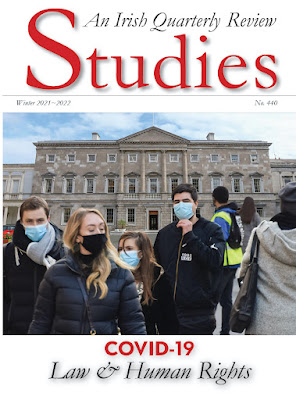
The Winter 2021 edition of ‘Studies: An Irish Quarterly Review’(Vol 110, No 440) , Winter 2021) included my paper, ‘A Reflection on the Crises in Afghanistan following the Fall of Kabul’ (pp 458-469)
Patrick Comerford
Introduction
The fall of Kabul in recent months and the completion of the Taliban takeover of Afghanistan in August have created a multiplicity of crises and have had repercussions in many areas of life in Ireland. The responses in Ireland have included knee-jerk and prejudiced reactions from people who object to accepting Afghan refugees. Paradoxically they are also among the people who point vocally to the forms of Islam expounded by the Taliban, yet have exercised little or no effort to understand Afghanistan, its history, its people, and the complexity and diversity of its religious cultures.
For many too, the Taliban confirm all their fears and prejudices of an expanding, militant Islam, and they are unwilling to concede that Islam is as diverse as Christianity and other religions, if not more so. The Taliban represents an extreme expression of Islam that has arisen only comparatively recently. Indeed, the Taliban expression of Islam cannot easily be labelled ‘conservative’ – for it is not conserving anything that is traditional in many streams of Islamic culture and thinking, nor is it rooted in traditions in Afghanistan.
Fears about the rights of women, for the education of children, and for freedom of expression in Afghanistan are well-founded. But there are genuine fears too for the loss of religious and cultural diversity and pluralism in Afghanistan under Taliban rule.
It is difficult too, for many of us, to understand and accept that Afghanistan is not a distant and remote part of Asia, but that for many centuries it came within the ambit of the ‘Euro-Mediterranean’ world, that it has long had close links with the classical and Hellenistic worlds, and that its history has been intimately interconnected with the history of Europe, including the history of Ireland.
Childhood reminders
As a child in Cappoquin, Co. Waterford, I was regaled with stories of General Sir John Keane (1781–1844), who eventually become Baron Keane of Ghuznee and Cappoquin. Those derring-do stories of Keane’s escapades and adventures in Afghanistan were as gripping as the stories of ‘the Wolf of Kabul’, which featured in my childhood days in The Hotspur, a popular British boy’s comic in the 1960s.
Keane played the key role in the capture of Ghuznee (Ghazni) during the First Anglo-Afghan War in 1839, following the fall of Kabul. I was reminded of this link between Ireland and past conflicts in Afghanistan during a recent visit to Cappoquin House, when Sir Charles Keane showed me many family mementoes of Lord Keane, including a portrait, a painting of Ghunzee Fort, and a ceremonial sword.
John Keane was born in Belmont, Cappoquin, on 6 February 1781, the second son of Sir John Keane, 1st baronet. He joined the army as an ensign at the age of 11 in 1792, rose to the rank of lieutenant-colonel and commanded a brigade in the Peninsular War, and he was promoted to major-general when he commanded a brigade at the Battle of New Orleans. Later, he was the British commander-in-chief in the West Indies and administered the colonial government of Jamaica.
Keane was commander-in-chief of the Bombay Army in 1834–1840, and he commanded the combined British and Indian army (‘The Army of the Indus’) during the opening campaign of the First Anglo-Afghan War. He and his forces seized Karachi in February 1839. He then commanded an expeditionary force that entered Afghanistan from India to forestall an expected, imminent Russian invasion, and commanded the victorious British and Indian army at the Battle of Ghazni on 23 July 1839.
Because of severe shortages of supplies and the lack of draft horses, Keane’s forces had to leave heavy siege equipment behind them in Kandahar. The defence of the city was led by Hyder Khan, the son of Dost Muhammad, then the ruler of Afghanistan. All the gates into Ghazni were sealed with rocks and debris, with the sole exception of the Kabul Gate, which was lightly guarded and poorly defended. Keane’s forces went around the city, camped on the north side facing the Kabul gate, and attacked early on the morning of 23 July. By dawn, Keane’s force had captured the city.
The British forces suffered 200 men killed and wounded while the Afghans lost almost 500 men and 1,600 were taken prisoner. Keane left a small garrison in Ghazni and began to march his forces towards Kabul on 30 July. When Dost Muhammad heard of the fall of Ghazni, he fled Kabul towards Western Afghanistan and the Afghan army surrendered. The
British then installed Shuja Shah Durrani of Kandahar as the new ruler of Afghanistan.
Keane retired without being engaged in further fighting. He was honoured with the peerage title of Baron Keane, of Ghuznee and of Cappoquin, Co. Waterford, on 23 December 1839, and received a pension of £2,000 a year for his and two successive lives.
Lord Keane died on 24 August 1844, and his title died out in 1901. But his remaining mementoes in Cappoquin House are a reminder that events in Afghanistan were never remote from the lives of people in Ireland.1
The reaches of ‘Euro-Med’ civilisation
From Keane’s adventures to recent events in Afghanistan, we are reminded throughout wars and history why Afghanistan has been known to military and diplomatic figures as the ‘graveyard of empires.’ But modern Afghanistan, as we know it, dates from 1747, when Ahmad Shah Durrani captured territory from Nader Shah’s descendants in Persia, from the Mughals, and the Uzbeks to his north. Although the name Afghanistan, meaning the land of the Afghans or Pashtuns, only came into general use during the wars of the 19th century, it can be traced to some time between the eighth and the 14th centuries.
Afghanistan is not a new country, nor is it culturally Asian. Traditionally, it has been seen as part of the ‘Euro-Med’ world. In classical times, the area was regarded as within the ambit of the Persian Empire, one of the great classical civilisations, and was known to both Greek and Roman writers as Ariana (Ἀριανή), from an Old Persian word (Ariyanem) meaning ‘the Land of the Aryans.’
In Rudyard Kipling’s short story ‘The Man Who Would Be King’ (1888), two British venturers, Peachy Carnehan and Danny Dravot, played by Michael Caine and Sean Connery in John Huston’s film of the same name (1975), set out to become kings of Kafiristan, a mountainous, isolated country beyond the Hindu Kush in north-east Afghanistan. They confide in their plans to Rudyard Kipling (Christopher Plummer), who tells them they
are mad. No man, he says, has made it to Kafiristan since Alexander the Great, to which Peachy replies, ‘If a Greek can do it, we can do it’. In north-east Afghanistan, they find the last remnants of the empire of Alexander the Great, and a local culture and religion that are part-Greek, part-Kafiri.2
The story is fiction, but aspects of its historical content are true. Alexander the Great spent most of the years 330–325 BCE campaigning in Afghanistan, Pakistan and India, and left behind Greek kingdoms and culture that flourished throughout the Hellenistic period and even later.3
Alexander the Great and his Macedonian forces crossed the Euphrates, marched through Mesopotamia, defeated Darius III of Persia in 331 BCE, and dismantled the Achaemenid empire. Alexander arrived in Afghanistan in 330 BCE, and the Seleucid Empire held on to the area for 15 years.
Later, there was a second Hellenistic conquest of the area by the Greco-Bactrians. Until the Taliban first took over Afghanistan, traces of these Greek kingdoms came to light continually, and the archaeological, artistic and epigraphic evidence from Afghanistan revealed a prosperous and culturally diverse kingdom.
Kandahar, the second city of Afghanistan and the de facto capital of the Taliban until the fall of Kabul, dates from the conquests of Alexander the Great, who laid out the foundation of what is now Old Kandahar in 330 BCE and gave it the Greek name Ἀλεξάνδρεια Ἀραχωσίας (Alexandria of Arachosia).
Alexander the Great is also said to have founded the city of Alexandria on the Oxus, at present-day Ai-Khanoum in Takhar Province, northern Afghanistan, in 327 BCE. It had a magnificent royal palace, a large amphitheatre, several Hellenic temples, a gymnasium, stoas and mosaics. For almost two centuries, this was a focal point of Hellenism in the East, and the centre of Hellenistic culture at the doorstep of India.4
This area was the most easterly reach of Greek civilisation and the Hellenistic world, and the Greek influence survived until at least the year 10 CE. This was the access point for the Classical World to the east, and when the Silk Road opened in the first century BCE, Afghanistan flourished thanks to trade along the routes from the Greek and Roman world through Persia to China and India. Ideas as well as goods were bartered, traded and exchanged at this centre point, so that Afghanistan was at the ultimate reach of our European-Mediterranean or ‘Euro-Med’ world.
The Kalash people in the Hindu Kush mountains are unique, with a distinctive cultural and religious identity; they are light-skinned, have blonde hair and blue eyes. To this day, traditions and myths persist that they are the descendants of Alexander the Great’s army.5
But how diverse is Afghanistan and its people in terms of religious heritage and identity?
Diversity in Afghanistan
The Taliban, or ‘students’ in the Pashto language, emerged as recently as the early 1990s in northern Pakistan, following the withdrawal of Soviet troops from Afghanistan. The predominantly Pashtun movement first appeared in religious seminaries, mostly financed from Saudi Arabia, and preached an extreme form of Salafism within Sunni Islam, with their own austere version of sharia, or Islamic law.6
One of the principal objectives of the Taliban is to impose a uniform practice of Islam throughout Afghanistan that forces all Muslims to conform to their own interpretation of Salafism.
Within weeks of the fall of Kabul, Muslim minorities became the first religious groupings to feel the impact of this religious intolerance. Yet, in the past, Afghanistan was known for its diversity among Muslims, once embracing a variety of expressions of Islam, among Shia minorities and Sufi orders.
Shia Islam
Shia Muslims form Afghanistan’s largest religious minority, and they are the religious group facing immediate threats and fears today. Estimates vary, but Shia Muslims make up from 7 to 20 per cent of the population of Afghanistan. They are mainly divided into two groupings, the Twelvers, who look to Iran for spiritual leadership, and the Ismailis, most of whom recognise the leadership of the Aga Khan. Both groups are regarded as heretical by the Sunni majority, and there is no doubt that the Taliban and Isis seek to eliminate their presence in Afghanistan and throughout the Islamic world.
The association of Twelver Shia Muslims with Iran also makes them politically vulnerable under the Taliban, and Shia Muslims are additionally vulnerable because they are mainly members of ethnic and linguistic minorities, including the Hazaras, Farsiwan (who are Persian speakers), Qizilbash and Pamir people.7
Two recent attacks on mosques in Afghanistan serve to illustrate not only the diversity of Islam in Afghanistan, but that the first target of Islamists in any religious purge is the country’s Muslim minorities.
At least 65 people were killed when the Imambargah in Kandahar, the equivalent of a Shia mosque, was attacked by a suicide bomber during Friday prayers on 15 October. The attack came a week after a similar bomb attack on a Shia mosque in northern Kunduz province, in which at least 50 people were killed.
Following the fall of Kabul, the Taliban has disarmed all security guards at Shia buildings, leaving them vulnerable to attacks by the even more extreme Isis. Kandahar is in the Taliban heartland, and the attack sent the clear message that Afghanistan’s Shia minority is no longer safe in a Taliban-ruled Afghanistan. ‘Life is becoming difficult and risky in Afghanistan for every Afghan, especially for Shias as Isis are only targeting Shia Muslims in Afghanistan. The world communities must help Afghanistan and Afghans in this terrible time’, one social activist who asked not to be named told The Guardian.8
Rumi, poet and Sufi mystic
Perhaps the most influential Muslim figure to emerge from what is today’s Afghanistan was Jalāl ad-Dīn Mohammad Rūmī, also known as Jalāl ad-Dīn Mohammad Balkhī or Mevlânâ and known more popularly and more simply as Rumi. Although this Sufi mystic was born to Persian-speaking parents in 1207 and was buried in Konya in present-day Turkey when he died in 1273, he was born, as his name indicates, in Balkh, then part of the Khwareziman Empire and now in present-day Afghanistan.
At the time, Greater Balkh was a major centre of Persian culture, and Sufism had developed there for several centuries, and Rumi’s father, Bahā ud-Dīn Walad, was a theologian, jurist and mystic from Balkh. For several generations, the family were preachers of the relatively liberal Hanafi Maturidi school. Rumi’s influence transcends national borders and ethnic and religious divisions, and he has been described as the ‘most popular poet’ and the ‘best-selling poet’ in the United States.9
Later, in the sixteenth century, Ahmad al Faruqi Kabuli, who was born near Kabul, was renowned for his teachings in India.
Three Sufi orders are prominent in Afghanistan: the Naqshbandiya, founded in Bukhara; the Qadiriya, founded in Baghdad; and the Cheshtiya, found mainly at Chesht-i-Sharif, east of Herat.
Afghan religious minorities
Buddhism first arrived in what we now know as Afghanistan with the expansion and conquests of the Maurya Empire throughout the Hindu Kush region during the reign of King Ashoka (268-232 BCE). In the following century, the Buddhist monk Lokakṣema travelled to China, and his translations of Mahayana Buddhist scriptures contributed significantly to the development of Buddhism in China.
His near contemporary, Mahadhammarakkhita, was a Greek Buddhist master in the reign of the Indo-Greek king Menander in the 2nd century BCE. His birth name Yona means ‘Ionian,’ and he travelled from ‘Alasandra’ – Alexandria of the Caucasus, about 150 km north of Kabul, or Alexandria of the Arachosians – with 30,000 monks for the dedication of the Great Stupa in Sri Lanka.10
Buddhism began to fall into decline in Afghanistan with the Muslim conquest in the seventh century, but finally came to an end under the Ghaznavid dynasty in the eleventh century.
The last great, surviving monuments to the presence of Buddhism in Afghanistan were the massive Buddha of Bamiyan, carved in the sixth and seventh centuries, and destroyed by rocket and guns in March 2001 after the Taliban decreed they were idolatrous.
The region of Arachosia, around Kandahar in southern Afghanistan, was once primarily Zoroastrian and is sometimes described as the ‘second homeland of Zoroastrianism.’ Until half a century ago, 2,000 Zoroastrians or Parsees were living in Afghanistan. There may still be small pockets of Bahais, Sikhs, Jains and Hindus in the country.
Christianity in Afghanistan
A legend in the apocryphal Gospel of Thomas and other traditions suggests that Saint Thomas the Apostle once preached in Bactria. By the fifth century, the Nestorian Church had a number of dioceses in Afghanistan, and there was a Christian presence in Herat until at least the early fourteenth century.
But Christianity has always had a small presence in Afghanistan. Until recently, the total number of Christians in Afghanistan was put at 10,000–12,000, almost all of them converts from Islam, although the law has not allowed Afghans to convert to Christianity, and only expatriates may be recognised as Christians.
Perhaps the best-known expatriate Christian living in Afghanistan until this year was Rula Ghani, a Maronite Christian from Lebanon, whose husband, Ashraf Ghani, was President of Afghanistan from 2014 until they fled Kabul as it fell to the Taliban earlier this year.
The only legally recognised Christian church building in Afghanistan is the Catholic chapel in the Italian embassy, which existed from the 1930s. The only Protestant church in Kabul was destroyed on 17 June 1973.
The last Jew of Kabul
Legends claim that Balkh, the home of Rumi, was also the burial place of the prophet Ezekiel and was once home to the prophet Jeremiah. There is a tradition among the Pashtuns of Afghanistan that they are descended from the exiled lost tribes of Israel. Interest in the topic was revived recently by a Jerusalem anthropologist, Professor Shalva Weil, who was quoted in the popular press as claiming the ‘Taliban may be descended from Jews’.11
Legends aside, a Jewish presence flourished in eastern Afghanistan from about the seventh century CE. An estimated 40,000 Jews once lived in the area of Herat. That number dwindled to fewer than 5,000 by the mid-twentieth century, as the community faced persecution from successive regimes that, influenced partly by Nazi propaganda and beliefs that Jews were ‘Bolshevik agents,’ restricted where they could live and work.
The Jewish presence in Afghanistan virtually disappeared from the 1950s, with emigration to Israel, India, Britain, and the US. When the Taliban first came to power in 1996, the Jewish population had dwindled to single-digit numbers.
Afghanistan’s last known surviving Jew, Zabulon Simantov (62), was finally evacuated from Kabul after spurning a number of rescue attempts in the days immediately after the city fell to the Taliban. Earlier this year, he told Arab News he would leave Afghanistan after the High Holy Days, which began on Rosh Hashanah (6 September 2021). Simantov had stayed on in Afghanistan to look after the last remaining synagogue in Kabul, through decades of violence and turmoil.
Simantov is a carpet and jewellery merchant who was born in Herat, once home to hundreds of Jews. He moved to Kabul but fled to Tajikistan in 1992, before returning to Kabul. Since then, he had lived the synagogue – which he has renovated– in the heart of Kabul’s flower district.
He became the country’s last Jew when Yitzhak Levi died in 2005. The pair famously did not get along, and in 1998 Levi wrote to the Taliban interior minister to accuse Simantov of the theft of Jewish relics. Simantov retorted by telling the Taliban that Levi ran a secret brothel where he sold alcohol. The Taliban jailed both men, but eventually released them when they
continued to fight in prison.
Their story inspired Michael J Flexer’s play My Brother’s Keeper, staged by the Apikoros Theatre Company at the Edinburgh Fringe Festival in 2006. The play tells the tale of the last two remaining Jews in Afghanistan under Taliban rule. They harbour a bitter hatred for one another, born out of their enforced co-habitation in a small, dilapidated synagogue, and spend the duration of the play feuding in fiery fashion.
Flexer told interviewers at the time that he had ‘tried to infuse the play with that feisty yet phlegmatic Jewish gallows humour’, and that he wanted the play to get across the idiocy of religious intolerance: ‘The comedy comes from the fact that, in this case, there was only one religion involved!’
However, in the past few months, comedy has given way to disturbing reality, and fears grow for everyone with the return of Taliban rule. Simantov’s departure means the future of the synagogue in Kabul is perilous and brings to an end Jewish life in Afghanistan after 1,500 to 2,000 years, or more.12
Conclusions
The ‘Wolf of Kabul’ in the Hotspur was supposed to be the moniker of Second Lieutenant Bill Sampson, a British intelligence agent in the North-West Frontier, and he first appeared in the Wizard in 1922. But, apart from Keane of Cappoquin, there have been other real-life ‘wolves of Kabul’ in Irish history.
Michael Mallin (1874–1916), chief of staff of the Irish Citizen Army garrison at the Royal College of Surgeons during the 1916 Rising in Dublin, spent 14 years in the British army, mainly in Afghanistan and India. He was decorated with the India Medal of 1895, and with the Punjab Frontier and Tirah clasps in 1897-1898. But it is also said that he was radicalised during his years in Afghanistan.
Before him, Lieutenant Walter Hamilton (1856-1879) from Inistioge, Co. Kilkenny, was posthumously decorated with the Victoria Cross for his part in the second Afghan War (1878–1880). He was part of the guard on duty when British headquarters in Kabul were overwhelmed and their guns seized in 1879. Other Irish recipients of awards and decorations during that war in Afghanistan include Sir Reginald Clare Hart (1848–1931) from Scarriff, Co. Clare, but Hamilton is remembered too for his appearance in M.M. Kaye’s epic novel The Far Pavilions (1978), which later became a British television mini-series.
Rudyard Kipling made popular the label ‘The Great Game’ as a description of the wars between Britain and Russia for control of Afghanistan – although the phrase was probably first used by the explorer Arthur Conolly (1807–1842), born in London of Irish parents. Kipling was so intrigued by the story of the disappearance and possible survival after the Battle of Balaclava of an Irish heir that it provided the basis for another of his short stories, ‘The Man Who Was’.
John Charles Henry Fitzgibbon (1829–1854), Viscount Fitzgibbon of Mountshannon House in Castleconnell, Co. Limerick, disappeared during the Crimean War and his body was never found. However, there were persistent rumours in his native Co. Limerick and in army lore that he had survived and escaped through Russia and Siberia to Afghanistan.
During the second Afghan War, Fitzgibbon’s regiment, the 8th Hussars, was stationed near the North-West frontier. One night, a dishevelled-looking man who spoke English was brought into the officers’ mess and was invited to stay for dinner. There he surprised all with his uncannily good knowledge of the regimental customs, indicating he was an ex-officer of the regiment. He was not asked to identify himself, but rumours developed and persisted that he was, in reality, the missing Fitzgibbon heir from Co. Limerick.
Kipling adapted the story in 1890 to tell of a man arrested for gun-stealing and who is believed to be an Afghan. He turns out to be an ex-officer, Austin Limmason – perhaps a verbal play on ‘Limerick’s son’ – who had been a Russian prisoner for many decades before making good his escape and finding his way back to his regiment in Afghanistan.
Kipling heads his 1891 version of this short story in his collection Life’s Handicap with a short ballad:
The Earth gave up her dead that tide,
Into our camp he came,
And said his say, and went his way,
And left our hearts aflame.
Keep tally – on the gun-butt score
The vengeance we must take,
When God shall bring full reckoning,
For our dead comrade’s sake.13
But the fall of Kabul and the conquest of Afghanistan cannot be regarded as part of God’s reckoning, nor can we continue to seek the ‘vengeance we must take’. In a geopolitical understanding of the present crises in Afghanistan, we are seeing yet another working out of the internal power struggles in the Islamic world between Saudi Arabia, seeking to assert its place as the major power among Sunni Muslims, and Iran, equally assertive of its place as the major power among Shia Muslims. It is a power struggle that has already had disastrous consequences for the people of Yemen and Syria, and Afghanistan serves to let the Iranians know that the Saudis have now opened another front on the eastern borders of Iran.
Western concerns for the future of Afghanistan cease being a continuing playout of ‘The Great Game’ in the ‘Graveyard of Empires’ when we begin to grasp that Afghanistan is – and has always been – an integral part of our ‘Euro-Med’ world; and condemnations of the Taliban and their expressions of Salafism can only gain legitimacy when we start to appreciate the pluralism and diversity within Islam and the religious, cultural and ethnic diversity that is part of the heritage of Afghanistan.
(Canon) Patrick Comerford is a priest in the Church of Ireland Diocese of Limerick and canon precentor of Saint Mary’s Cathedral, Limerick. He is a former adjunct assistant professor in Trinity College Dublin, a former lecturer in Church History and Liturgy in the Church of Ireland Theological Institute, and a former foreign desk editor at The Irish Times. He has written and lectured widely on Christian-Muslim affairs, and blogs daily at www.patrickcomerford.com.
Notes
1 Glacott Symes, Sir John Keane and Cappoquin House in Time of War and Revolution (Dublin: Four Courts Press, 2016), passim; the author’s visits to Cappoquin House, last visited 28 August 2020.
2 Rudyard Kipling, ‘The Man Who Would Be King,’ in The Man Who Would Be King: Selected Stories of Rudyard Kipling (Oxford: Oxford World’s Classics, 1999); Rachel Meirs, The Archaeology of the Hellenistic Far East, BAR International Series 2196 (2011), 13.
3 Shane Wallace, ‘Greek Culture in Afghanistan and India: Old Evidence and New Discoveries,’ 205–226 in Greece & Rome, 63.2 (The Classical Association, 2016), p 209. Meirs (2011), 8.
4 Meirs (2011), 16.
5 Barbara A West, Encyclopedia of the Peoples of Asia and Oceania (New York: Infobase Publishing, 2009), 357–358.
6 Malise Ruthven, Islam in the World (London: Penguin, 2000), 393–394; Sayed Hassan Akhlaq, ‘Taliban and Salafism: a historical and theological exploration,’ Open Democracy, 1 December 2013, https://www.opendemocracy.net/en/taliban-and-salafism-historical-and-theological-exploration/, accessed 22 October 2021.
7 Ruthven, Islam in the World, 211–21.
8 ‘Dozens dead in mosque bombing as doubt cast on Taliban security’, Guardian, 16 October 2021; ‘Islamic State Bombing Kills at Least 65 people in Southern Afghanistan’, Washington Post, 16 October 2021.
9 John Baldock, The Essence of Sufism (Royston, Herts: Eagle Editions, 2004); William C Chittick, Sufism (London: Oneworld, 2013), 76.
10 Meirs (2011), 12.
11 Rory McCarthy, ‘Pashtun clue to lost tribes of Israel’, The Observer, 17 January 2010; Michael Freund, ‘Are the Taliban descendants of Israel?’ Jerusalem Post, 9 September 2021.
12 Josef Federman, ‘Rescuers: Last Jew of Kabul making his way to Israel, AP News, 17 October 2021, https://apnews.com/article/afghanistan-middle-east-religion-israel-turkey-c701c38308bbd81c8f69b32315ee3393, accessed 22 October 2021.
13 Rudyard Kipling, ‘The Man Who Was’ in Life’s Handicap (London: Macmillan, 1891), 84.
● Patrick Comerford, ‘A Reflection on the Crises in Afghanistan following the Fall of Kabul,’ Studies: An Irish Quarterly Review (Vol 110, No 440, Winter 2021, pp 458-469)
Showing posts with label Inistioge. Show all posts
12 December 2022
A Reflection on the Crises in Afghanistan
following the Fall of Kabul
Labels:
‘Studies’,
Afghanistan,
archaeology,
Buddhism,
Cappoquin,
Castleconnell,
Church History,
Classics,
Guardian,
Inistioge,
Inter-Faith Dialogue,
Islam,
Judaism,
Konya,
Rumi,
Sufism,
Talking about 1916,
War and peace
23 January 2021
Charles Gray-Stack (1912-1985): a former
Dean of Ardfert and Precentor of Limerick
Nantenan Glebe near Askeaton … Charles Gray-Stack lived there in the 1950s (Photograph: Patrick Comerford)
Patrick Comerford
The death of the Revd Martha Gray-Stack (1935-2021) earlier this week reminded me that her late husband, Dean Charles Gray-Stack (1912-1985), was one of my predecessors as Precentor of Limerick, and long before me he had been in ministry in the Rathkeale Group of Parish in the 1940s and 1950s. He was also a well-known contributor to the The Irish Times in the 1950s and 1960s.
When a project looking at my predecessors as Precentors of Limerick was postponed some months ago due to pandemic limits on public events, I thought it might still be interesting to continue looking at past precentors in a number of blog postings.
In earlier postings, I recalled some previous precentors who had been accused of ‘dissolute living’ or being a ‘notorious fornicator’ (Awly O Lonysigh), or who were killed in battle (Thomas Purcell). There were those who became bishops or archbishops: Denis O’Dea (Ossory), Richard Purcell (Ferns) and John Long (Armagh).
There was the tragic story too of Robert Grave, who became Bishop of Ferns while remaining Precentor of Limerick, but – only weeks after his consecration – drowned with all his family in Dublin Bay as they made their way by sea to their new home in Wexford (read more HERE).
In the 17th century, two members of the Gough family were also appointed Precentors of Limerick. In all, three brothers in this family were priests in the Church of Ireland and two were priests in the Church of England, and the Rathkeale branch of the family was the ancestral line of one of Ireland’s most famous generals (read more HERE).
In the mid to late 18th century, two members of the Maunsell family were Precentors of Limerick: Richard Maunsell (1745-1747) and William Thomas Maunsell (1786-1781) (read more HERE).
They were related to Canon John Warburton who was, perhaps, the longest-ever holder of the office, being Precentor of Limerick for 60 years from 1818 until he died to 1878 (red more HERE).
Earlier this week, I looked at Warburton’ successor, Canon Frederic Charles Hamilton, who provides an interesting links with both this group of parishes, with the Mariners’ Church in Dún Laoghaire and the Anglican mission agency SPG, now USPG (United Society Partners in the Gospel), of which I am a trustee. (see HERE).
As I move to the end of the 19th and the early 20th century, Hamilton’s successor as Precentor, Francis Meredyth, was a published poet and dramatist, and some of the Precentors of Limerick were also among the last Deans of Ardfert, including Robert Archibald Adderley (1870-1946), who also served in Listowel and Ballybunion (see HERE).
Charles Maurice Gray-Stack was born in Armagh, the son of the Revd William Bagot Stack (1878-1953), a grandson of Charles Maurice Stack (1825-1914), Bishop of Clogher (1886-1902), and a descendant of the Stack family of Stackstown and Crotta, Co Kerry.
The Stacks were a prominent clerical family in the Church of Ireland. The bishop’s father, the Revd Edward Stack, and grandfather, Canon Walter Bagot, were both priests, while his brothers included Canon Thomas Stack (1810-1871) was an SPG missionary in New South Wales before moving to Sydney; and the Revd Richard Stack (1815-1851), curate of Saint Peter’s and known for his work as a ‘slum priest’ in Dublin.
The Revd William Bagot Stack (1878-1953) had worked in British colonial administration in Central Africa and was a lieutenant in the Royal Irish Fusiliers before being ordained deacon in 1907 and priest in 1908. Later in life he was the Rector of Dundalk (1934-1941) and Rector of Inistioge, Co Kilkenny (1941-1946) in the Diocese of Ossory.
He was educated at Campbell College Belfast and Trinity College Dublin (BA, MA), and was ordained deacon in 1937 and priest in 1939. He served his first curacies in Birr (1937-1938) and then in the dioceses of Ferns and Ossory – Ardamine (1938-1940), Kilnehue and Kilpipe (1940-1941) and Inistioge (1941-1944), where his father was the rector.
He then moved to the Diocese of Limerick and Ardfert, and for five years was the diocesan curate in Ardfert and Aghadoe and curate of Killarney (1944-1949). While he was there, he obtained a confirmation of the coat of arms of Bishop Charles Maurice Stack for the bishop’s descendants in 1948.
He moved to the Rathkeale and Nantenan Union of Parishes as curate in 1949, when Maurice Talbot, a future Dean of Limerick, was the rector, and lived for five years at Nantenan Glebe. During his time here, he changed his surname from Stack to Gray-Stack, recalling his maternal grandfather, Dr Robert Gray of Armagh.
He moved to Co Kerry as a parish rector in 1953, first in Kilgobbin (1953-1961), which included Dingle from 1957, and then in Kenmare and Sneem (1961-1985), which included Waterville and Valentia from 1984.
In the cathedral chapter, he was Prebendary of Ballycahane (1962-1963), Precentor of Limerick (1963-1966), and Chancellor of Limerick, Prebendary of Kilpeacon and Dean of Ardfert (1966-1985). Of course, the title of Dean of Ardfert was an honour or sinecure, often offered to the most senior rector in the Diocese of Ardfert: the cathedral in Ardfert had ceased to function for a long time, and the church there closed in the 1940s.
He married Martha Mary Stewart-Clarke from Castledawson in Saint George’s Church, Belfast, in 1959.
Charlie Gray-Stack became a national figure for his regular contributions to The Irish Times and to RTÉ. He was known as a liturgist and for his engagement in social affairs. He was prominent in ecumenical activities, especially the Glenstal and Greenhills ecumenical conferences.
When he died on 25 July 1985, he was still Rector of Kenmare and Dean of Ardfert, and his funeral at Saint Patrick’s Church, Kenmare, was featured on the RTÉ news.
His widow, Martha-Gray Stack, was ordained deacon in 1990 and priest in 1991. She was an NSM curate in Saint Mary’s Cathedral and Saint Michael’s Church, Limerick (1990-1993), Rector of Clara (1993-2000), and the chaplain of Kingston College (2000-2010) in Mitchelstown, Co Cork. She died earlier this week (21 January 2021).
Saint Brendan’s Cathedral, Ardfert, Co Kerry … Charles Gray-Stack was the Dean of Ardfert in 1966-1985 (Photograph: Patrick Comerford)
Patrick Comerford
The death of the Revd Martha Gray-Stack (1935-2021) earlier this week reminded me that her late husband, Dean Charles Gray-Stack (1912-1985), was one of my predecessors as Precentor of Limerick, and long before me he had been in ministry in the Rathkeale Group of Parish in the 1940s and 1950s. He was also a well-known contributor to the The Irish Times in the 1950s and 1960s.
When a project looking at my predecessors as Precentors of Limerick was postponed some months ago due to pandemic limits on public events, I thought it might still be interesting to continue looking at past precentors in a number of blog postings.
In earlier postings, I recalled some previous precentors who had been accused of ‘dissolute living’ or being a ‘notorious fornicator’ (Awly O Lonysigh), or who were killed in battle (Thomas Purcell). There were those who became bishops or archbishops: Denis O’Dea (Ossory), Richard Purcell (Ferns) and John Long (Armagh).
There was the tragic story too of Robert Grave, who became Bishop of Ferns while remaining Precentor of Limerick, but – only weeks after his consecration – drowned with all his family in Dublin Bay as they made their way by sea to their new home in Wexford (read more HERE).
In the 17th century, two members of the Gough family were also appointed Precentors of Limerick. In all, three brothers in this family were priests in the Church of Ireland and two were priests in the Church of England, and the Rathkeale branch of the family was the ancestral line of one of Ireland’s most famous generals (read more HERE).
In the mid to late 18th century, two members of the Maunsell family were Precentors of Limerick: Richard Maunsell (1745-1747) and William Thomas Maunsell (1786-1781) (read more HERE).
They were related to Canon John Warburton who was, perhaps, the longest-ever holder of the office, being Precentor of Limerick for 60 years from 1818 until he died to 1878 (red more HERE).
Earlier this week, I looked at Warburton’ successor, Canon Frederic Charles Hamilton, who provides an interesting links with both this group of parishes, with the Mariners’ Church in Dún Laoghaire and the Anglican mission agency SPG, now USPG (United Society Partners in the Gospel), of which I am a trustee. (see HERE).
As I move to the end of the 19th and the early 20th century, Hamilton’s successor as Precentor, Francis Meredyth, was a published poet and dramatist, and some of the Precentors of Limerick were also among the last Deans of Ardfert, including Robert Archibald Adderley (1870-1946), who also served in Listowel and Ballybunion (see HERE).
Charles Maurice Gray-Stack was born in Armagh, the son of the Revd William Bagot Stack (1878-1953), a grandson of Charles Maurice Stack (1825-1914), Bishop of Clogher (1886-1902), and a descendant of the Stack family of Stackstown and Crotta, Co Kerry.
The Stacks were a prominent clerical family in the Church of Ireland. The bishop’s father, the Revd Edward Stack, and grandfather, Canon Walter Bagot, were both priests, while his brothers included Canon Thomas Stack (1810-1871) was an SPG missionary in New South Wales before moving to Sydney; and the Revd Richard Stack (1815-1851), curate of Saint Peter’s and known for his work as a ‘slum priest’ in Dublin.
The Revd William Bagot Stack (1878-1953) had worked in British colonial administration in Central Africa and was a lieutenant in the Royal Irish Fusiliers before being ordained deacon in 1907 and priest in 1908. Later in life he was the Rector of Dundalk (1934-1941) and Rector of Inistioge, Co Kilkenny (1941-1946) in the Diocese of Ossory.
He was educated at Campbell College Belfast and Trinity College Dublin (BA, MA), and was ordained deacon in 1937 and priest in 1939. He served his first curacies in Birr (1937-1938) and then in the dioceses of Ferns and Ossory – Ardamine (1938-1940), Kilnehue and Kilpipe (1940-1941) and Inistioge (1941-1944), where his father was the rector.
He then moved to the Diocese of Limerick and Ardfert, and for five years was the diocesan curate in Ardfert and Aghadoe and curate of Killarney (1944-1949). While he was there, he obtained a confirmation of the coat of arms of Bishop Charles Maurice Stack for the bishop’s descendants in 1948.
He moved to the Rathkeale and Nantenan Union of Parishes as curate in 1949, when Maurice Talbot, a future Dean of Limerick, was the rector, and lived for five years at Nantenan Glebe. During his time here, he changed his surname from Stack to Gray-Stack, recalling his maternal grandfather, Dr Robert Gray of Armagh.
He moved to Co Kerry as a parish rector in 1953, first in Kilgobbin (1953-1961), which included Dingle from 1957, and then in Kenmare and Sneem (1961-1985), which included Waterville and Valentia from 1984.
In the cathedral chapter, he was Prebendary of Ballycahane (1962-1963), Precentor of Limerick (1963-1966), and Chancellor of Limerick, Prebendary of Kilpeacon and Dean of Ardfert (1966-1985). Of course, the title of Dean of Ardfert was an honour or sinecure, often offered to the most senior rector in the Diocese of Ardfert: the cathedral in Ardfert had ceased to function for a long time, and the church there closed in the 1940s.
He married Martha Mary Stewart-Clarke from Castledawson in Saint George’s Church, Belfast, in 1959.
Charlie Gray-Stack became a national figure for his regular contributions to The Irish Times and to RTÉ. He was known as a liturgist and for his engagement in social affairs. He was prominent in ecumenical activities, especially the Glenstal and Greenhills ecumenical conferences.
When he died on 25 July 1985, he was still Rector of Kenmare and Dean of Ardfert, and his funeral at Saint Patrick’s Church, Kenmare, was featured on the RTÉ news.
His widow, Martha-Gray Stack, was ordained deacon in 1990 and priest in 1991. She was an NSM curate in Saint Mary’s Cathedral and Saint Michael’s Church, Limerick (1990-1993), Rector of Clara (1993-2000), and the chaplain of Kingston College (2000-2010) in Mitchelstown, Co Cork. She died earlier this week (21 January 2021).
Saint Brendan’s Cathedral, Ardfert, Co Kerry … Charles Gray-Stack was the Dean of Ardfert in 1966-1985 (Photograph: Patrick Comerford)
12 April 2012
A return visit to Castle Durrow
Patrick Comerford
A few days before Christmas, I was at a fund-raising ball for Christ Church Cathedral in Castle Durrow, Co Laois, and won the last spot-prize of the night – a voucher for midweek dinner, bed and breakfast in Castle Durrow.
And so, I took full pleasure in returning to Castle Durrow last night, enjoying two days in the countryside of counties Laois, Kilkenny and Carlow.
On the way, two of us first stopped in Monasterevin, on the banks of the River Barrow in Co Kildare, where my grandfather’s second cousin, Bishop Michael Comerford, had been parish priest at the end of the 19th century and became friends with the English poet, Gerard Manley Hopkins, who was regular visitor to Monasterevin.
This small town has wide streets and squares lined with elegant Georgian houses, and tree-lined avenues and walkways. It became known as “the Venice of Ireland” because of the river, its many bridges and the Grand Canal, which arrived in Monasterevin in 1786.
From Monasterevin, we drove south and then across The Heath in Co Laois to the Rock of Dunamase, near Stradbally. The Rock, which looks like Mystras in miniature, stands 46 metres high in the heart of a flat plain, with expansive views across the countryside to as far as the Slieve Bloom Mountains.
The Rock was first settled in the ninth century and the castle at the top of the outcrop was built in the 12th century. Over the centuries, it was owned by the Marshal and Mortimer families, but eventually was captured by local Irish lords before it became a ruined shell in the mid-14th century.
During the Cromwellian wars, it was blown up in 1650 to stop it being used in battle. By the 18th century, it was owned by Sir John Parnell who tried to build a banqueting hall here. But his efforts were in vain, and once again it was abandoned. This is now a mysterious but majestic ruin that captivates the imagination, almost as romantic in its setting as the Rock of Cashel.
From Dunamase, we drove on to Abbeyleix for lunch. Since the M8 bypassed the town two years ago, Abbeyleix has reclaimed its charm as planned estate town, built by the de Vesci family. As we are all recalling the centenary of the sinking of the Titanic this week, it was interesting to learn that the former carpet factory in Abbeyleix produced the carpets for the Titanic before it set sail in 1912.
The site of the carpet factory is now Bramleys, an elegant interiors shop with an excellent coffee shop. We decided to have lunch there, and were pleasantly surprised by both the attention and the food – without realising that Bramleys is owned by the same couple who own the hotel at Castle Durrow.
From Abbeyleix, we were only a few minutes’ drive from Durrow, a planned Georgian estate village built on the banks of the River Erkina, close to the point where it joins the River Nore.
Durrow celebrated its tercentenary four years ago, although the pub by the river claims it dates back to 1692. The village was redesigned by William Flower of Castle Durrow in 1708, has elegant Georgian townhouses built around a village green in the shape of a diamond and known as The Square, with hotels, coffee shops and Sheppard’s Auction House.
We strolled around the village green, through the narrow streets, by the banks of the river, and through the grounds of the castle, with its ageing trees, fresh bluebells, grazing horses and walled gardens. At the end of the drive, a gate leading into the churchyard was half-open, like an invitation into a secret garden. Later, dinner was served in a room looking out onto the stepped terrace.
I awoke before dawn to find a clear half moon streaming into the room, and the garden and terrace below bathed in its moonbeams.
After strolling through the castle grounds and the village once more this morning, we drove down to Kells at midday to see the unusual bridge over the King’s River. The eight-arch bridge was built over the river in 1725 and widened in 1775, and there is a five-arch stone parallel road bridge to the south-east with three elliptical arches.
From Kells we drove past the ruins of Kells Priory, which I had visited last year, then south past the round tower and monastic site at Kilree, before taking a tiny lane down to the hamlet of Danganmore.
In Danaganmore, the ruins of a Comerford castle dating back to the 16th century have been incorporated inelegantly into a farmhouse owned by generations of the Forrestal family. The castle once gave rise to the eccentric Joseph Comerford’s claims to the tile of Baron of Danganmore in the early 18th century. A nearby church and churchyard, where the Comerfords of Danganmore may have been buried, is now desolate and in ruins.
We had lunch in Café Sol in Thomastown, and stopped on the banks of the River Nore to look at Grennan Castle on our way to Inistioge, where we walked through part of the Woodstock Estate, strolled by the banks of river, and checked out the ruined castles before having coffee in the warmly-welcoming café, ‘Circle of Friends.’
From Inistioge, we drove on to The Rower to see the sad ruins of the Church of Ireland parish church, where the Revd Thomas Comerford had been Vicar from 1630 until his death in 1635.
We turned back north, drove along the banks of the river through Graiguenamanagh, and stopped one last time in Borris, Co Carlow, to see the gates of Borris House, the ancestral home of the Kavanagh family.
On the way back to Dublin, through Bagenalstown – which once prided itself in being the “Versailles of Ireland” – and Leighlinbridge there were occasional hailstorms, but every now and then we were rewarded with a full rainbow bursting through the clouds, and views across green and golden fields.
From the “Venice of Ireland” to the “Versailles of Ireland,” these were two joyful days in Easter Week.
06 June 2011
A summer Sunday in south Kilkenny
Patrick Comerford
Three of us spent Sunday driving around south Co Kilkenny – and most of it in glorious sunshine too.
We arrived in Kilkenny in time to have a short stroll through the city, looking at the castle, the Kilkenny Design Workshops, the Parade, the Tholsel and the late mediaeval merchant houses in High Street, including the Butterslip and Rothe House, before continuing on to Saint Canice’s Cathedral, for the Cathedral Eucharist, celebrated by the Revd Elaine Murray.
Later, we had a second stroll through the city, looking at Saint Mary’s in its sad and neglected state, and visiting Shee’s Almshouse, the late 16th century almshouse on Rose Inn Street now used as a tourist office.
After some browsing in the Kilkenny Book Centre – a shop I could spend hours in, if not days – we then drove south, stopping first at Ballybur Castle, the ancestral home of the Comerford family. There we received a warm welcome from Frank Gray, who has lovingly restored the 16th century tower house over the past three or four decades.
From Ballybur, we drove on south to Callan, where the local historian Joe Kennedy was waiting to greet us at Saint Mary’s Church. I wanted to photograph a Comerford family monument and a Comerford family tomb, both dating back to the early 17th century.
The church is a detached, seven-bay, double-height rubble stone mediaeval parish church, built around 1460, but possibly incorporating the fabric of an earlier church, dating back to 1250. It includes a three-bay, double-height nave with a four-bay double-height chancel to the east with a single-bay, double-height lower vestry to the south, and a single-bay three-stage tower, dating from 1250, to the west, built on a square plan.
There is a local story, retold for us by Joe Kennedy, that three “maiden” ladies of the Comerford family provided substantial funds for the 15th century rebuilding of Saint Mary’s. But because they could not agree on the style of architecture to use, they were each given their own way and allowed to design a section each. This, he said, explains why the windows at one side are different from the windows at the other side, why the pillars are shaped differently between the south aisle and the nave and the north aisle and the nave, and why the arches are different also.
Joe recalled how these three legendary Comerford sisters were known as the “Three Shaughrauns.”
However, the bulk of the funds for rebuilding Saint Mary’s came from Sir James Butler, who founded the Augustinian Abbey in Callan in 1471. The church was completed by 1530, with three-bay double-height side aisles added to both the north and to the south.
The chancel was used as the Church of Ireland parish church until it closed in the early 1970s. The former parish church is disused, although inside it is covered with scaffolding and under restoration that appears to be proceeding slowly. It is a reminder of the once-prosperous Church of Ireland community in the locality, but hopefully may soon find a new use for the whole community.
The nave and side aisles of Saint Mary’s are now in ruins. At the east end of the north aisles, I photographed the tomb of Gerald Comerford, dated 1604, an ornate altar tomb with sculptured emblems of the passion on its front panel and the Comerford coat-of-arms on one of the side panels.
At the east gable wall in the south aisle, I photographed the Renaissance monument of Thomas Comerford, dated 1629. This monument, with a Latin eulogy in raised Roman capital letters, displays the coat-of-arms of the Comberford family of Comberford, between Lichfield and Tamworth in Staffordshire.
On our way out of the ruins of Saint Mary’s, Joe pointed out the doorway into the north aisle with a carving above it of a lady’s head adorned with the horned headdress fashionable in the 15th century. Was she one of the “Three Shaughrauns” from the Comerford family, he asked jokingly.
The door is low arched and around its curved is a hollow, pipe-like stone known as the “Whispering Stone.” When you whisper softly into it, a person standing with her ear at the side hears clearly what you say. But is the Shaughraun above listening it on those sweet whispers?
There is a local saying:
Kells was,
Kilkenny is,
and Callan will be
the greatest city of the three.
Having seen Kilkenny and Callan, we drove on to Kells, but took a scenic route there through Dunamaggan, Danganamore – one a Comerford estate – and Kilree, where we stopped in search of another Comerford grave and to look at the round tower, the church ruins and the high cross.
The old monastic site is in the middle of a cow field, with a warning on the gate that there is a bull in the field. Undeterred, we crossed two stiles and visited the site.
Kilree High Cross and Round Tower probably date from the ninth century. The images on the high cross include a hunting scene, the Adoration of the Magi and Daniel in the Lion’s Den. Tradition says the high cross was erected to commemorate Neill Callan, High King of Ireland, who was drowned while trying to save the life of a man who had fallen into the King’s River at Kells.
The round tower is a capless, battlemented tower that is 20 metres high. The doorway is relatively low to the present cemetery ground level. The squared plinth-like foundation is unusual: the only other tower with a similar is to be found the south at Aghaviller. The tower doorway faces the ruin of an early church with pronounced antae, though nothing appears to be known of the monastery here.
The church and lands belonged to the dean and chapter of the Ossory before they were transferred to the Priory of Kells in the 13th century. Inside the church is the altar tomb of Richard Comerford, and his wife Joanna St Leger, who both died in 1622. Richard Comerford was the second son of Richard Comerford of Ballybur, and his tomb against the north wall of Kilree Church, like Gerald Comerford’s altar tomb in Callan, is decorated with the symbols of Christ’s Passion. In all, there 20 symbols of the Passion on the Kilree tomb, which the Kilkenny historian Margaret Phelan believed was carved by Walter Kerin or his son Patrick.
The cemetery surrounding the church is heavily wooded, giving the place a hushed and surrealistic but peaceful feeling.
From Kilree, we drove north to Kells, which claims it is the mediaeval capital of Kilkenny. This is a small village on the banks of the King’s River, with the extensive ruins of the fortified 12th century Augustinian priory, mills, round tower and high cross, nestled in the fertile farmlands of south Co Kilkenny.
The priory was founded in 1193, and although it was sacked and burned in 1252 and again in 1327, the priory continued to prosper. After the priory was dissolved during the reign of Henry VIII in 1540, the once affluent town of Kells began a slow decline.
From Kells, we drove back through Kilree and Danganmore, and then through Knocktopher, Jerpoint and Thomastown, and south along the banks of the River Nore to Inistioge, where the village was alive in glorious bank holiday sunshine, celebrating the Inistioge Sumer Festival. People were enjoying the arrival of summer, there was music in the Square, on the streets and by the river banks.
Because of its rich archaeological heritage, Inistioge is a National Monument. The village stands at the lowest river crossing on the River Nore, and so it may have its origins in a Viking settlement. History records that the people of Ossory (Osraige) defeated King Olaf Cuaran of Dublin at Inistioge in 964.
The area was granted in 1169 to Thomas FitzAnthony Walsh who established an Augustinian Priory in Inistioge in 1206. The motte of Thomas FitzAnthony’s first fortification is located behind the houses halfway up the hill from the Square and survives to a height of 10 metres and 12 metres wide at the top.
The priors developed the settlement, but Inistioge declined after the dissolution of the monasteries in 1540, and in 1566 the priory lands were granted to Sir Edmond Butler.
Inistioge was incorporated as a town with a charter from King James I in 1608, with weekly markets on a Friday and an annual fair on 13 December. The combination of a steep hill and the earlier mediaeval walled settlement resulted in a dense concentration of buildings.
Inistioge prospered in the 18th and 19th centuries and its development of the town was intimately linked with the prosperity of the Woodstock Estate. Woodstock was built by Francis Bindon in the late 1740s for the Fownes family. Although the house is remote from the village, the main approach to Woodstock, the River Gate, Lower Avenue and lodge and the almshouses on the Square are all testimony to the importance of the estate in the development of the village.
This density and the elegance of the developments give Inistioge an urban quality that unusual in a small town of this size that has been compared with pre-renaissance Italy.
The Almshouse in the Square was built in 1788. The building was of particular significance in Inistioge. It was as an almshouse for local widows by Sarah (Fownes) Tighe (1743-1820), who had inherited nearby Woodstock House. This is a terraced seven-bay two-storey widows’ almshouse, with a three-bay two-storey pedimented central bay, incorporating classically-derived elements, including block-and-start door-cases and a pediment, lending a formal quality to the street scene.
The almshouse closed in 1973, was renovated and subdivided, to form two separate four-bay two-storey and three-bay two-storey houses.
Below the village, the bridge at Inistioge is a ten-arch, rubble stone, classical-style road bridge over the River Nore, built in 1763, on site of an earlier bridge. The bridge forms an imposing landmark in the townscape, with its combination of unrefined and dressed stone producing an appealing textured visual effect.
Five us spent about half an hour sipping wine at the Woodtstock Arms, before crossing the street to Saint Mary’s, the Church of Ireland parish church, for the institution of the new rector, the Revd Martin Hilliard.
Saint Mary’s shares the same site as the Roman Catholic parish church, which was built in 1836. The fact that the two parish churches stand side-by-side in the heart of the village is said to indicate a long tradition of religious tolerance in Inistioge down through the ages.
Although the present Saint Mary’s was built in 1824, the church incorporates parts of older parish churches and fabric from the mediaeval Augustinian abbey. To the immediate west of the church is a single-bay, four-stage mediaeval tower house known as White Castle. This was built ca 1525 on a square plan and has been adapted as the entrance tower of the church.
William Tighe (1794-1878) – who with his wife, Lady Louisa Lennox (1803-1900), developed the Woodstock Gardens and Arboretum in 19th century – donated the belfry and clock. The Black Castle in the churchyard behind, was also part of the Priory, and is now the Tighe family mausoleum.
On a slightly elevated site in the churchyard is the mausoleum of the local poet, Mary Tighe (1782-1810) of Woodstock House, built in 1810. This is a free-standing, square single-bay, single-storey, granite ashlar pedimented Greek Revival mausoleum.
By the time we left the reception in the community centre across the street from Saint Mary’s, the music in the square had become much quieter. There was a crescent moon above, but there was still a feeling of summer in the air. As we drove back through Thomastown, Dungarvan and Thomastown, there was a beautiful and lingering sunset in the west.
Subscribe to:
Posts (Atom)
