Showing posts with label RTÉ. Show all posts

20 February 2026

Arthur Fields, ‘The Man on the Bridge’,
is a bridge between Dublin and Kyev,
and with Jewish refugees from Ukraine

The photographer Arthur Fields (1901-1994), known affectionately to generations of Dubliners as the ‘Man on the Bridge’

Patrick Comerford

Tuesday next marks the fourth anniversary of the Russia’s launch of a large-scale invasion of Ukraine on 24 February 2022, expanding its war against Ukraine and creating Europe’s largest refugee crisis since World War II.

Of course, the Russia-Ukraine War began eight years earlier, in February 2014, with Russia’s covert invasion and annexation of Crimea. The conflict escalated significantly with Russia’s full-scale invasion on 24 February 2022, which expanded the existing conflict in eastern Ukraine’s Donbas region.

The life story of the photographer Arthur Fields (1901-1994), known affectionately to generations of Dubliners as the ‘Man on the Bridge’, provides a link between Ireland and Ukraine, a link between Dublin and Kyiv, and is a reminder of the sufferings of Jewish refugees who fled pogroms, antisemitism and oppression in the Russian Empire and of the positive contributions refugee families to countries that receive and welcome them.

Arthur Fields was born Abraham Feldman on 27 October 1901 in Dublin to Ukrainian Jewish parents Malka, also known as Molly or Mary (Sweed) and Simon Feldman, a draper, of 6 Raymond Street off the South Circular Road. He had four brothers: Oran, Jacob, David and Moses, and a sister who died in infancy.

Simon Feldman was originally from Kyiv, Ukraine, where his father had been a prosperous rabbi. Simon Feldman fled Ukraine with his wife and their two eldest sons, in 1891 or 1885, escaping the pogroms that spread across the Tsarist empire following the assassination of Tsar Alexander II of Russia. About two million Jews fled the Russian empire between 1881 and 1914, with around 3,500 arriving in Ireland, the majority settling in Dublin.

Feldman is family name found in a number of Jewish refugees who fled Ukraine at the time, and a number of Feldman families were living in Dublin by the end of the 19th and the early 20th century; the comedian Marty Feldman (1934-1982) was a son of Myer Feldman, an East End gown manufacturer who was a Ukrainian Jewish immigrant from Kyiv.

Simon Feldman left Kyiv in the middle of the night with his family in a horse-drawn carriage, taking whatever valuables they could manage. Like many of the new ‘foreign Jews’ who arrived in Dublin, they settled around the South Circular Road and Portobello area of Dublin, and lived at a number of addresses in the ‘Little Jerusalem’ area, including 20 Windsor Terrace (1897), 24 Saint Kevin’s Road (1899) and 6 Raymond Street (1901), when Arthur was born as Abraham Feldman on 27 October 1901.

The Feldman family later changed their name to Fields and the children took on English-sounding versions of their Hebrew-sounding names: Oran became Harry, Jacob became Jack, Moses became Morris, David remained David, and Abraham became Arthur, although continued to be known to his family as Abby.

Arthur Fields went to Saint Catherine’s School, Donore Avenue, and then to Wesley College on Saint Stephen’s Green, before going into the tailoring trade. As a young man, he visited his elder brother Jack who had a successful real estate business in the US and his brothers Harry, Morris and David in England.

For a time, he lived in Chalkwell in Southend-on-Sea, Essex, where he and his brother David Fields (1897-1956) bought a house. He met his wife-to-be, Doreen Cracknell (1917-1990) from the East End in London, at a dance in Southend in 1934. Doreen was 17 and Arthur was 33 when they married and moved to Dublin. They first lived Sandymount, but then lived for the rest of their married life at 602 Howth Road, Raheny. They were the parents of one daughter, Norma, and three sons, Bernard, Philip and David.

Doreen was an Anglican, and Arthur was largely non-observant as a Jew, but he retained a strong personal religious commitment and attended Adelaide Road Synagogue on high days and holy days.

Arhur Fields began working as a street photographer in the 1930s and worked on O’Connell Bridge for half a century

Arhur Fields left the tailoring business and moved into street photography in the 1930s. Alongside other street photographers jostling for customers, Arthur established his patch on O’Connell Bridge, but also worked on O’Connell Street, particularly at night to photograph young people visiting the street’s cafés, ballrooms and cinemas, at a time when the street was at the heart of bustling night life in Dublin

He would approach potential customers, take their photograph, ask whether they would like the picture, give them a ticket for a local studio, where they could pay for the photograph have it posted out to them. His wife Doreen developed the photographs – first in premises on Pearse Street, then in a darkroom at home – and posted the prints out to customers.

Arthur was a sturdy and committed man, and would walk from Raheny to the bridge each day and back home again, a 10-mile round trip. He was cautioned for peddling or selling with a licence on several occasions in the early days. But he persevered and was eventually tolerated by the gardai. He began using a Polaroid camera in the 1960s so he could give customers their photographs on the spot.

For almost half of his 50-year career on the bridge, Fields worked one side while his older brother David worked the other. The brothers shared a close bond, David lived with Arthur and his family in Raheny, and the two spoke Yiddish to each other at home. Their mother Molly died at Kilworth Road, Drimnagh, in 1940.

David died on 13 June 1956, leaving his younger brother bereft: Arthur had a breakdown and was given a course of electric shock treatment, before returning to work on the bridge. He travelled further afield at times, taking photographs in resorts like Bray, Co Wicklow, and Bundoran, Co Donegal, or at the Spring Show at the RDS, Ballsbridge, or at the Ploughing Championships.

The ‘Man on Bridge’ multimedia project was launched in 2014

Privately, Fields did not have good social skills, nor did he have close bonds with many other people outside his family circle, nor did he take part in family occasions or attend any of the weddings of his four children, choosing to work instead.

But, while Arthur Fields may have been just one among the many street photographers in Dublin in his day, he was the most prominent and had the lengthiest career. He finally left his pitch on O’Connell Bridge in 1988 at the age of 87. Doreen died two years later on 2 April 1990. He continued to live alone at home in Raheny with the help of his neighbours and family. He died of heart failure in Beaumont Hospital on 11 April 1994 at the age of 92. At his funeral and cremation in Glasnevin Cemetery, many people brought photographs he had taken to share with his family.

The Irish Times described him as ‘one of Dublin’s best known characters’, while the Evening Herald called him a ‘Dublin institution for thousands of people visiting the city’. Declan Kiberd wrote in the Irish Press: ‘Those who mourned the Man on the Bridge … may have been lamenting not just their lost youth, but the lost innocence of an era which Arthur Fields in a way symbolised.’

The legacy of Arthur Fields is his archive of city life in Dublin. During his 50-year career from the 1930s to the 1980s, it is estimated, he took at least 182,500 photographs. These photographs chart the many changes in the city, from fashions in clothing and changes in hairstyles to the disappearance of Nelson’s Pillar. The many celebrities he photographed on O’Connell Bridge or on O’Connell Street include Noel Purcell, Gene Tierney, Bing Crosby, Margaret Rutherford, Brendan Behan, Jack Doyle and George Harrison.

Fields never kept any negatives or copies of his images. His archives survive primarily in homes across Ireland. To bring some of these images together, the ‘Man on Bridge’ multimedia project was launched on the Late Late Show on RTÉ in 2014, asking people to submit their photographs. This resulted in a book of 250 images and an exhibition of 3,400 photographs at the Gallery of Photography in Dublin later that year.

RTÉ broadcast a documentary, Man on Bridge on 28 December 2014. A further book, Man on the Bridge: more photos by Arthur Fields, was published in 2017, when the archive had reached 6,000 photographs.

Shabbat Shalom, שבת שלום‎


02 January 2026

Daily prayer in Christmas 2025-2026:
9, Friday 2 January 2026

‘Nine Ladies (and men) Dancing’ in Uçhisar in the Nevşehir District in Cappadocia … traditionally the nine ladies dancing in the Christmas song represent the nine fruits of the Holy Spirit (Photograph: Patrick Comerford)

Patrick Comerford

On the ninth day of Christmas my true love sent to me … ‘nine ladies dancing, eight maids a-milking, seven swans a-swimming, six geese a-laying, five golden rings, four colly birds, three French hens, two turtle doves, and a partridge in a pear tree’.

I recently heard these days after Christmas as ‘Betwixtmas’, but we are still in the season of Christmas. The Calendar of the Church of England in Common Worship today (2 January) remembers Saint Basil the Great (379) and Saint Gregory of Nazianzus (389), Bishops and Teachers of the Faith; Saint Seraphim (1833), Monk of Sarov and Spiritual Guide; and Vedanayagam Samuel Azariah (1945), Bishop in South India and Evangelist.

Before today begins, I am taking some quiet time this morning to give thanks, to reflect, to pray and to read in these ways:

1, today’s Gospel reading;

2, a short reflection;

3, a prayer from the USPG prayer diary;

4, the Collects and Post-Communion prayer of the day.

‘On the Ninth Day of Christmas … Nine Ladies Dancing’… traditionally they represent the nine fruits of the Holy Spirit

John 1: 19-28 (NRSVA):

19 This is the testimony given by John when the Jews sent priests and Levites from Jerusalem to ask him, ‘Who are you?’ 20 He confessed and did not deny it, but confessed, ‘I am not the Messiah.’ 21 And they asked him, ‘What then? Are you Elijah?’ He said, ‘I am not.’ ‘Are you the prophet?’ He answered, ‘No.’ 22 Then they said to him, ‘Who are you? Let us have an answer for those who sent us. What do you say about yourself?’ 23 He said,

‘I am the voice of one crying out in the wilderness,
“Make straight the way of the Lord”,’

as the prophet Isaiah said.

24 Now they had been sent from the Pharisees. 25 They asked him, ‘Why then are you baptizing if you are neither the Messiah, nor Elijah, nor the prophet?’ 26 John answered them, ‘I baptize with water. Among you stands one whom you do not know, 27 the one who is coming after me; I am not worthy to untie the thong of his sandal.’ 28 This took place in Bethany across the Jordan where John was baptizing.

The nine fruits of the Holy Spirit … traditionally represented by the ‘nine ladies dancing’

Today’s Reflections:

The Christian interpretation of the song ‘The 12 Days of Christmas’ often sees the nine ladies dancing as figurative representations of the nine fruits of the Holy Spirit:

• Love,
• Joy,
• Peace,
• Patience,
• Kindness,
• Goodness,
• Faithfulness,
• Gentleness,
• Self-control
(see Galatians 5: 19-23).

In a sermon in Christ Church Cathedral, Dublin, many years ago, my late friend the Revd Robert Lawson listed the ten most popular New Year’s resolutions as:

1, Stop smoking.
2, Get fit.
3, Lose weight.
4, Enjoy life more.
5, Quit drinking.
6, Organise myself.
7, Learn something new.
8, Get out of debt.
9, Spend more time with family.
10, Help people.

Which of these gifts of the Holy Spirit do you value most? Which of these gifts of the Holy Spirit do I feel most lacking in me at this stage in my life? Which of these New Year’s resolutions did you make this year?

And how many of these New Year’s resolutions have I made in the past and never managed to keep – even beyond this first week in January?

If you were a speech writer for Saint John the Baptist, what words would you like to hear from ‘the voice of one crying out in the wilderness’ in the face of the many, complex problems the world faces in the coming year?

In the opening verses of his Gospel, Saint John tells us, that the Word, the logos – in other words, what God says, God in action, creating, revealing and redeeming – exists before all time. He is the force behind all that exists; he causes physical and spiritual life to be; life, goodness, light, overcomes all evil. Jesus, the ‘light’ (John 1: 7), took on being human through God, and is the force for goodness, light, godliness, for all people.

He tells too of John the Baptist, who is sent or commissioned by God to point to Christ, to ‘testify to the light’ (verse 7). John is the lamp that illumines the way, but Christ is the light (verse 8). When the religious authorities (verse 19) send their representatives, priests and Levites, to assess John’s authenticity as a religious figure, John tells them that he is neither of the two figures they are expecting to come to earth: he is neither ‘the Messiah’ (verse 20) nor the returned ‘Elijah’ (verse 21). At the time, pious Jews believed that one or both would establish a kingdom on earth that would be free of Roman domination.

Neither is John the prophet some expected would be instrumental in establishing the Messiah’s kingdom. Saint John says simply that he is the one who prepares ‘the way of the Lord’ (verse 23), who announces the Messiah’s coming, fulfilling the promise in Isaiah 40: 3.

The representatives of the Pharisees ask John (verse 25) why he is performing an official rite without official status. John tells them that the one to whom he points is already on earth. He is so great that for his part John protests he is not even worthy to be his slave.

Have you noticed the interesting setting for all this story?

It all takes place outside Israel (see verse 28).

Many years ago, when I was recording a television programme for Joe Duffy’s Spirit Level for RTÉ in 2014, I was part of a panel of four, and in the test run beforehand, each of us was asked how to be addressed, and for titles for the on-screen captions.

We can become very precious about our titles in the Church … ‘Reverend’ … ‘Very Reverend’ … ‘Right Revd’ … Canon … Professor … Dr … Dean … Archdeacon … Your Grace … My Lord … and so on.

I suppose, in terms of respect for the office, or in terms of shorthand descriptions of someone’s function in the Church, they serve a purpose. But respect is not a right, it must be earned, and when we start standing on our dignity, taking ourselves too seriously, something has gone wrong.

I figure if I am known to God by the name I was baptised with, Patrick, then all Christians should feel perfectly comfortable in calling me that.

And in terms of office, I should never forget that I too am one of the laos, the People of God, by virtue of my baptism, and that I remain a deacon, someone who was first ordained to serve.

Meanwhile, as the Orthodox Church commemorated Saint Basil yesterday (1 January) and the Church of England remembers him today, I am reminded that Saint Basil the Great was one of the three Great Cappadocian Fathers, alongside his brother Saint Gregory of Nyssa and the their close friend Gregory of Nazianzus.

And as I think of both Saint Basil and of those nine dancers in Cappadocia who illustrate this posting, and of the nine fruits of the Holy Spirit, I am reminded of how the values of Saint Basil challenge the priorities expressed in any of the New Year’s resolutions we may make: ‘The bread which you do not use is the bread of the hungry; the garment hanging in your wardrobe is the garment of him who is naked; the shoes that you do not wear are the shoes of the one who is barefoot; the money that you keep locked away is the money of the poor; the acts of charity that you do not perform are so many injustices that you commit.’

Would I be recognised as a Christian not for the titles, honours and names the church and society give me but for living showing the fruits of the Spirit by living out values such as these?

The bell above the Church of Aghios Vassilios (Saint Basil) in Koutouloufári, a mountain village in Crete … Saint Basil the Great is remembered in church calendars yesterday and today (Photograph: Patrick Comerford)

Today’s Prayers (Friday 2 January 2026):

The theme this week (28 December 2025 to 3 January 2026) in Pray with the World Church, the prayer diary of the Anglican mission agency USPG (United Society Partners in the Gospel), is ‘Mother and Child’ (pp 14-15). This theme was introduced last Sunday with a Programme Update by Imran Englefield, Individual Giving Manager, USPG.

The USPG Prayer Diary today (Friday 2 January 2026) invites us to pray:

Merciful God, we pray for those who are struggling with loss, illness, or fear. Surround them with your comfort, and help them look forward with hope, trusting in your care.

The Collect:

Lord God, whose servants Basil and Gregory
proclaimed the mystery of your Word made flesh,
to build up your Church in wisdom and strength:
grant that we may rejoice in his presence among us,
and so be brought with them to know the power
of your unending love;
through Jesus Christ your Son our Lord,
who is alive and reigns with you,
in the unity of the Holy Spirit,
one God, now and for ever.

The Post-Communion Prayer:

God of truth,
whose Wisdom set her table
and invited us to eat the bread and drink the wine
of the kingdom:
help us to lay aside all foolishness
and to live and walk in the way of insight,
that we may come with Basil and Gregory to the eternal feast of heaven;
through Jesus Christ our Lord.

Yesterday’s Reflections

Continued Tomorrow

Aghios Vassilios (Saint Basil) in traditional icon-style on a studio door in Koutouloufári in Crete … ‘Common Worship’ today remembers Saint Basil the Great (Photograph: Patrick Comerford)

Scripture quotations are from the New Revised Standard Version Bible: Anglicised Edition copyright © 1989, 1995 National Council of the Churches of Christ in the United States of America. Used by permission. All rights reserved worldwide. http://nrsvbibles.org

04 January 2023

Sam Comerford, a Dublin
musician and composer
now based in Brussels

Sam Comerford is a musician and composer from Dublin (Photograph © Chloë Delanghe, 2020)

Patrick Comerford

Sam Comerford is a musician and composer from Dublin now living and working in Brussels. He composes for and leads the trio Thunderblender, whose critically acclaimed debut album Stillorgan (WERF records, 2020) was described by RTÉ Lyric FM as ‘the estrangement of the familiar.’

He was born in Salem, Massachusetts, in 1991, and grew up in Stillorgan in suburban south Dublin. Starting with Irish traditional music, he played tin whistle and Irish flute from the age of nine. A love of the music of Charles Mingus made him take up saxophone at 15. After four years studying with Patrice Brun, he attended the Banff International Workshop in Jazz and Creative Music. Being surrounded by musicians such as Dave Douglas, Matana Roberts, Donny McCaslin and Drew Gress opened his mind to the possibilities of creative music.

Sam studied saxophone with Michael Buckley and composition with Ronan Guilfoyle, and he completed his BA in Jazz Performance at 21 in Newpark Academy of Music, Blackrock, now part of Dublin City University.

He then moved to Brussels to work on his master’s degree in Jazz saxophone from the Koninklijk Conservatorium Brussel, the Royal Conservatory of Brussels (KCB). There he studied saxophone with John Ruocco, composition with Kris Defoort, and rhythm with Stéphane Galland. At KCB he was awarded the Toots Thielemans Award, given to their most exceptional masters student.

As a saxophonist, Sam represented Ireland in the European Saxophone Ensemble from 2012-2014. Led by Guillaume Orti, the project premiered works from composers working in contemporary improvised music, and performing 22 concerts in 14 European countries. He represented Ireland twice in the 12 Points Festival, in 2015 and 2016.

Sam received the ‘Best Instrumentalist prize from the Concours Tremplin d’Avignon, when performing at the Concours Tremplin Jazz d’Avignon in 2017 with Thunderblender. He has been supported by the Arts Council of Ireland, Music Network, and the Vlaamse Overheid.

Alongside his own musical activities he has a busy schedule touring and recording in projects incorporating elements of jazz, improvised music, and Irish music. These include performances at venues and festivals in Belgium, Britain, Canada, France, Germany, India, Ireland, Italy, the Netherlands, Switzerland, and Taiwan, with the Hayden Chisholm saxophone quartet and with the European Saxophone Ensemble, led by Guillaume Orti.

He has worked with musicians and composers such as Hayden Chisholm, Ronan Guilfoyle, Guillaume Orti, Andrew Hozier-Byrne, Joao Lobo, André Vida, Ingrid Laubrock, Stéphane Payen, Yoch’ko Seffer, Nick Roth, Utsav Lal, and many more.

Sam is active on the European scene, and specialises in creative improvised music, playing tenor and bass saxophone. His current projects include his own trio Thunderblender, with Jens Bouttery and Hendrik Lasure, Insufficient Funs, a bass saxophone/drums duo with Matthew Jacobson, Aerie, an avant-garde jazz quintet led by Ingo Hipp, Umbra, Chris Guilfoyle’s contemporary jazz quintet, Hendrik Lasure’s warm bad, Heptatomic, a Belgian septet led by Eve Beuvens, and Brilliant Corners, a free jazz quartet founded by Manolo Cabras.

Sam Comerford leads Thunderblender, a trio from Brussels. Together with two trailblazers on the Belgian jazz scene, Hendrik Lasure and Jens Bouttery, they play Comerford’s dark and unpredictable compositions with joy and abandon. All three members are laureates of the ‘Toots Thielemans Award’ from the KCB.

Their music explores intense emotions, moving between order and chaos, free improvisation and intricate writing, heavy grooves and fragile intimate moments. This is a European band with a nod to the American avant-garde, influenced by Henry Threadgill and Tim Berne, with references to 20th century classical harmony.

Sam Comerford plays tenor and the rarely-heard bass saxophone, with playing that could be characterised as equal parts abrasive and lyrical. Jens Bouttery augments his drum set with left-handed bass synth, giving him complete freedom as a one-man rhythm section. Without a conventional bass player, Lasure is free to use the full range of the grand piano, sometimes with live sampling.

They released their debut album, Stillorgan, on 11 September 2020. It was recorded with producer Koen Gisen, in CD and LP formats on WERF Records. It was accompanied by a Belgian release tour in association with Jazzlab Series.

The album features Sam Comerford on tenor and bass saxophone and composition, with Hendrik Lasure, piano and effects, and Jens Bouttery, drums and bass synth. It was recorded and mixed at La Patrie in Ghent, Belgium, in 2019 and 2020, by Koen Gisen and was mastered by Rashad Becker at clunk.

Drawing on the mixture of heavy grooves and tender lyricism contained in their first EP Last Minute Panic (2017), this album offers an intensely personal statement from the bandleader and composer, Sam Comerford.

The album title Stillorgan refers to the Dublin suburb where Sam Comerford grew up. The sleeve was designed by Jelle Martens, and the cover photograph by Susan Keyes shows Sam Comerford with his father Will Comerford.

The album tracks reflect the core themes of family life and love which is affectionately conveyed through its intimate imagery. Given their impressionistic and haunting quality, reviewers say, the imagery is both opaque, and a glaring confrontation with that lived reality.

Stillorgan’s opening number, ‘Lament’ offers melancholic atmospheres, spacious chords, dispersed percussion and damp, grizzly saxophone textures, counterposed by the slightly jarring effect of Lasure’s use of live sampling techniques.

If ‘Lament’ offers a sense of contemplative flight, the LP’s single ‘Movin On’ brings the listener back to earth with its sense of urgency. Held together by Bouttery’s propulsive, syncopated groove, the track is driven forward by a lively conversation between Sam Comerford’s escalating and sinuous saxophone articulations and Lasure’s measured piano chords. This dialogue is propelled onto different sonic planes through its continually evolving and restless structure.

Following the earthy density of ‘Movin On!’, ‘Last Light Out’ oscillates into abstract speculative chaos. Reminiscent of Henry Threadgill’s admixture of contemporary classical and free jazz idioms, ‘Last Light Out’ offers a subtle dynamic between Bouttery’s cacophonous, dexterous grooves, Lasure’s complex chord progressions, and Comerford’s frenetic, yet agile tonal explorations.

‘Doubt’ shifts gear once again by plunging the listener into an eerie, contemplative state.

‘Hope’ leaps from solemn reflection into buoyancy, where obtuse angular jabs propel the track along its zigzagging terrain: we are invited to a macabre carnival, a rhizomatic tap dance.

‘Arrival’ picks up the pieces from the carnage of ‘Hope’ by offering shimmering lyrical sound passages.

Like Samuel Beckett said of his play Not I, that the piece should ‘work on the nerves of the audience, not its intellect,’ Thunderblender’s ‘Panic Redux’ operates as its sonic equivalent, hammering out electrifying doses of distilled sound clusters.

‘Lights Out’ brings to the surface many of the melancholic themes that are lurking throughout the LP into sharp relief with a sparse compositional language that is at once haunting and densely layered.

Ian Patterson, writing on their 2017 debut EP Last Minute Panic All About Jazz, says: ‘Even in Thunderblender’s most intense improvisational flights there's an abiding sense of the three musicians locked on the same intuitive wavelength, whereby freedom and control are but two sides of the same coin. Gutsy yet melodic, rhythmically complex yet grooving, there's plenty to admire in this fine debut.’

Sam Comerford’s other projects include a solo saxophone album based on the music of Irish fiddler Tommie Potts, a second album with Thunderblender, and the soundtrack of experimental horror film Hexham Heads.


02 February 2022

Bloomsday arrives early
in Dublin to celebrate
the centenary of Ulysses

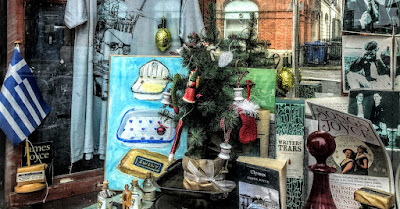
‘Ulysses’ and Joyce … Joyceana in Sweny’s window in Lincoln Place, Dublin (Photograph: Patrick Comerford, 2022)

Patrick Comerford

Bloomsday has come early to Dublin this year. Today marks the 100th anniversary of the publication of James Joyce’s Ulysses on 2 February 1922, and a plethora of Joycean activity around Dublin throughout this year.

Ulysses was first published 100 years ago, on 2 February 1922, by Sylvia Beach in her small bookshop in Paris, Shakespeare and Company. The book consumed seven years of Joyce’s life, and has transformed our culture and literary world.

Joyce celebrated his 40th birthday on the same day that Ulysses was published. In that same year, 1922, Ireland was grappling with its new independent status in the world. It is hard to imagine today that Ulysses was banned in the US and Britain until the 1930s, and that until Joyce died in 1941 he was out of favour with the Irish establishment. But no modern novel rivals Ulysses in its reach, and it has become the most influential pieces of modernist literature.

In my own personal celebration of this centenary, I visited a number of Joycean sites in Dublin yesterday (1 February 2022) during an extended walking tour between a dental appointment in the late morning and a consultation in mid-afternoon.

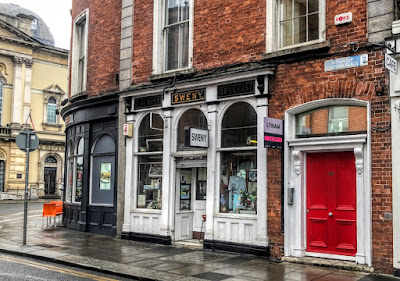
The places I visited included Sweny’s on the corner of Lincoln Place and Lower Merrion Street, where Leopold Bloom bought his lemon soap; and Kennedy’s, on the opposite corner of Lincoln Place and Westland Row, where Joyce once drank at the bar.

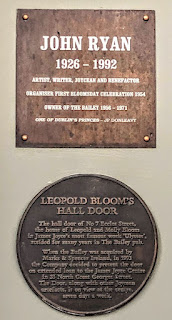
The Bailey on Duke Street once displayed the front door of 7 Eccles Street, where, according to Ulysses, Molly and Leopold Bloom lived on Bloomsday in 1904. When the Bailey was acquired by Marks and Spencer in 1993, the door was presented to the James Joyce Centre on North Great George’s Street.

Another plaque on the Bailey celebrated John Ryan (1926-1992), the ‘artist, writer, Joycean and benefactor’ who was the owner of the Bailey in 1956-1971, and who organised the first ‘Bloomsday’ celebrations in Dublin in 1954.

And, of course, on bus journeys in and out of the city centre, I passed the houses on Clanbrassil Street where Leopold Bloom may have been born, and where his neighbours, the Comerfords, lived when Molly Bloom was caught short after one of their parties. Joyce says Bloom was born at 52 Clanbrassil Street, two doors down from a Comerford family home.

Sweny’s on the corner of Lincoln Place and Lower Merrion Street, where Leopold Bloom bought his lemon soap (Photograph: Patrick Comerford, 2022)

RTÉ is marking the 100th anniversary with an extensive and ambitious programme of themed content across television, radio and online.

RTÉ One is screening 100 Years of Ulysses on television tomorrow night (10.15 pm, 3 February). This new documentary by the historian the late Frank Callanan and directed by Ruán Magan features interviews with writers and scholars including Eimear McBride, Paul Muldoon, John McCourt and Margaret O Callaghan, illuminative archive film and photographs, newly commissioned art works by Jess Tobin, Brian Lalor and Holly Pereira and a beautiful original score by Natasa Paulberg.

Tomorrow night’s 100 Years of Ulysses promises an enlightening journey into the heart of one of the most inspiring and influential novels and reveals how it remains relevant today.

RTÉ One is devoting a special edition of Nationwide to Ulysses this evening (7 pm, 2 February). Anne Cassin views the first ever printed copy of Ulysses with Katherine McSharry at the Museum of Literature Ireland. She meets Booker Prize-winning author Anne Enright, who shares her thoughts on Ulysses. She visits the Joyce Tower in Sandycove to meet with one of the early curators, Vivien Igoe. And she returns to Studio 9 in RTÉ with actor Patrick Dawson to hear about the marathon 30-hour radio dramatisation that was broadcast in 1982.

The feature ‘Book on One’ during Late Date on RTÉ Radio 1 each evening this week at 11.20 pm highlights the worldwide significance and influence of Ulysses on other writers.

A special edition of Arena on RTÉ Radio 1 this evening (7 pm, 2 February) is dedicated to Ulysses and the contributors include Colm Toibín, Nuala O'Connor, Mary Costello, John Patrick McHugh and Catherine Flynn.

Other contributions from RTÉ include Finnegans Wake – Suite of Affections, a new work by composer Roger Doyle; readings of excerpts from Ulysses and other works by Joyce; and ‘James Joyce’s Chamber Music: The Lost Song Settings and the Story of an Intriguing Collaboration.’

Nora, a novel by Nuala O’Connor, reimagines the fascinating love story of Nora Barnacle and James Joyce and has been chosen as the ‘One Dublin One Book’ choice for 2022.

An Post has launched two new postage stamps to celebrate this centenary. The Ulysses 100 stamps are the work by Amsterdam-based Irish designers, The Stone Twins, and consist of 18 sections, signifying the number of chapters in the book. The stamp design features photographs by the photographer JJ Clarke, who took vivid images of daily life in Dublin when he was a medical student in the city between 1897 and 1904.

Ulysses Journey 2022 is an international programme of music, film and talks to mark this centenary. It began yesterday (1 February 2022) and continues until 18 June 18, and is a collaboration between Contemporary Music Centre, Ireland (CMC) and Centre Culturel Irlandais (CCI).

To celebrate the centenary, six specially commissioned films are being screened in Dublin, Belfast, Paris and Budapest. Other programmes include an international concert series of new and existing works by Irish and Hungarian composers, which is appropriate given Leopold Bloom’s supposed Hungarian origins.

Plaques at the Bailey celebrate John Ryan and recall Leopold Bloom’s front door (Photograph: Patrick Comerford, 2022)

04 February 2021

A Wexford family history
features on RTÉ and makes
a ‘Nationwide’ publisher

Helen Skrine’s book on the Boxwell family and the publisher Michael Freeman featured on RTÉ’s ‘Nationwide’ this week

Patrick Comerford

When I was living in High Street, Wexford, Michael Freeman regularly called round, and I remember late night discussions about John Robinson’s Honest to God and Teilhard de Chardin’s theology.

At the time, he was involved in Macra na Feirme and I was working as a journalist with the Wexford People group of newspapers. He too became a journalist, and now he is a leading Wexford publisher, based in Rosslare, Co Wexford.

It was a delight to see Michael taking part in the RTÉ news magazine, Nationwide, earlier this week (1 February 2021), when it featured The Boxwells of Butlerstown Castle, the 200-page memoir about the Boxwell by Helen Skrine, a descendant of the Boxwell family. This is one of two books that arrived in the post unexpectedly a few weeks ago from Michael Freeman.

Michael is the publisher this book, edited by Helen’s daughter, Anna Skrine Brunton, and the programme was filmed in Butlerstown House, near Tacumshane, Co Wexford.

Helen Skrine (94) was secretary and later president of the Wexford Historical Society for some years in the 1980s. She wrote this book over a 30-year period, and in descriptive, colourful, and entertaining prose she tells of her experiences, and the history of her family in the 1798 Rising, the War of Independence, and the bleak 1950s.

The Boxwells are one among the families that for hundreds of years have owned castles in Co Wexford and have influenced social, political, economic and cultural change across the world.

The Bowxwells have lived for centuries at Butlerstown House and Butlerstown Castle, just a mile or two away from two other castles linked with the Boxwell family, Bargy Castle and Lingstown Castle. This is a fascinating memoir of the Boxwell family, which came England in the 1600s and settled in Co Wexford. She tells the story that is sometimes tragic and often-times funny.

She charts the contribution of members of the Boxwell family to government, medicine, sport, community and even rebellion, through war and peace to the present day.

Butlerstown Castle, like Ballybur Castle in Co Kilkenny, had its origins as a tower house, ‘a modest affair aimed not at warmongering or at display of power and wealth, but merely at survival, for defence in a hostile and embittered environment.’

The so-called ‘English’ baronies of Forth and Bargy in Co Wexford became more thickly populated with castles than any other part of Ireland. They included Bargy Castle built by the Rossiters, Lingstown Castle built by the Lamberts, Ballycogley Castle, built by the Waddings, and Butlerstown Castle, near Tomhaggard, built for the Butlers of Mountgarret, and with views north to Forth Mountain, west to the Comeragh Mountains in Co Waterford, and south to the Saltee Islands.

Helen traces the Boxwell family back to John Boxall or Boxwell of New College, Oxford, a favourite of Queen Mary, and John Boxwell (1614-1677) of Wootton Bassett, and a third John Boxwell who moved from Wootton Bassett to Co Wexford in the late 17th century.

For many people in Co Wexford, the Boxwell family is best-known for the close family relationship that links John Boxwell, John’s brother-in-law John Colclough and John’s cousin, Beauchamp Bagenal Harvey, the three key figures in the 1798 Rising in Wexford.

But she also tells the stories of colourful family members, including Susan Boxwell the artist; John Boxwell, Governor of Dhaka, now the capital of Bangladesh; William Boxwell, President of the Royal College of Physicians of Ireland; and Colonel Ambrose Boxwell of the Indian army.

There are honeymoons in Rome and Athens, tennis in Assam, Bengal and Chittagong, hunting with the Killinick Harriers, polo in Malaysia and a connection with Chris de Burgh. There are stories that take the reader to South Africa and Brazil, and of coffee in White’s Hotel, the Opera Festival in Wexford, and starting an arts centre in the Old Town Hall in Cornmarket.

There are intriguing connections with the Elgee family from Wexford and Oscar Wilde; with Whitley Stokes and William Stokes, pioneers in medicine; with Percy French; and through her mother with the St Leger family of Doneraile. And there is the story a ‘visit’ to Bargy Castle by the IRA during a Christmas party at the height of the Irish Civil War.

In addition, 16 family trees help guide the reader labyrinthine details of the different branches Boxwell family tree, with the many intermarriages within the Boxwell family, the details of kinship with other kindred families, including the Harveys, the MacMurroughs Kavanaghs and the St Legers, and extensions of the family to Abbeyleix, Liverpool and Brazil.

The cover photographs are by Jim Campbell and Ger Lawlor, while many of the photographs inside this generously illustrated book are by Ger Lawlor, Helen’s son-in-law Simon de Courcy Wheeler and Pat O’Connor.

The programme this week featured Michael Freeman and Helen Skrine’s friend Maeve Davison of Bargy Castle, mother of the singer-songwriter Chris de Burgh.

Michael Freeman is from Glynn, Co Wexford. He lived in Dublin for many years, working as a freelance journalist, a press officer for Macra na Feirme and in PR and publishing. He returned to Wexford with his wife Brigid in 2005 and now lives in Rosslare.

A suggestion by the Wexford historian and author Nicky Furlong led him to set up Three Sisters Press, and the first book he published was volume five of Nicky’s Wexford in the Rare Auld Times. Other books from Three Sisters Press include Sailor, Airman, Spy, Memoir of a Cold War Veteran by Ted Hayes (2018).

Perhaps, after this week’s programme on RTÉ, he can be regarded as truly ‘Nationwide’ publisher.

Helen Skrine’s book on the Boxwell family was a recent welcome gift in the post (Photograph: Patrick Comerford)

23 January 2021

Charles Gray-Stack (1912-1985): a former
Dean of Ardfert and Precentor of Limerick

Nantenan Glebe near Askeaton … Charles Gray-Stack lived there in the 1950s (Photograph: Patrick Comerford)

Patrick Comerford

The death of the Revd Martha Gray-Stack (1935-2021) earlier this week reminded me that her late husband, Dean Charles Gray-Stack (1912-1985), was one of my predecessors as Precentor of Limerick, and long before me he had been in ministry in the Rathkeale Group of Parish in the 1940s and 1950s. He was also a well-known contributor to the The Irish Times in the 1950s and 1960s.

When a project looking at my predecessors as Precentors of Limerick was postponed some months ago due to pandemic limits on public events, I thought it might still be interesting to continue looking at past precentors in a number of blog postings.

In earlier postings, I recalled some previous precentors who had been accused of ‘dissolute living’ or being a ‘notorious fornicator’ (Awly O Lonysigh), or who were killed in battle (Thomas Purcell). There were those who became bishops or archbishops: Denis O’Dea (Ossory), Richard Purcell (Ferns) and John Long (Armagh).

There was the tragic story too of Robert Grave, who became Bishop of Ferns while remaining Precentor of Limerick, but – only weeks after his consecration – drowned with all his family in Dublin Bay as they made their way by sea to their new home in Wexford (read more HERE).

In the 17th century, two members of the Gough family were also appointed Precentors of Limerick. In all, three brothers in this family were priests in the Church of Ireland and two were priests in the Church of England, and the Rathkeale branch of the family was the ancestral line of one of Ireland’s most famous generals (read more HERE).

In the mid to late 18th century, two members of the Maunsell family were Precentors of Limerick: Richard Maunsell (1745-1747) and William Thomas Maunsell (1786-1781) (read more HERE).

They were related to Canon John Warburton who was, perhaps, the longest-ever holder of the office, being Precentor of Limerick for 60 years from 1818 until he died to 1878 (red more HERE).

Earlier this week, I looked at Warburton’ successor, Canon Frederic Charles Hamilton, who provides an interesting links with both this group of parishes, with the Mariners’ Church in Dún Laoghaire and the Anglican mission agency SPG, now USPG (United Society Partners in the Gospel), of which I am a trustee. (see HERE).

As I move to the end of the 19th and the early 20th century, Hamilton’s successor as Precentor, Francis Meredyth, was a published poet and dramatist, and some of the Precentors of Limerick were also among the last Deans of Ardfert, including Robert Archibald Adderley (1870-1946), who also served in Listowel and Ballybunion (see HERE).

Charles Maurice Gray-Stack was born in Armagh, the son of the Revd William Bagot Stack (1878-1953), a grandson of Charles Maurice Stack (1825-1914), Bishop of Clogher (1886-1902), and a descendant of the Stack family of Stackstown and Crotta, Co Kerry.

The Stacks were a prominent clerical family in the Church of Ireland. The bishop’s father, the Revd Edward Stack, and grandfather, Canon Walter Bagot, were both priests, while his brothers included Canon Thomas Stack (1810-1871) was an SPG missionary in New South Wales before moving to Sydney; and the Revd Richard Stack (1815-1851), curate of Saint Peter’s and known for his work as a ‘slum priest’ in Dublin.

The Revd William Bagot Stack (1878-1953) had worked in British colonial administration in Central Africa and was a lieutenant in the Royal Irish Fusiliers before being ordained deacon in 1907 and priest in 1908. Later in life he was the Rector of Dundalk (1934-1941) and Rector of Inistioge, Co Kilkenny (1941-1946) in the Diocese of Ossory.

He was educated at Campbell College Belfast and Trinity College Dublin (BA, MA), and was ordained deacon in 1937 and priest in 1939. He served his first curacies in Birr (1937-1938) and then in the dioceses of Ferns and Ossory – Ardamine (1938-1940), Kilnehue and Kilpipe (1940-1941) and Inistioge (1941-1944), where his father was the rector.

He then moved to the Diocese of Limerick and Ardfert, and for five years was the diocesan curate in Ardfert and Aghadoe and curate of Killarney (1944-1949). While he was there, he obtained a confirmation of the coat of arms of Bishop Charles Maurice Stack for the bishop’s descendants in 1948.

He moved to the Rathkeale and Nantenan Union of Parishes as curate in 1949, when Maurice Talbot, a future Dean of Limerick, was the rector, and lived for five years at Nantenan Glebe. During his time here, he changed his surname from Stack to Gray-Stack, recalling his maternal grandfather, Dr Robert Gray of Armagh.

He moved to Co Kerry as a parish rector in 1953, first in Kilgobbin (1953-1961), which included Dingle from 1957, and then in Kenmare and Sneem (1961-1985), which included Waterville and Valentia from 1984.

In the cathedral chapter, he was Prebendary of Ballycahane (1962-1963), Precentor of Limerick (1963-1966), and Chancellor of Limerick, Prebendary of Kilpeacon and Dean of Ardfert (1966-1985). Of course, the title of Dean of Ardfert was an honour or sinecure, often offered to the most senior rector in the Diocese of Ardfert: the cathedral in Ardfert had ceased to function for a long time, and the church there closed in the 1940s.

He married Martha Mary Stewart-Clarke from Castledawson in Saint George’s Church, Belfast, in 1959.

Charlie Gray-Stack became a national figure for his regular contributions to The Irish Times and to RTÉ. He was known as a liturgist and for his engagement in social affairs. He was prominent in ecumenical activities, especially the Glenstal and Greenhills ecumenical conferences.

When he died on 25 July 1985, he was still Rector of Kenmare and Dean of Ardfert, and his funeral at Saint Patrick’s Church, Kenmare, was featured on the RTÉ news.

His widow, Martha-Gray Stack, was ordained deacon in 1990 and priest in 1991. She was an NSM curate in Saint Mary’s Cathedral and Saint Michael’s Church, Limerick (1990-1993), Rector of Clara (1993-2000), and the chaplain of Kingston College (2000-2010) in Mitchelstown, Co Cork. She died earlier this week (21 January 2021).

Saint Brendan’s Cathedral, Ardfert, Co Kerry … Charles Gray-Stack was the Dean of Ardfert in 1966-1985 (Photograph: Patrick Comerford)

15 January 2021

A ‘Day in the Sun’ in mid-November with RTÉ and the Cardinal

AWN Pugin (1812-1852)

Patrick Comerford

We were a disparate and motley group of half a dozen who arrived from Kimmage Manor in Maynooth for our conferring on one dark November day in 1987. In my first year at Kimmage Manor there were 13 of us on the BD course. Now, three years later, we were just six.

The Theology Faculty at Kimmage Manor has long since been absorbed into other schools and colleges. But in the 1980s, it had a special relationship with Maynooth that allowed its students to sit for the degree of bachelor of divinity.

It was an unusual arrangement, and in academic fiction it was supposed to apply only to students preparing for ordination and sponsored by either the Spiritans at Kimmage Manor or the Redemptorists at Marianella. But I had been brash and cheeky enough to knock on the front door one summer evening and ask John O’Brien could I sign up for the three-year programme.

My lecturers and professors were mainly either Redemptorists or Spiritans. The Redemptorist Con Casey coached me through the philosophy requirement Maynooth sought before completing the course in theology. The Spiritan Paddy Ryan taught us Church history. Another Redemptorist, Brendan McConvery, who had lectured on New Testament studies, would present us to the chancellor of the Pontifical University, Cardinal Tomás Ó Fiaich, who would die within three years.

We were the only six from Kimmage Manor that day, and I was the only member of the Church of Ireland. The other five teased: Would I be presented as a Redemptorist? Would I be presented as a Spiritan?

Outside, the late Eddie Kelly of the Irish Times was waiting to take photographs. He too teased me: would I like my photograph in the paper tomorrow morning – the very paper where I was a staff journalist? The story is still told of an embarrassing moment when Eddie was covering the funeral of Cardinal Conway in Armagh ten years earlier – a gust of wind carried Eddie’s hat into the grave, along with the cardinal.

I sat in the chapel comfortably, waiting for our names to be called and for Brendan McConvery to lead us up. My great-grandfather, James Comerford, had worked with the architects A.W.N. Pugin, Richard Pierce and J.J. McCarthy on their churches in County Wexford. After Pugin died in 1852 and Pierce died in 1854, James Comerford moved from Wexford to Dublin, married, and found new architectural commissions with the Board of Works and designing public houses. As I gazed up at the stucco work and ceiling, and admired the craftsmanship throughout the Gothic Revival chapel, I wondered whether James, who became the patriarch of our branch of the family, had ever worked with any one of this great architectural trio in Maynooth.

As our names were called out, I realised how we were less than half the number who entered the first lectures three earlier. As I was introduced to Cardinal Ó Fiaich, I was greeted with a broad, knowing grin. Yes, he remembered me. He knew of my work with the Campaign for Nuclear Disarmament (CND); Seán MacBride had given him a copy of my recent book; he knew me from the Irish Times; he had listened to Christian CND while the Irish bishops were preparing The Storm that Threatens, their joint statement in 1983 ‘on war and peace in the nuclear age,’ and he had appreciated my comment on it in the Furrow later that year.[1]

As we processed out, to applause from our families and our professors, the television cameras were waiting for us too. It was one thing to bump into a photographer who was a colleague on the Irish Times; it was another thing to find RTÉ cameras had turned up at our graduation.

We rushed home that evening, not just to share a bottle of bubbly and cut a special cake, but also hoping to be in time for the six o’clock news. However, earlier that day, the loyalist politician and paramilitary George Seawright – whose calls for ‘revenge and retribution’ made him too toxic for both the Democratic Unionist Party and the Free Presbyterians – had been shot in a black taxi on the Shankill Road in Belfast.

Once again, events in Northern Ireland dominated the evening news. Maynooth had slipped down the list of news priorities, and Cardinal O Fiaich’s interview must have been heavily edited. Nevertheless, he still got his point across: a large number of women were among the BATh graduates that day, and he expressed his hopes that women with inquiring theological minds would one day find a greater role in the life of the Church. Some of those women graduates served to illustrate his argument.

The six of us from Kimmage Manor could be seen in the background on the news report that evening – although, perhaps, only by ourselves and those who loved us. We had our day in the sun, even if it was mid-November.

George Seawright was shot on 19 November and died from his wounds on 3 December; Tomás Ó Fiaich died just over two years later on 8 May 1990. Two men of very different backgrounds, temperaments and values had been brought together on the news for very different reasons on the day of my graduation in Maynooth. As for Eddie Kelly, his trademark hat sat on his coffin at his funeral in January 2010.

Of the six of us from Kimmage Manor who arrived in Maynooth that day, one is a now well-known broadcast journalist, one is working in London on development programmes, and one quickly resigned from active priestly ministry; two are Redemptorist priests; and I was ordained in the Church of Ireland by Archbishop Walton Empey thirteen years later.

Many years after our ‘day in the sun,’ as I was thumbing through some forgotten books on my bookshelves, I came across a well-thumbed postcard from Tomás Ó Fiaich which had been used as a bookmark. My regular return visits to Maynooth have included a quiet day in the chapel on my own self-designed retreat shortly before my ordination, many book launches, as a visiting lecturer and as a guest when Brendan McConvery was given an honorary doctorate.

[1] Patrick Comerford, 'The Storm That Threatens: A Comment', in The Furrow Vol 34, No 10 (October 1983), pp 620-625.

This is a chapter in We Remember Maynooth: A College Across Four Centuries, ed Salvador Ryan and John-Paul Sheridan (Dublin: Messenger Publications, 2020, 512 pp), pp 363-365.

Notes on Contributors (p 496):

Patrick Comerford is a priest in the Church of Ireland Diocese of Limerick, a former adjunct assistant professor in TCD, and a former lecturer in the Church of Ireland Theological Institute

25 November 2020

Sailing between Scylla
and Charybdis, trying
to set the right course

The National Library of Ireland ... the venue for ‘Scylla and Charybdis,’ the ninth episode in ‘Ulysses’ (Photograph: Patrick Comerford)

Patrick Comerford

The Tánaiste, Leo Varadkar, was trying to sail through choppy waters in Dail yesterday afternoon (24 November 2020) as he spoke about Covid-19 and hinted at the government plans to lift or ease the pandemic lockdown.

He said, ‘As we all know, the Government faces difficult decisions in the week ahead, as we approach the end of six weeks of Level 5 restrictions. We sail between Scylla and Charybdis in trying to set the right course.’

‘In doing so, we know for certain that increased human interaction will result in more people getting infected thus increasing the chance of a third wave.’

Journalists discussing the debate on RTÉ’s ‘Drive Time’ later in the day feigned or boasted ignorance of the reference, and even seemed to delight in mispronouncing both Scylla and Charybdis; reports in The Irish Times today seem to miss the reference altogether.

There was a time when both media outlets had a number of staff journalists with at least a basic classical education, and a time when staff journalists in The Irish Times who did not understand the classical significance of the Tánaiste’s classical citation would at least have understood its place in the canon of Irish literature through James Joyce’s Ulysses.

Scylla and Charybdis are two immortal and irresistible monsters in Greek mythology and literature, and they beset the narrow waters navigated by Odysseus in his wanderings described in Homer’s Odyssey, Book XII. They were later localised in the Strait of Messina, between Sicily and the tip of the Italian mainland.

Scylla was a supernatural female creature, with 12 feet and six heads on long snaky necks, each head having a triple row of sharklike teeth, while her loins were girdled by the heads of baying dogs. From her lair in a cave, she devoured whatever ventured within reach, including six of Odysseus’s companions.

Charybdis, who lurked under a fig tree a bowshot away on the opposite shore, drank down and belched forth the waters thrice a day and was fatal to shipping. Her character was most likely the personification of a whirlpool. The shipwrecked Odysseus barely escaped her clutches by clinging to a tree until the improvised raft that she swallowed floated to the surface again after many hours.

Later, Scylla was often rationalised in antiquity as a rock or reef.

‘Scylla and Charybdis,’ the ninth episode in Joyce’s Ulysses, is set in the National Library in Dublin, where Stephen Dedalus delivers his much-anticipated (though sparsely attended) lecture on Shakespeare and Hamlet.

As Dedalus delivers his lecture, he navigates between various pairs of powerful forces: the ideas of Aristotle and Plato, the impulses of youth and maturity, the relationship between the artist and art, and the disciplines of dogmatic scholasticism and spiritual mysticism.

It is like, one might say, being caught between a rock and a hard place.

Leo Varadkar has shown in the past how he can out-do Boris Johnson when it comes to quoting from the Classics.

As last night’s speech by Joe Biden shows once again, the Brexit negotiations are more complicated by the position of Northern Ireland. I imagine that for Spanish negotiators, there are similar concerns about the Rock of Gibraltar.

Perhaps when Leo Varadkar is next swapping classical quips with Boris Johnson, he may remind him of what it is to be caught between a rock and a hard place.

Gibraltar has been British since 1704 … but could Boris Johnson be caught between a rock and a hard place? (Photograph: Patrick Comerford)

21 October 2020

Lily Comerford (1900-1969):
a pioneer in promoting
Irish dancing and folk song

Lily Comerford being interviewed by Des Keogh for RTÉ in 1964 (Photograph: RTÉ archives)

Patrick Comerford

The name of Lily Comerford (1900-1969) has been associated with Irish dancing and Irish folk songs since the 1920s. She was the founder and director of the Irish Folk Dance Society and for 40 years a member of An Comisiún Le Rincí Gaelacha, the Irish Dancing Commission, founded in 1927.

Lily Comerford was born Elizabeth Mary Comerford at 74 Capel Street, Dublin, on 11 January 1900, and was baptised in Saint Mary’s Pro-Cathedral, Dublin, on 19 January 1900. She was a daughter of John Comerford (1870-1918), who later had a shop at 32 Parnell Street, and his wife Bridget (née McGuinness).

The descent of this family can be traced back to:

Patrick Comerford (? born ca 1802/1807), who married Margaret … They were the parents of:

James Comerford (? born ca 1832/1837) of 33 Lower Church Street, Dublin (1862) and 44 Reginald Street, Dublin, who worked in a distillery. He married Elizabeth White, daughter of Thomas and Margaret White, in Saint Mary’s Pro-Cathedral, Dublin, on 13 July 1862. They were the parents of:

John Comerford (1870-1918), who was born on 2 May 1870 at Marrowbone Lane, Dublin. He later lived at 44 Reginald Street (1896), 74 Capel Street (1897-ca 1904), Britain Street Great (ca 1911-ca 1916) and 32 Parnell Street (ca1916-1918).

John began life as cycle mechanic, later worked as an engineer, and in his 40s he was running a shop in Parnell Street, off O’Connell Street in Dublin.

John Comerford and Bridget McGuinness were married in the Pro-Cathedral, Dublin, on 4 October 1896. She was the daughter of Martin McGuinness and his wife Esther (née Thomas). They were the parents of two sons and four daughters:

1, Esther Josephine, born on 27 September 1897 at 74 Capel Street; she married Michael John Jesson (1895-1944) in the Pro-Cathedral on 7 February 1918.

2, Elizabeth Mary (Lily) Comerford (1900-1969).

3, Martin Comerford, born at 74 Capel Street on 2 October 1902.

4, Patrick Comerford, born at 74 Capel Street on 12 November 1904.

After the Easter Rising in Dublin in 1916, John Comerford claimed for a total loss of £29 for household goods and damage to his building and the contents at 32 Parnell Street. He claimed his windows had been broken and his shop wrecked during Easter Week. The glass cases had been put in, and the furniture damaged included a mahogany table, six chairs, and a ‘chimney pier glass.’

He also sought compensation for repairs to the roof. However, a claim for £18.10.0 in cash taken from a box was not allowed, and he received a total of £14. Nearby, at No 75A, at the junction of Parnell Street Lower and O’Connell Street, one of the signatories of the 1916 Proclamation, Tom Clarke, owned a tobacconist’s shop.

Seven months after the marriage of his elder daughter Esther, John Comerford died at 32 Parnell Street on 21 September 1918.

Meanwhile, his younger daughter, Lily, was learning Irish dancing at the Maxwell Brewer Academy of Irish Dancing, and traditional set-dances from Cormack O’Keeffe of Cork.

By the early 1920s, she had opened a class for children, and she became the first woman in Ireland to make a career out of dance teaching. Out of her love for children, she started to teach dancing to the local children once a fortnight at a penny a lesson. Her many successes included training champions like Rory O´Connor, the well-known teacher and adjudicator.

At a time when Irish dancing was virtually unheard of outside Ireland, Lily presented skilfully designed and executed team dances in venues such as the Albert Hall and the London Palladium on several occasions.

Her team was invited to the Eisteddfod at Wrexham in Wales in 1933. This festival later gave Lily the idea of forming the Irish Folk Dance Society.

During a tour of Germany in the mid-1930s, Lily Comerford presented one of her ‘spectaculars’ in Berlin. The organisers were impressed by her reputation and invited several leading figures in the Third Reich. Their reports led to Lily Comerford and her troupe being asked to perform before Hitler on 28 September 1934, and it is said he presented her with a civilian decoration.

Her troupe also appeared before Queen Juliana of the Netherlands and Lily was presented to the Dutch monarch.

Other awards that came her way included the much-coveted Feis Atha Cliath Shield, which she held for 10 years. She was an eloquent speaker and an untiring worker with a steely quality.

She married Roy Thomson, a professional pianist, on 20 August 1945. In his own words, this made him ‘Mr Comerford.’

She travelled regularly throughout Europe with her troupe of dancers. She founded the Irish Folk Song and Dance Society in 1951 to develop and promote folklore and to create better understanding between people of all nations through music, song and dance. Since it was founded, Lily Comerford’s name has remained synonymous with the society. In 1958 she was Ireland’s representative to the Federation of International Folk Groups.

Lily Comerford was such a legend in her own time that letters addressed simply ‘Lily Comerford, Post Office, Dublin’ were delivered to her.

RTÉ’s Newsbeat broadcast an interview with her by Des Keogh on 17 September 1964.

Roy Thomson died on 23 November 1968; Lily Comerford died on 9 March 1969, and they are buried in Mount Jerome Cemetery, Harold’s Cross.

The grave of Lily Comerford and her husband Roy Thomson in Mount Jerome Cemetery, Harold’s Cross, Dublin (Photograph: Patrick Comerford)

Last updated: 25 June 2023

25 July 2019

A sculpture on Red Island
honours Skerries title
as Ireland’s tidiest town

Shane Holland’s sculpture on Red Island celebrates Skerries winning the Tidy Towns Competition in 2016 (Photograph: Patrick Comerford, 2019)

Patrick Comerford

As I walked around Red Island in Skerries earlier this week, I saw for the first time a new sculpture by the sculptor Shane Holland. This new sculpture on the seafront at Red Island was commissioned to celebrate Skerries winning the Tidy Towns Competition in 2016, and was unveiled on 11 December 2017.

The sculpture was commissioned by Skerries Tidy Towns who approached Shane Holland to design a suitable piece to acknowledge Skerries being named as Ireland’s Tidiest Town in 2016.

This is a permanent, marine-grade structure that people in Skerries hope is going to become a landmark for the town. The project was co-funded by Fingal County Council, and the commission was supported by 13 local organisations and businesses from Fingal, Meath, Limerick and Dublin.

The sculpture is located on council land between the car park and the playground, just six metres from the seafront. This location made the installation challenging, and at times the site works were almost blown into the sea during Storm Ophelia.

This 4.3 metre sculpture on Red Island is based on the National Tidy Towns Trophy, originally designed by Shane Holland in 2006. It is made in marine-grade stainless steel, designed to be hard-wearing and withstand the wear from its close proximity to the sea and from natural grange limestone that comes from near Newgrange, Co Meath, and that was supplied by James Gogarty.

One of four swipe-like prongs represents the theme of Plant Life (Photograph: Patrick Comerford, 2019)

The sculpture has four swipe-like prongs extending from the central base, each with a pattern representing four separate themes: Water, Plant Life, Heritage and the Built Environment or architecture. Each swipe reaches for the sky on the headland of Red Island.

Walkers are invited to sit on the limestone plinth. The piece also features 12 lights that make it visible from the sea as well as to people passing by on land and on the beach.

The plinth is surrounded by five metres of concentric limestone cobbles expertly laid by Anthony Kelly from neighbouring Rush.

The structure weighs about five tonnes, including the five metres of cobblestone that surrounds it.

Shane Holland designs many high-profile trophies for national events, including the RTÉ Sports Star Awards. He lives in Skerries and runs his workshop in Duleek Business Park near Drogheda.

His works have been exported across the world and are sought after by collectors of lighting, furniture and sculpture. He has been involved in previous Skerries projects, including the Pole Sea Memorial and works at the Community Centre and Skerries Harps GAA Club.

One of four swipe-like prongs represents the theme of Heritage (Photograph: Patrick Comerford, 2019)

19 July 2018

When McNamara truly was
the leader of the band in
Saint Mary’s Parish, Limerick

The ‘birthplace’ of McNamara’s Band in Mary Street, Limerick (Photograph: Patrick Comerford, 2018)

Patrick Comerford

The Chas Flats are part of a boarded-up complex of apartments, with broken windows and doors and a sad air of abandonment, on the corner of Mary Street and Creagh Lane, awaiting redevelopment in heart of the old city on King’s Island.

A fading green plaque placed on one of the gable ends on Mary Street by Limerick Civic Trust is now almost illegible to make out but once read:

McNamara’s Band
1905-1927
This world-wide
celebrated musical ensemble got
its name from the Limerick brothers –
Paddy, Michael, Jack and Tom
McNamara,
all of whom were born in
St Mary’s Parish

“My name is McNamara,
I’m the leader of the Band”.


The fading plaque placed on the Chas Flats by Limerick Civic Trust (Photograph: Patrick Comerford, 2018)

This is one of the oldest parts of Limerick, the street names are reminders of the city’s mediaeval legacy, and these houses stand beside Fanning’s Castle, a tower house dating from the 16th and 17th centuries and built by the Whitamore and Fanning families, two of the leading merchant and political families in late Tudor, Stuart and Cromwellian Limerick.

A few doors away down Mary Street, the band room of Saint Mary’s Band Room bears the date 1885. But the building was erected in 1922, and the date refers to the foundation of the band in 1885.

Three years later, in 1889, Shamus O’Connor and John J Stamford wrote the first version of ‘McNamara’s Band.’ The song was originally about a one-man band, but people in Limerick insist it was inspired by Saint Mary’s Band, which at the time included many members of the McNamara family from Saint Mary’s Parish.

Stamford, who wrote the lyrics, was then the manager of the Alhambra Theatre in Belfast and the song was written expressly for the theatre’s owner, the Irish-American music hall veteran William J ‘Billy’ Ashcroft.

Saint Mary’s Fife and Drum Band was founded in 1885. From its humble beginnings in the Yellow Driller on the King’s Island, it moved to Nicholas Street, then to Barrington’s Mall, Fish Lane and finally in 1922 the new band room was built in Mary Street.

The band was the brainchild of Patrick ‘Todsy’ McNamara, an Abbey fisherman, and many of his fisher friends formed the original band.

The founding figures in the band included Paddy Salmon, Steve Collins, the brothers Patrick and Michael McNamara, Paddy (Halley) Kennedy, Jack Gogarty, Jim Ring, Paddy (Sparrow) O’Donoghue and his two brothers, Ned Walsh, John Lynch, Tom Forward, Jack McNamara, John Hayes, Jim Doyle, and Gerry, Michael and Jimmy Frawley.

At its first attempt in September 1885, the band won the All-Ireland Championship under the baton of Steve Collins. By the late 19th century, Saint Mary’s Fife and Drum Band included the four McNamara brothers named on the fading plaque – Patrick, John, Michael and Thomas – and played throughout Ireland.

In the early 20th century, Patrick and Thomas McNamara emigrated to New York, where they formed ‘McNamara’s Band’ with Patrick ‘Patsy’ Salmon, another Limerick emigre. When Patsy Salmon left, Patrick and Thomas McNamara formed ‘McNamara’s Trio,’ with Thomas on piccolo, Patrick on violin and Patrick’s daughter Eileen on the piano. The trio recorded and released several songs.

During World War I, three members of the band were killed in action within six months of each other in 1915. John McNamara, who remained behind in Limerick, enlisted in the Royal Munster Fusiliers and fought in the Second Boer War and World War I. He was killed in action on 9 May 1915, and his body was never recovered. He is remembered on Le Touret Memorial in France.

Saint Mary’s Prize Band was founded in 1885, and the present band room on Mary Street was built in 1922 (Photograph: Patrick Comerford, 2018)

A recording of ‘McNamara’s Band’ features in the film The Way to the Stars (1945), in which Stanley Holloway leads the crowd in a pub close to a Royal Air Force base during World War II.

Later that year, on 6 December 1945, Bing Crosby recorded the best-known version of the song. It was released early in 1946, when the lyrics were credited to ‘The Three Jesters’ (Red Latham, Wamp Carlson and Guy Bonham). It was an immediate Top 10 hit for Bing Crosby and remains one of his most popular songs.

The English Premier League team Tottenham Hotspur also adopted the song as its club anthem. Supporters claim the song was written in Barnet, not far from White Hart Lane, the Spurs home in North London until last year (2017).

Other sources say it became the Spurs song because Peter McWilliam was a long-time Spurs manager (1912-1927, 1938-1942) and ‘Mac’s Band’ became his song appropriately.

With its Irish resonances, the song was revived at White Hart Lane when the Northern Ireland international Danny Blanchflower joined Spurs in 1954. The song experienced another revival in the ‘Glory years’ of the early 1960s, and continued to be played until last year as the players emerged from the tunnel after half-time and returned to the pitch for the second half.

The original lyrics of the song are:

My name is McNamara, I’m the Leader of the Band,
And tho’ we’re small in number we’re the best in all the land.
Oh! I am the Conductor, and we often have to play
With all the best musicianers you hear about to-day.

(Chorus)

When the drums go bang, the cymbals clang, the horns will blaze away,
MacCarthy puffs the ould bassoon while Doyle the pipes will play;
Oh! Hennessy Tennessy tootles the flute, my word ’tis something grand,
Oh! a credit to Ould Ireland, boys, is McNamara’s Band!

Whenever an election’s on, we play on either side –
The way we play our fine ould airs fills Irish hearts with pride.
Oh! if poor Tom Moore was living now, he’d make yez understand
That none could do him justice like ould McNamara’s Band.

(Chorus)

We play at wakes and weddings, and at every county ball,
And at any great man’s funeral we play the ‘Dead March in Saul,’
When the Prince of Wales to Ireland came, he shook me by the hand,
And said he’d never heard the like of ‘McNamara’s Band.’

In the Bing Crosby 1946 version, the politics of ‘Ould Ireland’ are removed and the words are made more ‘Oirish.’ ‘My name is ...’ becomes ‘Me name is ...,’ the Prince of Wales becomes General (Ulysses) Grant, and stereotypes are added in the final lines to make it a comedy song.

Oh!, me name is McNamara, I’m the Leader of the Band,
And tho’ we’re few in numbers we’re the finest in the land.
We play at wakes and weddings, and at every fancy ball,
And when we play at funerals we play the march from Saul.

(Chorus)

Oh! the drums go bang, and the cymbals clang,
and the horns they blaze away,
McCarthy pumps the old bazoon
while I the pipes do play;
And, Hennessey Tennessey tootles the flute,
and the music ’tis somethin’ grand,
A credit to old Ireland is McNamara’s Band!

Right now we are rehearsin’ for a very swell affair,
The annual celebration, all the gentry will be there.
When General Grant to Ireland came,
he took me by the hand,
Says he, ‘I never saw the likes of McNamara’s Band.’

(Chorus)

Oh me name is Uncle Yulius
and from Sweden I have come,
To play with McNamara’s Band
and beat the big bass drum,
And when I march along the street
the ladies think I’m grand,
They shout ‘There’s Uncle Yulius
playing with an Irish band.’

(no chorus)

Oh! I wear a bunch of shamrocks
and a uniform of green,
And I am the funniest looking Swede
that you have ever seen.
There’s O’Briens and Ryans and Sheehans and Meehans,
they come from Ireland,
But by Yimminy I’m the only Swede
in McNamara’s Band.

This version also misses the cultural significance of the reference to ‘The Dead March’ in Act 3 of Handel’s oratorio Saul. ‘The Dead March’ introduces the obsequies for the deaths of Saul and Jonathan, and includes an organ part and trombones alternating with flutes, oboes and quiet timpani. It has been played at most British state funerals, and was performed too at the funerals of George Washington and Abraham Lincoln.

The White Hart Lane version has changed one verse:

Oh the whistle blows the cockerel crows,
and now we’re in the game,
It’s up to you, you Lilywhites,
to play the Tottenham way.
Oh there’s many a team from many a town
and some are great and small,
But the famous Tottenham Hotspur
are the greatest of them all.

In August 1965, Arthur Quinlan interviewed Thomas McNamara, the last surviving member of McNamara’s Band, for RTÉ News outside the venue where it all began in 1885. Thomas, who played flute and piccolo with the quartet, died in May 1978.

Saint Mary’s Band has continued to honour the custom of parading through Saint Mary’s Parish on New Year’s Eve and then to Saint Mary’s Cathedral to ring out the old year and to ring in the New.

Saint Mary’s Band continues as part of the life of Saint Mary’s Parish (Photograph: Patrick Comerford, 2018)