The Lichfield Gospels or Saint Chad’s Gospel, dating from 730, is the greatest treasure in the mediaeval library at Lichfield Cathedral (Photograph: Patrick Comerford)
Patrick Comerford
We are continuing in Ordinary Time in the Church Calendar, we returned to ordinary time in the secular time too when the clocks went back overnight, and today is the Last Sunday after Trinity (25 October 2026). Dare I say it, but we are also just two months from Christmas.
Later this morning, I am reading one of the readings and leading the intercessions at the Parish Eucharist in Saint Mary and Saint Giles Church, Stony Stratford.
In many parishes this morning, the Gospel reading in the lectionary is Matthew 22: 34-46. But in places, including Stony Stratford, where this Sunday is being marked as Bible Sunday, the readings are: Nehemiah 8: 1-4a [5-6] 8-12; Psalm 119: 9-16; Colossians 3: 12-17; Matthew 24: 30-35.
Before today begins, meanwhile, I am taking some quiet time early this morning to give thanks, and for reflection, prayer and reading in these ways:
1, today’s Gospel reading;
2, a short reflection;
3, a prayer from the USPG prayer diary;
4, the Collects and Post-Communion prayer of the day.
‘Give thanks for those whose inspiration is the Law, the Prophets and the Writings of Holy Scripture’ … pages from a hand-made copy of Saint John’s Gospel in the ‘Holy Writ’ exhibition in Lichfield Cathedral some years ago (Photograph: Patrick Comerford)
Matthew 24: 30-35 (NRSVA):
[Jesus said:] 30 ‘Then the sign of the Son of Man will appear in heaven, and then all the tribes of the earth will mourn, and they will see “the Son of Man coming on the clouds of heaven” with power and great glory. 31 And he will send out his angels with a loud trumpet call, and they will gather his elect from the four winds, from one end of heaven to the other.
32 ‘From the fig tree learn its lesson: as soon as its branch becomes tender and puts forth its leaves, you know that summer is near. 33 So also, when you see all these things, you know that he is near, at the very gates. 34 Truly I tell you, this generation will not pass away until all these things have taken place. 35 Heaven and earth will pass away, but my words will not pass away.’
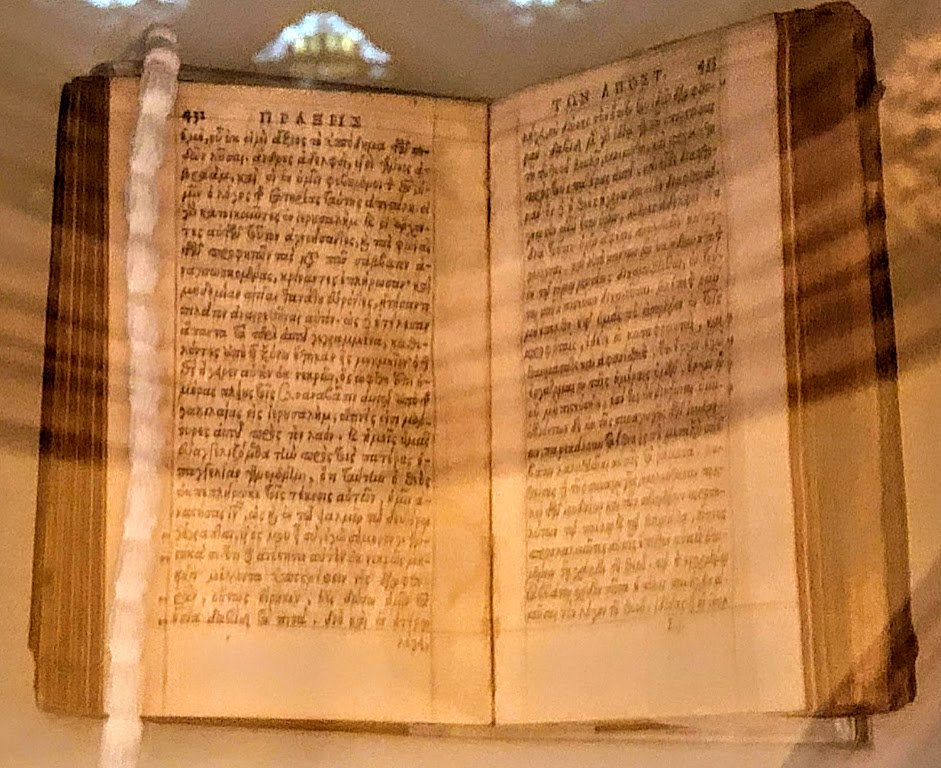
A Greek New Testament in the library in Lichfield Cathedral was published in Paris in 1569 (Photograph: Patrick Comerford)
Today’s Reflections:
My idea of indulgence is spending hours on end in the bookshops – new and second-hand – in Dublin, in Cambridge and in Oxford, and I still miss the old Staffs Bookshop in Lichfield, once my favourite second-hand bookshop.
But, as I navigate my way through the aisles and shelves of bookshops, I find I cannot help noticing the very limited versions of Bibles on many shelves. I seldom set out to buy a new Bible – my bookshelves have been stacked with a variety of translations and versions, usually known by their Initials (NRSV, NRSVA, JB, RSV, NIV, AV … ), and with Bibles in many languages, including English, Irish, Greek, Hebrew, French, Italian, Latin and Chinese – bought in Shanghai … I once had a version in Xhosa, bought in South Africa.
For a long-time I I clung onto some of these Bibles, even when they were bruised and battered, torn and dog-eared. I still have a King James Version that I think I was given during my school days.
There was a Living Bible, paraphrased by Kenneth Taylor … this version was printed in 1972 and sold for £1. It was heavily marked and stained, having endured being packed into rucksacks and travelling with me as I hitch-hikeded around Ireland and England at the age of 20.
My copy of the New English Bible had a note of where and when it was bought over 50 years ago: ‘Lichfield, 10.9.1973’ … I still remember that day, because the coup against Allende was staged in Chile the following day. The art nouveau illustrations by Horace Knowles are still a pleasure to come across.
I bought my first version of the Common Bible, with its ecumenical presentation of western and eastern canonical books, when I was working in Wexford in 1974. It was a paperback edition that fell apart through years of use, and was replaced over time with a later edition.
My many copies of the NRSVA have been lost, misplaced, borrowed or lent over the years, and the latest copy was found in the basement of the Oxfam bookshop on St Giles in Oxford.
A range of translations and commentaries is important for anyone who is interested in Biblical scholarship. And so, I was a little surprised at the very limited range of Bibles available on the shelves of one bookshop recently: four stacks of the King James Version, and one copy of the English Standard Version … and that was it.
The translations of the Bible we favour indicate a theological bias even before we start reading it.
The beauty of the English language in the King James Version is beyond question. Its influence on literary English places it alongside the works of Chaucer and Shakespeare and the Book of Common Prayer.
But, apart from historical, dramatic, poetic or comparative reasons, there are limited reasons for using the King James Version today, and if this was given to someone today as their first Bible, I would not expect them to continue reading it for very long.
The single, sole alternative of the English Standard Version in that bookshop that particular day took me aback.
There is a saying in Italian that I learned in Ealing Abbey while studying patristic and liturgical Latin: Traduttore, traditore – ‘The translator is a traitor.’
Every translation of the Bible is an interpretation as well as a translation, and the new text always betrays the old prejudices of the translators.
There was an interesting debate in the letters columns of the The Tablet some years ago when the Roman Catholic bishops of England and Wales approved the English Standard Version for a revised Lectionary.
The Irish-born historian Eamon Duffy, Emeritus Professor of the History of Christianity at Cambridge and author of The Stripping of the Altars, finds the ESV reflects ‘a deep-rooted dimension of Anglophone culture.’
He finds the Jerusalem Bible ‘is often woefully flat-footed, most painfully-obvious in Passiontide and at Christmas, when what is read in our churches falls so far short of versions given familiarity and valence by their presence in cultural touch-points like Handel’s Messiah or the Festival of Nine Lessons and Carols.’
Dr Sara Parvis of the University of Edinburgh was generously kind when she described the ESV as a ‘low-church evangelical Protestant translation.’ Neil Xavier O’Donoghue of Saint Patrick’s College, Maynooth, conceded that the ESV ‘was produced by conservative Evangelical scholars in the United States and is often described as Calvinist in philosophy.’
In fact, the ESV is deeply ‘fundamentalist,’ unnecessarily imposing the translators’ extreme ‘conservative evangelical’ views and dogmas on the text and on the reader.
The ESV’s general editor, Wayne Grudem, argued in paper published in 2016 ‘Why Voting for Donald Trump Is a Morally Good Choice.’
In recent years, Grudem and his colleagues have challenged the consensus on the Trinity, arguing that Christ is eternally subordinate to God the Father and that this provides a pattern for how men and women should relate to each other – that is, women should be subordinate to men.
This is a radical departure from what the Church has taught for more than 1,500 years, and a serious misunderstanding of a core Christian belief that needs to be rejected by anyone concerned for biblical orthodoxy.
The concept of the Eternal Subordination of the Son (ESS) has been created by Grudem and the Neo-Calvinists. Grudem, Bruce Ware of Southern Baptist Theological Seminary, Owen Strachen, and other Neo-Calvinists believe that Christ submitted to God for all eternity, a concept that reflects the teachings of Arius of Alexandria. Arianism is the belief that the Father, and the Son, and the Holy Spirit are not equal, instead Jesus was created by God and is eternally subordinate to the Father.
Grudem and his supporters have been challenged by some leading evangelicals, including Carl Trueman and Liam Goligher, who have asked whether he is creating a new deity. They have contrasted statements from Grudem and Ware with quotations from the historic creeds.
One critic concluded: ‘It comes down to this; if they are right we have been worshipping an idol since the beginning of the church; and if they are wrong they are constructing a new deity – a deity in whom there are degrees of power, differences of will, and diversity of thought. Because, mark this, to have an eternally subordinate Son intrinsic to the Godhead creates the potential of three minds, wills and powers. What they have done is to take the passages referring to the economic Trinity and collapse them into the ontological Trinity.’
Grudem also drafted the ‘Guidelines’ of the Council of Biblical Manhood and Womanhood (1997) that reject gender-inclusive approaches. This is due to their patriarchy-based objective of excluding women from leadership in the Church. But it may explain why the ESV, again and again, uses masculine pronouns and male gender-specific words that are absent from the Greek original, where other translations do not.
For example, although the ESV in its preface claims that ‘people rather than men is regularly used where the original languages refer to both men and women,’ this is not so. A good example would be when the generic Greek ἄνθρωποι (anthropoi), ‘human beings,’ is used to refer to a mixed group containing both women and men. To translate the term ‘men’ in such a case is in fact to misrepresent the meaning of the word since women were also present and were not mere ciphers or appendages of the men present.
But there are at least 100 instances in the ESV New Testament where ‘men’ translates the Greek ἄνθρωποι.
In some places the word ‘men’ is even added unnecessarily. For example, πρῶτοι τοῦ λαοῦ (protoi tou lao), ‘leaders of the people’ (NRSV and RNJB) or, more literally, ‘the first in rank among the people,’ in Luke 19: 47, becomes ‘principal men of the people’ in the ESV.
Earlier, the ESV translate Luke 18: 27, ‘What is impossible with man is possible with God.’ The NRSV renders this as, ‘What is impossible for mortals is possible for God.’ The original Greek says, Τὰ ἀδύνατα παρὰ ἀνθρώποις δυνατὰ παρὰ τῷ θεῷ ἐστιν.
The ESV translates I Corinthians 1: 25 as ‘For the foolishness of God is wiser than men, and the weakness of God is stronger than men.’ The NRSV says, ‘For God’s foolishness is wider than human wisdom, and God’s weakness is stronger than human strength.’ The RNJB says, ‘God’s folly is wiser than human wisdom, and God’s weakness is stronger than human strength.’ The original Greek says, ὅτι τὸ μωρὸν τοῦ θεοῦ σοφώτερον τῶν ἀνθρώπων ἐστίν, καὶ τὸ ἀσθενὲς τοῦ θεοῦ ἰσχυρότερον τῶν ἀνθρώπων.
When I am asked to recommend ‘versions’ of the Bible, I say without hesitation, ‘read the original.’ There is nothing to compare with wrestling with the original texts in Hebrew and Greek. But if I must recommend a translation to students and readers then it is the RSV and NRSV, for their scholarship and despite all their weaknesses.
Have I ever recommended the ESV?
Never.
Why?
Traduttore, traditore.
Bibles on a shelf in a bookshop … which translation would you recommend? (Photograph: Patrick Comerford)
Today’s Prayers (Sunday 25 October 2026, Bible Sunday):
The theme this week (25 to 31 October) in Pray with the World Church, the prayer diary of the Anglican mission agency USPG (United Society Partners in the Gospel), is ‘Update from Myanmar’ (pp 50-51). This theme was introduced today with a programme update from the Revd Davidson Solanki, Senior Regional Manager for Asia and the Middle East, USPG:
On 28 March 2025, a 7.7-magnitude earthquake hit central Myanmar, destroying homes, churches, and important infrastructure. Many communities were already struggling because of ongoing conflict and displacement since the 2021 military coup. The Church in Myanmar (CPM), together with USPG, responded quickly with emergency relief, putting faith into action by supporting those most in need.
Since then, CPM has been strengthening its longer-term development work. Church staff and leaders have met in workshops and discussions to reflect on what they have learned in the field, look at the impact of their programmes, and agree on shared priorities. This has helped ensure that work across dioceses is better coordinated and shaped by local communities.
This teamwork between leaders and practitioners is helping CPM move from short-term crisis response to more planned and sustainable programmes. Bishops have affirmed that development is a key part of the Church’s mission and have committed to supporting staff, improving systems, and reducing reliance on outside funding.
The aim is simple but important: to help communities be better prepared not only for emergencies like earthquakes, but also for ongoing social and economic challenges. Faith, experience, and leadership are coming together to build stronger, more resilient communities.
The USPG Prayer Diary today (Sunday 25 October 2026, Bible Sunday) invites us to pray:
Bible Sunday in the Anglican Church is a day to celebrate Scripture as God’s living Word, shaping our faith, worship, and daily life.
Consider: how would you summarise the Gospel in 60 seconds? Perhaps you could take inspiration from the lectionary reading for today, Matthew 22: 34-46, where Jesus teaches the greatest commandments: to love God and love our neighbour.
A copy of William Bedell’s Bible in Irish in a bookshop window in Camden Street, Dublin (Photograph: Patrick Comerford)
The Collect of the Day:
Blessed Lord,
who caused all holy Scriptures to be written for our learning:
help us so to hear them,
to read, mark, learn and inwardly digest them
that, through patience, and the comfort of your holy word,
we may embrace and for ever hold fast
the hope of everlasting life,
which you have given us in our Saviour Jesus Christ,
who is alive and reigns with you,
in the unity of the Holy Spirit,
one God, now and for ever.
The Post Communion Prayer:
God of all grace,
your Son Jesus Christ fed the hungry
with the bread of his life
and the word of his kingdom:
renew your people with your heavenly grace,
and in all our weakness
sustain us by your true and living bread;
who is alive and reigns, now and for ever.
Additional Collect:
Merciful God,
teach us to be faithful in change and uncertainty,
that trusting in your word
and obeying your will
we may enter the unfailing joy of Jesus Christ our Lord.
Yesterday’s Reflections
Continued Tomorrow
I always recommend reading the Bible in the original texts … bookshelves in the synagogue in Porto (Photograph: Patrick Comerford)
Scripture quotations are from the New Revised Standard Version Bible: Anglicised Edition copyright © 1989, 1995, National Council of the Churches of Christ in the United States of America. Used by permission. All rights reserved worldwide. http://nrsvbibles.org
Showing posts with label Bible Studies. Show all posts
25 October 2026
25 July 2026
Visiting Westcott House, Cambridge,
is like standing on the shoulders of
the theological giants of Anglicanism
Westcott House on Jesus Lane is one of the two Anglican theological colleges in Cambridge (Photograph: Patrick Comerford, 2026)
Patrick Comerford
During this week’s walking tour of Cambridge, when I showed a visiting friend from Ireland around the Cambridge I have felt a part of for almost 20 years and that has been a part of me too, we visited a number of colleges, chapels and churches, including King’s College and Jesus College and their chapels, and Sidney Sussex College and Christ’s College.
One of the theological colleges we visited was Westcott House, the Anglican theological college on Jesus Lane in the heart of Cambridge, squeezed between Sidney Sussex College to the west and All Saints’ Church to the east, and across the street on Jesus Lane from Jesus College, as well as the Institute for Orthodox Christian Studies and Wesley House.
When I stayed at Sidney Sussex College on courses organised by the IOCS, I became well acquainted with Westcott House, and I have often mused that it Westcott was the one theological college in England – or, perhaps, Ripon College Cuddesdon – I would like to have trained at had I not trained in Ireland.
I stayed in Westcott House once many years ago during a residential meeting of USPG trustees, and I have been there for chapel services and for seminars organised by the IOCS, when the lecturers have included Archbishop Rowan Williams, Metropolitan Kallistos Ware and Metropolitan John Zizioulas.
Westcott House on Jesus Lane, Cambridge, is squeezed between Sidney Sussex College and All Saints’ Church and across the street from Jesus College (Photograph: Patrick Comerford, 2026)
Westcott House is one of two Anglican theological colleges in Cambridge, the other being Ridley Hall. Westcott stands in the Liberal Catholic tradition in Anglicanism, but the college accepts ordinands from a range of traditions in the Church of England and other Anglican churches. Its main activity is training men and women for ordained ministry in the Church of England, and it is part of the Cambridge Theological Federation.
The chapel at Westcott is at the heart of the community life. Its uncluttered simplicity provides ideal sacred space for a range of services from sung high mass to said Morning Prayer, from adoration of the Blessed Sacrament to ‘prayer and praise’ services.
As we strolled around the grounds of Westcott House, my friend and I compared notes about theological training in England and Ireland, the accommodation and facilities provided for ordinands and their families, the links theological colleges and students ought to be encouraged to have with the university, and the links the philosopher Ludwig Wittgenstein developed with Ireland thanks to his friendship with a former ordinand at Westcott, Maurice O’Connor (Con) Drury.
Westcott House was founded in 1881 by Brooke Foss Westcott, one of the ‘Cambridge Triumvirate’ of biblical scholars and theologians (Photograph: Patrick Comerford, 2026)
Westcott House was founded in 1881 as the Cambridge Clergy Training School. Brooke Foss Westcott (1825-1901), the then Regius Professor of Divinity at the University of Cambridge, was its first president, and he later became the Bishop of Durham.
Westcott was a distinguished New Testament scholar and one of the ‘Cambridge Triumvirate’ of biblical scholars and theologians, alongside Joseph Barber Lightfoot (1828-1899) and Dublin-born Fenton John Anthony Hort (1828-1892). Together, they produced The New Testament in the Original Greek (1881), shaping modern Bible translations, and leading to the Revised Version, the Revised Standard Version and eventually the New Revised Standard Version (NRSV) of the Bible.
Westcott House was the result of Westcott’s passionate concern to raise the standard of clergy education and to equip clergy to meet the challenges of parish ministry. He was also exercised by the way in which the Church of England was increasingly dominated by parties and factions, and he refused to be labelled with any factional affiliations or labels.
In its history, Westcott House has said: ‘As a scholar, educator, priest and prophet, Westcott’s legacy to the Church of England challenges sectarianism, ignorance, complacency and empty faith. This is the spirit which Westcott House seeks to honour today, drawing students from all backgrounds to prepare them for ministry in this historic centre of Christian learning.’
Visiting Westcott House is an experience that could be compared to standing on the shoulders of theological giants (Photograph: Patrick Comerford, 2026)
I once described staying in Westcott House as an experience that could be compared to standing on the shoulders of the theological giants of the Church of England, and even of wider Anglicanism. Today, Westcott House describes itself as ‘the home of a diverse, inclusive and international community of people who share a vision of ministry to all society’.
The Revd Dr Helen Dawes has been the principal of Westcott House since 2021. Previous principals have included Peter Walker (1962-1972), later Bishop of Ely, Mark Santer (1972-1981), later Bishop of Birmingham, and Canon Chris Chivers, who chaired the Trustees of USPG. The first Irish-born principal was William Derrick Lindsay Greer (1902-1972), later Bishop of Manchester.
The boot scarpers at the entrance, depicting a rabbit and a pig, are a heraldic pun on the surname of Bertram Cunningham (1871-1944), who was the principal in 1919-1943.
Notable staff members have included Earl (Gregory) Collins, formerly of Glenstal Abbey and Abbot of the Dormition Abbey, Jerusalem, author of the Glenstal Book of Icons, and now Canon Chancellor of Chichester Cathedral; Canon John Collins and Dean Alan Webster, later of Saint Paul’s Cathedral, London; Don Cupitt, later Dean of Emmanuel College, Cambridge; John Habgood, later Archbishop of York; Hugh Montefiore, later Bishop of Birmingham; Mary Tanner, later European President of the World Council of Churches; Canon Angela Tilby; and two former Archbishops of Canterbury, Robert Runcie and Rowan Williams.
Notable alumni include: the Revd Professor John Polkinghorne (1930-2021), theoretical physicist and theologian, who wrote extensively on quantum physics and theology; John Robinson, Bishop of Woolwich and author of Honest to God; Mervyn Stockwood, Bishop of Southwark; and Graham Ward, Regius Professor of Divinity at Oxford until 2024.
The chapel is at the heart of daily life in Westcott House (Photograph: Patrick Comerford, 2026)
Dr Maurice O’Connor (Con) Drury (1907-1976), who left Westcott House after a year as an ordinand, was an Irish psychiatrist, is known for his accounts of his conversations and close friendship with the philosopher Ludwig Wittgenstein. He studied philosophy at Trinity College, Cambridge, where his tutors included Wittgenstein. Drury and Wittgenstein remained close friend and Drury was among a group of friends present at Wittgenstein’s deathbed in 1951.
After leaving Westcott House, Con Drury studied medicine in Trinity College Dublin, thanks to financial assistance from Wittgenstein and friends, including the economist John Maynard Keynes. He took part in the Normandy landings, and later was the resident psychiatrist at Saint Patrick’s Hospital, Dublin, and a lecturer in TCD and the Royal College of Surgeons in Ireland.
His son, Dr Luke Drury, an astrophysicist, was elected president of the Royal Irish Academy in 2011. Another son, Paul Drury, who died in 2015, edited The Star, Evening Herald, Irish Daily Mail and Ireland on Sunday, and was also deputy editor of the Irish Independent.
Con Drury’s papers are held in the library of Mary Immaculate College, Limerick.
The architects of Westcott House included Temple Lushington Moore, who was born in Tullamore, Co Offaly (Photograph: Patrick Comerford, 2026)
Westcott House is now Grade II listed, and visually it can look like the cloisters of All Saints’ Church, which is adjacent and was designed by George Frederick Bodley (1827-1907).
The main buildings were built in 1899-1929 around an attractive Tudor-style courtyard. The north range was designed in 1899 by the architectural practice of GE Grayson (1834-1912) and Edward Ould (1852-1909), the west range in 1912 by Hartwell Simpson, the east range and south part in 1914 by the Tullamore-born architect Temple Lushington Moore (1856-1920). Temple Moore was also the architect of Pusey House, Oxford; his only son, Richard Temple Moore (1891-1918), was killed when the RMS Leinster was torpedoed and sunk off Dublin a mere month before the end of World War I.
Temple Moore has been described as ‘England’s leading ecclesiastical architect from the mid-Edwardian years’. The architectural historian Sir Nikolaus Pevsner said that he was ‘always sensitive in his designs and often interesting.’ His designs reflect his Anglo-Catholic practice and values. His work can be seen across England; he is known for a series of fine Gothic Revival churches built about 1890 and 1917 and he also restored many churches and designed church fittings.
The chapel and other buildings at Westcott House were designed in 1923-1929 by the architect Percy Richard Morley Horder (1870-1944), who also worked on Chapel Court in Jesus College and designed the Jesus College boathouse (1932).
Westcott House is in an idyllic college setting in the heart of Cambridge (Photograph: Patrick Comerford, 2026)
Since the 1985 report Faith in the City, Westcott House has retained a commitment to develop expertise and capacity in the fields of urban ministry and mission.
Through a partnership with the Diocese of Manchester, the college has pioneered patterns of context-based learning and innovative approaches to contextual theology for over twenty years. These approaches have been widely imitated and developed by other theological education institutions. The college has also developed a programme for continuing ministerial development through the Westcott Foundation.
The college provides training pathways in conjunction with the University of Cambridge and the Common Awards, validated by Durham University, as well as opportunities for independent study for undergraduate and postgraduate degrees through the wider Cambridge Theological Federation and Anglia Ruskin University.
Today, Westcott House is a collection of beautiful buildings overlooking the gardens of Old Court, and it offers a peaceful and idyllic college setting in the heart of Cambridge.
The boot scrapers at the main entrance to Westcott House, in the shape of a rabbit and a pig, are heraldic puns on the name of Bertram Cunningham (Photographs: Patrick Comerford, 2026)
05 April 2026
A new icon that tells of
the 58 women saints in
the New Testament who
were ‘equal to the Apostles’
Heather MacKean’s icon of women in the New Testament … commissioned by the University of Portland (Photograph: Axia Women)
Patrick Comerford
The Easter Gospel reading this morning (John 20: 1-18) tells how early on the Sunday morning (‘the first day of the week’) after the Crucifixion, before dawn, Mary Magdalene, who has been a witness to Christ’s death and burial, comes to the tomb and finds that the stone has been rolled away.
Initially it seems she is on her own, for she alone is named. But later she describes her experiences using the word ‘we,’ which indicates she was with other women.
In the Eastern Orthodox tradition, these women are known as the Holy Myrrhbearers (Μυροφόροι). The Myrrhbearers are traditionally listed as: Mary Magdalene, Mary the mother of James and Joses, Mary the wife of Cleopas, Martha of Bethany, sister of Lazarus, Mary of Bethany, sister of Lazarus, Joanna, the wife of Chuza the steward of Herod Antipas, and Salome, the mother of James and John, the sons of Zebedee, and Susanna, although it is generally said that there are other Myrrhbearers whose names are not known.
Mary and these women run to tell Saint Peter and the other disciple (presumably Saint John the Evangelist) that they suspect someone has removed the body. The tidy way the linen wrappings and the shroud have been folded or rolled up shows that the body has not been stolen.
Peter and John return without seeing the Risen Lord. It is left to Mary to tell the Disciples that she has seen the Lord. Mary Magdalene is the first witness of the Resurrection.
All four gospels are unanimous in telling us that the women are the earliest witnesses to the Risen Christ. In Saint John’s Gospel, the Risen Christ sends Mary Magdalene to tell the other disciples what she had seen. Mary becomes the apostle to the apostles.
As I was recalling this morning, the word apostle comes from the Greek ἀπόστολος (apóstólos), formed from the prefix ἀπό- (apó-, ‘from’) and the root στέλλω (stéllō, ‘I send,’ ‘I depart’). So, the Greek word ἀπόστολος (apóstolos) or apostle means one who is sent.
In addition, at the end of the reading (see verse 18), Mary comes announcing what she has seen. The word used there (ἀγγέλλουσα, angéllousa) is from the word that gives us the Annunciation, the proclamation of the good news, the proclamation of the Gospel (Εὐαγγέλιον, Evangélion). Mary, in her proclamation of the Gospel of the Resurrection, is not only the apostle to the apostles, but she is also the first of the evangelists.
Some of the 58 women in Heather MacKean’s icon of women in the New Testament (Photograph: Axia Women)
Axia Women, a Facebook network by, for, and about Orthodox women and based in Stamford, Connecticut. On its Facebook page last month, the group told how the University of Portland commissioned the Canadian iconographer Heather MacKean to compose an icon of women in the New Testament, and sent her a list of 18 names. Several months later, that number had grown to 20, then 24, and finally to 58.
‘I had no idea when I started that there would be so many names,’ she told Axia Women last month. ‘If I had more time I might have come up with ten more women.’
While she was researching the women for her commission, Heather MacKean learned about many female saints in the days of Christ and in the early Church that were new to her. Many women of the women in the New Testament are not named but have names in the Orthodox tradition: the woman with the flow of blood becomes Saint Bernice, Pilate’s wife is known as Saint Claudia; the Samaritan woman at the well is Saint Photini; the Queen of Ethiopia is Saint Candace; and Saint Junia is said to be one of the 70 apostles sent out by Christ.
Dozens of women were involved in the early Church, supporting the work of the apostles, hosting home churches, caring for the poor, becoming ‘unmercenary healers’, suffering martyrdom and preaching the Good News.
‘When you start researching it, you realise there were hundreds of women involved,’ Heather MacKean says.
Eventually, she set herself a cut-off criteria: women must have chosen to follow Christ in the first century, either as a result of an encounter with him or through one of the Apostles. Even then, her list kept growing. ‘A month before I was supposed to deliver the icon, I learned that Saint Photini was martyred with her five sisters, so I added them in,’ she recalls. ‘Then I found out that Saint Photini converted Nero’s daughter, Domnina, who brought 100 of her slaves to the faith. I couldn’t add in that many faces, unfortunately!’
To accommodate her growing list, Heather changed the design of the icon three or four times and the size of the icon panel. Eventually she ended up with an icon piece 4 ft tall and over 3 ft 7 in wide, and she was still running out of space. For the composition of the icon, she chose as her model of one of her favourite icons, ‘In Thee Rejoices.’ The Theotokos or Virgin Mary is in the centre in a mandorla with Christ enthroned on her lap, and the Church and Creation around her as an image of Paradise.
‘I was really amazed to hear the story of Saint Photini,’ Heather told Axia Women. ‘She was known as Equal to the Apostles, one of the greats in terms of preaching, and imprisoned for three years with her family. They turned the whole prison into a paradise. It smelled like myrrh and incense; they healed those who had been blinded by the guards, and it was filled with lots of rejoicing and praise.’
To honour women’s role in sharing the Gospel News, Heather chose to put the Myrrhbearing Women at the front and centre of her icon, below the Theotokos.
‘I was also surprised at how many women preachers there were, I was not expecting that,’ she commented. ‘Women like Thekla, Syntyche, and Euodia, they were sent out by Paul to preach – and not only to women.’
The new icon is in the chapel of the University of Portland, where it will be blessed before residing in the chapel of one of the female dorms.
Martha and Mary among the women depicted in Heather MacKean’s icon of women in the New Testament (Photograph: Axia Women)
Heather MacKean lists the 58 women of the New Testament in her new icon:
• Anna, the mother of the Theotokos
• Elizabeth, the mother of John the Baptist
• The prophetess Anna who was present at the Presentation of Christ to Saint Simeon in the Temple
• The Widow of Nain, whose son Christ raised from the dead
• The poor widow who gave her two mites in the Temple
• The wife of Jairus
• The daughter of Jairus
• Peter’s mother-in-law
• Junia, one of the 70 apostles
• Apphia, also one of the 70 apostles – she was the wife of Philemon, the first Bishop of Gaza and was martyred with her husband
• The Mother of Rufus and Alexander, who was probably the wife of Simon of Cyrene – Saint Paul commends her as his ‘mother’ because of her loving maternal care for him
• Lydia who was baptised with her whole family in Philippi by Saint Paul – she is considered by the Orthodox Church as ‘Equal to the Apostles’
• Chloe of Corinth who alerted Saint Paul to the divisions in the Corinthian church
• Persis, called a beloved friend by Saint Paul, who commends her for her hard work for the Church
• Thekla who was converted by Saint Paul and is also considered to be ‘Equal to the Apostles’. She worked with Paul and Barnabas to spread the Gospel, lived for many years as a hermit in a cave in the desert, and is considered to be the first female martyr.
• Syntyche and Euodia who were co-workers with Saint Paul in the church in Philippi
• Priscilla – she and her husband Aguila were fellow tentmakers and worked with Saint Paul to spread the Gospel
• Eunice, Saint Timothy’s mother
• Lois, Timothy’s grandmother – Saint Paul commends her for her sincere faith
• Nympha, who is mentioned by Saint Paul
• Phoebe the deaconess
• Mary the wife of Cleopas and mother of John Mark and who had a church in her home
• Mary of Rome, who treated Saint Paul with tremendous kindness
• Basilissa and Anastasia, who were converted by Saint Peter and Saint Paul and became martyrs
• Damaris, said to be the first Athenian woman converted by Saint Paul
• Julia, who is mentioned by Saint Paul
• The Syrophoenician woman who asked Christ to heal her daughter
• Tryphena and Tryphosa, commended by Saint Paul for their hard work for the Lord
• Zenaida and Philonella, cousins of Saint Paul, who provided free medical care to the sick
• Berenice and Drusilla, daughters of Herod Agrippa and converts to the faith
• Claudia, the wife of Pontius Pilate
• Candace, the Queen of Ethiopia
• Photini, the Samaritan woman at the well who converted her whole family after her encounter with Christ. She is also considered to be ‘Equal to the Apostles’. She was martyred with her two sons and five sisters, Anatole, Phota, Photida, Kyriake and Paraskeva
• Domnina the daughter of Nero who was converted by Saint Photini and who brought 100 slaves into the faith with her
• Rhoda, the first person to hear Peter after he was freed him from prison
• Mariamne the sister of the Apostle Philip
• Enkhidia, Charilene and Hermione, Philip’s three daughters. They were prophets and ‘unmercenary healers’ and Hermione also became a martyr.
• The seven Myrrhbearing women: Salome, Joanna, Mary, Susanna, Martha and Mary who were the sisters of Lazarus, and Mary Magdalene.
There are 58 women in total, not counting the Theotokos. But after she varnished the icon, Heather found out that Dorcas and Tabitha are the same person, and that the woman with the flow of blood was named Bernice. ‘So the next time I am in Portland, I would like to change the name of the woman currently labelled Dorcas to Bernice’, she says.
Χριστὸς ἀνέστη!
Christ is Risen!
Heather MacKean with her icon of women in the New Testament … commissioned by the University of Portland (Photograph: Axia Women)
31 January 2026
The resistance in Crete,
‘Water into Wine’, the Dance
of Love, and Bishop Stephen
Verney’s reluctant pacifism
‘Water into Wine’ (1985), Bishop Stephen Verney’s commentary on Saint John’s Gospel, drawing on his scholarly knowledge of Greek and insights from his experiences with the resistance in Crete
Patrick Comerford
When I was writing about the sundial at Dial House on Bristle Hill in Buckingham on Thursday (29 January 2026), I noted that the Latin inscription had been provided by Bishop Stephen Verney (1919-2009), who died only a year after the dial was installed by the late Anthony Randall (1933-2021).
Bishop Stephen has been described as ‘brave, open-thinking and creative’ with a ‘strong romantic side’. He had been a conscientious objector during World War II, but later became an undercover agent in occupied Crete, working with the Greek resistance. He was as an Oxford classicist and at one time his book Water into Wine (1985) had a profound influence on my understandings of Saint John’s Gospel.
Because of a combination of so many of his interests – classical Greek, early pacifism, the resistance in Crete, the Cross of Nails in Coventry Cathedral and Saint John’s Gospel – as well as his family links with Buckinghamshire, I said at the time I should return to his story in the days or weeks to come
The Gospel reading tomorrow, in those places where it is marked as the Fourth Sunday after Epiphany, is John 2: 1-11, the story of the Wedding at Cana and changing water into wine, which inspired that book by Stephen Verney, Water into Wine (1985), and I found myself this week trying to find one of my copies of this book.
Bishop Stephen Verney (1919-2009) has been described as ‘brave, open-thinking and creative’ with a ‘strong romantic side’
Stephen Edmund Verney was the second Bishop of Repton (1977-1985) and when he retired he was an honorary assistant bishop in the Diocese of Oxford. He was born on 17 April 1919 in Anglesey at his paternal grandmother’s home. His father, Sir Harry Verney (1881-1974), 4th Baronet, of Claydon House, had been the Liberal MP for Buckingham until 1918, held a number of junior ministerial posts and won a DSO in World War I. His maternal grandfather, Victor Alexander Bruce (1849-1917), 9th Earl of Elgin, was Viceroy of India in 1894-1899, and the family was also related to Florence Nightingale.
Stephen Verney spent his childhood at Claydon House, outside Winslow in Buckinghamshire. He went to school at Harrow and then to Balliol College, Oxford, in 1937 to take a classics degree. When World War II broke out, his brothers joined the armed forces. However, Stephen was a conscientious objector and chose to interrupt his university studies to work with the Quaker-run Friends’ Ambulance Unit in in Norway, Finland, Libya and Syria.
But as the war intensified, the Nazi campaign became demonstrably more evil. An incident in Aleppo that led Verney to the agonising decision to leave the Quakers and join the army, and he became a private in the Royal Army Service Corps. This took him to Egypt, and a chance encounter at a party in Cairo with his former headmaster at Harrow, Paul Vellacott (1891-1954), then the director of political warfare in the Middle East with the Political Warfare Executive (PWE).
Aware that Verney was a classicist who could easily master modern Greek, and whose shortness of stature and often scruffy appearance might enable him to pass for a Greek peasant, Vellacott persuaded Verney to join the PWE.
The shore at Preveli on the south coast of Crete … Stephen Verney was landed in Crete on a small boat in 1944
After initial involvement in black propaganda from Cairo, he was commissioned, and in August 1944 – disguised and accompanied by a German Jewish interpreter – he was sent to Crete by night in a small boat. On landing he was met by a Cretan ‘guardian angel’, who recruited a few others to form a cell under Verney’s leadership. With his expertise in classical Greek, it was an easy step to learn modern Greek, and because he was short and naturally dishevelled, it was said he could pass for a Greek peasant.
Verney and his team operated from a base outside Chania – home to the headquarters of the German commander in Crete. With the assistance of a German sergeant major who was in love with a Cretan woman and a Cretan journalist, he printed and distributed Kreta Post, a subtle propaganda paper, in German and Greek, from a cave outside Chania.
His newssheet created a false impression of the size of the resistance movement and that the occupation forces were cracking under the strain. He wrote frequently to the German commander, General Hans-Georg Benthack (1894-1973), telling him Kapitulation was the only real option. A graffiti campaign with the letter ‘K’ was launched, local boys daubed it in on walls, bridges and sentry boxes, and acid was used to etch it on military vehicles.
Verney and his partisans targeted dissatisfied German soldiers who rejected the Nazi regime, others who had fallen in love with Cretan girls, as well as Austrians, Poles and other nationals who had been forced unwillingly into the German army. He negotiated the release of several partisan prisoners by threatening to castrate ‘his’ German prisoners.
On one occasion, Verney was responsible for the mass desertion of Italians who had been fighting with the German army. After indirect contacts with their colonel, a disguised Verney crept into the camp hospital. The meeting was conducted with Verney stretched out on an operating table, the colonel hunched by him as if hearing his confession, while another officer played the part of a surgeon. Verney negotiated the defection of the whole battalion the next morning, and he arranged their evacuation after confiscating all their weapons.
Benthag formally, but secretly, surrendered to one of Verney’s fellow-officers on 8 May, and that evening the small group of British officers in the area invited the German officers who had been hunting them to a party in a café. A jazz band from the German garrison was pressed into service, and during the festivities Verney and the others disclosed their code names and true identities to their astonished guests, including some of the most detested men in the occupying army. All were immediately taken prisoner.
Following the German surrender of Crete, Verney he set up an exhibition of photographs received from recently liberated concentration camps. These were not believed by the still armed German soldiers and a grenade was left under his car.
Verney’s exploits in Crete were recognised after the war with a military MBE. I sometimes wonder whether anyone at the time knew that the man who played such a crucial role in the liberation of Greece was a direct descendant through his mother of Thomas Bruce (1766-1841), 7th Earl of Elgin, who plundered the Parthenon Marbles or Elgin Marbles from the Parthenon and other structures on the Acropolis of Athens almost a century and a half earlier.
The Suda Bay Commonwealth War Cemetery in Crete, near Chania … Stephen Verney’s exploits in Crete were recognised after the war with a military MBE (Photograph: Patrick Comerford, 2025)
Verney returned to Baliol College in 1946 to complete his degree in Oxford and married his first wife, Priscilla (‘Scilla’) Schwerdt, in 1947. He had been drawn by his wartime experience to ordained ministry, and so trained for the priesthood at Westcott House, Cambridge.
He was ordained deacon by Bishop Russell Barry of Southwell at Southwell Minster in 1950, and priest in 1951. He was a curate at Gedling, then the priest in charge of Saint Francis Clifton, Nottingham and Vicar of Leamington Hastings, often working in tough housing estates.
He moved to the Diocese of Coventry as the diocesan missioner in 1958, as Basil Spence’s new cathedral was rising from the ashes of the old cathedral. Cuthbert Bardsley was an enthusiastic new bishop, putting together a team of gifted clergy to develop a vibrant Christian life for the new cathedral. The slogan, ‘A consecrated building requires a consecrated people’, was adopted for a three-year period of preparation, and Verney was entrusted with the project.
Verney enthused people, combining an organising vision with deep spirituality. The Cross of Nails, formed of nails from timber in the ruined cathedral, was passed from parish to parish and made the focus of prayer vigils. By the time Coventry Cathedral was ready for consecration on 26 May 1962, the diocese was in a state of high expectancy and Verney’s leadership was a vital factor.
He was appointed a residentiary canon at Coventry Cathedral in 1964, and by then had become known as an energetic and informal priest within the radical tradition in the Church of England. The gifted team he was a central part of made the Coventry Cathedral a centre of creativity and theological thinking.
To mark the 50th anniversary of the foundation of the diocese in 1968, he organised an international conference on ‘People and Cities’, celebrating the benefits of urban life and confronting the problems of depersonalisation caused by the scale of modern cities. The participants included planners, philosophers and theologians, and some of the conference’s proposals eventually led to new approaches to urban planning.
In the conference book People and Cities (1969), Verney argued that the future of the Church’s work in cities lay in the formation of small groups, what he called ‘companies of forgiveness’. The book gave rise to the term ‘megalopolis’; it was an early warning about urban conglomeration and exploitation of the natural environment, had a discernable influence on the planners of the new city of Milton Keynes, and was a precursor of the Church of England report Faith in the City (1985).
At the conference, Verney met Fred Blum (1914-1990) who had founded the New Era Centre in 1967. Blum, who had been a Jewish refugee from Nazi Germany, had become a Quaker and was later ordained an Anglican priest. They became close friends and Verney became a trustee of the New Era Centre.
The Cross of Nails is at the heart of the ministry and outreach of Coventry Cathedral (Photograph: Patrick Comerford, 2023)
Verney became a residentiary canon at Saint George’s Chapel, Windsor, in 1970, and was responsible for Saint George’s House, the centre for discussions and conferences in Windsor Castle, organising conferences along ‘Chatham House’ rules. But he was challenged by the traditions and protocols at Saint George’s and when he tried to introduce contemporary worship and modern music he faced opposition and a sharp clash of personalities.
He was also a confessor and friend for ordination candidates at Ripon College, Cuddesdon, near Oxford, and became a spiritual adviser to the L’Arche community, working with people with learning difficulties. Its founder, Jean Varnier, shared Verney's passion for Saint John’s Gospel.
Scilla’s death in 1974 affected him profoundly. Three years later, he became the Suffragan Bishop of Repton in the Diocese of Derby and he was consecrated bishop by Archbishop Donald Coggan of Canterbury in Westminster Abbey in 1977.
In 1981, Stephen Verney married Sandra Bailey, a divorcee whose husband was still living. He was the first bishop to marry a divorced woman. The controversy that followed became a catalyst for permanent changes in the Church of England’s policies on divorce.
As a bishop, he cared warmly for his clergy, believing the church was too restrictive and cautious in matters of morality. He accepted relationships of all sorts so long as they were not exploitative, and was vocal on issues such as nuclear disarmament, just war, trade unions and capitalism, opposed capital punishment and advocated moving away from prison as punishment towards restorative justice.
He developed a ministry to articulate ecumenical groups disillusioned by their churches because of their priorities for maintain buildings or doctrinal differences, or for ostracising gay people or people seeking divorce or remarriage. He encouraged the distinction between church and faith, arguing that God is liberating, and established the retreat centre at Sutton Courtenay near Abingdon, Oxfordshire.
After eight years as Bishop of Repton, he retired to Blewbury in Oxfordshire in1985. In retirement, he was saddened by the pressures for narrowness and judgmentalism within the Anglican Communion, and used his linguistic skills for a sharp critique of fundamentalism in all forms.
He died on 9 November 2009 and was survived by Sandra and the children of his first marriage; a son from his second marriage predeceased him.
His book Fire in Coventry (1964) tells how the people of Coventry prepared for a new cathedral after World War II. In his posthumously published Snakes And Ladders (2016), he reflects on his whole life, from his childhood, his army service, his ordination, and his time in Coventry to his time as a bishop. His ideas found expression in three other small books – Into the New Age (1976), Water into Wine (1985) and The Dance of Love (1989) – each a combination of romanticism, vision and insight.
‘Fill the jars with water … and they filled them up to the brim’ (John 2: 7) … two large jars or pithoi at the Minoan palace in Knossos, Crete (Photograph: Patrick Comerford)
The Gospel reading tomorrow is Saint John’s account of the wedding at Cana (John 2: 1-11), long one of my favourite passages in the Gospels and the reading Charlotte and I chose for the blessing of our weddng in Southwark Cathedral in 2023. This story gave the title to Sttephen Verney’s commentary on Saint John’s Gospel, Water into Wine (1985). His intimate knowledge of Classical Greek served him well as a biblical commentator and the depth of his scholarship made him thoroughly familiar with New Testament Greek, so that he brought out nuances lost so often in English translations.
Water Into Wine is a beautiful book on Saint John’s Gospel, and I have lost many copies over the years, lending them to friends and students, then rummaging again in second-hand bookshops for fresh copies. It was first published in 1985, a year before Steven Verney retired as Bishop of Repton, the year of the miners’ strike and the riots in Handsworth, Brixton and Tottenham, and soon after the Falklands War in 1982 and the intense personal loss of a baby son.
In Water Into Wine, he ties his themes together well, using the Wedding at Cana as the first sign that gives context to the other signs Jesus performed. He draws on the Greek words ἄνω (ano) and κάτω (kato) as ways to understand Saint John’s Gospel. He points out how these two words are different orders, where order is the pattern and the governing principle behind the pattern.
In the order of kato, the ruling principle is me and the pattern is people competing, manipulating and trying to control each other. The order of ano, on the other hand has love as its governing principle and the pattern is one of compassion. The most urgent question confronting each of us, and humanity as a whole, he argues, is how these two orders can be reconciled.
He talks of how ‘the ruling principle is the Spirit of Love’ and of ‘people giving to each other what they really are, and accepting what others are, recognising their differences, and sharing their vulnerability.’
The insight into how Saint John’s Gospel that emerges is one of a carefully constructed narrative in which seemingly trivial details, such as the ‘third day’ in tomorrow’s Gospel reading (see John 2: 1), assume a new significance in the events of Holy Week. Verney includes vignettes from his long and varied life, including his time with the resistance in Crete, to illustrate aspects of the gospel.
He writes that ‘we can see in our world order the terrible consequences of our ego-centricity. We have projected it into our institutions, where it has swollen up into a positive force of evil. We are all imprisoned together, in a system of competing nation states, on the edge of a catastrophe which could destroy all life on our planet.’ He was writing in the 1980s but could have been describing today’s populism and nationalism.
The theme of the wedding feast at Cana at the beginning of Saint John’s Gospel points to another third day and to another marriage in eternity. This new age of eternal life begins on the third day after the death of Jesus at the Resurrection ‘and it continues in our experience.’
A new age begins with the crucifixion and resurrection, and Verney locates the new age in the ‘I AM’ sayings of Jesus and what they reveal of his relationship with God. In Jesus, there is a marriage of heaven and earth – a bringing together of ano and kato, up and down, water and wine – and we are called, by Jesus, to become part of that marriage. The marriage of heaven and earth reflects an even more astonishing union that Verney calls ‘The Dance of Love’.
Jesus does only what he sees the Father doing and the Father reveals to Jesus everything that he is doing. In that dance of love between them, says Jesus, ‘I and the Father are one.’ The Son cries, ‘Abba! Father!’ and the Father cries ‘my beloved Son’, and the love which leaps between them is Holy Spirit – the Spirit of God, God himself, for God is Spirit and God is Love.’
There is a relationship of love at the heart of the Godhead where love is constantly shared and exchanged and we are invited into that relationship of love. Becoming part of the Dance of Love through the marriage of heaven and earth is the new age into which we are born again through the death and resurrection of Jesus. To be born again in this way is to be raised from a consciousness that is really death into a quality of life that is eternal.
Stephen Verney's life is recalled in his posthumous ‘Snakes and Ladders’ (2016)
Labels:
Athens,
Bible Studies,
Books,
Buckinghamshire,
Cairo,
Chania,
Coventry,
Crete,
Crete 2026,
Greek,
Holocaust,
Oxford,
pacifism,
Parthenon,
Quakers,
Saint John's Gospel,
War and peace,
Weddings,
Westcott House,
wine
16 October 2025
The single and sole use of
of a rare Greek word for
a Samaritan challenges
prejudice against foreigners
The inscription on the Temple barrier in Jerusalem warned the intruding foreigner (αλλογενῆ) of impending death (Istanbul Archaeology Museums)
Patrick Comerford
In the Sunday and daily lectionary readings these weeks, we are reading from Saint Luke’s Gospel, and in recent weeks, we have had a number of readings that refer to the Samaritans, including:
• the Parable of the Good Samaritan (Luke 10: 25-37, Sunday 13 July 2025 and again on Monday 6 October 2025);
• the disciples’ suggestion of bringing down fire to consume a Samaritan village (Luke 9: 51-56, Tuesday 30 September 2025);
• the Samaritan among the ten people with leprosy who are healed (Luke 17: 11-19, Sunday 12 October 2025).
There are other Gospel stories about Samaritans, most noticeably the story of the Samaritan woman at the well in Sychar (see John 4: 5-42), and there is one moment when Jesus is asked whether he is, in fact a Samaritan (see John 8: 48). But it could be said that as a Gospel writer Saint Luke has a distinctive interest in Jewish-Samaritan relationships.
We are about to celebrate Saint Luke in the church calendar on Saturday next (18 October 2025), and some ideas shared in the sermon in Saint Mary and Saint Giles on Sunday (12 October) caused me to return in the days since to the Gospel reading about the Samaritan who was in the group of ten who are healed of leprosy.
In the Gospels and in the New Testament, the Greek words for foreigner often include:
• ξένος (xenos), stranger, guest. This term is used when there is an emphasis on hospitality and the welcoming of outsiders. It is the words that gives us the modern words philoxenia and xenophobia.
• πάροικος (paroikos), sojourner, alien resident, resident foreigner. This term refers to a temporary resident who is not a native-born citizen. br />
Both words highlight the New Testament's expanded concept of community to include all believers, regardless of origin, moving beyond a strictly national or ethnic identity (see Ephesians 2: 19).
The New Testament emphasises that in Christ, ethnic and national barriers are broken down. Believers become fellow citizens with the saints and members of the household of God, they are no longer strangers and foreigners to one another (Ephesians 2:19).
The only word connected with the ‘foreigner’ category of the Old Testament that the New Testament uses with any regularity is ‘foreigner’ (ξένος, xenos). Even though it appears only nine times in the Greek Old Testament, it becomes a more common word for outsiders in the Second Temple period and is the main word for them in the New Testament, although it is still used only 14 times.
The New Testament chooses the word foreigner (ξένος) to recall the Old Testament’s command to love the immigrant, even though the Greek Old Testament only uses the word ξένος to translate גֵּר one time.
The most direct reference to loving the immigrant (גֵּר) in the New Testament is in the parable of the sheep and the goats, when Christ designates the person helped as a foreigner (ξένος, Matthew 25: 35, 38, 43, 44). Since the foreigners are also described as ‘brothers’ (Matthew 25: 40), it seems most likely that they are fellow Christians.
The Hebrew Scriptures talk about non-Israelites with two different word groups: foreigners who remain different (the Hebrew words נָכְרִי and נֵכָר) and immigrants who assimilate into Israelite culture and are generally poorer (גֵּר).
However, the line between the two words is often blurred, even undefined, and people may appear on a spectrum in terms of their relation to Israel, from those who remain opposed to God and worship other gods, to those immigrants who assimilate into Israel. To complicate matters even further, the category of foreign-worker (תושב) does not exactly overlap with either category, landing somewhere between the two.
The New Testament continues the theme of loving the immigrant, but due to linguistic changes speaks of the command using the broader word foreigner (ξένος).
Interestingly, the story of the Good Samaritan does not use any of the words for foreigner or immigrant, and instead it focuses on the word ‘neighbour’, and Jesus expands the category of neighbour to include even a Samaritan. Here he follows the similar expansion in Leviticus 19 from love your neighbour as yourself (Leviticus 19: 18) to love the immigrant as yourself (Leviticus 19: 34).
In the New Testament, the Greek word ἔθνος (ethnos) is used to mean ‘gentile,’ which refers to people who are not Jewish. The term denotes nations or ethnic groups in general, and its meaning evolved to specifically identify non-Jews.
The English word gentile derives from the Latin word gentilis, meaning of or belonging to the same people or nation, and in turn from the Latin gēns, a clan, tribe, people or family.
Two other Greek words for foreigner also appear in the Bible: ἀλλότριος (allotrios) and ἀλλόφυλος, allophilos, but they appear rarely in the New Testament.
‘Was none of them found to return and give praise to God except this foreigner?’ … thank you in Greek in a restaurant in Aghios Georgios in Corfu (Photograph: Patrick Comerford)
Yet the word used in Sunday’s reading (Luke 17: 11-19) to refer to the healed Samaritan as a ‘foreigner’ (verse 18) is the very rare word ἀλλογενής, (allogenes): ‘Was none of them found to return and give praise to God except this foreigner?’
The word ἀλλογενής (allogenes) identifies someone who does not belong to the covenant people of Israel – an outsider by birth and by nation. This word does not appear anywhere in classical Greek writings, and the only other known contemporary use of it is in the inscription on the Temple barrier in Jerusalem warning:
Μηθένα ἀλλογενῆ εἰσπορεύεσθαι ἐντὸς τοῦ περὶ τὸ ἱερὸν τρυφάκτου καὶ περιβόλου
Ὃς δ᾽ἂν ληφθῇ, ἑαυτῶι αἴτιος ἔσαι διὰ τὸ ἐξακολουθεῖν θάνατον
Let no foreigner enter within the screen and enclosure surrounding the sanctuary.
Anyone who is caught will be held accountable for his ensuing death.
The tablet with this inscription was discovered in 1871 outside the al-Atim Gate to the Temple Mount, and published by CS Clermont-Ganneauthe of the Palestine Exploration Fund. It was taken by the Ottoman authorities, and it is now in the Istanbul Archaeology Museums.
The Samaritan among the ten healed from leprosy may have well known that taking the advice from Jesus to go and show himself to the priests in the Temple would have resulted in a sure and certain death for daring to seek to enter the Temple.
Instead, he turns back, praises God, prostrates himself at the feet of Jesus and thanks him. It is an act of acknowledging that he is in the presence of God, that the discovery of new life has replaced the threat of death, and he gives thanks with an expression of gratitude (εὐχαριστέω, eucharisteō) that speaks too of being included in the community and communion of the Eucharist.
This is the sole and only use of the word ἀλλογενής (allogenes) in the New Testament, yet its theological weight is profound. The appearance of this word in this context is a deliberate theological signal, illuminating how God’s gracious kingdom reaches beyond ethnic borders, and challenges us to continually push out the boundaries, so that instead of excluding we include the foreigner, the disabled, the marginalised, the outcast, the different, those who are threatened that should they challenge the grounds on which they are excluded they face punishment and even death.
Have we got words for foreigners in our vocabulary today that are part some type of insider language, understood by only the few, yet used to keep them on the margins of social life and economic activity, that tell them that no what they do or believe they are going to be kept on the margins, on the outside, that imply they may as well be dead, that threaten their very life, and that suggest all this has religious and divine sanction?
The healed Samaritan’s thankfulness implies inclusion in the Eucharistic community (Photograph: Patrick Comerford)
25 August 2025
Daily prayer in Ordinary Time 2025:
107, Monday 25 August 2025
James Tissot (1836-1902), ‘Woe unto You, Scribes and Pharisees’ (Malheur à vous, scribes et pharisiens), opaque watercolour over graphite on gray wove paper (Photo: Brooklyn Museum)
Patrick Comerford
We are continuing in Ordinary Time in the Church Calendar and the week began yesterday with the Tenth Sunday after Trinity (Trinity X). If the Festival of Saint Bartholomew was not observed yesterday (Sunday 24 August), it may be observed today.
This is a holiday weekend in England, and today is the Summer Bank holiday that really marks the end of the summer holiday period here. Before today begins, I am taking some quiet time this morning to give thanks, for reflection, prayer and reading in these ways:
1, today’s Gospel reading;
2, a reflection on the Gospel reading;
3, a prayer from the USPG prayer diary;
4, the Collects and Post-Communion prayer of the day.
Classical masks on sale near the Acropolis in Athens … the word ‘hypocrite’ comes from the Greek word for an actor who masked or hid his face (Photograph: Patrick Comerford)
Matthew 23: 13-22 (NRSVA):
[Jesus said:] 13 ‘But woe to you, scribes and Pharisees, hypocrites! For you lock people out of the kingdom of heaven. For you do not go in yourselves, and when others are going in, you stop them. 15 Woe to you, scribes and Pharisees, hypocrites! For you cross sea and land to make a single convert, and you make the new convert twice as much a child of hell as yourselves.
16 ‘Woe to you, blind guides, who say, “Whoever swears by the sanctuary is bound by nothing, but whoever swears by the gold of the sanctuary is bound by the oath.” 17 You blind fools! For which is greater, the gold or the sanctuary that has made the gold sacred? 18 And you say, “Whoever swears by the altar is bound by nothing, but whoever swears by the gift that is on the altar is bound by the oath.” 19 How blind you are! For which is greater, the gift or the altar that makes the gift sacred? 20 So whoever swears by the altar, swears by it and by everything on it; 21 and whoever swears by the sanctuary, swears by it and by the one who dwells in it; 22 and whoever swears by heaven, swears by the throne of God and by the one who is seated upon it.’
A classical Greek mask in a museum in Naxos in Sicily … the word ‘hypocrite’ comes from the Greek word for an actor who masked or hid his face as he said someone else’s words (Photograph: Patrick Comerford)
Today’s Reflection:
In the Beatitudes at the beginning of Saint Matthew’s Gospel, Jesus says eight groups of people are blessed: ‘the poor in spirit … those who mourn … the meek … those who hunger and thirst for righteousness … the merciful … the pure in heart … the peacemakers … those who are persecuted for the sake of righteousness …’ (Matthew 5: 3-10).
Now, as we come close to the end of this Gospel, we come across seven groups of people who are condemned as hypocrites and against whom Jesus pronounces seven woes.
In today’s reading (Matthew 23: 13-22), we hear the first three of these seven woes: woe to you who ‘lock people out of the kingdom of heaven’ (13) … who ‘make the new convert twice as much a child of hell’ (15) … and ‘blind guides’ who swear by the ‘gold of the sanctuary’ (16-22).
We hear two further woes tomorrow (Matthew 23: 23-26): those who tithe mint, dill, and cummin but neglect the weightier matters of justice, mercy and faith; and we hear the final of the seven woes on Wednesday (Matthew 23: 27-32): a double woe on those who on the outside look righteous to others, but inside you are full of hypocrisy and lawlessness.
A ‘woe’ is an exclamation of grief, similar to what is expressed by the word alas. In pronouncing woes, Jesus is prophesying judgment on the religious leaders of the day for their hypocrisy. He calls them hypocrites, blind guides, snakes and a ‘brood of vipers’.
In some translations, notably the King James Version, there is an eighth woe in verse 14: ‘Woe to you, scribes and Pharisees, hypocrites! For you devour widows’ houses and for the sake of appearance you make long prayers; therefore you will receive the greater condemnation.’ However, older manuscripts do not include this verse.
Before Jesus condemns the hypocrisy of religious leaders, they have been following him to test him and try to trick him with questions about divorce (Matthew 19: 3), his authority (Matthew 21: 23), paying taxes to Caesar (Matthew 22: 17), the resurrection (Matthew 22: 23), and the greatest commandment of the law (Matthew 22: 36).
Jesus prefaces his seven woes by explaining to the disciples that they should obey the teachings of the religious leaders – as they teach the law of God – but not to emulate their behaviour because they do not practice what they preach (Matthew 23: 3).
The first of these seven woes condemns the scribes and Pharisees for keeping people out of the kingdom of heaven: ‘But woe to you, scribes and Pharisees, hypocrites! For you lock people out of the kingdom of heaven. For you do not go in yourselves, and when others are going in, you stop them’ (Matthew 23: 13).
The missing woe in verse 14 is found in footnotes in the NRSV and many other modern translations but not in the main text. The most important authoritative early manuscripts do not include verse 14.
Although part or all of the verse is found in some versions, it is almost certainly not original. Elsewhere, Christ condemns these woeful practices (see Mark 12: 40 and Luke 20: 47), and these verse are not disputed textually.
We might ask whether some scribe long ago omitted this woe, and the omission was then repeated in several subsequent manuscripts, or whether some scribe accidentally copied a marginal note from one of the parallel accounts.
Most Biblical scholars argue for the accidental insertion theory. But the woe in verse 14 is still included in what could be described as conservative evangelical versions, albeit often with brackets around the text or a footnote.
It is absent from Codex Sinaiticus and Codex B (both early 4th century), Codex D (5th century), Codex Z (6th century), Codex L (8th century), Codex Θ, minuscule 33 and 892 (9th century), and other later manuscripts, on into the middle ages. Many early Old Latin manuscripts do not contain it, such as ita (4th century), ite (5th century), and others. The majority of the Latin Vulgate manuscripts, including all of the earliest copies, also lack the reading. The verse is missing in the earliest Syriac manuscript, the Sinaitic Palimpsest (4th century), as well as some of the later Palestinian Syriac copies. Most of the Coptic manuscripts also lack the verse, including the middle Egyptian manuscripts, the Sahidic manuscripts, and some of the Bohairic Coptic manuscripts. The Armenian and Georgian translations likewise do not contain it.
The words in Matthew 23: 14 are found in only a few relatively late Greek witnesses. These include Uncial 0233 (8th century), and some later mediaeval manuscripts and lectionaries. The verse is present here in a number of Old Latin manuscripts, including itb and itff2 (both 5th century), and others. It is also found in the late mediaeval Clementine revision of the Vulgate, the second oldest Syriac manuscript, the Curetonian Gospels (5th century), some of the later Palestinian Syriac manuscripts, and some later Bohairic Coptic manuscripts.
The words in Matthew 23: 14 in the KJV appear between verses 12 and 13 in Codex W (late 4th or early 5th century), Codex O, Σ, and Uncial 0104 (all 6th century), Uncial 0102 and 0107 (both 7th century), Codex E (8th century), Codex F, G, H, K, Y, Δ, Π, and Uncial 0133 (all 9th century), as well as the majority of mediaeval manuscripts.
It is present in this place in very few Latin manuscripts, but is the reading in most of the Syriac copies and a few Bohairic Coptic manuscripts. The verse is also found in this alternate location in the Slavonic and Ethiopic translations.
In other words, there is much older, much stronger, more diverse, and vastly more numerous evidence in favour of the words being between 12 and 13 than there is for them being between 13 and 15.
But the earliest sources lack the verse, and it was absent throughout the centuries. Where there is fairly early evidence in some of the ancient translations, in each case there is even earlier evidence without the verse. Modern scholars conclude that the earliest copies in virtually every stream of transmission lack the verse entirely. The strongest evidence indicates that the words of Matthew 23: 14 are not original to this gospel, but were added in by a later scribe.
In the second of the seven woes, Jesus condemns religious leaders for teaching their converts the same hypocrisy that they themselves practice. They ‘cross sea and land to make a single convert’, and then make ‘the new convert twice as much a child of hell as yourselves’ (Matthew 13: 15).
In the third woe, Jesus refers to the religious elite not as hypocrites but as ‘blind guides’ (verse 16) and ‘blind fools’ (verse 17). They regarded themselves as guides of the blind (see Romans 2: 19), but were blind themselves and unfit to guide others. Instead of teaching spiritual truth, they preferred to quibble over irrelevant matters and find loopholes in the rules (Matthew 23: 16-22).
We should remember that the Pharisees are very religious, pious and good people. Too often we forget that Saint Paul boasts he is a Pharisee, that among the different Jewish groups of the day the Pharisees are the closest in tradition and practice to Jesus, and that Pharisaic Judaism is the spiritual ancestor of all modern forms of Judaism today.
The Pharisees looked at the demands the religious law of the Book of Leviticus made on the priests in the Temple. This priestly class included some of Jesus’ own family, such as Zechariah, the father of Saint John the Baptist.
Purity and cleanliness were part of their role in the Temple. Before they ate or handled any sacred food, they had to wash their hands thoroughly. But these rules only applied when they were on the rota for priestly duties in the Temple. They took it in turn, and outside that turn, those rules did not apply. Nor did they apply to the people in general, the average, everyday Jew on the street or at home.
But after the people return from exile in Babylon to Jerusalem, the Pharisees see the whole people as a royal people, a holy priesthood. And to make the people conscious of how holy the whole nation is, they suggest people should take on those priestly practices, to show they are holy.
In time, this becomes so accepted that people who do not bother washing their hands ritually before they eat are seen as being hypocrites if, at the same time, they are supposed to be holy and religious people.
The word hypocrite comes from classical Greek drama. This word (ὑποκριτής, hypokrités) was used for an actor who on stage puts on a mask and speaks the words of someone else. The actor with the mask could have subtitles with a disclaimer: ‘These are not my words, I am only using the words of Sophocles, Euripides, Aristophanes … or one of the other great playwrights.’
In Athens in the 4th century BCE, the orator Demosthenes ridiculed his rival Aeschines, who had been a successful actor before taking up politics, as a ῠ̔ποκρῐτής (hypokrités) whose skill at impersonating characters on stage made him untrustworthy as a politician. This negative view of the hypokrités, combined with the Roman disdain for actors, shaded into the originally neutral ὑπόκρισις (hypokrisis) or hypocrisy.
It is this later sense of hypokrisis as ‘play-acting’ or assuming a counterfeit persona that gives us the modern word hypocrisy with all its negative connotations.
So, a hypocrite was an actor, a pretender, a dissembler, a hypocrite puts on a mask and says something that represents someone else’s ideas, but that he does not necessarily believe himself.
Jesus is saying that the Pharisees are using someone else’s words but do not necessarily understand why those rules and regulations came about.
We should beware when piety gets in the way of fulfilling the heart of the law: loving God with all your heart, mind, soul, and strength, and loving your neighbour as yourself. Let us beware when our piety separates us from others, for then it also separates us from God.
Classical masks from the theatre in Athens on display in the Acropolis Museum … the word ‘hypocrite’ comes from the Greek word for an actor who masked or hid his face (Photograph: Patrick Comerford)
Today’s Prayers (Monday 25 August 2025):
The theme this week (24 to 30 August) in Pray with the World Church, the prayer diary of the Anglican mission agency USPG (United Society Partners in the Gospel), is been ‘From Strangers to Neighbours’ (pp 32-33) This theme was introduced yesterday with a programme update from the Right Revd Antonio Ablon, Chaplain of Saint Catherine’s Anglican Church, Stuttgart, Germany.
The USPG Prayer Diary today (Monday 25 August 2025) invites us to pray:
Loving God, you walked with the exiled and the displaced. Be with all migrants, refugees, and political exiles, especially those struggling with uncertainty, loneliness, and rejection. May they find strength in your presence and hope in their journey.
The Collect of the Day:
Let your merciful ears, O Lord,
be open to the prayers of your humble servants;
and that they may obtain their petitions
make them to ask such things as shall please you;
through Jesus Christ your Son our Lord,
who is alive and reigns with you,
in the unity of the Holy Spirit,
one God, now and for ever.
The Post-Communion Prayer:
God of our pilgrimage,
you have willed that the gate of mercy
should stand open for those who trust in you:
look upon us with your favour
that we who follow the path of your will
may never wander from the way of life;
through Jesus Christ our Lord.
Additional Collect:
Lord of heaven and earth,
as Jesus taught his disciples to be persistent in prayer,
give us patience and courage never to lose hope,
but always to bring our prayers before you;
through Jesus Christ our Lord.
Actors promoting a theatrical performance of classical drama in the square at Monastiraki in Athens … the word ‘hypocrite’ comes from the Greek word for an actor who masked or hid his face (Photograph; Patrick Comerford)
Yesterday’s reflections
Continued tomorrow
Scripture quotations are from the New Revised Standard Version Bible: Anglicised Edition copyright © 1989, 1995, National Council of the Churches of Christ in the United States of America. Used by permission. All rights reserved worldwide. http://nrsvbibles.org
Subscribe to:
Posts (Atom)


