‘Arbeit macht frei’ … the gate at Auschwitz … today is Holocaust Memorial Day (Photograph: Patrick Comerford)
Patrick Comerford
Today is Holocaust Memorial Day, marking the anniversary of the liberation of Auschwitz in 1945 and the beginning of the liberation of the concentration camps in Europe.
In a ‘virtual tour’ today, I visit Holocaust memorials in a dozen European countries: Austria, Czech Republic, England, France, Germany, Greece, Hungary, Ireland, Italy, Poland, Slovakia and Slovenia.
Looking back on many visits over the years, my images today include monuments, memorials, plaques, sculptures, shattered grave stones and Stolpersteine or ‘stumbling stones’, in cemeteries, libraries, museums, parks, schools, squares, streets, synagogues, railway stations, and bridges.
There are photographs from the concentration camps in Auschwitz, Birkenau and Sachsenhausen. There are Jewish families and individuals, mothers and children, the murdered and the survivors, resistance fighters and the ‘Righteous Among the Nations’.
Austria:
Rachel Whiteread’s Holocaust Memorial in Judenplatz in Vienna (Photograph: Patrick Comerford)
Czech Republic:
The walls of the Pinkas Synagogue in Prague are covered with the names of 78,000 victims of the Holocaust (Photograph: Patrick Comerford)
The names of the concentration camps surround the Aron haKodesh or Holy Ark in the Pinkas Synagogue, Prague (Photograph: Patrick Comerford)
England:
The Holocaust Memorial Stone at the east end of Bourton Park, Buckingham, was installed in 2021 (Photograph: Patrick Comerford)
France:
The Mur des Names or Wall of Names in the Mémorial de la Shoah lists 76,000 French Jews deported and murdered by the Nazis (Photograph: Patrick Comerford)
A plaque on a school in the Marais in Paris recalling the children of the Shoah (Photograph: Patrick Comerford)
Germany:
The Memorial to the Murdered Jews of Europe in Berlin (Photograph: Patrick Comerford)
A memorial to Jewish children at the Jewish Cemetery in Berlin (Photograph: Patrick Comerford)
The memorial to the victims of the Sachsenhausen Concentration Camp 1936-1945 … the victims included gays, Gypsies, political prisoners and disabled people (Photograph: Patrick Comerford)
Greece:
The Jewish Holocaust Memorial at Plateia Eleftherias (Liberty Square) in Thessaloniki (Photograph: Patrick Comerford)
Chief Rabbi Gabriel Negrin places candles in the Holocaust memorial in Etz Hayyim Synagogue in Chania (Photograph: Patrick Comerford)
The Holocaust Memorial by Georgios Karahalios (2001) in Corfu remembers the 2,000 Jews of Corfu who were murdered in Auschwitz in 1944 (Photograph: Patrick Comerford)
The monument in the Nuova or New Synagogue in Corfu to families who died in the Holocaust (Photograph: Patrick Comerford)
Hungary:
The Memorial of the Hungarian Jewish Martyrs by Imre Varga at the Dohány Street Synagogue in Budapest (Photograph: Patrick Comerford)
The Holocaust Memorial Park at the Dohány Street Synagogue in Budapest (Photograph: Patrick Comerford)
Italy:
A monument in Bologna commemorating victims of the Holocaust (Photograph: Patrick Comerford)
The Holocaust Memorial outside the railway station in Gorizia, a town that straddles the border of Italy and Slovenia (Photograph: Patrick Comerford)
The Holocaust Memorial at the Synagogue in Padua (Photograph: Patrick Comerford)
A monument to Jewish partisans and resistance to the Nazis and Fascists in Rome (Photograph: Patrick Comerford)
The memorial wall to victims of the Holocaust in the Ghetto in Venice (Photograph: Patrick Comerford)
The Holocaust memorial in the Ghetto in Venice (Photograph: Patrick Comerford)
Poland:
Multilingual memorials in Birkenau … a reminder of the many nationalities of the victims of the Holocaust (Photographs: Patrick Comerford)
Shattered gravestones make a Holocaust memorial in a Jewish cemetery in Kraków (Photograph: Patrick Comerford)
The Empty Chairs Memorial in Ghetto Heroes Square in Kazimierz , symbolising abandoned homes and mass deportations from the Kraków Ghetto in 1943 (Photograph: Patrick Comerford)
Slovakia:
The Holocaust Memorial in the centre of Bratislava on the site of the former Neolog Synagogue (Photograph: Patrick Comerford)
Stolpersteine or ‘stumbling stones’
Berlin:
Stolpersteine or Stumbling stones on Rosenthaler Straße 39, Berlin-Mitte, remembering members of the Salinger family murdered by the Nazis in Auschwtiz and Riga (Photograph: Patrick Comerford)
Dublin:
Dublin’s first Stolpersteine or ‘stumbling stones’, recalling six Irish Holocaust victims, at Saint Catherine’s National School on Donore Avenue (photograph: Patrick Comerford)
Prague:
‘Stolpersteine’ or ‘Stumbling Stones’ on the streets of Prague remember members of the Bergmann family deported to Terezín during the Holocaust (Photograph: Patrick Comerford)
Thessaloniki:
‘Stolpersteine’ or ‘Stumbling Stones’ on the pavement on Vassilisis Olgas Avenue in Thessaloniki commemorate Greek Jews deported to Auschwitz (Photograph: Patrick Comerford)
Venice:
Stolpersteine or stumbling stones (Pietre d’inciampo) in Venice recall victims of the Holocaust (Photograph: Patrick Comerford)
Remembering individuals:
Remembering Anne Frank in street art in Berlin (Photograph: Patrick Comerford)
The sculpture of Anne Frank by Doreen Kern in the British Library, London (Photograph: Patrick Comerford)
The Kindertransport monument at Liverpool Street Station … a reminder in the heart of London of the Holocaust (Photograph: Patrick Comerford)
A plaque on Heydukova Street in Bratislava marks the former home of Aron Grünhut (1895-1974), involved in heroic rescues during the Holocaust (Photograph: Patrick Comerford)
Monuments to ‘Righteous Among the Nations’:
Philip Jackson’s monument of the Swedish diplomat Raoul Wallenberg at Wallenberg Place, near Hyde Park, London (Photograph: Patrick Comerford)
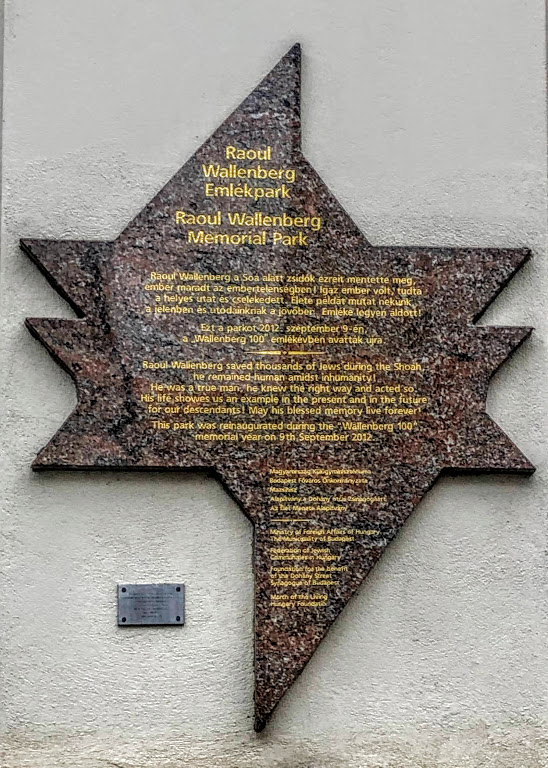
A memorial to Raoul Wallenberg in the Raoul Wallenberg Holocaust Memorial Park at the Dohány Street Synagogue, Budapest (Photograph: Patrick Comerford)
The Mary Elmes Bridge in Cork … the centrepiece of the bridge is designed to look like a menorah (Photograph: Patrick Comerford)
The Wall of the Righteous in Paris lists 3,300 French people who have been recognised as ‘Righteous Among the Nations’ (Photograph: Patrick Comerford)
These images are reminders not only of the Holocaust and its victims, but of real individuals who suffered and were humiliated, whose lives were shattered and who were murdered.
They are reminders of why we must never forget. The Holocaust happened not just because of one evil man but because many good people stood by and remained silent.
Over 80 years after the end of the Holocaust, antisemitism is on the rise once again. We are seeing the rise of the far-right in Britain across Europe and a resurgence of the far-right in Latin America, far-right ideology and vocabulary has become part and parcel of the language of the Trump regime, its spokespersons and those who support street murders by ICE in Minneapolis.
We must never forget.
The Eternal Flame in the Mémorial de la Shoah, Paris (Patrick Comerford)
Showing posts with label Hungary. Show all posts
27 January 2026
A ‘virtual tour’ of Holocaust
memorials on Holocaust
Memorial Day, a reminder
that we must never forget
Labels:
#HolocaustMemorialDay,
antisemitism,
Austria,
Crete 2026,
Czech Republic,
France,
Germany,
Greece,
Greece 2026,
Holocaust,
Hungary,
Jewish history,
Poland,
Sculpture,
Slovakia,
Slovenia,
Street art,
Synagogues,
Virtual Tours
18 November 2025
Daily prayer in the Kingdom Season:
18, Tuesday 18 November 2025
James Tissot, ‘Zacchaeus in the Sycamore Awaiting the Passage of Jesus’ (Brooklyn Museum)
Patrick Comerford
We are in the Kingdom Season, the time between All Saints’ Day and Advent, and this week began with the Second Sunday before Advent. The calendar of the Church of England in Common Worship today remembers Saint Elizabeth of Hungary (1231), Princess of Thuringia, Philanthropist.
Before the day begins, before I have breakfast, I am taking some quiet time early this morning to give thanks, to reflect, to pray and to read in these ways:
1, today’s Gospel reading;
2, a short reflection;
3, a prayer from the USPG prayer diary;
4, the Collects and Post-Communion prayer of the day.
Jesus calls Zacchaeus down from the sycamore tree (Illustration © Henry Martin)
Luke 19: 1-10 (NRSVA):
1 He entered Jericho and was passing through it. 2 A man was there named Zacchaeus; he was a chief tax-collector and was rich. 3 He was trying to see who Jesus was, but on account of the crowd he could not, because he was short in stature. 4 So he ran ahead and climbed a sycamore tree to see him, because he was going to pass that way. 5 When Jesus came to the place, he looked up and said to him, ‘Zacchaeus, hurry and come down; for I must stay at your house today.’ 6 So he hurried down and was happy to welcome him. 7 All who saw it began to grumble and said, ‘He has gone to be the guest of one who is a sinner.’ 8 Zacchaeus stood there and said to the Lord, ‘Look, half of my possessions, Lord, I will give to the poor; and if I have defrauded anyone of anything, I will pay back four times as much.’ 9 Then Jesus said to him, ‘Today salvation has come to this house, because he too is a son of Abraham. 10 For the Son of Man came to seek out and to save the lost.’
Do we neglect Christ’s presence in Word and Sacrament too often? … an icon of the Last Supper in a shop window in Rethymnon (Photograph: Patrick Comerford)
Today’s reflection:
The Gospel reading at the Eucharist this morning (Luke 19: 1-10) is a reminder that the oppressed, the small people, those who are made to feel small by others, especially the proud and the violent, are truly cared for by God, have the promise of new life, and are invited into the kingdom.
In this reading, Zacchaeus is despised both as a tax collector and as a man who is ‘short in stature.’ Both his occupation and his physique squeeze him to the margins and put him outside the community of faith. Yet, he is seen by Christ not as he seems to others, but as God sees him to truly be.
In the previous chapter in Saint Luke’s Gospel, we read the parable of the Pharisee and the tax collector praying in the Temple (Luke 18: 9-14). I sometimes ask: what if Zacchaeus was the model for that publican, that tax collector.
The story of Zacchaeus is a fast-moving story: every verse from verse 1 to 7, in the original Greek, begins with the word καὶ (kai, and), indicating that the pace has heightened, the story is speeding up, we are moving closer to the climax of this Gospel.
Christ is about to set out from Jericho to Jerusalem. From Jericho, the road is going to be uphill and more treacherous: remember that it is on this road between Jericho and Jerusalem that a certain man is mugged and left for dead until the Good Samaritan passes by (Luke 10: 25-37).
Jericho was a major resting place or stopping point on a main trade route, making it a lucrative and profitable location both for tax collectors and for bandits.
But Jericho has other significance: the walls of Jericho fell down at the call of the trumpets (see Joshua 6). So, in this reading, after Christ passes through the walls of Jericho, his call breaks down all the walls people erect around themselves, individually and collectively.
Who is Zacchaeus?
Certainly, Zacchaeus is not any run-of-the-mill tax collector. He is the ἀρχιτελώνης (architelonis), the chief tax collector, and so by contract had the right to collect revenues throughout this district. His name (Ζακχαῖος, Zakchaios) means pure, but his neighbours would have despised him, not only because they believed he squeezed the last drachma and the last lepta out of widows and children, but because they would also have seen him as a collaborator with the Roman administration.
There, a man who wants to see Christ is probably pushed to the back of the crowd for two reasons that count him out: he is small in stature, and he is a tax collector.
The physical problem shows how Zacchaeus is pushed to the margins by those who should have counted him into their social and religious community. He is of little stature not just physically, but socially too.
Can you imagine yourself as a little child trying to see a great parade or a football match when you were small?
Did everyone want to let you through?
Or did you not count? Did no-one stand aside for you?
No-one is going to stand aside for Zacchaeus. They belittle him, and they probably think he deserves it – after all, the taxes he collects support the Roman occupation and administration.
But Zacchaeus overcomes, rises above, his exclusion, by climbing the tree – is there a symbolic reference here to clinging to the Cross? In any case, Zacchaeus climbs the tree to see Jesus – something you could imagine a child doing, but surely not the sort of thing a well-paid civil servant should be seen doing?
Zacchaeus sees Jesus and Jesus sees Zacchaeus.
And Jesus invites himself not just to dine with Zacchaeus, but to stay with him: ‘Zacchaeus, make haste and come down, for I must stay at your house today’ (verse 5).
Normally, it is the potential host rather than the intended guest who does the inviting. So once again, Jesus the Guest becomes Jesus the Host.
Zacchaeus is delighted. But the good burghers of Jericho are unsettled. They murmur that Jesus is heading off to dine with sinners.
We are so self-righteous at times in our churches that I am worried we are in danger of being unwilling to welcome those who would be seen today as the little people.
One priest I know in a comfortable parish challenged his parishioners, who are very generous in their giving, especially when it comes to development agencies, mission agencies and what we once called Third World causes. He asked them how they would react if refugees or asylum seekers were moved into a vacant hotel or hostel in the parish on a Saturday night, and all of them presumed to come to church on the following Sunday morning.
In welcoming Jesus, Zacchaeus has what can only be described as a conversion experience.
The NRSV translation tells us that he promises to amend his ways and that, in the future, he will give half his possessions to the poor, and return anything extra he has squeezed out of people when he has been collecting taxes.
Unfortunately, the NRSV translation is a little inaccurate here. Zacchaeus makes no such promise about the future. He says, in the original Greek, that this is what he is doing in the present – the present tense is used.
If he is telling the truth, then Zacchaeus has been grossly misrepresented, misunderstood and libelled by his neighbours and within his own community, even at the point where he is dining with Jesus.
The present tense is important. For this day, on this day, Christ affirms that Zacchaeus too is a child of Abraham, that he too is an heir to those promises made long, long ago to Abraham.
Those who needed conversion were not Zacchaeus and others like him on the margins, who were in need of seeing people as Christ sees them.
Christ seeks out the sinners, the lost, those who are excluded, those counted out, and invites them to the heavenly banquet. Like Zacchaeus, they too are brought from the margins into the centre.
The one person everyone thought was outside, is on the inside as far as Christ is concerned. And those who think they are on the inside are in danger of finding that they are on the outside.
Are we welcoming enough, as individuals and as a Church?
How would we feel if Jesus came to our parish next weekend, but decided not to come to our church on Sunday morning, but to go somewhere else?
What if we were left without Christ being present in our church on Sunday morning … in either Word or Sacrament?
How often are we prepared to welcome Christ’s presence among us only in the way we choose, on our terms?
For those of us in what might be described as ‘High Church’ or Anglo-Catholic traditions, do we neglect Christ’s presence in the Word too often?
To those of us in what might be described as ‘Evangelical’ traditions, do we neglect Christ’s presence in the Sacrament too often?
May our faith and love continue to increase and to grow abundantly so that we count in those who are overlooked, those who are not counted in, those who are pushed to the margins.
Today’s Prayers (Tuesday 18 November 2025):
The theme this week (16 to 22 November) in Pray with the World Church, the prayer diary of the Anglican mission agency USPG (United Society Partners in the Gospel), is ‘In the Shadow of the Carneddau’ (pp 56-57). This theme was introduced on Sunday with Reflections from Bishop Andrew John, who stepped down as Archbishop of Wales and Bishop of Bangor on 27 June.
.
The USPG Prayer Diary today invites us to pray:
Pray for scientists and other researchers who help us understand the challenges posed by climate change.
The Collect:
Lord God,
who taught Elizabeth of Hungary
to recognize and reverence Christ in the poor of this world:
by her example
strengthen us to love and serve the afflicted and the needy
and so to honour your Son, the servant king,
who is alive and reigns with you,
in the unity of the Holy Spirit,
one God, now and for ever.
Post-Communion Prayer:
Faithful God,
who called Elizabeth of Hungary to serve you
and gave her joy in walking the path of holiness:
by this eucharist
in which you renew within us the vision of your glory,
strengthen us all to follow the way of perfection
until we come to see you face to face;
through Jesus Christ our Lord.
Yesterday’s Reflections
Continued Tomorrow
Inside Saint Margaret’s Church, the Anglican church in Budapest … Saint Margaret of Hungary is remembered on 18 November (Photograph: Patrick Comerford)
Scripture quotations are from the New Revised Standard Version Bible: Anglicised Edition copyright © 1989, 1995 National Council of the Churches of Christ in the United States of America. Used by permission. All rights reserved worldwide. http://nrsvbibles.org
Patrick Comerford
We are in the Kingdom Season, the time between All Saints’ Day and Advent, and this week began with the Second Sunday before Advent. The calendar of the Church of England in Common Worship today remembers Saint Elizabeth of Hungary (1231), Princess of Thuringia, Philanthropist.
Before the day begins, before I have breakfast, I am taking some quiet time early this morning to give thanks, to reflect, to pray and to read in these ways:
1, today’s Gospel reading;
2, a short reflection;
3, a prayer from the USPG prayer diary;
4, the Collects and Post-Communion prayer of the day.
Jesus calls Zacchaeus down from the sycamore tree (Illustration © Henry Martin)Luke 19: 1-10 (NRSVA):
1 He entered Jericho and was passing through it. 2 A man was there named Zacchaeus; he was a chief tax-collector and was rich. 3 He was trying to see who Jesus was, but on account of the crowd he could not, because he was short in stature. 4 So he ran ahead and climbed a sycamore tree to see him, because he was going to pass that way. 5 When Jesus came to the place, he looked up and said to him, ‘Zacchaeus, hurry and come down; for I must stay at your house today.’ 6 So he hurried down and was happy to welcome him. 7 All who saw it began to grumble and said, ‘He has gone to be the guest of one who is a sinner.’ 8 Zacchaeus stood there and said to the Lord, ‘Look, half of my possessions, Lord, I will give to the poor; and if I have defrauded anyone of anything, I will pay back four times as much.’ 9 Then Jesus said to him, ‘Today salvation has come to this house, because he too is a son of Abraham. 10 For the Son of Man came to seek out and to save the lost.’
Do we neglect Christ’s presence in Word and Sacrament too often? … an icon of the Last Supper in a shop window in Rethymnon (Photograph: Patrick Comerford)
Today’s reflection:
The Gospel reading at the Eucharist this morning (Luke 19: 1-10) is a reminder that the oppressed, the small people, those who are made to feel small by others, especially the proud and the violent, are truly cared for by God, have the promise of new life, and are invited into the kingdom.
In this reading, Zacchaeus is despised both as a tax collector and as a man who is ‘short in stature.’ Both his occupation and his physique squeeze him to the margins and put him outside the community of faith. Yet, he is seen by Christ not as he seems to others, but as God sees him to truly be.
In the previous chapter in Saint Luke’s Gospel, we read the parable of the Pharisee and the tax collector praying in the Temple (Luke 18: 9-14). I sometimes ask: what if Zacchaeus was the model for that publican, that tax collector.
The story of Zacchaeus is a fast-moving story: every verse from verse 1 to 7, in the original Greek, begins with the word καὶ (kai, and), indicating that the pace has heightened, the story is speeding up, we are moving closer to the climax of this Gospel.
Christ is about to set out from Jericho to Jerusalem. From Jericho, the road is going to be uphill and more treacherous: remember that it is on this road between Jericho and Jerusalem that a certain man is mugged and left for dead until the Good Samaritan passes by (Luke 10: 25-37).
Jericho was a major resting place or stopping point on a main trade route, making it a lucrative and profitable location both for tax collectors and for bandits.
But Jericho has other significance: the walls of Jericho fell down at the call of the trumpets (see Joshua 6). So, in this reading, after Christ passes through the walls of Jericho, his call breaks down all the walls people erect around themselves, individually and collectively.
Who is Zacchaeus?
Certainly, Zacchaeus is not any run-of-the-mill tax collector. He is the ἀρχιτελώνης (architelonis), the chief tax collector, and so by contract had the right to collect revenues throughout this district. His name (Ζακχαῖος, Zakchaios) means pure, but his neighbours would have despised him, not only because they believed he squeezed the last drachma and the last lepta out of widows and children, but because they would also have seen him as a collaborator with the Roman administration.
There, a man who wants to see Christ is probably pushed to the back of the crowd for two reasons that count him out: he is small in stature, and he is a tax collector.
The physical problem shows how Zacchaeus is pushed to the margins by those who should have counted him into their social and religious community. He is of little stature not just physically, but socially too.
Can you imagine yourself as a little child trying to see a great parade or a football match when you were small?
Did everyone want to let you through?
Or did you not count? Did no-one stand aside for you?
No-one is going to stand aside for Zacchaeus. They belittle him, and they probably think he deserves it – after all, the taxes he collects support the Roman occupation and administration.
But Zacchaeus overcomes, rises above, his exclusion, by climbing the tree – is there a symbolic reference here to clinging to the Cross? In any case, Zacchaeus climbs the tree to see Jesus – something you could imagine a child doing, but surely not the sort of thing a well-paid civil servant should be seen doing?
Zacchaeus sees Jesus and Jesus sees Zacchaeus.
And Jesus invites himself not just to dine with Zacchaeus, but to stay with him: ‘Zacchaeus, make haste and come down, for I must stay at your house today’ (verse 5).
Normally, it is the potential host rather than the intended guest who does the inviting. So once again, Jesus the Guest becomes Jesus the Host.
Zacchaeus is delighted. But the good burghers of Jericho are unsettled. They murmur that Jesus is heading off to dine with sinners.
We are so self-righteous at times in our churches that I am worried we are in danger of being unwilling to welcome those who would be seen today as the little people.
One priest I know in a comfortable parish challenged his parishioners, who are very generous in their giving, especially when it comes to development agencies, mission agencies and what we once called Third World causes. He asked them how they would react if refugees or asylum seekers were moved into a vacant hotel or hostel in the parish on a Saturday night, and all of them presumed to come to church on the following Sunday morning.
In welcoming Jesus, Zacchaeus has what can only be described as a conversion experience.
The NRSV translation tells us that he promises to amend his ways and that, in the future, he will give half his possessions to the poor, and return anything extra he has squeezed out of people when he has been collecting taxes.
Unfortunately, the NRSV translation is a little inaccurate here. Zacchaeus makes no such promise about the future. He says, in the original Greek, that this is what he is doing in the present – the present tense is used.
If he is telling the truth, then Zacchaeus has been grossly misrepresented, misunderstood and libelled by his neighbours and within his own community, even at the point where he is dining with Jesus.
The present tense is important. For this day, on this day, Christ affirms that Zacchaeus too is a child of Abraham, that he too is an heir to those promises made long, long ago to Abraham.
Those who needed conversion were not Zacchaeus and others like him on the margins, who were in need of seeing people as Christ sees them.
Christ seeks out the sinners, the lost, those who are excluded, those counted out, and invites them to the heavenly banquet. Like Zacchaeus, they too are brought from the margins into the centre.
The one person everyone thought was outside, is on the inside as far as Christ is concerned. And those who think they are on the inside are in danger of finding that they are on the outside.
Are we welcoming enough, as individuals and as a Church?
How would we feel if Jesus came to our parish next weekend, but decided not to come to our church on Sunday morning, but to go somewhere else?
What if we were left without Christ being present in our church on Sunday morning … in either Word or Sacrament?
How often are we prepared to welcome Christ’s presence among us only in the way we choose, on our terms?
For those of us in what might be described as ‘High Church’ or Anglo-Catholic traditions, do we neglect Christ’s presence in the Word too often?
To those of us in what might be described as ‘Evangelical’ traditions, do we neglect Christ’s presence in the Sacrament too often?
May our faith and love continue to increase and to grow abundantly so that we count in those who are overlooked, those who are not counted in, those who are pushed to the margins.
Today’s Prayers (Tuesday 18 November 2025):
The theme this week (16 to 22 November) in Pray with the World Church, the prayer diary of the Anglican mission agency USPG (United Society Partners in the Gospel), is ‘In the Shadow of the Carneddau’ (pp 56-57). This theme was introduced on Sunday with Reflections from Bishop Andrew John, who stepped down as Archbishop of Wales and Bishop of Bangor on 27 June.
.
The USPG Prayer Diary today invites us to pray:
Pray for scientists and other researchers who help us understand the challenges posed by climate change.
The Collect:
Lord God,
who taught Elizabeth of Hungary
to recognize and reverence Christ in the poor of this world:
by her example
strengthen us to love and serve the afflicted and the needy
and so to honour your Son, the servant king,
who is alive and reigns with you,
in the unity of the Holy Spirit,
one God, now and for ever.
Post-Communion Prayer:
Faithful God,
who called Elizabeth of Hungary to serve you
and gave her joy in walking the path of holiness:
by this eucharist
in which you renew within us the vision of your glory,
strengthen us all to follow the way of perfection
until we come to see you face to face;
through Jesus Christ our Lord.
Yesterday’s Reflections
Continued Tomorrow
Inside Saint Margaret’s Church, the Anglican church in Budapest … Saint Margaret of Hungary is remembered on 18 November (Photograph: Patrick Comerford)
Scripture quotations are from the New Revised Standard Version Bible: Anglicised Edition copyright © 1989, 1995 National Council of the Churches of Christ in the United States of America. Used by permission. All rights reserved worldwide. http://nrsvbibles.org
08 November 2025
Daily prayer in the Kingdom Season:
8, Saturday 8 November 2025
‘Whoever is faithful in a very little is faithful also in much’ (Luke 16: 10) … changing old banknotes for new ones (Photograph: Patrick Comerford)
Patrick Comerford
We are in the Kingdom Season, the time between All Saints and Advent. The Calendar of the Church of England in Common Worship today remembers the Saints and Martyrs of England and tomorrow is the Third Sunday before Advent and Remembrance Sunday.
Before today begins, before having breakfast, I am taking some quiet time early this morning to give thanks, and for reflection, prayer and reading in these ways:
1, today’s Gospel reading;
2, a short reflection;
3, a prayer from the USPG prayer diary;
4, the Collects and Post-Communion prayer of the day.
‘Make friends for yourselves by means of dishonest wealth so that when it is gone, they may welcome you into the eternal homes’ (Luke 16: 9) … not an ATM but street art, seen in Bray, Co Wicklow (Photograph: Patrick Comerford)
Luke 16: 9-15 (NRSVA):
[Jesus said:] 9 ‘And I tell you, make friends for yourselves by means of dishonest wealth so that when it is gone, they may welcome you into the eternal homes.
10 ‘Whoever is faithful in a very little is faithful also in much; and whoever is dishonest in a very little is dishonest also in much. 11 If then you have not been faithful with the dishonest wealth, who will entrust to you the true riches? 12 And if you have not been faithful with what belongs to another, who will give you what is your own? 13 No slave can serve two masters; for a slave will either hate the one and love the other, or be devoted to the one and despise the other. You cannot serve God and wealth.’
14 The Pharisees, who were lovers of money, heard all this, and they ridiculed him. 15 So he said to them, ‘You are those who justify yourselves in the sight of others; but God knows your hearts; for what is prized by human beings is an abomination in the sight of God.’
The former Commercial Bank of Greece branch in Rethymnon is abandoned and the oranges and lemons are rotting on the trees in the garden (Photograph: Patrick Comerford)
Today’s reflection:
In the Gospel reading for the Eucharist today, we read Jesus’s explanation of the parable of ‘the Unjust Steward’ or the ‘Parable of the Dishonest Manager’, which we read yesterday.
Sarah Dylan Breuer, when she produced her celebrated American blog Sarah Laughed (www.sarahlaughed.net), said most commentators agree the parable is about how the shrewd steward acts decisively, and that Jesus is describing the ‘in-breaking of the Kingdom of God, call[ing] upon us all to act decisively.’
But she also points out that forgiveness is an overarching theme throughout the Gospels. How often should I forgive? As Saint Luke reminds us in the next chapter, even if someone offends seven times a day, I should be willing to forgive them seven times (Luke 17: 1-4). Seven … the perfect number … I should be willing to forgive perfectly.
If this story is all about forgiveness, and if Sarah Dylan Breuer is correct, then we must forgive, even when we have no right to forgive, even if it does not benefit us at all. We must forgive with grand irresponsibility.
But there is another difficult point in this Gospel story. Verses 10-11 say: ‘Whoever is faithful in a very little is faithful also in much; and whoever is dishonest in a very little is dishonest also in much. If then you have not been faithful with the dishonest wealth, who will entrust to you the true riches?’
Being faithful with what is given to me is also a familiar Gospel theme: it is found in the parable of the talents. But being faithful with dishonest wealth is a puzzling concept, even if it speaks to recent economic dilemmas in both Britain and Ireland. Is it still possible to manage goods in ways that are appropriate to, that witness to, that are signs of the Kingdom of God?
If I am responsible for the small things in life, then hopefully I can be responsible for the large things. Very few of us are asked to do huge things, such as win a by-election, finish a masterpiece, solve the banking crisis, score a winning try or goal. But we are asked to do a multitude of small things – within our family, our friends, our neighbours, our fellow students, in this community.
And: ‘Whoever is faithful in a very little is faithful also in much.’ Yet, it is often most difficult to forgive the small things.
I heard a comedian tell of a young man, up from the provinces, starting work in a menial clerical post, living in a cramped, one-room flat in Rathmines. In the room above is another man in similar circumstances, working late shifts as a labourer.
Each night, just as he goes to sleep, the office worker is woken by his neighbour as he opens the front door, clumps-clumps up the stairs, plods into his room above, sits on his bed, and throws his two big boots on the floor above our poor, weary and demented friend, one-by-one.
Each night, our sad insurance clerk waits for same routine, knowing that he cannot get to sleep until at least he hears both boots being thumped on the floor above.
One day, being a Christian, the more timid office worker approaches his neighbour, explains the problem, and asks could he come in quietly at night, and take his shoes off gently.
Surprisingly, his neighbour is sympathetic, understanding. The next night, he turns the key quietly, tip toes upstairs, sits down quietly, takes off both shoes in one go and places them together, gently, on the floor above.
Meanwhile, his neighbour downstairs is lying in bed, waiting anxiously. He can’t get any shut eye. He’s heard his neighbour come in, go up, sit down, and has heard the one muffled thud on the floor … Only one … he waits … he tosses … he waits … he turns … And finally, he can wait no more. He screams out: ‘Would you throw down the other darn shoe and let’s all go to sleep!’
Learning to forgive the very little slights and offences is often so difficult when we live closely to one another: the muffled sounds next door when someone is up late finishing an essay; the early riser heading out for a morning jog who unintentionally wakes us; the unexpected slurps at the table; the accent that irritates me because, subconsciously, it reminds me of a particular neighbour or family member.
Sometimes, if truth is told, it is easier to forgive when it comes to the big things. Yet, our spiritual relationship with God is reflected in our social and economic relationship with others. If we can be entrusted with the small things, are ready to forgive the small things, then we can be entrusted with the biggest of all … We can be stewards of the mysteries of God.
Perhaps, like the shrewd steward, we need to be as wise as serpents and as harmless as doves.
‘Who will entrust to you the true riches?’ (Luke 16: 11) … old Greek banknotes that have lost their currency and true value (Photograph: Patrick Comerford)
Today’s Prayers (Saturday 8 November 2025):
The theme this week (2 to 8 November) in Pray with the World Church, the prayer diary of the Anglican mission agency USPG (United Society Partners in the Gospel), has been ‘From Solitude to Connection’ (pp 52-53). This theme was introduced last Sunday with a Programme Update from Ljudmila, a Ukrainian Refugee living in Budapest, Hungary.
The USPG Prayer Diary today (Saturday 8 November 2025) invites us to pray:
Lord of Peace, we pray for your peace to fill the world, healing divisions and bringing unity. May Christians everywhere commit to being prayerful, reflecting your love and sharing your peace with others.
The Collect:
God, whom the glorious company of the redeemed adore,
assembled from all times and places of your dominion:
we praise you for the saints of our own land
and for the many lamps their holiness has lit;
and we pray that we also may be numbered at last
with those who have done your will
and declared your righteousness;
through Jesus Christ your Son our Lord,
who is alive and reigns with you,
in the unity of the Holy Spirit,
one God, now and for ever.
Post Communion Prayer:
God, the source of all holiness
and giver of all good things:
may we who have shared at this table
as strangers and pilgrims here on earth
be welcomed with all your saints
to the heavenly feast on the day of your kingdom;
through Jesus Christ our Lord.
Collect on the Eve of the Third Sunday before Advent:
Almighty Father,
whose will is to restore all things
in your beloved Son, the King of all:
govern the hearts and minds of those in authority,
and bring the families of the nations,
divided and torn apart by the ravages of sin,
to be subject to his just and gentle rule;
who is alive and reigns with you,
in the unity of the Holy Spirit,
one God, now and for ever.
Yesterday’s Reflections
Continued Tomorrow
‘Father Forgive’ and the Cross of Nails in Coventry Cathedral … it is often most difficult to forgive the small things (Photograph: Patrick Comerford)
Scripture quotations are from the New Revised Standard Version Bible: Anglicised Edition copyright © 1989, 1995 National Council of the Churches of Christ in the United States of America. Used by permission. All rights reserved worldwide. http://nrsvbibles.org
Patrick Comerford
We are in the Kingdom Season, the time between All Saints and Advent. The Calendar of the Church of England in Common Worship today remembers the Saints and Martyrs of England and tomorrow is the Third Sunday before Advent and Remembrance Sunday.
Before today begins, before having breakfast, I am taking some quiet time early this morning to give thanks, and for reflection, prayer and reading in these ways:
1, today’s Gospel reading;
2, a short reflection;
3, a prayer from the USPG prayer diary;
4, the Collects and Post-Communion prayer of the day.
‘Make friends for yourselves by means of dishonest wealth so that when it is gone, they may welcome you into the eternal homes’ (Luke 16: 9) … not an ATM but street art, seen in Bray, Co Wicklow (Photograph: Patrick Comerford)
Luke 16: 9-15 (NRSVA):
[Jesus said:] 9 ‘And I tell you, make friends for yourselves by means of dishonest wealth so that when it is gone, they may welcome you into the eternal homes.
10 ‘Whoever is faithful in a very little is faithful also in much; and whoever is dishonest in a very little is dishonest also in much. 11 If then you have not been faithful with the dishonest wealth, who will entrust to you the true riches? 12 And if you have not been faithful with what belongs to another, who will give you what is your own? 13 No slave can serve two masters; for a slave will either hate the one and love the other, or be devoted to the one and despise the other. You cannot serve God and wealth.’
14 The Pharisees, who were lovers of money, heard all this, and they ridiculed him. 15 So he said to them, ‘You are those who justify yourselves in the sight of others; but God knows your hearts; for what is prized by human beings is an abomination in the sight of God.’
The former Commercial Bank of Greece branch in Rethymnon is abandoned and the oranges and lemons are rotting on the trees in the garden (Photograph: Patrick Comerford)
Today’s reflection:
In the Gospel reading for the Eucharist today, we read Jesus’s explanation of the parable of ‘the Unjust Steward’ or the ‘Parable of the Dishonest Manager’, which we read yesterday.
Sarah Dylan Breuer, when she produced her celebrated American blog Sarah Laughed (www.sarahlaughed.net), said most commentators agree the parable is about how the shrewd steward acts decisively, and that Jesus is describing the ‘in-breaking of the Kingdom of God, call[ing] upon us all to act decisively.’
But she also points out that forgiveness is an overarching theme throughout the Gospels. How often should I forgive? As Saint Luke reminds us in the next chapter, even if someone offends seven times a day, I should be willing to forgive them seven times (Luke 17: 1-4). Seven … the perfect number … I should be willing to forgive perfectly.
If this story is all about forgiveness, and if Sarah Dylan Breuer is correct, then we must forgive, even when we have no right to forgive, even if it does not benefit us at all. We must forgive with grand irresponsibility.
But there is another difficult point in this Gospel story. Verses 10-11 say: ‘Whoever is faithful in a very little is faithful also in much; and whoever is dishonest in a very little is dishonest also in much. If then you have not been faithful with the dishonest wealth, who will entrust to you the true riches?’
Being faithful with what is given to me is also a familiar Gospel theme: it is found in the parable of the talents. But being faithful with dishonest wealth is a puzzling concept, even if it speaks to recent economic dilemmas in both Britain and Ireland. Is it still possible to manage goods in ways that are appropriate to, that witness to, that are signs of the Kingdom of God?
If I am responsible for the small things in life, then hopefully I can be responsible for the large things. Very few of us are asked to do huge things, such as win a by-election, finish a masterpiece, solve the banking crisis, score a winning try or goal. But we are asked to do a multitude of small things – within our family, our friends, our neighbours, our fellow students, in this community.
And: ‘Whoever is faithful in a very little is faithful also in much.’ Yet, it is often most difficult to forgive the small things.
I heard a comedian tell of a young man, up from the provinces, starting work in a menial clerical post, living in a cramped, one-room flat in Rathmines. In the room above is another man in similar circumstances, working late shifts as a labourer.
Each night, just as he goes to sleep, the office worker is woken by his neighbour as he opens the front door, clumps-clumps up the stairs, plods into his room above, sits on his bed, and throws his two big boots on the floor above our poor, weary and demented friend, one-by-one.
Each night, our sad insurance clerk waits for same routine, knowing that he cannot get to sleep until at least he hears both boots being thumped on the floor above.
One day, being a Christian, the more timid office worker approaches his neighbour, explains the problem, and asks could he come in quietly at night, and take his shoes off gently.
Surprisingly, his neighbour is sympathetic, understanding. The next night, he turns the key quietly, tip toes upstairs, sits down quietly, takes off both shoes in one go and places them together, gently, on the floor above.
Meanwhile, his neighbour downstairs is lying in bed, waiting anxiously. He can’t get any shut eye. He’s heard his neighbour come in, go up, sit down, and has heard the one muffled thud on the floor … Only one … he waits … he tosses … he waits … he turns … And finally, he can wait no more. He screams out: ‘Would you throw down the other darn shoe and let’s all go to sleep!’
Learning to forgive the very little slights and offences is often so difficult when we live closely to one another: the muffled sounds next door when someone is up late finishing an essay; the early riser heading out for a morning jog who unintentionally wakes us; the unexpected slurps at the table; the accent that irritates me because, subconsciously, it reminds me of a particular neighbour or family member.
Sometimes, if truth is told, it is easier to forgive when it comes to the big things. Yet, our spiritual relationship with God is reflected in our social and economic relationship with others. If we can be entrusted with the small things, are ready to forgive the small things, then we can be entrusted with the biggest of all … We can be stewards of the mysteries of God.
Perhaps, like the shrewd steward, we need to be as wise as serpents and as harmless as doves.
‘Who will entrust to you the true riches?’ (Luke 16: 11) … old Greek banknotes that have lost their currency and true value (Photograph: Patrick Comerford)
Today’s Prayers (Saturday 8 November 2025):
The theme this week (2 to 8 November) in Pray with the World Church, the prayer diary of the Anglican mission agency USPG (United Society Partners in the Gospel), has been ‘From Solitude to Connection’ (pp 52-53). This theme was introduced last Sunday with a Programme Update from Ljudmila, a Ukrainian Refugee living in Budapest, Hungary.
The USPG Prayer Diary today (Saturday 8 November 2025) invites us to pray:
Lord of Peace, we pray for your peace to fill the world, healing divisions and bringing unity. May Christians everywhere commit to being prayerful, reflecting your love and sharing your peace with others.
The Collect:
God, whom the glorious company of the redeemed adore,
assembled from all times and places of your dominion:
we praise you for the saints of our own land
and for the many lamps their holiness has lit;
and we pray that we also may be numbered at last
with those who have done your will
and declared your righteousness;
through Jesus Christ your Son our Lord,
who is alive and reigns with you,
in the unity of the Holy Spirit,
one God, now and for ever.
Post Communion Prayer:
God, the source of all holiness
and giver of all good things:
may we who have shared at this table
as strangers and pilgrims here on earth
be welcomed with all your saints
to the heavenly feast on the day of your kingdom;
through Jesus Christ our Lord.
Collect on the Eve of the Third Sunday before Advent:
Almighty Father,
whose will is to restore all things
in your beloved Son, the King of all:
govern the hearts and minds of those in authority,
and bring the families of the nations,
divided and torn apart by the ravages of sin,
to be subject to his just and gentle rule;
who is alive and reigns with you,
in the unity of the Holy Spirit,
one God, now and for ever.
Yesterday’s Reflections
Continued Tomorrow
‘Father Forgive’ and the Cross of Nails in Coventry Cathedral … it is often most difficult to forgive the small things (Photograph: Patrick Comerford)
Scripture quotations are from the New Revised Standard Version Bible: Anglicised Edition copyright © 1989, 1995 National Council of the Churches of Christ in the United States of America. Used by permission. All rights reserved worldwide. http://nrsvbibles.org
07 November 2025
Daily prayer in the Kingdom Season:
7, Friday 7 November 2025
The Unjust Steward … part of the East Window in Saint Michael’s Church, Limerick, made in 1878 by Mayer & Co and illustrating 10 parables (Photograph: Patrick Comerford)
Patrick Comerford
We are in the Kingdom Season, the time between All Saints and Advent. The Calendar of the Church of England in Common Worship today remembers Saint Willibrord of York (739), Bishop, Apostle of Frisia (7 November).
Before today begins, before having breakfast, I am taking some quiet time early this morning to give thanks, and for reflection, prayer and reading in these ways:
1, today’s Gospel reading;
2, a short reflection;
3, a prayer from the USPG prayer diary;
4, the Collects and Post-Communion prayer of the day.
‘The Unjust Steward,’ by the Kazakhstan Artist, Nelly Bube (Bubay)
Luke 16: 1-8 (NRSVA):
1 Then Jesus said to the disciples, ‘There was a rich man who had a manager, and charges were brought to him that this man was squandering his property. 2 So he summoned him and said to him, “What is this that I hear about you? Give me an account of your management, because you cannot be my manager any longer.” 3 Then the manager said to himself, “What will I do, now that my master is taking the position away from me? I am not strong enough to dig, and I am ashamed to beg. 4 I have decided what to do so that, when I am dismissed as manager, people may welcome me into their homes.” 5 So, summoning his master’s debtors one by one, he asked the first, “How much do you owe my master?” 6 He answered, “A hundred jugs of olive oil.” He said to him, “Take your bill, sit down quickly, and make it fifty.” 7 Then he asked another, “And how much do you owe?” He replied, “A hundred containers of wheat.” He said to him, “Take your bill and make it eighty.” 8 And his master commended the dishonest manager because he had acted shrewdly; for the children of this age are more shrewd in dealing with their own generation than are the children of light.’
A ‘Shop To Let’ sign within view of Sidney Sussex College chapel, Cambridge … can we reconcile the values of the Kingdom and the demands of commercial life? (Photograph: Patrick Comerford)
Today’s reflection:
In the Gospel reading for the Eucharist today, we read the parable of ‘the Unjust Steward’ or the ‘Parable of the Dishonest Manager’.
Whatever name you give it, this morning’s reading is about ignoring and exploiting the plight of the oppressed and the poor and tells us that this amounts to turning away from God and turning towards idolatry. We are called to turn around, and in turning to the needs of the poor we find that we are turning to God.
So, let me tell this morning’s Gospel story (Luke 16: 1-13) in another way. When I left school, I started training as a chartered surveyor and in estate manager. I never finished that training, but I can visualise some of the characters in this story.
A very, very rich man lives in a big city, let’s say it is Dublin. He has a luxurious lifestyle made possible by the income from the apartments, hotels and office blocks he owns in the city centre. He has been a major property developer, and a key shareholder in one of the business banks lending to developers.
He has hired an estate manager to run his property holding company, his building society, and his insurance agency while he spends most of his time in his large country house in Co Kildare or Co Meath, in the Algarve playing golf or in Marbella on his yacht.
All the work of painting, maintaining the lifts and the plumbing in his apartment blocks, working the bar and servicing the rooms in his hotels, and working at the call centres in the office blocks, is done by people who travel in and out from the rims of the city, people whose grandparents probably once lived in the small terraced houses that once stood along the docks or the canal banks but were levelled to build those apartments, office blocks and hotels.
They pay their mortgages to the bank that financed the apartment blocks and similar developments. Their overdrafts are from the same bank. Their mortgage, insurance and life assurance policies are from an agency he owns. They find themselves increasingly in debt, paying school fees and health insurance, running a car or two cars, meeting term loan payments for fridges, freezers, TVs and laptops … What they earn is never enough to pay off their mortgages, their overdrafts, their term loans.
These families are slipping further and further into debt, working harder and harder to pay what cannot be paid.
But they never meet the rich developer. The immediate face of this system, of his companies and his investments, is the face of the estate agent who manages the blocks – a man whose grandparents came from the same families as the people who now suffer under his management.
However, his parents had escaped the system, he got a good education, and then got sucked into the system.
The developer hears rumours that the estate manager, who is also his insurance agent, has been squandering the developer’s resource, and gives him his dismissal notice. Now, remember that ‘squandering’ is not necessarily a bad word here – the sower in another parable squanders seed by tossing it on roads and in bird-feeding zones, and the shepherd in one of this week’s parables potentially squanders 99 sheep by running after the lost one; the widow searching for her lost coin risks losing her other nine as she sweeps everything out.
Meanwhile, the estate agent has to work out his notice, but is no longer authorised to let, to rent, to buy, to sell, to do anything at all in the developer’s name.
He probably shares the same background only a generation or two ago with the maintenance workers, the tenants, the workers in the office blocks. But when he is out on his ear, they are not going to help him to find a place to live, or find a new job, given that up to now he has allied himself with the developer’s interests, collecting high rents, refusing to bring down rents when the reviews are due, managing the work rotas for the maintenance workers, forcing them to work longer hours rather than taking on the staff needed for the job, dealing unjustly with both tenants and workers.
He has been demanding higher rents and premiums, and longer working hours, yet providing fewer and fewer services – doing what certain economists have advised him to do: increasing profit margins and productivity and cutting costs and outlays at one and the same time.
He may be shrewd, but that is why he is called ‘the dishonest manager’ (verse 8).
The agent then does something that is extraordinarily clever.
He gathers all the tenants and workers who owe him money, and he declares that their debts have been written down, more than the courts could ever write them down, to something that might be repaid, freeing families from heartbreaking choices. He has been upping their rents and their premiums; now he brings them all back to a payable rate. And in doing this, he manages to wipe out the arrears that have been mounting up.
The smart agent manages not to tell the tenants or the workers that he has been sacked. Nor does he tell them that the developer has not authorised any of his largesse. But the tenants and the workers now think the developer, their landlord, is more generous than anyone else in his position could be. The developer is now a hero in their eyes – and, by extension, the agent is too.
The developer comes back for his quarterly or annual visit to pick up the income the agent has collected for him, and he gets a surprise that is exhilarating and challenging. The people are delighted to see him. Workers shake his hands, tenants lean out of the balconies to wave at him, children want to have ‘selfies’ taken with him.
Then, as he inspects the books in the small office the agent has worked from in the complex, he finds out what the agent has done in telling the tenants and the workers that the developer has forgiven their debts.
He has a choice to make.
He can go and tell them that it was all a terrible mistake, that the agent’s ‘stroke’ amounted not to generosity but to theft, or at least to dishonesty, and has no legal basis – he can tell them they are still responsible for the unpaid rent, for the overdrawn loans.
The warm welcome could quickly turn to nasty protests.
Or, the developer can go outside, bask in the unexpected welcome he has received, and take credit for the agent’s actions. At least he has cash in his hand where once he might have had nothing because of defaulting tenants and clients. That would save him going to court, but has he to take the agent back to work for him?
What would you do?
Picture yourself in this dilemma, both as the agent and as the developer.
From the agent’s point of view, does it matter any more what the developer decides to do? Whatever decision the developer makes, his future is safe – either he gets his job back, or his own people are going to look after him.
But here is the big problem: what the agent did is clearly dishonest. He has taken the landlord’s property and squandered it – even after he was sacked and had no right to do anything in the developer’s name.
What is it that the agent has done, without permission? Who has he deceived?
The agent forgives. He forgives things that he had no right to forgive. He forgives for all the wrong reasons, for personal gain and to compensate for his past misconduct. But that decisive action that he undertakes redeems him from a position to which it seems he could not be reconciled, to the developer any more than to the tenants and workers.
So what is the moral of the story?
This story is unique to Saint Luke’s Gospel, and for him there is a significance that is important throughout the third gospel: Forgive. Forgive it all. Forgive it now. Forgive it for any reason you want. Forgive for the right reason. Forgive for the wrong reason. Forgive for no reason at all. Just forgive.
Remember, Saint Luke’s version of the Lord’s Prayer includes the helpful confusion: καὶ ἄφες ἡμῖν τὰς ἁμαρτίας ἡμῶν, καὶ γὰρ αὐτοὶ ἀφίομεν παντὶ ὀφείλοντι ἡμῖν: καὶ μὴ εἰσενέγκῃς ἡμᾶς εἰς πειρασμόν (‘and forgive us our sins for indeed we ourselves are forgiving everyone who is [monetarily] indebted to us’) (Luke 11: 4) – the monetary indebtedness is obvious in the original Greek.
We pray it, but do we put it into practice?
The arrival of the Kingdom of God is no occasion for score-keeping of any kind, whether monetary or moral.
Why should I forgive someone who has sinned against me, or against my sense of what is obviously right? I don’t have to do it out of love for the other person.
I could forgive the other person because of what I pray in the Lord’s Prayer every Sunday if not every morning.
I could forgive because I know I would like to be forgiven myself.
I could forgive because I know what it is like to be me when I am unforgiving.
I could forgive because I am, or I want to be, deeply in touch with a sense of Christ’s power to forgive and free someone just like me.
Or I could forgive because I think it will improve my life and sense of well-being.
It boils down to the same thing: deluded or sane, selfish or unselfish, there is no bad reason to forgive.
Extending the kind of grace God shows me in every possible arena – financial and moral – can only put me more deeply in touch with God’s grace.
If a crafty agent, a dishonest manager, an unjust steward, the sort of person we meet in this Gospel reading, can forgive to save his job or give himself a safety net when he is sacked, then those of us who have the experience of real grace, we who have been invited to the Heavenly Banquet, have a better reason than most people to forgive.
Where is the place for Christian values in today’s world of finance and debt? (Photograph: Patrick Comerford)
Today’s Prayers (Friday 7 November 2025):
The theme this week (2 to 8 November) in Pray with the World Church, the prayer diary of the Anglican mission agency USPG (United Society Partners in the Gospel), is ‘From Solitude to Connection’ (pp 52-53). This theme was introduced on Sunday with a Programme Update from Ljudmila, a Ukrainian Refugee living in Budapest, Hungary.
The USPG Prayer Diary today (Friday 7 November 2025) invites us to pray:
Father, we pray for the ministry of Saint Margaret’s Church as they seek to be a light for you in Budapest. Thank you for the way your love is modelled through the church’s open doors.
The Collect:
God, the Saviour of all,
you sent your bishop Willibrord from this land
to proclaim the good news to many peoples
and confirm them in their faith:
help us also to witness to your steadfast love
by word and deed
so that your Church may increase
and grow strong in holiness;
through Jesus Christ your Son our Lord,
who is alive and reigns with you,
in the unity of the Holy Spirit,
one God, now and for ever.
Post Communion Prayer:
Holy Father,
who gathered us here around the table of your Son
to share this meal with the whole household of God:
in that new world where you reveal
the fullness of your peace,
gather people of every race and language
to share with Willibrord and all your saints
in the eternal banquet of Jesus Christ our Lord.
Yesterday’s Reflections
Continued Tomorrow
Property developments and financial growth on the banks of the River Liffey in Dublin (Photograph: Patrick Comerford, 2024)
Scripture quotations are from the New Revised Standard Version Bible: Anglicised Edition copyright © 1989, 1995 National Council of the Churches of Christ in the United States of America. Used by permission. All rights reserved worldwide. http://nrsvbibles.org
Patrick Comerford
We are in the Kingdom Season, the time between All Saints and Advent. The Calendar of the Church of England in Common Worship today remembers Saint Willibrord of York (739), Bishop, Apostle of Frisia (7 November).
Before today begins, before having breakfast, I am taking some quiet time early this morning to give thanks, and for reflection, prayer and reading in these ways:
1, today’s Gospel reading;
2, a short reflection;
3, a prayer from the USPG prayer diary;
4, the Collects and Post-Communion prayer of the day.
‘The Unjust Steward,’ by the Kazakhstan Artist, Nelly Bube (Bubay)
Luke 16: 1-8 (NRSVA):
1 Then Jesus said to the disciples, ‘There was a rich man who had a manager, and charges were brought to him that this man was squandering his property. 2 So he summoned him and said to him, “What is this that I hear about you? Give me an account of your management, because you cannot be my manager any longer.” 3 Then the manager said to himself, “What will I do, now that my master is taking the position away from me? I am not strong enough to dig, and I am ashamed to beg. 4 I have decided what to do so that, when I am dismissed as manager, people may welcome me into their homes.” 5 So, summoning his master’s debtors one by one, he asked the first, “How much do you owe my master?” 6 He answered, “A hundred jugs of olive oil.” He said to him, “Take your bill, sit down quickly, and make it fifty.” 7 Then he asked another, “And how much do you owe?” He replied, “A hundred containers of wheat.” He said to him, “Take your bill and make it eighty.” 8 And his master commended the dishonest manager because he had acted shrewdly; for the children of this age are more shrewd in dealing with their own generation than are the children of light.’
A ‘Shop To Let’ sign within view of Sidney Sussex College chapel, Cambridge … can we reconcile the values of the Kingdom and the demands of commercial life? (Photograph: Patrick Comerford)
Today’s reflection:
In the Gospel reading for the Eucharist today, we read the parable of ‘the Unjust Steward’ or the ‘Parable of the Dishonest Manager’.
Whatever name you give it, this morning’s reading is about ignoring and exploiting the plight of the oppressed and the poor and tells us that this amounts to turning away from God and turning towards idolatry. We are called to turn around, and in turning to the needs of the poor we find that we are turning to God.
So, let me tell this morning’s Gospel story (Luke 16: 1-13) in another way. When I left school, I started training as a chartered surveyor and in estate manager. I never finished that training, but I can visualise some of the characters in this story.
A very, very rich man lives in a big city, let’s say it is Dublin. He has a luxurious lifestyle made possible by the income from the apartments, hotels and office blocks he owns in the city centre. He has been a major property developer, and a key shareholder in one of the business banks lending to developers.
He has hired an estate manager to run his property holding company, his building society, and his insurance agency while he spends most of his time in his large country house in Co Kildare or Co Meath, in the Algarve playing golf or in Marbella on his yacht.
All the work of painting, maintaining the lifts and the plumbing in his apartment blocks, working the bar and servicing the rooms in his hotels, and working at the call centres in the office blocks, is done by people who travel in and out from the rims of the city, people whose grandparents probably once lived in the small terraced houses that once stood along the docks or the canal banks but were levelled to build those apartments, office blocks and hotels.
They pay their mortgages to the bank that financed the apartment blocks and similar developments. Their overdrafts are from the same bank. Their mortgage, insurance and life assurance policies are from an agency he owns. They find themselves increasingly in debt, paying school fees and health insurance, running a car or two cars, meeting term loan payments for fridges, freezers, TVs and laptops … What they earn is never enough to pay off their mortgages, their overdrafts, their term loans.
These families are slipping further and further into debt, working harder and harder to pay what cannot be paid.
But they never meet the rich developer. The immediate face of this system, of his companies and his investments, is the face of the estate agent who manages the blocks – a man whose grandparents came from the same families as the people who now suffer under his management.
However, his parents had escaped the system, he got a good education, and then got sucked into the system.
The developer hears rumours that the estate manager, who is also his insurance agent, has been squandering the developer’s resource, and gives him his dismissal notice. Now, remember that ‘squandering’ is not necessarily a bad word here – the sower in another parable squanders seed by tossing it on roads and in bird-feeding zones, and the shepherd in one of this week’s parables potentially squanders 99 sheep by running after the lost one; the widow searching for her lost coin risks losing her other nine as she sweeps everything out.
Meanwhile, the estate agent has to work out his notice, but is no longer authorised to let, to rent, to buy, to sell, to do anything at all in the developer’s name.
He probably shares the same background only a generation or two ago with the maintenance workers, the tenants, the workers in the office blocks. But when he is out on his ear, they are not going to help him to find a place to live, or find a new job, given that up to now he has allied himself with the developer’s interests, collecting high rents, refusing to bring down rents when the reviews are due, managing the work rotas for the maintenance workers, forcing them to work longer hours rather than taking on the staff needed for the job, dealing unjustly with both tenants and workers.
He has been demanding higher rents and premiums, and longer working hours, yet providing fewer and fewer services – doing what certain economists have advised him to do: increasing profit margins and productivity and cutting costs and outlays at one and the same time.
He may be shrewd, but that is why he is called ‘the dishonest manager’ (verse 8).
The agent then does something that is extraordinarily clever.
He gathers all the tenants and workers who owe him money, and he declares that their debts have been written down, more than the courts could ever write them down, to something that might be repaid, freeing families from heartbreaking choices. He has been upping their rents and their premiums; now he brings them all back to a payable rate. And in doing this, he manages to wipe out the arrears that have been mounting up.
The smart agent manages not to tell the tenants or the workers that he has been sacked. Nor does he tell them that the developer has not authorised any of his largesse. But the tenants and the workers now think the developer, their landlord, is more generous than anyone else in his position could be. The developer is now a hero in their eyes – and, by extension, the agent is too.
The developer comes back for his quarterly or annual visit to pick up the income the agent has collected for him, and he gets a surprise that is exhilarating and challenging. The people are delighted to see him. Workers shake his hands, tenants lean out of the balconies to wave at him, children want to have ‘selfies’ taken with him.
Then, as he inspects the books in the small office the agent has worked from in the complex, he finds out what the agent has done in telling the tenants and the workers that the developer has forgiven their debts.
He has a choice to make.
He can go and tell them that it was all a terrible mistake, that the agent’s ‘stroke’ amounted not to generosity but to theft, or at least to dishonesty, and has no legal basis – he can tell them they are still responsible for the unpaid rent, for the overdrawn loans.
The warm welcome could quickly turn to nasty protests.
Or, the developer can go outside, bask in the unexpected welcome he has received, and take credit for the agent’s actions. At least he has cash in his hand where once he might have had nothing because of defaulting tenants and clients. That would save him going to court, but has he to take the agent back to work for him?
What would you do?
Picture yourself in this dilemma, both as the agent and as the developer.
From the agent’s point of view, does it matter any more what the developer decides to do? Whatever decision the developer makes, his future is safe – either he gets his job back, or his own people are going to look after him.
But here is the big problem: what the agent did is clearly dishonest. He has taken the landlord’s property and squandered it – even after he was sacked and had no right to do anything in the developer’s name.
What is it that the agent has done, without permission? Who has he deceived?
The agent forgives. He forgives things that he had no right to forgive. He forgives for all the wrong reasons, for personal gain and to compensate for his past misconduct. But that decisive action that he undertakes redeems him from a position to which it seems he could not be reconciled, to the developer any more than to the tenants and workers.
So what is the moral of the story?
This story is unique to Saint Luke’s Gospel, and for him there is a significance that is important throughout the third gospel: Forgive. Forgive it all. Forgive it now. Forgive it for any reason you want. Forgive for the right reason. Forgive for the wrong reason. Forgive for no reason at all. Just forgive.
Remember, Saint Luke’s version of the Lord’s Prayer includes the helpful confusion: καὶ ἄφες ἡμῖν τὰς ἁμαρτίας ἡμῶν, καὶ γὰρ αὐτοὶ ἀφίομεν παντὶ ὀφείλοντι ἡμῖν: καὶ μὴ εἰσενέγκῃς ἡμᾶς εἰς πειρασμόν (‘and forgive us our sins for indeed we ourselves are forgiving everyone who is [monetarily] indebted to us’) (Luke 11: 4) – the monetary indebtedness is obvious in the original Greek.
We pray it, but do we put it into practice?
The arrival of the Kingdom of God is no occasion for score-keeping of any kind, whether monetary or moral.
Why should I forgive someone who has sinned against me, or against my sense of what is obviously right? I don’t have to do it out of love for the other person.
I could forgive the other person because of what I pray in the Lord’s Prayer every Sunday if not every morning.
I could forgive because I know I would like to be forgiven myself.
I could forgive because I know what it is like to be me when I am unforgiving.
I could forgive because I am, or I want to be, deeply in touch with a sense of Christ’s power to forgive and free someone just like me.
Or I could forgive because I think it will improve my life and sense of well-being.
It boils down to the same thing: deluded or sane, selfish or unselfish, there is no bad reason to forgive.
Extending the kind of grace God shows me in every possible arena – financial and moral – can only put me more deeply in touch with God’s grace.
If a crafty agent, a dishonest manager, an unjust steward, the sort of person we meet in this Gospel reading, can forgive to save his job or give himself a safety net when he is sacked, then those of us who have the experience of real grace, we who have been invited to the Heavenly Banquet, have a better reason than most people to forgive.
Where is the place for Christian values in today’s world of finance and debt? (Photograph: Patrick Comerford)
Today’s Prayers (Friday 7 November 2025):
The theme this week (2 to 8 November) in Pray with the World Church, the prayer diary of the Anglican mission agency USPG (United Society Partners in the Gospel), is ‘From Solitude to Connection’ (pp 52-53). This theme was introduced on Sunday with a Programme Update from Ljudmila, a Ukrainian Refugee living in Budapest, Hungary.
The USPG Prayer Diary today (Friday 7 November 2025) invites us to pray:
Father, we pray for the ministry of Saint Margaret’s Church as they seek to be a light for you in Budapest. Thank you for the way your love is modelled through the church’s open doors.
The Collect:
God, the Saviour of all,
you sent your bishop Willibrord from this land
to proclaim the good news to many peoples
and confirm them in their faith:
help us also to witness to your steadfast love
by word and deed
so that your Church may increase
and grow strong in holiness;
through Jesus Christ your Son our Lord,
who is alive and reigns with you,
in the unity of the Holy Spirit,
one God, now and for ever.
Post Communion Prayer:
Holy Father,
who gathered us here around the table of your Son
to share this meal with the whole household of God:
in that new world where you reveal
the fullness of your peace,
gather people of every race and language
to share with Willibrord and all your saints
in the eternal banquet of Jesus Christ our Lord.
Yesterday’s Reflections
Continued Tomorrow
Property developments and financial growth on the banks of the River Liffey in Dublin (Photograph: Patrick Comerford, 2024)
Scripture quotations are from the New Revised Standard Version Bible: Anglicised Edition copyright © 1989, 1995 National Council of the Churches of Christ in the United States of America. Used by permission. All rights reserved worldwide. http://nrsvbibles.org
Labels:
Banking,
Budapest,
Cambridge,
Dublin,
Hungary,
Kingdom Season,
Limerick,
Mission,
Parables,
Prayer,
refugees,
River Liffey,
Saint Luke's Gospel,
Stained Glass,
Ukraine,
USPG,
York
Subscribe to:
Posts (Atom)