The Church of Saint Edmund and Saint Frideswide or Greyfriars on Iffley Road in East Oxford (Photograph: Patrick Comerford, 2026)
Patrick Comerford
During my walkabout in Oxford last week, by the river, through Iffley in East Oxford, and in the city centre, I had opportunities to see from the outside four religious houses that have interesting places in the story of religious communities and community life in Oxford.
Greyfriars has one of the most distinctive buildings in Oxford; it is the only flint-stone Norman-style building in the city, and its green spire is prominent along the Iffley Road in East Oxford. Greyfriars is a Catholic parish and a Franciscan friary, and until 2008 it was also a permanent private hall of the University of Oxford.
The original Greyfriars church and friary in Oxford was founded by the Franciscans in the marshy St Ebbe’s area of the city in 1224. The mediaeval friars in Oxford included the theologian Robert Grosseteste, also Bishop of Lincoln and the first Chancellor of the University of Oxford. Other early Franciscans in mediaeval Greyfriars in Oxford included Roger Bacon, John Duns Scotus, William of Ockham, and the Antipope Alexander V, who was from Neapolis in Crete.
The mediaeval friary was in the south-west corner of the city walls. Its footprint was extensive, running between the present-day Paradise Street and the Westgate Oxford Shopping Centre. The Franciscan order divided into two branches in 1517: the friars who had been living in city-convents and teaching in universities became known as Conventuals, while the friars who lived a more eremitical life became known as Observants; the Capuchins developed in 1528.
The original Greyfriars in Oxford continued as an educational and religious centre in the Middle Ages before being dissolved at the Tudor Reformations in 1538, and the Capuchins did not return to Oxford until 1905.
Greyfriars Church or the Church of Saint Edmund and Saint Frideswide on Iffley Road was built in 1910-1911 as a chapel of ease to the Jesuits of the Church of Saint Aloysius, Woodstock Road. The dedication recalls Saint Edmund of Abingdon, Archbishop of Canterbury, who gives his name to St Edmund Hall, Oxford, and Saint Frideswide, the patron of Oxford. It succeeded Saint Ignatius chapel in St Clement’s (1793) as the principal site of Roman Catholic worship in east Oxford.
The church was designed by the priest-architect William Edward (Father Benedict) Williamson (1868-1948). The builders were Hunt & Sons of High Wycombe. Williamson’s other works include the Jesuit church of Saint Ignatius in Stamford Hill, north London, and a range of monastic buildings at Farnborough Abbey in Hampshire – both, like his church in Oxford, in a neo-Romanesque style.
The church is listed Grade II for its architectural interest as an austerely dignified neo-Romanesque church by an accomplished architect, with a particularly serene and well-proportioned interior. The church is at the north end of the long range of buildings at Greyfriars on the west side of Iffley Road and is aligned north-south. The church is built in a plain neo-Norman style. The main entrance is through the tower, with an organ gallery above.
Meanwhile, the Capuchin Franciscans had returned to Oxford in 1905 when they founded Saint Anselm’s Friary, and it was recognised by the university as a house of studies in 1910. The Jesuits transferred responsibility for the Church of Saint Edmund and Saint Frideswide on Iffley Road in 1928 to the Capuchins who already ran a student hostel at Grosseteste House in a pair of nearby houses on Iffley Road. The present friary buildings, designed by the Oxford architect Gilbert Gardner under the supervision of Father Cuthbert Hess, were built in 1930-1931 to the south of the church.
The Capuchins first named the house Grosseteste House after the first head of the original Greyfriars. When the present building was completed in 1930, the name of Greyfriars was adopted once more.
Greyfriars became a private hall in the university in 1957. Greyfriars had an unusual position in Oxford, and the university hall and Franciscan friary were part of the same institution and coexisted on the same site. The friars and the students mingled on the site and shared mealtimes. The hall had a tradition of noted theology academics, but students were in a range of disciplines, including English, history, theology, geography and law. Greyfriars was closely linked with Balliol College, with a long-standing tradition of sporting links.
In October 2007, the Capuchins announced they planned to close Greyfriars as a permanent private hall, for financial and personnel reasons. All students and prospective applicants were transferred to Regent’s Park College, and the hall closed in June 2008, despite a last-minute attempt by the Holy See to save the hall. At the time Greyfriars closed, the fellows included Aidan Nichols and honorary fellows included Archbishop Vincent Nichols of Birmingham. There was surprise in some circles that the Greyfriars students did not migrate to Saint Benet’s Hall, the Benedictine PPH, or Blackfriars Hall, the Dominican PPH; Saint Benet’s Hall closed in 2022. The buildings continue to house the friary.
The Fairacres Road entrance to the Convent of the Incarnation off Iffley Road, Oxford (Photograph: Patrick Comerford, 2026)
As I was walking back from the River and Donnington Bridge towards Iffley Road, I found myself at the back gate of the Convent of the Incarnation on Fairacres Road, although the main convent entrance is at Daubeny Road. The Convent of the Incarnation – known as Fairacres – is home to around 15 sisters, and their work includes prayer, hospitality, study. And publishing.
The Sisters of the Love of God began in 1906, and their first convent was a small house in East Oxford. They moved a little further from the centre of Oxford in 1911, the present chapel was built in 1923.
As the community numbers grew from 1928 into the 1970s, new houses opened in Hemel Hampstead, at Burwash in Sussex and near Staplehurst in Kent, and a house opened in New Zealand in 1995. By 2005, falling numbers and increasing age led to closing the other houses, and community life since then has been centred in Oxford, where their story began.
Later this week, on the Feast of the Birth of Saint John the Baptist (Wednesday 24 June 2026), Sister Christine (South) will be blessed and installed as the new Reverend Mother of the Fairacres Convent.
The community established a small publishing house, SLG Press, in 1967 and produces a journal with short theological papers twice a year, the Fairacres Chronicle. The main publishing activity is a list of over 200 short books on prayer and the spiritual life, including a significant collection of Syriac patristics works and a series of contemplative poetry. The authors include AM Allchin, Professor Sebastian Brock, Father John Chryssavgis, Professor Andrew Louth, Professor John McGuckin, Archbishop Michael Ramsey, Sister Benedicta Ward, Metropolitan Kallistos Ware and Archbishop Rowan Williams.
The Convent of the Incarnation off Iffley Road is home to the Sisters of the Love of God and SLG Press (Photograph: Patrick Comerford, 2026)
At the corner of Holywell Street, St Cross Road and Longwall Street, a plaque to four Catholic Martyrs was erected at 100 Holywell Street in October 2008 and reads: ‘Near this spot George Nichols, Richard Yaxley, Thomas Belson, Humphrey Pritchard, were executed for their Catholic Faith, 5 July 1589.
The plaque was organised by Dr Joseph Shaw of Saint Benet's Hall, with permission from Merton College, the owner of the house. The four men are also remembered on the plaque commemorating all the martyrs of the Reformation, both Roman Catholic and Protestant, erected in the University Church of Saint Mary the Virgin on 19 June 2008.
All four men were hanged at Holywell Gallows in Oxford in 1589 were Roman Catholics living in Oxford. The first two were priests, and the second two were laymen.
Father George Nichols was born in Oxford in 1550 and studied at Brasenose College. He was ordained in Reims in France in 1583, before being sent back to Oxford. Father Richard Yaxley (alias Tankard) Yaxley was born in Boston, Lincolnshire. He was ordained in Reims In 1585 and returned to England in 1586.
Thomas Belson was born at Brill in Buckinghamshire and studied at Saint Mary Hall, Oxford, and at the English College in Reims in 1584. He was a prisoner in the Tower of London for a while, before returning to Oxford, where George Nichols was his confessor.
Humphrey Pritchard, or Prichard or ap Richard, or ap Richard ap Gruffydd or Griffin or Griffith, was a Welsh servant at the Catherine Wheel Inn in Oxford, and a tailor. He was said to have served the Catholics who came to the inn in every way possible during the 12 or 14 years before his execution. Some Catholic priests in Oxford were hunted down at the Catherine Wheel Inn in Magdalen Street, which was owned by a Catholic widow.
All four men named on the plaque were arrested at the Catherine Wheel Inn. The priests were held in Bocardo in Cornmarket Street, then the city gaol, and the two laymen in Oxford Castle, then the county gaol, before being sent to London, where they were questioned and tortured in the Bridewell and in the Tower of London.
The four were returned to Oxford on 30 June 1589. The two priests were convicted of high treason and hanged, drawn, and quartered at Holywell Gallows, and their parts parboiled in a cauldron before being fixed to the wall of Oxford Castle, where they were mutilated by Protestants. Two days later the heads and quarters were removed by the authorities and placed on high poles over the four town gates of Oxford. The two laymen who had been convicted of felony were simply hanged. All four martyrs were beatified by Pope John Paul II in 1987.
A plaque to four Catholic Martyrs at 100 Holywell Street, at the corner with St Cross Road and Longwall Street (Photograph: Patrick Comerford, 2026)
Grandpont House, near Folly Bridge, takes its name from a long causeway on the River Thmas known as Grandpont that once stretched along almost the full length of Abingdon Road.
Grandpont House sits on stone arches over a water channel off the River Thames. It was built in 1785 for Sir William Elias Taunton (1744-1825), the City Solicitor and Town Clerk of Oxford. The Taunton family owned Grandpont House until 1847, when it was acquired by Brasenose College. It was the home in the 1850s and 1860s of Thomas Randall (1805-1887), a tailor who may have been the inspiration for the Hatter in Lewis Carroll’s Alice’s Adventures in Wonderland.
Prince Hassan, son of the Khedive of Egypt, lived in the house in 1869-1872 while he was studying law at Brasenose. The chaplain of Brasenose, the Revd HC Wace, was living at Grandpont House In the early 20th century. Another Brasenose Fellow, William Holdsworth, Vinerian Professor of Law, was living there From 1922 to 1944.
Josemaría Escrivá, the founder of Opus Dei, who spent five summers in England, was keen to open an Opus Dei in Oxford. He visited Grandpont House in 1958 and the house and grounds were bought in April 1959. Grandpont House is one of several properties which is owned and operated by Netherhall Educational Association, which is linked with Opus Dei.
Grandpont House was bought by Opus Dei after Josemaría Escrivá visited in 1958 (Photograph: Patrick Comerford, 2026)
21 June 2026
Daily prayer in Ordinary Time 2026:
45, Sunday 21 June 2026,
Third Sunday after Trinity (Trinity III)
‘Whoever does not take the cross and follow me is not worthy of me’ (Matthew 10: 38) … the Byzantine-style crucifix by Laurence King (1907-1981) in the crypt of Saint Mary le Bow on Cheapside in London (Photograph: Patrick Comerford)
Patrick Comerford
We are in Ordinary Time in the Church Calendar, and this is the Third Sunday after Trinity (Trinity III, 21 June 2026). Tomorrow is also Father’s Day and the Summer Solstice, although next Wednesday (24 June) is officially Midsummer’s Day.
I hope to be involved in the Parish Eucharist in Saint Mary and Saint Giles Church later this morning. Meanwhile, before today begins, I am taking some quiet time this morning to give thanks, to reflect, to pray and to read in these ways:
1, reading today’s Gospel reading;
2, a short reflection;
3, a prayer from the USPG prayer diary;
4, the Collects and Post-Communion prayer of the day.
‘Whoever does not take up the cross and follow me is not worthy of me’ (Matthew 10: 37) … Station 5 in the Chapel at Saint John’s Hospital, Lichfield, Simon of Cyrene helps Jesus carry the Cross (Photograph: Patrick Comerford)
Matthew 10: 24-39 (NRSVA):
[Jesus said:] 24 ‘A disciple is not above the teacher, nor a slave above the master; 25 it is enough for the disciple to be like the teacher, and the slave like the master. If they have called the master of the house Beelzebul, how much more will they malign those of his household!
26 ‘So have no fear of them; for nothing is covered up that will not be uncovered, and nothing secret that will not become known. 27 What I say to you in the dark, tell in the light; and what you hear whispered, proclaim from the housetops. 28 Do not fear those who kill the body but cannot kill the soul; rather fear him who can destroy both soul and body in hell. 29 Are not two sparrows sold for a penny? Yet not one of them will fall to the ground unperceived by your Father. 30 And even the hairs of your head are all counted. 31 So do not be afraid; you are of more value than many sparrows.
32 ‘Everyone therefore who acknowledges me before others, I also will acknowledge before my Father in heaven; 33 but whoever denies me before others, I also will deny before my Father in heaven.
34 ‘Do not think that I have come to bring peace to the earth; I have not come to bring peace, but a sword.
35 For I have come to set a man against his father,
and a daughter against her mother,
and a daughter-in-law against her mother-in-law;
36 and one’s foes will be members of one’s own household.
37 Whoever loves father or mother more than me is not worthy of me; and whoever loves son or daughter more than me is not worthy of me; 38 and whoever does not take up the cross and follow me is not worthy of me. 39 Those who find their life will lose it, and those who lose their life for my sake will find it.’
‘What I say to you in the dark, tell in the light …’ (Matthew 10: 27) … a moment of prayer in Saint Titus Church, Iraklion (Photograph: Patrick Comerford, 2025)
Today’s Reflections:
In the Gospel reading last Sunday (Matthew 9: 35 to 10: 8 or 10: 23, Sunday 14 June 2026), Christ calls the Twelve together to prepare them for their ministry and mission. In today’s Gospel reading (Matthew 10: 24-39), Christ continues to prepare the Twelve for this mission, as both their teacher and their master. They are his students, and they are to be like him, they are told, and they receive their instructions and commission for mission, even in the most hostile of environments.
When the late Archbishop Desmond Tutu (1931-2021) received the Nobel Peace Prize in 1984, I profiled him for The Irish Times. We had met previously, at events co-hosted by AfrI and Christian CND and at dinner in Roebuck House, Seán MacBride’s house in Clonskeagh, Dublin.
I asked him about the death threats he faced in South Africa at the height of apartheid. He engaged me with that look that confirmed his deep hope, commitment and faith, and said: ‘But you know, death is not the worst thing that could happen to a Christian.’
He must have been tempted at times to give up being a thorn in the side of the regime, to stop being a ‘turbulent priest,’ and to live a comfortable life. But his conscience would never have been comfortable.
While apartheid was still in force, Desmond Tutu became Dean of Saint Mary’s Cathedral in Johannesburg, and when I first met him, he was the secretary general of the South African Council of Churches.
I was worried about the many death threats he was receiving, and I asked him how he lived with those threats. Was he worried about them? Did he ever consider modifying what he had to say because of them? His answer was similar to the one he gave when he was facing tough questioning before the regime’s Eloff Commission. He told that inquiry:
‘There is nothing the government can do to me that will stop me from being involved in what I believe God wants me to do. I do not do it because I like doing it. I do it because I am under what I believe to be the influence of God’s hand. I cannot help it. When I see injustice, I cannot keep quiet, for, as Jeremiah says, when I try to keep quiet, God’s Word burns like a fire in my breast. But what is it that they can ultimately do? The most awful thing that they can do is to kill me, and death is not the worst thing that could happen to a Christian.’
In 1987, Veritas invited me to write a short, 36-page biography of Archbishop Tutu, published as Desmond Tutu: Black Africa’s Man of Destiny. It was launched by the then Minister for Foreign Affairs, Brian Lenihan. It was a small book, hardly more than a pamphlet, but it came at an important time when both the Irish Government and the Irish Churches were becoming increasingly vocal about the evils of apartheid. It was republished in the US by Citadel (1988) and Hyperion Books (1989).
When I visited South Africa in 1990 with The Irish Times and Christian Aid, I met Archbishop Tutu in Cape Town, where once again he spoke powerfully about the changes that were beginning to take place.
Then, when my colleague Patsy McGarry was organising a monumental series of features in The Irish Times in 2000 to mark the millennium, Archbishop Tutu was one of the international contributors, along with Hans Küng, Andrew Greeley and Mary Robinson. The complete series was published by Veritas the following year as a book, Christianity, in which Part Two was my ‘Brief History of Christianity.’
I last met Archbishop Tutu when he visited Dublin in 2005, and he preached in Saint George’s and Saint Thomas’s Church in the inner city, where Canon Katharine Poulton was then the Rector, as part of the Discovery Gospel Choir services.
His unforgettable words to me echo Christ’s words to the disciples in today’s Gospel reading: ‘Do not fear those who kill the body but cannot kill the soul; rather fear him who can destroy both soul and body in hell’ (Matthew 10: 28).
‘The most awful thing that they can do is to kill me, and death is not the worst thing that could happen to a Christian’ … Archbishop Desmond Tutu visiting Saint George’s and Saint Thomas’s Church, Dublin, and the Discovery Gospel Choir
Today’s Prayers (Sunday 21 June 2026, Trinity III, Fathers Day):
In Pray with the World Church, the prayer diary of the Anglican mission agency USPG (United Society Partners in the Gospel), the theme this week, from 21 to 27 June 2026 (pp 12-13), is ‘Land Taken, Land Remembered’. This theme is introduced today with a reflection by the Venerable Rosalyn Kantlaht’ant Elm, Director of Indigenous Ministries, Anglican Church of Canada:
When I think about how land was taken from Indigenous communities in Canada, I see that it was not the work of one person or a single event. It happened slowly, over more than four hundred years. In the early days of European settlement, Indigenous peoples and settlers often lived and worked alongside one another. Though imperfect, there was a time of coexistence.
As Canada developed, laws such as the Civilization Act and the Indian Act enabled the government to take Indigenous lands and move our people onto reserves – fenced-in areas often far from our traditional territories, languages, medicines, ceremonies, and rituals. This process unfolded over generations. Today, Indigenous peoples occupy only a small fraction of our original lands. Much of the rest remains under treaty dispute or is unceded territory, often threatened by mining, forestry, and oil and gas development.
Churches also played a significant role. In partnership with the government, they sought to ‘civilise’ Indigenous children, attempting to erase our cultures. In doing so, they became complicit in what can rightly be described as a legislative form of cultural genocide.
These truths are difficult to speak and to hear. But just as Christians cannot have Easter without Good Friday, we cannot skip the hard history and move straight to celebration. Facing these truths together allows us to lament, to pray, and to understand ourselves not by what we own, but as people created by God, called to care for one another and for the land.
The USPG prayer diary today (Sunday 21 June 2026, Trinity III, Fathers Day, National Indigenous Peoples Day, Canada) invites us to pray:
Creator God, from you every family in heaven and earth takes its name. Rooted and grounded in your covenant love, empowered by your Spirit, help us speak the truth in love and walk in your way towards justice and wholeness. (Anglican Church of Canada)
The Collect of the Day:
Almighty God,
you have broken the tyranny of sin
and have sent the Spirit of your Son into our hearts
whereby we call you Father:
give us grace to dedicate our freedom to your service,
that we and all creation may be brought
to the glorious liberty of the children of God;
through Jesus Christ your Son our Lord,
who is alive and reigns with you,
in the unity of the Holy Spirit,
one God, now and for ever.
The Post-Communion Prayer:
O God, whose beauty is beyond our imagining
and whose power we cannot comprehend:
show us your glory as far as we can grasp it,
and shield us from knowing more than we can bear
until we may look upon you without fear;
through Jesus Christ our Saviour.
Additional Collect:
God our saviour,
look on this wounded world
in pity and in power;
hold us fast to your promises of peace
won for us by your Son,
our Saviour Jesus Christ.
Yesterday’s Reflections
Continued Tomorrow
‘Whoever does not take up the cross and follow me is not worthy of me’ (Matthew 10: 37) … Christ is given his cross, a fresco in Analipsi Church in Georgioupoli, Crete (Photograph: Patrick Comerford)
Scripture quotations are from the New Revised Standard Version Bible: Anglicised Edition copyright © 1989, 1995, National Council of the Churches of Christ in the United States of America. Used by permission. All rights reserved worldwide. http://nrsvbibles.org
‘Are not two sparrows sold for a penny? … you are of more value than many sparrows’ (Matthew 10: 29-30) … a mother sparrow feds her chicks in a church in the ceiling of Aghias Anna Church, Maroulas, near Rethymnon in Crete (Patrick Comerford)
Patrick Comerford
We are in Ordinary Time in the Church Calendar, and this is the Third Sunday after Trinity (Trinity III, 21 June 2026). Tomorrow is also Father’s Day and the Summer Solstice, although next Wednesday (24 June) is officially Midsummer’s Day.
I hope to be involved in the Parish Eucharist in Saint Mary and Saint Giles Church later this morning. Meanwhile, before today begins, I am taking some quiet time this morning to give thanks, to reflect, to pray and to read in these ways:
1, reading today’s Gospel reading;
2, a short reflection;
3, a prayer from the USPG prayer diary;
4, the Collects and Post-Communion prayer of the day.
‘Whoever does not take up the cross and follow me is not worthy of me’ (Matthew 10: 37) … Station 5 in the Chapel at Saint John’s Hospital, Lichfield, Simon of Cyrene helps Jesus carry the Cross (Photograph: Patrick Comerford)
Matthew 10: 24-39 (NRSVA):
[Jesus said:] 24 ‘A disciple is not above the teacher, nor a slave above the master; 25 it is enough for the disciple to be like the teacher, and the slave like the master. If they have called the master of the house Beelzebul, how much more will they malign those of his household!
26 ‘So have no fear of them; for nothing is covered up that will not be uncovered, and nothing secret that will not become known. 27 What I say to you in the dark, tell in the light; and what you hear whispered, proclaim from the housetops. 28 Do not fear those who kill the body but cannot kill the soul; rather fear him who can destroy both soul and body in hell. 29 Are not two sparrows sold for a penny? Yet not one of them will fall to the ground unperceived by your Father. 30 And even the hairs of your head are all counted. 31 So do not be afraid; you are of more value than many sparrows.
32 ‘Everyone therefore who acknowledges me before others, I also will acknowledge before my Father in heaven; 33 but whoever denies me before others, I also will deny before my Father in heaven.
34 ‘Do not think that I have come to bring peace to the earth; I have not come to bring peace, but a sword.
35 For I have come to set a man against his father,
and a daughter against her mother,
and a daughter-in-law against her mother-in-law;
36 and one’s foes will be members of one’s own household.
37 Whoever loves father or mother more than me is not worthy of me; and whoever loves son or daughter more than me is not worthy of me; 38 and whoever does not take up the cross and follow me is not worthy of me. 39 Those who find their life will lose it, and those who lose their life for my sake will find it.’
‘What I say to you in the dark, tell in the light …’ (Matthew 10: 27) … a moment of prayer in Saint Titus Church, Iraklion (Photograph: Patrick Comerford, 2025)
Today’s Reflections:
In the Gospel reading last Sunday (Matthew 9: 35 to 10: 8 or 10: 23, Sunday 14 June 2026), Christ calls the Twelve together to prepare them for their ministry and mission. In today’s Gospel reading (Matthew 10: 24-39), Christ continues to prepare the Twelve for this mission, as both their teacher and their master. They are his students, and they are to be like him, they are told, and they receive their instructions and commission for mission, even in the most hostile of environments.
When the late Archbishop Desmond Tutu (1931-2021) received the Nobel Peace Prize in 1984, I profiled him for The Irish Times. We had met previously, at events co-hosted by AfrI and Christian CND and at dinner in Roebuck House, Seán MacBride’s house in Clonskeagh, Dublin.
I asked him about the death threats he faced in South Africa at the height of apartheid. He engaged me with that look that confirmed his deep hope, commitment and faith, and said: ‘But you know, death is not the worst thing that could happen to a Christian.’
He must have been tempted at times to give up being a thorn in the side of the regime, to stop being a ‘turbulent priest,’ and to live a comfortable life. But his conscience would never have been comfortable.
While apartheid was still in force, Desmond Tutu became Dean of Saint Mary’s Cathedral in Johannesburg, and when I first met him, he was the secretary general of the South African Council of Churches.
I was worried about the many death threats he was receiving, and I asked him how he lived with those threats. Was he worried about them? Did he ever consider modifying what he had to say because of them? His answer was similar to the one he gave when he was facing tough questioning before the regime’s Eloff Commission. He told that inquiry:
‘There is nothing the government can do to me that will stop me from being involved in what I believe God wants me to do. I do not do it because I like doing it. I do it because I am under what I believe to be the influence of God’s hand. I cannot help it. When I see injustice, I cannot keep quiet, for, as Jeremiah says, when I try to keep quiet, God’s Word burns like a fire in my breast. But what is it that they can ultimately do? The most awful thing that they can do is to kill me, and death is not the worst thing that could happen to a Christian.’
In 1987, Veritas invited me to write a short, 36-page biography of Archbishop Tutu, published as Desmond Tutu: Black Africa’s Man of Destiny. It was launched by the then Minister for Foreign Affairs, Brian Lenihan. It was a small book, hardly more than a pamphlet, but it came at an important time when both the Irish Government and the Irish Churches were becoming increasingly vocal about the evils of apartheid. It was republished in the US by Citadel (1988) and Hyperion Books (1989).
When I visited South Africa in 1990 with The Irish Times and Christian Aid, I met Archbishop Tutu in Cape Town, where once again he spoke powerfully about the changes that were beginning to take place.
Then, when my colleague Patsy McGarry was organising a monumental series of features in The Irish Times in 2000 to mark the millennium, Archbishop Tutu was one of the international contributors, along with Hans Küng, Andrew Greeley and Mary Robinson. The complete series was published by Veritas the following year as a book, Christianity, in which Part Two was my ‘Brief History of Christianity.’
I last met Archbishop Tutu when he visited Dublin in 2005, and he preached in Saint George’s and Saint Thomas’s Church in the inner city, where Canon Katharine Poulton was then the Rector, as part of the Discovery Gospel Choir services.
His unforgettable words to me echo Christ’s words to the disciples in today’s Gospel reading: ‘Do not fear those who kill the body but cannot kill the soul; rather fear him who can destroy both soul and body in hell’ (Matthew 10: 28).
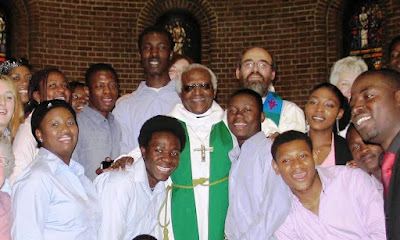
‘The most awful thing that they can do is to kill me, and death is not the worst thing that could happen to a Christian’ … Archbishop Desmond Tutu visiting Saint George’s and Saint Thomas’s Church, Dublin, and the Discovery Gospel Choir
Today’s Prayers (Sunday 21 June 2026, Trinity III, Fathers Day):
In Pray with the World Church, the prayer diary of the Anglican mission agency USPG (United Society Partners in the Gospel), the theme this week, from 21 to 27 June 2026 (pp 12-13), is ‘Land Taken, Land Remembered’. This theme is introduced today with a reflection by the Venerable Rosalyn Kantlaht’ant Elm, Director of Indigenous Ministries, Anglican Church of Canada:
When I think about how land was taken from Indigenous communities in Canada, I see that it was not the work of one person or a single event. It happened slowly, over more than four hundred years. In the early days of European settlement, Indigenous peoples and settlers often lived and worked alongside one another. Though imperfect, there was a time of coexistence.
As Canada developed, laws such as the Civilization Act and the Indian Act enabled the government to take Indigenous lands and move our people onto reserves – fenced-in areas often far from our traditional territories, languages, medicines, ceremonies, and rituals. This process unfolded over generations. Today, Indigenous peoples occupy only a small fraction of our original lands. Much of the rest remains under treaty dispute or is unceded territory, often threatened by mining, forestry, and oil and gas development.
Churches also played a significant role. In partnership with the government, they sought to ‘civilise’ Indigenous children, attempting to erase our cultures. In doing so, they became complicit in what can rightly be described as a legislative form of cultural genocide.
These truths are difficult to speak and to hear. But just as Christians cannot have Easter without Good Friday, we cannot skip the hard history and move straight to celebration. Facing these truths together allows us to lament, to pray, and to understand ourselves not by what we own, but as people created by God, called to care for one another and for the land.
The USPG prayer diary today (Sunday 21 June 2026, Trinity III, Fathers Day, National Indigenous Peoples Day, Canada) invites us to pray:
Creator God, from you every family in heaven and earth takes its name. Rooted and grounded in your covenant love, empowered by your Spirit, help us speak the truth in love and walk in your way towards justice and wholeness. (Anglican Church of Canada)
The Collect of the Day:
Almighty God,
you have broken the tyranny of sin
and have sent the Spirit of your Son into our hearts
whereby we call you Father:
give us grace to dedicate our freedom to your service,
that we and all creation may be brought
to the glorious liberty of the children of God;
through Jesus Christ your Son our Lord,
who is alive and reigns with you,
in the unity of the Holy Spirit,
one God, now and for ever.
The Post-Communion Prayer:
O God, whose beauty is beyond our imagining
and whose power we cannot comprehend:
show us your glory as far as we can grasp it,
and shield us from knowing more than we can bear
until we may look upon you without fear;
through Jesus Christ our Saviour.
Additional Collect:
God our saviour,
look on this wounded world
in pity and in power;
hold us fast to your promises of peace
won for us by your Son,
our Saviour Jesus Christ.
Yesterday’s Reflections
Continued Tomorrow
‘Whoever does not take up the cross and follow me is not worthy of me’ (Matthew 10: 37) … Christ is given his cross, a fresco in Analipsi Church in Georgioupoli, Crete (Photograph: Patrick Comerford)
Scripture quotations are from the New Revised Standard Version Bible: Anglicised Edition copyright © 1989, 1995, National Council of the Churches of Christ in the United States of America. Used by permission. All rights reserved worldwide. http://nrsvbibles.org
‘Are not two sparrows sold for a penny? … you are of more value than many sparrows’ (Matthew 10: 29-30) … a mother sparrow feds her chicks in a church in the ceiling of Aghias Anna Church, Maroulas, near Rethymnon in Crete (Patrick Comerford)
Labels:
Apartheid,
Canada,
CND,
Crete 2026,
Father's Day,
Georgioupoli,
Greece 2026,
Iraklion,
Lichfield,
Maroulas,
Mission,
Prayer,
Rethymnon,
Saint Matthew's Gospel,
South Africa,
The Irish Times,
USPG
Subscribe to:
Posts (Atom)