COMERFORD WAY: Patrick Comerford’s online journal on Anglicanism, theology, spirituality, history, architecture, travel, poetry, beach walks ... and more
‘Arbeit macht frei’ … the gate at Auschwitz … today is Holocaust Memorial Day (Photograph: Patrick Comerford)
Patrick Comerford
Today is Holocaust Memorial Day, marking the anniversary of the liberation of Auschwitz in 1945 and the beginning of the liberation of the concentration camps in Europe.
In a ‘virtual tour’ today, I visit Holocaust memorials in a dozen European countries: Austria, Czech Republic, England, France, Germany, Greece, Hungary, Ireland, Italy, Poland, Slovakia and Slovenia.
Looking back on many visits over the years, my images today include monuments, memorials, plaques, sculptures, shattered grave stones and Stolpersteine or ‘stumbling stones’, in cemeteries, libraries, museums, parks, schools, squares, streets, synagogues, railway stations, and bridges.
There are photographs from the concentration camps in Auschwitz, Birkenau and Sachsenhausen. There are Jewish families and individuals, mothers and children, the murdered and the survivors, resistance fighters and the ‘Righteous Among the Nations’.
Austria:
Rachel Whiteread’s Holocaust Memorial in Judenplatz in Vienna (Photograph: Patrick Comerford)
Czech Republic:
The walls of the Pinkas Synagogue in Prague are covered with the names of 78,000 victims of the Holocaust (Photograph: Patrick Comerford)
The names of the concentration camps surround the Aron haKodesh or Holy Ark in the Pinkas Synagogue, Prague (Photograph: Patrick Comerford)
England:
The Holocaust Memorial Stone at the east end of Bourton Park, Buckingham, was installed in 2021 (Photograph: Patrick Comerford)
France:
The Mur des Names or Wall of Names in the Mémorial de la Shoah lists 76,000 French Jews deported and murdered by the Nazis (Photograph: Patrick Comerford)
A plaque on a school in the Marais in Paris recalling the children of the Shoah (Photograph: Patrick Comerford)
Germany:
The Memorial to the Murdered Jews of Europe in Berlin (Photograph: Patrick Comerford)
A memorial to Jewish children at the Jewish Cemetery in Berlin (Photograph: Patrick Comerford)
The memorial to the victims of the Sachsenhausen Concentration Camp 1936-1945 … the victims included gays, Gypsies, political prisoners and disabled people (Photograph: Patrick Comerford)
Greece:
The Jewish Holocaust Memorial at Plateia Eleftherias (Liberty Square) in Thessaloniki (Photograph: Patrick Comerford)
Chief Rabbi Gabriel Negrin places candles in the Holocaust memorial in Etz Hayyim Synagogue in Chania (Photograph: Patrick Comerford)
The Holocaust Memorial by Georgios Karahalios (2001) in Corfu remembers the 2,000 Jews of Corfu who were murdered in Auschwitz in 1944 (Photograph: Patrick Comerford)
The monument in the Nuova or New Synagogue in Corfu to families who died in the Holocaust (Photograph: Patrick Comerford)
Hungary:
The Memorial of the Hungarian Jewish Martyrs by Imre Varga at the Dohány Street Synagogue in Budapest (Photograph: Patrick Comerford)
The Holocaust Memorial Park at the Dohány Street Synagogue in Budapest (Photograph: Patrick Comerford)
Italy:
A monument in Bologna commemorating victims of the Holocaust (Photograph: Patrick Comerford)
The Holocaust Memorial outside the railway station in Gorizia, a town that straddles the border of Italy and Slovenia (Photograph: Patrick Comerford)
The Holocaust Memorial at the Synagogue in Padua (Photograph: Patrick Comerford)
A monument to Jewish partisans and resistance to the Nazis and Fascists in Rome (Photograph: Patrick Comerford)
The memorial wall to victims of the Holocaust in the Ghetto in Venice (Photograph: Patrick Comerford)
The Holocaust memorial in the Ghetto in Venice (Photograph: Patrick Comerford)
Poland:
Multilingual memorials in Birkenau … a reminder of the many nationalities of the victims of the Holocaust (Photographs: Patrick Comerford)
Shattered gravestones make a Holocaust memorial in a Jewish cemetery in Kraków (Photograph: Patrick Comerford)
The Empty Chairs Memorial in Ghetto Heroes Square in Kazimierz , symbolising abandoned homes and mass deportations from the Kraków Ghetto in 1943 (Photograph: Patrick Comerford)
Slovakia:
The Holocaust Memorial in the centre of Bratislava on the site of the former Neolog Synagogue (Photograph: Patrick Comerford)
Stolpersteine or ‘stumbling stones’
Berlin:
Stolpersteine or Stumbling stones on Rosenthaler Straße 39, Berlin-Mitte, remembering members of the Salinger family murdered by the Nazis in Auschwtiz and Riga (Photograph: Patrick Comerford)
Dublin:
Dublin’s first Stolpersteine or ‘stumbling stones’, recalling six Irish Holocaust victims, at Saint Catherine’s National School on Donore Avenue (photograph: Patrick Comerford)
Prague:
‘Stolpersteine’ or ‘Stumbling Stones’ on the streets of Prague remember members of the Bergmann family deported to Terezín during the Holocaust (Photograph: Patrick Comerford)
Thessaloniki:
‘Stolpersteine’ or ‘Stumbling Stones’ on the pavement on Vassilisis Olgas Avenue in Thessaloniki commemorate Greek Jews deported to Auschwitz (Photograph: Patrick Comerford)
Venice:
Stolpersteine or stumbling stones (Pietre d’inciampo) in Venice recall victims of the Holocaust (Photograph: Patrick Comerford)
Remembering individuals:
Remembering Anne Frank in street art in Berlin (Photograph: Patrick Comerford)
The sculpture of Anne Frank by Doreen Kern in the British Library, London (Photograph: Patrick Comerford)
The Kindertransport monument at Liverpool Street Station … a reminder in the heart of London of the Holocaust (Photograph: Patrick Comerford)
A plaque on Heydukova Street in Bratislava marks the former home of Aron Grünhut (1895-1974), involved in heroic rescues during the Holocaust (Photograph: Patrick Comerford)
Monuments to ‘Righteous Among the Nations’:
Philip Jackson’s monument of the Swedish diplomat Raoul Wallenberg at Wallenberg Place, near Hyde Park, London (Photograph: Patrick Comerford)
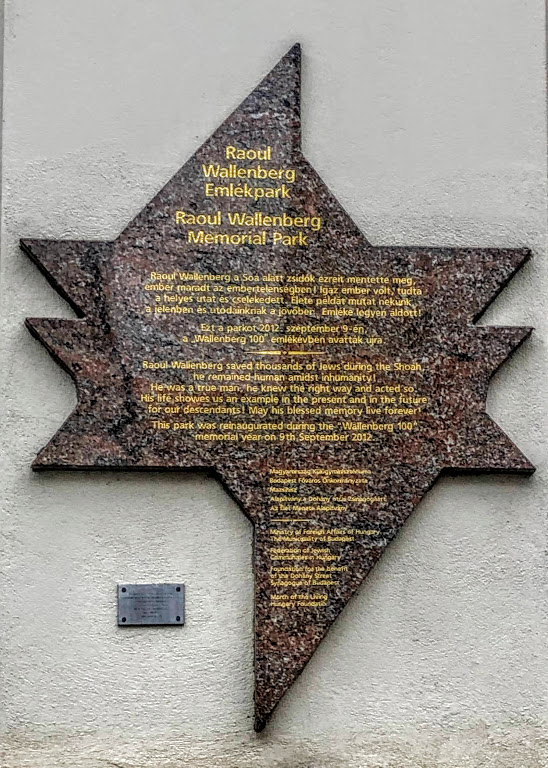
A memorial to Raoul Wallenberg in the Raoul Wallenberg Holocaust Memorial Park at the Dohány Street Synagogue, Budapest (Photograph: Patrick Comerford)
The Mary Elmes Bridge in Cork … the centrepiece of the bridge is designed to look like a menorah (Photograph: Patrick Comerford)
The Wall of the Righteous in Paris lists 3,300 French people who have been recognised as ‘Righteous Among the Nations’ (Photograph: Patrick Comerford)
These images are reminders not only of the Holocaust and its victims, but of real individuals who suffered and were humiliated, whose lives were shattered and who were murdered.
They are reminders of why we must never forget. The Holocaust happened not just because of one evil man but because many good people stood by and remained silent.
Over 80 years after the end of the Holocaust, antisemitism is on the rise once again. We are seeing the rise of the far-right in Britain across Europe and a resurgence of the far-right in Latin America, far-right ideology and vocabulary has become part and parcel of the language of the Trump regime, its spokespersons and those who support street murders by ICE in Minneapolis.
We must never forget.
The Eternal Flame in the Mémorial de la Shoah, Paris (Patrick Comerford)
‘The Ballad of Mauthausen’, the Holocaust cantata written by Iakovos Kambanellis and Mikis Theodorakis … Mauthausen was the last of the concentration camps to be liberated, on 3 May 1945
Patrick Comerford
The Victory in Europe Day (VE Day) commemorations next week mark Germany's unconditional surrender on 8 May 1945 and the end of all German military operations. Yom haShoah, the Jewish world’s annual day of remembrance of the Holocaust, was marked last week (24 April 2025). Wednesday marked the 80th anniversary of Ravenruck (30 April 1945), and the 80th anniversary of the liberation of Bergen-Belsen was marked two weks earlier (15 April 1945).
This weekend also marks the liberation of the concentration camps at Mauthausen and Gusen. The last members of the SS fled the camps on 3 May 1945, and a US Army reconnaissance unit arrived in Gusen and Mauthausen on 5 May. On the following day, the US army finally liberated around 40,000 prisoners in the camps. In both camps they found the bodies of hundreds of detainees who had died in the days before liberation.
Mauthausen was the last of the concentration camps to be liberated at the end of the Holocaust. Mauthausen-Gusen was about 20 km east of Linz in Upper Austria. Unlike Auschwitz, it was not an extermination camp, but countless people were murdered and died there in horrific circumstances. There the Nazis forced their victims to work in a stone quarry, hauling large pieces of rock and stone up the ‘Stairs of Death’ along steep and uneven ramps.
The Jewish prisoners there included Simon Wiesenthal (1908-2005), who is remembered for his tireless efforts to bring those responsible for the Holocaust to justice. He survived the Lwów ghetto, concentration camps in Janowska (1941-1944), Kraków-Płaszów (1944) and Gross-Rosen, a death march to Chemnitz, and the concentration camps at Buchenwald and Mauthausen (1945).
After World War II, Wiesenthal dedicated his life to tracking down and gathering information on fugitive Nazi war criminals so that they could be brought to trial. He played a role in capturing Adolf Eichmann in Buenos Aires in 1960. He died in Vienna at the age of 96 on 20 September 2005.
Other prisoners or detainees in Mauthausen included Jehovah’s Witnesses, Romanies and Spanish republicans. Between 240,000 and 320,000 people, including Jews, intellectuals, and people classified as political ‘undesirables,’ were murdered in Mauthausen.
The Greek playwright Iakovos Kambanellis, author of ‘Mauthausen’ … is regarded by many as the greatest Greek playwright of the 20th century
Over the past week, I have been listening once again to the words and the music of The Ballad of Mauthausen, a cantata written by Iakovos Kambanellis and Mikis Theodorakis 60 years ago in 1965, 20 years after the end of World War II.
The Ballad of Mauthausen (Η Μπαλάντα του Μαουτχάουζεν) is based on the experiences of the Greek playwright Iakovos Kambanellis (Ιάκωβος Καμπανέλλης, 1922-2011), who wrote four poems that Mikis Theodorakis (Μίκης Θεοδωράκης) set to music.
Kambanellis was a poet, playwright, screenwriter, lyricist, and novelist, best known as a screenwriter for films, including Stella (1955), directed by Michael Cacoyannis. It was first written the script as a play, Stella With the Red Gloves, based on Carmen, but was never produced on the Greek stage because of its sexual frankness. The film, shot in the streets of Athens, follows a singer (Melina Mercouri) who refuses to marry her lover and begins a passionate affair with a football player. The film made a star of Melina Mercouri and boosted Greek cinema’s international reputation.
Kambanellis was born on 2 December 1922 in Hora on the island of Naxos. He was forced to leave school at an early age and to find work after the family moved to Athens, but he continued his studies at an evening technical school. He was arrested in 1942 after attempting to flee Nazi-occupied Greece, and was sent to Mauthausen in Austria, where he spent the rest of World War II.
The ‘Stairs of Death’ in Mauthausen
Kambanellis owed his survival in Mauthausen to the protection of a philhellenic German prisoner who assigned him to the architectural drafting office, where additions to the camp were designed.
Mauthausen was the last of the concentration camps to be liberated in May 1945. Kambanellis was not a Jew, and he was free to return with the other Greek prisoners to Greece. But knowing there were Greek Jews who dreamed of reaching Palestine, he elected to stay on in the camp until the last Greek Jew left.
Interviewed later in life, he said: ‘I don’t want to make myself into a hero. What could I do? I saw the eyes of the sick, of the weak, of the abandoned; could I have said okay, fine, I’m leaving now? I was their friend.” He admitted he was deeply envious of them “because we all went back to an old world and we were scared of it. We couldn’t, after those three years, go back to the world of the past, of before the war. And they went to a new, virgin, country and started a new world in Palestine.’
On his return to Greece, Kambanellis began writing a newspaper column in Athens before turning to the theatre and film.
A recurring feature of his work is the use of multiple, often unexpected voices. He attributed this to the years he spent in Mauthausen, listening to the voices of nameless sufferers. His success as a writer seemed miraculous to him and perhaps contributed to his unique blend of realism and mysticism.
His most successful play, Our Grand Circus, was staged in 1973 at the height of the colonels’ dictatorship in Greece. Weaving history, myth, and the traditional shadow puppet theatre with folk motifs, the play ridicules the heroic view of Greek history favoured by the colonels, rewriting Greek history from a left-wing perspective.
By calling the performances a circus and transforming his bleak view of the regime and of Greek history into a series of amusing vignettes, he escaped the strict censorship of the time. Our Grand Circus broke all box-office records and made Kambanellis a popular symbol of resistance.
He wrote the scripts for about a dozen films and directed two of them. He died in Athens on 29 March 2011. He is regarded by many as the greatest Greek playwright of the 20th century.
Mauthausen, his only novel, is a memoir recalling his experiences in the concentration camp. It was first published 60 years ago in Athens in 1965 and has been translated into English and German. At the same time, he wrote the Mauthausen cantata with a setting by his close friend Mikis Theodorakis, when his publisher suggested that they publish their works together.
The book and the music were born in an incendiary political and cultural milieu in Greece. Two days after its first performance, all music by Theodorakis was banned from Greek state radio. Within two years, the military had seized power and the colonels silenced Theodorakis and many other voices for seven long years.
Kambanellis was inspired by a photograph of an unknown girl which he found in the camp and which he kept with him.
The memoir begins in the camp and the neighbouring villages in the weeks immediately after their liberation. The horrors the inmates have seen and have suffered are recalled by the author and the woman he falls in love with, a Lithuanian Jew, in merciless detail as the lovers exorcise their demons by revisiting the sites of the atrocities they witnessed. When the inmates are gradually repatriated, many of the Jews there wait to find a way to get to Palestine.
The best-known song of all, performed by Maria Farantouri, is the first song, Άσμα Ασμάτων (Asma Asmaton, ‘Song of Songs’), which opens with the words:
Τι ωραία που είν’ η αγάπη μου
με το καθημερνό της φόρεμα
κι ένα χτενάκι στα μαλλιά.
Κανείς δεν ήξερε πως είναι τόσο ωραία.
‘My love, how beautiful she is in her everyday dress’.
This first song recalls the poignant questioning of a man who describes how beautiful his beloved is and asks the other inmates if they have seen her. They tell him they have seen her on a long march, standing on large square with a number on her arm and a yellow star on her heart. Maria Farantouri hauntingly sings the repeated line: ‘No-one knows how beautiful my beloved was.’<’br />
This song maintains the poetic structure of the Biblical Song of Songs, until the chilling line, coming as if in response to ‘have you seen him whom my soul loves,’ echoes with the question: ‘Young girls of Mauthausen, Young girls of Belsen, Have you seen my love?’ and the answer ‘We saw her in the frozen square, A number in her white hand And a yellow star on her heart.’
The second song, O Αντώνης (O Antonis, ‘Adonis’) is also known from the score of the film Z. This song tells the story of a Jew who collapses on the ‘Stairs of Death’ at the base of the quarry and is shot by the guard who then orders the Greek prisoner Antonis to lift a double burden or he too will be shot.
Antonis lifts this second rock and defiantly walks on with it. In this song we also hear the stairs being depicted in the introduction to every couplet.
The third song, Ο Δραπέτης (O Drapetis, The Fugitive), is the story of a prisoner who escapes the camp but cannot find refuge in the hostile surroundings. He is captured again and is shot.
The introduction to this song depicts the landscape of Austria with a Mozart-like melody.
In the last song, Όταν τελειώσει Ο Πόλεμος (Otan Teliossi O Polemos, When the War Ends), the poet addresses one of the girls he sees standing by the fence of the female camp and asks whether they can come together when the war is finally over, kiss at the gate, make love in the quarry and in the gas chamber until the shadow of death is driven away.
The song ends with an epilogue, returning to the first song and ending with the plaintive words that no-one knows how beautiful my beloved was.
The instrumentation includes bouzoukis, spinet, electric guitar, baglamas, flute, bass and percussion, all helping to create a desolate yet beautiful atmosphere.
Greek popular music in the 1960s became known all over the world thanks to the scores by two composers in particular, Manos Hadjidakis and Mikis Theodorakis, for two popular movies, Never on Sunday and Zorba the Greek. Both worked in the laika tradition of Greek popular music influenced by European melodic form. Each had his own muse or angel in a female singer who interpreted his music – for Hadjidakis she was Nana Mouskouri, for Theodorakis she was Maria Farandouri.
The recording of The Ballad of Mauthausen marked the beginning of one of the most fruitful collaborations in Greek music. Mikis Theodorakis discovered the singer Maria Farantouri when she was a 16-year-old young singer. He is said to have told her at the time: ‘You will be my high priestess.’ Her unique dramatic voice and style complements his music, and it is so productive a partnership that it has lasted for half a century.
Listening to The Ballad of Mauthausen, it is difficult to grasp that this is the voice of a teenager who has just left school, for she sings with a raw force and energy that reaches into the heart and soul with intensity.
Farandouri and Theodorakis had a life-long musical collaboration, intensified by their shared political activism. This album is both a classic and the high point of that collaboration.
Farandouri’s voice is a marvel of depth and beauty, and the songs are among the best by Theodorakis. The power and majesty of his music combined and the soaring beauty of her voice make The Ballad of Mauthausen a profound testament to the power of human resistance to tyranny and oppression.
The most accessible recording by Maria Farantouri (Μαρία Φαραντούρη) is complemented by a cycle of six songs for Farantouri, named ‘Farantouri’s Cycle’:
5, Κουράστηκα να σε κρατώ (Kourastika na se Krato, ‘I Am Tired of Holding Your Hand’).
6, Ο ίσκιος έπεσε βαρύς (O Iskios Epesse Varis, ‘The Shadow is so heavy’).
7, Πήρα τους δρόμους τ' ουρανού (Tous Thromous T’Ouranou, ‘I Took to the Streets of Heaven’).
8, Στου κόσμου την ανηφοριά (Stou Kosmou Tin Aniforya, ‘The Uphill Road’).
9, Το Εκκρεμές (To Ekremes, ‘The Pendulum’).
10, Τ' όνειρο καπνός (Tóniro Kapnos, ‘Dreams Go up in Smoke’).
The Ballad of Mauthausen is a difficult poem to read and a difficult cantata to listen to, and yet is compelling.
It is difficult to realise how a poet could be inspired to write about love in the all-encompassing atmosphere of evil and death in a concentration camp.
Yet this is the dream of love, and love is the way a great soul not only survives such terror, but finds meaning and triumphs over it.
A sketch by Simon Wiesenthal in Mauthausen for ‘Café As’ … part of a recent exhibition in the Jewish Museum, Vienna (Photograph: Patrick Comerford)
Άσμα Ασμάτων
Τι ωραία που είν’ η αγάπη μου
με το καθημερνό της φόρεμα
κι ένα χτενάκι στα μαλλιά.
Κανείς δεν ήξερε πως είναι τόσο ωραία.
Κοπέλες του Άουσβιτς,
του Νταχάου κοπέλες,
μην είδατε την αγάπη μου;
Την είδαμε σε μακρινό ταξίδι,
δεν είχε πια το φόρεμά της
ούτε χτενάκι στα μαλλιά.
Τι ωραία που είν’ η αγάπη μου,
η χαϊδεμένη από τη μάνα της
και τ’ αδελφού της τα φιλιά.
Κανείς δεν ήξερε πως είναι τόσο ωραία.
Κοπέλες του Μαουτχάουζεν,
κοπέλες του Μπέλσεν,
μην είδατε την αγάπη μου;
Την είδαμε στην παγερή πλατεία
μ’ ένα αριθμό στο άσπρο της το χέρι,
με κίτρινο άστρο στην καρδιά.
Τι ωραία που είν’ η αγάπη μου,
η χαϊδεμένη από τη μάνα της
και τ’ αδελφού της τα φιλιά.
Κανείς δεν ήξερε πως είναι τόσο ωραία.
Ο Αντώνης
Εκεί στη σκάλα την πλατιά
στη σκάλα των δακρύων
στο Βίνερ Γκράμπεν το βαθύ
το λατομείο των θρήνων
Εβραίοι κι αντάρτες περπατούν
Εβραίοι κι αντάρτες πέφτουν,
βράχο στη ράχη κουβαλούν
βράχο σταυρό θανάτου.
Εκεί ο Αντώνης τη φωνή
φωνή, φωνή ακούει
ω καμαράντ, ω καμαράντ
βόηθα ν’ ανέβω τη σκάλα.
Μα κει στη σκάλα την πλατιά
και των δακρύων τη σκάλα
τέτοια βοήθεια είναι βρισιά
τέτοια σπλαχνιά είν’ κατάρα.
Ο Εβραίος πέφτει στο σκαλί
και κοκκινίζει η σκάλα
κι εσύ λεβέντη μου έλα εδω
βράχο διπλό κουβάλα.
Παίρνω διπλό, παίρνω τριπλό
μένα με λένε Αντώνη
κι αν είσαι άντρας, έλα εδώ
στο μαρμαρένιο αλώνι.
Ο Δραπέτης
Ο Γιάννος Μπερ απ’ το βοριά
το σύρμα δεν αντέχει.
Κάνει καρδιά, κάνει φτερά,
μες στα χωριά του κάμπου τρέχει.
«Δώσε, κυρά, λίγο ψωμί
και ρούχα για ν’ αλλάξω.
Δρόμο να κάνω έχω μακρύ,
πάν’ από λίμνες να πετάξω.»
Όπου διαβεί κι όπου σταθεί
φόβος και τρόμος πέφτει.
Και μια φωνή, φριχτή φωνή
«κρυφτείτε απ’ τον δραπέτη.»
«Φονιάς δεν είμαι, χριστιανοί,
θεριό για να σας φάω.
Έφυγα από τη φυλακή
στο σπίτι μου να πάω.»
Α, τι θανάσιμη ερημιά
στου Μπέρτολτ Μπρεχτ τη χώρα.
Δίνουν το Γιάννο στους Ες Ες,
για σκότωμα τον πάνε τώρα.
Όταν τελειώσει Ο Πόλεμος
Κορίτσι με τα φοβισμένα μάτια
κορίτσι με τα παγωμένα χέρια,
άμα τελειώσει ο πόλεμος
μη με ξεχάσεις.
Χαρά του κόσμου, έλα στην πύλη
να φιληθούμε μες στο δρόμο
ν’ αγκαλιαστούμε στην πλατεία.
Κορίτσι με τα φοβισμένα μάτια
κορίτσι με τα παγωμένα χέρια,
άμα τελειώσει ο πόλεμος
μη με ξεχάσεις.
Στο λατομείο ν’ αγαπηθούμε
στις κάμαρες των αερίων
στη σκάλα, στα πολυβολεία.
Κορίτσι με τα φοβισμένα μάτια
κορίτσι με τα παγωμένα χέρια,
άμα τελειώσει ο πόλεμος
μη με ξεχάσεις.
Έρωτα μες στο μεσημέρι
σ’ όλα τα μέρη του θανάτου
ώσπου ν’ αφανιστεί η σκιά του.
Κορίτσι με τα φοβισμένα μάτια
κορίτσι με τα παγωμένα χέρια,
άμα τελειώσει ο πόλεμος
μη με ξεχάσεις.
The Song of Songs
How beautiful she is, my love
in her everyday dress
and the little comb on her hair
Nobody ever knew that she is so beautiful
Girls of Auschwitz
Dachau’s girls
have you seen by chance my love?
We saw her leaving on a long voyage
she was no longer wearing her dress
nor a little comb on her hair.
How beautiful she is, my love
the one pampered by her mother
and her brother’s kisses
Nobody ever knew that she is so beautiful
Girls of Auschwitz
Dachau’s girls
have you seen by chance my love?
We saw her in the frigid town square
with a number stamped on her white hand
with a yellow star pinned by her heart
How beautiful she is, my love
the one pampered by her mother
and her brother’s kisses
Nobody ever knew that she is so beautiful
Adonis
There on the wide staircase
the staircase of tears
in Wiener Graben’s deep stone-
quarry of cries and lamentation
Jews and partisans stroll by
Jews and partisans fall down
a rock they carry on their back
a rock a burden cross of death
There comes Adonis and a voice
a voice, a voice he hears
oh comrade, oh comrade,
help me to climb these stairs
But there on the wide staircase
that staircase of tears
such help is taken as insult
such a compassion is a curse
The Jewish man falls on the step
and red bleeds through the staircase
and you young lad come over here
a double rock you’ll carry
A double rock I’ll take, a triple
my name, they call me Adonis
come and meet me if you are a man
at the marble threshing circle.
The Fugitive
Janos Ber from the North
can’t stand the barbed wire.
He takes heart, takes wing
runs through the villages of the valley.
Ma’am, give me a piece of bread
and clothes to change into –
I have a long way to go
and lakes to fly across.
Wherever he goes or stops
fear and terror strike
and a cry, a terrible cry:
Hide from the fugitive!
Christians, I’m no murderer,
no beast come to eat you.
I left the prison
to go back to my home.
Ah, what deathly loneliness
in this land of Berthold Brecht!
They hand Janos over to the SS
They’re taking him, now, to be killed.
When the War is Over
Girl with the weeping eyes,
Girl with the frozen hands.
Forget me not when the war is over.
Joy of the world. come to the gate
So that we could embrace in the street.
So that we could kiss in the square.
So that we could make love in the quarry.
In the gas chambers,
On the staircase, in the observation post.
Love in the middle of noon
In all the corners of death
’Til its shadow will be no more.
Girl with the weeping eyes,
Girl with the frozen hands.
Forget me not when the war is over.
• Maria Farantouri, who is on a tour marking the 100th anniversary of the death of Mikis Theodorakis, is taking part in a concert in Schauspielhaus in Bochum, Germany next Friday (9 May 2025). The programme that includes ‘The Ballad of Mauthausen’, other songs, readings and a talk. The concert marks the 80th anniversary of the end of World War II, and she is accompanied by the pianist Henning Schmiedt.
Marianne Faithfull, who died last week at the age of 78, had a strong Jewish family background in Austria, Hungary, Romania, Serbia, Ukraine and Germany
Patrick Comerford
Marianne Faithfull, the singer, muse and actor who helped write and inspired some of the Rolling Stones’ greatest songs, died last week at the age of 78. She was 17 and I had just started secondary school when she took every teenage boy’s world by storm with her hit version of ‘As Tears Go By.’
The story of Marianne Faithfull’s disturbing early life, her brave efforts at recovery, and her death last week brought back so many of my teenage and school years. They reminded me too of the amazing story of her mother, Eva von Sacher-Masoch, who styled herself Baroness Erisso, and called me back again to a blog series, ‘Tales of the Viennese Jews,’ which I began in November 2019, although I had not returned to it since the story of Max Perutz almost for four years ago (18 May 2021).
The Tales from the Vienna Woods is a waltz by the composer Johann Strauss II (1825-1899), written just over a century and a half ago, in 1868. Although Strauss was baptised in the Roman Catholic Church, he was born into a prominent Jewish family. Because the Nazis had a particular penchant for Strauss’s music, they tried to conceal and even deny the Jewish identity of the Strauss family.
However, the stories of Vienna’s Jews cannot be hidden, and many of those stories from Vienna are told in the exhibits in the Jewish Museum in its two locations, at the Palais Eskeles on Dorotheergasse and in the Misrachi-Haus in Judenplatz.
Rather than describe both museums in detail in one or two blog postings, I decided after a visit to Vienna in November 2019 to post occasional blog postings that re-tell some of these stories, celebrating a culture and a community whose stories should never be forgotten.
The newspaper obituaries last week focussed on Marianne Faithfull as a singer, actor, her brave battle for recovery from addiction and against cancer, and her short relationship with Mick Jagger, and portrayed her as the archetypal wild child of the 1960s.
She had a convent school education, and was often described as the daughter of an aristocratic baroness who had survived the Nazi occupation of Austria. Both details added to the media attention to her lifestyle in the 1960s and 1970s.
Marianne Faithfull’s mother, Eva von Sacher-Masoch, who called herself Baroness Erisso
In recent years, the singer also explored her Jewish background and her Jewish ancestry featured in the BBC series Who Do You Think You Are?. She once declared she had to thank her Jewish roots for her renditions of the songs of Bertholt Brecht and Kurt Weill and for an innate flair for their music.
Recent genealogical research reveals that, despite her Catholic background and schooling, Marianne Faithfull was Jewish by all rabbinical definitions. Although she never practised Judaism, her mother, her maternal grandmother, and all her ancestors on that side of her family are Jewish, which meets the definition of being Jewish according to halacha or Jewish traditional law.
Her mother, Eva von Sacher-Masoch, who called herself Baroness Erisso, was a dancer in Weimar Berlin and was then living in Vienna when World War II began. Eva’s mother Flora was born into a well-known Jewish family; she converted to Christianity when she married an Austrian aristocrat Artur Wolfgang Ritter von Sacher-Masoch (1875-1953), but she still attended synagogue on High Holy Days.
Marianne Faithfull’s father, Major Robert Glynn Faithfull, was a British intelligence officer during World War II and later Professor of Italian Literature at Bedford College, London University. He met Eva in Vienna after the defeat of the Nazis.
Marianne Faithfull’s mother was known as Eva but was born Hermine von Sacher-Masoch (1912-1991) on 4 December 1912 in Budapest, then the second city in the Austro-Hungarian Empire.
Eva’s father, Artur Wolfgang von Sacher-Masoch, was an Austrian writer who used the pseudonym Michael Zorn. His family was descended from central European minor nobility through Leopold Johann Nepomuk Ritter von Sacher – the title ritter indicates an hereditary knight, and is somewhat equivalent to the title of baronet. Leopold combined his own family name with that of von Masoch, to keep alive the name of the family of his wife, who was the last descendant of a Slovak family of minor aristocrats. He did this when the Habsburg emperor gave him the title of ritter to recognise his work as the imperial police commissioner in Lemberg, present-day Lviv in Ukraine.
Another family member was the writer Leopold von Sacher-Masoch (1836-1895), whose last name and scandalous novel Venus in Furs gave rise to the word ‘masochism’.
Eva’s mother, Flora Ziprisz (1881-1955), was born into a central European Jewish family whose members included many prominent medical doctors. She was known in her family as Flora but was born Elisabeth Rosa Ziprisz on 29 September 1881 in Karánsebes, then in Hungary and now Caransebeș in the Banat region in south-west Romania. Flora’s mother, Therese (Deutsch) Ziprisz, was also born in Caransebeş.
Flora’s father, Eva’s grandfather, Dr Wilhelm ‘Vilmos’ Ziprisz (1844-1922), was born in the Banat region on 23 November 1844 in Neusatz or Novi Sad, once known as the ‘Serbian Athens’. It was then an important city on the Danube in the Hungarian part of the Austro-Hungarian. Today it is the second largest city in Serbia.
He was a son of Salamon Ziprisz, a member of a leading Jewish family from Bač, now in Vojvodina in Serbia. He studied medicine in Vienna under Dr Ignaz Semmelweis, and later became a doctor battling the diphtheria and cholera in the Austro-Hungarian Empire. He publicly vaccinated his daughter Flora with the smallpox vaccine to show villagers that it would not poison them. He died in Vienna at the age of 78 on 28 April 1922.
Despite strong disapproval from both their families, Flora married Artur Wolfgang Sacher-Masoch in Caransebeș on 9 January 1901 when she was 18. She converted to Christianity – not an uncommon experience at the time – but continued to attended synagogue on High Holy days.
The main building of the Jewish community in Vienna, housing the Stadttempel or City Synagogue at Seitenstettengasse 4 … Eva Sacher-Masoch moved with her family to Vienna in 1918 (Photograph: Patrick Comerford)
After the collapse of the Hapsburg empire, Austrian abolished and outlawed all aristocratic titles. As a child, Eva was known as Eva Sacher-Masoch. She spent her early childhood living on her family’s estates near Caransebeș, and moved with her family to Vienna in 1918. Her brother was the novelist Alexander Sacher-Masoch (1901-1972), author of Die Parade.
As a young woman, Eva moved to Berlin where she studied ballet at the Max Reinhardt Company. She danced in productions by the German theatrical duo Bertolt Brecht and Kurt Weill, as well as in the cabaret scene of Weimar Berlin, depicted in the film Cabaret. In one anecdote, she recalled how she was befriended by a prostitute on the Kurfurstendamm who would see her home safely at night.
As World War II loomed, Eva returned to her parents’ home in Vienna and lived with them throughout the war. The family opposed Hitler since the Anschluss or forced annexation of Austria by Nazi Germany. Flora thought of herself as a Hungarian patriot, first and foremost, but was as shocked as any other Jew by the Nazi racial laws.
Despite their Jewish ancestry, Flora and Eva were protected to a degree because of Artur’s World War I military record, his standing as the writer Michael Zorn, and perhaps his aristocratic claims. This may have saved Flora from having to wear a yellow star and from being sent to the death camps but did not remove the constant fear, and Eva was officially labelled a mischling or ‘a mongrel’.
At times, the family secretly helped Jews fleeing Austria, and hid socialist pamphlets in their home. Artur joined the anti-Nazi resistance, and ended up being arrested and hung by his hands in torture chambers in his 60s.
Soviet troops liberated Vienna in April 1945, but Eva and Flora were among 100,000 or so women in Vienna who were raped by Red Army troops. A Russian soldier found Eva and Flora hiding in a room. He raped Eva, but she then picked up a gun and shot him before he could do the same to Flora; later Eva had an abortion.
In post-war Vienna, Eva met a British intelligence officer, Major Robert Glynn Faithfull (1912-1998), a lecturer in Italian at Liverpool University. They married in 1946, moved to England and were the parents of a daughter Marianne, born Marian Evelyn Gabrielle Faithfull in Hampstead, London, on 29 December 1946.
The family lived for a time in Ormskirk, Lancashire while the father completed his PhD at Liverpool University. Marianne then spent part of her childhood in Braziers Park, a commune in Oxfordshire formed by John Norman Glaister in which Robert Faithfull played an instrumental role.
The couple divorced in 1952. Despite Austrian law, Eva chose to style herself Eva von Sacher-Masoch, Baroness Erisso, despite Austrian constitutional laws. Research for Who Do You Think You Are? revealed Eva’s claim to a title was exaggerated though rooted in reality.
To help support her daughter, Eva taught dance at Bylands School, a private boarding school near Basingstoke, Hampshire. She later lived in Reading, Berkshire, where she worked as a waitress at a Sally’s Café on Friar Street. Eva’s mother Flora came to live with them and died in Reading at the age of 74 in July 1955.
Eva and Marianne seem to have lived in straitened circumstances, and Marianne’s childhood included bouts of tuberculosis. She went to a primary school in Brixton, London, and had a bursary to attend Saint Joseph’s Convent School, Reading, where she was a weekly boarder and part of the Progress Theatre’s student group.
Eva died on 22 May 1991. Dr Robert Glyn Faithfull died on 5 February 1998, aged 85.
Marianne Fathfull’s mother Eva von Sacher-Masoch, who was half-Jewish, and her mother Flora, who was a Hungarian Jew (Photo courtesy of http://www.cabaret-berlin.com)
Despite Eva’s bohemian past, Marianne Faithfull said she broke her mother’s heart when she embarked on her own wild time. As a singer, she was discovered at 17 by the Rolling Stones manager Andrew Oldham. Her first single, ‘As Tears Go By’, was written by Mick Jagger and Keith Richards and made her a star. She would dismiss any rumours that she had had a hand in writing the song.
Her life quickly became a whirlwind. By 18, she was married to the artist John Dunbar and the mother of a son, Nicholas. Her affair with Mick Jagger ended in 1970, and that same year she lost custody of her son. She survived a suicide attempt and spiralled downwards, spending two years sleeping rough in Soho and addicted to heroin. Later in life, she was seen as the rock ’n’ roll casualty who had survived to tell her tale.
She acted in films including The Girl On A Motorcycle with French actor Alain Delon, as well as theatre productions. She entered a new phase with an understated performance as Maggie in Sam Garbaski’s film comedy-drama Irina Palm that was lauded by critics at the Berlin Film Festival in 2007.
She also fought anorexia, hepatitis and breast cancer, broke her hip in a fall and was in hospital with Covid-19. Her final album was an experimental collaboration in 2021 with the Australian multi-instrumentalist Warren Ellis, She Walks In Beauty.
Although Marianne Faithfull was raised a Catholic, she was proud of her Jewish heritage through her mother and grandmother and once said music by Kurt Weill, a cantor’s son, was ‘very much the tonic scale from the temple.’ She had never been to a synagogue nor heard the music there. ‘But I think there must really be some genetic memory of my Jewish background,’ she once told the Jewish Chronicle.
Marianne Faithfull would say she had lived out her dreams and her nightmares. She died on 30 January 2025.
Canon Frederic Anstruther Cardew (1866-1942) … known in Paris as the ‘chorus girls' friend’
Patrick Comerford
We are in Ordinary Time, the time between Candlemas and the 40 days of Lent, which begins next Wednesday.
Charlotte and I arrived in Paris yesterday, and we are staying here for two days. So, in these 11 days in Ordinary Time, my reflections each morning are drawing on the lives of 11 French saints and spiritual writers.
As this series of reflections began, I admitted I am often uncomfortable with many aspects of French spirituality, and that I need to broaden my reading in French spirituality. So, I have turned to 11 figures or writers you might not otherwise expect. They include men and women, Jews and Christians, immigrants and emigrants, monks and philosophers, Catholics and Protestants, and even a few Anglicans.
I am taking some quiet time early this morning for reflection, prayer and reading in these ways:
1, A reflection on a French saint or writer in spirituality;
2, today’s Gospel reading;
3, a prayer from the USPG prayer diary.
Canon Frederic Anstruther Cardew at the wedding of Lord Dudley and Gertie Millar in Paris in 1924
French saints and writers: 5, the Revd Canon Frederic Cardew (1866-1942):
Saint George's Church, the main Church of England church in Paris, is at 7 rue Auguste Vacquerie, just a few steps from the Arc de Triomphe. Although the present church is a modern church dating from 1978, the church dates back to 1824.
Saint George’s is one of two Church of England congregations in central Paris, the other being Saint Michael’s. There are four other Church of England congregations in the suburbs. Paris also has an American Episcopal Church at avenue George V.
Saint George’s says it seeks, ‘in the very heart of this busy city, to be a place of the holy, a place of silence and of prayer,’ where visitors may experience ‘something of the wonder and loving mystery of our God, and may feel drawn gently into His sacred presence.’
The foundation stone of ‘old Saint George’s’ was laid in 1887 on the site of the present church. That church was high in both senses – Victorian Gothic and Anglo-Catholic. The church, with its colourful chaplains and curates – including Father Frederic Cardew and his ministry to English ‘dancing-girls’ – survived two World Wars and the Nazi occupation of Paris, and in more recent decades became the centre for Anglican-Roman Catholic ecumenism.
Throughout much of the first half of the 20th century, Canon Frederic Anstruther Cardew (1866-1942) was known in Paris as the ‘chorus girls' friend.’
He was born in Mean Meir in Lahore, now in Pakistan, on 6 March 1866, a son of Colonel Sir Frederic Cardew, an army officer in India, and Clara (Newton) Cardew. Sir Frederic was later the Governor of Sierra Leone (1894 -1900).
Canon Frederic Cardew had many prominent church figures in his family. His aunt Lucy Cardew was married to Frederick William Farrar (1831-1903), Dean of Canterbury; his first cousin Maud Farrar married the SPG secretary, Bishop Henry Montgomery (1847-1932) from Moville, Co Donegal, and they were the parents of Viscount ‘Monty’ Montgomery of Alamein.
Frederic Anstruther-Cardew was still in his late teens when he went to Canada in 1884, volunteered to fight Indians and sought adventure as a cowboy in the US. He returned to England, was ordained in 1891.
He was Precentor of Brisbane Cathedral when he married Norah Skye Kington in Saint Mary Abbots Church, Kensington, in 1894. Her father, Colonel William Miles Nairne Kington (1838-1898), played cricket for Gloucestershire. In Australia, Cardew was the Vicar of Charleville in Queensland for three years from 1894.
In Charleville, Cardew ministered to the biggest cattle stations in the world. It was there that he became famous across the colony as the ‘Cattle Punchers Padre.’ It was said his parish was the biggest in the world, covering 120,000 square miles.
Cardew then spent three years as the Vicar of All Saints’ Church, Brisbane. There he officiated at the wedding in 1898 of Travers Robert Goff (1863-1907), a bank manager from Dublin, and Margaret Agnes Morehead – their children included PL Travers (1899-1996), born Helen Lyndon Goff, the author of Mary Poppins.
Cardew was back in England, living in Leicestershire and Derbyshire in the early 20th century. He became the chaplain of Saint George’s Church, Paris, in 1907, and remained there until 1939. He was also the rural dean of France and a prebendary of Saint Paul’s Cathedral, London.
Soon after his arrival in Paris, Cardew founded the Cardew Theatre Girls’ Hostel in Montmartre for American and English ‘chorus girls’ in 1907. For over 30 years, he fed and sheltered countless chorus girls who sought their fame and fortune in the burlesque shows of Paris. He became the confessor, matchmaker, and legal adviser to thousands of ‘Les Girls’ and in doing so became famous across Europe as the ‘Chorus Girls’ Friend.’
During World War I he visited the frontlines, the trenches and the battlefields, and one of his sons was taken prisoner of war at the Second Battle of Ypres in 1915. At a victory dinner in Paris after the war signed himself with aplomb as ‘Chaplain of Blighty.’
Cardew continued his work among the ‘chorus girls’ after World War I. His fame and personality were so great that he was worked into the storyline of a show, The Nymph Errant, that became a musical by Cole Porter. He was also chaplain to the Actors’ Union and the Actors’ Association, was involved in the Anglo-Catholic Congress in 1923.
Canon Cardew officiated at the marriage of one of his ‘chorus girls,’ Gertie Millar (1879-1952), who married the widowed William Ward (1867-1932), 2nd Earl of Dudley, in Paris in 1924. Lord Dudley’s first wife had drowned in 1920 while she was visiting Connemara. The wedding caused a stir because Gertie was well-known on stage and in the chorus halls, while Lord Dudley had been Viceroy of Ireland (1902-1905) and Governor-General of Australia (1908-1911). He is named in James Joyce’s description of his Vice-Regal progress through Dublin in Ulysses.
But the publicity surrounding the wedding attracted public support for Cardew rather than notoriety, and in 1928 the British Ambassador in Paris presented him with a cheque for £1 million. The long list of subscribers was headed by the Prince of Wales, later Edward VIII, who had known Cardew from childhood but was also known to many of the chorus girls and was a close friend of Lord Dudley.
Canon Cardew’s first wife Norah died in London on 27 July 1931. He married his second wife, Margaret Sophie Stokes, on 17 August 1933. He had been made OBE the previous year, and the French government recognised his work by making him a Chevalier du Legion d’Honneur, the highest award from the French government.
When Edward VIII abdicated in 1936 and subsequently married Wallace Simpson at the Château de Candé in Tours on June 1937, Cardew became embroiled in the controversy. The civil marriage was followed by a Church of England service conducted by the Revd Robert Anderson Jardine, Vicar of Darlington in the Diocese of Durham.
Cardew said he the former king was ‘an old friend of mine and I have known him since he was a boy.’ But, he said, Jardine had conducted the service without his permission as Rural Dean of France and in defiance of the Bishop of Fulham, Bishop Basil Batty, who was in charge of Anglican affairs in continental Europe, and in defiance of the Archbishop of Canterbury and the Bishop of Durham.
Cardew said he was responsible for Anglican matters in France, and called for Jardine to be dismissed. He added that ‘any clergyman under my jurisdiction here in France who performed such a breach would almost certainly be deprived of his living.’ Cardew may also have disliked Jardine’s aggressive evangelical views. Jardine was eventually forced to retire and never worked again in parish ministry in the Church of England and died penniless in 1950.
Meanwhile, Cardew retired in 1939, and moved back to London. Canon Frederic Cardew died at the age of 76 in Shrewsbury House, Cheyne Walk, Chelsea, on 12 July 1942. He was the father of four sons.
After World War II, a memorial was erected to Canon Cardew in Saint George’s Church in 1950. With the help of the Girls’ Friendly Society, his widow Margaret refounded his club in 1952. In 1970, the YMCA contributed a legacy to the organisation, later known as the YMCA-Cardew Club. The club supports young English speakers, many of them au pairs, and the clubroom is at Saint George’s Church.
Saint George’s Church had been badly damaged during World War II. The site was sold to developers and the church is now housed in the ground floor and the basement of a modern apartment building on the site.
Frederic Anstruther Cardew is remembered to this day as a saintly and pastorally caring priest. The American writer Julien Green (1900-1998), who was born and lived in Paris, became a Roman Catholic in 1916. But in his autobiographical Young Years (1984) he recalled the influence on him of Cardew during his childhood days when he went to church in Saint George’s with his parents:
‘I remember that when the Reverend Cardew knelt in front of the altar and in an uncertain voice, but with an accent that did not deceive, intoned a hymn immediately taken up by the faithful, an indescribable emotion took possession of me. There was in this man a humility so deep and a faith so pure that I received something from it without even guessing what it was about. Because of this man, I loved God. I didn’t know anything about it and Reverend Cardew didn’t know anything about it either. Recently, a Catholic priest told me that this man had left behind the memory of an unblemished life after having been for a long time the chaplain of the girls at the Folies Bergère.’
Saint George’s Church was rebuilt in 1978. The Revd Mark Osborne is the chaplain, the Revd Nicolas Razafindratsima is the curate, and the former Dean of St Albans, the Very Revd Jeffrey John, is Associate Chaplain. The Sunday services include the Said Eucharist (BCP 1662) at 8:30 and Solemn Eucharist at 10:30.
Saint George’s Church, Paris, was rebuilt in 1978
Mark 7: 14-23 (NRSVA):
14 Then he called the crowd again and said to them, ‘Listen to me, all of you, and understand: 15 there is nothing outside a person that by going in can defile, but the things that come out are what defile.’
17 When he had left the crowd and entered the house, his disciples asked him about the parable. 18 He said to them, ‘Then do you also fail to understand? Do you not see that whatever goes into a person from outside cannot defile, 19 since it enters, not the heart but the stomach, and goes out into the sewer?’ (Thus he declared all foods clean.) 20 And he said, ‘It is what comes out of a person that defiles. 21 For it is from within, from the human heart, that evil intentions come: fornication, theft, murder, 22 adultery, avarice, wickedness, deceit, licentiousness, envy, slander, pride, folly. 23 All these evil things come from within, and they defile a person.’
Édouard Manet’s ‘A Bar at the Folies-Bergère’ (1882) … Canon Frederic Cardew was known in Paris as the ‘chorus girls' friend’
Today’s Prayers (Wednesday 7 February 2024):
The theme this week in ‘Pray With the World Church,’ the Prayer Diary of the Anglican mission agency USPG (United Society Partners in the Gospel), is ‘Gender Justice in Christ.’ This theme was introduced on Sunday by Ellen McMibanga, Zambia Anglican Council Outreach Programme.
The USPG Prayer Diary today (7 February 2024) invites us to pray in these words:
Let us pray for gender justice across the world, remembering that gender equality can lead to the abolishment of poverty.
The Collect:
Almighty God,
you have created the heavens and the earth
and made us in your own image:
teach us to discern your hand in all your works
and your likeness in all your children;
through Jesus Christ your Son our Lord,
who with you and the Holy Spirit reigns supreme over all things,
now and for ever.
The Post-Communion Prayer:
God our creator,
by your gift
the tree of life was set at the heart of the earthly paradise,
and the bread of life at the heart of your Church:
may we who have been nourished at your table on earth
be transformed by the glory of the Saviour’s cross
and enjoy the delights of eternity;
through Jesus Christ our Lord.
Additional Collect:
Almighty God,
give us reverence for all creation
and respect for every person,
that we may mirror your likeness
in Jesus Christ our Lord.