Showing posts with label Gorey. Show all posts

09 October 2023

Daily prayers in Ordinary Time
with USPG: (134) 9 October 2023

Saint Michael’s Church, Gorey, Co Wexford … Pugin’s only Romanesque church in Ireland (Photograph: Patrick Comerford)

Patrick Comerford

We are in Ordinary Time in the Church Calendar, and the week began with the Eighteenth Sunday after Trinity (Trinity XVIII, 8 October 2023).

Today, the Calendar of the Church of England in Common Worship remembers the lives and witness of Denys, Bishop of Paris, and his Companions, Martyrs (ca 250) and Robert Grosseteste, Bishop of Lincoln, Philosopher, Scientist (1253).

Before the day begins, I am taking some time early this morning for prayer and reflection.

The Church recently celebrated Saint Michael and All Angels last month (29 September). So in my reflections each morning this week I am continuing the Michaelmas theme of the last two weeks in this way:

1, A reflection on a church named after Saint Michael or his depiction in Church Art;

2, the Gospel reading of the day in the Church of England lectionary;

3, a prayer from the USPG prayer diary.

The West Door of Saint Michael’s Gorey … can be compared with Joseph Potter’s Romanesque door in Holy Cross Church, Lichfield (Photograph: Patrick Comerford)

Saint Michael’s Church, Gorey, Co Wexford:

Saint Michael’s Church, Gorey, Co Wexford, is Pugin’s only Romanesque-style church in Co Wexford. His designs were strongly influenced by Joseph Potter’s mixed Romanesque and Gothic style for Holy Cross Church, Lichfield, including Potter’s entrance door and his turret.

Saint Michael’s is one of the earliest of Pugin’s churches, and dates from 1839, when he was also working in Alton for the Earl of Shrewsbury and beginning his plans for Saint Chad’s Cathedral, Birmingham, and Saint Giles’, his ‘perfect’ church in Cheadle.

When the church opened in 1843, it was claimed that Pugin’s design had been influenced by Dunbrody Abbey in south Co Wexford. But Saint Michael’s has many of the proportions of his cathedral in Birmingham, being as wide and almost as long.

Had his planned spire been built on the battlemented tower, Saint Michael’s would have acquired a height that balanced its horizontal proportions.

Phoebe Stanton notes that while Saint Michael’s is comparable in size to Saint Giles’, it does not share its richness: ‘The Gorey church is large and sober, astonishing not only for its Norman style but for the way in which it does and does not resemble the work Pugin was doing in England.’

The church has a seven-bay aisled and clerestoried nave, two-bay transepts and an apsidal chancel. This apse in the East End of the church is more of an English Romanesque feature that an Irish one – Irish examples typically had square east ends. Pugin’s only other Romanesque essays – Saint James in Reading, and the crypt of Saint Chad’s Cathedral in Birmingham also had apsidal chancels.

John Woodburn once showed me around Saint Michael’s Church. Pugin’s rood screen, altar and reredos have been removed since the post-Vatican II liturgical changes, and the original stencilling is gone from the towers and walls. But if the church has lost some of its internal beauty, it retains its majesty.

This is Pugin’s first cruciform church, and Pugin used the windows in each transept and at the west end to make a subtle Trinitarian statement. He pays some interesting tributes to Irish church history, with his round tower and the mission cross at the west end.

The Mortuary Chapel has a later Harry Clarke window, but the former Baptistry is crumbling. It is in the shape of an octagon – a shape from the Lantern Tower that inspired Pugin after his visits to Ely Cathedral. But the font has been removed, and is in a neglected state outside a door on the north side of the church, while the tiles, in a pattern inspired by Pugin’s stencil work, are beginning to crumble on the window ledges.

The Romanesque West Door, with its round arch, is unique for a Pugin church in Ireland, but is similar to his door in Dudley, and both the door and the transepts remind me of Holy Cross Roman Catholic Church on Upper John Street, Lichfield, designed by Joseph Potter, and where Pugin had designed the (now gone) rood screen. There are also echoes of the small door into the tower in Holy Cross and its spiral stairs.

Pugin’s clerk of works at Gorey was Richard Pierce, who had also worked with Pugin in Wexford, and who would later design the twin churches there.

The interior of Saint Michael’s Church, Gorey, Co Wexford (Photograph: Patrick Comerford)

Luke 10: 25-36 (NRSVA):

25 Just then a lawyer stood up to test Jesus. ‘Teacher,’ he said, ‘what must I do to inherit eternal life?’ 26 He said to him, ‘What is written in the law? What do you read there?’ 27 He answered, ‘You shall love the Lord your God with all your heart, and with all your soul, and with all your strength, and with all your mind; and your neighbour as yourself.’ 28 And he said to him, ‘You have given the right answer; do this, and you will live.’

29 But wanting to justify himself, he asked Jesus, ‘And who is my neighbour?’ 30 Jesus replied, ‘A man was going down from Jerusalem to Jericho, and fell into the hands of robbers, who stripped him, beat him, and went away, leaving him half dead. 31 Now by chance a priest was going down that road; and when he saw him, he passed by on the other side. 32 So likewise a Levite, when he came to the place and saw him, passed by on the other side. 33 But a Samaritan while travelling came near him; and when he saw him, he was moved with pity. 34 He went to him and bandaged his wounds, having poured oil and wine on them. Then he put him on his own animal, brought him to an inn, and took care of him. 35 The next day he took out two denarii, gave them to the innkeeper, and said, “Take care of him; and when I come back, I will repay you whatever more you spend.” 36 Which of these three, do you think, was a neighbour to the man who fell into the hands of the robbers?’ 37 He said, ‘The one who showed him mercy.’ Jesus said to him, ‘Go and do likewise.’

Inside Saint Michael’s Church, Gorey, Co Wexford, facing west (Photograph: Patrick Comerford)

Today’s Prayer:

The theme this week in ‘Pray With the World Church,’ the Prayer Diary of the Anglican mission agency USPG (United Society Partners in the Gospel), is ‘After the Storm.’ This theme was introduced yesterday.

The USPG Prayer Diary today (9 October 2023) invites us to pray in these words:

We pray for Mozambique and all countries that were impacted by Cyclone Freddy. We pray for the rebuilding of homes and communities in the wake of the storm.

Pugin’s apsidal chancel at the East End of Saint Michael’s Church is more of an English Romanesque feature that an Irish one (Photograph: Patrick Comerford)

The Collect:

Almighty and everlasting God,
increase in us your gift of faith
that, forsaking what lies behind
and reaching out to that which is before,
we may run the way of your commandments
and win the crown of everlasting joy;
through Jesus Christ your Son our Lord,
who is alive and reigns with you,
in the unity of the Holy Spirit,
one God, now and for ever.

The Post Communion Prayer:

We praise and thank you, O Christ, for this sacred feast:
for here we receive you,
here the memory of your passion is renewed,
here our minds are filled with grace,
and here a pledge of future glory is given,
when we shall feast at that table where you reign
with all your saints for ever.

The Mortuary Chapel has a later Harry Clarke window depicting the Resurrection (Photograph: Patrick Comerford)

Yesterday’s Reflection

Continued Tomorrow

Scripture quotations are from the New Revised Standard Version Bible: Anglicised Edition copyright © 1989, 1995, National Council of the Churches of Christ in the United States of America. Used by permission. All rights reserved worldwide. http://nrsvbibles.org

The coat-of-arms of the Esmonde baronets above the west door (Photograph: Patrick Comerford)

22 August 2023

Daily prayers in Ordinary Time
with USPG: (86) 22 August 2023

Holy Cross Church, Lichfield … Joseph Potter’s design influenced Pugin’s design of Saint Michael’s Church, Gorey, Co Wexford (Photograph: Patrick Comerford)

Patrick Comerford

We are in Ordinary Time in the Church Calendar, and this week began on Sunday with the Eleventh Sunday after Trinity (Trinity XI, 20 August 2023).

Before this day begins (22 August 2023), I am taking some time this morning for prayer, reading and reflection.

In recent weeks, I have been reflecting on the churches in Tamworth. Throughout this week and last week, I am reflecting each morning in these ways:

1, Looking at a church in Lichfield;

2, the Gospel reading of the day in the Church of England lectionary;

3, a prayer from the USPG prayer diary.

The entrance to Potter’s turret in Holy Cross Church, Lichfield (Photograph: Patrick Comerford)

Holy Cross Church, Upper Saint John Street, Lichfield:

My photographs this morning (22 August 2023) are from Holy Cross Church, Upper Saint John Street, Lichfield.

Joseph Potter (1756-1842), who was born in Lichfield, who had a considerable practice in Staffordshire and the neighbouring counties in the late 18th and early 19th century. Potter had some bruising encounters with Pugin in the 1830s, but also influenced Pugin in ways that the great master of the Gothic revival in church architecture never acknowledged .

Early in his career as an architect, Joseph Potter was employed by James Wyatt, one of the most prominent architects of the day, to supervise his alterations to Lichfield Cathedral in 1788-1793 and to Hereford Cathedral in 1790-1793.

At this time, Potter also worked with Wyatt in repairing Saint Michael’s Church, Coventry (later Coventry Cathedral) in 1794 and on rebuilding Plas Newydd, Anglesey (1795-1823), for the 1st Marquess of Anglesey. At Plas Newydd, Potter was responsible for designing and building the Gothic chapel. He also carried out alterations between 1816 and 1830 to the Gothic Hall at Beaudesert House, on the edges of Cannock Chase, for the Paget family, Marquesses of Anglesey.

Potter became the established architect at Lichfield Cathedral, overseeing the repairs to the south-west spire (1794), the restoration of the vaults in the north transept (1795-1797), and the restoration of the west front (1820-1822).

Potter was also the architect in 1800 for Newton’s College in the Cathedral Close. The college was established by Andrew Newton as an almshouse for the widows and unmarried daughters of clergy, particularly those who had served in Lichfield Cathedral. Newton was the son of a Lichfield brandy and cider merchant, and endowed the college with a bequest of £20,000.

The college buildings are a range of 16 dwellings with a central doorway designed by Potter and built in brick with stone facings on the south side of the road from Beacon Street. The first almswomen moved in probably towards the end of 1803. Potter also designed a house at the south-west corner of the range in Beacon Street that provided a further four dwellings. The college trustees transferred the building to the Dean and Chapter of Lichfield Cathedral in 1988.

In 1816, Potter designed the Causeway Bridge at Bird Street, crossing the Minister Pool and linking the Cathedral Close with the rest of the city.

Towards the end of his career, Potter also designed Holy Cross Church, Upper Saint John Street, Lichfield, in 1835. Father John Kirk bought the site for a Roman Catholic church in Upper Saint John Street in 1802 and within a year had built a house and a chapel that was originally dedicated to Saint Peter and Saint Paul.

When the chapel was enlarged and rebuilt by Joseph Potter in 1834, the dedication was changed to the Church of the Holy Cross. The Church is a brick building in a Gothic style with an entrance front and turret of Tixall stone in a mixed Romanesque and Gothic style, designed by Joseph Potter.

While Potter was working on Holy Cross Church in 1834, the great Gothic revival architect, AWN Pugin, first visited Staffordshire and stayed in Lichfield during this architectural tour of the Midlands and the West Country ‘in search of the picturesque and the beautiful.’

Pugin’s stay in Lichfield was memorable for two reasons. First of all, he arrived late at night, and in the dark he crept unwittingly into the wrong bedroom. Aware of something soft and warm in the bed, he found it to be ‘the thigh of a female occupant already turned in.’ There were loud screams and shouts. Chambermaids came rushing in with lighted candles. Pugin had some difficulty in convincing everyone that he had made a genuine mistake.

But Pugin was in for another unpleasant shock when he visited Lichfield Cathedral the next day. Taken aback by the refurbishment of the cathedral 30 years earlier by James Wyatt (1746-1813), he declared: ‘Yes – this monster of architectural depravity, this pest of Cathedral architecture, has been here. need I say more.’

Referring to Lichfield’s own architect, Joseph Potter, he said: ‘The man I am sorry to say – who executes the repairs of the building was a pupil of the Wretch himself and has imbibed all the vicious propensities of his accursed tutor without one spark of even practical ability to atone for his misdeeds.’

Pugin found the fabric of the cathedral had been mutilated by ‘the Wretch’ – and he also described Lichfield as ‘a dull place – without anything remarkable.’

Pugin returned to Lichfield in 1837. After staying briefly at Wolseley Park with Sir Charles Wolseley, a recent convert to Roman Catholicism, Pugin returned to Lichfield. By then, Potter had completed Holy Cross Church, and Pugin would add a screen and other furnishings in 1841 … although they have long disappeared.

Potter’s designs for Holy Cross, including his entrance door and his turret of Tixall stone in a mixed Romanesque and Gothic style, later influenced Pugin’s designs for Saint Michael’s Church, Gorey, his only Romanesque-style church in Co Wexford. Potter’s West Doors of Lichfield Cathedral would also inspire Pugin’s design for the doors of Saint Chad’s Roman Catholic Cathedral in Birmingham.

It was only after this second visit to Lichfield that Pugin arrived for the first time at Alton Towers, the home of the Earl and Countess of Shrewsbury, on 31 August 1837, staying there for the next four days. Lord Shrewsbury’s Irish titles included Earl of Wexford; Lady Shrewsbury was Maria Theresa Talbot, was the daughter of William Talbot of Castle Talbot, Co Wexford, and the favourite niece of John Hyacinth Talbot MP, of Ballytrent, Co Wexford.

The visit changed Pugin’s career for ever, and transformed the ecclesiastical landscape of both Staffordshire and Co Wexford. Lord Shrewsbury’s influence led to Pugin rebuilding Alton Towers and designing great works of architecture including Saint Giles’s, Cheadle, and Saint Mary’s, Uttoxeter. The patronage of Lady Shrewsbury’s uncle brought Pugin to Wexford the following year.

Potter was the architect at Oscott College from 1834 to 1839, but he was replaced by Pugin when the college buildings were almost complete.

Potter’s other works in Lichfield and the surrounding area include:

● Christ Church, Burntwood (1819-1820);
● Chetwynd Bridge, Alrewas (1824);
● Freeford Hall, enlarged for the the Dyott family (1826-1827);
● The High Bridge, Armitage (1829-1830);
● Saint John Baptist Roman Catholic Church, Tamworth (1829-1830).

Potter lived in Pipehill outside Lichfield and had his office in Saint John’s Street. He was the county surveyor of Staffordshire for 45 years until his death in 1842. He had three sons who all carried on the family profession:

● Robert Potter (1795-1854), the eldest son, was architect and designed many buildings.
● Joseph Potter Jnr. (1797-1875) took over his father’s practice after his death. He designed the Guildhall (1846-1848) and the Clock Tower (1863) in Lichfield.
● James Potter (1801-1857), the youngest son, was a civil engineer who worked mainly on canals and railways.

Inside Holy Cross Church, Lichfield (Photograph Patrick Comerford)

Matthew 19: 23-30 (NRSVA):

23 Then Jesus said to his disciples, ‘Truly I tell you, it will be hard for a rich person to enter the kingdom of heaven. 24 Again I tell you, it is easier for a camel to go through the eye of a needle than for someone who is rich to enter the kingdom of God.’ 25 When the disciples heard this, they were greatly astounded and said, ‘Then who can be saved?’ 26 But Jesus looked at them and said, ‘For mortals it is impossible, but for God all things are possible.’

27 Then Peter said in reply, ‘Look, we have left everything and followed you. What then will we have?’ 28 Jesus said to them, ‘Truly I tell you, at the renewal of all things, when the Son of Man is seated on the throne of his glory, you who have followed me will also sit on twelve thrones, judging the twelve tribes of Israel. 29 And everyone who has left houses or brothers or sisters or father or mother or children or fields, for my name’s sake, will receive a hundredfold, and will inherit eternal life. 30 But many who are first will be last, and the last will be first.’

The interior of the Church of the Holy Cross, Upper John Street, Lichfield, today … the screen and furnishings designed by Pugin in 1841 are no longer here (Photograph: Patrick Comerford)

Today’s Prayer:

The theme this week in ‘Pray With the World Church,’ the Prayer Diary of the Anglican mission agency USPG (United Society Partners in the Gospel), is ‘Modern-Day Slavery Reflection – The Clewer Initiative.’ This theme was introduced on Sunday.

For more resources: www.theclewerinitiative.org

The USPG Prayer Diary today (22 August 2023, International Day Commemorating the Victims of Violence Based on Religion or Belief) invites us to pray in these words:

We pray for an end to all forms of religious persecution and sectarianism.

The Collect:

O God, you declare your almighty power
most chiefly in showing mercy and pity:
mercifully grant to us such a measure of your grace,
that we, running the way of your commandments,
may receive your gracious promises,
and be made partakers of your heavenly treasure;
through Jesus Christ your Son our Lord,
who is alive and reigns with you,
in the unity of the Holy Spirit,
one God, now and for ever.

The Post Communion Prayer:

Lord of all mercy,
we your faithful people have celebrated that one true sacrifice
which takes away our sins and brings pardon and peace:
by our communion
keep us firm on the foundation of the gospel
and preserve us from all sin;
through Jesus Christ our Lord.

Holy Cross Church, Upper John Street, Lichfield … the door is reflected in AWN Pugin’s designs for Saint Michael’s Church, Gorey (Photograph: Patrick Comerford)

Yesterday’s reflection

Continued tomorrow

Scripture quotations are from the New Revised Standard Version Bible: Anglicised Edition copyright © 1989, 1995, National Council of the Churches of Christ in the United States of America. Used by permission. All rights reserved worldwide. http://nrsvbibles.org

13 March 2023

Colonel Thomas Comerford:
the life in the Indian army
of a revolutionary’s brother

Colonel Thomas Comerford and Edith Donaldson on their wedding day in Bombay on 10 October 1921 (Photograph courtesy Roger Comerford)

Patrick Comerford

Colonel Thomas James Comerford (1894-1959) was a polo-playing army officer in the Indian army who played crucial roles in both World War I and World War II. He was born into the landed gentry and minor aristocracy of Co Wexford and Co Wicklow, and his mother’s family was deeply involved in politics in Co Wexford. Yet, the story of Thomas and his elder sister shows how many Irish families were deeply divided politically and socially during the War of Independence and the decades that followed.

Thomas James Comerford was the elder son of James Charles Comerford (1842-1907) of Ardavon House, Rathdrum, Co Wicklow, and Eva Mary Esmonde (1860-1949), who were married on 24 August 1892 in Saint Peter and Saint Paul Church, Kilanerin (Killinierin), outside Gorey, Co Wexford. This church was designed by Pugin and Ashlin and the Esmonde family of Ballynastragh were major benefactors of the church, where are listed on a plaque together with other benefactors.

James Charles Comerford of Ardavon House, who is described at his wedding as ‘Gentleman’, was the principal shareholder in Rathdrum Mill. He was a friend and political ally of his neighbour, Charles Stewart Parnell. When the Land League organised a demonstrative day of action on 15 December 1881 in support of Parnell by calling on people to plough and manure his fields at Garrymore, near Rathdrum, and at Avondale, Comerford gave his mill workers in Rathdrum and Laragh the day off to take part.

The Comerford mill in Rathdrum burned down in June 1885, but was rebuilt and the business was flourishing a year later in June 1886 when the Comerfords hosted a visit by British and Irish millers.

At the time of their wedding, Eva Mary Esmonde was living at Borleigh Manor, then the home of Major General Thomas James Quin. She was a daughter of Lieutenant-Colonel Thomas Esmonde VC (1829-1872) and a niece of Sir John Esmonde (1826-1876), 10th Baronet, of Ballynastragh, Gorey, Co Wexford, and Glenwood, Rathdrum, Co Wicklow, Liberal MP for Waterford (1852-1876).

Colonel Thomas Esmonde was an officer in the 18th Royal Irish Regiment during the Crimean War. He only 26 when he was the first officer to enter Sebastopol on 18 June 1855 after the siege. He was decorated with the Victoria Cross for his part in the Battle of Sebastopol. Later, Colonel Esmonde became Aide de Camp to the Lord Lieutenant of Ireland, Lord Abercorn, and Deputy-Inspector General of the Royal Irish Constabulary. He died in Bruges on 14 January 1872 after a riding accident at the age of 43, and is buried in the Central Cemetery. His grave was restored by volunteers of the Victoria Cross Trust in 2017.

Lieutenant-Colonel Thomas Esmonde, VC (1831-1872), father of Eva Mary Comerford (Photograph courtesy Roger Comerford)

When James and Eva Comerford married in Co Wexford, the witnesses at the wedding were his brother, William Comerford (1838-1893), who died a year later, and her sister Matilda (‘Milly’) Mary Josephine Esmonde (1862-1937).

James Charles Comerford died on 3 October 1907, aged 64, and is buried in Three Mile Water, Ennisboyne, Co Wicklow, with the Ellis family of Kilpoole, Co Wicklow. At the time of her death in 1949, Eva Comerford was living at St Nessan’s, Sandyford, Co Dublin, and she too was buried in Ennisboyne.

James and Eva Comerford were the parents of four children: Mary Eva (Maire) Comerford (1893-1982); Colonel Thomas James Comerford (1894-1959); Dympna Helen Mulligan (1897-1977) and Alexander E Comerford (1900-1966) of Malahide, Co Dublin.

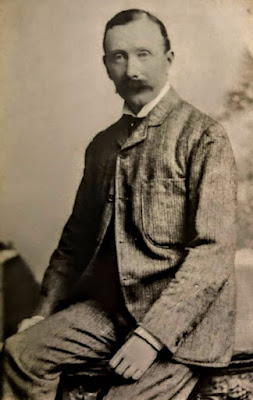
James Charles Comerford (1842-1907) of Ardavon House, Rathdrum … a contemporary of Charles Stewart Parnell, and father of Máire Comerford

Although their father died in 1907 when they were still in their teens or childhood, the Comerford children grew up in Co Wexford and Co Waterford in relative prosperity, provided by their father’s land and business interests in Co Wicklow and their family connections in Co Wexford.

Their uncle, Alexander Comerford (1844-1895), was a corn merchant in Liverpool, and lived at Greenfield House, Hoole, Chester. He was a gentleman jockey, he was the owner of Woodcock and other steeplechasers. He made his last appearance on a racecourse at the Tanatside Hunt Meeting, held at Llanymynech, on 30 April 1895, when he fell on Colonel Sandbach’s Sorcerer in the Maiden Steeplechase won by Beauty. He died on Sunday 26 May 1895, after he was thrown from a four-year-old horse he was schooling at Sealand Shooting Range, Chester, and landed on his head the previous afternoon. Their aunts were the only friends of Charles Stewart Parnell’s daughter, Anna, as she grew up in Rathdrum.

As a young woman, their mother, Eva Mary Comerford, was three times tennis champion of Ireland. She was a first cousin of three baronets: Sir Thomas Grattan Esmonde (1862-1935), the Irish Parliamentary Party MP for South Dublin (1885-1892), West Kerry (1892-1900) and North Wexford (1900-1918), and later an independent Senator (1922-1934); and Sir Laurence Grattan Esmonde (1863-1943).

The Comerford children grew up as the second cousins of three baronets: Sir Osmond Thomas Grattan Esmonde (1896-1936), Cumann na nGaedheal (Fine Gael) TD for Wexford (1923-1927-1936); Sir John Lymbrick Esmonde (1893-1958), MP for North Tipperary (1915-1918) and Fine Gael TD for Wexford (1937-1944, 1948-1951); and Sir Anthony Charles Esmonde (1899-1981), Fine Gael TD for Wexford (1951-1973).

Ardavon House, Rathdrum, Co Wicklow … home to generations of the Comerford family

The stories of the two elder Comerford children show how divided Irish families were at the time of the 1916 Rising.

The elder daughter, Mary Eva Comerford (1893-1982), of St Nessan’s, Sandyford, Co Dublin, is better known as Máire Comerford, a Republican activist and journalist. She was raised in Co Wexford and Co Waterford. She first became active in politics as a Redmondite in Wexford Town, but then took part in the 1916 Rising. She ran a farm in Co Wexford before working as a journalist with The Irish Press from 1935. She is buried at Mount Saint Benedict outside Gorey, Co Wexford.

Maire Comerford’s elder brother, Colonel Thomas James Comerford (1894-1959), was born James Thomas Comerford in Ardavon Rathdrum, Co Wicklow, on 1 November 1894, but was known throughout his life as Thomas James Comerford.

He too was raised in Co Wexford and Co Waterford, and probably went to school in Clongowes Wood College, Co Kildare. He was 19 when World War I broke out, and he was commissioned as a Second Lieutenant in the Royal Irish Regiment in September 1914.

He was on active service at the Souvla Bay landing (Gallipoli), and was temporarily with the 6th Battalion, Royal Munster Fusiliers, from 7 to 16 August 1915. He was badly wounded in the mouth and chest and was not declared fit for active service until December 1915.

He later told his son that he was in Dublin while his sister Máire was involved in the Easter Rebellion in 1916.

The army moved him to France and from 22 July 1916 he was involved in the latter part of Battle of the Somme with the 13th Battalion, Royal Irish Rifles, and then in Belgium at the Battles of Messines, Langemark, Menin Road, Ploegsteert and Wytschaate.

He became a captain in the 18th/19th cavalry, moved to the Indian Army in November 1917 and spent the next 30 years in India.

Thomas Comerford and Edith Isobel Donaldson were married in Bombay on 10 October 1921. She was a daughter of John Donaldson KC and Elizabeth Anne (née Munro) of 4 Dartmouth Square, Dublin, and Knocknagor, Banbridge, Co Dublin.

During the 1930s, Thomas Comerford was a noted polo player in India, playing polo for the Blue Birds in the Delhi Low Handicap Polo Tournament in 1930 and for the Wild Geese in 1932.

As Major TJ Comerford, he was gazetted on 3 September 1939 as Remounts Officer at the headquarters of the Northern Command of the Indian Army in Rawalpindi (now Pakistan). The northern command encompassed the North-West Frontier Provinces, Waziristan District, Kashmir State, the Punjab (less Districts of Rohtak and Gurgaon) and the Punjab States including the Punjab Hill States (less Khairpur, Tehri (Garhwal), Pataudi, Dujana and the Bawal District of the Nabha State).

Remount referred to the provision of fresh horses for military purposes. The word refers to both the animals themselves and the means by which they were provided. In many cases, remounts were horses provided to replace horses killed or injured in battle. Comerford was active organising supplies for the Chindits throughout World War II.

He was promoted from major to lieutenant-colonel on 16 June 1941, and he was Deputy Director of Remounts in the Indian Army from 1944 to 1946.

Colonel Thomas Comerford and his wife Edith retired to England when India and Pakistan achieved independence. His mother, Eva Mary Comerford, died at St Nessan’s, Sandyford, on 5 September 1949.

Thomas Comerford was 65 when he died on 1 January 1959 in West Malling, Kent; Edith died on 9 September 1990. They were the parents of a son and a daughter. Their grandson is Roger Comerford.

Saint Nessan’s, Sandyford … Eva Mary Comerford, died at St Nessan’s, Sandyford, on 5 September 1949

20 July 2022

A return to journalism
in Wexford, thanks to
the Tory leadership race

The front page of the ‘Gorey Guardian’ this week … a front-page curtain-raiser for my inside full-page feature on the Wexford roots of the Tory hopeful Penny Mordaunt

Patrick Comerford

In the early and mid-1970s, I worked for almost three years as a journalist with the Wexford People and other titles in the People Group of Newspapers, including the Enniscorthy Guardian, the Gorey Guardian and the New Ross Standard in Co Wexford, and the Wicklow People and Bray People in Co Wicklow.

It was good to work for these newspapers against this week, writing a feature on the Co Wexford family roots of the Tory hopeful Penny Mordaunt, who was squeezed out of the Tory leadership this afternoon. The latest round of voting today ended with these figures: Rishi Sunak, 137; Liz Truss, 113; Penny Mordaunt, 105.

Before the results were announced this afternon, my research makes a full-page feature inside the Wexford People today (20 June 2022) and the other three local newspapers in Co Wexford, and the Gorey Guardian also carries a front-page ‘curtain raiser’ news report this morning:

Tory
hopeful
has links
to Gorey


The Tory leadership hopeful Penny Mordaunt has strong family roots in north Wexford. Ms Mordaunt (49), who hopes to stand against the former Chancellor Rishi Sunak, was born Penelope Mary Mordaunt in Torquay in 1973.

The MP for Portsmouth North is a niece of Henry Mordaunt, who maintains the family’s genealogy website. Henry traces their family roots back to Denis and Mary Mordaunt, born in north Co Wexford in the late 18th century.

The family were tenant farmers in Ballintlea, near Gorey, throughout the 19th century and in north Co Wexford, where the family name was often pronounced and even spelt ‘Morning.’

A family legend claims the Mordaunt or Morning family in Co Wexford is descended from Osmund Mordaunt who married Mary Bulger ‘from Liran nr. Gorey in Ireland’ in London in 1673.

See Page 22

19 July 2022

How James Joyce refers
to Penny Mordaunt’s family
in ‘Portrait of the Artist’

Clongowes Wood College, Co Kildare … James Joyce’s contemporaries included Patrick Rath, who makes passing appearances in ‘Portrait of the Artist as a Young Man’

Patrick Comerford

I am writing in the Wexford People and other newspapers in Co Wexford this week about Penny Mordaunt and the Tory leadership hopeful’s deep family roots in Co Wexford.

But there is also an interesting – even if distant – link with James Joyce too.

Esther or Hester Mordaunt (ca1843-1881) of Clone married Francis Rath of Garrydaniel in Enniscorthy on 15 September 1869. She was a sister of Edward Mordaunt (ca1831-1917), the great-great-grandfather of Penny Mordaunt.

Esther and Patrick Rath emigrated to Argentina, where they farmed extensively. She died in 1881 and is buried in the Mordaunt family plot marked with a headstone erected by her husband, Francis, who by then was a wealthy sheep-farmer in San Pedro, Buenos Aires.

Their only son, Patrick Rath (1873-1936), then, is a first cousin of Penny Mordaunt’s great-grandfather, Patrick Mordaunt (1874-1914), a warrant officer in a cavalry regiment.

Patrick Rath was aged about eight when his mother died in Argentina and he was sent home to Ireland to be educated in Clongowes Wood College. He was the Paddy Rath, a fellow student at Clongowes Wood College, who is referred to twice by James Joyce in Portrait of the Artist as a Young Man, first published in 1916.

James Joyce was at school in Clongowes Wood from 1888 to 1891. Many of his contemporaries in Clogowes appear as characters in Portrait. They include ‘decent’ Fleming, Jack Lawton, ‘Nasty’ Roche, Wells who pushes Stephan Dedalus into a the ‘square ditch,’ Athy, Aubrey Mills, and Mike Flynn.

Other schoolboys in Clongowes at the time who are named by Joyce include Rody Kickham, Cecil Thunder, Simon Moonan, Hamilton Rowan, Dominic Kelly, Tusker Boyle, Jimmy Magee, Paddy Rath, Corrigan, Cantwell, Saurin and Anthony McSwiney. They serve as foils and sharp contrasts to Stephen Dedalus, representing the opposite of Stephen's artistic temperament and introspective behaviour. For the most part, they are either crude, disrespectful, or overtly physical.

Soon after he arrives at Clongowes, Stephen Dedalus, Joyce’s alter ego, is in the refectory when he observes: ‘Then the higher line fellows began to come down along the matting in the middle of the refectory, Paddy Rath and Jimmy Magee and the Spaniard who was allowed to smoke cigars and the little Portuguese who wore the woolly cap. And then the lower line tables and the tables of the third line. And every single fellow had a different way of walking.’

As he is on his way to receive corporal punishment, Stephen Dedalus wonders ‘What would happen? He heard the fellows of the higher line stand up at the top of the refectory and heard their steps as they came down the matting: Paddy Rath and Jimmy Magee and the Spaniard and the Portuguese and the fifth was big Corrigan who was going to be flogged by Mr Gleeson.’

After leaving school, Patrick M Rath wrote ‘Up Country in the Argentine’ for the school magazine, The Clongownian (Christmas, 1900, pp 14-17). Rath addresses his paper to ‘old Tullabeggars and Clongownians’ and describes the life on his ranch from a traditional perspective, with many colourful descriptions of the pampas and of work on a sheep-farm and depictions of gauchos similar to William Bulfin’s characters.

Paddy Rath was living on Northumberland Road in Dublin when he married Sarah Murtagh on 4 July 1906. She was the daughter of Francis Murtagh, a shopkeeper, of Elm Grove, Ranelagh. The witnesses are their wedding in Rathmines were Eileen Meehan and James M Magee, the ‘Jimmy Magee’ also referred to by James Joyce in Portrait of the Artist as a Young Man.

Paddy also played rugby for Bective Rangers. He and Sarah had no children. His funeral in 1936 was attended by the leader of the opposition and former Taoiseach, WT Cosgrave, and his wife Louisa (Flanagan), as well as members of the extended Mordaunt family.

Paddy Rath and his cousin Patrick Mordaunt (1874-1914) were contemporaries of Edward Mordaunt (1866-1957), a Jesuit who was born in Gorey, Co Wexford. Although Edward was a lay brother in the Jesuit community in Milltown Park, perhaps this explains why Paddy Rath was sent to school with the Jesuits in Clongowes Wood, and Patrick Mordaunt’s son, New Mordaunt, Penny Mordaunt’s grandfather, was sent to school with the Jesuits in Mungret College, Co Limerick.

At least three women in this Mordaunt family were nuns: Elizabeth Mordaunt (born 1867) was a Sister of Charity teaching at Saint Paul the Apostle, Monkgate, York (1891, 1901, 1911); Margaret Mordaunt (born 1879) was a Sister of Charity teaching at Saint Patrick’s Convent, York Road, Leeds (1911); and Mary Mordaunt (born 1880 ) was a Sister of Charity of Saint Paul in Saint Paul's Convent, King’s Norton, Worcestershire (1901).

They are further interesting insights into the family background of the Tory hopeful Penny Mordaunt who was also educated at a convent school.

‘Portrait of the Artist as a Young Man’ (1916) makes two references to Paddy Rath … he was a first cousin of Penny Mordaunt’s great-grandfather, Patrick Mordaunt

18 July 2022

Tory leader hopeful Penny Mordaunt has deep family roots in County Wexford

Penny Mordaunt at the launch of her campaign to be Conservative Party leader and Prime Minister, at the Cinnamon Club, in Westminster, London. Picture date: Wednesday July 13, 2022

Patrick Comerford finds one of the Tory leadership hopefuls has Wexford ancestors linked with the 1798 Rising, the Land War and the Civil War

Patrick Comerford

The Tory leadership hopeful Penny Mordaunt has strong family roots in Co Wexford. Ms Mordaunt (49), who hopes to stand against the former Chancellor Rishi Sunak, was born Penelope Mary Mordaunt in Torquay in 1973. She hopes to get to No 10 Downing but has to beat Rishi Sunak in the ballot of Tory party members.

The convent-educated daughter of a former paratrooper, Penny Mordaunt has held a number of posts under Boris Johnson and Theresa May, including Defence Secretary, Paymaster General, Trade Minister, and the Women and Equalities and International Development portfolios.

The MP for Portsmouth North is a niece of Henry Mordaunt, who maintains the family’s genealogy website. Henry traces their family roots back to Denis and Mary Mordaunt, born in north Co Wexford in the late 18th century.

The family were tenant farmers on land in Ballintlea, near Gorey, throughout the 19th century and in north Wexford the family name was often pronounced and even spelt ‘Morning.’

In England, one branch of the Mordaunt family held the title of Earl of Peterborough from 1628 until the family line died out in 1814. Another Mordaunt family have been baronets since 1611, and included five MPs for Warwickshire and Warwickshire South. The present and fourteenth holder of the title is Sir Richard Mordaunt.

A family legend claims the Mordaunt or Morning family in Co Wexford is descended from Osmund Mordaunt who married Mary Bulger, from ‘Liraan nr. Gorey in Ireland,’ in London in 1673. This Osmund Mordaunt was said to be a grandson of the 1st Earl of Peterborough.

However, Henry Mordaunt admits this is a ‘curious tale’ based on a ‘clumsy and incompetent forgery.’ He admits no one knows how or when the Mordaunt family came to Co Wexford, nor has anyone traced a direct link between his family and the titled Mordaunt families.

He declares: ‘Given the number of Mordaunt family groups in Co Wexford in the late 1700s, it does suggest the family had been settled there for several generations.’

Before 1840, most members of the family were identified by the name Morning, and it is only after 1840 they usually spell their name as Mordaunt.

The earliest family members in Co Wexford identified with any certainty are the brothers Patrick and Michael Morning or Mordaunt, born in the 1740s or 1750s and possibly the second generation of Mordaunts born in Co Wexford.

Michael Morning is named in the memoirs of the 1798 leader Miles Byrne from Monaseed as his aunt’s husband. Michael sympathised with the early rebels, and his son Miles Morning, who was a 15-year-old in 1796, was a first cousin of the hero of Vinegar Hill.

Michael’s brother Patrick Mordaunt or Morning was a tenant of the Hatton family, living for much of his life on a small holding in Ballantlea, near Gorey, with his wife Mary. When Patrick died – sometime before 1825 – his farm was divided between his two sons Patrick and Denis Mordaunt.

Denis Mordaunt (1783-1868) was baptised in the parish of Kilanerin, near Gorey, and, as Denis Morning, he married Mary Byrne (1791-1851) in Avoca, Co Wicklow, in 1813. He held about 30 acres in Ballintlea, and may also have held land at Clone, near Monamolin. He died in 1868 and was buried in Boolavogue.

One of his younger children, Edward Mordaunt (1831-1917), married Bridget Crowe (1841-1921) in Litter Parish in 1863. They lived on 86 acres at Cullentra until he was evicted in 1886 for non-payment of rent and was jailed for his role in the ‘Land War.’ The house was destroyed by fire, and Edward and his family later lived in Court Ballyedmond, Monamolin, where he was a farmer and shopkeeper. He died in 1917, and he was buried in Boolavogue, alongside his father and older brothers.

Edward’s son Patrick Mordaunt (1874-1914) was baptised in Monamolin and married Bridget Plunkett (1873-1957) in Wexford in 1898. He enlisted in a cavalry regiment and the family moved to Canterbury.

His son, Penny Mordaunt’s grandfather, Edward (Ned) Patrick Mordaunt (1900-1982), was born in Canterbury, but was sent back to Ireland to school, attending a Christian Brothers school in Dublin and Mungret College in Limerick until 1918. After a brief time in the British army in France during World War I, he returned to Ireland in 1919, and during the Civil War he was jailed for his Republican sympathies.

Penny Mordaunt’s father, John Edward Patrick Mordaunt, went to St John’s College, a Catholic secondary school in Portsmouth, and spent three years in the Parachute Regiment before training as a teacher in Leeds.

The Morning or Mordaunt family in Co Wexford married into the Brennan, Byrne, Connolly, Crowe, Doyle, Laffin, Murphy, Nolan, Sinnott and Willoughby families. Many of their descendants have continued to live in the Craanford, Monaseed, Gorey, Enniscorthy and Rosslare Strand areas.

(Revd Professor) Patrick Comerford is a former Wexford People journalist. Now an Anglican priest, he lives in retirement in Milton Keynes. www.patrickcomerford.com

Patrick Mordaunt (1874-1914), left, Penny Mordaunt’s great-grandfather, was baptised in Monamolin, Co Wexford

This feature is published this week in the ‘Wexford People’, the Enniscorthy Guardian’, the ‘Gorey Guardian’ and the ‘New Ross Standard’, p 22.

13 June 2022

In search of books and
the lost bookshops of
Charing Cross Road

No 84 Charing Cross Road is no longer a bookshop (Photograph: Patrick Comerford, 2022)

Patrick Comerford

During a visit to London last week, two of us walked along Charing Cross Road in search of some of the best-known and some of the lost bookshops of London.

Charing Cross Road, north of Saint Martin-in-the-Fields and Trafalgar Square, is still known for specialist and second-hand bookshops. From Leicester Square station to Cambridge Circus, the street is home to antiquarian, specialist and second-hand bookshops. Between Cambridge Circus and Oxford Street, the street includes more generalist bookshops.

Foyles was once listed in the Guinness Book of Records as the world’s largest bookshop in terms of shelf length, at 30 miles (48 km), and for number of titles on display. It was a tourist attraction in the past and was known for its literary lunches and for its eccentric business practices.

Foyles moved from 111-119 Charing Cross Road to 107 Charing Cross Road, once the premises of Central Saint Martin’s College of Art and Design. It was bought by Waterstones in 2018 and now has a chain of seven shops in England.

A plaque at 84 Charing Cross Road recalls Helene Hanff’s search for books and her correspondence (Photograph: Patrick Comerford, 2022)

The New York-based writer Helene Hanff had a 24-year correspondence from 1949 with Frank Doel, the chief buyer of Marks & Co, antiquarian booksellers on Charing Cross Road. She was in search of obscure classics and British literature titles that she could not find in New York.

The books she bought ranged from Jane Austen’s Pride and Prejudice and John Donne’s Sermons to the writings of Samuel Johnson and Kenneth Grahame’s The Wind in the Willows.

Their exchange inspired her book 84 Charing Cross Road (1970). It has been made into a film starring Anne Bancroft and Anthony Hopkins (1987), and also into a play and a BBC radio drama.

Charing Cross Road still has a selection of second-hand bookshops (Photograph: Patrick Comerford, 2022)

Like so many other premises, 84 Charing Cross Road is no longer a bookshop; it eventually closed in December 1970. It is now part of a McDonald’s outlet, with its entrance around the corner in Cambridge Circus. A brass plaque on a stone pilaster facing Charing Cross Road commemorates the former bookshop and Hanff’s book.

Helen Hanff was searching for obscure books she could not find in New York. She and Doel developed a long-distance friendship and their letters discussed diverse topics, from the Brooklyn Dodgers and the coronation of Elizabeth II, to how to make Yorkshire Pudding,

I first came across her book many years ago, and so appropriately, on a table in Zozimus Bookshop in Gorey, founded in 2011 by the late John Wyse Jackson. It was one of the most unusual second-hand and antiquarian bookshops I have visited in many years, and ranked alongside David’s in Cambridge and the lost and much-lamented Staffs Bookshop in Lichfield.

Every town and city deserves a good second-hand bookshop.

‘84 Charing Cross Road’ … an appropriate find in a second-hand bookshop (Photograph: Patrick Comerford)

02 March 2022

‘A strange thread of events’ that
links Gorey with the lost Caravaggio

‘The Taking of Christ’ by Caravaggio … bought by Dr Marie Lea-Wilson after her husband was murdered in Gorey, Co Wexford (National Gallery of Ireland)

Patrick Comerford

During my ‘road trip’ visit to Co Wexford last week, I visited Christ Church, Gorey, and last night in this blog (1 March 2022) I described the windows from the Harry Clarke Studios that are unique treasures in this Church of Ireland parish church in north Wexford. But the church and these windows also have an interesting link with one of the greatest art discoveries in Ireland in recent decades.

Two of the windows commemorate Percival Lea-Wilson, the District Inspector for North Wexford in the Royal Irish Constabulary, who was shot dead by the IRA on the streets of Gorey on 15 June 1920 during the War of Independence.

Percival Lea-Wilson was then 33 and was a marked man because of his alleged brutal treatment of Tom Clarke, one of the signatories of the Easter Proclamation, and other republican prisoners after the 1916 Rising.

It is said Michael Collins had seen Lea-Wilson humiliating and mistreating Tom Clarke in the Rotunda Gardens after the Easter Rising. Clarke was ordered to strip naked in front of the other prisoners, an incident depicted in the RTÉ drama Rebellion.

Collins got his revenge four years later when Lea-Wilson was gunned down in daylight after buying a newspaper at the railway station in Gorey.

The murder of Lea-Wilson is listed in the brigade activity reports for the North Wexford Brigade (3 Eastern Division) of the IRA as an operation sanctioned by IRA General Headquarters involving 10 men, of whom five took part in the shooting and five in scouting.

In his application for a military pension, Sean Whelan, an IRA activist in Co Wexford, said he shot Lea-Wilson in the shoulder during the attack, but added: ‘I was supposed to be the best shot and I was selected and it turned out I was not.’

The Saint Stephen window by Harry Clarke was erected in Christ Church, Gorey, in memory of Percival Lea-Wilson by his widow, Dr Marie Lea-Wilson (Photograph: Patrick Comerford, 2022)

Lea-Wilson had married Galway-born Marie Ryan in 1914. The effect of his murder on her life would become a key factor in one of the greatest art discoveries of the 20th century.

After her husband’s murder, Dr Lea-Wilson went on to train as a doctor at Trinity College Dublin, where she graduated in 1928. She was one of only three women in the class, and became a noted paediatrician at the Children’s Hospital in Harcourt Street, Dublin. Although she was described as somewhat stern, she attended Mass daily before work and was devoted to her four dachshunds.

Dr Lea-Wilson forged a strong connection with the Jesuit community in Dublin, receiving spiritual support from Father Tom Finlay at the Jesuit house on Leeson Street, which may explain her subsequent gift of an important painting to them in the 1930s.

Dr Lea-Wilson bought the painting at an auction in 1924, four years before she qualified as a paediatrician. She gifted the painting to the Jesuits in the 1930s in thanks for their support after her husband’s murder. She died in 1971.

Sergio Benedetti, a conservator at the National Gallery of Ireland, was invited to the Jesuit house in Leeson Street in August 1990 to look over the collection of paintings. It all seemed a matter of routine until he came to The Taking of Christ, then attributed to the Dutch painter Gerrit van Honthorst.

Benedetti was startled. As a specialist in Caravaggio and his followers, he was convinced that he was looking not at a Honthorst – he painted in the same style – but at Caravaggio’s long-lost original, which he painted in 1602 for the Mattei family, his patrons in Rome.

Three years of historical detective work began. Working through the Mattei archives, two Italian PhD students traced the history of the painting from commission to payment to the year 1793, when a careless archivist misattributed it to Honthorst.

Ten years after that it was sold – as a Honthorst – along with other paintings to a Scottish landowner, and a century later, having been turned down by the Scottish National Gallery, it was bought by an Edinburgh art dealer who sold it to an unknown buyer for £8.8.0 in 1921.

The painting was bought at an auction in 1924 by Lea-Wilson’s widow. Four years later, she qualified as a paediatrician in 1928. A devout Catholic, she gifted the painting to the Jesuits in the 1930s in thanks for their support after her husband’s murder. She died in 1971.

Michelangelo Merisi da Caravaggio (1571-1610) painted The Taking of Christ in 1602 as a commission for the distinguished patrician and city official Ciriaco Mattei (1545-1614). The painting remained in the Mattei family, inherited by various family members, for the next 200 years. However, by the second half of the 18th century, Caravaggio’s name was no longer attached to the painting. At this time, a number of paintings in the Mattei collection were reattributed, and Caravaggio’s The Taking of Christ was incorrectly attributed to a Dutch artist, Gerrit van Honthorst (1592-1656).

Honthorst was a follower of Caravaggio, and was particularly influenced by the Italian painter’s use of dramatic shadow and light (chiaroscuro) in his compositions. He painted many candle-lit scenes that earned him the Italian nickname Gherardo delle Notti (Gerard of the Night Scenes). However, in the Mattei archives his nickname was misspelled as Gherardo della Notte. This mistake, repeated in every successive document, was an important clue during the authentication process in the 1990s.

Duke Giuseppe Mattei sold The Taking of Christ, along with other paintings, in 1802 to William Hamilton Nisbet, a wealthy Scottish art collector in Rome. Records from this sale list the painting as Imprigionamento del N.S. di Gherardo della Notte. The mistake in spelling (Notte rather than Notti) was repeated on the gilt tablet made for the new frame.

The painting remained in the Hamilton family for 119 years, until it was sold at auction by Dowell’s in Edinburgh in 1921, and again in 1922. At this point, it was owned by Major the Charles Hubert Francis Noel (1885-1947), a younger son of Charles William Francis Noel (1850-1926), 3rd Earl of Gainsborough, and his Irish-born wife, Mary Elizabeth Dease. (For my story of Major Noel’s aunt, Lady Blanche Noel, and her marriage to Thomas Murphy, click HERE).

Dr Marie Lea-Wilson bought the painting in 1924 and brought it to Ireland. The first record of its presence in Ireland is a receipt for £20 for the restoration of its frame by James Hicks (1886-1936), of 5 Lower Pembroke Street, Dublin, a well-known furniture maker and restorer, in 1924.

When Dr Lea-Wilson presented the painting to the Jesuit Fathers of Leeson Street it was still attributed to Honthorst. It remained in their house, hanging in the dining room, for over 50 years.

In August 1990, Father Noel Barber SJ contacted the National Gallery of Ireland about assessing the works of art in the Jesuit House. A senior conservator, Sergio Benedetti, visited the house and noticed the potential in the dark painting hanging in the dining room. Even though it was obscured by discoloured varnish, he recognised the subject and composition as those of the ‘lost’ Caravaggio painting. Three years of meticulous research, analysis and consultation with international experts followed to authenticate and conserve the masterpiece.

After the discovery, Father Noel Barber played a pivotal role in the decision to place Caravaggio’s painting on indefinite loan to the Irish public from the Jesuit Community in Leeson Street, acknowledging the generosity of Dr Marie Lea-Wilson.

The Jesuits gave the painting on an indefinite loan to the National Gallery of Ireland, where it remains one of the most significant masterpieces on display and one of its most popular exhibits.

As Father Noel Barber said, it is ‘a strange thread of events’ that led to this magnificent painting finding its place on the wall of the National Gallery of Ireland.

The one-light window depicting Gideon by Joshua Clarke in Christ Church, Gorey … erected by Pericval Lea-Wilson’s colleagues and friends (Photograph: Patrick Comerford, 2022)

01 March 2022

Christ Church, Gorey: a church
in Co Wexford with a unique
collection of stained glass

Christ Church, Gorey, Co Wexford … designed by Joseph Welland and with a unique collection of Irish stained-glass (Photograph: Patrick Comerford, 2022)

Patrick Comerford

During my ‘road trip’ visit to Wexford last week, I visited a number of churches including the mediaeval ruins of Saint Mary’s Church in Wexford town, the modern Church of the Annunciation in Clonard on the outskirts of Wexford, and Christ Church, Gorey, a Church of Ireland parish church with an impressive collection of modern Irish stained-glass windows, including works by the Harry Clarke Studios and An Túr Gloine.

Christ Church Gorey was designed 1858-1861 by Joseph Welland (1798-1860), architect to the Ecclesiastical Commissioners from 1843. The church replaced an earlier church, and at the time was seen as ‘blending the Norman and English styles of architecture [in] a vague and unseemly’ manner.

Christ Church Gorey has been part the history of Gorey for 400 years, and dates back to the Revd Thomas Ram in 1610. A new bell was installed in the Market Square Church, as it was known in 1735, much to the delight of the people of Gorey.

A new church, Christ Church, was ready for use in 1819. It was a spacious building, blending the Norman and English styles. However, that church fell into disrepair in the 1850s. It was not being big enough for the area and seated 400 people, and was eventually demolished in 1858.

Inside Christ Church, Gorey, facing east … the churches on this site have been part the history of Gorey for 400 years (Photograph: Patrick Comerford, 2022)

A new seven-bay, double-height church designed by Joseph Welland opened in 1861 and was consecrated in 1862. The church is built on a cruciform plan, aligned along a slightly skewed liturgically-correct axis. The rock-faced opus incertum stone work is offset by silver-grey granite dressings that show good quality workmanship and produce a sober two-tone palette.

The slender profile of the windows underpins a mediaeval Gothic theme, with the chancel defined by an elegant Trinity Window. A slender ‘candle-snuffer’ spirelet embellishes the tower and is a picturesque eye-catcher in the north Wexford landscape.

Christ Church is built on a cruciform plan, with a four-bay, double-height double nave opening into single-bay double-height transepts centred on a two-bay double-height chancel at the east end. The single-bay four-stage tower on the north side is built on a square plan, abutting single-bay five-stage turret on a circular plan supporting a conical spirelet.

Christ Church has pitched slate roofs, terracotta ridge tiles, roll-topped cut-granite ‘Cavetto’ coping on the gables, cut-granite ‘Cavetto’ corbels, and cast-iron rainwater goods. There are lancet windows, Rose windows, cut-granite sill courses, cut or hammered granite block-and-start surrounds.

Inside Christ Church, Gorey, seen from the chancel (Photograph: Patrick Comerford, 2022)

The church has been well maintained, and the form and massing survive intact with substantial parts of the original fabric, both outside and inside.

The decorative work in the church includes encaustic tiles, an exposed timber roof, a cloaked altar attributed to Charles William Harrison (1834-1903) of Dublin, timber pews, classical-style wall monuments, a Gothic-style pulpit on an octagonal plan, a Gothic-style clerk’s desk, a pointed-arch chancel arch, and brass communion rails, all adding to the artistic integrity of the building.

The church has a rich collection of stained-glass windows by Joshua Clarke (1868-1921), Harry Clarke (1881-1939), Ethel Rhind (1879-1952), Catherine ‘Kitty’ O’Brien (1881-1963) of An Túr Gloine, Michael Joseph Cunningham Buckley (1847-1905) of Youghal, and William Dowling (1907-1980) of the Harry Clarke Studios.

The one-light Lea-Wilson memorial window depicting Gideon may have been designed by Joshua Clarke (Photograph: Patrick Comerford, 2022)

Joshua Clarke designed the one-light Lea-Wilson memorial window, and Harry Clarke designed three windows for Christ Church, Gorey, between 1921 and 1923. These windows are the one-light Lea-Wilson memorial window, the one-light window depicting Saint Stephen (1922), the two-light window depicting Saint Luke and Saint Martin of Tours with the Beggar (1923), and a Rose window (1923).

The Lea-Wilson RIC Memorial window in Christ Church is signed ‘J Clarke & Sons’ at the bottom left, and ‘33 Nth Frederick Street, Dublin’ at the bottom right. It depicts Gideon and though it is said to be the work of Joshua Clarke, other sources say it is the work of his son Harry Clarke.

Percival Lea-Wilson, who was a Deputy Inspector of the Royal Irish Constabulary and was murdered by Republicans outside his home in Gorey on 15 June 1920.

The inscription below reads: ‘‘To the glory of God and in honoured and loving memory of Percival Lea-Wilson DIRIC who was killed 15th June 1920. Erected by his companions and Brother Freemasons.’

The Saint Stephen window by Harry Clarke was erected in memory of Percival Lea-Wilson by his widow, Dr Marie Lea-Wilson (Photograph: Patrick Comerford, 2022)

The Saint Stephen window was erected in memory of Percival Lea-Wilson by his widow, Dr Marie Lea-Wilson. In January 1921, Clarke drew a preliminary sketch for the Lea-Wilson memorial window, and the commission for a one-light window depicting Saint Stephen was confirmed by Mrs Marie Lea-Wilson in April.

Harry Clarke worked on the Saint Stephen window with Kathleen Quigley. On 21 December 1921, he wrote to Mrs Lea-Wilson, telling her the window would be completed by mid-January 1922 and stating: ‘The window has come out extremely well and you will be pleased to hear that I have successfully carried out your views with regard to the crest, and the coat of arms.’

The background of the window is silver grey decorated with colourful flowers and foliage, and it is bordered by white rectangles and beads of white, blue and red.

The top panels of the window show an angel in robes of magenta, ruby and gold. Her arms are outstretched and a large silver crown is suspended above Saint Stephen, the first martyr, who is portrayed in blue, purple and magenta robes. He holds a large emerald book and a martyr’s palm. His features are pale and angular and his feet are clad in leather sandals. The stones used to kill him are woven into the pattern of his robes.

In the lower panel, a child-like angel is in crimson robes. She has long flaxen hair and a headband of flowers and holds a banner with Saint Stephen’s final words, ‘Lord, lay not this sin to their charge’ (Acts 7: 60). The badge of the RIC is to the left of the angel and on her right is the Wilson family coat of arms with the motto Facta Non Verba (‘Deeds Not Words’).

The window is signed ‘Harry Clarke, Dublin 1922’ above the bottom right border. The inscription in the lower panel reads, ‘To the glory of God and in honoured and loving memory of Percival Lea-Wilson DIRIC who was killed 15th June 1920. Erected by his wife.’

The two-light window by Harry Clarke depicting Saint Luke and Saint Martin of Tours with the Beggar (Photograph: Patrick Comerford, 2022)

The Rector of Gorey, the Revd WHT Gahan, commissioned the two-light window depicting Saint Luke and Saint Martin of Tours with the Beggar in December 1922 as a memorial to a local surgeon Francis Nolan. The two-light window was a memorial to a local surgeon, Francis Nolan. It is signed ‘Clarke Dublin’ and was erected in autumn 1924.

The windows are long and narrow and set closely together. The background of the windows is white with streaks of silver, and the borders are decorated with abstract and floral motifs and tiny blue beads.

The top panels of the first light depict Saint Louis IX, King of France, wearing a golden crown and carrying a martyr’s palm. He wears a blue cloak and robes of purple and gold. His arms are crossed and he is surrounded by a crimson halo of light and colourful blossoms.

The main panels depict Saint Martin of Tours holding an ornate silver sword. He wears a crimson and gold cloak over a silver-grey suit of chain mail and a helmet, denoting his early career as a soldier. A ragged beggar with a sad expression kneels before him, dressed in blue and grey scraps of cloth.

Saint Martin of Tours was enlisted in the Roman army in his youth. As his regiment was approaching a town, Saint Martin took pity on a ragged beggar and cut his cloak in two, giving one half to the beggar. In this window, he is depicted at the moment he cut his cloak to clothe the beggar.

The lower panel depicts the church in Marmoutier, outside of Tours, founded by Saint in the year 372 when he became Bishop of Tours. The church inset is decorated with blossoms and foliage.

The top of the second light depicts Saint Luke in a blue cloak and robes, surrounded by colourful foliage. He holds a book and a quill as the author of Saint Luke’s Gospel and the Acts of the Apostles.

The main panels depict the bearded Saint Luke, physician and author, wearing a blue cloak decorated with floral motifs, an elaborate turquoise collar, and a long golden sash. His outer robes are blue, purple and magenta, worn over garments of jade and grey. He holds a parchment in his hands. To the left of the saint is his emblem, the bull or ox, symbolising the first story in his Gospel where Zachary makes a sacrifice in the Temple.

The lower panel shows Saint Luke in blue robes decorated with white motifs and a golden sash, holding a staff and a lily, surrounded by rich-coloured blossoms.

The inscription on the window reads, ‘To the Glory of God and in loving memory of Francis Nolan PRCSI this window and the Rose Window in this transept are erected by some of his friends. Born Feb[ruary] 22 1870, Died March 25 1922.’

The 12-light Rose window representing the Apostles by Harry Clarke is a memorial to Dr Francis Nolan (Photograph: Patrick Comerford, 2022)

At the same time, the Revd WHT Gahan also commissioned a 12-light Rose window representing the Apostles in December 1922 as a memorial to Francis Nolan. It was designed by Harry Clarke and was made by the Clarke studios in Dublin.

The window has 12 decorative abstract panels, denoting the 12 apostles. The central panel is a decorative hexagon in green and turquoise, with buds of red, purple and lilac.

The 12 main panels alternate between lights of deep crimson decorated with blue, lilac and green, and purple and blue lights decorated with magenta, ruby and gold. The outer section is made up of 12 small panels depicting green foliage.

The three-light East Window in memory of Lucie Catherine Owen by Michael Buckley of Youghal (Photograph: Patrick Comerford, 2022)

Other windows in Christ Church are by Shrigley and Hunt of Lancaster, Ethel Rhind and Catherine O’Brien of An Túr Gloine, Michael Joseph Cunningham Buckley of Youghal, and William Dowling of the Harry Clarke Studios.

The East Window is a three-light window in memory of Lucie Catherine Owen (1903) by Michael Buckley of Cox, Sons, Buckley & Co, of Youghal and London. The inscription reads: ‘Come unto me all ye that labour and are heavy laden and I will give you rest’ (see Matthew 11: 28).

Three scenes from the life of Christ in a window by Catherine O’Brien (Photograph: Patrick Comerford, 2022)

Catherine O’Brien designed the 1956 window in the north nave with three depictions: Christ in the Wilderness (top), Christ and Saint Peter walking on the water (middle) and Christ and the Disciples in the Storm (bottom).

The ‘Angel of Peace’ window … is it by Catherine O’Brien or Ethel Rhind? (Photograph: Patrick Comerford, 2022)

The ‘Angel of Peace’ window (1910) in the south aisle, in memory of George Warren, is also attributed to Catherine O’Brien, although other sources say it is the work of Ethel Rhind of An Túr Gloine.

William Dowling’s window depicting Saint Brigid and the Beggar (Photograph: Patrick Comerford, 2022)

William Dowling of the Harry Clarke Studios designed the south aisle window showing Saint Brigid and the Beggar (1922), commissioned by the Warren family.

The West Window (1864) in memory of James Thomas Stopford (1794-1858), 4th Earl of Courtown, was erected ‘by his tenants, neighbours and friends.’

The Good Shepherd window in the South Transept (Photograph: Patrick Comerford, 2022)

The Virgin Mary as Charity … a window in the South Transept (Photograph: Patrick Comerford, 2022)

Two windows in the South Transept were commissioned by the Ellis family and are by Shrigley and Hunt of Lancaster: the Good Shepherd (1885) and the Virgin Mary as Charity (1885).

An opus sectile panel by Ethel Rhind in memory of Arnold George Ellis (Photograph: Patrick Comerford, 2022)

An opus sectile panel on a wall has been attributed to Ethel Rhind but appears to be the work of William Gasby (1863-1941). It shows two angels holding a scroll, and is in memory of Arnold George Ellis (1905-1924) of Ramsgate, Gorey.

Other monuments on the walls commemorate many parishioners, including monuments from the earlier churches to Colonel Lambert Theodore Walpole (1798) and Major Abraham Augustus Nunn (1805). Throughout the church there are many reminders too of the Ven William Samuel Parker, who was Rector of Gorey (1947-1986) and Archdeacon of Ferns (1971-1986), at a time when I was working with the local newspapers in Co Wexford in the 1970s.

Christ Church was renovated in 1983 and forms a self-contained group with neighbouring Christ Church Old School on Gorey’s Main Street. The church is set in landscaped grounds with cut-granite panelled piers and cast-iron double gates.

Today, Christ Church, Gorey, is open seven days a week and the Rector of Gorey is Canon Mark Hayden.

Christ Church, Gorey, Co Wexford … open seven days a week (Photograph: Patrick Comerford, 2022)

Further reading:

Lucy Costigan and Michael Cullen, Strangest Genius (Dublin: The History Press Ireland, 2010)

Nicola Gordon Bowe, David Caron and Michael Wynne, Gazetteer of Irish Stained Glass (Newbridge: Irish Academic Press, revised edition, 2021)