Saint Matthew’s version of the Lord’s Prayer (bottom left) on the reredos in Saint Mary Woonoth Church in the City of London (Photograph: Patrick Comerford, 2026)
Patrick Comerford
We are continuing in Ordinary Time in the Church Calendar, and this week began with the Eighteenth Sunday after Trinity (Trinity XVIII, 4 October). Today is the third anniversary of the horrific attacks on kibbutzim close to the border between Israel and Gaza on 7 October 2023.
Later this evening, I hope to take part in the choir rehearsals in Saint Mary and Saint Giles Church, Stony Stratford. Before today begins, however, I am taking some quiet time this morning to give thanks, and for reflection, prayer and reading in these ways:
1, today’s Gospel reading;
2, a reflection on the Gospel reading;
3, a prayer from the USPG prayer diary;
4, the Collects and Post-Communion prayer of the day.
‘Lord, teach us to pray’ (Luke 11: 1) … prayer books and prayer shawls in the Kadoorie Mekor Haim in Porto (Photograph: Patrick Comerford)
Luke 11: 1-4 (NRSVA):
1 He was praying in a certain place, and after he had finished, one of his disciples said to him, ‘Lord, teach us to pray, as John taught his disciples.’ 2 He said to them, ‘When you pray, say:
Father, hallowed be your name.
Your kingdom come.
3 Give us each day our daily bread.
4 And forgive us our sins,
for we ourselves forgive everyone indebted to us.
And do not bring us to the time of trial.’
‘Give us each day our daily bread’ (Luke 11: 3) … bread in the window of Knead Baker on Oxford’s High Street (Photograph: Patrick Comerford)
Today’s Reflections:
The version of the Lord’s Prayer in Saint Luke’s Gospel (Luke 11: 2-4) is not the same as the familiar text we use, based on the version in Saint Matthew’s text.
In Saint Matthew’s Gospel, Christ teaches the Lord’s Prayer within the context of the Sermon on the Mount. But in Saint Luke’s Gospel, immediately after visiting the home of Mary and Martha in Bethany, Christ finds a private place to pray. It is then that the disciples ask him to teach them ‘to pray, as John taught his disciples.’
The disciples are already familiar not only with the prayers of Saint John the Baptist, but also with traditional Jewish prayers in the home, in the synagogue and in the Temple in Jerusalem.
As a rabbi and a religious leader, Jesus was responsible for teaching his followers how to fulfil Jewish religious commandments, including the obligation to pray at certain times and in certain forms.
Then and now, a religious community has a distinctive way of praying; ours is exemplified by the Lord’s Prayer, which is a communal rather than individual prayer, expressed in the plural and not the singular:
Father, hallowed be your name.
Your kingdom come.
Give us each day our daily bread.
And forgive us our sins,
for we ourselves forgive everyone indebted to us.
And do not bring us to the time of trial.
We approach God in a personal way, as Father. We then bring before him five petitions that are not on behalf of me personally, but on behalf of us, on behalf of all.
Sometimes we miss out on the impact of the Lord’s Prayer because we are so familiar with it. But, in the public worship of the Church, we often facilitate people missing out on the impact of the Lord’s Prayer when we privatise it.
Many of us were taught to pray the Lord’s Prayer as a private personal prayer as children, perhaps even saying it kneeling by our bedside, hands joined together, fingers pointing up.
So often, in our churches, we encourage people to kneel for the Lord’s Prayer, as if this was now both the most sacred and the most personal part of the Liturgy, rather than asking them to remain standing and to continue in collective prayer.
At synods and mission conferences, we often invite everyone present to say the Lord’s Prayer in their own first language. In this way, a collective, public prayer becomes a private, personal prayer, detached from and ignoring where everyone else is at each stage in the petitions.
As someone with English as my first language, I often notice how others finish a lot later than we do – the Finns in particular, but even the Germans too. Each language has its own rhythms and cadences. And the cacophony and conflicting rhythms mean it sounds as if we are in Babel rather than praying together, collectively and in the plural.
The first two petitions place us in God’s presence (‘hallowed be your name’ and ‘your kingdom come’), the next two bring our needs before God, both physical (‘daily bread,’ verse 3) and spiritual (forgiveness, verse 4), and the final petition has an eschatological dimension, looks forward to the fulfilment of all God’s promises, in God’s own time (‘the time of trial,’ verse 4).
The ‘time of trial’ is the final onslaught of evil forces, before Christ comes again, but also refers to the temptations we experience day-by-day.
So there is a temporal and an eternal dimension to these petitions, even when we pray for ourselves in the here and now.
The privatisation of the Lord’s Prayer, even on Sundays, takes away from its impact and from the collective thrust of each of the petitions.
Jesus, when he is teaching us to pray, is responding not to one individual but to the disciples as the core, formative, collective group of the Church. God is addressed not as my Father, but our Father, and each petition that follows is in the plural: our daily bread, our forgiveness, our sins, our debts, how we forgive, and do not ‘bring us.’
When we say ‘Amen’ at the end, are we really saying ‘Amen’ to the holiness of God’s name, to the coming of the Kingdom, to the needs of each being met on a daily basis, to forgiveness both given and received, to being put on the path of righteousness and justice, to others falling into no evil or into no harm.
If we privatise the Lord’s Prayer, we leave little room for its collective impact to grab a hold of those who are praying, and we leave little room for our own conversion, which is a continuing and daily need.
And so, let the kingdom, the power and the glory be God’s as we pray together:
Father, hallowed be your name.
Your kingdom come.
Give us each day our daily bread.
And forgive us our sins,
for we ourselves forgive everyone indebted to us.
And do not bring us to the time of trial.
‘Give us each day our daily bread’ … bread at a restaurant in Panormos, near Rethymnon in Crete (Photograph: Patrick Comerford)
Today’s Prayers (Wednesday 7 October 2026):
In Pray with the World Church, the prayer diary of the Anglican mission agency USPG (United Society Partners in the Gospel), the theme this week, 4-10 October 2026 (pp 44-45), is ‘The Gun, The Sword, and The Bible’. This theme was introduced on Sunday with a reflection by the Revd Les Isaac OBE, founder and President of Ascension Trust and co-founder of Street Pastors.
The USPG Prayer Diary today (Wednesday 7 October 2026) invites us to pray:
Father, teach us to recognise that you have called all peoples into Your Kingdom. Break down division and unite us as true brothers and sisters in Christ.
The Collect of the Day:
Almighty and everlasting God,
increase in us your gift of faith
that, forsaking what lies behind
and reaching out to that which is before,
we may run the way of your commandments
and win the crown of everlasting joy;
through Jesus Christ your Son our Lord,
who is alive and reigns with you,
in the unity of the Holy Spirit,
one God, now and for ever.
The Post-Communion Prayer:
We praise and thank you, O Christ, for this sacred feast:
for here we receive you,
here the memory of your passion is renewed,
here our minds are filled with grace,
and here a pledge of future glory is given,
when we shall feast at that table where you reign
with all your saints for ever.
Additional Collect:
God, our judge and saviour,
teach us to be open to your truth
and to trust in your love,
that we may live each day
with confidence in the salvation which is given
through Jesus Christ our Lord.
Yesterday’s Reflections
Continued Tomorrow
‘Give us each day our daily bread’ … bread and wine on the table at the end of the day in the Sunset Taverna in Rethymnon in Crete (Photograph: Patrick Comerford)
Scripture quotations are from the New Revised Standard Version Bible: Anglicised Edition copyright © 1989, 1995 National Council of the Churches of Christ in the United States of America. Used by permission. All rights reserved worldwide. http://nrsvbibles.org
Showing posts with label Mission. Show all posts
06 October 2026
Daily prayer in Ordinary Time 2026:
151, Tuesday 6 October 2026
Christ in the home of Mary, Martha and Lazarus … a panel in the Herkenrode glass windows in the Lady Chapel in Lichfield Cathedral (Photograph: Patrick Comerford)
Patrick Comerford
We are continuing in Ordinary Time in the Church Calendar, and this week began with the Eighteenth Sunday after Trinity (Trinity XVIII, 4 October). The calendar of the Church of England in Common Worship remembers William Tyndale (1494-1536), Translator of the Scriptures and Reformation Martyr. The exhibition ‘A Dangerous Calling: 500 years of William Tyndale’s New Testament’ is in Saint Paul’s Cathedral, London, until February 2027 stpauls.co.uk/tyndale
Before today begins, however, I am taking some quiet time this morning to give thanks, and for reflection, prayer and reading in these ways:
1, today’s Gospel reading;
2, a reflection on the Gospel reading;
3, a prayer from the USPG prayer diary;
4, the Collects and Post-Communion prayer of the day.
Christ in the home of Mary and Martha … the East Window in Saint Peter and Saint Paul Church, Watford, Northamptonshire (Photograph: Patrick Comerford)
Luke 10: 38-42 (NRSVA):
38 Now as they went on their way, he entered a certain village, where a woman named Martha welcomed him into her home. 39 She had a sister named Mary, who sat at the Lord’s feet and listened to what he was saying. 40 But Martha was distracted by her many tasks; so she came to him and asked, ‘Lord, do you not care that my sister has left me to do all the work by myself? Tell her then to help me.’ 41 But the Lord answered her, ‘Martha, Martha, you are worried and distracted by many things; 42 there is need of only one thing. Mary has chosen the better part, which will not be taken away from her.’
Christ in the House of Martha and Mary by Diego Velázquez (1630)
Today’s Reflections:
Saint Luke’s story of the meal that Jesus has with his friends Mary and Martha is not found in the other synoptic gospels, and the only other parallel is in the Fourth Gospel, where Jesus visits Mary and Martha after the death of Lazarus.
So the meals Jesus has with Mary and Martha must be understood in the light of the Resurrection, which is prefigured by the raising of Lazarus from the dead.
For many women, and for many men too, the story of the meal with Martha and Mary raises many problems, often created by insights that may not have been possible to have at the time when Saint Luke’s Gospel was written.
Our approach to understanding and explaining this meal very often depends on the way in which I understand Martha and the busy round of activities that have her distracted, and that cause her to complain to Jesus about her sister’s apparent lack of zeal and activity.
These activities in the Greek are described as Martha’s service – she is the deacon at the table: where the NRSV says ‘But Martha was distracted by her many tasks,’ the Greek says: ἡ δὲ Μάρθα περιεσπᾶτο περὶ πολλὴν διακονίαν (‘But Martha was being distracted by much diaconal work, service at the table’).
Quite often, when this story is told, over and over, again and again, it is told as if Martha is getting stroppy about having to empty the dishwasher while Mary is lazing, sitting around, making small talk with Jesus.
Does Martha see that Mary should only engage in kitchen work too?
Does she think, perhaps, that only Lazarus should be out at the front of the house, keeping Jesus engaged in lads’ banter about the latest league match between Bethany United and Jerusalem City?
Is Jesus being too dismissive of Martha’s complaints?
Or is he defending Mary’s right to engage in a full discussion of the Word, to engage in an alive ministry of the Word?
Martha is presented in this story as the dominant, leading figure. It is she who takes the initiative and who welcomes Jesus into her home (verse 38); it is she who offers the hospitality, who is the host at the meal, who is the head of the household – in fact, Lazarus is not even on the stage for this scene, and Mary is merely ‘her sister’ – very much the junior partner in the household.
Yet it is Mary, the figure on the margins, who offers the sort of hospitality that Jesus commends and praises.
Mary simply listens to Jesus, sitting at his feet, like a student would sit at the feet of a great rabbi or teacher, waiting and willing to learn what is being taught.
Martha is upset about this, and comes out from the back and asks Jesus to pack off Mary to the kitchen where she can help Martha.
But perhaps Martha was being too busy with her household tasks.
I was once invited to dinner by people I knew as good friends. And for a long time I was left on my own with the other guest as the couple busied themselves with things in the kitchen – they had decided to do the washing up before bringing out the coffee … the wife knew that if she left the washing up until later, the husband would shirk his share of the task.
But being left on our own was a little embarrassing. Part of the joy of being invited to someone’s home for dinner is the conversation around the table.
When I have been on retreats, at times, in Greek Orthodox and Benedictine monasteries, conversation at the table has been discouraged by a monk reading, usually from the writings of the Early Fathers, from the Patristic writings.
A good meal, good table fellowship, good hospitality, are not just about the food that is served, but about the ideas and words shared, heard and listened to around the table too.
One commentator suggests that Martha has gone overboard in her duties of hospitality. She has spent too much time preparing the food, and has failed to pay real attention to her guest.
On the other hand, Mary has chosen her activity (verse 42). It does not just happen by accident. Mary has chosen to offer Jesus the real hospitality that a guest should receive. She talks to Jesus, and real conversation is about both talking and listening.
If she is sent back into the kitchen, then – in the absence of Lazarus, indeed, in the notable absence of the disciples – Jesus would be left without hospitality, without words of welcome, without conversation.
Perhaps Martha might have been better off if she had a more simple lifestyle, if she prepared just one dish for her guest and for her family – might I be bold enough to suggest, if she had been content for them to sup on bread and wine alone.
She could have joined Mary in her hospitality, in welcoming Jesus to their home and to their table; they could have been in full communion with one another.
In this way, Martha will experience what her sister is experiencing, but which she is too busy to notice – their visitor’s invitation into the hospitality of God.
One commentator, Brendan Byrne, points out the subtle point being made in this story:
‘Frenetic service, even service of the Lord, can be a deceptive distraction from what the Lord really wants. Luke has already warned that the grasp of the word can be choked by the cares and worries of life … Here the cares and worries seem well justified – are they not in the service of the Lord? But precisely therein lies the power of the temptation, the great deceit. True hospitality – even that given directly to the Lord – attends to what the guest really wants.’
‘Christ at the home of Martha and Mary,’ Georg Friedrich Stettner (1639)
Today’s Prayers (Tuesday 6 October 2026):
In Pray with the World Church, the prayer diary of the Anglican mission agency USPG (United Society Partners in the Gospel), the theme this week, 4-10 October 2026 (pp 44-45), is ‘The Gun, The Sword, and The Bible’. This theme was introduced on Sunday with a reflection by the Revd Les Isaac OBE, founder and President of Ascension Trust and co-founder of Street Pastors.
The USPG Prayer Diary today (Tuesday 6 October 2026) invites us to pray:
We pray for healing where faith has been entangled with harm and injustice. Bring repentance where it is needed and restore hearts towards your righteousness.
The Collect of the Day:
Lord, give to your people grace to hear and keep your word
that, after the example of your servant William Tyndale,
we may not only profess your gospel
but also be ready to suffer and die for it,
to the honour of your name;
through Jesus Christ your Son our Lord,
who is alive and reigns with you,
in the unity of the Holy Spirit,
one God, now and for ever.
The Post-Communion Prayer:
Eternal God,
who gave us this holy meal
in which we have celebrated the glory of the cross
and the victory of your martyr William Tyndale:
by our communion with Christ
in his saving death and resurrection,
give us with all your saints the courage to conquer evil
and so to share the fruit of the tree of life;
through Jesus Christ our Lord.
Yesterday’s Reflections
Continued Tomorrow
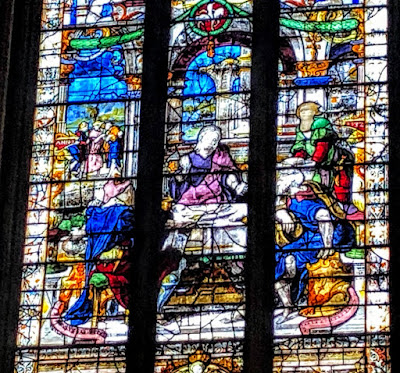
The Risen Christ with Mary of Bethany (left) and Mary Magdalene (right) … a stained glass window in Saint Nicholas’s Church, Adare, Co Limerick (Photograph: Patrick Comerford)
Scripture quotations are from the New Revised Standard Version Bible: Anglicised Edition copyright © 1989, 1995 National Council of the Churches of Christ in the United States of America. Used by permission. All rights reserved worldwide. http://nrsvbibles.org
Patrick Comerford
We are continuing in Ordinary Time in the Church Calendar, and this week began with the Eighteenth Sunday after Trinity (Trinity XVIII, 4 October). The calendar of the Church of England in Common Worship remembers William Tyndale (1494-1536), Translator of the Scriptures and Reformation Martyr. The exhibition ‘A Dangerous Calling: 500 years of William Tyndale’s New Testament’ is in Saint Paul’s Cathedral, London, until February 2027 stpauls.co.uk/tyndale
Before today begins, however, I am taking some quiet time this morning to give thanks, and for reflection, prayer and reading in these ways:
1, today’s Gospel reading;
2, a reflection on the Gospel reading;
3, a prayer from the USPG prayer diary;
4, the Collects and Post-Communion prayer of the day.
Christ in the home of Mary and Martha … the East Window in Saint Peter and Saint Paul Church, Watford, Northamptonshire (Photograph: Patrick Comerford)
Luke 10: 38-42 (NRSVA):
38 Now as they went on their way, he entered a certain village, where a woman named Martha welcomed him into her home. 39 She had a sister named Mary, who sat at the Lord’s feet and listened to what he was saying. 40 But Martha was distracted by her many tasks; so she came to him and asked, ‘Lord, do you not care that my sister has left me to do all the work by myself? Tell her then to help me.’ 41 But the Lord answered her, ‘Martha, Martha, you are worried and distracted by many things; 42 there is need of only one thing. Mary has chosen the better part, which will not be taken away from her.’
Christ in the House of Martha and Mary by Diego Velázquez (1630)Today’s Reflections:
Saint Luke’s story of the meal that Jesus has with his friends Mary and Martha is not found in the other synoptic gospels, and the only other parallel is in the Fourth Gospel, where Jesus visits Mary and Martha after the death of Lazarus.
So the meals Jesus has with Mary and Martha must be understood in the light of the Resurrection, which is prefigured by the raising of Lazarus from the dead.
For many women, and for many men too, the story of the meal with Martha and Mary raises many problems, often created by insights that may not have been possible to have at the time when Saint Luke’s Gospel was written.
Our approach to understanding and explaining this meal very often depends on the way in which I understand Martha and the busy round of activities that have her distracted, and that cause her to complain to Jesus about her sister’s apparent lack of zeal and activity.
These activities in the Greek are described as Martha’s service – she is the deacon at the table: where the NRSV says ‘But Martha was distracted by her many tasks,’ the Greek says: ἡ δὲ Μάρθα περιεσπᾶτο περὶ πολλὴν διακονίαν (‘But Martha was being distracted by much diaconal work, service at the table’).
Quite often, when this story is told, over and over, again and again, it is told as if Martha is getting stroppy about having to empty the dishwasher while Mary is lazing, sitting around, making small talk with Jesus.
Does Martha see that Mary should only engage in kitchen work too?
Does she think, perhaps, that only Lazarus should be out at the front of the house, keeping Jesus engaged in lads’ banter about the latest league match between Bethany United and Jerusalem City?
Is Jesus being too dismissive of Martha’s complaints?
Or is he defending Mary’s right to engage in a full discussion of the Word, to engage in an alive ministry of the Word?
Martha is presented in this story as the dominant, leading figure. It is she who takes the initiative and who welcomes Jesus into her home (verse 38); it is she who offers the hospitality, who is the host at the meal, who is the head of the household – in fact, Lazarus is not even on the stage for this scene, and Mary is merely ‘her sister’ – very much the junior partner in the household.
Yet it is Mary, the figure on the margins, who offers the sort of hospitality that Jesus commends and praises.
Mary simply listens to Jesus, sitting at his feet, like a student would sit at the feet of a great rabbi or teacher, waiting and willing to learn what is being taught.
Martha is upset about this, and comes out from the back and asks Jesus to pack off Mary to the kitchen where she can help Martha.
But perhaps Martha was being too busy with her household tasks.
I was once invited to dinner by people I knew as good friends. And for a long time I was left on my own with the other guest as the couple busied themselves with things in the kitchen – they had decided to do the washing up before bringing out the coffee … the wife knew that if she left the washing up until later, the husband would shirk his share of the task.
But being left on our own was a little embarrassing. Part of the joy of being invited to someone’s home for dinner is the conversation around the table.
When I have been on retreats, at times, in Greek Orthodox and Benedictine monasteries, conversation at the table has been discouraged by a monk reading, usually from the writings of the Early Fathers, from the Patristic writings.
A good meal, good table fellowship, good hospitality, are not just about the food that is served, but about the ideas and words shared, heard and listened to around the table too.
One commentator suggests that Martha has gone overboard in her duties of hospitality. She has spent too much time preparing the food, and has failed to pay real attention to her guest.
On the other hand, Mary has chosen her activity (verse 42). It does not just happen by accident. Mary has chosen to offer Jesus the real hospitality that a guest should receive. She talks to Jesus, and real conversation is about both talking and listening.
If she is sent back into the kitchen, then – in the absence of Lazarus, indeed, in the notable absence of the disciples – Jesus would be left without hospitality, without words of welcome, without conversation.
Perhaps Martha might have been better off if she had a more simple lifestyle, if she prepared just one dish for her guest and for her family – might I be bold enough to suggest, if she had been content for them to sup on bread and wine alone.
She could have joined Mary in her hospitality, in welcoming Jesus to their home and to their table; they could have been in full communion with one another.
In this way, Martha will experience what her sister is experiencing, but which she is too busy to notice – their visitor’s invitation into the hospitality of God.
One commentator, Brendan Byrne, points out the subtle point being made in this story:
‘Frenetic service, even service of the Lord, can be a deceptive distraction from what the Lord really wants. Luke has already warned that the grasp of the word can be choked by the cares and worries of life … Here the cares and worries seem well justified – are they not in the service of the Lord? But precisely therein lies the power of the temptation, the great deceit. True hospitality – even that given directly to the Lord – attends to what the guest really wants.’
‘Christ at the home of Martha and Mary,’ Georg Friedrich Stettner (1639)
Today’s Prayers (Tuesday 6 October 2026):
In Pray with the World Church, the prayer diary of the Anglican mission agency USPG (United Society Partners in the Gospel), the theme this week, 4-10 October 2026 (pp 44-45), is ‘The Gun, The Sword, and The Bible’. This theme was introduced on Sunday with a reflection by the Revd Les Isaac OBE, founder and President of Ascension Trust and co-founder of Street Pastors.
The USPG Prayer Diary today (Tuesday 6 October 2026) invites us to pray:
We pray for healing where faith has been entangled with harm and injustice. Bring repentance where it is needed and restore hearts towards your righteousness.
The Collect of the Day:
Lord, give to your people grace to hear and keep your word
that, after the example of your servant William Tyndale,
we may not only profess your gospel
but also be ready to suffer and die for it,
to the honour of your name;
through Jesus Christ your Son our Lord,
who is alive and reigns with you,
in the unity of the Holy Spirit,
one God, now and for ever.
The Post-Communion Prayer:
Eternal God,
who gave us this holy meal
in which we have celebrated the glory of the cross
and the victory of your martyr William Tyndale:
by our communion with Christ
in his saving death and resurrection,
give us with all your saints the courage to conquer evil
and so to share the fruit of the tree of life;
through Jesus Christ our Lord.
Yesterday’s Reflections
Continued Tomorrow
The Risen Christ with Mary of Bethany (left) and Mary Magdalene (right) … a stained glass window in Saint Nicholas’s Church, Adare, Co Limerick (Photograph: Patrick Comerford)
Scripture quotations are from the New Revised Standard Version Bible: Anglicised Edition copyright © 1989, 1995 National Council of the Churches of Christ in the United States of America. Used by permission. All rights reserved worldwide. http://nrsvbibles.org
05 October 2026
Daily prayer in Ordinary Time 2026:
150, Monday 5 October 2026
An Orthodox icon of the Parable of the Good Samaritan, interpreting the parable according to Patristic and Orthodox traditions (Click on image for full-screen viewing)
Patrick Comerford
We are continuing in Ordinary Time in the Church Calendar, and this week began with the Eighteenth Sunday after Trinity (Trinity XVIII, 4 October).
Before today begins, however, I am taking some quiet time this morning to give thanks, and for reflection, prayer and reading in these ways:
1, today’s Gospel reading;
2, a reflection on the Gospel reading;
3, a prayer from the USPG prayer diary;
4, the Collects and Post-Communion prayer of the day.
The Good Samaritan … a stained glass window by Charles Eamer Kempe in Saint Andrew’s Church, Great Linford, Buckinghamshire (Photograph: Patrick Comerford)
Luke 10: 25-37 (NRSVA):
25 Just then a lawyer stood up to test Jesus. ‘Teacher,’ he said, ‘what must I do to inherit eternal life?’ 26 He said to him, ‘What is written in the law? What do you read there?’ 27 He answered, ‘You shall love the Lord your God with all your heart, and with all your soul, and with all your strength, and with all your mind; and your neighbour as yourself.’ 28 And he said to him, ‘You have given the right answer; do this, and you will live.’
29 But wanting to justify himself, he asked Jesus, ‘And who is my neighbour?’ 30 Jesus replied, ‘A man was going down from Jerusalem to Jericho, and fell into the hands of robbers, who stripped him, beat him, and went away, leaving him half dead. 31 Now by chance a priest was going down that road; and when he saw him, he passed by on the other side. 32 So likewise a Levite, when he came to the place and saw him, passed by on the other side. 33 But a Samaritan while travelling came near him; and when he saw him, he was moved with pity. 34 He went to him and bandaged his wounds, having poured oil and wine on them. Then he put him on his own animal, brought him to an inn, and took care of him. 35 The next day he took out two denarii, gave them to the innkeeper, and said, “Take care of him; and when I come back, I will repay you whatever more you spend.” 36 Which of these three, do you think, was a neighbour to the man who fell into the hands of the robbers?’ 37 He said, ‘The one who showed him mercy.’ Jesus said to him, ‘Go and do likewise.’
The Good Samaritan … a modern icon
Today’s Reflection:
We are all very familiar with the parable of the Good Samaritan, so familiar and so used to it that we are probably comfortable with the explanations and sermons we have heard over the years about this episode in today’s Gospel reading (Luke 10: 25-37), leaving very little to our own imaginations.
But the Early Fathers offered another interpretation of this parable.
The man who goes down from Jerusalem to Jericho is Adam, or humanity, or each and every one of us.
What does it mean that he goes down from Jerusalem to Jericho?
Jerusalem is the holy city of God, the place where God is served in worship and in public prayer. It is an impregnable stronghold, but it is located in a hill country, where the soil is stony and barren.
On the other hand, Jericho lies below the sea level in the Jordan Valley, in an area that is very fertile and rich in vegetation.
Jerusalem signifies the Divine Commandments. These commandments, like the walls of a city, limit us and our desires, but also create a safe living space where we can live unharmed by sin.
A man being seduced by earthly pleasures, represented by Jericho, goes out from Jerusalem, the stronghold of Divine Commandments. Here, we might think of Adam and Eve, leaving the Garden and going out into the world.
But the robbers control this way. Who are the robbers?
When people abandon God and seek pleasures in other places, the way of bodily desires first appears to be full of joy. But as time passes, indulging in passions becomes a heavy burden on the soul; in place of pleasure it becomes endless slavery. A man realises that he has lost his freedom and has become a captive of his passions. A soul blinded by passions and wounded by sin becomes incapable of any spiritual activity.
Before God, such a man is half-dead. On the way, the man has been stripped of his raiment, deprived of the raiment of virtues and of the cover of God’s grace and protection.
In this patristic approach to reading the parable, the robbers are demons who act through our own passions. The man wounded by robbers represents fallen humanity before the coming of Christ.
Who then were the Priest and Levite who saw the wounded man and passed by without providing him any help?
The Priest and the Levite are ministers of God. They represent the saints and prophets sent by God from the beginning of time.
Why then is it said that they passed by without helping that man?
Did they not fulfil the ministry of preaching?
Yes, they did. They came to that place, they stopped, they saw the man and they passed by. But wounded humanity remained lying on the road. Moses came and passed away, Elijah came and passed away, other prophets came and passed away, but the illness of humanity remained without being healed.
Only God who has created us can recreate us.
This is how Isaiah speaks on the incurable disease of the humanity:
Why do you seek further beatings?
Why do you continue to rebel?
The whole head is sick,
and the whole heart faint.
From the sole of the foot even to the head,
there is no soundness in it,
but bruises and sores
and bleeding wounds;
they have not been drained, or bound up,
or softened with oil. (Isaiah 1: 5-6)
Who then is the Samaritan who goes down on the same road?
The Samaritans were the descendants of Israelites and the nations who migrated to Palestine under Assyrian rule after the destruction of Jerusalem. They lived to the south of Judea, between Judea and Galilee. Samaritans believed in the One God of Israel and kept the Law of Moses, but they developed their own traditions. For the Jews, they were heretics, and so Jews kept their distance from Samaritans.
Why then does Christ represent himself as a Samaritan?
The Pharisees mockingly labelled Christ a Samaritan, saying, ‘Are we not right in saying that you are a Samaritan and have a demon?’ (John 8: 48).
Christ humbly attributes to himself the name given to him by his detractors.
In addition, Greek Orthodox hymns note a similarity between the phrases ‘from Samaria’ and ‘from Mary,’ for in Greek these phrases sound similar. (For example, the Samarian Gorge in Crete takes its name not from Samaria but from the abandoned village and church of Óssia María or Saint Mary).
The Samaritan, moved with compassion, approaches the wounded man. He binds his wounds, pouring oil and wine on them. The oil symbolises mercy and the wine the true teaching of God. Then he brings the man to an inn where he can be taken care of.
This Gospel readings says that the Good Samaritan ‘put him on his own animal, brought him to an inn, and took care of him.’ However, in traditional icons, Christ carries the man on his back. Christ in the incarnation takes on our human nature, our soul and body. That is why in the parable he ‘set him on his own beast,’ interpreted by the Early Fathers that Christ makes us members of his own body.
There is a similar image in the parable of the Lost Sheep (see Luke 15). The Good Shepherd left 99 sheep in the desert and went after the lost sheep, representing humanity. When he found the lost sheep, he put it on his shoulders, rejoicing.
The inn in this parable represents the Church. The innkeeper represents bishops and priests. Christ establishes his Church which, like an inn, accepts and provides shelter for all. The wounded man should stay here to be taken care of. The Samaritan has to leave, however. He takes out two silver coins and gave them to the innkeeper, saying: ‘Take care of him; and when I come back, I will repay you whatever more you spend.’
Christ indicates his second coming when he will come not to heal our infirmities, but to judge the living and the dead, and to reward each one according to his works.
The silver the Samaritan gives to the innkeeper is the divine grace Christ gives to the Church; it heals and saves souls through the sacraments. Bishops and priests, the ministers of the sacraments of the Church, are the distributors of God’s gifts. They offer to others what they have received: the sacraments and the teaching of Christ. Are they able to spend more? What can they add from themselves to the gift of the Divine Grace? Their labour, their cares, their zeal, which Christ shall recompense them on the day of the Last Judgment.
In this interpretation of the parable of the Good Samaritan, Christ offers himself as the prime example of mercy and compassion. Through his compassion, he takes on our sufferings and becomes the true neighbour of all fallen humanity.
This is a reading of this parable that connects with the assertion in the New Testament reading that God through Christ ‘has rescued us from the power of darkness and transferred us into the kingdom.
The Good Samaritan window in Saint George’s Church, Belfast (Photograph: Patrick Comerford)
Today’s Prayers (Monday 5 October 2026):
In Pray with the World Church, the prayer diary of the Anglican mission agency USPG (United Society Partners in the Gospel), the theme this week, 4-10 October 2026 (pp 44-45), is ‘The Gun, The Sword, and The Bible’. This theme was introduced yesterday with a reflection by the Revd Les Isaac OBE, founder and President of Ascension Trust and co-founder of Street Pastors.
The USPG Prayer Diary today (Monday 5 October 2026) invites us to pray:
Lord, give us courage to face the complexities of your Church’s history with honesty and humility. Help us to seek truth without fear and to grow in understanding and grace.
The Collect of the Day:
Almighty and everlasting God,
increase in us your gift of faith
that, forsaking what lies behind
and reaching out to that which is before,
we may run the way of your commandments
and win the crown of everlasting joy;
through Jesus Christ your Son our Lord,
who is alive and reigns with you,
in the unity of the Holy Spirit,
one God, now and for ever.
The Post-Communion Prayer:
We praise and thank you, O Christ, for this sacred feast:
for here we receive you,
here the memory of your passion is renewed,
here our minds are filled with grace,
and here a pledge of future glory is given,
when we shall feast at that table where you reign
with all your saints for ever.
Additional Collect:
God, our judge and saviour,
teach us to be open to your truth
and to trust in your love,
that we may live each day
with confidence in the salvation which is given
through Jesus Christ our Lord.
Yesterday’s Reflections
Continued Tomorrow
The Good Samaritan … a stained glass window in Saint Mary’s Cathedral, Limerick (Photograph: Patrick Comerford)
Scripture quotations are from the New Revised Standard Version Bible: Anglicised Edition copyright © 1989, 1995 National Council of the Churches of Christ in the United States of America. Used by permission. All rights reserved worldwide. http://nrsvbibles.org
Patrick Comerford
We are continuing in Ordinary Time in the Church Calendar, and this week began with the Eighteenth Sunday after Trinity (Trinity XVIII, 4 October).
Before today begins, however, I am taking some quiet time this morning to give thanks, and for reflection, prayer and reading in these ways:
1, today’s Gospel reading;
2, a reflection on the Gospel reading;
3, a prayer from the USPG prayer diary;
4, the Collects and Post-Communion prayer of the day.
The Good Samaritan … a stained glass window by Charles Eamer Kempe in Saint Andrew’s Church, Great Linford, Buckinghamshire (Photograph: Patrick Comerford)
Luke 10: 25-37 (NRSVA):
25 Just then a lawyer stood up to test Jesus. ‘Teacher,’ he said, ‘what must I do to inherit eternal life?’ 26 He said to him, ‘What is written in the law? What do you read there?’ 27 He answered, ‘You shall love the Lord your God with all your heart, and with all your soul, and with all your strength, and with all your mind; and your neighbour as yourself.’ 28 And he said to him, ‘You have given the right answer; do this, and you will live.’
29 But wanting to justify himself, he asked Jesus, ‘And who is my neighbour?’ 30 Jesus replied, ‘A man was going down from Jerusalem to Jericho, and fell into the hands of robbers, who stripped him, beat him, and went away, leaving him half dead. 31 Now by chance a priest was going down that road; and when he saw him, he passed by on the other side. 32 So likewise a Levite, when he came to the place and saw him, passed by on the other side. 33 But a Samaritan while travelling came near him; and when he saw him, he was moved with pity. 34 He went to him and bandaged his wounds, having poured oil and wine on them. Then he put him on his own animal, brought him to an inn, and took care of him. 35 The next day he took out two denarii, gave them to the innkeeper, and said, “Take care of him; and when I come back, I will repay you whatever more you spend.” 36 Which of these three, do you think, was a neighbour to the man who fell into the hands of the robbers?’ 37 He said, ‘The one who showed him mercy.’ Jesus said to him, ‘Go and do likewise.’
Today’s Reflection:
We are all very familiar with the parable of the Good Samaritan, so familiar and so used to it that we are probably comfortable with the explanations and sermons we have heard over the years about this episode in today’s Gospel reading (Luke 10: 25-37), leaving very little to our own imaginations.
But the Early Fathers offered another interpretation of this parable.
The man who goes down from Jerusalem to Jericho is Adam, or humanity, or each and every one of us.
What does it mean that he goes down from Jerusalem to Jericho?
Jerusalem is the holy city of God, the place where God is served in worship and in public prayer. It is an impregnable stronghold, but it is located in a hill country, where the soil is stony and barren.
On the other hand, Jericho lies below the sea level in the Jordan Valley, in an area that is very fertile and rich in vegetation.
Jerusalem signifies the Divine Commandments. These commandments, like the walls of a city, limit us and our desires, but also create a safe living space where we can live unharmed by sin.
A man being seduced by earthly pleasures, represented by Jericho, goes out from Jerusalem, the stronghold of Divine Commandments. Here, we might think of Adam and Eve, leaving the Garden and going out into the world.
But the robbers control this way. Who are the robbers?
When people abandon God and seek pleasures in other places, the way of bodily desires first appears to be full of joy. But as time passes, indulging in passions becomes a heavy burden on the soul; in place of pleasure it becomes endless slavery. A man realises that he has lost his freedom and has become a captive of his passions. A soul blinded by passions and wounded by sin becomes incapable of any spiritual activity.
Before God, such a man is half-dead. On the way, the man has been stripped of his raiment, deprived of the raiment of virtues and of the cover of God’s grace and protection.
In this patristic approach to reading the parable, the robbers are demons who act through our own passions. The man wounded by robbers represents fallen humanity before the coming of Christ.
Who then were the Priest and Levite who saw the wounded man and passed by without providing him any help?
The Priest and the Levite are ministers of God. They represent the saints and prophets sent by God from the beginning of time.
Why then is it said that they passed by without helping that man?
Did they not fulfil the ministry of preaching?
Yes, they did. They came to that place, they stopped, they saw the man and they passed by. But wounded humanity remained lying on the road. Moses came and passed away, Elijah came and passed away, other prophets came and passed away, but the illness of humanity remained without being healed.
Only God who has created us can recreate us.
This is how Isaiah speaks on the incurable disease of the humanity:
Why do you seek further beatings?
Why do you continue to rebel?
The whole head is sick,
and the whole heart faint.
From the sole of the foot even to the head,
there is no soundness in it,
but bruises and sores
and bleeding wounds;
they have not been drained, or bound up,
or softened with oil. (Isaiah 1: 5-6)
Who then is the Samaritan who goes down on the same road?
The Samaritans were the descendants of Israelites and the nations who migrated to Palestine under Assyrian rule after the destruction of Jerusalem. They lived to the south of Judea, between Judea and Galilee. Samaritans believed in the One God of Israel and kept the Law of Moses, but they developed their own traditions. For the Jews, they were heretics, and so Jews kept their distance from Samaritans.
Why then does Christ represent himself as a Samaritan?
The Pharisees mockingly labelled Christ a Samaritan, saying, ‘Are we not right in saying that you are a Samaritan and have a demon?’ (John 8: 48).
Christ humbly attributes to himself the name given to him by his detractors.
In addition, Greek Orthodox hymns note a similarity between the phrases ‘from Samaria’ and ‘from Mary,’ for in Greek these phrases sound similar. (For example, the Samarian Gorge in Crete takes its name not from Samaria but from the abandoned village and church of Óssia María or Saint Mary).
The Samaritan, moved with compassion, approaches the wounded man. He binds his wounds, pouring oil and wine on them. The oil symbolises mercy and the wine the true teaching of God. Then he brings the man to an inn where he can be taken care of.
This Gospel readings says that the Good Samaritan ‘put him on his own animal, brought him to an inn, and took care of him.’ However, in traditional icons, Christ carries the man on his back. Christ in the incarnation takes on our human nature, our soul and body. That is why in the parable he ‘set him on his own beast,’ interpreted by the Early Fathers that Christ makes us members of his own body.
There is a similar image in the parable of the Lost Sheep (see Luke 15). The Good Shepherd left 99 sheep in the desert and went after the lost sheep, representing humanity. When he found the lost sheep, he put it on his shoulders, rejoicing.
The inn in this parable represents the Church. The innkeeper represents bishops and priests. Christ establishes his Church which, like an inn, accepts and provides shelter for all. The wounded man should stay here to be taken care of. The Samaritan has to leave, however. He takes out two silver coins and gave them to the innkeeper, saying: ‘Take care of him; and when I come back, I will repay you whatever more you spend.’
Christ indicates his second coming when he will come not to heal our infirmities, but to judge the living and the dead, and to reward each one according to his works.
The silver the Samaritan gives to the innkeeper is the divine grace Christ gives to the Church; it heals and saves souls through the sacraments. Bishops and priests, the ministers of the sacraments of the Church, are the distributors of God’s gifts. They offer to others what they have received: the sacraments and the teaching of Christ. Are they able to spend more? What can they add from themselves to the gift of the Divine Grace? Their labour, their cares, their zeal, which Christ shall recompense them on the day of the Last Judgment.
In this interpretation of the parable of the Good Samaritan, Christ offers himself as the prime example of mercy and compassion. Through his compassion, he takes on our sufferings and becomes the true neighbour of all fallen humanity.
This is a reading of this parable that connects with the assertion in the New Testament reading that God through Christ ‘has rescued us from the power of darkness and transferred us into the kingdom.
The Good Samaritan window in Saint George’s Church, Belfast (Photograph: Patrick Comerford)
Today’s Prayers (Monday 5 October 2026):
In Pray with the World Church, the prayer diary of the Anglican mission agency USPG (United Society Partners in the Gospel), the theme this week, 4-10 October 2026 (pp 44-45), is ‘The Gun, The Sword, and The Bible’. This theme was introduced yesterday with a reflection by the Revd Les Isaac OBE, founder and President of Ascension Trust and co-founder of Street Pastors.
The USPG Prayer Diary today (Monday 5 October 2026) invites us to pray:
Lord, give us courage to face the complexities of your Church’s history with honesty and humility. Help us to seek truth without fear and to grow in understanding and grace.
The Collect of the Day:
Almighty and everlasting God,
increase in us your gift of faith
that, forsaking what lies behind
and reaching out to that which is before,
we may run the way of your commandments
and win the crown of everlasting joy;
through Jesus Christ your Son our Lord,
who is alive and reigns with you,
in the unity of the Holy Spirit,
one God, now and for ever.
The Post-Communion Prayer:
We praise and thank you, O Christ, for this sacred feast:
for here we receive you,
here the memory of your passion is renewed,
here our minds are filled with grace,
and here a pledge of future glory is given,
when we shall feast at that table where you reign
with all your saints for ever.
Additional Collect:
God, our judge and saviour,
teach us to be open to your truth
and to trust in your love,
that we may live each day
with confidence in the salvation which is given
through Jesus Christ our Lord.
Yesterday’s Reflections
Continued Tomorrow
The Good Samaritan … a stained glass window in Saint Mary’s Cathedral, Limerick (Photograph: Patrick Comerford)
Scripture quotations are from the New Revised Standard Version Bible: Anglicised Edition copyright © 1989, 1995 National Council of the Churches of Christ in the United States of America. Used by permission. All rights reserved worldwide. http://nrsvbibles.org
04 October 2026
Daily prayer in Ordinary Time 2026:
149, Sunday 4 October 2026,
Eighteenth Sunday after Trinity (Trinity XVIII)
Patrick Comerford
We are continuing in Ordinary Time in the Church Calendar, and this is the Eighteenth Sunday after Trinity (Trinity XVIII). Later this morning, I hope to sing with the choir at the Parish Eucharist in Saint Mary and Saint Giles Church in Stony Stratford, and we are planning a small family celebration later in the day.
In the Jewish calendar, the holiday of Simchat Torah (שִׂמְחַת תּוֹרָה) began at sunset last night (3 October) and ends at nightfall this evening (4 October). Simchat Torah involves joyous Torah-dancing of Simchat Torah and celebrates the completion of the annual public Torah-reading cycle and the immediate start of a new one.
Simchat Torah means ‘Rejoicing of the Law’ and the holiday follows immediately after Sukkot. The celebrations include hakafot or Torah dancing, with the Torah scrolls carried in seven celebratory circuits and dancing around the synagogue’s bimah or reading platform. The final verses of Deuteronomy are read, followed immediately by the opening verses of Genesis to show that the Torah is a continuous, never-ending cycle. Everyone in the community participates equally, holding the closed scrolls to emphasise unity, regardless of level of learning. Children often wave flags, receive sweet treats, and join the procession to associate learning with joy.
But, before today begins, I am taking some quiet time this morning to give thanks, for reflection, prayer and reading in these ways:
1, today’s Gospel reading;
2, a reflection on the Gospel reading;
3, a prayer from the USPG prayer diary;
4, the Collects and Post-Communion prayer of the day.
‘Now when the owner of the vineyard comes, what will he do …’ (Matthew 21: 40) … vineyards, vines, groves and terraces in Tuscany (Photograph: Patrick Comerford)
Matthew 21: 33-46 (NRSVA):
[Jesus said:] 33 ‘Listen to another parable. There was a landowner who planted a vineyard, put a fence around it, dug a wine press in it, and built a watch-tower. Then he leased it to tenants and went to another country. 34 When the harvest time had come, he sent his slaves to the tenants to collect his produce. 35 But the tenants seized his slaves and beat one, killed another, and stoned another. 36 Again he sent other slaves, more than the first; and they treated them in the same way. 37 Finally he sent his son to them, saying, “They will respect my son.” 38 But when the tenants saw the son, they said to themselves, “This is the heir; come, let us kill him and get his inheritance.” 39 So they seized him, threw him out of the vineyard, and killed him. 40 Now when the owner of the vineyard comes, what will he do to those tenants?’ 41 They said to him, ‘He will put those wretches to a miserable death, and lease the vineyard to other tenants who will give him the produce at the harvest time.’
42 Jesus said to them, ‘Have you never read in the scriptures:
“The stone that the builders rejected
has become the cornerstone;
this was the Lord’s doing,
and it is amazing in our eyes”?
43 ‘Therefore I tell you, the kingdom of God will be taken away from you and given to a people that produces the fruits of the kingdom. 44 The one who falls on this stone will be broken to pieces; and it will crush anyone on whom it falls.’
45 When the chief priests and the Pharisees heard his parables, they realized that he was speaking about them. 46 They wanted to arrest him, but they feared the crowds, because they regarded him as a prophet.
Today’s Reflections:
A Mediterranean village vineyard … grapes ripening in Tsesmes, near Rethymnon in Crete (Photograph: Patrick Comerford)
Today’s Reflections:
We have had a lot of visits to the vineyard in the Gospel readings for the past few weeks.
Two weeks ago (20 September 2026), we had the landowner who hired labourers at different times of the day to work in his vineyard (Matthew 20: 1-16). And we saw how those who worked from early in the day were upset that those who were hired later in the day were still paid a full day’s pay.
Last week (27 September 2026), we had the father who asked his two sons to go to work in the vineyard (Matthew 21: 23-32). And we saw there how one son said no, but still went to work there, while another son said yes, and went off and did his own thing.
This morning (4 October 2026), we have another story set in the vineyard (Matthew 21: 33-46).
I imagine we have very few vineyards in England or Ireland. Yet, most of us can identify with the time and season in this morning’s Gospel reading.
It is harvest time, and it is time to collect the harvest. It should be a time for celebration, and for counting our blessings, as we celebrated the harvest on Friday evening.
But this morning’s Gospel reading challenges us to ask what if we think more about the field than the harvest, more about our personal gain and profit than the overall plans that God may have for us, more about short-term gains than about the long-term impact of our decisions, what if I think more about my individual needs than the good of wider society and community.
The setting of the parable is the estate of a wealthy landowner. This landowner does not live on the land, and does not work at planting or harvesting. The hard work is carried out by the hired labourers, who must turn over most of what they grow to the landowner. The landowner in the parallel parable in Luke 19 is a harsh, demanding man, reaping what he does not sow (see Luke 19: 20).
This absentee landlord does not send messengers out of any great love for the people or the land, but to collect the profits from their labour that sustain his life of ease in the cosmopolitan city where he lives.
In Saint Matthew’s version of parable, the farmers have had enough. The next time the landowner sends one of his servants to collect the rent, the farmers send him packing. Forget how you have consistently read this parable for years. Those who listened to Christ telling this parable for the first time probably smiled at the demanding landlord getting a revolutionary response from the exploited tenants living on the edge and on the margins.
After all, Saint Paul tells us in the Pastoral Epistles: ‘for the scripture says, “You shall not muzzle an ox while it is treading out the grain,” and, “The labourer deserves to be paid”.’ (I Timothy 5: 18)
Then the landowner sends another agent to collect the rent. Again, the farmers get together to send him away empty-handed. More cause for rejoicing among the first listeners.
Then the son of the landowner arrives. He has a different standing than the messengers. He is the son, perhaps the ‘beloved son,’ probably the only son. If he is the heir and the landowner had died, then he has inherited the estate himself. If the son dies and he does not have an heir, the land goes to those who live on it, and the farmers will be free. The farmers have been resisting years of what they feel has been exploitation, and now they rise up and kill the son.
But the twist in the story is that the landowner is not dead. He does exactly what we expect him to do in the circumstances. He wreaks revenge, slaughters the farmers and replaces them with others. He does this so he can return to his life of ease in the city, living on the income provided by the labour of others.
But no-one among those who hear this ending to the story for the first time would hardly regard it as comforting or good news.
The chief priests and the scribes who are listening the audience, and who come from the same social class as the rich landowner and his hirelings, must realise that they have just heard a scathing condemnation from Christ of how they exploit their fellow Jews.
The peasants or tenant farmers who hear the story are reminded that escalating the spiral of violence only results in more violence being visited upon them and their children.
Everyone who listens is challenged to rethink their prejudices and their judgmental values.
In this, the parable is a challenge to us today.
In what ways are we like the absentee landlord, dependent on others’ exploitation to support our lives of relative ease?
How much do we consume without knowing or caring about where our clothes, our coffee, our computers, our gadgets and toys come from, or about the cost to poor people and the environments in which they live?
In what ways are we like the agents, willing to do wrong to achieve what we think is right, to escalate interpersonal and international conflict in ways that will be visited upon generations to come?
And in what ways are we responding to Christ’s challenge to care for those the world disregards and to disregard the world’s standards of strength and honour?
As the American theologian and writer Sarah Dylan Breuer once wrote, Christ challenges us to do the unthinkable, to turn the other cheek and let others think us weak, to care as much for God’s children who make our clothes and shoes, who mine the ore for our electronics and dispose of the toxic computer monitors we discard when want newer and better ones, as we do for our own children.
Christ challenges us to bless and honour the peacemakers rather than the mighty, to strive for justice and peace and the dignity of every human being above our own comfort.
Today’s Prayers (Sunday 4 October 2026, Trinity XVIII):
In Pray with the World Church, the prayer diary of the Anglican mission agency USPG (United Society Partners in the Gospel), the theme this week, from 4 to 10 October 2026 (pp 44-45), is ‘The Gun, The Sword, and The Bible’. This theme is introduced today with a reflection by the Revd Les Isaac OBE, founder and President of Ascension Trust and co-founder of Street Pastors:
I distinctly remember sitting in my local church in London and asking myself: “How come the Jesus that I’m seeing up there looks like the people who hate me?” I couldn’t ask my mother that as it was seen as rude in my culture. But it did get me thinking.
I’ve not spent the last 40 years defending the negative side of the Church’s history, but rather trying to help people to understand the complexity of the transatlantic slave trade and its entanglement with the Church. In spite of the gun, the sword, and the Bible travelling together in the same chest on the same ship, there were people who have done a great work. There are men and women who made great sacrifices, as did Jesus. I can’t figure out why he allowed the Bible to be in that chest, but I’m consoled by Scripture that says everything works together for good.
That’s why I think the Church must rediscover its unique role in shaping history and humanity. The Church has to recognise that we are agents of the gospel. And I say this to those who are Black, white, or of any other colour. I say, listen, God hasn’t called one culture to deal with His Kingdom. He’s called all people. We ought to come together because we value the fact that we are sisters and brothers in the Kingdom of God.
I see this potential in the resilience of young African and Caribbean people: their gifts, abilities, and zeal excites me. Partnering with them, we can bring the gospel to life in unity and hope across communities, nations, and the world.
Watch the full recording at: www.youtube.com/@uspg6204
The USPG Prayer Diary today (Sunday 4 October 2026, Trinity XVIII) invites us to pray as we read and meditate on Matthew 21: 33-46.
The Collect of the Day:
Almighty and everlasting God,
increase in us your gift of faith
that, forsaking what lies behind
and reaching out to that which is before,
we may run the way of your commandments
and win the crown of everlasting joy;
through Jesus Christ your Son our Lord,
who is alive and reigns with you,
in the unity of the Holy Spirit,
one God, now and for ever.
The Post-Communion Prayer:
We praise and thank you, O Christ, for this sacred feast:
for here we receive you,
here the memory of your passion is renewed,
here our minds are filled with grace,
and here a pledge of future glory is given,
when we shall feast at that table where you reign
with all your saints for ever.
Additional Collect:
God, our judge and saviour,
teach us to be open to your truth
and to trust in your love,
that we may live each day
with confidence in the salvation which is given
through Jesus Christ our Lord.
Yesterday’s Reflections
Continued Tomorrow
A vineyard on the slopes at Fattoria il Poggia outside Montecarlo, near Lucca in Tuscany (Photograph: Patrick Comerford)
Scripture quotations are from the New Revised Standard Version Bible: Anglicised Edition copyright © 1989, 1995 National Council of the Churches of Christ in the United States of America. Used by permission. All rights reserved worldwide. http://nrsvbibles.org
03 October 2026
Daily prayer in Ordinary Time 2026:
148, Saturday 3 October 2026
‘See, I have given you authority to tread on snakes’ (Luke 10: 19) … a Moroccan snake charmer in Tangier (Photograph: Patrick Comerford)
Patrick Comerford
We are continuing in Ordinary Time in the Church Calendar, and tomorrow is the Eighteenth Sunday after Trinity (Trinity XVIII). The calendar of the Church of England in Common Worship remembers the life and work of George Bell (1881-1958), Bishop of Chichester, Ecumenist and Peacemaker.
In the Jewish calendar, Shemini Atseret or Shemini Atzeret (שְׁמִינִי עֲצֶרֶת) began at sunset last night (2 October) and ends at nightfall this evening (3 October). Shemini Atzeret is an intimate, sacred Jewish holiday on the 22nd day of Tishrei that immediately follows the seven days of Sukkot.
The word Shemini (שְׁמִינִי) means ‘eighth’, meaning it is the Eighth Day, or the ‘Eighth day of Assembly’, and it acts as a transition from the public celebrations of Sukkot to a quiet, personal closing moment with God. Atzeret (עֲצֶרֶת) comes from a Hebrew root that implies a ‘halt’ or ‘detention’, symbolising God asking the Jewish people to stay one extra day before returning to their regular routines. The customs and practices associated with Shemini Atzeret include a special prayer for winter rains, marking the start of the agricultural water season.
The holiday of Simchat Torah (שִׂמְחַת תּוֹרָה), which follows immediately after Shemini Atzeret, begins at sunset this evening (3 October) and ends at nightfall tomorrow (4 October), involves joyous Torah-dancing of Simchat Torah.
Later this morning, I hope to go to Το Στεκι Μασ / Our Place, the ‘pop-up’ coffee shop in the Greek Orthodox Church in Stony Stratford, from 10:30 to 3 pm today. But, before today begins, I am taking some quiet time this morning to give thanks, for reflection, prayer and reading in these ways:
1, today’s Gospel reading;
2, a reflection on the Gospel reading;
3, a prayer from the USPG prayer diary;
4, the Collects and Post-Communion prayer of the day.
In search of the 70 on the way to Jerusalem … on Bridge Street, Cambridge (Photograph: Patrick Comerford)
Luke 10: 17-24 (NRSVA):
17 The seventy returned with joy, saying, ‘Lord, in your name even the demons submit to us!’ 18 He said to them, ‘I watched Satan fall from heaven like a flash of lightning. 19 See, I have given you authority to tread on snakes and scorpions, and over all the power of the enemy; and nothing will hurt you. 20 Nevertheless, do not rejoice at this, that the spirits submit to you, but rejoice that your names are written in heaven.’
21 At that same hour Jesus rejoiced in the Holy Spirit and said, ‘I thank you, Father, Lord of heaven and earth, because you have hidden these things from the wise and the intelligent and have revealed them to infants; yes, Father, for such was your gracious will. 22 All things have been handed over to me by my Father; and no one knows who the Son is except the Father, or who the Father is except the Son and anyone to whom the Son chooses to reveal him.’
23 Then turning to the disciples, Jesus said to them privately, ‘Blessed are the eyes that see what you see! 24 For I tell you that many prophets and kings desired to see what you see, but did not see it, and to hear what you hear, but did not hear it.’
The early 19th century Gothic door at No 70 Bridge Street, Cambridge (Photograph: Patrick Comerford)
Today’s Reflection:
In our Gospel reading on Thursday (Luke 10: 1-12), when they were on the road to Jerusalem, Christ sent out the 72 – or the 70 – in mission, two by two. In the Gospel reading this morning (Luke 10: 17-24), they return, filled with joy and boasting, perhaps even exaggerating their experiences.
As I was saying two days ago, whether we speak of them as the 72 or the 70 depends on the translation we are reading and, in turn, the manuscripts the translations give greater weight to. In the Eastern Christian traditions, they are known as the 70 or 72 apostles, while in Western Christianity they are usually described as disciples.
The number 70 may derive from the 70 nations in Genesis 10, while the number 72 may represent the 12 tribes, as in the significance of the number of translators of the Septuagint, the symbolism of three days (24 x 3), and understanding the meaning of 144 (12 x 12), to appear again in the 144,000 in the Book of Revelation.
In translating the Vulgate, Saint Jerome selected the reading of 72. In modern translations, the number 72 is preferred in the NRSV, NIV, ESV and the New Catholic Bible, for example, but 70 figures in the NRSV Anglicised (NRSVA) and the Authorised or King James Version.
Some years back, when these two readings came together as one Sunday Gospel reading (Luke 10: 1-11, 16-20), I searched for a photograph that would illustrate the story of the 70, sent out in mission by Christ ahead of his journey on the road to Jerusalem.
I could find no speed signs for 70 kph on roads in Ireland or 70 mph in England – perhaps there are none, although they might have been suitable for a story about setting out on the road. Perhaps then, I thought, I might find a number 70 on a house or a shop on the streets of Cambridge.
It was hard to figure out where No 70 Sidney Street was in Victorian Cambridge. The older houses and shops have gone, and they have been replaced with an arcade of shops that includes Boots.
It would have suited my purpose if the former No 70 stood at the place where two plaques mark Charles Darwin’s lodgings on Sidney Street for his first year as an undergraduate at Christ’s College. But nothing was clear about the numbering on this part of Sidney Street, and I had to press on.
But later, as I made my way from Saint John’s College and the Round Church along Bridge Street towards the corner of Jesus Lane and Sidney Street and Sidney Sussex College, I came across Lindum House on 70 Bridge Street … a single doorway that I might have missed if I did not have this purpose in mind.
Discreetly located on the south-west side of Bridge Street, between 69 and 71 Bridge Street, the entrance archway to No 70 has a good early 19th century Gothic door. In the yard behind, No 70 was once the Flying Stag, a former public house, built in 1842 of brick, but incorporating a timber framed 17th century cell and 18th century fragments.
The door was firmly closed, and had the look of not being opened for years. But I understand this is a three-storey and three-storey building with attic ranges, sashes with glazing bars, and a tiled roof on an early lower build.
The architectural historian Sir Nikolaus Pevsner notes that it is an 18th century building. The Survey of Cambridge by the Royal Commission on Historical Monuments In 1959 described it as a mainly early 19th century building incorporating part of an 18th century structure.
I looked at the significance of the number 72 in my reflections on Thursday morning. But is there a further significance to the number 70 as 70 disciples go out on mission into Gentile territory?
The number 70 is assigned to the families of Noah’s descendants (see Genesis 10: 1-32). In Jewish tradition, 70 is the number of nations of the world, and this is repeated in the Book of Jubilees (44: 34), although it is not regarded as Biblical in almost every tradition. The Septuagint lists 72 names, and some translations of Saint Luke’s Gospel enumerates the 70 as 72. Could the number 70 represent a future mission to all nations?
In the wilderness, Moses was aided by 70 elders (see Exodus 24: 1, 9; Numbers 11: 16, 24-25).
The Septuagint or Greek translation of the Hebrew Bible, takes its Latin name, abbreviated to LXX, the Roman numeral 70, from the Greek name for the translation, Ἡ τῶν Ἑβδομήκοντα μετάφρασις (ton evdomekonta metaphrais), ‘The Translation of the Seventy.’
The Letter of Aristeas in the Second Century BCE says the Septuagint was translated in Alexandria at the command of Ptolemy II Philadelphus (285-247 BCE) by 70 Jewish scholars (or, according to later tradition, 72 – six scholars from each of the Twelve Tribes) who independently produced identical translations.
Once again, we can see the confusion between the numbers 70 and 72. Is Saint Luke saying the 70 (or 72) represent the true words of God?
The Great Sanhedrin is described in rabbinic texts as the Court of 71, although no Biblical text ever refers to such an institution. It was regarded as the supreme authority in matters religious and civil, including the appointment of kings, authorising offensive wars, punishing idolatry and teaching Torah.
Do Jesus and the 70 – or the 72 – represent the new 71, the new Sanhedrin?
The figure 70 as a speed limit in Venice (Photograph: Patrick Comerford)
Today’s Prayers (Saturday 3 October 2026):
In Pray with the World Church, the prayer diary of the Anglican mission agency USPG (United Society Partners in the Gospel), the theme this week, from 27 September to 3 October 2026 (pp 42-43), has been ‘Power of Language’. This theme was introduced last Sunday with a reflection by Rachel Weller, Communications Officer, USPG.
The USPG Prayer Diary today (Saturday 3 October 2026) invites us to pray:
Gracious God, bless the Anglican Church in Mexico as it honours Spanish and Indigenous languages in worship and mission. May its work foster inclusion, preserve cultural identity, and bring hope and dignity to all communities.
The Collect of the Day:
Almighty God,
you have made us for yourself,
and our hearts are restless till they find their rest in you:
pour your love into our hearts and draw us to yourself,
and so bring us at last to your heavenly city
where we shall see you face to face;
through Jesus Christ your Son our Lord,
who is alive and reigns with you,
in the unity of the Holy Spirit,
one God, now and for ever.
The Post-Communion Prayer:
Lord, we pray that your grace
may always precede and follow us,
and make us continually to be given to all good works;
through Jesus Christ our Lord.
Additional Collect:
Gracious God,
you call us to fullness of life:
deliver us from unbelief
and banish our anxieties
with the liberating love of Jesus Christ our Lord.
Collect on the Eve of Trinity XVIII:
Almighty and everlasting God,
increase in us your gift of faith
that, forsaking what lies behind
and reaching out to that which is before,
we may run the way of your commandments
and win the crown of everlasting joy;
through Jesus Christ your Son our Lord,
who is alive and reigns with you,
in the unity of the Holy Spirit,
one God, now and for ever.
Yesterday’s Reflections
Continued Tomorrow
‘I watched Satan fall from heaven like a flash of lightning’ (Luke 10: 18) … Sir Jacob Epstein’s Saint Michael and the Devil on the façade of Coventry Cathedral (Photograph: Patrick Comerford)
Scripture quotations are from the New Revised Standard Version Bible: Anglicised Edition copyright © 1989, 1995 National Council of the Churches of Christ in the United States of America. Used by permission. All rights reserved worldwide. http://nrsvbibles.org
Patrick Comerford
We are continuing in Ordinary Time in the Church Calendar, and tomorrow is the Eighteenth Sunday after Trinity (Trinity XVIII). The calendar of the Church of England in Common Worship remembers the life and work of George Bell (1881-1958), Bishop of Chichester, Ecumenist and Peacemaker.
In the Jewish calendar, Shemini Atseret or Shemini Atzeret (שְׁמִינִי עֲצֶרֶת) began at sunset last night (2 October) and ends at nightfall this evening (3 October). Shemini Atzeret is an intimate, sacred Jewish holiday on the 22nd day of Tishrei that immediately follows the seven days of Sukkot.
The word Shemini (שְׁמִינִי) means ‘eighth’, meaning it is the Eighth Day, or the ‘Eighth day of Assembly’, and it acts as a transition from the public celebrations of Sukkot to a quiet, personal closing moment with God. Atzeret (עֲצֶרֶת) comes from a Hebrew root that implies a ‘halt’ or ‘detention’, symbolising God asking the Jewish people to stay one extra day before returning to their regular routines. The customs and practices associated with Shemini Atzeret include a special prayer for winter rains, marking the start of the agricultural water season.
The holiday of Simchat Torah (שִׂמְחַת תּוֹרָה), which follows immediately after Shemini Atzeret, begins at sunset this evening (3 October) and ends at nightfall tomorrow (4 October), involves joyous Torah-dancing of Simchat Torah.
Later this morning, I hope to go to Το Στεκι Μασ / Our Place, the ‘pop-up’ coffee shop in the Greek Orthodox Church in Stony Stratford, from 10:30 to 3 pm today. But, before today begins, I am taking some quiet time this morning to give thanks, for reflection, prayer and reading in these ways:
1, today’s Gospel reading;
2, a reflection on the Gospel reading;
3, a prayer from the USPG prayer diary;
4, the Collects and Post-Communion prayer of the day.
In search of the 70 on the way to Jerusalem … on Bridge Street, Cambridge (Photograph: Patrick Comerford)
Luke 10: 17-24 (NRSVA):
17 The seventy returned with joy, saying, ‘Lord, in your name even the demons submit to us!’ 18 He said to them, ‘I watched Satan fall from heaven like a flash of lightning. 19 See, I have given you authority to tread on snakes and scorpions, and over all the power of the enemy; and nothing will hurt you. 20 Nevertheless, do not rejoice at this, that the spirits submit to you, but rejoice that your names are written in heaven.’
21 At that same hour Jesus rejoiced in the Holy Spirit and said, ‘I thank you, Father, Lord of heaven and earth, because you have hidden these things from the wise and the intelligent and have revealed them to infants; yes, Father, for such was your gracious will. 22 All things have been handed over to me by my Father; and no one knows who the Son is except the Father, or who the Father is except the Son and anyone to whom the Son chooses to reveal him.’
23 Then turning to the disciples, Jesus said to them privately, ‘Blessed are the eyes that see what you see! 24 For I tell you that many prophets and kings desired to see what you see, but did not see it, and to hear what you hear, but did not hear it.’
The early 19th century Gothic door at No 70 Bridge Street, Cambridge (Photograph: Patrick Comerford)
Today’s Reflection:
In our Gospel reading on Thursday (Luke 10: 1-12), when they were on the road to Jerusalem, Christ sent out the 72 – or the 70 – in mission, two by two. In the Gospel reading this morning (Luke 10: 17-24), they return, filled with joy and boasting, perhaps even exaggerating their experiences.
As I was saying two days ago, whether we speak of them as the 72 or the 70 depends on the translation we are reading and, in turn, the manuscripts the translations give greater weight to. In the Eastern Christian traditions, they are known as the 70 or 72 apostles, while in Western Christianity they are usually described as disciples.
The number 70 may derive from the 70 nations in Genesis 10, while the number 72 may represent the 12 tribes, as in the significance of the number of translators of the Septuagint, the symbolism of three days (24 x 3), and understanding the meaning of 144 (12 x 12), to appear again in the 144,000 in the Book of Revelation.
In translating the Vulgate, Saint Jerome selected the reading of 72. In modern translations, the number 72 is preferred in the NRSV, NIV, ESV and the New Catholic Bible, for example, but 70 figures in the NRSV Anglicised (NRSVA) and the Authorised or King James Version.
Some years back, when these two readings came together as one Sunday Gospel reading (Luke 10: 1-11, 16-20), I searched for a photograph that would illustrate the story of the 70, sent out in mission by Christ ahead of his journey on the road to Jerusalem.
I could find no speed signs for 70 kph on roads in Ireland or 70 mph in England – perhaps there are none, although they might have been suitable for a story about setting out on the road. Perhaps then, I thought, I might find a number 70 on a house or a shop on the streets of Cambridge.
It was hard to figure out where No 70 Sidney Street was in Victorian Cambridge. The older houses and shops have gone, and they have been replaced with an arcade of shops that includes Boots.
It would have suited my purpose if the former No 70 stood at the place where two plaques mark Charles Darwin’s lodgings on Sidney Street for his first year as an undergraduate at Christ’s College. But nothing was clear about the numbering on this part of Sidney Street, and I had to press on.
But later, as I made my way from Saint John’s College and the Round Church along Bridge Street towards the corner of Jesus Lane and Sidney Street and Sidney Sussex College, I came across Lindum House on 70 Bridge Street … a single doorway that I might have missed if I did not have this purpose in mind.
Discreetly located on the south-west side of Bridge Street, between 69 and 71 Bridge Street, the entrance archway to No 70 has a good early 19th century Gothic door. In the yard behind, No 70 was once the Flying Stag, a former public house, built in 1842 of brick, but incorporating a timber framed 17th century cell and 18th century fragments.
The door was firmly closed, and had the look of not being opened for years. But I understand this is a three-storey and three-storey building with attic ranges, sashes with glazing bars, and a tiled roof on an early lower build.
The architectural historian Sir Nikolaus Pevsner notes that it is an 18th century building. The Survey of Cambridge by the Royal Commission on Historical Monuments In 1959 described it as a mainly early 19th century building incorporating part of an 18th century structure.
I looked at the significance of the number 72 in my reflections on Thursday morning. But is there a further significance to the number 70 as 70 disciples go out on mission into Gentile territory?
The number 70 is assigned to the families of Noah’s descendants (see Genesis 10: 1-32). In Jewish tradition, 70 is the number of nations of the world, and this is repeated in the Book of Jubilees (44: 34), although it is not regarded as Biblical in almost every tradition. The Septuagint lists 72 names, and some translations of Saint Luke’s Gospel enumerates the 70 as 72. Could the number 70 represent a future mission to all nations?
In the wilderness, Moses was aided by 70 elders (see Exodus 24: 1, 9; Numbers 11: 16, 24-25).
The Septuagint or Greek translation of the Hebrew Bible, takes its Latin name, abbreviated to LXX, the Roman numeral 70, from the Greek name for the translation, Ἡ τῶν Ἑβδομήκοντα μετάφρασις (ton evdomekonta metaphrais), ‘The Translation of the Seventy.’
The Letter of Aristeas in the Second Century BCE says the Septuagint was translated in Alexandria at the command of Ptolemy II Philadelphus (285-247 BCE) by 70 Jewish scholars (or, according to later tradition, 72 – six scholars from each of the Twelve Tribes) who independently produced identical translations.
Once again, we can see the confusion between the numbers 70 and 72. Is Saint Luke saying the 70 (or 72) represent the true words of God?
The Great Sanhedrin is described in rabbinic texts as the Court of 71, although no Biblical text ever refers to such an institution. It was regarded as the supreme authority in matters religious and civil, including the appointment of kings, authorising offensive wars, punishing idolatry and teaching Torah.
Do Jesus and the 70 – or the 72 – represent the new 71, the new Sanhedrin?
The figure 70 as a speed limit in Venice (Photograph: Patrick Comerford)
Today’s Prayers (Saturday 3 October 2026):
In Pray with the World Church, the prayer diary of the Anglican mission agency USPG (United Society Partners in the Gospel), the theme this week, from 27 September to 3 October 2026 (pp 42-43), has been ‘Power of Language’. This theme was introduced last Sunday with a reflection by Rachel Weller, Communications Officer, USPG.
The USPG Prayer Diary today (Saturday 3 October 2026) invites us to pray:
Gracious God, bless the Anglican Church in Mexico as it honours Spanish and Indigenous languages in worship and mission. May its work foster inclusion, preserve cultural identity, and bring hope and dignity to all communities.
The Collect of the Day:
Almighty God,
you have made us for yourself,
and our hearts are restless till they find their rest in you:
pour your love into our hearts and draw us to yourself,
and so bring us at last to your heavenly city
where we shall see you face to face;
through Jesus Christ your Son our Lord,
who is alive and reigns with you,
in the unity of the Holy Spirit,
one God, now and for ever.
The Post-Communion Prayer:
Lord, we pray that your grace
may always precede and follow us,
and make us continually to be given to all good works;
through Jesus Christ our Lord.
Additional Collect:
Gracious God,
you call us to fullness of life:
deliver us from unbelief
and banish our anxieties
with the liberating love of Jesus Christ our Lord.
Collect on the Eve of Trinity XVIII:
Almighty and everlasting God,
increase in us your gift of faith
that, forsaking what lies behind
and reaching out to that which is before,
we may run the way of your commandments
and win the crown of everlasting joy;
through Jesus Christ your Son our Lord,
who is alive and reigns with you,
in the unity of the Holy Spirit,
one God, now and for ever.
Yesterday’s Reflections
Continued Tomorrow
‘I watched Satan fall from heaven like a flash of lightning’ (Luke 10: 18) … Sir Jacob Epstein’s Saint Michael and the Devil on the façade of Coventry Cathedral (Photograph: Patrick Comerford)
Scripture quotations are from the New Revised Standard Version Bible: Anglicised Edition copyright © 1989, 1995 National Council of the Churches of Christ in the United States of America. Used by permission. All rights reserved worldwide. http://nrsvbibles.org
02 October 2026
Daily prayer in Ordinary Time 2026:
147, Friday 2 October 2026
‘Whoever listens to you listens to me, and whoever rejects you rejects me’ (Luke 10: 16) … listening ears in street art on Tottenham Court Road, London (Photograph: Patrick Comerford)
Patrick Comerford
We are continuing in Ordinary Time in the Church Calendar, and the week began with the Seventeenth Sunday after Trinity (Trinity XV,II 27 September). Later this morning, I expect to sing with the choir of Saint Mary and Saint Giles Church at a funeral Mass in Stony Stratford.
In the Jewish calendar, Shemini Atseret or Shemini Atzeret (שְׁמִינִי עֲצֶרֶת) begins this evening (2 October) and ends at nightfall tomorrow (3 October). Shemini Atzeret is an intimate, sacred Jewish holiday on the 22nd day of Tishrei that immediately follows the seven days of Sukkot.
But, before today begins, I am taking some quiet time this morning to give thanks, and for reflection, prayer and reading in these ways:
1, today’s Gospel reading;
2, a reflection on the Gospel reading;
3, a prayer from the USPG prayer diary;
4, the Collects and Post-Communion prayer of the day.
‘They would have repented long ago, sitting in sackcloth and ashes’ (Luke 10: 13) … could the disciples have expected the same rejection in Galilean towns and in Phoenician towns? (Photograph: Patrick Comerford)
Luke 10: 13-16 (NRSVA):
[Jesus said:] 13 ‘Woe to you, Chorazin! Woe to you, Bethsaida! For if the deeds of power done in you had been done in Tyre and Sidon, they would have repented long ago, sitting in sackcloth and ashes. 14 But at the judgement it will be more tolerable for Tyre and Sidon than for you. 15 And you, Capernaum,
will you be exalted to heaven?
No, you will be brought down to Hades.
16 ‘Whoever listens to you listens to me, and whoever rejects you rejects me, and whoever rejects me rejects the one who sent me.’
‘Whoever listens to you listens to me, and whoever rejects you rejects me’ (Luke 10: 16) … the Ear of Dionysius, near Syracuse in Sicily, where legend says the tyrant Dionysius I eavesdropped on prisoners (Photograph: Patrick Comerford)
Today’s Reflections:
We have been reading in Saint Luke’s Gospel this week how Jesus set his face to go to Jerusalem, and a Samaritan village had refused to welcome his messengers (Luke 9: 51-62). But Christ rebuked James and John for their response to this rejection, and he then sent out 70 (or 72) disciples on a mission of healing and proclaiming the coming of the Kingdom of God.
In this morning’s readings, Christ tells the Seventy to expect but not to be dejected when they meet hostility, and to leave rejection to God’s own judgment and God’s own time.
The term ‘woe’ (Greek: ου̉̀αὶ, ouai) is often used in prophetic literature to express divine displeasure and impending judgment, and it appears frequently in prophetic writings, such as Isaiah, Jeremiah, and in Christ’s teachings.
Could the disciples could have expected to face rejection in these familiar Galilean town or even similar rejections in the Phoenician towns of Tyre and Sidon?
Chorazin was about 3 km (two miles) north of the Sea of Galilee, and archaeological excavations suggests the small town had a thriving Jewish community. Bethsaida, on the north-east shore of the Sea of Galilee, was the hometown of apostles Peter, Andrew and Philip, and the town where Jesus healed a blind man (Mark 8: 22-26). Capernaum is often called Jesus’ own city (Matthew 9: 1), it served as the centre for his Galilean ministry, and he taught and healed in the synagogue there.
Tyre and Sidon were ancient Phoenician coastal cities, known for their wealth and maritime trade. Prophets often denounced them for their pride and wickedness (Ezekiel 26-28, Isaiah 23). Sodom was infamous for its wickedness and destroyed by God in the time of Abraham (Genesis 19), and became a byword for divine judgment and extreme sinfulness among Jews and Christians.
But Jesus and the disciples often retreated to Tyre and Sidon, the Syrophoenician woman in Tyre begged for healing for her daughter (Matthew 15: 21-28; Mark 7: 24-37), and the deaf man was healed in Sidon (Mark 7: 31-36).
The woes serve as both a lament and as a warning, expressing sorrow over the cities’ current state and educating those who are listening about the future consequences of such a state.
They are a challenge too to think of how the very threats we face in life are not always the ones we fear, and those who offer us comfort and support in life may be those we least expect to offer it.
‘Whoever listens to you listens to me, and whoever rejects you rejects me’ (Luke 10: 16)) … part of a sculpture in St Pancras International Station in London (Photograph: Patrick Comerford)
Today’s Prayers (Friday 2 October 2026):
In Pray with the World Church, the prayer diary of the Anglican mission agency USPG (United Society Partners in the Gospel), the theme this week, from 27 September to 3 October 2026 (pp 42-43), is ‘Power of Language’. This theme was introduced on Sunday with a reflection by Rachel Weller, Communications Officer, USPG.
The USPG Prayer Diary today (Friday 2 October 2026) invites us to pray:
Lord God, bless the Anglican Church in Sri Lanka as it brings Tamil, Singala, and English communities together in worship. We thank you for this amazing example of unity in diversity.
The Collect of the Day:
Almighty God,
you have made us for yourself,
and our hearts are restless till they find their rest in you:
pour your love into our hearts and draw us to yourself,
and so bring us at last to your heavenly city
where we shall see you face to face;
through Jesus Christ your Son our Lord,
who is alive and reigns with you,
in the unity of the Holy Spirit,
one God, now and for ever.
The Post-Communion Prayer:
Lord, we pray that your grace
may always precede and follow us,
and make us continually to be given to all good works;
through Jesus Christ our Lord.
Additional Collect:
Gracious God,
you call us to fullness of life:
deliver us from unbelief
and banish our anxieties
with the liberating love of Jesus Christ our Lord.
Yesterday’s Reflections
Continued Tomorrow
div class="separator" style="clear: both;">
‘Our hearts are restless till they find their rest in you’ (Saint Augustine, Collect of the Day) … Saint Augustine and the Augustinian heart in a window by George W Walsh in the Augustinian Church in Galway (Photograph: Patrick Comerford)Patrick Comerford
We are continuing in Ordinary Time in the Church Calendar, and the week began with the Seventeenth Sunday after Trinity (Trinity XV,II 27 September). Later this morning, I expect to sing with the choir of Saint Mary and Saint Giles Church at a funeral Mass in Stony Stratford.
In the Jewish calendar, Shemini Atseret or Shemini Atzeret (שְׁמִינִי עֲצֶרֶת) begins this evening (2 October) and ends at nightfall tomorrow (3 October). Shemini Atzeret is an intimate, sacred Jewish holiday on the 22nd day of Tishrei that immediately follows the seven days of Sukkot.
But, before today begins, I am taking some quiet time this morning to give thanks, and for reflection, prayer and reading in these ways:
1, today’s Gospel reading;
2, a reflection on the Gospel reading;
3, a prayer from the USPG prayer diary;
4, the Collects and Post-Communion prayer of the day.
‘They would have repented long ago, sitting in sackcloth and ashes’ (Luke 10: 13) … could the disciples have expected the same rejection in Galilean towns and in Phoenician towns? (Photograph: Patrick Comerford)
Luke 10: 13-16 (NRSVA):
[Jesus said:] 13 ‘Woe to you, Chorazin! Woe to you, Bethsaida! For if the deeds of power done in you had been done in Tyre and Sidon, they would have repented long ago, sitting in sackcloth and ashes. 14 But at the judgement it will be more tolerable for Tyre and Sidon than for you. 15 And you, Capernaum,
will you be exalted to heaven?
No, you will be brought down to Hades.
16 ‘Whoever listens to you listens to me, and whoever rejects you rejects me, and whoever rejects me rejects the one who sent me.’
‘Whoever listens to you listens to me, and whoever rejects you rejects me’ (Luke 10: 16) … the Ear of Dionysius, near Syracuse in Sicily, where legend says the tyrant Dionysius I eavesdropped on prisoners (Photograph: Patrick Comerford)
Today’s Reflections:
We have been reading in Saint Luke’s Gospel this week how Jesus set his face to go to Jerusalem, and a Samaritan village had refused to welcome his messengers (Luke 9: 51-62). But Christ rebuked James and John for their response to this rejection, and he then sent out 70 (or 72) disciples on a mission of healing and proclaiming the coming of the Kingdom of God.
In this morning’s readings, Christ tells the Seventy to expect but not to be dejected when they meet hostility, and to leave rejection to God’s own judgment and God’s own time.
The term ‘woe’ (Greek: ου̉̀αὶ, ouai) is often used in prophetic literature to express divine displeasure and impending judgment, and it appears frequently in prophetic writings, such as Isaiah, Jeremiah, and in Christ’s teachings.
Could the disciples could have expected to face rejection in these familiar Galilean town or even similar rejections in the Phoenician towns of Tyre and Sidon?
Chorazin was about 3 km (two miles) north of the Sea of Galilee, and archaeological excavations suggests the small town had a thriving Jewish community. Bethsaida, on the north-east shore of the Sea of Galilee, was the hometown of apostles Peter, Andrew and Philip, and the town where Jesus healed a blind man (Mark 8: 22-26). Capernaum is often called Jesus’ own city (Matthew 9: 1), it served as the centre for his Galilean ministry, and he taught and healed in the synagogue there.
Tyre and Sidon were ancient Phoenician coastal cities, known for their wealth and maritime trade. Prophets often denounced them for their pride and wickedness (Ezekiel 26-28, Isaiah 23). Sodom was infamous for its wickedness and destroyed by God in the time of Abraham (Genesis 19), and became a byword for divine judgment and extreme sinfulness among Jews and Christians.
But Jesus and the disciples often retreated to Tyre and Sidon, the Syrophoenician woman in Tyre begged for healing for her daughter (Matthew 15: 21-28; Mark 7: 24-37), and the deaf man was healed in Sidon (Mark 7: 31-36).
The woes serve as both a lament and as a warning, expressing sorrow over the cities’ current state and educating those who are listening about the future consequences of such a state.
They are a challenge too to think of how the very threats we face in life are not always the ones we fear, and those who offer us comfort and support in life may be those we least expect to offer it.
‘Whoever listens to you listens to me, and whoever rejects you rejects me’ (Luke 10: 16)) … part of a sculpture in St Pancras International Station in London (Photograph: Patrick Comerford)
Today’s Prayers (Friday 2 October 2026):
In Pray with the World Church, the prayer diary of the Anglican mission agency USPG (United Society Partners in the Gospel), the theme this week, from 27 September to 3 October 2026 (pp 42-43), is ‘Power of Language’. This theme was introduced on Sunday with a reflection by Rachel Weller, Communications Officer, USPG.
The USPG Prayer Diary today (Friday 2 October 2026) invites us to pray:
Lord God, bless the Anglican Church in Sri Lanka as it brings Tamil, Singala, and English communities together in worship. We thank you for this amazing example of unity in diversity.
The Collect of the Day:
Almighty God,
you have made us for yourself,
and our hearts are restless till they find their rest in you:
pour your love into our hearts and draw us to yourself,
and so bring us at last to your heavenly city
where we shall see you face to face;
through Jesus Christ your Son our Lord,
who is alive and reigns with you,
in the unity of the Holy Spirit,
one God, now and for ever.
The Post-Communion Prayer:
Lord, we pray that your grace
may always precede and follow us,
and make us continually to be given to all good works;
through Jesus Christ our Lord.
Additional Collect:
Gracious God,
you call us to fullness of life:
deliver us from unbelief
and banish our anxieties
with the liberating love of Jesus Christ our Lord.
Yesterday’s Reflections
Continued Tomorrow
div class="separator" style="clear: both;">
Scripture quotations are from the New Revised Standard Version Bible: Anglicised Edition copyright © 1989, 1995 National Council of the Churches of Christ in the United States of America. Used by permission. All rights reserved worldwide. http://nrsvbibles.org
01 October 2026
Daily prayer in Ordinary Time 2026:
146, Thursday 1 October 2026
‘After this the Lord appointed seventy others and sent them on ahead of him in pairs’ (Luke 10: 1) … 70 on a front door in Cambridge (Photograph: Patrick Comerford)
Patrick Comerford
Today marks the beginning of a new month (1 October) and we are continuing in Ordinary Time in the Church Calendar. The week began with the Seventeenth Sunday after Trinity (Trinity XVII, 27 September).
The calendar of the Church of England in Common Worship today remembers Saint Remigius (533), Bishop of Rheims, Apostle of the Franks, and Anthony Ashley Cooper (1801-1885), Earl of Shaftesbury, Social Reformer.
I am involved with an amateur dramatic group in Stony Stratford that meets later this evening in the library. But, before today begins, I am taking some quiet time this morning to give thanks, and for reflection, prayer and reading in these ways:
1, today’s Gospel reading;
2, a reflection on the Gospel reading;
3, a prayer from the USPG prayer diary;
4, the Collects and Post-Communion prayer of the day.
Tradition says the degrees of Jacob’s Ladder were 72 in number
Luke 10: 1-12 (NRSVA):
1 After this the Lord appointed seventy others and sent them on ahead of him in pairs to every town and place where he himself intended to go. 2 He said to them, ‘The harvest is plentiful, but the labourers are few; therefore ask the Lord of the harvest to send out labourers into his harvest. 3 Go on your way. See, I am sending you out like lambs into the midst of wolves. 4 Carry no purse, no bag, no sandals; and greet no one on the road. 5 Whatever house you enter, first say, “Peace to this house!” 6 And if anyone is there who shares in peace, your peace will rest on that person; but if not, it will return to you. 7 Remain in the same house, eating and drinking whatever they provide, for the labourer deserves to be paid. Do not move about from house to house. 8 Whenever you enter a town and its people welcome you, eat what is set before you; 9 cure the sick who are there, and say to them, “The kingdom of God has come near to you.” 10 But whenever you enter a town and they do not welcome you, go out into its streets and say, 11 “Even the dust of your town that clings to our feet, we wipe off in protest against you. Yet know this: the kingdom of God has come near.” 12 I tell you, on that day it will be more tolerable for Sodom than for that town.’
The Number 72 on a garden fence in the Coffee Hall estate in Milton Keynes (Photograph: Patrick Comerford)
Today’s Reflections:
The Gospel reading at the Eucharist today (Luke 10: 1-12) tells of the sending out of the 72, or the 70, depending on which translation we are reading and which manuscripts the translations give greater weight to. In the Eastern Christian traditions, they are known as the 70 or 72 apostles, while in Western Christianity they are usually described as disciples.
The number 70 may derive from the 70 nations in Genesis 10, but the number 72 may represent the 12 tribes, as in the significance of the number of translators of the Septuagint, the symbolism of three days (24 x 3), and understanding the meaning of 144 (12 x 12), to appear again in the 144,000 in the Book of Revelation.
In translating the Vulgate, Jerome selected the reading of 72. In modern translations, the number 72 is preferred in the NRSV, NIV, ESV and the New Catholic Bible, for example, but 70 figures in the NRSV Anglicised (NRSVA) and the Authorised or King James Version.
In number theory, 72 is the natural number after 71 and before 73, prime numbers. It is a pronic number, as it is the product of 8 and 9, it is the smallest Achilles number, as it is a powerful number that is not itself a power.
The number 72 is an abundant number. With exactly 12 positive divisors, including 12 (one of only two sublime numbers), 72 is also the twelfth member in the sequence of refactorable numbers. It has a Euler totient of 24, which makes it a highly totient number, as there are 17 solutions to the equation φ(x) = 72, more than any integer below 72. It is equal to the sum of its preceding smaller highly totient numbers, 24 and 48, and contains the first six highly totient numbers 1, 2, 4, 8, 12 and 24 as a subset of its proper divisors.
The number 144, or twice 72, is also highly totient, as is 576, the square of 24. While 17 different integers have a totient value of 72, the sum of Euler’s totient function φ(x) over the first 15 integers is 72. It also is a perfect indexed Harshad number in decimal (28th), as it is divisible by the sum of its digits (9).
In addition, 72 is the second multiple of 12, after 48, that is not a sum of twin primes. It is, however, the sum of four consecutive primes (13 + 17 + 19 + 23), as well as the sum of six consecutive primes (5 + 7 + 11 + 13 + 17 + 19). Also, 72 is the first number that can be expressed as the difference of the squares of primes in just two distinct ways: 112 − 72 = 192 − 172.
In science, 72 is the atomic number of hafnium, and in degrees Fahrenheit 72 is 22.22 Celsius and is considered to be room temperature.
Biblically, tradition says 72 is the number of languages spoken at the Tower of Babylon. The degrees of Jacob’s Ladder (Genesis 28:10-19) were 72 in number, according to the Zohar, a foundational work of Kabbalistic literature.
The conventional number of scholars involved in translating the Septuagint was 72, not 70, with six Hebrew scholars drawn from each of the 12 tribes. According to tradition, Ptolemy II Philadelphus sent 72 Hebrew scholars and translators from Jerusalem to Alexandria to translate the Tanakh from Biblical Hebrew into Koine Greek, for inclusion in his library.
According to Kabbalah, 72 is the number of names of God. In Kaballah, the Shem HaMephorash (שֵׁם הַמְּפֹרָשׁ) or ‘the explicit name’ of God is composed of 72 letters. The 72-fold name is derived from a reading of Exodus 14:19-21. Kabbalist legend says the 72-fold name was used by Moses to cross the Red Sea, and that it could grant later holy men the power to cast out demons, heal the sick, prevent natural disasters, and even kill enemies. This, of course, relates directly to the commission of the 72 in Saint Luke’s Gospel.
So, when I turned 72 two years ago, I wondered whether I had arrived at my prime – or, at least, between two prime numbers – perhaps I am best served at room temperature. I was then a powerful number, suited to translation, ready to be sent out.
I once stayed at the Tamworth Arms at 71-72 Lichfield Street, almost directly across the street from the Moat House, the former Comberford family home. where The choir of Saint Mary and Saint Giles Church, Stony Stratford, which resumes its rehearsals tomorrow evening, regularly adjourns after rehearsals to the Cock Hotel, which is at 72 High Street.
But what is there to look forward to after 70 or even 72?
When the long-serving Labour MP for Rochdale Sir Tony Lloyd two years ago, the Guardian reported him as saying some years ago: ‘There’s this recognition that you only have a certain time left … I’m 70, and as such you think, “Well, I’m probably not going to be around in X years’ time, so use these years wisely. Use these days wisely.” That’s good advice for us all.’
Of course that’s good advice for us all. But surely, whether we are counting beyond 70 or 72, no matter how we translate or count numbers, there is more to look forward to than merely counting the X number of years ahead, to something that has more meaning than what is left of my mere temporal existence.
‘After this the Lord appointed seventy others and sent them on ahead of him in pairs’ (Luke10: 1) … No 70 Bridge Street, Cambridge (Photograph: Patrick Comerford)
Today’s Prayers (Thursday 1 October 2026):
In Pray with the World Church, the prayer diary of the Anglican mission agency USPG (United Society Partners in the Gospel), the theme this week, from 27 September to 3 October 2026 (pp 42-43), is ‘Power of Language’. This theme was introduced on Sunday with a reflection by Rachel Weller, Communications Officer, USPG.
The USPG Prayer Diary today (Thursday 1 October 2026) invites us to pray:
Lord God, forgive us when we fail to honour the gift of every language and dismiss the voices of others. Teach us to celebrate linguistic diversity and to listen with respect, so that all may share in your love and truth.
The Collect of the Day:
Almighty God,
you have made us for yourself,
and our hearts are restless till they find their rest in you:
pour your love into our hearts and draw us to yourself,
and so bring us at last to your heavenly city
where we shall see you face to face;
through Jesus Christ your Son our Lord,
who is alive and reigns with you,
in the unity of the Holy Spirit,
one God, now and for ever.
The Post-Communion Prayer:
Lord, we pray that your grace
may always precede and follow us,
and make us continually to be given to all good works;
through Jesus Christ our Lord.
Additional Collect:
Gracious God,
you call us to fullness of life:
deliver us from unbelief
and banish our anxieties
with the liberating love of Jesus Christ our Lord.
Yesterday’s Reflections
Continued Tomorrow
The Cock Hotel at 72 High Street, Stony Stratford … the choir of Saint Mary and Saint Giles Church regularly adjourns there after rehearsals (Photograph: Patrick Comerford)
Scripture quotations are from the New Revised Standard Version Bible: Anglicised Edition copyright © 1989, 1995 National Council of the Churches of Christ in the United States of America. Used by permission. All rights reserved worldwide. http://nrsvbibles.org
Patrick Comerford
Today marks the beginning of a new month (1 October) and we are continuing in Ordinary Time in the Church Calendar. The week began with the Seventeenth Sunday after Trinity (Trinity XVII, 27 September).
The calendar of the Church of England in Common Worship today remembers Saint Remigius (533), Bishop of Rheims, Apostle of the Franks, and Anthony Ashley Cooper (1801-1885), Earl of Shaftesbury, Social Reformer.
I am involved with an amateur dramatic group in Stony Stratford that meets later this evening in the library. But, before today begins, I am taking some quiet time this morning to give thanks, and for reflection, prayer and reading in these ways:
1, today’s Gospel reading;
2, a reflection on the Gospel reading;
3, a prayer from the USPG prayer diary;
4, the Collects and Post-Communion prayer of the day.
Tradition says the degrees of Jacob’s Ladder were 72 in number
Luke 10: 1-12 (NRSVA):
1 After this the Lord appointed seventy others and sent them on ahead of him in pairs to every town and place where he himself intended to go. 2 He said to them, ‘The harvest is plentiful, but the labourers are few; therefore ask the Lord of the harvest to send out labourers into his harvest. 3 Go on your way. See, I am sending you out like lambs into the midst of wolves. 4 Carry no purse, no bag, no sandals; and greet no one on the road. 5 Whatever house you enter, first say, “Peace to this house!” 6 And if anyone is there who shares in peace, your peace will rest on that person; but if not, it will return to you. 7 Remain in the same house, eating and drinking whatever they provide, for the labourer deserves to be paid. Do not move about from house to house. 8 Whenever you enter a town and its people welcome you, eat what is set before you; 9 cure the sick who are there, and say to them, “The kingdom of God has come near to you.” 10 But whenever you enter a town and they do not welcome you, go out into its streets and say, 11 “Even the dust of your town that clings to our feet, we wipe off in protest against you. Yet know this: the kingdom of God has come near.” 12 I tell you, on that day it will be more tolerable for Sodom than for that town.’
The Number 72 on a garden fence in the Coffee Hall estate in Milton Keynes (Photograph: Patrick Comerford)
Today’s Reflections:
The Gospel reading at the Eucharist today (Luke 10: 1-12) tells of the sending out of the 72, or the 70, depending on which translation we are reading and which manuscripts the translations give greater weight to. In the Eastern Christian traditions, they are known as the 70 or 72 apostles, while in Western Christianity they are usually described as disciples.
The number 70 may derive from the 70 nations in Genesis 10, but the number 72 may represent the 12 tribes, as in the significance of the number of translators of the Septuagint, the symbolism of three days (24 x 3), and understanding the meaning of 144 (12 x 12), to appear again in the 144,000 in the Book of Revelation.
In translating the Vulgate, Jerome selected the reading of 72. In modern translations, the number 72 is preferred in the NRSV, NIV, ESV and the New Catholic Bible, for example, but 70 figures in the NRSV Anglicised (NRSVA) and the Authorised or King James Version.
In number theory, 72 is the natural number after 71 and before 73, prime numbers. It is a pronic number, as it is the product of 8 and 9, it is the smallest Achilles number, as it is a powerful number that is not itself a power.
The number 72 is an abundant number. With exactly 12 positive divisors, including 12 (one of only two sublime numbers), 72 is also the twelfth member in the sequence of refactorable numbers. It has a Euler totient of 24, which makes it a highly totient number, as there are 17 solutions to the equation φ(x) = 72, more than any integer below 72. It is equal to the sum of its preceding smaller highly totient numbers, 24 and 48, and contains the first six highly totient numbers 1, 2, 4, 8, 12 and 24 as a subset of its proper divisors.
The number 144, or twice 72, is also highly totient, as is 576, the square of 24. While 17 different integers have a totient value of 72, the sum of Euler’s totient function φ(x) over the first 15 integers is 72. It also is a perfect indexed Harshad number in decimal (28th), as it is divisible by the sum of its digits (9).
In addition, 72 is the second multiple of 12, after 48, that is not a sum of twin primes. It is, however, the sum of four consecutive primes (13 + 17 + 19 + 23), as well as the sum of six consecutive primes (5 + 7 + 11 + 13 + 17 + 19). Also, 72 is the first number that can be expressed as the difference of the squares of primes in just two distinct ways: 112 − 72 = 192 − 172.
In science, 72 is the atomic number of hafnium, and in degrees Fahrenheit 72 is 22.22 Celsius and is considered to be room temperature.
Biblically, tradition says 72 is the number of languages spoken at the Tower of Babylon. The degrees of Jacob’s Ladder (Genesis 28:10-19) were 72 in number, according to the Zohar, a foundational work of Kabbalistic literature.
The conventional number of scholars involved in translating the Septuagint was 72, not 70, with six Hebrew scholars drawn from each of the 12 tribes. According to tradition, Ptolemy II Philadelphus sent 72 Hebrew scholars and translators from Jerusalem to Alexandria to translate the Tanakh from Biblical Hebrew into Koine Greek, for inclusion in his library.
According to Kabbalah, 72 is the number of names of God. In Kaballah, the Shem HaMephorash (שֵׁם הַמְּפֹרָשׁ) or ‘the explicit name’ of God is composed of 72 letters. The 72-fold name is derived from a reading of Exodus 14:19-21. Kabbalist legend says the 72-fold name was used by Moses to cross the Red Sea, and that it could grant later holy men the power to cast out demons, heal the sick, prevent natural disasters, and even kill enemies. This, of course, relates directly to the commission of the 72 in Saint Luke’s Gospel.
So, when I turned 72 two years ago, I wondered whether I had arrived at my prime – or, at least, between two prime numbers – perhaps I am best served at room temperature. I was then a powerful number, suited to translation, ready to be sent out.
I once stayed at the Tamworth Arms at 71-72 Lichfield Street, almost directly across the street from the Moat House, the former Comberford family home. where The choir of Saint Mary and Saint Giles Church, Stony Stratford, which resumes its rehearsals tomorrow evening, regularly adjourns after rehearsals to the Cock Hotel, which is at 72 High Street.
But what is there to look forward to after 70 or even 72?
When the long-serving Labour MP for Rochdale Sir Tony Lloyd two years ago, the Guardian reported him as saying some years ago: ‘There’s this recognition that you only have a certain time left … I’m 70, and as such you think, “Well, I’m probably not going to be around in X years’ time, so use these years wisely. Use these days wisely.” That’s good advice for us all.’
Of course that’s good advice for us all. But surely, whether we are counting beyond 70 or 72, no matter how we translate or count numbers, there is more to look forward to than merely counting the X number of years ahead, to something that has more meaning than what is left of my mere temporal existence.
‘After this the Lord appointed seventy others and sent them on ahead of him in pairs’ (Luke10: 1) … No 70 Bridge Street, Cambridge (Photograph: Patrick Comerford)
Today’s Prayers (Thursday 1 October 2026):
In Pray with the World Church, the prayer diary of the Anglican mission agency USPG (United Society Partners in the Gospel), the theme this week, from 27 September to 3 October 2026 (pp 42-43), is ‘Power of Language’. This theme was introduced on Sunday with a reflection by Rachel Weller, Communications Officer, USPG.
The USPG Prayer Diary today (Thursday 1 October 2026) invites us to pray:
Lord God, forgive us when we fail to honour the gift of every language and dismiss the voices of others. Teach us to celebrate linguistic diversity and to listen with respect, so that all may share in your love and truth.
The Collect of the Day:
Almighty God,
you have made us for yourself,
and our hearts are restless till they find their rest in you:
pour your love into our hearts and draw us to yourself,
and so bring us at last to your heavenly city
where we shall see you face to face;
through Jesus Christ your Son our Lord,
who is alive and reigns with you,
in the unity of the Holy Spirit,
one God, now and for ever.
The Post-Communion Prayer:
Lord, we pray that your grace
may always precede and follow us,
and make us continually to be given to all good works;
through Jesus Christ our Lord.
Additional Collect:
Gracious God,
you call us to fullness of life:
deliver us from unbelief
and banish our anxieties
with the liberating love of Jesus Christ our Lord.
Yesterday’s Reflections
Continued Tomorrow
The Cock Hotel at 72 High Street, Stony Stratford … the choir of Saint Mary and Saint Giles Church regularly adjourns there after rehearsals (Photograph: Patrick Comerford)
Scripture quotations are from the New Revised Standard Version Bible: Anglicised Edition copyright © 1989, 1995 National Council of the Churches of Christ in the United States of America. Used by permission. All rights reserved worldwide. http://nrsvbibles.org
Subscribe to:
Posts (Atom)


