Patrick Comerford
Bloxham, about three or four miles south-west of Banbury, is a village nestled in the north Oxfordshire countryside with considerable heritage and fine architecture, including a beautiful 14th century church with one of the tallest spires in England.
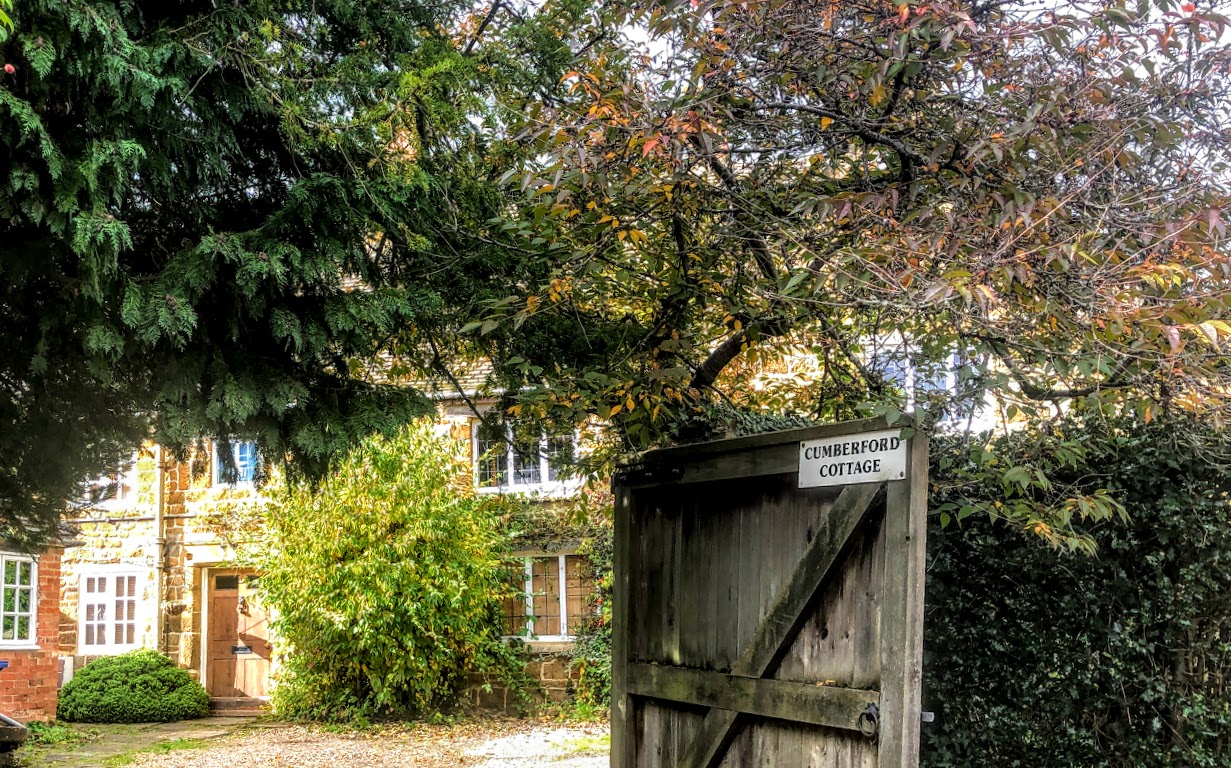
I was in Bloxham earlier this week to visit Cumberford and to photograph Cumberford House, Cumberford Cottage and Cumberford Hill. But I had time too to walk around the village, which dates back centuries.
The Romano-British people were among the early settlers in the area and they were followed by Anglo Saxons, who established the site of the modern village on the slopes of the valley of the Sor Brook, a tributary of the Cherwell River.
The Domesday survey in 1086 records the village of Bloxham as having six mills and trading in wool and corn. Bloxham continued to expand after the Norman Conquest, and, the north and south of the village developed quite separately.
The village name derives from the Old English Blocc’s Ham (‘the Home of Blocc’) in the sixth century, and the village became Bloxham in 1316.
The principal road through the parish was once a route of importance, running from Banbury to Chipping Norton and the wealthy wool-producing area of the Cotswolds.
From mediaeval times on, money was left for the upkeep of the main bridges. These included the Great Bridge, later Old Bridge, on the old High Street, and the Little Bridge to the west of the old High Street. Other bridges included Cumberford Bridge, Wickham Bridge, and Bridle Road Bridge near Grove Mill.
To a large extent, Bloxham retains its mediaeval street plan, which was extremely irregular and consisted of a network of winding streets or alleys.
Bloxham has many well-built yeomen’s houses dating from this period. Many of these have been comparatively little altered, retaining their a mediaeval core with original details and plans.

The Joiners Arms, where I stopped at lunchtime, is a 14th century pub set back from the old green alongside the main road. The Elephant and Castle is an old village pub that was originally a coaching inn, built in the 15th century.
In my search for the origins and history of Cumberford, Cumberford House and Cumberford Hill, I learned that Cumberford was a comparatively late development in Bloxham, and Cumberford House, at the top of Cumberford Hill, was probably first built in the 17th century.
The evidence of surviving houses shows that the outskirts of Bloxham as we see them today were at least partly occupied by the 16th century, and most of the village street names dated from about this period or earlier.
The row of eight cottages in King’s Road, including one with a thatched roof, are among the earliest and the least altered. They are two-storied, built of coursed ironstone rubble, and have a number of original stone-mullioned windows in moulded frames with square moulded labels over them.
Tank Lane, now King Street, occurs in 1513 and was named after the family who had the chief farm there. Humber Lane and the Humber family occur in 1536, and other lanes were called after the families of Doughty, Job, and Budd families. These too may have been of mediaeval origin, but the earliest documentary evidence for them dates from around 1700.

Church Lane, now Church Street, Great Bridge Street and Little Bridge Street are mediaeval names that have survived. Chapel Street takes its name from the Methodist Chapel, but contains many cottages dating from the 16th to the 17th century and a farmhouse of still older date. Similarly, Queen’s Street, formerly Grub Street, has many houses dating from the 17th century and earlier.
Campbell Cottage in Workhouse Lane and the cottage opposite are good examples of the period. So too is the end cottage in Sycamore Terrace. This last house and the rest of the terrace were used as weavers’ cottages in the 19th century. They were completely modernised in 1956.
All roads into Bloxham were gated until 1802, and travellers had to pay a toll to enter the village. Several roads connect Bloxham with the neighbouring villages of Barford, South Newington, Wigginton, Milton, Adderbury and Tadmarton, and also with the road from Banbury to Shipston-on-Stour that skirts the western boundary of the parish.
The main road was straightened in 1815, when the trustees of the Banbury and Chipping Norton turnpike bought two cottages on the brook in order to alter the tortuous line of the old road. This old road, shortly after the junction with Cumberford, originally turned left at Saint Mary’s Church, passed along Unicorn Street, and came out by the Green. It then ran down Old Bridge Street to the Great Bridge and on to the Elephant and Castle, where it again turned left to join the present stretch of the main road.
The 19th century saw the demolition of institutions for the poor such as the Almshouses next to the parish church, the Workhouse, the so-called ‘pest house’ and the poor houses on the green.
Bloxham School, formally All Saints’ School in the north of the village, was founded in 1853 by the Revd Philip Reginald Egerton, a local curate. The main school building was designed in the neo-gothic style by George Edmund Street, and the school was largely funded by Egerton’s wealthy wife, Harriet. Bloxham School is a public school and became fully co-educational in 1998. The school grounds extend to about 60 acres beside the village.

The site of Bloxham Gasworks is by the bridge at Cumberford Hill. Bloxham Gasworks dated from 1869, and had its own gasometer. In 1870, 14 standard lamps and nine bracket lamps lit the village. No light was allowed four nights before and four nights after a full moon.
The manager of the gasworks blew himself up accidentally in December 1905 while he was inspecting a faulty meter. The Bucks and Oxon Gas Company owned the site by 1908 and began promoting the use of gas for cooking with a display of gas cookers and cookery demonstrations. The original lamps were converted to electricity in 1937.
Saint Mary’s Church, the Church of England parish church, is one of the grandest in England. Parts of the church date from the 12th century, but most of the current building dates from the 14th and 15th centuries. The church is an excellent example of the Decorated Gothic style of architecture. The 198 ft spire is a local landmark and is said to be the tallest in Oxfordshire, pinpointing the village for miles around – but more about this church some time next week, perhaps.
The Court House, beside Saint Mary’s Church, was rebuilt in the 1680s, but has retained some 14th century details. Over the years, the property has had many uses, including an infants’ school and a soup house and in 1879 the downstairs area became a fire station. It is now Bloxham Museum and the displays include an old fire engine dating from 1749.
The village ‘Pest House,’ where residents or ‘inmates’ with highly infectious diseases were isolated, once stood by the Slade Nature Reserve. Public contact was not allowed and a pedestal stone with a hollow top was filled with vinegar. Inmates left money in the vinegar – thought to be a disinfectant – in exchange for food left nearby by friends and relatives.
The ‘Pest House’ was in use from 1765, but was eventually abandoned in 1890. I was grateful for the welcome I received in Saint Mary’s Church and the Joiners Arms.