Showing posts with label Venice 2022. Show all posts

20 December 2022

Latimer in Stony Stratford
hides the story of a banking
heir who claimed a title

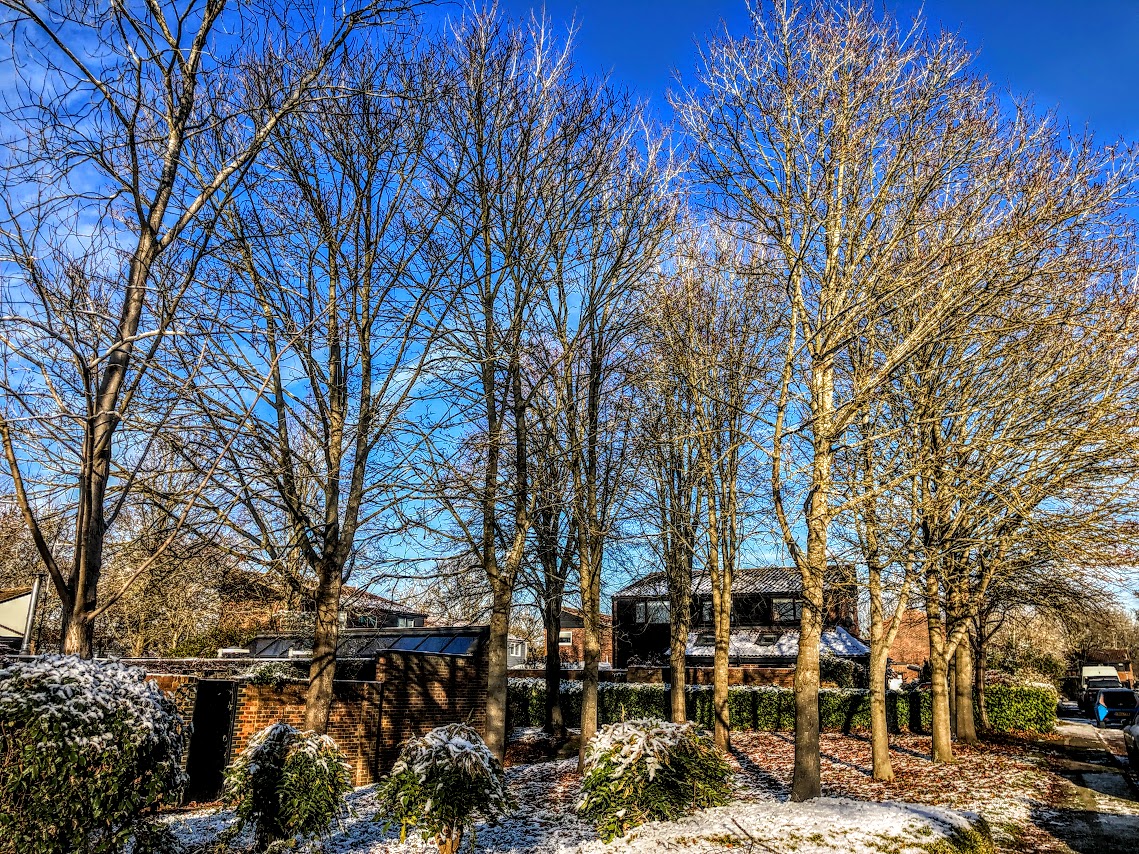
Latimer in Stony Stratford was developed in the 1970s … the name has curious historical, mediaeval and banking links (Photograph: Patrick Comerford, 2022)

Patrick Comerford

I was writing last night about the architects who developed who designed some of the 1970s housing estates on the southern edges of Stony Stratford half a century ago, including Gally Hill, Fullers Slade and Latimer.

I was intrigued by the name of Latimer as a housing development.

Was it named after Latimer, a village on the border of Buckinghamshire and Hertfordshire? This Latimer is near Amersham and Little Chalfont, and is part of the district of Chiltern in Buckinghamshire.

Or was it named after Hugh Latimer (1487-1555), who was the Bishop of Worcester during the Tudor Reformation and later chaplain to Edward VI? During the reign of Mary I, he was burned at the stake in 1555, becoming one of the three Oxford Martyrs of Anglicanism.

Instead, it seems Latimer was takes its name from the holders of the title of Lord Latimer. The title Baron Latimer or Latymer has existed four times in the English peerage, all associated with the descendants of the same mediaeval family, whose surname was Latimer (Latiner, ‘translator’), and in time the title of Lord Latimer was held by the Lords of the Manor of Calverton.

The first Baron Latimer also sat in the Parliament of 1290, and the title eventually passed to the Nevill of Neville and Willoughby families. In my search for the story of these local magnates, I found an interesting connection among my predecessors among the priests, vicars and rectors of Askeaton in the Diocese of Limerick, where I spent five years until I retired earlier this year (31 March 2022).

John Neville (1493-1543), 3rd Baron Latimer, was married three times. His first wife, Dorothy de Vere, was a sister of John de Vere, 14th Earl of Oxford, while his third wife, Catherine Parr (1512-1548), when she was widowed married Henry VIII as his sixth and last wife, becoming Queen of England. She outlived Henry VIII by 20 months; with four husbands, she is the most-married English queen.

When John de Vere inherited the title of Earl of Oxford, he also inherited Calverton Manor, and after his death in 1506 a legal ruling decreed that Calverton Manor should pass to his nephew, Catherine Parr’s stepson, John Neville (1520-1577), 4th Baron Latimer. However, this John Neville had no sons to inherit his title and estates.

The Calverton estate then descended to the Percy family, Earls of Northumberland. It was sold to Sir Thomas Bennet, a former Lord Mayor of London, in 1616, and then descended to the Cecil family, Earls of Salisbury.

On the other hand, the claims to the title of Lord Latimer or Lord Latymer descended in equal portions to the descendants of John Nevill’s four daughters, Catherine, Dorothy, Lucy and Elizabeth.

As time passed, the Latimer title and name seem to have been largely forgotten, and no-one used the title for almost 3½ centuries, from 1577 until 1911, when Francis Burdett Thomas Money-Coutts (1852-1923), a member of the prominent Liberal banking family, identified himself as the heir to one of these four sub-shares in 1911.

Money-Coutts made a legal claim to the Latimer title in 1911, and he was summoned to sit in the House of Lords in February 1913. Since then, he and his heirs have chosen to spell their title Latymer.
Francis Money-Coutts … a poet and writer, who inherited the Latimer title and a banking fortune

I first came across Lord Latymer and his father while I was researching my predecessors among the priests, rectors, vicars and curates of Askeaton for a lecture hosted by Askeaton Civic Trust almost three years ago [19 February 2020]. It is an exotic story of a vicar’s son who inherited one of the largest banking fortunes in Britain and who also managed, by sleight of hand, to wangle a seat in the House of Lords.

Francis Burdett Thomas Nevill Money-Coutts (1852-1923) was born plain Francis Money in London on 18 September 1852, the son of the Revd James Drummond Money (1800-1875), who was Vicar of Askeaton in 1830-1833.

The Revd James Drummond Money was born in Bombay, India, on 26 April 1805, a son of Sir William Taylor Money (1769-1834), an MP (1816-1826) who made his fortune in India and Java as a director of the East India Company and who died of cholera in Venice in 1834.

James was educated at Harrow and Trinity College Cambridge (BA, 1828; MA, 1868), and was ordained deacon (1828) and priest (1829). He was the curate (‘lecturer’) in Ashbourne, Derbyshire, for less than a year when he came to Co Limerick in 1830 and was presented as Vicar of Askeaton by Sir Matthew Blakiston (1783-1862).

What brought a young man like this to Askeaton in west Limerick? He was then only 25, newly-ordained and with little parish experience. The answer is probably provided by his marriage on 10 October 1832 to Charlotte Noel, daughter of Canon Gerard Thomas Noel (1782-1851), Vicar of Romsey Abbey, Hampshire, and a famous evangelical hymnwriter.

The Revd James Drummond Money’s father, Sir William Taylor Money, died of cholera in Venice in 1834 (Photograph: Patrick Comerford, 2022)

Charlotte was his first wife, and she was a first cousin of Charles Noel, Earl of Gainsborough … I have told the sad and romantic stories of his daughters’ marriages in ‘Four Victorian weddings and a funeral’ (in Marriage and the Irish: A miscellany, ed Salvador Ryan, Wordwell: Dublin, 2019, pp 163-165). Charlotte was also a granddaughter of Sir Lucius O’Brien (1731-1795) of Dromoland Castle, Co Clare, and a first cousin of William Smith O’Brien (1803-1864) of Cahermoyle, Co Limerick.

This explains why Charlotte and James moved to Co Limerick in the 1830s. But they stayed in Askeaton for a very short time. They returned to England in 1833, where he became the Rector of Blatherwyck in Northamptonshire, where the O’Brien family also had a home. He then became Rector of Sternfield, Suffolk (1834-1861) in the Diocese of St Edmundsbury. Charlotte and James were the parents of nine children, but most of them died in infancy and she died in 1848.

The Revd James Money married his second wife, Clara Maria Money-Coutts, originally Clara Maria Burdett, at Chelsea on 28 April 1850. Clara was one of the three daughters of the wealthy banker Sir Francis Burdett (1770-1844) and his wife Sophia, a daughter of the banker Thomas Coutts. Clara’s sister was the Victorian philanthropist Angela Burdett-Coutts, who eventually inherited the Coutts banking fortune.

James Money and his second wife Clara were the parents of Francis Burdett Thomas Nevill Money-Coutts (1852-1923), who was born Francis Money in London on 18 September 1852; and the Revd Walter Baptist Money (1849-1924), who played cricket for Kent and Surrey and who was ordained in the Diocese of Lichfield.

The Revd James Money died in 1875 and Clara died in 1899. Their son, Francis Money, was educated at Eton and Trinity College Cambridge (BA 1875; MA and LLM 1878). He was admitted to the Inner Temple in 1873 and was called to the bar in 1879. But, although he was both a barrister and solicitor, he spent most of his life as a poet, librettist and writer. He is now remembered chiefly as a patron and collaborator of the Spanish composer Isaac Albéniz.

In 1875, Francis Money, as he was then named, married Edith Ellen Churchill. In 1881, his aunt Angela Burdett married a foreigner – an American who was 40 years her junior. The marriage violated the terms of the will of her father, Sir Francis Burdett, who had made her the sole heir of the Coutts banking fortune.

Seeing an opportunity, Clara and her son adopted the name Coutts under the terms of the will, so that he became Francis Burdett Thomas Nevill Money-Coutts on 20 September 1880. Mother and son then contested Angela’s claims. A settlement was reached, and Angela received two-fifths of the income until her death in 1906, when Francis then became the sole beneficiary.

At one point, Francis was considered for a partnership in the family bank, but this idea was abandoned as he was thought too unstable in temperament for such a position.

Adopting the pen name of ‘Mountjoy,’ he wrote and published at least 23 works between 1896 and 1923. Many of these were collections of poems. He also worked for the publisher John Lane in London, writing prefaces for, and editing, collections of poems by other authors, including the poet Alfred, Lord Tennyson and the 17th century mystic, theologian and bishop Jeremy Taylor.

In 1912, by a genealogical sleight of hand, Francis became the 5th Baron Latymer through his mother’s family, when the title was called out of abeyance. The title was thought to have been extinct for 335 since the death of John Nevill in 1577. Francis petitioned for the title in 1911, and by resolution of the House of Lords on 15 July 1912 he was declared to be co-heir to the Barony of Latymer. He was summoned to sit in the House of Lords on 11 February 1913.

Francis changed his name again in 1914 to Francis Burdett Thomas Coutts-Nevill. He died in London on 8 June 1923.

When Latimer was developed in Stony Stratford in the mid-1970s, the title was held by his grandson, Thomas Burdett Money-Coutts (1901-1987), 7th Baron Latymer, a director of Coutts and Company and chair of the London Committee of the Ottoman Bank.

Ballindeel House, Askeaton … the former rectory was the home of the Revd James Drummond Money in 1830-1833 (Photograph: Patrick Comerford)

13 December 2022

Praying in Advent with Lichfield Cathedral
and USPG: Tuesday 13 December 2022

A statue of Samuel Johnson on the south-east wall of the Lady Chapel, Lichfield Cathedral (Photograph: Patrick Comerford, 2022)

Patrick Comerford

The Calendar of the Church of England in Common Worship today (13 December 2022) remembers Saint Lucy, Martyr at Syracuse, 304, with a Lesser Festival, and Samuel Johnson, Moralist, 1784, with a Commemoration.

Samuel Johnson (1709-1784) was born in Lichfield and is best known as a writer of dictionaries and a literary editor. Yet in his lifetime he was renowned for his religious beliefs and as a firm supporter of the practice and order of the Church of England. He had been converted to Christianity as a young man after reading William Law’s A Serious Call to a Devout and Holy Life, and his support of the High Church party was unstinting. Amongst his other writings, his essays entitled The Rambler, which appeared twice-weekly between 1750 and 1752, earned him the nickname ‘The Great Moralist’, then a term of affection and honour. He died on this day, 13 December 1784.

I am back in Stony Stratford this morning after yesterday’s day visit to Dublin. Before today gets busy, I am taking some time this morning for reading, prayer and reflection.

During Advent, I am reflecting in these ways:

1, The reading suggested in the Advent and Christmas Devotional Calendar produced by Lichfield Cathedral this year;

2, praying with the Lichfield Cathedral Devotional Calendar;

3, a prayer from the USPG prayer diary, ‘Pray with the World Church.’

John Myatt’s mural of Samuel Johnson on a corner wall in Bird Street, Lichfield (Photograph: Patrick Comerford)

Luke 11: 33-36 (NRSVA):

[Jesus said:] 33 ‘No one after lighting a lamp puts it in a cellar, but on the lampstand so that those who enter may see the light. 34 Your eye is the lamp of your body. If your eye is healthy, your whole body is full of light; but if it is not healthy, your body is full of darkness. 35 Therefore consider whether the light in you is not darkness. 36 If then your whole body is full of light, with no part of it in darkness, it will be as full of light as when a lamp gives you light with its rays.’

The bust commemorating Samuel Johnson in the south transept, Lichfield Cathedral (Photograph: Patrick Comerford)

The Lichfield Cathedral Devotional Calendar:

Lucy was put to death for her faith in 304. Her name in Latin means ‘light’. She is therefore associated with Jesus, the light of the world, the light that banishes the darkness and lets the eyes of all see the Truth of Christ incarnate. Pray for the people of Scandinavia who have special customs to celebrate Saint Lucy (young women dress in white and wear headdresses with candles). As we prepare for Christmas, pray that all who encounter the church may glimpse Christ’s light.

Collect:

God our redeemer,
who gave light to the world that was in darkness
by the healing power of the Saviour’s cross:
shed that light on us, we pray,
that with your martyr Lucy
we may, by the purity of our lives,
reflect the light of Christ
and, by the merits of his passion,
come to the light of everlasting life;
through Jesus Christ your Son our Lord,
who is alive and reigns with you,
in the unity of the Holy Spirit,
one God, now and for ever.

Post Communion:

God our redeemer,
whose Church was strengthened by the blood of your martyr Lucy:
so bind us, in life and death, to Christ’s sacrifice
that our lives, broken and offered with his,
may carry his death and proclaim his resurrection in the world;
through Jesus Christ our Lord.

(or)

Eternal God,
who gave us this holy meal in which we have celebrated the glory of the cross
and the victory of your martyr Lucy:
by our communion with Christ
in his saving death and resurrection,
give us with all your saints the courage to conquer evil
and so to share the fruit of the tree of life;
through Jesus Christ our Lord.

USPG Prayer Diary:

The theme in the USPG Prayer Diary this week is ‘Walking Together.’ This theme was introduced on Sunday by the Right Revd Maria Grace Tazu Sasamori, who became Bishop of Hokkaido in Japan in April 2022. She shared her reflections on this year’s Lambeth Conference with Archbishop Justin Welby.

The USPG Prayer Diary invites us to pray today in these words:

Let us pray for the worldwide Church, for different Churches and denominations. May we be open to receive the riches from each other’s traditions.

Yesterday’s reflection

Continued tomorrow

The body of Saint Lucy is preserved in the Chiesa di S. Geremia e Lucia in Venice (Photograph: Charlotte Hunter, 2022)

Scripture quotations are from the New Revised Standard Version Bible: Anglicised Edition copyright © 1989, 1995, National Council of the Churches of Christ in the United States of America. Used by permission. All rights reserved worldwide. http://nrsvbibles.org

20 November 2022

Praying in Ordinary Time with USPG:
Sunday 20 November 2022,
Christ the King

The large sculpture of Christ the King by John Maguire above the entrance to the Church of Christ the King, Turner’s Cross, Cork (Photograph: Patrick Comerford)

Patrick Comerford

Today in the Calendar of the Church of England is the Feast of Christ the King and the Sunday next before Advent. Because of the traditional collect on this Sunday in the Book of Common Prayer, this Sunday was often known as ‘Stir Up Sunday,’ a traditional designation that coincided with the domestic tradition of beginning to make the mixtures for Christmas cakes and Christmas puddings.

Later this morning, I hope to be present at the Parish Eucharist in the Church of Saint Mary and Saint Giles in Stony Stratford.

Before this day gets busy, I am taking some time this morning for reading, prayer and reflection.

This morning I am reflecting in these ways:

1, One of the readings for the morning;

2, A reflection on the Feast of Christ the King;

3, a prayer from the USPG prayer diary, ‘Pray with the World Church.’

Christ the King depicted in the reredos in Saint Mary’s Church, Lichfield (Photograph: Patrick Comerford)

Luke 23: 33-43 (NRSVA):

33 When they came to the place that is called The Skull, they crucified Jesus there with the criminals, one on his right and one on his left. [34 Then Jesus said, ‘Father, forgive them; for they do not know what they are doing.’] And they cast lots to divide his clothing. 35 And the people stood by, watching; but the leaders scoffed at him, saying, ‘He saved others; let him save himself if he is the Messiah of God, his chosen one!’ 36 The soldiers also mocked him, coming up and offering him sour wine, 37 and saying, ‘If you are the King of the Jews, save yourself!’ 38 There was also an inscription over him, ‘This is the King of the Jews.’

39 One of the criminals who were hanged there kept deriding him and saying, ‘Are you not the Messiah? Save yourself and us!’ 40 But the other rebuked him, saying, ‘Do you not fear God, since you are under the same sentence of condemnation? 41 And we indeed have been condemned justly, for we are getting what we deserve for our deeds, but this man has done nothing wrong.’ 42 Then he said, ‘Jesus, remember me when you come into your kingdom.’ 43 He replied, ‘Truly I tell you, today you will be with me in Paradise.’

The Church of Christ the King in Gordon Square, Bloomsbury, London (Photograph: Patrick Comerford)

Christ the King:

There are few Anglican churches dedicated to Christ the King, but they include the Church of Christ the King in Gordon Square, Bloomsbury, London, now used by Forward in Faith.

The Feast of Christ the King is a recent innovation in the Church calendar. It was first suggested at the end of 1925 when Pope Pius XI published an encyclical, Quas Primas, in which he castigated secularism in Europe and declared that the secular powers ought to recognise Christ as King and that the Church needed to recapture this teaching.

At the time, the entire idea of kingship was quickly losing credibility in western societies, not so much to democracy but to burgeoning fascism – Mussolini was in power in Italy since 1922, and a wave of fascism was about to sweep across central Europe.

The mere mention of kingship and monarchy today may evoke images of either the extravagance of Louis XVI in Versailles, or the anachronism of pretenders in Ruritanian headdress, sashes and medals claiming thrones and privilege in Eastern Europe.

However, since 1925, the celebration of Christ the King or the Kingship of Christ has become part of the calendar of the wider Western Church. It took on an ecumenical dimension from 1983 on with its introduction to Anglicans, Lutherans, Methodists and others through the Revised Common Lectionary.

The Christmas tree is up in the Market Square in Stony Stratford since the middle of last week, and everyone in the town is looking forward to the Christmas lights being switched on next Saturday (26 November 2022).

But, for some people, putting the Christmas trees up too early or hanging up the lights and frosting the windows too far ahead of Advent may detract from encouraging a true Christmas spirit because they help us forget what Advent is all about.

Christ comes not just as a cute cuddly babe wrapped up in the manger and under the floodlights of a front window in a large department store in a shopping centre or city centre.

Despite the accession of Charles III earlier this year, kingship may not be a good role model in many people living in modern democratic societies where the heads of state are elected. Nor are the models of kingship in history or in contemporary society so good. It is worth considering three examples:

● We are familiar with a model of monarchy that paradoxically appears to be benign on the one hand and appears aloof and remote on the other hand, at the very apex of a class system defined by birth, title and inherited privilege.

● In other northern European countries, the model of monarchy is portrayed in the media by figureheads who are slightly daft do-gooders, riding around on bicycles in parks and by canals in ways that threaten to rob kingship of majesty, dignity and grace.

● Or, take deposed emperors from the 20th century: Halie Selassie, who died in 1975, sat back in luxury as his people starved to death; Emperor Bokassa, who died in 1996, was a tyrant accused of eating his people and having them butchered at whim.

Is it any wonder that some modern translations of the Psalms avoid the word king and talk about God as our governor?

Marking this Sunday before Advent by crowning Christ as King helps us to focus on Advent from next Sunday, and Advent is supposed to be a time and a season of preparing for the coming of Christ.

Eric Gill’s last work is the Crucifixion in the Chapel of Saint George and the English Martyrs in Westminster Cathedral, showing the Crucified Christ as Christ the King (Photograph: Patrick Comerford)

Collect:

Eternal Father,
whose Son Jesus Christ ascended to the throne of heaven
that he might rule over all things as Lord and King:
keep the Church in the unity of the Spirit
and in the bond of peace,
and bring the whole created order to worship at his feet;
who is alive and reigns with you,
in the unity of the Holy Spirit,
one God, now and for ever.

Post Communion:

Stir up, O Lord,
the wills of your faithful people;
that they, plenteously bringing forth the fruit of good works,
may by you be plenteously rewarded;
through Jesus Christ our Lord.

Additional Collect:

God the Father,
help us to hear the call of Christ the King
and to follow in his service,
whose kingdom has no end;
for he reigns with you and the Holy Spirit,
one God, one glory.

The theme in the USPG Prayer Diary this week is ‘Prophetic Voice of the Nation.’ This theme is introduced this morning by Bishop Matthew Mhagama, from the Diocese of South-West Tanganyika in the Anglican Church of Tanzania, who writes:

‘The nation of Tanzania is going through a time of change. In a nation where the economy is weak, the Anglican Church of Tanzania has a great opportunity to touch people’s lives spiritually and physically, offering them comfort and healing.

‘One of the ways the Anglican Church of Tanzania has been a healing presence for the wider population is through its service in response to the Covid-19 pandemic. Not only has the Church offered counselling to those in fear of the disease, but it has also actively challenged misinformation around vaccines and built trust in medical institutions. For example, broadcasting radio adverts to encourage people to get the vaccine and working closely with government officials to spread accurate information through the churches.

‘By speaking out against misinformation and showing care for the population of Tanzania, the Church can be a prophetic voice to the nation. The Church has a wide range of opportunities to open the eyes of the people and to show God’s purpose for the nation. It is God’s time.’

The USPG Prayer Diary invites us to pray today in these words:

Oh Lord I have heard of your fame;
I stand in awe of your deeds;
Lord, revive your work over the years,
that we may know your purposes for us.

Yesterday’s reflection

Continued tomorrow

Christ the King depicted in the War Memorial window by Henry Holiday in Saint Editha’s Church Tamworth (Photograph: Patrick Comerford)

Scripture quotations are from the New Revised Standard Version Bible: Anglicised Edition copyright © 1989, 1995, National Council of the Churches of Christ in the United States of America. Used by permission. All rights reserved worldwide. http://nrsvbibles.org

Christ Pantocrator enthroned between two archangels, Saint Michael and Saint Gabriel in the Basilica in Torcello (Photograph: Patrick Comerford)

12 November 2022

Praying in Ordinary Time with USPG
and the poetry of TS Eliot:
Saturday 12 November 2022

‘The child wonders at the Christmas Tree’ TS Eliot … a Christmas card with the Church of Saint Mary and Saint George Church, Comberford, in a watercolour by Freda Morgan (2008)

Patrick Comerford

This is Remembrance weekend: yesterday was Remembrance Day, and tomorrow is Remembrance Sunday. Before this day gets busy, I am taking some time this morning for reading, prayer and reflection.

Throughout this week, I have been reflecting in these ways:

1, One of the readings for the morning;

2, A reflection based on the poetry of TS Eliot … ‘The Waste Land’ was first published 100 years ago, in 1922;

3, a prayer from the USPG prayer diary, ‘Pray with the World Church.’

‘... the child/For whom the candle is a star, and the gilded angel/Spreading its wings at the summit of the tree/Is not only a decoration, but an angel’ (TS Eliot) … an angel atop a Christmas Tree in Christ Church Cathedral, Dublin (Photograph: Patrick Comerford)

Luke 18: 1-8 (NRSVA):

1 Then Jesus told them a parable about their need to pray always and not to lose heart. 2 He said, ‘In a certain city there was a judge who neither feared God nor had respect for people. 3 In that city there was a widow who kept coming to him and saying, “Grant me justice against my opponent.” 4 For a while he refused; but later he said to himself, “Though I have no fear of God and no respect for anyone, 5 yet because this widow keeps bothering me, I will grant her justice, so that she may not wear me out by continually coming”.’ 6 And the Lord said, ‘Listen to what the unjust judge says. 7 And will not God grant justice to his chosen ones who cry to him day and night? Will he delay long in helping them? 8 I tell you, he will quickly grant justice to them. And yet, when the Son of Man comes, will he find faith on earth?’

‘The child wonders at the Christmas Tree’ TS Eliot … a Christmas Tree with Christmas presents on the floor, in Castle Durrow, Co Laois (Photograph: Patrick Comerford)

‘The Cultivation of Christmas Trees,’ by TS Eliot: a reflection

Throughout this week, from Monday to Friday, I have been reflecting each morning on TS Eliot’s ‘The Waste Land,’ first published 100 years ago in 1922.

It is still six weeks to Christmas. But already many of the Christmas decorations are up in Stony Stratford, and the anticipation has begun in the build-up towards switching on the Christmas lights in the town two weeks from now (26 November 2022).

Many shop fronts have Christmas themes in the windows, cards and Christmas baubles are on sale, and some people are already planning their Christmas trees.

So, following this week’s reflections on ‘The Waste Land,’ my choice of a poem this morning is ‘The Cultivation of Christmas Trees,’ by TS Eliot.

Eliot’s poem ‘The Cultivation of Christmas Trees’ was first published on 26 October 1954 as part of a newer series of his ‘Ariel Poems’ by Faber & Faber, and was illustrated by David Jones. This poem is numbered A66 in Gallup’s bibliography of Eliot’s works.

Christmas has a significance throughout Eliot’s work, not only in the Ariel poems, but in his play Murder in the Cathedral, where Thomas à Becket preaches his Christmas sermon.

The four earlier Ariel poems – ‘Journey of the Magi’ (1927), ‘A Song for Simeon’ (1928), ‘Animula’ (1929) and ‘Marina’ (1930) – are Eliot’s first poems of declared Christian belief and were published in successive years as illustrated Christmas greetings by his London publishers and employers Faber & Gwyer (later Faber and Faber). They are severe and rigorous examinations of the significance of Christmas. The original four could hardly be described as ‘festive.’

But ‘The Cultivation of Christmas Trees’ relents a little in this respect. When I first read this poem, I thought it was a more lightweight and less serious poem than the other Ariel poems or other well-known poems by Eliot, such as ‘The Waste Land’ (1922), ‘Ash Wednesday’ (1930), and the poems in ‘The Four Quartets’ (1935-1942) Yet, in many ways, this poem is marked by its wry understatement.

This poem is much later and is less well-known than ‘Journey of the Magi’ or ‘A Song for Simeon’ (1928). In those poems, Eliot presents the Nativity not as a joyous event but in the context of the ‘bitter agony’ of death that is inextricably linked with this birth.

The speaker in ‘Journey of the Magi’ is one of the Magi, now elderly, for whom Christ’s birth represents his own death but who is uncertain of the significance of what he has witnessed.

In ‘A Song for Simeon’, the narrator is also an old man, Simeon, who sees, understands and embraces the significance of the new-born child presented in the Temple.

In many ways, ‘Animula’ is the bleakest of the Ariel poems, tracing human life from birth to death, while recalling in the child ‘taking pleasure/ In the fragrant brilliance of the Christmas tree.’

The fourth Ariel poem, ‘Marina,’ seems to be the most hopeful, in which Eliot recalls the ‘scent of pine and the woodthrush singing through the fog,’ so that the boat carries hints of Christmas trees, as this life is only a foretaste, ‘Living to live in a world of time beyond me.’

Eliot returns to the Christmas theme in ‘The Cultivation of Christmas Trees,’ and in this poem he turns to the meaning of Advent and Christmas that can so easily get lost in the panic about chores, turkeys and cards:

Because the beginning shall remind us of the end
And the first coming of the second coming.


Here, we find echoes of Eliot’s opening words in ‘East Coker’, the second of ‘The Four Quartets’: ‘In my beginning is my end,’ and of his closing words: ‘In my end is my beginning.’

While ‘A Song for Simeon’ and ‘Journey of the Magi’ address specifically Biblical and theological themes, ‘The Cultivation of Christmas Trees’ deals directly with the holiday season, and is filled with contemporary observations of popular devotions and rituals that we all love at this time of the year.

By the time he wrote this poem, Eliot was 66 years old, but he imagines himself as a more elderly man looking back at the Christmases of his childhood, recapturing his own childhood memories as he anticipates Christmas morning.

Eliot seems to strike the appropriate tone when he discusses the proper celebration and meaning of Christmas. He advocates the innocence and simplicity of a sentimental celebration of Christmas, filled with a beautiful tree, a bountiful feast, and new toys. The spirit of the season is not idolatry, but is a truly Christian ‘happiness and cheer.’ This is a season of cheer and goodwill, a season filled with the warmth and joy that Christ’s coming into the world should inspire in a loveless world that is in need of saving.

Here we read Eliot’s last poetic comments on the mystery of the incarnation and on the mystery of life itself. The same mystery that in majesty creates the child’s wonder also brings the soul and the world to judgment.

The first sentence of the poem introduces several possible attitudes towards Christmas, of whom the childish is the one Eliot wants us to give priority. The second sentence, which constitutes the rest of the poem – thanks to three colons, a semicolon, and several sets of parentheses – tells the reader how Christmas should be viewed and experienced.

Eliot now pictures vividly the various trappings of Christmas and the wonder they should inspire from childhood onward, while warning against ‘bored habituation,’ fatigue, tedium, awareness of death, consciousness of failure and

... the piety of the convert
Which may be tainted with a self-conceit.


Then, in parentheses, he recalls his own memories of Saint Lucy’s Day, which he may have been part of his American childhood experiences, but is difficult for readers in this part of Europe to grasp. He clearly wants to link the celebration of this day and its inclusion of children with the celebration of Christmas, and paints a visual image by evoking the flame of light in darkness and of brave martyrdom when he speaks of ‘her carol, and her crown of fire.’

Saint Lucy was a young woman in the third century who maintained unflinching faith in the face of martyrdom. Her name comes from the Latin for ‘light,’ and some traditions say she was miraculously protected from being burned alive. On her feast day on 13 December, Scandinavian girls dress as Saint Lucy, wearing crowns of candles and singing carols about her.

Eliot closes the poem with a reminder of the true significance of Christmas and the future. Christ’s birth leads to his death and resurrection, and to the founding of the Church, when ‘fear came upon every soul.’ His first coming at his incarnation also foreshadows his second coming in judgment:

Because the beginning shall remind us of the end
And the first coming of the second coming.


‘The Cultivation of Christmas Trees’ was published in 1954 and illustrated by David Jones

The Cultivation of Christmas Trees by TS Eliot.

There are several attitudes towards Christmas,
Some of which we may disregard:
The social, the torpid, the patently commercial,
The rowdy (the pubs being open till midnight),
And the childish – which is not that of the child
For whom the candle is a star, and the gilded angel
Spreading its wings at the summit of the tree
Is not only a decoration, but an angel.

The child wonders at the Christmas Tree:
Let him continue in the spirit of wonder
At the Feast as an event not accepted as a pretext;
So that the glittering rapture, the amazement
Of the first-remembered Christmas Tree,
So that the surprises, delight in new possessions
(Each one with its peculiar and exciting smell),
The expectation of the goose or turkey
And the expected awe on its appearance,

So that the reverence and the gaiety
May not be forgotten in later experience,
In the bored habituation, the fatigue, the tedium,
The awareness of death, the consciousness of failure,
Or in the piety of the convert
Which may be tainted with a self-conceit
Displeasing to God and disrespectful to children
(And here I remember also with gratitude
St. Lucy, her carol, and her crown of fire):

So that before the end, the eightieth Christmas
(By “eightieth” meaning whichever is last)
The accumulated memories of annual emotion
May be concentrated into a great joy
Which shall be also a great fear, as on the occasion
When fear came upon every soul:
Because the beginning shall remind us of the end
And the first coming of the second coming.

‘I remember also with gratitude / St. Lucy, her carol, and her crown of fire’(TS Eliot) … an image of Saint Lucy on the Campo di San Geremia door of the Chiesa di S. Geremia e Lucia in Venice (Photograph: Patrick Comerford, 2022)

The Collect:

Almighty Father,
whose will is to restore all things
in your beloved Son, the King of all:
govern the hearts and minds of those in authority,
and bring the families of the nations,
divided and torn apart by the ravages of sin,
to be subject to his just and gentle rule;
who is alive and reigns with you,
in the unity of the Holy Spirit,
one God, now and for ever.

Post Communion Prayer:

God of peace,
whose Son Jesus Christ proclaimed the kingdom
and restored the broken to wholeness of life:
look with compassion on the anguish of the world,
and by your healing power
make whole both people and nations;
through our Lord and Saviour Jesus Christ.

Additional Collect

God, our refuge and strength,
bring near the day when wars shall cease
and poverty and pain shall end,
that earth may know the peace of heaven
through Jesus Christ our Lord.

Collect on the Eve of the Second Sunday before Advent:

Heavenly Father, whose blessed Son was revealed
to destroy the works of the devil
and to make us the children of God and heirs of eternal life:
grant that we, having this hope,
may purify ourselves even as he is pure;
that when he shall appear in power and great glory
we may be made like him in his eternal and glorious kingdom;
where he is alive and reigns with you,
in the unity of the Holy Spirit,
one God, now and for ever.

The theme in the USPG Prayer Diary this week has been ‘A New Commandment.’ This theme was introduced on Sunday by Sue Claydon, chair of the Anglican Pacifist Fellowship.

The USPG Prayer Diary invites us to pray today in these words:

Let us pray that our hearts may be open towards our neighbour. And for those who persecute us, or intend, or would like to harm us – then we are directly following Christ’s commandment. Help us to work together for the common good.

Yesterday’s reflection

Continued tomorrow

TS Eliot’s former offices with Faber and Faber at 24 Russell Square … ‘The Cultivation of Christmas Trees’ was published in 1954 as part of a newer series of his ‘Ariel Poems’ by Faber & Faber (Photograph: Patrick Comerford)

Scripture quotations are from the New Revised Standard Version Bible: Anglicised Edition copyright © 1989, 1995, National Council of the Churches of Christ in the United States of America. Used by permission. All rights reserved worldwide. http://nrsvbibles.org

‘The child wonders at the Christmas Tree’ TS Eliot … the Christmas Tree in the Rectory in Askeaton, Co Limerick, last Christmas (Photograph: Patrick Comerford)

07 November 2022

Praying in Ordinary Time with USPG
and TS Eliot’s ‘The Waste Land’:
Monday 7 November 2022

‘And went on in sunlight, … And drank coffee, and talked for an hour’ … coffee and TS Eliot’s ‘The Waste Land’ in the Rectory garden in Askeaton, Co Limerick (Photograph: Patrick Comerford)

Patrick Comerford

Today, the Calendar of the Church of England in Common Worship remembers Saint Willibrord of York, Bishop, Apostle of Frisia, 739, with a lesser festival.

Saint Willibrord was born in Northumbria and educated at Ripon but the main part of his life was dedicated to his missionary work in Frisia and northern Germany. He built many churches, inaugurated bishoprics and consecrated cathedrals: the Cathedral of Utrecht, with a diocesan organisation based on that of Canterbury, is his most well-known foundation.

Together with the younger Boniface, he began a century of English Christian influence on continental Christianity. Alcuin described him as venerable, gracious and full of joy, and his ministry as based on energetic preaching informed by prayer and sacred reading. He died on this day in 739 and was buried at Echternach monastery in Luxembourg, which he founded. He is the patron saint of the Netherlands.

Later this morning, I have an appointment later this morning at the Open University in Milton Keynes for my next Covid-19 vaccination. But, before this day gets busy, I am taking some time this morning for reading, prayer and reflection.

Throughout this week, I am reflecting in these ways:

1, One of the readings for the morning;

2, A reflection based on TS Eliot’s ‘The Waste Land,’ first published 100 years ago, in 1922;

3, a prayer from the USPG prayer diary, ‘Pray with the World Church.’

‘… breeding / Lilacs out of the dead land, mixing / Memory and desire …’ TS Eliot (‘The Waste Land’) … Lilacs in Spring in a garden in York Road, Stony Stratford (Photograph: Patrick Comerford, 2022)

Luke 17: 1-6 (NRSVA):

1 Jesus said to his disciples, ‘Occasions for stumbling are bound to come, but woe to anyone by whom they come! 2 It would be better for you if a millstone were hung around your neck and you were thrown into the sea than for you to cause one of these little ones to stumble. 3 Be on your guard! If another disciple sins, you must rebuke the offender, and if there is repentance, you must forgive. 4 And if the same person sins against you seven times a day, and turns back to you seven times and says, “I repent”, you must forgive.’

5 The apostles said to the Lord, ‘Increase our faith!’ 6 The Lord replied, ‘If you had faith the size of a mustard seed, you could say to this mulberry tree, “Be uprooted and planted in the sea”, and it would obey you.’

Dante’s meeting with Virgil (Truro Cathedral) … Dante’s ‘Inferno’ strongly influenced TS Eliot’s ‘The Waste Land’ (Photograph: Patrick Comerford)

The Waste Land 1: ‘The Burial of the Dead’

In 1922, the same year as James Joyce published Ulysses, Eliot published ‘The Waste Land.’ The poem includes well-known phrases such as ‘April is the cruellest month,’ and ‘I will show you fear in a handful of dust.’ Recent studies see in ‘The Waste Land’ a description of Eliot’s pilgrimage from the Unitarianism of his childhood to his life-lasting Anglo-Catholicism.

‘The Waste Land’, which I am reflecting on throughout this week, was first published 100 years ago at the end in 1922. It is a masterpiece of modern literature and one of the greatest poems in the English language. Its opening lines are often quoted, even by people who have never read all five sections and 434 lines of the poem.

‘The Waste Land’ was published in Eliot’s The Criterion in October 1922 – this was the same year James Joyce’s Ulysses was published in Paris. ‘The Waste Land’ was then published in the US in the November issue of The Dial, and was published in book form in December 1922.

To mark the 100th anniversary of the publication of The Waste Land in 1922, I am dipping in and out of the five sections of The Waste Land in this prayer diary each day this week. ‘The Waste Land’ is divided into five sections:

1, ‘The Burial of the Dead’, introduces the diverse themes of disillusionment and despair.

2, ‘A Game of Chess’, employs alternating narrations, in which vignettes of several characters address those themes experientially.

3, ‘The Fire Sermon’, offers a philosophical meditation in relation to the imagery of death and views of self-denial in juxtaposition, influenced by Augustine of Hippo and Eastern religions.

4, ‘Death by Water’, includes a brief lyrical petition.

5, ‘What the Thunder Said’, the culminating fifth section, concludes with an image of judgment.

The first section, ‘The Burial of the Dead,’ introduces the diverse themes of disillusionment and despair.

‘The Waste Land’ is a masterpiece of modern literature and one of the greatest poems in the English language. The opening lines are often quoted, even by people who have never read all five sections and 434 lines of the poem:

April is the cruellest month, breeding
Lilacs out of the dead land, mixing
Memory and desire, stirring
Dull roots with spring rain.
Winter kept us warm, covering
Earth in forgetful snow, feeding
A little life with dried tubers.
Summer surprised us, coming over the Starnbergersee
With a shower of rain; we stopped in the colonnade,
And went on in sunlight, into the Hofgarten,
And drank coffee, and talked for an hour


The opening stanzas of ‘The Waste Land’ refer to the blooming of flowers and the coming of spring, but in gloomy tones. Winter is recalled nostalgically, with snow keeping us warm. As I wait for my fourth Covid-19 vaccination this morning, I am also re-reading ‘The Waste Land’ in the light of the pandemic a century ago that sheds new light on lines such as:

Unreal City,
Under the brown fog of a winter dawn,
A crowd flowed over London Bridge, so many,
I had not thought death had undone so many.
Sighs, short and infrequent, were exhaled,
And each man fixed his eyes before his feet.
Flowed up the hill and down King William Street,
To where Saint Mary Woolnoth kept the hours
With a dead sound on the final stroke of nine.
There I saw one I knew, and stopped him, crying “Stetson!
“You who were with me in the ships at Mylae!
“That corpse you planted last year in your garden,
“Has it begun to sprout? Will it bloom this year?
Or has the sudden frost disturbed its bed?
“Oh keep the Dog far hence, that’s friend to men,
“Or with his nails he’ll dig it up again!
“You! hypocrite lecteur!—mon semblable,—mon frère!”


The Church of Saint Mary Woolnoth, which is referred to in these lines, is in the centre of the City of London and is one of the two churches named in ‘The Waste Land.’ It stands on the corner of Lombard Street and King William Street near Bank junction, and Eliot worked nearby at Lloyd’s Bank from 1917 to 1925.

Professor Barry Spurr of the University of Sydney, in his study of Eliot’s Anglo-Catholicism, ‘Anglo-Catholic in Religion’ TS Eliot and Christianity (Cambridge: Lutterworth, 2010), says the dedication of the church to the Blessed Virgin Mary chimes with Eliot’s subsequent Anglo-Catholicism.

In his notes to the poem, Eliot remarks that the ‘dead sound on the final stroke of nine’ was ‘A phenomenon which I have often noticed.’ However, Barry Spurr reads in this mention of the ‘dead sound on the final stroke of nine’ a reference to the traditional time of execution in prisons – and so to the execution of Christ at the ninth hour.

Saint Mary Woolnoth is one of the two London churches named in ‘The Waste Land’ (Photograph: Patrick Comerford)

Dante’s ‘Inferno’ strongly influenced TS Eliot’s ‘The Waste Land,’ and Eliot returns to this poem throughout ‘The Waste Land.’ In ‘The Burial of the Dead,’ a latter-day Dante walks the streets of London seeing death all around him:

I was neither
Living nor dead, and I knew nothing,
Looking into the heart of light, the silence.


Eliot said that ‘the poetry of Dante is the one universal school of style for the writing of poetry in any language,’ and that ‘there is no poet in any tongue – not even Latin or Greek – who stands so firmly as a model for all poets.’

‘The Waste Land’ is dedicated ‘For Ezra Pound, il miglior fabbro’, a dedication drawn from Dante’s epic, ‘The Divine Comedy.’ Dante divides his poem into three parts — ‘Inferno’, ‘Purgatorio’, and ‘Paradiso’ — describing Dante’s journey through Hell, Purgatory, and finally Paradise. Eliot’s dedication translates as ‘the better craftsman,’ a reference to Canto 26 of the ‘Purgatorio’ and the poet Arnault Daniel. But Eliot passes the compliment on to Pound, who helped edit ‘The Waste Land.’

In Part 1 of ‘The Waste Land,’ ‘The Burial of the Dead,’ Eliot invokes the Prophet Ezekiel as he describes modern existence:

What are the roots that clutch, what branches grow
Out of this stony rubbish? Son of Man
You cannot say, or guess, for you know only
A heap of broken images, where the sun beats
And the dead trees give no shelter, the cricket no relief,
And the dry stone no sound of water.


He sees us living in a time of hopelessness, of ‘broken images,’ where there is no shelter, no life-giving water. Yet, glimpses of hope are to be found all around us:

… … Only
There is shadow under this red rock,
(Come in under the shadow of this red rock),
And I will show you something that is different from either
Your shadow at morning striding behind you
Or your shadow at evening rising to meet you;
I will show you fear in a handful of dust.


While earlier commentators tended to read ‘The Waste Land’ as a secular commentary on life in London in the inter-war years, more recent studies see in this poem a description of Eliot’s pilgrimage to faith from the Unitarianism of his childhood and youth, through his readings in Hinduism to his preparation for his eventual Baptism in 1927 and his subsequent, life-lasting Anglo-Catholicism.

In his study, A Lee Fjordbotten, (‘Liturgical influences of Anglo-Catholicism on ‘The Waste Land’ and other works by TS Eliot,’ Fordham University, 1999), says ‘The Waste Land’ reveals a spiritually searching and developing Eliot who is anticipating his formal conversion in 1927. He points out that the structure of the poem is similar to the traditional process of conversion, especially as seen in the season of Lent.

In her study, ‘The Prefiguration of TS Eliot’s conversion in ‘The Waste Land’,’ in the Saint Austin Review (January/February 2012, pp 19-20), Paula L Gallagher, says the beginning of Eliot’s conversion is prefigured in this poem and begins with his recognition of the emptiness of modernity.

She argues that the poem – far from being just the apogee of modernist despair – significantly prefigures his conversion to Anglo-Catholicism: ‘Eliot’s personal journey through the Waste Land – from the rejection of modernity, to the search for Christ, to the arrival of rain – contains imagery, allusions and ideas that prefigure that conversion to Anglo-Catholicism.’

The fact that Eliot is writing this poem about the barrenness of modernity and imaging it as a Waste Land shows that he sees through modernity to the reality of its sterility. The image of the Waste Land represents the aridity of modernity, its lack of culture and tradition, and indeed its inability to allow culture and tradition to grow and flourish. Hence, the Waste Land is repeatedly described as a desert with ‘dry stone and no sound of water.’

The Waste Land, where ‘there is not water but only rock,’ lacks the life-giving and life-sustaining water that will enable tradition and culture to thrive. The poet is seeking the rain which will reanimate the Waste Land of modernity; the rain which will touch and enliven the dead roots of tradition and culture. This water, ultimately, is Christianity.

‘What are the roots that clutch, what branches grow / Out of this stony rubbish?... / A heap of broken images, where the sun beats/ And the dead trees give no shelter ...’ TS Eliot, ‘The Waste Land’ (Photograph: Patrick Comerford, 2022)

Today’s Prayer (Monday 7 November 2022):

The Collect:

God, the Saviour of all,
you sent your bishop Willibrord from this land
to proclaim the good news to many peoples
and confirm them in their faith:
help us also to witness to your steadfast love
by word and deed
so that your Church may increase
and grow strong in holiness;
through Jesus Christ your Son our Lord,
who is alive and reigns with you,
in the unity of the Holy Spirit,
one God, now and for ever.

The Post Communion Prayer:

Holy Father, who gathered us here around the table of your Son
to share this meal with the whole household of God:
in that new world where you reveal
the fullness of your peace,
gather people of every race and language
to share with Willibrord and all your saints
in the eternal banquet of Jesus Christ our Lord.

The theme in the USPG Prayer Diary this week is ‘A New Commandment.’ This theme was introduced yesterday by Sue Claydon, chair of the Anglican Pacifist Fellowship.

The USPG Prayer Diary invites us to pray today in these words:

We pray for guidance for the leaders of the nations and those who work internationally and make us all subject to Christ’s just and gentle rule.

Yesterday’s reflection

Continued tomorrow

‘A crowd flowed over London Bridge, so many, / I had not thought death had undone so many’ … London Bridge, the Thames and the South Bank seen from the City (Photograph: Patrick Comerford, 2022)

Scripture quotations are from the New Revised Standard Version Bible: Anglicised Edition copyright © 1989, 1995, National Council of the Churches of Christ in the United States of America. Used by permission. All rights reserved worldwide. http://nrsvbibles.org

Ezra Pound’s grave in Venice … TS Eliot dedicated ‘The Waste Land’ to Ezra Pound ‘il miglior fabbro’ (Photograph: Patrick Comerford, 2022)

06 November 2022

The people of Venice
fear they are losing
out to the demands
of mass tourism

The resident population of Venice has dropped below 50,000 for the first time (Photograph: Patrick Comerford, 2022)

Patrick Comerford

The last remaining inhabitants of the historic centre of Venice fear they are becoming like ‘relics in an open museum’ and the population has dropped below 50,000 for the first time.

The main island of Venice has lost more than 120,000 residents since the early 1950s, driven away mainly by the city’s focus on mass tourism and the thousands of visitors who crowd Venice each day.

The population of central Venice fell below 50,000 this August, and the trend seems to be irreversible with no government or local authority willing or able to challenge this catastrophic trend.

The residents who remain say they feel suffocated by an economic machine that focusses on tourism but leaves residents grappling with a high cost of living and without affordable housing. Shops that once sold essential daily items are being replaced by souvenir shops.

Local campaigners worry that Venice has been turned into a cash machine and they fear the people of Venice are becoming relics in an open museum.

Symon Semeonis from Clonmel visited ‘sumptuous’ Saint Mark’s Basilica in 1323 (Photograph: Patrick Comerford, 2022)

An earlier visitor
from Clonmel


The first Irish tourist to visit Venice may have been Symon Semeonis, whose name might be rendered today as Simon FitzSimons. He was the author of Itinerarium Symonis Semeonis ab Hybernia ad Terram Sanctam (‘The Journey of Symon Semeonis of Ireland to the Holy Land’).

Symon and his companion friar, Hugh the Illuminator, left Clonmel, Co Tipperary, in 1323 on a pilgrimage to Jerusalem. In his account, he described his experiences on his journey through Europe. He gives unique descriptions of life in 14th century Europe, with minute details of distances, prices, religion, the value of money and the manners and customs of people and places.

For him, Paris was ‘the home and nurse of theological and philosophical science, the mother of the liberal arts, the mistress of justice, the standard of morals, and in fine the mirror and lamp of all moral and theological virtues.’

He arrived in ‘the renowned city of Venice’ in mid-1323. ‘Although this city is situated entirely in the sea, yet by virtue of its beauty and cleanliness it deserves to be placed between the stars of Arcturus and the shining Pleiades.’

***

Symon spent seven weeks in Venice, where he travelled along the canals, and visited ‘sumptuous’ Saint Mark’s Basilica, ‘incomparably constructed of marble and other most precious stones, and adorned with wonderful mosaic work reproducing Biblical stories.’

In the Palace of the Doges, Symon said, ‘living lions are kept for the glory of the Doge and of the citizens.’ He searched for ‘the entire and undecayed bodies of Mark the Evangelist; of Zacharias the prophet, father of John the Baptist, whose mouth is open even to the present day and of many other martyrs, confessors, and holy virgins.’

In the lagoon, he visited the monastery of San Nicolò del Lido. Later in the 14th century, the Jewish community was granted a small plot of land at San Nicolò of Lido to create the first Jewish cemetery in Venice.

From Venice, Symon continued down the Adriatic coasts of present-day Croatia and Albania into present-day Greece, travelling through Corfu and Kephallonia before landing in western Crete, then under Venetian rule and a crossroads in the Mediterranean. He describes Iraklion as a prosperous city that ‘abounds in most excellent wine, in cheese and in fruit.’ He was the first writer to record the presence in Europe of Romanies or Gypsies.

From Iraklion, Symon Semeonis travelled through Alexandria, Cairo and Gaza to Jerusalem. But his account of Jerusalem is cut short and we have little or no information about his return journey.

The only known manuscript copy of Symon’s account of his extraordinary journey was presented to the library of Corpus Christi College, Cambridge, by Archbishop Matthew Parker of Canterbury in 1575.

The Jewish Ghetto in Venice was the first-ever ghetto in the world (Photograph: Patrick Comerford, 2022)

The hidden corners of
minorities in Venice


I find two essential books for any visit to Venice are John Ruskin’s Stones of Venice and Jan Morris’s Venice. Jan Morris’s book has been described as ‘classic, witty love letter to Italy’s most iconic city.’ She says the ‘practical tolerance of Venice has always made it a cosmopolitan city, where east and west mingle.’

She identifies three minorities who have always had a place in the life of Venice: the Jews, the Armenians and the Greeks. The Jewish Ghetto in Venice was the world’s first, and I visit it each time I return to Venice, with its synagogues, the museum and the shops, and – of course – staying on to eat.

During my latest visit this summer, I also returned to the Greek quarter at the other end of the city, behind Saint Mark’s Square. The Greek community in Venice dates back to the Middle Ages, when Venice was still nominally part of the Byzantine Empire. There was an exodus of Byzantine scholars and artists to Venice after the fall of Constantinople in 1453. The Greeks of Venice were the most significant ethnic minority in the lagoon during the 16th century, and they also became the largest community of Greeks living in exile.

The émigrés were teachers, humanists, poets, writers, printers, lecturers, musicians, astronomers, architects, academics, artists, scribes, philosophers, scientists, politicians and theologians. They reintroduced the teaching of the Greek language to their western counterparts, and brought with them classical texts that were printed on the first printing presses for Greek books in Venice in 1499.

The Greeks of Venice helped to trigger the revival of Greek and Roman studies, arts and sciences, and they are a key to understanding the development of the Italian Renaissance and humanism. Without this reintroduction of patristic texts – and their rapid dissemination due to the development of printing – would the Reformation that followed in the decades immediately after have been anything more than a damp squid?

San Giorgio dei Greci in Venice is known to many for its leaning bell-tower (Photograph: Patrick Comerford, 2022)

***

For centuries, the Greeks in Venice were not allowed to celebrate the Orthodox Liturgy. However, in 1498, they gained the right to found the Scuola de San Nicolò dei Greci, a Greek confraternity. After protracted negotiations, they received permission in 1539 to build San Giorgio. The work, financed by a tax on all ships from the Orthodox world, began in 1548.

Michael Damaskinos (1535-1593), the leading exponent of the Cretan School of icon painting in the 16th century, was born in Iraklion and later lived in Venice, from 1577 to 1582.

Damaskinos and Emmanuel Tzanes painted the icons and frescoes in the Greek Orthodox Cathedral of San Giorgio dei Greci in Venice, known to many for its leaning bell-tower. The fresco of ‘The Last Judgment’ (1589-1593) in the dome is the work of John Kyprios, while the icon screen is the work of many Cretan artists, especially Michael Damaskinos. When Damaskinos returned to Crete, the dome was completed under Tintoretto’s supervision.

Damaskinos was a near-contemporary of the most famous of all Cretan painters, El Greco, and is believed by many to have been El Greco’s teacher. El Greco, or Doménikos Theotokópoulos (1541-1614), was born in Venetian Crete and moved to Venice in 1567 when he was 26. There, he worked closely with Titian, who was then in his 80s. In 1570, he moved to Rome, where his works were strongly marked by his Venetian experiences. His subsequent influence on western art is immeasurable.

After the fall of the Venetian Republic and the establishment of the modern Greek state, the Greek community in Venice declined. But a noticeable Orthodox and Greek presence remains in the city.

The Church of San Giorgio dei Greci in Venice has been the cathedral of the Greek Orthodox Archdiocese of Italy since 1991. Greek landmarks include the neighbouring Hellenic Institute of Byzantine and Post-Byzantine in Studies in Venice, and the Greek community retains its own burial rights on the cemetery island of San Michele in the Lagoon.

Michael Damaskinos and Emmanuel Tzanes painted the icons and frescoes in San Giorgio dei Greci (Photograph: Patrick Comerford, 2022)

The daily commute
from Mestre to Venice


Napoleon described Saint Mark’s Square as ‘the drawing room of Europe.’ But as the core resident population of Venice continues to decline, many Venetians are moving their drawing rooms – and every other room in their homes – to outlying, mainland towns such as Mestre.

For many tourists, Mestre is merely an affordable place to sleep and leave luggage, a convenient starting point for a day-trip to Venice. Mestre was always overshadowed by its powerful neighbour Venice. Yet this is the most populated borough within Venice, serving as a kind of mainland suburb.

The population of Mestre today is almost three times that of Venice itself. Mestre offers modern houses and apartments, space for children to play, and a place for family cars. There are normal shops with normal prices, including Mestre’s shopping centre, Centro Le Barche.

Mestre is linked to Venice by Ponte della Libertà, the 3.8 km railway and road bridge that crosses the lagoon. Buses run constantly, crossing the lagoon to Piazzale Roma, Venice’s bus terminus, bringing day-trippers and commuters from Mestre to Venice each morning.

Even the gondoliers can be seen commuting each morning from Mestre – a sign of how things are changing in Venice.

Mestre has always been overshadowed by its neighbour Venice (Photograph: Patrick Comerford, 2022)

Canon Patrick Comerford blogs daily at www.patrickcomerford.com. This feature was originally prepared for the ‘Church Review’ (Dublin and Glendalough)

7, A gondolier and gondola below the Rialto Bridge … even the gondoliers can be seen commuting each morning from Mestre (Photograph: Patrick Comerford, 2022)

07 October 2022

A ‘determination that all … shall
enjoy the blessings of the earth’

Shaking a lulav and an etrog … a figure in a shop window in the Ghetto in Venice (Photograph: Patrick Comerford, 2022)

Patrick Comerford

The Jewish Festival of Sukkot this year begins at sunset on Sunday evening (9 October 2022) and ends at sunset the following Sunday (16 October 2022).

Sukkot is known as the ‘Festival of Tabernacles’ or the ‘Feast of Booths,’ and it is one of the three central pilgrimage festivals in Judaism, along with Passover and Shavuot. It is traditional in Jewish families and homes to mark this festival by building a sukkah or a temporary hut to stay over in during the holiday.

The customs include buying a lulav and etrog and shaking them daily throughout the festival: the lulav is a palm branch joined with myrtle and willow branches; an etrog is a citron fruit, usually a lemon.

A sukkah is a temporary dwelling in which farmers once lived during the harvest. Today, it is also a reminder of the type of the fragile dwellings in which the people lived during their 40 years wandering through the wilderness after fleeing slavery in Egypt.

Throughout the holiday, meals are eaten inside the sukkah and some people even sleep there as well. On each day of the holiday, it is traditional to perform a waving ceremony with the ‘Four Species’ or specified plants: citrus trees, palm trees, thick or leafy trees and willows.

On each day of the festival, worshippers walk around the synagogue carrying the ‘Four Species’ while reciting special prayers known as Hoshanot.  This takes place either after the morning’s Torah reading or at the end of Mussaf. This ceremony recalls the willow ceremony in the Temple in Jerusalem, when willow branches were piled beside the altar with worshippers parading around the altar reciting prayers.

Sukkot is a joyous and upbeat celebration, and is celebrated today with its own customs and practices.

Prayers during Sukkot include reading the Torah every day, the Mussaf or additional service after morning prayers, reciting Hallel, and adding special additions to the Amidah and Grace after Meals. There are traditional readings from the Book of Ecclesiastes.

A custom originating with Lurianic Kabbalah is to recite the ushpizin prayer to ‘invite’ one of seven ‘exalted guests’ into the sukkah. According to tradition, each night a different guest enters the sukkah followed by the other six. Each of the ushpizin has a unique lesson to teach that parallels the spiritual focus of the day on which they visit, based on the Sephirah associated with that character.

Some streams of Judaism also recognise a set of seven female shepherds of Israel, known as ushpizot or ushpizata. At times, they are listed as the seven women prophets: Sarah, Miriam, Deborah, Hannah, Abigail, Hulda and Esther. Other lists name seven matriarchs: Ruth, Sarah, Rebecca, Miriam, Deborah, Tamar and Rachel.

The interim days of Sukkot, known as hol HaMoed (חול המועד, festival weekdays), are often marked with special meals in the sukkah, when guests are welcomed.

The Shabbat that falls during the week of Sukkot, beginning next Friday evening (14 October), is known as Shabbat Hol haMoed. The Book of Ecclesiastes is read, with its emphasis on the ephemeral nature of life: ‘Vanity of vanities, all is vanity.’ This echoes the theme of the sukkah, while its emphasis on death reflects the time of year in which Sukkot falls, the ‘autumn’ of life.

The conclusion of Sukkot marks the beginning of the separate holidays of Shemini Atzeret and Simchat Torah.

‘Just as the etrog has a both a beautiful taste as well as a beautiful fragrance, so there are (those) who are learned and who do good deeds …’ (Midrash Vayikra Rabbah 30:12) … lemons in a restaurant in York (Photograph: Patrick Comerford, 2022)

A meditation on Sukkot in Service of the Heart, a prayer book I use regularly in my daily prayer and meditation, offers this Kiddush, composed by Rabbi Sidney Brichto (1936-2009), for welcoming Sukkot:

‘The Festival of Sukkot teaches us to give thanks to God for the harvest of fruit and grain and to share these and all nature’s blessings with our fellow men.

‘Let us praise God with this symbol of joy and thank him for his providence which has upheld us in our wanderings and sustained us with nature’s bounty from year to year. May our worship lead us to live this day and all days in the spirit of this Festival of Sukkot with trust in God’s care, with thanksgiving for his goodness, and with determination that all … shall enjoy the blessings of the earth.’

‘Sometimes I sing the psalms of Hallel. Sometimes I sip coffee’ (Rabbi Rachel Barenblat) … sipping coffee in Great Linford (Photograph: Patrick Comerford, 2022)

On her blog Velveteen Rabbi, Rabbi Rachel Barenblat shared this poem for Sukkot some years ago [29 September 2018]:

Small scenes from a sukkah

I got a new sukkah this year.
A simple white metal frame.
Three canvas walls with windows in them.
Cornstalks overhead, twined with autumnal garlands.

In the mornings, when it is not raining, I sit here
and watch the morning light move across the valley.
Sometimes I sing the psalms of Hallel.
Sometimes I sip coffee.

During the afternoon I listen to the wind rustle the cornstalks
and the tinsel garlands overhead.
Every now and then I listen to a small plane overhead,
or a flock of geese.

As afternoon gives way to evening,
the sky goes through its rapid costume change.
If I’m paying attention at the right moment
I can see it happen.

Once evening falls
the sukkah gleams
on my mirpesset,
a little house filled with light.

Shabbat Shalom

‘The Festival of Sukkot teaches us to give thanks to God for the harvest of fruit and grain and to share these and all nature’s blessings with our fellow men’ (Rabbi Sidney Brichto) … a harvest wreath on a front door in Stony Stratford (Photograph: Patrick Comerford, 2022)