The Battle of Cable Street … fought 90 years ago and commemorated in a mural on the side of on the side of Saint George’s Town Hall in Cable Street (Photograph: Patrick Comerford)
Patrick Comerford
I have stayed twice in the East End of London in the past decade, staying on both occasions at the Royal Foundation of Saint Katharine, which is built around the old Georgian vicarage of Saint James in Ratcliffe.
The Battle of Cable Street made that part of the East End famous 90 years ago on this day, 4 October 1936, and the events of that day not only shaped the identity of the East End but are also worth recalling today as the far-right is on the rise again, threatening life in cities and towns, ports and suburbs.
The old vicarage at Saint Katharine’s faces out towards Cable Street, which runs through the heart of Tower Hamlets, from Limehouse to the edge of London’s financial district, the City of London.
Cable Street runs parallel to, and south of, the Docklands Light Railway and Commercial Road, and north of The Highway. The area is close to Wapping and Shadwell Basin to the south, Tower Hill to the west, and Whitechapel and Stepney to the north. Because many Londoners define where they live by the nearest station, the Cable Street area is often known as Shadwell.
In the past, Stepney was divided into four hamlets – Ratcliffe, Limehouse, Poplar and Mile End – and the northern part of the hamlet of Ratcliffe, where the 17th century Kilkenny-born mapmaker Nicholas Comberford (1600-1673) lived, is between Shadwell and Limehouse.
A view of Cable Street looking east towards Butcher Row and Saint Katharine’s (Photograph: Patrick Comerford)
Each time I stayed at Saint Katharine’s, I walked the length of Cable Street through the East End, towards the City of London.
When Saint Katharine’s moved back to the East End in the 1940s, the first Master appointed after the move was Father St John Groser (1890-1966), who had been the Rector of Saint George-in-the-East, on Canon Street Road off Cable Street
He was an Anglican priest and a prominent Christian socialist. He was said to be ‘the best-known priest in the East End’ and Kenneth Leech said that he was ‘one of the most significant Christian socialist figures in 20th century Britain’. He took part in the Battle of Cable Street in 1936, and had his nose broken by a police baton.
Cable Street started as a rope walk or straight path where hemp ropes were twisted along its length into ships’ ropes or cables. These cables supplied ships anchored nearby in the Pool of London, between London Bridge and Wapping and Rotherhithe.
Until Victorian times, the present-day Cable Street had different names for each of its sections, including Cable Street, Knock Fergus, New Road, Back Lane, Blue Gate Fields, Sun Tavern Fields, and Brook Street. The whole central area of present-day Cable Street was named after Saint George-in-the-East Church and Saint George-in-the-East parish.
Up to the 1950s, Cable Street had a reputation for cheap lodgings, brothels, drinking inns and opium dens. In 1868, the Dublin-born Dr Thomas Barnardo (1845-1905) opened his first home for destitute children nearby in Stepney Causeway.
The Battle of Cable Street took place 90 years ago, on Sunday 4 October 1936, when local communities clashed with police who were protecting a planned fascist march in Cable Street in the heart of the Jewish East End.
Local Jewish groups and residents, along with trade unionists, Labour groups, socialists, Communists, anarchists and local Irish organisations, decided to take a stand against a planned march through the East End by Oswald Mosley’s British Union of Fascists.
Mosley planned to goose-step thousands of his marchers dressed in uniforms like those of Mussolini’s Blackshirts through the East End, which then had a large Jewish population. Despite the strong likelihood of violence, the government hesitated about banning the march. A large police escort was provided in a bid to block anti-fascist protesters from disrupting the march.
The Board of Deputies of British Jews denounced the march as antisemitic and urged Jewish people to stay away. The Communist Party, under the leadership of Phil Piratin, was one of the leaders of the opposition forces.
The anti-fascist groups set up roadblocks in an attempt to prevent the march from taking place. The barricades were set up near the junction with Christian Street, towards the west end of Cable Street. About 20,000 anti-fascist demonstrators turned out, only to be met by 6,000 police, who attempted to clear the road to allow 2,000-3,000 fascists to march.
The demonstrators fought back with sticks, rocks, chair legs and other improvised weapons. Rubbish, rotten vegetables and the contents of chamber pots were thrown at the police by women from the doors and windows of houses along Cable Street. A bus was overturned and used as a barricade, Mosley’s car was attacked with bricks, and hand-to-hand fighting broke out on the surrounding streets.
After a series of running battles that day, Mosley appeared to climb down and agreed to abandon his march, claiming he now wanted to prevent bloodshed. The fascist marchers were dispersed towards Hyde Park and the police then attacked the counter-demonstrators. About 150 of them were arrested, although some escaped, and several members of the police were also arrested by demonstrators. Around 175 people were injured, including police, women and children.
Many of the arrested demonstrators reported they had been treated harshly by the police. Most were charged with the minor offence of obstructing police and fined £5, but several of the leaders were found guilty of affray and sentenced to three months hard labour.
Jewish figures from the East End in a work by Dan Jones in the corridors of the Royal Foundation of Saint Katharine (Photograph: Patrick Comerford)
Two days after the Battle, Mosley was married in Joseph Goebbels’s drawing room, with Hitler as his special guest. The Battle of Cable Street was a major factor leading to the passage of the Public Order Act 1936, which required police consent for political marches and forbade the wearing of political uniforms in public. It provided a short-term boost for Mosley’s fascists but eventually proved to be a significant moment in their decline in the years immediately before World War II.
Piratin was one of the heroes of the day. In 1937, he became the first Communist elected to Stepney Borough Council, and in 1945 he was elected as the Communist MP for Mile End.
Beatty Orwell, who took part in the counter-fascist protests was then a 19-year-old. She went on to be the Mayor of Tower Hamlets and served as councillor for 10 years in the 1970s and 1980s. She is now a great-grandmother 18 times over.
In the 1980s, a large mural depicting scenes from the battle was painted on the side of Saint George’s Town Hall in Cable Street, immediately west of Shadwell station and next to Library Place. This building was originally the vestry hall for the parish and later the town hall of Stepney Borough Council.
Little is recognisable from that period on today’s Cable Street, apart from the faded street signs. Cable Street is now home to a large South Asian community, a cycle route to the City, and some parts of it look as though they are becoming up-and-coming residential areas for young hipsters.
At a rally ten years ago to mark the 80th anniversary of the Battle of Cable Street, the speakers included 100-year-old Dublin-born Max Levitas, a veteran of the battle, a Communist councillor in Stepney for 15 years, and still active then in political causes. He died at the age of 103 on 2 November 2018 after a life of political activism fighting for housing for the poor and for social justice. He was buried in Rainham Jewish Cemetery.
His brother, Maurice (‘Morry’) Lavitas, was a veteran of the Connolly Column in the International Brigade in the Spanish Civil War. He took part in the commemoration of the Connolly Column in Liberty Hall, Dublin, in 1991, when he was chosen to read out the list of members. He also attended a ceremony hosted by the Lord Mayor of Dublin in the Mansion House in 1997 to honour the surviving Irish members of the International Brigade. He died in London in 2001.
Their father Harry fled from Lithuania and their mother Leah from Latvia in 1913, both escaping the antisemitic pogroms of Tsarist Russia. They met in Dublin and were married in the Camden Street Synagogue. However, on the other side of Europe, Harry’s sister Sara was burnt to death along with fellow-villagers in the synagogue of Akmeyan, and Leah’s sister Rachel was killed with her family by the Nazis in Riga.
Levitas House on Jubilee Street, new flats in Stepney Green in 2020, are a fitting memory and tribute to Max Levitas, the Dublin-born hero of the Battle of Cable Street and a veteran political activist. But the most fitting tribute to the Levitas brothers and the heroes of Cable Street 90 years ago is to continue to resist the far-right which is on the rise again.
My first visit to Cable Street came immediately after visiting Auschwitz, Birkenau and the Old Jewish Quarter of Kraków. In a time when we are seeing the rise of political extremism and racism not only in Britain but throughout Europe, and holding a tight grip on political power in the US, it is good to be reminded of the courage and resilience of people who stood against the rise of fascism in years immediately before World War II.
Part of the mural at Saint George’s Town Hall commemorating the Battle of Cable Street (Photograph: Patrick Comerford)
Showing posts with label Racism. Show all posts
04 October 2026
28 August 2026
Tales of the Viennese Jews:
23, Gabriele Keenaghan,
survivor of the Kindertransport
Gabriele Keenaghan escaped from Vienna on the eve of World War II and is returning there this week to mark her 100th birthday
Patrick Comerford
Gabriele Keenaghan is a Holocaust survivor and former Kindertransport child who escaped from Vienna on the eve of World War II. She has been decorated for her services to Holocaust education and regularly tells her story in the hope of bringing ‘kindness, tolerance and acceptance of diversity’ to others.
The retired head teacher now lives in North Shields and is one of the oldest survivors of the Shoah to have been evacuated from Nazi-occupied Europe by the Kindertransport. This week she is marking the approach of her 100th birthday by returning to Vienna where she was born in 1926.
I began this occasional blog series, ‘Tales of the Viennese Jews,’ in November 2019. I last returned to this theme earlier this year (16 January 2026) following the death of Eva Schloss, a Holocaust survivor, author, and step-sister of Anne Frank. A year earlier (7 February 2025), I told the stories of Marianne Faithfull (1946-2025), the archetypal ‘wild child’ of the 1960s, and of her mother, Eva Hermine von Sacher-Masoch (1912-1991), a self-styled baroness who resisted the Nazis in Austria.
This occasional series takes its title from the Tales from the Vienna Woods, a waltz by the composer Johann Strauss II (1825-1899), written more than a century and a half ago in 1868. Although Strauss was baptised a Roman Catholic, he was born into a prominent Jewish family. Because the Nazis had a particular penchant for his music, they tried to conceal and even deny the Strauss family’s Jewish identity.
However, the stories of Vienna’s Jews cannot be hidden, and many of these stories are told in the exhibits in the Jewish Museum in its two locations, at the Palais Eskeles on Dorotheergasse and in the Misrachi-Haus in Judenplatz. Rather than describe both museums in detail in one or two postings, I decided after visiting Vienna to re-tell some of these stories through this series, celebrating a culture and a community whose stories should never be forgotten.
A family photograph of the young Gabriele Weiss with her parents, Hildegard and Josef Weiss, in Berlin
The Guardian and the Jewish Chronicle reported earlier this week how Gabriele Keenaghan, a Kindertransport centenarian, is returning to Vienna. She was born Gabriele Franziska Maria Weiss in Vienna on 10 November 1926, an only child who did not even know she was Jewish until after the Nazis invaded Austria.
Her father Josef Weiss was Jewish and manufactured heating stoves. Her mother Hildegard was a Catholic. Family photographs show her as an only child with her parents, and include photographs with her parents in Berlin and visits to the Vienna Woods with her great-aunt Maria who was also her godmother.
After her mother died suddenly in 1935, Gabriele was brought up by her grandmother, also called Gabriele. She never knew her father was Jewish until after Austria was annexed by Nazi Germany in the Anschluss on 12 March 1938. She was a boarder at a Catholic convent school when the Nazis came and told the girls they would all be moving.
She was labelled a mischling, a pejorative term meaning ‘mixed’. ‘I was the only one left standing,’ she recalled in an interview with Mark Brown of the Guardian, and she wondered: ‘What’s happening to me?’ She was told she would have to go to a Jewish school and have a yellow star of David sewn on to her coat.
‘They called me “a dirty little Jew” … it was upsetting.’ But, she recalls, ‘I hadn’t realised that my father was a Jew. I didn’t know. I don’t think I even knew what being a Jew meant.’
From then, she was verbally and physically assaulted on her way to and from school, and she was now forbidden from entering the park to play with her friends by a sign declaring ‘Jude Verboten’.
The events of Kristallnacht on 9-10 November 1938 came on the eve of her 12th birthday. Gabriele never saw her father again: he was deported to Łódź in Poland and she believes he either died in the ghetto or was sent to be murdered in Auschwitz.
Her grandmother made arrangements for her to be taken out of Austria on a Kindertransport, the scheme that brought about 10,000 Jewish children to Britain as refugees.
She was still only 12 when she said goodbye to her grandmother and left on a train with 150 other children. They arrived the Netherlands, and from there they were sent by boat to Harwich and on to Liverpool Street station in London.
Gabriele quickly learned English and in January 1940 the Catholic Committee for Refugees moved her from Aldershot to Ashford, where she boarded at the Convent of Notre Dame. When she turned 16 In 1942, she was classified as an ‘enemy alien’ because of her Austrian nationality. She was moved again to a convent in Mill Hill, north London, and then trained in nursery nursing and Montessori education.
One of her first jobs was as a nanny to the Richardson family in Woldingham, Surrey. She has vivid memories of sheltering in air raid shelters during the Blitz in 1940 and 1941 and of VE Day, standing in front of Buckingham Palace.
After World War II, she studied at a teacher training college, and later became headmistress of a school in Newcastle. She met her husband, John ‘Ken’ Keenaghan, an RAF navigator with an Irish Catholic background and stationed in Bedford. They married in 1953 and raised their family in Wallsend. Later she became a middle-school head teacher and has fond memories of her career, the children and her teacher colleagues.
She returned to Austria each year to see relatives, especially her grandmother, who died in 1974.
She is now 99 and her actual 100th birthday is not until November. But she is marking her birthday a little early this year, returning this week with several generations of her family, including her daughters Pat and Christine to Westbahnhof, the train station she left Vienna from almost 90 years ago.
She continues to share her frightening and terrifying childhood experiences and has spoken many times to children about her experiences. ‘I hope they have learned something from it,’ she said this week. ‘But do we ever learn? Look at the world, look at the state it is in now.’
Gabriele Keenaghan told her story in a short book, My Story Gabriele Keenaghan BEM, published by the Association of Jewish Refugees (AJR) in 2021 (here).
Shabbat Shalom, שבת שלום
Gabriele Keenaghan in her childhood visiting the Vienna Woods with her great aunt Maria
Tales of the Viennese Jews:
1, the chief rabbi and a French artist’s ‘pogrom’
2, a ‘positively rabbinic’ portrait of an Anglican dean
3, portraits of two imperial court financiers
4, portrait of Sigmund Freud, founder of psychoanalysis
5, Lily Renée, from Holocaust Survivor to Escape Artist
6, Sir Moses Montefiore and a decorative Torah Mantle
7, Theodor Herzl and the cycle of contradictions
8, Simon Wiesenthal and the café in Mauthausen
9, Leonard Cohen and ‘The Spice-Box of Earth’
10, Ludwig Wittgenstein and his Jewish grandparents
11, Wolfgang Amadeus Mozart and his Jewish librettist
12, Salomon Mayer von Rothschild and the railways in Vienna
13, Gustav Mahler and the ‘thrice homeless’ Jew
14, Beethoven at 250 and his Jewish connections in Vienna
15, Martin Buber and the idea of the ‘I-Thou’ relationship
16, Three Holocaust survivors who lived in Northern Ireland.
17, Schubert’s setting of Psalm 92 for the synagogue.
18, Bert Linder and his campaign against the Swiss banks.
19, Adele Bloch-Bauer and Gustav Klimt’s ‘Lady in Gold’.
20, Max Perutz, Nobel laureate and ‘the godfather of molecular biology’.
21, Marianne Faithfull (1946-2025) and her mother Eva Hermine von Sacher-Masoch (1912-1991)
22, Eva Geiringer Schloss (1929-2026), step-sister of Anne Frank
23, Gabriele Keenaghan, survivor of the Kindertransport
Children of the Kindertransport … Frank Meisler’s bronze sculpture at Liverpool Street Station in London (Photograph: Patrick Comerford)
Patrick Comerford
Gabriele Keenaghan is a Holocaust survivor and former Kindertransport child who escaped from Vienna on the eve of World War II. She has been decorated for her services to Holocaust education and regularly tells her story in the hope of bringing ‘kindness, tolerance and acceptance of diversity’ to others.
The retired head teacher now lives in North Shields and is one of the oldest survivors of the Shoah to have been evacuated from Nazi-occupied Europe by the Kindertransport. This week she is marking the approach of her 100th birthday by returning to Vienna where she was born in 1926.
I began this occasional blog series, ‘Tales of the Viennese Jews,’ in November 2019. I last returned to this theme earlier this year (16 January 2026) following the death of Eva Schloss, a Holocaust survivor, author, and step-sister of Anne Frank. A year earlier (7 February 2025), I told the stories of Marianne Faithfull (1946-2025), the archetypal ‘wild child’ of the 1960s, and of her mother, Eva Hermine von Sacher-Masoch (1912-1991), a self-styled baroness who resisted the Nazis in Austria.
This occasional series takes its title from the Tales from the Vienna Woods, a waltz by the composer Johann Strauss II (1825-1899), written more than a century and a half ago in 1868. Although Strauss was baptised a Roman Catholic, he was born into a prominent Jewish family. Because the Nazis had a particular penchant for his music, they tried to conceal and even deny the Strauss family’s Jewish identity.
However, the stories of Vienna’s Jews cannot be hidden, and many of these stories are told in the exhibits in the Jewish Museum in its two locations, at the Palais Eskeles on Dorotheergasse and in the Misrachi-Haus in Judenplatz. Rather than describe both museums in detail in one or two postings, I decided after visiting Vienna to re-tell some of these stories through this series, celebrating a culture and a community whose stories should never be forgotten.
A family photograph of the young Gabriele Weiss with her parents, Hildegard and Josef Weiss, in Berlin
The Guardian and the Jewish Chronicle reported earlier this week how Gabriele Keenaghan, a Kindertransport centenarian, is returning to Vienna. She was born Gabriele Franziska Maria Weiss in Vienna on 10 November 1926, an only child who did not even know she was Jewish until after the Nazis invaded Austria.
Her father Josef Weiss was Jewish and manufactured heating stoves. Her mother Hildegard was a Catholic. Family photographs show her as an only child with her parents, and include photographs with her parents in Berlin and visits to the Vienna Woods with her great-aunt Maria who was also her godmother.
After her mother died suddenly in 1935, Gabriele was brought up by her grandmother, also called Gabriele. She never knew her father was Jewish until after Austria was annexed by Nazi Germany in the Anschluss on 12 March 1938. She was a boarder at a Catholic convent school when the Nazis came and told the girls they would all be moving.
She was labelled a mischling, a pejorative term meaning ‘mixed’. ‘I was the only one left standing,’ she recalled in an interview with Mark Brown of the Guardian, and she wondered: ‘What’s happening to me?’ She was told she would have to go to a Jewish school and have a yellow star of David sewn on to her coat.
‘They called me “a dirty little Jew” … it was upsetting.’ But, she recalls, ‘I hadn’t realised that my father was a Jew. I didn’t know. I don’t think I even knew what being a Jew meant.’
From then, she was verbally and physically assaulted on her way to and from school, and she was now forbidden from entering the park to play with her friends by a sign declaring ‘Jude Verboten’.
The events of Kristallnacht on 9-10 November 1938 came on the eve of her 12th birthday. Gabriele never saw her father again: he was deported to Łódź in Poland and she believes he either died in the ghetto or was sent to be murdered in Auschwitz.
Her grandmother made arrangements for her to be taken out of Austria on a Kindertransport, the scheme that brought about 10,000 Jewish children to Britain as refugees.
She was still only 12 when she said goodbye to her grandmother and left on a train with 150 other children. They arrived the Netherlands, and from there they were sent by boat to Harwich and on to Liverpool Street station in London.
Gabriele quickly learned English and in January 1940 the Catholic Committee for Refugees moved her from Aldershot to Ashford, where she boarded at the Convent of Notre Dame. When she turned 16 In 1942, she was classified as an ‘enemy alien’ because of her Austrian nationality. She was moved again to a convent in Mill Hill, north London, and then trained in nursery nursing and Montessori education.
One of her first jobs was as a nanny to the Richardson family in Woldingham, Surrey. She has vivid memories of sheltering in air raid shelters during the Blitz in 1940 and 1941 and of VE Day, standing in front of Buckingham Palace.
After World War II, she studied at a teacher training college, and later became headmistress of a school in Newcastle. She met her husband, John ‘Ken’ Keenaghan, an RAF navigator with an Irish Catholic background and stationed in Bedford. They married in 1953 and raised their family in Wallsend. Later she became a middle-school head teacher and has fond memories of her career, the children and her teacher colleagues.
She returned to Austria each year to see relatives, especially her grandmother, who died in 1974.
She is now 99 and her actual 100th birthday is not until November. But she is marking her birthday a little early this year, returning this week with several generations of her family, including her daughters Pat and Christine to Westbahnhof, the train station she left Vienna from almost 90 years ago.
She continues to share her frightening and terrifying childhood experiences and has spoken many times to children about her experiences. ‘I hope they have learned something from it,’ she said this week. ‘But do we ever learn? Look at the world, look at the state it is in now.’
Gabriele Keenaghan told her story in a short book, My Story Gabriele Keenaghan BEM, published by the Association of Jewish Refugees (AJR) in 2021 (here).
Shabbat Shalom, שבת שלום
Gabriele Keenaghan in her childhood visiting the Vienna Woods with her great aunt Maria
Tales of the Viennese Jews:
1, the chief rabbi and a French artist’s ‘pogrom’
2, a ‘positively rabbinic’ portrait of an Anglican dean
3, portraits of two imperial court financiers
4, portrait of Sigmund Freud, founder of psychoanalysis
5, Lily Renée, from Holocaust Survivor to Escape Artist
6, Sir Moses Montefiore and a decorative Torah Mantle
7, Theodor Herzl and the cycle of contradictions
8, Simon Wiesenthal and the café in Mauthausen
9, Leonard Cohen and ‘The Spice-Box of Earth’
10, Ludwig Wittgenstein and his Jewish grandparents
11, Wolfgang Amadeus Mozart and his Jewish librettist
12, Salomon Mayer von Rothschild and the railways in Vienna
13, Gustav Mahler and the ‘thrice homeless’ Jew
14, Beethoven at 250 and his Jewish connections in Vienna
15, Martin Buber and the idea of the ‘I-Thou’ relationship
16, Three Holocaust survivors who lived in Northern Ireland.
17, Schubert’s setting of Psalm 92 for the synagogue.
18, Bert Linder and his campaign against the Swiss banks.
19, Adele Bloch-Bauer and Gustav Klimt’s ‘Lady in Gold’.
20, Max Perutz, Nobel laureate and ‘the godfather of molecular biology’.
21, Marianne Faithfull (1946-2025) and her mother Eva Hermine von Sacher-Masoch (1912-1991)
22, Eva Geiringer Schloss (1929-2026), step-sister of Anne Frank
23, Gabriele Keenaghan, survivor of the Kindertransport
Children of the Kindertransport … Frank Meisler’s bronze sculpture at Liverpool Street Station in London (Photograph: Patrick Comerford)
19 July 2026
60 years later, this has been
a very different World Cup
to the one I rejoiced in as
a teenager in summer 1966
The former Saint Michael’s Convent above the beach in Ballinskelligs … the preferred venue for discerning teenagers for the 1966 World Cup final (Photograph: Patrick Comerford)
Patrick Comerford
At the outset, as my own personal protest against the state of politics in Trump’s USA and the ways he and it are infecting, devouring and destabilising the world, I decided not to watch any 2026 FIFA World Cup matches broadcast from the US, although I was watching games played in the two other co-host nations, Canada and Mexico.
Donald Trump and Gianni Infantino, a pair of presidents, have come to embody everything that is wrong about this year’s competition. From the beginning, right up to its end this evening, this World Cup has been a complete disaster, one shambles after another. There has been nothing but one litany after another of controversies, from FIFA’s ticket pricing, to entertaining Trump’s political meddling, along with logistical and environmental problems, cost over-runs, disgraceful abuses of human rights and displays of ugly and unchecked racism.
Harsh US immigration and visa restrictions have targetted players, officials, journalists, referees and fans from several nations. A travel ban blocked fans from Haiti, Iran, Ivory Coast, and Senegal attending matches in the US, the Iraqi striker Aymen Hussein was detained for seven hours on his arrival, and the Somali referee Omar Artan was denied entry to the US.
Trump wanted FIFA to give Iran’s place to Italy, and threatened that the safety of the Iranian team could not be guaranteed. That failed to stop Iran, but Iran’s team was forced to relocate its training base from Tucson, Arizona, to Tijuana, Mexico, they constantly bullied and harassed each time they played in the US, the team’s ticket allocation was revoked, and many of the coaching and administrative staff were denied visas.
It was clear Infantino was never going to make good on his pledge that ‘any team, including the supporters and officials of that team, who qualify for a World Cup need to have access to the country, otherwise there is no World Cup.’ But then this is the same man who presented a newly-invented ‘FIFA Peace Prize’ to Trump last December – whoever thought he would want signs of peace and goodwill at this World Cup?
The national teams from Senegal and Uzbekistan faced unusually strict security checks when they arrived in the US, including individual body searches, the Uruguay national team complained if excessive security checks, and security personnel in Atlanta searched Egyptian fans but not Argentinian fans. In Arlington, Texas, ahead of Egypt’s match against Australia, a Dallas police officer pushed Egypt’s assistant coach and other members of the Egyptian delegation.
Spanish-speaking reporters have been asked by FIFA moderators to use English and their questions have often been turned away, even though Spanish is one of FIFA’s seven official languages, Mexico, one of the three co-hosts, is the world's most populous Spanish-speaking country, and two countries in the final this evening are Spanish-speaking.
FIFA officials have been accused of making racist and white supremacy gestures. At the match between Paraguay and France, a former Paraguay goalkeeper José Luis Chilavert referred to France as ‘a squad from Africa’, Paraguayan senator Celeste Amarilla made widely condemned racist comments in which she mocked Kylian Mbappé’s background and education.
Folarin Balogun’s red card and automatic one-match suspension ought to have ruled him out of the US match against Belgium. But Trumpphoned a friend, intervened directly with Infantino and then rejoiced that due to his special pleading FIFA had ‘made the right decision’. Belgium and UEFA condemned FIFA’s decision. That alone put an end to my personal boycott. I joined the world in watching and rejoicing when Belgium defeated the US.
I watched England’s defeat by Argentina on Wednesday night in the Old George in Stony Stratford, and I stayed up late last night at home to watch England’s 6-4 win over France in the third place play-off, a truly memorable match.
But my memories of this year’s World Cup are going to be distinctively different from my memories of the World Cup final 60 years ago in 1966.
It was a weekend in July, I was in my teens, it was summer, and it was 30 July 1966. It was the year Ireland had gone over the top in marking the fiftieth anniversary of the Easter Rising in 1916.
My parents had a real fear that I might fail Irish in the ‘Inter Cert’ the following year. Failing Irish at the time meant failing the full exam outright, and the consequences for families were dire: repeat the full year, which still provided no guarantee of success a second time; leave school and find an apprenticeship, which was never considered in a family such as mine; or being sent to England to a school such as Downside or Ampleforth.
Three of us were packed off to Ballinskelligs for a month to learn Irish. I boarded with cousins from Co Cork and learned much from them too; and when I returned home and was asked whether I had learned much Irish I answered smartly, ‘No, but I learned a lot about French, eh, French kissing.’
During that month in Coláiste Mhichíl, I also remember learning Irish dancing, boring evenings listening to the old seanachaí, reading Anne Frank’s Diaries and JD Sallinger’s Catcher in the Rye, having my first smoke, being challenged to go ‘skinny dipping’, and my first kiss.
I was the butt of some slight humour – but all in good taste – because of what must have been a tinge of an English accent at the time. On the other hand, I remember feeling negative about that year’s commemorations of the Easter Rising in 1916. If Irish colleges were about shaping national identity then, despite my age, I realised already some people wanted to classify me as an outsider.
There was no doubt on Saturday afternoon, 30 July 1966, who I was going to support in the World Cup Final. The main adventure that weekend was finding a place to watch it. Ballinskelligs was then a remote part of Kerry, it was not only part of the Gaeltacht, but it was ‘single-channel land’ and – even then – there were few homes there with a television, and we were never going to risk being caught in a pub at that age.
Two first cousins, Dick and Tom Barrett from Millstreet, Co Cork, came up with a cunning plan. They knew some nuns from the Presentation convent in Millstreet who were staying in Saint Michael’s Convent, the nuns’ summer house above the beach in Ballinskelligs. There we would be hidden safely from anyone listening out for any teenagers at the summer college risking to speak English, to say nothing about cheering on the English football team.
Not only did the nuns welcome us, and allow us to monopolise the one television in their best room, but they even brought in biscuits, cake and soft drinks to keep us fuelled for the afternoon. For us, that alone was almost more memorable than Geoff Hurst’s hat-trick and England’s controversial third goal – did it go over the line fully?
England had a 4-2 win over West Germany after extra time. It was the first and only time that England hosted or won the World Cup and it remains England’s last final in a major international football tournament, and still is England’s only World Cup final to date.
We stayed right through to see Bobby Moore receiving the cup and the team receiving their medals.
We were not watching alone. The British television audience peaked at 32.3 million viewers, making it Britain’s most-watched television event ever.
When I returned in August after a month in Ballinskelligs, my parents never showed any evidence they had received any reports of my independent behaviour. And, yes, I passed Irish in the ‘Inter Cert’ the following year – albeit a pass on a pass paper – and went on to finish the ‘Leaving Cert’ in 1969 at Gormanston College, Co Meath.
I can still remember with joy, delight and glee, England’s first, and so far only, World Cup title back in 1966. As I wait for this evening’s World Cup final between Spain and Argentina, I know which team I am disappointed is not playing tonight.
I do not particularly want to see tonight’s half-time show, which is nothing less that the Americanisation and commercialisation of the game. But I going to be eager to see how uncomfortable Trump is as he finds himself sitting beside the Spanish Prime Minister, Pedro Sanchez, the western politician he seems to dislike most, and hopefully to see Trump squirm as he presents the World Cup to Spain too.
And I shall be smiling too as I recall teenage memories of that summer afternoon in July 60 years ago.
A summer stroll on the beach in Ballinskelligs (Photograph: Patrick Comerford)
Patrick Comerford
At the outset, as my own personal protest against the state of politics in Trump’s USA and the ways he and it are infecting, devouring and destabilising the world, I decided not to watch any 2026 FIFA World Cup matches broadcast from the US, although I was watching games played in the two other co-host nations, Canada and Mexico.
Donald Trump and Gianni Infantino, a pair of presidents, have come to embody everything that is wrong about this year’s competition. From the beginning, right up to its end this evening, this World Cup has been a complete disaster, one shambles after another. There has been nothing but one litany after another of controversies, from FIFA’s ticket pricing, to entertaining Trump’s political meddling, along with logistical and environmental problems, cost over-runs, disgraceful abuses of human rights and displays of ugly and unchecked racism.
Harsh US immigration and visa restrictions have targetted players, officials, journalists, referees and fans from several nations. A travel ban blocked fans from Haiti, Iran, Ivory Coast, and Senegal attending matches in the US, the Iraqi striker Aymen Hussein was detained for seven hours on his arrival, and the Somali referee Omar Artan was denied entry to the US.
Trump wanted FIFA to give Iran’s place to Italy, and threatened that the safety of the Iranian team could not be guaranteed. That failed to stop Iran, but Iran’s team was forced to relocate its training base from Tucson, Arizona, to Tijuana, Mexico, they constantly bullied and harassed each time they played in the US, the team’s ticket allocation was revoked, and many of the coaching and administrative staff were denied visas.
It was clear Infantino was never going to make good on his pledge that ‘any team, including the supporters and officials of that team, who qualify for a World Cup need to have access to the country, otherwise there is no World Cup.’ But then this is the same man who presented a newly-invented ‘FIFA Peace Prize’ to Trump last December – whoever thought he would want signs of peace and goodwill at this World Cup?
The national teams from Senegal and Uzbekistan faced unusually strict security checks when they arrived in the US, including individual body searches, the Uruguay national team complained if excessive security checks, and security personnel in Atlanta searched Egyptian fans but not Argentinian fans. In Arlington, Texas, ahead of Egypt’s match against Australia, a Dallas police officer pushed Egypt’s assistant coach and other members of the Egyptian delegation.
Spanish-speaking reporters have been asked by FIFA moderators to use English and their questions have often been turned away, even though Spanish is one of FIFA’s seven official languages, Mexico, one of the three co-hosts, is the world's most populous Spanish-speaking country, and two countries in the final this evening are Spanish-speaking.
FIFA officials have been accused of making racist and white supremacy gestures. At the match between Paraguay and France, a former Paraguay goalkeeper José Luis Chilavert referred to France as ‘a squad from Africa’, Paraguayan senator Celeste Amarilla made widely condemned racist comments in which she mocked Kylian Mbappé’s background and education.
Folarin Balogun’s red card and automatic one-match suspension ought to have ruled him out of the US match against Belgium. But Trumpphoned a friend, intervened directly with Infantino and then rejoiced that due to his special pleading FIFA had ‘made the right decision’. Belgium and UEFA condemned FIFA’s decision. That alone put an end to my personal boycott. I joined the world in watching and rejoicing when Belgium defeated the US.
I watched England’s defeat by Argentina on Wednesday night in the Old George in Stony Stratford, and I stayed up late last night at home to watch England’s 6-4 win over France in the third place play-off, a truly memorable match.
But my memories of this year’s World Cup are going to be distinctively different from my memories of the World Cup final 60 years ago in 1966.
It was a weekend in July, I was in my teens, it was summer, and it was 30 July 1966. It was the year Ireland had gone over the top in marking the fiftieth anniversary of the Easter Rising in 1916.
My parents had a real fear that I might fail Irish in the ‘Inter Cert’ the following year. Failing Irish at the time meant failing the full exam outright, and the consequences for families were dire: repeat the full year, which still provided no guarantee of success a second time; leave school and find an apprenticeship, which was never considered in a family such as mine; or being sent to England to a school such as Downside or Ampleforth.
Three of us were packed off to Ballinskelligs for a month to learn Irish. I boarded with cousins from Co Cork and learned much from them too; and when I returned home and was asked whether I had learned much Irish I answered smartly, ‘No, but I learned a lot about French, eh, French kissing.’
During that month in Coláiste Mhichíl, I also remember learning Irish dancing, boring evenings listening to the old seanachaí, reading Anne Frank’s Diaries and JD Sallinger’s Catcher in the Rye, having my first smoke, being challenged to go ‘skinny dipping’, and my first kiss.
I was the butt of some slight humour – but all in good taste – because of what must have been a tinge of an English accent at the time. On the other hand, I remember feeling negative about that year’s commemorations of the Easter Rising in 1916. If Irish colleges were about shaping national identity then, despite my age, I realised already some people wanted to classify me as an outsider.
There was no doubt on Saturday afternoon, 30 July 1966, who I was going to support in the World Cup Final. The main adventure that weekend was finding a place to watch it. Ballinskelligs was then a remote part of Kerry, it was not only part of the Gaeltacht, but it was ‘single-channel land’ and – even then – there were few homes there with a television, and we were never going to risk being caught in a pub at that age.
Two first cousins, Dick and Tom Barrett from Millstreet, Co Cork, came up with a cunning plan. They knew some nuns from the Presentation convent in Millstreet who were staying in Saint Michael’s Convent, the nuns’ summer house above the beach in Ballinskelligs. There we would be hidden safely from anyone listening out for any teenagers at the summer college risking to speak English, to say nothing about cheering on the English football team.
Not only did the nuns welcome us, and allow us to monopolise the one television in their best room, but they even brought in biscuits, cake and soft drinks to keep us fuelled for the afternoon. For us, that alone was almost more memorable than Geoff Hurst’s hat-trick and England’s controversial third goal – did it go over the line fully?
England had a 4-2 win over West Germany after extra time. It was the first and only time that England hosted or won the World Cup and it remains England’s last final in a major international football tournament, and still is England’s only World Cup final to date.
We stayed right through to see Bobby Moore receiving the cup and the team receiving their medals.
We were not watching alone. The British television audience peaked at 32.3 million viewers, making it Britain’s most-watched television event ever.
When I returned in August after a month in Ballinskelligs, my parents never showed any evidence they had received any reports of my independent behaviour. And, yes, I passed Irish in the ‘Inter Cert’ the following year – albeit a pass on a pass paper – and went on to finish the ‘Leaving Cert’ in 1969 at Gormanston College, Co Meath.
I can still remember with joy, delight and glee, England’s first, and so far only, World Cup title back in 1966. As I wait for this evening’s World Cup final between Spain and Argentina, I know which team I am disappointed is not playing tonight.
I do not particularly want to see tonight’s half-time show, which is nothing less that the Americanisation and commercialisation of the game. But I going to be eager to see how uncomfortable Trump is as he finds himself sitting beside the Spanish Prime Minister, Pedro Sanchez, the western politician he seems to dislike most, and hopefully to see Trump squirm as he presents the World Cup to Spain too.
And I shall be smiling too as I recall teenage memories of that summer afternoon in July 60 years ago.
A summer stroll on the beach in Ballinskelligs (Photograph: Patrick Comerford)
11 July 2026
Daily prayer in Ordinary Time 2026:
65, Saturday 11 July 2026
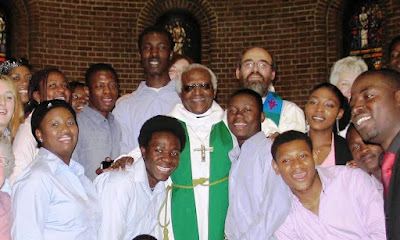
‘But you know, death is not the worst thing that could happen to a Christian’ … with Archbishop Desmond Tutu and members of the Discovery Gospel Choir in Dublin in 2005
Patrick Comerford
We are in Ordinary Time in the Church Calendar and tomorrow is the Sixth Sunday after Trinity (Trinity VI, 12 July 2026). The Calendar of the Church of England in Common Worship today remembers the life and witness of Saint Benedict of Nursia (550), Abbot of Monte Cassino and Father of Western Monasticism.
I may not venture out to the festival in the cricket club later today. But, before I make any decisions about what to do today, I am taking some quiet time this morning to give thanks, to reflect, to pray and to read in these ways:
1, reading today’s Gospel reading;
2, a short reflection;
3, a prayer from the USPG prayer diary;
4, the Collects and Post-Communion prayer of the day.
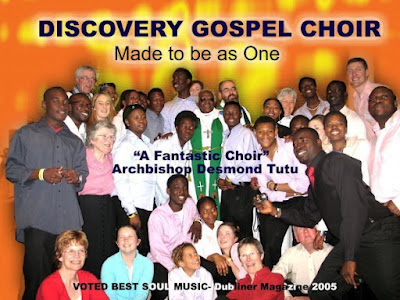
‘But you know, death is not the worst thing that could happen to a Christian’ … with Archbishop Desmond Tutu on the cover of a Discovery Gospel Choir CD
Matthew 10: 24-33 (NRSVA):
[Jesus said:] 24 ‘A disciple is not above the teacher, nor a slave above the master; 25 it is enough for the disciple to be like the teacher, and the slave like the master. If they have called the master of the house Beelzebul, how much more will they malign those of his household!
26 ‘So have no fear of them; for nothing is covered up that will not be uncovered, and nothing secret that will not become known. 27 What I say to you in the dark, tell in the light; and what you hear whispered, proclaim from the housetops. 28 Do not fear those who kill the body but cannot kill the soul; rather fear him who can destroy both soul and body in hell. 29 Are not two sparrows sold for a penny? Yet not one of them will fall to the ground unperceived by your Father. 30 And even the hairs of your head are all counted. 31 So do not be afraid; you are of more value than many sparrows.
32 ‘Everyone therefore who acknowledges me before others, I also will acknowledge before my Father in heaven; 33 but whoever denies me before others, I also will deny before my Father in heaven.’
‘What I say to you in the dark, tell in the light …’ (Matthew 10: 27) … 30 seconds of calm at Platanias in Rethymnon, Crete (Patrick Comerford)
Today’s Reflections:
When the late Archbishop Desmond Tutu (1931-2021) received the Nobel Peace Prize in 1984, I profiled him for The Irish Times. We had met previously, at events co-hosted by AfrI and Christian CND and at dinner in Roebuck House, Seán MacBride’s house in Clonskeagh, Dublin.
I asked him about the death threats he faced in South Africa at the height of apartheid. He engaged me with that look that confirmed his deep hope, commitment and faith, and said: ‘But you know, death is not the worst thing that could happen to a Christian.’
He must have been tempted at times to give up being a thorn in the side of the regime, to stop being a ‘turbulent priest,’ and to live a comfortable life. But his conscience would never have been comfortable.
While apartheid was still in force, Desmond Tutu became Dean of Saint Mary’s Cathedral, Johannesburg, and when I first met him he was the secretary general of the South African Council of Churches.
I was worried about the many death threats he was receiving, and I asked him how he lived with those threats. Was he worried about them? Did he ever consider modifying what he had to say because of them? His answer was similar to the one he gave when he was facing tough questioning before the regime’s Eloff Commission. He told that inquiry:
‘There is nothing the government can do to me that will stop me from being involved in what I believe God wants me to do. I do not do it because I like doing it. I do it because I am under what I believe to be the influence of God’s hand. I cannot help it. When I see injustice, I cannot keep quiet, for, as Jeremiah says, when I try to keep quiet, God’s Word burns like a fire in my breast. But what is it that they can ultimately do? The most awful thing that they can do is to kill me, and death is not the worst thing that could happen to a Christian.’
In 1987, Veritas invited me to write a short, 36-page biography of Archbishop Tutu, published as Desmond Tutu: Black Africa’s Man of Destiny. It was launched by the then Minister for Foreign Affairs, Brian Lenihan. It was a small book, hardly more than a pamphlet, but it came at an important time when both the Irish Government and the Irish Churches were becoming increasingly vocal about the evils of apartheid. It was republished in the US by Citadel (1988) and Hyperion Books (1989).
When I visited South Africa in 1990 with The Irish Times and Christian Aid, I met Archbishop Tutu in Cape Town, where once again he spoke powerfully about the changes that were beginning to take place.
Then, when my colleague Patsy McGarry was organising a monumental series of features in The Irish Times in 2000 to mark the millennium, Archbishop Tutu was one of the international contributors, along with Hans Küng, Andrew Greeley and Mary Robinson. The complete series was published by Veritas the following year as a book, Christianity, in which Part Two was my ‘Brief History of Christianity.’
I last met Archbishop Tutu when he visited Dublin in 2005, and he preached in Saint George’s and Saint Thomas’s Church in the inner city, where Canon (now Archdeacon) Katharine Poulton was then the Rector, as part of the Discovery Gospel Choir services.
His unforgettable words to me echo Christ’s words to the disciples in today’s Gospel reading: ‘Do not fear those who kill the body but cannot kill the soul; rather fear him who can destroy both soul and body in hell’ (Matthew 10: 28).
The Gospel reading at the Eucharist today (Matthew 10: 24-33) continues our readings from the commission and mission of the Twelve, as the Twelve continue to receive their instructions and commission for mission, even in the most hostile of environments.
‘What I say to you in the dark, tell in the light …’ (Matthew 10: 27) … walking through Galley Hill in Stony Stratford at night (Photograph: Patrick Comerford)
Today’s Prayers (Saturday 11 July 2026):
In Pray with the World Church, the prayer diary of the Anglican mission agency USPG (United Society Partners in the Gospel), the theme this week, from 5 to 11 July 2026 (pp 16-17), has been ‘Faith in the Midst of Fractures’. This theme was introduced last Sunday with a reflection by the Revd Godfrey Owino Adera, Anglican priest, theologian, and lecturer at Saint Paul’s University, Limuru, Kenya.
The USPG prayer diary today (Saturday 11 July 2026) invites us to pray:
God of truth and reconciliation, grant us courage to engage in difficult but necessary conversations. Where there is fear, give us boldness; where there is injustice, stir us to action; where there is brokenness, lead us toward healing and unity.
The Collect of the Day:
Eternal God,
who made Benedict a wise master
in the school of your service
and a guide to many called into community
to follow the rule of Christ:
grant that we may put your love before all else
and seek with joy the way of your commandments;
through Jesus Christ your Son our Lord,
who is alive and reigns with you,
in the unity of the Holy Spirit,
one God, now and for ever.
The Post-Communion Prayer:
Merciful God,
who gave such grace to your servant Benedict
that he served you with singleness of heart
and loved you above all things:
help us, whose communion with you
has been renewed in this sacrament,
to forsake all that holds us back from following Christ
and to grow into his likeness from glory to glory;
through Jesus Christ our Lord.
Collect on the Eve of Trinity VI:
Merciful God,
you have prepared for those who love you
such good things as pass our understanding:
pour into our hearts such love toward you
that we, loving you in all things and above all things,
may obtain your promises,
which exceed all that we can desire;
through Jesus Christ your Son our Lord,
who is alive and reigns with you,
in the unity of the Holy Spirit,
one God, now and for ever.
Collect on the Eve of Trinity VI:
O God, the protector of all who trust in you,
without whom nothing is strong, nothing is holy:
increase and multiply upon us your mercy;
that with you as our ruler and guide
we may so pass through things temporal
that we lose not our hold on things eternal;
grant this, heavenly Father,
for our Lord Jesus Christ’s sake,
who is alive and reigns with you,
in the unity of the Holy Spirit,
one God, now and for ever.
Yesterday’s reflections
Continued tomorrow
‘So do not be afraid; you are of more value than many sparrows’ (Matthew 10: 31) … Watching a mother sparrow feed her chicks in a nest in the ceiling of Aghias Anna Church, Maroulas, near Rethymnon in Crete (Patrick Comerford)
Scripture quotations are from the New Revised Standard Version Bible: Anglicised Edition copyright © 1989, 1995, National Council of the Churches of Christ in the United States of America. Used by permission. All rights reserved worldwide. http://nrsvbibles.org
Patrick Comerford
We are in Ordinary Time in the Church Calendar and tomorrow is the Sixth Sunday after Trinity (Trinity VI, 12 July 2026). The Calendar of the Church of England in Common Worship today remembers the life and witness of Saint Benedict of Nursia (550), Abbot of Monte Cassino and Father of Western Monasticism.
I may not venture out to the festival in the cricket club later today. But, before I make any decisions about what to do today, I am taking some quiet time this morning to give thanks, to reflect, to pray and to read in these ways:
1, reading today’s Gospel reading;
2, a short reflection;
3, a prayer from the USPG prayer diary;
4, the Collects and Post-Communion prayer of the day.
‘But you know, death is not the worst thing that could happen to a Christian’ … with Archbishop Desmond Tutu on the cover of a Discovery Gospel Choir CD
Matthew 10: 24-33 (NRSVA):
[Jesus said:] 24 ‘A disciple is not above the teacher, nor a slave above the master; 25 it is enough for the disciple to be like the teacher, and the slave like the master. If they have called the master of the house Beelzebul, how much more will they malign those of his household!
26 ‘So have no fear of them; for nothing is covered up that will not be uncovered, and nothing secret that will not become known. 27 What I say to you in the dark, tell in the light; and what you hear whispered, proclaim from the housetops. 28 Do not fear those who kill the body but cannot kill the soul; rather fear him who can destroy both soul and body in hell. 29 Are not two sparrows sold for a penny? Yet not one of them will fall to the ground unperceived by your Father. 30 And even the hairs of your head are all counted. 31 So do not be afraid; you are of more value than many sparrows.
32 ‘Everyone therefore who acknowledges me before others, I also will acknowledge before my Father in heaven; 33 but whoever denies me before others, I also will deny before my Father in heaven.’
‘What I say to you in the dark, tell in the light …’ (Matthew 10: 27) … 30 seconds of calm at Platanias in Rethymnon, Crete (Patrick Comerford)
Today’s Reflections:
When the late Archbishop Desmond Tutu (1931-2021) received the Nobel Peace Prize in 1984, I profiled him for The Irish Times. We had met previously, at events co-hosted by AfrI and Christian CND and at dinner in Roebuck House, Seán MacBride’s house in Clonskeagh, Dublin.
I asked him about the death threats he faced in South Africa at the height of apartheid. He engaged me with that look that confirmed his deep hope, commitment and faith, and said: ‘But you know, death is not the worst thing that could happen to a Christian.’
He must have been tempted at times to give up being a thorn in the side of the regime, to stop being a ‘turbulent priest,’ and to live a comfortable life. But his conscience would never have been comfortable.
While apartheid was still in force, Desmond Tutu became Dean of Saint Mary’s Cathedral, Johannesburg, and when I first met him he was the secretary general of the South African Council of Churches.
I was worried about the many death threats he was receiving, and I asked him how he lived with those threats. Was he worried about them? Did he ever consider modifying what he had to say because of them? His answer was similar to the one he gave when he was facing tough questioning before the regime’s Eloff Commission. He told that inquiry:
‘There is nothing the government can do to me that will stop me from being involved in what I believe God wants me to do. I do not do it because I like doing it. I do it because I am under what I believe to be the influence of God’s hand. I cannot help it. When I see injustice, I cannot keep quiet, for, as Jeremiah says, when I try to keep quiet, God’s Word burns like a fire in my breast. But what is it that they can ultimately do? The most awful thing that they can do is to kill me, and death is not the worst thing that could happen to a Christian.’
In 1987, Veritas invited me to write a short, 36-page biography of Archbishop Tutu, published as Desmond Tutu: Black Africa’s Man of Destiny. It was launched by the then Minister for Foreign Affairs, Brian Lenihan. It was a small book, hardly more than a pamphlet, but it came at an important time when both the Irish Government and the Irish Churches were becoming increasingly vocal about the evils of apartheid. It was republished in the US by Citadel (1988) and Hyperion Books (1989).
When I visited South Africa in 1990 with The Irish Times and Christian Aid, I met Archbishop Tutu in Cape Town, where once again he spoke powerfully about the changes that were beginning to take place.
Then, when my colleague Patsy McGarry was organising a monumental series of features in The Irish Times in 2000 to mark the millennium, Archbishop Tutu was one of the international contributors, along with Hans Küng, Andrew Greeley and Mary Robinson. The complete series was published by Veritas the following year as a book, Christianity, in which Part Two was my ‘Brief History of Christianity.’
I last met Archbishop Tutu when he visited Dublin in 2005, and he preached in Saint George’s and Saint Thomas’s Church in the inner city, where Canon (now Archdeacon) Katharine Poulton was then the Rector, as part of the Discovery Gospel Choir services.
His unforgettable words to me echo Christ’s words to the disciples in today’s Gospel reading: ‘Do not fear those who kill the body but cannot kill the soul; rather fear him who can destroy both soul and body in hell’ (Matthew 10: 28).
The Gospel reading at the Eucharist today (Matthew 10: 24-33) continues our readings from the commission and mission of the Twelve, as the Twelve continue to receive their instructions and commission for mission, even in the most hostile of environments.
‘What I say to you in the dark, tell in the light …’ (Matthew 10: 27) … walking through Galley Hill in Stony Stratford at night (Photograph: Patrick Comerford)
Today’s Prayers (Saturday 11 July 2026):
In Pray with the World Church, the prayer diary of the Anglican mission agency USPG (United Society Partners in the Gospel), the theme this week, from 5 to 11 July 2026 (pp 16-17), has been ‘Faith in the Midst of Fractures’. This theme was introduced last Sunday with a reflection by the Revd Godfrey Owino Adera, Anglican priest, theologian, and lecturer at Saint Paul’s University, Limuru, Kenya.
The USPG prayer diary today (Saturday 11 July 2026) invites us to pray:
God of truth and reconciliation, grant us courage to engage in difficult but necessary conversations. Where there is fear, give us boldness; where there is injustice, stir us to action; where there is brokenness, lead us toward healing and unity.
The Collect of the Day:
Eternal God,
who made Benedict a wise master
in the school of your service
and a guide to many called into community
to follow the rule of Christ:
grant that we may put your love before all else
and seek with joy the way of your commandments;
through Jesus Christ your Son our Lord,
who is alive and reigns with you,
in the unity of the Holy Spirit,
one God, now and for ever.
The Post-Communion Prayer:
Merciful God,
who gave such grace to your servant Benedict
that he served you with singleness of heart
and loved you above all things:
help us, whose communion with you
has been renewed in this sacrament,
to forsake all that holds us back from following Christ
and to grow into his likeness from glory to glory;
through Jesus Christ our Lord.
Collect on the Eve of Trinity VI:
Merciful God,
you have prepared for those who love you
such good things as pass our understanding:
pour into our hearts such love toward you
that we, loving you in all things and above all things,
may obtain your promises,
which exceed all that we can desire;
through Jesus Christ your Son our Lord,
who is alive and reigns with you,
in the unity of the Holy Spirit,
one God, now and for ever.
Collect on the Eve of Trinity VI:
O God, the protector of all who trust in you,
without whom nothing is strong, nothing is holy:
increase and multiply upon us your mercy;
that with you as our ruler and guide
we may so pass through things temporal
that we lose not our hold on things eternal;
grant this, heavenly Father,
for our Lord Jesus Christ’s sake,
who is alive and reigns with you,
in the unity of the Holy Spirit,
one God, now and for ever.
Yesterday’s reflections
Continued tomorrow
‘So do not be afraid; you are of more value than many sparrows’ (Matthew 10: 31) … Watching a mother sparrow feed her chicks in a nest in the ceiling of Aghias Anna Church, Maroulas, near Rethymnon in Crete (Patrick Comerford)
Scripture quotations are from the New Revised Standard Version Bible: Anglicised Edition copyright © 1989, 1995, National Council of the Churches of Christ in the United States of America. Used by permission. All rights reserved worldwide. http://nrsvbibles.org
Labels:
Apartheid,
Benedictines,
Books,
Crete 2026,
Galley Hill,
Greece 2026,
Kenya,
Maroulas,
Mission,
Platanias,
Prayer,
Racism,
Rethymnon,
Saint Matthew's Gospel,
South Africa,
Stony Stratford,
The Irish Times,
USPG
23 June 2026
Ten Brexit Lies that still
rankle ten years after
the vote – why do they
still have the last word?
The Big Lie in the Brexit campaign … and the Real Truth (Photograph: Liberal Democrats)
Patrick Comerford
It is ten years since the United Kingdom voted 52-48 per cent in a referendum on 23 June 2016 to leave the European Union. The leave campaign sold their message with a tissue of lies that have not gone away in those ten years since, and the nation is more divided than ever.
Not satisfied with the wind of division they had then sown across the land, in every village, town and cities, many of the key figures in the ‘Leave’ campaign are now reaping the whirlwind of racism and hatred, stirring up ‘cold rage’, misogyny, Islamophobia on the streets, calling for mass deportations, and targeting minorities that include Muslims, Sikhs and any other group they decide to hate today.
That year we were approaching the 200th anniversary of the death of Jane Austen, and when a number of bookshops placed some of her best-known works on display in 2017, I wondered whether the juxtaposition of the titles was a reminder that the Brexit vote was 48% ‘Sense and Sensibility’ but 52% ‘Pride and Prejudice’.
I remember the big red bus rolling into Lichfield, and how the then Conservative MP was grinning like a Cheshire Cat, prattling on as he repeated the lies and half-truths peddled by Boris Johnson, Michael Gove, Jacob Rees-Mogg and Nigel Farage.
On the Remain side, the attempts to talk about the damage that would be inflicted on the UK economy by leaving were supported by almost every prominent economist. Michael Gove declared dismissively ‘we have had enough of experts’, presumably meaning all those economists and business leaders who said Brexit would be a disaster. One of the few economists who disagreed, Patrick Minford of Cardiff University, claimed Brexit would increase GDP by 6.8% and would reduce prices for consumers. So much for his expertise.
Was the Brexit vote 48% ‘Sense and Sensibility’ but 52% ‘Pride and Prejudice’? (Photograph: Patrick Comerford)
The lies of that campaign still rankle, as those the lack of political leadership, still less bravery, from both David Cameron as Prime Minister and Jeremy Corbyn as leader of the Labour Party.
David Cameron could have had enough foresight to demand a two-thirds majority and to rule out a paper-thin divisive margin. It was a dereliction of political responsibility on a fundamental issue for short-term political gain. He whistled a little tune as he turned back into No 10 after announcing his resignation. It was the same frivolity that had had marked his role in the whole campaign.
The Labour Party could have energetically pointed out that the EU had ensured women’s rights, children’s rights, workers’ rights, students’ rights, consumer rights, human rights, that the EU had brought economic and political stability in the decades immediately after World War II, that trade within the EU had created jobs and brought hope to the regions, that the Common Agricultural Policy had benefitted farmers and regional communities, that more open borders had benefitted trade and been a boon to tourism.
That’s a list of ten or more benefits of EU membership that ought to have been repeated by Cameron and Corbyn, and repeated again and again. But there are ten lies that were repeated throughout the campaign and that have never been swept away in the ten years since.
Brexit did not take away Britain’s international responsibilities, commitments and obligations (Photograph: Patrick Comerford)
The Brexit campaign repeated numerous high-profile pledges, misrepresentations and claims that failed to materialise, that never amounted to even half-truths, and that are still embedded in my memory:
1, The big red bus was plastered with claims that Britain sends £350 million a week to the EU, and pretending that the same money could be used instead to fund the NHS instead. The UK’s net contribution to the EU was significantly lower, and no such £350 million dividend was ever realised. Instead, successive Tory governments, from David Cameron and Teresa May to Boris Johnson, Liz ‘Lettuce’ Truss and Rishi Sunak, continued to underfund and under-resource the NHS, while Nigel Farage seems intent on seeing the NHS scrapped and health care privatised, so that it is available only an ability-to-pay rather than a needs basis.
2, ‘Take back control of our borders’: This lie had many voters believe the Brexit vote would give powers to deport and turn people away who wanted to make a life in Britain, either by choice or by necessity, and resolve all immigration issues. But this closed-border, small-island big lie is having a lasting and damaging impacts. The number of hate crimes doubled in the days after the referendum and jumped by 41% in the month following it. Their promise was not just empty, it was also divisive and dangerous. Net migration to the UK continued to rise, while British passport-holders found they were facing rigorous border checks and sometimes missing flights or even holidays. Michael Fabricant seems not to have realised the irony in his complaints last weekend that he had to queue with his passport at airports in France.
3, Leave campaigners claimed negotiating a free trade deal with the EU would be the easiest thing imaginable and that the UK would sign numerous deals soon after leaving. Instead, negotiations took years, new trade barriers were introduced, and the UK had to leave both the single market and the customs union.
4, Leave campaigners, including Penny Mordaunt, then the Armed Forces Minister, claimed Britain would be forced to join an EU army if it stayed in the EU. Ten years later, the EU does not have a unified standing army, and both the US and Russia have done their utmost to divide Europe, particularly in terms of a response to the war in Ukraine and Putin’s campaign to undermine European unity.
5, The Leave campaign, with barely disguised anti-Muslim rhetoric, claimed Turkey, with a population of 76 million, was joining the EU. The implication was that millions of Muslim migrants would flock to the UK. Needless to say, Turkey has not joined the EU, is a further than ever from joining.
6, The more intolerant campaigners tried to insist that leaving the EU would mean leaving all international agreements. They soon learned that European Court of Human Rights has nothing to do with the EU, and was in fact the brainchild of Winston Churchill – the same Winston Churchill the far-right wants to own when it comes to rotating images on £5 notes. The UK still has responsibilities and obligations in international law.
7, Jacob Rees-Mogg claimed that Brexit would reduce the cost of clothes, food and wine by 20%. He has probably never shopped in Asda, or talked to people doing the weekly big shop, or parents on budgets buying school clothes for their children. He may know the price of a bottle of his favourite Bordeaux, Cos d’Estournel, but does he know the price of a pint of milk?
8, It was claimed that Britain’s energy bills would be slashed by £2 billion a year if voters backed Brexit, because ministers could scrap the ‘unfair’ VAT tax on gas and electricity. Boris Johnson claimed Brexit would benefit the poorest families because they pay three times more of their income on household energy bills than the richest households. Surely even Boris Johnson has noticed the rise in energy bills. This is the same Boris Johnson who later spoke about ‘levelling up’, which proved to be nothing more than empty words.
9, Tim Martin of Wetherspoons claimed he had calculated that Brexit would offer a saving of 3.5p per meal. Instead, costs in any of his pubs that I have visited have risen above inflation in the past ten years. Although, I have to admit, I have been in fewer than ten Wetherspoons in my life.
10, The greatest lie after the vote ten years ago was that Britain had voted, that No means No, and there was going to be no going back. The false logic in that would mean there should be no more general elections, the people have voted, and that’s that. And what, then, of the referendum in 1975 that decided to stay in the Common Market? Who said, in addition, that 52% of voters all voted for a ‘hard Brexit’. If even half of that 52% voted only for a ‘soft Brexit’, then 74% voted against a ‘hard Brexit’. And everyone is entitled to change her or his mind ten years later.
How long must we live with the consequences of a vote ten years ago?
It was clear during the run-up to referendum in 2016, that anti-immigrant feeling could easily turn into violence. The murder of Jo Cox by a neo-Nazi was the most horrific example and came a week before the vote. We have seen in recent weeks how the most vocal Brexit campaigners have been the least willing to condemn the racist violence on the streets, and Farage traduced Jo Cox’s memory and ignored her murder when he claimed this morning in a BBC interview ‘I have been physically the most attacked and endangered politician for now well over a decade.’
Indeed, the British people had not spoken: Scotland and Northern Ireland voted to remain, Wales voted by a whisker to leave, England alone voted by a large margin to leave. It was hardly a united nation or a united kingdom.
All the lies I list this evening have gone unexamined and unquestioned by the right-wing newspapers that printed them. There has been no soul-searching, no acceptance that they gave the oxygen of publicity to lies and to liars, no taking responsibility for an entire nation being gaslit into voting for something that has brought immense economic damage down on the nation. There has been no remorse, no apology, no accountability. The liars still peddle their lies ten years later and a nation continues to suffer as the consequence.
A voice for sanity at Birkbeck University of London in Bloomsbury (Photograph: Patrick Comerford, 2026)
Patrick Comerford
It is ten years since the United Kingdom voted 52-48 per cent in a referendum on 23 June 2016 to leave the European Union. The leave campaign sold their message with a tissue of lies that have not gone away in those ten years since, and the nation is more divided than ever.
Not satisfied with the wind of division they had then sown across the land, in every village, town and cities, many of the key figures in the ‘Leave’ campaign are now reaping the whirlwind of racism and hatred, stirring up ‘cold rage’, misogyny, Islamophobia on the streets, calling for mass deportations, and targeting minorities that include Muslims, Sikhs and any other group they decide to hate today.
That year we were approaching the 200th anniversary of the death of Jane Austen, and when a number of bookshops placed some of her best-known works on display in 2017, I wondered whether the juxtaposition of the titles was a reminder that the Brexit vote was 48% ‘Sense and Sensibility’ but 52% ‘Pride and Prejudice’.
I remember the big red bus rolling into Lichfield, and how the then Conservative MP was grinning like a Cheshire Cat, prattling on as he repeated the lies and half-truths peddled by Boris Johnson, Michael Gove, Jacob Rees-Mogg and Nigel Farage.
On the Remain side, the attempts to talk about the damage that would be inflicted on the UK economy by leaving were supported by almost every prominent economist. Michael Gove declared dismissively ‘we have had enough of experts’, presumably meaning all those economists and business leaders who said Brexit would be a disaster. One of the few economists who disagreed, Patrick Minford of Cardiff University, claimed Brexit would increase GDP by 6.8% and would reduce prices for consumers. So much for his expertise.
Was the Brexit vote 48% ‘Sense and Sensibility’ but 52% ‘Pride and Prejudice’? (Photograph: Patrick Comerford)
The lies of that campaign still rankle, as those the lack of political leadership, still less bravery, from both David Cameron as Prime Minister and Jeremy Corbyn as leader of the Labour Party.
David Cameron could have had enough foresight to demand a two-thirds majority and to rule out a paper-thin divisive margin. It was a dereliction of political responsibility on a fundamental issue for short-term political gain. He whistled a little tune as he turned back into No 10 after announcing his resignation. It was the same frivolity that had had marked his role in the whole campaign.
The Labour Party could have energetically pointed out that the EU had ensured women’s rights, children’s rights, workers’ rights, students’ rights, consumer rights, human rights, that the EU had brought economic and political stability in the decades immediately after World War II, that trade within the EU had created jobs and brought hope to the regions, that the Common Agricultural Policy had benefitted farmers and regional communities, that more open borders had benefitted trade and been a boon to tourism.
That’s a list of ten or more benefits of EU membership that ought to have been repeated by Cameron and Corbyn, and repeated again and again. But there are ten lies that were repeated throughout the campaign and that have never been swept away in the ten years since.
Brexit did not take away Britain’s international responsibilities, commitments and obligations (Photograph: Patrick Comerford)
The Brexit campaign repeated numerous high-profile pledges, misrepresentations and claims that failed to materialise, that never amounted to even half-truths, and that are still embedded in my memory:
1, The big red bus was plastered with claims that Britain sends £350 million a week to the EU, and pretending that the same money could be used instead to fund the NHS instead. The UK’s net contribution to the EU was significantly lower, and no such £350 million dividend was ever realised. Instead, successive Tory governments, from David Cameron and Teresa May to Boris Johnson, Liz ‘Lettuce’ Truss and Rishi Sunak, continued to underfund and under-resource the NHS, while Nigel Farage seems intent on seeing the NHS scrapped and health care privatised, so that it is available only an ability-to-pay rather than a needs basis.
2, ‘Take back control of our borders’: This lie had many voters believe the Brexit vote would give powers to deport and turn people away who wanted to make a life in Britain, either by choice or by necessity, and resolve all immigration issues. But this closed-border, small-island big lie is having a lasting and damaging impacts. The number of hate crimes doubled in the days after the referendum and jumped by 41% in the month following it. Their promise was not just empty, it was also divisive and dangerous. Net migration to the UK continued to rise, while British passport-holders found they were facing rigorous border checks and sometimes missing flights or even holidays. Michael Fabricant seems not to have realised the irony in his complaints last weekend that he had to queue with his passport at airports in France.
3, Leave campaigners claimed negotiating a free trade deal with the EU would be the easiest thing imaginable and that the UK would sign numerous deals soon after leaving. Instead, negotiations took years, new trade barriers were introduced, and the UK had to leave both the single market and the customs union.
4, Leave campaigners, including Penny Mordaunt, then the Armed Forces Minister, claimed Britain would be forced to join an EU army if it stayed in the EU. Ten years later, the EU does not have a unified standing army, and both the US and Russia have done their utmost to divide Europe, particularly in terms of a response to the war in Ukraine and Putin’s campaign to undermine European unity.
5, The Leave campaign, with barely disguised anti-Muslim rhetoric, claimed Turkey, with a population of 76 million, was joining the EU. The implication was that millions of Muslim migrants would flock to the UK. Needless to say, Turkey has not joined the EU, is a further than ever from joining.
6, The more intolerant campaigners tried to insist that leaving the EU would mean leaving all international agreements. They soon learned that European Court of Human Rights has nothing to do with the EU, and was in fact the brainchild of Winston Churchill – the same Winston Churchill the far-right wants to own when it comes to rotating images on £5 notes. The UK still has responsibilities and obligations in international law.
7, Jacob Rees-Mogg claimed that Brexit would reduce the cost of clothes, food and wine by 20%. He has probably never shopped in Asda, or talked to people doing the weekly big shop, or parents on budgets buying school clothes for their children. He may know the price of a bottle of his favourite Bordeaux, Cos d’Estournel, but does he know the price of a pint of milk?
8, It was claimed that Britain’s energy bills would be slashed by £2 billion a year if voters backed Brexit, because ministers could scrap the ‘unfair’ VAT tax on gas and electricity. Boris Johnson claimed Brexit would benefit the poorest families because they pay three times more of their income on household energy bills than the richest households. Surely even Boris Johnson has noticed the rise in energy bills. This is the same Boris Johnson who later spoke about ‘levelling up’, which proved to be nothing more than empty words.
9, Tim Martin of Wetherspoons claimed he had calculated that Brexit would offer a saving of 3.5p per meal. Instead, costs in any of his pubs that I have visited have risen above inflation in the past ten years. Although, I have to admit, I have been in fewer than ten Wetherspoons in my life.
10, The greatest lie after the vote ten years ago was that Britain had voted, that No means No, and there was going to be no going back. The false logic in that would mean there should be no more general elections, the people have voted, and that’s that. And what, then, of the referendum in 1975 that decided to stay in the Common Market? Who said, in addition, that 52% of voters all voted for a ‘hard Brexit’. If even half of that 52% voted only for a ‘soft Brexit’, then 74% voted against a ‘hard Brexit’. And everyone is entitled to change her or his mind ten years later.
How long must we live with the consequences of a vote ten years ago?
It was clear during the run-up to referendum in 2016, that anti-immigrant feeling could easily turn into violence. The murder of Jo Cox by a neo-Nazi was the most horrific example and came a week before the vote. We have seen in recent weeks how the most vocal Brexit campaigners have been the least willing to condemn the racist violence on the streets, and Farage traduced Jo Cox’s memory and ignored her murder when he claimed this morning in a BBC interview ‘I have been physically the most attacked and endangered politician for now well over a decade.’
Indeed, the British people had not spoken: Scotland and Northern Ireland voted to remain, Wales voted by a whisker to leave, England alone voted by a large margin to leave. It was hardly a united nation or a united kingdom.
All the lies I list this evening have gone unexamined and unquestioned by the right-wing newspapers that printed them. There has been no soul-searching, no acceptance that they gave the oxygen of publicity to lies and to liars, no taking responsibility for an entire nation being gaslit into voting for something that has brought immense economic damage down on the nation. There has been no remorse, no apology, no accountability. The liars still peddle their lies ten years later and a nation continues to suffer as the consequence.
A voice for sanity at Birkbeck University of London in Bloomsbury (Photograph: Patrick Comerford, 2026)
11 June 2026
Ten good reasons why I am
not going to the pub to
watch any World Cup
games played in the US
I have decided not watch any of this year’s World Cup matches played in the US
Patrick Comerford
I have spent much of the day in London, meeting a writer fried from New Zealand, and now I’m on my way back to Milton Keynes, hoping to find an appropriate place in Stony Stratford this evening to join friends and neighbours watching the opening match in this year’s World Cup tournament, when the co-hosts Mexico plan South Africa.
Mexico is one of the three host nations, each staging its own opening ceremony ahead of its first match. Canada follows tomorrow night (Friday 12 June 2026), with its first game against Bosnia-Herzegovina in Toronto. The USA hosts the third and last opening ceremony on Saturday (13 June), before facing Paraguay in Los Angeles.
Scotland’s first match is against Haiti in Foxborough, Massachusetts in the far-too early hours of Sunday (2 am, 14 June), and England has to wait almost a week before playing Croatia in Dallas next Wednesday (17 June, 9 pm).
Doubtless, Trump will try to hijack the events, although his appearance at a major basketball game in New York was meet with Booing throughout the stadium – hopefully setting an example of how to welcome him to any World Cup games.
Today’s opening ceremony is in the Azteca Stadium in Mexico City, the first stadium to host matches in three World Cups – it was there Maradona blamed it all on the ‘hand of God’ in 1986 and there Pelé passed to Carlos Alberto in 1970.
The opening ceremony in Canada takes place tomorrow at the BMO Field in Toronto while the opening ceremony for the US tomorrow when the USA and Paraguay play in the SoFi Stadium in Los Angeles, which also hosts the opening ceremony for the Los Angeles Olympics in 2028.
In addition, two extra ceremonies are planned for 4 July as part of the celebrations marking the 250th anniversary United States during the Last 16 fixtures in Philadelphia and Houston.
I still remember my enthusiasm in my childhood and teenage years for World Cup finals: in 1962, when Brazil beat Czechoslovakia 3-1 in Chile … in 1966, as a schoolboy finding a place in Ballinskelligs, Co Kerry, to watch England win dramatically 4-2 against West Germany in London … in 1970, when Brazil beat Italy 4-1 … And who from Ireland can forget Ireland’s performance in Italia 1990, reaching the quarter final and losing 1-0 to Italy in what every Irish fan still thinks of as a victory for heroes?
But, despite all my enthusiasm, I have decided that I am going to watch televised matches played olny in Mexico and Canada, but I am not going to watch any matches played at venues in the US, even though this means I am going to miss England’s three fixtures in the Group Stage, including the opening game against Croatia in Dallas next Wednesday, and the other games against Ghana in Boston, Panama in New York or New Jersey.
Of course, I never had any notion, ever, of going to the US, or any other World Cup competition for that matter. It has never been my idea of how to spend time or to spend money. But if I was so disposed, I have no doubt I would have been refused a visa. And how could I, in all conscience, feel safe on the streets of any city in the US when even US citizens, never mind foreigners, are not safe from the capricious actions of ICE?
And if, in conscience, I would not be safe and comfortable being in the US for this World Cup, why should I feel comfortable and safe at home, watching it from a distance?
But, while I may continue to watch matches staged in Mexico or Canada, here are ten good (or bad) reasons for not watching any fixtures at venues in the US:
1, Haiti has qualified for the World Cup for the first time in 52 years, and plays against Scotland on late on /early on Sunday Saturday in Boston, in the heart of the exiled Haitian community in Foxborough. The national stadium in Port-au-Prince has been controlled by armed gangs since 2024, so the team played every home qualifier in exile, and clinched a World Cup place with a 2-0 defeat of Nicaragua.
But Trump’s travel ban bars Haitian visitors from entering the US. The players and staff have been given an exemption, but their fans have no such exemption. This can only be put down to racism. During the 2024 election campaign Trump repeated baseless claims that illegal immigrants from Haiti have been eating pets in Springfield, Ohio. During ABC’s presidential debate, he claimed: ‘In Springfield, they are eating the dogs. The people that came in, they are eating the cats. They’re eating – they are eating the pets of the people that live there.’
2, Iran’s supporters are banned too. Iran’s first game is due to be against New Zealand in Los Angeles on Tuesday (16 June), but there are real fears that the team may never get there. Iran has qualified for the FIFA World Cup last March, but after months of war Iran has had to switch basecamps from Tucson, Arizona, to Tijuana in Mexico. Under the conditions of their visas, they will have to fly in and out of the US on matchday for each of their three group games. It emerged last Saturday that the US had denied visas to members of the team’s backroom staff, with 15 administrative officials denied entry.
Iran’s allocation of fan tickets for the group stage was revoked this week just days before the start of the tournament, and the US has cancelled all tickets that have been sold to Iran’s supporters. Since the US war against Iran began in February, the US military targets have included the Azadi Stadium in Tehran, where the national team trained.
3, Omar Artan, a FIFA-employed referee from Somalia and named as Africa’s best referee last year, was refused entry to the US at Miami International Airport despite having a valid travel visa and was deported to Istanbul.
4, The Iraqi striker Aymen Hussein was held and questioned for almost seven hours at O’Hare airport in Chicago, the team’s official photographer was sent back despite having a valid visa, and team members from Senegal and Uzbekistan were taken aside when they arrived and given full cavity searches.
5, The Swiss midfielder Breel Embolo was denied an entry visa – although Swiss authorities seem to have been successful in appealing against the decision.
6, The South African football team faced a 24-hour delay in their departure over a visa bungle, fans from Senegal and the Ivory Coast face restrictions despite qualifying for the tournament, and 90 per cent of Moroccan fans with tickets have been denied entry.
7, Tickets to the games are costing up to $8,000, wich means these are not fixtures for ordinary football fans. Instead, for whom the ‘beautiful game’ has became an ugly game and a game only for the rich.
8, Fans from 27 of the 48 nations taking part need a US visa, costing between $185 and $435. This represents wages that an average person in many countries in the Global South would take several months to earn. The US has a FIFA Priority Appointment Scheduling System (PASS), supposed to speed up the visa process for fans who have bought tickets through FIFA. But last month, about 150 fans in Ghana had their visa applications rejected.
9, Amnesty International is warning World Cup fans about the dangers involved in travelling to the US. Human Rights Watch has reported how an asylum seeker who attended the Club World Cup final last year in New Jersey with his children was arrested by ICE and deported.
10, FIFA’s president Gianni Infantino had no shame about giving a ‘peace prize’ to Trump, the petulant president who knows how to make demands but not how to keep commitments. When the US was bidding in 2018 to host this World Cup, Donald Trump personally wrote to FIFA promising that ‘all eligible athletes, officials, and fans from all countries around the world would be able to enter the United States without discrimination.’
It all amounts to a complete package of lies, humiliation, discrimination, racism, petty vindictiveness and an apparently planned and co-ordinated effort to humiliate black and Muslim players and team officials. So much for football being the ‘beautiful game’. So much for that FIFA ‘peace prize’ for Trump, who is using this world cup for propagamda in the same way Hitler used the 1936 Berlin Olympics.
These may be small gestures on my part. They may have no impact at all. And I don’t want anyone to interpret them or misrepresent them as anti-American protests. Nor do I want any family members or friends in the US to take offence, to take umbrage. I have had too much of the Trump regime, and I do not want Trump to have one more viewer who adds to his capacity to boast that this year’s World Cup was his World Cup and his success, his triumph.
I have decided not watch any of this year’s World Cup matches played in the US
Patrick Comerford
I have spent much of the day in London, meeting a writer fried from New Zealand, and now I’m on my way back to Milton Keynes, hoping to find an appropriate place in Stony Stratford this evening to join friends and neighbours watching the opening match in this year’s World Cup tournament, when the co-hosts Mexico plan South Africa.
Mexico is one of the three host nations, each staging its own opening ceremony ahead of its first match. Canada follows tomorrow night (Friday 12 June 2026), with its first game against Bosnia-Herzegovina in Toronto. The USA hosts the third and last opening ceremony on Saturday (13 June), before facing Paraguay in Los Angeles.
Scotland’s first match is against Haiti in Foxborough, Massachusetts in the far-too early hours of Sunday (2 am, 14 June), and England has to wait almost a week before playing Croatia in Dallas next Wednesday (17 June, 9 pm).
Doubtless, Trump will try to hijack the events, although his appearance at a major basketball game in New York was meet with Booing throughout the stadium – hopefully setting an example of how to welcome him to any World Cup games.
Today’s opening ceremony is in the Azteca Stadium in Mexico City, the first stadium to host matches in three World Cups – it was there Maradona blamed it all on the ‘hand of God’ in 1986 and there Pelé passed to Carlos Alberto in 1970.
The opening ceremony in Canada takes place tomorrow at the BMO Field in Toronto while the opening ceremony for the US tomorrow when the USA and Paraguay play in the SoFi Stadium in Los Angeles, which also hosts the opening ceremony for the Los Angeles Olympics in 2028.
In addition, two extra ceremonies are planned for 4 July as part of the celebrations marking the 250th anniversary United States during the Last 16 fixtures in Philadelphia and Houston.
I still remember my enthusiasm in my childhood and teenage years for World Cup finals: in 1962, when Brazil beat Czechoslovakia 3-1 in Chile … in 1966, as a schoolboy finding a place in Ballinskelligs, Co Kerry, to watch England win dramatically 4-2 against West Germany in London … in 1970, when Brazil beat Italy 4-1 … And who from Ireland can forget Ireland’s performance in Italia 1990, reaching the quarter final and losing 1-0 to Italy in what every Irish fan still thinks of as a victory for heroes?
But, despite all my enthusiasm, I have decided that I am going to watch televised matches played olny in Mexico and Canada, but I am not going to watch any matches played at venues in the US, even though this means I am going to miss England’s three fixtures in the Group Stage, including the opening game against Croatia in Dallas next Wednesday, and the other games against Ghana in Boston, Panama in New York or New Jersey.
Of course, I never had any notion, ever, of going to the US, or any other World Cup competition for that matter. It has never been my idea of how to spend time or to spend money. But if I was so disposed, I have no doubt I would have been refused a visa. And how could I, in all conscience, feel safe on the streets of any city in the US when even US citizens, never mind foreigners, are not safe from the capricious actions of ICE?
And if, in conscience, I would not be safe and comfortable being in the US for this World Cup, why should I feel comfortable and safe at home, watching it from a distance?
But, while I may continue to watch matches staged in Mexico or Canada, here are ten good (or bad) reasons for not watching any fixtures at venues in the US:
1, Haiti has qualified for the World Cup for the first time in 52 years, and plays against Scotland on late on /early on Sunday Saturday in Boston, in the heart of the exiled Haitian community in Foxborough. The national stadium in Port-au-Prince has been controlled by armed gangs since 2024, so the team played every home qualifier in exile, and clinched a World Cup place with a 2-0 defeat of Nicaragua.
But Trump’s travel ban bars Haitian visitors from entering the US. The players and staff have been given an exemption, but their fans have no such exemption. This can only be put down to racism. During the 2024 election campaign Trump repeated baseless claims that illegal immigrants from Haiti have been eating pets in Springfield, Ohio. During ABC’s presidential debate, he claimed: ‘In Springfield, they are eating the dogs. The people that came in, they are eating the cats. They’re eating – they are eating the pets of the people that live there.’
2, Iran’s supporters are banned too. Iran’s first game is due to be against New Zealand in Los Angeles on Tuesday (16 June), but there are real fears that the team may never get there. Iran has qualified for the FIFA World Cup last March, but after months of war Iran has had to switch basecamps from Tucson, Arizona, to Tijuana in Mexico. Under the conditions of their visas, they will have to fly in and out of the US on matchday for each of their three group games. It emerged last Saturday that the US had denied visas to members of the team’s backroom staff, with 15 administrative officials denied entry.
Iran’s allocation of fan tickets for the group stage was revoked this week just days before the start of the tournament, and the US has cancelled all tickets that have been sold to Iran’s supporters. Since the US war against Iran began in February, the US military targets have included the Azadi Stadium in Tehran, where the national team trained.
3, Omar Artan, a FIFA-employed referee from Somalia and named as Africa’s best referee last year, was refused entry to the US at Miami International Airport despite having a valid travel visa and was deported to Istanbul.
4, The Iraqi striker Aymen Hussein was held and questioned for almost seven hours at O’Hare airport in Chicago, the team’s official photographer was sent back despite having a valid visa, and team members from Senegal and Uzbekistan were taken aside when they arrived and given full cavity searches.
5, The Swiss midfielder Breel Embolo was denied an entry visa – although Swiss authorities seem to have been successful in appealing against the decision.
6, The South African football team faced a 24-hour delay in their departure over a visa bungle, fans from Senegal and the Ivory Coast face restrictions despite qualifying for the tournament, and 90 per cent of Moroccan fans with tickets have been denied entry.
7, Tickets to the games are costing up to $8,000, wich means these are not fixtures for ordinary football fans. Instead, for whom the ‘beautiful game’ has became an ugly game and a game only for the rich.
8, Fans from 27 of the 48 nations taking part need a US visa, costing between $185 and $435. This represents wages that an average person in many countries in the Global South would take several months to earn. The US has a FIFA Priority Appointment Scheduling System (PASS), supposed to speed up the visa process for fans who have bought tickets through FIFA. But last month, about 150 fans in Ghana had their visa applications rejected.
9, Amnesty International is warning World Cup fans about the dangers involved in travelling to the US. Human Rights Watch has reported how an asylum seeker who attended the Club World Cup final last year in New Jersey with his children was arrested by ICE and deported.
10, FIFA’s president Gianni Infantino had no shame about giving a ‘peace prize’ to Trump, the petulant president who knows how to make demands but not how to keep commitments. When the US was bidding in 2018 to host this World Cup, Donald Trump personally wrote to FIFA promising that ‘all eligible athletes, officials, and fans from all countries around the world would be able to enter the United States without discrimination.’
It all amounts to a complete package of lies, humiliation, discrimination, racism, petty vindictiveness and an apparently planned and co-ordinated effort to humiliate black and Muslim players and team officials. So much for football being the ‘beautiful game’. So much for that FIFA ‘peace prize’ for Trump, who is using this world cup for propagamda in the same way Hitler used the 1936 Berlin Olympics.
These may be small gestures on my part. They may have no impact at all. And I don’t want anyone to interpret them or misrepresent them as anti-American protests. Nor do I want any family members or friends in the US to take offence, to take umbrage. I have had too much of the Trump regime, and I do not want Trump to have one more viewer who adds to his capacity to boast that this year’s World Cup was his World Cup and his success, his triumph.
I have decided not watch any of this year’s World Cup matches played in the US
08 June 2026
‘Silence seems to us to
to be the worst thing we
can do on these issues’
Antifa graffiti in the narrow streets of Rethymnon … the people of Crete have been marking the 85th anniversary of the Battle of Crete and the struggle against fascism (Photographs: Patrick Comerford)
Patrick Comerford
There have been two important anniversaries over the past week or two: the 85th anniversary of the Battle of Crete in 1941, and the 82nd anniversary of the D-Day landings in 1944.
Both recall the sacrifices made by so many. It is important remember that both the D-Day landings and the Battle of Crete were key landmarks in the struggle against the anti-democratic, far-right racism that had enslaved most of Europe and that by 1944 threatened too to engulf or overwhelm Britain which had not yet been invaded by the forces of fascism.
The D-Day landings marked the beginning of the end of fascism, for that generation. As the far-right tries to stir up hatred against people fleeing in small boats across the Channel, victimising vulnerable people who are seeking sanctuary from oppression, at home, I remind myself that 82 years ago a flotilla of boats in the Channel on D-Day marked the turning of the tide against racism and the far-right across Europe.
But victory is only of the day, at best of the generation. The anti-democratic and racist far-right must be named, shamed, and stopped once again. The collaborators with fascism in Britain in the 1930s, Oswald Moseley and his blackshirt thugs, were humiliated at the Battle of Cable Street 90 years ago in 1936, but they still had to be locked away for the duration of World War II.
Meanwhile, in the small and petty minds of JD Vance and Pete Hegseth, Europe is under siege, civilisation is collapsing, western values are in retreat, migration is threatening social cohesion, and the future of Europe hangs in the balance.
Pete Hegseth, who wants us all to call the US Defence Department the US War Department, tried during the weekend to warp and twist the meaning and significance of the D-Day landings and to hijack the anniversary for his own twisted and warped political agenda.
It is bewildering that this critique of life in Europe is being advanced by senior politicians from the US, where thousands of children die from gun violence every year, where mass shootings have become routine, where political polarisation is actively encouraged by the regime, and where trust in the institutions of democracy and justice continue to vaporise.
Who gave Pete Hegseth or JD Vance the right to lecture anyone or anywhere in Europe about justice, about human rights, about the risks and dangers of war, about core values and social cohesion?
My grandfather fought in the Gallipoli landings during World War I, and was then sent to Thessaloniki and the Balkan front. He caught malaria, was sent home in 1916, and my father was conceived soon after. But the malaria he caught in northern Greece was incurable, and he died a lonely and frightening death on 21 January 1921, soon after my father’s second birthday, leaving my widowed grandmother and four sons and two daughters.
Ireland was neutral during World War II, as were most European countries until they were invaded. But my father spent much of that war in a cavalry intelligence unit in the reserve army (LDF). He would later recall that when German military personnel, Nazi agents or spies were caught in Ireland, they were sent to prison camps where they spent the rest of the war; when his unit met Irish personnel who were in the British or allied forces and who were on leave for family visits, they ensured they had the fare to return to their units or their bases.
It was clear to my father whose side Ireland was neutral in favour of. He later rejoiced in the acclamation for one of his childhood friends, the journalist and writer Cornelius Ryan (1920-1974), known for his award-winning book The Longest Day: 6 June 1944 D-Day (1959), which was turned into the 1962 film The Longest Day. Both men were in their teens when they visited Rome a few years before World War II began and were shocked then by what they saw of fascism in Mussolini’s Italy.
In their own way, men like these passed on to my generation an acute awareness of the horrors and the sacrifices entailed in war, and an appreciation for others in their generation who risked their lives to save European civilisation from fascism and Nazism. In the previous generation, my grandfather had learned and experienced the horrors of war in Turkey and Greece.
The war graves at Suda Bay near Chania … a reminder of the Battle of Crete and the consequences of dangerous ideologies (Photograph: Patrick Comerford)
In a posting last year I recalled the names of the dead from World War II from the extended Comerford families that I have found recorded on memorials and graves by the Commonwealth War Graves Commission. The 19 members of this extended family I have found to date on Commonwealth War Graves include soldiers in the D-Day landings, merchant seamen torpedoed in Atlantic convoys, brothers and sisters, and prisoners of war of the Japanese in Borneo, Burma (Myanmar), Hong Kong and Japan.
They are buried or commemorated in the Phaleron War Cemetery near Athens, in Normandy, Hong Kong, Thanbyuzayat War Cemetery and the Rangoon Memorial in Burma (Myanmar), Yokohama War Cemetery in Japan, and the Labuan Memorial on Labuan Island off the coast of Sabah in Borneo, Malaysia.
Thomas Matthew Commerford, a trooper, Royal Armoured Corps, 8th King’s Royal Irish Hussars, was 36 when he died on 19 August 1944 after the Normandy Landings. He is named in Banneville-la-Campagne War Cemetery and left a widow in Sunbury.
In Europe, we do not need lessons on the consequences of dangerous ideologies. An entire generation was buried after World War I, millions more were buried after World War II. The Holocaust was a European experience, not confined or limited to one country. The Cold War was a European experience that lasted for half a century after World War II.
We have cemeteries, war graves and Holocaust memorials across the entire continent because of wars and because of war-mongers and extreme political ideologies. When Pete Hegseth and JD Vance warn Europe about ideological invasions, we know where the threat comes from today.
In Europe at the weekend we were reminded that are now exposed to a dangerous foreign ideology, one obsessed with culture wars, one that sees compromise as weakness, one that turns every disagreement into an existential battle, one that relies on fear and outrage and creates phantom enemies rather than developing political strategies and government programmes to meet the real needs of real people.
And just as Oswald Moseley became the mouthpiece for Hitler and Mussolini on the streets of Britain in the 1930s, Farage and Lowe have become mouthpieces for the Oval Office 90 years later, the hand-picked voices for Elon Muck, stirring up the baying mobs on the streets and in the towns of Britain.
In his weekend rant, Hegseth claimed: ‘Beaches in Spain, Italy, Greece and Bulgaria, boats and men arrive. When will European capitals do something about that invasion, or is it too late? I pray not, and I believe not.’ Who was praying to? What does he truly believe in?
My grandfather suffered on the beaches of Gallipoli and in the Bay of Thessaloniki as a victim of ideological war mongering 110 years ago.
The people of Crete still remember 85 years later the consequences of invasions engineered and directed by far-right regimes.
The threat of invasion across Europe today comes not from the frightened families on small boats crossing the Channel or arriving on beaches in southern Europe, or from huddled families crossing borders in the dead of night. The threat to Europe comes today in social media, cable television, political influencers and visiting politicians and moguls who pretend they are the guardians of western civilisation.
When Vance ignores the wishes of Henry Nowak’s families and lectures people here about protecting children and preserving civilisation, I cannot but realise the irony in all of this considering how thousands of children and teenagers are killed in gun violence in the US every year. When he repeats the prattling of Farage and Lowe about ‘two-tier’ policing, I cannot but realise the irony as I recall how ICE kills protesters on the streets of the US without any consideration of due process or accountability and ponder how a pompous president plots to use public funds to reward the rioters who stormed the Capitol violently on 6 January 2021. One of those rioters, Elias Irizarry, has even been given a key security role in Hegseth’s Pentagon.
Democracy survives not through fear but through restraint, not through outrage but through institutions that guarantee justice, not through cultural wars but through coexistence. My grandfather who landed on the Gallipoli beaches and went on to catch malaria in Thessaloniki, those who died in the trenches of the Somme, the brave but frightened boatloads who crossed the Channel to the beaches of Normandy, those buried in mass graves across Europe, each and very one of them continues to remind the rest of us of what happens when politics becomes a crusade and opponents become enemies.
The Nazi spies my father helped to track down and put away for the duration of World War II in supposedly neutral Ireland were searching for collaborators and potential provocateurs among people whose political heirs and descendants today are in the parties led by Farage and Lowe.
Hegseth’s rambling rant at the weekend in Normandy was described by the historian Simon Schema as a ‘special kind of loathsomeness: a blend of historical deafness, grotesque stupidity and comically ludicrous self-importance. As if the little people’s rage immigration is somehow superior to to the war against the Third Reich and entitles this comic-book nobody to lecture the actual heroes.’ One local resident Colleville-sur-Mer is quoted in The Guardian today as saying: ‘The words must be spoken, he must be called out for who he is, for the values he represents: colonial, warmongering, racist, far-right values. Silence seems to us to be the worst thing we can do on these issues.’
Anti-Nazi graffiti on the streets of Exarchia in Athens … Europe needs no lessons from Washington on the dangers of extreme ideologies and invasions (Photographs: Patrick Comerford)
Patrick Comerford
There have been two important anniversaries over the past week or two: the 85th anniversary of the Battle of Crete in 1941, and the 82nd anniversary of the D-Day landings in 1944.
Both recall the sacrifices made by so many. It is important remember that both the D-Day landings and the Battle of Crete were key landmarks in the struggle against the anti-democratic, far-right racism that had enslaved most of Europe and that by 1944 threatened too to engulf or overwhelm Britain which had not yet been invaded by the forces of fascism.
The D-Day landings marked the beginning of the end of fascism, for that generation. As the far-right tries to stir up hatred against people fleeing in small boats across the Channel, victimising vulnerable people who are seeking sanctuary from oppression, at home, I remind myself that 82 years ago a flotilla of boats in the Channel on D-Day marked the turning of the tide against racism and the far-right across Europe.
But victory is only of the day, at best of the generation. The anti-democratic and racist far-right must be named, shamed, and stopped once again. The collaborators with fascism in Britain in the 1930s, Oswald Moseley and his blackshirt thugs, were humiliated at the Battle of Cable Street 90 years ago in 1936, but they still had to be locked away for the duration of World War II.
Meanwhile, in the small and petty minds of JD Vance and Pete Hegseth, Europe is under siege, civilisation is collapsing, western values are in retreat, migration is threatening social cohesion, and the future of Europe hangs in the balance.
Pete Hegseth, who wants us all to call the US Defence Department the US War Department, tried during the weekend to warp and twist the meaning and significance of the D-Day landings and to hijack the anniversary for his own twisted and warped political agenda.
It is bewildering that this critique of life in Europe is being advanced by senior politicians from the US, where thousands of children die from gun violence every year, where mass shootings have become routine, where political polarisation is actively encouraged by the regime, and where trust in the institutions of democracy and justice continue to vaporise.
Who gave Pete Hegseth or JD Vance the right to lecture anyone or anywhere in Europe about justice, about human rights, about the risks and dangers of war, about core values and social cohesion?
My grandfather fought in the Gallipoli landings during World War I, and was then sent to Thessaloniki and the Balkan front. He caught malaria, was sent home in 1916, and my father was conceived soon after. But the malaria he caught in northern Greece was incurable, and he died a lonely and frightening death on 21 January 1921, soon after my father’s second birthday, leaving my widowed grandmother and four sons and two daughters.
Ireland was neutral during World War II, as were most European countries until they were invaded. But my father spent much of that war in a cavalry intelligence unit in the reserve army (LDF). He would later recall that when German military personnel, Nazi agents or spies were caught in Ireland, they were sent to prison camps where they spent the rest of the war; when his unit met Irish personnel who were in the British or allied forces and who were on leave for family visits, they ensured they had the fare to return to their units or their bases.
It was clear to my father whose side Ireland was neutral in favour of. He later rejoiced in the acclamation for one of his childhood friends, the journalist and writer Cornelius Ryan (1920-1974), known for his award-winning book The Longest Day: 6 June 1944 D-Day (1959), which was turned into the 1962 film The Longest Day. Both men were in their teens when they visited Rome a few years before World War II began and were shocked then by what they saw of fascism in Mussolini’s Italy.
In their own way, men like these passed on to my generation an acute awareness of the horrors and the sacrifices entailed in war, and an appreciation for others in their generation who risked their lives to save European civilisation from fascism and Nazism. In the previous generation, my grandfather had learned and experienced the horrors of war in Turkey and Greece.
The war graves at Suda Bay near Chania … a reminder of the Battle of Crete and the consequences of dangerous ideologies (Photograph: Patrick Comerford)
In a posting last year I recalled the names of the dead from World War II from the extended Comerford families that I have found recorded on memorials and graves by the Commonwealth War Graves Commission. The 19 members of this extended family I have found to date on Commonwealth War Graves include soldiers in the D-Day landings, merchant seamen torpedoed in Atlantic convoys, brothers and sisters, and prisoners of war of the Japanese in Borneo, Burma (Myanmar), Hong Kong and Japan.
They are buried or commemorated in the Phaleron War Cemetery near Athens, in Normandy, Hong Kong, Thanbyuzayat War Cemetery and the Rangoon Memorial in Burma (Myanmar), Yokohama War Cemetery in Japan, and the Labuan Memorial on Labuan Island off the coast of Sabah in Borneo, Malaysia.
Thomas Matthew Commerford, a trooper, Royal Armoured Corps, 8th King’s Royal Irish Hussars, was 36 when he died on 19 August 1944 after the Normandy Landings. He is named in Banneville-la-Campagne War Cemetery and left a widow in Sunbury.
In Europe, we do not need lessons on the consequences of dangerous ideologies. An entire generation was buried after World War I, millions more were buried after World War II. The Holocaust was a European experience, not confined or limited to one country. The Cold War was a European experience that lasted for half a century after World War II.
We have cemeteries, war graves and Holocaust memorials across the entire continent because of wars and because of war-mongers and extreme political ideologies. When Pete Hegseth and JD Vance warn Europe about ideological invasions, we know where the threat comes from today.
In Europe at the weekend we were reminded that are now exposed to a dangerous foreign ideology, one obsessed with culture wars, one that sees compromise as weakness, one that turns every disagreement into an existential battle, one that relies on fear and outrage and creates phantom enemies rather than developing political strategies and government programmes to meet the real needs of real people.
And just as Oswald Moseley became the mouthpiece for Hitler and Mussolini on the streets of Britain in the 1930s, Farage and Lowe have become mouthpieces for the Oval Office 90 years later, the hand-picked voices for Elon Muck, stirring up the baying mobs on the streets and in the towns of Britain.
In his weekend rant, Hegseth claimed: ‘Beaches in Spain, Italy, Greece and Bulgaria, boats and men arrive. When will European capitals do something about that invasion, or is it too late? I pray not, and I believe not.’ Who was praying to? What does he truly believe in?
My grandfather suffered on the beaches of Gallipoli and in the Bay of Thessaloniki as a victim of ideological war mongering 110 years ago.
The people of Crete still remember 85 years later the consequences of invasions engineered and directed by far-right regimes.
The threat of invasion across Europe today comes not from the frightened families on small boats crossing the Channel or arriving on beaches in southern Europe, or from huddled families crossing borders in the dead of night. The threat to Europe comes today in social media, cable television, political influencers and visiting politicians and moguls who pretend they are the guardians of western civilisation.
When Vance ignores the wishes of Henry Nowak’s families and lectures people here about protecting children and preserving civilisation, I cannot but realise the irony in all of this considering how thousands of children and teenagers are killed in gun violence in the US every year. When he repeats the prattling of Farage and Lowe about ‘two-tier’ policing, I cannot but realise the irony as I recall how ICE kills protesters on the streets of the US without any consideration of due process or accountability and ponder how a pompous president plots to use public funds to reward the rioters who stormed the Capitol violently on 6 January 2021. One of those rioters, Elias Irizarry, has even been given a key security role in Hegseth’s Pentagon.
Democracy survives not through fear but through restraint, not through outrage but through institutions that guarantee justice, not through cultural wars but through coexistence. My grandfather who landed on the Gallipoli beaches and went on to catch malaria in Thessaloniki, those who died in the trenches of the Somme, the brave but frightened boatloads who crossed the Channel to the beaches of Normandy, those buried in mass graves across Europe, each and very one of them continues to remind the rest of us of what happens when politics becomes a crusade and opponents become enemies.
The Nazi spies my father helped to track down and put away for the duration of World War II in supposedly neutral Ireland were searching for collaborators and potential provocateurs among people whose political heirs and descendants today are in the parties led by Farage and Lowe.
Hegseth’s rambling rant at the weekend in Normandy was described by the historian Simon Schema as a ‘special kind of loathsomeness: a blend of historical deafness, grotesque stupidity and comically ludicrous self-importance. As if the little people’s rage immigration is somehow superior to to the war against the Third Reich and entitles this comic-book nobody to lecture the actual heroes.’ One local resident Colleville-sur-Mer is quoted in The Guardian today as saying: ‘The words must be spoken, he must be called out for who he is, for the values he represents: colonial, warmongering, racist, far-right values. Silence seems to us to be the worst thing we can do on these issues.’
Anti-Nazi graffiti on the streets of Exarchia in Athens … Europe needs no lessons from Washington on the dangers of extreme ideologies and invasions (Photographs: Patrick Comerford)
17 May 2026
Praying with the ‘in-between’
people caught in these
‘in-between’ times of
uncertainty and unrest
The Ascension depicted in a window in Saint Mary and Saint Giles Church, Stony Stratford (Photograph: Patrick Comerford, 2026)
Patrick Comerford
In this week, we find ourselves in an ‘in-between’ time, between the Ascension and Pentecost, between the Son ascending to the Father and the pouring out of the Holy Spirit.
But this is also an ‘in-between’ time, with uncertainty at the top of government, and with uncertainty on the streets, with open expressions of hatred and racism and threats of violence.
In a poem he posted on his Facebook page this morning, the priest poet Jon Swales of Leeds prayed:
Christ, show us a unity
not crafted in statements,
not shouted in streets,
but broken in bread,
poured in wine,
birthed at your table.
In preparing the intercessions for the Parish Eucharist in Saint Mary and Saint Giles Church, Stony Stratford, this morning(Easter VII, 17 May 2026), I adapted a well-known prayer by Bishop Thomas Ken (1637-1711) that seems so appropriate at this time of marches, tension and the deliberate hijacking of Christian symbols and language:
O God, make the door of this house
wide enough to receive all who need human love and fellowship,
and a heavenly Father’s care;
and narrow enough to shut out all envy, pride and hate.
Make its threshold smooth enough to be no stumbling block to children,
nor to straying feet,
but rugged enough to turn back the tempter’s power:
make it a gateway to thine eternal kingdom.
His prayer was inscribed on the door of Saint Stephen’s Church, Walbrook, in London, which I have visited a number of times, and it is found inside the doors of many churches in the Church of England. The prayer is found in many sources, including the King’s Chapel Prayer Book at King’s Chapel, one of the oldest churches in Boston, and The Oxford Book of Prayer, edited by George Appleton.
Bishop Thomas Ken is one of the founding figures in Anglican hymnody. He had an often-fraught relationship with the Church of England and was one of the Non-Juring bishops at the time of the Williamite Revolution.
Thomas Ken was born in 1637 at Little Berkhamsted, Hertfordshire. His father was Thomas Ken of Furnival’s Inn; his mother was the daughter of the poet John Chalkhill; and his step-sister Anne married Izaak Walton, author of The Compleat Angler and biographer of some of the key Caroline divines and poets, including George Herbert and John Donne.
Ken was educated at Winchester College, Hart Hall, Oxford, and New College, Oxford. He was ordained in 1662, and was the rector of parishes in Essex, the Isle of Wight and Hampshire, before returning to Winchester in 1672 as a prebendary of the cathedral, chaplain to the bishop and a fellow of Winchester College. There he prepared manuals on prayer and wrote many of his hymns, including ‘Awake, my soul, and with the sun,’ ‘Glory to thee, my God, this night’ and ‘Praise God, from whom all blessings flow.’
Ken visited to Rome with Izaak Walton in 1674, and the journey seems to have confirmed him in his commitment to Anglicanism.
King Charles II appointed Ken chaplain to Princess Mary, wife of William of Orange, in 1679. However, he incurred William’s displeasure at the court in The Hague, and when he returned to England in 1680 he was appointed one of the king’s chaplains.
When Charles II visited Winchester with his court in 1683, Ken refused to provide lodgings for Nell Gwynne, the king’s mistress. Later that year, he accompanied Lord Dartmouth to Tangier as chaplain to the fleet.
When the fleet returned, Charles II appointed Ken as Bishop of Bath and Wells. He was consecrated at Lambeth on 25 January 1685, and one of his first duties was to attend the king on his deathbed. That year he also published The Practice of Divine Love.
When James II issued the Declaration of Indulgence in 1688, Ken was one of the seven bishops who refused to publish it. Ken and the other his six bishops were sent to the Tower of London on charges of high misdemeanour, but were acquitted at their trial.
When the Williamite Revolution followed, however, Ken believed his sworn allegiance to James II prevented him from taking an oath of loyalty to William of Orange. He became one the Non-Jurors, and in 1691 he was replaced as Bishop of Bath and Wells by the Dean of Peterborough, Richard Kidder.
For the next 20 years, he lived in retirement as a guest of Lord Weymouth at Longleat in Wiltshire. There he wrote many of his famous hymns, including ‘Awake my soul.’
Queen Anne failed to persuade him to return to Bath and Wells when Bishop Kidder died in 1703, but he persuaded George Hooper to accept the vacant see. At Hooper’s request, Queen Anne granted Ken a pension of £200. He died at Longleat on 19 March 1711.
One of Ken’s last sayings was, ‘I am dying in the Holy, Catholic and Apostolic Faith professed by the whole Church before the disunion of East and West; and, more particularly, in the Communion of the Church of England, as it stands distinguished from both Papal and Protestant innovation, and adheres to the Doctrine of the Cross.’
At dawn on 20 March 1711, while his friends sang ‘Awake, my soul,’ he was buried below the East Window of Saint John’s Church in Frome, Somerset, the nearest parish in the Diocese of Bath and Wells.
Thomas Ken is remembered in the Church of England with on 8 June and in the Episcopal Church on 20 March. He is also commemorated with a statue in a niche on the West Front of Salisbury Cathedral.
‘O God, make the door of this house wide enough to receive all’ … Bishop Thomas Ken’s prayer was inscribed on the doors of Saint Stephen’s Walbrook (Photograph: Patrick Comerford)
Patrick Comerford
In this week, we find ourselves in an ‘in-between’ time, between the Ascension and Pentecost, between the Son ascending to the Father and the pouring out of the Holy Spirit.
But this is also an ‘in-between’ time, with uncertainty at the top of government, and with uncertainty on the streets, with open expressions of hatred and racism and threats of violence.
In a poem he posted on his Facebook page this morning, the priest poet Jon Swales of Leeds prayed:
Christ, show us a unity
not crafted in statements,
not shouted in streets,
but broken in bread,
poured in wine,
birthed at your table.
In preparing the intercessions for the Parish Eucharist in Saint Mary and Saint Giles Church, Stony Stratford, this morning(Easter VII, 17 May 2026), I adapted a well-known prayer by Bishop Thomas Ken (1637-1711) that seems so appropriate at this time of marches, tension and the deliberate hijacking of Christian symbols and language:
O God, make the door of this house
wide enough to receive all who need human love and fellowship,
and a heavenly Father’s care;
and narrow enough to shut out all envy, pride and hate.
Make its threshold smooth enough to be no stumbling block to children,
nor to straying feet,
but rugged enough to turn back the tempter’s power:
make it a gateway to thine eternal kingdom.
His prayer was inscribed on the door of Saint Stephen’s Church, Walbrook, in London, which I have visited a number of times, and it is found inside the doors of many churches in the Church of England. The prayer is found in many sources, including the King’s Chapel Prayer Book at King’s Chapel, one of the oldest churches in Boston, and The Oxford Book of Prayer, edited by George Appleton.
Bishop Thomas Ken is one of the founding figures in Anglican hymnody. He had an often-fraught relationship with the Church of England and was one of the Non-Juring bishops at the time of the Williamite Revolution.
Thomas Ken was born in 1637 at Little Berkhamsted, Hertfordshire. His father was Thomas Ken of Furnival’s Inn; his mother was the daughter of the poet John Chalkhill; and his step-sister Anne married Izaak Walton, author of The Compleat Angler and biographer of some of the key Caroline divines and poets, including George Herbert and John Donne.
Ken was educated at Winchester College, Hart Hall, Oxford, and New College, Oxford. He was ordained in 1662, and was the rector of parishes in Essex, the Isle of Wight and Hampshire, before returning to Winchester in 1672 as a prebendary of the cathedral, chaplain to the bishop and a fellow of Winchester College. There he prepared manuals on prayer and wrote many of his hymns, including ‘Awake, my soul, and with the sun,’ ‘Glory to thee, my God, this night’ and ‘Praise God, from whom all blessings flow.’
Ken visited to Rome with Izaak Walton in 1674, and the journey seems to have confirmed him in his commitment to Anglicanism.
King Charles II appointed Ken chaplain to Princess Mary, wife of William of Orange, in 1679. However, he incurred William’s displeasure at the court in The Hague, and when he returned to England in 1680 he was appointed one of the king’s chaplains.
When Charles II visited Winchester with his court in 1683, Ken refused to provide lodgings for Nell Gwynne, the king’s mistress. Later that year, he accompanied Lord Dartmouth to Tangier as chaplain to the fleet.
When the fleet returned, Charles II appointed Ken as Bishop of Bath and Wells. He was consecrated at Lambeth on 25 January 1685, and one of his first duties was to attend the king on his deathbed. That year he also published The Practice of Divine Love.
When James II issued the Declaration of Indulgence in 1688, Ken was one of the seven bishops who refused to publish it. Ken and the other his six bishops were sent to the Tower of London on charges of high misdemeanour, but were acquitted at their trial.
When the Williamite Revolution followed, however, Ken believed his sworn allegiance to James II prevented him from taking an oath of loyalty to William of Orange. He became one the Non-Jurors, and in 1691 he was replaced as Bishop of Bath and Wells by the Dean of Peterborough, Richard Kidder.
For the next 20 years, he lived in retirement as a guest of Lord Weymouth at Longleat in Wiltshire. There he wrote many of his famous hymns, including ‘Awake my soul.’
Queen Anne failed to persuade him to return to Bath and Wells when Bishop Kidder died in 1703, but he persuaded George Hooper to accept the vacant see. At Hooper’s request, Queen Anne granted Ken a pension of £200. He died at Longleat on 19 March 1711.
One of Ken’s last sayings was, ‘I am dying in the Holy, Catholic and Apostolic Faith professed by the whole Church before the disunion of East and West; and, more particularly, in the Communion of the Church of England, as it stands distinguished from both Papal and Protestant innovation, and adheres to the Doctrine of the Cross.’
At dawn on 20 March 1711, while his friends sang ‘Awake, my soul,’ he was buried below the East Window of Saint John’s Church in Frome, Somerset, the nearest parish in the Diocese of Bath and Wells.
Thomas Ken is remembered in the Church of England with on 8 June and in the Episcopal Church on 20 March. He is also commemorated with a statue in a niche on the West Front of Salisbury Cathedral.
‘O God, make the door of this house wide enough to receive all’ … Bishop Thomas Ken’s prayer was inscribed on the doors of Saint Stephen’s Walbrook (Photograph: Patrick Comerford)
06 May 2026
When you vote, consider the people
who feel the need to ‘always keep
a packed suitcase by the front door’
Tomorrow is polling day in local elections in many parts of England and in assembly elections in Wales and Scotland (Photograph: Patrick Comerford)
Patrick Comerford
There is an old adage among football fans that ‘you don’t choose the club, the club chooses you.’
So, on Sunday night, as I stood in the bar in the Old George, I really wanted – hope against hope – as five minutes of added time stretched into an agonising six, that Aston Villa would clinch an equaliser, and rise back into the top four in the Premier League.
I have been a Villa fan since my teens for no other reasons than that Villa Park is a few stations south of Lichfield on the trainline from Lichfield into Birmingham. I seldom go to football games these days, but I still watch Villa matches in my local pub, and I have benign, avuncular feelings when I see Villa fans at Lichfield Trent Valley and Lichfield City heading off to games.
In the present political climate, I recall that Aston Villa has a proud tradition of standing up against antisemitism and racism. When Aston Villa was invited on a three-match tour of Germany in 1938, the players refused to give the Nazi salute. Later, during World War II, local lore says, the Villa reserve team were all captured at Dunkirk, and in captivity they thrashed their SS guards.
But on Sunday night I had something of an internal conflict – I didn’t want to see Tottenham Hotspur relegated either. Spurs have been my second team since my teens too, but for very different reasons.
Part of Spurs’ traditional support base was for long in the Jewish community in London, so that to fans of Chelsea and other clubs, Tottenham Hotspur is a Jewish club. In response to racist and antisemitic taunts, Spurs fans long ago adopted as their own chant: ‘We are the Yids’, embracing the label to render the abuse impotent.
Since 1982, Spurs have had three chairs who were Jewish businessmen with pre-existing degrees of allegiance to the club. It is said about 5 per cent of the Spurs fans at games may be Jewish.
The Jewish community in Tottenham began to grow early in the last century. East European Jews fleeing pogroms in Russia arrived in London from the 1880s on, and a fresh wave in 1905-1906 as the persecution intensified. Many Jews settled in the East End, and other families then moved further north to the Tottenham area. In time, Tottenham Hotspur became part of the lives of working-class Jewish men in the Tottenham area.
Jewish numbers at home matches rose after World War I, when improved public transport made it possible to be in synagogue in the morning and to catch a tram from Aldgate in time for a 2:30 kick-off at White Hart Lane. In the 1920s, the Jewish Chronicle claimed, almost all Jews who followed soccer were Spurs supporters, and the Jewish fanbase continued to grow in the 1930s. Several reports in 1935 estimated as many as 10,000 Jews in a Spurs crowd, or about one-third of the total.
When White Hart Lane was the venue for an international between England and Germany, the choice seen as an affront to the Jewish community. The swastika flew over White Hart Lane on 4 December 1935 and the German team gave a sinister Nazi salute to the crowd before kick-off. But a fan climbed onto the roof of the West Stand and tore down the Nazi flag. Perhaps it was irony, certainly it was justice, that Germany was defeated 3-0 that day.
After the war, Jewish fans still felt they belonged at White Hart Lane, although the local community was shrinking from the 1960s on. In the late 1960s, fans from opposing clubs began chanting abuse at Spurs fan using the ‘Yid’ word. When Spurs beat Chelsea in the 1967 FA Cup Final, the antisemitic abuse from Chelsea fans was so undiluted that many were deeply disgusted.
Throughout the 1970s, opposition fans openly labelled Spurs fans as Jews, and the chants descended into extreme racism. These chants raged from ‘does your rabbi know you’re here?’ to ‘I’ve never felt more like gassing the Jews,’ and ‘Spurs are on their way to Auschwitz.’ Nazi salutes were common, and hissing sound that resounded was intended as a reminder of the gas chambers.
In response, Spurs fans embraced the label and on the terraces, they took to chanting, ‘We are the Yids.’ They do not use the word in a derogatory way, nor is it an example of cultural appropriation. They use the label imposed on them by others to celebrate their history, continuity and identity in a form of defence mechanism against virulent and often uncontrolled antisemitism.
At a game between Spurs and West Ham some years ago, songs about Hitler and gas chambers could be heard from the away crowd, and Nazi salutes were also seen. In recent years, Chelsea supporters have chanted anti-Jewish songs on the London Underground, a group of Chelsea fans forced an Orthodox Jewish passenger to move carriages after targeting him for abuse, and a Chelsea season ticket-holder was banned for three years after making 13 Nazi salutes at Spurs fans.
This reminds me of behaviour by Nigel Farage that he refuses to acknowledge, to accept responsibility for, or to accept how offensive his refusal and responses to continue to be. The leader of Reform UK has faced significant allegations regarding antisemitism and racism, largely stemming from his time as a student at Dulwich College in the late 1970s and early 1980s, alongside criticism of his political rhetoric in later years.
Over 20 former classmates and teachers report having witnessed Farage engage in racist and antisemitic behaviour, including singing ‘gas ’em all’ songs, mimicking gas hissing sounds, and telling Jewish pupils that ‘Hitler was right’. Jewish contemporaries have recalled him as a school bully who targeted them and other ethnic minority students with abusive language.
Farage has either denied these claims, calling them ‘complete made-up fantasies’, or, in an apparent admission of their truth, has claimed he never intended to be hurtful or racist, dismissing his past comments as nothing more than ‘banter’.
A 1981 letter from a teacher previously described him as a ‘publicly professed racist’ with ‘neo-fascist views’, according to reports. In recent months, 11 Holocaust survivors have joined calls for Farage to apologise for the alleged school-era antisemitic remarks, but Farage’s response has not been to deny or to apologise, but to claim his critics are ‘politically motivated’.
Jewish groups and MPs have also criticised Farage for using the term ‘globalist’ to describe public figures, describing it as an antisemitic ‘dog whistle’. Farage has been accused of adopting antisemitic tropes by labelling financier George Soros ‘the biggest danger to the entire western world’ and alleging a ‘globalist’ plot, themes often linked to far-right conspiracy theories. Farage has gladly been guest on far-right US shows, with hosts such as Alex Jones and Rick Wiles, who has made overtly antisemitic claims, such as calling a political event a ‘Jew coup’.
And so, it is nothing less than galling to see Farage visit Golder’s Green after last week’s attack, trying to make political capital in advance of tomorrow’s local elections out of the mounting fears of antisemitism in the Jewish community, and accusing the government of failing to respond adequately to rising antisemitism, arguing that political considerations are preventing stronger action, particularly fear of offending a key voting bloc of Muslim South Asians.
My worst experience of racism was at a bus stop late one evening, when two burly men stood by me, one on either side, and started a conversation across me with each other with one saying: ‘’itler was right about ’em.’ I have no doubt it was my beard, black hat and black coat.
The coward’s response would have been to tell them that I’m not Jewish. It may have implied it was not OK to victimise me but was OK to victimise people who are Jews. And once one group of racists identify or perceive you as a Jew, you are always going to be a Jew in the eyes of racists and antisemites everywhere, no matter what ruling is made by a beth din, no matter what definitions are built into the Law of Return, no matter how narrow interpretations and applications of Halakha may be. On the other hand, even Chabad activits approach me on the streets, from London to Paris or Krakow, and ask me very direct questions about my identity.
In a recent discussion on a social media platform on how people are perceived as being Jews, one contributor wrote: ‘You will always be a Jew no matter what. When I was a kid I told my father I hated being a Jew and did not want to be one anymore, he told me you will always be a Jew. When the nazis come, you will be a Jew. When the PLO hijacks a plane and takes the Jews, you will be a Jew.’
My father grew up playing on the streets of ‘Little Jerusalem’ in Portobello in Dublin, where many of his uncles and cousins lived and where his schoolboy friends included Chaim Herzog and the Levitas brothers. I was born a few doors a way from the synagogue on Rathfarnham Road and I too played on those same streets in my younger schooldays, familiar with the small shuls on Walworth Road, Lennox Street, Lombard Street, Saint Kevin’s Parade and Oakfield Place, and the larger synagogues then on the South Circular Road and Adelaide Road. The late Kevin Martin, ‘a cousin of cousins’, was an expert in Sephardic genealogy, and constantly encouraged me to explore our shared stories of the Comerford, Mendoza, Martinez and Nunez families and his descent from the family of the Irish-Jewish prize fighter Daniel Mendoza.
But in today’s climate of induced fear, many Jews are increasingly afraid of openly discussing or displaying their identity, of having that long beard and black hat and coat. For my part, I have suspended my once regular blog postings, often on a Friday evening, discussing the history, architecture and heritage of synagogues, for fear of adding to the feelings of vulnerability among the people and congregations using those synagogues. This fear was confirmed yesterday with news of a fire at the former East London Central Synagogue on Nelson Street in east London. I have written about this synagogue many times in the past, including its recent sale to a Muslim group. Police are concerned that the attack on Tuesday morning may be part of an arson campaign linked to Iran, and now I am concerned about writing about other synagogues and their locations in the weeks, possibly months, ahead.
None of these fears and concerns takes away in any way from the reality of the disgusting misogyny that makes women feel afraid on our streets, the open Islamophobia that sees verbal and physical attacks on Muslims on the streets and on mosques, and the unfettered racism that is expressed against refugees, asylum seekers and immigrants but, is in fact, targeting all minorities of Africa and Asian heritage or descent, and even many with European origins. All this combines in a lethal cocktail that is being stirred by the far-right and that is being served up by their candidates in these elections.
The Labour politician Margaret Hodge, who was born in Alexandria in 1944 to Jewish parents who had fled Germany and Austria, has spoken of how her father advised her always to keep a packed suitcase by the front door. That fear has returned to many Jewish people in recent years, in an atmosphere that must not be linked only with the current crisis in the Middle East, but also with the actions and statements from far-right parties, their candidates and their leaders.
We have nation-wide local elections tomorrow. I shall be up early in the morning to vote: democracy has come at a very heavy price in too many countries, and once it is eroded it is very difficult to recover, as people in Hungary have learned, and as voters in the US are going to realise later this year.
How we vote tomorrow may determine whether the racist atmosphere on our streets is given permission to become even more vocal and more extreme, whether Farage becomes more smug about the past he agressievly sidesteps away from whenever he is challenged about it, hectoring and berating the interviewers while smiling smugly, and whether many people feel the need now to pay greater heed to the advice from previous generations to ‘always keep a packed suitcase by the front door’.
I shall be hoping for a better result tomorrow evening in the second leg of the Europa League semi-final between Aston Villa and Nottingham Forest. But I fear for the results from tomorrow’s elections.
Democracy has come at a very heavy price in many places, and once it is eroded it is very difficult to recover (Photograph: Patrick Comerford)
Patrick Comerford
There is an old adage among football fans that ‘you don’t choose the club, the club chooses you.’
So, on Sunday night, as I stood in the bar in the Old George, I really wanted – hope against hope – as five minutes of added time stretched into an agonising six, that Aston Villa would clinch an equaliser, and rise back into the top four in the Premier League.
I have been a Villa fan since my teens for no other reasons than that Villa Park is a few stations south of Lichfield on the trainline from Lichfield into Birmingham. I seldom go to football games these days, but I still watch Villa matches in my local pub, and I have benign, avuncular feelings when I see Villa fans at Lichfield Trent Valley and Lichfield City heading off to games.
In the present political climate, I recall that Aston Villa has a proud tradition of standing up against antisemitism and racism. When Aston Villa was invited on a three-match tour of Germany in 1938, the players refused to give the Nazi salute. Later, during World War II, local lore says, the Villa reserve team were all captured at Dunkirk, and in captivity they thrashed their SS guards.
But on Sunday night I had something of an internal conflict – I didn’t want to see Tottenham Hotspur relegated either. Spurs have been my second team since my teens too, but for very different reasons.
Part of Spurs’ traditional support base was for long in the Jewish community in London, so that to fans of Chelsea and other clubs, Tottenham Hotspur is a Jewish club. In response to racist and antisemitic taunts, Spurs fans long ago adopted as their own chant: ‘We are the Yids’, embracing the label to render the abuse impotent.
Since 1982, Spurs have had three chairs who were Jewish businessmen with pre-existing degrees of allegiance to the club. It is said about 5 per cent of the Spurs fans at games may be Jewish.
The Jewish community in Tottenham began to grow early in the last century. East European Jews fleeing pogroms in Russia arrived in London from the 1880s on, and a fresh wave in 1905-1906 as the persecution intensified. Many Jews settled in the East End, and other families then moved further north to the Tottenham area. In time, Tottenham Hotspur became part of the lives of working-class Jewish men in the Tottenham area.
Jewish numbers at home matches rose after World War I, when improved public transport made it possible to be in synagogue in the morning and to catch a tram from Aldgate in time for a 2:30 kick-off at White Hart Lane. In the 1920s, the Jewish Chronicle claimed, almost all Jews who followed soccer were Spurs supporters, and the Jewish fanbase continued to grow in the 1930s. Several reports in 1935 estimated as many as 10,000 Jews in a Spurs crowd, or about one-third of the total.
When White Hart Lane was the venue for an international between England and Germany, the choice seen as an affront to the Jewish community. The swastika flew over White Hart Lane on 4 December 1935 and the German team gave a sinister Nazi salute to the crowd before kick-off. But a fan climbed onto the roof of the West Stand and tore down the Nazi flag. Perhaps it was irony, certainly it was justice, that Germany was defeated 3-0 that day.
After the war, Jewish fans still felt they belonged at White Hart Lane, although the local community was shrinking from the 1960s on. In the late 1960s, fans from opposing clubs began chanting abuse at Spurs fan using the ‘Yid’ word. When Spurs beat Chelsea in the 1967 FA Cup Final, the antisemitic abuse from Chelsea fans was so undiluted that many were deeply disgusted.
Throughout the 1970s, opposition fans openly labelled Spurs fans as Jews, and the chants descended into extreme racism. These chants raged from ‘does your rabbi know you’re here?’ to ‘I’ve never felt more like gassing the Jews,’ and ‘Spurs are on their way to Auschwitz.’ Nazi salutes were common, and hissing sound that resounded was intended as a reminder of the gas chambers.
In response, Spurs fans embraced the label and on the terraces, they took to chanting, ‘We are the Yids.’ They do not use the word in a derogatory way, nor is it an example of cultural appropriation. They use the label imposed on them by others to celebrate their history, continuity and identity in a form of defence mechanism against virulent and often uncontrolled antisemitism.
At a game between Spurs and West Ham some years ago, songs about Hitler and gas chambers could be heard from the away crowd, and Nazi salutes were also seen. In recent years, Chelsea supporters have chanted anti-Jewish songs on the London Underground, a group of Chelsea fans forced an Orthodox Jewish passenger to move carriages after targeting him for abuse, and a Chelsea season ticket-holder was banned for three years after making 13 Nazi salutes at Spurs fans.
This reminds me of behaviour by Nigel Farage that he refuses to acknowledge, to accept responsibility for, or to accept how offensive his refusal and responses to continue to be. The leader of Reform UK has faced significant allegations regarding antisemitism and racism, largely stemming from his time as a student at Dulwich College in the late 1970s and early 1980s, alongside criticism of his political rhetoric in later years.
Over 20 former classmates and teachers report having witnessed Farage engage in racist and antisemitic behaviour, including singing ‘gas ’em all’ songs, mimicking gas hissing sounds, and telling Jewish pupils that ‘Hitler was right’. Jewish contemporaries have recalled him as a school bully who targeted them and other ethnic minority students with abusive language.
Farage has either denied these claims, calling them ‘complete made-up fantasies’, or, in an apparent admission of their truth, has claimed he never intended to be hurtful or racist, dismissing his past comments as nothing more than ‘banter’.
A 1981 letter from a teacher previously described him as a ‘publicly professed racist’ with ‘neo-fascist views’, according to reports. In recent months, 11 Holocaust survivors have joined calls for Farage to apologise for the alleged school-era antisemitic remarks, but Farage’s response has not been to deny or to apologise, but to claim his critics are ‘politically motivated’.
Jewish groups and MPs have also criticised Farage for using the term ‘globalist’ to describe public figures, describing it as an antisemitic ‘dog whistle’. Farage has been accused of adopting antisemitic tropes by labelling financier George Soros ‘the biggest danger to the entire western world’ and alleging a ‘globalist’ plot, themes often linked to far-right conspiracy theories. Farage has gladly been guest on far-right US shows, with hosts such as Alex Jones and Rick Wiles, who has made overtly antisemitic claims, such as calling a political event a ‘Jew coup’.
And so, it is nothing less than galling to see Farage visit Golder’s Green after last week’s attack, trying to make political capital in advance of tomorrow’s local elections out of the mounting fears of antisemitism in the Jewish community, and accusing the government of failing to respond adequately to rising antisemitism, arguing that political considerations are preventing stronger action, particularly fear of offending a key voting bloc of Muslim South Asians.
My worst experience of racism was at a bus stop late one evening, when two burly men stood by me, one on either side, and started a conversation across me with each other with one saying: ‘’itler was right about ’em.’ I have no doubt it was my beard, black hat and black coat.
The coward’s response would have been to tell them that I’m not Jewish. It may have implied it was not OK to victimise me but was OK to victimise people who are Jews. And once one group of racists identify or perceive you as a Jew, you are always going to be a Jew in the eyes of racists and antisemites everywhere, no matter what ruling is made by a beth din, no matter what definitions are built into the Law of Return, no matter how narrow interpretations and applications of Halakha may be. On the other hand, even Chabad activits approach me on the streets, from London to Paris or Krakow, and ask me very direct questions about my identity.
In a recent discussion on a social media platform on how people are perceived as being Jews, one contributor wrote: ‘You will always be a Jew no matter what. When I was a kid I told my father I hated being a Jew and did not want to be one anymore, he told me you will always be a Jew. When the nazis come, you will be a Jew. When the PLO hijacks a plane and takes the Jews, you will be a Jew.’
My father grew up playing on the streets of ‘Little Jerusalem’ in Portobello in Dublin, where many of his uncles and cousins lived and where his schoolboy friends included Chaim Herzog and the Levitas brothers. I was born a few doors a way from the synagogue on Rathfarnham Road and I too played on those same streets in my younger schooldays, familiar with the small shuls on Walworth Road, Lennox Street, Lombard Street, Saint Kevin’s Parade and Oakfield Place, and the larger synagogues then on the South Circular Road and Adelaide Road. The late Kevin Martin, ‘a cousin of cousins’, was an expert in Sephardic genealogy, and constantly encouraged me to explore our shared stories of the Comerford, Mendoza, Martinez and Nunez families and his descent from the family of the Irish-Jewish prize fighter Daniel Mendoza.
But in today’s climate of induced fear, many Jews are increasingly afraid of openly discussing or displaying their identity, of having that long beard and black hat and coat. For my part, I have suspended my once regular blog postings, often on a Friday evening, discussing the history, architecture and heritage of synagogues, for fear of adding to the feelings of vulnerability among the people and congregations using those synagogues. This fear was confirmed yesterday with news of a fire at the former East London Central Synagogue on Nelson Street in east London. I have written about this synagogue many times in the past, including its recent sale to a Muslim group. Police are concerned that the attack on Tuesday morning may be part of an arson campaign linked to Iran, and now I am concerned about writing about other synagogues and their locations in the weeks, possibly months, ahead.
None of these fears and concerns takes away in any way from the reality of the disgusting misogyny that makes women feel afraid on our streets, the open Islamophobia that sees verbal and physical attacks on Muslims on the streets and on mosques, and the unfettered racism that is expressed against refugees, asylum seekers and immigrants but, is in fact, targeting all minorities of Africa and Asian heritage or descent, and even many with European origins. All this combines in a lethal cocktail that is being stirred by the far-right and that is being served up by their candidates in these elections.
The Labour politician Margaret Hodge, who was born in Alexandria in 1944 to Jewish parents who had fled Germany and Austria, has spoken of how her father advised her always to keep a packed suitcase by the front door. That fear has returned to many Jewish people in recent years, in an atmosphere that must not be linked only with the current crisis in the Middle East, but also with the actions and statements from far-right parties, their candidates and their leaders.
We have nation-wide local elections tomorrow. I shall be up early in the morning to vote: democracy has come at a very heavy price in too many countries, and once it is eroded it is very difficult to recover, as people in Hungary have learned, and as voters in the US are going to realise later this year.
How we vote tomorrow may determine whether the racist atmosphere on our streets is given permission to become even more vocal and more extreme, whether Farage becomes more smug about the past he agressievly sidesteps away from whenever he is challenged about it, hectoring and berating the interviewers while smiling smugly, and whether many people feel the need now to pay greater heed to the advice from previous generations to ‘always keep a packed suitcase by the front door’.
I shall be hoping for a better result tomorrow evening in the second leg of the Europa League semi-final between Aston Villa and Nottingham Forest. But I fear for the results from tomorrow’s elections.
Democracy has come at a very heavy price in many places, and once it is eroded it is very difficult to recover (Photograph: Patrick Comerford)
Subscribe to:
Posts (Atom)