Showing posts with label Lutheranism. Show all posts

09 April 2024

Daily prayer in Easter 2024:
10, 9 April 2024

Dietrich Bonhoeffer questioned the proper role of a Christian in the midst of political turmoil … he is remembered in the Church Calendar on 9 April

Patrick Comerford

This week began with the Second Sunday of Easter (Easter II), sometimes known as ‘Low Sunday’ (7 April 2024). The Calendar of the Church of England in Common Worship today (9 April) remembers the life and witness of Dietrich Bonhoeffer (1906-1945), Lutheran Pastor and Martyr.

Throughout this Season of Easter, my morning reflections each day include the daily Gospel reading, the prayer in the USPG prayer diary, and the prayers in the Collects and Post-Communion Prayer of the day.

Before this day begins, I am taking some quiet time this morning to give thanks, for reflection, prayer and reading in these ways:

1, today’s Gospel reading;

2, a prayer from the USPG prayer diary;

3, the Collects and Post-Communion prayer of the day.

The life and witness of Dietrich Bonhoeffer (1906-1945) is remembered in the calendar of Common Worship today

John 3: 7-15 (NRSVA):

[Jesus said:] 7 ‘Do not be astonished that I said to you, “You must be born from above.” 8 The wind blows where it chooses, and you hear the sound of it, but you do not know where it comes from or where it goes. So it is with everyone who is born of the Spirit.’ 9 Nicodemus said to him, ‘How can these things be?’ 10 Jesus answered him, ‘Are you a teacher of Israel, and yet you do not understand these things?

11 ‘Very truly, I tell you, we speak of what we know and testify to what we have seen; yet you do not receive our testimony. 12 If I have told you about earthly things and you do not believe, how can you believe if I tell you about heavenly things? 13 No one has ascended into heaven except the one who descended from heaven, the Son of Man. 14 And just as Moses lifted up the serpent in the wilderness, so must the Son of Man be lifted up, 15 that whoever believes in him may have eternal life.’

The New Synagogue in Berlin … when synagogues throughout Germany were set on fire in 1938, Dietrich Bonhoeffer declared: ‘Only those who cry out for the Jews may sing Gregorian chant’ (Photograph: Patrick Comerford)

Dietrich Bonhoeffer (1906-1945):

Dietrich Bonhoeffer (1906-1945), who is remembered in Common Worship today, was born into an academic family. Ordained in the Lutheran Church, his theology was influenced by Karl Barth and he became a lecturer: in Spain, the US and, in 1931, back in Berlin.

He opposed to the philosophy of Nazism, and was one of the leaders of the Confessing Church, a movement which broke away from the Nazi-dominated Lutherans in 1934. Banned from teaching, and harassed by Hitler’s regime, he bravely returned to Germany at the outbreak of war in 1939, despite being on a lecture tour in the US at the time.

His defiant opposition to the Nazis led to his arrest in 1943. His experiences led him to propose a more radical theology in his later works, which have been influential among post-war theologians. He was executed by the Nazi police in Flossenburg concentration camp on 9 April 1945.

Dietrich Bonhoeffer (seventh from left) among the ten martyrs of the 20th century above the West Door of Westminster Abbey (Photograph: Patrick Comerford)

Today’s Prayers (Tuesday 9 April 2024):

The theme this week in ‘Pray With the World Church,’ the Prayer Diary of the Anglican mission agency USPG (United Society Partners in the Gospel), is the ‘Certificate in Youth Leadership Programme in the West Indies.’ This theme was introduced on Sunday by the Right Revd Michael B St J Maxwell, Bishop of the Diocese of Barbados.

The USPG Prayer Diary today (9 April 2024) invites us to pray:

Lord, we pray for efficiency in promoting and presenting the modules of the certificate programme to effectively equip and prepare participants for the exercise of youth ministry and leadership within their parishes and dioceses.

The Collect:

Almighty Father,
you have given your only Son to die for our sins
and to rise again for our justification:
grant us so to put away the leaven of malice and wickedness
that we may always serve you
in pureness of living and truth;
through the merits of your Son Jesus Christ our Lord,
who is alive and reigns with you,
in the unity of the Holy Spirit,
one God, now and for ever.

Post Communion Prayer:

Lord God our Father,
through our Saviour Jesus Christ
you have assured your children of eternal life
and in baptism have made us one with him:
deliver us from the death of sin
and raise us to new life in your love,
in the fellowship of the Holy Spirit,
by the grace of our Lord Jesus Christ.

Additional Collect:

Risen Christ,
for whom no door is locked, no entrance barred:
open the doors of our hearts,
that we may seek the good of others
and walk the joyful road of sacrifice and peace,
to the praise of God the Father.

Yesterday’s reflection

Continued Tomorrow

Patrick Comerford’s sermon in Saint Patrick’s Cathedral, Dublin, on 5 February 2006, marking the 100th anniversary of the birth of Dietrich Bonhoeffer, was published in ‘A Year of Sermons at Saint Patrick’s, Dublin’ (pp 19-22)

Scripture quotations are from the New Revised Standard Version Bible: Anglicised Edition copyright © 1989, 1995, National Council of the Churches of Christ in the United States of America. Used by permission. All rights reserved worldwide. http://nrsvbibles.org

06 February 2024

Daily prayer in Ordinary
Time with French
saints and writers
4: 6 February 2024

Albert Schweitzer received the Nobel Peace Prize in 1952

Patrick Comerford

We are in Ordinary Time, the time between Candlemas and the 40 days of Lent, which begins next week. The Calendar of the Church of England in Common Worship today recalls the Martyrs of Japan (1597).

Charlotte and I are travelling to Paris later today. So, in these 11 days in Ordinary Time, my reflections each morning are drawing on the lives of 11 French saints and spiritual writers.

As this series of reflections began, I admitted how I am often uncomfortable with many aspects of French spirituality, and how I need to broaden my reading in French spirituality. So, I have turned to 11 figures or writers you might not otherwise expect. They include men and women, Jews and Christians, immigrants and emigrants, monks and philosophers, Catholics and Protestants, and even a few Anglicans.

I am taking some quiet time early this morning for reflection, prayer and reading in these ways:

1, A reflection on a French saint or writer in spirituality;

2, today’s Gospel reading;

3, a prayer from the USPG prayer diary.

Albert Schweitzer is remembered for his work at the Hôpital Albert Schweitzer in Lambaréné in Gabon

French saints and writers: 4, Albert Schweitzer (1875-1965):

The Revd Dr Ludwig Philipp Albert Schweitzer (1875-1965) was a theologian, organist, musician, writer, philosopher, physician, Lutheran minister and Nobel laureate, and he challenged the traditional and historical views of Jesus and of Saint Paul.

Albert Schweitzer became the eighth French citizen to receive the Nobel Peace Prize in 1952, but is best remembered for his work at the Hôpital Albert Schweitzer in Lambaréné in French Equatorial Africa, now Gabon.

Albert Schweitzer was born on 14 January 1875 in Kaysersberg in Alsace. Until 1871, it had been part of France, and then became part of the German empire as part of the Imperial Territory of Alsace-Lorraine. He later became a French citizen after World War I when Alsace once again became French.

He was the son of Adèle (née Schillinger) and Louis Théophile Schweitzer. He grew up in Gunsbach in Alsace, where his father was the local Lutheran-Evangelical pastor. The Protestant and Catholic congregations shared mediaeval parish church in the village, with Sunday services in different areas at different times in a compromise dating from the Reformation and the Thirty Years’ War.

Schweitzer went to school in Mulhouse, where he also studied organ in 1885-1893 with Eugène Munch, who inspired him with an enthusiasm for the music of Richard Wagner. When he played at Saint-Sulpice in Paris in 1893 for Charles-Marie Widor, the French organist was deeply impressed and agreed to teach Schweitzer without fee.

Schweitzer studied theology in Strasbourg from 1893, and returned to Paris in 1898 to write a PhD dissertation on the religious philosophy of Kant at the Sorbonne, and to study with Widor.

Schweitzer became a deacon in Saint Nicholas Church, Strasbourg, in 1899. When he completed his licentiate in theology, he was ordained as a curate in 1900. He became Principal of the Theological College of Saint Thomas, from which he graduated, and the appointment was made permanent in 1903.

As a musical scholar and organist, Schweitzer interpreted Bach’s music, drawing on his knowledge of theology and Lutheran hymns. Widor and Schweitzer were among the six musicians who founded the Paris Bach Society in 1905. A pamphlet in 1906 effectively launched the 20th century Orgelbewegung and a major reform in organ building.

Meanwhile Schweitzer first considered missionary work in 1905, but the Society of the Evangelical Missions of Paris was looking for a physician and also considered his Lutheran theology as ‘incorrect.’

His book Geschichte der Leben-Jesu-Forschung (History of Life-of-Jesus research) was published in 1906 and established his theological reputation. It was first published in English in 1910 as The Quest of the Historical Jesus. In The Quest of the Historical Jesus, Schweitzer argued that the life of Jesus must be interpreted in the light of Jesus’ own convictions, which reflected late Jewish eschatology and apocalypticism.

Schweitzer concluded his treatment of Jesus with what has been called the most He words of 20th century theology: ‘He comes to us as One unknown, without a name, as of old, by the lake-side, He came to those men who knew him not. He speaks to us the same word: 'Follow thou me' and sets us to the task which he has to fulfil for our time. He commands. And to those who obey him, whether they be wise or simple, he will reveal himself in the toils, the conflicts, the sufferings which they shall pass through in his fellowship, and as an ineffable mystery, they shall learn in their own experience who he is.’

He returned to university to study medicine in Strasbourg and meanwhile, in June 1912, he married Hélène Bresslau, municipal inspector for orphans and daughter of the Jewish German historian Harry Bresslau.

After receiving his MD degree, Schweitzer offered to work at his own expense as a physician in the Paris Missionary Society’s mission at Lambaréné on the Ogooué River, in what is now Gabon, then a French colony in West Africa. In early 1913, Albert and Helene Schweitzer left to establish the Hôpital Albert Schweitzer, and they had about 2,000 patients in the first nine months, some travelling many days and hundreds of kilometres to reach the hospital.

After World War I began in 1914, life became difficult for the Schweitzers as German citizens in a French colony. They were sent to Bordeaux in 1917 and not released until 1918, when they were transferred to Alsace. After World War I, his parents’ former French citizenship was reinstated and he became a French citizen.

He worked for a time as a medical assistant and assistant pastor in Strasbourg, gave organ recitals and was invited to lecture in the University of Oxford in 1922 on civilisation and ethics. He also spoke in Cambridge, London and Birmingham, where he played the organ to enthusiastic audiences.

Schweitzer returned to Africa in 1924, expanded the hospital wards, buildings and staff, and built a new hospital. He returned to Europe in 1927, but later returned again to Lambaréné and continued working there throughout World War II.

Meanwhile, his theological research, writing and publication continued. He published Mystik des Apostels Paulus (The Mysticism of Paul the Apostle) in 1931, in which he summarises Pauline mysticism as ‘being in Christ’ rather than ‘being in God.’ He argues that the experience of ‘being-in-Christ’ is not a ‘static partaking in the spiritual being of Christ, but as the real co-experiencing of his dying and rising again.’ The ‘realistic’ partaking in the mystery of Jesus is only possible within the solidarity of the Christian community.

Schweitzer argued that rather than reading justification by faith as the main topic of Pauline thought, as set out by Luther, Saint Paul’s emphasis was on the mystical union with God by ‘being in Christ’. After baptism, Christians are continually renewed throughout their lives by participation in the dying and rising with Christ, most notably through the Sacraments.

Unable to return to Europe during World War II, he stayed in Lambaréné from 1939 until 1948, when he returned to Europe for the first time.

After World II, Schweitzer’s practices, standards and attitudes in Lambaréné were criticised by many visitors, including journalists and writers, and he was accused of paternalism in his attitude towards Africans. But he continued to see his work as a medical missionary in Africa to be his response to Jesus’ call to become ‘fishers of men’ and he was a harsh critic of colonialism and ‘the crimes … committed under the pretext of justice.’

Schweitzer was awarded the Nobel Peace Prize of 1952, accepting the prize with the speech, ‘The Problem of Peace.’

He was awarded the Order of Merit in 1955 and honorary Doctorates by Cambridge, Oxford and Edinburgh. The philosopher Bertrand Russell, the composer Vaughan Williams and the painter Augustus John queued up to see him in the restaurant of his friend Emil Mettler in Petty France, London.

The keynote of Schweitzer’s personal philosophy was the idea of Reverence for Life (Ehrfurcht vor dem Leben). From 1952 until his death he worked against nuclear tests and nuclear weapons with Albert Einstein, Otto Hahn and Bertrand Russell. He was one of the founders of the Committee for a Sane Nuclear Policy in 1957.

In his ‘Declaration of Conscience’ speech in 1957, Schweitzer appealed for the abolition of nuclear weapons, concluding: ‘The end of further experiments with atom bombs would be like the early sunrays of hope which suffering humanity is longing for.’ His four speeches on Radio Oslo in 1957-1958 were published in Peace or Atomic War.

Albert Schweitzer died on 4 September 1965 at his hospital in Lambaréné. His grave, on the banks of the Ogooué River, is marked by a cross he made himself. His cousin Anne-Marie Schweitzer Sartre was the mother of Jean-Paul Sartre.

Albert Schweitzer at 21, when he was studying theology in Strasbourg and Paris

Mark 7: 1-13 (NRSVA):

7 Now when the Pharisees and some of the scribes who had come from Jerusalem gathered around him, 2 they noticed that some of his disciples were eating with defiled hands, that is, without washing them. 3 (For the Pharisees, and all the Jews, do not eat unless they thoroughly wash their hands, thus observing the tradition of the elders; 4 and they do not eat anything from the market unless they wash it; and there are also many other traditions that they observe, the washing of cups, pots, and bronze kettles.) 5 So the Pharisees and the scribes asked him, ‘Why do your disciples not live according to the tradition of the elders, but eat with defiled hands?’ 6 He said to them, ‘Isaiah prophesied rightly about you hypocrites, as it is written,

“This people honours me with their lips,
but their hearts are far from me;
7 in vain do they worship me,
teaching human precepts as doctrines.”

8 You abandon the commandment of God and hold to human tradition.’

9 Then he said to them, ‘You have a fine way of rejecting the commandment of God in order to keep your tradition! 10 For Moses said, “Honour your father and your mother”; and, “Whoever speaks evil of father or mother must surely die.” 11 But you say that if anyone tells father or mother, “Whatever support you might have had from me is Corban” (that is, an offering to God) – 12 then you no longer permit doing anything for a father or mother, 13 thus making void the word of God through your tradition that you have handed on. And you do many things like this.’

Albert Schweitzer receiving an honorary degree in Cambridge

Today’s Prayers (Tuesday 6 February 2024):

The theme this week in ‘Pray With the World Church,’ the Prayer Diary of the Anglican mission agency USPG (United Society Partners in the Gospel), is ‘Gender Justice in Christ.’ This theme was introduced on Sunday by Ellen McMibanga, Zambia Anglican Council Outreach Programme.

The USPG Prayer Diary today (6 February 2024) invites us to pray reflecting on these words:

Blessed is she who had faith that the Lord’s promise would be fulfilled. All generations shall call her blessed (Luke 1:45).

The Collect:

Almighty God,
you have created the heavens and the earth
and made us in your own image:
teach us to discern your hand in all your works
and your likeness in all your children;
through Jesus Christ your Son our Lord,
who with you and the Holy Spirit reigns supreme over all things,
now and for ever.

The Post-Communion Prayer:

God our creator,
by your gift
the tree of life was set at the heart of the earthly paradise,
and the bread of life at the heart of your Church:
may we who have been nourished at your table on earth
be transformed by the glory of the Saviour’s cross
and enjoy the delights of eternity;
through Jesus Christ our Lord.

Additional Collect:

Almighty God,
give us reverence for all creation
and respect for every person,
that we may mirror your likeness
in Jesus Christ our Lord.

Yesterday’s Reflection (Eugénie Mouchon-Niboyet, 1796-1883)

Continued Tomorrow (Frederic Cardew, 1866-1942)

‘Life’ magazine announces the death of Albert Schweitzer in 1965

Scripture quotations are from the New Revised Standard Version Bible: Anglicised Edition copyright © 1989, 1995, National Council of the Churches of Christ in the United States of America. Used by permission. All rights reserved worldwide. http://nrsvbibles.org

17 January 2023

A virtual tour of ten
churches in Budapest

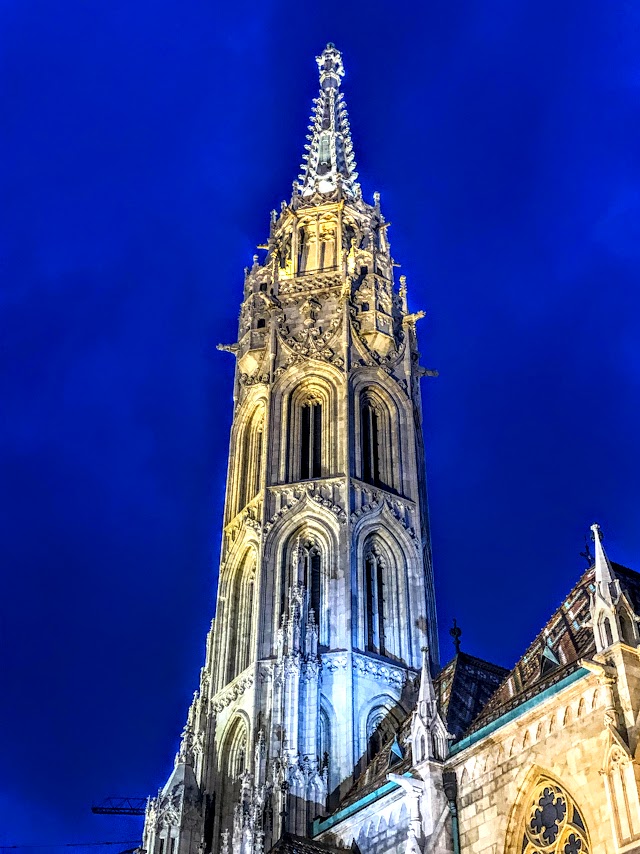
The south-west bell tower of the Matthias Church beside the Fisherman’s Bastion at Buda Castle is one of the finest pieces of Gothic architecture in Hungary (Photograph: Patrick Comerford, 2023)

Patrick Comerford

During our recent visit to Budapest with the Anglican mission agency USPG (United Society Partners in the Gospel) and the Anglican Diocese in Europe, Charlotte and I were introduced to a number of projects working with Ukrainian refugees by the Revd Dr Frank Hegedűs, the Anglican chaplain in the Hungarian capital, and attended the Sunday Eucharist in Saint Margaret’s Church, Budapest.

We never got to visit Saint Stephen’s Basilica which is named in honour of Saint Stephen, the first King of Hungary. It is been the co-cathedral of the Roman Catholic Archdiocese of Esztergom-Budapest and the third largest church building in Hungary.

However, during our visits to projects throughout the Hungarian capital, we visited a number of churches in various traditions, including Roman Catholic, Anglican, Lutheran, Reformed, Church of Scotland and Greek Catholic churches and a shared ecumenical chapel.

The Matthias Church stands in Holy Trinity Square, in front of the Fisherman’s Bastion at the heart of Buda’s Castle District (Photograph: Patrick Comerford, 2023)

1, Matthias Church, Fisherman’s Bastion:

The Church of the Assumption of the Buda Castle is more commonly known as the Matthias Church and is sometimes referred to as the Coronation Church of Buda. The church stands in Holy Trinity Square, in front of the Fisherman’s Bastion at the heart of Buda’s Castle District.

According to tradition, the first church on the site was founded by Saint Stephen, King of Hungary, in Romanesque style in 1015. The present church was built in the florid late Gothic style in the second half of the 14th century and was extensively restored in the late 19th century.

The Matthias Church is said to have been founded in 1015 by Saint Stephen, King of Hungary (Photograph: Patrick Comerford, 2023)

This was the second largest church in mediaeval Buda and the seventh largest church in mediaeval Hungary. Two Austrian emperors were crowned as Kings of Hungary in the church: Franz Joseph I and Charles IV.

During the siege of Buda in 1686, a wall of the church – used as a mosque by the Ottoman occupiers of the city – collapsed under to cannon fire. An old, hidden statue of the Virgin Mary was revealed behind the wall. As the statue appeared before the praying Muslims, the morale of the Muslim garrison collapsed and the city fell on the same day.

Since the 19th century, the church has been known as the Matthias Church, after King Matthias Corvinus (1458-1490), who built the south-west bell tower, one of the finest pieces of Gothic architecture in Hungary.

The Reformed Church on Kálvin tér or Calvin Square was built in 1816-1830 (Photograph: Patrick Comerford, 2023)

2, Calvin Church, Calvin Square:

The Reformed Church on Kálvin tér or Calvin Square is a neoclassical church near the Hungarian National Museum and has been the centre of Budapest’s Reformed community for almost two centuries.

The church was designed by Vince Hild and built in 1816-1830. The four-columned foyer at the main entrance and the two-storey side galleries were designed by József Hild. The originally plan was for two belfries, but only one belfry was built.

The Puritan interior is painted white, giving an impressive effect. The memorials inside include one to an English-born countess, Charlotte Strachan (1815-1851), wife of Count Emanuel Zichy-Ferraris (1808-1877). She was an Anglican, but because she made a significant contribution towards the cost of building the church, she was given special permission to be buried there.

The statue of John Calvin faces the church with his back to the square (Photograph: Patrick Comerford, 2023)

The tower is topped with a star, referring to the Star of Bethlehem, and the tower is especially striking when lit up from behind at night. A statue of the reformer John Calvin (János Kálvin in Hungarian) stands facing the church, with his back to the square.

This part of the city is a centre of the Reformed Church, with a Reformed theology faculty, a Protestant university, secondary school, Bible museum and book shop.

The University Church was built on the site of a former mosque (Photograph: Patrick Comerford, 2023)

3, The University Church:

The Church of Saint Mary the Virgin, commonly known as the University Church, is on Papnövelde Street in inner city Budapest.

Since 1786, the church has belonged to the former Theology Faculty of the Eötvös Loránd University, and to the Pázmány Péter Catholic University. Prior to that, it was the main church of the Pauline Order, the only Hungarian-founded monastic order and dating from the 13th century.

The Central Priestly Educational Institute is beside to the church, and the liturgical services in the church are provided by the student priests and the academic staff of the institute.

The church stands on the site of a former mosque in Pest. When Buda was liberated from the Ottoman Empire in 1686, the Paulines moved to Pest and bought the former mosque and some neighbouring houses.

The foundation stone of the church was laid in 1725. The church was completed in 1771 and has two towers, each 56 metres high.

Fasor Lutheran Church is part of a Lutheran campus created in the late 19th century (Photograph: Patrick Comerford, 2023)

4, Fasor Lutheran Church:

The Evangelical-Lutheran Church of Budapest-Fasor is on a prominent street corner close to Reformáció Park and the Fasori Gimnázium school. The church was designed by Samu Petz and built in 1905. The features include the mosaic from Miksa Róth’s workshop above the main entrance, the central rose window and the organ.

The first school on the site was built in 1795, the first church there was built in 1799-1808, and the high school in 1862-1865, creating a Lutheran centre. A new church was designed in the early 20th century by the architect Samu Pecz, who submitted up to seven proposed plans. The church two years to build, and opened on 8 October 1905. The altar was painted in 1911-1913 by Gyula Benczúr, one of Hungary's foremost painters.

Fasor Lutheran Church was designed by Samu Pecz (Photograph: Patrick Comerford, 2023)

The church in Fasor was the first in Budapest where services were held exclusively in Hungarian. Until then, Lutheran services in Budapest had been held in Hungarian and German and in Slovak.

The windows were blown out during World War II. The interior of the church was restored in 1973-1974, with new decorative painting by Géza Kovács, the two manual organs were rebuilt in 1989, and new windows and new bells were installed in the years that followed.

The Sacred Heart Church is the main Jesuit church in Hungary (Photograph: Patrick Comerford, 2023)

5, The Sacred Heart Church:

The Sacred Heart Church on Horánszky Street in the Józsefváros district is the main Jesuit church in Hungary. It stands in a small square next to it the Jesuit community house and other Jesuit houses, and a statue of Count Nándor Zichy, the main patron of the church, stands in the square.

The Jesuits came to Budapest again in the early 1880s and acquired a plot for building a church and a community house. The community house was built in 1890, but financial problems delayed the construction of the church and it was not completed until 1909.

The Sacred Heart Church was designed by József Kauser in a neo-Romanesque style with Gothic elements (Photograph: Patrick Comerford, 2023)

The church was designed by József Kauser is built in red brick in a neo-Romanesque style with Gothic elements. The façade is symmetrical with an impressive rose window and two towers on each side of the entrance, flying buttresses and gargoyles. The nave is high, but there are two low aisles, so the church follows the classical basilica floor plan, with a half-octagonal sanctuary.

The church and the community buildings were returned to the Jesuits after the Communist system fell in 1989.

Saint Michael’s Church in inner city Budapest was built for the Dominicans in the 18th century (Photograph: Patrick Comerford, 2023)

6, Saint Michael’s Church:

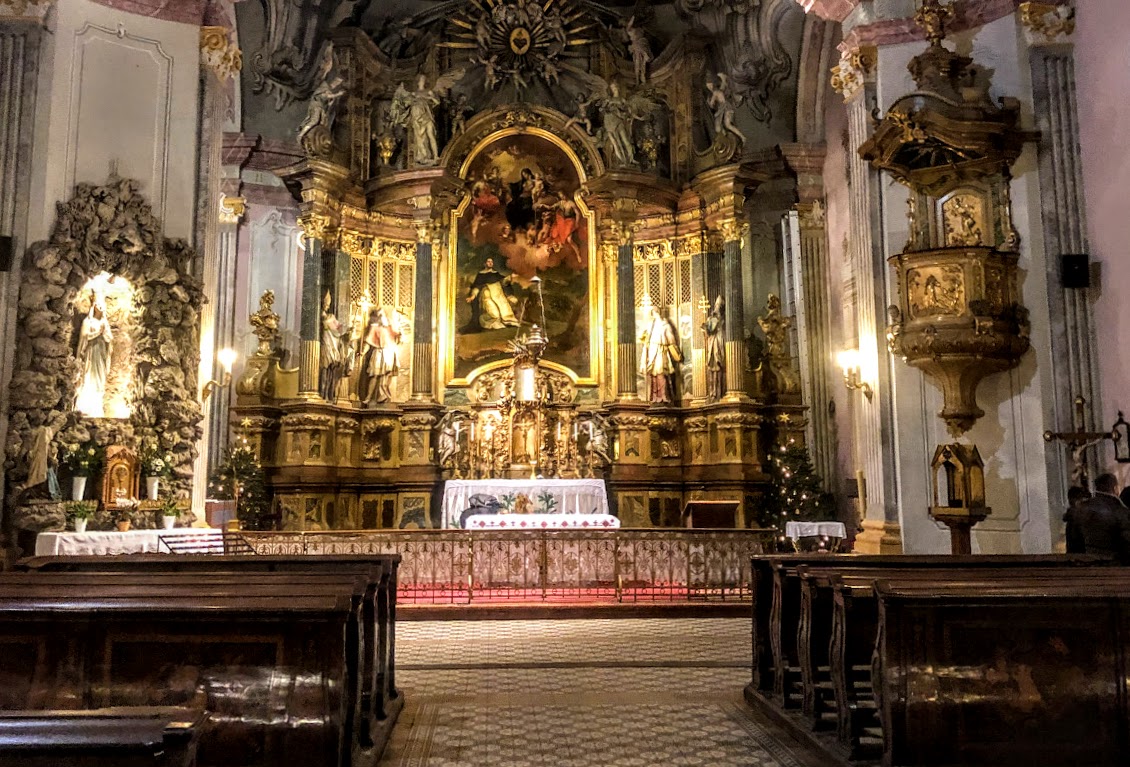
Saint Michael’s Church in inner city Budapest is a remarkable baroque church in the middle of the busy bustle of Váci Street. The church dates back to the 1700s, and was built between 1700 and 1765 for the Dominicans. The beautiful main altar and the furniture of the sacristy were made by the Dominican friars in the 1760s.

After the Dominicans in Hungary was dissolved by Joseph II in 1784, the church was given to the Order of Saint Paul for a short period (1785-1786), and then to the Congregatio Jesu or Mary Ward sisters in 1787. During the Great Flood of Budapest in 1838, the water stood two metres high in the church, yet the wood furnishings of the church were saved.

The nuns ran a girls’ school in the building next door until 1950, when the school was nationalised by the Communist regime.

Saint Michael’s Church also serves the Greek Catholic Church (Photograph: Patrick Comerford, 2023)

The frescoes were whitewashed during renovation in 1964-1968. Since 1997, the church has been under continuous restoration both inside and outside.

Today, the excellent acoustics and beautiful setting make Saint Michael’s Church a popular venue for classical music concerts.

The church is also used by the Greek Catholic Church, a church with Orthodox-style liturgy and in communion with the Roman Catholic Church and with a predominantly Ukrainian congregation, and Charlotte and I were invited to join them for their Christmas celebrations on 7 January.

Saint Columba’s Church dates back to the work of Scottish missionaries in the 1840s (Photograph: Patrick Comerford, 2023)

7, Saint Columba’s (Church of Scotland):

Saint Columba’s Scottish Church is an English-speaking international church in Budapest. It belongs to both the Church of Scotland and the Reformed Church in Hungary, and is Presbyterian in its style of church government and theology. It dates back to 1841, and in the past was known as ‘the Scottish Mission.’ Its roots are in evangelical publishing and mission to the Jewish community in Budapest, with a girls’ school for Jewish and Christian girls. Later, the school served as a shelter for refugee Polish Jews.

The place was known for its religious tolerance and high standards, and because of her work there Jane Haining, Matron of the Jewish-Hungarian School for Girls, was arrested in 1944 and was later killed in Auschwitz.

During the Communist era, the work of the mission was continued by Hungarian Reformed ministers who occasionally held services for the international community. The Revd Aaron C Stevens, has been the minister of Saint Columba’s since 2006.

Members of Saint Columba’s were involved in launching the Refugee Mission of the Reformed Church in Hungary in 2005. In recent decades, the church has reached out to refugees from Romania, Iran, Syria, and, more recently, Ukraine.

In recent years, the church has engaged with the Kalunba Charity Group, which set up the Salaam Overnight Shelter in the church in 2015 to welcome families who would have otherwise slept at railway stations. Today, Saint Columba’s is hosting refugees from Ukraine. Many of them are Africans who were students in Ukraine when the war started last year. The church is open four nights a week for up to 20 overnight guests.

The chapel at the centre run by the Ecumenical Council of Churches in Hungary (MEÖT) in Budapest (Photograph: Patrick Comerford, 2023)

8, Evangelical University Church:

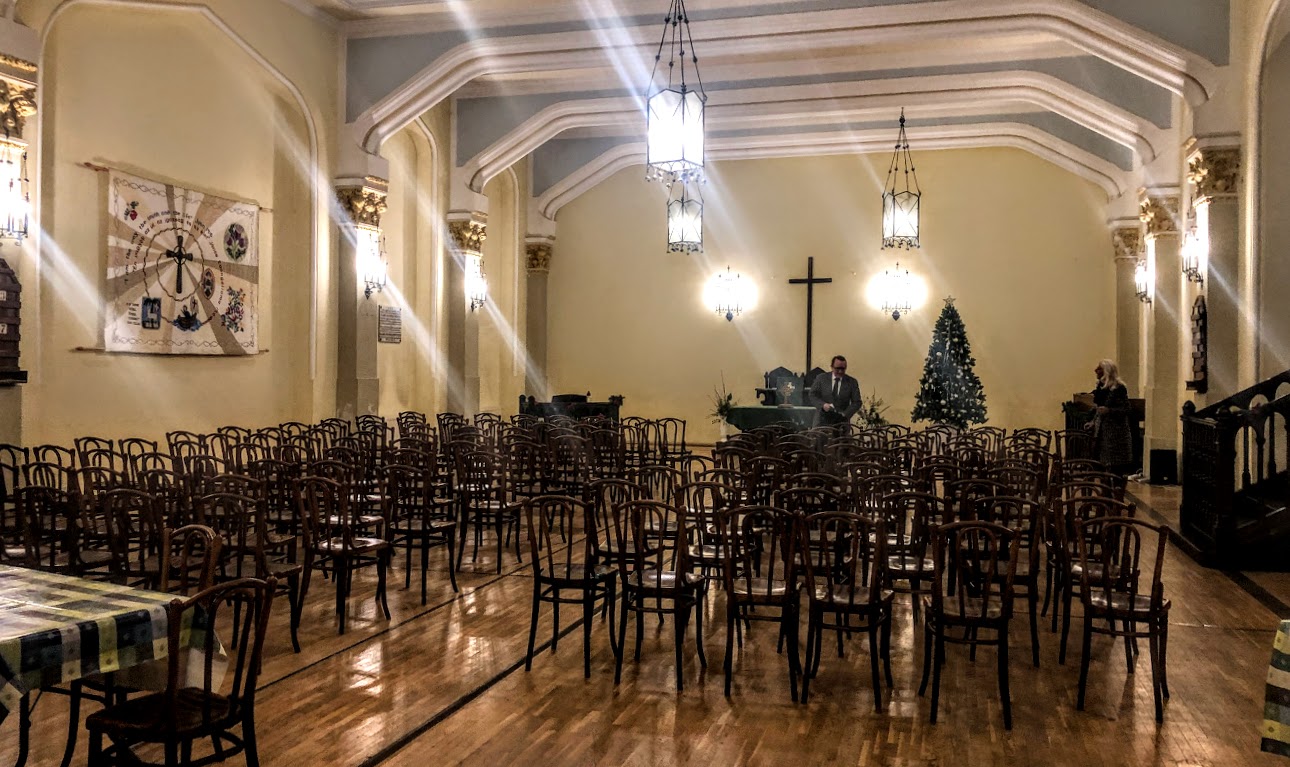
Charlotte and I were staying in Budapest in the centre run by the Ecumenical Council of Churches in Hungary (MEÖT) on Magyar Tudósok körútja (Hungarian Scientists Boulevard). MEÖT groups 10 Protestant, Orthodox and Anglican churches in Hungary, and co-operates with 18 other churches and church-related organisations, including the Roman Catholic Church.

The MEÖT centre is close to the Petőfi bridge across the Danube, linking Buda and Pest, and next to the Magyar Szentek church.

The chapel and the centre were designed by the award-wining architects Lászlo Benczúr and Pál Csonka (Photograph: Patrick Comerford, 2023)

The chapel and the centre were designed by the award-wining architects Lászlo Benczúr and Pál Csonka.

The chapel is used for ecumenical and church conferences, as well as occasional weddings. The chapel is used by the Evangelical University Church, which welcomes university students, college students, college students and young adults, regardless of religious affiliation. It is also used on Sundays by a Korean-speaking congregation.

The Church of the Hungarian Saints in Budapest (Photograph: Patrick Comerford, 2023)

9, The Church of the Hungarian Saints:

From our rooms in the MEÖT centre, we could see the Church of the Hungarian Saints on Magyar Tudosok körútja is one of the newest churches in Budapest, and we were woken by its bells each morning. This part of Budapest was designated as the site of the World Exhibition (Expo) in Budapest in 1996, and the church site was originally planned as part of the Vatican Pavilion. When Expo was cancelled, the Archdiocese of Budapest decided to go ahead with building the church.

Pope John Paul II was invited to consecrate the church, but this never materialised and instead he blessed a marble slab that was placed in the new church.

The church was built in the form of a fifth century Rotunda. In his design, the architect was inspired by Santo Stefano Rotondo or the Basilica of Saint Stephen in the Round, an early Rotunda in Rome dating from the 5th century AD and now Hungary’s ‘national church’ in Rome.

The Church of the Hungarian Saints is inspired by Santo Stefano Rotondo in Rome (Photograph: Patrick Comerford, 2023)

The church is a centrally planned church, with an inner circular shape surrounded by an external ring. The church can be accessed through a two-storey gate, leading into a courtyard complex and the church entrances. These ‘adherent’ structures, like a ‘city wall,’ hide the slowly unfolding beauty of the central space. The complex interior-exterior space structure gives a character of ever varied beauties that are slowly showing themselves over the time. The sanctuary is embellished by a unique crucifix in gold, wood and stone by the sculptor László Somogyi-Soma, the painter Mihály Balázs and the architect Katalin Somogyi-Soma.

The cornerstone was laid in May 1995, and the church was dedicated to the Hungarian Saints. The church was consecrated on 17 August 1996 by Cardinal László Paskai and received parish church status on 1 January 2001.

The church is beside the campus of the Eötvös Loránd Public University and is also home to the University Chaplaincy in Budapest. The chaplaincy community has nurtured co-operation between the historical Christian Churches and played a role in forming the Christian Ecumenical Student Movement.

The church crypt or undercroft served Saint Margaret’s Anglican Church in Budapest for some years.

Inside Saint Margaret’s Church, the Anglican church in Budapest (Photograph: Patrick Comerford, 2023)

10, Saint Margaret’s Anglican Church:

The Revd Dr Frank Hegedűs, the chaplain of Saint Margaret’s Anglican Church in Budapest, has been the catalyst in securing funding from USPG (United Society Partners in the Gospel) and the Anglican Diocese in Europe for the projects working with Ukrainian refugees we have been visiting in recent weeks.

The congregation in Budapest comes from many nations and continents: from Hungary to the United Kingdom, from Africa to North America, of ‘all vintages and sizes,’ as Father Frank says.

Anglicans have been present in Hungary for generations, with an Anglican presence in Hungary that dates back to the 1890s. Many of those early Anglicans were business-people and, interestingly, English horse trainers and riders employed by Hungarian aristocrats In the Tata Castle in Komárom-Esztergom county.

Anglican worship in Hungary remained sporadic during the Communist era, with an Anglican priest coming to Budapest periodically from Vienna. Current records also show there was an Anglican service on the first Sunday after the revolution in 1956.

Saint Margaret’s was officially founded after the fall of Communism in 1992 by Canon Denis Moss. The church first met in the crypt in the Church of the Hungarian Saints. Canon Moss now lives in retirement near Lake Balaton in Hungary.

Father Frank Hegedűs presides at the Sunday Eucharist in Saint Margaret’s Church, Budapest (Photograph: Charlotte Hunter, 2023)

Saint Margaret’s uses a chapel in the Lutheran building on Szentkirály utca, with the Sunday Eucharist celebrate at 10:30 according to Rite II in Common Worship of the Church of England.

According to Father Frank, the Anglican presence in Budapest is ‘miniscule’ but this small congregation provides a presence in Hungary for one of the largest Churches or Communions in the world.

About one-third of the current community is British, and another third, Hungarian. There are members too from Africa and from North America.

Father Frank says the Ukrainian crisis and the arrival of Ukrainian refugees in Budapest has given Saint Margaret’s and its people ‘a new sense of purpose and mission’, with the people actively responding to the needs of refugees and engaging with the projects we have been visiting.

He recalls how Saint Margaret’s opened its doors to about 20 Nigerian medical students who had been studying in Ukraine. ‘Along with the students came a medical professor and her husband, Father Solomon Ekiyor, who had been an Archdeacon in Nigeria. Receiving Father Solomon and his family was a bittersweet experience – it was wonderful to have them with us but the circumstances that brought them here were most unfortunate.’

The crisis has also given a new ecumenical dimension to the presence of Saint Margaret’s in the Hungarian capital. Through Father Frank’s passion, grants from the Diocese in Europe and USPG have also helped the work of other churches in Hungary, including the Jesuit Refugee Service and Saint Columba’s Church, the Church of Scotland church in Budapest.

The monument commemorating Martin Luther and the Reformation at Fasor Lutheran Church (Photograph: Patrick Comerford, 2023)

15 January 2023

Helsinki Cathedral has become
Finland’s best-known building

Helsinki Cathedral faces onto Senate Square in central Helsinki and is the best-known building in Finland (Photograph: Patrick Comerford, 2023)

Patrick Comerford

Helsinki Cathedral faces onto Senate Square in central Helsinki and is probably the best-known building in Finland, featuring prominently on postcards, posters and tourism promotions.

The cathedral, with its impressive domes with its high flights of steps, stands on a prominent hill above the harbour of Helsinki and stands out dramatically in the winter snow.

The cathedral towers above its next-door neighbour, Holy Trinity Church, the oldest Orthodox church in Finland, which I was visiting this week with the Anglican mission agency USPG (United Society Partners in the Gospel) and the Diocese in Europe, to see church responses to the Ukrainian refugee crisis.

Both Helsinki Cathedral and Holy Trinity Church were designed by the same architect, and they were built at the same time with similar funding from the czarist state.

This is the cathedral of the Diocese of Helsinki in the Finnish Evangelical Lutheran Church, which is one of Finland’s two national churches, along with the Orthodox Church of Finland. The Church is in full communion with the Church of England, the Church of Ireland and other member churches of the Anglican Communion through the Porvoo Communion.

The Evangelical Lutheran Church of Finland was part of the Church of Sweden until 1809, when the Grand Duchy of Finland was established as a part of the Russian Empire. With about 3.7 million members, it is one of the largest Lutheran churches in the world, and is Finland’s largest religious body: 66.5% of Finns are members of the church. The present head of the Church is Archbishop Tapio Luoma of Turku, who succeeded in 2018.

A statue of Alexander II in front of Helsinki Cathedral on Senate Square (Photograph: Patrick Comerford, 2023)

Helsinki Cathedral is a distinctive landmark in the cityscape of the capital, with its tall, green dome surrounded by four smaller domes. Helsinki Cathedral was originally built in 1830-1852 as a tribute to the Grand Duke of Finland, Tsar Nicholas I of Russia. It was also known as Saint Nicholas’s Church until the independence of Finland in 1917.

It was built in the neoclassical style and was designed by the architect Carl Ludvig Engel (1778-1840), who also designed Holy Trinity Church, the Orthodox church next door. Engel saw the cathedral as the climax of his layout of Senate Square, and it is surrounded by other, smaller buildings also designed by him.

The church plan is a Greek cross, or a square centre and four equilateral arms. It is symmetrical in each of the four cardinal directions, with each arm’s façade featuring a colonnade and pediment. Engel originally intended to place a further row of columns on the west end to mark the main entrance opposite the east-end altar, but this was never built.

After Helsinki became the capital of the autonomous Grand Duchy of Finland in 1812, Alexander I decreed in 1814 that 15 per cent of the salt import tax was to be collected into a fund to build two churches, one Lutheran and one Orthodox.

The cathedral was built on the site of the smaller church, Ulrika Eleonora Church, built in 1724-1727 and dedicated to its patroness, Queen Ulrika Eleonora of Sweden.

Helsinki Old Church was built in nearby Kamppi in 1824-1826 to serve the parish while the Ulrika Eleonora Church was being demolished and until the new cathedral was completed. The bells of the old church were reused in the cathedral.

The construction of the cathedral began in 1830, although it was only officially inaugurated in 1852.

Engel died in 1840, and the building was later altered by his successor, Ernst Lohrmann, whose four small domes emphasise the architectural connection to the cathedral’s models, Saint Isaac’s Cathedral and Kazan Cathedral in St Petersburg.

A chapel next to Helsinki Cathedral was once used by Saint Nicholas’s Church, the Anglican church in Helsinki (Photograph: Patrick Comerford, 2023)

Lohrmann also designed two extra buildings to the sides of the steps: looking from the square the left building is a bell tower and the right building a chapel, which was once used by Saint Nicholas’s Church, the Anglican church in Helsinki.

Lohrmann also erected larger-than-life sized zinc statues of the Twelve Apostles at the apexes and corners of the roofline in 1849. They were sculpted by August Wredov and Hermann Schievelbein and cast by SP Devaranne in Berlin in 1845-1847.

The altarpiece was painted by Carl Timoleon von Neff and donated to the church by Emperor Nicholas I.

The cathedral crypt was renovated in the 1980s by the architects Vilhelm Helander and Juha Leiviskä for use in exhibitions and church functions. Helander was also responsible for conservation repairs on the cathedral in the late 1990s.

Today, the cathedral is one of Helsinki's most popular tourist attractions, and in pre-Covid times it attracted half a million visitors a year. The church is in regular use for services and special events.

Carl Ludvig Engel saw the cathedral as the climax of his layout of Senate Square (Photograph: Patrick Comerford, 2023)

03 June 2011

Bloom-like walks and the story of the ‘Prince of Thomond’

Trinity College Dublin in the sunshine this week (Photograph: Patrick Comerford, 2011)

Patrick Comerford

The weather has been beautiful in Dublin for the past few days – clear blue skies, warm sunshine and temperatures to rival those in Cyprus and other parts of the Mediterranean.

I spent much of today enjoying the sunshine in the back garden. But I remember how I loved walking in this weather until the months before I was diagnosed with sarcoidosis and a severe deficiency of Vitamin B12. How I used to love walking by the banks of the River Dodder on the way to and from work, or walking from the institute to Rathgar village or even as far as Rathmines, just for a cup of coffee.

Despite that diagnosis, I have managed to have a walk on the beach most weeks. Although those walks do little for me in terms of fitness and exercise – I have put on a little too much weight in recent months – they help lift my spirits and sustain a sense of pleasure with this world and with where I live.

I still have pains in my knees, a constant sensation of “pins-and-needles” under my feet, and a dry cough. But I’m sleeping more regularly, and over the past few weeks I have noticed the positive benefits of the steroids I have been prescribed. Those walks on the beach may not have become any more vigorous, but I’m working at a better pace, and have found easier to concentrate on writing papers for conferences and journals.

At swim two birds ... a pair of swans enjoying the sunshine on the River Dodder below the bridge at Rathfarnham Road this week (Photograph: Patrick Comerford, 2011)

Earlier this week, I walked along the banks of the River Dodder for the first time for about four months. It was sunny afternoon, one or two people were fishing from the banks, and there were magpies and some mallards on the water and a pair of swans between the weir and the bridge on Rathfarnham Road.

I walked on down Rathfarnham Road, past the houses I had lived in as a child and had been born in, and past Terenure Synagogue, before catching the bus in Terenure village. And I felt so much better for that walk that I had another the following day.

I had been working in the Irish Architectural Archives, researching a journal paper on my great-grandfather, James Comerford, and his work on the Irish House, built in 1870. Earlier in the morning I had walked from College Green through Trinity College to Merrion Square. As I finished I found to my delight that once again it was a sunny afternoon. Rather than walking back through Trinity into College Green for a bus, I walked along Lower Fitzwilliam Street, Upper Fitzwilliam Street, Fitzwilliam Square East, Fitzwilliam Place, across Leeson Street, and along Adelaide Road, past the former synagogue.

The former synagogue on Adelaide Road, Dublin, closed in 1999 (Photograph: Patrick Comerford, 2011)

Adelaide Road Synagogue (architect JJ O’Callaghan) was the first purpose-built synagogue in Ireland, and cost over £5,000 to build in 1892. It was designed in what could be described as a vaguely Byzantine style, and was extended in 1925 to provide school facilities for Jewish children.

This synagogue once held over 600 people on a Saturday, but by the 1990s there were less than 50 regular members of the congregation. With declining numbers, the congregation decided to merge with the Terenure Synagogue, the building was sold in 1999 and most of the site redeveloped as offices.

Saint Finian’s Lutheran Church, Adelaide Road, built in the 1860s for the Irvingites (Photograph: Patrick Comerford, 2011)

A few paces on is Saint Finian’s Lutheran Church (architect ET Owen), which had been built in 1863 as the Dublin church of the Irivingites, a strange sect who were known as the Catholic Apostolic Church and once had their main London church in Gordon Square, Bloomsbury. Saint Finian’s is a simple structure with pointed arched windows on its main front. The side elevation is pierced by smaller windows and has simple buttresses.

On further is Adelaide Road Presbyterian Church (1840), with a full vista down Earlsfort Terrace. Although the architect of the building is unknown, the dramatic façade by designed by HJ Lundy. The Ionic portico was inspired by Palladio’s Villa Foscari or Villa Malcontenta (1558-1560) in Mira, near Venice.

Unfortunately the dramatic façade with that wonderful portico is all that really remains of this church, as I found when I took part in a funeral there some years ago. The interior has been gutted and the building redeveloped, supposedly reflecting the changing role of the church in the community.

The heraldic plaque above the door at No 5 Charlemont Street recalls the bizarre story of the self-styled Prince of Thomond (Photograph: Patrick Comerford, 2011)

At the junction of Harcourt Road and Charlemont Street, I was surprised to see that a curious heraldic plaque still survives over No 5, one of the few surviving Georgian houses surviving on thus street.

The house has been incorporated in to the Citi Hostel but the heraldic plaque, now covered in black paint, dates back to the mid-20th century when the house was the residence a man who wanted to be known as “Colonel His Highness Raymond Moulton Seaghan O’Brien, Prince of Thomond, Earl and Count of Thomond, Count of Pogla (Constitutionally and Judicially entitled the O’Brien, Prince of the Dalcassians of Thomond), of Clare Castle, Principality of Thomond.”

To be more precise, this self-styled prince claimed his house was the Royal Dalcassian Legation and the diplomatic presence of his principality in a foreign capital. The Irish Government and most other countries ignored him, but he claimed to have documents proving that Norway, Yugoslavia, Latvia and Estonia had recognised his sovereignty over Thomond.

He expended a lot of energy on bestowing titles and orders and sending out documents and papers from his “Royal Dalcassian Legation” in humble Charlemont Street, bearing the principality’s coat-of-arms, decorated with a golden crown and a consular seal, and decorated with a golden crown.

In London, he appointed a “Count Howard d’Angeryille” As his “Minister Plenipotentiary and Envoy Extra-ordinary, Prince Nicholas Vladimirovitch Galitzine, an exiled member of the Czarist Russian nobility, received by mail “The Most Honourable Dalcassian Order of the Princely House of Thomond.” The Russian prince ended his days happily in Canada, running “Ocean Bliss,” a bed and breakfast house on Sointula Island off the north east coast of Vancouver Island.

But the story of the self-styled Prince of Thomond was a less happy one. He claimed his “country” was Thomond, and that he was directly descended not only of Brian Boru but from an Irish royal line that he traced back to 1300 B.C. The last official Prince of Thomond surrendered his title in 1545, and one wondered whether O’Brien was deluded or this was all a grand, Ruritanian hoax.

In 1940s, the then Lord Inchiquin declared indignantly that Raymond O’Brien was an impostor, pointing out: “The only person entitled to be called Prince or Earl of Thomond is myself.”

O’Brien had arrived in Ireland at the beginning of World War II, claiming he was the Earl of Thomond and the O’Brien, although his only supporting documents were a Mexican court judgment and some newspaper cuttings. He called himself “prince” on his children’s birth certificates, faked a court case of slander against him, set up his own order of chivalry, elicited a blessing from the Vatican, and even attempted to issue his own postage stamps.

The genealogist Edward MacLysaght dryly recounted that “he was eventually confined to St John of Gods, an institution then situated at Stillorgan Castle … an address well suited to his dignity.”

He died in 1977, but his story shows how anyone can claim to be an Irish “chief,” calling himself the Mac This or the Mac That. Other similar cases in the past include a plain Mr Phelan who became “The O Phelan, Prince of the Decies,” and Michael Neale, who called himself the “Prince of the Saltees” after he bought the Great Saltee Island, off the coast of Co Wexford. More recently there was the absurd case of “Terence MacCarthy Mor, Prince of Desmond,” who started his own order of chivalry and had a great inauguration service on the Rock of Cashel attended by many Americans amid great pomp and circumstance. After his bogus claims were exposed, he moved to live in secluded retirement in Tangiers.

Charlemont Street had more benign residents in the past: John Wesley stayed at No 46, the home of Arthur Keene, when he visited Dublin in 1787, and the singers Mary Black and Frances Black grew up on this street.

The pinnacled reredos behind the altar in Saint Kevin’s Church, Harrington Street ... the work of James Comerford in the 1870s (Photograph: Patrick Comerford, 2011)

From the less-than-regal setting of the former “Royal Dalcassian Legation,” I strolled on through Kelly’s Corner, and stopped at Saint Kevin’s Church in Harrington Street to take photographs of the pinnacled reredos behind the altar, which was also the work of my great-grandfather, James Comerford, around the same time as he worked on the Irish House.

This Gothic Revival church (architect George Ashlin, 1867-1872) also has beautiful Earley stained glass windows from their studios in Camden Street.

Saint Kevin’s Church, on the site of the former Royal Portobello Gardens, closed after less than a century on 28 January 1983 (Photograph: Patrick Comerford, 2011)

Further on along the South Circular Road, heading towards Leonard’s Corner, is another Saint Kevin’s Church, the former Church of Ireland parish church. It stands on the site of the former Royal Portobello Gardens, which opened in 1839.

The original Saint Kevin’s, which now stands in ruins in Saint Kevin’s Park in Camden Row, was one of the four churches of the Irish settlement on the River Poddle, and later formed part of the Manor of Saint Sepulchre.

The parish became independent from Saint Peter’s in 1876, and the Victorian Saint Kevin’s (1888-1889, architect Sir Thomas Drew) was built on the corner of the South Circular Road and Victoria Street with a bequest from a Miss Jane Shannon of Rathgar. The Gothic building, with red sandstone trims, was consecrated as a church in 1889.

Saint Kevin’s Church became part of the Saint Patrick’s Cathedral group of parishes in 1981 and closed after a final service on 28 January 1983. After lying empty for many years, the church was converted into apartments in the 1990s, and the adjacent church buildings became a community centre.

I continued on through Leonard’s Corner, and caught the bus at a stop on Upper Clanbrassil Street, close to the terrace of houses in “Little Jerusalem” where James Joyce says Leopold Bloom was born.

Over those two days, I had had my own Bloom-like walk through the streets of Dublin, and I felt much better for that.