Patrick Comerford
April is Sarcoidosis Awareness Month. And, having been diagnosed with Sarcoidosis around 2008, I would have thought that after almost 20 years I would know how to recognise fresh symptoms of a new flare up of this pernicious syndrome.
For the last three weeks, since I returned to England from Kuching, I have had a series of symptoms that I was responding to separately. I have had a serious failure in doing the ‘joined-up writing’, not realising that together these symptoms have indicated yet another flare-up of sarcoidosis.
I must have picked up a cough and a cold on one of my recent flights from Kuching, Kuala Lumpur or Muscat. But I ought to have been able to shake that off within a week or ten days. Instead, for almost three weeks now, I have had the uncomfortable symptoms of a heavy head and chest cold, along with pains in my joints, particularly in my hips, legs, knees and ankles and legs, late-night asthma-like breathlessness, a feeling of being tired and listless, and a nasty, red rash across the lower shin on my left leg.
My breathlessness forced me to excuse myself from reading one of the lessons and singing at the Parish Eucharist the Sunday before last and to stay away from the choir rehearsals the following Wednesday.
I went to my GP earlier this week complaining about some of these symptoms, worried that the pain in my lungs might even be pneumonia.
I went to the pharmacist about the rash, and was recommended to use hydrocortisone ointment with a mild steroid.
I had what I thought was a mild but troubling asthma attack when four of us went out for a family dinner in Stony Stratford on Tuesday night and needed extra use of my inhaler.
I was not in full voice when I returned to the choir rehearsals on Wednesday evening.
Then, when more volunteers were being asked to take part in foot-washing at the Maundy Eucharist in Saint Mary and Saint Giles Church last night, I realised I was about to make my excuse, ‘Sorry, I still have a nasty sarcoid rash on one of my shins.’
Subconsciously, I had already made the connection within the last 24 or 48 hours. I now realise that all these symptoms amount to Erythema Nodosum.
I have just learned in recent days that Sarcoidosis often presents on the shins as Erythema Nodosum or tender, red, or purple-blue nodules indicating an acute, often self-limiting, flare-up of this nasty syndrome. These nodules can be accompanied by joint pain, fever and fatigue. Other skin manifestations include chronic, brown or purple papules or plaques. And I just thought it was a nasty, large pimple right beside the rash.
The key characteristics of shin rashes in Sarcoidosis involve Erythema Nodosum, a rash that appears as painful, tender, red-to-blue lumps on nodules, and they are primarily on the shins. This acute but transient symptom of sarcoidosis often resolves on its own within three to six weeks, but as the tender, red nodules fade they often leave behind bruised-looking, purple-blue areas.
Of course, Erythema Nodosum is not solely caused by sarcoidosis and can result from other conditions. But the other associated, common symptoms include flu-like symptoms before or at the same time as the patches on the skin, fever, malaise, and arthralgia or swollen, aching joints.
A full diagnosis often requires a skin biopsy to distinguish this from other conditions. But acute cases of erythema nodosum often resolve themselves without treatment, although ibuprofen or paracetamol can be used for pain and in chronic cases dermatologists may prescribe topical corticosteroids, tacrolimus ointment or oral medications if the lesions are widespread.
Erythema nodosum commonly affects the lower legs, but you can get it in other areas, such as on the arms, thighs and neck. Thankfully, it usually goes away by itself. The skin usually heals on its own within three to eight weeks. But when the affected patches of skin heal and fade, some people are left with marks that look like bruises.
They say some things that can help ease the pain of erythema nodosum include ibuprofen or other anti-inflammatory painkillers, rest with your feet raised on a pillow, avoiding long periods of standing, walking and running, or putting .a cool wet compress, like a damp cloth, on the affected area.
I have heeded little of this advice in recent weeks. If only I had known. I walked and walked, quite a lot, when I was in Walsingham a few weeks ago. I walked and walked, quite a lot, around Oxford yesterday, before and after the Christ Eucharist in Christ Church Cathedral yesterday.
If only I had realised that my subconscious mind was telling me all this. Already there have been warning signs that as well as my lungs sarcoidosis may have have left some traces on my heart and a kidney.
It has been a tough reminder over these past three weeks that we should all liisten to what our body is instinctively telling us about our health.
Hopefully I’ll be as right as rain within a few days.
As I have said so often in the past, I may have sarcoidosis, but sarcoidosis does not have me.
Had I realised what my inner instincts were telling me, I would not have walked so much around Oxford yesterday (Photograph: Patrick Comerford, 2026)
Showing posts with label Good Friday. Show all posts
03 April 2026
Daily prayer in Lent 2026:
45, Friday 3 April 2026,
Good Friday
An icon of the Crucifixion by Hanna-Leena Ward in her recent exhibition in Lichfield Cathedral (Photograph: Patrick Comerford, 2026)
Patrick Comerford
We are at the climax of Holy Week, the last week in Lent. Today is Good Friday (3 April 2026), known as Great Friday in the Greek Orthodox Church.
We were in Oxford yesterday for the Chrism Eucharist in Christ Church and the renewal of ordination vows, and I was back in Stony Stratford last night for the Eucharist of the Last Supper and the Watch of the Passion in Saint Mary and Saint Giles Church. I hope to sing with the choir this afternoon when the Watch of the Passion continues (12 noon to 2 pm), followed by the Veneration of the Cross from 2 pm.
But, before this day begins, I am taking some quiet time this morning to give thanks, to reflect, to pray and to read in these ways:
1, reading today’s Gospel reading;
2, a short reflection;
3, a prayer from the USPG prayer diary;
4, the Collects of the day.
A Byzantine-style crucifix by Αλεξανδρα Καουκι, icon writer in Rethymnon, Crete
John 18: 1 to 19: 42 (NRSVA):
1 After Jesus had spoken these words, he went out with his disciples across the Kidron valley to a place where there was a garden, which he and his disciples entered. 2 Now Judas, who betrayed him, also knew the place, because Jesus often met there with his disciples. 3 So Judas brought a detachment of soldiers together with police from the chief priests and the Pharisees, and they came there with lanterns and torches and weapons. 4 Then Jesus, knowing all that was to happen to him, came forward and asked them, ‘For whom are you looking?’ 5 They answered, ‘Jesus of Nazareth.’ Jesus replied, ‘I am he.’ Judas, who betrayed him, was standing with them. 6 When Jesus said to them, ‘I am he’, they stepped back and fell to the ground. 7 Again he asked them, ‘For whom are you looking?’ And they said, ‘Jesus of Nazareth.’ 8 Jesus answered, ‘I told you that I am he. So if you are looking for me, let these men go.’ 9 This was to fulfil the word that he had spoken, ‘I did not lose a single one of those whom you gave me.’ 10 Then Simon Peter, who had a sword, drew it, struck the high priest’s slave, and cut off his right ear. The slave’s name was Malchus. 11 Jesus said to Peter, ‘Put your sword back into its sheath. Am I not to drink the cup that the Father has given me?’
12 So the soldiers, their officer, and the Jewish police arrested Jesus and bound him. 13 First they took him to Annas, who was the father-in-law of Caiaphas, the high priest that year. 14 Caiaphas was the one who had advised the Jews that it was better to have one person die for the people.
15 Simon Peter and another disciple followed Jesus. Since that disciple was known to the high priest, he went with Jesus into the courtyard of the high priest, 16 but Peter was standing outside at the gate. So the other disciple, who was known to the high priest, went out, spoke to the woman who guarded the gate, and brought Peter in. 17 The woman said to Peter, ‘You are not also one of this man’s disciples, are you?’ He said, ‘I am not.’ 18 Now the slaves and the police had made a charcoal fire because it was cold, and they were standing round it and warming themselves. Peter also was standing with them and warming himself.
19 Then the high priest questioned Jesus about his disciples and about his teaching. 20 Jesus answered, ‘I have spoken openly to the world; I have always taught in synagogues and in the temple, where all the Jews come together. I have said nothing in secret. 21 Why do you ask me? Ask those who heard what I said to them; they know what I said.’ 22 When he had said this, one of the police standing nearby struck Jesus on the face, saying, ‘Is that how you answer the high priest?’ 23 Jesus answered, ‘If I have spoken wrongly, testify to the wrong. But if I have spoken rightly, why do you strike me?’ 24 Then Annas sent him bound to Caiaphas the high priest.
25 Now Simon Peter was standing and warming himself. They asked him, ‘You are not also one of his disciples, are you?’ He denied it and said, ‘I am not.’ 26 One of the slaves of the high priest, a relative of the man whose ear Peter had cut off, asked, ‘Did I not see you in the garden with him?’ 27 Again Peter denied it, and at that moment the cock crowed.
28 Then they took Jesus from Caiaphas to Pilate’s headquarters. It was early in the morning. They themselves did not enter the headquarters, so as to avoid ritual defilement and to be able to eat the Passover. 29 So Pilate went out to them and said, ‘What accusation do you bring against this man?’ 30 They answered, ‘If this man were not a criminal, we would not have handed him over to you.’ 31 Pilate said to them, ‘Take him yourselves and judge him according to your law.’ The Jews replied, ‘We are not permitted to put anyone to death.’ 32 (This was to fulfil what Jesus had said when he indicated the kind of death he was to die.)
33 Then Pilate entered the headquarters again, summoned Jesus, and asked him, ‘Are you the King of the Jews?’ 34 Jesus answered, ‘Do you ask this on your own, or did others tell you about me?’ 35 Pilate replied, ‘I am not a Jew, am I? Your own nation and the chief priests have handed you over to me. What have you done?’ 36 Jesus answered, ‘My kingdom is not from this world. If my kingdom were from this world, my followers would be fighting to keep me from being handed over to the Jews. But as it is, my kingdom is not from here.’ 37 Pilate asked him, ‘So you are a king?’ Jesus answered, ‘You say that I am a king. For this I was born, and for this I came into the world, to testify to the truth. Everyone who belongs to the truth listens to my voice.’ 38 Pilate asked him, ‘What is truth?’
After he had said this, he went out to the Jews again and told them, ‘I find no case against him. 39 But you have a custom that I release someone for you at the Passover. Do you want me to release for you the King of the Jews?’ 40 They shouted in reply, ‘Not this man, but Barabbas!’ Now Barabbas was a bandit.
1 Then Pilate took Jesus and had him flogged. 2 And the soldiers wove a crown of thorns and put it on his head, and they dressed him in a purple robe. 3 They kept coming up to him, saying, ‘Hail, King of the Jews!’ and striking him on the face. 4 Pilate went out again and said to them, ‘Look, I am bringing him out to you to let you know that I find no case against him.’ 5 So Jesus came out, wearing the crown of thorns and the purple robe. Pilate said to them, ‘Here is the man!’ 6 When the chief priests and the police saw him, they shouted, ‘Crucify him! Crucify him!’ Pilate said to them, ‘Take him yourselves and crucify him; I find no case against him.’ 7 The Jews answered him, ‘We have a law, and according to that law he ought to die because he has claimed to be the Son of God.’
8 Now when Pilate heard this, he was more afraid than ever. 9 He entered his headquarters again and asked Jesus, ‘Where are you from?’ But Jesus gave him no answer. 10 Pilate therefore said to him, ‘Do you refuse to speak to me? Do you not know that I have power to release you, and power to crucify you?’ 11 Jesus answered him, ‘You would have no power over me unless it had been given you from above; therefore the one who handed me over to you is guilty of a greater sin.’ 12 From then on Pilate tried to release him, but the Jews cried out, ‘If you release this man, you are no friend of the emperor. Everyone who claims to be a king sets himself against the emperor.’
13 When Pilate heard these words, he brought Jesus outside and sat on the judge’s bench at a place called The Stone Pavement, or in Hebrew Gabbatha. 14 Now it was the day of Preparation for the Passover; and it was about noon. He said to the Jews, ‘Here is your King!’ 15 They cried out, ‘Away with him! Away with him! Crucify him!’ Pilate asked them, ‘Shall I crucify your King?’ The chief priests answered, ‘We have no king but the emperor.’ 16 Then he handed him over to them to be crucified.
So they took Jesus; 17 and carrying the cross by himself, he went out to what is called The Place of the Skull, which in Hebrew is called Golgotha. 18 There they crucified him, and with him two others, one on either side, with Jesus between them. 19 Pilate also had an inscription written and put on the cross. It read, ‘Jesus of Nazareth, the King of the Jews.’ 20 Many of the Jews read this inscription, because the place where Jesus was crucified was near the city; and it was written in Hebrew,[o] in Latin, and in Greek. 21 Then the chief priests of the Jews said to Pilate, ‘Do not write, “The King of the Jews”, but, “This man said, I am King of the Jews.”’ 22 Pilate answered, ‘What I have written I have written.’ 23 When the soldiers had crucified Jesus, they took his clothes and divided them into four parts, one for each soldier. They also took his tunic; now the tunic was seamless, woven in one piece from the top. 24 So they said to one another, ‘Let us not tear it, but cast lots for it to see who will get it.’ This was to fulfil what the scripture says,
‘They divided my clothes among themselves,
and for my clothing they cast lots.’
25 And that is what the soldiers did.
Meanwhile, standing near the cross of Jesus were his mother, and his mother’s sister, Mary the wife of Clopas, and Mary Magdalene. 26 When Jesus saw his mother and the disciple whom he loved standing beside her, he said to his mother, ‘Woman, here is your son.’ 27 Then he said to the disciple, ‘Here is your mother.’ And from that hour the disciple took her into his own home.
28 After this, when Jesus knew that all was now finished, he said (in order to fulfil the scripture), ‘I am thirsty.’ 29 A jar full of sour wine was standing there. So they put a sponge full of the wine on a branch of hyssop and held it to his mouth. 30 When Jesus had received the wine, he said, ‘It is finished.’ Then he bowed his head and gave up his spirit.
31 Since it was the day of Preparation, the Jews did not want the bodies left on the cross during the sabbath, especially because that sabbath was a day of great solemnity. So they asked Pilate to have the legs of the crucified men broken and the bodies removed. 32 Then the soldiers came and broke the legs of the first and of the other who had been crucified with him. 33 But when they came to Jesus and saw that he was already dead, they did not break his legs. 34 Instead, one of the soldiers pierced his side with a spear, and at once blood and water came out. 35 (He who saw this has testified so that you also may believe. His testimony is true, and he knows that he tells the truth.) 36 These things occurred so that the scripture might be fulfilled, ‘None of his bones shall be broken.’ 37 And again another passage of scripture says, ‘They will look on the one whom they have pierced.’
38 After these things, Joseph of Arimathea, who was a disciple of Jesus, though a secret one because of his fear of the Jews, asked Pilate to let him take away the body of Jesus. Pilate gave him permission; so he came and removed his body. 39 Nicodemus, who had at first come to Jesus by night, also came, bringing a mixture of myrrh and aloes, weighing about a hundred pounds. 40 They took the body of Jesus and wrapped it with the spices in linen cloths, according to the burial custom of the Jews. 41 Now there was a garden in the place where he was crucified, and in the garden there was a new tomb in which no one had ever been laid. 42 And so, because it was the Jewish day of Preparation, and the tomb was nearby, they laid Jesus there.
Venerating the Cross in Church of the Four Martyrs in Rethymnon at the beginning of the commemorations of Great and Good Friday (Photograph: Patrick Comerford)
Today’s Reflections:
Throughout this week, the Holy Week prayers and devotions in many churches have included the Stations of the Cross. The verse and response at each station is:
We adore you, O Christ, and we bless you,
Because by your holy cross
you have redeemed the world.
And then, following a meditation:
Lord Jesus crucified,
Have mercy on us!
The Stations of the Cross are not usually found in Greek Orthodox Churches, but the Good Friday processions through the streets of cities, towns and villages in Greece on the evening of Good Friday are unmatched in northern Europe. Because of the differences in calculating the date of Easter, Great and Good Friday is taking place in Greece next week. It is marked with the Veneration of the Cross, sombre tolling of church bells, and procession of the Epitaphios or bier of Christ through the streets.
This morning, my reflections on today’s Gospel reading (John 18: 1 to 19: 42) are assisted by images of the Stations of the Cross in Saint Mary and Saint Giles Church in Stony Stratford:
Jesus is condemned to Death … Station 1 in the Stations of the Cross in Saint Mary and Saint Giles Church in Stony Stratford (Photograph: Patrick Comerford)
Jesus is made to carry his Cross … Station 2 in Stony Stratford (Photograph: Patrick Comerford)
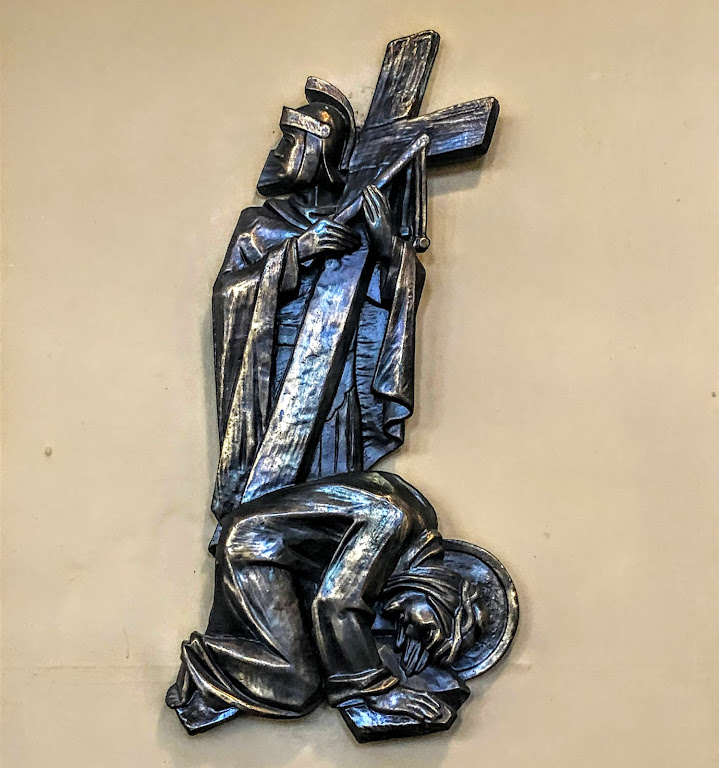
Jesus falls the First Time … Station 3 in Stony Stratford (Photograph: Patrick Comerford)
Jesus meets his Sorrowful Mother … Station 4 in Stony Stratford (Photograph: Patrick Comerford)
Simon of Cyrene Helps Jesus carry his Cross … Station 5 in Stony Stratford (Photograph: Patrick Comerford)
Veronica wipes the Face of Jesus … Station 6 in Stony Stratford (Photograph: Patrick Comerford)
Jesus falls The Second Time … Station 7 in Stony Stratford (Photograph: Patrick Comerford)
The Women Of Jerusalem weep over Jesus … Station 8 in the Stations of the Cross in Stony Stratford (Photograph: Patrick Comerford)
Jesus falls The Third Time … Station 9 in Stony Stratford (Photograph: Patrick Comerford)
Jesus Is stripped of his garments … Station 10 in Stony Stratford (Photograph: Patrick Comerford)
Jesus Is nailed To The Cross … Station 11 in Stony Stratford (Photograph: Patrick Comerford)
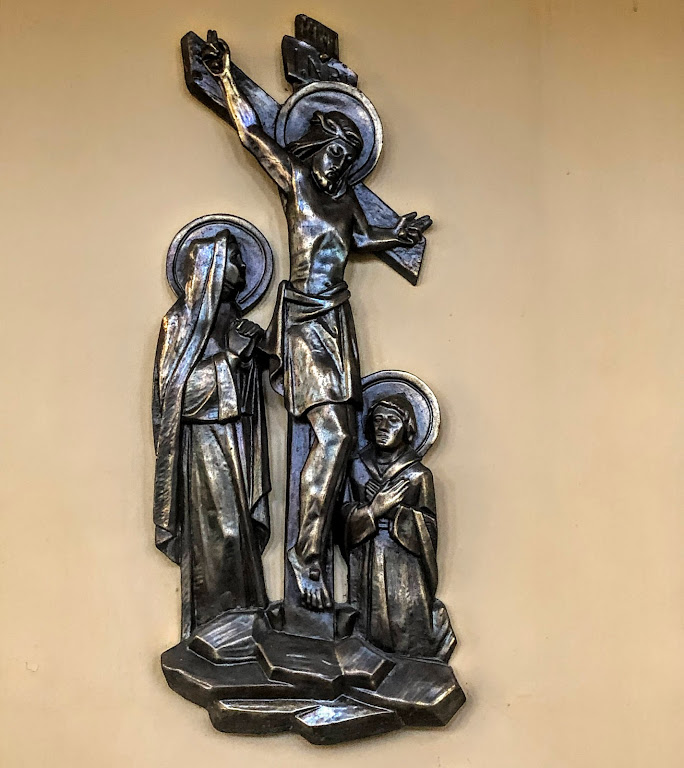
Jesus Is Raised Upon the Cross And Dies … Station 12 in Stony Stratford (Photograph: Patrick Comerford)
Jesus Is taken down from the Cross and placed In the arms of his Mother … Station 13 in Stony Stratford (Photograph: Patrick Comerford)
Jesus is laid In the Sepulchre … Station 14 in Stony Stratford (Photograph: Patrick Comerford)
Today’s Prayers (Friday 3 April 2026, Good Friday):
The theme this week (29 March-4 April 2026) in ‘Pray With the World Church’, the Prayer Diary of the Anglican mission agency USPG (United Society Partners in the Gospel), is a ‘Holy Week’ reflection’ (pp 42-43). This theme was introduced on Sunday with reflections by the Revd Kenson Li, Assistant Curate of Manchester Cathedral and a Trustee of USPG.
The USPG Prayer Diary today (Friday 4 April 2026, Good Friday) invites us to pray:
Jesus, Saviour of the world, who rested in the tomb and sanctified the grave as a bed of hope: help us to know the depth of our need for forgiveness, and the greater power of your everlasting love.
The Collect:
Almighty Father,
look with mercy on this your family
for which our Lord Jesus Christ was content to be betrayed
and given up into the hands of sinners
and to suffer death upon the cross;
who is alive and glorified with you and the Holy Spirit,
one God, now and for ever.
Additional Collect:
Eternal God,
in the cross of Jesus
we see the cost of our sin
and the depth of your love:
in humble hope and fear
may we place at his feet
all that we have and all that we are,
through Jesus Christ our Lord.
Yesterday’s Reflections
Continued Tomorrow
The processions arriving at the Church of the Four Martyrs in Rethymnon on Good Friday last year (Patrick Comerford)
Scripture quotations are from the New Revised Standard Version Bible: Anglicised Edition copyright © 1989, 1995 National Council of the Churches of Christ in the United States of America. Used by permission. All rights reserved worldwide. http://nrsvbibles.org
Patrick Comerford
We are at the climax of Holy Week, the last week in Lent. Today is Good Friday (3 April 2026), known as Great Friday in the Greek Orthodox Church.
We were in Oxford yesterday for the Chrism Eucharist in Christ Church and the renewal of ordination vows, and I was back in Stony Stratford last night for the Eucharist of the Last Supper and the Watch of the Passion in Saint Mary and Saint Giles Church. I hope to sing with the choir this afternoon when the Watch of the Passion continues (12 noon to 2 pm), followed by the Veneration of the Cross from 2 pm.
But, before this day begins, I am taking some quiet time this morning to give thanks, to reflect, to pray and to read in these ways:
1, reading today’s Gospel reading;
2, a short reflection;
3, a prayer from the USPG prayer diary;
4, the Collects of the day.
A Byzantine-style crucifix by Αλεξανδρα Καουκι, icon writer in Rethymnon, Crete
John 18: 1 to 19: 42 (NRSVA):
1 After Jesus had spoken these words, he went out with his disciples across the Kidron valley to a place where there was a garden, which he and his disciples entered. 2 Now Judas, who betrayed him, also knew the place, because Jesus often met there with his disciples. 3 So Judas brought a detachment of soldiers together with police from the chief priests and the Pharisees, and they came there with lanterns and torches and weapons. 4 Then Jesus, knowing all that was to happen to him, came forward and asked them, ‘For whom are you looking?’ 5 They answered, ‘Jesus of Nazareth.’ Jesus replied, ‘I am he.’ Judas, who betrayed him, was standing with them. 6 When Jesus said to them, ‘I am he’, they stepped back and fell to the ground. 7 Again he asked them, ‘For whom are you looking?’ And they said, ‘Jesus of Nazareth.’ 8 Jesus answered, ‘I told you that I am he. So if you are looking for me, let these men go.’ 9 This was to fulfil the word that he had spoken, ‘I did not lose a single one of those whom you gave me.’ 10 Then Simon Peter, who had a sword, drew it, struck the high priest’s slave, and cut off his right ear. The slave’s name was Malchus. 11 Jesus said to Peter, ‘Put your sword back into its sheath. Am I not to drink the cup that the Father has given me?’
12 So the soldiers, their officer, and the Jewish police arrested Jesus and bound him. 13 First they took him to Annas, who was the father-in-law of Caiaphas, the high priest that year. 14 Caiaphas was the one who had advised the Jews that it was better to have one person die for the people.
15 Simon Peter and another disciple followed Jesus. Since that disciple was known to the high priest, he went with Jesus into the courtyard of the high priest, 16 but Peter was standing outside at the gate. So the other disciple, who was known to the high priest, went out, spoke to the woman who guarded the gate, and brought Peter in. 17 The woman said to Peter, ‘You are not also one of this man’s disciples, are you?’ He said, ‘I am not.’ 18 Now the slaves and the police had made a charcoal fire because it was cold, and they were standing round it and warming themselves. Peter also was standing with them and warming himself.
19 Then the high priest questioned Jesus about his disciples and about his teaching. 20 Jesus answered, ‘I have spoken openly to the world; I have always taught in synagogues and in the temple, where all the Jews come together. I have said nothing in secret. 21 Why do you ask me? Ask those who heard what I said to them; they know what I said.’ 22 When he had said this, one of the police standing nearby struck Jesus on the face, saying, ‘Is that how you answer the high priest?’ 23 Jesus answered, ‘If I have spoken wrongly, testify to the wrong. But if I have spoken rightly, why do you strike me?’ 24 Then Annas sent him bound to Caiaphas the high priest.
25 Now Simon Peter was standing and warming himself. They asked him, ‘You are not also one of his disciples, are you?’ He denied it and said, ‘I am not.’ 26 One of the slaves of the high priest, a relative of the man whose ear Peter had cut off, asked, ‘Did I not see you in the garden with him?’ 27 Again Peter denied it, and at that moment the cock crowed.
28 Then they took Jesus from Caiaphas to Pilate’s headquarters. It was early in the morning. They themselves did not enter the headquarters, so as to avoid ritual defilement and to be able to eat the Passover. 29 So Pilate went out to them and said, ‘What accusation do you bring against this man?’ 30 They answered, ‘If this man were not a criminal, we would not have handed him over to you.’ 31 Pilate said to them, ‘Take him yourselves and judge him according to your law.’ The Jews replied, ‘We are not permitted to put anyone to death.’ 32 (This was to fulfil what Jesus had said when he indicated the kind of death he was to die.)
33 Then Pilate entered the headquarters again, summoned Jesus, and asked him, ‘Are you the King of the Jews?’ 34 Jesus answered, ‘Do you ask this on your own, or did others tell you about me?’ 35 Pilate replied, ‘I am not a Jew, am I? Your own nation and the chief priests have handed you over to me. What have you done?’ 36 Jesus answered, ‘My kingdom is not from this world. If my kingdom were from this world, my followers would be fighting to keep me from being handed over to the Jews. But as it is, my kingdom is not from here.’ 37 Pilate asked him, ‘So you are a king?’ Jesus answered, ‘You say that I am a king. For this I was born, and for this I came into the world, to testify to the truth. Everyone who belongs to the truth listens to my voice.’ 38 Pilate asked him, ‘What is truth?’
After he had said this, he went out to the Jews again and told them, ‘I find no case against him. 39 But you have a custom that I release someone for you at the Passover. Do you want me to release for you the King of the Jews?’ 40 They shouted in reply, ‘Not this man, but Barabbas!’ Now Barabbas was a bandit.
1 Then Pilate took Jesus and had him flogged. 2 And the soldiers wove a crown of thorns and put it on his head, and they dressed him in a purple robe. 3 They kept coming up to him, saying, ‘Hail, King of the Jews!’ and striking him on the face. 4 Pilate went out again and said to them, ‘Look, I am bringing him out to you to let you know that I find no case against him.’ 5 So Jesus came out, wearing the crown of thorns and the purple robe. Pilate said to them, ‘Here is the man!’ 6 When the chief priests and the police saw him, they shouted, ‘Crucify him! Crucify him!’ Pilate said to them, ‘Take him yourselves and crucify him; I find no case against him.’ 7 The Jews answered him, ‘We have a law, and according to that law he ought to die because he has claimed to be the Son of God.’
8 Now when Pilate heard this, he was more afraid than ever. 9 He entered his headquarters again and asked Jesus, ‘Where are you from?’ But Jesus gave him no answer. 10 Pilate therefore said to him, ‘Do you refuse to speak to me? Do you not know that I have power to release you, and power to crucify you?’ 11 Jesus answered him, ‘You would have no power over me unless it had been given you from above; therefore the one who handed me over to you is guilty of a greater sin.’ 12 From then on Pilate tried to release him, but the Jews cried out, ‘If you release this man, you are no friend of the emperor. Everyone who claims to be a king sets himself against the emperor.’
13 When Pilate heard these words, he brought Jesus outside and sat on the judge’s bench at a place called The Stone Pavement, or in Hebrew Gabbatha. 14 Now it was the day of Preparation for the Passover; and it was about noon. He said to the Jews, ‘Here is your King!’ 15 They cried out, ‘Away with him! Away with him! Crucify him!’ Pilate asked them, ‘Shall I crucify your King?’ The chief priests answered, ‘We have no king but the emperor.’ 16 Then he handed him over to them to be crucified.
So they took Jesus; 17 and carrying the cross by himself, he went out to what is called The Place of the Skull, which in Hebrew is called Golgotha. 18 There they crucified him, and with him two others, one on either side, with Jesus between them. 19 Pilate also had an inscription written and put on the cross. It read, ‘Jesus of Nazareth, the King of the Jews.’ 20 Many of the Jews read this inscription, because the place where Jesus was crucified was near the city; and it was written in Hebrew,[o] in Latin, and in Greek. 21 Then the chief priests of the Jews said to Pilate, ‘Do not write, “The King of the Jews”, but, “This man said, I am King of the Jews.”’ 22 Pilate answered, ‘What I have written I have written.’ 23 When the soldiers had crucified Jesus, they took his clothes and divided them into four parts, one for each soldier. They also took his tunic; now the tunic was seamless, woven in one piece from the top. 24 So they said to one another, ‘Let us not tear it, but cast lots for it to see who will get it.’ This was to fulfil what the scripture says,
‘They divided my clothes among themselves,
and for my clothing they cast lots.’
25 And that is what the soldiers did.
Meanwhile, standing near the cross of Jesus were his mother, and his mother’s sister, Mary the wife of Clopas, and Mary Magdalene. 26 When Jesus saw his mother and the disciple whom he loved standing beside her, he said to his mother, ‘Woman, here is your son.’ 27 Then he said to the disciple, ‘Here is your mother.’ And from that hour the disciple took her into his own home.
28 After this, when Jesus knew that all was now finished, he said (in order to fulfil the scripture), ‘I am thirsty.’ 29 A jar full of sour wine was standing there. So they put a sponge full of the wine on a branch of hyssop and held it to his mouth. 30 When Jesus had received the wine, he said, ‘It is finished.’ Then he bowed his head and gave up his spirit.
31 Since it was the day of Preparation, the Jews did not want the bodies left on the cross during the sabbath, especially because that sabbath was a day of great solemnity. So they asked Pilate to have the legs of the crucified men broken and the bodies removed. 32 Then the soldiers came and broke the legs of the first and of the other who had been crucified with him. 33 But when they came to Jesus and saw that he was already dead, they did not break his legs. 34 Instead, one of the soldiers pierced his side with a spear, and at once blood and water came out. 35 (He who saw this has testified so that you also may believe. His testimony is true, and he knows that he tells the truth.) 36 These things occurred so that the scripture might be fulfilled, ‘None of his bones shall be broken.’ 37 And again another passage of scripture says, ‘They will look on the one whom they have pierced.’
38 After these things, Joseph of Arimathea, who was a disciple of Jesus, though a secret one because of his fear of the Jews, asked Pilate to let him take away the body of Jesus. Pilate gave him permission; so he came and removed his body. 39 Nicodemus, who had at first come to Jesus by night, also came, bringing a mixture of myrrh and aloes, weighing about a hundred pounds. 40 They took the body of Jesus and wrapped it with the spices in linen cloths, according to the burial custom of the Jews. 41 Now there was a garden in the place where he was crucified, and in the garden there was a new tomb in which no one had ever been laid. 42 And so, because it was the Jewish day of Preparation, and the tomb was nearby, they laid Jesus there.
Venerating the Cross in Church of the Four Martyrs in Rethymnon at the beginning of the commemorations of Great and Good Friday (Photograph: Patrick Comerford)
Today’s Reflections:
Throughout this week, the Holy Week prayers and devotions in many churches have included the Stations of the Cross. The verse and response at each station is:
We adore you, O Christ, and we bless you,
Because by your holy cross
you have redeemed the world.
And then, following a meditation:
Lord Jesus crucified,
Have mercy on us!
The Stations of the Cross are not usually found in Greek Orthodox Churches, but the Good Friday processions through the streets of cities, towns and villages in Greece on the evening of Good Friday are unmatched in northern Europe. Because of the differences in calculating the date of Easter, Great and Good Friday is taking place in Greece next week. It is marked with the Veneration of the Cross, sombre tolling of church bells, and procession of the Epitaphios or bier of Christ through the streets.
This morning, my reflections on today’s Gospel reading (John 18: 1 to 19: 42) are assisted by images of the Stations of the Cross in Saint Mary and Saint Giles Church in Stony Stratford:
Jesus is condemned to Death … Station 1 in the Stations of the Cross in Saint Mary and Saint Giles Church in Stony Stratford (Photograph: Patrick Comerford)
Jesus is made to carry his Cross … Station 2 in Stony Stratford (Photograph: Patrick Comerford)
Jesus falls the First Time … Station 3 in Stony Stratford (Photograph: Patrick Comerford)
Jesus meets his Sorrowful Mother … Station 4 in Stony Stratford (Photograph: Patrick Comerford)
Simon of Cyrene Helps Jesus carry his Cross … Station 5 in Stony Stratford (Photograph: Patrick Comerford)
Veronica wipes the Face of Jesus … Station 6 in Stony Stratford (Photograph: Patrick Comerford)
Jesus falls The Second Time … Station 7 in Stony Stratford (Photograph: Patrick Comerford)
The Women Of Jerusalem weep over Jesus … Station 8 in the Stations of the Cross in Stony Stratford (Photograph: Patrick Comerford)
Jesus falls The Third Time … Station 9 in Stony Stratford (Photograph: Patrick Comerford)
Jesus Is stripped of his garments … Station 10 in Stony Stratford (Photograph: Patrick Comerford)
Jesus Is nailed To The Cross … Station 11 in Stony Stratford (Photograph: Patrick Comerford)
Jesus Is Raised Upon the Cross And Dies … Station 12 in Stony Stratford (Photograph: Patrick Comerford)
Jesus Is taken down from the Cross and placed In the arms of his Mother … Station 13 in Stony Stratford (Photograph: Patrick Comerford)
Jesus is laid In the Sepulchre … Station 14 in Stony Stratford (Photograph: Patrick Comerford)
Today’s Prayers (Friday 3 April 2026, Good Friday):
The theme this week (29 March-4 April 2026) in ‘Pray With the World Church’, the Prayer Diary of the Anglican mission agency USPG (United Society Partners in the Gospel), is a ‘Holy Week’ reflection’ (pp 42-43). This theme was introduced on Sunday with reflections by the Revd Kenson Li, Assistant Curate of Manchester Cathedral and a Trustee of USPG.
The USPG Prayer Diary today (Friday 4 April 2026, Good Friday) invites us to pray:
Jesus, Saviour of the world, who rested in the tomb and sanctified the grave as a bed of hope: help us to know the depth of our need for forgiveness, and the greater power of your everlasting love.
The Collect:
Almighty Father,
look with mercy on this your family
for which our Lord Jesus Christ was content to be betrayed
and given up into the hands of sinners
and to suffer death upon the cross;
who is alive and glorified with you and the Holy Spirit,
one God, now and for ever.
Additional Collect:
Eternal God,
in the cross of Jesus
we see the cost of our sin
and the depth of your love:
in humble hope and fear
may we place at his feet
all that we have and all that we are,
through Jesus Christ our Lord.
Yesterday’s Reflections
Continued Tomorrow
The processions arriving at the Church of the Four Martyrs in Rethymnon on Good Friday last year (Patrick Comerford)
Scripture quotations are from the New Revised Standard Version Bible: Anglicised Edition copyright © 1989, 1995 National Council of the Churches of Christ in the United States of America. Used by permission. All rights reserved worldwide. http://nrsvbibles.org
Labels:
Crete 2026,
Good Friday,
Greece 2026,
Holy Week,
Icons,
Lent 2026,
Mission,
Orthodoxy,
Oxford,
Prayer,
Rethymnon,
Saint John's Gospel,
Stations of the Cross,
Stony Stratford,
USPG
19 February 2026
Daily prayer in Lent 2026:
2, Thursday 19 February 2026
‘Let them deny themselves and take up their cross daily and follow me’ (Luke 9: 23) … the Crucifixion depicted on a 16th century sarcophagus from Skouloufia in the Archaeological Museum in Rethymnon (Photograph: Patrick Comerford, 2025)
Patrick Comerford
Lent began yesterday with Ash Wednesday yesterday (18 February 2026). At present we are in the middle of an epic marathon or odyssey, travelling from Heathrow overnight to Muscat, and then catching an early flight from Muscat to Kuala Lumpur in Malaysia this morning, before taking a later flight tonight to Kuching.
During the early hours of this morning, in Muscat Airport, between flights as the day began in the Gulf, I am taking some quiet time this morning to give thanks, to reflect, to pray and to read in these ways:
1, today’s Gospel reading;
2, a short reflection;
3, a prayer from the USPG prayer diary;
4, the Collects and Post-Communion prayer of the day.
‘Let them deny themselves and take up their cross daily and follow me’ (Luke 9: 23) … the Crucifixion by Georgia Grigoriadou, in an exhibition in the Fortezza in Rethymnon (Photograph: Patrick Comerford)
Luke 9: 22-25 (NRSVA):
22 [Jesus said:] ‘The Son of Man must undergo great suffering, and be rejected by the elders, chief priests, and scribes, and be killed, and on the third day be raised.’
23 Then he said to them all, ‘If any want to become my followers, let them deny themselves and take up their cross daily and follow me. 24 For those who want to save their life will lose it, and those who lose their life for my sake will save it. 25 What does it profit them if they gain the whole world, but lose or forfeit themselves?’
Penitents carrying their Crosses in the Good Friday procession in Barcelona (Photograph: Patrick Comerford)
Today’s Reflections:
In the Gospel reading at the Eucharist today (Luke 9: 22-25), after feeding the multitude and sending them away, Jesus has been was praying alone, with only the disciples nearby. When he asks them ‘Who do the crowds say that I am?’ (verse 18) and ‘who do you say that I am?’ (verse 20), Peter answers, ‘The Messiah of God.’
But Jesus commands them not to tell anyone, and goes on to talk about his own impending suffering, death and resurrection. He then challenges the disciples to follow him, deny themselves and ‘take up their cross daily and follow me’.
Last year and the year before I followed the Good Friday processions in Rethymnon in Crete. Over the years, I have often watched the Good Friday processions in places such as Rethymnon, Tsesmes and Thessaloniki in Greece and in Barcelona in Spain, where people humble themselves and take up the Cross in processions to symbolise their penitence and their renewed intention to follow Christ.
The cathedral in Barcelona is dedicated to the Holy Cross (Santa Cruz) and to Saint Eulalia, Barcelona’s martyr and first patron saint. There I once joined the procession of the Cross on Good Friday from the cathedral cloisters into the nave of the cathedral and out onto the steps of the west front for the solemn prayers and readings.
Later that day, I joined one of the many Good Friday evening processions through the narrow cobbled streets and small squares of the old city to the square in front of the main façade of the cathedral.
The outpouring of collective and individual piety in these processions is deeply moving. The procession I joined was led by a uniformed brass band playing solemn, funeral-style music or marchas procesionales, followed by a large float bearing a life-size Pieta composition from the Church of Sant Jaume on Calle Ferran, with a weeping Madonna cradling the dead body of Christ taken down from the Cross.
Along its way, the procession stopped relatedly in the narrow streets, and when it arrived at the cathedral it was joined by similar processions from other parishes throughout the old town with their own pasos or floats.
Penitent and pious people thronged the square for the evening of prayers. Some were dressed in the distinctive cloaks and hoods (capirotes) of the brotherhoods and confraternities associated with the Holy Week processions in Spain. Some women were dressed formally in black with tall head-dresses and black mantillas. A small number of people in bare feet carried their own large wooden crosses, shackled to chains they dragged behind them.
It is important for the processing penitents to keep their faces covered so that others do not know their identity. The fear is that the praise they might receive for taking up the cross would cancel out the penitence and piety they seek to express.
At the beginning of Lent, it is worth asking what benefits I expect from my planned penitential practices this Lent, as I seek to take up the Cross once again and to follow Christ? And I am reminded of the advice in yesterday’s Gospel reading (Matthew 6: 1-6, 16-21) about being private rather than public about almsgiving, praying and fasting.
Do I do any of these for the praise of others or in my search for ways to take up my cross daily and follow Christ?
The Crucifixion depicted in an icon by Hanna-Leena Ward in her exhibition in Lichfield Cathedral, which continues until tomorrow (Photograph: Patrick Comerford, 2026)
Today’s Prayers (Thursday 19 February 2026):
The theme this week (15-21 February 2026) in ‘Pray With the World Church,’ the Prayer Diary of the Anglican mission agency USPG (United Society Partners in the Gospel), is: ‘Look to the Amazon!’ (pp 28-29). This theme was introduced on Sunday with a Programme Update by the Most Revd Marinez Bassotto, Bishop of Amazonia and Archbishop of the Igreja Episcopal Anglicana do Brasil.
The USPG Prayer Diary today (Thursday 19 February 2026) invites us to pray:
Creator God, protect the Amazon, its rivers, forests, and the communities who call it home. Give us strength to act in ways that protect your earth.
The Collect:
Almighty and everlasting God,
you hate nothing that you have made
and forgive the sins of all those who are penitent:
create and make in us new and contrite hearts
that we, worthily lamenting our sins
and acknowledging our wretchedness,
may receive from you, the God of all mercy,
perfect remission and forgiveness;
through Jesus Christ your Son our Lord, who is alive and reigns with you,
in the unity of the Holy Spirit,
one God, now and for ever.
The Post-Communion Prayer:
Almighty God,
you have given your only Son to be for us
both a sacrifice for sin
and also an example of godly life:
give us grace
that we may always most thankfully receive
these his inestimable gifts,
and also daily endeavour
to follow the blessed steps of his most holy life;
through Jesus Christ our Lord.
Additional Collect:
Holy God,
our lives are laid open before you:
rescue us from the chaos of sin
and through the death of your Son
bring us healing and make us whole
in Jesus Christ our Lord.
Yesterday’s Reflections
Continued Tomorrow
The Good Friday procession in Rethymnon last year (Patrick Comerford)
Scripture quotations are from the New Revised Standard Version Bible: Anglicised Edition copyright © 1989, 1995, National Council of the Churches of Christ in the United States of America. Used by permission. All rights reserved worldwide. http://nrsvbibles.org
Patrick Comerford
Lent began yesterday with Ash Wednesday yesterday (18 February 2026). At present we are in the middle of an epic marathon or odyssey, travelling from Heathrow overnight to Muscat, and then catching an early flight from Muscat to Kuala Lumpur in Malaysia this morning, before taking a later flight tonight to Kuching.
During the early hours of this morning, in Muscat Airport, between flights as the day began in the Gulf, I am taking some quiet time this morning to give thanks, to reflect, to pray and to read in these ways:
1, today’s Gospel reading;
2, a short reflection;
3, a prayer from the USPG prayer diary;
4, the Collects and Post-Communion prayer of the day.
‘Let them deny themselves and take up their cross daily and follow me’ (Luke 9: 23) … the Crucifixion by Georgia Grigoriadou, in an exhibition in the Fortezza in Rethymnon (Photograph: Patrick Comerford)
Luke 9: 22-25 (NRSVA):
22 [Jesus said:] ‘The Son of Man must undergo great suffering, and be rejected by the elders, chief priests, and scribes, and be killed, and on the third day be raised.’
23 Then he said to them all, ‘If any want to become my followers, let them deny themselves and take up their cross daily and follow me. 24 For those who want to save their life will lose it, and those who lose their life for my sake will save it. 25 What does it profit them if they gain the whole world, but lose or forfeit themselves?’
Penitents carrying their Crosses in the Good Friday procession in Barcelona (Photograph: Patrick Comerford)
Today’s Reflections:
In the Gospel reading at the Eucharist today (Luke 9: 22-25), after feeding the multitude and sending them away, Jesus has been was praying alone, with only the disciples nearby. When he asks them ‘Who do the crowds say that I am?’ (verse 18) and ‘who do you say that I am?’ (verse 20), Peter answers, ‘The Messiah of God.’
But Jesus commands them not to tell anyone, and goes on to talk about his own impending suffering, death and resurrection. He then challenges the disciples to follow him, deny themselves and ‘take up their cross daily and follow me’.
Last year and the year before I followed the Good Friday processions in Rethymnon in Crete. Over the years, I have often watched the Good Friday processions in places such as Rethymnon, Tsesmes and Thessaloniki in Greece and in Barcelona in Spain, where people humble themselves and take up the Cross in processions to symbolise their penitence and their renewed intention to follow Christ.
The cathedral in Barcelona is dedicated to the Holy Cross (Santa Cruz) and to Saint Eulalia, Barcelona’s martyr and first patron saint. There I once joined the procession of the Cross on Good Friday from the cathedral cloisters into the nave of the cathedral and out onto the steps of the west front for the solemn prayers and readings.
Later that day, I joined one of the many Good Friday evening processions through the narrow cobbled streets and small squares of the old city to the square in front of the main façade of the cathedral.
The outpouring of collective and individual piety in these processions is deeply moving. The procession I joined was led by a uniformed brass band playing solemn, funeral-style music or marchas procesionales, followed by a large float bearing a life-size Pieta composition from the Church of Sant Jaume on Calle Ferran, with a weeping Madonna cradling the dead body of Christ taken down from the Cross.
Along its way, the procession stopped relatedly in the narrow streets, and when it arrived at the cathedral it was joined by similar processions from other parishes throughout the old town with their own pasos or floats.
Penitent and pious people thronged the square for the evening of prayers. Some were dressed in the distinctive cloaks and hoods (capirotes) of the brotherhoods and confraternities associated with the Holy Week processions in Spain. Some women were dressed formally in black with tall head-dresses and black mantillas. A small number of people in bare feet carried their own large wooden crosses, shackled to chains they dragged behind them.
It is important for the processing penitents to keep their faces covered so that others do not know their identity. The fear is that the praise they might receive for taking up the cross would cancel out the penitence and piety they seek to express.
At the beginning of Lent, it is worth asking what benefits I expect from my planned penitential practices this Lent, as I seek to take up the Cross once again and to follow Christ? And I am reminded of the advice in yesterday’s Gospel reading (Matthew 6: 1-6, 16-21) about being private rather than public about almsgiving, praying and fasting.
Do I do any of these for the praise of others or in my search for ways to take up my cross daily and follow Christ?
The Crucifixion depicted in an icon by Hanna-Leena Ward in her exhibition in Lichfield Cathedral, which continues until tomorrow (Photograph: Patrick Comerford, 2026)
Today’s Prayers (Thursday 19 February 2026):
The theme this week (15-21 February 2026) in ‘Pray With the World Church,’ the Prayer Diary of the Anglican mission agency USPG (United Society Partners in the Gospel), is: ‘Look to the Amazon!’ (pp 28-29). This theme was introduced on Sunday with a Programme Update by the Most Revd Marinez Bassotto, Bishop of Amazonia and Archbishop of the Igreja Episcopal Anglicana do Brasil.
The USPG Prayer Diary today (Thursday 19 February 2026) invites us to pray:
Creator God, protect the Amazon, its rivers, forests, and the communities who call it home. Give us strength to act in ways that protect your earth.
The Collect:
Almighty and everlasting God,
you hate nothing that you have made
and forgive the sins of all those who are penitent:
create and make in us new and contrite hearts
that we, worthily lamenting our sins
and acknowledging our wretchedness,
may receive from you, the God of all mercy,
perfect remission and forgiveness;
through Jesus Christ your Son our Lord, who is alive and reigns with you,
in the unity of the Holy Spirit,
one God, now and for ever.
The Post-Communion Prayer:
Almighty God,
you have given your only Son to be for us
both a sacrifice for sin
and also an example of godly life:
give us grace
that we may always most thankfully receive
these his inestimable gifts,
and also daily endeavour
to follow the blessed steps of his most holy life;
through Jesus Christ our Lord.
Additional Collect:
Holy God,
our lives are laid open before you:
rescue us from the chaos of sin
and through the death of your Son
bring us healing and make us whole
in Jesus Christ our Lord.
Yesterday’s Reflections
Continued Tomorrow
The Good Friday procession in Rethymnon last year (Patrick Comerford)
Scripture quotations are from the New Revised Standard Version Bible: Anglicised Edition copyright © 1989, 1995, National Council of the Churches of Christ in the United States of America. Used by permission. All rights reserved worldwide. http://nrsvbibles.org
Labels:
Barcelona,
Brazil,
Crete 2026,
Good Friday,
Greece 2026,
Icons,
Kuala Lumpur,
Kuching,
Lent 2026,
Lichfield Cathedral,
Mission,
Muscat,
Oman,
Prayer,
Rethymnon,
Saint Luke's Gospel,
Travel,
USPG
22 April 2025
Climbing the walls of
Iraklion at Easter to
visit the simple grave
of Nikos Kazantzakis
The grave of Nikos Kazantzakis on the Martinengo Bastion of the Venetian walls surrounding Iraklion (Photograph: Patrick Comerford, 2025)
Patrick Comerford
While I was in Iraklion last weekend, I climbed the old Venetian walls to see the panoramic view across the city and out to the Mediterranean and to visit the grave of the Greek writer and philosopher Nikos Kazantzakis (1883-1957).
It was a warm sunny day in Iraklion and I had spent part of my time visiting Saint Minas Cathedral and some of the older churches in the city. It was that quiet day between Good Friday and the celebrations on Easter night when little happens anywhere in Greece, when most of the cafés and restaurants are closed, and when tourists are at a loss about what to do.
When a friend I had arranged to meet for lunch found unexpectedly that she had to delay our arrangements for an hour or two, I decided to walk on through the colourful narrow streets of the older parts of Iraklion, and to visit the grave, which is found on the southernmost bastion, built by the Venetians in the 16th century.
I had last visited this grave almost 12 years ago (5 September 2013). It stands alone on top of the great walls and bastions that were part of the Venetian defences of the city they called Candia.
Two of the great city gates have survived to this day: the Pantocrator or Panigra Gate, also known now as the Chania Gate (1570), at the west edge; and the Jesus Gate or Kainouryia Gate (ca 1587), at the south edge. Between them, at the south-west corner of these great walls, is the grave of Nikos Kazantzakis on the Martinengo Bastion.
The roof tops of Iraklion and the dome and towers of Aghios Minas seen from the grave of Nikos Kazantzakis (Photograph: Patrick Comerford, 2025)
The grave, with its plain cross of two unadorned wooden beams and a simple, carved epitaph, is a tranquil oasis looking north across the roof tops of the city, pierced by the dome and the baroque towers of Aghios Minas. Beyond, the blue of the Mediterranean stretches out to meet the blue of the sky on the horizon.
To the south is Mount Iouktas: it looks like the head of a man in profile and so is said to have given rise to the Cretan legend that this was the head of the dead and buried god Zeus, a prequel to many thoughts in Crete on the death and resurrection of Christ at Easter.
This simple grave is so beloved of Greeks that it is a work of art in itself, visited by countless people who may never have read any books by Kazantzakis, or perhaps only know of him through films such as Zorba the Greek or The Last Temptation of Christ.
The grave is marked by a simple cross and a pithy epitaph carved in his own handwriting, with his own words:
Δεν ελπίζω τίποτα.
Δε φοβάμαι τίποτα.
Είμαι λέφτερος
(Den elpizo tipota. Den fovamai tipota. Eimai leftheros, ‘I hope for nothing, I fear nothing, I am free’).
The epitaph carved in the handwriting of Nikos Kazantzakis, with his own words (Photograph: Patrick Comerford, 2025)
Nikos Kazantzakis is a giant of modern Greek literature, and he was nominated for the Nobel Prize in Literature on nine separate occasions. He is best known, probably, for Zorba the Greek (1946, Βίος και Πολιτεία του Αλέξη Ζορμπά). But his other works include Christ Recrucified (1948, Ο Χριστός Ξανασταυρώνεται); Kapetan Michalis (1950, Καπετάν Μιχάλης), also published in English as Freedom or Death; The Last Temptation of Christ (1951, Ο Τελευταίος Πειρασμός); and Saint Francis or God’s Pauper: St Francis of Assisi (1956, Ο Φτωχούλης του Θεού). Report to Greco (1961, Αναφορά στον Γκρέκο), is both autobiographical and fictional.
Kazantzakis also published plays, travel books, poetry, memoirs, encyclopaedia entries and philosophical essays such as The Saviours of God: Spiritual Exercises, and translated Dante. His children’s books include Alexander the Great and At the Palaces of Knossos. His epic version of the Odyssey occupied Kazantzakis for his last 10 years.
After spending six months in a monastery, Kazantzakis published his Spiritual Exercises (Ασκητική) in 1927, which was translated into English and published posthumously in 1960 as The Saviours of God.
When The Last Temptation of Christ was published 1951, the Roman Catholic Church placed it on the Index of Prohibited Books. Kazantzakis’ reaction was to send a telegram to the Vatican quoting Tertullian: ‘Ad tuum, Domine, tribunal appello’ (I lodge my appeal at your tribunal, Lord, Στο δικαστήριό σου ασκώ έφεση, ω Kύριε).
When the Church of Greece condemned Kazantzakis in 1955 and anathematised him, his response was prompt and clear: ‘You gave me a curse, Holy fathers, I give you a blessing: may your conscience be as clear as mine and may you be as moral and religious as I.’ (‘Μου δώσατε μια κατάρα, Άγιοι πατέρες, σας δίνω κι εγώ μια ευχή: Σας εύχομαι να ‘ναι η συνείδηση σας τόσο καθαρή, όσο είναι η δική μου και να ‘στε τόσο ηθικοί και θρήσκοι όσο είμαι εγώ.’).
In his later years, Kazantzakis was banned from entering Greece for long periods. By one vote, he lost the Nobel Prize for Literature to Albert Camus a few days before he died in exile in Germany on 26 October 1957. When his body was brought back from Freiburg, the Greek Orthodox Church refused to allow any priests to provide rites or ceremonies in Athens.
The Martinengo Bastion on the Venetian walls surrounding Iraklion (Photograph: Patrick Comerford, 2025)
Western writers often claim Kazantzakis was denied an Orthodox burial because of his unorthodox views, or because of The Last Temptation. But Aristotle Onassis provided a plane to take his coffin to Iraklion, where Kazantzakis lay in state in the Cathedral of Aghios Minas.
Those who came to pay tribute included the Archbishop of Crete and the resistance leader and future prime minister, George Papandreou. A priest officiated at the burial, giving lie to the popular claim that Kazantzakis had died an excommunicate.
His widow Eleni later lived in Geneva, and from 1967 until 1974 she was unable to travel to Greece until the fall of the colonels’ junta. She died on 18 February 2004 in the Henry Dunant Hospital in Athens, holding the hand of her adopted son, Patroclos Stavrou. I was visiting Athens at the time, and had arranged to meet her, only to find she died on the night I arrived and the day before we were due to meet. She was buried with her husband on the walls looking across Aghios Minas and the city.
The funeral of Nikos Kazantzakis in Iraklion in 1957
My friend Manolis Chrysakis, the proprietor of Mika Villas in Piskopiano, and his family in Iraklion and Piskopiano are proud of their kinship with Nikos Kazantzakis: they are descended from the sister-in-law of ‘Kapetan Mihailis’, the eponymous hero of the Kazantzakis novel based on his father’s adventures published in English as Freedom and Death.
One balmy summer’s evening with the Chrysakis family in Piskopiano almost 30 years ago, Manolis’ uncle, the late Kostas Chrysakis, pored over old family photographs, postcards and letters, sharing childhood memories of his famous ‘Uncle Nikos.’
Kostas Chrysakis shared his family’s treasured photographs of his uncle’s funeral. They show men in traditional island costumes, like Dirk Bogarde in Ill Met by Moonlight, in a procession led by robed Orthodox priests through the narrow thronged streets up to the city walls.
Kostas claimed that when the Vatican and the Archbishop of Athens demanded the excommunication of Kazantzakis following the publication of The Last Temptation of Christ, the Patriarch of Constantinople insisted that the Church of Crete was independent from the Church of Greece and under his direct oversight. A year later, a priest led the traditional family prayers at the graveside.
Visiting Manolis Chrysakis of Iraklion in Mika Villas in Piskopiano (Photograph: Patrick Comerford)
To mark the 60th anniversary of his death, the Greek Ministry of Culture declared 2017 as the ‘Year of Nikos Kazantzakis,’ with cultural events in Crete, throughout Greece and across the world.
In Ireland, the events included a public lecture by his adopted granddaughter, Dr Niki Stavrou, in University College Dublin. Niki Stavrou is the publisher of Kazantzakis’s works and the Director of Kazantzakis Publications since May 2014. Her godmother, Eleni Kazantzakis, gave her the name Niki to honour and commemorate her late husband, Nikos Kazantzakis.
In her research on the life of Nikos Kazantzakis and the real people behind the characters of Report to Greco, Niki Stavrou identified the first love of Nikos Kazantzakis as Kathleen Forde from Ireland.
Peter Bien of Dartmouth, who translated many of his novels, once wondered whether Kazantzakis would be read 50 years after his death. But after his death, his fame spread in the English-speaking world because of the film adaptations of Zorba the Greek (1964) and The Last Temptation of Christ (1988).
For many people in Crete, his outstanding works remain his semi-autobiographical but posthumous Report to Greco (1960) and his Freedom and Death (1946), set in Iraklion during the struggle against Ottoman oppression.
Freedom and Death first appeared in Greek as Kapetan Michailis, and the eponymous hero is the author’s own father. The characters are the people of 19th century Iraklion, the settings are its streets, churches, harbour, fountains, mosques, and houses, which I had strolled through in the sunshine last weekend.
His home town of Iraklion provides the setting for much of the work of Nikos Kazantzakis (Photograph: Patrick Comerford, 2025)
The simplicity of the cross on his grave reminds me of the simplicity of the Cross of Nails in Coventry Cathedral. The simplicity and the quiet spirituality expressed in the setting and the epitaph on the grave reflect his personality and style and his life and work.
Throughout his writings, he wrestles with his ideas about God and Humanity, and at different times he spent months in monasteries on Mount Athos and on Mount Sinai in prayer and contemplation.
At his grave, I recalled how he prefaced Report to Greco with a prayer:
Three kinds of souls, three kinds of prayers: 1, I am a bow in your hands, Lord, draw me lest I rot. 2, Do not overdraw me, Lord, I shall break. 3, Overdraw me, Lord, and who cares if I break!’
The figure of Christ is ever-present in his thoughts, from his youth to his final days. In his introduction to Report to Greco, Kazantzakis says ‘My entire soul is a cry, and all my work the commentary on that cry.’ In The Fratricides (1964), I came across this beautiful line: ‘I said to the almond tree: ‘Speak to me of God.’ and the almond tree blossomed.’
In The Last Temptation of Christ, he presents a tragic Christ wrestling all his life with the conflicting claims of his divine mission and duty and his human desire to live a normal life, to love and be loved, and to have a family. In this book, Christ summarises his purpose and mission: ‘I said only one word, brought only one message: ‘Love. Love – nothing else’.’
Writing about this book, Kazantzakis said: ‘I am certain that every free man who reads this book, so filled as it is with love, will more than ever before, love Christ.’
Some years ago, I wrote about Kazantzakis and his brief love affair with Kathleen Ford, the daughter of an Irish rector, which he recalls in his semi-autobiographical Report to Greco. He prefaces that book with a prayer: ‘Three kinds of souls, three kinds of prayers: 1, I am a bow in your hands, Lord, draw me lest I rot. 2, Do not overdraw me, Lord, I shall break. 3, Overdraw me, Lord, and who cares if I break!’
During my climb to his grave last weekend, in the space between Good Friday and Easter on my climb up the walls of Iraklion, I was reminded that Kazantzakis says in Report to Greco: ‘Every man worthy of being called a son of man bears his cross and mounts his Golgotha. Many, indeed most, reach the first or second step, collapse pantingly in the middle of the journey, and do not attain the summit of Golgotha, in other words the summit of their duty: to be crucified, resurrected, and to save their souls. Afraid of crucifixion, they grow fainthearted; they do not know that the cross is the only path to resurrection. There is no other path.’
Later in the book, he writes: ‘Whoever climbed the Lord’s mountain had to possess clean hands and an innocent heart; otherwise the Summit would kill him. Today the doorway is deserted. Soiled hands and sinful hearts are able to pass by without fear, for the Summit kills no longer.’
And he advises: ‘Tomorrow, go forth and stand before the Lord. A great and strong wind will blow over you and rend the mountains and break in pieces the rocks, but the Lord will not be in the wind. And after the wind and earthquake, but the Lord will not be in the earthquake. And after the earthquake a fire, but the Lord will not be in the fire. And after the fire a gentle, cooling breeze. That is where the Lord will be. This is how the spirit comes. After the gale, the earthquake, and fire: a gentle, cooling breeze. This is how it will come in our own day as well. We are passing through the period of earthquake, the fire is approaching, and eventually (when? after how many generations?) the gentle, cool breeze will blow.’
I said only one word, brought only one message: ‘Love. Love – nothing else’ (Photograph: Patrick Comerford, 2025)
Patrick Comerford
While I was in Iraklion last weekend, I climbed the old Venetian walls to see the panoramic view across the city and out to the Mediterranean and to visit the grave of the Greek writer and philosopher Nikos Kazantzakis (1883-1957).
It was a warm sunny day in Iraklion and I had spent part of my time visiting Saint Minas Cathedral and some of the older churches in the city. It was that quiet day between Good Friday and the celebrations on Easter night when little happens anywhere in Greece, when most of the cafés and restaurants are closed, and when tourists are at a loss about what to do.
When a friend I had arranged to meet for lunch found unexpectedly that she had to delay our arrangements for an hour or two, I decided to walk on through the colourful narrow streets of the older parts of Iraklion, and to visit the grave, which is found on the southernmost bastion, built by the Venetians in the 16th century.
I had last visited this grave almost 12 years ago (5 September 2013). It stands alone on top of the great walls and bastions that were part of the Venetian defences of the city they called Candia.
Two of the great city gates have survived to this day: the Pantocrator or Panigra Gate, also known now as the Chania Gate (1570), at the west edge; and the Jesus Gate or Kainouryia Gate (ca 1587), at the south edge. Between them, at the south-west corner of these great walls, is the grave of Nikos Kazantzakis on the Martinengo Bastion.
The roof tops of Iraklion and the dome and towers of Aghios Minas seen from the grave of Nikos Kazantzakis (Photograph: Patrick Comerford, 2025)
The grave, with its plain cross of two unadorned wooden beams and a simple, carved epitaph, is a tranquil oasis looking north across the roof tops of the city, pierced by the dome and the baroque towers of Aghios Minas. Beyond, the blue of the Mediterranean stretches out to meet the blue of the sky on the horizon.
To the south is Mount Iouktas: it looks like the head of a man in profile and so is said to have given rise to the Cretan legend that this was the head of the dead and buried god Zeus, a prequel to many thoughts in Crete on the death and resurrection of Christ at Easter.
This simple grave is so beloved of Greeks that it is a work of art in itself, visited by countless people who may never have read any books by Kazantzakis, or perhaps only know of him through films such as Zorba the Greek or The Last Temptation of Christ.
The grave is marked by a simple cross and a pithy epitaph carved in his own handwriting, with his own words:
Δεν ελπίζω τίποτα.
Δε φοβάμαι τίποτα.
Είμαι λέφτερος
(Den elpizo tipota. Den fovamai tipota. Eimai leftheros, ‘I hope for nothing, I fear nothing, I am free’).
The epitaph carved in the handwriting of Nikos Kazantzakis, with his own words (Photograph: Patrick Comerford, 2025)
Nikos Kazantzakis is a giant of modern Greek literature, and he was nominated for the Nobel Prize in Literature on nine separate occasions. He is best known, probably, for Zorba the Greek (1946, Βίος και Πολιτεία του Αλέξη Ζορμπά). But his other works include Christ Recrucified (1948, Ο Χριστός Ξανασταυρώνεται); Kapetan Michalis (1950, Καπετάν Μιχάλης), also published in English as Freedom or Death; The Last Temptation of Christ (1951, Ο Τελευταίος Πειρασμός); and Saint Francis or God’s Pauper: St Francis of Assisi (1956, Ο Φτωχούλης του Θεού). Report to Greco (1961, Αναφορά στον Γκρέκο), is both autobiographical and fictional.
Kazantzakis also published plays, travel books, poetry, memoirs, encyclopaedia entries and philosophical essays such as The Saviours of God: Spiritual Exercises, and translated Dante. His children’s books include Alexander the Great and At the Palaces of Knossos. His epic version of the Odyssey occupied Kazantzakis for his last 10 years.
After spending six months in a monastery, Kazantzakis published his Spiritual Exercises (Ασκητική) in 1927, which was translated into English and published posthumously in 1960 as The Saviours of God.
When The Last Temptation of Christ was published 1951, the Roman Catholic Church placed it on the Index of Prohibited Books. Kazantzakis’ reaction was to send a telegram to the Vatican quoting Tertullian: ‘Ad tuum, Domine, tribunal appello’ (I lodge my appeal at your tribunal, Lord, Στο δικαστήριό σου ασκώ έφεση, ω Kύριε).
When the Church of Greece condemned Kazantzakis in 1955 and anathematised him, his response was prompt and clear: ‘You gave me a curse, Holy fathers, I give you a blessing: may your conscience be as clear as mine and may you be as moral and religious as I.’ (‘Μου δώσατε μια κατάρα, Άγιοι πατέρες, σας δίνω κι εγώ μια ευχή: Σας εύχομαι να ‘ναι η συνείδηση σας τόσο καθαρή, όσο είναι η δική μου και να ‘στε τόσο ηθικοί και θρήσκοι όσο είμαι εγώ.’).
In his later years, Kazantzakis was banned from entering Greece for long periods. By one vote, he lost the Nobel Prize for Literature to Albert Camus a few days before he died in exile in Germany on 26 October 1957. When his body was brought back from Freiburg, the Greek Orthodox Church refused to allow any priests to provide rites or ceremonies in Athens.
The Martinengo Bastion on the Venetian walls surrounding Iraklion (Photograph: Patrick Comerford, 2025)
Western writers often claim Kazantzakis was denied an Orthodox burial because of his unorthodox views, or because of The Last Temptation. But Aristotle Onassis provided a plane to take his coffin to Iraklion, where Kazantzakis lay in state in the Cathedral of Aghios Minas.
Those who came to pay tribute included the Archbishop of Crete and the resistance leader and future prime minister, George Papandreou. A priest officiated at the burial, giving lie to the popular claim that Kazantzakis had died an excommunicate.
His widow Eleni later lived in Geneva, and from 1967 until 1974 she was unable to travel to Greece until the fall of the colonels’ junta. She died on 18 February 2004 in the Henry Dunant Hospital in Athens, holding the hand of her adopted son, Patroclos Stavrou. I was visiting Athens at the time, and had arranged to meet her, only to find she died on the night I arrived and the day before we were due to meet. She was buried with her husband on the walls looking across Aghios Minas and the city.
The funeral of Nikos Kazantzakis in Iraklion in 1957
My friend Manolis Chrysakis, the proprietor of Mika Villas in Piskopiano, and his family in Iraklion and Piskopiano are proud of their kinship with Nikos Kazantzakis: they are descended from the sister-in-law of ‘Kapetan Mihailis’, the eponymous hero of the Kazantzakis novel based on his father’s adventures published in English as Freedom and Death.
One balmy summer’s evening with the Chrysakis family in Piskopiano almost 30 years ago, Manolis’ uncle, the late Kostas Chrysakis, pored over old family photographs, postcards and letters, sharing childhood memories of his famous ‘Uncle Nikos.’
Kostas Chrysakis shared his family’s treasured photographs of his uncle’s funeral. They show men in traditional island costumes, like Dirk Bogarde in Ill Met by Moonlight, in a procession led by robed Orthodox priests through the narrow thronged streets up to the city walls.
Kostas claimed that when the Vatican and the Archbishop of Athens demanded the excommunication of Kazantzakis following the publication of The Last Temptation of Christ, the Patriarch of Constantinople insisted that the Church of Crete was independent from the Church of Greece and under his direct oversight. A year later, a priest led the traditional family prayers at the graveside.
Visiting Manolis Chrysakis of Iraklion in Mika Villas in Piskopiano (Photograph: Patrick Comerford)
To mark the 60th anniversary of his death, the Greek Ministry of Culture declared 2017 as the ‘Year of Nikos Kazantzakis,’ with cultural events in Crete, throughout Greece and across the world.
In Ireland, the events included a public lecture by his adopted granddaughter, Dr Niki Stavrou, in University College Dublin. Niki Stavrou is the publisher of Kazantzakis’s works and the Director of Kazantzakis Publications since May 2014. Her godmother, Eleni Kazantzakis, gave her the name Niki to honour and commemorate her late husband, Nikos Kazantzakis.
In her research on the life of Nikos Kazantzakis and the real people behind the characters of Report to Greco, Niki Stavrou identified the first love of Nikos Kazantzakis as Kathleen Forde from Ireland.
Peter Bien of Dartmouth, who translated many of his novels, once wondered whether Kazantzakis would be read 50 years after his death. But after his death, his fame spread in the English-speaking world because of the film adaptations of Zorba the Greek (1964) and The Last Temptation of Christ (1988).
For many people in Crete, his outstanding works remain his semi-autobiographical but posthumous Report to Greco (1960) and his Freedom and Death (1946), set in Iraklion during the struggle against Ottoman oppression.
Freedom and Death first appeared in Greek as Kapetan Michailis, and the eponymous hero is the author’s own father. The characters are the people of 19th century Iraklion, the settings are its streets, churches, harbour, fountains, mosques, and houses, which I had strolled through in the sunshine last weekend.
His home town of Iraklion provides the setting for much of the work of Nikos Kazantzakis (Photograph: Patrick Comerford, 2025)
The simplicity of the cross on his grave reminds me of the simplicity of the Cross of Nails in Coventry Cathedral. The simplicity and the quiet spirituality expressed in the setting and the epitaph on the grave reflect his personality and style and his life and work.
Throughout his writings, he wrestles with his ideas about God and Humanity, and at different times he spent months in monasteries on Mount Athos and on Mount Sinai in prayer and contemplation.
At his grave, I recalled how he prefaced Report to Greco with a prayer:
Three kinds of souls, three kinds of prayers: 1, I am a bow in your hands, Lord, draw me lest I rot. 2, Do not overdraw me, Lord, I shall break. 3, Overdraw me, Lord, and who cares if I break!’
The figure of Christ is ever-present in his thoughts, from his youth to his final days. In his introduction to Report to Greco, Kazantzakis says ‘My entire soul is a cry, and all my work the commentary on that cry.’ In The Fratricides (1964), I came across this beautiful line: ‘I said to the almond tree: ‘Speak to me of God.’ and the almond tree blossomed.’
In The Last Temptation of Christ, he presents a tragic Christ wrestling all his life with the conflicting claims of his divine mission and duty and his human desire to live a normal life, to love and be loved, and to have a family. In this book, Christ summarises his purpose and mission: ‘I said only one word, brought only one message: ‘Love. Love – nothing else’.’
Writing about this book, Kazantzakis said: ‘I am certain that every free man who reads this book, so filled as it is with love, will more than ever before, love Christ.’
Some years ago, I wrote about Kazantzakis and his brief love affair with Kathleen Ford, the daughter of an Irish rector, which he recalls in his semi-autobiographical Report to Greco. He prefaces that book with a prayer: ‘Three kinds of souls, three kinds of prayers: 1, I am a bow in your hands, Lord, draw me lest I rot. 2, Do not overdraw me, Lord, I shall break. 3, Overdraw me, Lord, and who cares if I break!’
During my climb to his grave last weekend, in the space between Good Friday and Easter on my climb up the walls of Iraklion, I was reminded that Kazantzakis says in Report to Greco: ‘Every man worthy of being called a son of man bears his cross and mounts his Golgotha. Many, indeed most, reach the first or second step, collapse pantingly in the middle of the journey, and do not attain the summit of Golgotha, in other words the summit of their duty: to be crucified, resurrected, and to save their souls. Afraid of crucifixion, they grow fainthearted; they do not know that the cross is the only path to resurrection. There is no other path.’
Later in the book, he writes: ‘Whoever climbed the Lord’s mountain had to possess clean hands and an innocent heart; otherwise the Summit would kill him. Today the doorway is deserted. Soiled hands and sinful hearts are able to pass by without fear, for the Summit kills no longer.’
And he advises: ‘Tomorrow, go forth and stand before the Lord. A great and strong wind will blow over you and rend the mountains and break in pieces the rocks, but the Lord will not be in the wind. And after the wind and earthquake, but the Lord will not be in the earthquake. And after the earthquake a fire, but the Lord will not be in the fire. And after the fire a gentle, cooling breeze. That is where the Lord will be. This is how the spirit comes. After the gale, the earthquake, and fire: a gentle, cooling breeze. This is how it will come in our own day as well. We are passing through the period of earthquake, the fire is approaching, and eventually (when? after how many generations?) the gentle, cool breeze will blow.’
I said only one word, brought only one message: ‘Love. Love – nothing else’ (Photograph: Patrick Comerford, 2025)
Labels:
Athens,
Crete 2025,
Easter 2025,
Family History,
Good Friday,
Greece 2025,
Iraklion,
Kazantzakis,
Literature,
Local History,
Movies,
Orthodoxy,
Piskopiano,
Poetry,
Prayer,
Theology and Culture
19 April 2025
The Epitaphios processions
make their way through the
streets of Rethymnon on
Great Friday or Good Friday
Good Friday evening 2025 in Rethymnon, Part 1: the procession of the Epitaphios leaves the Cathedral (Patrick Comerford, 2025)
Good Friday evening 2025 in Rethymnon, Part 2: the procession of the Epitaphios reaches the Church of the Four Martyrs (Patrick Comerford, 2025)
Patrick Comerford
I spent three or four hours last night (18 April 2025) at the Cathedral in Rethymnon, following the Great Friday or Good Friday prayers and services, presided over by Metropolitan Prodromos of Rethymnon.
The cathedral was packed inside, and there was as many people waiting patiently outside as a military detachment stood ready to provide a guard of honour.
Towards the end of the service, Metropolitan Prodromos came to the steps at the front of the cathedral to cense and bless the throng outside.
Acolytes had their candles lighting, and a group of young women and teenage girls were stood with their baskets of petals to be strewn before the Epitaphios.
As the Epitaphios came down the steps of the cathedral, with a large number of intoning and chanting priests, deacons, readers and cantors, people in the crowd jostled for positions to join the procession.
From the cathedral, we pushed and heaved our way through the narrow streets of Rethmynon, through the Porta Guora, the city’s old Venetian gate, and into the square in front of the Church of the Four Martyrs.
Similar processions from churches throughout Rethymnon, each with its own decorated bier and Epitaphios, were converging in the square, as they do on Good Friday each year. There a choir was singing traditional solemn Great Friday hymns to a square that was packed with thousands of people, many only able to cram into the side streets and alleyways.
From the steps of the church, Metropolitan Prodromos delivered his Great Friday address, and blessed the massed crowd.
As each Epitaphios was carried away solemnly, back to its own waiting church, the choir resumed singing on the steps of the Church of the Four Martyrs.
The Easter celebrations begin tonight with the first Eucharist of Easter beginning before Midnight.
Metroplitan Prodromos censes the people outside the cathedral in Rethymnon (Photograph: Patrick Comerford, 2025)
Acolytes wait patiently for the procession of the Epitaphios outside the Cathedral in Rethymnon last night (Photograph: Patrick Comerford, 2025)
18 April 2025
A solemn commemoration
of Great and Good Friday in
the cathedral in Rethymnon on
the most solemn day in Crete
People queue to venerate the Epitaphios in the cathedral in Rethymnon this afternoon (Photograph: Patrick Comerford, 2025)
Patrick Comerford
Today is known in the Orthodox Church as Great Friday rather than Good Friday, and I have spent much of the morning at the morning services in the Cathedral in Rethymnon (18 April 2025).
This is the most solemn day in the calendar of the Orthodox Church, and, despite the sunshine and the large throngs of tourists, many of the shops and cafés in Rethymnon closed for a few hours this morning.
People who remember the solemnity of Good Friday commemorations in Ireland that continued into the 1970s, perhaps even the 1980s, will understand the solemnity with which this day is marked in Greece.
The commemorations in the cathedral today were presided over by the Metropolitan of Rethymnon, Bishop Prodromos (Xenakis), who has been in office for the past three years. He is a former Bishop of Knossos, and I got to know him when he was a post-graduate student in Maynooth in 2010-2012. He was following a programme in Biblical studies leading to the MTh degree, and was attached to the Greek Orthodox Church in Dublin.
During those post-graduate student days in Maynooth, we took part together in Greek community events in Dublin, a broadcast service on RTÉ, and he came to the Church of Ireland Theological Institute when I was presiding at the Community Eucharist on the day the Church Calendar remembers Saint Polycarp of Smyrna.
After meeting a good friend for coffee this afternoon, I went to this morning’s main service in the cathedral, which included the veneration of the Cross and the Bier and Christ, and the Epitaphios (Ἐπιτάφιον), the large, embroidered and richly adorned cloth that is woven with the image of the dead Christ.
The priests and deacons had already places the Epitaphios on the Holy Table or altar, had anointed the Epitaphios with perfumed oil, and had placed a chalice veil and the Gospel Book on top of it.
During the reading of the Gospel accounts of the death and burial of Christ, the icon depicting the body of Christ was taken down from the cross, wrapped in a white cloth and taken into the sanctuary.
As the service was drawing to its end, the priest and deacon, accompanied by acolytes with candles and incense, carried the Epitaphios in procession from the Holy Table the church, placed it on the bier, richly decorated with white, red, and purple flowers, beneath the kouvouklion, an elaborately carved canopy, and laid the Gospel Book on the Epitaphios. In some Greek churches. Finally, Metropolitan Prodromos, scattered more petals on bier and the Epitaphios, and sprinkled the congregation with holy water.
The largest commemorations take place this evening so that the largest number of people can attend. The Epitaphios will vary be processed through the streets, with bands and solemn music. Sometimes, young people crawl under the bier, perhaps representing that they too are entering into death with Christ.
This evening’s procession ends with drama and solemnity at the steps at the steps leading up to the Church of the Four Martyrs.
As I was leaving the cathedral this afternoon, people were still joining a long queue to venerate the Epitaphios as the choir chanted. The bells of the cathedral and the neighbouring churches are continuing to toll this afternoon, and there is a constant stream of people coming to venerate the Epitaphios in the cathedral and churches in Rethymnon.
The hustle and bustle of daily life has resumed in the city, and few tourists have probably glimpsed this dimension of Greek life and piety today. But everything grinds to a halt this evening to mark the climax of this, the most solemn day in Crete.
The Epitaphios is placed in the bier in the cathedral in Rethymnon this afternoon (Photograph: Patrick Comerford, 2025)
Patrick Comerford
Today is known in the Orthodox Church as Great Friday rather than Good Friday, and I have spent much of the morning at the morning services in the Cathedral in Rethymnon (18 April 2025).
This is the most solemn day in the calendar of the Orthodox Church, and, despite the sunshine and the large throngs of tourists, many of the shops and cafés in Rethymnon closed for a few hours this morning.
People who remember the solemnity of Good Friday commemorations in Ireland that continued into the 1970s, perhaps even the 1980s, will understand the solemnity with which this day is marked in Greece.
The commemorations in the cathedral today were presided over by the Metropolitan of Rethymnon, Bishop Prodromos (Xenakis), who has been in office for the past three years. He is a former Bishop of Knossos, and I got to know him when he was a post-graduate student in Maynooth in 2010-2012. He was following a programme in Biblical studies leading to the MTh degree, and was attached to the Greek Orthodox Church in Dublin.
During those post-graduate student days in Maynooth, we took part together in Greek community events in Dublin, a broadcast service on RTÉ, and he came to the Church of Ireland Theological Institute when I was presiding at the Community Eucharist on the day the Church Calendar remembers Saint Polycarp of Smyrna.
After meeting a good friend for coffee this afternoon, I went to this morning’s main service in the cathedral, which included the veneration of the Cross and the Bier and Christ, and the Epitaphios (Ἐπιτάφιον), the large, embroidered and richly adorned cloth that is woven with the image of the dead Christ.
The priests and deacons had already places the Epitaphios on the Holy Table or altar, had anointed the Epitaphios with perfumed oil, and had placed a chalice veil and the Gospel Book on top of it.
During the reading of the Gospel accounts of the death and burial of Christ, the icon depicting the body of Christ was taken down from the cross, wrapped in a white cloth and taken into the sanctuary.
As the service was drawing to its end, the priest and deacon, accompanied by acolytes with candles and incense, carried the Epitaphios in procession from the Holy Table the church, placed it on the bier, richly decorated with white, red, and purple flowers, beneath the kouvouklion, an elaborately carved canopy, and laid the Gospel Book on the Epitaphios. In some Greek churches. Finally, Metropolitan Prodromos, scattered more petals on bier and the Epitaphios, and sprinkled the congregation with holy water.
The largest commemorations take place this evening so that the largest number of people can attend. The Epitaphios will vary be processed through the streets, with bands and solemn music. Sometimes, young people crawl under the bier, perhaps representing that they too are entering into death with Christ.
This evening’s procession ends with drama and solemnity at the steps at the steps leading up to the Church of the Four Martyrs.
As I was leaving the cathedral this afternoon, people were still joining a long queue to venerate the Epitaphios as the choir chanted. The bells of the cathedral and the neighbouring churches are continuing to toll this afternoon, and there is a constant stream of people coming to venerate the Epitaphios in the cathedral and churches in Rethymnon.
The hustle and bustle of daily life has resumed in the city, and few tourists have probably glimpsed this dimension of Greek life and piety today. But everything grinds to a halt this evening to mark the climax of this, the most solemn day in Crete.
The Epitaphios is placed in the bier in the cathedral in Rethymnon this afternoon (Photograph: Patrick Comerford, 2025)
Daily prayer in Lent 2025:
45, Friday 18 April 2025,
Great and Good Friday
A Byzantine-style crucifix by Αλεξανδρα Καουκι, icon writer in Rethymnon, Crete
Patrick Comerford
We are at the climax of Holy Week, the last week in Lent. Today is Good Friday (18 April 2025), known as Great Friday in the Greek Orthodox Church.
I awoke once this morning to the sound of the church bells from the Cathedral and the Church of the Four Martyrs in Rethymnon. I am spending these closing days of Holy Week and Easter in Rethymnon. I spent part of yesterday the villages of Tsesems and Platanias, east of Rethymnon, with a short time for swimming at Pavlos Beach – my first time to swim in the sea this year. I am meeting friends for coffee later during the day, but I plan to spend much of the day at church events in Rethymnon, and I am looking forward to the processions of the Epitaphios through the streets of Rethymnon this evening.
But, before this day begins, I am taking some quiet time this morning to give thanks, to reflect, to pray and to read in these ways:
1, reading today’s Gospel reading;
2, a short reflection;
3, a prayer from the USPG prayer diary;
4, the Collects of the day.
The Crucifixion depicted on a 16th century sarcophagus from Skouloufia in the Archaeological Museum in Rethymnon; the symbols includes the moon, stars and sun, with Adam and the Tree of Life on the left and the Harrowing of Hell on the right (Photograph: Patrick Comerford, 2025)
John 18: 1 to 19: 42 (NRSVA):
1 After Jesus had spoken these words, he went out with his disciples across the Kidron valley to a place where there was a garden, which he and his disciples entered. 2 Now Judas, who betrayed him, also knew the place, because Jesus often met there with his disciples. 3 So Judas brought a detachment of soldiers together with police from the chief priests and the Pharisees, and they came there with lanterns and torches and weapons. 4 Then Jesus, knowing all that was to happen to him, came forward and asked them, ‘For whom are you looking?’ 5 They answered, ‘Jesus of Nazareth.’ Jesus replied, ‘I am he.’ Judas, who betrayed him, was standing with them. 6 When Jesus said to them, ‘I am he’, they stepped back and fell to the ground. 7 Again he asked them, ‘For whom are you looking?’ And they said, ‘Jesus of Nazareth.’ 8 Jesus answered, ‘I told you that I am he. So if you are looking for me, let these men go.’ 9 This was to fulfil the word that he had spoken, ‘I did not lose a single one of those whom you gave me.’ 10 Then Simon Peter, who had a sword, drew it, struck the high priest’s slave, and cut off his right ear. The slave’s name was Malchus. 11 Jesus said to Peter, ‘Put your sword back into its sheath. Am I not to drink the cup that the Father has given me?’
12 So the soldiers, their officer, and the Jewish police arrested Jesus and bound him. 13 First they took him to Annas, who was the father-in-law of Caiaphas, the high priest that year. 14 Caiaphas was the one who had advised the Jews that it was better to have one person die for the people.
15 Simon Peter and another disciple followed Jesus. Since that disciple was known to the high priest, he went with Jesus into the courtyard of the high priest, 16 but Peter was standing outside at the gate. So the other disciple, who was known to the high priest, went out, spoke to the woman who guarded the gate, and brought Peter in. 17 The woman said to Peter, ‘You are not also one of this man’s disciples, are you?’ He said, ‘I am not.’ 18 Now the slaves and the police had made a charcoal fire because it was cold, and they were standing round it and warming themselves. Peter also was standing with them and warming himself.
19 Then the high priest questioned Jesus about his disciples and about his teaching. 20 Jesus answered, ‘I have spoken openly to the world; I have always taught in synagogues and in the temple, where all the Jews come together. I have said nothing in secret. 21 Why do you ask me? Ask those who heard what I said to them; they know what I said.’ 22 When he had said this, one of the police standing nearby struck Jesus on the face, saying, ‘Is that how you answer the high priest?’ 23 Jesus answered, ‘If I have spoken wrongly, testify to the wrong. But if I have spoken rightly, why do you strike me?’ 24 Then Annas sent him bound to Caiaphas the high priest.
25 Now Simon Peter was standing and warming himself. They asked him, ‘You are not also one of his disciples, are you?’ He denied it and said, ‘I am not.’ 26 One of the slaves of the high priest, a relative of the man whose ear Peter had cut off, asked, ‘Did I not see you in the garden with him?’ 27 Again Peter denied it, and at that moment the cock crowed.
28 Then they took Jesus from Caiaphas to Pilate’s headquarters. It was early in the morning. They themselves did not enter the headquarters, so as to avoid ritual defilement and to be able to eat the Passover. 29 So Pilate went out to them and said, ‘What accusation do you bring against this man?’ 30 They answered, ‘If this man were not a criminal, we would not have handed him over to you.’ 31 Pilate said to them, ‘Take him yourselves and judge him according to your law.’ The Jews replied, ‘We are not permitted to put anyone to death.’ 32 (This was to fulfil what Jesus had said when he indicated the kind of death he was to die.)
33 Then Pilate entered the headquarters again, summoned Jesus, and asked him, ‘Are you the King of the Jews?’ 34 Jesus answered, ‘Do you ask this on your own, or did others tell you about me?’ 35 Pilate replied, ‘I am not a Jew, am I? Your own nation and the chief priests have handed you over to me. What have you done?’ 36 Jesus answered, ‘My kingdom is not from this world. If my kingdom were from this world, my followers would be fighting to keep me from being handed over to the Jews. But as it is, my kingdom is not from here.’ 37 Pilate asked him, ‘So you are a king?’ Jesus answered, ‘You say that I am a king. For this I was born, and for this I came into the world, to testify to the truth. Everyone who belongs to the truth listens to my voice.’ 38 Pilate asked him, ‘What is truth?’
After he had said this, he went out to the Jews again and told them, ‘I find no case against him. 39 But you have a custom that I release someone for you at the Passover. Do you want me to release for you the King of the Jews?’ 40 They shouted in reply, ‘Not this man, but Barabbas!’ Now Barabbas was a bandit.
1 Then Pilate took Jesus and had him flogged. 2 And the soldiers wove a crown of thorns and put it on his head, and they dressed him in a purple robe. 3 They kept coming up to him, saying, ‘Hail, King of the Jews!’ and striking him on the face. 4 Pilate went out again and said to them, ‘Look, I am bringing him out to you to let you know that I find no case against him.’ 5 So Jesus came out, wearing the crown of thorns and the purple robe. Pilate said to them, ‘Here is the man!’ 6 When the chief priests and the police saw him, they shouted, ‘Crucify him! Crucify him!’ Pilate said to them, ‘Take him yourselves and crucify him; I find no case against him.’ 7 The Jews answered him, ‘We have a law, and according to that law he ought to die because he has claimed to be the Son of God.’
8 Now when Pilate heard this, he was more afraid than ever. 9 He entered his headquarters again and asked Jesus, ‘Where are you from?’ But Jesus gave him no answer. 10 Pilate therefore said to him, ‘Do you refuse to speak to me? Do you not know that I have power to release you, and power to crucify you?’ 11 Jesus answered him, ‘You would have no power over me unless it had been given you from above; therefore the one who handed me over to you is guilty of a greater sin.’ 12 From then on Pilate tried to release him, but the Jews cried out, ‘If you release this man, you are no friend of the emperor. Everyone who claims to be a king sets himself against the emperor.’
13 When Pilate heard these words, he brought Jesus outside and sat on the judge’s bench at a place called The Stone Pavement, or in Hebrew Gabbatha. 14 Now it was the day of Preparation for the Passover; and it was about noon. He said to the Jews, ‘Here is your King!’ 15 They cried out, ‘Away with him! Away with him! Crucify him!’ Pilate asked them, ‘Shall I crucify your King?’ The chief priests answered, ‘We have no king but the emperor.’ 16 Then he handed him over to them to be crucified.
So they took Jesus; 17 and carrying the cross by himself, he went out to what is called The Place of the Skull, which in Hebrew is called Golgotha. 18 There they crucified him, and with him two others, one on either side, with Jesus between them. 19 Pilate also had an inscription written and put on the cross. It read, ‘Jesus of Nazareth, the King of the Jews.’ 20 Many of the Jews read this inscription, because the place where Jesus was crucified was near the city; and it was written in Hebrew,[o] in Latin, and in Greek. 21 Then the chief priests of the Jews said to Pilate, ‘Do not write, “The King of the Jews”, but, “This man said, I am King of the Jews.”’ 22 Pilate answered, ‘What I have written I have written.’ 23 When the soldiers had crucified Jesus, they took his clothes and divided them into four parts, one for each soldier. They also took his tunic; now the tunic was seamless, woven in one piece from the top. 24 So they said to one another, ‘Let us not tear it, but cast lots for it to see who will get it.’ This was to fulfil what the scripture says,
‘They divided my clothes among themselves,
and for my clothing they cast lots.’
25 And that is what the soldiers did.
Meanwhile, standing near the cross of Jesus were his mother, and his mother’s sister, Mary the wife of Clopas, and Mary Magdalene. 26 When Jesus saw his mother and the disciple whom he loved standing beside her, he said to his mother, ‘Woman, here is your son.’ 27 Then he said to the disciple, ‘Here is your mother.’ And from that hour the disciple took her into his own home.
28 After this, when Jesus knew that all was now finished, he said (in order to fulfil the scripture), ‘I am thirsty.’ 29 A jar full of sour wine was standing there. So they put a sponge full of the wine on a branch of hyssop and held it to his mouth. 30 When Jesus had received the wine, he said, ‘It is finished.’ Then he bowed his head and gave up his spirit.
31 Since it was the day of Preparation, the Jews did not want the bodies left on the cross during the sabbath, especially because that sabbath was a day of great solemnity. So they asked Pilate to have the legs of the crucified men broken and the bodies removed. 32 Then the soldiers came and broke the legs of the first and of the other who had been crucified with him. 33 But when they came to Jesus and saw that he was already dead, they did not break his legs. 34 Instead, one of the soldiers pierced his side with a spear, and at once blood and water came out. 35 (He who saw this has testified so that you also may believe. His testimony is true, and he knows that he tells the truth.) 36 These things occurred so that the scripture might be fulfilled, ‘None of his bones shall be broken.’ 37 And again another passage of scripture says, ‘They will look on the one whom they have pierced.’
38 After these things, Joseph of Arimathea, who was a disciple of Jesus, though a secret one because of his fear of the Jews, asked Pilate to let him take away the body of Jesus. Pilate gave him permission; so he came and removed his body. 39 Nicodemus, who had at first come to Jesus by night, also came, bringing a mixture of myrrh and aloes, weighing about a hundred pounds. 40 They took the body of Jesus and wrapped it with the spices in linen cloths, according to the burial custom of the Jews. 41 Now there was a garden in the place where he was crucified, and in the garden there was a new tomb in which no one had ever been laid. 42 And so, because it was the Jewish day of Preparation, and the tomb was nearby, they laid Jesus there.
Venerating the Cross in Church of the Four Martyrs in Rethymnon last night marked the beginning of the commemorations of Great and Good Friday (Photograph: Patrick Comerford, 2025)
Today’s Reflection:
Throughout this week, the Holy Week prayers and devotions in Saint Mary and Saint Giles Church in Stony Stratford have included the Stations of the Cross in the evening. The verse and response at each station has been:
We adore you, O Christ, and we bless you,
Because by your holy cross
you have redeemed the world.
And then, following a meditation:
Lord Jesus crucified,
Have mercy on us!
The Stations of the Cross are not usually found in Greek Orthodox Churches, but the Good Friday processions through the streets of cities, towns and villages in Greece on the evening of Good Friday are unmatched in northern Europe. The Great and Good Friday commemorations began in Greece last night, and I attended the Vespers with the Veneration of the Cross in the Church of the Four Martyrs in Rethymnon late into the evening, with sombre tolling of the church bells, echoing the solemn tolling of the bells of the cathedral a few metres away.
This morning, my reflections on today’s Gospel reading (John 18: 1 to 19: 42) are assisted by images of the Stations of the Cross in Saint Mary and Saint Giles Church in Stony Stratford:
Jesus is Condemned to Death … Station 1 in the Stations of the Cross in the Church of Saint Mary and Saint Giles in Stony Stratford (Photograph: Patrick Comerford)
Jesus is Made to Carry His Cross … Station 2 in Stony Stratford (Photograph: Patrick Comerford)
Jesus Falls The First Time … Station 3 in Stony Stratford (Photograph: Patrick Comerford)
Jesus Meets His Sorrowful Mother … Station 4 in Stony Stratford (Photograph: Patrick Comerford)
Simon of Cyrene Helps Jesus Carry His Cross … Station 5 in Stony Stratford (Photograph: Patrick Comerford)
Veronica Wipes The Face Of Jesus … Station 6 in Stony Stratford (Photograph: Patrick Comerford)
Jesus Falls The Second Time … Station 7 in Stony Stratford (Photograph: Patrick Comerford)
The Women Of Jerusalem Weep over Jesus … Station 8 in the Stations of the Cross in the Church of Saint Mary and Saint Giles in Stony Stratford (Photograph: Patrick Comerford)
Jesus Falls The Third Time … Station 9 in Stony Stratford (Photograph: Patrick Comerford)
Jesus Is Stripped Of His Garments … Station 10 in Stony Stratford (Photograph: Patrick Comerford)
Jesus Is Nailed To The Cross … Station 11 in Stony Stratford (Photograph: Patrick Comerford)
Jesus Is Raised Upon the Cross And Dies … Station 12 in Stony Stratford (Photograph: Patrick Comerford)
Jesus Is Taken Down From The Cross And Placed In The Arms Of His Mother … Station 13 in Stony Stratford (Photograph: Patrick Comerford)
Jesus Is Laid In The Sepulchre … Station 14 in Stony Stratford (Photograph: Patrick Comerford)
Today’s Prayers (Friday 18 April 2025, Good Friday):
A ‘Holy Week Reflection’ provides the theme this week in ‘Pray With the World Church’, the Prayer Diary of the Anglican mission agency USPG (United Society Partners in the Gospel).’ This theme was introduced on Sunday with reflections by Bishop David Walker of Manchester, who is the chair of USPG trustees.
The USPG Prayer Diary today (Friday 18 April 2025, Good Friday) invites us to pray:
O Suffering Saviour, we lament the weight of our sin you bore. And yet, by the miracle of grace, we find healing and peace in your wounds.
The Collect:
Almighty Father,
look with mercy on this your family
for which our Lord Jesus Christ was content to be betrayed
and given up into the hands of sinners
and to suffer death upon the cross;
who is alive and glorified with you and the Holy Spirit,
one God, now and for ever.
Additional Collect:
Eternal God,
in the cross of Jesus
we see the cost of our sin
and the depth of your love:
in humble hope and fear
may we place at his feet
all that we have and all that we are,
through Jesus Christ our Lord.
Yesterday’s Reflection
Continued Tomorrow
The processions arriving at the Church of the Four Martyrs in Rethymnon on a recent Good Friday (Patrick Comerford)
Scripture quotations are from the New Revised Standard Version Bible: Anglicised Edition copyright © 1989, 1995 National Council of the Churches of Christ in the United States of America. Used by permission. All rights reserved worldwide. http://nrsvbibles.org
Patrick Comerford
We are at the climax of Holy Week, the last week in Lent. Today is Good Friday (18 April 2025), known as Great Friday in the Greek Orthodox Church.
I awoke once this morning to the sound of the church bells from the Cathedral and the Church of the Four Martyrs in Rethymnon. I am spending these closing days of Holy Week and Easter in Rethymnon. I spent part of yesterday the villages of Tsesems and Platanias, east of Rethymnon, with a short time for swimming at Pavlos Beach – my first time to swim in the sea this year. I am meeting friends for coffee later during the day, but I plan to spend much of the day at church events in Rethymnon, and I am looking forward to the processions of the Epitaphios through the streets of Rethymnon this evening.
But, before this day begins, I am taking some quiet time this morning to give thanks, to reflect, to pray and to read in these ways:
1, reading today’s Gospel reading;
2, a short reflection;
3, a prayer from the USPG prayer diary;
4, the Collects of the day.
The Crucifixion depicted on a 16th century sarcophagus from Skouloufia in the Archaeological Museum in Rethymnon; the symbols includes the moon, stars and sun, with Adam and the Tree of Life on the left and the Harrowing of Hell on the right (Photograph: Patrick Comerford, 2025)
John 18: 1 to 19: 42 (NRSVA):
1 After Jesus had spoken these words, he went out with his disciples across the Kidron valley to a place where there was a garden, which he and his disciples entered. 2 Now Judas, who betrayed him, also knew the place, because Jesus often met there with his disciples. 3 So Judas brought a detachment of soldiers together with police from the chief priests and the Pharisees, and they came there with lanterns and torches and weapons. 4 Then Jesus, knowing all that was to happen to him, came forward and asked them, ‘For whom are you looking?’ 5 They answered, ‘Jesus of Nazareth.’ Jesus replied, ‘I am he.’ Judas, who betrayed him, was standing with them. 6 When Jesus said to them, ‘I am he’, they stepped back and fell to the ground. 7 Again he asked them, ‘For whom are you looking?’ And they said, ‘Jesus of Nazareth.’ 8 Jesus answered, ‘I told you that I am he. So if you are looking for me, let these men go.’ 9 This was to fulfil the word that he had spoken, ‘I did not lose a single one of those whom you gave me.’ 10 Then Simon Peter, who had a sword, drew it, struck the high priest’s slave, and cut off his right ear. The slave’s name was Malchus. 11 Jesus said to Peter, ‘Put your sword back into its sheath. Am I not to drink the cup that the Father has given me?’
12 So the soldiers, their officer, and the Jewish police arrested Jesus and bound him. 13 First they took him to Annas, who was the father-in-law of Caiaphas, the high priest that year. 14 Caiaphas was the one who had advised the Jews that it was better to have one person die for the people.
15 Simon Peter and another disciple followed Jesus. Since that disciple was known to the high priest, he went with Jesus into the courtyard of the high priest, 16 but Peter was standing outside at the gate. So the other disciple, who was known to the high priest, went out, spoke to the woman who guarded the gate, and brought Peter in. 17 The woman said to Peter, ‘You are not also one of this man’s disciples, are you?’ He said, ‘I am not.’ 18 Now the slaves and the police had made a charcoal fire because it was cold, and they were standing round it and warming themselves. Peter also was standing with them and warming himself.
19 Then the high priest questioned Jesus about his disciples and about his teaching. 20 Jesus answered, ‘I have spoken openly to the world; I have always taught in synagogues and in the temple, where all the Jews come together. I have said nothing in secret. 21 Why do you ask me? Ask those who heard what I said to them; they know what I said.’ 22 When he had said this, one of the police standing nearby struck Jesus on the face, saying, ‘Is that how you answer the high priest?’ 23 Jesus answered, ‘If I have spoken wrongly, testify to the wrong. But if I have spoken rightly, why do you strike me?’ 24 Then Annas sent him bound to Caiaphas the high priest.
25 Now Simon Peter was standing and warming himself. They asked him, ‘You are not also one of his disciples, are you?’ He denied it and said, ‘I am not.’ 26 One of the slaves of the high priest, a relative of the man whose ear Peter had cut off, asked, ‘Did I not see you in the garden with him?’ 27 Again Peter denied it, and at that moment the cock crowed.
28 Then they took Jesus from Caiaphas to Pilate’s headquarters. It was early in the morning. They themselves did not enter the headquarters, so as to avoid ritual defilement and to be able to eat the Passover. 29 So Pilate went out to them and said, ‘What accusation do you bring against this man?’ 30 They answered, ‘If this man were not a criminal, we would not have handed him over to you.’ 31 Pilate said to them, ‘Take him yourselves and judge him according to your law.’ The Jews replied, ‘We are not permitted to put anyone to death.’ 32 (This was to fulfil what Jesus had said when he indicated the kind of death he was to die.)
33 Then Pilate entered the headquarters again, summoned Jesus, and asked him, ‘Are you the King of the Jews?’ 34 Jesus answered, ‘Do you ask this on your own, or did others tell you about me?’ 35 Pilate replied, ‘I am not a Jew, am I? Your own nation and the chief priests have handed you over to me. What have you done?’ 36 Jesus answered, ‘My kingdom is not from this world. If my kingdom were from this world, my followers would be fighting to keep me from being handed over to the Jews. But as it is, my kingdom is not from here.’ 37 Pilate asked him, ‘So you are a king?’ Jesus answered, ‘You say that I am a king. For this I was born, and for this I came into the world, to testify to the truth. Everyone who belongs to the truth listens to my voice.’ 38 Pilate asked him, ‘What is truth?’
After he had said this, he went out to the Jews again and told them, ‘I find no case against him. 39 But you have a custom that I release someone for you at the Passover. Do you want me to release for you the King of the Jews?’ 40 They shouted in reply, ‘Not this man, but Barabbas!’ Now Barabbas was a bandit.
1 Then Pilate took Jesus and had him flogged. 2 And the soldiers wove a crown of thorns and put it on his head, and they dressed him in a purple robe. 3 They kept coming up to him, saying, ‘Hail, King of the Jews!’ and striking him on the face. 4 Pilate went out again and said to them, ‘Look, I am bringing him out to you to let you know that I find no case against him.’ 5 So Jesus came out, wearing the crown of thorns and the purple robe. Pilate said to them, ‘Here is the man!’ 6 When the chief priests and the police saw him, they shouted, ‘Crucify him! Crucify him!’ Pilate said to them, ‘Take him yourselves and crucify him; I find no case against him.’ 7 The Jews answered him, ‘We have a law, and according to that law he ought to die because he has claimed to be the Son of God.’
8 Now when Pilate heard this, he was more afraid than ever. 9 He entered his headquarters again and asked Jesus, ‘Where are you from?’ But Jesus gave him no answer. 10 Pilate therefore said to him, ‘Do you refuse to speak to me? Do you not know that I have power to release you, and power to crucify you?’ 11 Jesus answered him, ‘You would have no power over me unless it had been given you from above; therefore the one who handed me over to you is guilty of a greater sin.’ 12 From then on Pilate tried to release him, but the Jews cried out, ‘If you release this man, you are no friend of the emperor. Everyone who claims to be a king sets himself against the emperor.’
13 When Pilate heard these words, he brought Jesus outside and sat on the judge’s bench at a place called The Stone Pavement, or in Hebrew Gabbatha. 14 Now it was the day of Preparation for the Passover; and it was about noon. He said to the Jews, ‘Here is your King!’ 15 They cried out, ‘Away with him! Away with him! Crucify him!’ Pilate asked them, ‘Shall I crucify your King?’ The chief priests answered, ‘We have no king but the emperor.’ 16 Then he handed him over to them to be crucified.
So they took Jesus; 17 and carrying the cross by himself, he went out to what is called The Place of the Skull, which in Hebrew is called Golgotha. 18 There they crucified him, and with him two others, one on either side, with Jesus between them. 19 Pilate also had an inscription written and put on the cross. It read, ‘Jesus of Nazareth, the King of the Jews.’ 20 Many of the Jews read this inscription, because the place where Jesus was crucified was near the city; and it was written in Hebrew,[o] in Latin, and in Greek. 21 Then the chief priests of the Jews said to Pilate, ‘Do not write, “The King of the Jews”, but, “This man said, I am King of the Jews.”’ 22 Pilate answered, ‘What I have written I have written.’ 23 When the soldiers had crucified Jesus, they took his clothes and divided them into four parts, one for each soldier. They also took his tunic; now the tunic was seamless, woven in one piece from the top. 24 So they said to one another, ‘Let us not tear it, but cast lots for it to see who will get it.’ This was to fulfil what the scripture says,
‘They divided my clothes among themselves,
and for my clothing they cast lots.’
25 And that is what the soldiers did.
Meanwhile, standing near the cross of Jesus were his mother, and his mother’s sister, Mary the wife of Clopas, and Mary Magdalene. 26 When Jesus saw his mother and the disciple whom he loved standing beside her, he said to his mother, ‘Woman, here is your son.’ 27 Then he said to the disciple, ‘Here is your mother.’ And from that hour the disciple took her into his own home.
28 After this, when Jesus knew that all was now finished, he said (in order to fulfil the scripture), ‘I am thirsty.’ 29 A jar full of sour wine was standing there. So they put a sponge full of the wine on a branch of hyssop and held it to his mouth. 30 When Jesus had received the wine, he said, ‘It is finished.’ Then he bowed his head and gave up his spirit.
31 Since it was the day of Preparation, the Jews did not want the bodies left on the cross during the sabbath, especially because that sabbath was a day of great solemnity. So they asked Pilate to have the legs of the crucified men broken and the bodies removed. 32 Then the soldiers came and broke the legs of the first and of the other who had been crucified with him. 33 But when they came to Jesus and saw that he was already dead, they did not break his legs. 34 Instead, one of the soldiers pierced his side with a spear, and at once blood and water came out. 35 (He who saw this has testified so that you also may believe. His testimony is true, and he knows that he tells the truth.) 36 These things occurred so that the scripture might be fulfilled, ‘None of his bones shall be broken.’ 37 And again another passage of scripture says, ‘They will look on the one whom they have pierced.’
38 After these things, Joseph of Arimathea, who was a disciple of Jesus, though a secret one because of his fear of the Jews, asked Pilate to let him take away the body of Jesus. Pilate gave him permission; so he came and removed his body. 39 Nicodemus, who had at first come to Jesus by night, also came, bringing a mixture of myrrh and aloes, weighing about a hundred pounds. 40 They took the body of Jesus and wrapped it with the spices in linen cloths, according to the burial custom of the Jews. 41 Now there was a garden in the place where he was crucified, and in the garden there was a new tomb in which no one had ever been laid. 42 And so, because it was the Jewish day of Preparation, and the tomb was nearby, they laid Jesus there.
Venerating the Cross in Church of the Four Martyrs in Rethymnon last night marked the beginning of the commemorations of Great and Good Friday (Photograph: Patrick Comerford, 2025)
Today’s Reflection:
Throughout this week, the Holy Week prayers and devotions in Saint Mary and Saint Giles Church in Stony Stratford have included the Stations of the Cross in the evening. The verse and response at each station has been:
We adore you, O Christ, and we bless you,
Because by your holy cross
you have redeemed the world.
And then, following a meditation:
Lord Jesus crucified,
Have mercy on us!
The Stations of the Cross are not usually found in Greek Orthodox Churches, but the Good Friday processions through the streets of cities, towns and villages in Greece on the evening of Good Friday are unmatched in northern Europe. The Great and Good Friday commemorations began in Greece last night, and I attended the Vespers with the Veneration of the Cross in the Church of the Four Martyrs in Rethymnon late into the evening, with sombre tolling of the church bells, echoing the solemn tolling of the bells of the cathedral a few metres away.
This morning, my reflections on today’s Gospel reading (John 18: 1 to 19: 42) are assisted by images of the Stations of the Cross in Saint Mary and Saint Giles Church in Stony Stratford:
Jesus is Condemned to Death … Station 1 in the Stations of the Cross in the Church of Saint Mary and Saint Giles in Stony Stratford (Photograph: Patrick Comerford)
Jesus is Made to Carry His Cross … Station 2 in Stony Stratford (Photograph: Patrick Comerford)
Jesus Falls The First Time … Station 3 in Stony Stratford (Photograph: Patrick Comerford)
Jesus Meets His Sorrowful Mother … Station 4 in Stony Stratford (Photograph: Patrick Comerford)
Simon of Cyrene Helps Jesus Carry His Cross … Station 5 in Stony Stratford (Photograph: Patrick Comerford)
Veronica Wipes The Face Of Jesus … Station 6 in Stony Stratford (Photograph: Patrick Comerford)
Jesus Falls The Second Time … Station 7 in Stony Stratford (Photograph: Patrick Comerford)
The Women Of Jerusalem Weep over Jesus … Station 8 in the Stations of the Cross in the Church of Saint Mary and Saint Giles in Stony Stratford (Photograph: Patrick Comerford)
Jesus Falls The Third Time … Station 9 in Stony Stratford (Photograph: Patrick Comerford)
Jesus Is Stripped Of His Garments … Station 10 in Stony Stratford (Photograph: Patrick Comerford)
Jesus Is Nailed To The Cross … Station 11 in Stony Stratford (Photograph: Patrick Comerford)
Jesus Is Raised Upon the Cross And Dies … Station 12 in Stony Stratford (Photograph: Patrick Comerford)
Jesus Is Taken Down From The Cross And Placed In The Arms Of His Mother … Station 13 in Stony Stratford (Photograph: Patrick Comerford)
Jesus Is Laid In The Sepulchre … Station 14 in Stony Stratford (Photograph: Patrick Comerford)
Today’s Prayers (Friday 18 April 2025, Good Friday):
A ‘Holy Week Reflection’ provides the theme this week in ‘Pray With the World Church’, the Prayer Diary of the Anglican mission agency USPG (United Society Partners in the Gospel).’ This theme was introduced on Sunday with reflections by Bishop David Walker of Manchester, who is the chair of USPG trustees.
The USPG Prayer Diary today (Friday 18 April 2025, Good Friday) invites us to pray:
O Suffering Saviour, we lament the weight of our sin you bore. And yet, by the miracle of grace, we find healing and peace in your wounds.
The Collect:
Almighty Father,
look with mercy on this your family
for which our Lord Jesus Christ was content to be betrayed
and given up into the hands of sinners
and to suffer death upon the cross;
who is alive and glorified with you and the Holy Spirit,
one God, now and for ever.
Additional Collect:
Eternal God,
in the cross of Jesus
we see the cost of our sin
and the depth of your love:
in humble hope and fear
may we place at his feet
all that we have and all that we are,
through Jesus Christ our Lord.
Yesterday’s Reflection
Continued Tomorrow
The processions arriving at the Church of the Four Martyrs in Rethymnon on a recent Good Friday (Patrick Comerford)
Scripture quotations are from the New Revised Standard Version Bible: Anglicised Edition copyright © 1989, 1995 National Council of the Churches of Christ in the United States of America. Used by permission. All rights reserved worldwide. http://nrsvbibles.org
Labels:
archaeology,
Crete 2025,
Good Friday,
Greece 2025,
Icons,
Iraklion,
Lent 2025,
Mission,
Museums,
Prayer,
Rethymnon,
Saint John's Gospel,
Stations of the Cross,
Stony Stratford,
Tsesmes,
USPG
Subscribe to:
Posts (Atom)