Showing posts with label Tipperary. Show all posts

17 October 2024

Daily prayer in Ordinary Time 2024:
160, Friday 18 October 2024,
Saint Luke the Evangelist

Saint Luke depicted in a fresco in the Church of the Transfiguration in Piskopianó in Crete (Photograph: Patrick Comerford, 2024)

Patrick Comerford

We are continuing in Ordinary Time in the Church Calendar, and this week began with the Twentieth Sunday after Trinity (Trinity XX). The Church Calendar celebrates Saint Luke the Evangelist today (18 October).

We are staying within sight of Saint Thomas’s Anglican Cathedral in Kuching, and I learned this week that Francis Thomas McDougall (1817-1886), the first Anglican bishop in Sarawak (1849-1868), was consecrated bishop in Calcutta on Saint Luke’s Day, 18 October 1855. He was supported by SPG (now USPG) and was styled Bishop of Labuan and Sarawak because Labuan was a British territory and Sarawak was not. His consecration was the first of an English bishop to take place outside the British Isles.

We are still in the process of cleaning up our apartment in Kuching. But I am taking some quiet time this morning to give thanks, and for reflection, prayer and reading in these ways:

1, today’s Gospel reading;

2, a short reflection;

3, a prayer from the USPG prayer diary;

4, the Collects and Post-Communion prayer of the day.

Saint Luke, represented by the figure of a winged ox at the porch of Newman University Church on Saint Stephen’s Green, Dublin (Photograph: Patrick Comerford, 2024)

Luke 10: 1-9 (NRSVA):

1 After this the Lord appointed seventy others and sent them on ahead of him in pairs to every town and place where he himself intended to go. 2 He said to them, ‘The harvest is plentiful, but the labourers are few; therefore ask the Lord of the harvest to send out labourers into his harvest. 3 Go on your way. See, I am sending you out like lambs into the midst of wolves. 4 Carry no purse, no bag, no sandals; and greet no one on the road. 5 Whatever house you enter, first say, “Peace to this house!” 6 And if anyone is there who shares in peace, your peace will rest on that person; but if not, it will return to you. 7 Remain in the same house, eating and drinking whatever they provide, for the labourer deserves to be paid. Do not move about from house to house. 8 Whenever you enter a town and its people welcome you, eat what is set before you; 9 cure the sick who are there, and say to them, “The kingdom of God has come near to you”.’

Saint Luke in a spandrel beneath the dome in Analipsi Church (Εκκλησία Ανάληψη) or the Church of the Ascension in Georgioupoli in Crete (Photograph: Patrick Comerford)

Today’s Reflection:

In the Church Calendar, today [18 October] is the Feast of Saint Luke (Λουκάς) the Evangelist, traditionally remembered as the author of the Third Gospel and of the Acts of the Apostles.

I have never quite worked out why Saint Luke among the four evangelists is traditionally represented in Church art and architecture as a winged ox. But I find he is an interesting Biblical figure, not just as an evangelist, but as a writer who provided fascinating accounts of his travels – in all, he names 32 countries, 54 cities and nine islands – and as a key figure in the tradition of icons and iconography.

Although Saint Luke is not one of the Twelve, he figures throughout the New Testament. Apart from the Gospel he gives his name to and the Acts of the Apostles, he is also mentioned in the Epistle to Philemon (verse 24), Colossians (4: 14) and II Timothy (4: 11), which is part of the Epistle reading in the Lectionary readings for today.

Later traditions claim Saint Luke is one of the Seventy at the heart of the Gospel reading at the Eucharist today, that he is one of the disciples on the road to Emmaus, or even that he is closely related to the Apostle Paul. But Saint Luke, in his own statement at the beginning of the Acts of the Apostles, tells us he was not an eyewitness to the events of the Gospel. On the other hand, he repeatedly uses the word ‘we’ as he describes Saint Paul’s missionary journeys in the Acts of the Apostles, indicating he was personally there so many times.

Yet, both Saint Luke’s Gospel and the Acts of the Apostles are detailed in history, expression, and narrative that are held in regard by Biblical historians and archaeologists for their historical accuracy and trustworthiness.

Saint Luke is also known as the ‘glorious physician,’ and – especially in the Eastern Church – as an icon writer.

It is said that Saint Luke was born in Antioch in Syria (now in Turkey) to Greek-speaking parents. As a physician, he was said to have had a skill for healing, but that he left all this behind around the year 50 AD and joined Saint Paul after they met in Antioch.

He may have accompanied Saint Paul on his missionary journeys before staying on in Troas (Troy) after Saint Paul left, although it is also possible that he was with Saint Paul in Rome until Saint Paul was martyred (see II Timothy 4: 11; Acts 28: 16). Tradition says Saint Luke died in Thebes, in central Greece, at the age of 84.

Saint Luke gives us the great poetry of the canticles Magnificat (Luke 1: 46-55), Benedictus (Luke 1: 68-79) and Nunc Dimittis (Luke 2: 29-32). He alone gives us the Annunciation, the Visitation, the birth of Saint John the Baptist, and the Presentation of the Christ Child in the Temple. He introduces us to Elizabeth and Zechariah, the angels and the shepherds at the first Christmas, Simeon and Anna, the Christ Child lost in the Temple, the Good Samaritan, the unjust steward, the Prodigal Son, the healed Samaritan, Zacchaeus the tax-collector in Jericho, and the Disciples on the Road to Emmaus.

Saint Luke devotes significantly more attention to women. He presents Christ as the constant friend of the poor, the downtrodden, the marginalised, the sidelined, healing the sick, comforting even the despairing thief on the cross beside him.

As I arm challenged by the ways of the world, I sometimes wonder how – like Saint Luke the Gospel writer and Saint Luke the Iconographer – I can present the world with meaningful and accessible accounts and images of who Christ is.

As I pray each morning about the work of the Anglican mission agency USPG, I find inspiration in the commitment of Saint Luke the early missionary, with his accounts of the missionary work of the early Church.

Without Saint Luke, we may wonder how we would have come to know about the earliest missionary endeavours of Saint Paul and the Apostolic Church.

Saint Luke remains an attractive and interesting Biblical figure … as an evangelist, as someone who presents Christ in ways that can be understood in the language of the people, whether word or image, as someone who gives healing a proper place in ministry, as a friend of the poor and the sick, the marginalised and the stereotyped, as someone who, in all his travels and travails, remains faithful unto death to the ministry he is called to and is charged with.

Saint Luke depicted in a stained-glass window by Catherine O’Brien of An Túr Gloine in Holy Trinity Church, Rathkeale … Saint Luke’s Day is on 18 October (Photograph: Patrick Comerford)

Today’s Prayers (Friday 18 October 2024, Saint Luke the Evangelist):

The theme this week in ‘Pray With the World Church’, the Prayer Diary of the Anglican mission agency USPG (United Society Partners in the Gospel), is the ‘Mission hospitals in Malawi’. This theme was introduced on Sunday with a programme update by Tamara Khisimisi, Project Co-ordinator, Anglican Council in Malawi.

The USPG Prayer Diary today (Friday 18 October 2024, Saint Luke the Evangelist) invites us to pray:

Let us give thanks for the life and works of Luke the Evangelist. May we be inspired by his Christian witness.

The Collect:

Almighty God,
you called Luke the physician,
whose praise is in the gospel,
to be an evangelist and physician of the soul:
by the grace of the Spirit
and through the wholesome medicine of the gospel,
give your Church the same love and power to heal;
through Jesus Christ your Son our Lord,
who is alive and reigns with you,
in the unity of the Holy Spirit,
one God, now and for ever.

The Post Communion Prayer:

Almighty God,
who on the day of Pentecost
sent your Holy Spirit to the apostles
with the wind from heaven and in tongues of flame,
filling them with joy and boldness to preach the gospel:
by the power of the same Spirit
strengthen us to witness to your truth
and to draw everyone to the fire of your love;
through Jesus Christ our Lord.

Yesterday’s reflection

Continued tomorrow

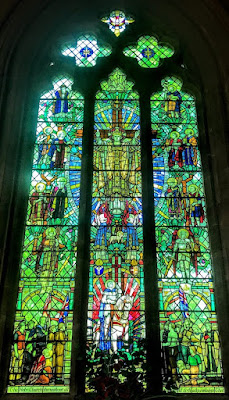
Saint Luke the Evangelist and Physician … a stained-glass window in Saint Michael’s Church, Tipperary (Photograph: Patrick Comerford)

Scripture quotations are from the New Revised Standard Version Bible: Anglicised Edition copyright © 1989, 1995 National Council of the Churches of Christ in the United States of America. Used by permission. All rights reserved worldwide. http://nrsvbibles.org

18 October 2023

Daily prayers in Ordinary Time
with USPG: (143) 18 October 2023,
Week of Prayer for World Peace (4)

‘The struggle for peace, like the struggle for human rights and humanity, is not one in which, having reached the peak of the mountain, the final goal comes into view’ … a peak-top monastery in Meteora in Greece (Photograph: Patrick Comerford)

Patrick Comerford

We are in Ordinary Time in the Church Calendar, and the week began with the Nineteenth Sunday after Trinity (Trinity XIX, 15 October 2023). The Church Calendar celebrates Saint Luke the Evangelist (18 October).

Before today begins, I am taking some time early this morning for prayer and reflection.

The Week of Prayer for World Peace began on Sunday, and so my reflections each morning this week are gathered around this theme in these ways:

1, A reflection on the Week of Prayer for World Peace ;

2, the Gospel reading of the day in the Church of England lectionary;

3, a prayer from the USPG prayer diary.

The Week of Prayer for World Peace began with ‘A Call to Prayer for World Peace’ signed by faith leaders in 1974

A Week of Prayer for World Peace, Day 4:

The International Prayer For Peace:

Lead me from death to life, from falsehood to truth
Lead me from despair to hope, from fear to trust
Lead me from hate to love, from war to peace
Let peace fill our hearts, our world, our universe

Day 4, Heroes: For those working with courage to improve the world:

O Allah, the Creator of all that’s good,
bless our heroes, courageous and understood.
For those who strive to make the world better,
grant them strength and guidance in every endeavour.

Watch over those who help others in need,
their acts of kindness, a noble deed.
Guide them in their mission, both big and small,
as they spread love and kindness to all.

Bless our heroes, young and old,
with bravery and hearts of gold.
May their efforts inspire us to do good,
and make a difference, just as they would. Ameen
– Islamic

‘The struggle for peace, like the struggle for human rights and humanity, is not one in which, having reached the peak of the mountain, the final goal comes into view. Rather, it should be thought of as the work of generating an uninterrupted and unstoppable flow of commitment that connects and is passed on from one generation to the next.

‘Each of us, no matter how weak or ineffectual we may feel ourselves to be, must build deep within our hearts a stronghold for peace, one that will be capable of withstanding and in the end silencing the incessant calls to war. This is the only way humanity’s tragic predilection for violence can be reformed and its energies channelled in new directions.

‘We need to awaken a common consciousness of being all inhabitants of Earth. This consciousness is not to be found in some distant place. It will not be found on a computer screen. It lies in our hearts, in our ability to share the pain of our fellow human beings. It is the spirit that says ‘As long as you are suffering, whoever you are and whatever your suffering may be, I suffer also.’
– Daisaku Ikeda, Buddhist philosopher

We thank you God, for all those who … courageously go into areas of conflict and natural disaster, to give humanitarian aid, bind wounds, heal broken bodies, save lives. We give thanks for all NGOs and charities … who bring healing and hope to all those affected by war and disaster.
– Susan Gale WPWP Committee member

Saint Luke the Evangelist and Physician … a stained-glass window in Saint Michael’s Church, Tipperary (Photograph: Patrick Comerford)

Luke 10: 1-9 (NRSVA):

1 After this the Lord appointed seventy others and sent them on ahead of him in pairs to every town and place where he himself intended to go. 2 He said to them, ‘The harvest is plentiful, but the labourers are few; therefore ask the Lord of the harvest to send out labourers into his harvest. 3 Go on your way. See, I am sending you out like lambs into the midst of wolves. 4 Carry no purse, no bag, no sandals; and greet no one on the road. 5 Whatever house you enter, first say, “Peace to this house!” 6 And if anyone is there who shares in peace, your peace will rest on that person; but if not, it will return to you. 7 Remain in the same house, eating and drinking whatever they provide, for the labourer deserves to be paid. Do not move about from house to house. 8 Whenever you enter a town and its people welcome you, eat what is set before you; 9 cure the sick who are there, and say to them, “The kingdom of God has come near to you”.’

‘Study for the Calf of Saint Luke’ by Graham Sutherland in the ‘Consequence of War’ exhibition in Lichfield Cathedral in 2018 (Photograph: Patrick Comerford)

Today’s Prayers: USPG Prayer Diary:

The theme this week in ‘Pray With the World Church,’ the Prayer Diary of the Anglican mission agency USPG (United Society Partners in the Gospel), is ‘Helpline to women in need.’ This theme was introduced on Sunday.

The USPG Prayer Diary today (18 October 2023, Saint Luke the Evangelist) invites us to pray in these words:

Let us give thanks for the life and works of Luke the Evangelist. May we be inspired by his Christian witness.

The Collect:

Almighty God,
you called Luke the physician,
whose praise is in the gospel,
to be an evangelist and physician of the soul:
by the grace of the Spirit
and through the wholesome medicine of the gospel,
give your Church the same love and power to heal;
through Jesus Christ your Son our Lord,
who is alive and reigns with you,
in the unity of the Holy Spirit,
one God, now and for ever.

The Post Communion Prayer:

Almighty God,
who on the day of Pentecost
sent your Holy Spirit to the apostles
with the wind from heaven and in tongues of flame,
filling them with joy and boldness to preach the gospel:
by the power of the same Spirit
strengthen us to witness to your truth
and to draw everyone to the fire of your love;
through Jesus Christ our Lord.

Yesterday’s Reflection

Continued Tomorrow

The Week of Prayer for World Peace began on Sunday 15 October 2023

Scripture quotations are from the New Revised Standard Version Bible: Anglicised Edition copyright © 1989, 1995, National Council of the Churches of Christ in the United States of America. Used by permission. All rights reserved worldwide. http://nrsvbibles.org

14 October 2023

Daily prayers in Ordinary Time
with USPG: (139) 14 October 2023

Saint Michael’s Church, Tipperary … designed by JJ McCarthy, with a High Altar and reredos by John Hardman of Birmingham (Photograph: Patrick Comerford)

Patrick Comerford

We are in Ordinary Time in the Church Calendar, and tomorrow is the Nineteenth Sunday after Trinity (Trinity XIX, 15 October 2023).

My priorities later today may well be the Rugby World Cup quarter final between Ireland and South Africa. But, before today begins, I am taking some time early this morning for prayer and reflection.

The Church recently celebrated Saint Michael and All Angels last month (29 September). So my reflections each morning for the past three weeks have continued the Michaelmas theme in this way:

1, A reflection on a church named after Saint Michael or his depiction in Church Art;

2, the Gospel reading of the day in the Church of England lectionary;

3, a prayer from the USPG prayer diary.

Saint Michael’s Church, Tipperary … designed by JJ McCarthy and added to by Ashlin and Coleman (Photograph: Patrick Comerford)

Saint Michael’s Church, Tipperary:

Saint Michael’s Church on Saint Michael’s Street in Tipperary is an impressive building designed by the celebrated church architect, James Joseph McCarthy (1817-1882), built in 1855-1861 by Doolins of Dublin, and added to half a century later by Ashlin and Coleman.

The church spire is visible from every road approaching the town, and there is fine craftsmanship throughout the church, representing the best of church architecture and decoration in the traditions introduced to Ireland by AWN Pugin.

The size, style and composition of the church is an illustration of the sense of the power of the Roman Catholic Church at the time.

The church was designed by JJ McCarthy in the Early English style for the Parish Priest of Tipperary, Father James Howley, and was built by Doolins of Dublin at an estimated cost of £7,000.

McCarthy claimed Pugin’s mantle and his great works include the Cathedral of the Assumption, Thurles, Co Tipperary, the Church of Our Lady, Ballingarry, Co Limerick, Saint Macartan’s Cathedral, Monaghan, Saint Mary’s Church, Rathkeale, Co Limerick, Saint Patrick’s Cathedral, Armagh, SS Peter and Paul Church, Kilmallock, Co Limerick, the Capuchin Church, Church Street, Dublin, and the College Chapel, Saint Patrick’s College, Maynooth, Co Kildare.

The church was consecrated in November 1861. Its spire is visible from every approach road. Fine craftsmanship is seen throughout the building, in the quality of the stonework and stone carving, and the detailing of the various elevations.

The reredos by John Hardman & Co of Birmingham is an impressive artistic achievement, and the interior is also enhanced by the stone carving at the organ gallery and the attractive glazed screen.

This cruciform-plan, gable-fronted church includes a five-bay nave with side aisles, three-bay transepts, a two-bay chancel, a three-bay projecting porch, a mortuary chapel added ca 1915, a three-stage bell tower with a spire, a lean-to porch on the north side and a sacristy at the north-east.

The broached octagonal spire on the tower has metal cross finial and trefoil and pointed vent-lights with louvres. There are carved limestone crenellations and spires at the octagonal engaged columns on the porch. There are necked dressed limestone walls, limestone dressings, and buttresses at the corners of the church, at the lower two stages of the tower and between the windows of the side aisles. There is a plinth course and moulded string courses at the porch.

A carved limestone statue of Saint Michael the Archangel stands in a gabled niche at the front of the bell tower. Throughout the church there are pointed-arch window openings throughout the church, including a five-light window at the west front, a trefoil-headed five-light east window, three-light windows in the gables of the transepts, two-light windows in the side aisles and the front of the tower, and single-light windows in other parts of the church, with hood mouldings on the windows at the front.

The porch has paired pointed-arch windows with hood-mouldings and engaged colonnettes, and a hexafoil window over the central entrance door, with a moulded limestone surround.

John Hardman & Co of Birmingham, who worked on many of Pugin’s churches, designed the High Altar with an ornate carved marble reredos in 1860. The reredos is an impressive artistic achievement, At the time, the altar was said to be ‘the largest and most elaborate erected in the United Kingdom since the Reformation.’

There are side altars, with figure sculptures, an ornate carved marble pointed segmental arcade at organ gallery with trefoil arcading details on the parapet and polished granite columns.

The boarded timber ceiling and braced truss roof are supported on cut stone corbels in the nave walls. Other details inside the church include pitch pine confessionals and pews, and the timber and stucco Stations of the Cross.

Ashlin and Coleman made a number of additions in 1914, including a new front porch and mortuary chapel commissioned by Canon Arthur Ryan, parish priest of Tipperary in 1903-1922. The mosaic work on the sanctuary walls and floor was completed by Ludwig Oppenheimer in 1915.

Canon Ryan was a staunch supporter of John Redmond and encouraged Irish involvement in World War I in support of achieving Irish Home Rule.

During the Christmas season in 1916, Canon Ryan travelled throughout the Western Front in Flanders, visiting and ministering to regiments of the 16th Irish Division on the battlefields.

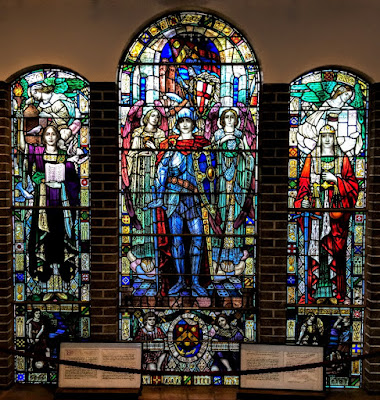
His niece Philomena was the wife of Major John Carlon Markes of the Leinster Regiment, who was killed in action at the Battle of the Somme on 19 July 1916, aged 36. Major Markes is commemorated in the stained glass World War I Memorial Window in the side Chapel of Adoration, to the right of the High Altar.

A window in a side chapel depicts Saint Luke, the patron saint of physicians, and is dedicated to the memory of Dr John F O’Halloran, who died in 1969.

A window depicting Saint Luke the physician is dedicated to the memory of a local doctor, John F O’Halloran (Photograph: Patrick Comerford)

Luke 11: 27-28 (NRSVA):

27 While he was saying this, a woman in the crowd raised her voice and said to him, ‘Blessed is the womb that bore you and the breasts that nursed you!’ 28 But he said, ‘Blessed rather are those who hear the word of God and obey it!’

The sanctuary in Saint Michael’s Church, Tipperary (Photograph: Patrick Comerford)

Today’s Prayer (Saturday 14 October 2023):

Today’s Prayer:

The theme this week in ‘Pray With the World Church,’ the Prayer Diary of the Anglican mission agency USPG (United Society Partners in the Gospel), has been ‘After the Storm.’ This theme was introduced on Sunday.

The USPG Prayer Diary today (14 October 2023) invites us to pray in these words:

We pray for all those supporting the relief and rebuilding in areas affected by natural disasters. May people see the light of your love from those who seek to help those in dire need.

Inside Saint Michael’s Church, Tipperary … there is fine craftsmanship throughout the church (Photograph: Patrick Comerford)

The Collect:

Almighty and everlasting God,
increase in us your gift of faith
that, forsaking what lies behind
and reaching out to that which is before,
we may run the way of your commandments
and win the crown of everlasting joy;
through Jesus Christ your Son our Lord,
who is alive and reigns with you,
in the unity of the Holy Spirit,
one God, now and for ever.

The Post Communion Prayer:

We praise and thank you, O Christ, for this sacred feast:
for here we receive you,
here the memory of your passion is renewed,
here our minds are filled with grace,
and here a pledge of future glory is given,
when we shall feast at that table where you reign
with all your saints for ever.

Saint Michael’s Church, Tipperary … the High Altar and reredos were designed by John Hardman & Co (Photograph: Patrick Comerford)

Yesterday’s reflection

Continued tomorrow

Looking west in Saint Michael’s Church, Tipperary (Photograph: Patrick Comerford)

Scripture quotations are from the New Revised Standard Version Bible: Anglicised Edition copyright © 1989, 1995, National Council of the Churches of Christ in the United States of America. Used by permission. All rights reserved worldwide. http://nrsvbibles.org

The gallery and organ in Saint Michael’s Church, Tipperary (Photograph: Patrick Comerford)

12 January 2023

Praying through poems and
with USPG: 12 January 2023

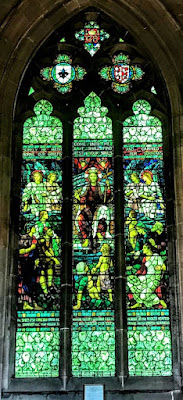
The East Window in Saint Mary’s Church, Tipperary, designed by AJ Davies (1877-1953), shows the Adoration by the Magi of the Christ Child, presenting their gifts (Photograph: Patrick Comerford)

Patrick Comerford

Christmas is not a season of 12 days, despite the popular Christmas song. Christmas is a 40-day season that lasts from Christmas Day (25 December) to Candlemas or the Feast of the Presentation (2 February).

Throughout the 40 days of this Christmas Season, I am reflecting in these ways:

1, Reflecting on a seasonal or appropriate poem;

2, a prayer from the USPG prayer diary, ‘Pray with the World Church.’

We arrived back in Heathrow from Helsinki late last night after a week visiting Hungary and Finland with the Anglican mission agency USPG (United Society Partners in the Gospel) and the Diocese in Europe, looking at how the church and church agencies there are working with refugees from Ukraine.

After these Epiphany-tide journeys across Europe, my choice of a seasonal poem this morning is ‘Epiphany,’ a sonnet by the priest poet Malcolm Guite.

The Revd Malcolm Guite has been a Bye-Fellow and chaplain of Girton College, Cambridge, and associate chaplain of Saint Edward King and Martyr in Cambridge. On several occasions, he has taught as visiting faculty at several colleges and universities in England and North America.

Malcolm Guite is the author of five books of poetry, including two chapbooks and three full-length collections, as well as several books on Christian faith and theology. He has a decisively simple, formalist style in poems, many of which are sonnets. He says his aim is to ‘be profound without ceasing to be beautiful.’ He also performs as a singer and guitarist fronting the Cambridgeshire-based blues, rhythm and blues, and rock band ‘Mystery Train.’

This sonnet is the first in a sequence of Epiphany Sonnets, drawn from his book Sounding the Seasons, which is available from Amazon or by ordering from local bookshops.

The Adoration of the Shepherds and the Magi depicted in a stained-glass window in the chapel of Oriel College, Oxford (Photograph: Patrick Comerford, 2022)

Epiphany, by Malcolm Guite:

It might have been just someone else’s story,
Some chosen people get a special king.
We leave them to their own peculiar glory,
We don’t belong, it doesn’t mean a thing.
But when these three arrive they bring us with them,
Gentiles like us, their wisdom might be ours;
A steady step that finds an inner rhythm,
A pilgrim’s eye that sees beyond the stars.
They did not know his name but still they sought him,
They came from otherwhere but still they found;
In temples they found those who sold and bought him,
But in the filthy stable, hallowed ground.
Their courage gives our questing hearts a voice
To seek, to find, to worship, to rejoice.

The Visit of the Magi by Giotto in the Scrovegni Chapel in Padua (Photograph: Patrick Comerford, 2021)

USPG Prayer Diary:

The theme in the USPG Prayer Diary this week is an ‘Epiphany Reflection,’ introduced on Sunday morning by the Revd Michael Sei from the Episcopal Church of Liberia.

The USPG Prayer Diary invites us to pray today in these words:

Let us pray for the work of the Church amongst the marginalised. May we join our brothers and sisters in Liberia in seeking to include those who feel abandoned.

Yesterday’s reflection

Continued tomorrow

The Magi visit the crib … a stained glass window in Saint Nicholas Church, Adare, Co Limerick (Photograph: Patrick Comerford)

25 October 2022

It’s a long way to Tipperary,
as a question mark hangs
over the pub on Fleet Street

The Tipperary on Fleet Street … it is now closed and its future looks grim (Photograph: Patrick Comerford, 2022)

Patrick Comerford

Things are changing rapidly on Fleet Street.

When I was a working journalist and Foreign Desk at The Irish Times, I frequently visited Fleet Street. In those days, The Irish Times had an office in the PA Building, and there were colleagues to meet from other newspapers too.

There were visits too to Saint Bride’s, the journalists’ church on Fleet Street, which also had a family link through a former rector, the Revd Edwards Comerford Hawkins (1827-1906), father of Anthony Hope, author of The Prisoner of Zenda. During the 1980s and 1990s, there were constant vigils in Saint Bride’s for John McCarthy, Terry Anderson and other journalists held hostage in Lebanon.

In those days, liquid lunches were popular among journalists on the ‘Streets of Shame,’ and at a time when many journalists still worked on Fleet Street, Private Eye developed the character of Lunchtime O’Booze as the archetypal drunken journalist.

During those visits, many colleagues in London insisted on repeating the story that one of those popular pubs, The Tipperary, had given its name to the war song of soldiers pining to return not to provincial Ireland but to London, including Piccadilly, Leicester Square and the pubs frequented by the printers who worked on Fleet Street.

Saint Paul’s Cathedral seen from The Tipperary on Fleet Street … times are changing for journalists and pub clients (Photograph: Patrick Comerford, 2022)

The journalists, the newsrooms and the printers have long moved out of Fleet Street. The street continues to change. And now, as I found out last week, the Tipperary, one of the oldest Irish bars in London, has closed its doors at 66 Fleet Street for the last time.

The Tipperary is within sight of and just a stone’s throw away from Saint Paul’s Cathedral, and claimed to be the oldest Irish pub in London. Through the years it was better known as a journalists’ pub rather than an Irish pub, and it was a well-known haunt for editors and journalists, alongside barristers from the nearby courts.

The journalists have long gone from Fleet Street, although there are signs everywhere that this was once the hub of real journalism in the English-speaking world.

The journalists have long gone from Fleet Street (Photograph: Patrick Comerford, 2022)

Now, sadly, even the Tipperary has closed its doors and has been issued with a possession order, raising fears about the future of the Grade II listed building.

There has been a pub on the site since the 15th century, although 1605 is claimed as the foundation date. It became an Irish pub when JG Mooney and Co bought the Boar’s Head in the late 19th century. It claimed – not without contention – to be the ‘oldest Irish pub’ in London and was said to be one of the first pubs in London to serve Guinness.

I had always thought – and repeated on many occasions – that the World War I song, ‘It’s long way to Tipperary,’ took its name not from Tipperary Town but from The Tipperary on Fleet Street.

The Tipperary on Fleet Street … tall tales once graced the noticeboard beside the front door (Photograph: Patrick Comerford)

The Tipperary is a beautiful building architecturally, it was known for its mosaic flooring and antique decor. A colourful noticeboard at the entrance has been painted over in the last year or two, but in the past it perpetuated many of the myths associated with this much-photographed pub.

The noticeboard was littered with grammatical errors and spelling mistakes that could have been corrected by every Fleet Street sub-editor who passed through its doors on the way to a liquid lunch. Perhaps all this was in jest, as a challenge to the sobriety of journalists.

The sign claimed the pub was built in 1605 with stones from the Whitefriars Monastery, and that these stones helped the pub to survive ‘unharmed in the raging inferno of the Great Fire of London.’

The pub sign also claimed that at the end of World War I, Fleet Street printers returning from the war had the pub’s name changed to The Tipperary and that it has kept this name for 100 years since.

However, Martyn Cornell, whose ‘Zythophile’ blog looks at ‘bars, beer myths, beer nonsense, pub names, pubs [and] rants,’ has challenged ‘the reliability of the information on the sign at The Tipperary. He identified at least a dozen errors in just 10 sentences, from the names of proprietors to details about the pub’s history, as well as stories about that war-time song.

The future of the Tipperary is now in doubt (Photograph: Patrick Comerford, 2022)

The pub was called Mooney’s Irish House in Fleet Street into the 1950s, and the Irish House up to 1967.

The former Boar’s Head was sold ca 1966-1967, and in 1968 its name was changed from Mooney’s Irish House to The Tipperary. At the same time the name of the old Boar’s Head was revived and used for the upstairs dining room.

The pub closed for a few years for refurbishment in the early 1980s. It was a Greene King pub by 1986, but had been in private ownership in recent years.

During Covid-19 closures, the pub struggled to cope with the lack of office workers in the city visiting after work. They were working from home instead, and the pub has been closed since December 2020.

It was reported in March 2021 that one rare Victorian mirror advertising Jameson whiskey had been removed from the building to be sold to a museum in Ireland. However, a passer-by noticed that the mirrors were being moved and alerted the City of London’s planning enforcement team who swiftly returned them to the site.

Last January, local residents submitted an application for the pub to be registered as an ‘Asset of Community Value’ that would secure its continued existence as a pub. The City of London Corporation approved the application in May, and the designation will remain in place for five years. This means that The Tipperary cannot be sold without first providing the local community with a chance to bid on the land or building.

Signs on the door and the windows declares that Equivo Limited, a ‘Collections & Field, Legal Services and Enforcement’ company acting on behalf of Whitefriars Ltd, re-entered and secured the premises under an Interim Possession Order issued in the County Court on 9 August 2022.

Equivo said it at the time that it ‘simply assisted with removing some squatters under a Court order.’ But when I walked by last week, some of the windows were open, leaving it vulnerable to any squatter who had a mind to regaining entry.

The Tipperary on Fleet Street in its heyday (Photograph: Patrick Comerford)

18 October 2022

Praying for World Peace and with USPG:
Tuesday 18 October 2022

The Week of Prayer for World Peace invites prayers today on the theme of ‘A Prayer for the Earth’ … Arnaldo Pomodoro’s sculpture ‘Sphere Within Sphere’ at the Berkeley Library in Trinity College Dublin (Photograph: Patrick Comerford)

Patrick Comerford

The Church Calendar today celebrates Saint Luke the Evangelist today (18 October).

It is seven months today since I suffered a stroke (18 March 2022). Later today, I am planning to have lunch with a friend in Oxford. But, before today gets busy, I am taking some time this morning for reading, prayer and reflection.

This year, the Week of Prayer for World Peace is from 16 to 23 October. In my prayer diary from last Sunday until next Sunday, I am reflecting in these ways:

1, One of the readings for the morning;

2, A reflection from the programme for the Week of Prayer for World Peace (16 to 23 October);

3, a prayer from the USPG prayer diary, ‘Pray with the World Church.’

Saint Luke the Evangelist and Physician … a stained-glass window in Saint Michael’s Church, Tipperary (Photograph: Patrick Comerford)

Saint Luke was a close companion of the Apostle Paul, and is mentioned by him three times in his Letters. Saint Paul describes him as ‘the beloved physician’ and, in his second Letter to Timothy, as his only companion in prison. He is believed to be the author of two books of the New Testament: Saint Luke’s Gospel and the Acts of the Apostles. Saint Luke’s narrative of the life of Christ has a pictorial quality and shows the sequential pattern from the nativity through to the death and resurrection. The developed sense of theology that comes over in Saint Paul’s writings is virtually unknown in Saint Luke’s writings. But, as a Gentile, Saint Luke makes clear that the good news of salvation is for all, regardless of gender, social position or nationality.

Luke 10: 1-9 (NRSVA):

10 After this the Lord appointed seventy others and sent them on ahead of him in pairs to every town and place where he himself intended to go. 2 He said to them, ‘The harvest is plentiful, but the labourers are few; therefore ask the Lord of the harvest to send out labourers into his harvest. 3 Go on your way. See, I am sending you out like lambs into the midst of wolves. 4 Carry no purse, no bag, no sandals; and greet no one on the road. 5 Whatever house you enter, first say, “Peace to this house!” 6 And if anyone is there who shares in peace, your peace will rest on that person; but if not, it will return to you. 7 Remain in the same house, eating and drinking whatever they provide, for the labourer deserves to be paid. Do not move about from house to house. 8 Whenever you enter a town and its people welcome you, eat what is set before you; 9 cure the sick who are there, and say to them, “The kingdom of God has come near to you”.’

The Week of Prayer for World Peace takes place this year from Sunday 16 October 2022 to Sunday 23 October 2022

Week of Prayer for World Peace 2022, Day 3:

The week of Prayer for World Peace takes place from the second to third Sunday in October each year, which this year is from Sunday last (Sunday 16 October 2022) to next Sunday (23 October 2022).

The Week of Prayer for World Peace is supported by a wide range of organisations, many of which I have engaged with over the years, including the Anglican Pacifist Fellowship, Christian CND, the Fellowship of Reconciliation, Pax Christi, and Quaker Peace and Social Witness.

Day 3: A Prayer for Our Earth:

We pray for the earth and all her goodness to flourish and be nurtured by humankind.

‘I visualise the earth with my inner eye, slowly revolving; I visualise the oceans, the mountains, the forests and all living beings. Whilst holding my vison of the earth in front of me, I open my angel wings of compassion and care to embrace the earth to heal the pain with love and mercy.’ – Brahma Kumaris Environment Initiative

‘Our Gaia, whose art is Nature –
abode of our life,
Your time has come, your battle won
for people’s planet – consciousness.
Teach us each day how to be and live
through observing Nature’s models,
Those models that bring us into harmony
and not into conflict with Life’s source.
Home to humanity,
in sacred diversity.
Deities in unity, our dream.’ – from The Earth’s Prayer (to intonations of the Lord’s Prayer) by Anne Palmer, Isle of Lewis, UK

‘Cease the winds from the west
‘Cease the winds from the south
‘Let the breeze blow over the land
‘Let the breeze blow over the ocean
‘Let the red-tipped dawn come with a sharpened air.
‘A touch of frost, a promise of a glorious day.’ – Traditional Maori Blessing

‘I pray for the good of the life of all the living creatures which Spirit of Wisdom has created.’ – Zoroastrian Gathas

Sunset on the River Deel and the Shannon Estuary at Askeaton, Co Limerick … the Week of Prayer for World Peace invites prayers today on the theme of ‘A Prayer for the Earth’ (Photograph: Patrick Comerford)

Today’s Prayer (Tuesday 18 October 2022, Saint Luke):

The Collect:

Almighty God,
you called Luke the physician,
whose praise is in the gospel,
to be an evangelist and physician of the soul:
by the grace of the Spirit
and through the wholesome medicine of the gospel,
give your Church the same love and power to heal;
through Jesus Christ your Son our Lord,
who is alive and reigns with you,
in the unity of the Holy Spirit,
one God, now and for ever.

The Post Communion Prayer:

Almighty God,
who on the day of Pentecost
sent your Holy Spirit to the apostles
with the wind from heaven and in tongues of flame,
filling them with joy and boldness to preach the gospel:
by the power of the same Spirit
strengthen us to witness to your truth
and to draw everyone to the fire of your love;
through Jesus Christ our Lord.

The theme in the USPG Prayer Diary this week is ‘World Food Day.’ This theme was introduced on Sunday.

The USPG Prayer Diary invites us to pray today in these words:

Let us give thanks for the life and works of Luke the Evangelist. May we be inspired by his Christian witness.

Yesterday’s reflection

Continued tomorrow

‘I visualise the earth with my inner eye, slowly revolving; I visualise the oceans, the mountains, the forests and all living beings’ (Photograph: Patrick Comerford)

Scripture quotations are from the New Revised Standard Version Bible: Anglicised Edition copyright © 1989, 1995, National Council of the Churches of Christ in the United States of America. Used by permission. All rights reserved worldwide. http://nrsvbibles.org

‘Study for the Calf of Saint Luke’ by Graham Sutherland in the ‘Consequence of War’ exhibition in Lichfield Cathedral in 2018 (Photograph: Patrick Comerford)

14 November 2021

Praying in Ordinary Time 2021:
169, Remembrance Day windows

The East Window is one of two war memorials in Saint Mary’s Church, Tipperary, and commemorates three members of the Bell and Lyle families (Photograph: Patrick Comerford)

Patrick Comerford

Today is the Second Sunday before Advent and Remembrance Day. Later this morning (14 November 2021) I am presiding and preaching at the Parish Eucharist in Castletown Church near Pallaskenry, Co Limerick, and taking part in the Remembrance Day service in Holy Trinity Church, Rathkeale, Co Limerick.

Each morning in the time in the Church Calendar known as Ordinary Time, I am reflecting in these ways:

1, photographs of a church or place of worship;

2, the day’s Gospel reading;

3, a prayer from the USPG prayer diary.

As part of my reflections and my prayer diary, my photographs this morning (14 November 2021) are of Remembrance windows in a selection of churches.

Harry Clarke’s ‘The Madonna with Saints Aidan and Adrian’ (1919) … a war memorial window in Bride Street Church, Wexford (Photograph: Patrick Comerford)

A prayer from Westminster Abbey:

May God grant
to the living grace,
to the departed rest,
to the Church and the World peace and concord,
and to us sinners eternal life.

The World War II window by Gerald ER Smith in Saint Editha’s Church, Tamworth, shows the Risen Christ in Glory and illustrates the canticle Te Deum (Photograph: Patrick Comerford)

Mark 13: 1-8 (NRSVA):

1 As he [Jesus] came out of the temple, one of his disciples said to him, ‘Look, Teacher, what large stones and what large buildings!’ 2 Then Jesus asked him, ‘Do you see these great buildings? Not one stone will be left here upon another; all will be thrown down.’

3 When he was sitting on the Mount of Olives opposite the temple, Peter, James, John, and Andrew asked him privately, 4 ‘Tell us, when will this be, and what will be the sign that all these things are about to be accomplished?’ 5Then Jesus began to say to them, ‘Beware that no one leads you astray. 6 Many will come in my name and say, “I am he!” and they will lead many astray. 7 When you hear of wars and rumours of wars, do not be alarmed; this must take place, but the end is still to come. 8For nation will rise against nation, and kingdom against kingdom; there will be earthquakes in various places; there will be famines. This is but the beginning of the birth pangs.’

The war memorial window in the High School, Dublin, originally in the school chapel in Harcourt Street, Dublin (Photograph: Patrick Comerford)

The Prayer in the USPG Prayer Diary today (14 November 2021, Remembrance Sunday, Second Sunday before Advent) invites us to pray:

Peaceful God,
May we take refuge in you.
Let us trust and care for each other,
pursuing peace and justice
in place of war and conflict.

Saint George in a war memorial window by James Powell & Sons in Saint Fachtna’s Cathedral, Rosscarbery, Co Cork (Photograph: Patrick Comerford, 2021)

Yesterday’s reflection

Continued tomorrow

The World War II memorial window by Henry Holiday depicting Christ the King in Saint Editha’s Church, Tamworth (Photograph: Patrick Comerford)

Scripture quotations are from the New Revised Standard Version Bible: Anglicised Edition copyright © 1989, 1995, National Council of the Churches of Christ in the United States of America. Used by permission. All rights reserved worldwide. http://nrsvbibles.org

The Maurice Peel war memorial window in Saint Editha’s Church, Tamworth, depicts Life, Death and Resurrection (Photograph: Patrick Comerford)

06 January 2021

Gold, frankincense and
myrrh: bringing our best to
Christ as gifts at Epiphany

The Magi arriving at the crib outside Saint Mary’s Church, Askeaton, Co Limerick (Photograph: Patrick Comerford, 2021)

Patrick Comerford

Wednesday 6 January 2021 (The Epiphany):

11 a.m.: Saint Mary’s Church, Askeaton, Co Limerick

The Epiphany Eucharist (Holy Communion 2)

Readings: Isaiah 60: 1-6; Psalm 72: 1-7, 10-14; Ephesians 3: 1-12; Matthew 2: 1-12

There is a link to the readings HERE.

The visit of the Magi in the sixth century Basilica of Sant’Apollinare Nuovo in Ravenna (Photograph: Patrick Comerford)

May I speak to you in the name of God, + Father, Son and Holy Spirit, Amen.

The 12 Days of Christmas have come to an end, and we have arrived at the Feast of Epiphany. Yes, the season of Christmas continues in the Church until Candlemas or the Feast of the Presentation on 2 February. But this Feast of the Epiphany is part and parcel of the Christmas celebrations.

In Epiphany-tide, we mark three events in which Christ is revealed to all nations and peoples:

● the Visit of the Wise Men, told of in this morning’s Gospel reading (Matthew 2: 1-12, 6 January 2021).
● the Baptism of Christ in the Jordan, which we read about next Sunday (Mark 1: 4-11, Sunday 10 January 2021).
● the Wedding Feast in Cana (John 2: 1-12, a Gospel story we miss reading about this year).

Today’s Gospel reading (Matthew 2: 1-12) is a story that symbolises the Gentiles coming to Christ, bowing before him in worship, and laying their gifts and treasurers at his feet.

The promise of Isaiah after the return to Jerusalem is that the ‘nations shall come to your light, and kings to the brightness of your dawn … the wealth of the nations shall come to you. A multitude of camels shall cover you’ (Isaiah 60: 3, 5-6).

The images in the Psalm of the kings across the known universe coming to visit the king in Jerusalem after the return from exile in the Persia empire also inspires Saint Matthew’s account of the visit of the magi.

Saint Paul reminds us in the Epistle reading of the promises in Christ being brought as gifts to the Gentiles.

In the Gospel reading, we are reminded of the Gentiles bringing their gifts to Christ and worshipping him with all they have.

The Magi, as the ‘Three Kings’ or ‘Three Wise Men,’ are regular figures in traditional nativity stories and in Christmas and Epiphany celebrations.

Saint Matthew’s phrase ‘from the east’ (ἀπὸ ἀνατολῶν, apo anatolon, Matthew 2: 1), more literally means ‘from the rising [of the sun],’ but it does not tell us who they were or where they came from.

Saint Matthew does not count the number of wise men, nor does he describe them as kings. But the number of their gifts gives rise to the popular tradition that there were three Magi.

In Western tradition, these Epiphany magi have been named as Caspar, Melchior and Balthasar. These names may come from an early sixth century Greek manuscript (ca 500) in Alexandria, although other authorities say the names are first found in an eighth century Irish manuscript.

In our cribs, they are often portrayed as European, African and Asian, with the European giving gold and the other two giving myrrh and frankincense.

As the tradition developed, the three wise men were transformed into kings who have been named as:

● Melchior, a Persian scholar;
● Caspar, an Indian scholar;
● Balthazar, an Arabian scholar.

The early mediaeval Church historian from Northumbria, the Venerable Bede, is the first scholar to say that Balthazar is black.

In Western art from the 14th century on, they are portrayed in these ways:

● Caspar is the older man with a long white beard, who is first in line to kneel before the Christ Child and who gives him the gift of gold.

● Melchior is portrayed as a middle-aged man, giving frankincense.

● Balthazar is presented a young man, very often black-skinned, with the gift of myrrh.

The story of the late mediaeval and Renaissance paintings of the Visit of the Magi is told in the Christmas exhibition, ‘Seeing the Unseen’, in the National Gallery in London, from today (6 January 2021) until the end of next month (28 February 2021). The exhibition creates a soundscape to enhance ‘The Adoration of the Kings,’ a wonderfully detailed painting by Jan Gossaert of the Low Countries. Although the gallery is closed because of Covid-19, the exhibition is available online.

Perhaps those mediaeval traditions and those Renaissance paintings were already making a statement against racism, centuries ago when Europe was beginning to engage in slave trading and began thinking of Africa as the ‘dark continent.’

Christ comes into the world as God’s gift of love and light, salvation and redemption, for all nations, for all peoples, and not just for the self-selecting elect.

And the gifts brought in turn by the magi and kings have been named by Saint Matthew names their gifts as: gold, frankincense, and myrrh: χρυσον (chryson), λιβανον (libanon) and σμυρναν (smyrnan) (Matthew 2: 11).

Traditionally these gifts have been given spiritual meanings:

● Gold as a symbol of Christ’s kingship;
● Frankincense as a symbol of worship and so of Christ’s deity;
● Myrrh as an anointing oil for his priesthood, or as an embalming oil and a symbol of his death.

These interpretations are alluded to by John Henry Hopkins (1820-1891), the son of a Dublin-born Episcopalian bishop, in his carol We Three Kings (No 201, Irish Church Hymnal), in which the last verse summarises this interpretation:

Glorious now behold him arise,
King, and God and Sacrifice
.

But whatever the traditions, whatever the myths, whatever the legends may say, the truth they are trying to get at is that Christmas and Epiphany find their full meaning and their fulfilment in Good Friday and Easter Day, in the Crucifixion and the Resurrection, when we see the Suffering and Risen Christ fully revealed to us as Prophet, Priest and King.

And they challenge us to ask whether we are offering our best, or merely our second best to Christ – to Christ in the suffering world, to Christ in the Church, to Christ who is to come again.

It was a challenge that was thrown down over a century and a half ago by John Keble (1792-1866), who concludes his poem Epiphany with these words:

Behold, her wisest throng thy gate,
Their richest, sweetest, purest store,
(Yet owned too worthless and too late,)
They lavish on thy cottage-floor.

They give their best – O tenfold shame
On us their fallen progeny,
Who sacrifice the blind and lame –
Who will not wake or fast with thee!


And so, may all we think, say and do be to the praise, honour and glory of God, + Father, Son and Holy Spirit, Amen.

‘The Adoration of the Kings’ by Jan Gossaert in the ‘Seeing the Unseen’ exhibition at the National Gallery, London, from 6 January to 28 February 2021

Matthew 2: 1-12 (NRSVA):

1 In the time of King Herod, after Jesus was born in Bethlehem of Judea, wise men from the East came to Jerusalem, 2 asking, ‘Where is the child who has been born king of the Jews? For we observed his star at its rising, and have come to pay him homage.’ 3 When King Herod heard this, he was frightened, and all Jerusalem with him; 4 and calling together all the chief priests and scribes of the people, he inquired of them where the Messiah was to be born. 5 They told him, ‘In Bethlehem of Judea; for so it has been written by the prophet:

6 “And you, Bethlehem, in the land of Judah,
are by no means least among the rulers of Judah;
for from you shall come a ruler
who is to shepherd my people Israel.”

7 Then Herod secretly called for the wise men and learned from them the exact time when the star had appeared. 8 Then he sent them to Bethlehem, saying, ‘Go and search diligently for the child; and when you have found him, bring me word so that I may also go and pay him homage.’ 9 When they had heard the king, they set out; and there, ahead of them, went the star that they had seen at its rising, until it stopped over the place where the child was. 10 When they saw that the star had stopped, they were overwhelmed with joy. 11 On entering the house, they saw the child with Mary his mother; and they knelt down and paid him homage. Then, opening their treasure-chests, they offered him gifts of gold, frankincense, and myrrh. 12 And having been warned in a dream not to return to Herod, they left for their own country by another road.

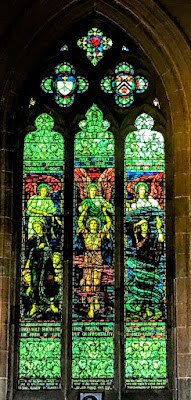
The Adoration of the Magi … a window in Saint Mary’s Church, Tipperary Town (Photograph: Patrick Comerford, 2019)

Liturgical Colour: White (or Gold)

The Penitential Kyries:

God be merciful to us and bless us,
and make his face to shine on us.

Lord, have mercy.
Lord, have mercy.

May your ways be known on earth,
your saving power to all nations.

Christ, have mercy.
Christ, have mercy.

You, Lord, have made known your salvation,
and reveal your justice in the sight of the nations.

Lord, have mercy.
Lord, have mercy.

The Collect:

O God,
who by the leading of a star
manifested your only Son to the peoples of the earth:
Mercifully grant that we, who know you now by faith,
may at last behold your glory face to face;
through Jesus Christ our Lord.

Introduction to the Peace:

Our Saviour Christ is the Prince of Peace.
Of the increase of his government and of peace
there shall be no end. (cf Isaiah 9: 6, 7)

Preface:

For Jesus Christ our Lord
who in human likeness revealed your glory,
to bring us out of darkness
into the splendour of his light:

The Post-Communion Prayer:

Lord God,
the bright splendour whom the nations seek:
May we, who with the wise men
have been drawn by your light,
discern the glory of your presence in your incarnate Son;
who suffered, died, and was buried,
and who is alive and reigns with you and the Holy Spirit,
now and for ever.

The Blessing:

Christ the Son be manifest to you,
that your lives may be a light to the world:

The Magi waiting to arrive at the Epiphany … a scene in Saint Brendan’s Church, Kilnaughtin (Tarbert), Co Kerry (Photograph: Patrick Comerford, 2020)

Hymns:

202, What child is this, who laid to rest (CD 13)
201, We three kings of Orient are (CD 13)

Scripture quotations are from the New Revised Standard Version Bible: Anglicised Edition copyright © 1989, 1995, National Council of the Churches of Christ in the United States of America. Used by permission. All rights reserved worldwide. http://nrsvbibles.org

Material from the Book of Common Prayer is copyright © 2004, Representative Body of the Church of Ireland.


06 January 2020

‘A cold coming we had of it,
Just the worst time of the year’

‘A cold coming we had of it’ … the visit of the Magi in a fresco in the sixth century Basilica of Sant’Apollinare Nuovo in Ravenna (Photograph: Patrick Comerford)

Patrick Comerford

Monday 6 January 2020

The Epiphany

11 a.m.:
The Epiphany Eucharist

Saint Mary’s Church, Askeaton, Co Limerick

Readings: Isaiah 60: 1-6; Psalm 72: 1-7, 10-14; Ephesians 3: 1-12; Matthew 2: 1-12.

May I speak to you in the name of God, + Father, Son and Holy Spirit, Amen:

The Twelfth Day of Christmas is the day, traditionally, that the Christmas decorations come down. For many, Epiphany is the ‘Twelfth Night,’ ‘Little Christmas’ or Nollaig na mBan or ‘Women’s Christmas.’

There are three principle Epiphany themes in the Gospels:

● The Adoration of the Magi (this year’s Gospel reading on the Feast of the Epiphany, 6 January 2020, Matthew 2: 1-12)

● The Baptism of Christ by Saint the Baptist in the River Jordan (Epiphany 1, next Sunday’s reading, 12 January 2020, Matthew 3: 13-17)

● the Wedding Feast in Cana (John 2: 1-11), which we read about in this season last year (Epiphany II, 20 January 2019).

But, while we are moving from Christmas to Epiphany, which ends at the Feast of the Presentation on Candlemas on 2 February, the Epiphany season is truly a continuation of the Christmas season, the liturgical colour remains white, and together Christmas and Epiphany form one full, continuous season of 40 days.

The visit of the Magi is a symbolic presentation of God’s revelation in Christ to the Gentiles. This visit is a popular image for Christmas cards, but very often we have taken down the Christmas cards by the Feast of the Epiphany, and so we are left without a visual reminder of what they represent.

Many years, ago, instead of preaching on this morning’s story in Saint Matthew’s Gospel, I read TS Eliot’s poem, ‘The Journey of the Magi.’

TS Eliot was the greatest Anglican poet of the 20th century. In this poem, he links Christmas, Epiphany and the Easter story, links beginnings and ends, ends and beginnings, and so makes sense and meaning of the Christmas story at the beginning of this New Year.

Eliot wrote this poem after his conversion to Christianity and his confirmation in the Church of England in 1927, but it was not published until 1930 in his Ariel Poems.

In some ways, this poem recalls ‘Dover Beach’ by Matthew Arnold (1822-1888), but also shows some influences of an earlier poet by WB Yeats, ‘The Magi.’

However, unlike that poem by Yeats, Eliot’s poem is a truly Anglican poem, for the first five lines are based on the 1622 ‘Nativity Sermon’ of Lancelot Andrewes (1555-1626), Bishop of Winchester.

Eliot’s poem recalls the journey of the Magi to Bethlehem from the point of view of one of the Wise Men. He chooses an elderly speaker who is world-weary, reflective and sad. This narrator is a witness to momentous historical change who seeks to rise above that historical moment, a man who, despite material wealth and prestige, has lost his spiritual bearings. The speaker is agitated, his revelations are accidental and born out of his emotional distress, and he speaks to us, the readers, directly.

Instead of celebrating the wonders of the journey, the wise man recalls a journey that was painful and tedious. He remembers how a tempting, distracting voice was constantly whispering in their ears on that journey that ‘this was all folly.’

The poem picks up Eliot’s persistent theme of alienation and a feeling of powerlessness in a world that has changed.

Instead of celebrating the wonders of his journey, the surviving magus complains about a journey that was painful, tedious, and seemingly pointless. He says that a voice was always whispering in their ears as they went that ‘this was all folly.’ The magus may have been unimpressed by the new-born infant, but he realises that the incarnation changes everything, and he asks:

... were we led all that way for
Birth or Death?


The birth of Christ was the death of the old religions. Now in his old age, he realises that with this birth his world had died, and he has little left to do but to wait for his own death.

On their journey, the Magi see ‘three trees against a low sky’ – a vision of the future Crucifixion on Calvary. The Incarnation points to the Cross. Without Good Friday and Easter Day, Christmas has no significance for us at all. The birth of Christ leads to the death of old superstitions and old orders.

The ‘running stream’ may refer to the Baptism of Christ by John the Baptist in the River Jordan, which is also an Epiphany moment.

The ‘six hands at an open door dicing for pieces of silver’ recall both the betrayal of Christ by Judas for 30 pieces of silver, and the dice thrown for Christ’s garment at the foot of the cross.

The empty wineskins recall the miracle at the Wedding in Cana, another Epiphany theme.

The early morning descent into a ‘temperate valley’ evokes three significant Christian events: the nativity and the dawning of a new era; the empty tomb of Easter; and the Second Coming and the return of Christ from the East, dispelling darkness as the Sun of Righteousness.

In his old age, as he recalls these events, has the now-elderly Wise Man little left to do apart from waiting for his own death?

He is a witness of historical change, but does he manage to rise above his historical moment?

With his material wealth and prestige, has he lost his spiritual bearings?

Or has he had spiritual insights before his time?

The Journey of the Magi – TS Eliot

A cold coming we had of it,
Just the worst time of the year
For a journey, and such a long journey:
The ways deep and the weather sharp,
The very dead of winter.
And the camels galled, sore-footed, refractory,
Lying down in the melting snow.
There were times when we regretted
The summer palaces on slopes, the terraces,
And the silken girls bringing sherbet.
Then the camel men cursing and grumbling
And running away, and wanting their liquor and women,
And the night-fires going out, and the lack of shelters,
And the cities dirty and the towns unfriendly
And the villages dirty and charging high prices:
A hard time we had of it.
At the end we preferred to travel all night,
Sleeping in snatches,
With the voices singing in our ears, saying
That this was all folly.

Then at dawn we came down to a temperate valley,
Wet, below the snow line, smelling of vegetation;
With a running stream and a water mill beating the darkness,
And three trees on the low sky,
And an old white horse galloped away in the meadow.
Then we came to a tavern with vine-leaves over the lintel,
Six hands at an open door dicing for pieces of silver,
And feet kicking the empty wineskins.
But there was no information, and so we continued
And arrived at evening, not a moment too soon
Finding the place; it was (you may say) satisfactory.

All this was a long time ago, I remember,
And I would do it again, but set down
This set down
This: were we led all that way for
Birth or Death? There was a Birth, certainly,
We had evidence and no doubt. I had seen birth and death,
But had thought they were different; this Birth was
Hard and bitter agony for us, like Death, our death.
We returned to our places, these Kingdoms,
But no longer at ease here, in the old dispensation,
With an alien people clutching their gods.
I should be glad of another death.

And so, may all we think, say and do be to the praise, honour and glory of God, + Father, Son and Holy Spirit, Amen.

The Visit of the Magi seen on a panel on the triptych in the Lady Chapel in Lichfield Cathedral (Photograph: Patrick Comerford)

Matthew 2: 1-12 (NRSVA):

1 In the time of King Herod, after Jesus was born in Bethlehem of Judea, wise men from the East came to Jerusalem, 2 asking, ‘Where is the child who has been born king of the Jews? For we observed his star at its rising, and have come to pay him homage.’ 3 When King Herod heard this, he was frightened, and all Jerusalem with him; 4 and calling together all the chief priests and scribes of the people, he inquired of them where the Messiah was to be born. 5 They told him, ‘In Bethlehem of Judea; for so it has been written by the prophet:

6 “And you, Bethlehem, in the land of Judah,
are by no means least among the rulers of Judah;
for from you shall come a ruler
who is to shepherd my people Israel.”

7 Then Herod secretly called for the wise men and learned from them the exact time when the star had appeared. 8 Then he sent them to Bethlehem, saying, ‘Go and search diligently for the child; and when you have found him, bring me word so that I may also go and pay him homage.’ 9 When they had heard the king, they set out; and there, ahead of them, went the star that they had seen at its rising, until it stopped over the place where the child was. 10 When they saw that the star had stopped, they were overwhelmed with joy. 11 On entering the house, they saw the child with Mary his mother; and they knelt down and paid him homage. Then, opening their treasure-chests, they offered him gifts of gold, frankincense, and myrrh. 12 And having been warned in a dream not to return to Herod, they left for their own country by another road.

The Adoration of the Magi … a stained glass window in Saint Mary’s Church, Tipperary (Photograph: Patrick Comerford, 2019)

Liturgical Colour: White (or Gold)

The Penitential Kyries:

God be merciful to us and bless us,
and make his face to shine on us.

Lord, have mercy.
Lord, have mercy.

May your ways be known on earth,
your saving power to all nations.

Christ, have mercy.
Christ, have mercy.

You, Lord, have made known your salvation,
and reveal your justice in the sight of the nations.

Lord, have mercy.
Lord, have mercy.

The Collect:

O God,
who by the leading of a star
manifested your only Son to the peoples of the earth:
Mercifully grant that we, who know you now by faith,
may at last behold your glory face to face;
through Jesus Christ our Lord.

Introduction to the Peace:

Our Saviour Christ is the Prince of Peace.
Of the increase of his government and of peace
there shall be no end. (cf Isaiah 9: 6, 7)

Preface:

For Jesus Christ our Lord
who in human likeness revealed your glory,
to bring us out of darkness
into the splendour of his light:

The Post-Communion Prayer:

Lord God,
the bright splendour whom the nations seek:
May we, who with the wise men
have been drawn by your light,
discern the glory of your presence in your incarnate Son;
who suffered, died, and was buried,
and who is alive and reigns with you and the Holy Spirit,
now and for ever.

The Blessing:

Christ the Son be manifest to you,
that your lives may be a light to the world:

Hymns:

202, What child is this, who laid to rest (CD 13)
201, We three kings of Orient are (CD 13)
189, As with gladness men of old (CD 12)

The Adoration of the Magi, by Mikhail Damaskinos, ca 1585-1591, in the Museum of Christian Art in the Church of Saint Catherine of Sinai in Iraklion (Photograph: Patrick Comerford, 2017)

Scripture quotations are from the New Revised Standard Version Bible: Anglicised Edition copyright © 1989, 1995, National Council of the Churches of Christ in the United States of America. Used by permission. All rights reserved worldwide. http://nrsvbibles.org

Material from the Book of Common Prayer is copyright © 2004, Representative Body of the Church of Ireland.

The Visit of the Magi in the 13th century Church of the Holy Cross or ‘Martyrium’ in Bologna (Photograph: Patrick Comerford)